My Sister Lucie Artist and source of inspiration 1933~2013
1
Roel Van Duijn
in her absence, by her youngest brother
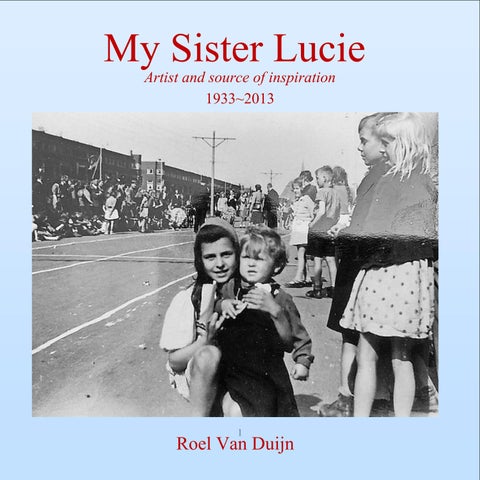
Front cover photo by our father, Gerrit van Duyn: Lucie (12) with braids, and Roeltje (2) awaiting the Canadian victory parade in The Hague, May 19, 1945, on the Laan van Meerdervoort, corner of Abrikozenstraat. Back cover photo: Lucie, in a painting made by our oldest sister Dinie, from a photo in which Lucie is standing at a train station in France. Lucie lived there from 1977 to 1987. rvd © Roel van Duijn, roelvduijn@planet.nl Editing by Eckart Dissen Einstein Publishers, ISSUU Einstein.Publishers@gmail.com ISBN FOR THE Dutch version: 9789072845054 English translation by Pamela Docters.
2
My Sister Lucie Artist and source of inspiration 1933~2013
Roel van Duijn
With a contribution by Ella Arps 3
Portrait of Lucie van Duyn, by Paul Citroen
4
Table of Contents 1. My Sister Lucie, Roel van Duijn
p. 7
2. The Work of Lucie, Ella Arps
p. 33
3. A Selection of Lucie’s Work
p. 43
5
Lucie at school, 1943
6
MY SISTER LUCIE Today it's been years since she's been gone, but her face lives in me and I see it again in the head of the Buddha statue next to my computer which I inherited from her. Impatiently I jump from my chair and surprise myself by calling out her name. My dark-haired sister Lucie was born less than a week before Hitler's rise to power, in the fateful year 1933. When she was a big girl, on May 19, 1945, she and I stood together waiting for the Canadians, singing on the sidewalk in front of our house on the Laan van Meerdervoort, between a crowd of children and flags. It is my own memory, not one which was told to me. A memory of The Hague, I keep it in the safe under my skull. I must have been two years old, and her long braids trailed past my fat cheeks. A soldier jumped off his tank to lift my big sister onto it! Admiringly I looked at them on the weapon rolling away. In the afternoon she came into the garden to tell us how the people had cheered them on everywhere, everywhere along the way. And sung and sung! “Prince Bernhard was also there, Pappa!” She paused and looked up at the uniformed hero on the wicker chair in front of the roses, a real Canadian. My father spoke English with him, my mother gave him water, and I got something unforgettable. A piece of chocolate.
BEZUIDENHOUT BOMBARDMENT During the Hunger Winter she stole potatoes for me from the communal gardens on the Schenkkade. Only a few months before this liberation day. She made clothes out of old curtains, did the household duties while Mamma lay in bed with a severe nail wound in her foot. We were hungry.
7
My sister, Lucie, my brother, Peter, and me in the summer of the war year 1944 at the Wassenaar Zoo on a real lion!
But she went with Pappa and the baby carriage to look for coal and pieces of wood between the tram rails to warm up the tulip bulb soup. She pushed me in the baby carriage. One night she heard a commotion in our parents' darkened bedroom, she told me. Mom had had a miscarriage. “Or was it his diphtheria?” I asked. “Because they always had to change the bed for that.” That was when we were walking to the fiftieth anniversary of the bombing of Bezuidenhout. We’re sitting under the stairs. Lucie is screaming. Mamma has me on her lap and says: “Nice, isn't it, Roeltje? Look, there flies the front door! Look, the ceiling is a cloud!” Why is Lucie crying? “Boom, boom, boom, Roeltje! Look how nicely the window glass is jumping! Like stars!” Lucie and I were together under the stairs. She filled in the memory for me when she was living in her studio after her divorce, near the Hollands Spoor. Her decrepit 8
house. “Pappa, who called from his office: 'Dien, Luus, Roeltje, are you still there?’ He sat under a shower of fallen limestone.” March 8, 1945. We fled the burning borough through the flames. Lucie holding Mamma’s hand, me in the arms of Pappa. To Uncle Huug and Aunt Cato. And later, walking from the Laan van Nieuw Oost-Indië to the hoped-for new address at the Laan van Meerdervoort. Lucie pushed my baby carriage, the plaster statue of Goethe firmly next to me. In the new home, Pappa yanked the portrait of Hitler from the wall and placed Goethe’s portrait in front instead. I later heard that there were 500 people killed and countless injured in the bombardment. The English pilots, who were targeting the bases of the monstrous rockets that the Germans shot from The Hague to London, were mistaken. Churchill apologized but we never blamed our liberators.
LACE BLOUSE She briefly went to the school in Zonnebloemstraat and then to the Dalton. The Dalton HBS, by bike to the Aronskelkweg. For a while she cycled together with her friend Thijs, but after Thijs said that Mrs. Blavatsky, the mother of Theosophy, was mad, she was no longer allowed to associate with him, and Mamma brought her to school. Next to each other on the bike, so Thijs couldn’t secretly ride along next to her. Along the quiet, wide avenue. Now and then a car. Towards Meer en Bosch, where Pappa conjured up for us that a crocodile was swimming in the pond. We got a new sister, the third. Do you remember being allowed on a tank, I asked Lucie. She sniffed with pleasure remembering it. That you sat by the cannon cheering with your arms up? She was eighteen now, a very big, beautiful girl. That conversation was in the following address, in the garden, with even more roses at the fence, on the Laan van Eik en Duinen. The NSB [National Socialist] man whose empty house we had crawled into had gotten us out and we moved. 1950. 9
Lucie attended the drawing academy. In the morning, before she takes her bike, she asks my father for money for drawing paper. He fishes something out of his wallet, I watch this routine at the start of the day with awe. Before I walk to school myself, wondering along the way what she was going to draw. It was often fashion drawings, she did fashion. She sewed dresses which she designed herself, green with yellow, she wore them sleeveless. I once sat on her bike, as it stood in the hallway. Since it had hand brakes, I circled the pedals backwards and so I rode to the Prinsessegracht, to the drawing academy, I imagined. It was with that bike that Lucie stood in front of the door after school talking to a tall man who had brought her home from school. Their heads close together. Then my father came out to motion her in. “Luus, what are you doing, standing there so long talking to this man?” It was Johan, the painter, her new friend. On the wall of our living room, above the coal stove, hung the portrait of a blindfolded girl with a white lace blouse. It was a self-portrait that Lucie had made at school. And I knew exactly what it was about because I remembered the tears that were hidden behind this linocut. It had played out a few years ago in the old house on the Laan van Meerdervoort. One day Lucie came home laughing with Mamma, they had been in town. She took off her coat and a white lace blouse shone beneath her black hair, like sea salt on a sparkling beach. She had chosen it herself. Pappa liked it, too, and we were all proud, but what happened? Thijs came. And sat down with Lucie on the long armchair, in the middle of the room, and pulled her onto his lap. It was spring, the sun was shining through the large doors in the room. My brother Peter played a Chopin polonaise on the new black piano, but the next day I saw her sobbing. Thijs did not want the blouse. He didn't want her to wear the blouse. He thought it was ugly!
10
Mamma tried to console her, but her crying howled louder and louder. Thijs didn’t want the blouse? I didn’t understand it, but my sister was inconsolable, and I suffered with her. I felt it was so bad for her, so incomprehensible of Thijs. Had she not been cheerful when our big brother Bob came home after the war from his hiding place at Aunt Mary’s in Epe? Had she not then danced on the stone walk with joy? And hadn't she danced beautifully in the ballet performance by Theosophy in Pulchri Studio, where my brother and I sat breathlessly in the audience? Wasn't she a fantastic girl, what right did he have to forbid her the blouse? The first girl in which I fell in love with also had long, black braids like Lucie. I was five and no one knew it.
Lucie, Norwalk, Connecticut, at our brother, Bob’s, around 1980.
11
When Lucie completed the drawing academy, she married Johan. There is a picture that they got married in the Javastraat, when the town hall before the previous one was still there. I see my father in the picture, but was I there? Lucie was still young, and they moved into a newly built building in the morning red Morgenstond [borough]. On the floor lay something completely new: linoleum. We came to visit them, and my father praised the work of Johan and no less than that of his Lucie. They were paintings, drawings, sketches they had made during day-long wanderings in the Veluwe. All alone, not a human in sight, Pap. We got lost and then we made our most beautiful things. How did the bombing affect the rest of Lucie’s life? Could she stay as she now was?
THE DEATH OF OUR FATHER We, Pappa’s wife and children, were quivering. Below, his wonderful accountant’s office furnished like a museum with the Balinese dragon heads and shelves full of his collection of magical krisses [Indonesian daggers]. In the mahogany case under the brass Buddha statue. Upstairs he lay dying. Did we talk about the illness he had? No. It was too terrible, and nobody thought about euthanasia in 1962. He got an eerie death mask, his arms and legs emaciated, and his stomach bloated. As a ghost, he walked down the hall to the bathroom when he still could do that. “Let’s call Lucie”, I said to my mother, with knees trembling. My younger sister, Candeetje, also thought this was a good idea. Lucie would know what to do. I was nineteen, not too old to be afraid of the man with the scythe. Luus came and had on shiny black leather pants. I'd never seen anything like this, but now I know that she wore them at parties of The Hague Art Circle. She was an artist, she had become what Pappa meant to her to be. When she asked him what to draw, as she had as a child, his answer was: “Draw what you see out the window.” That set her pencils in motion.
12
My big sister walked to his bed, but he didn't move his lips and his eyes didn’t see. The drawing she had made according to his instructions was still on the white-veined, dark gray bedside table next to the marital bed. The sketch depicted what he envisioned in his delirious pain, half numbed by the opium. His hand with spread fingers between a high flame. A few days before, he had still been able to convey the image. Lucie alternated with Mamma watching by his bed and slept with us that night, in the side room next to the sick room. Everything was safe again. No dragon would breathe fire out of his bed now that Lucie was in the house. Lucie was stronger than Mamma, I imagined. She could ride the cannon of a Canadian Sherman tank. And what was I going to do after Lucie had jumped on the liberators' tank? Yes, I stepped back to Pappa. He who was now dying, had then, on the sidewalk along the liberation parade, first shot the photo of his two children to thereafter put Roeltje on his shoulders. And so we cheered together for the wide rows of the marching Scottish bagpipers. The Colonel Bogey March! The high whistles still make my mouth water and long for corned beef, dropped fresh in those delicious cans from the English planes, the same ones that had first dropped bombs on us.
AIRPLANES After the death of my father, I was still living with my mother and sister, Candee. I could now take my final exams at Lucie’s school, the Dalton, which was now also a high school. Lucie came home one day. She had burst into tears in the middle of the Denneweg when a plane flew over. “Mamma, don't you know what happened? I just stood with my hands to the sky! In broad daylight!” Lucie knew herself how it happened. She was reminded of the day the planes had flown over and dropped the bombs on our street. She didn’t ask if I also did that. No, I don't, thanks to the flawless improvisation of Mamma’s, it had been a weird game for me. Well, yeah, when I was in the cinema much later for the film about the 13
bombing of Rotterdam, tears flowed at the first bomb and they didn't stop until the movie was done. I have it too, but for me it's conveniently hidden under a zest for life.
METAMORPHOSIS I heard my mother speak to her earnestly on the phone, in the office in our back room. Something had come up in Lucie that we didn't know about her when she divorced her first husband. Since we liked the modest and justifiably proud painter who taught me carpentry, it hit us hard. It was a mystery. In any case, Lucie was now in her late twenties, living in a studio apartment near the Hollands Spoor, and had a nightly affair with the director of the Vrije Academy, George Lampe. I think this gave her the feeling of freedom which she needed. We thought that because of this she was endangering her bond with her son, my nephew, because he stayed with his father. My parents wanted it to stop but she persevered. Too in love with George, the attracting center of the art world in The Hague, who encouraged her not as a housewife but as an artist and perhaps made promises. Lucie earned money with guided tours of the Costume Museum. A remnant of her fashion education. The first St. Nicholas evening after our father's death, we went to celebrate with her in her decrepit studio. A thick fog settled over the city and halfway there, all passengers had to leave the tram. We reached her house by touch, Mamma, Candeetje, and I with my first girlfriend, with whom I read Homer by a wood-burning stove. Lucie had written funny poems, but we couldn't go back that night. The house was sealed as if with cotton wool. We slept in a row on the floor, newspapers under and over us. Mamma and my two sisters spooning together, but Herma and me beneath a luminous fissure that flashed right through the mist to the sky. It was the first night I slept with a woman. 14
BARONESS My sister moved to another world. After a few years, she had another lover, it was now the chairman of the Art Circle in The Hague, Baron Frans von Voorst tot Voorst. “Oh, Mam, don’t you know how much he inspires me!” I heard her cheer. How then, such an old baldie? I asked myself. He provided that Lucie now lived in a sunny apartment on the Schelpkade, with doors opening onto the garden, and a little later they married. My relationship with him did not run smoothly, he was Advocate General at the Supreme Court, and was notorious for his tirades against conscientious objectors, comparing them to orangutans or other unsound beasts and levied severe punishments against them, just at a time when I was known as an anti-militarist. But we were friendly to each other. He was actually a staunch Catholic. Secret Chamberlain with Hood and Sword from His Holiness the Pope, but to accommodate me he once let it slip that he might very well vote for D66,1 truly. And I observed intently the row of ancestral family portraits that were on display in his and Lucie's house and praised his father, who had bravely defended himself as a commander in the war. Lucie eagerly entered the aristocrat game and allowed herself to be called Baroness. With family dinners of the Van Voorsten in the marital house on the Johannes Bildersstraat in the chic Benoordenhout [neighborhood], she was the radiant hostess, who served with white gloves and silver cutlery. I let loose my whole book of psychology on it, didn't understand it, but accepted it. It was also Lucie. You can't control your sister's life. The white gloves suited her exemplarily.
1
Democrats 66, a social liberal political party.
15
I wasn't there often, but I once saw her son, now a boy, in her study. He now lived with his father in Arnhem, where they moved shortly after the divorce because Johan got a new job as a teacher at the Art Academy. Was her son comfortable with the Baroness and the Baron? I had my doubts. He was doing a chore. But could her relationship with me remain good?
The last photo taken of the whole Van Duyn family, August 1962, in my childhood room on Laan van Eik en Duinen 203 in The Hague. Left, our father (62), in a dressing gown, three months before his death, above him, Bob (35), in the middle, Lucie (29), standing against the wall, Roel (19), below, Mamma (60), right, Peter (27), and below right, Candee (14) and Dinie (38).
16
SCARABEE It makes me happy that my memories now cause a surviving woman to make contact. An unknown friend of Lucie’s comments on Facebook; she asks me how my sister is. She thinks Lucie is still alive, if only it were true. She had worked with Lucie at the theater company Scarabee, in the late 1960s. Batman in Exile was the name of their piece: Lucie made the sets, the friend did the publicity. I don’t let her go. I miss Lucie and this woman, Ella Arps, may not be a substitute, but she can tell me about her firsthand. Something which I don't know: delicious! She says that Lucie was special to her. According to her, she was very sweet, and she admired her. Unlike herself and most colleagues in this group, Lucie did not participate in demonstrations against the war in Vietnam. I would have been surprised if Lucie had, because she lived in her inner world, not on the crude battleground. Lucie showed her concern for me, she told me that my rebellion would land me in jail again. In 1966, I had indeed been in jail for a while. It didn’t bother me at all, but now Lucie's sisterly concern lays her hand on my heart. Now that Ella tells me this, it comes to my mind that Lucie had also held an exhibition of her work of which she had donated the proceeds to me. How sweet! What occurs to me now is that she was in love with Freek Piket at the time. How could she be? Typically the kind of patriarch I fought with playful yet razor-sharp provocations at the time. He was a senator for the conservative CHU, a lawyer, and a man of order and authority. Moreover, an erudite man and a great art collector, who held Lucie and her work high and bought it. “Oh Mamma, that man inspires me so much, you can’t imagine!” A balding, erudite art collector, who reminds me of our father, who had recently passed away. Our father's kriss collection was sold through him, I think for a pittance. But it didn't work out between them; later I heard that he chose a different direction.
17
Thoughts are Living Beings. 6.5 cm, bottom of large panel, probably 1970.
18
GHOSTS The friend soon defied my unbridled curiosity and firmly turned the roles around, she wanted to know who Lucie really was. She sent me a photo of artwork by Lucie that she had just bought. The contours of two figures, showing their innermost creatures, like tadpoles so small. What shall I call them? Ghosts. Jinns. Souls. Gliding beings with halos. I know them from so many paintings and works of art by my sister. Like tiny ballet dancers. How did she think of it? We used to have those spirits earlier in our Theosophical house. Mrs. Blavatsky had taught us that thoughts are living beings. The universe abounds in it. “Solely sunbeams darting through the air”, we sang in my mother’s spiritual Lotus Circle. Energy particles, thoughts, monads, that's what it was about. Even though we didn’t notice that as children. Sunday morning. We children sang of sunbeams darting through the sky like the human thoughts dance through the cosmos. Lucie started painting them, I am now reconstructing. The two figures that the friend bought depict, according to me, Lucie herself and one of her men, who are animated within by the spiritual particles that make up the cosmos. Lucie's cosmos. The friend also sends me a bullet-round painting, Lucie’s Bezielde Cosmos2 and my chest swells when I read in the English caption Artist Lucie van Duyn (1933-2013) sister of Roel van Duijn. Why not vice versa, I brother of the artist Lucie? Friends of hers saw her work concentratedly on this cosmos piece for four months. She meticulously painted the souls in the shapes of females with golden halos. She didn't now paint what she saw out the window, like our father had suggested to her, but what she saw through her inner window. The spiritual pantheon.
2
Animated Cosmos
19
The Animated Cosmos
20
Taken from our Theosophical education. And over all that, the watchword of my mother: "Love is the cement of the universe." Lucie did not remain a Theosophist, she was not a follower of any doctrine other than her own. She lived in herself and there were the sunbeams, the monads, and the living thoughts. When Mamma was in a coma in the hospital after falling down the stairs and after the umpteenth stroke, we children sat at her bedside. Lucie started playing the old songs. "Solely sunbeams..." “Darting through the air,” I replied. And Mamma hiccupped, one sunbeam had reached her right through her darkness. Lucie was okay with death. In 1987, just like in 1962, with the transition of our father, she played the game cheerfully. In those years, I once opened an exhibition of Lucie’s in Pulchri Studio. We spoke beforehand in De Posthoorn, the artist café close to Pulchri, where I used to play hooky. Luus had on the same white nail polish she also had worn in our last family photo. What about her passion for art? I reminded her that long ago, when Thijs had broken up with her again because he was going with another girl, she had thrown herself down the stairs crying. Home, on the Laan van Eik en Duinen. She wouldn't do it now anymore, she replied, it’s better for you to say goodbye before the other does. She once advised me on the telephone to do that, too. “And then you have to leave a note for her, at the end you write: Good luck!"
21
Horse riding lesson on the beach, 1949. Lucie right, with father (second from left) and mother (left).
22
JEWISH She didn't stay with the Baron. Had she wondered if this was it? Presumably, she enjoyed the Baroness game but one day gave preference to her own game. Also via Facebook, a friend of hers told me that my sister had had an affair with a friend of his in the days after her marriage to the Baron. A younger, blond actor. The same way she had started her divorce from her first husband, in her new studio on the Zoutmanstraat. Men as bookmarks to the next chapter. In those days, a friend of hers, Ella the cat painter, was walking on the Lange Voorhout near Pulchri and bumped into Baron Frans, gray in the face, poisoned by the pain of love. He begged her to have dinner with him, but she refused. I hear the story gladly, Lucie had given him something he couldn't get from everyone. Not long after, another metamorphosis. In the Weissenbruchstraat. I met her along with her third husband-to-be, both in fashionable overalls and with the same short haircut as his. “Unisex!”, sparkled Lucie. 1976, she was now 43. A touch of Dolle Mina3 shone on her no longer pitch-black hair. I was also at a new beginning, after I was overthrown as an alderman and had just fallen in love. We were connecting again, I hoped. This third husband was an anguished, very wealthy man. Frits Sanders was a Jewish Holocaust victim, who had inherited a lot from his horribly massacred family. He allowed little contact, only with Lucie. That he was Jewish attracted her, she liked to emphasize the Jewish father of our grandmother. “Pappa”, she said earnestly, “was asked by his client, Barnstijn, the film magnate, to go to Berlin on business in place of him before the war, but on closer inspection, he kept him away from it. ‘They’ll see it right away from your Jewish face’, he warned.” 3
Dolle Mina feminist group, named after Wilhelmina Drucker.
23
When she spoke like that, I always thought of Lucie and the war. She was no longer a Baroness, and she laughed vaguely at her status from then. But she behaved arrogantly, I noticed, towards our brother Peter, who in her eyes had failed. She and Frits traveled the world, the millionaire's wife lived in a country house with a swimming pool in France and also in Switzerland. In Saint-Remy, France and Geneva, Switzerland. I thought that besides his being a Jew and his trauma, his money was also part of the appeal. In that respect, he was a continuation of the upper class which she had chosen. She had stood her ground. As a needy artist in a decrepit workshop, who was not seen enough by the art fools, she had developed a hatred of poverty. With her beauty and her talents, she preferred to fly past the bushes to the castle on the mountain. In the very expensive hotel Des Indes, just behind Pulchri and the center of The Hague bluff, her exhibition was now opened and celebrated afterwards. In Groningen, I milked the cows, organic farmer.
CATERPILLAR AND BUTTERFLY The mental distance hurt me, but I'm not the brother to write a biography with hidden attacks on my sister. I miss her, I see her in her original, young state. That's the real Lucie and her metamorphosis is for me an aberration, war damage, forgivable madness. I cherish her, the form I call the real Lucie. But I have to admit that the metamorphosis is insidious, it took thousands of years for man to understand that the butterfly and the caterpillar are two forms of the same animal. And that the caterpillar according to its program turns into a butterfly. The aristocratic Lucie was already present in the program of the playful, real Lucie of my youth. One and the same person. Yet I’m not trying to paint a rosy picture: I want to know who she really was. Metamorphosis is a dazzling, deceptive drama. If you see the variegated butterfly, then also think of the solid green, but agile caterpillar. Does Lucie end up as the caterpillar she was in her youth or as the butterfly after her emergence? 24
PAUSES She was sixty, she was stopping with men, she declared when she returned from France. She did, however, regularly telephone her first husband, the calm and at the same time energetic painter Johan, father of her son. Was Lucie unhappy in love because none of her three marriages lasted more than ten years and she, after her heartbreak from childhood flame Thijs, usually took the initiative herself for the divorce? She could fall madly in love, a heart on triple time. A new world then opened to her. They were father figures for her, I think, she had also followed our father in his advice to become an artist. She certainly had picked out the men she needed in her various phases. Johan, her ten years older painting teacher at the academy when she wanted to become an artist. The Baron when she wanted to work her way out of poverty and paint carefree. The traveling Holocaust victim when she was fascinated with her possible Jewish ancestry and wanted to get out into the world. She enjoyed the pauses intensively, she used them but also gave them what they thirsted for. Not because she had been unhappy in love, certainly not, but because she lived strongly in herself, she had no need for a new man.
STATENKWARTIER She now lived in the Statenkwartier, in a beautiful apartment with a dune in the garden. On the corner of the Frankenslag, where she was born. Her home was a luxurious ground floor apartment in the Johan van Oldenbarneveltstraat near the Frederik Hendrikstraat, a name that certainly comfortably reminded her of her former lover and patron Frederik Hendrik Piket. And Johan van Oldenbarnevelt reminded her of her first husband, whom she occasionally met. She even once met Thijs on the street, now a well-known surgeon, who was still married with that annoying other girl. For a moment her fire blazed on again in her. But her son and grandsons, she liked to tell me about them.
25
Lucie in her garden in the Statenkwartier (year?)
I stayed with her once, after a lecture in our hometown. In the morning, I was standing in the shower to clean it when she appeared in the bathroom to explain to me which brush to use, with bare breasts. My eyes didn't know what they saw, but I immediately heard my sister of old in her normal tone of instructions about toilet cleaner, as the second mother she had been in the Hunger Winter and afterwards always was. Since the time I couldn't pronounce her name and cried “Uusja” when I called her to pee at night. Uusja, our father called her Lucia. She had a dog and two cats, Soetemannetje and Poppeswaantje, one of them 26
gray with long hair, the other a Siamese. Her friend was the famous Ella, the cat painter. Every day they telephoned about their four-legged friends, art, and men, or the two buddies would go to IKEA together. But over time she painted less. That disturbed us and we became even more apprehensive when once, thinking it was the next day, she walked the dog in the middle of the night, in the pitch dark. Her son Jeroen made sure that she moved to vegetarian retirement home, Felix Ortt, in the Veluwe deciduous forests of Oosterbeek. She was at home in that place because Ortt was not only vegetarian, animal lover like her, but also spiritualist. Felixoord is actually the name of the beautiful place.
27
Farewell in Felixoord. From left to right: Dinie, Lucie, Candee, and Roel. Lucie shows the photo of the entire family van Duijn.
28
My two other sisters and I visited her there, and from my chess tournament in the Bilderberg Hotel, I could walk straight through the undergrowth to her. She shuffled, but we had a clear conversation; she liked it there. She was eighty. One afternoon the three of us rode our wrinkled Lucie, grinning and pointing at the plants, around the estate in a wheelchair. Back in her room, with a Buddha statue from Pappa on the windowsill that was still sitting musing about the office where he once supervised the krisses, her tongue had trouble finding the words. The birds outside the window became “gogeltjes”.4 I showed her our last family photo and pointed to Mamma inquiringly, "Yes, that one, that, that,” she replied, with joyous eyes and a groping, crooked hand. With our jackets on, ready to leave, I escorted her to the dining room. Lucie went to sit at the dining table with her back towards me and said goodbye to me with a hand over her shoulder, certainly turning her face to the potato croquettes. Like Pappa had also done to me the very last time. I guess she had learned from him how to say goodbye for the last time. She dealt with death agilely, she was well versed in it. She didn't say "best wishes". But I knew then it was time and that we loved each other.
CATERPILLAR A few years ago, in 2013, I walked into a white side room, people whispering. There she lay. On a white bed, her face made up, and swathed in an orange, red shroud. Like a caterpillar, flowers around her. Would she emerge and fly away from the flowers like a butterfly? I walked into the auditorium and saw a select group of funeral friends, art experts, and also Luus's first husband, the old rock Johan. I immediately went up to him to shake his hand, his eyes lit up too when he saw me. Her son, who had organized the event, told me that he had checked how remarkably often Lucie had moved in her life. "Thirteen times!" The number impressed me for a moment, but when I sat in my chair, next to our sister Candeetje, I quickly calculated that I had moved at least twenty times. 4
Instead of “vogeltjes”
29
Lucie's son stood behind the lectern and announced that his mother had had two sides. For starters, she was demanding and exhausting. There was that in her later life, so I got curious about the other side, but he didn't really get around to that. It sounded like a punishment for the divorce that his mother had wanted in his early childhood. The funny thing was that while the speaker continued, I admired his courage to do something so unusual and I imagined he was talking about a woman I recognized from afar. The woman from after Lucie's metamorphosis and then also seen by someone who still - I also understood that - had a bone to pick with her. There has never been greater contrast at a cremation. I trumpeted one after the other about how bravely she stole the potatoes for me in the Hunger Winter, how tirelessly she pushed my baby carriage after the bombing on our flight to a dubious house, how original her self-portrait with a lace blouse and blindfold was, how beautifully she carried out the drawing assignment which Pappa requested on his deathbed, how she, with twinkling brown eyes, let the sunbeams frolic with Mamma when she lay in a coma. It poured out and I didn't feel ashamed in front of her son, at that moment also the host, for whatever may be true of his reproaches, my life would have been poorer and paler if Lucie hadn't been my sister. Lucie was someone with two wings.
30
CANNON One more time we were allowed to take one a last look at the controversial deceased. She now resembled one of the angels in her paintings, almost transparent, her robe full of holes, Thijs would have forbidden her because of immodesty, but for me it was familiar and sweet. She blinked her eyes and as soon as she saw me, she jumped up on a tank, jubilantly raised her arms and, before she turned the corner, Lucie waved at me again, straddling the barrel of the cannon. Roel van Duijn, February 2022
Lucie an een exhibition. Lucie aanworking het werkfor voor expositie
31
32
THE WORK OF LUCIE VAN DUYN Ella Arps A chance meeting on Facebook allowed me to ask Roel van Duijn how it is with his sister. I'd been friends with her for a few years and never forgot her. My question came quite late because she had already passed away in 2013. Given the age difference between Lucie and me, her earlier death was actually not so strange. But my question to Roel may not have been as coincidental as it seemed, because he was just starting to write a memorial to his sister, Lucie. I got to read his first memory. This prompted me to dive into my memory and look for clues via the Internet. Her work is very accessible, and her impressive oeuvre has been almost completely sold and is widespread among collectors. Although there is talk of sufficient caliber, a museum exhibition has never been organized. That's why we're missing a biographical overview. I would like to make up for this and call on all collectors to photograph Lucie van Duyn’s work and send it to me. Perhaps we can write a more complete biography. My first acquaintance with Lucie took place in winter 1964, in a small gallery next to café De Posthoorn on Lange Voorhout. Here she proposed an exhibition together with some artists under the title Bewogen Beweging,5 in imitation of the kinetic sculpture of Alexander Calder. In May 1965, I saw her work in a playful exhibition by 6 Hague artists from The Hague Art Circle, Kunst in Bed.6 Lucie's installation made an impression with a finely embroidered folding screen around a thematic bed, on which a throng of dolls are born in a constant stream.
5 6
Moving Movement Art in Bed
33
Celebration
34
GRAPHIC Through family and the Internet, I now find some graphic works (see attachment). Lucie van Duyn uses forms in their purest sense and allows this matter to then go up in smoke, from which a shapeless void, the other side of the visible, appears. She seeks the images contained in man himself but can no longer be disconnected from the countless images that come in through the media, separates them, and places them in a new daylight. She symbolizes becoming; innovation of the sixties. Not serious, not moralizing. It's a smile, a deep warm human smile that follows after the concern about things as they go. It is a poetic reality, in partly geometric forms.
PAINTINGS In her paintings, it is clear that she has taken to heart the technique of the old masters around 1400. The studio has an important function, it is a rite: the painter's stick, the rubbing stone, the palette, the wooden panels. Lucie could work on one oil painting for months with a sliver-thin brush. The substrate is a layer of tempera on a wooden panel. Then custom mixed oil paint applied thinly, layer by layer, until the correct color is achieved. After a few weeks of drying, she topped it off with a hard varnish prepared according to her own recipe. The flat surface was not enough for her. She constructed triptychs with surprising effects. Another foundation of her work is the Golden Ratio. It starts from the ideal distribution of the flat surface. She reached for the perfect display of beauty.
35
Crusader
36
On the panels we see that, repeated, she placed the painted figures in equally divided subjects. This creates a bond with the spectator, whose eyes wander with amazement from one subject to another and composes a personal connection. Thin as tulle, she paints the mists which appear in outer space. The background is composed of geometrical figures, drawn as logically as a piece of music. The many layers of paint are deep black. It is a top achievement to let oil paint become so black and yet let it live. Her work reflects archetypes: judges and convicts, motherhood, the Messiah, the Madonna, the cosmos, falling angels. Joy, lust, despair. She paints women with a halo. Tiny figures gesturing to the viewer and seeming to come from another world, living on the edge of our existence. As if they have something to tell us that we can't understand. Sometimes floating in a bright green grass like the angels of Hieronymus Bosch, a dance around the Maypole. They swarm like moths to the light. To an amigurumi7 head with two nails for eyes, the scepter holds sway. Salt and pepper shakers. That we folded as children. Does he love me, yes, no, yes, no.
THEATER SETS In the years that I knew her, she worked for theater Scarabee, a Dutch stage experiment founded in The Hague in the 1960s as an answer to the prevailing traditional theatrical forms. A new form of expression was sought in various fields of art. This resulted in a series of theater productions that present themselves to the viewer as an unrolling diorama full of tableaus of vivants. Set and costumes coincide with movement and music. Her first contribution was to the production Spiraal (1964), a series of wall reliefs, together with Gerard Coljé. The spectators sit as if in a diorama. One seems thereby complicit in what happens on the stage without being able to do anything about it. It takes on the meaning of metaphysically realistic theatre. 7
The art of crocheting or knitting little dolls or figures.
37
Lucie was able to fit reality above the visible in the sets and deliberately worked towards the absurd. Made something light out of the heavy. Perhaps typical of a traumatized post-war generation that needed a relatable smile. Lucie felt at home with Scarabee's theme. It brings a form of criticism on the consumer society which takes everything that is tasty and easy and the parallel phenomenon of aggression. This continues as a common thread through her early work. She reflects this in the desire for peace and a Zen experience, necessary for her to accomplish the refined technique of her paintings. They are certainly not the least with whom she works: Woody van Amen, Georg Hadeler, Hans Hollenbach, Lucebert, Herman Berserik. The sets that Van Duyn made for the Poppetgom production have been shown many times in various publications. Bodies appear dancing and perform a ceremonial tea ritual, after a ritual execution is performed by a death squadron. The performance is filmed and broadcast on television in 1969 – in color! A television experiment. The stage masks resemble newspapers folded like amigurumi. These otherworldly masks are also found in her paintings. Often they are called God. Sometimes self-portrait. They leave a deep impression on the viewer. Are we looking at the mystery of the gnosis [esoteric knowledge of spiritual truth]? In the Lexicon of Dutch Visual Artists by Pieter Scheen, she is listed as a surrealist artist. I don’t agree. I think we can place her work more among the symbolists. Imagination, fantasy, and intuition are placed centrally. The symbolism is characterized by a strong longing for the past and a focus on the subconscious, the unusual, and the inexplicable.
38
Hundreds of fascinating graphic works can be found in Lucie’s estate. Definitely worth the effort to again exhibit another selection. In 1967, I lost track of Lucie. I'm now wondering: How did she further develop? She remained a member of The Hague Art Circle more than 50 years. Who did she have exhibitions with? Also as a member of Pulchri. She doesn't use many dates on her artworks. Typical Lucie, who didn't live in time so accurately. Was she an initiate? A messenger of the old masters and initiate in the divine mysticism? Was her motivation metaphysical realism? What did she think about that? Was she simply a religious person? In a lot of work, Lucie shows that she does not want to connect herself with Mother Mary: Here the title of a work, "Moeder Gods, de Gesloten Tuin",8 testifies to that. She is much more explicit in "Verschijningsvormen van de Almacht".9 In the years I knew her, around 1963, she had elaborated “Verschijningen van Maria Magdalena”10 in a powerful linocut. Much work from that time is reminiscent of the symbolism of Charley Toorop. Can she also not connect with Maria Magdalene? Is she familiar with the axiom on the Emerald Table of Hermes Trismegistus, the ancient prophet who revealed secret knowledge to man, and is the central figure in Hermeticism: “As above, so (also) below”, referring to the equality of heaven and earth, of the microcosm and the macrocosm. This “hermetic axiom by Lucie” is literally captured on a wooden table that she had painted for the salon, furnished by her husband Baron Van Voorst to Voorst. A secret joke?
8
Mother of God’s Closed Garden Appearances of the Almighty 10 Apparitions of Mary Magdalene 9
39
The Emerald Table, details.
40
.
The Emerald Table
41
Did she conform to the prevailing standards and intend the following: the need for authority is not an expression of herd mentality but an instinct. “I, Lucie van Duyn, appear to adapt. In silence. Then I can do my work. In that, I am free. Between heaven and earth. Watch!”
Ella Arps February 2022
Literature research in own archive Painting material and its use in Paintings; Max Doerner – 1890 Lucebert – the perfect crime – little radio voices game 1955, printed 1968 Haagse Courant, R.E. Penning May 1965 Bres Planète Nr 8 June 1967 – Artists of our Time – E.C. Arps Study trip to Helene Weigel, East Berlin, at the widow of Bertolt Brecht 1967 – E.C Arps Poppetgom, publisher Octopus, Deventer, editors Frits Becht, Paul Brand, Wim Crouwel, Hein van Haaren, Joop Hardy, Fred Paréé, book design Willem van Toorn Annual Report Council for the Arts 1968, the illustrations are from Scarabee, incl. Van Duyn Scarabee 1965-1983 The Message of the Image – publisher Haagse Kunstkring Studio Scarabee, 7 projecten H. van Haaren (editor) The Hague 1975 NRC handelsblad interview with Adri Boon R. Engelander, 26 August Work trip to Laterna Magica, Prague, encounter with Vaclav Havel – E.C. Arps Director of Netherlands Institute for Amateur Theater, Feb. 1986. Poppetgom all texts and music. Jan van Bakel.nl Poppetgom film version, site Literature Museum Johan de Haas, artist 88, Summer 2012, interview for magazine STMG.nl The Hague Art Circle, see the site.
42
A SELECTION FROM THE ART WORKS OF LUCIE VAN DUYN
1. Graphic Works 2. Theater work Scarabee 3. Paintings 4. Miniatures 5. Triptychs
43
1. Graphic Works
He has Truly Risen
44
Empty Shell
45
Apparition of Mary Magdalene
46
Mother with Party Hat
47
Self-portrait with Flower
48
Self-portrait and Apparitions
49
Withourt Title
50
Summer Girl
51
View of a Cosmic Representation
52
Appearances of the Almighty
53
Crown Princess
54
Holy Cat
55
2. Theater work Scarabee
Set design Tea Garden, with costumes and studies for Poppetgom (ill. from books)
56
Falling Angels, set design and drawings
57
3.Paintings
Saints in Debate
58
Mother of God’s Closed Garden
59
Landscape
60
Mystery with Crystal Characters
61
Seraphim
62
Cryistals surrounded by Angels
63
Ladies Young and Old
64
Cherubins
65
4. Miniatures
66 From left to right: Angel with Three Arms, Madonna with Four Hands, Jeroen, and Saint of Nature
From left to right: Red Ladies, Ladies Young and Old, Shout to the Gods, and The Almighty
67
The Green Box
1.
Wooden Box with Miniatures on Panel
68
In the Year of the Lord
69
5. Triptychs
Judge’s House
70
Lawyers and Mermaids
71
Self-portrait in Landscape, closed triptych
72
Self-portrait in Landscape, open triptych
73
Clouds, Self-portrait in closed triptych, unfinished
74
Self-portrait
75
Overview of selected recorded works by Lucie van Duyn 1. Graphic works p. 18 Thoughts are Living Creatures, oil, lacquer on mahogany, 2 cm thick, 6.5 cm, part of large panel, 1970 p. 20 The Animated Cosmos, oil, lacquer on panel, 100 cm diameter, 1970 p. 34 Festivity, linocut, 50 x 64.5 cm, 1963/65 p. 36 Knight of the Cross, gold leaf, mixed media, 24 x 30 cm. p. 41 Emerald Table, oil, lacquer on panel, 110 cm diameter. p. 44 Behold He is Risen Verily, linocut, 60 x 30 cm, 1962 p. 45 Empty Shell, linocut, 11 x 13 cm,1962 p. 46 Apparition of Mary Magdalene, linocut, 30 x 30 cm, 1963 p. 47 Mother with Party Hat, linocut, 50 x 50 cm, 1971/72 p. 48 Self-portrait with Flower, linocut, 40 x 60 cm. p. 49 Self-portrait and Apparitions, linocut, 60 x 40 cm, 1967 p. 50 Untitled, mixed media with pen, 24 x 30 cm, 1964. Collection Museum de Fundatie. p. 51 Summer Girl, lithograph, 40 x 60 cm, 1965 p. 52 View of a Cosmic Representation, linocut, 20 x 20 cm. Recorded in 12 Linocuts, HKK. Edition of 600, 1960 p. 53 Appearances of the Almighty, linocut, 50 x 50 cm, 1969 p. 54 Crown Princess, linocut, 40 x 60 cm, 1965 p. 55 Holy Cat, linocut, 40 x 60 cm, 1965 2. Theater Scarabee p. 56 Tea Garden scenery with costumes, model/photo tryout, 1963. Show Poppetgom. p. 57 Falling Angels, scenery detail, drawings, 1968. Annual Report Council for the Arts. 3. Paintings p. 58 Saints in Debate, oil, gold leaf, lacquer on panel. 40 x 30 cm, 1970 p. 59 Mother of God’s Closed Garden, gold leaf, oil, lacquer on panel. 60 x 80 cm p. 60 Landscape, gold leaf on panel, 24 x 38 cm, 1970. Frame in two shades of blue. p. 61 Mystery with Crystal Characters, gold, gold leaf and lacquer, 39 x 41 cm, 1995 p. 62 Seraphim, lacquer on panel, 90 cm diameter p. 63 Crystals Surrounded by Angels, lacquer on panel, 90 cm diameter p. 64 Women Young and Old, mixed media, 55 x 55 cm, 1980. Frame is painted. p. 65 Cherubins, mixed media, 44 x 21 cm, 1997. Baking frame 20 cm. (p.77)
76
4. Miniatures p. 66 Angel with Three Arms, lacquer on wood, 8 x 11 cm, 1995 Madonna with Four Hands, lacquer on wood, 8.5 x 8.5 cm, 1975 Jeroen, lacquer on wood, 7.5 x 11 cm, 1970 Saint of Nature, lacquer on wood, 9 x 11 cm, 1995 p. 67 Red Ladies, lacquer on wood, 9 x 12 cm, 1980 Ladies Young and Old, lacquer on wood, 8 x 12 cm, 1980 Shouting to the Gods, lacquer on wood, 11.5 x 10 cm, 1973 The Almighty, lacquer on wood, 5 x 7 cm, 1975 p. 68 Wooden box with Miniatures, lacquer on wood, 10 x 13 x 11 cm, 1973-74 p. 69 In the Year of the Lord, lacquer on wood, 10 x 13 cm, 1973 5. Triptychs p. 70 House of Judges triptych, lacquer on wood, 16 x 11 cm, 1974 p. 71 Lawyers and Mermaids triptych, lacquer on wood, 16 x 11 cm, 1974 p. 72 Self-portrait in Landscape, closed triptych, lacquer on wood, 51 x 25 cm, 1972 p. 73 Self-portrait in Landscape, open triptych, lacquer on wood, 51 x 25 cm, 1972 p. 74 Clouds, Self-portrait closed triptych, unfinished, 51 x 25 cm, 1995 p. 75 Self-portrait, lacquer on wood, 51 x 25 cm, 1995 Lucie van Duyn's works are included in various private collections and collections of the Municipal Museum of Amsterdam, the Municipality of Gouda, the Zwolle Museum de Fundatie, and Art Dealership Delta98, in The Hague. Graphic works were included in the annual calendars of The Hague Art Circle in 1966, 1969, 1971, and 1973.
Acknowledgments This publication was made possible thanks to the cooperation and photography of the owners of the works by Lucie van Duyn:Candee van Duyn, Marx Warmerdam and Jaap Eerland, Ella Arps, Jeroen de Haas, Ella van Schaik, Rikst and Peter Jansen, and the author. Thanks for the photography to Robbert van de Weetering. Art Dealership Delta98, The Hague. Our thanks also go to Sacha Gaus and Max de la Croix for their corrections and to Pamela Docters for the English translation. To Ella Arps for her great contribution. It was a pleasure working with you to finally bring the full and well-deserved attention to Lucie’s life and wonderful works, so that it will find its way in the world. Roel van Duijn (author), Eckart Dissen (publisher).
77
The issue in Dutch of My Sister Lucie has been published in an edition of fifty numbered copies. All signed by the author.
78
Roel van Duijn (1/20/1943) is an author, former politician, farmer, heartbreakconsultant, and historian. Besides numerous articles for newspapers and on Facebook, he has authored about thirty books. Published by him in the last ten years: Freezer Figure (autobiography); Digging for the Krauts (about his father's war diary, himself, and his childhood as a war child. Both these books are at the publishing house Van Praag); Treason (published by Aspekt);and A Son for the Führer, the Nazi Utopia of Julia op ten Noort (Boom publisher). The last three are about war, resistance, and fascism. Most recently is The Real Conspiracy, the truth behind the delusions (published by Aspekt). His wish for the readers of My Sister Lucie is that you see her alive in front of you and let her inspire you. Amsterdam – Fulda, summer 2022. 79
80