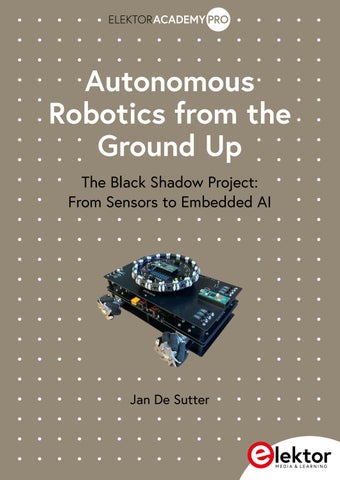
Autonomous Robotics from the Ground Up The Black Shadow Project: From Sensors to Embedded AI
Jan De Sutter
Autonomous Robotics from the Ground Up
The Black Shadow Project: From Sensors to Embedded AI
● Jan De Sutter
● This is an Elektor Publication. Elektor is the media brand of Elektor International Media B.V.
PO Box 11, NL-6114-ZG Susteren, The Netherlands Phone: +31 46 4389444
● All rights reserved. No part of this book may be reproduced in any material form, including photocopying, or
storing in any medium by electronic means and whether or not transiently or incidentally to some other use of this publication, without the written permission of the copyright holder except in accordance with the provisions of the Copyright Designs and Patents Act 1988 or under the terms of a licence issued by the Copyright Licencing Agency Ltd., 90 Tottenham Court Road, London, England W1P 9HE. Applications for the copyright holder's permission to reproduce any part of the publication should be addressed to the publishers.
● Declaration
The author and publisher have used their best efforts in ensuring the correctness of the information contained in this book. They do not assume, or hereby disclaim, any liability to any party for any loss or damage caused by errors or omissions in this book, whether such errors or omissions result from negligence, accident or any other cause.
● British Library Cataloguing in Publication Data
A catalogue record for this book is available from the British Library
● I SBN 978-3-89576-780-7 Print
ISBN 978-3-89576-781-4 eBook
● © Copyright 2026 Elektor International Media www.elektor.com
Editor: Clemens Valens Prepress Production: D-Vision, Julian van den Berg Printers: Ipskamp, Enschede, The Netherlands
Elektor is the world's leading source of essential technical information and electronics products for pro engineers, electronics designers, and the companies seeking to engage them. Each day, our international team develops and delivers high-quality content - via a variety of media channels (including magazines, video, digital media, and social media) in several languages - relating to electronics design and DIY electronics. www.elektormagazine.com
●4
Contents
Contents Part I – Foundations of Robotics . . . . . . . . . . . . . . . . . . . . . . . . . . . . . . . . . . . . . . . 10 Chapter 1 • Introduction: From Principles to Practice . . . . . . . . . . . . . . . . . . . . . . 11 Anatomy of a Robot . . . . . . . . . . . . . . . . . . . . . . . . . . . . . . . . . . . . . . . . . . . . . . . 11 Telling Robots Apart . . . . . . . . . . . . . . . . . . . . . . . . . . . . . . . . . . . . . . . . . . . . . . . 12 How a Robot Is Built . . . . . . . . . . . . . . . . . . . . . . . . . . . . . . . . . . . . . . . . . . . . . . . 13 Keeping Time . . . . . . . . . . . . . . . . . . . . . . . . . . . . . . . . . . . . . . . . . . . . . . . . . . . . 14 Climbing the Autonomy Ladder . . . . . . . . . . . . . . . . . . . . . . . . . . . . . . . . . . . . . . . 15 Where Machine Learning Fits In . . . . . . . . . . . . . . . . . . . . . . . . . . . . . . . . . . . . . . . 16 What's Ahead . . . . . . . . . . . . . . . . . . . . . . . . . . . . . . . . . . . . . . . . . . . . . . . . . . . 17 Review Questions . . . . . . . . . . . . . . . . . . . . . . . . . . . . . . . . . . . . . . . . . . . . . . . . . 18 Part II – Core Functions of the Black Shadow . . . . . . . . . . . . . . . . . . . . . . . . . . . . 19 Chapter 2 • System Architecture . . . . . . . . . . . . . . . . . . . . . . . . . . . . . . . . . . . . . . . 20 Peripherals vs. Cores: The Real-Time Allocation Problem . . . . . . . . . . . . . . . . . . . . . . 20 Distributed Computing Architecture . . . . . . . . . . . . . . . . . . . . . . . . . . . . . . . . . . . . 22 Communication . . . . . . . . . . . . . . . . . . . . . . . . . . . . . . . . . . . . . . . . . . . . . . . . . . 23 The Architectural Foundation: ARM, RISC, and CISC . . . . . . . . . . . . . . . . . . . . . . . . . 25 Core Processing Hardware: The Raspberry Pi Pico 2W . . . . . . . . . . . . . . . . . . . . . . . . 26 Raspberry Pi Pico 2W Compared to Competitors . . . . . . . . . . . . . . . . . . . . . . . . . . . . 30 Software Architecture: Division of Responsibilities . . . . . . . . . . . . . . . . . . . . . . . . . . 31 Dual-core Operation . . . . . . . . . . . . . . . . . . . . . . . . . . . . . . . . . . . . . . . . . . . . . . . 32 Multitasking . . . . . . . . . . . . . . . . . . . . . . . . . . . . . . . . . . . . . . . . . . . . . . . . . . . . . 33 Understanding System Performance and Scalability . . . . . . . . . . . . . . . . . . . . . . . . . 35 Optimising for the RP2350 Hardware FPU . . . . . . . . . . . . . . . . . . . . . . . . . . . . . . . . 37 Wrapping Up . . . . . . . . . . . . . . . . . . . . . . . . . . . . . . . . . . . . . . . . . . . . . . . . . . . . 38 Review Questions . . . . . . . . . . . . . . . . . . . . . . . . . . . . . . . . . . . . . . . . . . . . . . . . . 39 Chapter 3 • P erception: Sensors and Environmental Awareness . . . . . . . . . . . . . . 40 Inertial Measurement Unit . . . . . . . . . . . . . . . . . . . . . . . . . . . . . . . . . . . . . . . . . . . 41 Navigation Systems and Relative Orientation . . . . . . . . . . . . . . . . . . . . . . . . . . . . . . 49 Inertial Collision Detection and Impact Dynamics . . . . . . . . . . . . . . . . . . . . . . . . . . . 51 LiDAR . . . . . . . . . . . . . . . . . . . . . . . . . . . . . . . . . . . . . . . . . . . . . . . . . . . . . . . . 54
●5
Autonomous Robotics from the Ground Up
High-Speed Circular LiDAR Array Management . . . . . . . . . . . . . . . . . . . . . . . . . . . . . 55 Motor Encoders . . . . . . . . . . . . . . . . . . . . . . . . . . . . . . . . . . . . . . . . . . . . . . . . . . 72 Motor Fault Control . . . . . . . . . . . . . . . . . . . . . . . . . . . . . . . . . . . . . . . . . . . . . . . . 79 Power Monitoring . . . . . . . . . . . . . . . . . . . . . . . . . . . . . . . . . . . . . . . . . . . . . . . . . 80 Temperature Monitoring . . . . . . . . . . . . . . . . . . . . . . . . . . . . . . . . . . . . . . . . . . . . 81 CPU Load Monitoring . . . . . . . . . . . . . . . . . . . . . . . . . . . . . . . . . . . . . . . . . . . . . . 82 Wrapping Up . . . . . . . . . . . . . . . . . . . . . . . . . . . . . . . . . . . . . . . . . . . . . . . . . . . . 82 Review Questions . . . . . . . . . . . . . . . . . . . . . . . . . . . . . . . . . . . . . . . . . . . . . . . . . 83 Chapter 4 • A ctuation: Motors, Lights and Motion Control . . . . . . . . . . . . . . . . . . . 84 Mecanum Wheels . . . . . . . . . . . . . . . . . . . . . . . . . . . . . . . . . . . . . . . . . . . . . . . . . 85 Mecanum Drive . . . . . . . . . . . . . . . . . . . . . . . . . . . . . . . . . . . . . . . . . . . . . . . . . . 87 Motorisation . . . . . . . . . . . . . . . . . . . . . . . . . . . . . . . . . . . . . . . . . . . . . . . . . . . . 92 Motor Drivers . . . . . . . . . . . . . . . . . . . . . . . . . . . . . . . . . . . . . . . . . . . . . . . . . . . . 96 PWM Slices and Channels . . . . . . . . . . . . . . . . . . . . . . . . . . . . . . . . . . . . . . . . . . . 99 Robot Lights . . . . . . . . . . . . . . . . . . . . . . . . . . . . . . . . . . . . . . . . . . . . . . . . . . . 101 Wrapping Up . . . . . . . . . . . . . . . . . . . . . . . . . . . . . . . . . . . . . . . . . . . . . . . . . . . 102 Review Questions . . . . . . . . . . . . . . . . . . . . . . . . . . . . . . . . . . . . . . . . . . . . . . . . 102 Chapter 5 • Control: From Feedback Loops to Autonomy . . . . . . . . . . . . . . . . . . . 104 Data Flow: The Big Picture . . . . . . . . . . . . . . . . . . . . . . . . . . . . . . . . . . . . . . . . . 104 Expressing the User's Wishes: Remote Control . . . . . . . . . . . . . . . . . . . . . . . . . . . 107 The Prefrontal Cortex: Obstacle Avoidance . . . . . . . . . . . . . . . . . . . . . . . . . . . . . . 109 The Cerebellum: Motion Control . . . . . . . . . . . . . . . . . . . . . . . . . . . . . . . . . . . . . 113 The Spinal Cord: Motor Velocity Control . . . . . . . . . . . . . . . . . . . . . . . . . . . . . . . . 119 From Reaction to Intention: The Virtual Machine . . . . . . . . . . . . . . . . . . . . . . . . . . 121 Wrapping Up . . . . . . . . . . . . . . . . . . . . . . . . . . . . . . . . . . . . . . . . . . . . . . . . . . . 122 Review Questions . . . . . . . . . . . . . . . . . . . . . . . . . . . . . . . . . . . . . . . . . . . . . . . . 122 Chapter 6 • C ommunication: Internal Bus and Remote Control . . . . . . . . . . . . . . 124 Internal Bus: The I2C Backbone . . . . . . . . . . . . . . . . . . . . . . . . . . . . . . . . . . . . . . 124 The Wireless Link: WiFi and WebSockets . . . . . . . . . . . . . . . . . . . . . . . . . . . . . . . . 132 Real-Time Interaction . . . . . . . . . . . . . . . . . . . . . . . . . . . . . . . . . . . . . . . . . . . . . 134 Diagnostics . . . . . . . . . . . . . . . . . . . . . . . . . . . . . . . . . . . . . . . . . . . . . . . . . . . . 138
●6
Contents
The Bus That Wouldn't Stay Up: A Debugging Case Study . . . . . . . . . . . . . . . . . . . . 140 Wrapping Up . . . . . . . . . . . . . . . . . . . . . . . . . . . . . . . . . . . . . . . . . . . . . . . . . . . 149 Review Questions . . . . . . . . . . . . . . . . . . . . . . . . . . . . . . . . . . . . . . . . . . . . . . . . 150 Chapter 7 • Power and Energy Management . . . . . . . . . . . . . . . . . . . . . . . . . . . . 151 Basic Electrical Concepts . . . . . . . . . . . . . . . . . . . . . . . . . . . . . . . . . . . . . . . . . . . 152 Understanding LiPo Batteries . . . . . . . . . . . . . . . . . . . . . . . . . . . . . . . . . . . . . . . . 156 Supercapacitors . . . . . . . . . . . . . . . . . . . . . . . . . . . . . . . . . . . . . . . . . . . . . . . . . 162 Combining LiPos with Supercapacitors . . . . . . . . . . . . . . . . . . . . . . . . . . . . . . . . . 166 The Black Shadow Power Tree . . . . . . . . . . . . . . . . . . . . . . . . . . . . . . . . . . . . . . . 169 Battery charging . . . . . . . . . . . . . . . . . . . . . . . . . . . . . . . . . . . . . . . . . . . . . . . . 170 Low Voltage Cut-off and Source Selection . . . . . . . . . . . . . . . . . . . . . . . . . . . . . . . 172 Pre-Charging and Supercapacitor Balancing . . . . . . . . . . . . . . . . . . . . . . . . . . . . . 178 Soft-latching and Power Control . . . . . . . . . . . . . . . . . . . . . . . . . . . . . . . . . . . . . . 181 Battery Monitoring and Power Safety Logic . . . . . . . . . . . . . . . . . . . . . . . . . . . . . . 182 DC-DC Converters . . . . . . . . . . . . . . . . . . . . . . . . . . . . . . . . . . . . . . . . . . . . . . . 187 Electromagnetic Interference, Grounding, and Decoupling . . . . . . . . . . . . . . . . . . . . 191 Safety Considerations . . . . . . . . . . . . . . . . . . . . . . . . . . . . . . . . . . . . . . . . . . . . . 192 Environment and Public Health . . . . . . . . . . . . . . . . . . . . . . . . . . . . . . . . . . . . . . 196 Wrapping Up . . . . . . . . . . . . . . . . . . . . . . . . . . . . . . . . . . . . . . . . . . . . . . . . . . . 197 Review Questions . . . . . . . . . . . . . . . . . . . . . . . . . . . . . . . . . . . . . . . . . . . . . . . . 198 Part III – Implementation and Practice . . . . . . . . . . . . . . . . . . . . . . . . . . . . . . . . 199 Chapter 8 • Building and Testing . . . . . . . . . . . . . . . . . . . . . . . . . . . . . . . . . . . . . 200 Bench Preparation, Hardware, and Software Tools . . . . . . . . . . . . . . . . . . . . . . . . . 200 The Self-Supporting Chassis and Structural PCB Stack . . . . . . . . . . . . . . . . . . . . . . 208 Component Sourcing and Bill of Materials (BOM) Strategies . . . . . . . . . . . . . . . . . . 211 Through-Hole Technology (THT) and Precision Soldering . . . . . . . . . . . . . . . . . . . . . 212 The Sequence of Solder Assembly . . . . . . . . . . . . . . . . . . . . . . . . . . . . . . . . . . . . 215 Specialised Diagnostic and Power Cabling . . . . . . . . . . . . . . . . . . . . . . . . . . . . . . . 217 Chassis Board #2 – Battery Control . . . . . . . . . . . . . . . . . . . . . . . . . . . . . . . . . . . 222 Chassis Board #1 – Motor and Power Control . . . . . . . . . . . . . . . . . . . . . . . . . . . . 232 Assembling Chassis Boards #1 and #2 . . . . . . . . . . . . . . . . . . . . . . . . . . . . . . . . . 233
●7
Autonomous Robotics from the Ground Up
Controller Board . . . . . . . . . . . . . . . . . . . . . . . . . . . . . . . . . . . . . . . . . . . . . . . . . 237 LiDAR Sub-Assembly . . . . . . . . . . . . . . . . . . . . . . . . . . . . . . . . . . . . . . . . . . . . . 240 Chassis Board #3 – Bottom Plate . . . . . . . . . . . . . . . . . . . . . . . . . . . . . . . . . . . . . 247 Bringing the Stack Together: Final Assembly and Battery Installation . . . . . . . . . . . . 247 Installing the Remote Control UI . . . . . . . . . . . . . . . . . . . . . . . . . . . . . . . . . . . . . 248 Battery Charge Test . . . . . . . . . . . . . . . . . . . . . . . . . . . . . . . . . . . . . . . . . . . . . . 249 Bench Testing . . . . . . . . . . . . . . . . . . . . . . . . . . . . . . . . . . . . . . . . . . . . . . . . . . 252 Field Testing . . . . . . . . . . . . . . . . . . . . . . . . . . . . . . . . . . . . . . . . . . . . . . . . . . . 254 Wrapping up . . . . . . . . . . . . . . . . . . . . . . . . . . . . . . . . . . . . . . . . . . . . . . . . . . . 257 Review Questions . . . . . . . . . . . . . . . . . . . . . . . . . . . . . . . . . . . . . . . . . . . . . . . . 257 Chapter 9 • Operation and Programming . . . . . . . . . . . . . . . . . . . . . . . . . . . . . . . 259 Power-on Sequence . . . . . . . . . . . . . . . . . . . . . . . . . . . . . . . . . . . . . . . . . . . . . . 259 The Remote-control Interface . . . . . . . . . . . . . . . . . . . . . . . . . . . . . . . . . . . . . . . 261 Power-off Sequence . . . . . . . . . . . . . . . . . . . . . . . . . . . . . . . . . . . . . . . . . . . . . . 262 The Cooperative Task Scheduler . . . . . . . . . . . . . . . . . . . . . . . . . . . . . . . . . . . . . 264 The Virtual Machine . . . . . . . . . . . . . . . . . . . . . . . . . . . . . . . . . . . . . . . . . . . . . . 268 Programmable I/O . . . . . . . . . . . . . . . . . . . . . . . . . . . . . . . . . . . . . . . . . . . . . . . 273 Machine learning: Training and Deploying the Obstacle-Avoidance ANN . . . . . . . . . . 275 Wrapping up . . . . . . . . . . . . . . . . . . . . . . . . . . . . . . . . . . . . . . . . . . . . . . . . . . . 279 Review Questions . . . . . . . . . . . . . . . . . . . . . . . . . . . . . . . . . . . . . . . . . . . . . . . . 279 Chapter 10 • Toward Full Autonomy . . . . . . . . . . . . . . . . . . . . . . . . . . . . . . . . . . . 280 Two Rungs Still to Climb . . . . . . . . . . . . . . . . . . . . . . . . . . . . . . . . . . . . . . . . . . . 280 What Level 2+ Quietly Assumes . . . . . . . . . . . . . . . . . . . . . . . . . . . . . . . . . . . . . . 281 The Capability Gaps . . . . . . . . . . . . . . . . . . . . . . . . . . . . . . . . . . . . . . . . . . . . . . 282 One Way of Mapping the Gaps to the Ladder . . . . . . . . . . . . . . . . . . . . . . . . . . . . . 285 Designing Your Own Black Shadow 2.0 . . . . . . . . . . . . . . . . . . . . . . . . . . . . . . . . . 285 Review Questions . . . . . . . . . . . . . . . . . . . . . . . . . . . . . . . . . . . . . . . . . . . . . . . . 286 Epilogue . . . . . . . . . . . . . . . . . . . . . . . . . . . . . . . . . . . . . . . . . . . . . . . . . . . . . . . . . 287 Part IV – Annexes . . . . . . . . . . . . . . . . . . . . . . . . . . . . . . . . . . . . . . . . . . . . . . . . . 289 Annex 1 – Chassis Board #1 . . . . . . . . . . . . . . . . . . . . . . . . . . . . . . . . . . . . . . . . . 290 Annex 2 – Chassis Board #2 . . . . . . . . . . . . . . . . . . . . . . . . . . . . . . . . . . . . . . . . . 293
●8
Contents Annex 3 – Chassis Board #3 . . . . . . . . . . . . . . . . . . . . . . . . . . . . . . . . . . . . . . . . . 296 Annex 4 – Controller Board . . . . . . . . . . . . . . . . . . . . . . . . . . . . . . . . . . . . . . . . . . 298 Annex 5 – LiDAR Board . . . . . . . . . . . . . . . . . . . . . . . . . . . . . . . . . . . . . . . . . . . . . 301 Annex 6 – Inter-board Connectors . . . . . . . . . . . . . . . . . . . . . . . . . . . . . . . . . . . . 304 Annex 7 – Model Answers . . . . . . . . . . . . . . . . . . . . . . . . . . . . . . . . . . . . . . . . . . . 305 Chapter 1 – Introduction: From Principles to Practice . . . . . . . . . . . . . . . . . . . . . . . 305 Chapter 2 – System Architecture . . . . . . . . . . . . . . . . . . . . . . . . . . . . . . . . . . . . . 307 Chapter 3 – Perception: Sensors and Environmental Awareness . . . . . . . . . . . . . . . 309 Chapter 4 – Actuation: Motors, Lights, and Motion Control . . . . . . . . . . . . . . . . . . . 310 Chapter 5 – Control: From Feedback Loops to Autonomy . . . . . . . . . . . . . . . . . . . . 312 Chapter 7 – Power and Energy Management . . . . . . . . . . . . . . . . . . . . . . . . . . . . . 315 Chapter 8 – Building and Testing . . . . . . . . . . . . . . . . . . . . . . . . . . . . . . . . . . . . . 317 Chapter 9 – Operation and Programming . . . . . . . . . . . . . . . . . . . . . . . . . . . . . . . 319 Chapter 10 – Toward Full Autonomy . . . . . . . . . . . . . . . . . . . . . . . . . . . . . . . . . . . 320 Index . . . . . . . . . . . . . . . . . . . . . . . . . . . . . . . . . . . . . . . . . . . . . . . . . . . . . . . . . . . 323
●9
Autonomous Robotics from the Ground Up
Part I Foundations of Robotics
● 10
Chapter 1 • Introduction: From Principles to Practice
Chapter 1 • Introduction: From Principles to Practice The word "robot" comes from the Czech robota — forced labour, drudgery — a term Karel Čapek gave the world in 1920 through his play R.U.R., Rossum's Universal Robots1. Čapek's robots were built for one purpose: to perform monotonous work without complaint until they rebelled against the humans who built them. When the BBC brought the play to television in 1938, it did so with actors squeezed into riveted metal suits, moving with the stiff, deliberate gait that a live studio broadcast — and no real robots yet in existence — demanded. It is a charmingly clumsy image by modern standards, and a useful one: it marks exactly how far the idea of a robot has travelled since. Today's machines have shed the factory-drudge stereotype entirely. They assist in surgery, traverse the surface of Mars, vacuum living rooms, and, in the case of the machine this book is about, learn to steer themselves around obstacles using a neural network small enough to fit in a few kilobytes of memory. That machine is Black Shadow — a semi-autonomous educational mobile robot and the reason this book exists. Modern robotics is entering a new phase of adaptive autonomy, and Black Shadow addresses the same architectural, mathematical, and algorithmic challenges that engineers face in autonomous vehicles and industrial systems, at a scale that a student or hobbyist can build and understand. This book will take you from simple motor telemetry to sophisticated, machine-learning-powered navigation. Underneath it all is a distributed setup of three independent Raspberry Pi Pico 2W boards, each built around a dual-core RP2350 microcontroller — a deliberate choice to spread the workload rather than overload a single processor, leaving enough headroom for the system to behave predictably under load. One of those boards even runs asymmetric multiprocessing: a real-time neural network handling obstacle avoidance on one core, while essential safety routines and heading control run simultaneously on the other. Power and stability, side by side, on the same chip. This chapter has two objectives. The first is to outline, in general terms, what a robot is and how engineers think about robots — vocabulary that applies equally to an industrial arm bolted to a factory floor and to Black Shadow. The second is to introduce Black Shadow itself: its ambitions, its hardware, and its position on the long spectrum between a remotecontrolled toy and a fully self-driving vehicle. By the end of this chapter, you should have both a shared vocabulary for the engineering discussion ahead and a clear picture of the machine you are about to build.
Anatomy of a Robot Every robot, no matter how simple or sophisticated, runs the same loop. It gathers information about the world and itself — perception. Based on that information, it decides what to do next — control. It acts on that decision through motors, servos, lights, or speakers — actuation. And increasingly, it shares what it has learned and receives instructions in turn from operators, other robots, or the cloud — communication. These four are not separate steps performed in sequence; they form a single, continuous cycle, repeated many times a
1 https://en.wikipedia.org/wiki/R.U.R.
● 11
Autonomous Robotics from the Ground Up
second, that scales from a floor-sweeping robot bumping gently off a table leg to a surgical robot compensating in real time for a patient's breathing. Consider a robotic arm reaching for an object on a cluttered table. Its perception begins the instant a fingertip sensor detects unexpected resistance — not from a camera, but from touch, the same sense a blindfolded person would use to find a doorknob in the dark. That single signal must traverse the arm's control logic within milliseconds: is this the object I was reaching for, or an obstacle I need to avoid? The answer triggers actuation an instant later, as a joint angle shifts by a fraction of a degree. It is a small, unglamorous example, but it captures exactly what "perception, control, actuation" means in practice — sensing something a camera alone would miss, deciding what it means, and correcting course before the mistake compounds. The same cycle plays out, on a much larger scale, in Black Shadow. Sixteen time-of-flight sensors and an inertial measurement unit take the place of the robotic arm's fingertip: a constant stream of range and orientation data stands in for a single touch signal, feeding an obstacle-avoidance system that has to make the same kind of split-second judgement call, many times over and in every direction at once. Communication, meanwhile, is the newest member of this family and arguably the one that has most transformed robotics over the past two decades. Historically, robots were self-contained machines with a single controller handling every task. Today, most operate as interconnected systems, exchanging information among their subsystems and with the outside world — operators, other robots, and cloud services. Communication lets a robot's capabilities extend beyond its physical shell: remote control, collaboration, and integration into something larger than itself. Taken together, perception, control, actuation, and communication define the full range of what a robot does. Before moving on, it is worth noting that this book's structure mirrors that cycle quite closely. Chapters 3 through 6 cover perception, actuation, control, and communication in turn, as dedicated engineering disciplines applied to Black Shadow — in that slightly unusual order, deliberately chosen: the control chapter's discussion of decision-making assumes you already understand both what the robot can sense and what it can physically do, so actuation is taught first. Those four chapters are framed by System Architecture (Chapter 2) and Power and Energy Management (Chapter 7), which together explain how the four functions are wired together and kept running.
Telling Robots Apart Robots can be distinguished in several ways, and it is worth learning to make these distinctions before diving into any one robot's design. The first is the environment. Industrial robots excel at repetitive, precise tasks on a controlled factory floor. By contrast, service and medical robots face the opposite challenge — they must adapt to people and interact safely in everyday, unpredictable situations. And some robots are built for environments no person would want to inhabit: the deep ocean floor, the surface of another planet, or the inside of a nuclear reactor.
● 12
Chapter 1 • Introduction: From Principles to Practice
The second is mobility. Some robots move on wheels, prized for efficiency on flat ground; others use legs to traverse terrain wheels cannot. Boston Dynamics' four-legged Spot2 has become something of a mascot for legged mobility — watch enough footage of it picking its way up a construction site's temporary staircase, one hydraulic leg testing each tread before committing its weight, and the appeal of legs over wheels on rough ground becomes obvious. Drones and underwater vehicles solve the same problem through flight or buoyancy. Robotic arms take a different path entirely: fixed in place yet achieving extraordinary dexterity through articulated joints. The third distinction is autonomy, which is sufficiently significant to warrant its own section later in this chapter. In short: with manual robots, human operators retain full control; semiautonomous systems perform specific tasks but still require guidance; fully autonomous robots make decisions independently, using only their own sensors and algorithms.
How a Robot Is Built Robot architecture describes how a robot's hardware and software are organised and how they collaborate — a blueprint for implementing the perception-control-actuationcommunication cycle outlined above. Over the decades, researchers have converged on a handful of recurring patterns, each with its own trade-offs. The choice between them depends on the balance a given robot needs among careful planning, swift responses, and flexibility. The earliest of these patterns is the hierarchical, or layered, architecture, in which control is organised into levels: higher layers develop plans, intermediate layers translate them into actions, and the lowest layer executes them using sensors and motors. The clearest illustration of this approach, still cited in every robotics course half a century later, is Shakey3 — built at Stanford Research Institute in the late 1960s. Shakey deliberated over each move so slowly, reasoning layer by layer through formal logic, that crossing a single room could take the better part of an hour. It was glacially slow by any modern standard, but it demonstrated a kind of reasoning no machine had shown before, and it set the template — modularity, at the cost of speed — that hierarchical architectures still trade on today. Reactive architectures take the opposite bet, eliminating complex planning altogether in favour of immediate responses to whatever the environment throws at them, via rapid, direct sensor-to-actuator loops. The benefit is responsiveness; the cost is that a purely reactive robot has no memory and no strategy — it can dodge an obstacle it can see right now, but it cannot plan a route around one it saw a moment ago. Hybrid architectures aim to do both: a deliberative planning layer sits above a set of fast reactive layers, with a coordinating control system supervising all layers and balancing longterm goals against immediate responses. This balance is a major reason hybrid designs have become the default choice for mobile robots operating in unpredictable environments — Black Shadow included, as we will return to shortly. 2 https://bostondynamics.com/products/spot/ 3 https://en.wikipedia.org/wiki/Shakey_the_robot
● 13
Autonomous Robotics from the Ground Up
Behaviour-based and cognitive architectures push the reactive idea further by layering in adaptability and reasoning. In behaviour-based systems, several behaviours run simultaneously, each responding to the environment in its own way, coordinated by mechanisms that shape the robot's overall response; cognitive architectures go further still, adding memory, planning, and learning in pursuit of something closer to humanlike reasoning. Both are powerful and expensive—in computation, complexity, and design effort—which is why they tend to show up in research platforms and advanced humanoids rather than everyday hardware. Finally, service-oriented architectures treat robotic functions — vision, navigation, manipulation — as modular services, often distributed across a network and accessible independently by other components or even other robots. This is an adaptable, scalable way to build a system, at the cost of real-time performance whenever network latency interferes. None of these five approaches is objectively best; each trades planning depth for responsiveness in a different way. Hierarchical control plans thoroughly but responds slowly, as Shakey demonstrated in the most literal way. Reactive control responds instantly but forgets everything the moment a sensor value changes. Behaviour-based and cognitive systems trade adaptability for computational weight. Service-oriented systems trade scalability for latency risk. Black Shadow deliberately sits in the hybrid camp: reactive enough to swerve around a table leg in real time, with just enough of a planning layer above it to maintain a coherent sense of where it is trying to go.
Keeping Time In robotics, the timing of a computation is often as important as its correctness. A realtime system is designed not only to produce the right answer but also to deliver it within a predictable deadline — a distinction that matters enormously for an industrial robot on an assembly line, a self-driving car in traffic, or a surgical robot in an operating theatre. Picture a professional kitchen during a dinner rush: a dozen dishes cooking at once, each on its own schedule, a head chef juggling priorities so that nothing burns while something more urgent gets plated first. Real-time computing runs on the same three principles that keep that kitchen from descending into chaos. Determinism guarantees that the system responds predictably to a given input, every time. Concurrency lets multiple tasks make progress at once. Priority scheduling ensures the most critical task — the one about to burn — is attended to first. Real-time operating systems such as FreeRTOS or QNX provide exactly this kind of software framework, with guarantees built in rather than bolted on. Robots rarely perform just one task at a time. Navigation, obstacle detection, communication, and motor control must all run simultaneously, so multitasking — dividing a processor's time among tasks and switching between them fast enough that they appear concurrent — is essential rather than optional. Several strategies exist for managing this. Pre-emptive scheduling lets an urgent task interrupt a less critical one mid-stream, which is what realtime responsiveness generally demands. Cooperative scheduling instead relies on each task voluntarily yielding control when it's done with its slice of time — simpler to reason
● 14
Chapter 1 • Introduction: From Principles to Practice
about, if less predictable under pressure. Round-robin scheduling simply cycles through tasks in sequence, trading prioritisation for fairness. Interrupts add another layer of responsiveness, allowing the system to pause its current activity to handle an urgent event — such as a sensor signal — before resuming where it left off. Watchdog timers add robustness from a different angle, resetting the system if the software ever stops responding. In more advanced robots, multiprocessing takes these same ideas and spreads them across multiple cores or processors, achieving true parallelism for demanding tasks such as image recognition or sensor fusion. Black Shadow takes the simpler end of this spectrum by design: a cooperative scheduling approach in which tasks voluntarily yield control during fixed time slices. It is a deliberately modest choice that still delivers everything the robot needs — reliable timing for sensor updates, motor control, and communication — without the complexity of a fully preemptive, multi-priority scheduler.
Climbing the Autonomy Ladder To situate Black Shadow's autonomy within the wider engineering landscape, it helps to climb a ladder that mobile robotics has informally but widely borrowed from the automotive industry4: the SAE's 0-to-5 autonomy scale, originally written for passenger vehicles and since adopted — unofficially, but almost universally — as a shorthand for describing autonomy in robots, drones, and unmanned vessels too, even though several of those fields also maintain their own, more specialised standards. What the scale really measures at each rung is a single question: who is responsible for monitoring the environment and intervening if something goes wrong — the human or the machine? At the bottom of the ladder, there is no automation at all: a human operator controls every axis directly, and the machine does nothing but faithfully translate a joystick deflection or a PWM command into a motor output, without judgement. Point it at a wall, and it will drive into the wall. One rung up, the machine takes over a single axis — say, maintaining a fixed following distance from a target using a forward-facing sensor — while the human retains full, unassisted control of everything else. Another rung up, and the machine manages two axes at once, steering and speed together, but only within tightly defined conditions and with the human still fully engaged and ready to take over at any moment — the same territory occupied by commercial adaptive-cruise-and-lane-centring packages in ordinary cars. Just above that sits a rung with no official number, because the SAE scale never quite anticipated it: an unofficial "Level 2+", describing systems that integrate continuous situational awareness with the human's own inputs rather than simply switching on or off at a hard boundary. This is where Black Shadow lives. Its "Prefrontal Cortex" engine, described in detail in Chapter 5, does not wait for a physical boundary to be crossed before reacting, as a strict Level 2 system would. Instead, it continuously applies a mathematical potential field across the robot's surroundings, gently deflecting or scaling the operator's commands in real time to avoid hazards, without ever fighting the human for control or 4 https://www.sae.org/news/blog/sae-levels-driving-automation-clarity-refinements
● 15
Autonomous Robotics from the Ground Up
cutting power outright. The operator remains responsible for where the robot is going; the machine simply ensures it gets there without a collision along the way. The next rung up marks a genuine leap, not an incremental one: full control of driving, monitoring, and safety manoeuvres within a defined domain, with the human able to disengage entirely from moment-to-moment attention, provided they can step back in within a few seconds if the machine asks. A warehouse delivery robot navigating known corridors, halting and flashing a warning the instant it meets an unmapped obstacle, sits at exactly this level. Higher still, the human is no longer needed at all, provided the robot stays within a geofenced, pre-mapped operating zone — an urban robotaxi confined to a mapped city centre, or a piece of automated farm equipment confined to one field, both of which must be able to bring themselves to a safe stop unaided the moment they leave that zone. And at the top of the ladder sits full, unconstrained autonomy: a machine capable of anything a skilled human operator could manage, anywhere, in any conditions, with no geofence and no safety net — a rung that remains, for now, more horizon than reality. Black Shadow deliberately stops climbing this ladder at Level 2+. That is not a limitation of the platform so much as a considered design choice, one that keeps a human in the loop while giving the machine genuine situational intelligence — and, not incidentally, keeps the consequences of every control decision visible and immediate, which is exactly what makes it a productive machine to learn from.
Where Machine Learning Fits In Alongside the established foundations of perception, control, actuation, and communication, recent advances in artificial intelligence and machine learning are expanding what robots can do—moving them beyond pre-programmed routines toward interpreting complex environments, adapting to new situations, and improving performance through experience. In perception, AI helps extract meaning from raw sensor data: recognising objects, fusing information from multiple sources, and building a map of an environment the robot has never seen before. This family of techniques is known as Simultaneous Localisation and Mapping, or SLAM5. SLAM is not the only route to that goal, though. Simpler strategies — dead reckoning, beacon- or marker-based positioning, or localising within an existing map using particle-filter methods such as Monte Carlo Localisation — solve the same underlying problem of "where am I?" at a fraction of the computational cost, but they cannot cope with genuinely unfamiliar surroundings. A modern robotic lawnmower, reading its lawn through a camera and building a map of flowerbeds and obstacles as it mows, is trading a cheap, pre-mapped approach for a computationally hungry one precisely because its environment changes from one garden to the next. In control, learning-based methods allow a robot to improve its navigation or motor performance over time; reinforcement learning goes further, enabling a robot to learn through trial and error rather than explicit programming. In human-robot interaction, AI increasingly supports natural interfaces — speech, vision, and gesture. AI-driven predictive 5 https://www.mathworks.com/discovery/slam.html
● 16
diagnostics enable a robot to monitor its condition and forecast its maintenance needs, rather than waiting for a failure. None of this is friction-free. Training data must reflect the real-world environment the robot will encounter; embedded hardware imposes strict limits on the available computational budget; and each additional layer of learned behaviour raises fresh questions about explainability and trust. Yet none of it is a distant research ambition either — Black Shadow is proof of the opposite. Its obstacle-avoidance system is a feedforward neural network, trained on ten thousand synthetic scenarios and deployed as a frozen TensorFlow Lite6 model on a microcontroller with no internet access, no cloud backend, and only a few kilobytes of SRAM — and reasons about its spatial environment in real time. The fundamental principles of robotics introduced in this chapter have not changed. What has changed is that AI tools are now accessible enough to be used on a student-built platform, and the chapters ahead show exactly how that integration works.
What's Ahead This chapter has set out the vocabulary this book will rely on throughout: perceiving, deciding, acting, and communicating. Repeated many times a second, in whatever order a given architecture prefers, this is what a robot fundamentally is. The chosen architecture — hierarchical, reactive, hybrid, behaviour-based, or service-oriented — determines what that robot can and cannot do in an unpredictable world, and its position on the autonomy ladder determines who bears responsibility for the outcome at any given moment. Black Shadow's answers to both questions — a hybrid architecture and Level 2+ shared control — are not arbitrary. They are the specific design choices the rest of this book justifies, chapter by chapter. Part II and Part III build exactly this platform, across eight chapters, establishing Level 2+ shared autonomy in which human intent and machine intelligence work together. An omnidirectional array of sixteen LiDAR sensors generates a real-time map of the robot's surroundings; a local, multilayer feedforward neural network processes that map to steer the robot around obstacles; hybrid safety gates, written in C++, combine that neural judgement with strict hard rules to keep every manoeuvre predictable. Under the intelligence sits a reflexive, closed-loop heading controller, acting as the machine's intuition, automatically compensating for wheel slip, surface friction, and the parasitic torques inherent in a rectangular Mecanum chassis. Beneath that, multi-core thread barriers and hardware watchdog fallbacks provide the kind of industrial-grade fault tolerance that keeps the robot stable and responsive even if its main AI briefly goes offline. Chapter 10 then turns from shared control towards genuine autonomy — and here, for the first time, the design work shifts onto you. Rather than handing you a finished implementation, it names the specific capabilities Black Shadow is still missing — knowing where it is without being told, deciding where to go on its own, trusting its senses enough to act without supervision, holding its bearings unattended, watching its own power budget, and, hardest of all, recognising when it doesn't know something and doing something safe about it — and walks through worked examples of each, sketched as detailed engineering 6 https://www.geeksforgeeks.org/deep-learning/introduction-to-tensorflow-lite/
● 17
Autonomous Robotics from the Ground Up
blueprints alongside this platform's own development, before handing you the brief: define your own operating envelope, choose your own combination of hardware and software, and prove that the machine you build earns the next rung of the ladder. By the final page, it is not Black Shadow that has changed so much as what you have taught it to do: the robot you finish with is no longer one that only shares control with its operator — you will have given it the means to work out, for itself, where it is and where it needs to go. One more thing before you turn the page. This book was written in dialogue with several AI tools, each brought in for a distinct strength — from early architectural scaffolding to deep technical debugging, critical review, and editorial polish. That collaboration is described in full in the Epilogue, and it is worth reading not as an afterthought but as part of the engineering story: an honest account of how human judgement and machine reasoning worked together to bring both the robot and this book to completion. A small disclaimer, too: the photographs and code snippets throughout this book were captured during active development and prototyping, so you may notice minor differences in component placement or software syntax compared with the final build. None of it changes the underlying engineering principles, mathematics, or architecture discussed here.
Review Questions Q1. The chapter argues that perception, control, actuation, and communication form an interconnected cycle rather than a simple sequence of steps. Using Black Shadow's Level 2+ "Prefrontal Cortex" system as an example, explain how a single control decision simultaneously depends on perception input and shapes both actuation output and communication behaviour. Q2. Compare hierarchical and reactive robot architectures in terms of responsiveness and planning capability, and explain why Black Shadow's hybrid design combines properties of both rather than adopting either in pure form. Q3. The SAE 0–5 autonomy scale was originally developed for passenger vehicles. Discuss the risks of directly transplanting an automotive standard onto mobile robotics, marine, or industrial platforms, and propose one alternative way you might define an autonomy classification specific to a mobile ground robot. Q4. Level 2+ is described as an unofficial industry designation, not a formal SAE category. Explain the qualitative difference between a Level 2 system and Black Shadow's Level 2+ shared-control approach, and argue whether the distinction is safety-relevant or primarily an engineering convenience. Q5. A cooperative, non-preemptive scheduler is used instead of an RTOS such as FreeRTOS or QNX. Identify which properties of real-time computing (determinism, concurrency, priority scheduling) are most directly supported by this design choice, and explain the trade-off being made.
● 18
Index
Index A ADC (Analogue-to-Digital Converter), 28, 31, 81, 175–176, 183–184, 204, 211, 218, 235–236, 252, 263 AI (Artificial Intelligence), 16–18, 66, 111–112, 125, 135, 256, 276–277, 279, 287–288 ANN (Artificial Neural Network), 44, 66, 70, 83, 109, 205, 256, 275, 279, 287, 312, 322 AREF (Analogue Reference), 183–184, 236 ARM (Acorn RISC Machine), 21, 25–27, 30, 37, 39, 43, 205, 260, 267, 309 B Bill of Materials (BOM), 206, 209, 211, 237, 293, 296, 299, 302, 305 BNO085, 28, 40–43, 45–46, 51, 82, 190, 209, 217–218, 260 C CC/CV (Constant Current / Constant Voltage), 151, 158–159, 171, 197 Cerebellum (metaphor), 104, 106, 113, 122 CISC (Complex Instruction Set Computer), 25–26, 39, 309–310 Collision detection, 44–45, 47, 51–52, 83, 281, 312 Complementary filter, 50, 78–79 CPR (Counts Per Revolution), 21, 39, 73–74, 78, 95, 309 CPU (Central Processing Unit), 21, 28, 35, 38, 46, 77, 82, 139, 183, 240, 244, 273 CSS (Cascading Style Sheets), 24, 134, 138 D DC-DC converter, 170, 189, 260, 262 DC (Direct Current), 27, 81, 94, 97, 153, 165, 170, 182, 187, 190, 201, 260 Deadband, 47–48, 71, 117, 264 Dead reckoning, 16, 212, 257, 273, 282–283 DMA (Direct Memory Access), 27 DMM (Digital Multimeter), 201, 226–231, 320 Dual-core, 11, 21, 27, 30, 32, 36–37, 55, 123, 130, 133, 150, 267, 315 Duty cycle, 80, 97–98, 100, 103, 121, 186, 188, 313 E Echolocation (bat metaphor), 40 EMF (Electromotive Force), 153, 155, 169, 191, 198, 317 EMI (Electromagnetic Interference), 45, 49, 98, 152, 170, 189, 191–192, 197, 210, 311 Encoder (quadrature), 21, 28, 35, 39, 73, 77, 95, 120, 190, 235, 309, 322 ESR (Equivalent Series Resistance), 169, 178, 192, 197, 209, 216, 264, 293, 318 F Feedforward, 17, 107, 120, 275, 287 FPU (Floating-Point Unit), 26–27, 37–38, 184, 200, 206, 236
● 323
Autonomous Robotics from the Ground Up
G GND (Ground), 43, 217, 226, 230, 242–243, 298 GPIO (General-Purpose Input/Output), 22, 28, 31, 43, 57, 68, 73, 80, 101, 230, 267, 274 H Hard iron / soft iron, 49, 283, 311 H-bridge, 20–21, 28, 94, 96–99, 102–103, 209, 309, 313–314 Heading fusion, 50, 77, 240, 255 HTML (HyperText Markup Language), 24, 134, 137–138 HTTP (Hypertext Transfer Protocol), 24, 36, 124, 132, 244, 260–261 I I²C (Inter-Integrated Circuit), 23, 28, 56, 67, 125, 129, 143, 146, 240, 265, 274, 316 IDE (Integrated Development Environment), 38, 140, 203–207 IMU (Inertial Measurement Unit), 22, 31, 41, 45, 49, 52, 79, 113, 200, 209, 260, 264 Interrupt / ISR, 15, 21, 28, 36, 67, 75, 128, 267, 274, 309, 316, 322 IP (Internet Protocol), 24, 132, 150, 249, 261, 317 J JSON (JavaScript Object Notation), 24, 31, 76, 126, 129, 133, 139, 150, 204, 246, 266, 316 K Kalman filter, 26, 32, 41, 71 KB (Kilobyte), 11, 17, 27, 30, 206 Kinematics (forward), 78, 91–92 Kinematics (inverse), 78, 91–92 L LED (Light-Emitting Diode), 67, 101, 108, 174, 182, 190, 231, 239, 244, 261, 296, 302 LiDAR (Light Detection and Ranging), 23, 54, 82, 125, 131, 150, 211, 243, 255, 283, 303, 316 LiPo (Lithium Polymer battery), 151, 156, 159, 166, 169, 173, 194, 198, 201, 260, 263, 318 LVC (Low Voltage Cut-off), 158, 169, 174, 177, 193, 198, 225, 231, 234, 248, 255, 320 M MCU (Microcontroller Unit), 20–23, 28 mDNS (Multicast DNS), 132, 150, 249, 261, 317 Mecanum wheel, 84–85, 88, 91, 218, 312 MOSFET (Metal-Oxide-Semiconductor Field-Effect Transistor), 57, 68, 165, 170, 175, 179, 182, 188, 224, 231, 260, 264 Mutex, 32, 36, 48, 53, 113, 128, 133, 139, 267, 277, 316, 322
● 324
Index
O Obstacle avoidance, 11, 24, 55, 70, 109, 205, 275–276, 283 ODD (Operational Design Domain), 280–282, 285–286, 308, 322–324 Odometry, 31, 44, 73, 77–79, 114, 239–240, 257, 271–273, 282 P PCB (Printed Circuit Board), 29, 70, 171, 200, 208, 211, 216, 220, 224, 233, 242, 259 PFC (metaphor: prefrontal cortex), 15, 18, 104–105, 107, 109, 122–123, 280, 307, 315 PID (Proportional-Integral-Derivative) / PD (Proportional-Derivative) controller, 21, 37, 44, 77, 107, 116, 121, 182, 201, 270, 284, 315 PIO (Programmable I/O), 21, 24, 28, 32, 56, 59, 62, 77, 240, 244, 273, 309 Pivot, 44, 51, 107–108, 114, 116, 136, 255, 261, 272 PPTC (polyfuse), 171, 180, 195–196, 251, 296 PSU (Power Supply Unit), 169, 226–230 Pull-up resistor, 73, 242–243 PWM (Pulse Width Modulation), 15, 20, 28, 31, 93, 99, 102, 117, 124, 186, 309, 314 Q QDEC (Quadrature Decoder), 20–21, 39, 74–76, 309 Quaternion, 47 R RDS(on), 176 RISC (Reduced Instruction Set Computer), 25–27, 39, 309–310 Rotation Vector (Game Rotation Vector), 45, 49, 282 RP2350, 11, 20, 28, 32, 37, 56, 61, 75, 99, 204, 273, 309 RPM (Revolutions Per Minute), 21, 39, 75, 96, 117, 119–120, 233–235, 309, 313 RTOS (Real-Time Operating System), 14, 18, 33, 308–309 S SAE (Society of Automotive Engineers), 15, 18, 280–281, 286, 308, 323 Scheduler / multitasking, 22, 33, 36, 106, 111, 257, 260, 264, 267, 272, 279, 322 SCL (Serial Clock), 28, 43, 57–58, 68, 125, 142, 145, 242, 245, 265, 274, 321 SDA (Serial Data), 28, 43, 57–58, 125, 128, 142, 145, 242, 245, 265, 274, 316, 321 SDK (Software Development Kit), 142–143, 145–146, 149, 204, 274 SLAM (Simultaneous Localisation and Mapping), 16, 282, 286, 323 Slew rate (limiter), 38, 107, 119–120, 122 SOC (State of Charge), 151, 157, 260, 284 SOH (State of Health), 151, 225, 284 Spinal cord (metaphor), 104, 106–107, 119, 122 SPI (Serial Peripheral Interface), 20, 22–23, 28, 31, 42–43, 202, 211, 244, 260, 273 SRAM (Static Random-Access Memory), 17, 27, 30, 108, 110, 206, 276, 282, 315, 323 State machine, 21, 28, 56–57, 268, 273–274 Strafe, 51, 88, 107, 136, 255, 261, 271–272, 278 Supercapacitor, 28, 152, 162, 165, 168, 174, 178, 198, 229, 259, 262, 318
● 325
Autonomous Robotics from the Ground Up
T TensorFlow Lite (TFLite), 24, 106, 109–110, 122, 276 THT (Through-Hole Technology), 200, 212–214 Time-of-Flight (ToF) / VL53L0X, 12, 23, 40, 54, 57, 63, 69, 109, 200, 217, 242, 288 TVS (Transient Voltage Suppression), 196 U UI (User Interface), 24, 44, 49, 60, 101, 131, 134, 138, 144, 253, 277, 307 USB (Universal Serial Bus), 22, 32, 65, 72, 202, 205, 218, 244, 254, 257, 267, 320 V Vestibular system (metaphor), 40 Virtual Machine (VM) / bytecode interpreter, 116, 121, 136, 237, 257, 259, 262, 268, 271, 279, 283, 321 VL53L0X, 40, 54, 57, 60, 63, 69, 82, 143, 210, 217, 242, 288 W Watchdog, 15, 23, 38, 45, 102, 121, 141, 146, 267, 279, 309, 321 Waypoint, 283 WebSocket, 24, 28, 44, 48, 114, 131, 137, 150, 261, 267, 277, 322 X XSHUT (hardware shutdown pin), 57, 61, 68, 242–243, 245, 288
● 326
Autonomous Robotics from the Ground Up The Black Shadow Project: From Sensors to Embedded AI Most robotics books stop at individual components or jump to frameworks that hide the hardware. This book explores how a complete autonomous robot is designed, integrated and debugged from first principles, following an engineer’s practical problems, failed approaches and workable solutions. Three dedicated dual-core microcontrollers divide perception, motor control and navigation, reducing timing conflicts. Sixteen time-of-flight sensors across eight independent I²C buses provide 360° environmental coverage at 20 Hz. Their measurements feed a trained neural network that performs real-time obstacle avoidance directly on the microcontroller using TensorFlow Lite for Microcontrollers, without cloud services or a GPU. A built-in Wi-Fi access point and browser interface give your smartphone access to live telemetry, sensor visualisation and manual driving without installing an app. An onboard virtual machine executes bytecode scripts one instruction per scheduler tick, allowing multi-step manoeuvres without blocking real-time control loops. This establishes a foundation for increasingly independent behaviour. The closing chapter examines what separates shared control from the book’s goal of Level 3 autonomy: self-localisation, mission planning, reliable heading, predictive power management and recognising when to stop. It outlines possible solutions, then challenges you to design Black Shadow 2.0. Throughout, the emphasis remains on integration, troubleshooting and practical engineering decisions.
Jan De Sutter, MSc (Eng), is a Belgian robotics developer and embedded systems engineer specialising in autonomous mobile robotics and distributed microcontroller architectures. Before dedicating himself full-time to robotics after retiring in 2013, he built a multi-decade career spanning the military, the Belgian public sector, and the EU administration as an IT developer, project manager, and performance coach. Through his writing, Jan aims to share not only technical expertise in Artificial Neural Networks, sensor fusion, power distribution, and multi-core firmware, but also the structured engineering mindset required to bring complex autonomous systems to life.
Elektor International Media www.elektor.com
Continue your Autonomous Robotics journey Get the Black Shadow project resources, code, updates and additional technical content at elektor.com/black-shadow