Consider the Possi bi lities
COMPLETE GUIDE TO CHURCH COLUMBARIA

Paul Eickhof, President and CEO

Congratulations! By contacting us at Eickhof, you have taken the first step towards installing a beautiful, meaningful, and high-quality columbarium at your church. Your future columbarium will serve the families of your congregation for many generations to come, keeping your church a vital place in the hearts of your congregation.
The community of faith reaches to the past and extends far into the future, encompassing those who have come before us and those who will follow. That is why more churches are seeking tangible ways to evoke the extended community of faith. As churches have come to appreciate a deeper understanding of the theological, environmental, and economic significance of cremation, they are making columbaria an integral part of life in their communities.
A columbarium sends the powerful message that the faithful are one in life and one in death. It is another way of fulfilling a church’s mission. Since 1983, we have designed, built, and installed the highest quality columbarium memorials for numerous organizations across the United States and abroad, including over 1,000 churches. We are pleased to share our extensive experience. Utilize our team and this guidebook as you create a long-lasting columbarium at your church that will serve its members for generations to come.
In your service,
Paul M. Eickhof
Paul M. Eickhof President and CEO Co-Founder of Eickhof Columbaria Inc.
As you consider installing a columbarium, this question will be raised by the church council, members of your congregation, and even members of the greater community (neighbors, city council, and other churches). Churches across the country are installing columbaria for three main reasons: to provide complete ministry to their congregations, to anticipate the increasing demand for cremation, and to help themselves prosper.
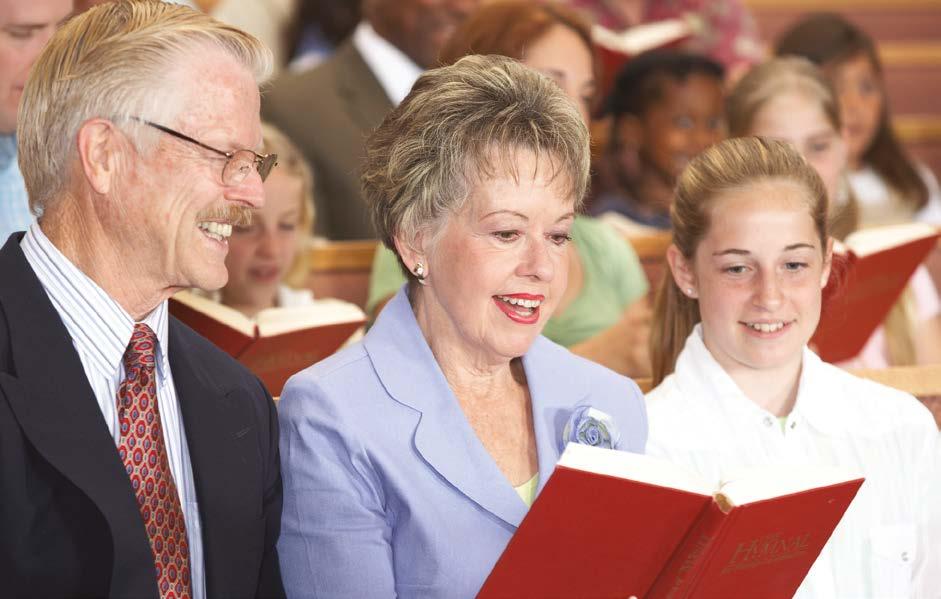
Not long ago, people were buried in their local cemetery without giving thought to other options. This was often the same place their parents, and possibly their grandparents, were buried. Today, this is less common as the average American moves several times during their life. Even after they’ve put down roots in a different part of the world, they may not develop a connection to the local cemetery.
This is where the church comes in. Where would you like to be laid to rest for all of eternity: a cemetery that you have never stepped foot in, or a church where you have developed a sense of belonging and community? A columbarium on your church property allows for complete ministry to your congregation, from baptism to burial. It is a reminder that while our physical lives will end, our spiritual lives will have a new beginning.
Nationally, 2016 was the first year in which cremation was more popular than traditional, in-ground burial. In 2021, the national cremation rate was 57.5% and is projected to be 64.1% by 2026 and 69.6% by 2031. Some states - including Arizona, California, Colorado, Maine, Montana, Vermont, and Wyoming - have
exceeded that rate, with a few approaching 80%. Many factors cause more people each year to choose cremation, including cost and convenience. See the map on page 98 of the appendix to determine the cremation rate in your state.
One of the benefits of cremation is also its main challenge because cremation is legally known as “final disposition.” This means that once a loved one is cremated, their family can choose to do any number of things with the cremated remains. Final arrangements often aren’t made ahead of time and many urns end up in attics, garages, or basements. The church is a more respectful place of rest.
HISTORICAL & PROJECTED CREMATION AND BURIAL RATES
Data from the 2021 National Funeral Directors Association Cremation and Burial Report
A columbarium can pay for itself, leaving existing church funds untouched. (Read about pre-selling in Chapter 5.) After the columbarium is fully funded it can generate revenue to maintain itself while also funding other projects for the church. In our experience with over 1,000 churches, a columbarium helps the viability of the church more than just financially. It gives people another connection to their place of worship. It also helps the church grow its membership, especially churches that offer the columbarium to the greater community. Lastly, a columbarium helps the church prosper. Every church where we have installed a columbarium has remained open.
If you have never worked on a columbarium project before, you are not alone. Most churches we work with are new to columbaria and find it helpful to form a committee to research and choose a manufacturer. The committee usually consists of three to eight people and it is best to have a range of backgrounds, skills, and ages. We have found that columbarium committees with more than eight people are counterproductive.
When forming your team, consider the skills below. Someone with a background in construction, contracting, or engineering can help with understanding the nuts and bolts of the columbarium as well as the foundation and landscaping needs. Is there someone in your congregation who is talented at fundraising or marketing? Being able to raise funds for the columbarium project is a valuable skill. Is there someone who deals with death in their profession like a funeral director or physician? Think about who is gifted at communication and would be a good facilitator. It can also be helpful to have a church leader on the committee. This can be a pastor or a deacon, but could be a congregation member who likes to get projects accomplished at the church. Having a range of ages represented on your committee can bring in a wider variety of perspectives. It can also help get the word out to a larger range of people.
• Construction, contracting, engineering
• Fundraising, marketing
• Understanding death and grief
• Communication, leadership
Once the committee is formed, select one person to head up the group: the chairperson. This person will be the main contact for Eickhof, the contractor, the city, and the church council. It is important to choose someone with time to devote to the project. They should also be highly organized and be able to understand the mechanics of a columbarium.


Form a Committee
Set a Budget and Goals

Design Your Columbarium

After the committee is formed and the chairperson is appointed, the group will need to determine what they want to accomplish. Of course, you want to see a columbarium installed at your church, but you should set other goals that will culminate in the day of the columbarium dedication.
First, think about what you want your columbarium to accomplish. Will it be solely for church members who can afford a $2,500–$4,500 niche? Do you want it to serve as a bridge to the larger community by offering inurnment to non-members? Should there be niches available for those who can’t afford one but still want to be inurned there? Next, consider the quality of the columbarium. Do you want the columbarium to be a beautiful, sacred, and relevant space for generations to come or is cost the only determining factor? Not all columbaria are created equal. Lastly, think about your timeline. It will take time for the committee to plan the columbarium and it will take time for the columbarium to be built. Most projects take 1–2 years from the time the committee is formed to the day the columbarium is dedicated, though most of this time is due to committee deliberation.
Before you get too far into the columbarium design process, it is important to understand the interest, needs, and expectations of your congregation. Since you have contacted Eickhof and are reading this guide, odds are there is interest at your church. However, you might discover that not many people know what a columbarium is, which will need to be addressed. (Read more about educating the congregation in Chapter Four.) As we previously mentioned, the columbarium committee should be a good representation of the overall congregation; this is important for design considerations as you want as much of the congregation as possible interested in the columbarium. If people's expectations are not met, they may lose interest.

Pre-Sell Niches
Educate the Congregation

Create Marketing Materials


DEDICATE YOUR COLUMBARIUM

Order Your Columbarium
It is important to set a rough budget for the project early in the process. The cost of the columbarium is not the only thing to consider. Additional costs include the foundation, landscaping, marketing, administration, design, and any other miscellaneous costs such as city permits. Depending on the location of your columbarium, you may not need a foundation. (Read more about the pros and cons of exterior and interior columbaria in Chapter Two.)
The columbarium will likely be the largest part of the budget. The cost of one of our columbaria varies greatly depending on the size, style, and materials. We have completed projects for less than $25,000, more than $500,000, and everywhere in between, but most of our columbaria fall into the range of $350–$650 per niche. The other costs of the project also vary greatly, so we suggest budgeting at least $9,000 to cover them. Of course, some churches spend much more and some spend much less. Just like any church project, you can save money by recruiting volunteers from the congregation.
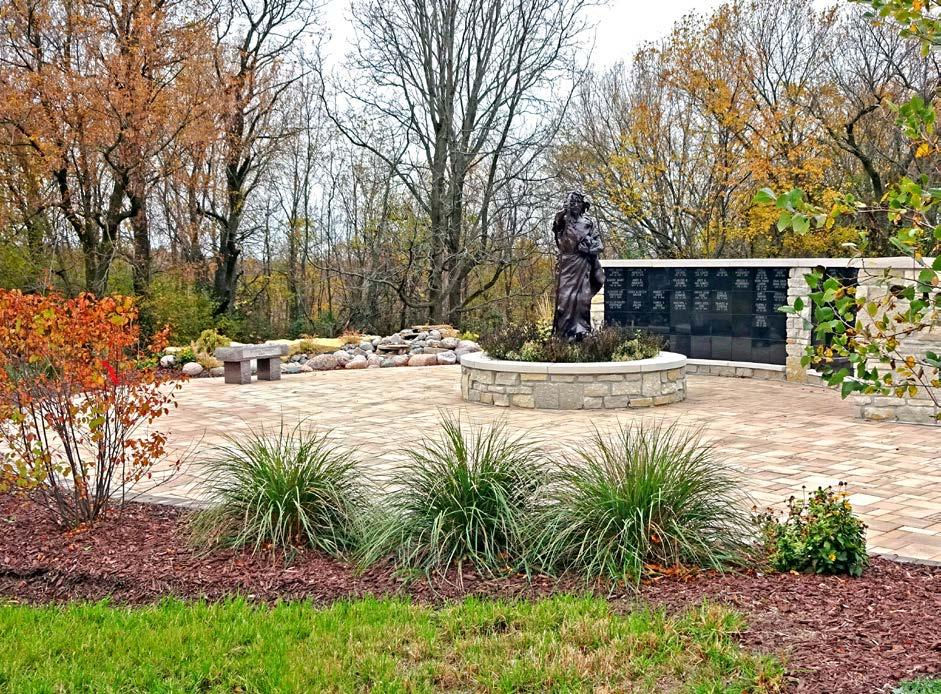
When setting a budget take into consideration the entirety of the memorial space.
After doing a little math, you may be asking yourself, “How will we ever pay for this project?” The good thing is that there are lots of options for funding. Remember, a columbarium does not have to use any existing funds. The three main funding options are pre-selling, recruiting donors, and taking out loans. Most commonly, the largest source of funds for churches is pre-selling. This means selling niches to individuals or couples before the columbarium is ordered. Approximately 75% of our customers fund the columbarium solely with pre-selling. Find out how on page 67.
Looking for donors is another good source of funding. We have worked with some exceptionally blessed churches that have had entire projects funded by a single donor, but most are not so fortunate. However, getting donors to fund parts of the project can be helpful. Consider what you want the area surrounding the columbarium to look like. Many of our customers have had donors who provided funding for memorial benches, trees, and flower beds. We have additional options for memorialization that can provide funding. Memorial walls and panels can display a person’s name and dates as a way to honor them, even if they do not plan on being inurned at the site. Some of our customers have incorporated memorial pavers into their space. While pavers are not offered by Eickhof, they are another way to honor those interred elsewhere while generating funds for the project.
The last option for funding is loans. Sometimes churches take out loans from the church itself, private banks, or larger church organizations. This can be a feasible option since most of our customers have a return on their investment of at least 400%.
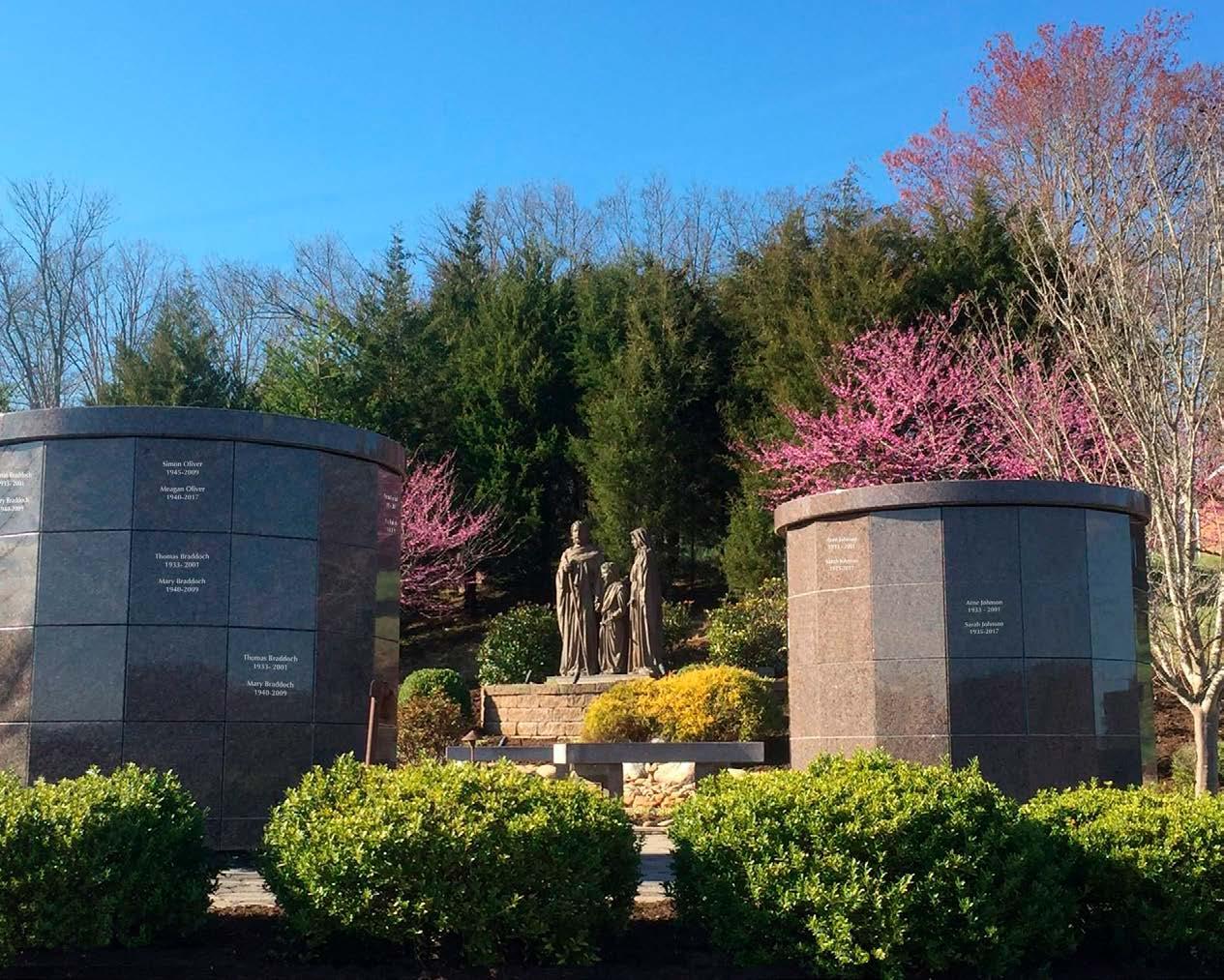
The possibilities of columbarium design are endless and all the decisions can be overwhelming. It may be tempting to finalize each of the following design steps before moving on, but that isn’t necessary. The design process is more circular than linear. It helps to start out with a general idea and then go back through the process to become increasingly more specific. For example, between an interior and exterior location, you may be able to narrow it down to exterior, but you may not know yet the exact location outside. That’s perfectly fine. By moving on in the design process and determining an approximate number of niches needed, you’ll be able to narrow down an exterior spot that can accommodate that amount, all while helping you hone in on other design decisions.
With the Eickhof Engine, you can freely explore different design concepts with captivating visuals and ensure the effective communication of ideas within your committee. Give your team the tools to confidently refine and select a columbarium design. Contact us to learn more today!
The committee should decide who will design your columbarium and the surrounding area early in the process. Before you make this decision, it is helpful to know what is involved in designing a columbarium. The six main components of columbarium design are:
1. Location
2. Scale
3. Style
4. Niche Size
5. Adornment
6. Future Phases
Decisions will need to be made for all six of these components. Additional factors will need to be taken into consideration, such as soil conditions, existing utility lines, maintenance, accessibility, and local building codes such as setback requirements.
Your first option is to explore our portfolio of existing projects. There’s no need to reinvent the wheel. We have installed more than 1,700 projects in over 35 years, so there may be a past project that speaks to you and your church. We can use that as a starting point, then tailor the design to your needs.
If you would prefer to start a design from scratch, we suggest looking inward at your church. Someone on your committee or in your congregation may be willing and able to do some initial design work. We have resources to help anyone with design skills understand how to design a columbarium. Remember, it does not have to be complicated.
For a project requiring more guidance, we offer three design service packages within the Eickhof Engine. Combine your goals with our immense experience in columbarium design. Learn more on the opposite page. It is important to note that we do not obtain city building permits, perform site or soil surveys, or check local building codes; these are the church’s responsibility.
If your church envisions a more elaborate memorial garden with plants, pathways, and benches around the columbarium, we suggest working with a professional designer. The most stunning projects we have been a part of started with the church hiring an architect, landscape architect, or contractor, and not a single one of them regrets their choice.
Deciding on the location of the columbarium is usually the first step in the design process because it will determine the parameters of the other design components. The first question to answer about location is: outside or inside?
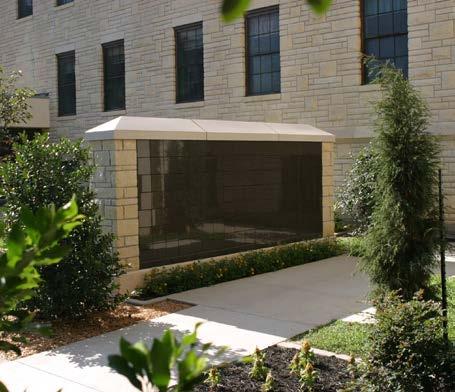
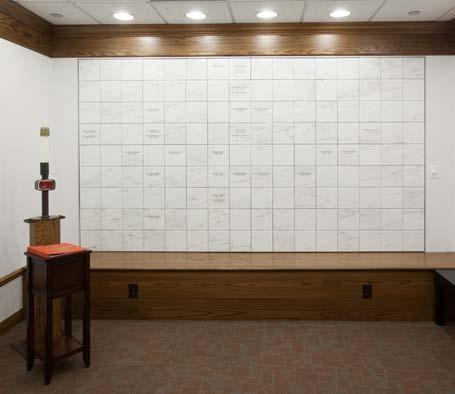
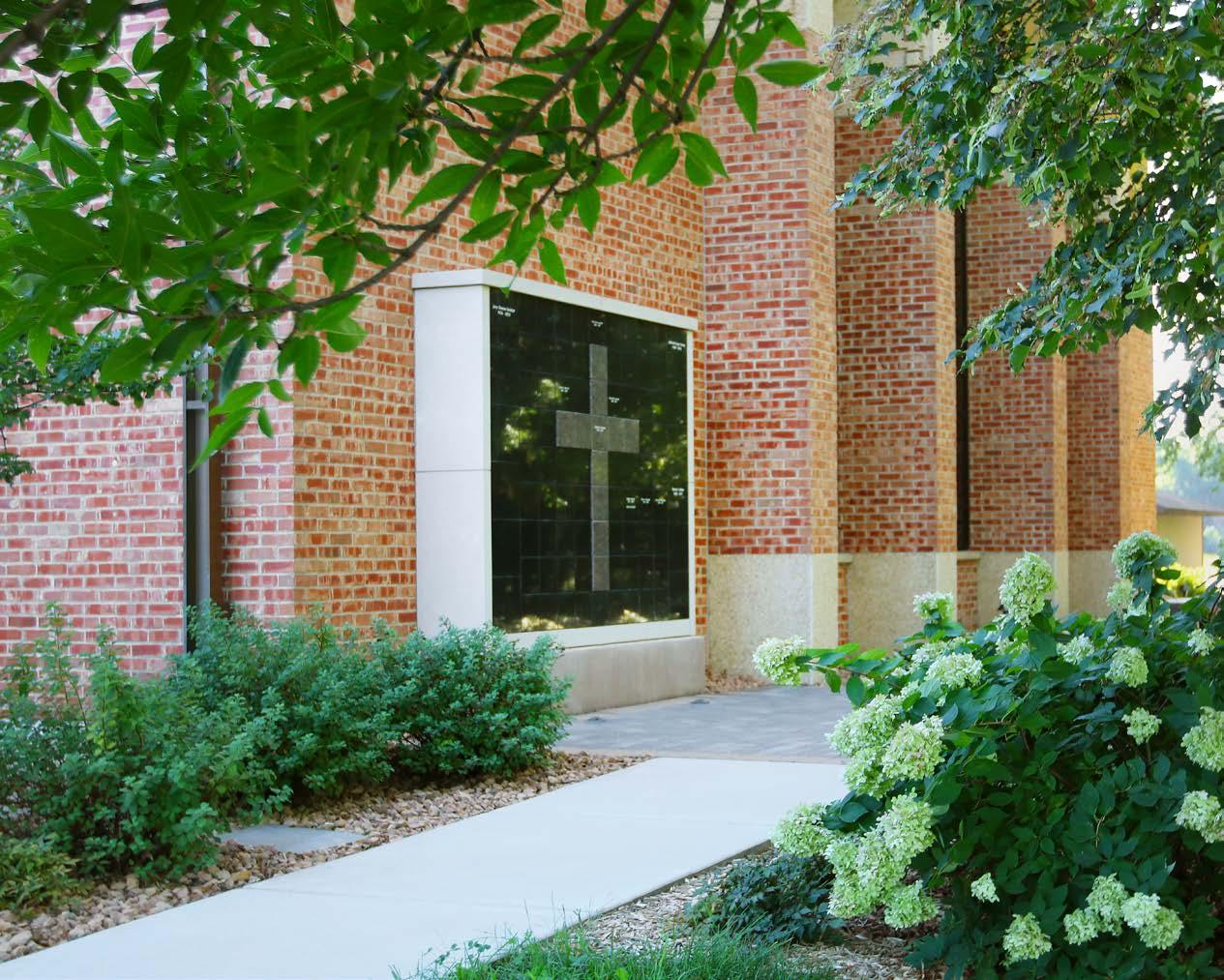
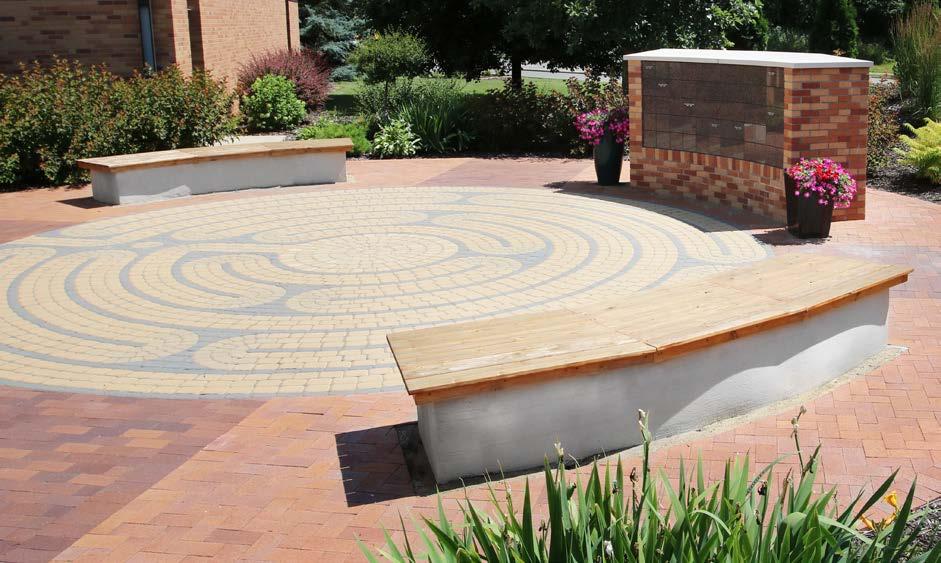
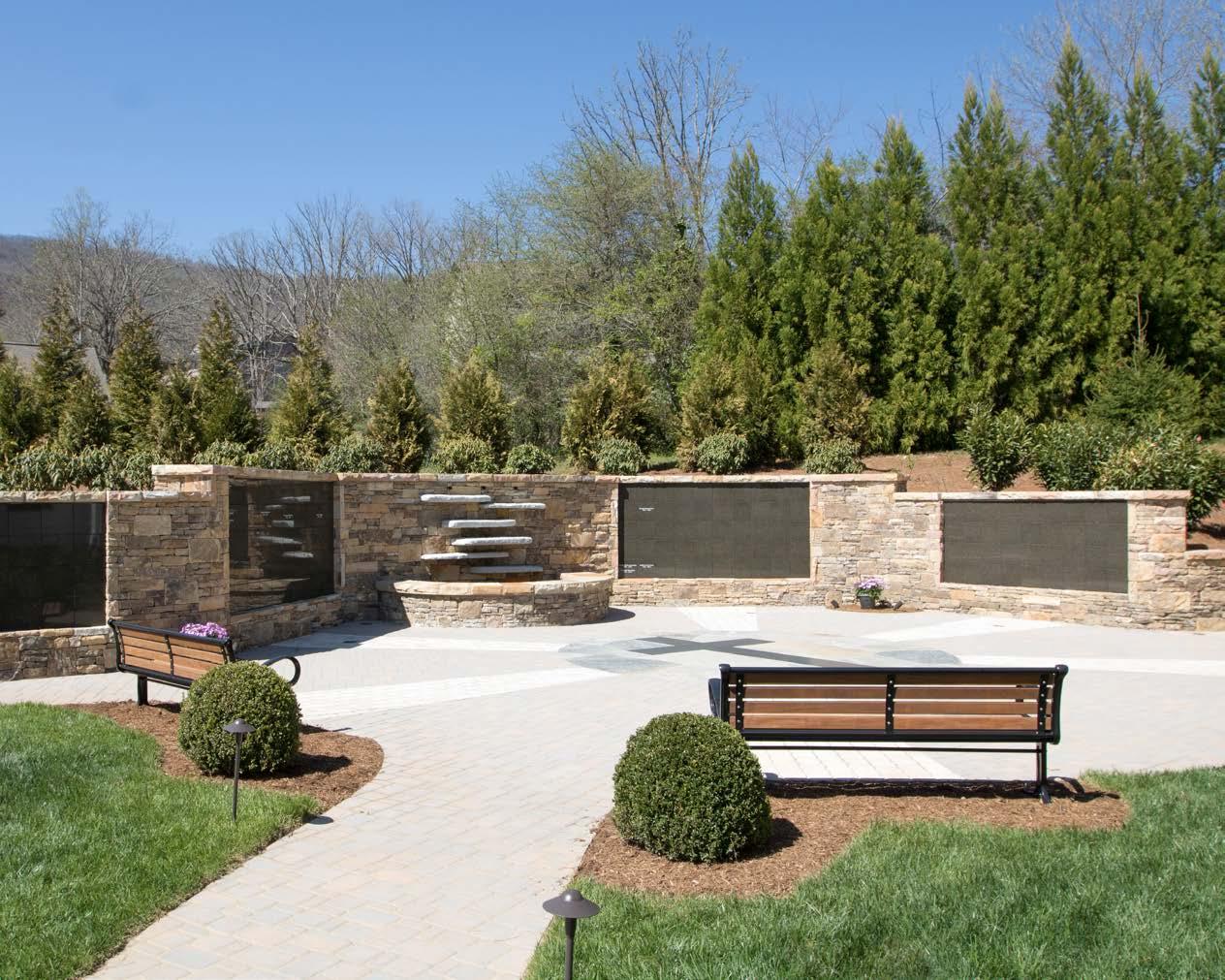
The majority of our projects are exterior installations. An exterior columbarium provides you with the opportunity to create a memorial or prayer garden, which is a popular design choice with our church customers. A memorial garden gives visitors the opportunity to enjoy the columbarium during each of the seasons and it can be accessible to visitors even when the church is not open. Depending on where the columbarium is placed outside, its location can be free advertising: a highly visible columbarium will pique interest.
However, an exterior columbarium has its disadvantages. When a columbarium is outside in the elements, some minimal maintenance is required. Cleaning of the columbarium once or twice a year is highly recommended. This can include use of a mild detergent and a small brush to clean off any dust, dirt, or bird droppings. Also, general care is necessary to keep the columbarium area looking its best. Gardens need to be maintained with proper watering, weeding, and animal management. More on columbarium maintenance can be read on page 84. The climate will also need to be considered in regard to mowing, snow removal
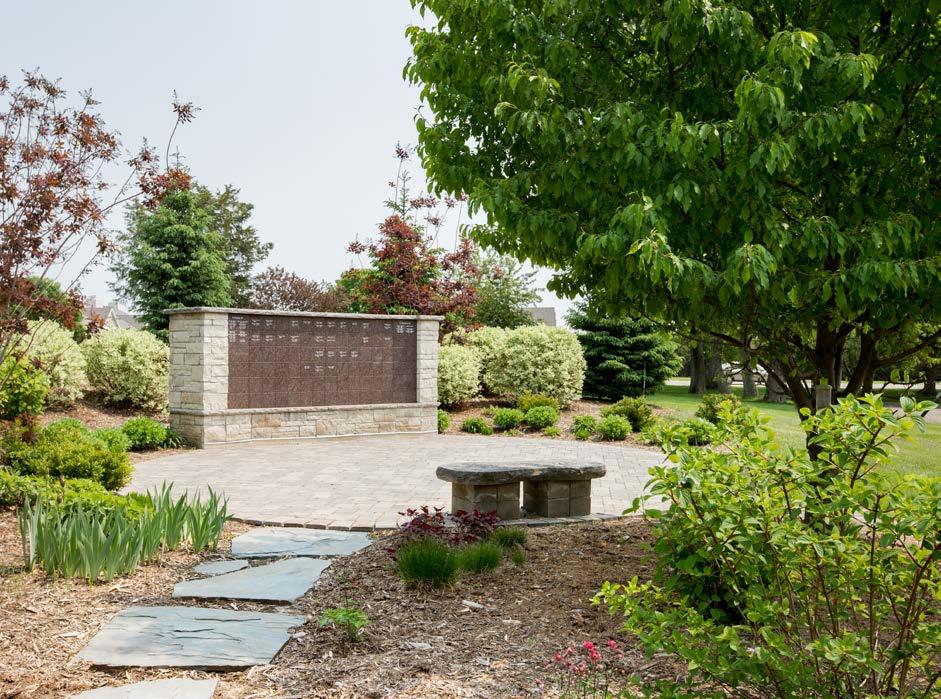
A memorial garden gives columbarium visitors the opportunity to enjoy each of the seasons.
in winter, shade in the summer, and water access for the plants. If security is a concern, the space may need to be gated or have cameras in use, but we have heard of very few security issues from our customers. Lastly, there are limits to what materials can be used on exterior columbaria. Other materials may be an option, but we highly recommend granite for the niche fronts.
The advantages of an exterior installation demonstrate the disadvantages of an interior installation. You cannot create a garden, the experience of seasons is far less, it can only be accessed while the church is open, and it does take up what can be valuable space within the church building. Keep in mind that there could be non-church members who have loved ones inurned in your columbarium and an interior columbarium can be less inviting to those visitors. The most disheartening outcome we have seen in a small number of churches is neglect. When a columbarium is inside, it is easy to forget how sacred it is. We have seen on more than one occasion an extra pew or storage box end up in front of the columbarium.
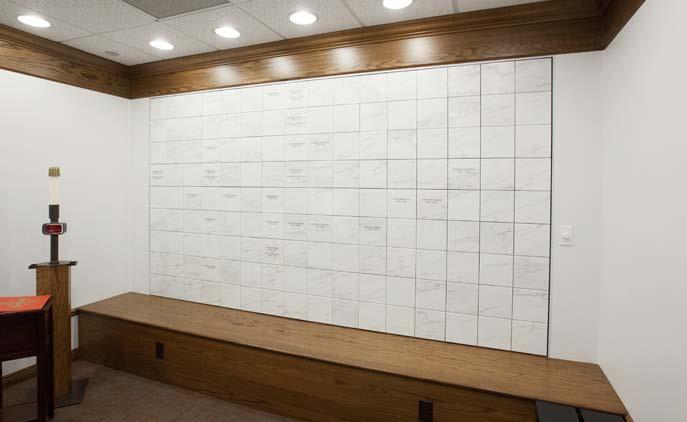
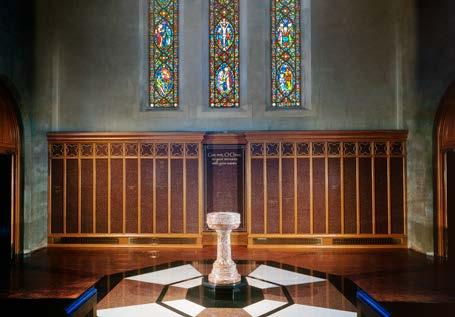
An interior columbarium does have some strong advantages over an exterior project. First, there are many more options for materials that can be used, including wood for the niche fronts or the surrounds of the columbarium. In some cases using wood for the surrounding material on a columbarium can be less expensive than exterior rated materials such as granite. You may even have a woodworker in your congregation who would be happy to volunteer their skills!
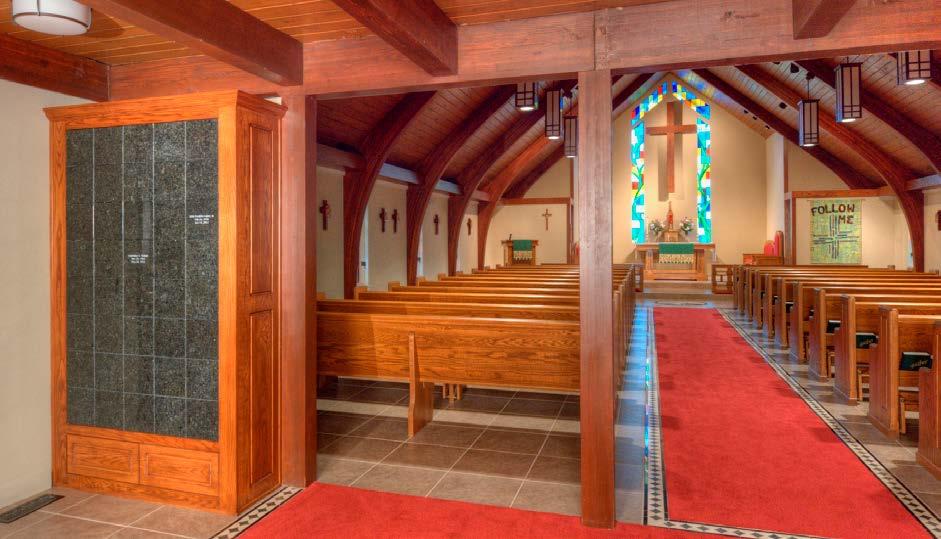
One obvious advantage of choosing an interior location is that the columbarium and its visitors will not be exposed to the elements. This means visits and services can be comfortable year-round and no lawn maintenance or snow removal is required. Finally, consider that an interior project does not require a foundation like an exterior project does. However, the floor does need to be flat and level prior to the columbarium being installed.
Whether you are considering an indoor or outdoor location, another thing to keep in mind is the surrounding area. A columbarium’s setting should be peaceful, respectful, and appropriate for quiet meditation. We suggest avoiding locations near a playground or daycare room, a busy street, or the church’s main entrance. A columbarium can be placed in close proximity to these high traffic and noisy areas because with careful planning we can frame the columbarium area as its own sacred space.
Another factor to consider is the columbarium's distance from the sanctuary. For committal services, the traffic flow from the sanctuary to the columbarium should be taken into account.
You have to make the decision that is right for your church. Our advice when it comes to determining location is to select a place that is beautiful and meaningful, removed from surrounding distractions, and an overall inviting space where your congregation can remember their loved ones.
• Garden option
• Must consider the climate and weather
• Can be accessible when church is closed
• Presence can be free advertising
• Requires exterior space
• May require security measures
• More maintenance
• Requires a foundation and landscaping
• Fewer options for niche front material
• Cannot have wood surrounds
• Cannot have a garden
• Weather is not a concern
• Only accessible when church is open
• Only seen within the church
• Requires interior space
• As secure as the church building
• Less maintenance
• No foundation or landscaping needed
• Endless options for niche front material
• Can have wood surrounds
The location will give you some good parameters for the design. The next step is to determine the scale of the project. This relates to the overall size of the columbarium area and the number of niches.
We have completed very large projects with hundreds of niches, some with over 1,000 niches. Projects of this size have typically been for very large churches with 1,000 or more members. On the other end of the spectrum we have completed small projects, some as modest as 48 niches. The average project size we complete is around 150 niches, while the most typical (median) project is about 96 niches. Even if you are a small church (200 members or less), we suggest installing at least 48 niches.
144 NICHES
306
HOW MANY NICHES?
To help you determine the ideal number of niches for your first columbarium, answer the following questions:
1. How many members are in your congregation?
2. What is the average age of your congregation?
a. Young (39 or under)
b. Middle-aged (40–59)
c. Senior (60 or older)
3. Are you in a high or low cremation rate state? (See page 96 for your state's cremation rate.)
a. Low, under 40%
b. Medium, 41–60%
c. High, 61–70%
d. Very high, 71%+
4. Will niches only be available to church members and their families or will you offer space to the greater community?
5. How many people have their loved ones’ cremated remains at home?
6. How many people have expressed interest in buying a niche?
Use your answers from the previous page to determine the total number of niches:
1. Take the size of your congregation and divide by 5.
2. If your congregation’s average age is:
a. Young: Multiply by 1.1
b. Middle-aged: Multiply by 1.2
c. Senior: Multiply by 1.3
3. If your state's cremation rate is:
a. Low: Multiply by 1.1
b. Medium: Multiply by 1.2
c. High: Multiply by 1.3
d. Very High: Multiply by 1.4
4. If you will only offer the columbarium to the congregation and their families, skip this step.
If you will offer to the greater community, multiply by 1.5.
5. Add the number of people you know have their loved ones’ cremated remains at home.
6. Add the number of people who have expressed interest in buying a niche. This exercise is only meant as a starting point or benchmark. If your score is less than 25, you may want to reconsider your need for a columbarium at this time. If you score between 25 and 47, we suggest starting with at least 48 niches.
Our suggestion for the top row of niches is that they should not be higher than the average person can reach. (This is between 7–9 feet.) People like to touch the niche where their loved one is inurned. When it comes to opening and closing niches for inurnment services most individuals do not want to be on anything higher than a step stool. However, we are able to build taller niche walls if your space requires it. The lowest level of niches will always be the most difficult to sell. It should be off the ground by at least 4 inches, but no higher than 12–18 inches.
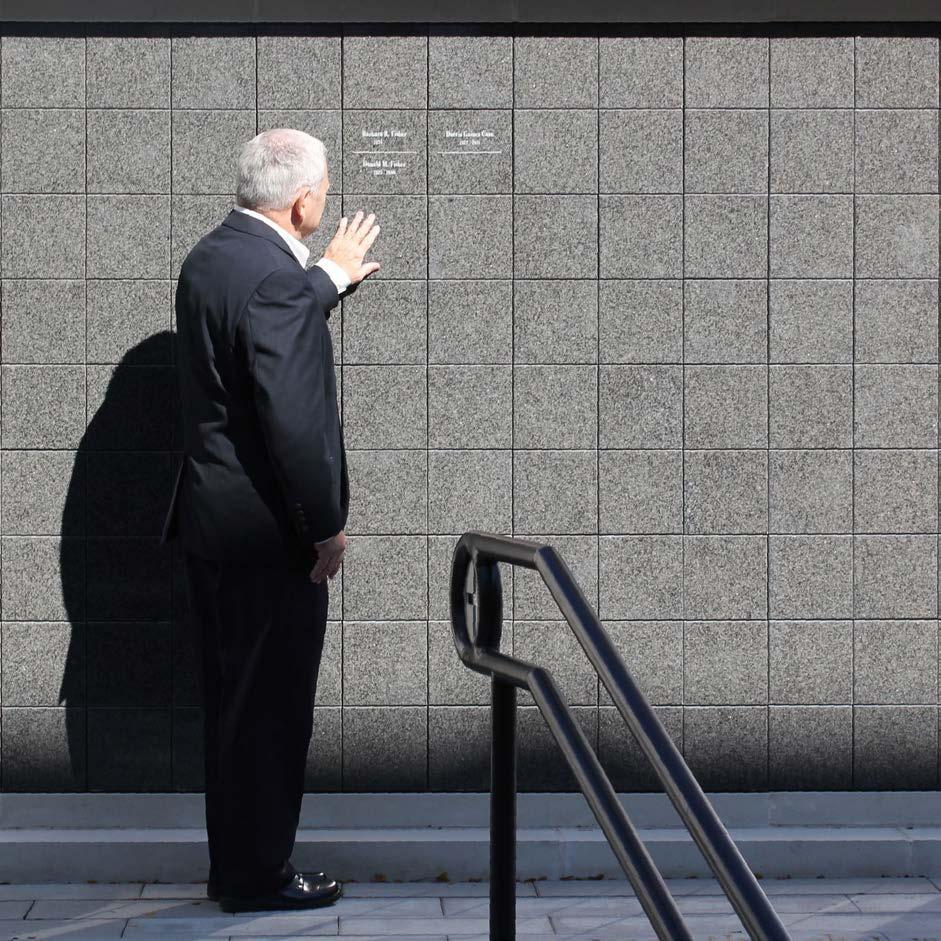
Next, it is time to consider what style columbarium works best for your needs. We highly recommend reviewing the “Projects” page on our website to see the wide range of styles that can be accomplished. When we say style, we are referring to both architectural style and type of columbarium. Our columbarium system allows us to create projects that work for modern churches and more traditional ones.
As for type of columbarium, all of our projects are made to order and fit into two main categories. The first category is what we call “Pre-Assembled.” These are pre-designed models that have a specific shape, size, and number of niches. They are also pre-fabricated and delivered in one piece. The second category is called “custom,” which means it is not one of our pre-designed models.
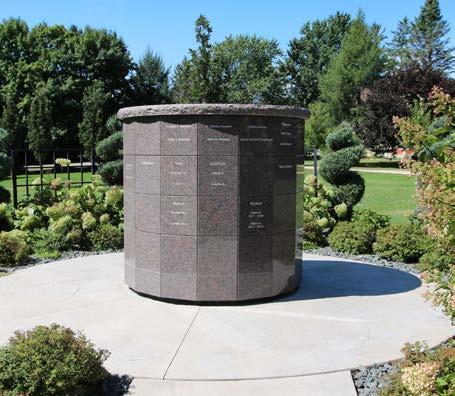
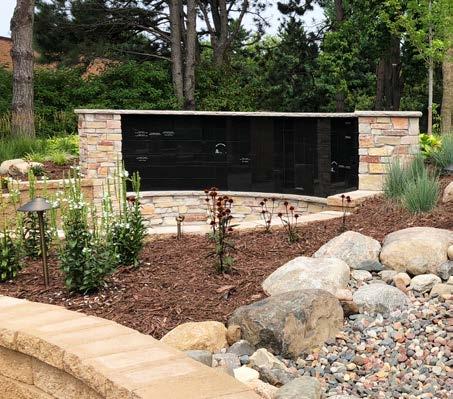
Choosing a Pre-Assembled model can help the columbarium committee get through the design process faster. They can select a specific model and add custom options as desired. We have a catalog complete with pricing for these models. There are many additional advantages to selecting a columbarium from our Pre-Assembled line. First, it can be installed in a few hours. All that is required of the church is to hire a crane operator and to have a foundation ready prior to delivery of the columbarium. The foundation must be created according to Eickhof's foundation design and local building codes. On delivery day the Pre-Assembled model is simply placed onto the foundation. Secondly,
our Pre-Assembled models are designed to use space efficiently by designing upwards instead of outwards. Each standard model is four niches tall. Your columbarium can be designed with more rows to increase the height and capacity without increasing the footprint. Adding the Ossuarium® option is an even more efficient use of space and it provides a lower price point than the traditional niches. An Ossuarium looks like a traditional Pre-Assembled model except that it has an above ground ossuary vault in its core. Another benefit of a Pre-Assembled model is that it can be relocated if the church moves to a different location in the future.
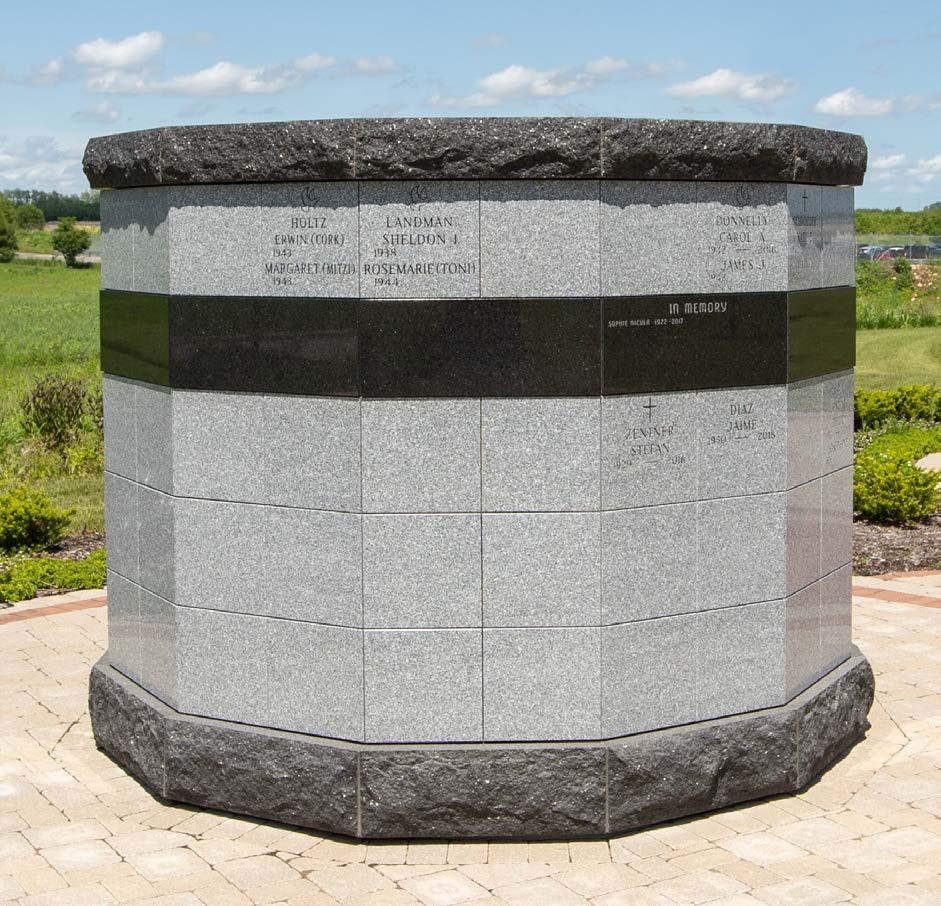
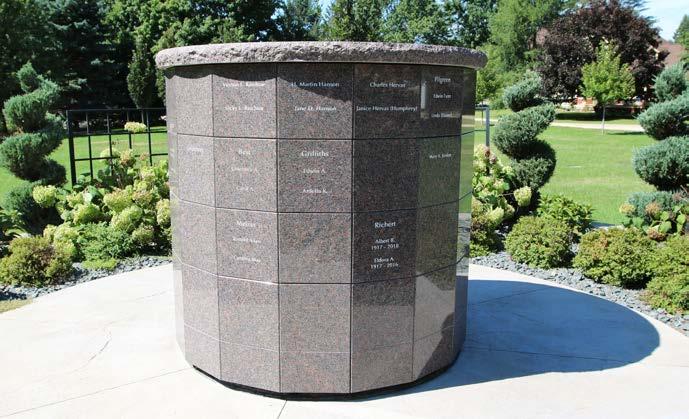
This Durham Ossuarium provides 96 companion niches and 325 ossuary spaces for a total of 517 urn spaces. Those inurned in the ossuary vault are memorialized on the Memorial Band ®, shown here in Cambrian Black granite. This Ossuarium was designed with the optional heavy base and thick capstone.
WINCHESTER
5'4" Diameter – 64 Niches
CANTERBURY
6'7" Diameter – 80 Niches
ELY
6'5" Diameter – 96 Niches
YORK
7'10" Diameter – 96 Niches
STERLING
6'9" Diameter – 80 Niches
DURHAM
7'10" Diameter – 96 Niches
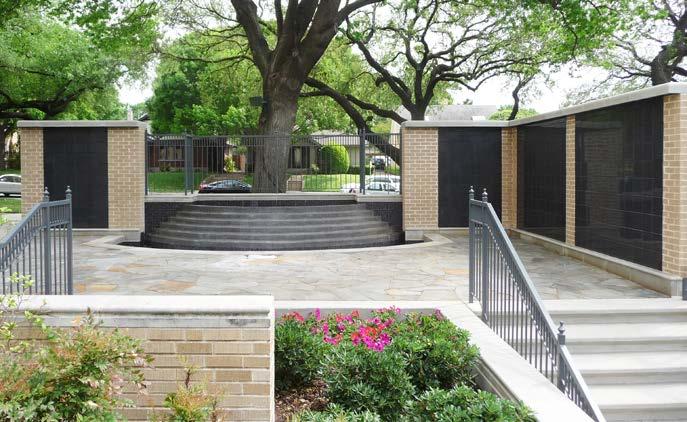
All of our columbaria, including our Pre-Assembled models, are made to order. That means our custom columbaria are not necessarily more expensive than the Pre-Assembled models. Typically, our custom columbaria are a wall style, which come in two main types: against an existing wall or free-standing. A free-standing exterior columbarium provides a barrier on your property and can have niches on one or both sides. There are also many options for a wall columbarium’s form: it can be straight or curved, concave or convex, or serpentine. You could choose a single columbarium wall with standout features or you could have a series of wall columbaria. A single feature wall creates a strong focal point while a series of multiple walls can provide a greater number of niches and create visual rhythm in your space.
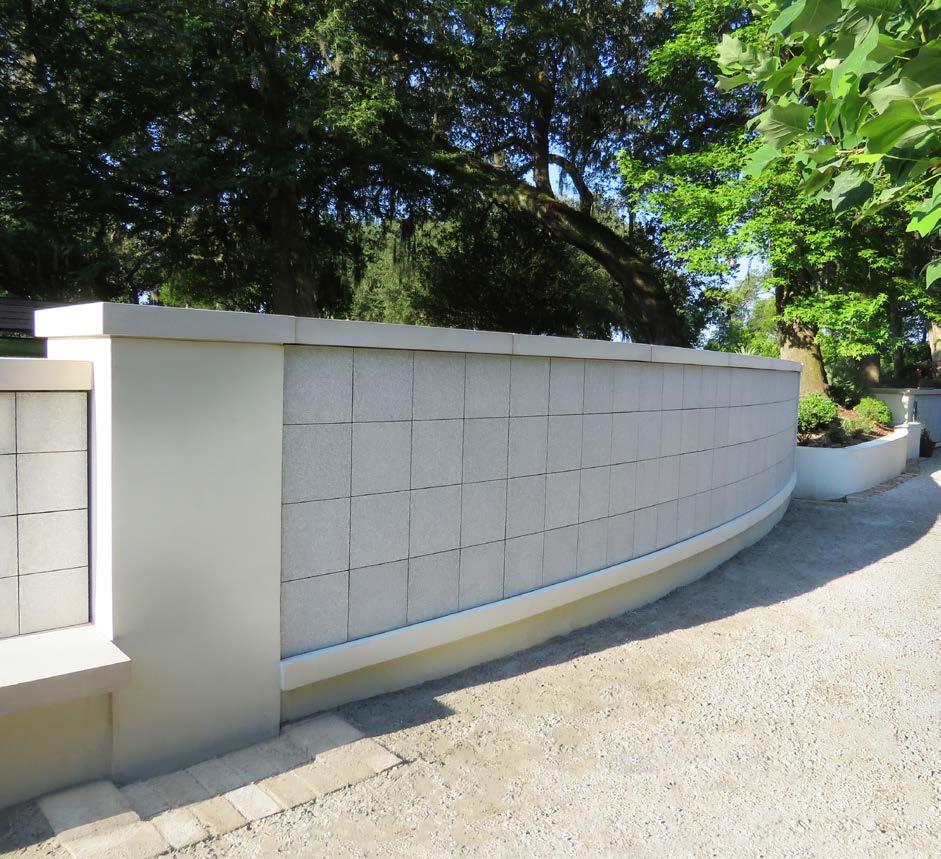
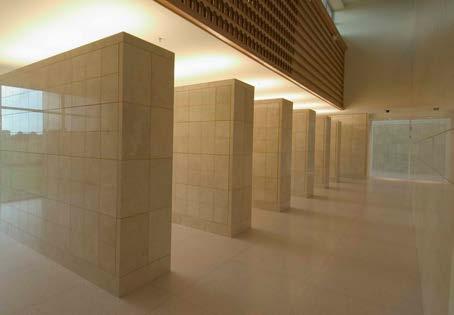
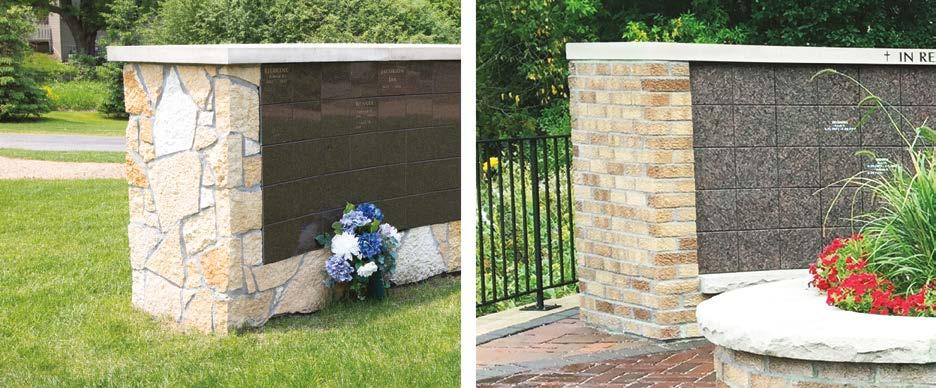
Against wall single-sided custom columbarium. Free-standing double-sided custom columbaria.
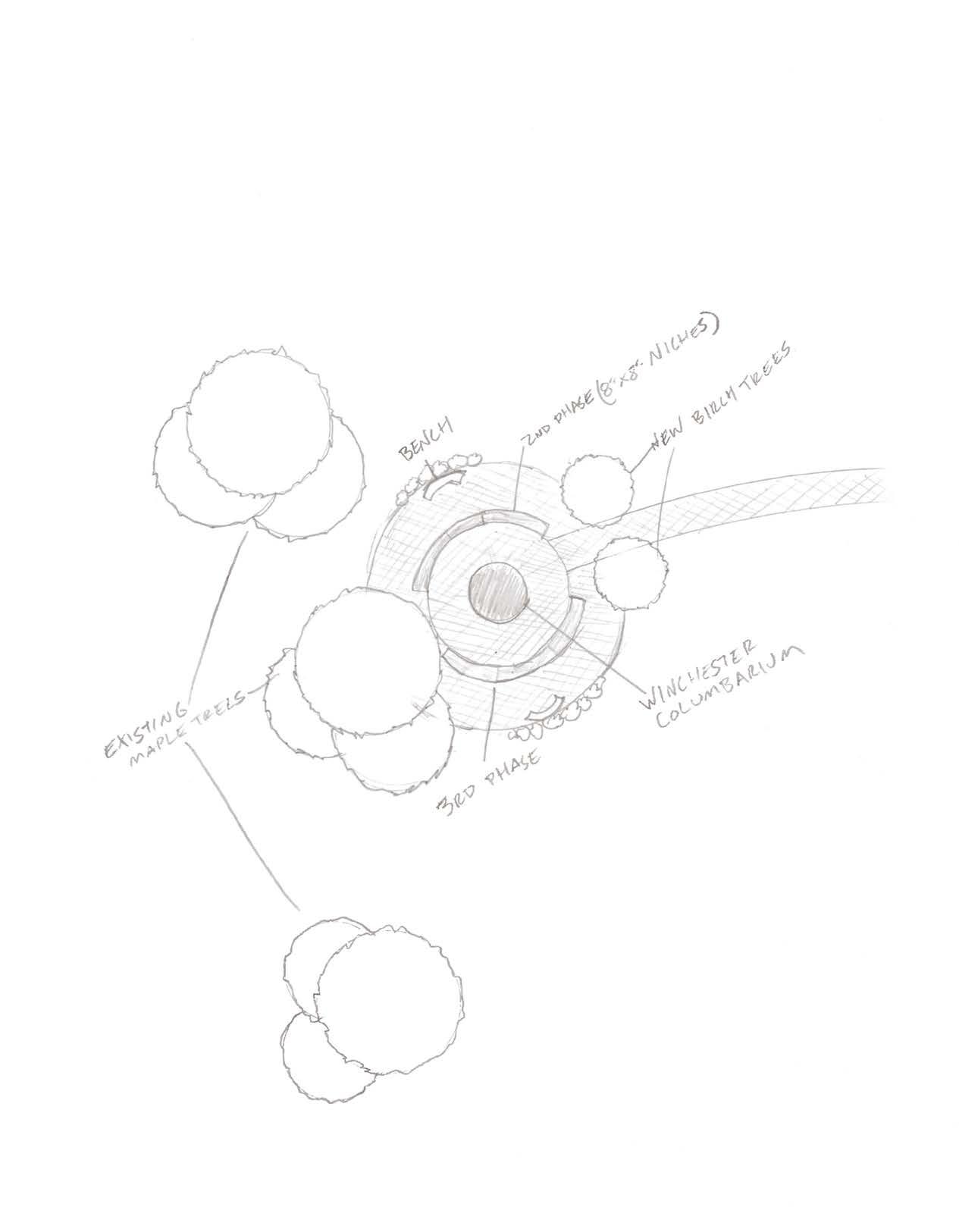
A memorial space can be created utilizing both a Pre-Assembled columbarium and a custom columbarium. We’ve designed memorial spaces that feature a Pre-Assembled columbarium in the center of the space with curved, free-standing custom walls placed around it. Another idea is to have a Pre-Assembled model in the center with straight columbarium walls radiating from it like spokes. There are numerous ways to mix and match these columbarium forms in order to attain the niche amount and style you have in mind.
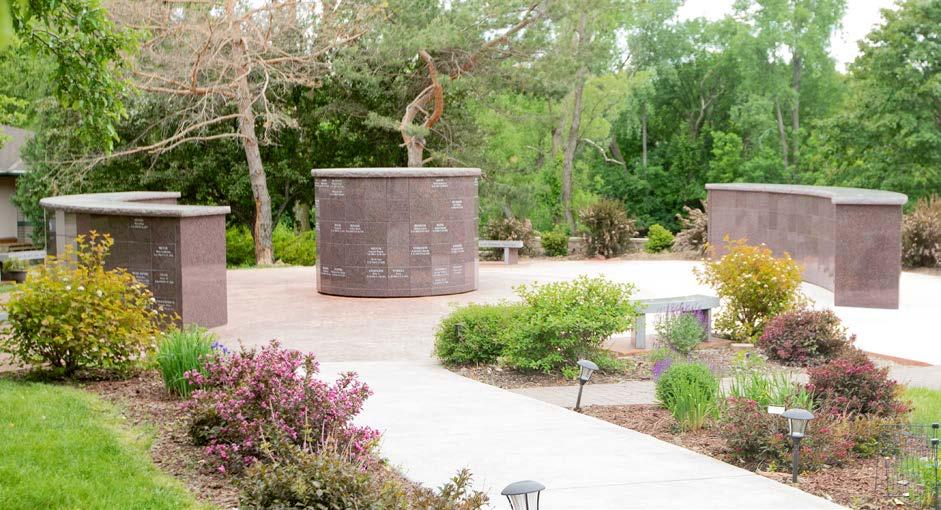
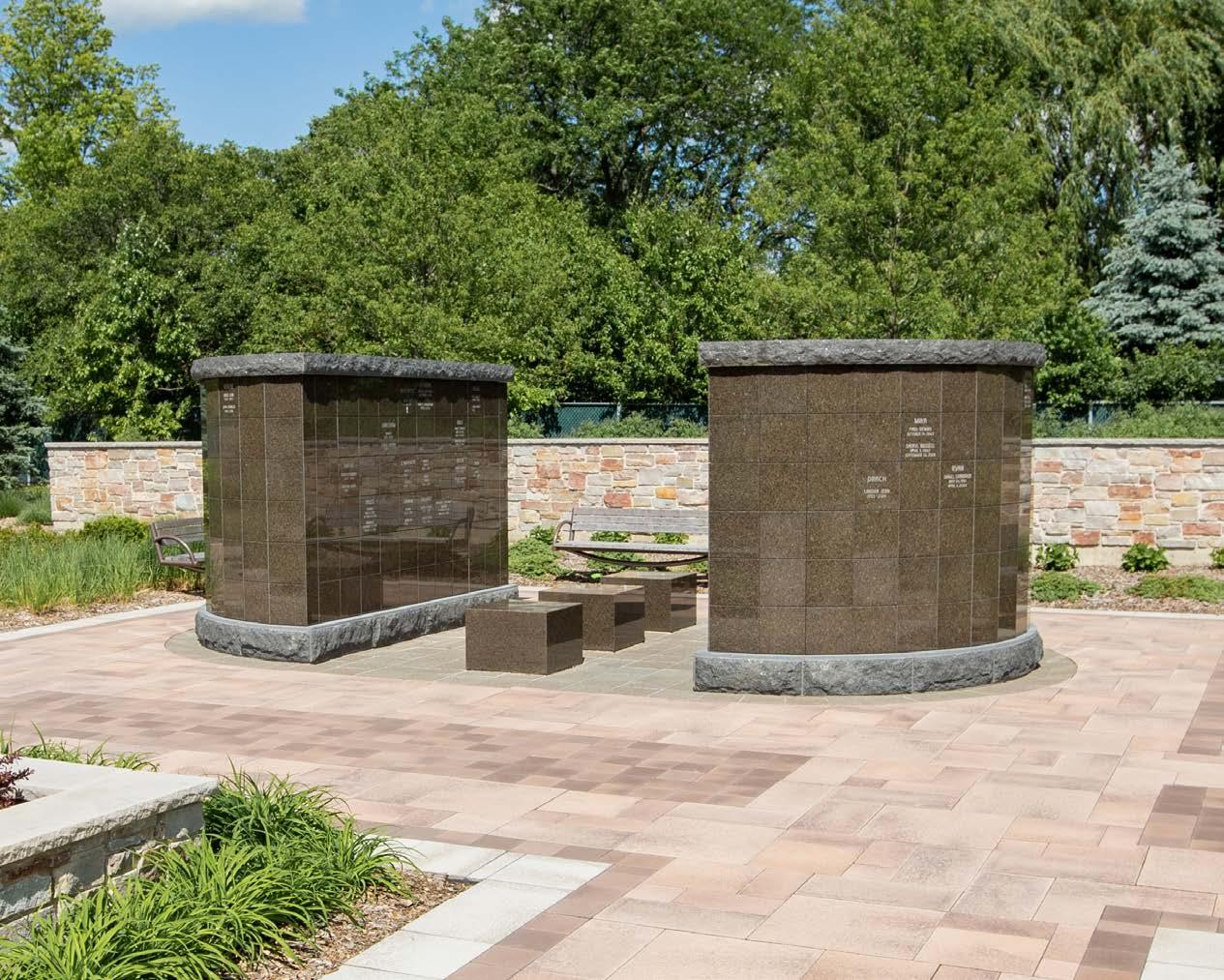
This memorial garden utilizes both styles of columbaria. It has a Pre-Assembled columbarium at the center and two custom free-standing columbaria. Each columbarium was installed at a different time, which we refer to as phases.
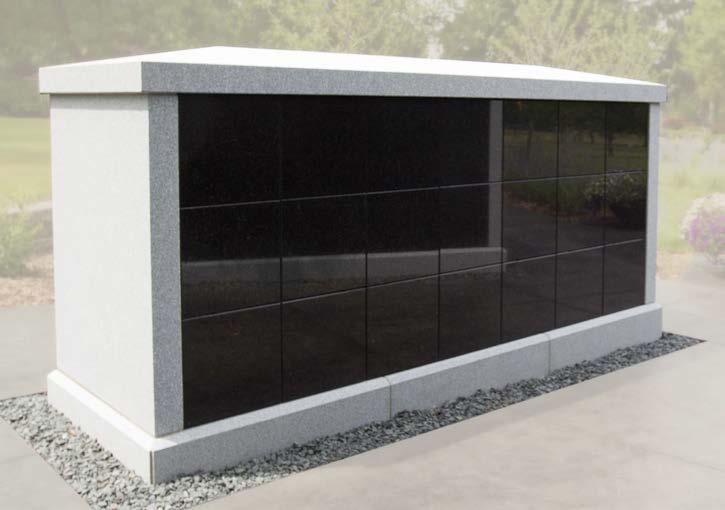
The church will need to select materials for the columbarium, such as the niche fronts and surrounds. The surrounds are all of the materials that are not the niche fronts: the capstone (top of the columbarium), the base/ base trim, the end panels (sides of the columbarium), and the back panels (if applicable). One material can be used for all areas, or a variety of materials can be used. We can send you material samples and help you select the best materials for your design. We do not complete masonry or wood surrounds; if you select these materials they will need to be completed by others after we install your columbarium.

Any material that can be used outdoors can be used indoors, but not all materials appropriate for interior use are also appropriate for exterior use. We will first look at materials suitable for exterior use.
The most common material we use for the niche fronts is granite. It is a dense material which allows us to mechanically fasten our hardware directly to the back of the stone without any glue or epoxy. It is mostly nonporous which
deters harmful effects from water or moisture, unlike limestone or marble, and in turn requires less maintenance. Granite is typically readily available, which minimizes lead time to complete the project and ensures a higher possibility that the same granite will be available for future phases. Lastly, granite is incredibly long-lasting, which is important when making a monument that will last for decades. Color consistency can vary depending on the type. Unless specialty granite is requested from a country like Spain or Italy, all granite Eickhof utilizes comes from North America. The majority of the granite we use is quarried in the United States, followed by Canada, and we have chosen to use these quarries because of the quality and consistency they provide. In our decades-long experience, we have found that stone coming from China or India does not meet the standards required for a columbarium that is meant to last for many generations.
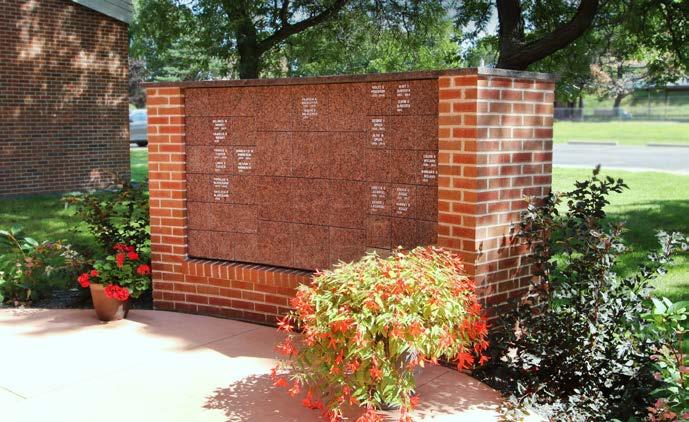
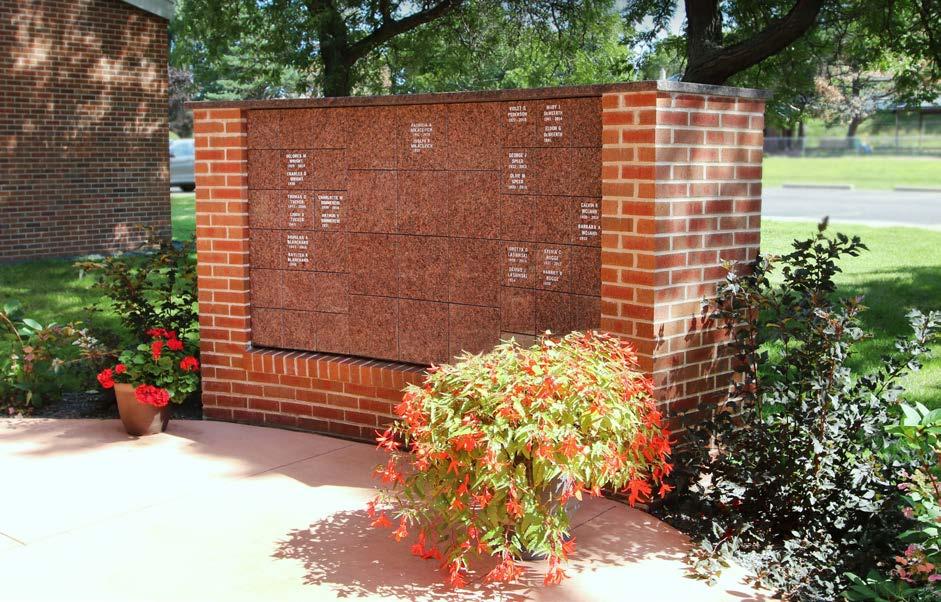
Granite is by far the most popular material for our niche fronts, but it is less commonly used for all the surrounds. This is simply due to cost. Granite is a fantastic choice for the surrounds because of the durability and minimal maintenance, but other materials like limestone, architectural pre-cast concrete, or masonry will be more cost-effective. One popular mix of materials is to utilize granite for the niche fronts and capstone, and masonry for the sides, back and base of the columbarium, as pictured below.
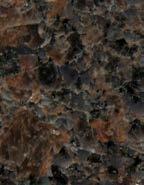
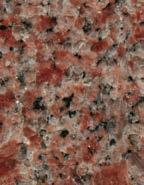
Granite also comes in a wide variety of types. We refer to these different types as "colors," however they are in fact different materials with different physical properties. It's similar to the way people talk about wood: walnut and pine are both types of wood with different colors and different physical properties. Some granite colors we use often are Mahogany, American Rose, Morning Rose, Superior Black, Cambrian Black, and Barre Gray. The most common granite color our customers select is Mahogany. It is a beautiful color that can fit into a Southwestern setting with adobe as easily as it fits into a historical East Coast church with dark, two-hundredyear-old wood. The quarry it comes from, located in South Dakota, is one of the deepest, most vast, and most consistent quarries in the world. This means that if Mahogany granite is taken from the earth today for your first columbarium, and five years from now more Mahogany granite is taken from that quarry for your second columbarium, you will have stone that matches as closely as possible. It is important to remember that granite, as well as other stones like marble, limestone, or slate, is a natural material. It is not man-made. This means the color of the stone, both in the ground or on a columbarium in the sun, can change over time. However, the granite colors we use at Eickhof keep their true color the best.
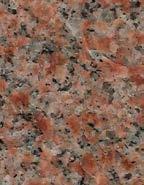



MAHOGANY
AMERICAN ROSE
MORNING ROSE
SUPERIOR BLACK
CAMBRIAN BLACK
BARRE GRAY
Limestone can be used for niche fronts, but it is most commonly used for the surrounds (capstones, end panels, and base trim). It is very common for capstones because of its cost. Unlike granite, limestone is porous and requires more maintenance. To maintain limestone surrounds (not niche fronts) a light power washing with some scrubbing keeps the limestone looking great. This should be done one or two times a year. Limestone niche fronts should be gently hand washed only. Some locations with year-round dry weather may not need to clean the limestone for several years. Some very humid locations may need to clean it more often, embrace the patina, or consider another material. It is possible to use limestone as niche fronts for exterior use, but we have found they are better suited for interior projects.
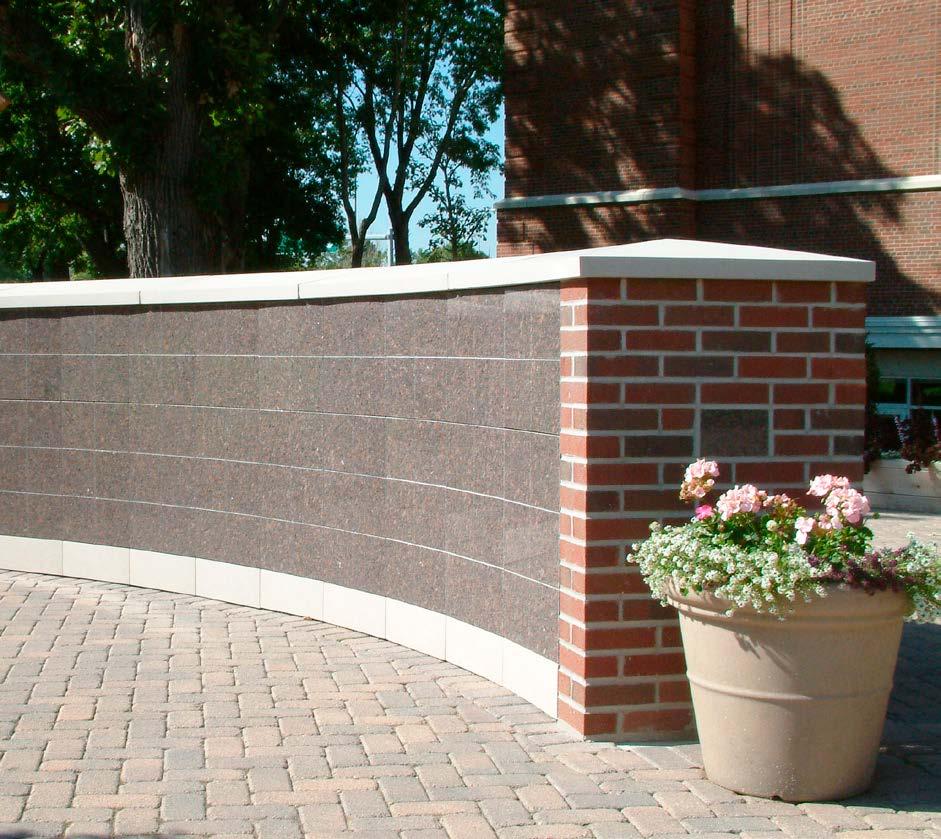
There are several advantages to choosing architectural pre-cast concrete. This material is most often used for capstones, end panels, and base trim. It can look similar to limestone, but it is more customizable and offered in a variety of colors. It can also be a more cost-effective option.
Several types of finishes are available and each one highlights different characteristics of the stone. A polished finish is the most common. People are used to seeing this in homes. This finish is smooth to the touch, reflective, dries quickly after the rain, and creates the most vibrant color of the material. A sanded finish is another popular option. It adds a textural element and provides a nice subtle contrast when the same material is used with a different finish. Other finishes are available, such as a honed finish that leaves the stone surface matte and a diamond finish that leaves the stone surface textured. The most cost-effective finish for capstones is a rock pitched finish, but there are other options.
There are a variety of other materials that we have used for niche fronts on exterior projects. These include marble, bronze, and aluminum. Climates with a wide temperature range will be limited from using these materials in some situations. We’re happy to hear what your material preferences are and to make recommendations based on your location.
• Polished
• Sanded
• Honed
• Diamond
• Rock pitched

Since an interior columbarium is protected from the natural elements of precipitation and large fluctuations in temperature, a wider variety of materials can be utilized.
Marble is a beautiful choice for your columbarium, but it is important to be aware of its limitations. Unlike granite, the color quality over time is far less consistent. This means that if your church has plans to install an additional phase a few years after your initial columbarium, it will be more difficult (not impossible) to get the marble to match your existing columbarium than if you had used granite. Even if the marble is extracted from the same quarry, there is naturally a wider range of color variations in marble compared to other stones. One marble that we have found that has the least amount of variance is Crème Marfil. Marble also has pronounced veining. When the stone is cut from a slab into niche fronts, its veining becomes segmented. In regard to structure, marble is softer when compared to granite and requires some reinforcement when we attach our hardware.
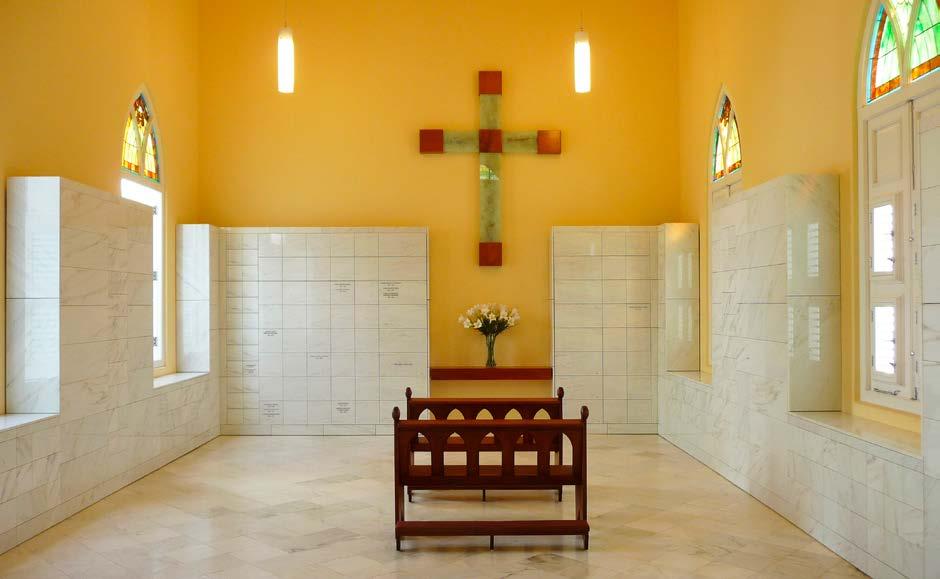
There is nothing like the warmth that comes from utilizing wood as a material. Niche fronts can be made to coordinate with existing woodwork in your church, but it can be expensive. As a result, this material can be more economical for smaller columbaria. Another option is to have your columbarium designed with stone niche fronts and wood surrounds. Depending on the type of wood and scale of the project, this could be a costly endeavor, but for the right project and location, it makes an incredible statement.
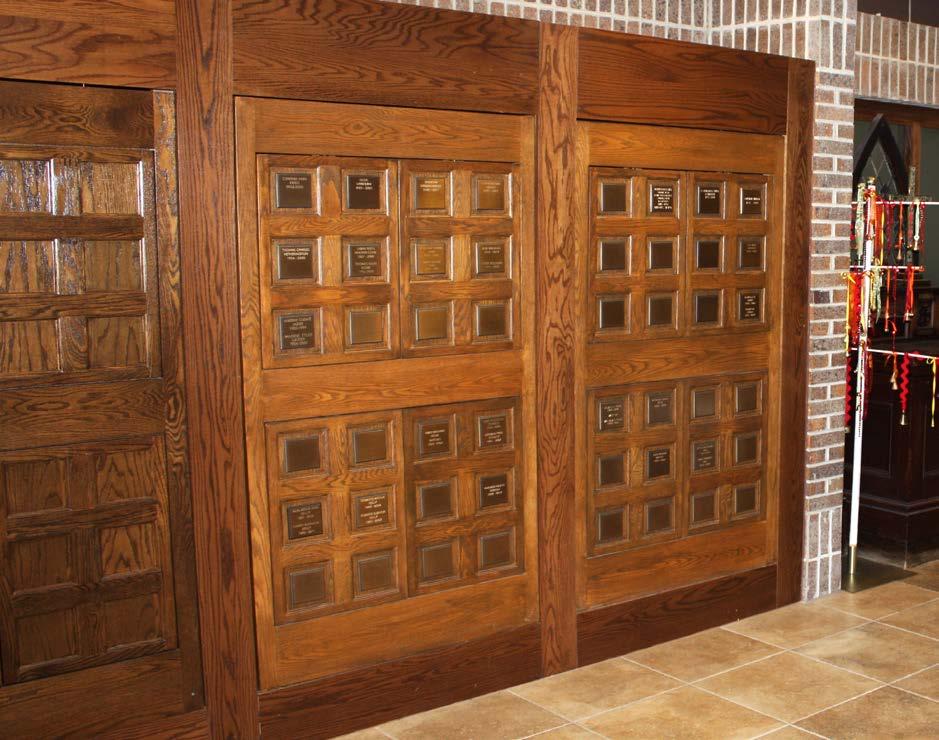
The previously mentioned materials are the most common, but our hardware system allows for nearly infinite material options. Slate, bronze, and aluminum have all been used in the past; however, these less common materials will increase the overall cost of your project.
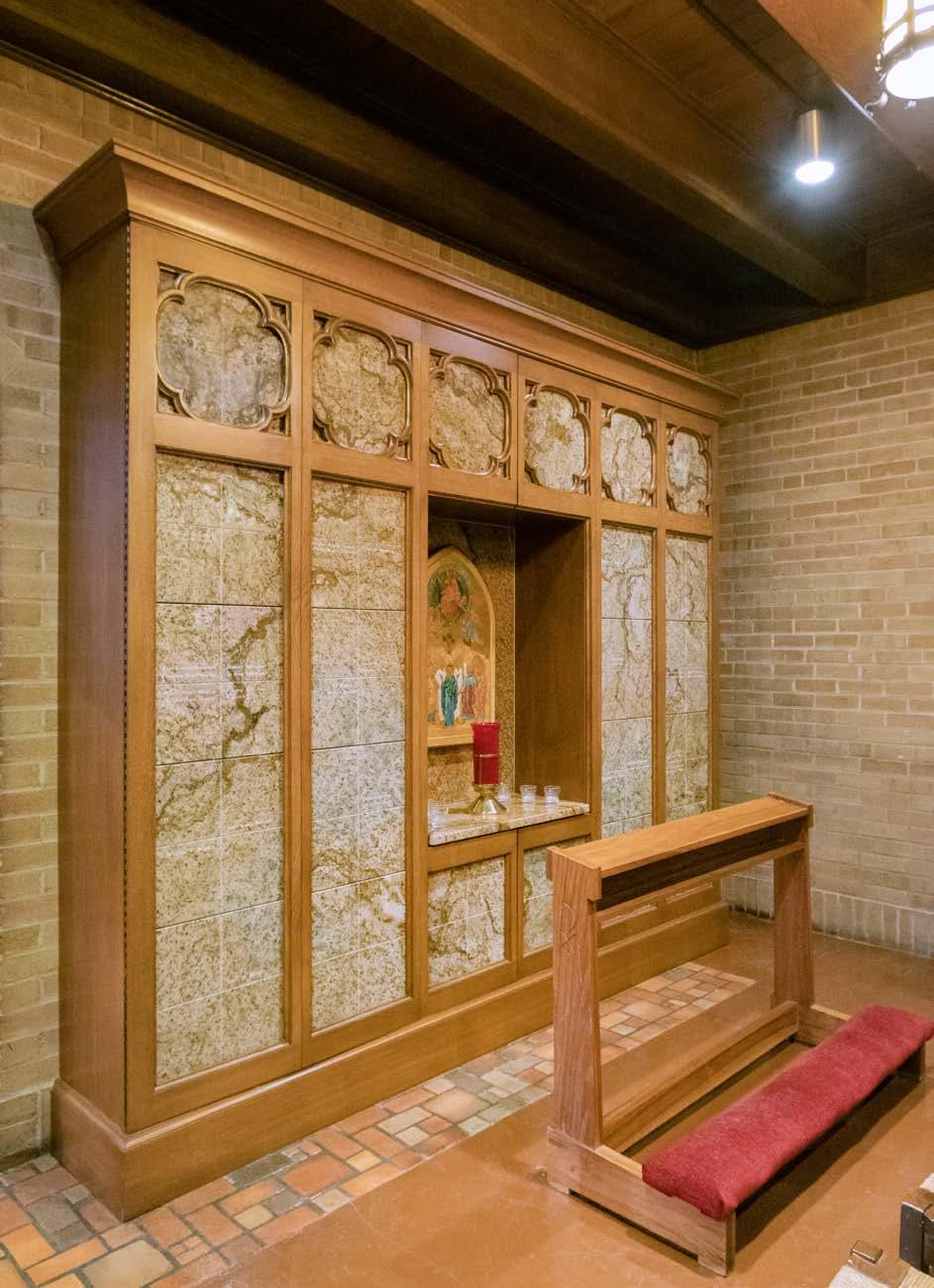
The wood surrounds of this columbarium add warmth to the existing masonry of the church.
Most churches we work with choose to use our smallest niche size, which is nominally 8" x 8" x 12". Though small, an 8" x 8" niche can accommodate two sheet bronze urns, which we sell at an economical price. Two sheet bronze urns, each 5.5" x 5.5" x 7", fit into the niche one behind the other. Churches choose this niche size based on cost, space efficiency, and ease of management. The 8" x 8" uses less material and therefore costs less than a project with the same amount of larger niches. The 8" x 8" is also incredibly space efficient. Only four of our larger 12" x 12" niches fit in a 2' x 2' space, but you can get nine 8" x 8" niches in that same footprint. When you multiply that over several feet, the numbers quickly add up. In a 4' x 8' space (the standard size of a piece of plywood), the ratio goes up to 32 - 12" x 12" and 72 - 8" x 8". In a wall that is twelve feet long by six feet tall, 162 - 8" x 8" niches could be installed, but only 72 - 12" x 12". Price and efficiency are important, but ease of management makes our 8" x 8" niches the most popular choice.
Urn options are infinite. In our 35+ years we have seen everything from urns shaped like fast food restaurants, urns made to be full-scale bald eagles, and urns with thick, decorative wood walls. It is impossible to have one niche size that could accommodate every type of urn imaginable. When you choose to offer only 8" x 8" niches, only the sheet bronze urn can be used. Communicating this clearly will prevent the unfortunate event of someone bringing an urn that won't fit.
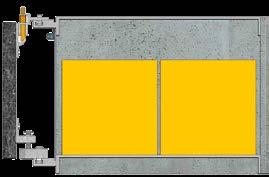
Sheet Bronze Urns in Niches
Side view illustrations of two sheet bronze urns in an 8" x 8" niche and a 12" x 12" niche.
In the 8" x 8" niche the urns are placed horizontally. For the 12" x 12" niche the urns fit vertically.
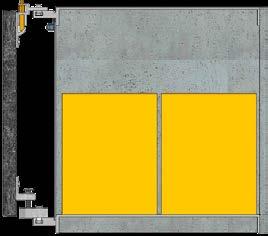
If your church wants to allow a wider variety of urn sizes, we recommend the 12" x 12" niche. The 12" x 12" will accommodate two vase style urns that are up to 10" high x 6" wide. This size requires a little more management and education of your church members, but it is possible.
We also offer customizable niche sizes. For example, we have created "family" niches that are 12" x 24" and accommodate up to five urns. We have also created niches that are 10" x 10", 12" x 8", and many other unique sizes.
Can't decide on a niche size? You can choose more than one size for your columbarium. The mix of sizes can create a unique visual appeal and also give your congregation a variety of options and price points. Most churches that incorporate multiple niche sizes into their columbarium choose mostly 8" x 8" niches (around 75%) and fewer 12" x 12" niches (around 25%). We have also completed several projects with three or more different niche sizes. See the top photo on page 45 for a project that utilizes a variety of niche sizes.
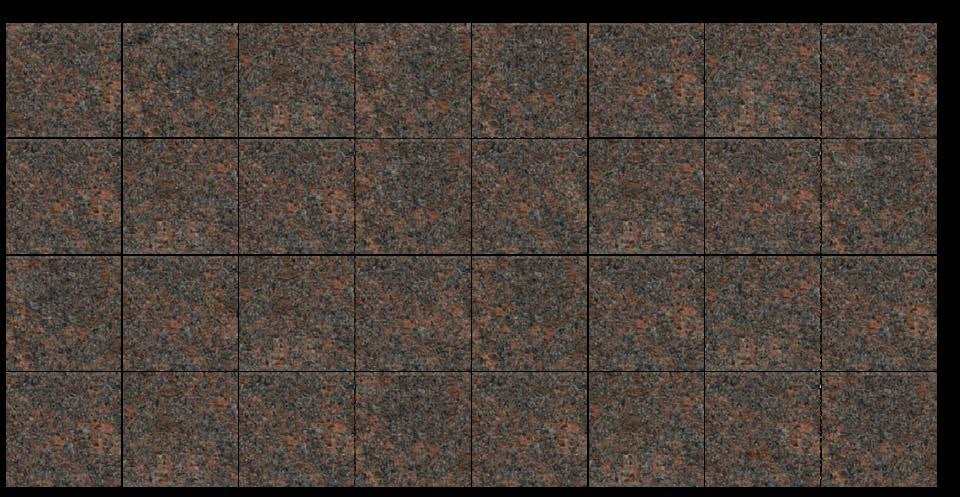
12" x 12" niches fit into a 4' x 8' space.
There are many ways to adorn your columbarium and memorial space. By adding things such as benches or a memorial wall, you can create a space that is meaningful to your congregation. These custom options will make your columbarium truly unique to your church.
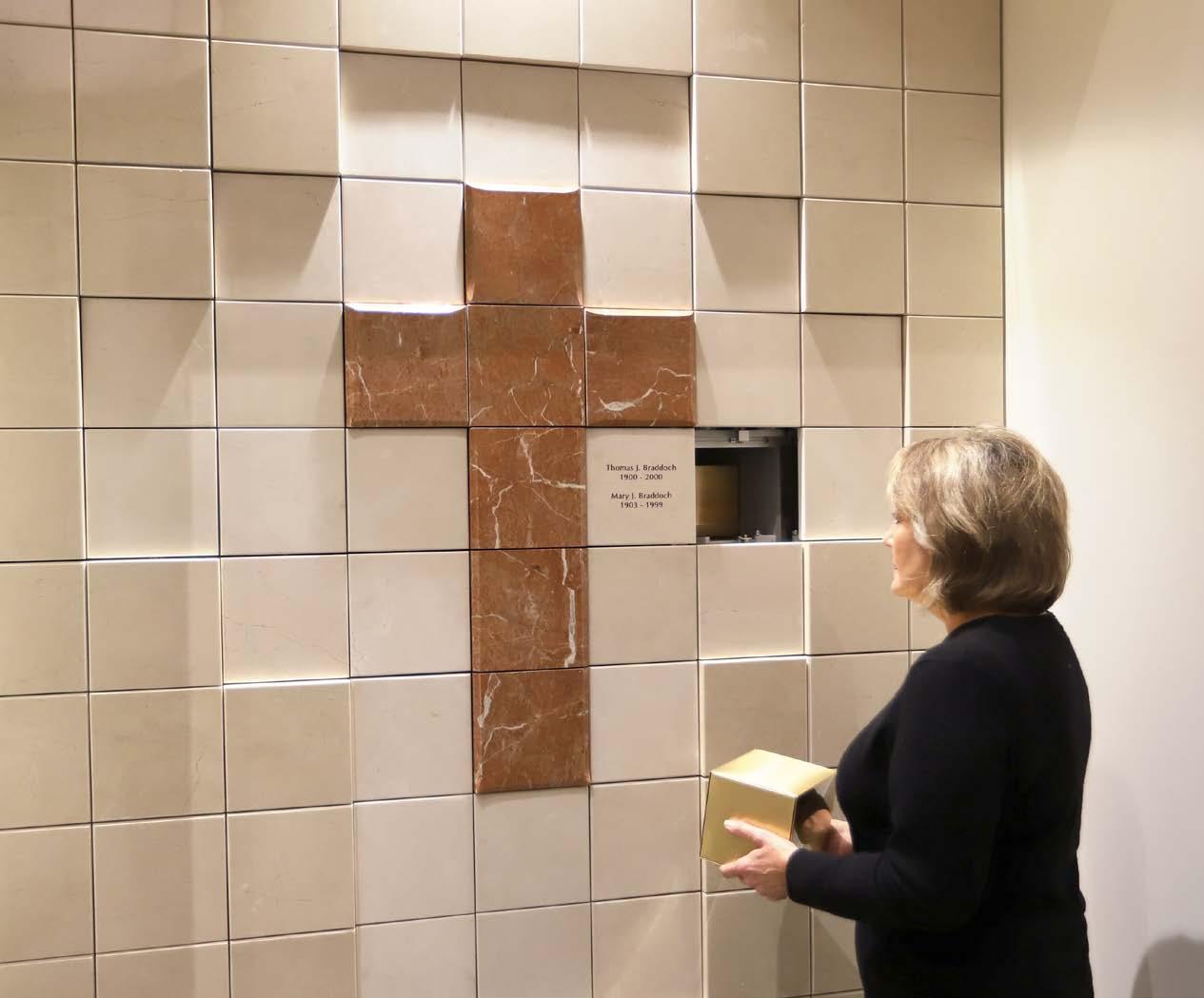
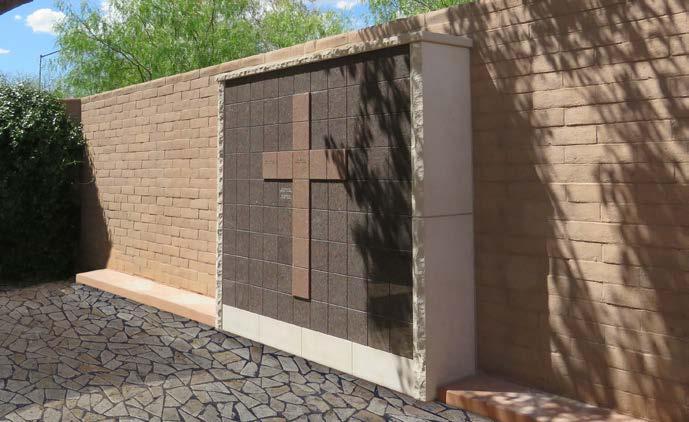
Our Raised Cross feature for custom columbarium walls is a popular design embellishment for good reason. With this design, we utilize thicker niche fronts for the cross, which protrude beyond the rest of the niche fronts. Not only is it a beautiful feat of design, but it also carries a lot of significance.
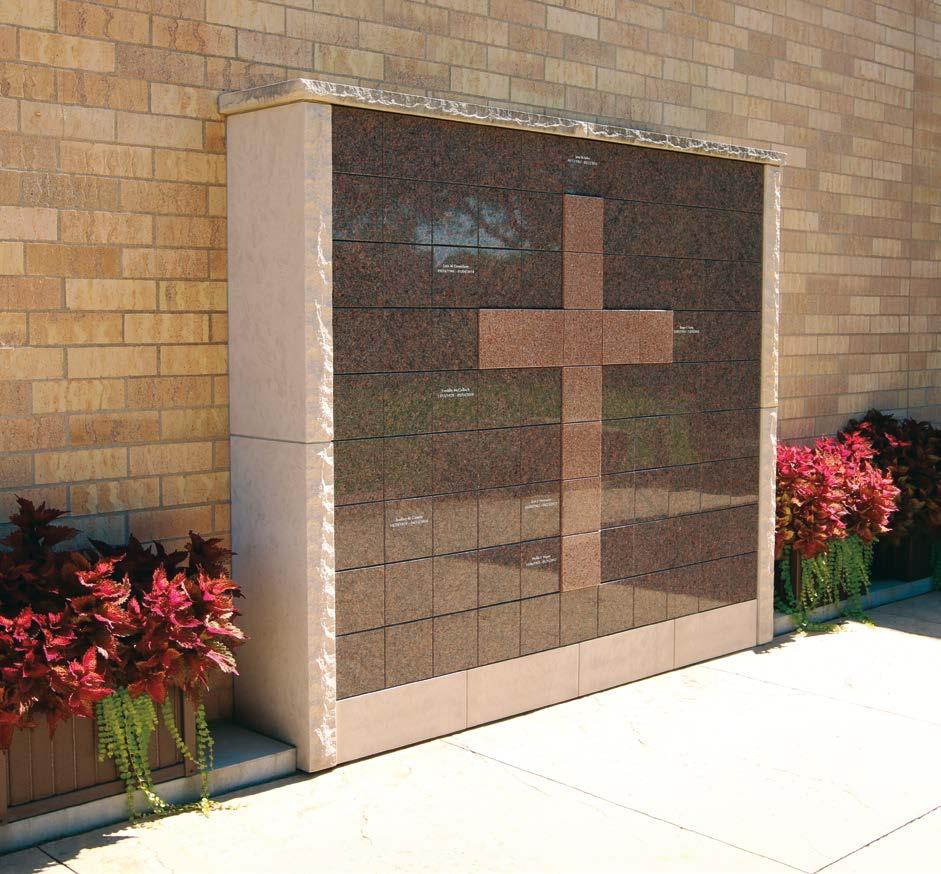
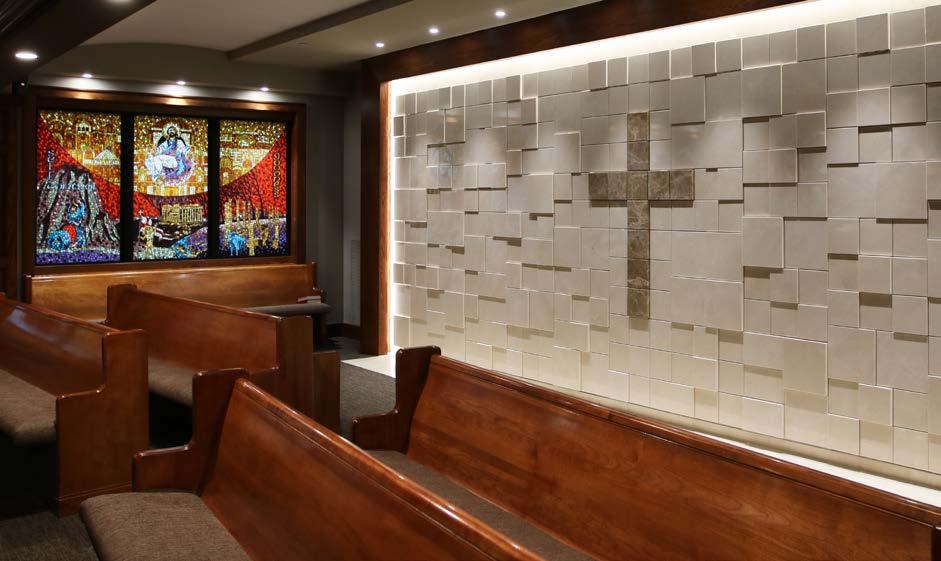
Pictured is our Niches as Sculpture design with our Raised Cross feature at the center. This columbarium has a variety of niche sizes and the niche fronts have varying thicknesses in order to create a sculptural effect.
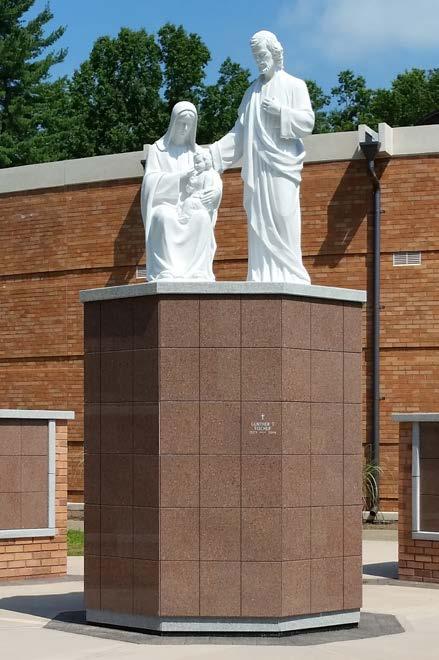
The addition of a statue to the top of a Pre-Assembled columbarium adds style and meaning. Some of our columbarium models were designed specifically with statues in mind.
We partner with an Italian company that creates elegant, long-lasting fiberglass statues. Other statues may work with our columbarium models. The height, width, and material of the statue all play an important role in the feasibility of placing it onto one of our columbaria. It is best to have this conversation early in the design process so that all of these factors can be taken into account.
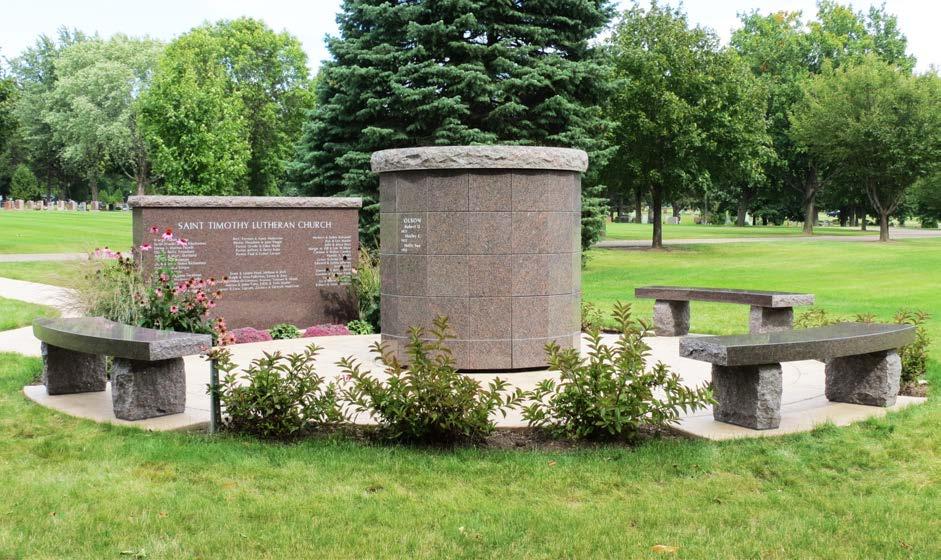
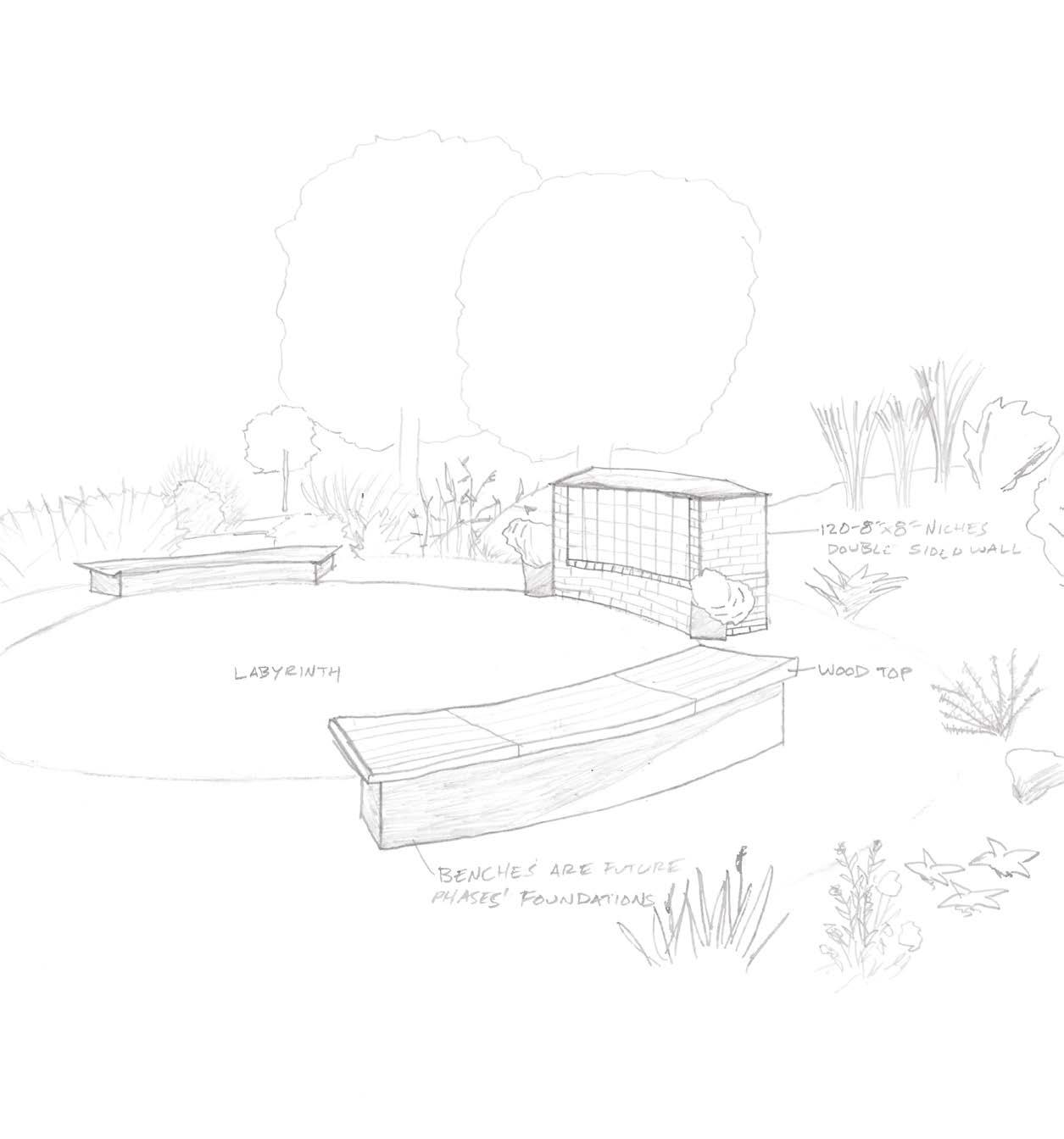
Benches and a matching memorial wall will make your memorial space cohesive.
Time and again we have heard from our customers that people like benches by their columbaria so visitors can sit and reflect in the memorial space. Niches with benches near them are more popular and sell more quickly than niches without them. Benches can be ordered in the same stone as your columbarium in two standard designs: straight and curved. Other designs are available upon request. We recommend making a plan for some seating in your memorial space whether or not you order benches with us. It adds value to your space that will increase the sale of your niches.
While niche fronts are inscribed to memorialize the individual(s) whose remains are inside the niche, there are additional ways that people can be honored on and around the columbarium. Memorial walls, panels, and bands are some of the seamless ways this is achieved, and these elements can be designed by us to coordinate beautifully with your columbarium project. Donors who helped fund the columbarium project could also be honored in this way. We’ve also seen many churches use memorial walls and memorial bands as an opportunity to display a piece of scripture or a quote that has special significance to their church.
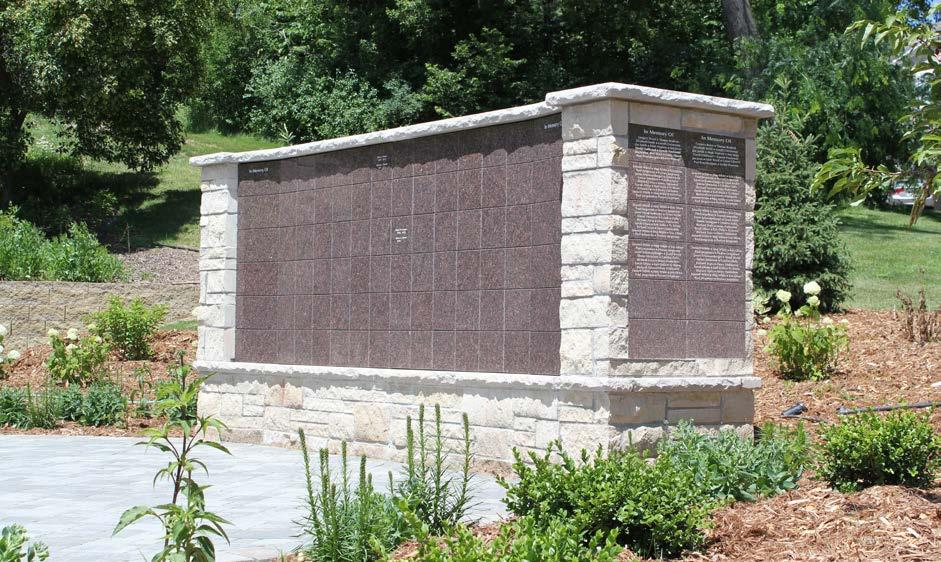
Memorial panels can take many forms. The end panels of this columbarium are the perfect place to honor and memorialize the lives of those who are interred elsewhere.
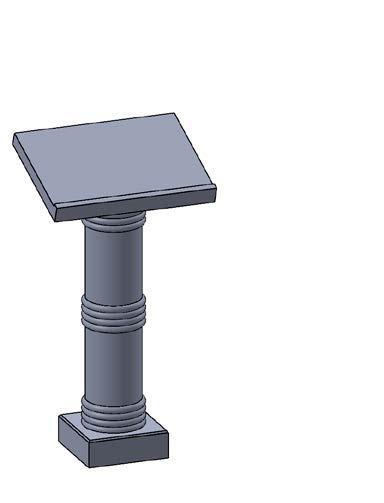
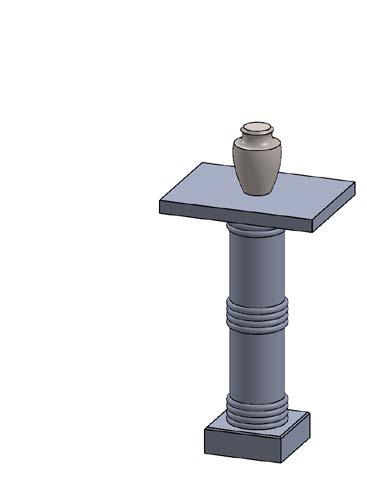
Elevate your memorial services and columbarium space by incorporating an elegant lectern and urn display. Both are available in granite, thoughtfully sourced from North American quarries, to perfectly complement your columbarium. Please contact us for current pricing.



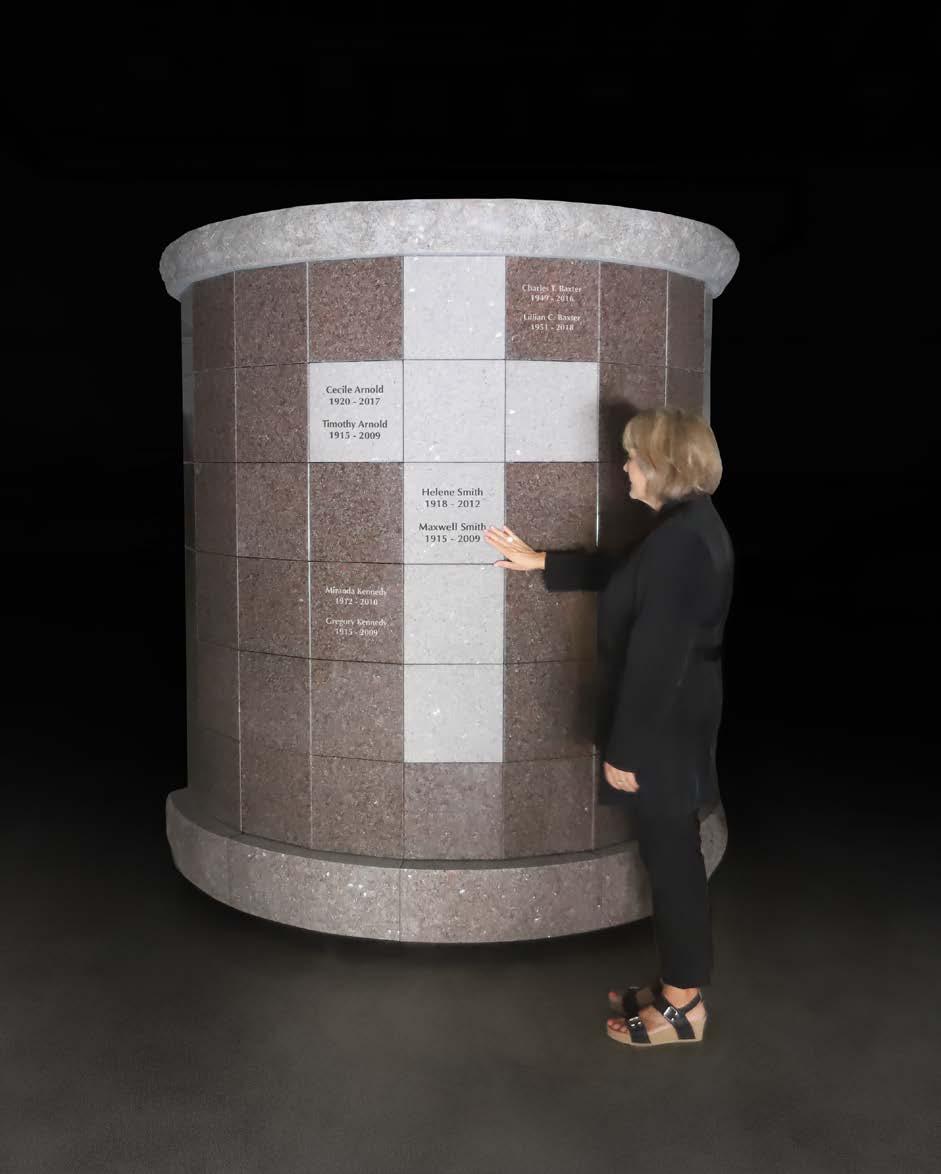
Contrasting Cross for Pre-Assembled Columbaria
Celebrate faith with our new Contrasting Cross design for Pre-Assembled columbaria. This feature can be added to the Winchester, Canterbury or York. Please contact us for current pricing.
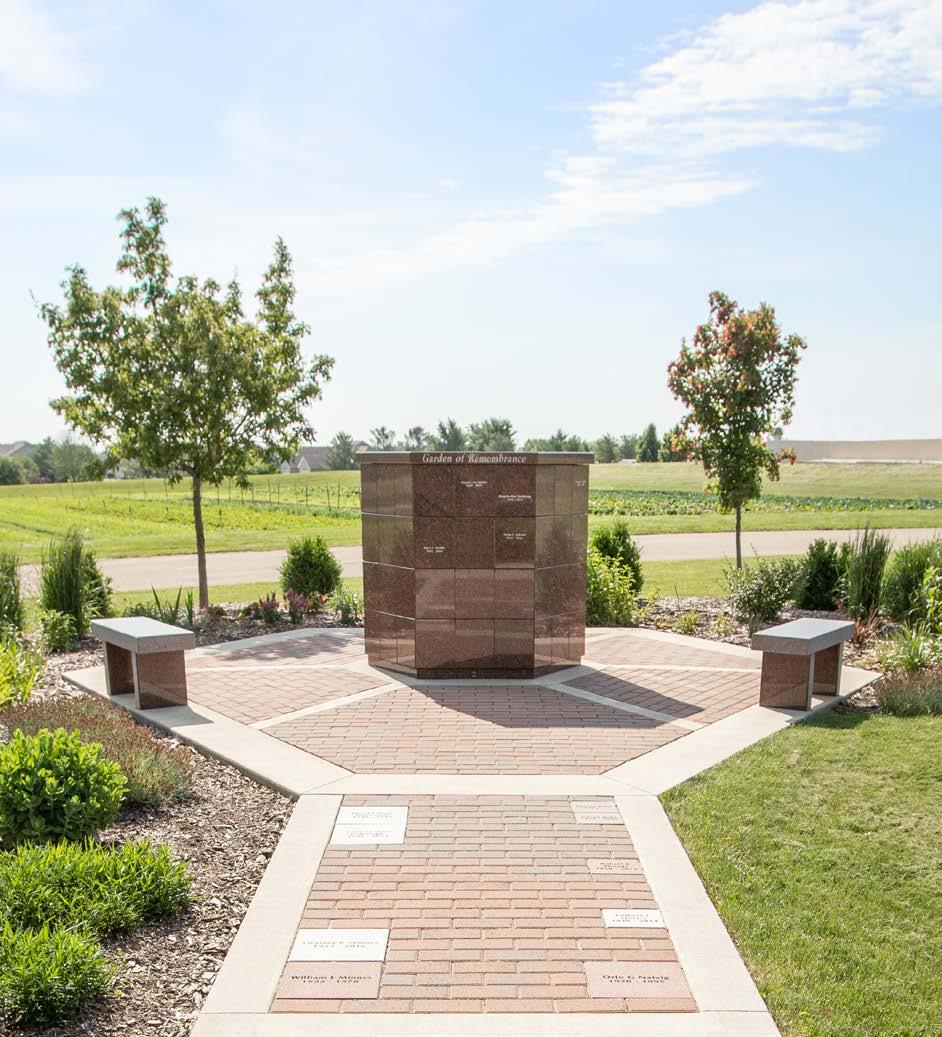
We’ve had customers implement many more features into their columbarium projects, including water features and lights. The options are endless and can enrich the memorial space. It is important to keep in mind that these elements can make the project more complicated and require more future maintenance. While we understand how these details create a more attractive memorial space, our expertise lies in columbarium design.
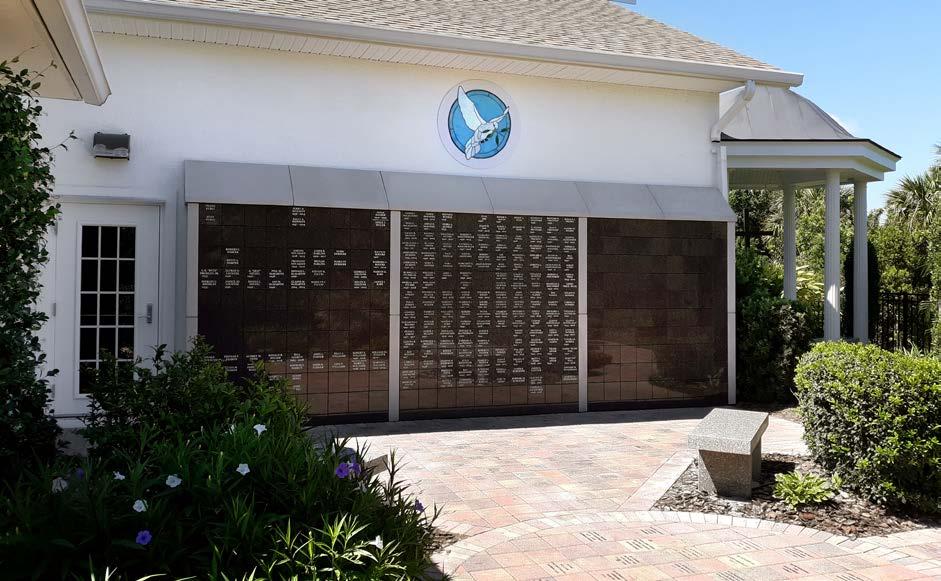
While you plan for your first columbarium there are a couple of other items to arrange for. The groundwork you lay today will help things go smoothly for your church in the future.
Additional Columbaria
Every year we install many second, third, and even seventh phase projects at churches. Churches are often surprised by the overwhelmingly positive response they receive from their congregation in regard to their first columbarium. On several occasions we have had a church order their second columbarium before we even installed the first one! Therefore, we highly recommend that you have a plan in mind for your second or even third columbarium as you make arrangements for your first one. Having a plan shows your congregation that your church is forward thinking, intends to grow, and values the columbarium project. It may take your church twenty years to be ready for the next columbarium, but if thoughtful planning is done today, it will be a gift for those who are there in the future. Through experience, we have found that the ideal time to order your next columbarium is when about half of the previous phase has sold out.
This church had foundations poured for future phases at the same time as their first phase columbarium. The foundations are currently serving as benches until the church is ready for their next columbarium.
It is helpful to have a plan for future columbaria before it’s time to install the foundation for your first columbarium. This way, you can have all of the foundations poured at the same time and avoid interruption of your columbarium site in the future. Our customers have utilized future phase foundations in beautiful and creative ways. Some use their foundations as benches until their next phase needs to be installed. Others have decorated the foundations with plantings and flowers. These ideas make memorial spaces look complete during each and every phase.
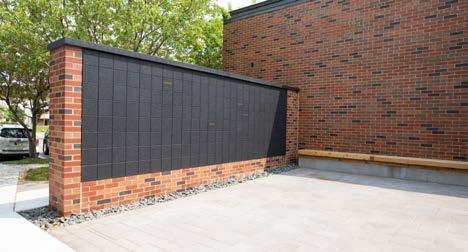
This church has a foundation poured for a future phase that is currently being utilized as a bench.
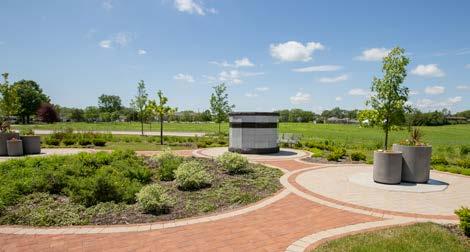
Attractive planters have been placed on two existing foundations for future phases. A similar example can be found on page 44.
As you begin the design process you will need to develop marketing materials for the columbarium. This chapter touches on many great ideas for materials which will help the congregation understand what the columbarium at your church will be. Some should be put together early in the process while others do not need to be completed until you are ready to start selling the niches.
The most important piece of the marketing puzzle is to determine who will be the point of contact for the congregation on behalf of the columbarium committee. There needs to be one person, or at most two people, who will be the go-to person for all columbarium-related questions. This individual must have the time and energy required for the position. It is best not to choose a clergy member as they are often overwhelmed with other duties.
Whoever you choose, the point of contact should be known to the congregation. Perhaps it could be a present or past staff member. They should also be friendly and have great people skills. Most importantly, your congregation needs to know who to look for when they want to learn more about the columbarium. It would be best for this person to present themselves to the congregation during a service so everyone can put a face to their name.
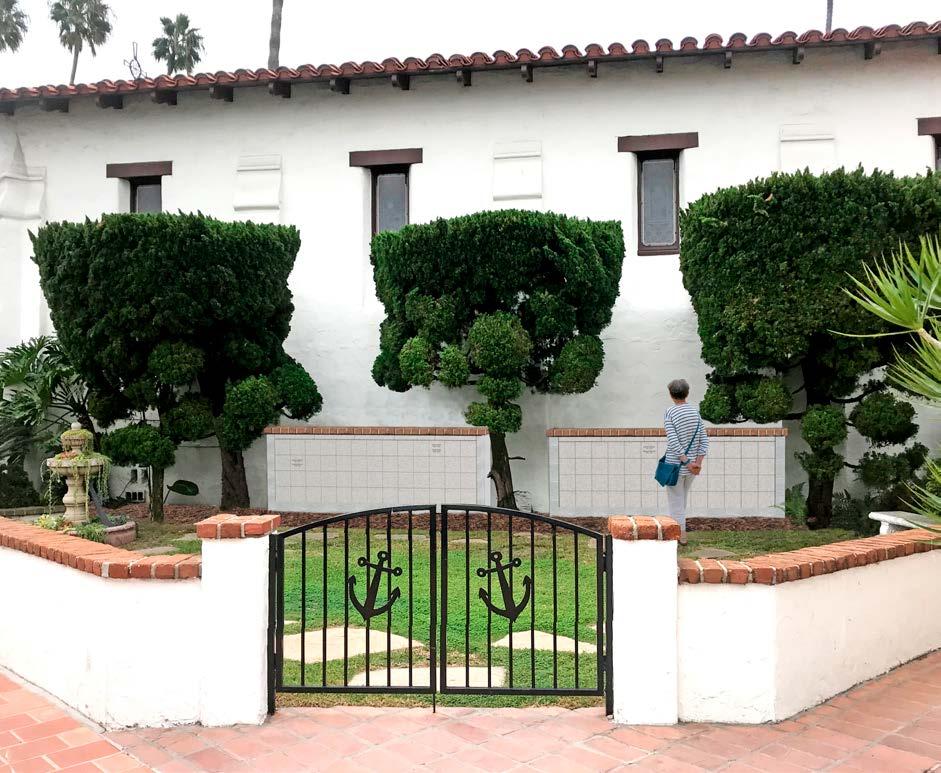
As soon as possible, you should have a visual aid to use when educating your congregation. This can be a photo of a similar project, a preliminary drawing, or a rendering. If your design is nearly finalized, we can create a rendering for a fee. A visual aid is highly effective and can be used in a variety of settings. Use it to promote the columbarium on your bulletin board, weekly church bulletin or newsletter, website, and as a poster on your tabletop display.
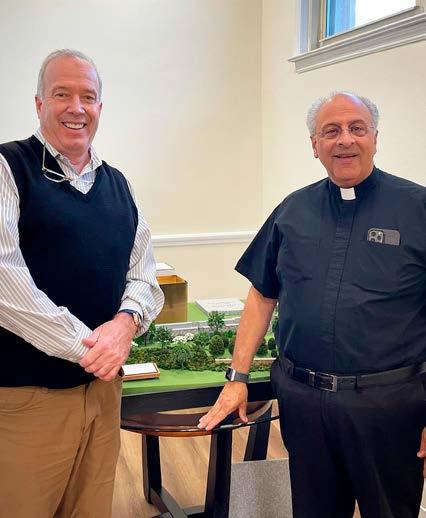
A tabletop display will likely be your most viewed marketing piece for your columbarium. You will need a small table located in the narthex, fellowship hall, or another high traffic area of the church. Start simply, perhaps with the visual aid printed on a poster board. As you get closer to pre-selling the niches you can add more materials such as a sample urn, brochures, information packets, and a sample niche front. Your columbarium marketing point of contact (or another member of the columbarium committee) should be at the table before and after services to answer questions. Some churches choose to leave the display up until they have completed pre-selling. Others disassemble and reassemble their display each Sunday.
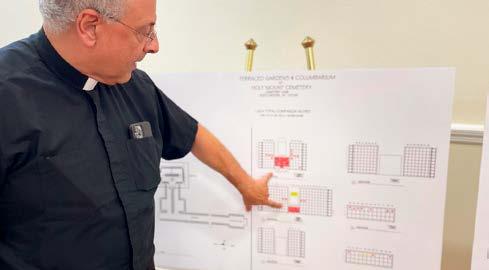
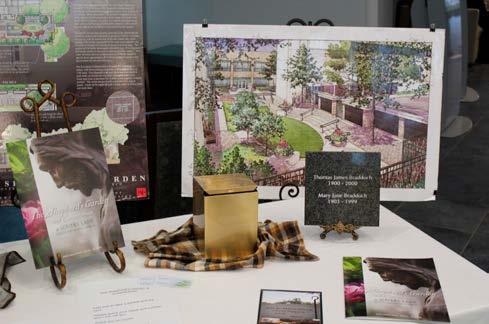
Large elevation prints for niche selection, sample inscriptions, and sheet bronze urns are also on display for prospective clients.
We are happy to provide samples to assist with your pre-selling. Upon request we can send your church a sheet bronze urn; two of these fit inside each of our niches. If you have selected the type of stone for your columbarium, we can send a sample niche front with inscription. The sample niche front will need to be returned after your pre-selling is completed.

A web page for your columbarium is one of the most effective marketing tools your church can utilize. This can be a central resource for all information related to the columbarium. While it is important to have physical components available for your congregation, such as the tabletop display and information packets (more on this on page 55), a web page gives your congregation access to information even when they are away from the church. A web page is vital after you have installed the columbarium and if you are offering niches to the greater community.
Initially, it is important to include the contact information for the point of contact, a visual of the proposed columbarium, and information about why the church is installing one. You can have relevant documents available to download, such as a brochure, the application for inurnment, and the rules and regulations governing the columbarium. All of the marketing materials we outline in the remainder of this chapter can be placed on your church’s website. You’ll want to continue marketing your columbarium and selling niches after pre-selling which is why a web page is a valuable marketing tool.
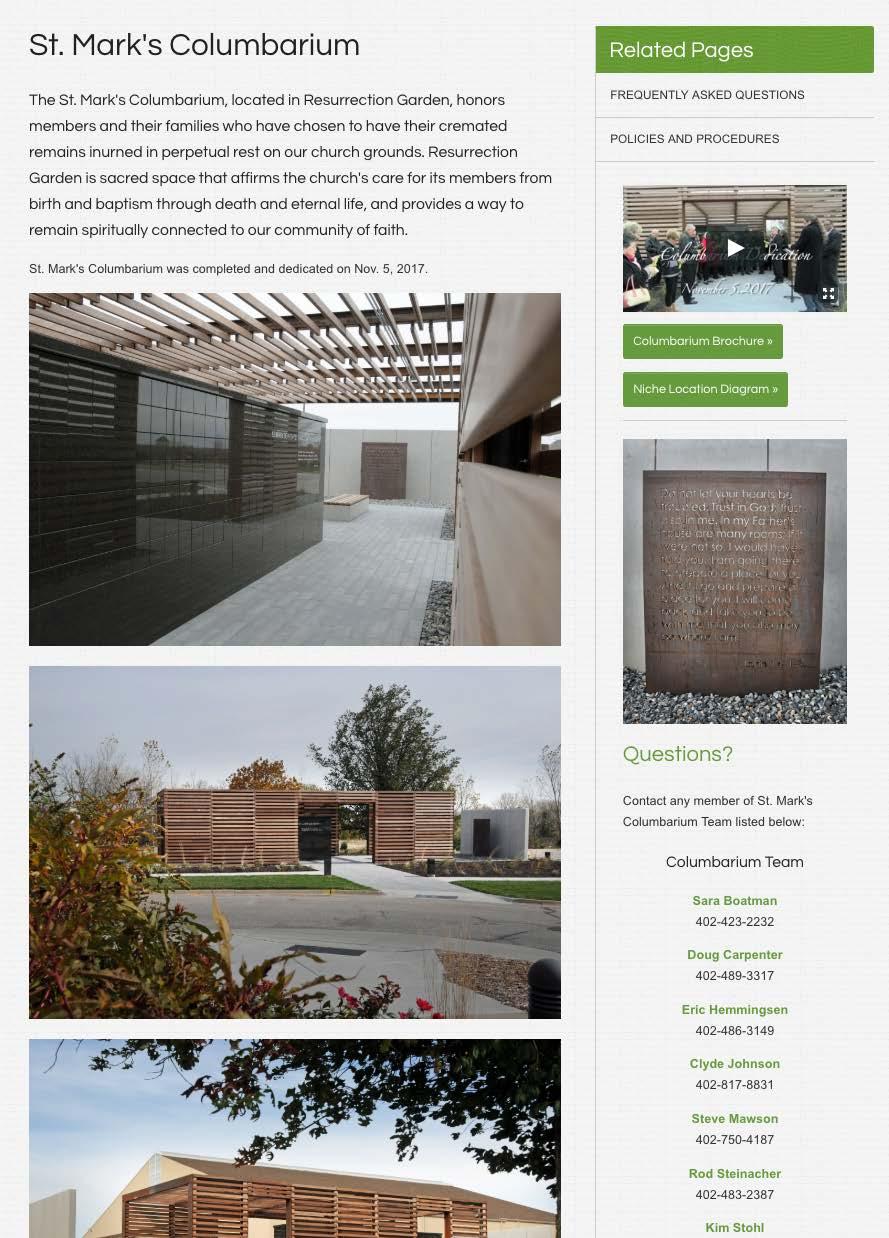
St. Mark’s United Methodist Church has a thorough columbarium web page: www.stmarks.org/columbarium
A columbarium packet is one of the largest marketing endeavors, yet it's a highly successful tool. The packet is a folder containing all the information a prospective niche purchaser needs, including:
• letter from the committee chair or clergy
• niche pricing sheet
• niche layout map
• detailed brochure
• glossary
• simple site plan or aerial map showing the columbarium's location
• application for inurnment
• rules and regulations
We can provide examples of this information, and if you choose Eickhof as your columbarium manufacturer we can provide you with complimentary Microsoft Word templates of many of these items. Some of our customers have hired a professional graphic designer to complete this work for them. It’s not required to put together a packet, but your church should have these items readily available to your congregation in some format. We will go over these items in more detail below.
Letter
A letter from the committee chair or clergy welcomes the church member to the packet and to the idea of the columbarium.
Pricing Sheet
This should be included if you are offering niches at more than one price. (More about pricing your niches on page 65.)
Niche Layout Map
A niche layout map shows where each niche is located in your columbarium.
We have seen a wide range of successful brochures, from simple one-page pamphlets, to more elaborate ten-page booklets. Whichever type is appropriate for your church, there is some basic information you should include:
• A visual aid
• What a columbarium is
• Why the church is installing one
• Cremation statistics
• Relevant scripture
• FAQ
• Contact information
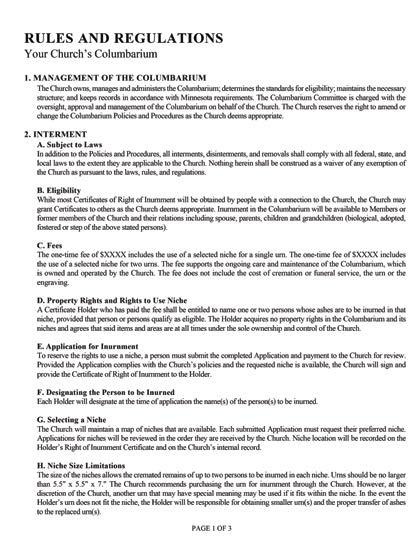
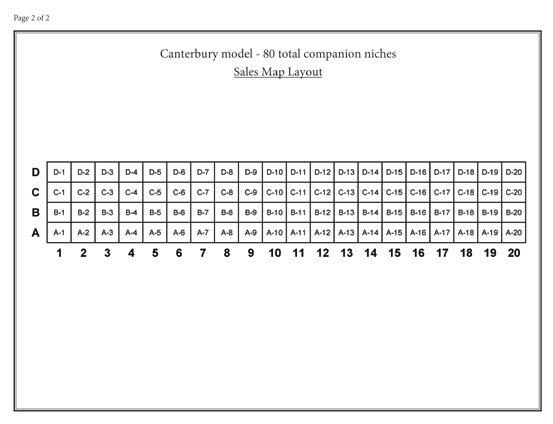
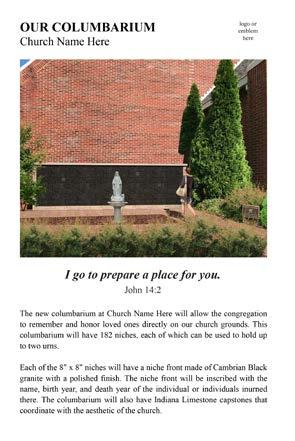
If you choose Eickhof as your columbarium manufacturer we have complimentary templates to assist you.
Glossary
Since columbaria are new to many, a glossary of key terms, such as “niche” and “inurnment,” is useful.
Site Plan or Aerial Map
A site plan or aerial map can be helpful to show members where the columbarium will be located on your church’s property.
This form will allow individuals to request a niche.
This is not the most enjoyable part of the packet, but it is necessary. See the Appendix for an example. Feel free to use this as a guide, but it is important that your church uses rules and regulations that are appropriate for you and your community of faith. More information can be found on page 93. It may not be necessary, but we do suggest that a lawyer reviews your document prior to publication.
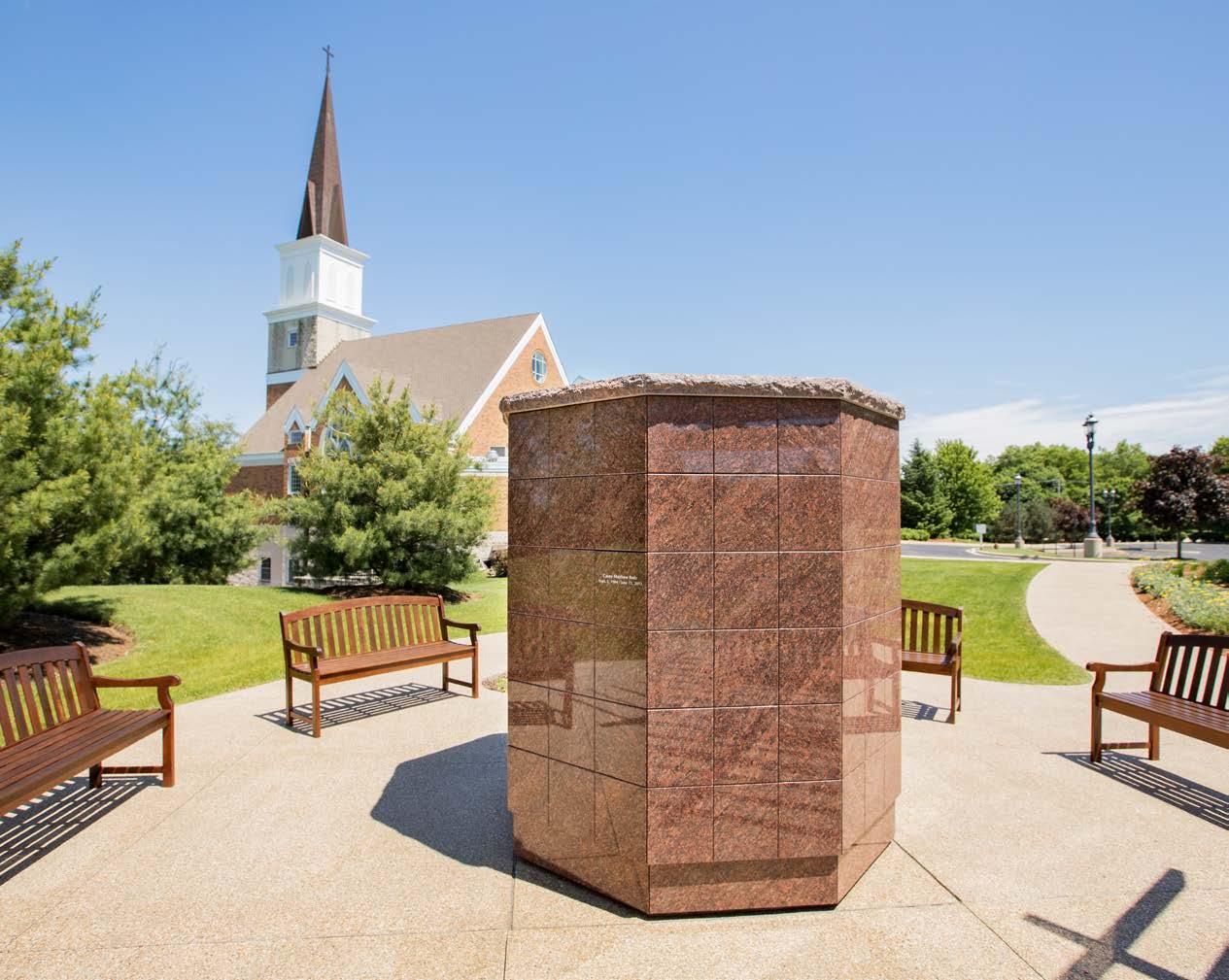
A Lutheran pastor we worked with couldn’t have said it better: “Last time I checked, the death rate was 100%.” We all will die and we must plan for that day. Unfortunately, few people have complete plans for end-of-life. A plan is not, “I want to be cremated.” Who will provide cremation services? Who will perform your funeral ceremony? Where will your final resting place be? Who will be responsible for all the arrangements? These are a few of the many questions that are best answered when death is still a safe distance away. The church may be the best place to begin these difficult but important conversations.
continued
We have found that many churches already engage their congregation in these important questions, but if your church has not, a Sunday Adult Forum focused on death and dying can be a vital educational series for all adult members of your congregation. This gives your members an opportunity to understand the wisdom of pre-planning their funeral and final disposition. On the opposite page is an example of a five-week outline.
A letter to your congregation members is a way to educate them about the columbarium while confirming interest. Take the opportunity to request a deposit from those who are interested; this is more effective than a verbal commitment. The deposit from congregation members can be used towards the initial down payment for the columbarium. By getting people to commit to the project in its developing stages, you'll build the momentum needed to bring the project to completion with ease.
Once you have the design of your columbarium near completion and some marketing materials ready, the next educational piece is to schedule the first columbarium information session or “Columbarium Open House.”
We have found that holding three sessions over 2–3 months is effective. The first session should take place one month before you are ready to start pre-selling. The following two should occur once your columbarium design is finalized and you are ready to pre-sell. All three sessions will follow the same outline. Start each session with why the church is installing a columbarium: the religious importance, the rise in cremation, etc. Next, present the plans for the columbarium: where it will be located, what it will look like, and when you hope to begin construction. Then, go over some of the items in your columbarium packet: the cost per niche, who to contact for more information, etc. For the second and third sessions your design should be finalized and you can explain how to reserve a niche. End each session with time for questions.
Join us for a new Sunday morning forum, “Living and Dying: Dilemmas Facing the Modern Age.” We invite you to bring your questions, concerns, and opinions as we navigate these difficult topics together. We will explore how we can best prepare ourselves and our loved ones to face the life and death decisions that will come to all of us.
Week One: Prolong Life or Prolonged Death?
Speakers: Medical professionals, church leader
Can this premature child be saved? Who should get this heart transplant? Should the plug be pulled on this patient? These are some of the ethical questions on the “downside” of medical miracles we have become accustomed to. How should we, as Christians, approach these dilemmas and other questions that new medical advances raise?
Week Two: Trusts and Wills
Speakers: Local trust attorney
We will discuss basic information about wills, trusts, and other planning devices by which property may be passed at death. We will also discuss “living wills”: your written expression of how you would like to be treated in certain medical conditions.
Week Three: Planning Your Funeral - Part I
Speakers: Local funeral director(s)
Cremation or casket burial?
Week Four: Cremation and Columbaria
Speakers: Columbarium Committee Chairperson
Cremation has now become more popular than casket burial. Hear about the advantages of cremation and why over 1.4 million Americans are cremated each year. This will also be an opportunity to learn about our current plans for our columbarium (repository for ashes) from the chair of the committee.
Week Five: Planning Your Funeral - Part II
Speakers: Clergy
Why deny yourself the privilege of making your own testimony of faith at the time of your death? A clergy member will discuss how to plan for a Christian funeral and memorial service.
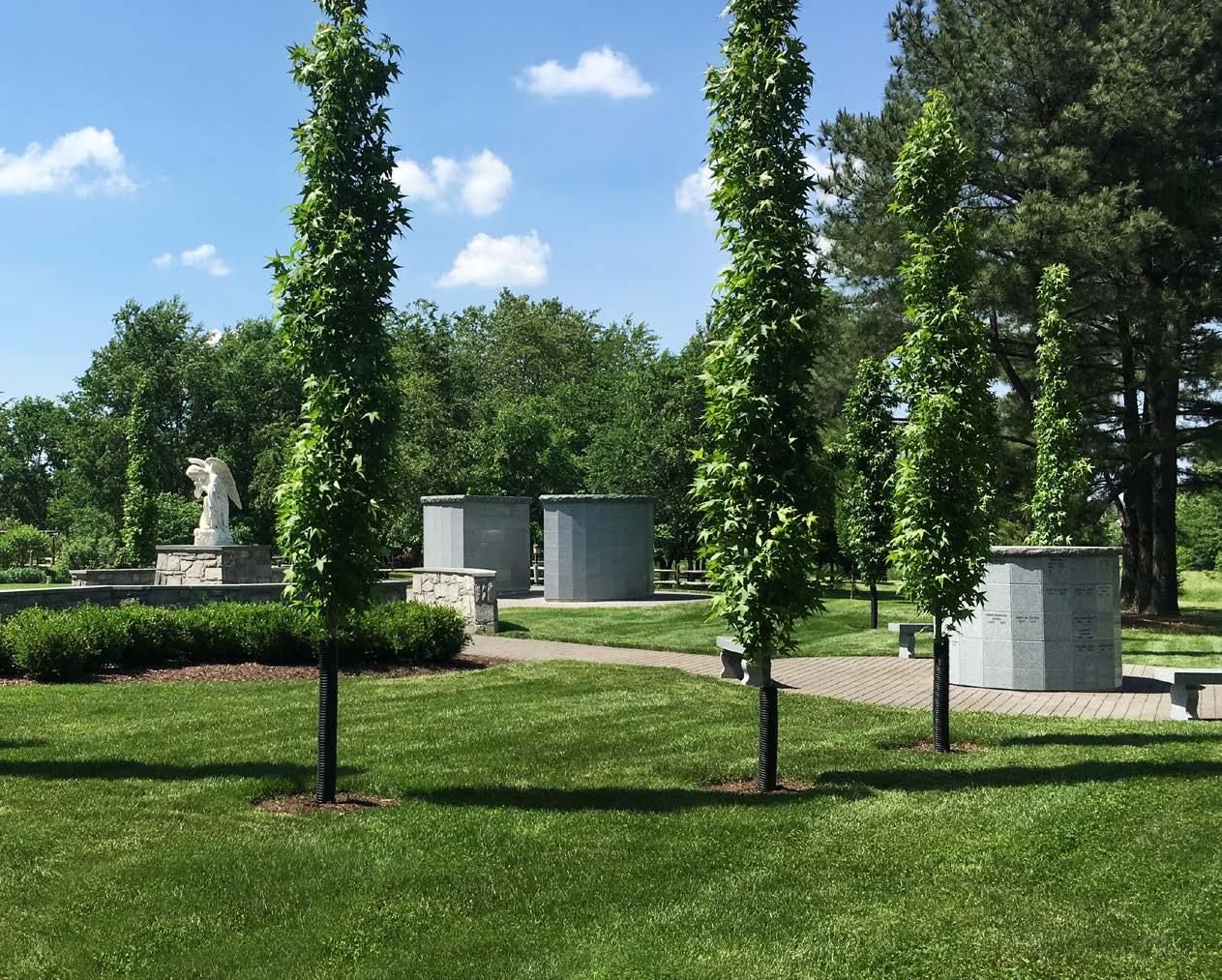
The cost of a columbarium will not be a burden if you are successful at selling your niches. We'll share how to raise all the funds necessary to purchase, install, and maintain your columbarium, including fundraising before the purchase of the memorial (pre-selling) and continuing to sell niches years after your columbarium has been installed. In our decades of experience we have seen our customers use a variety of methods to sell their niches and we are happy to share that knowledge with you.
When you are selling your niches, either before installation or after, every person purchasing a niche will fit into one of three groups: pre-need, at-need, or post-need.
The pre-need group constitutes the majority of a church’s niche sales. This group refers to those who are alive and well, but are planning ahead and making their funeral arrangements before they need them. Interest from this group can be generated during the Sunday Adult Forum outlined in the previous chapter. Purchasing a niche on a pre-need basis will:
• Ease the burden for loved ones
• Guarantee the opportunity to choose a final resting place
• Avoid the risk of no final resting place
• Ensure there are plenty of available niche options
• Avoid a higher niche price in the future
These are individuals who have recently passed, often without adequate pre-planning, and need a place of permanent rest. Individuals in this group do not have the same benefits as the pre-need group.
This is the most widely overlooked group. These are individuals who have been cremated and lack a permanent place of rest. In fact, most cremated remains do not find a final resting place: anywhere from 62%–90% are not inurned in a cemetery, columbarium, or other permanent place of rest. Instead they are scattered, placed in storage, or forgotten. Providing education on the benefits of permanent memorialization will not only help your church sell more niches, it will also be a meaningful service to post-need families. When you reach out to these people, you will be surprised by how many of them have urns sitting at home. We highly encourage you to educate your congregation about post-need inurnment.
Unless you are exceptionally blessed with a donor who will pay for your entire columbarium project, you will need to raise funds for it. We refer to this as pre-selling. Most of our clients have had to pre-sell niches in order to purchase their first columbarium. The good news is that you can learn from their experiences. Some of the information needed to begin pre-selling has already been covered in Chapters 3 and 4.
Before you begin pre-selling, follow the guide in Chapter 4 to hold Sunday Adult Forums and Columbarium Information Sessions. Decide on your point of contact and have them manage the tabletop display before and after services. Talk to church members individually to let them know why you are excited about this project. This level of personal engagement is meaningful and can spur word of mouth amongst the congregation. If you are offering other memorial options for those who are interred elsewhere, such as a memorial wall or pavers, make sure people know about it.
While your columbarium project is gaining interest, you should finalize your columbarium design and obtain pricing from Eickhof. Doing so will help you determine your price per niche and allow you to develop a visual aid for the congregation.
We highly recommend that you offer preconstruction niche pricing that is less than the niche pricing that will be available after the project is completed. This will help you make sales during the pre-selling phase rather than once the columbarium is purchased.
Note: You do not need to pre-sell enough niches to raise 100% of the cost of the project. Depending on your project size, we only require 1/3 to 2/3 as a down payment. Once your order is placed, you will have at least three months until the remainder is due.
Appropriate pricing for your niches is one of the most important components of a successful columbarium project. Pricing varies for all churches, but there are some common qualities amongst the churches that have been the most successful.
Not all niches will be as desirable as others. We have found that the most popular niches are those that are located at heart and eye level. These are considered premium niches and should be priced accordingly. The niches directly above and below eye level are almost as popular. Niches on the bottom row are the most difficult to sell, whether they are 3 inches or 18 inches off the ground. Additionally, if there are any special niches within the wall, like our Raised Cross option or larger niches, those should be offered at a higher price point.
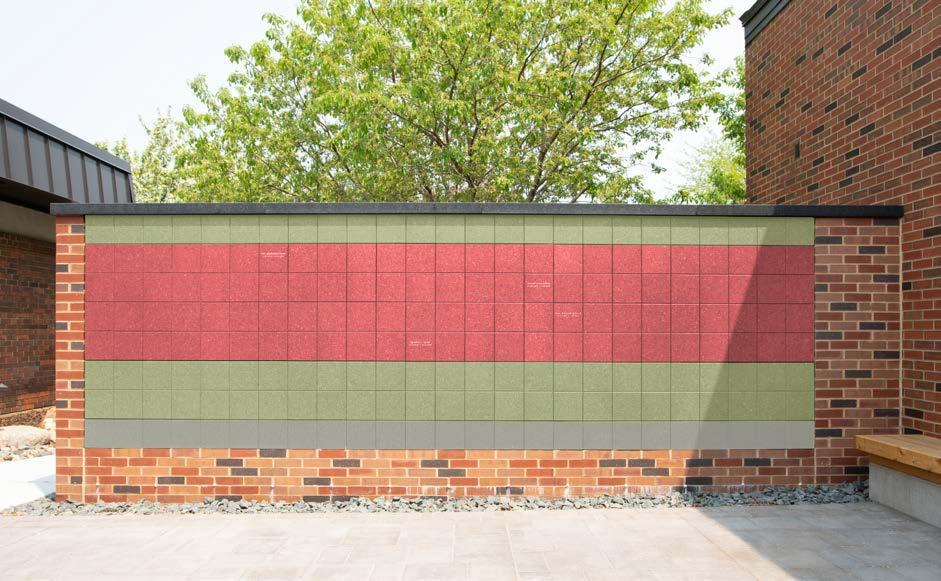
Not all niches are valued the same. Niches at the heart and eye level should be priced higher than other niches.
The wall we built for St. Philip the Deacon Lutheran Church, pictured above, is a great example of niche price distribution. They have four rows at the premium tier (shown in red), three at the second tier (shown in green), and the bottom row (shown in gray).
Some churches sell all of their niches at the same price. This simplifies niche management and creates pricing equality. However, these churches have sold very few niches on the bottom row. Once you decide if you will offer multiple pricing tiers or just one, you can begin looking at the numbers. You can use this formula to determine an appropriate ballpark for your niche price:
TOTAL ESTIMATED COST OF PROJECT
OPERATING COSTS NUMBER OF NICHES columbarium + site work + other expenses opening & closing fee + inscription cost + urns × 4 ÷ +
Nationally the average price per niche is approximately $2,800. However, as previously stated, we suggest tiered pricing. Using the Winchester pictured at the bottom of page 69, we suggest pricing the top two rows at $3,400, the green row at $2,800, and the bottom row at $2,200. We have worked with a wide variety of clients over the years. Large churches such as St. John the Divine in
New York, or Cathedral of Our Lady of the Angels in Los Angeles are able to charge very high prices for a niche, nearing or exceeding $10,000.
Note: The price you set for a niche today should not be the same price you use 10 years from now. Costs increase and your pricing should be adjusted accordingly. Many churches overlook this. We suggest increasing your prices each year by 2%–5%.
What will your price include? We’ve seen three options. First, you can price out everything a la carte: the niche, the urn(s), the inscription, the niche opening and closing, and the perpetual care. This option is advantageous for your church. If someone buys a niche on a pre-need basis today, the cost for inscriptions will increase by the time the need arises. This option spares the church from potentially incurring a loss on inscriptions. The next option is to have one price that includes everything: the niche, the urn(s), the inscription, the niche opening and closing, and the perpetual care. Most churches find that individuals like this price package. The third option is a combination of the first two – for example, there is one price for everything except the inscription, which is paid for at the time of need.
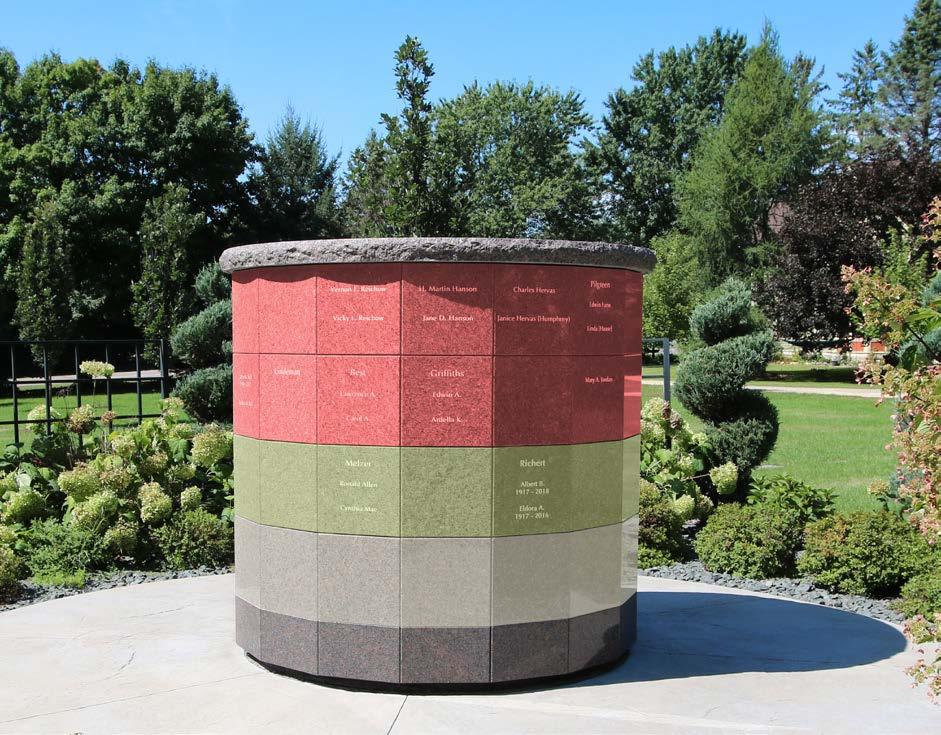
The top two rows of niches on this Winchester columbarium should be priced higher than the other rows.
You will need to decide who is eligible to purchase a niche – current members, past members, staff and clergy, and/or family members of these groups. Some churches make niches available to the larger community and do not limit niches to only those connected to the church. There are some strong advantages to offering niches to everybody. If a non-member purchases a niche from your church, that person’s family and friends now have a connection to your church that they may not have had before. Those individuals may want to become a part of your church and/or purchase their own niche, in turn growing your faith community.
Cremation is much more affordable than casket burial, but there may still be people in your community who struggle to cover all the expenses of a loved one’s death. Raising funds to offer one niche a year to a family in need is a good service to provide. This is a positive way to help promote your columbarium. You could also notify your local news sources about this service in order to generate awareness in your community. If you choose to include the Ossuarium as part of your project, you will be able to afford to simply give away some of the ossuary space. One of the first Ossuarium projects we installed was at a monastery in New York state. The brothers’ mission was to work with homeless men in New York City, often those without any family or means for a proper burial. The monastery used the niches for the brothers and gave the ossuary space to those men in need, giving them an eternal home.
Once you are ready to start selling your niches, you will need a way to keep track of which niches are sold, available, and occupied. Eickhof is proud to offer our customers an efficient way to record this information. Our online, cloud-based Niche Sales Tracker is an easy-to-use service that is available on any device with internet access. Only those with the secure link can view your Niche Sales Tracker. We offer Niche Sales Trackers free of charge to our customers. An example can be found on the following page.
Please email nichesales@eickhofcolumbaria.com with any questions, or call 800-253-0457.
Example of the niche sales tracker for a Winchester Pre-Assembled columbarium.
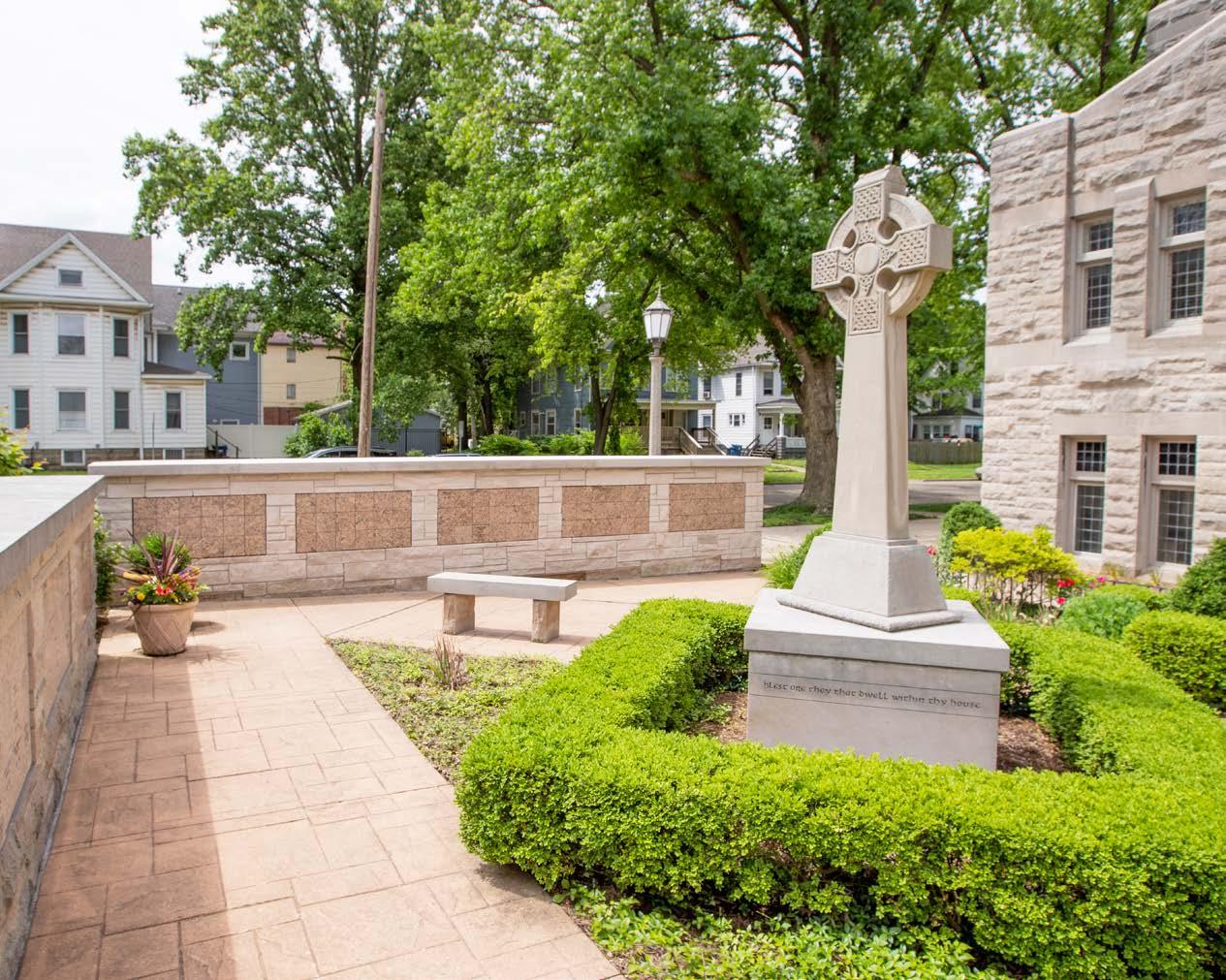
The Final Stretch
You and your committee have put in a great deal of work at this point. What may have started as a simple idea is now nearing a tangible, permanent structure. However, before you place the order for your columbarium, there are a few items to double check.
If you can check off all the applicable questions below, then you are ready to request the paperwork for your columbarium order!
Are the drawings for your project, either from Eickhof or an architect, complete, accurate, and up-to-date?
Is the latest pricing you received from Eickhof accurate and does it include everything you want Eickhof to provide? (Example: Niche fronts, trim, capstones, end panels, benches, etc.)
Have you decided the stone color and finish for all Eickhof provided stone pieces?
Have you decided the exact location the columbarium will be placed?
Do you know if the contract will be with your church or a contractor?
Do you know to whose attention we should send the documents?
Have you decided who will be signing the contract?
Has the governing body of your church (committee, board, diocese, etc.) approved the plan for the columbarium?
Have you obtained an acceptable quote for the foundation?
Have discussed site-access considerations with your Client Guide?
Have building permits been issued by local authorities?
Do you have funds secured for the initial down payment?
Have you sent us your sales/use tax exemption certificate?
Will you return the Contract Documents back to Eickhof within 30 days of receipt?
How to Order Your Columbarium
After you have checked off all of the questions on the previous page, you are ready to request Eickhof's Contract Documents. This will consist of:
• Contract Drawings
• Quote & Terms Sheet
• Deposit Invoice
Your columbarium is not on order until all necessary documents are completed and returned to us.
We will provide you with three sets of drawings of your columbarium. These drawings typically are plotted on 24" x 36" paper, depending on the scale of your project. One set is for your church to keep for your records. One set is for you to provide to the contractor who is preparing your foundation. The third set is for you to review, sign, and return to Eickhof. It is extremely important that you review this drawing closely, as it shows exactly what we will be building.
The next document is the Quote & Terms Sheet. This is the contract. It lays out exactly what Eickhof will be providing, the price, and the payment terms. Please review, sign, and return this to Eickhof.
We require a down payment to begin your order. Projects under $50,000 typically require a two-thirds down payment. The remaining one-third is due prior to installation. Projects over $50,000 typically require a one-third down payment. Another one-third payment is due prior to installation and the remaining one-third is due after installation. These terms are negotiable.
We will not begin your order until all Contract Documents are complete and we receive your deposit via physical check, bank wire transfer, or our online payment methods. The executed Contract Drawings and Quote & Terms Sheet can be scanned and submitted electronically, or physically mailed. If facing time constraints, electronic submission will generally be the preferred option. We cannot place your order in our production queue until all of the items are successfully received by Eickhof Columbaria. Again, these items include:
• Signed Contract Drawings
• Signed Quote & Terms Sheet
• Payment Received by Eickhof, per the Deposit Invoice
We ask that you return these documents within 30 days of receipt of these items. Should they be in your possession for more than 30 days, Eickhof does reserve the right to void said documents.
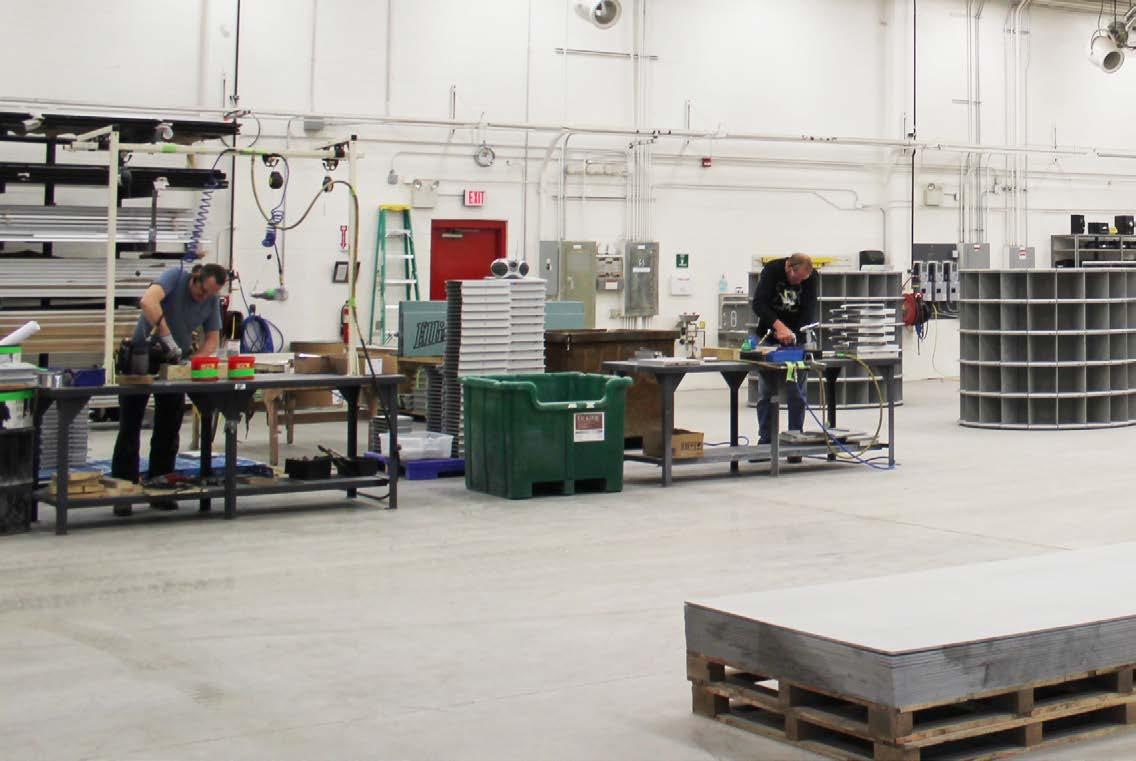
Good things take time and our columbaria are no exception. Our lead time can vary depending on several factors. Typically, it is 18–22 weeks (4–5 months), but at times it has been up to 39 weeks (9 months). Please consult your Eickhof representative for our current lead time. Quality cannot be rushed. Each of our columbaria, including our Pre-Assembled models, are built to order. Stone for each project is ordered from the quarry and that can be the longest portion of the lead time.
During this lead time there are some things the church will need to prepare. For exterior projects the most important thing to complete is the foundation. In the past, some customers have waited too long to install their foundation and were not ready for us to deliver their columbarium. We usually deliver several different customer projects on the same trip. Your lead time could become shorter if others aren’t ready for their columbarium, which happens often. Again, please contact us for our current lead time.
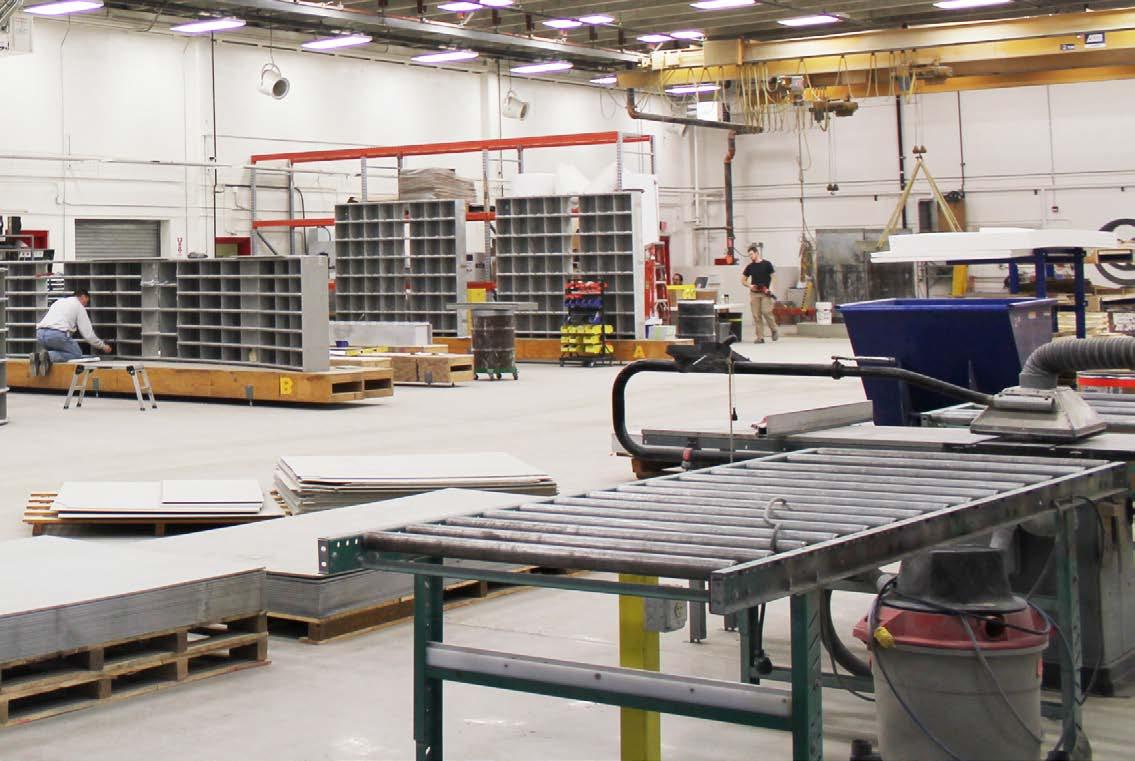
For exterior projects a foundation is required. Eickhof provides detailed foundation suggestions for each exterior project, including estimated weight with full urn capacity. The exact foundation requirements must be determined by a local professional to adhere to local building codes and local soil conditions.
We recommend arranging the preparation of your foundation immediately after your Order is Confirmed with Eickhof. This will ensure prompt delivery and smooth installation. We cannot deliver and install your columbarium without a completed foundation. It is perfectly acceptable to have your foundation installed two months prior to delivery. If you are two weeks late pouring your foundation, for example, it could take another month or two for you to receive your columbarium. All of our delivery trips are planned in advance and delivery is dependent upon a completed foundation.
Unforeseen circumstances can also hinder the installation of your columbarium. For example, a member of your team tasked with coordinating the foundation pouring may require an unexpected surgery. Their recovery could completely halt the preparation of your foundation and your site would be deemed unfit for delivery and installation.
Consider installing foundations for additional phases when installing your foundation for phase one. This will make installation of your future phases less obtrusive to your site. There are several ways to make future foundations blend seamlessly into the site, such as turning them into benches or placing planters on them. See page 51 for examples.
Foundations must be smooth, flat, and level. We cannot stress this enough.
Depending on the type of columbarium you are ordering, the installation process can take a couple hours or several days. Our Pre-Assembled models are the quickest to install, as there is minimal on-site work to be done on our end. Once we arrive with our truck and the crane is put in place, the columbarium is attached to the crane and then guided and set onto the foundation.
Custom wall columbaria take more time and effort to install, but the process is efficient. Each wall has already been built in our manufacturing facility and is reassembled on-site. A project like First United Methodist Church in Enid, OK (as seen on page 80) may take one and a half days for us to install our portion of the project. Niches are placed on the foundation by hand in sections. A project such as the one in Enid is comprised of three sections, which are attached together and secured to the foundation. Then the capstone is attached, utilizing a fork-lift. Lastly, the closure panels and niche fronts are attached.
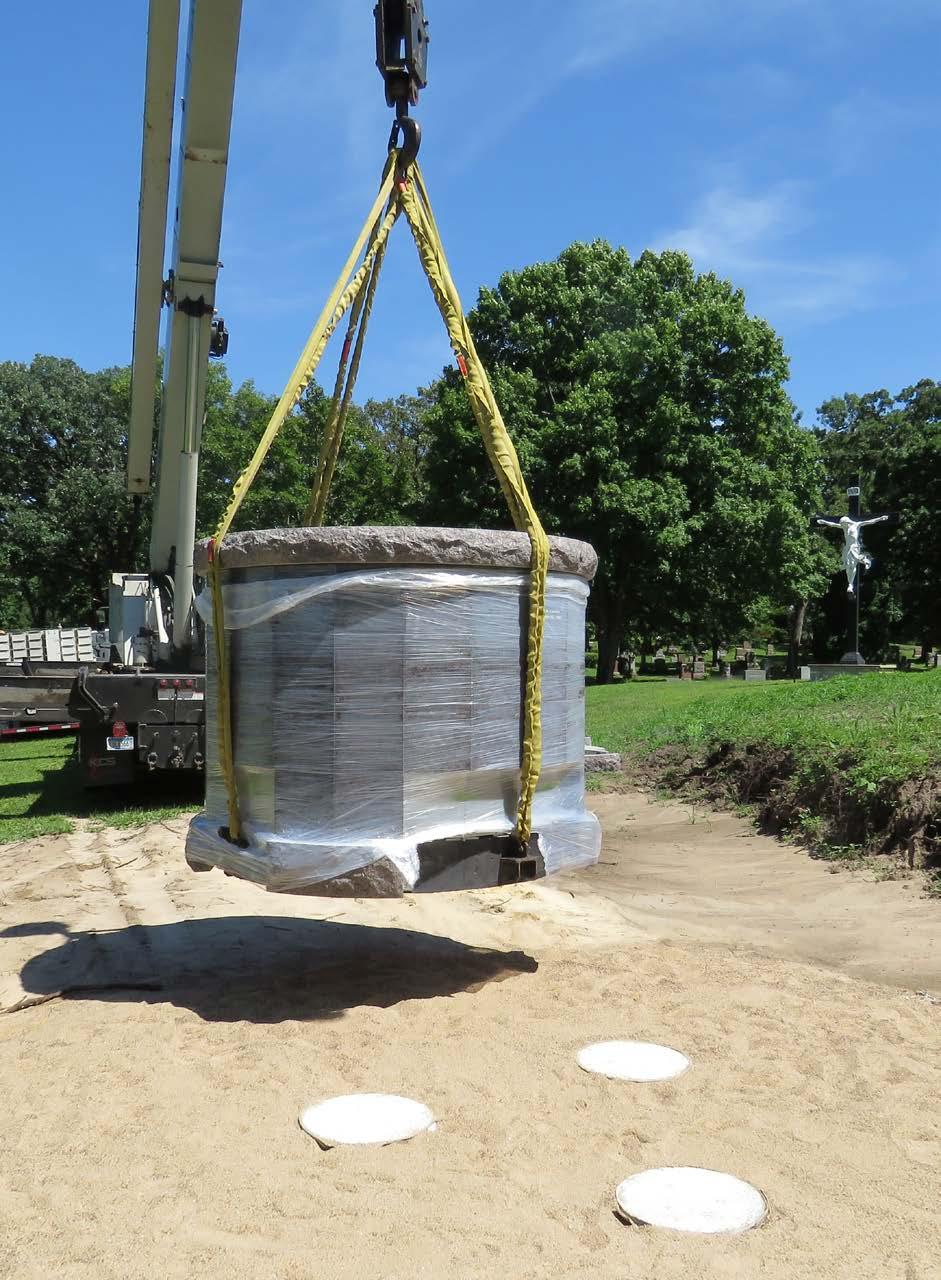
Our Pre-Assembled columbaria are the easiest to install. Pictured above, the foundation has been prepared and the columbarium is about to be placed onto it with the crane provided by the customer.
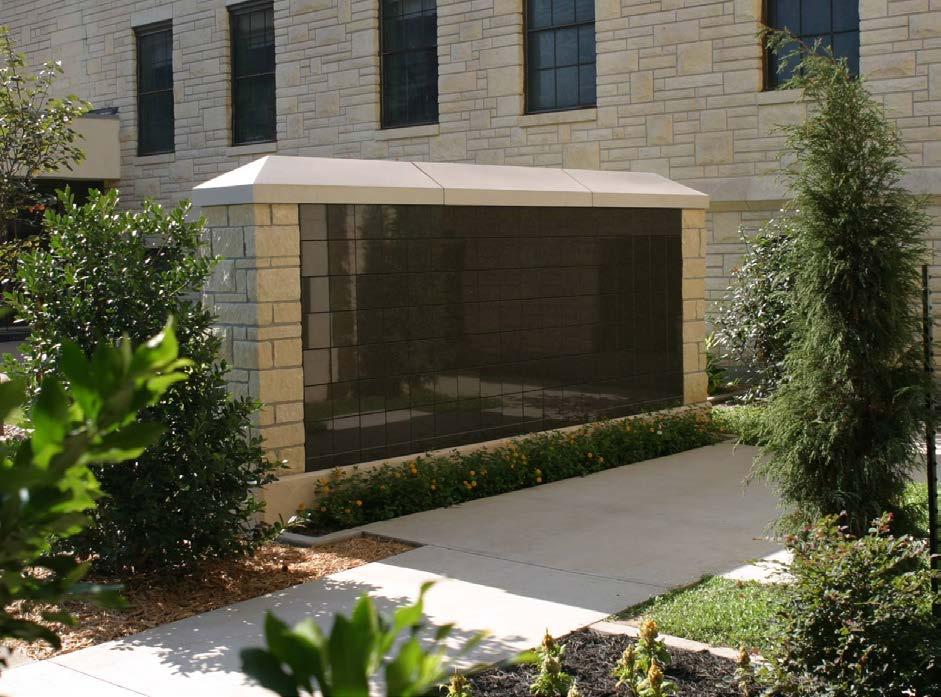
A wall columbarium, such as the one pictured above, could take us one and a half days to install.
We are typically not the last crew on site to complete your columbarium project. For a project like Enid, pictured above, a mason came to install the stone for the sides and back, installing their stone directly to our cabinet. After the mason completed their work, the landscaping was done in order to put the finishing touches on the memorial space.
No special permit, other than typical building permits, is required to install a columbarium at your church. However, keep in mind that columbaria are still a new concept to most people, and your city or county may not understand the definitions of columbaria or final disposition. A columbarium is not a cemetery. We have had cities question this, but once they understand that cremation is final disposition, and there is no law preventing a church from storing urns on a bookshelf, they drop this argument. We have had only one city in our decades of experience that has blocked a church from installing a columbarium. However, there may be other unique circumstances you should be aware of before ordering your columbarium. Is your church a historic landmark? If so,
you may want to consult the city or county on what you can and cannot do with the design of the columbarium. If you are a Catholic church, it is important to receive approval from your diocese early in the process.
It may take several months or even years to have a completed columbarium, but the day it’s ready is very special. Soon after the columbarium is completed most churches hold a dedication ceremony. Clergy bless the structure. Individuals who have passed away and have niches purchased in their name can be the first to be inurned. This is a beautiful event for the church and its members. As a committee member this will also be a meaningful moment as you witness the culmination of your hard work and dedication.
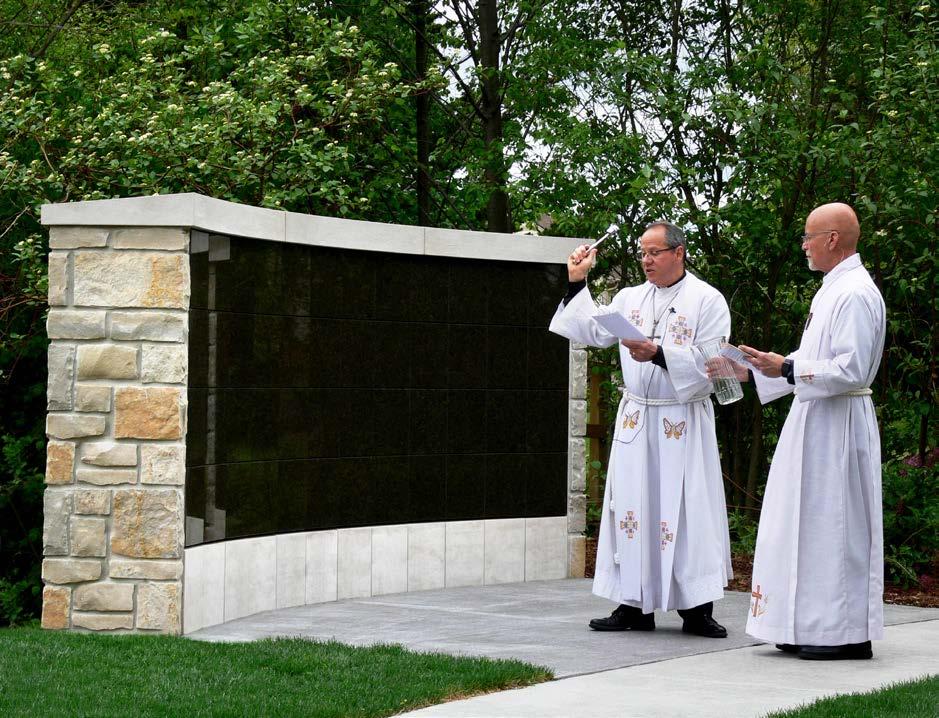
The columbarium at Galilee Lutheran Church receives a blessing on Dedication Day.
Moving Forward
Our high quality columbaria are designed to serve your members for generations to come. This chapter provides information on how to take care of your columbarium. We'll cover maintenance tips and instructions on how to use the columbarium after it has been installed.
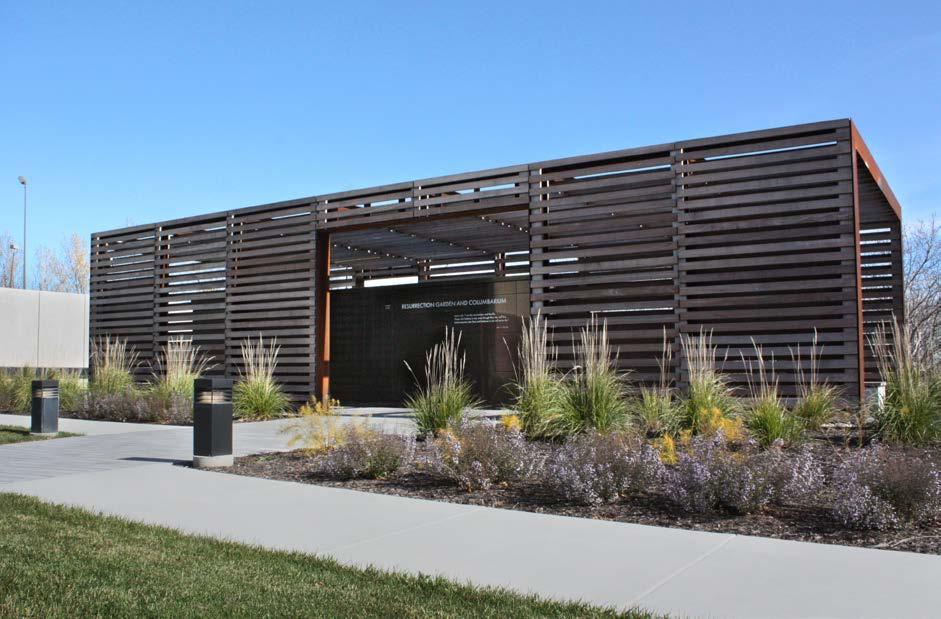
Your columbarium requires some minimal maintenance to keep it looking as beautiful as the day it was installed. Keeping your columbarium and the surrounding area looking attractive not only shows respect to those who are inurned there, but it also attracts other people to purchase a niche in the columbarium.
If you have an exterior columbarium make sure you are mowing the grass, removing snow from the paths, and beautifying the space with well-manicured landscaping. You should also carefully power-wash the columbarium one or two times a year to remove any bird droppings, dust, and other build-up from the outdoors. When using a power-washer, be sure to avoid inscription areas as this can damage the inscription.
An interior columbarium requires less maintenance. Periodically dust the columbarium, keep the area tidy, and do not allow boxes or extra furniture to encroach upon the space.
For both interior and exterior columbaria, check each niche front once a year to make sure they are properly tightened. This is a very important part of annual maintenance. We provide a thorough manual on how to maintain your columbarium.
Before you place any urns into a niche, make sure you are comfortable opening and closing the niche. The process is simple and only requires one tool, the Eickhof Key Wrench, however it does require a little practice. We also suggest dusting the niche’s interior prior to inurnment.
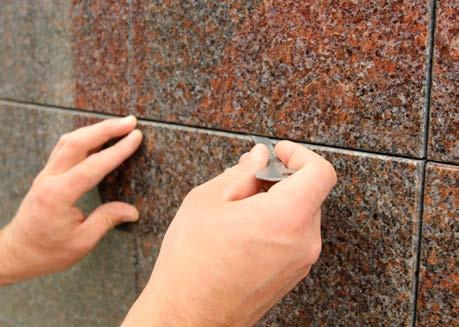
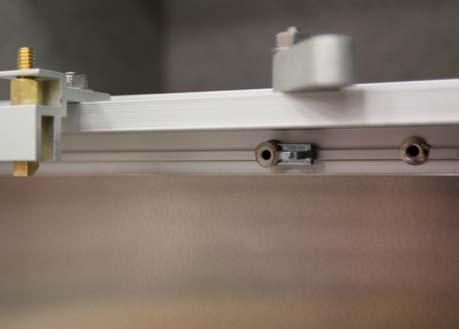
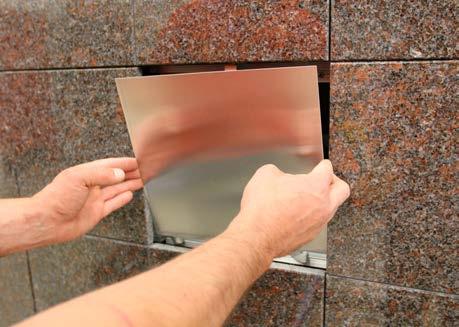
INSERT THE EICKHOF KEY WRENCH INTO JOINT AND REMOVE NICHE FRONT (8" x 8" NICHE SHOWN)
TURN THE INNER CLOSURE PANEL TAB TO A HORIZONTAL POSITION TO RELEASE THE ALUMINUM PANEL
GRASP THE EDGES AND REMOVE THE INNER CLOSURE PANEL
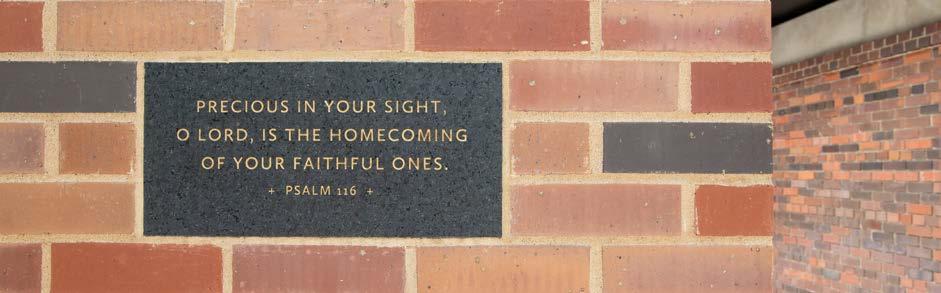
Our inscription services go beyond consistent niche fronts. From capstones to memorial walls, we understand the importance of f ine details.
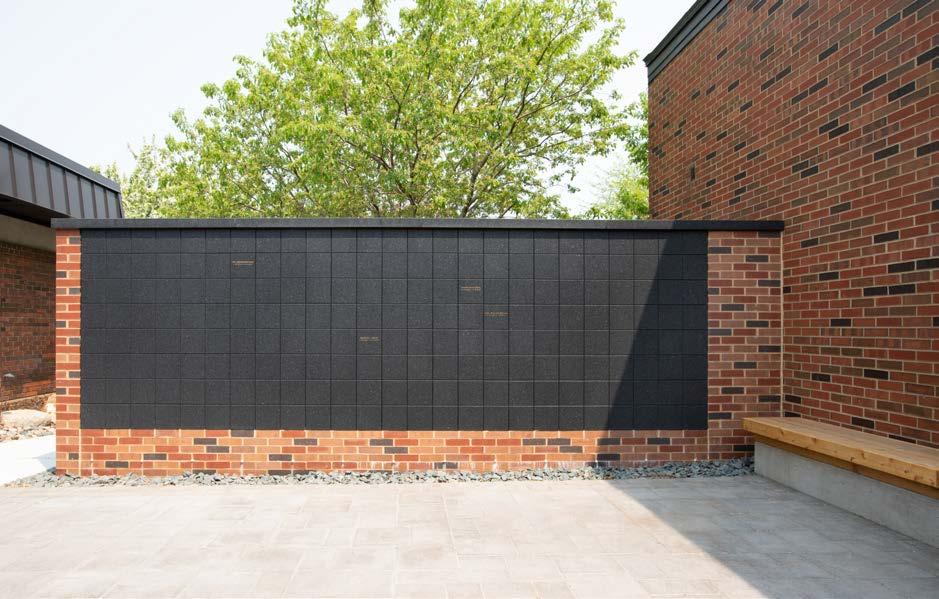
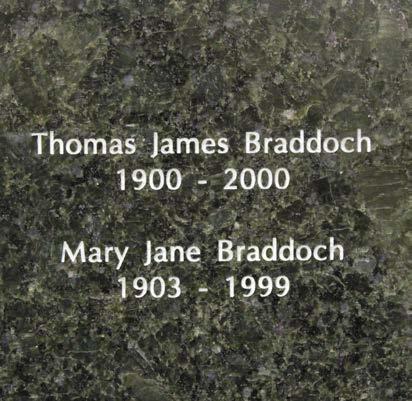
The inscriptions on these niche fronts are completed in the same style as the scripture verse pictured in the photo at the top of this page.
Whether you choose Eickhof Columbaria or someone local to complete your inscriptions it is important that they are consistent. Keep in mind that the last inscription on your columbarium may be completed years or even decades after the first inscription. For a uniform look, you'll want the same team completing them all. Many local inscribers are one-person-shops and may not be in business 20 years from now.
Eickhof Columbaria offers best-in-class Inscriptions for our Clients. This service is fast and competitively priced. We will help simplify your church’s processes and make your columbarium operation less stressful!
Three-Day Turnaround - Your niche front will spend less than three business days at our facility.
Transit Insurance - If anything happens to the niche front while in transit, we will replace the front, if it is packaged per our instructions.
Error Protection - We will replace your niche front and inscription if an error is made by us.
When we complete inscriptions for our customers, we work with them to create a layout that will be used for every niche front. We’ll walk you through some questions to determine what your needs are. Do you want to display first and last names only or include a middle initial? Will you write the date as “July 4th 2000” or “07/04/00”? We will also help you determine the best font and highlight color to use. We provide our inscription customers with a specially engineered box to ship the niche front to our facility. While a niche front is in transit to be inscribed, you can place a temporary niche front in its place that reads “Out for Inscription.” We have a quick turn-around time, with inscribed niche fronts leaving our facility as soon as possible, but always within three business days. Even with the shipping time, customers have told us that we are more timely than local inscribers.
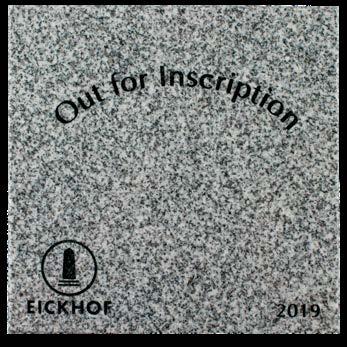
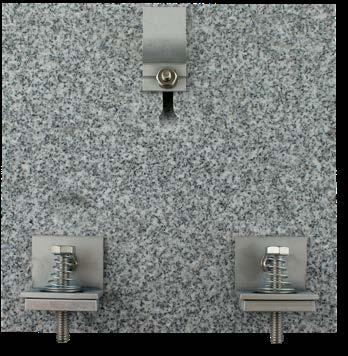
Front and back view of our temporary niche front. This is one of the many benef its of our inscription services.
There are unlimited options for urns and we’ve really seen it all: fullscale bald eagle urns, urns modeled after fast-food restaurant buildings, and two-foot tall wood-turned urns. It is impossible to design a columbarium that can accommodate all the urn shapes and sizes in the world. That is why we offer one urn for use in our niches: the simple and elegant sheet bronze urn. These urns can be purchased from us for a very reasonable cost and all of our standard niches will accommodate two.
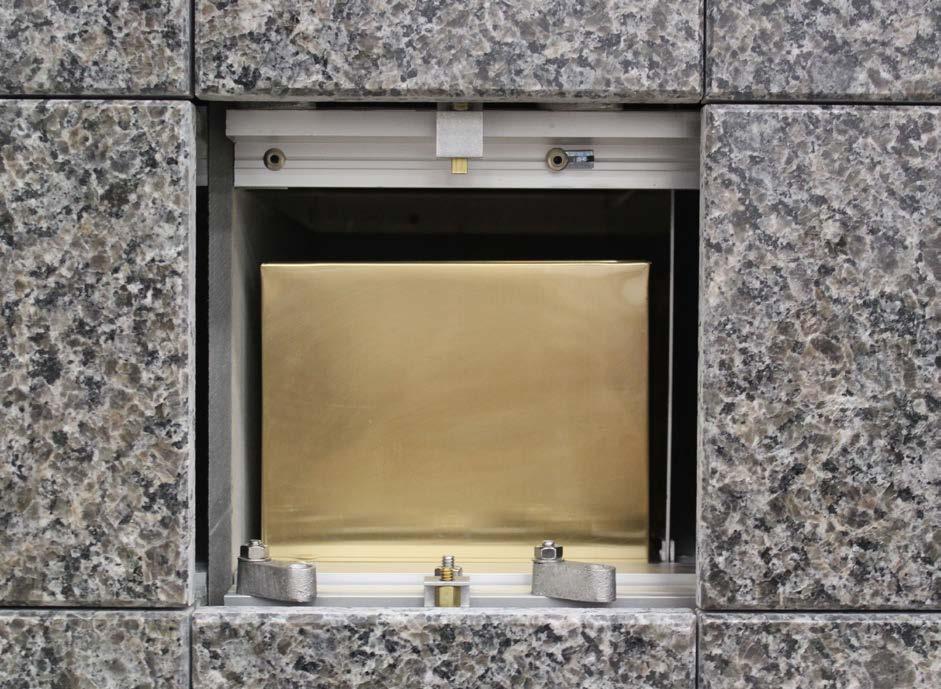
We love seeing our work! We always appreciate when customers send us photos of their columbaria when all the landscaping is completed. If you are planning to take photos of your columbarium for marketing purposes, please email us copies. We are proud to share these pictures and enjoy seeing the unique qualities each customer instills in their columbarium project.
Whether you are starting with 100 niches or 1,000 niches, eventually you will need to expand your columbarium. We suggest planning your next columbarium when you have sold approximately 50% of your niches (not the same as occupied). When the need arises please contact us. We are happy to help you create additional phases that work seamlessly with your existing memorial space.
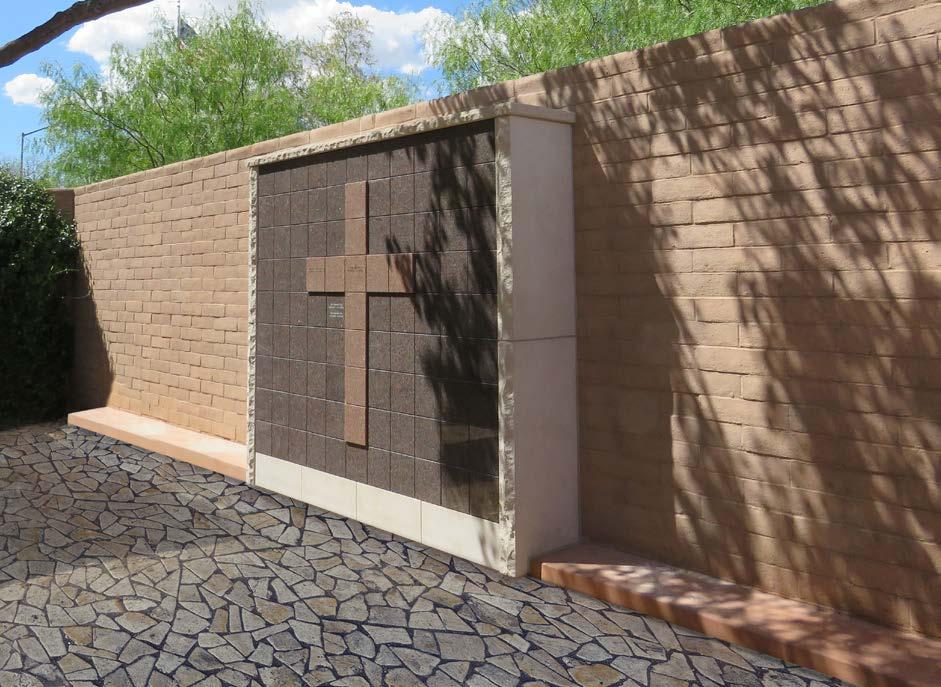
This church has foundations on each side of this columbarium in preparation for additional phases.
Ten Steps Towards Installing a Columbarium at Your Church
This guide is comprehensive and can be overwhelming. Here is a recap of the guide broken down into ten easy steps.
Find three to eight dedicated and interested individuals with diverse backgrounds to form your columbarium committee. (p. 12)
Consider how many people are interested in a columbarium right now and the number of members in your congregation. The need for a columbarium is determined through education. (p. 13) SET YOUR GOALS AND BUDGET
What do you want to accomplish with the columbarium and how much do you want to spend on the project? (pp. 13-14)
This step takes a fair amount of time as decisions will need to be made on the location, scale, style, niche size, adornment, and surrounding area of the columbarium. (pp. 17-50)
Create visual aids and other tools to educate your congregation and sell the columbarium niches. (pp. 55-59) Also, write the rules and regulations for the memorial. (pp. 95-97)
Help your members understand what a columbarium is and why the church wants to install one. (pp. 61-63)
Sell enough niches to fund at least the foundation and the down payment of the columbarium. (pp. 65-71)
When you are ready, a Confirmation of Order packet will be sent to you. Review, sign, and send it back to us to begin your columbarium order. (pp. 75-77)
We cannot deliver and install your exterior columbarium until the foundation is complete. (p. 78)
We know your new columbarium will serve the congregation for generations to come. Make sure to maintain your new columbarium and follow the instructions for inurnment and inscriptions. (pp. 84-89)
AT-NEED
CANA
CEMETERY
COLUMBARIA
COLUMBARIUM
COMPANION NICHE
Individuals in need of final resting places, often due to insufficient planning during life.
Cremation Association of North America. The industry experts on cremation statistics in the United States and Canada.
A place to inter human remains, either cremated or full body.
The plural form of columbarium.
A permanent memorial structure comprised of niches.
A space inside a columbarium that accommodates two urns for cremated remains.
CREMATED REMAINS
CREMATION RATE
CREMATORY (CREMATORIUM)
FAMILY NICHE
Remains of a human body after the body has been cremated. Legally this is final disposition.
The percentage of deaths that were cremated in relation to total deaths in a given year.
The machine or building where bodies are cremated. Located in funeral homes, cemeteries, or as stand-alone facilities.
A niche that can accommodate more than two urns.
FINAL DISPOSITION
GRANITE
INTERMENT (INTER, V.)
INURNMENT (INURN, V.)
Final state of human remains. For a full body (non-cremated remains), final disposition is when the body is interred in a grave plot or crypt. However, cremation is final disposition, which means once a body is cremated, there are few things you cannot do with the ashes.
A natural stone material that is dense and durable, with color ranging from black, gray, brown and pink. Different from marble.
To place human remains (cremated or not) into a grave, crypt, or columbarium niche.
To place cremated remains into an urn. Or, to place an urn into a columbarium niche.
LEAD TIME
LIMESTONE
MARBLE
MEMORIAL GARDEN
Time starting from when a columbarium order is placed to when the columbarium is delivered and installed.
Natural stone material that is more porous than granite. Color ranges from white, to gray, to golden tan.
Natural stone material usually with inconsistent veining. Typically white color with black, gray, or other color veins. More porous than granite.
Garden space that may include memorial pieces such as columbaria, scattering areas, or memorial walls, and/or landscape pieces including benches, paths, trees, flowers, and shrubs.
GLOSSARY CONTINUED
PRE-NEED
PRE-SELLING
The term “traditional burial” has been used to refer to full-body casket burial in the death care industry. However, now that cremation is more common than fullbody casket burial, the death care industry is beginning to call cremation the “new tradition.”
A private space within a columbarium that accommodates urns (usually two). Typical nominal sizes are 12" x 12" x 12" and 8" x 8" x 12".
Cremated remains that do not have a final resting place. Often found in closets, attics, or abandoned at funeral homes.
Individuals making their end-of-life arrangements while they are still living.
Selling niches prior to purchasing a columbarium.
Container that holds cremated remains. URN
1. MANAGEMENT OF THE COLUMBARIUM
The Church owns, manages and administers the Columbarium; determines the standards for eligibility; maintains the necessary structure; and keeps records in accordance with Minnesota requirements. The Columbarium Committee is charged with the oversight, approval and management of the Columbarium on behalf of the Church. The Church reserves the right to amend or change the Columbarium Rules and Regulations as the Church deems appropriate.
A. Subject to Laws
In addition to the Rules and Regulations, all inurnments, disinurnments, and removals shall comply with all federal, state, and local laws to the extent they are applicable to the Church. Nothing herein shall be construed as a waiver of any exemption of the Church as pursuant to the laws, rules, and regulations.
B. Eligibility
While most Certificates of Right of Inurnment will be obtained by people with a connection to the Church, the Church may grant Certificates to others as the Church deems appropriate. Inurnment in the Columbarium will be available to Members or former Members of the Church and their relations including spouse, parents, children and grandchildren (biological, adopted, fostered or step of the above stated persons).
C. Fees
The one-time fee of $XXXX includes the use of a selected niche for a single urn. The one-time fee of $XXXX includes the use of a selected niche for two urns. The fee supports the ongoing care and maintenance of the Columbarium, which is owned and operated by the Church. The fee does not include the cost of cremation or funeral service, the urn or the engraving.
D. Property Rights and Rights to Use Niche
A Certificate Holder who has paid the fee shall be entitled to name one or two persons whose ashes are to be inurned in that niche, provided that person or persons qualify as eligible. The Holder acquires no property rights in the Columbarium and its niches and agrees that said items and areas are at all times under the sole ownership and control of the Church.
E. Application for Inurnment
To reserve the rights to use a niche, a person must submit the completed Application and payment to the Church for review. Provided the Application complies with the Church’s policies and the requested niche is available, the Church will sign and provide the Certificate of Right of Inurnment to the Holder.
Each Holder will designate at the time of application the name(s) of the person(s) to be inurned.
The Church will maintain a map of niches that are available. Each submitted Application must request their preferred niche. Applications for niches will be reviewed in the order they are received by the Church. Niche location will be recorded on the Holder’s Right of Inurnment Certificate and on the Church’s internal record
The size of the niches allows the cremated remains of up to two persons to be inurned in each niche. Urns should be no larger than 5.5" x 5.5" x 7." The Church recommends purchasing the urn for inurnment through the Church. However, another urn that may have special meaning may be used if it fits within the discretion of the Church, and/or if it fits within the niche. In the event the Holder’s urn does not fit the niche, the Holder will be responsible for obtaining smaller urn(s) and the proper transfer of ashes to the replaced urn(s).
Only a Pastor of the Church or a minister invited by a Pastor of the Church may officiate at a committal service at the Columbarium.
Only cremated human remains may be inurned in niches. Ashes shall be placed in the urn in a niche. No valuables or personal items other than the urn may be placed in the niche. The urn must be sealed, be in good taste and is subject to approval by the Church. The urn must be marked with permanent identification prior to Inurnment. Identification is to be provided by the family, Crematorium, Mortuary or Funeral Home. At the family’s discretion, a decorative unsealed urn may be used for a memorial service and the ashes then transferred to a standard urn for Inurnment. Any transfer is the responsibility of the family. All urns will be permanently sealed at time of Inurnment. Urns may not be removed from their assigned niche once they are inurned unless cremated remains are being relocated.
An Inscription Order form will be provided to be completed by the person(s) with rights to use a niche. The inscribing of each niche front shall be of uniform size and style as the Church has selected. The inscription shall consist only of the person’s name, birth year, and date of death. The Church will arrange for the inscriptions, which are not included in the Right of Inurnment fee.
No flowers, decorations, signs, flags, or personal objects will be allowed within or on the Columbarium. Such items will be removed and disposed of by the Church without notice or liability to the owner of the item or any niche Holder. Flowers may be left at designated spots near the Columbarium for up to 3 days following inurnment.
It is the responsibility of the Holder to notify the Church office of any change in their mailing address. Notice sent to a Holder at the last address on file in the Church office shall be considered sufficient and proper legal notification for all purposes.
The Church will provide reasonable ongoing care for the Columbarium. However, neither the Church nor any persons acting on the Church’s behalf will be liable for any loss or damage to the Columbarium.
A. Surrender of Certificates
The Holder may elect to surrender the Certificate if no cremated remains have ever been inurned in the assigned niche. In this case, the Holder must contact the Church to terminate the right of inurnment. The Holder of the Right of Inurnment cannot sell the right to a third party.
Cremated remains are the property of the family or estate of the deceased. If the cremated remains for one or both persons listed on the Certificate have been inurned in their assigned niche and the survivors wish to remove all the cremated remains, rights to the assigned niches will revert to the Church with no compensation due to the Holder or Holder’s estate. The action to remove cremated remains shall be communicated to the Columbarium Committee by the Holder by submitting a Termination of Right of Inurnment form.
A Holder may make written application to the Columbarium Committee to transfer or assign the Holder’s rights under a Certificate of Inurnment Rights to an eligible transferee. The application shall state the grounds for eligibility of the proposed transferee as defined by these Policies and Procedures. The Church shall approve the request provided it finds the proposed transferee eligible. Upon approval, the Holder or Holder’s authorized representative shall surrender the Certificate of Inurnment Rights. The Columbarium Committee shall then issue a new Certificate of Inurnment Rights to the approved transferee. The new transferee shall be bound by these same Policies and Procedures.
If after 30 years from the date of the Inurnment Certificate, no cremated remains have been inurned in an assigned niche specified on a Certificate, and the Holder of the Certificate cannot be located after good faith efforts are made by the Columbarium Committee to locate the Holder, the Right of Inurnment and the Certificate shall be deemed null and void and the assigned niche will revert back to the Church with no compensation due to Holder or Holder’s estate. The Columbarium Committee will be free to reassign the abandoned niche.
A. Movement of the Columbarium
In the event the Church is moved to another location or should it be necessary to move the Columbarium to another location on the Church property, it shall be the responsibility of the Church to provide facilities for the re-depositing of the cremated remains committed to its care. The Church shall exercise reasonable efforts to locate and notify surviving heirs as to the new location.
Termination of the Columbarium
Inurnment Certificates and Rights of Inurnment will continue as long as the present Columbarium stands and is owned by the Church. In the rare possibility the present Columbarium is to be sold or demolished, a replacement Columbarium will not be furnished. Certificates will be canceled, and Rights of Inurnment will cease. In that event, the Church will attempt to notify each niche Holder or estate that the Certificate will be canceled and will attempt to notify a family member of each person inurned in the Columbarium that the person’s cremated remains must be removed from the niche. If the Church is not able to establish contact using Church records, or if the cremated remains are not removed within a reasonable period of time, the Church may relocate the cremated remains as it deems proper. No compensation will be due to the Holder or person’s estate or family.
Data from the 2022 National Funeral Directors Association (NFDA) Cremation & Burial Report.
Alabama
Alaska
Arizona
Arkansas
California
Colorado
Connecticut
Delaware
Low
Very High
Very High
Medium
High
Very High
Medium
Medium
Florida 71.1% Very High
Georgia
Hawaii
Idaho
Illinois
Indiana
Iowa
Kansas
Kentucky
Louisiana
Maine
Maryland
Massachusetts
Michigan
Minnesota
Mississippi
Missouri
Medium
Very High
High
Medium
Medium
Medium
Medium
Medium
Medium
Very High
Medium
Medium
High
High
Low
Medium
Montana
Nebraska
Nevada
New
New Jersey
New York
North Carolina
North Dakota
Ohio
Oregon
Very High
Medium
Very High
Very High
Medium
High
Medium
Medium
Medium
Medium
Oklahoma 55.1% Medium
Very High
Pennsylvania 59.0% Medium
Rhode Island 56.2% Medium
South Carolina 52.0% Medium
South Dakota 51.7% Medium
Tennessee 45.3% Medium
Texas 53.4% Medium
Utah 42.8% Medium
Vermont 77.3% Very High
Virginia 51.2% Medium
Washington 80.3% Very High
West Virginia 48.8% Medium
Wisconsin 68.0% High
PERCENTAGES OF CREMATIONS IN THE UNITED STATES IN 2022 Low Under
Wyoming 77.0% Very High
Data from the 2022 National Funeral Directors Association (NFDA) Cremation & Burial Report.
Overwhelmed? Not sure where to start?
That's where we come in.

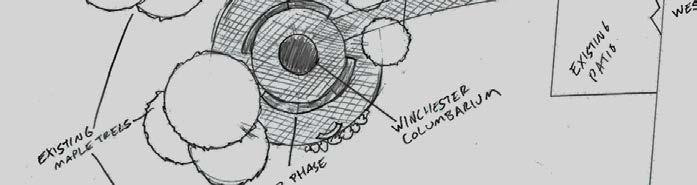
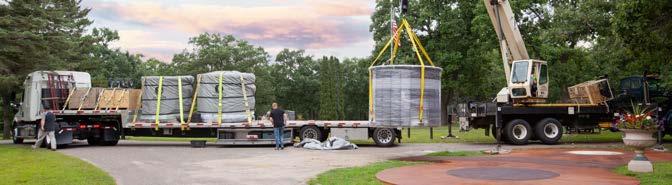

Together, we'll discover your specific needs and design a memorial that exceeds your expectations. Then, our installers will deliver it with the utmost care. Finally, you can count on lifelong support from our friendly team.
Schedule your discovery meeting today!

Our columbaria are designed and constructed by our expert team at our fabrication facility in Crookston, Minnesota. Each step, from parts fabrication to stone setting, is completed inhouse using thoughtfully sourced materials.
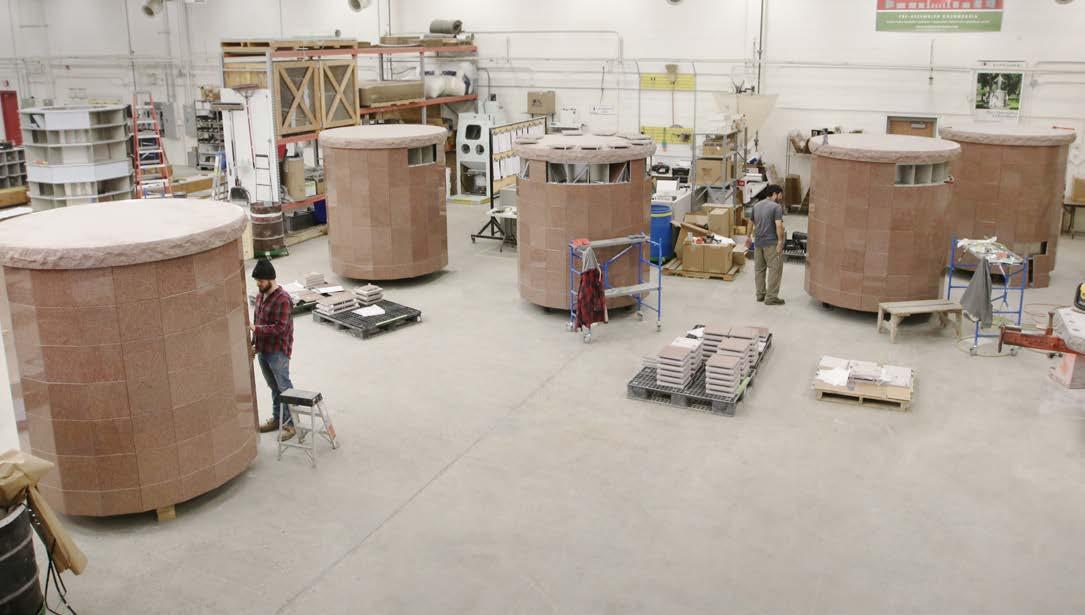
Eickhof Columbaria Inc.
Fabrication Facility
1200 Bruce Street
Crookston, MN 56716
800.253.0457
info@eickhofcolumbaria.com
©2026 EICKHOF COLUMBARIA INC. 061026

MADE IN MINNESOTA
PATENT NOTICE
Eickhof Columbaria Inc. products are covered under one or more of the United States & Canadian patents listed at www.eickhofcolumbaria.com/patents/.
Eickhof Columbaria Inc. has invested much time, effort and resources into developing technology for its columbaria and ossuaries. Eickhof Columbaria Inc. has obtained several patents and/or has filed patent applications on columbaria and related technology, including U.S. Patent 10,125,514, entitled COLUMBARIUM WITH INNER OSSUARY. Under 35 U.S.C. § 271, whoever without authority makes, uses, offers to sell, or sells any patented invention, within the United States or imports into the United States any patented invention during the term of the patent therefore, infringes the patent. Eickhof Columbaria, Inc. respects intellectual property rights and expects others to respect its rights.