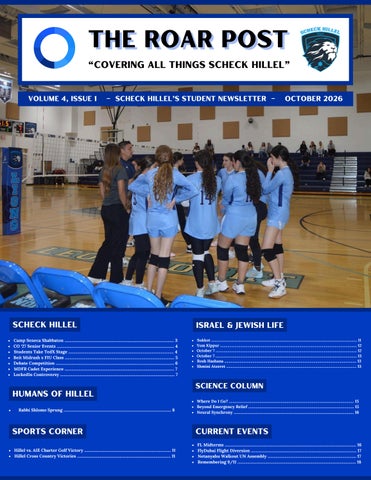
THE ROAR POST “COVERING ALL THINGS SCHECK HILLEL” VOLUME 4, ISSUE 1
– SCHECK HILLEL’S STUDENT NEWSLETTER –
October 2026
Scheck Hillel
ISRAEL & JEWISH LIFE
Camp Seneca Shabbaton .............................................................................................................. 3 CO ‘27 Senior Events ...................................................................................................................... 4 Students Take TedX Stage .......................................................................................................... 4 Beit Midrash x FIU Class .............................................................................................................. 5 Debate Competition ....................................................................................................................... 6 MDFR Cadet Experience .............................................................................................................. 7 LockedIn Controversy ................................................................................................................... 7
Sukkot ................................................................................................................................................................ 11 Yom Kippur ...................................................................................................................................................... 12 October 7 ........................................................................................................................................................... 12 October 7 ........................................................................................................................................................... 13 Rosh Hashana ................................................................................................................................................. 13 Shmini Atzeret ............................................................................................................................................... 13
Humans of Hillel Rabbi Shlomo Sprung ............................................................................................................ 8
SCIENCE COLUMN Where Do I Go? .................................................................................................................................. 15 Beyond Emergency Relief .............................................................................................................. 15 Neural Synchrony ............................................................................................................................. 16
Sports Corner
Current Events
Hillel vs. AIE Charter Golf Victory ....................................................................................... 11 Hillel Cross Country Victories .............................................................................................. 11
FL Midterms .................................................................................................................................... 16 FlyDubai Flight Diversion .......................................................................................................... 17 Netanyahu Walkout UN Assembly ......................................................................................... 17 Remembering 9/11 ....................................................................................................................... 18
Seniors, Let’s Talk. A Letter from the Editor-in-Chief Seniors, let’s have a chat. When was the last time you went to bed before 12:00a.m. on a weeknight? Can you count the days you’ve eaten three full meals on more than two hands? Have you gone more than a week without a complete mental breakdown? I probably haven’t–and neither have most of you. It’s time to speak up. Allow me to go back in time for a moment; August 1, 2026: the day the Common App opened for the 2026-27 application cycle. Some, already done with their main essays, rushed to complete their applications as soon as possible. Others spent meaningful time revising their awards and extracurriculars. And even more students, myself included, waited until late September to even begin their personal statements. But regardless of where we were and what we were doing back in August, we seniors are now all in the same boat, grappling with stress, exhaustion, and insecurity. Amidst the struggle to gain acceptances to top colleges, academic validation from peers, and leadership positions wherever possible, we seniors begin to lose touch with an important part of ourselves. By focusing too much on the far future, we lose sight of the things we have accomplished in our past. Awards, friendships, and experiences become meaningless if they do not contribute to the ultimate goal of admission. Let’s change that. I might be the biggest hypocrite ever for not calling out my own behavior. I, too, have been so absorbed in the admissions process that I’ve neglected the things that matter to me most (apologies to all of the friends I’ve snapped at recently ). But experiencing how this stress has impacted my personal life has pushed me to encourage others to turn back before it is too late.
❤️
Keep writing those essays. Keep organizing those clubs. Keep signing up for whatever competitions and volunteer opportunities you can find. But don’t stand by them for the short-term purpose of getting accepted into a school. Make those experiences a meaningful way to grow as a human being. There’s only a few months left before this is all over. Seniors, can we make them count? With love, Tamar Grobman 2
Juniors Make Memories at Camp Seneca Lake Shabbaton By Ami Kattan ‘28, Web Assistant From October 15-18, 2026, the Class of 2028 headed to New York for the Camp Seneca Lake Shabbaton. Since the Shabbaton was centered around the theme of chazak–the Hebrew word for strength–it gave the junior class a chance to take a break from their usual school routine, spend time with friends, and come together as a grade. However, chazak encompasses more than just physical strength: it is about finding the strength in the people around us, building meaningful relationships, and supporting one another. The Seneca Shabbaton gave juniors the opportunity to experience this idea firsthand as they connected with their classmates. On Thursday, the group visited the Orthodox Union headquarters in New York City, where students heard from Sabrina Naimark, the founder of Impacta Panama. Afterward, everyone went to the American Dream Mall in New Jersey. Students got the chance to enjoy the mall’s many attractions, including an amusement park and ice skating, before making their way to Camp Seneca Lake in Honesdale, Pennsylvania. Friday was filled with games, activities, and plenty of time to hang out with friends. The girls also participated in a challah bake in preparation for Shabbat. Shabbat was the main highlight of the weekend. The juniors sang together, shared meals, and enjoyed the beautiful scenery of the campsite. Rabbi Shlomo Sprung and his family also joined the group for Shabbat. After Shabbat ended, everyone gathered for a beautiful Havdalah ceremony, followed by a bonfire where students sang songs and made s’mores together. On Sunday, the juniors packed up and headed back to Miami after a weekend full of fun, friendship, and meaningful moments.
Pre-Shabbat photo from Camp Seneca Lake! - Photo Credit: Gabriela Waisburd ‘28
For junior Mijal Furman, the weekend was especially meaningful. She described the Shabbaton as an uplifting experience that changed her life. Additionally, junior Eva Winterman shared how the Shabbaton helped her connect with classmates she had not gotten to know as well before. The weekend gave her the opportunity to build new relationships and feel more connected to the grade. These experiences reflect one of the most important parts of the Shabbaton, bringing the Class of 2028 closer together and helping students form friendships that can last long after the weekend ended. Ultimately, the Camp Seneca Lake Shabbaton was more than just a weekend away. It was an opportunity for juniors to strengthen friendships, connect with classmates in new ways, and create memories that will last forever. And through the theme of Chazak, the Class of 2028 was reminded that one of the greatest sources of strength is the community we build and the people who stand beside us. The trip came together primarily through the efforts of Student Life Director, Rabbi Arieh Bnetolila and junior class representatives, Tali Kiblisky, Ben Cohen, and Stella Lekach for organizing the trip. The grade also thanks the chaperones who joined them and left their everyday lives for the weekend: Kristy Chapuseaux, Esther Ben-Shalom, Micaela Baredes, Opher Yunger, Rabbi Jeremy Litton, and Benajmin T hompson-Echevarria.
3
Class of 2027 Begins Senior Celebrations By Emily Waich ‘27 & Melanie Benlolo ‘27 For the class of 2027, senior year has officially begun, and together, they have already made so many amazing memories! From meaningful experiences to fun celebrations, our senior events have brought us closer together and made the start of our final year even more special. The senior girls kicked things off with a meaningful challah bake, hosted by Lihi Goldberg ‘27, where they had the opportunity to hear from Deborah Benchimol. She shared her personal journey with Judaism and the experiences that ultimately led her to where she is today. Her story was inspiring, and it made the experience of baking challah together even more meaningful. We have also had the opportunity to host two learning dinners–known as “La Casa Events”–as of October 2026. Our first La Casa was led by Student Life Director Arieh Bentolila in honor of Rosh Hashanah, giving us the chance to reflect and prepare for the new year together. Our second La Casa took place in the Sukkah of Israel Trip Director Opher Yunger, where we enjoyed delicious food, listened to an inspiring talk from a Hollywood rabbi, and spent time having fun with our friends. Both events allowed us to connect while celebrating our Jewish traditions.
Students gather at R. Bentolila’s house for a meaningful “La Casa” dinner andf shiur - Photo Credit: Emily Waich ‘27
On October 15, 2026, the class of 2027 took their senior pictures. It was such an exciting moment for students, as it reminded them that graduation–as well as other exciting senior memories–is getting closer. Another special event for the senior girls was our siddur decorating activity, hosted by Shira Sager ‘27. Each girl received her very own siddur and had the chance to decorate and personalize it. We also heard from multiple amazing speakers–Shira Sager ‘27, Ms. Donna Wolf, and Ms. Yael Sprung–who shared what prayer truly means to them and how it plays a role in their lives. It was a beautiful opportunity to reflect on our own connections to Judaism and make something meaningful that we can carry with us beyond high school. With so many memories already made, senior year is off to an incredible start! We are so grateful for all these special experiences and the opportunities to celebrate together as a grade. We can't wait to see what the rest of senior year has in store, and we are so excited for all the memories, milestones, and celebrations still to come.
Growing up Online: Hillel Students Take TEDx Stage By Olivia Herschman ‘29 The TEDxMiramar Youth event brought young speakers together at the Miramar Cultural Center to share personal experiences and lessons learned on the internet. TEDx is a program that gives people the opportunity to share meaningful ideas and inspire others through their own experiences. The theme, “Growing Up Online,” showcased the internet's impact on the lives of young people. Two of our very own students–Yakov Bensabat ‘28 and Jonathan Kleyman ‘27–took to the stage and discussed overcoming personal challenges and using the internet to grow and achieve goals they once perceived to be impossible. “Use the internet to your advantage, and don't just take for granted what you have in front of you,” said Bensabat, a junior.
(Continued on Page 5)
4
(Continued from Page 4) Bensabat says that the internet has played a key role in helping him achieve his goal of dunking a basketball on a 10-foot rim. After dealing with knee pain, Bensabat used the internet to research training programs to learn new techniques to improve. Through this experience, he began to see the internet differently, realizing how useful it could be when used for something meaningful. Bensabat explained that the main message he wanted his audience to take away was the importance of using the internet with a purpose. Kleyman, on the other hand, used the internet to make a big change in his life. As a freshman, he started using TikTok and Instagram to learn more about fitness and build healthy habits, which eventually led to him losing 50 pounds. However, Jonathan says that the most meaningful part of his journey wasn't just the physical change, but the confidence he gained along the way.
Kleyman ‘27 and Bensabat ’28 posing after their TedX talks - Photo Courtesy of Olivia Herschman ‘29
“Although I saw all the change on the outside, the biggest change I saw was on the inside,” he shared. Kleyman turned the self-doubt he felt during freshman year into self-trust. Although opening up about such a personal experience was challenging at first, Kleyman’s ability to share his story made his friends and family proud. He hoped that by sharing this, he could inspire others to believe they can make positive changes in their own lives.
Months of preparation, hard work, and commitment went into the students’ TEDx talks. Both Bensabat and Kleyman spent approximately five months working with personal coaches, attending meetings, and practicing their speeches. For Bensabat, one of the biggest challenges was the time commitment. He attended two-hour meetings every Sunday with event organizers and spent up to two hours practicing almost every day during the final month. He expressed how grateful he was for the opportunity, saying he felt grateful to share his story and inspire others. Kleyman faced a similar challenge, especially between August to early October, when he attended six meetings a week. “If you're willing to put in the work, then nothing can stop you,” said Bensabat, who believes in encouraging other students like him to give talks of their own. He also shared his passion for inspiring others and hopes to continue public speaking in the future. Kleyman added that when he was first introduced to TEDx, he never imagined himself on that stage, especially knowing that hundreds of teenagers apply and only a few are selected. However, after going through the experience himself, he encouraged other students not to let that discourage them. He explained that with the support and preparation provided by the organization, any student willing to put in the effort has the potential to deliver a TEDx talk. Ultimately, both students' stories showed that the internet can be more than entertainment. When used with purpose, it can help people learn, grow, and achieve goals they once thought were out of reach.
Beit Midrash Class Gains Dual Enrollment Status By Bina Sragovicz ‘27, Webmaster In September 2026, Rabbi Rodney Feinerman’s Judaic senior seminar class was approved to become a Florida International University (FIU)-accredited dual enrollment course. The class, titled ‘Introduction to Talmud,’ has students study selected pages of Gemara from the tractate of Brachot through interactive, discussion-based classes led by Rabbi Feinerman. Despite the class’s new status, Rabbi Feinerman claims that he will not change his teaching style or class content; rather, he will hold students to college-level expectations.
(Continued on Page 6)
5
(Continued from Page 5) The idea first came to Rabbi Feinerman in the summer of 2000. He noticed that the students in his class consistently studied Jewish texts at a very high academic level, and he wanted to formally recognize that. This led him to reach out to Dr. Nathan Katz, the chair of the Department of Religious Studies at FIU. After some initial hesitance, Rabbi Feinerman wrote a formal syllabus, got it approved by Dr. Katz, and established the first Beit Midrash dual-enrollment course that year. After a pause on this practice, Rabbi Feinerman worked closely with FIU's current chair of the Department of Religious Studies, Professor Erik Larson, as well as Hillel administrators Mr. Craig Carpentieri, Ms. Linda Feigenbaum, and Mr. Benjamin Thompson over this past summer to reinstate the dual enrollment class for students this year. “Our students are engaging in Judaic Studies at a level that meets college standards,” said Rabbi Feinerman, who strongly believes this course to be an “exceptional opportunity.” Students are able to earn college credit in high school, reducing the time and expense required for a college degree. “College-level rigor makes this intellectually demanding yet rewarding class completely unique,” said senior Hadar Z. “I don’t think I could get this experience anywhere else, and because of it, I feel much better prepared for college.” After the “considerable effort and coordination” it took to put this program together, Rabbi Feinerman is proud that students will receive college credit and formal recognition for the intellectually challenging work they do in Talmud. “I hope this initiative demonstrates the academic depth of Jewish learning,” said Feinerman, “and opens the door to similar opportunities in the future.”
Hillel Debate Team Dominates Miami-Dade Tournament By Julian Sharvit ‘28 On Sepember 29, 2026, Scheck Hillel’s speech and debate team traveled to Christopher Columbus Senior High School to compete against students from other Miami-Dade county schools. The tournament marked Scheck Hillel’s first debate competition of the school year, with 27 students participating in two different debate categories. The team delivered an impressive performance, earning multiple top ten finishes and four top three finishes, including a first-place victory. Students competed in either Lincoln-Douglas (1v1) or Public Forum (2v2) debate. Lincoln-Douglas participants debated whether outer space colonization is a moral imperative, while Public Forum teams discussed whether the United States should temporarily halt the construction of hyperscale data centers. Before the tournament, students prepared arguments supporting and opposing their assigned topics, researching evidence and anticipating counterarguments. During the competition, each student of the team participated in two rounds, defending a different position against different opponents and scored by different judges. After the debate, judges scored participants based on how well they spoke and the validity of their argument. Both rounds’ points were added up to calculate a final score. Hillel saw considerable success in both categories. Out of five LincolnDouglas debaters, Tamar Grobman ‘27 earned first place overall, followed by Sarah Litovsky ‘27 in second place. The Public Forum Competition, which featured 20 teams, also brought impressive results. Annie Slomovitz ‘28 and Sophia Gruszka ‘28 secured second place, while Noah Waserstein ‘27 and Noam Abitbol ‘28 finished in third. Since its first competition in February 2026, Scheck Hillel’s speech and debate team has faced unprecedented growth. With more participants than the previous year, the team included both experienced competitors and students attending their first formal debate tournament. As our students continue developing their skills, the team looks to build on its early success and represent Hillel at future tournaments.
Tamar Grobman ‘27 and Sarah Litovsky ’27 celebrating their victories - Photo Credit: @scheckhillel on Instagram
6
Answering the Call: My Experience as a MDFR Junior Cadet By Benjamin Ynterian ‘29 For more than 45 years, the Miami-Dade Fire Rescue (MDFR) Junior Cadet Program has prepared high school students for the demands of fire rescue and emergency medical services. Founded in 1979 as the Explorer's Program, it was created to introduce young people to careers in firefighting, emergency medical services, and technical rescue. Over the decades, the program has grown into a structured training program that gives students hands-on experience and a realistic picture of an emergency responder's job. Becoming a recruit is a competitive process–a process I have had to experience as a cadet-in-training. My parents and I attended an informational session with about 200 other applicants. A year later, in the summer of 2025, I was denied but given the first spot on the following year's list.
Inside the fire training program - Photo Credit: Benjamin Ynterian ‘29
In March 2026, I took the physical fitness test, which I was told many applicants struggled to pass. I passed, and that summer, I was accepted into the MDFR Junior Cadet Recruit Class of 2026. Recruits begin with a summer class in CPR and Emergency Medical Responder (EMR) skills. We practiced compressions on training dummies and used EMR training equipment for our tests, which gave us a deeper understanding of how to perform these skills in the field. Clear instruction and good study guidance helped the whole class pass the final exam. According to Mrs. Vanessa, the program's operations leader, this rate of success among cadets had not been seen in years.
After the class, recruits are assigned to shifts. I was placed on B shift, which meets every other week on Friday evenings. Each shift includes intense physical training, which is what I was looking for beyond traditional sports, along with an educational component that keeps building my knowledge of emergency response. During the educational part of each shift, cadets learn skills necessary for rides. At my most recent shift, I learned how to handle chainsaws, metal cutters, and spreaders, and how the different tools are stored on the fire engine. We also covered an essential everyday skill: changing a car tire. My B shift falls on Friday evenings, which sometimes overlap with the start of Shabbat. As a Jewish family, my parents and I give up every other Shabbat to make this work. We knew that when I applied, and we decided the commitment was worth it. Once cadets complete recruit training, the program offers experiences such as ride-alongs with professionals, community service opportunities, competitions, cadet expos, and scholarships to promising candidates. In April 2026, MDFR hosted its first Cadet Expo at the Doral Training Facility, where regional programs practiced ladder training and vehicle extraction. That year, MDFR also introduced the Timothy Burgs Distinguished Cadet of the Year Scholarship, established by the family of the late MDFR Firefighter Timothy Burgs. Not every cadet will become a firefighter or EMT, but the program builds leadership, teamwork, and discipline that lasts well beyond it. I'm halfway through my journey and will become an official cadet in January 2027. The process has taken waiting, perseverance, and sacrifice, and each stage has brought me closer to serving the Miami-Dade community.
The Controversy Behind “LockedIn” By Alexa Slimak ‘29 Putting your phone away used to mean placing it in your backpack. With Scheck Hillel considering the implementation of LockedIn, following the phone policy now involves an app on students’ personal devices. LockedIn allows schools to restrict phone use through blocked apps or locked sessions, depending on their settings. Administrators can see whether students are locked in and receive alerts when sessions end early. Though the policy intends to create more focused classroom environments, it also raises questions about what students should have to give schools access to in order to achieve such a goal. Teachers have good reason to want phones out of the picture; one notification can pull someone out of a lesson, and constantly reminding students to stop scrolling takes time away from a valuable education. Still, requiring software on a family-owned phone deserves a closer explanation. LockedIn asks for “Always” location permission during initial setup. The company says ordinary campus checks happen on the device, with an on-campus or off-campus status sent to the school. It also says it does not collect messages, photos, or browsing history. Families should understand what those permissions allow before being expected to accept them.
(Continued on Page 8) 7
(Continued from Page 7) Questions about reliability matter, too. An App Store reviewer identifying themselves as a parent reports battery drain and trouble accessing a Tesla app when their child left school early. Another parent says LockedIn worked without glitches and reduced their child’s phone use. These accounts are unverified and do not establish what happens at Hillel, but they point to situations worth preparing for. A student with permission to leave early should know how to regain access to necessary apps. Someone who receives an incorrect alert should have a clear way to get it reviewed. The conversation becomes frustrating when concern about the app gets treated as proof that students cannot handle being without their phones. Some students will complain simply because they want to scroll. Others will have a real problem that needs fixing, and the school needs to hear the difference. An open discussion with students and families would give Hillel a better picture of how LockedIn works in practice. Before an alert becomes a consequence, there should be a person willing to ask what happened.
Humans of Hillel: Rabbi Shlomo Sprung By Natalia Gruszka ‘30 Scheck Hillel’s Rabbinic Head of School, Rabbi Shlomo Sprung describes his job in just one sentence:
“It’s my responsibility to raise the water level of the Judaism of the entire school.” Rabbi Sprung was born in Manhattan, New York, though his family moved to North Miami shortly after. He would then attend Scheck Hillel, unaware that his roots would pull him back years later. After high school, he studied in yeshiva at Ner Yisrael in Baltimore, Maryland, Kerem B’Yavneh near Ashdod, and the Hebron Yeshiva in Jerusalem. During this time, he filled his days with learning “as much Torah as possible,” dedicating his time to Jewish texts and connecting as much as he could to his faith. At just 22 years old, he became a rabbi at the University of Miami, a position he held for about nine years. Rabbi Sprung’s connection to Hillel as a teacher began 15 years ago. The head of Judaics at the time continuously urged him to come to Hillel to teach for just one hour a day. He finally agreed, and as he spent more time here, he found himself becoming more attached to the school he was raised in. That very same one-hour class became the first “Capstone” class, a special course for 12th graders filled with important Torah values and stories that he continues to teach today. His wife, Mrs. Yael Sprung, eventually joined him at Scheck Hillel, where she currently teaches middle school Tanach.
Rabbi Sprung Speaks at Class of 2026 Graduation Ceremony - Photo Creedit: Rebecca Lopez ‘27 (also featured in May 2026 newsletter1)
“I never, ever thought I would be a teacher…I realized accidentally that I love it,” said Rabbi Sprung. He shared that over time, the job grew on him, and he felt that he found a deep sense of purpose in it. “I could have gone to a different place, but the families, the community, the humans here at Hillel are my favorite.”
After over a decade of experience as a Hillel teacher, Rabbi Sprung explains that the most important lesson he has learned is that a classroom should never revolve around the teacher, but rather the students. He teaches that a good teacher thinks about what the students need and is willing to step aside to give it to them. “It’s not what you need from the students,” said Sprung, “it’s what you need for them.” Many students and families may recognize Rabbi Sprung from his weekly popular Parasha videos posted on social media. He started posting a few years ago after the administration requested him to do it, as not enough people were watching those published by students. Once he took over, he was surprised by the number of people eagerly telling him that they actually watched them. Now, close to 2,000 people tune in to his weekly explanations. Rabbi Sprung is committed to creating the Parasha videos, and explains that he will always love educating and sharing Jewish teachings with an eager audience. Rabbi Sprung distinguishes bringing parents onto campus to learn Torah and pray as his proudest achievement. Rabbi Sprung opened seats for fathers to come daven with their kids at Tefilah every morning, and every week, mothers are able to come to campus to study a different aspect of Torah. He believes that it is vital for students to see their own parents, along with other adults, come to school and connect to important Jewish values “because they want to, not because they have to.” “I think we do a very good job, but just because we do a very good job doesn't mean you can get complacent,” said Sprung, who takes great pride in both his and the school’s growth. He hopes to make things “one step, one percent better every day”–and for someone whose job is to raise the “water level of Judaism at Hillel,” that just might be the best way to do it.
8
Photos
9
Photos
10
Sports Corner: Hillel Golf Defeats AIE Charter By Anael Haratz ‘27 & Sarah Coriat ‘27 The Hillel Lions’ golf team brought home a victory on Thursday, October 15, 2026, in a nine-hole match against AIE Charter in Miami Springs. Benjamin Ynterian ‘29, Shimon Bentov ‘30, Alejandro Cohen ‘30, Sarah Tchira ‘31, and Elias Koen ‘29 represented Hillel, with all five players finishing the round in fewer than 50 strokes. Ynterian recorded the Lions’ lowest score of the day with just 41 strokes. Bentov followed with 43, finishing just two strokes behind him. Cohen completed the round with 45 strokes, followed closely by Tchira with 46. Koen finished with 49 strokes, rounding out the team’s results. Only eight strokes separated Hillel’s lowest and highest scores. Unlike sports played against a clock, golf measures performance by the number of strokes needed to complete the course. Every shot adds to a player’s total, whether it is a long drive from the tee or a short putt near the hole. Over a nine-hole match, even a one-stroke difference can make an impact, as reflected in the close scores of Cohen and Tchira. The October 15 victory gave Hillel’s golfers an accomplishment to celebrate as they continue their season. The Roar Post congratulates the team and Coach Jorge on bringing home the win!
Our Lions celebrating their win against AIE Charter - Photo Credit: @scheckhillel_lions on Instagram
Sports Corner: Hillel Cross Country Sweeps Local 5K By Mijal Furman ‘28 On September 22, 2026, the Scheck Hillel Cross Country team competed in a meet at Hebrew Academy. The results of this extremely difficult 5K show the great determination and skill of our runners. The boys, as a team, brought home the first-place overall win, making Scheck Hillel history! This exceptional feat has never been accomplished by one of our own teams, marking a historic milestone for Scheck Hillel’s cross country program. Individually, eight out of fifteen boys were able to finish in the top fifty percent of the ninety-runner field, with five of them even finishing within the top fifteen runners. Specifically, Jose T. ‘28 won first place overall, finishing the race with an impressive time of 17:00.37. This outstanding achievement marks the first time a Scheck Hillel student has earned first place individually.
Our Lions celebrating their wins - Photo Credit: @scheckhillel_lions on Instagram
“Honestly, in that moment, I felt a mix of excitement and disbelief because all of the hard work I had put into running had finally paid off,” said Jose. “Breaking the school record and finishing first for the first time in school history was an incredible feeling, and I was proud to be part of something that would be remembered.” Just as honorable, Benjamin Y. ‘29 came in fifth, while Liron H. ’28 followed him closely, coming in sixth. Additionally, Eithan D. ‘32 finished eleventh, while Jack E. ‘28 finished thirteenth. The girls’ team earned fourth place overall, with all five girls finishing in the top fifty percent of the sixty-runner field. Leading the way, Noa N. ‘29 crossed the finish line with a remarkable time of 27:11.96. Beyond the final standings, this meet highlights the perseverance and talent of Hillel’s Cross Country team. With historic victories, multiple personal records, and improvement from both the boys and the girls, the Lions have set an extremely strong foundation for the rest of the season to come!
Sukkot By Dylan Cohen ‘28 Sukkot is more than just sitting in a second house for a week; rather, it is a Holiday filled with important lessons that the Jewish people can carry throughout their lives. Sukkot reminds us to appreciate the blessings G-D gives us and to strengthen our trust in Him. In our lives, whether it be inside or outside of school, we sometimes forget to stop and recognize everything we have. Sukkot teaches us to put our trust in G-D and keep Him at the center of our daily lives. Sukkot also teaches us about the importance of our family and community. The happiness we feel during the holiday should not end as we leave the Sukkah. Instead, we should carry the happiness with us by doing mitzvot, taking part in good deeds, and strengthening our overall connection with G-D and our fellow Jewish people. Although the holiday has since passed, we can still use the morals learned and implement them into our lives to bring more meaning into our lives and become better Jews and people as a whole.
11
Yom Kippur By Sara Sragovicz ‘30 On September 21, 2026, Jews around the world celebrated the holiday of Yom Kippur. But what exactly is Yom Kippur? Yom Kippur is the holiest day in the Jewish calendar. It is the day the Jewish people pray for forgiveness from Hashem for any sins that may have been committed over the past year. It is also the day in which our fates are sealed in the book of life or death. On this day, the tenth of Tishrei, Jews abstain from eating, drinking, using lotions or creams, wearing leather shoes, and engaging in traditional labor. These laws are in place so that we focus on the needs of our body, but rather focus on our neshama, our soul. Just months after Hashem took the Jews out of Egypt, they committed a serious sin by building and worshipping a golden calf. As a means to gain forgiveness from Hashem, Moshe ascended Har Sinai and prayed for 40 days and nights. The day he came down, and the day Hashem forgave the Jews, is Yom Kippur. Preparation for Yom Kippur begins a month in advance. The shofar is blown, and Tehilim are read daily starting from the first day of Elul. Sephardic Jews start saying selichot immediately, while Ashkenazim wait until the week before. This preparation helps awaken our soul and create an air of repentance for this special holiday.
October 7 Approaches: Has Anything Changed? By Rina Carpentieri ‘30 Since its establishment in 1948, the state of Israel has faced a disproportionately large number of wars in its short lifespan. Not all our fights have been presented as wars; competing ideologies, cultures, beliefs, along with pure hatred have been the cause for most Arab-Israeli conflicts. October 7 exemplified this in a way never imagined before. “On October 7th, 2023, the nation of Israel awoke, just to find ourselves in the nightmare of a brutal attack,” stated former Israeli defense minister Yoav Gallant. “Children, women and men were murdered, burned, sexually assaulted or dragged into Gaza to be held hostage in tunnels, by the Palestinian terrorist organization [Hamas]”. This is an understatement to describe the events of October 7. The attack awakened Jews all across the world. During the 2010s, Israel entered a time of national peace, economic prosperity, and technological innovation. The Israeli-Palestinian conflict had died down and was not extremely relevant for the average Israeli (mainly because of the West Bank security barrier and the end of the second Infitada). However, the status of the conflict underwent massive change in the year 2019. The nation became less and less relaxed, and underlying issues began to rise to the surface. Security concerns, religious controversies, Netanyahu's defeat, and later re-election caused the country to enter a period of tension. Day-to-day life, however, was still somewhat “normal” to Israeli citizens and comparable to that of Western society. However, the country was also leaning far-right, threatening Israeli democracy. Post October 7, however, we see the country in a state of pure shock. A tragedy that had the most Jews killed in one day since the Holocaust undoubtedly made the nation question everything. Israeli civilians were heartbroken and scared and unsure of whether or not they were actually safe. Though horrible, many citizens came together at the end of this; rather than identifying as politically far-left or far-right, these Jews just became Jews who understood the need to stick together. Today, political divisions are beginning to reemerge, but we must remember what happens when we as a people divide. Opposing opinions may create healthy discussion, though they must not take over the entirety of any nation. This political year ahead could go in many different directions; we can allow our ideas to blind us past the point of peace, or we can accept our differences and respect the diverse array of opinions that surround us. As elections grow nearer and the state of Israel continues in a state of warfare, we must remember not to go to war with each other.
Remembering October 7 as a high school - Photo Credit: @scheckhillel on Instagram
Here at Scheck Hillel, we have put that exact idea of unity into practice. High school students commemorated October 7 with a beautiful ceremony. Stories were shared– but more than that, we honored the memories of the fallen with a depth of remembrance. Students read about victims of October 7 and commemorated their lives with a promise to do more mitzvot. By living in the honor of our people, and with them in our hearts, we can move forward while also never forgetting the tragic events of that deadly day.
12
Remembering October 7 By Ailyn Dejman ‘29 On October 7, we commemorate the lives lost, families separated, and innocent Jews harmed in the deadliest single-day massacre of Jewish people since the Holocaust. October 7 was more than just a massacre; it was a day that led to years of sadness, remembrance, and rising Jewish resentment all around the world. At 6:29 AM on October 7, 2023, thousands of armed terrorists entered the gates of Israel, murdering, kidnapping, and abusing innocent civilians. The harm extended far beyond those physically attacked. The attack marked the beginning of a painful period for Jewish communities worldwide as rising antisemitism directly affected the Jewish diaspora. However, in the face of hatred, Jewish communities around the world rose above and worked together, showing unity, strength, and resilience. October 7, 2026 marks three years since this catalyst of change. Three years of mourning, fighting antisemitism, and remembering those whose lives were forever changed. As we commemorate the third anniversary of October 7, we honor not only the thousands of lives lost, but also the strength of a community that refuses to be divided by hatred. Three years later, we continue to remember, to stand together, and ensure that the lives lost and suffering endured are never forgotten.
Rosh Hashana By Mia Fishman ‘27 Rosh Hashana is known as the Jewish New Year; however, it is vastly different from the holiday we celebrate on January 1. January 1 marks a complete reset of oneself and the creation of–at times–unrealistic goals. This is not what Rosh Hashana is. Rosh Hashana is the beginning of the ten days of teshuva, a time when we have higher access to Hashem and repent for our past mistakes. There is an allegory used in Judaism of the “King in the field.” Throughout the year, the King resides in a gated castle. To access the King, you must go up to his level, going through the necessary steps to get in touch with Him, but one day a year, this is different. There is a day that the King comes down to your level, a time when you have uninterrupted, easy access to Him. When the King comes, he listens to your desires, to your issues, and turns a blind eye to the hurried organization of the town. He does not dwell on the fact that it is painfully obvious that the town was a mess before he came and was hurriedly put back together.
Shmini Atzeret By Leeyah Bitton ‘29 Each Jewish holiday has a specific purpose behind it. On Pesach, we celebrate our freedom. On Shavuot, we celebrate receiving the Torah. Rosh Hashana marks the beginning of the Jewish new year. Yom Kippur is a day of repentance, and Sukkot reminds us of our journey in the desert. Each holiday has its own mitzvot and customs, and even when they seem unusual at first, there is always a deeper meaning behind them.
(Continued on Page 14) 13
(Continued from Page 13) Yet, Shmini Atzeret appears to be among the most confusing holidays in the Jewish calendar. It arrives right after the holiday of Sukkot, known for its joyful spirit and many mitzvot. After seven days of celebrating this joyful holiday, one might expect the High Holiday season to come to a natural end. Instead, we find ourselves celebrating another holiday–one that is distinct from Sukkot, but at the same time closely connected to it. Unlike other Jewish holidays, Shmini Atzeret does not have as many distinctive rituals that immediately make its purpose obvious. Not only that, but its unusual placement on the Jewish calendar leaves us wondering what makes this holiday so unique that it deserves its own day of celebration. At first glance, Shmini Atzeret may seem like an unusual addition to the High Holiday season, but Hashem does not establish holidays for no reason. So, what exactly is Shmini Atzeret, and why is it celebrated as a separate holiday? What makes this holiday different from the ones surrounding it, and what is the deeper significance behind its placement on the Jewish calendar? The answer to these questions can be found in a Midrash. During Sukkot, a total of 70 bulls were offered. The 70 bulls represented atonement for the seventy nations of the world. In addition, 98 lambs were offered to atone for the sins of the Jewish people. Hashem is compared to a king who invited all the princes and nobles of his kingdom to a seven-day party, together with his son. When it was over, he begged his son to stay, crying “Please don’t leave! Stay one more day so we can talk privately. I will not order a fancy dinner like the ones we had during the previous seven days. Let’s have a plain one-course meal. We both don’t really care about the food because of how much we enjoy each other’s company!” The significance of this Midrash becomes clearer when we examine the sacrifices offered on Sukkot and Shmini Atzeret. 13 bulls were offered as a mussaf sacrifice on the first day of Sukkot, with the number of bulls decreasing by one each day. On the last day of Sukkot, seven bulls were brought. Therefore, we would expect the number to decrease again, with six bulls offered on Shmini Atzeret. But instead, He commanded that only one bull be offered. Why? On Shmini Atzeret, the King and His son spend time alone together. The meal itself is secondary; what matters is simply being together! The Midrash above teaches readers a major lesson: even though doing mitzvot and learning Torah are essential to a Jew’s relationship with Hashem, Shmini Atzeret reminds us to appreciate the relationship behind those mitzvot. The Midrash describes Hashem as a king who wants to spend one more day alone with his son, minus the elaborate meals and celebrations seen in the previous seven days. The emphasis is no longer on the grand celebration, but on the connection between the King and His son. We can become so focused on doing every mitzvah and doing it so precisely that we forget to stop and appreciate why we do all these mitzvot in the first place. Our observance is not just a list of responsibilities; rather, it is an expression of our relationship with Hashem. Furthermore, the one bull symbolizes that B’nei Yisrael is one unique nation that serves only one God. Through this Midrash we can now see how special this Yom Tov actually is. The word Atzeret means holding back. One of the explanations for this name is that Hashem so greatly treasures us that he hates to let us go. He therefore keeps us close for another day after Sukkot. Rather than emphasizing a collection of distinctive rituals, Shmini Atzeret expresses Hashem’s love for us and our special relationship with him.
14
Where Do I Go? By Annie Slomovitz ‘28, Assistant Editor When was the last time you went to the guidance counselor’s office for something other than a schedule change or a college question? “Mental health” is an overused term; it has been used to the point where it has lost all meaning. Most high school students rely on the same routine when it comes to handling stress–we say, “I’m fine” when anyone asks, and then we stay up until 2:00 AM doom scrolling on our phones. At times, the problem does eventually go away, but oftentimes, it looms off to the side and grows bigger. Even when we know we should talk to someone, there is always a reason or an excuse as to why we should not. While it is understandable that the entirety of the high school population is not going to begin making weekly visits to the guidance office for emotional support, getting help can be smaller and easier than that. It can be anything from texting a friend a real thought you're having instead of a simple “lol same.” It can be confiding in a parent about a stressful test or quiz. You do not have to wait until things are falling apart to stand up for yourself. Communication is key in working through problems; do not simply sweep your stress under the rug.
Beyond Emergency Relief: Healthcare for Displaced Venezuelans
By Sophia Gruszka ‘28 Imagine having your entire life changed over the course of a single natural disaster. Families that are forced to flee their homes due to natural disasters face ongoing difficulties even after they are safe. Many people lose access to medical professionals and necessary drugs. Others find it difficult to obtain basic medical care or clean water. The June 24, 2026, earthquakes in Venezuela caused severe difficulties for displaced families and added strain to the country's already overburdened healthcare system. According to PAHO (2026), the earthquakes damaged medical facilities and knocked out a lot of essential services. For families stuck in temporary shelters, things get rough fast, and their health is on the line. Overcrowding and not enough clean water? That’s a recipe for the rapid spread of infectious diseases. Pregnant women and children are particularly at risk in these situations. Medical resources for children–particularly those in line to receive their regular immunizations–are strained during times of disaster. Furthermore, prenatal visits and safe delivery services may become unavailable to pregnant mothers. It could be challenging for displaced families to get necessary prescription drugs. Subsequently, leaving home after a sudden disaster can separate families from their communities and familiar routines. This would create a hole that would otherwise be filled with emotional support. In these situations, many people face uncertainty about their future while trying to meet their most basic needs. PAHO (2026) has identified mental health support as an important need in temporary shelters. However, access to professional care can be limited when healthcare workers and resources are in short supply.
Disaster care in Venezuela - Photo Credit: Pan American Health Organization (PAHO)
Fixing these things takes more than dropping off emergency supplies right after a disaster hits. Families need steady access to medical care the whole way through recovery, and that is on healthcare providers and humanitarian groups to make happen. Mobile clinics can bring doctors straight to displaced communities. Medication programs keep people on their treatment, so nobody’s care just stops. Vaccination campaigns prevent secondary health problems from starting in the first place. Shelters matter here too: they give out reliable health info and make it easy to find support services. The response to the earthquake in Venezuela emphasizes how crucial it is to get healthcare systems ready for the long-term consequences of disasters. Families that are displaced demand more than just short-term housing. They require access to preventive treatments, regular medical care, and assistance for their mental health. Humanitarian groups can assist in stopping future health crises and improving the chances of recovery for vulnerable communities by concentrating on these needs.
15
The Science Behind Friendship & Neural Synchrony
By Anat Pfeffer ‘30 Have you ever been with your best friend and realized you were thinking the exact same thing? Maybe you both started laughing at the same moment, finished each other's sentences, or reacted to something in the same way. While these moments might seem like coincidences, recent neuroscience studies suggest otherwise: that there may be something more occurring behind the scenes. This idea is connected to neural synchrony, which happens when patterns of brain activity become coordinated. Researchers have discovered that people who share close relationships, especially friends, can show surprisingly similar brain responses. This raises an interesting question: can the people we spend the most time with actually influence how our brains work? In 2018, researchers published a study exploring the connections between friendship and brain activity. Scientists used brain scans to observe how participants respond while watching the same videos. Interestingly, they found that close friends showed more similar patterns of brain activity than people who were not friends. But why does this happen? One possible explanation is that friends often share experiences, interests, and ways of looking at the world. Think about how you and your friends might develop the same sense of humor, understand inside jokes, or react similarly to certain situations. However, scientists are still studying whether friends become more alike over time or naturally become friends because they already think similarly. Neural synchrony also goes beyond friendships. Scientists have studied how brain activity can become synchronized during conversations and shared activities. These findings help researchers better understand how humans communicate and build relationships. So, the next time you and your friend say the exact same thing, remember that your connection might go deeper than having similar personalities. Although our brains aren't literally sharing thoughts, science suggests that close friendships can be connected to similar brain activity. Maybe being on the same wavelength is not just an expression after all!
Florida Nears Midterm Election Date of November 3 By Gabriella Gorin ‘27 On November 3, 2026, Florida voters will be faced with a variety of impactful decisions. The first is to choose a successor to Governor Ron DeSantis. On top of a Senate special election, a redrawn House map will put the two parties to the test. Florida voters will also vote for a new U.S Senator, attorney general, chief financial officer, and for a new group of House representatives. The first of these candidates is Byron Donalds, a current Congressman in the run for Florida governor. Donalds is 47 years old and has been a member of Congress since 2021. Raised by a single mother in Brooklyn, Donalds built a career in banking and insurance in Southwest before becoming a member of the House in 2016. He is endorsed by Trump and has built his campaign on immigration agenda and tax reduction. If elected, Donalds would become Florida’s first black governor, with his running mate being state Senator Bryan Avila. Donalds’s opponent, David Jolly, is 52 years old and a former Pineallas county Congressman. Jolly won a seat in the House of Representatives in 2014. In 2018, he left the Republican party, registered as a Democrat, and built a career as an anti-Trump MSNBC commentator. His campaign is centered on housing, healthcare, education, and homeowner’s insurance, and has former Representative Gwen Graham as a running mate. Since former Senator Marco Rubio now serves as the United States Secretary of State, a special election is being held to finish the final two years of his term. The current incumbent is Ashley Moody, who is running for reappointment. Moody is a fifth generation Floridian, a former federal prosecutor, and at 31, the youngest judge in Florida. Prior to serving as a Senator, she served as attorney general from 2019-2025. She is a vocal Trump supporter and campaigns on securing the national border. Moody’s opponent is Angie Nixon, state representative from Jacksonville. Her campaign agenda is focused on housing costs, property insurance, Medicare for All, and free childcare.
(Continued on Page 17)
16
(Continued from Page 16) Another position to be elected is Florida’s Attorney General, a position currently held by James Uthmeier. He was appointed by DeSantis in February 2025, and has been endorsed by President Trump. His tenure includes the Alligator Alcatraz detention facility; additionally, he was held in civil contempt in 2025 for sending a memo calling a judge out for blocking a state immigration law. Most of his agenda follows Trump’s immigration policies and has faced scrutiny over the Hope Florida Foundation. His opponent is Jose Javier Rodriguez, an attorney and a former State Senator from Miami. He describes himself as a worker’s rights attorney and a lawyer for the people. Rodriguez called Uthmeier “the most corrupt attorney general in the history of Florida,” while Uthmeier denies any wrongdoing. Finally, another election that has been heavily discussed is the U.S. House District 25 election. The Republicans have redrawn the congressional map this year, which runs from Palm Beach County to Miami-Dade. Republicans already have 20 of Florida’s 28 House seats, and with this upcoming election, a shift may occur. Depending on who gets voted in as a Representative in Florida and a few other states could mean the difference between the House remaining Republican or flipping to Democrat. The Democratic candidate is Jared Moskowitz, a two-term Democrat who served on the Broward County Commission and as director of the state emergency department. His campaign is centered around bipartisanism on affordability. The Republican candidate, Scott Singer, is a three-term Mayor of Boca Raton who has been endorsed by Trump. His campaign centers on lowering taxes, stronger borders, and national defense. Both candidates have publically expressed support for the state of Israel.
FlyDubai Flight Diverted After Hijacking Attempt By Sofia Rauchwerger ‘30 On September 30, 2026, FlyDubai flight FZ1073, travelling from Dubai to Tel Aviv, was diverted to land in Saudi Arabia due to a reported hijacking attempt. According to reports, the incident involved 29-year-old co-pilot Hamam al-Hammami and Captain Smit Machchhar. Investigators believe that al-Hammami planned to take control of the aircraft and crash it into Ben Gurion Airport in Tel Aviv. Captain Machchhar, along with crew members, other pilots, and passengers, worked to stop the attack and regain control of the plane. The situation first escalated when co-pilot al-Hammami reportedly attacked his captain inside of the cockpit with an emergency axe kept onboard, striking him on the back of the head. Despite his injuries, Machchhar used his remaining strength to slightly open the cockpit door, allowing others to enter and help. According to an opinion piece published by Liat Collins, “My Word: A hijacked world agenda opinion,” multiple passengers on board played a role in stopping the attack. Passenger Tali Manes alerted the flight crew, dentist Dr. Shota Musaye treated the wounded captain, and plumber Yaniv Hayoun helped pull the plane out of its nosedive. With the co-pilot restrained, an off-duty pilot, also a passenger, helped regain control of the plane, which then made an emergency landing in Saudi Arabia.
FlyDubai Flight FZ1073. - Photo Credit: CNN
Reports have continued to flow in the days following the incident, with investigators examining the co-pilot’s actions, intentions, and any evidence relating to the attack. According to the Jerusalem Post, Saudi Arabia opened its own investigation into the accident, completely separate to the United Arab Emirates’ criminal investigation. Israeli aviation officials also offered to participate but have not yet received an invitation to do so. These investigations aim to clarify the circumstances of the incident and identify any regional aviation safety concerns going forward.
Anti-Netanyahu Walkout Occurs at UN Assembly By Emma Cohen ‘30 & Yael Gampel ‘30 This year's United Nations General Assembly meeting took place from September 22 to September 29, 2026, at the UN headquarters in New York. This meeting allows leaders and representatives from countries to debate and discuss international issues. All 193 delegations were given the respect of being heard while they spoke–with the exception of one. Over 100 delegates from 50 different countries walked out when Israeli Prime Minister Benjamin Netanyahu began his speech. The walkout attracted international attention and posed a significant question: was it an act of antisemitism, or was it an act of protest against Israel’s actions in the war?
(Continued on Page 18)
17
(Continued from Page 17) “This will send a clear message to Netanyahu and his government,” said the Palestine Mission, an organization and representative of Palestine to the U.N. The organization urged countries to bring as much staff as possible to the assembly hall for the collective walkout and show the Israeli government that no “peace-loving states and people” are willing to be associated with the alleged genocide. Although countries had different reasons for joining the walkout, the Palestine Mission sought to unite them under a shared dislike towards Prime Minister Netanyahu. Despite the mass walkout, Prime Minister Benjamin Netanyahu remained firm in his position, defending Israel and his leadership over the country. He accused the countries that walked out of being inconsistent towards Israel and questioned why they did not hold countries like Iran to similar standards. By bringing Iran into his argument, Netanyahu challenged the UN to consider whether Israel was being judged harsher than its neighbors. While the delegates who walked out aimed to show their protest towards Israel, Netanyahu used this opportunity to advocate for the Israeli government and Israeli Defense Forces in front of the delegates who remained.
“Large number of diplomats walk out as Netanyahu begins speech” - Photo & Caption Credit: CNN
This form of protest affects the Israeli government because it points to rising levels of international criticism towards the state. President Trump and Netanyahu’s actions in the Israel-Palestine conflict have created recognizable hate around the world. When delegates walked out of the assembly, it demonstrated that they wanted to distance themselves from Netanyahu and the actions of his government. This could eventually lead to reduced relationships between Israel and the international community. Ultimately, the walkout highlights the hatred and separation between Israel and other countries. This could eventually lead to Israel becoming more isolated as more and more countries criticize its actions.
Remembering 9/11 By Charlotte Pery ‘28, Assistant Editor & Ella Marcowicz ‘30 It was the morning of September 11, 2001. No one could have prepared themselves for the events to follow. Innocent individuals merely starting their ordinary morning had no idea that a few short flights would become forever engraved in American history. This year marks the 25th anniversary of the tragic events of September 11. American Airlines Flight 11 departed from Boston, Massachusetts, with plans to land in California. However, it soon took a turn for the worse when it was hijacked and diverted to New York City. At 8:46 am, the plane hit the North Tower of the World Trade Center, one of the tallest buildings in New York City. The building contained over 100 stories and was bustling with human activity. At first, the crash was deemed an accident, as Americans could not fathom the idea that someone would intentionally stage an attack in this way. Despite their positive attitude, they were quickly proved otherwise once a second plane hit the South Tower at 9:03 am. At this point, the entire world was astonished by the unfolding sequence of events. Not only did one tower get destroyed, but a second one did, proving that this was an orchestrated attack. People panicked; others were already affected. Phone calls and texts began flooding family and relatives' phones, preparing to say goodbye, while the many individuals trapped in the crossfire had already accepted their fate.
“25 Years later: Defining photos of 9/11 still endure” - Photo & Caption Credit: AP News
At 9:37 am, the attacks were still going strong as a third plane hit the Pentagon in Washington, D.C. Not long after this attack, the South Tower of the World Trade Center collapsed, resulting in an enormous smoke cloud that engulfed the city. The last plane that was part of this terrorist plan was United Airlines Flight 93. The plane was originally on course to hit another landmark in Washington, D.C. However, the plane later crashed in a field in Pennsylvania after passengers fought back against the hijackers. After this last attack, the North Tower collapsed as well, spreading even more smoke than before. This mass devastation of 9/11 caused nearly 3,000 casualties. No one can truly understand the pain and the impossible decisions at stake: was falling 100 stories a better way to die than staying in a burning and collapsing building? Today, after 25 years, this event still remains significant. People find an assortment of ways to commemorate the deceased and the heroes who risked their lives to save others. For instance, stair climbs are a popular way to honor the firefighters who gave their lives by having individuals–some firefighters in gear–climb 110 stories. Whether it is repeatedly walking up and down the stairs or using the stairmaster, this act is a meaningful way to show the respect we have for their bravery. Additionally, another memorable way to honor the deceased is for families to gather at the September 11 memorial sites and hear the reading of the names of the people who perished. Finally, schools often host assemblies to educate students about the events that took place and how they have forever altered the lives of many. 9/11 isn't a day to forget; it’s a day that shaped how our world looks today. The four hijacked planes that landed in NYC, Washington, D.C., and Pennsylvania not only highlight the terror and death that took place on that tragic day, but also how we as Americans can improve our future. By utilizing our resources today, we are constantly given the chance to make a change and prevent future dreadful events such as those that occurred on September 11.
18
Photos
19
Featured Photographers: Rebecca Lopez ‘27, Lead Photographer Alin Bar ‘27, Lead Photographer Elise Mizrahi ‘29, Cover Photo Gavriella Derai ‘28, Page 9 Gabriela Waisburd ‘28, Page 9 Roni Aizenberg ‘28, Page 9 Romi Harazi ‘29, Page 10 Lia Sharabani ‘29, Page 10 Ariella Daniel ‘29, Page 10 Veronica Farago ‘30, Page 10 Nadav Ben-Shalom ‘30, Page 10 Micaella Derai ‘29, Page 19 Samuel Goldenberg ‘29, Page 19 Solomon Lidskin ‘30, Page 19 Zachary Rokosz ‘30, Page 19 Tamara Albilia ‘30, Page 19 Dylan Weisblum ‘30, Page 19
Spot the differences! Circle three differences between the two images.
College Application Season: A Leo the Lion Comic By Shira Sager ‘27, Lead Videographer In this comic strip, Leo the Lion and TRP’s editor-in-chief, Tamar Grobman ‘27, explore how truly stressful and competitive college applications can be for our students. How can we as a school community support our seniors through this difficult time?
Chief Editor and Faculty Advisor Jason Touvi
Official Website: theroarpost.com @theroarpost on TikTok & Instagram 16