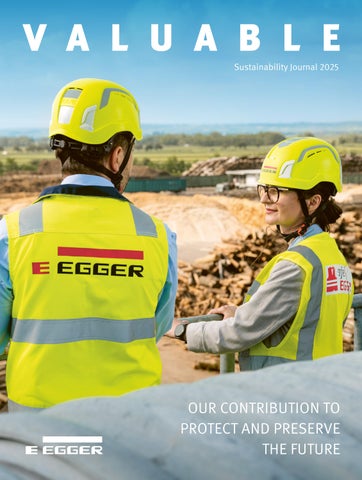
V A L U A B L E Sustainability Journal 2025
OUR CONTRIBUTION TO PROTECT AND PRESERVE THE FUTURE
Contents 2 Editorial 3 Introduction/Overview
4
UNDERSTAND 6 Product transparency One step ahead 8 RETHINK 12 Climate action A question of chemistry 14 PRESERVE 18 Sustainable forestry Rethinking wood construction 20 APPRECIATE 24 Circular economy Recycling that sets an example 26 GROW 30 Good jobs Encouraging and challenging 32 CREATE 36 Green industry Growing together 38 Going forward together 42 Imprint 43
2
EDITORIAL and sustainability can work together. Together, we are promoting important green industry projects. Dear readers, We are delighted to present the second issue of our sustainability journal VALUABLE. A lot has changed, but the title still rings true: we are continuing to work hard every day to use the valuable resource of wood responsibly and to consistently pursue our sustainability goals. Our journey towards Net Zero 2050 continues, with clear climate goals and innovative projects. We are also tackling complex challenges, such as the binding agents in our wood-based materials. An exciting insight into our research and development shows how we are working to reduce their carbon footprint.
Building on all our efforts, we want to provide our customers with deep insights into the environmental performance of our products. Based on this fundamental understanding, we are revolutionising the Life Cycle Assessment for our products: an interdisciplinary project with which we will achieve a new level of product transparency. In this issue, we are delighted to once again provide you with VALUABLE insights into our progress, our challenges and our goals. Sustainability is not a trend for us, but a central component of our corporate responsibility. Let us continue on this path together. Your EGGER Group Management
Sustainable forestry also remains a key topic. With the EGGER EcoBox, we are responding to changes in the forest and also enabling the use of lower-quality wood in modern wood construction. An example of how innovation and responsibility go hand in hand. We can set standards when it comes to the circular economy: We are now the largest wood recycler in Romania. This success is based on years of development work. As an employer, we are expressly committed to diversity and equality. By signing the United Nations Women’s Empowerment Principles, we have sent an important signal. We want to increase the proportion of women in our team. To this end, we are implementing targeted measures – from recruiting and infrastructure to raising awareness. We are convinced that all challenges can be mastered as a team. Our plant in Caorso (IT) is an example of how integration, innovation Thomas Leissing, Frank Bölling, Michael Egger Jr. and Hannes Mitterweissacher (from left)
3
Sustainable, of course. Innovative since 1961.
EGGER AT A GLANCE. Sustainable management lies at the heart of the EGGER Group’s corporate DNA. And this has been the case since the company was founded in 1961, as Fritz Egger Sr. believed that wood was far too valuable to simply throw it away. The family company is therefore clearly committed to sustainable management, geared towards future generations.
The EGGER Group is a leading international manufacturer of wood-based materials with around 12,000 employees and 22 production plants worldwide. EGGER is a full-range supplier for furniture and interior design, wood construction, and wood-based flooring, making it a reliable partner for the furniture industry,
wood and flooring distributors and DIY stores. In the 2024/2025 financial year, the EGGER Group generated revenues of EUR 4.13 billion and produced 10.8 million m³ of wood-based materials and timber.
Supporting goals for a better future
Excellent sustainability performance Prime status in the ISS ESG rating Gold medal from EcoVadis
MORE TRANSPARENCY Would you like to gain a deeper insight into our key figures and how they are calculated? The Financial and Sustainability Report of the EGGER Group for the 2024/2025 financial year: to.egger.link/sustainabilityreport The Environmental Product Declarations (EPDs) and Environmental and Health Data Sheets (EHDs) for EGGER products: to.egger.link/product-transparency The manufacturer’s declaration on timber origins: to.egger.link/declaration-timber-origin
4
Scan here:
11.7 MILLION EGGER products store carbon. In the past financial year, they stored 11.7 million tonnes of CO₂e.
91 %
of all EGGER products are recyclable, i.e. they are suitable for material recycling after use.
YOUNG PROFESSIONALS EGGER has already established its own apprenticeship programmes in 21 of its 22 production plants. There are currently 508 young people in training.
66 % 89 % 10 YEARS
of the wood used in the wood-based materials comes from by-products or recycling.
of all the materials used in the products are made from renewable raw materials.
EGGER values the experience of its employees – on average, team members have been with the company for over 10 years.
71 %
of the energy used at EGGER comes from renewable sources.
All our shown and mentioned decors are reproductions.
5
UNDERSTAND
EVERY PRODUCT LEAVES ITS MARK ON THE CLIMATE. EGGER DISCLOSES THE ENVIRONMENTAL IMPACT OF ITS PRODUCTS AND USES THE DATA FOR CONTINUOUS IMPROVEMENTS. 6
UNDERSTAND
EVERYTHING REVOLVES AROUND THE PCF
Signposts QNG, LEED, BREEAM or DGNB? And what’s the difference? Building certification, like the associated market of products and services, is complex. In almost every country, different standards and regulations apply, according to which a building receives a recognised certificate for sustainability, health and energy efficiency. For this reason, EGGER summarises all environmentally relevant data on its materials in its Environmental Product Declarations (EPDs) and Environmental and Health Data Sheets (EHDs) and makes them publicly available. This makes it easier for architects, planners and fabricators to select materials and obtain building certification.
The product carbon footprint (PCF) shows the total greenhouse gas emissions generated during the manufacture of a product and in its supply chain and is therefore the key climate action indicator. On the way to Net Zero, the fossil PCF in particular must be reduced to zero. The PCF is of interest to customers so that they know the carbon footprint of the products they buy and can use it for their own climate strategy. Read on to find out how EGGER can provide even more precise data in future.
Scan here:
Find out more: to.egger.link/product-transparency
86 % Is recycling good for the climate?
of all EGGER products have an externally verified environmental label, an environmental declaration or an EPD
The stored carbon remains bound in recycled wood, which contributes to climate action. However, the key question is: Which wood mix produces the lowest product carbon footprint (PCF)? EGGER wants to further increase the recycling rate in its own use of wood, but a local raw material optimum must be defined for each location. Issues such as local availability, quality of raw materials, product requirements, a potential increase in glue requirements, energy use, availability of the necessary processing technologies and transport distances must be taken into account – they could even increase the PCF. In the future, therefore, both pillars will continue to be needed, recycled wood and fresh wood – each in the optimum mix.
7
UNDERSTAND
Daniela Wohlschlager is an expert in product sustainability. She leads the pioneering Life Cycle Assessment project.
8
All our shown and mentioned decors are reproductions.
UNDERSTAND
ONE STEP AHEAD Every product leaves its mark on the climate. To make this visible and reduce the impact on our environment, EGGER is revolutionising the Life Cycle Assessment for its products. Daniela Wohlschlager, Product Sustainability Expert, is leading a complex project with an interdisciplinary team, which will ultimately make it very easy for customers to gain a deep insight.
Ms Wohlschlager, your area of responsibility revolves around the transparency and sustainability of products. What does this topic mean for you and for EGGER? We make consumer decisions every day. Product transparency is very helpful in order to get an idea of the footprint that comes with it. At EGGER, the topic of transparency is inextricably linked to our company philosophy. All product-relevant documents are made publicly available on our website. Since 2018, we have also been disclosing our performance annually in our Sustainability Report. In view of the increasing importance of product transparency, particularly with regard to legal requirements, we are consistently developing this aspect further. It not only helps us to further improve our products, but also to fulfil our customers’ objectives. What is your Life Cycle Assessment (LCA) project essentially about? A Life Cycle Assessment (LCA) covers all environmental impacts, including the product carbon footprint (PCF). In future, we will standardise data collection for the LCA of our products in all plants. You have to imagine the initial situation as if everyone were climbing a mountain together, but each person takes
a different route to the summit. In future, we want to standardise this process for the entire EGGER Group, make it more efficient and make much more detailed and comparable results available to our customers. Which customer objectives does EGGER meet with this? Our customers face different challenges: Industrial companies need reliable data for their sustainability reports in accordance with EU directives. The forthcoming Digital Product Passport requires the complete LCA to be disclosed for every product. This information is already a key component of construction projects. With our project we are creating the basis for meeting all of these requirements – efficiently, transparently and in a futureproof manner. In this way, we support our customers in making well-founded decisions and achieving their sustainability goals. What specifically will be improved by the LCA project? Creating an LCA for our products used to involve a lot of manual work and was therefore set up for an average product with production at a sample location. You can think of each LCA as a separate study. For the declared unit (e.g. 1 m² of laminated particleboard), data
is collected for each life cycle phase, such as material use, transport, energy requirements, etc. All this data is very complex to collect. To be able to prepare the LCA more efficiently in the long term, a project to increasingly automate data collection was launched in May 2024. We are currently in the early stages: the first functions can already be used, but full implementation for each location and for different product variants will still take time.
“THE LONG-TERM GOAL: CUSTOMERS RECEIVE PRODUCT- AND LOCATIONSPECIFIC LIFE CYCLE ASSESSMENTS.” DANIELA WOHLSCHLAGER
9
UNDERSTAND
How will the LCA be calculated in future? The project is establishing an internal standard for data collection. Part of this involves developing increasingly automated retrieval of data from our SAP system. This data will be fed into a calculation model that enables the entire LCA to be created. What can customers expect from this project? The declared goal is to offer a specific LCA for each product – in each product variant and for each production plant. This means that our customers know the exact environmental impact of the products they purchase and can use this data transparently. This is a large but forwardlooking goal and we are going to great lengths to achieve it. Was there a model that you followed? There are examples in other sectors. EGGER is a pioneer in the wood industry. We want to be a role model ourselves.
THE OBJECTIVE:
100 % PRODUCT TRANSPARENCY
How can the development process for such a complex project be imagined? Our project team is diverse and interdisciplinary: on the one hand, we work closely with IT and Controlling to set up a standardised data structure. All relevant departments that influence the LCA are involved in data collection. These include Purchasing, Logistics, Environment and Energy.
What is the status quo and what are the next steps? We started the project with a pilot product and pilot location, the laminated particleboard produced in Unterradlberg (AT). Further plants and products will be added step by step. Our LCA calculation model is externally verified and we have calculated first results for chosen products. From this, we are learning how much impact the respective materials and processes have on the overall result. We are also currently optimising the internal data collection process, which will continue to evolve with each roll-out to other plants and products.
“EGGER IS A PIONEER IN THE WOOD INDUSTRY. WE WANT TO BE A ROLE MODEL OURSELVES.” DANIELA WOHLSCHLAGER
10
UNDERSTAND
What do you personally find most exciting about this project? The project is very extensive in terms of content and personnel. Ongoing dialogue with a wide range of specialist departments and EGGER locations is particularly exciting – this not only broadens our own understanding, but also brings in new perspectives. The current focus is on optimising data collection, which has already seen significant progress compared to the start of the project. Initial insights into
the resulting environmental impacts for the investigated products show the potential of the new system. Seeing how the standardisation process is progressing is not only motivating, but also sends a strong signal for the future: we are on the right track – together, data-based and with a clear goal in mind.
The product carbon footprint (PCF) is part of the Life Cycle Assessment (LCA) and is regarded as a key climate action indicator. EGGER’s goal is to further reduce the fossil footprint of its products.
EXPERT KNOWLEDGE: PRODUCT CARBON FOOTPRINT The product carbon footprint is an important part of the LCA. The PCF is measured as the Global Warming Potential (GWP) and is declared via four indicators: GWP-fossil (fossil emissions in upstream chain and production) + GWP-biogenic (renewable raw materials) + GWP-luluc (land use and land use change) = GWP-total (total climate impact of the product) The GWP-fossil must be reduced towards zero on the way to Net Zero.
All our shown and mentioned decors are reproductions.
11
RETHINK
CLIMATE ACTION IS THE MOST URGENT TASK OF OUR TIME. EGGER IS PURSUING THE GOAL OF NET ZERO BY 2050 AND IS THEREFORE INVESTING SIGNIFICANTLY IN THE FUTURE. 12
RETHINK
NO MORE FOSSIL FUELS The production of wood-based materials is energyintensive. The EGGER Group’s total energy consumption in the 2024/2025 financial year was 9,896 GWh. Around 80 % of this is thermal energy and around 20 % electricity. The good news: 79 % of the heat requirement is already covered by renewable sources. For electricity, the renewable share is 23 %. On the way to Net Zero, EGGER will further reduce energy consumption and cover the remaining demand from renewable energy sources, among other measures. This requires extensive interventions.
71 %
Milestones on the way to Net Zero ▸ By 2030, reduction of direct emissions from EGGER plants (Scope 1) by at least 30 % ▸ By 2030, reduction of indirect emissions from purchased energy (Scope 2) by at least 40 % ▸B y 2030, reduction of indirect upstream and downstream emissions (Scope 3) by at least 10 %
Even now, 71 % of the energy used throughout the Group comes from renewable sources. The great thing about it is that a significant source of energy is generated directly from the own production processes. Wood residues that can no longer be converted into products provide renewable energy in the company’s own biomass power plants. They replace fossil fuels in energy generation. It is one of the many advantages of closed-loop production.
Scan here:
Find out more: to.egger.link/climate-strategy
MOBILITY TRANSITION E-fleets, alternative fuels, rail transport and smart logistics contribute to achieving climate goals. The proportion of electrically powered forklift trucks in the EGGER fleet is already at 47.7 %. 18.4 % of company cars are also electric. New additions to the fleet: hybrid excavators, which emit up to 30 % less CO₂ during operation, and driverless transport systems. Freighters are already covering millions of kilometres with alternative fuels such as Bio-LNG or HVO100.
OWN HEAT AND ELECTRICITY Construction of the new second power plant at EGGER’s headquarters in St. Johann in Tirol (AT) is progressing. The boiler and turbine have been installed and commissioning is planned for early 2026. In future, it will supply production with renewable heat and electricity. The use of fossil fuels is approaching zero. Surrounding communities will also benefit from more sustainable district heating.
13
RETHINK
Thomas Kuncinger, Chemical Engineering Senior Expert at EGGER, is an expert in alternative binding agents.
14
RETHINK
A QUESTION OF CHEMISTRY
They make up a small proportion of the product and yet carry a large CO₂ load – the binding agents in wood-based materials. Thomas Kuncinger, Chemical Engineering Senior Expert, gives a microscopic insight into the research and development work at EGGER, clear climate goals, complex challenges and patented successes.
“There’s no such thing as a classic work day for me, every day is different,” laughs Thomas Kuncinger, who is on his way from his office to the laboratory in the EGGER Group’s research and development centre, the TechCenter in Unterradlberg (AT). No wonder – after all, the EGGER Group’s climate targets are at stake, and the trained chemist and expert in biochemistry and technical microbiology is making an important contribution to achieving them. He has been part of the Chemistry Competence Centre for 20 years and conducts research into alternative binding THOMAS KUNCINGER agents. “Back then we were still a relatively small department, but over the years the research and development sector has grown significantly.” of up to 90 % renewable raw materials, its production still requires the use of chemical To reduce greenhouse gas emissions in line binding agents. As small as this proportion with the Paris Climate Agreement and achieve in the product is, its impact on the product its Net Zero goal by 2050, the company is carbon footprint (PCF) is huge. pursuing an ambitious strategy with many interim targets. A path full of milestones The principle of greening and challenges. Although, depending on the recipe, EGGER particleboard already consists 78 % of the EGGER Group’s climate-impacting emissions are generated in Scope 3, i.e. the upstream and downstream value chain, which is outside the company’s direct control. As far as binding agents are concerned, it is not only their fossil basis that plays a role, but also the energy required to produce them. A large
“THE NET ZERO GOAL BY 2050 WILL BE CHALLENGING. BUT
WE ARE WORKING ON MANY NEW PROJECTS AND ARE
CONTINUING AT FULL SPEED.”
The TechCenter in Unterradberg (AT) is the EGGER Group’s research and development centre.
15
RETHINK
A successful hybrid system At the same time, the company is researching alternative wood-based binding agents, such as lignin, tannin and cellulose. With great success, as a patented project shows. “Together with external partners, we have adapted water-soluble lignins from waste streams generated by the paper and pulp industry so that we can use them to replace a certain proportion of the conventional binding agent,” says Thomas Kuncinger, explaining the hybrid system, which saves up to 25 percent by mass of a fossil-based binding agent. “The idea originated on a piece of paper, was then tested in the laboratory and at the EGGER TechCenter here in Unterradlberg (AT), and finally implemented on the large-scale facility. Today, we use this hybrid system at several locations,” explains the expert. Binding agents are a major driver of the product carbon footprint. The first step is “greening”.
He has now arrived in the laboratory and is standing in front of a chemical testing set-up
with numerous test tubes, dressed in a white coat. “I’m an extremely meticulous person. Tidiness and cleanliness are my top criteria. This is already the case with housework and it extends to the systematisation of processes,” says the chemist. “The idea is always creative, but the implementation is then systematic in order to avoid coincidences and prevents you from getting lost somewhere.” Most development projects usually run for two, maximum three years, after which a decision has to be made as to whether it is really worth continuing the project. The complexity of plant-based alternatives The third area of internal research is dedicated to alternative plant-based binding agents. Even if this sounds promising, the whole system is a complex one. “The biological part is usually not very reactive, so I need a component for crosslinking that is highly
“ALTHOUGH THE REDUCTION OF THE overall package for the PCF, which EGGER is intensely trying to minimise, with foresight and in cooperation with suppliers, partners and research institutions. And this is not just a recent development. “Although the reduction of the PCF has only become a lot more important in recent years, optimising existing binding agents and research into alternative options have kept us busy for as long as the binding agents themselves. Starting with formaldehydefree binding agents, through lower-emission options, to research into alternative binding agents made from natural materials, such as by-products and waste streams from agriculture,” explains Thomas Kuncinger. Today, research and development work at EGGER is focused on three key areas. “The most widespread and successful binding agents are aminoplasts, whose basic components are urea and methanol. We initially try to ’green’ them. This means using PCF-reduced raw materials and renewable energy in production or optimising the recipes.”
16
PCF HAS ONLY BECOME SIGNIFICANTLY MORE IMPORTANT IN RECENT YEARS, THE OPTIMISATION OF EXISTING BINDING AGENTS AND RESEARCH INTO ALTERNATIVE OPTIONS HAS ALWAYS BEEN A PRIORITY FOR US.” THOMAS KUNCINGER
RETHINK
A binding agent must fulfil demanding criteria. Every option is thoroughly verified, with numerous tests being carried out in the laboratory.
reactive. Unfortunately, this is not found in nature,” says Thomas Kuncinger, summarising the problem. In addition, plant-based binding agents often have a large CO₂ load, which is hidden in the fertiliser or the fuels for the harvest. “We have already tested more than 50 different binding agent systems since we began our research work – each with a variety of different options and recipes. As a rule, suppliers, universities or start-ups approach us with an idea, which is then evaluated in several stages,” he adds, explaining the process. From chemical and physical characterisation to the CO₂ load that the material brings with it, right through to practical test pressing to determine the board characteristics required
by standards. Industrial availability also plays a decisive role. “The binding agent must ultimately fulfil all of these requirements.” A day of tests on the laboratory press requires a week of testing and documentation of the results. With patience, perseverance and clear goals Thomas Kuncinger opens one of the many machines in the TechCenter and compares another test pressing: “I am optimistic that we will achieve the climate goals we have set ourselves by 2030. The Net Zero goal by 2050 will be challenging.” But here too, the chemist thinks in the same structured and strategic way as in his work. “Many new projects and evaluations are already in the pipeline. We are continuing at full speed.” Step by step.
GOOD TO KNOW: BINDING AGENTS → EGGER particleboard already consists of up to 90 % renewable raw materials. → In total, EGGER has already tested over 50 different binding agent systems, each with a variety of options and recipes. → Plant-based binding agents also have a CO₂ load – and usually not a small one. → The key criterion for alternative binding agents on the way to Net Zero by 2050: they must reduce the PCF.
17
PRESERVE
SUSTAINABLY MANAGED FORESTS STORE THE MOST CARBON. EGGER USES THE VALUABLE RESOURCE OF WOOD RESPONSIBLY AND IN MULTIPLE STAGES. 18
PRESERVE
ISO 38200 Wood knowledge The “Forest & Biodiversity” nature learning trail, which runs around the EGGER plant in Rambervillers (FR) and was created in 2022, was the venue for the “Forest and Wood Purchasing Day” on 10 June. The day of action was aimed at employees and external parties. Workshops explained the forest ecosystem, the role of foresters, wood purchasing strategies, and provided practical experience such as identifying wood species and planting seedlings. For example, participants learnt that the European spruce trees in the Vosges forests are affected by bark beetles – and that infested wood can still be used at EGGER.
74 %
EGGER’s wood procurement strategy is based on important cornerstones. EGGER sources its wood as close as possible to its production plants. This shortens transport routes and strengthens regional value creation. Already 74 % of wood purchases are made in the local region. Long-term and stable cooperation with partners is also very important. Dealer structures are avoided and 92 % of procurement is carried out with direct suppliers. This ensures transparency in the overall process and advantageous solutions for both sides.
EGGER was one of the first wood-based material manufacturers in the world to implement ISO 38200, a globally applicable, internationally recognised standard for the transparent product chain of wood and wood products. EGGER thus fulfils all legal requirements for the legality and transparency of the wood used. The wood supply chain can be certified as third-party verified in accordance with ISO 38200. In addition, EGGER relies on control measures by independent third parties and, wherever available, favours wood from certified forests as proof of sustainable forest management.
RETHINKING THINGS
EGGER also uses finger-jointing at the sawmill in Brilon (DE). This wood joining technique makes it possible to produce long boards and slats from individual shorter pieces. The background: climate change is altering the wood qualities available. With finger-jointing, faulty areas are specifically cut out, resulting in a product that is in no way inferior to the non-finger-jointed alternative in terms of stability. Waste can be reduced and high-quality timber products can be manufactured even from poorer wood qualities. This enables efficient resource utilisation at the top of the wood cascade.
19
“THE FOREST IS OUR ELIXIR OF LIFE – WITHOUT WOOD, THERE WOULD BE NO EGGER. THAT’S WHY WE MAKE THE BEST POSSIBLE USE OF WOOD.” MORITZ STEINRUCK
20
PRESERVE
RETHINKING WOOD CONSTRUCTION
Moritz Steinruck was involved in the development of the EGGER EcoBox from the initial idea to perfection. It is a pioneering solution in wood construction that not only enables the efficient use of resources, but also gives a key role to lower-quality wood. He reveals how EGGER is responding to the changes in the forest with this product.
“I’m passionate about the outdoors and joined the scouts movement as a child. A classic,” laughs Moritz Steinruck. He is now in his late 30s and has not only been looking for new paths and solutions in nature, but has also been at EGGER for 13 years. As Head of Product Management, the wood technology graduate is responsible for the entire life cycle of EGGER building products. Made from wood, of course. Over the last 20 years, one of the oldest building materials in the world has become increasingly important again. And the trend is rising. “Just under ten years ago, for example, the proportion of single-family homes in Germany built with wood was somewhere around 15 percent, today we are at over 25 percent in some federal states, even above 28 percent for non-residential buildings and significantly more in Austria,” says the expert. A trend that is now also being used in the construction of apartment buildings. Natural climate action Wood is not only a renewable raw material, it also removes CO₂ from the atmosphere as it grows and stores the carbon over its entire useful life. A sustainably managed forest is the ideal carbon store and essential for climate action. But short construction times thanks to the high degree of prefabrication and a healthy home atmosphere also make wood the pioneering building material of our time. “At EGGER, we only use wood from sustainable forestry. We ensure this through comprehensive control measures, audits, various certifications and the high demands we
UP TO
38 % LESS WOOD
than a solid structural timber stud
place on our suppliers,” says Moritz Steinruck. “After all, the forest is our elixir of life – without wood, there would be no EGGER.” Making the best possible use of this valuable resource is therefore a key concern for the company. “By cascading use, we mean keeping the wood in the cycle for as long as possible and ideally reusing it several times. Until it is finally utilised thermally.” Engineering skill meets innovative spirit At the same time, the forest is facing major challenges. Environmental impact, above all climate change, is causing wood quality to decline. “This is where the term ’calamity wood’ comes into play. Due to persistent warm weather and drought, trees are increasingly struggling with pest infestation, especially
The EcoBox is a hybrid product made from OSB, timber and soft wood fibre insulation. This efficient material combination reduces wood consumption. 21
PRESERVE
The EcoBox also gives poorer quality wood a key role. The timber used is finger-jointed.
from bark beetles. At the same time, massive storms and extreme weather events are making the forest more vulnerable,” explains Moritz Steinruck. “These changes not only affect the appearance of the wood, but also its stability. This creates a gap in quality.” As a trained carpenter and passionate tinkerer who also likes to do things himself in his workshop at home, Moritz Steinruck knows that great solutions are not so easy to conjure up out of a box. Rather, it is necessary to think outside the box. And this is the case for the EcoBox, which combines experienced civil engineering expertise with foresight. Its secret: the hybrid product made from OSB boards, finger-jointed timber and soft wood fibre insulation is a resource-efficient alternative to solid wood studs in timber frame construction and provides an innovative response to the changing conditions in the forest. Thanks to its mix of materials, it not only requires up to 38 percent less wood than its solid timber counterpart, it also allows wood qualities to be used that previously had no chance as construction wood.
The most honest feedback on a new product is obtained directly from the fabricator.
UP TO
150 kg/m³ LESS WEIGHT
than a solid structural timber stud during transport and use
Excellent properties Moritz Steinruck was immediately taken with the idea of the EcoBox: “It was a solution that anticipates the bottleneck in the wood construction industry and saves material.” Three years of development later, the EcoBox is an approved building product that has met with great interest and has even been honoured with the German Sustainability Award and named as Product of the Year. “Back then, we asked ourselves what requirements a stud had and what materials were available to us? On the one hand, there was our sawmill in 22
More efficient and faster work thanks to maximum dimensional accuracy and dimensional stability.
PRESERVE
lower qualities.” Even calamity and damaged wood can be processed into durable wood construction products and thus bind carbon in the long term. Less wood use, more living space
Moritz Steinruck is a trained carpenter and studied wood technology. He has been with EGGER for 13 years.
“THE ECOBOX IS A SOLUTION THAT ANTICIPATES THE BOTTLENECK IN THE WOOD
Brilon (DE), to which we had initially added a finger-jointing line, which specifically cuts out defects in the wood and assembles it into new slats. On the other hand, there was our OSB production. So we looked for the best possible product to combine everything,” the engineer MORITZ STEINRUCK explains. “With the EcoBox, we use less wood and nevertheless get a more homogeneous material. While we have often focused on A-quality wood in wood construction in the past, we can now still manufacture high-quality products from
CONSTRUCTION INDUSTRY
The EcoBox has been manufactured industrially at the EGGER plant in Wismar (DE) since May 2024. Not only forests and forest owners, but also users, from carpenters to planners, benefit from the advantages afforded by this certified product. “In addition to the weight savings of up to 150 kg/m3 compared to a solid structural timber stud, the high insulation content of the EcoBox reduces thermal bridges. This means that the wall in which the EcoBox is installed can remain slightly narrower and more space is created.” Not to mention its circular concept, because the EcoBox is also 100 percent recyclable. A reassuring thought. Even though Moritz Steinruck already walked through the forest as a child with his eyes open and senses firing, today he understands all the more how important it is to protect its essential ecosystem and use it sensibly to meet the challenges of our time.
AND SAVES MATERIAL.” The wood construction company Nortmann is building its own office extension with EcoBox wall modules. Their low weight was the main thing that convinced them.
ECOBOX IN USE The family business Holzbau Nortmann from Werlte (DE) has championed high-quality wood construction since it was founded in 2019. Given its continuous growth – the team now has 17 employees – space was also becoming tight. The solution: a modern extension to the existing building, constructed inhouse. New rooms for offices, meetings and recreation were forged, in an area covering 91 m². The professionals used the EcoBox for the first time in this extension: This building product was chosen because it combines resource efficiency with practical advantages on the construction site. For owner Dieter Nortmann, the project was a success: “We made a conscious choice for the EGGER EcoBox because we were impressed by the product’s sustainability, dimensional stability and weight. The latter in particular is crucial in wall construction. Lighter elements mean real relief for our employees.”
23
A P P R ECI AT E
CLOSED CYCLES EXTEND THE UTILISATION OF WOOD AS A RESOURCE. EGGER MAINLY USES WOOD FROM THE CIRCULAR ECONOMY THAT HAS ALREADY HAD SEVERAL LIVES. 24
APPRECIATE
EXHIBITION STAND WITH A SECOND LIFE EGGER’s trade fair presentation at INTERZUM 2025 not only impressed visitors, but also ensured that the materials used were reused and recycled: in cooperation with Trash Galore, 12 tonnes of solid structural timber and OSB boards were given a second lease of life as part of social and cultural initiatives. The remaining materials went back into particleboard production via the company’s own recycled wood collection streams.
COMPLETE CYCLE IN SHOPFITTING
25 YEARS The very first Timberpak location was founded in Leeds (UK) 25 years ago. EGGER now operates its own recycling collection sites in the UK, Germany, Austria, France, Poland, Romania, Italy, Hungary and the USA. At these locations, recycled wood from the respective region is collected, sorted and pre-shredded for transport to the EGGER plants. The final processing takes place there. With this successful concept, the wood-based material manufacturer has also been able to contribute to the creation of appropriate structures in countries where wood recycling was not yet common practice.
For its new sports store in Bielefeld, INTERSPORT Finke focused on ecological responsibility, circular material utilisation and modern design. A key element: the closed waste wood cycle. Around 6.4 absolutely dry tonnes of wood from the old shop fittings were transported to the EGGER plant in Brilon (DE), processed and used together with the usual wood mix on site in the production of new high-quality wood-based materials. Around 5 tonnes of CO₂ equivalents are bound in the 50 m3 of particleboard used. And the pilot project continues: INTERSPORT Germany also collects board materials across projects to reuse them in the long term. This creates a sustainable material pool for future construction projects.
1st T IMBERPAK IN THE USA The first US Timberpak recycling collection site is located in Charlotte, North Carolina. EGGER has been operating the site since 2023 to supply the particleboard production at the Lexington, NC, plant. Board offcuts, pallets and other post-consumer materials receive a second life. Timberpak Charlotte is therefore a central building block for the circular model of EGGER wood-based material production in North America.
All our shown and mentioned decors are reproductions.
25
APPRECIATE
Circular economy pioneer in Romania: Vlad Alexe, Head of Recycling Wood Purchasing
26
APPRECIATE
RECYCLING THAT SETS AN EXAMPLE
With an annual processing capacity of 120,000 tonnes of recycled wood, the EGGER plant in Rădăuți is considered a pioneer for the circular economy in Romania. Fundamental development work was carried out to achieve this. And successfully so: EGGER is now the largest recycler of wood in all of Romania.
“OUR EXPLICIT COMMITMENT TO Vlad Alexe, Head of Recycling Wood Purchasing, has been part of this important project, which not only upholds ecological but also social responsibility, from the very beginning. “I started twelve years ago, when we were still at the start in terms of wood VLAD ALEXE recycling in Romania,” says Vlad Alexe. “I am now responsible for the reliable supply of recycled wood to our plant and manage the ongoing and long-term operation of our Timberpak the resource as extensively and as often as recycling collection sites throughout Romania.” possible. Trees absorb CO₂ as they grow and the carbon remains stored in the wood over Back into the production cycle its entire useful life. With every chip that is recycled, the storage effect is extended, which Under the Timberpak network, the EGGER contributes to climate action. Group operates recycling collection sites worldwide that return the valuable resource New recycling territory wood to the cycle. Even now, 66 % of the wood used in wood-based materials throughout the With an investment of almost EUR 22 million Group comes from by-products of the sawmill in recycling infrastructure, EGGER in Romania industry or recycling; in the case of EGGER is now a sustainability pioneer in the wood laminated particleboard, as much as 75 % of processing industry. “The EGGER Group the material comes from the circular economy. opened the plant in Rădăuți in 2008. When the The goal is to increase this quota even further. project was launched to utilise recycled wood After all, the circular business model is at the in the local production of particleboard, it core of the company’s DNA. This also includes broke new ground in Romania. Many framework the cascading use of wood, which means using conditions for material wood recycling had to be created first,” explains Vlad Alexe. “In 2014, we commissioned our first Romanian Timberpak in Cernica near Bucharest. In 2016, a
THE CIRCULAR ECONOMY NOT ONLY SERVES CLIMATE ACTION, BUT IT IS ALSO A BIG STEP FOR ROMANIA.”
Over 1 million tonnes of recycled wood have already been collected by EGGER in Romania.
27
APPRECIATE
second site opened in Cluj, a strategic location in the middle of the country. This was followed two years later by another site in Bucharest and the collection centres in Brașov and Arad in 2022.” While it used to be common practice in Romania to burn waste wood privately, EGGER has taken pioneering steps towards cascading wood use in Romania with the construction of the state-of-the-art recycling facility at the Rădăuți plant and the five recycling collection sites. Since the commissioning of the first Timberpak location in Romania, EGGER has collected more than 1 million tonnes of recycled wood and processed it into particleboard. Whether old furniture, school desks, pallets or wood waste from various industries – the discarded materials are collected in the five Timberpaks, sorted according to specific criteria, shredded and then transported to the plant in Rădăuți to be reintroduced into the production cycle and processed into particleboard. In 2024, the proportion of recycled wood in particleboard at the EGGER plant in Romania was around 25 % and this is set to increase further. “The plant in Romania is a fully integrated operation that also has a biomass plant to supply energy for its own production,” summarises
> 1 MILLION TONNES OF RECYCLED WOOD have been collected by EGGER in Romania since 2014
the specialist. If the recycled wood can no longer be used as a material for particleboard production at some point, it will instead be utilised in the biomass power plant in Rădăuți to generate heat and electricity. Already 78 % of the fuels used at the plant are renewable. Taking responsibility for climate action and society “Our explicit commitment to the circular economy not only serves to protect the climate, but it is also a big step for Romania, which has so far performed rather poorly in the EU’s recycling rankings. We want to be a model for the industry,” explains Vlad Alexe, not without pride. Merely by shredding the recycled wood
at the Timberpak recycling collection sites, the number of lorry journeys could be reduced by up to 75 %, thus saving CO₂. This is a project that sets an example in every direction. Even literally, as Alina Chifan explains. She is the Plant Director Customer Service at the Rădăuți plant and in this role is also responsible for the extensive donation activities that EGGER undertakes in the region. “As many schools struggled with the cost of disposing of their old furniture, we started a cooperation three years ago. Since then, we have been collecting old school desks and chairs, for example, and replacing them with new materials and furniture. This not only makes the children happy, but also the teachers.” In addition to its ecological commitment, the company also makes an important contribution to the social development of the region and
“WE WANT TO TAKE CARE OF THE COMMUNITY WHERE WE ARE PRESENT AND SELECT MEANINGFUL SOCIAL PROJECTS.” ALINA CHIFAN
The recycled wood is returned to the production cycle.
28
APPRECIATE
The recycled wood from Timberpak’s Romanian sites is turned back into high-quality particleboard at the Rădăuți plant.
has supported corporate social responsibility projects worth over EUR 7 million in the last 15 years – from supporting schools and renovating hospitals to building sports facilities and playgrounds and promoting culture. “We want to take care of the community where we are
present and select meaningful social projects that have a positive impact on everyone involved,” explains Alina Chifan. Because she and Vlad Alexe are not the only ones who know how important respectful treatment is. Of our resources and of our society.
Vlad Alexe and Alina Chifan visit the Principal to see for themselves that their contribution makes a difference at the school.
7
EUR MILLION
for CSR projects in the last 15 years
BACK TO SCHOOL When the summer holidays begin in Romania, it’s not just the schoolchildren who are happy, but also the Timberpak locations. After all, this is when schools and kindergartens are renovated and waste wood is collected. From discarded school desks to wooden packaging, the wood goes back into the cycle. There is no cost to the schools. On the contrary, EGGER Rădăuți invested EUR 723,000 in education and school renovations in 2024 alone. 48 schools and kindergartens have already benefited from the donations – from new desks and IT equipment to teaching materials. Another model that closes the cycle and transforms discarded furniture into a new basis for the future.
All our shown and mentioned decors are reproductions.
29
GROW
EMPLOYEES ARE THE MOST VALUABLE PART OF THE FAMILY BUSINESS. EGGER OFFERS SECURE WORKPLACES AND LONG-TERM DEVELOPMENT OPPORTUNITIES. 30
GROW
26,646 KILOMETRES
In the 2024/2025 financial year, 1,835 employees covered a total of 26,646 kilometres as part of the “EGGER runs” initiative. For every kilometre, EGGER donates five euros to charity, which goes to supporting important regional projects. This initiative has been running since 2010 and promotes health and social commitment in equal measure.
SAFETY FIRST
INTERNAL CAREER PATHS
EGGER aims to fill at least 80 % of management positions internally – and has clearly exceeded this goal, reaching 87 %. The aim is to develop potential, for example with strategic development programmes. The “STARTKLAR” programme for future executives has been in place for 20 years. The “START UP” programme for young professionals is now in its seventh round. The participants in each programme are as international as possible and have different backgrounds. After all, the aim is to learn from each other.
The most important thing is for employees to return home to their families safely after work. EGGER has therefore made massive efforts to further improve the work safety of its employees. The accident rate was again reduced in the last financial year to 7.51 accidents per 1 million working hours (internal Lost Time Injury Rate), meaning that the milestone EGGER set itself was achieved. The future goal is zero serious accidents at work.
YOUNG TALENT IS NURTURED 21 of the 22 EGGER production plants have their own apprenticeship programmes, even in countries that do not usually offer such dual training formats. Many careers start immediately after school. EGGER currently offers 508 apprentices a sustainable workplace with positive future prospects. They are on the best path to embarking on a specialised career at EGGER.
8.1
MILLION EGGER values the commitment and experience of its employees. Long-term employment with the company is honoured with an anniversary bonus. In the last financial year, a total of EUR 8.1 million was paid out to employees who have contributed to the company’s success for many years.
31
WOMEN’S POWER AT EGGER
ENCOURAGING AND CHALLENGING Silvia Fien is not only a top executive at EGGER, she is also actively committed to women’s empowerment. In this interview, she reveals why women are essential drivers of the process and where there is still room for improvement.
Voices can be heard through the door of the conference room, with an occasional laugh. Behind it, a group of women are engaged in a lively discussion. They are currently talking about equal opportunities when advertising job openings. The mood of the workshop is positive, and the ideas are just as inspiring. From Production Planners to Mechanics, the participants not only come from different areas of Technology, Production and Logistics, but also from different plants so that improvements are driven forwards together. Silvia Fien, Division Director Logistics EDP Components, is right in the middle of it all.
Ms Fien, you are a female top manager in a male-dominated industry. How does that feel? (Laughs) Quite normal, to be honest. But perhaps that’s also thanks to my long history at EGGER. I started 26 years ago in Production Planning at the Brilon plant (DE), which was a typical male sector at the time. That was shortly after completing my commercial training and parallel to my degree in economics. I was treated with respect right from the start. This
positive experience continues to this day. We have already achieved a lot in terms of promoting women at EGGER, but of course there is still a lot more to do. How does EGGER create suitable framework conditions to meet the individual needs of employees and their development opportunities? In my opinion, EGGER is already doing a lot of things right. But the wood-based material industry remains a rather conservative sector. We already have a high proportion of women in some of the typical office departments. Parttime work models and the option of working remotely have long been available here. There is still some catching up to do in Production and Logistics.
Silvia Fien’s long career path at EGGER includes positions in Logistics, IT and now as Division Director Logistics EDP Components. She is passionate about optimising processes.
“WHERE DIVERSITY IS LIVED, SATISFACTION AND MOTIVATION DEMONSTRABLY INCREASE.” SILVIA FIEN
32
GROW
Together, women from very different areas of the company tackle concrete improvements. 33
GROW
EGGER HAS
12,000 95 17.3 % AROUND WITH
EMPLOYEES
NATIONALITIES
PERCENTAGE OF WOMEN OF THE TOTAL WORKFORCE
55.1 % in IT, Sales, Marketing, Finance, Administration 9.4 % in Technology, Production, Logistics 18.9 % in management positions Today is good, tomorrow will be better: EGGER is taking steps towards more diversity.
technical focus or Girls’ Days in companies. But it’s also about being a role model at home. For example, my daughter and I once built a small industrial robot that looked and worked like the one at our plant in Brilon. You also have to give girls the chance to try things out, offer them opportunities, inspire and promote them.
Identifying and implementing measures requires active involvement across roles, functions and plants.
But there is an incredible amount of work in progress here. For example, we are working on pilot projects for part-time work in our shift model. That would be a big step for many of our colleagues, for mothers, but also for older employees or for anyone to whom the traditional shift model does not offer the necessary flexibility. And then, naturally, the issue of infrastructure also plays an important role. Do we have enough changing rooms and showers, and are they adequately equipped? The most important thing is that women can 34
feel comfortable and that they have equal rights. Of course, this also includes a regular review of the gender pay gap. Why are technical professions still dominated by men today? I think it’s still part of socialisation. There are now great programmes such as schools with a
What attracted you to a technical career back then? At school, I already preferred technology, soldering and building circuits. Later, I studied industrial engineering part-time. At EGGER, I was able to apply this knowledge directly to the automation of logistics processes. I am enthusiastic about exploiting optimisation potentials and thus making processes noticeably more efficient, reliable and safe. What are women’s fundamental strengths and what do they bring to a team? In my experience, women often have a different approach – they value structure, document thoroughly and sometimes have more empathy, or even offer completely different approaches to solutions. These are positive and important drivers in a team. We all notice that mixed teams often achieve better results than homogeneous ones. After all, where diversity is lived, satisfaction and motivation demonstrably increase.
“WE HAVE ALREADY ACHIEVED A LOT IN TERMS OF PROMOTING WOMEN, BUT THERE IS STILL A LOT MORE TO DO.” SILVIA FIEN
Are there any particular experiences you have had as a woman in a technical profession? I introduced RFID technology at EGGER back in 2006 and had the honour of giving a presentation on the subject at a specialist conference in 2013. Apart from me, all the speakers and the majority of the plenum were men. While walking through the foyer, I was asked by a man where “we” had set up the catering. When I took to the stage later, he winked at me and raised his thumb. I have really only had positive experiences within EGGER itself. When I rejoined the company after my daughter was born, the opportunities were truly unique. But it was also a case of give and take, encouraging and challenging. I believe that any woman who is given the chance to organise her personal and professional life better will be twice as motivated to do her job. How are women actively involved in identifying and implementing gender equality measures at EGGER? It is essential for EGGER to involve its female employees directly. Targeted workshops are not just about listening to the women and their needs, but also taking them along with us. Empowering them is particularly important to me. We have so many great women in the
company and sometimes it just takes a little push. Simply to say: you can do it, dare to do it. And suddenly female shift workers are confidently presenting their concerns to our Group Management. I was incredibly impressed by this power. In every role, at every level and in every function, you always
find committed women and role models who support each other. Having mentors who always listened to me and championed me helped me enormously along the way. I would very much like to pass on this positive experience. What would you personally wish for the future? My dream would be for this topic to no longer be a topic at some point. That we take and support every employee, whether male or female, as they need it and that a quota is no longer necessary to achieve these goals.
FOCUS ON DIVERSITY By signing the United Nations Women’s Empowerment Principles in April 2024, the EGGER Group officially acknowledged its responsibility towards gender equality – with the overarching goal of increasing the proportion of women by five percent annually. Extensive measures are being implemented to achieve this. In addition to recruiting, infrastructure adjustments and childcare support, there are also anti-discrimination bodies, confidential counsellors, women’s networks, special training courses and targeted communication to raise awareness.
35
CR E AT E
DIGITALISATION HELPS TO MANUFACTURE PRODUCTS EFFECTIVELY AND SUSTAINABLY. EGGER RELIES ON THE BEST INDUSTRIAL BASIS AND NEW IDEAS. 36
CREATE
435 MILLION
BACTERIA FOR CLEAN AIR An absorption scrubber was recently installed at the Rădăuți (RO) plant at a cost of around EUR 7 million. This system is used to clean the exhaust air at the board press by binding impurities and pollutants in water and thus removing them. The contaminated wash water is then channelled into a bio-reactor, where microorganisms break down the pollutants it contains. After this treatment, the purified water can be fed back into the process and the exhaust air meets applicable purity requirements.
MANAGING THE ENVIRONMENT
The EGGER Group continuously invests large sums in its own plants. In the last financial year alone, EUR 435 million were invested in maintenance and growth across the Group. In addition to major projects, such as expanding the Markt Bibart (DE) plant, this expenditure was channelled into all plants: into increasing capacity and, above all, into further developing the sustainability performance. In this way, EGGER intends to continue to fulfil its role as a technological pioneer in the future.
INVESTMENT IN THE FUTURE EGGER is investing more than EUR 200 million in the expansion of its 22nd plant in Markt Bibart (DE) – with an explicit focus on future-oriented technology. The centrepiece is a new recycled wood processing facility that enables the use of recycled wood on site. Further project steps include the creation of lamination capacities, automated logistics and facility optimisation. The investment not only strengthens the circular economy, but also the region: around 70 new jobs will be created by 2026.
EGGER has an integrated management system that covers all plants. It guarantees compliance with clearly defined requirements in all areas and helps with continuous improvement. 19 of the 22 plants have externally certified environmental management systems (ISO 14001). These systems allow environmental goals to be systematically and consistently pursued in an effort to minimise environmental impact and use resources and energy responsibly.
37
CREATE
GROWING TOGETHER The Caorso plant (IT) demonstrates that challenges and innovations are best mastered together. A lot has happened in Caorso since it was integrated into the EGGER Group. Visiting Sergio Doriguzzi, Plant Director for Technology and Production.
Plant Director Sergio Doriguzzi never gets bored in his day-to-day work. He starts each day with a tour of the plant. 38
CREATE
INVESTMENTS OF EUR MILLION
40
in standardising processes and green industry projects at the Caorso plant
The new thermal oil boiler is revolutionising the plant’s renewable energy supply.
“THANKS TO THE NEW THERMAL OIL BOILER, THE PLANT PRODUCES
It is 7 a.m. when Sergio Doriguzzi arrives at his office in the EGGER plant in Caorso near Piacenza. A quick look at the current production figures and e-mails, then it’s on to his daily tour of the plant. Exchanging with his colleagues is particularly important to him. “We are currently in a very varied and challenging phase, so targeted feedback is essential,” says the Plant Director. Since EGGER acquired 60 % of the SERGIO DORIGUZZI shares in the Italian wood-based material manufacturer SAIB in December 2022, the plant in Caorso has been an important part of the Group. Since then, EUR 40 million have been invested in the plant with 300 employees in order to standardise processes and drive forward projects in the green industry sector.
WITHOUT NATURAL GAS IN NORMAL OPERATION. THAT’S
16,000 TONNES FEWER FOSSIL CO₂ EMISSIONS PER YEAR.”
which is a biogenic fuel. “Experts at the plant worked together with colleagues from the Group on this project. Each side contributed their expertise and experience, and we were able to develop a high-performance system that takes advantage of the location and minimises our natural gas consumption to almost zero. “That’s 16,000 tonnes fewer fossil CO₂ emissions per year,” explains Sergio Doriguzzi, not without pride. And he is right to be proud. As part of the founding family, the industrial engineering graduate knows the plant inside out. He now manages it together with his cousins Clara Conti and Giuseppe Conti, as well as Iulian Gafencu. Like EGGER, SAIB was also initially founded as a family business, in this case in 1962, by Sergio’s grandmother
Pioneering steps in climate action Sergio Doriguzzi stops by a huge facility: “Since February 2025, our new thermal oil boiler has ensured that the plant produces without natural gas during normal operation.” This marks a further step towards reaching EGGER’s Net Zero goal, which was achieved thanks to the state-of-the-art industrial basis, an investment of EUR 16 million and good cooperation. The decisive factors were free capacity in the combustion chamber and a steady flow of wood dust from chip processing,
The Caorso plant produces particleboard from 100 % recycled wood.
39
CREATE
One of numerous innovations includes another short-cycle press for laminating particleboard.
PARTICLEBOARD FROM
100 %
RECYCLED WOOD
Eva Bosi. “Back then, plywood was made from poplar trees in the region. My grandmother quickly recognised the value of the wood waste and founded her own company to produce new particleboard for the Italian furniture industry using the leftovers. So strong women in the company have always been a matter of course for us,” laughs Sergio Doriguzzi, who is the
third generation to lead the plant into the future, with new partners and plans. Values and appreciation The plant has been producing particleboard from 100 % recycled wood since 1994. “We are not only focused on financial output, but also on the growth and prosperity of our employees and the region. Our long-term vision focuses on global sustainability that is both environmentally and socially focused.” On his morning tour, Sergio Doriguzzi also senses this connection among the employees. “We want to be part of a larger family,” he adds. After all, the investments and innovations not only bring improvements, but also long-term security. A feeling that is all the more important during challenging times. “We have just completed the SAP integration in order to standardise processes and data structures. While it is an important prerequisite for our collaboration, it initially changes the entire way we work,” explains the industrial engineer. “It wasn’t straightforward, but especially in a phase like this, you have to see the potential of the new system and the daily improvements.” The IT integration of the Italian location into the Group-wide EGGER network and SAP system has now been completed. This is all thanks to an intensive preparation phase and further constructive cooperation between the two teams.
All facilities have now been converted to EGGER standard systems.
40
CREATE
Creating stronger things together Once again, the Plant Director stops to speak to a colleague. They are talking about the planned expansion of the dry chip processing facility. This will improve how recycled wood is screened, which will positively impact the quality of the particleboard. High-quality design products, 100 percent made in Italy, are now marketed as the S-Collection, part of the EGGER industrial collection. In addition to many other projects, such as an automated packaging line, a new warehouse and a new short-cycle press for particleboard lamination, as well as reducing pressing times and rejects, work safety has also been optimised. “I particularly appreciate this focus at EGGER,” says a delighted Sergio Doriguzzi. “After all, this is about protecting the most important part of our company – the people.”
“I ALWAYS COMPARE OUR GROWING TOGETHER WITH MARRIAGE: TWO PEOPLE DECIDE TO LIVE TOGETHER TO CREATE SOMETHING STRONGER.”
The log yard can be seen in the distance. Mountains of recycled SERGIO DORIGUZZI wood are piled up there. “It’s always impressive and motivating to see how this unused material can be by a globally active corporate group, and transformed into new, high-quality products.” continuously develop our plant.” 70 new The father of three young children seems to employees from the local area have been have inherited a curiosity to try new things hired since then and a lot has already been from his grandmother. “For us, it was the achieved. But there is still a lot left to be right decision to become part of one of the done. “Our goal is higher production volumes, most important players in the industry. This new markets, new investments and an even allows us to consolidate our sustainable stronger connection with the local community. vision, capitalise on the synergies generated This will hopefully guarantee success not only
for our plant, but also for the entire Group,” says Sergio Doriguzzi. “I always compare our growing together with marriage: two people decide to live together to create something stronger. That’s the vision we all share.”
Two become one: creating something stronger, together.
On to new projects: Meeting with the Project Manager for the new dry chip processing facility. 41
GOING FORWARD TOGETHER
Sustainable management is only possible with strong partners. We want to constantly improve with them, which is why we let our customers have the last word.
“AS A SUPPLIER, EGGER IS HEAVILY INVOLVED IN FURTHER DEVELOPING OUR DECARBONISATION STRATEGY.” STEPHANE ROUX
“At Groupe Fournier, CSR is far more than just a set of measures. It shapes our strategy’s DNA and helps us to combine performance and responsibility. It drives growth, offers a competitive edge, and also provides a means of ensuring our company’s long-term sustainability. Responsibility does not end at our plant gates. Our carbon footprint shows how crucial responsible procurement is. That is why we rely on suppliers who share our values and are actively committed to sustainable development. As a committed partner, EGGER supports us in this endeavour. As a supplier, EGGER is heavily involved in further developing our decarbonisation strategy and we have been given transparent analyses and action plans. Together, we continue to work on eco-design initiatives in areas such as reducing our carbon footprint, certified wood, using recycled materials and further developing binding agents.” Stephane Roux, Head of Sustainable Development – Groupe Fournier
“At trend INTERIOR, we live partnerships; for us, they are far more than just customer-supplier relationships. We share common values with EGGER and our collaboration is characterised by innovative strength. EGGER is actively involved in our projects, making valuable contributions, and thinks about challenges from the customer’s perspective. Products that already anticipate the requirements of day-to-day use are particularly important to us. In schools, for example, board materials must meet the highest quality standards: they must be abrasion, impact and scratch resistant, moisture resistant, lightfast, stain resistant and with an antibacterial surface in accordance with ISO 22196. EGGER fulfils these requirements reliably and transparently. With CO₂e calculations as well as technical certificates and material documents such as B1 certificates or EPDs (Environmental Product Declarations), EGGER provides the necessary security for our demanding projects.” Christian Hilz, Managing Director – trend INTERIOR
SCHOOLS OF THE FUTURE Based on the takerspace concept, trend INTERIOR develops flexible furniture modules for schools that support a variety of learning needs, yet also create places of retreat. EGGER is supporting the project as a partner, providing robust and tested wood-based materials. The concept is already implemented in around 200 schools in Germany.
42
“WITH TECHNICAL CERTIFICATES AND MATERIAL DOCUMENTS, EGGER PROVIDES THE NECESSARY SECURITY FOR OUR DEMANDING PROJECTS.” CHRISTIAN HILZ
IMPRINT Published by: EGGER Holzwerkstoffe GmbH Weiberndorf 20 6380 St. Johann in Tirol (AT) Project Management: Katharina Wieser If you have any questions or suggestions, please contact: corporate-communications@egger.com Publication date: December 2025
Design: Werbeagentur Rypka GmbH, rypka.at
Image credits: Andreas Jacob
Text: Julia Hauch, Katharina Wieser
Additional image credits: Anna Bauer (inside cover, p.25) Ramon Haindl (inside cover) EGGER Holzwerkstoffe (p.3, p.5, p.13, p.19, p.25, p.31, p.37, p.42)
Print: FRIEDRICH Druck & Medien GmbH, printed on PEFC-certified paper Notes: Subject to technical modifications and printing errors.
The content of this publication has not been approved by the United Nations and does not reflect the views of the United Nations or its officials or Member States.
All our shown and mentioned decors are reproductions. 43
THE EGGER SUSTAINABILITY STRATEGY IN OVERVIEW The EGGER Group takes responsibility for its products, its production and also for its employees and society. Its sustainability management is based on a clear, Group-wide strategy. EGGER is committed to the 17 Sustainable Development Goals (SDGs) of the United Nations and has defined five strategic priorities based on them. Fostering sustainable forestry – Using wood as climatefriendly material – Transparent and safe timber supply chains
SUSTAINABLE FORESTRY Products from renewable raw materials – Closedcycle production – Utilisation of wood that has already had several lives – Durable and recyclable products
CIRCULAR ECONOMY Best employer in the respective region – Longterm development opportunities – Work safety as the highest goal
Action areas
Targets
Due diligence system in accordance with ISO 38200 and supply chain standards
→ 100 % wood purchase from verified legal sources
Wood purchase primarily via direct business relationships
→ Exclusion of dealer structures as far as possible
Wood purchase as regionally as possible
→ 2030: 75 % of wood purchased from regional proximity
Prioritises timber from FSC® and PEFC-certified forests (FSC® C017963 and PEFC/06–38–171)
→ > 60 % certification proportion in fresh wood
Multi-stage cascading use of wood
→ Use mainly of secondary raw materials
Action areas
Targets
Highest possible proportion of renewable raw materials
→ Alternatives to fossil binding agents
Strict quality standards and quality tests
→ 2025: 95 % products with eco-labels
Increased proportion of recycled wood
→ 2025: 25 % recycled proportion in the wood
Own recycling collection sites
→ Expansion of the Timberpak network
Products with a long service life
→ High product quality according to international product standards
Increased proportion of recyclable products
→ Continuous improvement
Action areas
Targets
Comprehensive measures for the “zero accidents” vision (Vision Zero)
→ 0 occupational accidents with serious consequences per 1 million working hours
Prevention for physical and mental health
→ > 97 % health quota
Equal opportunities and equal treatment
→ Annual increase by 5 % in the proportion of women in the total workforce
Internal specialist and management careers
→ > 80 % open management positions filled with internal candidates
Young professionals from own ranks
→ > 3 % apprenticeship quota
GOOD JOBS
GREEN INDUSTRY
Use of clean and environmentally friendly technologies – Internationally recognised standards and management systems – Extensive investment in the best available technology
Action areas
Targets
Integrated locations for raw materials, energy and strategic product groups
→ Modern waste water, noise protection and air pollution control systems to fulfil all requirements
Use of renewable energy
→ Significant global increase in the proportion of renewable energy
Energy efficiency
→ 2030: -10 % specific energy consumption
Resource efficiency
→ Reduced water consumption, utilising savings potential; 2025: -10 % specific residual waste volume
Environmentally friendly logistics
→ Optimised transport routes, efficient means of transport with the best possible capacity utilisation, alternative and lower-emission drives
THE EGGER CLIMATE STRATEGY IN DETAIL EGGER is committed to reducing its climate-impacting greenhouse gas emissions in line with the Paris Climate Agreement. EGGER is committed to the Net Zero target by 2050.
The commitment: The EGGER way to Net Zero This commitment is trend-setting for the EGGER Group and requires comprehensive measures in many areas of the company. On the way to Net Zero, the family company sets itself milestones and interim targets.
→ Target: Net Zero by 2050
CLIMATE ACTION SCOPE 1 Direct emissions of own plants
SCOPE 2 Indirect emissions from purchased energy
→ Interim target 2030: Reduction by min. -30 %
Action areas Energy savings
Biomass power plants
High efficiency facilities
Internal motor vehicle fleet
Action areas Energy Management
Expansion of own electricity production with biomass and photovoltaics
→ Interim target 2030: Reduction by min. -40 %
Electricity from renewable energy
SCOPE 3 Indirect upstream and downstream emissions
Action areas
CO₂
Joint solutions with business partners
Optimisation of binding agent and impregnating resin technology
Increasing the recycled content of basic materials
New technologies in transport
Procurement of low-carbon and zero-carbon products and raw materials
You will find the status of target achievement at the end of this journal.
→ Interim target 2030: Reduction by min. -10 %
EGGER SUSTAINABILITY INDICATORS AT A GLANCE Here you will find the most important key figures and clearly see how EGGER is implementing its sustainability strategy in practice, which milestones have already been reached and which further steps are being taken to achieve the ambitious targets. All key figures relate to the entire EGGER Group as at 30.04.2025.
SUSTAINABLE FORESTRY Target achievement wood purchase from verified legal sources
Target achievement regionally purchased wood
Target achievement fresh wood from certified sources
74 %
100 %
Status 2024/25
47 %
Status 2024/25
Target: 100 %
Financial year
Target 2030: 75 %
Status 2024/25
Target: > 60 %
2024/25
2023/24
2022/23
Directly purchased wood
92 %
92 %
93 %
Regionally purchased wood (Target 2030: 75 %)
74 %
73 %
76 %
Fresh wood from certified sources (Target: > 60 %)
47 %
44 %
44 %
Proportion of wood from the circular economy
66 %
65 %
65 %
CIRCULAR ECONOMY 89 % renewable raw materials
Target achievement products with eco-labels
91 % recyclable products
Financial year
Target achievement recycled wood content
29 %
86 %
Status 2024/25
Target 2025: 95 %
Status 2024/25
Target 2025: 25 %
2024/25
2023/24
2022/23
Share of renewable raw materials in all EGGER products
89 %
86 %
88 %
Products with eco-labels by share of sales (Target 2025: 95 %)
86 %
85 %
88 %
Recycling proportion in the wood (Target 2025: 25 %)
29 %
28 %
23 %
Recyclability of the EGGER product portfolio
91 %
91 %
91 %
GOOD JOBS
Target achievement internal appointments to management positions
Target achievement Vision Zero: No serious accidents at work Health quota: Target achieved 0.1
Status 2024/25
Target: 0
Financial year
87 %
Apprenticeship quota: Target achieved
Status 2024/25
Target: > 80 %
2024/25
2023/24
2022/23
Women quota total (Target: annual increase by 5 %)
17.3 %
16.8 %
16.5 %
Apprenticeship quota (Target: > 3 %)
4.1 %
4.1 %
3.9 %
Internal appointments to management positions (Target: > 80 %)
87 %
73 %
67 %
Serious accidents at work per 1 million working hours (Target: 0)
0.1
0
0.1
97.2 %
97.1 %
96.7 %
Health quota (Target: > 97 %)
GREEN INDUSTRY Target achievement lower specific energy consumption
Target achievement lower specific residual waste volume
11 of 22 plants with rail connection 93.2 % lorry utilisation
-4 %
-16 %
since 2018
since 2018
Target 2030: -10 %
Calendar year
Target 2025: -10 %
Generation of renewable energy in all 22 locations
2024/25
2023
2022 Reference year 2018
Proportion energy consumption from renewable sources
71 %
69 %
70 %
Proportion fuels from renewable sources
79 %
78 %
79 %
Specific energy consumption in kWh/m³ (Target 2030: -10 % since 2018)
893
880
890
933
Specific residual waste volume in kg/m³ (Target 2025: -10 % since 2018)
0.37
0.37
0.35
0.44
CLIMATE ACTION 4.2 million tonnes of CO₂e emissions; distributed as follows:
11.7 million tonnes of CO₂e bound in the products
CO₂ emissions in million tonnes & reduction targets
10 %
12 %
78 %
Scope 1
Scope 2
Scope 3
Interim target 2030: -30 % in Scope 1 -40 % in Scope 2 -10 % in Scope 3 Scope 1 Target 2050: Net Zero
2022
2026
2030
2034
2038
2042
2046
Scope 2 Scope 3
2050
Calendar year
2024/25
2023
2022
Scope 1: Fossil CO₂ emissions in tCO₂e
414,371
412,457
402,594
Scope 2: Indirect CO₂ emissions from external electricity generation in tCO₂e Scope 3: Fossil CO₂ emissions in tCO₂e
517,671
519,700
624,620
3,283,530
3,295,975
3,370,466
Would you like to delve even deeper into the sustainability performance of the EGGER Group? You can find all the details on these and other key figures in the Financial and Sustainability Report for the 2024/2025 financial year: to.egger.link/sustainabilityreport
EN_1953829_12/2025
EGGER Holzwerkstoffe GmbH Weiberndorf 20 6380 St. Johann in Tirol (AT) www.egger.com