Β
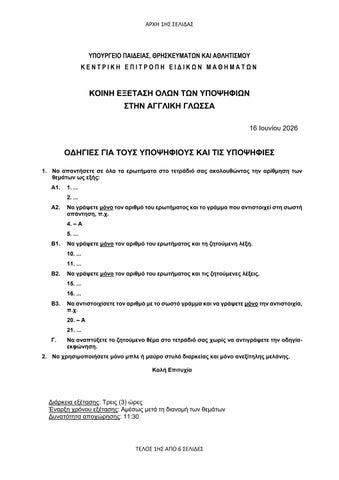
2.
5.
10. ...
11. ...
15. ...
16. ... Β
20.
21.
Α. Read the text below and respond to tasks A1 and A2.
It’s the day of a big test. Your heart is pounding. Your palms are sweating. Your breathing quickens and your stomach suddenly feels full of butterflies. Although these stress responses may not feel good, they are totally normal. They’re your body’s way of sharpening your focus and boosting the energy you have to help you perform well.
When we encounter a big challenge or risk —or become overly excited— our body responds in a way to keep us safe.
An increased heart rate and breathing will send more oxygen to our muscles and brain. Our muscles tense so they can react quickly. By sweating, our body attempts to avoid overheating. And our body releases stress hormones, such as adrenaline and cortisol, to boost our energy and focus.
Together, these changes are known as the fight-or-flight response. They’re automatically triggered by what’s known as the sympathetic nervous system. It helps us respond to danger or challenges. They give us more power, more speed and agility. All are important for physical activity, says Katharine Meddles, a neurologist for children in Denver, Colorado.
This survival mechanism helped our ancient hunter-gatherer ancestors fight or escape from a wild animal. Today, we face very different risks than people did 300,000 years ago. But our sympathetic nervous system remains very important to our making it through challenging events.
It turns on when we play sports. It motivates us to study or concentrate on difficult tasks. And it turns on when we’re trying something new or talking to someone we like. Activating that fight-or-flight response in short bursts is healthy.
But as soon as the stimulating event is over, our brain normally sends signals to our body to calm down. This turns on a second system: the parasympathetic nervous system. It handles what’s known as the rest-and-digest response.
Here, our heart rate and breathing become slow and steady. Our muscles relax. Stress hormone levels lower, and feel-good hormones become somewhat higher. We now can think calmly, digest food and sleep, all processes vital to our brain and overall health.
The sympathetic and parasympathetic nervous systems keep our bodies in balance. By switching us between rest and action, they work together to help us respond appropriately to the range of situations we experience.
Adapted from https://www.snexplores.org/article/
(30 points)
A1. Answer questions 1-3, based on information from the text (max. 30 words each). (3 x 4 points = 12 points)
1. What would be a suitable title for this text?
2. What is the main purpose of the text?
3. How does the text challenge the idea that stress is always harmful?
A2. Choose the correct answer (A, B or C) for items 4-9, based on information from the text. (6 x 3 points = 18 points)
4. According to the opening paragraph, why does the body produce symptoms such as a racing heart and sweaty palms before a big test?
A. To warn us that something is physically wrong.
B. To help us focus and prepare to perform well.
C. To make us avoid challenging situations.
5. What kinds of situations can trigger a stress response according to the text?
A. Only situations involving physical danger.
B. Only situations involving strong emotions.
6. What is the fight-or-flight response?
A. A set of automatic physical changes that prepare us to face or escape challenges.
B. A conscious decision to confront danger.
7. Why does the author mention ancient hunter-gatherers?
A. To show that stress responses evolved to help humans survive threats.
B. To explain why people experience more stress today than in the past.
C. Challenges, risks, or even intense excitement.
C. A medical condition caused by too much stress.
C. To suggest that modern humans no longer need stress responses.
8. Which change is associated with the rest-and-digest response?
A. Faster breathing and increased muscle tension.
B. Higher levels of adrenaline and cortisol.
C. Slower breathing, relaxed muscles, and lower stress hormone levels.
9. What is the main idea of the final paragraph?
A. The sympathetic nervous system is more important than the parasympathetic nervous system.
B. The two nervous systems work together to keep the body balanced and able to respond appropriately.
C. Rest-and-digest responses should occur more often than fight-or-flight responses.
(30 points)
B1. Use the correct form of the words (A-H) to complete the gaps (10-14) in the following text, as in the example. There are TWO words you do not need.
(5 x 2 points = 10 points)
A. symbol (example) B. surprise C. religion D. revive E. pure F. add G. invent H. significant
The example is in bold and italics
What does the Olympic flame symbolize?
According to the International Olympic Committee (IOC), the modern use of the flame represents “the positive values that Man has always associated with the (ex.) symbolism of fire,” including (10) “ ” . Beyond just the flame itself, though, the relay of the torch–which is a modern (11) ___________ to the Games–also has symbolic (12) ___________ : “To transmit a message of peace and friendship to the people along its route.”
As a result, as the torch makes its way from Olympia, Greece, to its host country, it reminds those watching of the power of “understanding and brotherhood among peoples,” which has been a goal for the Games since their (13) ___________ in 1896.
The lighting of a flame to start the Olympics has been a part of the Games since their inception in 776 B.C. However, for the ancient Greeks, the flame had deep (14) ___________ significance, while for today’s Games, the flame represents more secular values and establishes a connection to the past.
Source: https//www.rd.com
B2. Fill in the gaps with TWO words in the statements of column B, so that they are similar in meaning to the statements (15-19) of column A, as in the example. (5 x 2 points = 10 points)
Example: It isn’t necessary for you to stay late. You don’t have to stay late.
COLUMN A
COLUMN B
15. I’m sorry that I doubted the whole plan. I regret _____ _____ the whole plan.
16. You may take the day off only if productivity stays high. You may take the day off _____ _____ as productivity stays high.
17. We only realised the value of wetlands once they had gone. Not until they had gone, _____ _____ realise the value of wetlands.
18. If we give nature more space, it recovers faster. _____ _____ space we give nature, the faster it recovers.
19. The teacher explained everything clearly and precisely. The teacher’s _____ _____ clear and precise.
B3. The following paragraphs form a text about storytelling but are jumbled up. Use the boxes below (20-24) to put paragraphs (A-F) in the correct order. The first paragraph is provided. There is ΟΝΕ extra paragraph you do not need.
(5 x 2 points = 10 points)
Storytelling is the act of telling or writing stories, or narratives. Typically, stories are told for entertainment, for informational purposes, or for educational purposes.
A.
B.
Epic poems, like the Greek The Iliad and the Sumerian The Tale of Gilgamesh, were first recited and passed down by word of mouth, and only later written down. Similarly, Aesop—who, if he existed at all, hailed from around the sixth century B.C.—was probably a teller of tales. Later Greek writers mention him and his animal fables, but they originally belonged to the oral tradition.
Oral storytelling is telling a story through voice and gestures. Like storytelling itself, the tradition of oral storytelling is ancient and crosses cultures. The oral tradition can take many forms: epic poems, chants, rhymes, songs, and more. It can encompass myths, legends, fables, religion, prayers, proverbs, and instructions.
C.
D.
Storytelling is universal to the human experience. Indeed, although it is likely impossible to prove, it has been suggested that storytelling developed not long after the development of language itself.
Today, of course, stories can be told orally, in printed or handwritten text, and via recorded sound and images. Regardless of the media, we are all consumers of story and always have been.
E.
F.
Other peoples, such as the Native American Choctaw, similarly have animal fables that were traditionally passed down orally. Like those of Aesop, the Choctaw animal fables are used to impart lessons. The Choctaw also historically told religious tales, like their creation stories, via the oral tradition.
Stories can also let us see how others think and feel. In other words, they can allow us to empathize with the people around us. In fact, studies suggest that the more compelling the story, the more empathetic people become in real life.
Source: https://education.nationalgeographic.org/ 20. 21. 22. 23. 24.
TASK: A travel blog invites young people to share memorable travel experiences. Write a blog post (180-200 words) in which you:
a) describe a memorable trip you had, and
b) present two life lessons you learned from your trip and explain how they affected you as a person.
Do not provide a title.
Do not mention your name anywhere in the text.
Sign your post as “Young Traveller”.