
ΕΛΛΗΝΙΚΗ ΔΗΜΟΚΡΑΤΙΑ
ΥΠΟΥΡΓΕΙΟ ΥΓΕΙΑΣ
ΓΕΝΙΚΗ Δ/ΝΣΗ ΔΗΜΟΣΙΑΣ ΥΓΕΙΑΣ
&ΠΟΙΟΤΗΤΑΣ ΖΩΗΣ
Δ/ΝΣΗ ΔΗΜΟΣΙΑΣ ΥΓΕΙΑΣ & ΥΓΙΕΙΝΗΣ ΠΕΡΙΒΑΛΛΟΝΤΟΣ
ΤΜΗΜΑ Α΄
Ταχ. Δ/νση: Αριστοτέλους 17
Ταχ. Κώδικας: 104 33
Πληροφορίες: Α. Σπυριδωνίδου
Τηλέφωνο: 2132161232
ΑΝΑΡΤΗΤΕΟ ΣΤΟ ΔΙΑΔΙΚΤΥΟ
Αθήνα, 07/05/2026
Αρ. Πρωτ.:Δ1α/Γ.Π. οικ. 20944
E-mail: ddy@moh.gov.gr ΠΡΟΣ: Όπως Πίνακας Διανομής
ΣΧΕΤ:
1. Ο Κανονισμός
2. Ο Κανονισμός (ΕΕ) 2019/1239
3. Ο ν. 3991/2011
4. Το π.δ. 121/2017
5. Το π.δ. 125/2012
public health events on board ships, 2016: https://www.who.int/publications/i/item/9789241549462
8.
https://www.moh.gov.gr/articles/health/dieythynsh-dhmosiasygieinhs/metadotika-kai-mh-metadotika-noshmata/c387-nomothesia/10757ygeionomikes-epithewrhseis-ploiwn-protypa-egxeiridia-epithewrhshs-kai-ygieinhskai-epidhmiologikhs-epithrhshs-metadotikwn-noshmatwn-se-epibathga-ploia
9. Το European Manual for Hygiene Standards and Communicable Disease Surveillance on Passenger Ships:https://shipsanassociation.shipsan.eu/europeanmanual-for-hygiene-standards-and-communicable-disease-surveillance-onpassenger-ships/
10. Το παραδοτέο «D3.10 Evidence-based guidelines (final guidelines for routine operations)» του Ευρωπαϊκού
https://healthysailing.eu/deliverables/
HEALTHY SAILING:
11. Το παραδοτέο «D3.11 Evidence-based guidelines (guidelines for ventilation)»
HEALTHY SAILING:
https://healthysailing.eu/deliverables/
12. Η με Αρ.
/03.03.2023 Εγκύκλιος
Δ1α/Γ.Π. οικ.4350/23.01.2023
covid-19 σε κρουαζιερόπλοια» (ΑΔΑ: 6ΣΞΩ465ΦΥΟ-ΟΑ3).
14. Το υπ’ αριθ. ΚΠ 3955/2024- 21.02.2024 έγγραφο του ΕΟΔΥ με θέμα
15. Ηαπό13.09.2024έως16.03.2026ηλεκτρονικήαλληλογραφίατουΕργαστηρίου
Form» (πρώην «S2 Ship Communication form»)
EU COMMON SHIP SANITATION DATABASE (SHIPSAN INFORMATION SYSTEM) https://sis.shipsan.eu/,
Sanitation Database»,
https://shipsanassociation.shipsan.eu/
1.
2.
3.
4.
5.
2.
3.
4.
5.
6.
7.
8.
Τ.Κ. 185 38
9. Ε.Κ.Α.Β.
Οδού Υγείας ,Τ.Κ. 115 27 – Αθήνα
10. ΕΟΔΥ Υπόψη Προέδρου Αγράφων 3-5, Τ.Κ. 15123, Μαρούσι
11. Πανελλήνιος Σύνδεσμος Ναυτικών Πρακτόρων
12.
16.
17.
18.
19.
20. FedHATTA
21.
4.
5.
6.
7.
8.
2
4.
5.
6.
7.
8.
Syndromic surveillance log for passengers
The log included below may be used for conducting syndromic surveillance and for reporting purposes. This may be useful for passenger shipping companies or ships which have no designated recording and reporting formats. If so all fields should be completed. If the information is ’Not Known’, then ‘NK’ can be used.
Acute Respiratory Infection (SARI):
fever not classified in other syndromes:
and persistent cough or cough with bloody sputum:
and decreased consciousness or confusion of recent onset:
and persistent vomiting (other than sea sickness):
and headache with a stiff neck:
gastroenteritis with blood in stools:
date and time
Reporting
Name (Last, First)
Unique ID (UID) 1 Sex Age Nationality
Abdominal cramps
Sign and Symptoms (as detailed in the following List 1)
Bruising or bleeding or petechiea Coryza Cough Cough with bloody sputum Decreased level of consciousness
Diarrhoea with blood in stools
Diarrhoea without blood in stools Fever Feverishness Headache Headache with neck stiffness Myalgia Persistent cough Persistent vomiting Skin rash Sore throat Vomiting Other
1This number rather than the name may be reported to competent authority to protect patient confidentiality
2 During the first entry of a specific person the value will be “1”. Number will increase by one after each revisit
3 Currently ill / Recovered / Discharged / Hospitalisation ashore / Hospitalised on board / death
4 [Yes/No] + If yes: [Stayed in the same cabin / Part of the same travelling group / Close contact of another case]
List 1. Signs and symptoms used for the definition of syndromes
No Signs and symptoms Definition
1 Abdominal cramps -
Onset of symptoms
Diagnosis Laboratory confirmed Yes No (if yes, laboratory method) Treatment Cabin number Number of visit 2
Doctor’s name for each visit/reporting
Notes
Measures taken for the patient (as detailed in the following List 2 )
Measures taken in the environment of patient
Status/outcome of patient 3
Case linked with another case (Yes/No) (Yes if: stayed in the same cabin, working in the same area, close contact with another case) 4
2 Bruising or bleeding or petechiea Noticeable and unusual bruising or petechiea or bleeding from gums, ears, nose, or areas on the skin with no obvious explanation (such as injury), is vomiting blood, or has bloody stool or urine.
3 Coryza Runny nose or congestion caused by inflammation of the mucous membranes of the nose.
4 Cough -
5 Cough with bloody sputum The person is coughing up blood
6 Decreased level of consciousness Condition of an ill person when he or she is not fully aware of the surroundings and may be confused about who he or she is, where he or she is going, or the time of day/week, does not respond normally to questions or painful sensations, or may appear to be sleepy, groggy, unresponsive or difficult to awaken.
7 Diarrhoea 3 or more loose or watery stools in 24 hours.
8 Fever A measured temperature of 38 °C (100.4 °F) or more.
9 Feverishness The sensation of a patient of having a fever, even if a high temperature is not confirmed by measurement.
10 Headache
11 Headache with neck stiffness
The person has head pain of unusual severity.
The person has difficulty moving the neck or severe pain during neck movement.
12 Myalgia Muscle aches
13 Persistent cough A cough that is either frequent or severe enough to catch the attention of others on board the ship or a severe cough that lasts three weeks or more.
14 Persistent vomiting
15 Skin rash
The person has vomited two or more times (other than seasickness) and either expresses concern to the crew or it comes to the attention of others on board (crew or passengers).
Abnormal areas on the skin that may appear as discoloured bumps or flat spots or areas, or blisters or bumps containing fluid or pus that are intact or crusted over.
“Rash” includes insect bites or parasite lesions.
Colour: ranges from light-coloured to red or pink, purple, or black, but can also be the same colour as the person’s skin tone.
Texture: can be flat, raised, blister-like, or crusted. In some diseases, such as chickenpox, areas with more than one of these characteristics can be found at the same time.
Select the most appropriate description of the rash’s appearance
Maculopapular: A red rash with both flat red areas(macules)and small bumps(papules)that may run together.
Vesicular/Pustular: Small bumps filled with fluid that can be clear of cloudy(vesicles) or filled with a thick, opaque fluid(pustules)
Purpuric/Petechial: Red or purple discolorations caused by bleeding under the skin or mucous membranes; they do not blanch or fade with pressure. Petechial lesions appear as small, reddish freckles, while purpuric lesions cover larger areas.
Scabbed: Lesions that are crusted over.
Pattern: Can be disconnected (discrete) or run together(confluent)
Location: May include one area of the body, such as the face, or more than one area.
16 Sore throat -
17 Vomiting -
1. Pre-embarkation screening
review of travel history
review proof of medical examination
review of laboratory analysis
review proof of vaccination or other prophylaxis (preventive medication such as antimalarials or antibiotics given before exposure, and other treatments used to reduce the risk of infection or illness before it occurs)
questionnaire about exposure/symptoms
other
2. Treatment
3. Vaccination or other prophylaxis (preventive medication such as antimalarials or antibiotics given before exposure, and other treatments used to reduce the risk of infection or illness before it occurs)
4. Placing suspect case under public health observation
5. Isolation for affected person (on board or ashore, duration)
6. Quarantine for suspect cases (on board or ashore, duration)
7. Contact tracing
8. Implementing case finding/active surveillance (pax/ crew/ others)
9. Conducting diagnostic testing (pax/ crew/ others)
10. Reporting to competent authority
11. Risk communication to pax/ crew/ others
12. Education / training of pax/ crew/ others 13. Mask wearing
Physical distancing 15. Reducing face-to-face interactions
16. Disembarkation of cases and/or contacts
17. Medical evacuation and hospitalization
18. Other
Gastrointestinal Illness:
Syndromic surveillance log for crew members
Acute gastroenteritis without blood in stools:
Acute gastroenteritis with blood in stools:
Reporting date and time
Name (Last, First)
Unique ID (UID) 1 Sex Age Nationality
Sign and Symptoms (as detailed in the following List 1)
Abdominal cramps Bruising or bleeding or petechiea Coryza Cough Cough with bloody sputum Decreased level of consciousness Diarrhoea without blood in stools Diarrhoea with blood in stools Fever Feverishness Headache Headache with neck stiffness Myalgia Persistent cough Persistent vomiting Skin rash Sore throat Vomiting Other
1 This number rather than the name may be reported to competent authority to protect patient confidentiality
2 During the first entry of a specific person the value will be “1”. Number will increase by one after each revisit
3 Currently ill / Recovered / Discharged / Hospitalisation ashore / Hospitalised on board / death
4 [Yes/No] + If yes: [Stayed in the same cabin / Part of the same travelling group / Close contact of another case]
List 1. Signs and symptoms used for the definition of syndromes
No Signs and symptoms Definition
1 Abdominal cramps -
Onset of symptoms
Diagnosis
Laboratory confirmed Yes No (if yes, laboratory method) Treatment Fit for duty (If No, Number of days + date of discharge) Position Cabin number Number of visit 2
Doctor’s name for each visit/reporting Notes
Measures taken for the patient (as detailed in the following List 2)
Measures taken in the environment of patient Status/outcome of patient 3 Case linked with another case (Yes/No) (Yes if: stayed in the same cabin, working in t he same area, close contact with another case) 4
2 Bruising or bleeding or petechiea Noticeable and unusual bruising or petechiea or bleeding from gums, ears, nose, or areas on the skin with no obvious explanation (such as injury), is vomiting blood, or has bloody stool or urine.
3 Coryza Runny nose or congestion caused by inflammation of the mucous membranes of the nose.
4 Cough -
5 Cough with bloody sputum The person is coughing up blood
6 Decreased level of consciousness Condition of an ill person when he or she is not fully aware of the surroundings and may be confused about who he or she is, where he or she is going, or the time of day/week, does not respond normally to questions or painful sensations, or may appear to be sleepy, groggy, unresponsive or difficult to awaken.
7 Diarrhoea 3 or more loose or watery stools in 24 hours.
8 Fever A measured temperature of 38 °C (100.4 °F) or more.
9 Feverishness The sensation of a patient of having a fever, even if a high temperature is not confirmed by measurement.
10 Headache
11 Headache with neck stiffness
The person has head pain of unusual severity.
The person has difficulty moving the neck or severe pain during neck movement.
12 Myalgia Muscle aches
13 Persistent cough A cough that is either frequent or severe enough to catch the attention of others on board the ship or a severe cough that lasts three weeks or more.
14 Persistent vomiting
15 Skin rash
The person has vomited two or more times (other than seasickness) and either expresses concern to the crew or it comes to the attention of others on board (crew or passengers).
Abnormal areas on the skin that may appear as discoloured bumps or flat spots or areas, or blisters or bumps containing fluid or pus that are intact or crusted over.
“Rash” includes insect bites or parasite lesions.
Colour: ranges from light-coloured to red or pink, purple, or black, but can also be the same colour as the person’s skin tone.
Texture: can be flat, raised, blister-like, or crusted. In some diseases, such as chickenpox, areas with more than one of these characteristics can be found at the same time.
Select the most appropriate description of the rash’s appearance
Maculopapular: A red rash with both flat red areas(macules)and small bumps(papules)that may run together.
Vesicular/Pustular: Small bumps filled with fluid that can be clear of cloudy(vesicles) or filled with a thick, opaque fluid(pustules)
Purpuric/Petechial: Red or purple discolorations caused by bleeding under the skin or mucous membranes; they do not blanch or fade with pressure. Petechial lesions appear as small, reddish freckles, while purpuric lesions cover larger areas.
Scabbed: Lesions that are crusted over.
Pattern: Can be disconnected (discrete) or run together(confluent)
Location: May include one area of the body, such as the face, or more than one area.
16 Sore throat -
17 Vomiting -
1. Pre-embarkation screening
review of travel history
review proof of medical examination
review of laboratory analysis
review proof of vaccination or other prophylaxis (preventive medication such as antimalarials or antibiotics given before exposure, and other treatments used to reduce the risk of infection or illness before it occurs)
questionnaire about exposure/symptoms
other
2. Treatment
3. Vaccination or other prophylaxis (preventive medication such as antimalarials or antibiotics given before exposure, and other treatments used to reduce the risk of infection or illness before it occurs)
4. Placing suspect case under public health observation
5. Isolation for affected person (on board or ashore, duration)
6. Quarantine for suspect cases (on board or ashore, duration)
7. Contact tracing
8. Implementing case finding/active surveillance (pax/ crew/ others)
9. Conducting diagnostic testing (pax/ crew/ others)
10. Reporting to competent authority
11. Risk communication to pax/ crew/ others
12. Education / training of pax/ crew/ others 13. Mask wearing
Physical distancing 15. Reducing face-to-face interactions 16. Disembarkation of cases and/or contacts 17. Medical evacuation and hospitalization 18. Other
(European Commission,
o Πορφυρικό/πετεχειώδες:
Table 1: Syndrome definitions.
Syndromes
Acute Respiratory Illness (ARI)
a) Acute onset of at least two of the following four respiratory symptoms of presumed viral aetiology:
b) fever/ feverishness;
c) cough;
d) coryza (nasal congestion or runny nose);
e) sore throat;
f) and/or
g) confirmed acute respiratory infection diagnoses of COVID-19;
h) influenza; and
i) RSV infection.
j) The aforementioned excludes Streptococcal pharyngitis, Epstein-Barr virus infection, diagnoses of bacterial pneumonia: either clinical or testpositive (e.g., by urine Legionella antigen, urine Streptococcus pneumoniae antigen), and noninfectious conditions as determined by the ship's medical doctor (e.g., allergies) [CDC, 2023].
k) * Confirmed COVID-19 means laboratory confirmation for SARS-CoV-2, by detection of SARSCoV-2 nucleic acid in a clinical specimen, or identification of SARS-CoV-2 antigen in a clinical specimen (excluding self-tests performed outside healthcare settings), or isolation of SARS-CoV-2 from a clinical specimen [ECDC, 2024].
l) * Confirmed influenza means laboratory confirmation for influenza A or B by any of the following: a) isolation of influenza virus from a clinical specimen; b) detection of influenza virus nucleic acid in a clinical specimen, c) identification of influenza virus antigen by direct fluorescent
antibody test in a clinical specimen; d) influenza specific antibody response [European Commission, 2018].
m) * Confirmed RSV means laboratory confirmation for RSV by detection of RSV nucleic acid in a clinical specimen, or identification of RSV antigen in a clinical specimen, or isolation of RSV from a clinical specimen [ECDC, 2023].
Acute
gastroenteritis (without bloody stools)
Acute Gastroenteritis (AGE)
Acute gastroenteritis (with bloody stools)
Acute diarrhoea (three or more episodes of loose stools (without blood) in a 24-hour period or what is above normal for the individual, e.g., individuals with an underlying medical condition that may affect interpretation); or Vomiting and at least one of the following symptoms: one or more episodes of loose stools in a 24-hour period (without blood), abdominal cramps, headache, muscle aches, fever [EU SHIPSAN ACT joint action, 2016]
Acute diarrhoea (three or more episodes of loose stools (with blood) in a 24-hour period or what is above normal for the individual, e.g., individuals with underlying medical condition that may affect interpretation); or Vomiting and at least one of the following symptoms: one or more episodes of loose stools in a 24-hour period (with blood),
Other syndromes
Fever and rash
Haemorrhagic fever
Persistent fever not classified in other syndromes
Severe Acute Respiratory Infection (SARI)
abdominal cramps, headache, muscle aches, fever [EU SHIPSAN ACT joint action, 2016]
Fever and skin rash.
Fever and bruising or bleeding or petechiae.
Fever, lasting more than 48 hours.
An acute respiratory infection that meets all of the following criteria:
history of fever or a measured fever of ≥ 38 °C (100.4 °F);
cough;
onset within the last 10 days; and requires hospitalisation [WHO, 2014].
Fever and - persistent cough or cough with bloody sputum
Fever and - decreased consciousness or confusion of recent onset
Fever and persistent vomiting (other than sea sickness)
Fever and headache with a stiff neck
Fever and a cough that is either frequent or severe and that lasts three weeks or more; or Fever and a cough with bloody sputum.
See definitions of signs and symptoms.
Fever and persistent vomiting accompanied by signs of dehydration.
See definitions of signs and symptoms.
Pneumonia
Fever and rash
Clinical or radiological evidence of pneumonia [EU SHIPSAN ACT joint action, 2016].
Fever and skin rash.
Table 2: List of signs and symptoms used for the definition of syndromes.
Signs and symptoms Definition
Abdominal cramps –
Bruising or bleeding or petechiae
Coryza
Noticeable and unusual bruising or petechiae or bleeding from gums, ears, nose, or areas on the skin with no obvious explanation (such as injury), vomiting blood, or bloody stool or urine [EU SHIPSAN ACT joint action, 2016, CDC, 2017].
Runny nose or congestion caused by inflammation of the mucous membranes of the nose [CDC, 2017].
Cough –
Cough with bloody sputum
Decreased level of consciousness
The person is coughing up blood [CDC, 2017].
Condition of an ill person when he or she is not fully aware of the surroundings and may be confused about who he or she is, where he or she is going, or the time of day/week, does not respond normally to questions or painful sensations, or may appear to be sleepy, groggy, unresponsive or difficult to awaken [EU SHIPSAN ACT joint action, 2016, CDC, 2017].
Diarrhoea
Three or more loose or watery stools in 24 hours [EU SHIPSAN ACT joint action, 2016, CDC, 2017].
Fever A measured temperature of 38 °C (100.4 °F) or above.
Feverishness
Headache
Headache with neck stiffness
The sensation of a patient of having a fever, even if a high temperature is not confirmed by measurement.
The person has head pain of unusual severity [CDC, 2017].
The person has difficulty moving the neck or severe pain during neck movement [CDC, 2017].
Myalgia Muscle aches.
Persistent cough
Persistent vomiting
A cough that is either frequent or severe enough to catch the attention of others on board the ship or a severe cough that lasts three weeks or more [EU SHIPSAN ACT joint action, 2016, CDC, 2017].
The person has vomited two or more times (other than seasickness) and either expresses concern to the crew or it comes to the attention of others on board (crew or passengers) [CDC, 2017].
Sore throat –
Abnormal areas on the skin that may appear as discoloured bumps or flat spots or areas, or blisters or bumps containing fluid or pus that are intact or crusted over.
“Rash” includes insect bites or parasite lesions.
Colour: ranges from light-coloured to red or pink, purple, or black, but can also be the same colour as the person’s skin tone.
Texture: can be flat, raised, blister-like, or crusted. In some diseases, such as chickenpox, areas with more than one of these characteristics can be found at the same time.
Skin rash
Select the most appropriate description of the rash’s appearance:
o Maculopapular: A red rash with both flat red areas (macules) and small bumps (papules) that may run together.
o Vesicular/Pustular: Small bumps filled with fluid that can be clear of cloudy (vesicles) or filled with a thick, opaque fluid (pustules).
o Purpuric/Petechial: Red or purple discolourations caused by bleeding under the skin or mucous membranes; they do not blanch or fade with pressure.
Petechial lesions appear as small, reddish freckles, while purpuric lesions cover larger areas.
o Scabbed: Lesions that are crusted over.
Pattern: Can be disconnected (discrete) or run together (confluent).
Location: May include one area of the body, such as the face, or more than one area [EU SHIPSAN ACT joint action, 2016, CDC, 2017].
Vomiting –
Definition
Any person not recently vaccinated and meeting the clinical and the laboratory criteria
Clinical Criteria Fever and Maculo-papular rash and at least one of the following three:
– Cough – Coryza – Conjunctivitis
Laboratory Criteria
Confirmed case of measles
Definition
At least one of the following four:
– Isolation of measles virus from a clinical specimen
– Detection of measles virus nucleic acid in a clinical specimen
– Measles virus specific antibody response characteristic for acute infection in serum or saliva
– Detection of measles virus antigen by DFA in a clinical specimen using measles specific monoclonal antibodies.
Laboratory results need to be interpreted according to the vaccination status. If recently vaccinated,investigateforwildvirus.
Any person meeting the clinical and the laboratory criteria who has not been recently vaccinated.
Confirmed case of rubella
Clinical Criteria
Sudden onset of generalised maculo-papular rash and at least one of the following five:
– Cervical adenopathy
– Sub-occipital adenopathy
– Post-auricular adenopathy
– Arthralgia
– Arthritis
Laboratory Criteria At least one of the following four:
– Isolation of rubella virus from a clinical specimen.
– Detection of rubella virus nucleic acid in a clinical specimen.
– Rubella IgM antibody detection
– Rubella IgG seroconversion or significant rise in rubella IgG antibody titre in paired specimens tested in parallel.
Laboratoryresultsneedtobe interpretedaccordingtothe vaccinationstatus(possible persistenceofIgMantibodiesupon vaccination)
Definition
Confirmed case of varicella
Clinical Criteria
Any person meeting the clinical and the laboratory criteria or meeting the clinical criteria and having an epidemiological link
Clinical presentation compatible with varicella, in the absence of another apparent cause. Characteristic manifestations of the disease include fever and the sudden onset of a maculopapular rash that progresses to a vesicular stage and subsequently crusts. Typically, the rash is generalized, with lesions in different stages of development present simultaneously.
Laboratory Criteria – Isolation of varicella virus from a clinical specimen
– A rise in varicella-zoster virus specific IgG antibody titres
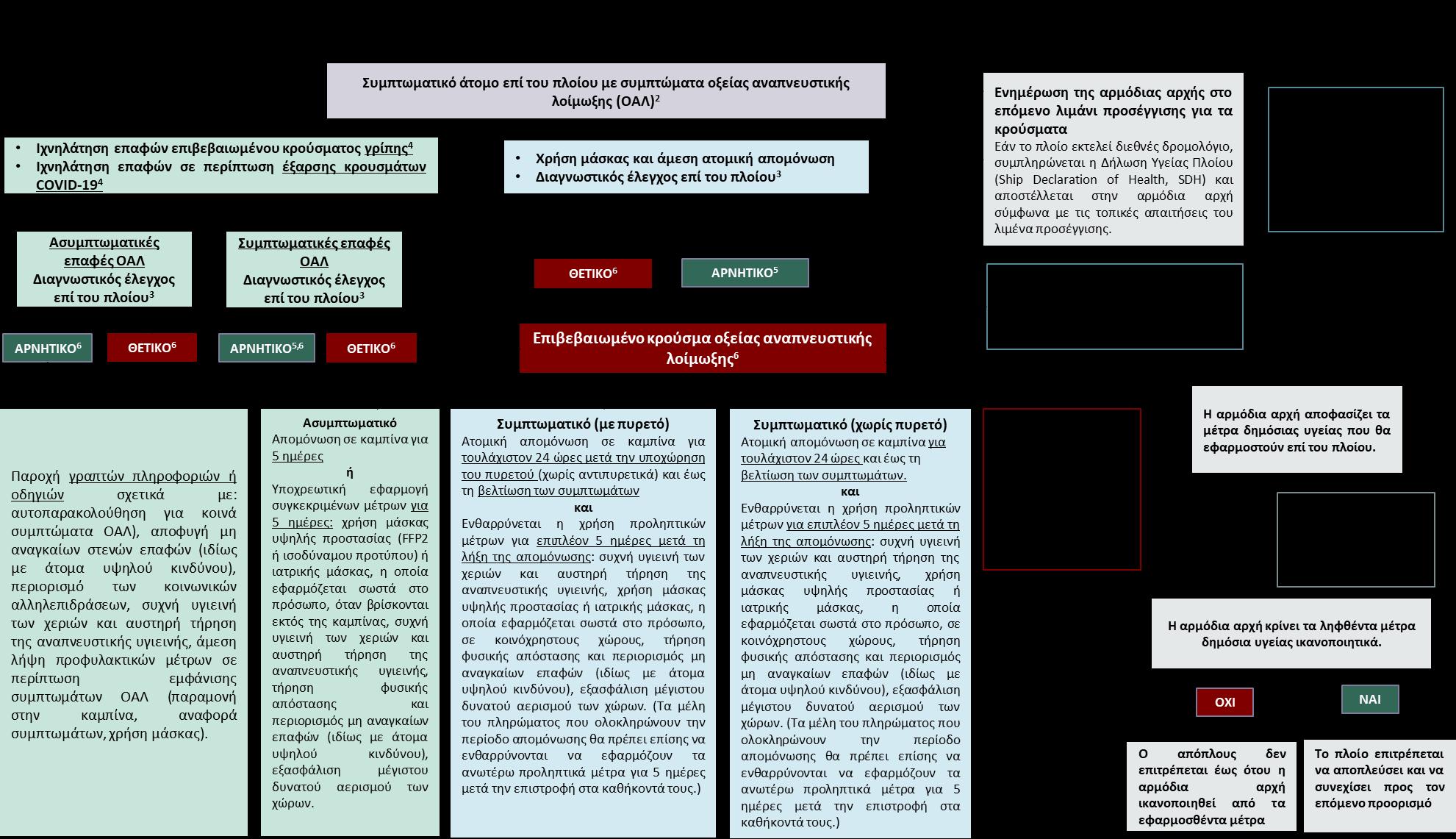
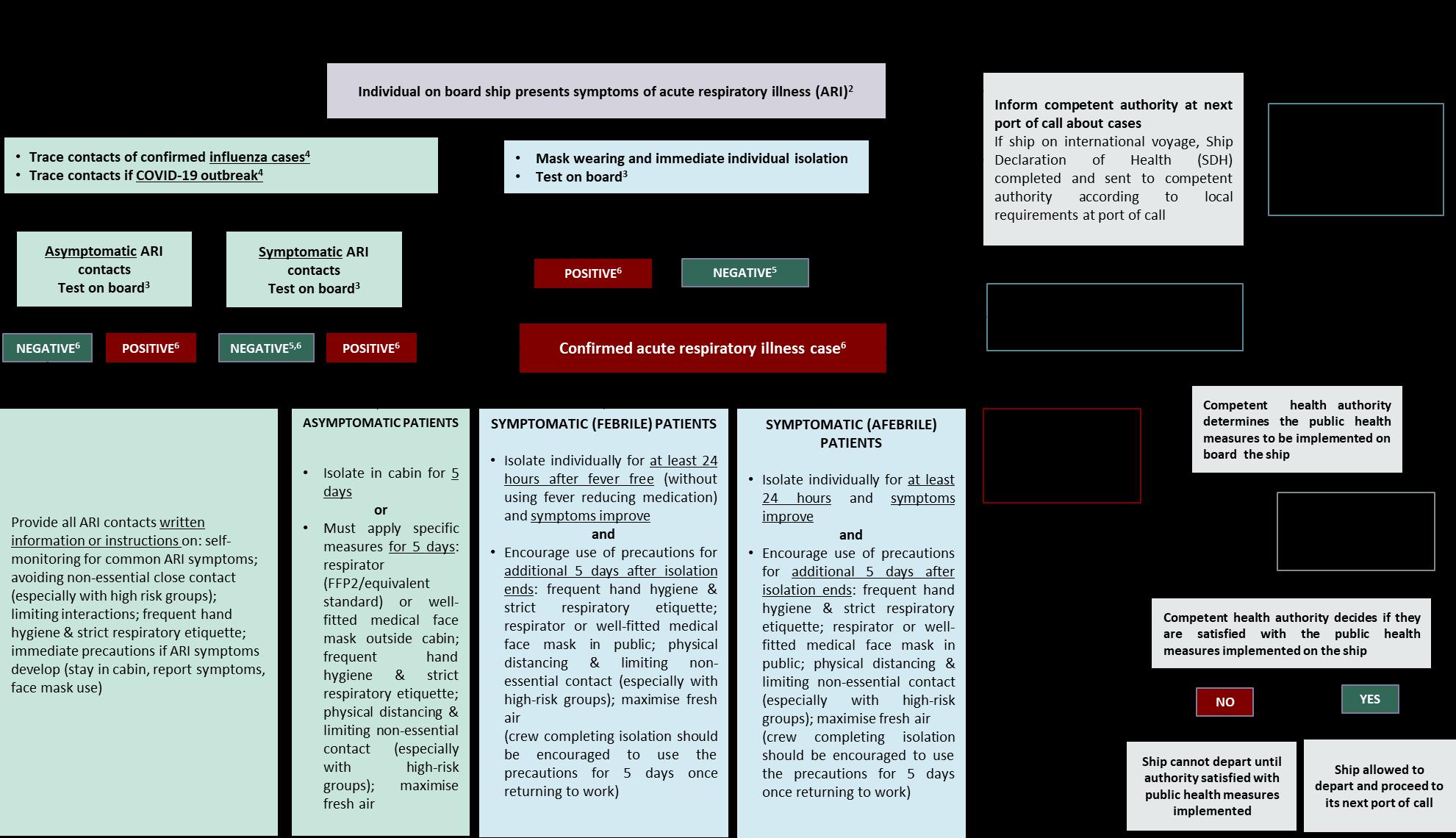
1During significant ARI outbreaks: targeted indoor use of face masks by crew should be considered; passengers may be advised to wear face mask indoors
2ARI: Acute onset of two or more of the following four respiratory symptoms of presumed viral aetiology: a) fever/ feverishness; b) cough; c) coryza (nasal congestion or runny nose); d) sore throat; and/or
a) confirmed acute respiratory infection diagnoses of COVID-19; b) influenza ; and c) RSV infection.
This excludes: Streptococcal pharyngitis, Epstein-Barr virus infection, diagnoses of bacterial pneumonia: either clinical or test-positive (e.g., by urine Legionella antigen, urine Streptococcus pneumoniae antigen), and non-infectious conditions as determined by the ship's medical doctor (e.g., allergies).
3Diagnostic testing capabilities should be available for respiratory infections (e.g., influenza A and B, COVID-19) and other infections presenting with similar symptoms (e.g., Group A Streptococcus, Streptococcus pneumoniae, and Legionella). Ships could consider carrying point-of-care diagnostic tests (RT-PCR panel kits, RADTs) and specimen collection equipment for shore-based or onboard testing.
4Contact tracing recommended for confirmed influenza cases. Contact tracing may be considered if COVID-19 outbreak, to inform targeted testing strategy.
5A negative rapid antigen diagnostic test result in a symptomatic patient does not exclude the possibility of infection with influenza, SARS−CoV−2 or RSV.Clinical diagnosis should be considered, or confirmation of results using molecular test and consideration of differential diagnosis". Based on a risk assessment, there is a need for isolation, contact tracing, use of face masks, and the implementation of additional measures, as appropriate.
6Consider providing antivirals prophylactically to close contacts of influenza cases or during influenza outbreak, particularly individuals at high-risk for complications)