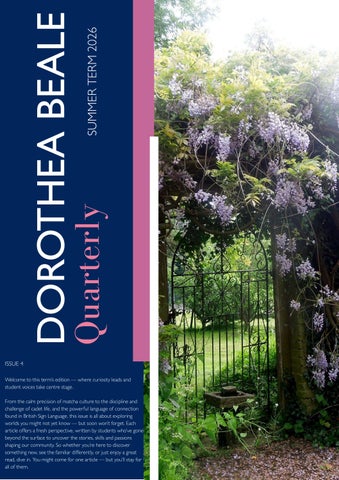
Welcome to this term’s edition where curiosity leads and student voices take centre stage
From the calm precision of matcha culture to the discipline and challenge of cadet life, and the powerful language of connection found in British Sign Language, this issue is all about exploring worlds you might not yet know but soon won’t forget Each article offers a fresh perspective, written by students who’ve gone beyond the surface to uncover the stories, skills and passions shaping our community So whether you ’ re here to discover something new, see the familiar differently, or just enjoy a great read, dive in You might come for one article but you’ll stay for all of them
INTRODUCTION
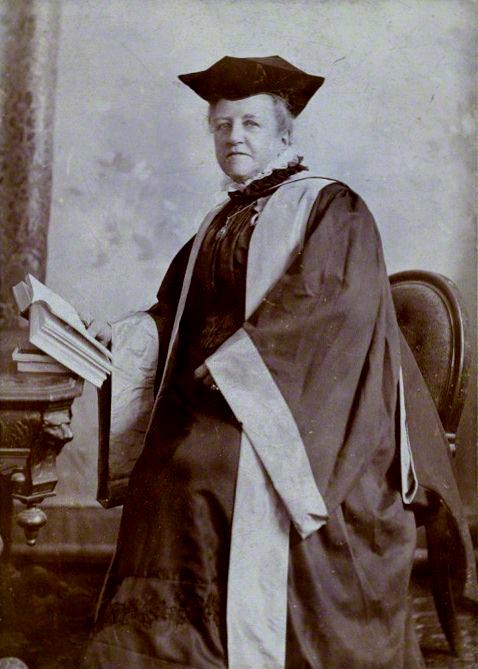
Dorothea Beale didn’t just care about education – she transformed it At a time when women ’ s voices were often ignored, she made her’s heard – in classrooms, in print, and through generations of students who followed As Head of Cheltenham Ladies’ College for nearly fifty years (which even now is one of the most prestigious all-girls independent schools in the UK), she raised standards, challenged expectations, and fought to give girls access to a serious, rigorous education – something that was far too rare in her day.
She also went on to found St Hilda’s College, Oxford, in 1893 – a bold move that carved out a space for women at one of the world’s oldest and most respected universities Until 2008, it remained a women-only college, a lasting symbol of Beale’s commitment to equality in education
So, in her honour, our Dorothea Beale Society and quarterly academic magazine celebrates the same spirit she stood for: curiosity, courage, and a fierce dedication to learning.
On behalf of the academic scholars and stars, we hope these pages spark your curiosity and show that academic work doesn’t have to be dull or distant – it’s full of questions worth asking and ideas worth exploring Maybe something here will inspire you to dive into your own research or look at a subject you thought you knew in a completely different way!
MATCHA
In this era of sugary energy drinks, attempting to find that one drink that gives you the focus of a double espresso, but without that mid-afternoon energy crash, has been challenging. Matcha has exploded across social media and health food stores; labelled as a superfood, capable of many health benefits with a calm alertness.
Chemistry of matcha:
Matcha is a nutrient-dense powder made from Camellia Sinensis tea leaves Compared to coffee, matcha has less caffeine and L-theanine, which reduces jitters and anxiety – aftereffects of coffee. L-theanine is an amino acid (building blocks of protein) L-theanine increases alpha brain waves, which are related to a calm, alert state of mind Caffeine supplies the first, natural energy boost by blocking adenosine receptors, helping to increase concentration and alertness through the central nervous system. With the combination of caffeine and L-theanine, the unique calm alertness associated with matcha is formed
Health benefits:
Matcha is a highly concentrated, powdered form of green tea that acts as a potent source of antioxidants and anti-inflammatory agents, primarily due to its unique cultivation method where tea leaves are shaded to increase chlorophyll and nutrient density It is good for heart health and helps with inflammation The shading process boosts chlorophyll, giving matcha its vibrant green colour, offering additional antioxidant and detoxification benefits
Where it can be found:
From the traditional Japanese tea ceremonies to modern, everyday life, matcha appears in food, beverages, and even beauty products. Beyond lattes, matcha can be found in ice cream, noodles, sweets, restaurants, and even matcha pizza in some cafes!
Fun facts:
While matcha originated in China during the Tang Dynasty, it was perfected in Japan as a ritualistic tool for Buddhist monks who valued its ability to provide sustained alertness for long meditations Not to mention samurai warriors drank matcha before battles because it helped them stay calm yet alert – due to the combination of caffeine & L-theanine
“WHY DO YOU ALWAYS TALK ABOUT CADETS?”
By E Tarr (Year 10)
Sergeant in the CCF, Corporal at 1075 Camberley
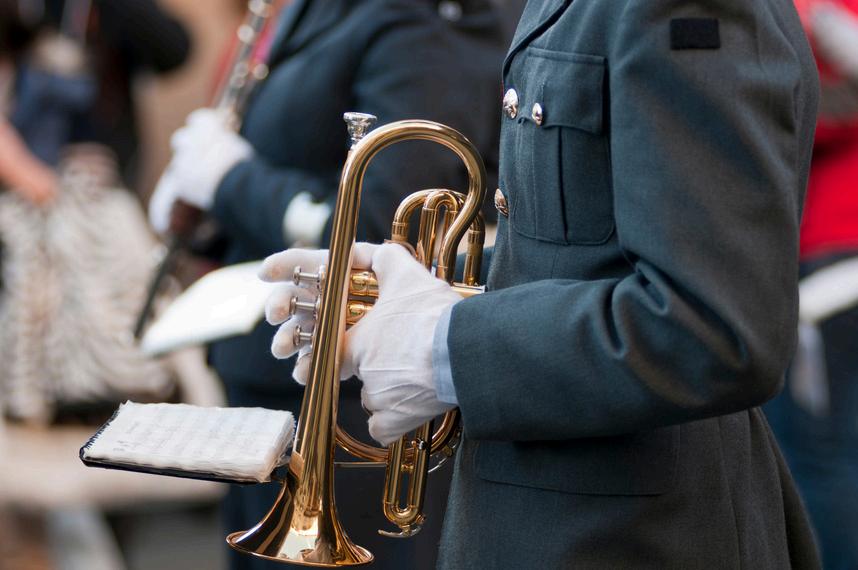
Hello lovely Dorothea Beale Quarterly readers! My name is Evie T, and I am often asked how I became involved with the RAF Air Cadets and what the experience has meant to me because I am always finding a way to mention it. It is a question I am always happy to answer, because the journey that began with simple curiosity has grown into one of the most defining experiences of my life - one that I believe has the potential to inspire other young people to take a step towards an opportunity that could truly change their future.
The RAF Air Cadets is, without doubt, the most transformative opportunity I have encountered in my young life What began as a fleeting moment of curiosity has grown into an experience that has shaped my confidence, skills, and sense of belonging in ways I could never have imagined For as long as I can remember, I was a shy individual with very little self-confidence, generally preferring my own company I am also a keen musician and can play six instruments - an achievement that, paradoxically, often intensified my nerves. Music concerts filled me with dread; standing on a stage in front of an audience felt uncomfortably exposing, and I would approach each performance with a sinking feeling rather than excitement
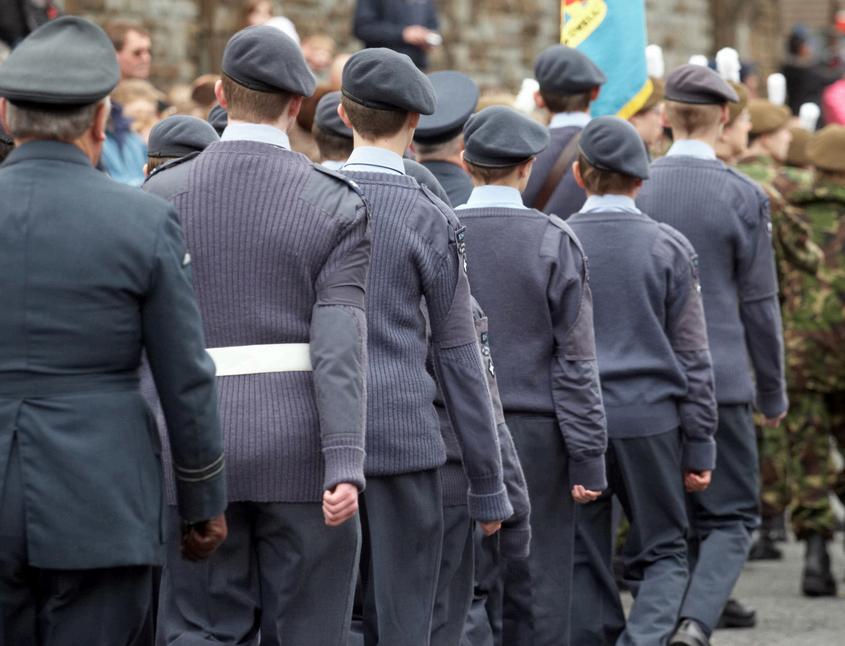
Everything changed just over four years ago. While walking with my mum, I noticed a group of teenagers wearing smart, polished uniforms, selling poppies to passers-by. They stood out immediately Their confidence, professionalism, and sense of purpose were striking I remember turning to my mum and asking who they were, commenting on how “cool” they looked. That brief moment opened my eyes to the world of cadets for the very first time.
A few months later, my school announced the formation of its own RAF Air Cadets Combined Cadet Force (CCF). I was thrilled Unfortunately, I was one year too young to join and had to wait, but the anticipation only strengthened my determination When I eventually joined the CCF, the experience exceeded my expectations
Squadron
Not long afterwards, a further opportunity arose when my school’s Director of Music suggested that I audition for the Surrey Wing Band My initial reaction was hesitation rather than excitement. The prospect of meeting unfamiliar people and placing myself in yet another vulnerable position felt overwhelming. I was also acutely aware that I would be the only CCF cadet amongst a group of experienced Air Training Corps (ATC) cadets, all of whom already shared friendships and similar experiences Despite my doubts, with encouragement from my mum, I decided to take a leap of faith
The first band practice was daunting, and for a short time I did feel like an outsider However, within minutes, two cadets welcomed me and put me entirely at ease As they spoke about their experiences through the ATC - places they had visited, skills they had gained, and challenges they had overcome - I was filled with admiration They were only a year or two older than me, yet their achievements felt extraordinary
As I continued to attend band practice days, my confidence gradually grew. The friendships I formed were deeper and more supportive than any I had previously known These connections soon led to my first marching band parade: the Battle of Britain Parade in 2023 at Brookwood Cemetery That morning tested my nerves enormously, and I very nearly refused to step out of the car. Yet once I stood alongside my peers and began to play, fear gave way to excitement For the first time, performing felt exhilarating rather than terrifying.
From that point onwards, opportunities seemed to multiply I attended Wing and Region Field Days, three Lord or Lady Mayors’ Parades, a Lady Mayors’ Competition, and many other events With each experience, my confidence strengthened. In August of that same year, I was asked to teach three younger cadets how to play the trumpet - something the ‘old’ version of myself would have seriously avoided Instead, I embraced the responsibility, gaining both confidence and lifelong friendships in the process
Almost two years ago, a conversation with a friend about joining a local ATC squadron resonated deeply with me By September 2024, I had joined 1075 Camberley Squadron, where many of my band friends already paraded It was there that I met my closest friends and truly began to understand the breadth of what the RAF Air Cadets could offer
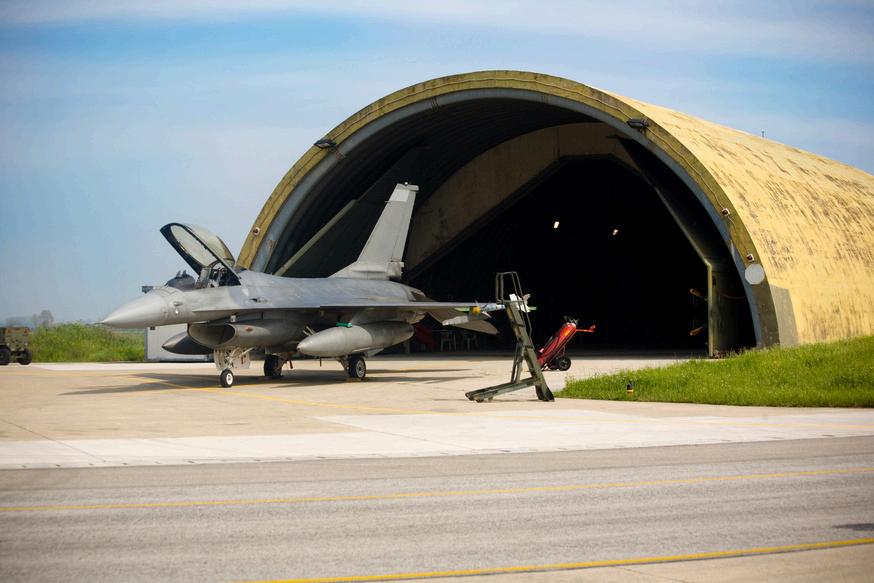
Through the squadron, I have climbed Pen-y-Fan in challenging Welsh weather, completed Bronze and Silver Duke of Edinburgh’s Award expeditions in both extreme heat and freezing conditions, visited aircraft hangars, and taken part in countless other adventures. These experiences have given me a diverse and evergrowing skillset, from leadership and teamwork to resilience and self belief
The RAF Air Cadets has provided me with far more than activities and qualifications. It has given me confidence, fitness, friendship, and a sense of belonging - to a community where I feel valued and supported It has opened doors to subjects and experiences beyond the classroom, challenged me physically and mentally, and helped shape me into someone I am proud to be
I know from my peers that my story is not unique Many young people within the Cadet Forces have grown beyond what they once believed possible. The RAF Air Cadets offers more than an extracurricular activity; it offers direction, purpose, and opportunity All it requires is a small leap of faith - one that can lead to a future that is a whole lot brighter and a whole lot easier.
BSL and the Deaf Community
By E MacGillivray (Year 9)
Have you ever wondered what life would be like if you couldn’t hear? No music, no sound from the TV, and never hearing other people’s voices – or your own. Communication would seem very difficult, and for many deaf people it is. Around 11 million people in the UK are deaf or hard of hearing, and many go about daily life without knowing what their friends’ and family’s voices sound like However, around 151,000 people in the UK communicate using British Sign Language (BSL), a unique language that uses hand gestures, facial expressions and signs instead of sound.
How can you learn Sign Language?
There are many ways to learn sign language, although some methods are more effective than others These include online courses, mobile apps, video dictionaries, in-person classes, and deaf community events. Online courses work like traditional classes but are completed on a device; examples include British Sign Language, Signworld and Signature, which are accredited and sometimes offer nationally recognised qualifications.
Mobile apps are quick and easy to use, such as Lingvano and Bright BSL, allowing learners to start immediately. In-person classes and community events are also valuable, as they help learners practise real-life communication and gain a better understanding of deaf culture, not just the language itself.
The BSL Act 2022:
The British Sign Language Act 2022, which came into force on April 28th 2022, officially recognised BSL as a language in England, Scotland and Wales It states that government departments report on their elevation and facilitation of BSL, and requires guidance to be issued to public bodies on meeting the needs of BSL users The legislation followed a long campaign by the British Deaf Association (BDA) and other promoters for legal recognition and better access to public acknowledgement.
Myths vs Reality:
BSL is just English on the hands – BSL has its own grammar and structure; you can’t accurately use BSL and speak
English simultaneously
All deaf people use BSL – Not all deaf people use sign language, many rely on lip reading, hearing aids, cochlear implants or written communication.
BSL is just for deaf people – Anyone can learn BSL to improve communication and accessibility
Sign language has no dialects – Sign language, just like any other language, has regional variations and slang
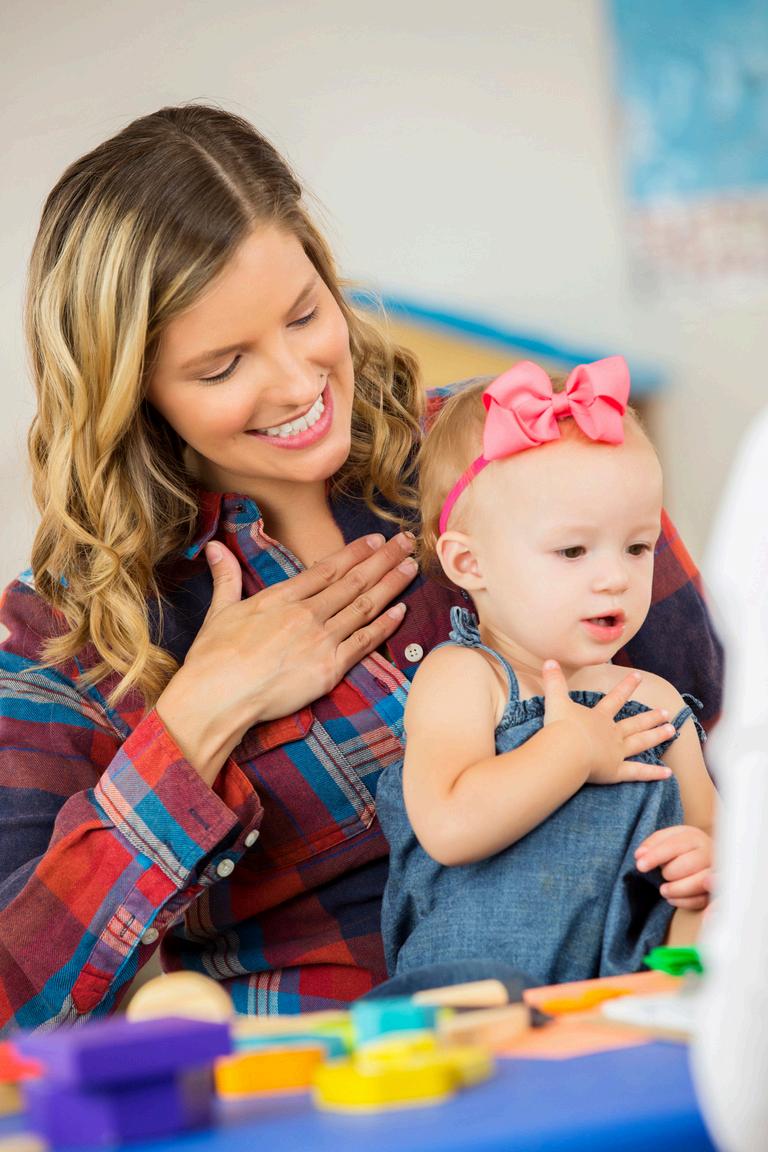
Babies learning sign language delays speech – Learning sign language from a young age can help them communicate earlier without hindering verbal speech
Speak to the interpreter instead of the deaf person –
When communicating with a deaf person, you should always look at them, not their interpreter, it is more respectful.
Facial expressions don’t matter that much – Facial expressions are a vital part of sign language, as many signs are similar but express different emotions
BOOK RECOMMENDATION: THE SELFISH GE
A book by Richard Dawkins detailing how genes are the fundamenta selection and evolution The 'selfish' gene is a metaphor for how one gen for their own longest survival above all other genes, rather than a pa causes selfish behaviour. Dawkins uses game theory to explain the behavi organisms and shares how memes are the social equivalent of genes and brain to brain
80,000 HOURS PODCAST
Brilliant for thoughtful students interested in: meaningful careers, AI, ethics, global problems, future-focused thinking. More analytical and less “hustle culture.”
BOOK RECOMMENDATION: ATOMIC HABITS BY JAME
Probably the single best “life systems” book for students Why it works: explains how small habits compound, makes productivity feel achievable, helps with revision, fitness, confidence, and consistency, avoids fake motivational clichés
It’s practical immediately
THANK YOU FOR READING!
We hope that you enjoyed reading through the essays submitted by some of our extremely talented academic scholars, and that their insights and our recommendations gave you something to reflect on If you would like to submit an essay for the next edition, you don’t have to be an academic scholar, please send it to m marsden-wilkins@st-teresas com
HOW TO BECOME A MEMBER...
Academic scholars automatically become members of The Dorothea Beale Society but, this academic society is open to anyone who is academically curious and so if you would like to become a member please contact Mrs Marsden-Wilkins, who will be able to help you!