
INTERFACING GUIDE
Selecting the perfect interfacing for your project can seem daunting, but with a little insight, you’ll be able to find the ideal match. Just as you carefully choose fabrics, understanding the basics of interfacing will empower you to make informed decisions. This straightforward guide will walk you through the process, ensuring you find the perfect interfacing for your next creation.
What is interfacing?
Interfacing is a woven, knit or non-woven fabric material that’s applied to the wrong side of a fabric to reinforce, add structure & stability to any project. You’ve probably seen interfacing used on the inside of shirt cuffs or collars, but it’s also essential for projects like bags, quilts, apparel, crafts, & many more.
What types of interfacing are there?
In general, there are 3 types of interfacing. Woven, non-woven, & knit. It is important to know the difference between them so you can choose the right interfacing for your project.
WOVEN: A popular choice among sewers, particularly for garment fabrics. It adds stability & body without compromising the fabric’s natural drape & movement, making it an ideal choice for projects where fabric flow is important. It closely resembles traditional woven fabric in appearance & texture. Like woven fabric, it has a grain, so it’s essential to align it with your fabric’s grain when applying it. Cutting along the grainline is also crucial, just as you would with woven fabric. Can be preshrunk by hand. Always follow the manufacturer’s instructions.
NON-WOVEN: Offers flexibility & convenience, as it lacks a grain & can be cut & applied in any direction. However, it’s worth noting that non-woven interfacing may be less stable after washing compared to woven interfacing. Despite this, non-woven interfacing remains a popular choice. Its slightly stiffer texture & appearance provide added structure & support, making it well-suited for projects that require a bit more stability.
KNIT: (AKA Tricot Interfacing) A unique type of interfacing made from a knitted material. This construction allows it to stretch, making it perfect for pairing with knits & stretch fabrics like jersey. One of the key benefits of Knit Interfacing is that it adds stability to these fabrics without restricting their natural stretch. This maintains the comfort & flexibility of the fabric. Like woven interfacing, knit interfacing also has a grainline, which should be considered when cutting & applying it.
We also carry many SPECIALTY INTERFACINGS for all your sewing projects.
- Fleece Interfacing: Soft non-woven interfacings used to add a layer of softness, body, & stability. Used in home décor projects, bag making, & apparel sewing.
- Foam Interfacing & Stabilizer: Used particularly in bags, pouches, & home décor. It’s sturdy without adding excessive weight or bulk. Allows your project to stand and remain pliable.
- Embroidery Stabilizer: Backing used to stabilize embroidery work and prevent puckering. Available in tear-away, cut-away, and wash-away.
- Hair Canvas Interfacing & Weft Interfacing: A coarse material used in suit tailoring where crisp edges are needed.
- Paper-Backed Adhesive: Heat activated adhesive material used for bonding fabrics together to create soft appliqué.
Fusible Vs. Sew-in Interfacing
Fusible interfacing has an adhesive backing that allows you to iron it onto your fabric, creating a permanent bond. This type is great for projects where you don’t want to add extra sewing steps & want to have more shape. Sew-in interfacing, on the other hand, has no adhesive & is sewn in place like any other fabric layer. The non-fusible is also ideal for delicate or heat intolerant fabrics to keep the shape & avoid damaging your fabric with the iron.
Weight & Color
Like fabric, interfacing comes in different weights. Match the weight of your fabric to the weight of your interfacing (or slightly lighter) for the most natural fabric appearance. Most interfacing comes in white, cream or black so choose whatever is closest to your fabric.
- LIGHTWEIGHT: Use with rayon, lightweight linen, viscose, silk, & lightweight cottons such as cotton poplin, chambray, & batiste.
- MIDWEIGHT: Use with midweight linen, viscose/linen blends, cotton/bamboo jersey, twill, denim waistbands, & buttonholes.
- HEAVYWEIGHT: Use with fleece, heavyweight stretch such as ponte & jacquard, as well as with canvas, coating, & denim.
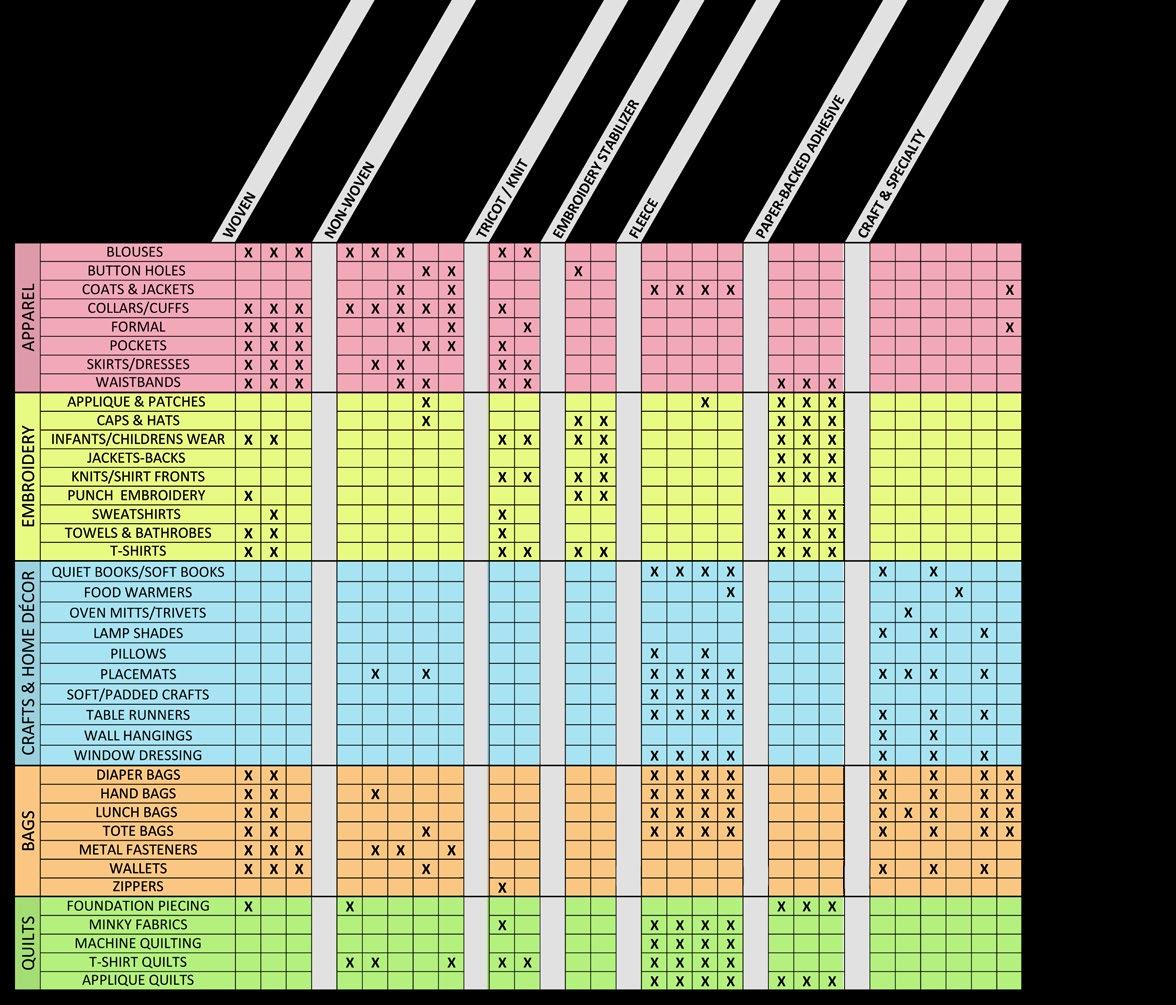
Project Reference Guide
Featured interfacing pairings to get you started on your next project.
Shop ALL interfacing here!