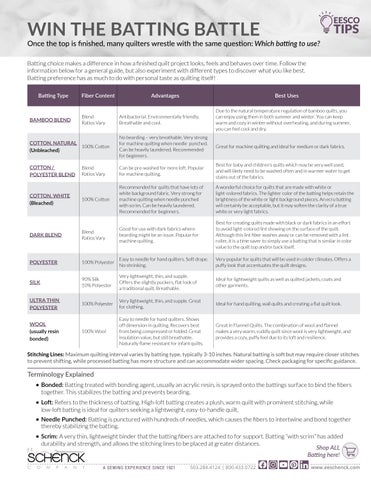

WIN THE BATTING BATTLE
Once the top is finished, many quilters wrestle with the same question: Which batting to use?
Batting choice makes a difference in how a finished quilt project looks, feels and behaves over time. Follow the information below for a general guide, but also experiment with different types to discover what you like best. Batting preference has as much to do with personal taste as quilting itself!
Batting Type Fiber Content
BAMBOO BLEND Blend Ratios Vary
COTTON, NATURAL (Unbleached)
100% Cotton
COTTON / POLYESTER BLEND Blend Ratios Vary
COTTON, WHITE (Bleached)
100% Cotton
DARK BLEND Blend Ratios Vary
POLYESTER
SILK
ULTRA THIN POLYESTER
WOOL (usually resin bonded)
100% Polyester
90% Silk
10% Polyester
100% Polyester
100% Wool
Advantages Best Uses
Antibacterial. Environmentally friendly. Breathable and cool.
No bearding – very breathable. Very strong for machine quilting when needle punched. Can be heavily laundered. Recommended for beginners.
Can be pre-washed for more loft. Popular for machine quilting.
Recommended for quilts that have lots of white background fabric. Very strong for machine quilting when needle punched with scrim. Can be heavily laundered. Recommended for beginners.
Good for use with dark fabrics where bearding might be an issue. Popular for machine quilting.
Easy to needle for hand quilters. Soft drape. No shrinking.
Very lightweight, thin, and supple. Offers the slightly puckers, flat look of a traditional quilt. Breathable.
Very lightweight, thin, and supple. Great for clothing.
Easy to needle for hand quilters. Shows off dimension in quilting. Recovers best from being compressed or folded. Great insulation value, but still breathable. Naturally flame resistant for infant quilts.
Due to the natural temperature regulation of bamboo quilts, you can enjoy using them in both summer and winter. You can keep warm and cozy in winter without overheating, and during summer, you can feel cool and dry.
Great for machine quilting and ideal for medium or dark fabrics.
Best for baby and children’s quilts which may be very well used, and will likely need to be washed often and in warmer water to get stains out of the fabrics.
A wonderful choice for quilts that are made with white or light-colored fabrics. The lighter color of the batting helps retain the brightness of the white or light background pieces. An ecru batting will certainly be acceptable, but it may soften the clarity of a true white or very light fabrics.
Best for creating quilts made with black or dark fabrics in an effort to avoid light-colored lint showing on the surface of the quilt. Although this lint fiber washes away or can be removed with a lint roller, it is a time saver to simply use a batting that is similar in color value to the quilt top and/or back itself.
Very popular for quilts that will be used in colder climates. Offers a puffy look that accentuates the quilt designs.
Ideal for lightweight quilts as well as quilted jackets, coats and other garments.
Ideal for hand quilting, wall quilts and creating a flat quilt look.
Great in Flannel Quilts. The combination of wool and flannel makes a very warm, cuddly quilt since wool is very lightweight, and provides a cozy, puffy feel due to its loft and resilience.
Stitching Lines: Maximum quilting interval varies by batting type, typically 3-10 inches. Natural batting is soft but may require closer stitches to prevent shifting, while processed batting has more structure and can accommodate wider spacing. Check packaging for specific guidance.
Terminology Explained
• Bonded: Batting treated with bonding agent, usually an acrylic resin, is sprayed onto the battings surface to bind the fibers together. This stabilizes the batting and prevents bearding.
• Loft: Refers to the thickness of batting. High-loft batting creates a plush, warm quilt with prominent stitching, while low-loft batting is ideal for quilters seeking a lightweight, easy-to-handle quilt.
• Needle Punched: Batting is punctured with hundreds of needles, which causes the fibers to intertwine and bond together thereby stabilizing the batting.
• Scrim: A very thin, lightweight binder that the batting fibers are attached to for support. Batting “with scrim” has added durability and strength, and allows the stitching lines to be placed at greater distances. Shop ALL Batting here!