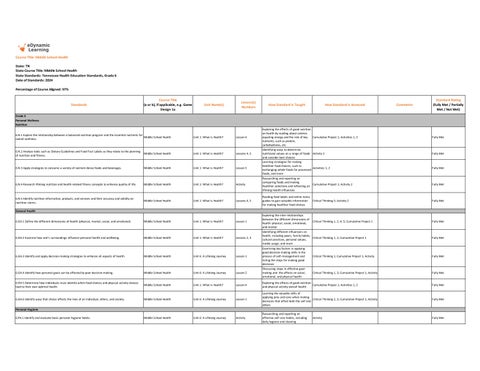
Course Title: Middle School Health State: TN State Course Title: Middle School Health State Standards: Tennessee Health Education Standards, Grade 6 Date of Standards: 2024 Percentage of Course Aligned: 97%
Standards
Course Title (a or b), if applicable, e.g. Game Design 1a
Unit Name(s)
Lesson(s) Numbers
How Standard is Taught
How Standard is Assessed
Comments
Standard Rating (Fully Met / Partially Met / Not Met)
Grade 6 Personal Wellness Nutrition 6.N.1 Explain the relationship between a balanced nutrition program and the essential nutrients for Middle School Health overall wellness.
Unit 1: What is Health?
Lesson 4
6.N.2 Analyze tools such as Dietary Guidelines and Food Fact Labels as they relate to the planning of nutrition and fitness.
Middle School Health
Unit 1: What is Health?
Lessons 4, 5
6.N.3 Apply strategies to consume a variety of nutrient dense foods and beverages.
Middle School Health
Unit 1: What is Health?
Lesson 5
6.N.4 Research lifelong nutrition and health-related fitness concepts to enhance quality of life.
Middle School Health
Unit 1: What is Health?
Activity
6.N.5 Identify nutrition information, products, and services and their accuracy and validity on nutrition claims.
Middle School Health
Unit 1: What is Health?
Lessons 4, 5
6.GH.1 Define the different dimensions of health (physical, mental, social, and emotional).
Middle School Health
Unit 1: What is Health?
Lesson 1
6.GH.2 Examine how one’s surroundings influence personal health and wellbeing.
Middle School Health
Unit 1: What is Health?
Lessons 2, 3
Exploring the effects of good nutrition on health by reading about calories equating energy and the role of key Cumulative Project 1; Activities 1, 2 nutrients, such as protein, carbohydrates, etc. Identifying ways to determine nutritional values on a range of foods Activity 2 and consider best choices Learning strategies for making healthier food choices, such as Activities 1, 2 exchanging whole foods for processed foods, and more Researching and reporting on comparing foods and making Cumulative Project 1; Activity 2 healthier selections and reflecting on lifelong health influences Reading food labels and online menu guides to gain valuable information Critical Thinking 5; Activity 2 for making healthier food choices
Fully Met
Fully Met
Fully Met
Fully Met
Fully Met
General Health Exploring the inter-relationships between the different dimensions of Critical Thinking 1, 2, 4, 5; Cumulative Project 1 health: physical, social, emotional, and mental Identifying different influencers on health, including peers, family habits, Critical Thinking 1, 2; Cumulative Project 1 cultural practices, personal values, media usage, and more Examining key factors in applying good decision-making skills in the process of self-management and listing the steps for making good decisions Discussing steps in effective goalmaking and the effects on social, emotional, and physical health
Fully Met
Fully Met
6.GH.3 Identify and apply decision-making strategies to enhance all aspects of health.
Middle School Health
Unit 6: A Lifelong Journey
Lesson 1
Critical Thinking 1; Cumulative Project 1; Activity
Fully Met
6.GH.4 Identify how personal goals can be affected by poor decision-making.
Middle School Health
Unit 6: A Lifelong Journey
Lesson 2
Critical Thinking 1, 3; Cumulative Project 1; Activity
Fully Met
6.GH.5 Determine how individuals must identify which food choices and physical activity choices lead to their own optimal health.
Middle School Health
Unit 1: What is Health?
Lesson 4
Exploring the effects of good nutrition Cumulative Project 1; Activities 1, 2 and physical activity overall health .
Fully Met
6.GH.6 Identify ways that choice affects the lives of an individual, others, and society.
Middle School Health
Unit 6: A Lifelong Journey
Lesson 1
Learning the valuable skills of applying pros and cons when making Critical Thinking 2, 3; Cumulative Project 1; Activity decisions that affect both the self and others
Fully Met
Middle School Health
Unit 6: A Lifelong Journey
Activity
Researching and reporting on effective self care habits, including daily hygiene and cleaning
Fully Met
Personal Hygiene 6.PH.1 Identify and evaluate basic personal hygiene habits.
Activity
6.PH.2 Identify personal hygiene practices and health/safety issues related to puberty (e.g., but not Middle School Health limited to, showering, use of sanitary products, deodorant, and cleaning of athletic gear).
Unit 2: My Body and My Mind
Lesson 1
Examining puberty and the physical changes as well as the other Critical Thinking 1, 5; Discussion 1 developments, such as hormones and brain growth
Fully Met
Examining positive reasons to include Cumulative Thinking 1; Activity 1 fitness to better overall health
Fully Met
Physical Activity and Fitness 6.PAF.1 Identify the importance of participation in the recommended one hour of daily physical activity.
Middle School Health
Unit 1: What is Health?
Lesson 1
6.PAF.2 Explain the benefits of exercise for improved social, mental, and physical health.
Middle School Health
Unit 1: What is Health?
Lesson 1
6.PAF.3 Differentiate between physical activity and exercise; health-related and skill-related fitness.
Middle School Health
Unit 1: What is Health?
Lesson 2
6.PAF.4 Identify recreational activities that increased physical activity.
Middle School Health
Unit 1: What is Health?
Lesson 5
6.DP.1 Identify communicable diseases, their symptoms, and how they are spread. Identify prevention techniques and treatment.
Middle School Health
Unit 2: My Body and My Mind
Lesson 2
6.DP.2 Identify common non- communicable diseases, their symptoms, and how they are prevented and treated.
Middle School Health
Unit 2: My Body and My Mind
Lesson 2
6.DP.3 Describe major chronic diseases and their relationship to nutrition, physical activity, genetics, and risky health choices and resources for preventative health care.
Middle School Health
Unit 2: My Body and My Mind
Lesson 2
6.DP.4 Describe how environment and lifestyle impact health.
Middle School Health
Unit 2: My Body and My Mind
Lesson 3
6.FA.1 Identify different emergencies and appropriate actions (ex. Cardiac arrest/CPR/AED).
Middle School Health
Unit 2: My Body and My Mind
Lesson 2
6.FA.2 Identify appropriate resources available during emergency situations.
Middle School Health
Unit 2: My Body and My Mind
Activity
Identifying the benefits of regular exercise to physical, emotional, and mental health Looking at ways that culture can impact the type of physical activity and/or exercise, such as competitive sports in towns or work-related physical activity in rural farm work.
Critical Thinking 2; Cumulative Project 1; Activity 1
Fully Met
Critical Thinking 1, 2; Cumulative Project 1
Fully Met
Exploring strategies for incorporating different types of fitness and physical activities, such as using technological Critical Thinking 2, 4; Cumulative Project 1; Activity tools or partnering with a friend, 1 trying physical activities that can be done in short doses, and more
Fully Met
Disease Prevention Learning more about communicable diseases and how infectious agents Activity 2 can be spread Reading about chronic health conditions such as asthma and Critical Thinking 2; Activity 2 diabetes Looking at certain chronic conditions and how they can be addressed or Critical Thinking 2; Cumulative Project 2; Activity 2 treated by seeing a doctor, exercising, and eating healthfully Examining factors that can influence health, such as grief, school pressure, family trauma, and more and ways to Critical Thinking 1, 4; Cumulative Project 2 deal effectively with an environment that is causing health problems
Fully Met
Fully Met
Fully Met
Fully Met
Safety and Prevention First Aid Examining different emergencies and appropriate actions, including first-aid for burns and choking, proper CPR Activity 1 techniques, treatments for diabetic emergencies and more Researching and reporting on available community health resources Critical Thinking 4; Activity 1 and how to perform key first aid
Fully Met
Fully Met
procedures Prevention Exploring important discussions when considering becoming sexually active, Critical Thinking 4, 5; Activity 3 as well as the importance of boundaries and one's ability to say no.
6.P.1 Identify basic refusal skills and demonstrate the ability to use them.
Middle School Health
Unit 3: Relationships That Rock Lesson 3
6.P.2 Identify laws and rules intended to prevent injuries.
Middle School Health
Unit 4: Weighty Decisions
Lesson 1
6.P.3 Compare ways to reduce and/or prevent injuries related to vehicles, bikes, and pedestrians etc.
Middle School Health
Unit 5: Beyond Safety
Activity
6.P.4 Explain the risks of possessing a weapon at home, school, and in the community and the importance of immediately reporting if a peer is possessing a weapon.
Middle School Health
Unit 5: Looking Beyond
Lesson 1
Examining the dangers involved in gang-related violence and the Critical Thinking 4 possession of weapons including guns
Fully Met
6.P.5 Identify resources for preventative healthcare.
Middle School Health
Unit 2: My Body and My Mind
Lesson 1
Understanding different factors that play into preventive care and identifying resources in healthcare systems
Fully Met
Technology Safety
Learning more about laws that limit possible dangers from alcohol and drug use, for example MIPs and DUIs Creating a personal safety plan that includes best practices for some aspect of personal or community heath
Fully Met
Critical Thinking 1
Fully Met
Cumulative Project 5
Fully Met
Critical Thinking 4; Activity 1
Comparing different available resources for health information at school, in the community, through national organizations and more
6.TS.1 Identify trustworthy resources for health-related information (e.g., CDC, WHO).
Middle School Health
Unit 2: My Body and My Mind
Lessons 1, 4
6.TS.2 Describe how to report bullying, threatening situations, or inappropriate content related to social media.
Middle School Health
Unit 5: Looking Beyond
Lessons 2, 3
6.TS.3 Explain the harmful effects of improper use of media, messages, and images.
Middle School Health
Unit 1: What is Health?
Lesson 3
6.TS.4 Describe the harmful effects on one’s physical and mental health (eye strain, headaches, neck pain, low self-esteem, withdrawing, etc.).
Middle School Health
Unit 2: My Body and My Mind
Lessons 1-4
Looking at different diseases, chronic conditions, and mental health issues Critical Thinking 1, 2, 4, 5; and how they can affect various areas of personal health
Fully Met
6.TS.5 Identify how media influences mental, emotional, and social health; personal values attitudes, beliefs, and health behaviors.
Middle School Health
Unit 1: What is Health?
Lesson 3
Exploring issues of media influences and unhealthy body image expectations and other messages regarding health matters
Critical Thinking 2, 4; Activity 1
Fully Met
Middle School Health
Unit 5: Beyond Safety
Activity
Creating a personal safety plan that includes best practices for some aspect of personal or community heath
Cumulative Project 5
Fully Met
Learning more about bullying and cyberbullying and discussing steps students can take to collaborate and combat it Exploring issues of media influences and unhealthy body image expectations and other messages regarding health matters
Critical Thinking 4; Activity 1
Fully Met
Activity
Fully Met
Critical Thinking 2, 4; Activity 1
Fully Met
Vehicle Occupant Safety 6.VOS.1 Discuss the importance of using seat belts while being a passenger to protect from injury or death. Water Safety 6.WS.1 Identify the five basic skills that could save a life in the water and how to avoid common Human Growth & Development Anatomy & Physiology
Not Met
6.AP.1 Describe and explain the basic body systems and their functions.
Middle School Health
Unit 2: My Body and My Mind
Lesson 1
6.AP.2 Summarize the human reproduction cycle.
Middle School Health
Unit 3: Relationships That Rock Lesson 4
Middle School Health
Unit 2: My Body and My Mind
Exploring the key body systems, such as skeletal, nervous, circulatory, and more Understanding making decisions regarding reproduction and the different stages of pregnancy
Activity 2
Fully Met
Critical Thinking 5; Cumulative Project 3; Activity 3
Fully Met
Puberty & Adolescent Development 6.PA.1 Explain that puberty and physical development can vary among individuals.
Lesson 1
6.PA.2 Understand the changes that occur during puberty and adolescence (e.g., growth spurts, peer influence, self- confidence, mood swings).
Middle School Health
Unit 2: My Body and My Mind
Lesson 1
6.PA.3 Identify parents or other trusted adults to whom you can ask questions about puberty and adolescent health issues.
Middle School Health
Unit 2: My Body and My Mind
Activity
6.PR.1 Define teen pregnancy and distinguish between myths and facts.
Middle School Health
Unit 3: Relationships That Rock Lesson 4
6.PR.2 Identify how the media influences risk behavior related to teen pregnancy.
Middle School Health
Unit 3: Relationships That Rock Lesson 4
6.PR.3 Identify the difference between abstinence and risk behaviors and why abstinence is the responsible and preferred choice for adolescence.
Middle School Health
Unit 3: Relationships That Rock Lesson 4
6.PR.4 Define sexual abstinence as it relates to pregnancy prevention.
Middle School Health
Unit 3: Relationships That Rock Lesson 4
6.PR.5 Explain how self-esteem affects decision-making related to pregnancy prevention.
Middle School Health
Unit 3: Relationships That Rock Lesson 4
Examining puberty and the physical changes as well as the other Critical Thinking 1, 5; Discussion 1 developments, such as hormones and brain growth Exploring different changes in puberty, including emotional changes caused by hormones, physical changes Critical Thinking 1, 5; Discussion 1 such as menstrual periods and hair growth, and more Researching and compiling a list of available and helpful community Activity 1 health resources teens can turn to with questions
Fully Met
Fully Met
Fully Met
Pregnancy & Reproduction
Relationships
Learning more about the challenges posed by teen pregnancies, physical, Critical Thinking 5; Activity 2 emotional, financial, and social Looking at different social situations and influences that affect decisionCritical Thinking 5; Activity 2 making regarding sexual activity, risk of teen pregnancy, and STDs Exploring risks and considerations that must be taken when deciding whether Activity 3; Discussion 2 r not to become sexually active, including the roe of abstinence Discussing abstinence as a viable choice for preventing unwanted teen pregnancies and STDs Learning more about the decisionmaking processes involved when considering being sexually active, including risks of pregnancy
Fully Met
Fully Met
Fully Met
Activity 3; Discussion 2
Fully Met
Activity 3
Fully Met
6.R.7 Identify and explain the types of child abuse (physical, emotional, neglect, and sexual abuse, Middle School Health including human trafficking), including abuse that may occur in the home.
Unit 3: Relationships That Rock Lesson 5
Examining instances of abuse, including trafficking, and discussing ways to help prevent children from being abuse victims
Cumulative Project 1
Fully Met
Activities 1, 2
Fully Met
Activity 2
Fully Met
Activities 1, 2
Fully Met
Activity 2
Fully Met
Critical Thinking 2, 3; Cumulative Project 4
Fully Met
Critical Thinking 1, 2, 3
Fully Met
Critical Thinking 1; Activity
Fully Met
Cumulative Project 4
Fully Met
Sexually Transmitted Infections/HIV 6.STI.1 Identify and define common sexually transmitted infection (STI) pathogens.
Middle School Health
Unit 3: Relationships That Rock Lesson 4
6.STI.2 Compare and contrast communicable and non-communicable diseases.
Middle School Health
Unit 2: My Body and My Mind
6.STI.3 Define human immunodeficiency virus (HIV) and acquired immunodeficiency syndrome (AIDS).
Middle School Health
Unit 3: Relationships That Rock Lesson 4
6.STI.4 Distinguish between safe and risky behavior as related to disease prevention.
Middle School Health
Unit 2: My Body and My Mind
Lesson 2
Middle School Health
Unit 4: Weighty Decisions
Lesson 4
6.CC.2 Explain school policies and Tennessee laws related to the sale and use of substances such a Middle School Health vapes, tobacco, alcohol, and other substances.
Unit 4: Weighty Decisions
Leson 4
6.CC.3 Identify influences that pressure people to use alcohol, vapes, tobacco, or other drugs, including but not limited to interpersonal relationships, advertising, and social media.
Middle School Health
Unit 4: Weighty Decisions
Lesson 1
6.CC.4 Identify harmful effects of vaping on the body and environment.
Middle School Health
Unit 4: Weighty Decisions
Lesson 2
6.EA.1 Explain the short- and long-term effects of substance use on an individual’s eleven body systems, including cosmetic consequences.
Middle School Health
Unit 4: Weighty Decisions
Lessons 1-4
6.EA.2 Identify the benefits of remaining substance use free (including vapes).
Middle School Health
Unit 4: Weighty Decisions
Lessons 1-4
6.EA.3 Define addiction and signs and symptoms.
Middle School Health
Unit 4: Weighty Decisions
Activity
6.EA.4 Describe how the misuse of prescription medicines can progress to addiction to other harmful substances.
Middle School Health
Unit 4: Weighty Decisions
Lesson 4
Lesson 2
Defining and explaining different STIs and STDs Learning more about communicable diseases and how infectious agents can be spread as well as chronic health problems Defining and explaining different STIs and STDs, including HIV Learning more about behaviors and habits that can reduce the risk of spreading communicable diseases
Substance Use & Abuse Core Concepts 6.CC.1 Describe appropriate and inappropriate use of medications and substances.
Identifying guiding rules for safe prescribed medication use and identifying common ones that are often misused Comparing what makes some drugs legal or illegal Examining the role of peer group pressure, and other social influences, on encouraging the use of alcohol, tobacco, and drugs Exploring the dangers of vaping and the need for much more research
Effects & Addiction Examining some of the effects of alcohol, nicotine, and drug misuse on Critical Thinking 1, 4; Cumulative Project 4; Activity the physical, mental, and social health Learning more about the way substance abuse can affect overall health, and writing a reflection that Cumulative Project 4 also looks ats alternate methods of avoiding these effects Researching and reporting on signs of addiction and strategies for Cumulative Project 4 combating it, including looking at available resources Identifying guiding rules for safe prescribed medication use and Critical Thinking 2, 3 identifying common ones that are
Fully Met
Fully Met
Fully Met
Fully Met
often misused Refusal & Risk Reduction 6.RR.1 Identify assertive refusal skills and strategies when confronted with peer pressure to use substance that pose a health risk.
Middle School Health
Unit 3: Relationships That Rock Lesson 3
Exploring important discussions when considering becoming sexually active, Critical Thinking 4, 5; Activity 3 as well as the importance of boundaries and one's ability to say no.
Fully Met
6.RR.2 Recognizing behaviors that may indicate alcohol or drug impairment and/or overdoses.
Middle School Health
Unit 4: Weighty Decisions
Lessons 1-4
Learning more about and reporting on key signs indicating possible Cumulative Project 4 substance abuse problems
Fully Met
Middle School Health
Unit 4: Weighty Decisions
Lesson 5
Researching and reporting on reliable resources for help with substance Critical Thinking 2; Cumulative Project 4 abuse issues
Fully Met
6.MH.1 Explain the importance of healthy self-esteem and positive body image.
Middle School Health
Unit 1: What is Health?
Lesson 3
6.MH.2 Identify ways to be mentally healthy.
Middle School Health
Unit 1: What is Health?
Lesson 1
6.MH.3 Define stigma, examples of it and how to reduce it.
Middle School Health
Unit 2: My Body and My Mind
Lesson 4
Community Resources and Substance Use Recovery 6.CRR.1 Identify and describe local valid community resources that provide care or assistance to people with substance abuse issues. Mental, Emotional, Social Health Mental Health Investigating the dangers involved in letting media overinfluence warped Critical Thinking 5 views regarding body image Identifying the benefits of regular exercise as one way to ensure a more Critical Thinking 2; Cumulative Project 1; Activity 1 positive mental health Discussing barriers to seeking help with mental health problems and Critical Thinking 4 appropriate steps to take
Fully Met
Fully Met
Fully Met
6.MH.4 Identify signs and symptoms of common mental health conditions including suicidal ideations.
Middle School Health
Unit 2: My Body and My Mind
Lesson 4
6.MH.5 Identify signs and symptoms, causes, triggers, and health effects of stress, loss, depression, and anxiety, and healthy and unhealthy coping skills.
Middle School Health
Unit 2: My Body and My Mind
Lesson 3
6.CR.1 Identify conflict management and resolution strategies.
Middle School Health
6.CR.2 Describe the importance of setting personal boundaries for privacy, safety, and expression of emotions and opinions.
Investigating signs and symptoms of several mental illnesses, including instances of self-harm and suicide Exploring conditions that can affect mental health, including anxiety, stress, and trauma, and methods to help deal with these
Critical Thinking 4; Cumulative Project 2
Fully Met
Cumulative Project 2
Fully Met
Unit 3: Relationships That Rock Lesson 2
Identifying key strategies for communicating through disagreement Critical Thinking 1, 2 and practicing conflict resolution skills
Fully Met
Middle School Health
Unit 3: Relationships That Rock Lesson 3
Understanding the importance of maintaining and identifying relationship boundaries and ensuring consensual interactions
Fully Met
6.CR.3 Identify refusal and negotiation skills to avoid or reduce mental, emotional, social health in Middle School Health hypothetical situations.
Unit 3: Relationships That Rock Lesson 3
Exploring important discussions when considering becoming sexually active, Critical Thinking 4, 5; Activity 3 as well as the importance of boundaries and one's ability to say no.
6.CR.4 Identify a variety of nonviolent ways to respond when angry or upset.
Middle School Health
Unit 3: Relationships That Rock Lesson 2
6.CR.5 Identify discrimination and bias, and how it can lead to violence.
Middle School Health
Unit 5: Looking Beyond
Lesson 1
6.SH.1 Identify family structure, roles, and responsibilities and how they may change.
Middle School Health
Unit 1: What is Health?
Lesson 2
6.SH.2 Describe healthy and respectful ways to express friendship, attraction, and affection.
Middle School Health
Unit 3: Relationships That Rock Lesson 2
6.SH.3 Identify that there are individual, family, and cultural differences in relationships.
Middle School Health
Unit 1: What is Health?
Lesson 2
6.SH.4 Define trauma and resiliency.
Middle School Health
Unit 2: My Body and My Mind
Lesson 3
6.SH.5 Discuss the importance of getting guidance from a trusted adult when faced with a threating situation (e.g., bullying, threats).
Middle School Health
Unit 3: Relationships That Rock Lesson 5
6.SH.6 Identify trusted adults who can help with mental, emotional, social health problems.
Middle School Health
Unit 3: Relationships That Rock Lesson 5
Conflict Resolution
Learning key first steps to take when angry or upset, such as taking a few deep breaths, to not increase the tension with others Investigating the causes of violence that may include name-calling, physical acts, intimidation, and more
Critical Thinking 3, 4; Cumulative Project 3; Discussion 1
Fully Met
Critical Thinking 1, 2
Fully Met
Critical Thinking 2; Cumulative Project 5
Fully Met
Social Health Examining different family roles in Cumulative Project 1 influencing health practices Learning more about effective communication methods, in speaking Critical Thinking 2; Activity 3 and listening, to express feelings and intentions
Fully Met
Fully Met
Looking at the role of culture in Cumulative Project 1 determining our actions and behaviors Defining trauma, with examples, and discussing its influence on overall Cumulative Project 2; Discussion 2 heath Discussing the importance of talking with a trusted adult as a critical first Cumulative Project 3 step if in an unhealthy relationship or potentially dangerous situation Identifying different examples of trusted adults, such as parents, Cumulative Project 3 teachers, coaches, and family members
Fully Met
Resiliency is covered in Unit 6
Fully Met
Fully Met
Fully Met