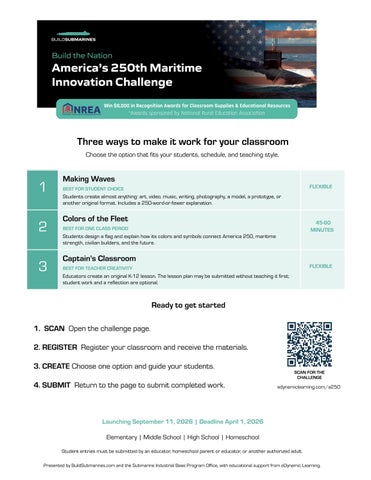
Three ways to make it work for your classroom Choose the option that fits your students, schedule, and teaching style.
1
Making Waves
2
Colors of the Fleet
3
FLEXIBLE
BEST FOR STUDENT CHOICE
Students create almost anything: art, video, music, writing, photography, a model, a prototype, or another original format. Includes a 250-word-or-fewer explanation. 45-60 MINUTES
BEST FOR ONE CLASS PERIOD
Students design a flag and explain how its colors and symbols connect America 250, maritime strength, civilian builders, and the future.
Captain's Classroom
FLEXIBLE
BEST FOR TEACHER CREATIVITY
Educators create an original K-12 lesson. The lesson plan may be submitted without teaching it first; student work and a reflection are optional.
Ready to get started 1. SCAN Open the challenge page. 2. REGISTER Register your classroom and receive the materials. 3. CREATE Choose one option and guide your students. 4. SUBMIT Return to the page to submit completed work.
SCAN FOR THE CHALLENGE
edynamiclearning.com/a250
Launching September 11, 2026 | Deadline April 1, 2026 Elementary | Middle School | High School | Homeschool Student entries must be submitted by an educator, homeschool parent or educator, or another authorized adult. Presented by BuildSubmarines.com and the Submarine Industrial Base Program Office, with educational support from eDynamic Learning.
THE STORY BEHIND THE CHALLENGE America has always needed builders America's maritime story is also a story of making things. The Naval Act of 1794 authorized the construction of the first six frigates of the young United States Navy. Those ships were built at six different Atlantic locations, linking national defense to shipyards, craftspeople, suppliers and local communities from the beginning. That connection grew over time. Navy yards built ships and later became major manufacturing centers. During the 20th century, hundreds of thousands of civilians worked in shipyards and factories machining parts, welding steel, laying out patterns, producing equipment and coordinating the enormous supply networks needed to build a fleet. Today, the Submarine Industrial Base and broader Maritime Industrial Base still depend on a nationwide network of people and companies. Careers include welding, CNC machining, engineering, design, additive manufacturing, quality inspection, metrology, non-destructive testing, logistics, planning and many more. BuildSubmarines.com describes thousands of roles across all 50 states.
The big idea for students As America marks 250 years, we are not only celebrating where the nation has been. We are celebrating the people who built and sustained its maritime strength, and asking who will build the next 250 years.
Four ideas every strong entry should connect America 250
A connection to the nation's history, ideals, ingenuity, communities or future, and a celebration of this milestone in the history of our democracy.
Navy +Maritime
A connection to the Navy, ships, submarines, shipbuilding, maritime strength or service at sea.
Builders + Makers
Recognition of the civilian workforce, manufacturing, skilled trades, engineering, suppliers or technologies that make the fleet possible.
The Next 250 Years
A forward-looking idea about innovation, careers, responsibility or what Americans may build next.
Path 1: Making Waves Open-Ended Student Challenge Student Challenge How would YOU honor 250 years of America's maritime strength and the people who build and sustain the U.S. Navy, while inspiring the next generation that will build its future?
Create almost anything ◦ Artwork or poster ◦ Short film or video ◦ Song or original music ◦ Poem or spoken-word piece ◦ Dance or performance ◦ Model or sculpture ◦ Animation or digital design ◦ Photography ◦ Story, comic or illustrated narrative ◦ Engineering concept or prototype ◦ A flag ◦ Another creative format you invent
What to submit ◦ A teacher, educator, or parent/guardian submits the entry on the student’s behalf using the official online form. ◦ For artwork, writing, photos, models, or other static work: upload a PDF, Word document, JPG, or PNG. For physical objects, upload clear photographs rather than mailing original materials. ◦ For video, music, dance, performance, animation, or other large media: provide a viewable link such as YouTube. Keep video/audio entries to 2 minutes or less. ◦ A required 250-word-or-fewer student explanation: What did you create? What does it mean? How does it connect America 250 to the Navy, the Submarine Industrial Base, maritime manufacturing, and the civilian people who build and sustain the fleet? ◦ Do not email contest entries. Email is reserved for questions and technical support. ◦ Hosted media links solve file-size and storage issues, but public display or reuse of student names, images, voices, or work will still follow the permissions and release language in the Official Challenge Rules.
Teacher facilitation option 1. Introduce the four core ideas on page 2. 2. Let students choose a format that fits their strengths and interests. 3. Ask students to research at least one historical or modern source from the Resource Guide. 4. Use the rubric as a planning checklist before students create. 5. Have students finish with the 250-word story so judges understand the meaning behind the work.
Path 2: Colors of the Fleet One-Class-Period Flag Design Challenge Student Challenge Design a flag that honors 250 years of America's maritime strength, the U.S. Navy and the civilian builders who make the fleet possible. Then tell the story behind your design in 250 words or fewer.
Lesson Snapshot Time
45-60 minutes
Grades
Adaptable for elementary, middle and high school
Materials
Flag worksheet, pencils/markers or digital design tools, Teacher Resource Guide
Product
One flag design + student story of 250 words or fewer
Core Ideas
America 250, Navy/maritime, civilian workforce/manufacturing, future
Extension
Research, digital redesign, peer critique, career exploration or a second class period
Learning goals ◦ Explain how symbols and colors can communicate ideas about history, identity, work and the future. ◦ Recognize that the U.S. Navy depends on a large civilian workforce and manufacturing supply chain. ◦ Connect America's 250th anniversary to maritime history and the people who build and sustain the fleet. ◦ Envision what the next 250 years of maritime industries will look like. ◦ Create a visual design and defend design choices with evidence and explanation.
Teacher preparation ◦ Print the Flag Design Worksheet and Tell Your Flag's Story page for each student, or provide digital copies. ◦ Review the four campaign ideas on page 3 and select one or two Resource Guide links that fit your students. ◦ Optional: use a companion slide deck when available. The lesson can also be taught directly from these pages.
One-period lesson sequence 1. Hook - 5 minutes
Ask: Who builds a Navy ship or submarine? Record student answers. Push beyond sailors to engineers, welders, machinists, electricians, designers, inspectors, logisticians, suppliers and thousands of civilian workers.
2. Connect the past - 8 minutes
Explain that the first six U.S. Navy frigates were authorized in 1794 and built in different Atlantic locations by a civilian workforce. America's maritime strength has always required communities of builders, materials, tools and suppliers.
3. Connect today - 7 minutes
Share examples of modern submarine-building careers such as welding, CNC machining, engineering, additive manufacturing, metrology and non-destructive testing. Emphasize that the work takes place across a national supply chain. (see Learning Blade resources for deeper understanding and lesson)
4. How to Read a flag - 5 minutes
Discuss how flags use simple symbols, colors and shapes to communicate big ideas. Share a few flags and examples for students to review. Ask students what symbols could represent America 250, the sea, manufacturing, builders, service, innovation or the future.
5. Design - 20 minutes
Students sketch and create their final flag. Encourage intentional choices rather than simply filling the page with patriotic symbols.
6. Tell the story - 10 minutes or extension
Students explain what their symbols mean, how the design connects to America 250 and maritime strength, and how the civilian workforce or manufacturing appears in the story.
Elementary and Middle School adaptation: See PowerPoint activity Use the interactive PowerPoint to guide students through the flag-design process. The slides introduce age-appropriate symbols connected to America’s 250th anniversary, the Navy and maritime industries, builders and manufacturing, careers, innovation, and the future. Students can explore the symbol bank, think about what different colors and images might represent, and then use the final blank flag canvas to create their own design. For younger students, teachers may simplify the activity by asking students to choose two or three symbols that represent their ideas and explain their choices through a short written response, labels, or teacher-recorded dictation. Middle school students can use the same PowerPoint as a starting point while developing a more detailed flag design and written story explaining how their symbols connect to America, the Navy, the people who build and sustain the fleet, and the next 250 years.
Middle/high school extension Require students to cite one historical or modern source from the Resource Guide and explain how one specific occupation, technology or manufacturing process influenced their design.
Student Worksheet: Design your Flag Step 1: Plan your symbols Theme
My symbol/color/image What it represents
America 250 Navy/Maritime Builder/Makers Next 250 Years Tip: A strong flag is usually simple enough to recognize from a distance. Choose a few meaningful elements and make every one count.
Step 2: Create your final flag
Use this space, a separate sheet, or a digital design tool.
Student Worksheet: Tell your Flag's Story 250 words or fewer Use your own words to help the judges understand your choices. You do not need to answer these questions one by one, but your story should make the meaning of your flag clear. ◦ What is the main idea of your flag? ◦ What do your colors, shapes and symbols represent? ◦ How does your flag connect to America's 250th anniversary? ◦ How does it honor the Navy, maritime industries or America's maritime strength? ◦ Where do builders, manufacturers, skilled workers, engineers or suppliers appear in your story? ◦ What does your flag say about the next 250 years?
Path 3: Captain's Classroom Teacher-Created Lesson Challenge Teacher Challenge Design an original lesson connecting America’s 250th anniversary to the Navy, the Submarine Industrial Base, maritime industries, manufacturing, and the civilian workforce. Submit your lesson plan, and if you teach it, you may also share student work or a short reflection.
What makes an eligible lesson? ◦ Designed for K-12 students ◦ Includes a clear America 250 connection. ◦ Includes a meaningful Navy, maritime, shipbuilding or submarine connection. ◦ Helps students see the civilian workforce, manufacturing, skilled trades, engineering, technology, logistics or supply chain behind the fleet. ◦ Requires students to create, investigate, discuss, design, solve, write, build or otherwise actively engage. ◦ May be submitted as a complete lesson plan without being taught before submission. Teachers are encouraged, but not required, to implement the lesson with students.
What to submit ◦ A completed lesson plan using the simple template below or your own format. ◦ Optional: examples or a summary of student work/results ◦ If the lesson was taught, an optional brief reflection should be included: What worked? What would you change? What did students learn or notice?
Simple lesson plan template
Lesson title
Grade/ subject
Time needed What should students understand or be able to do?
Learning goal
Materials/ resources What does the teacher do? What do students do?
Lesson steps
Student product/ evidence
What will students create, say, solve, design or demonstrate?
What worked? What would you change? What did students learn?
Reflection
Teacher Resource Guide A short path from 1776 to the submarine workforce of today You do not need to be a naval historian or manufacturing expert to teach this challenge. The resources below are intentionally short, credible and teacher-friendly. Pick one or two that fit your grade level and activity. President Washington Signs the Naval Act of 1794 [History | MS-HS] Naval History and Heritage Command overview of the law that authorized the Navy's first six frigates. Good for establishing why a young nation decided it needed naval strength. The First Six Frigates and the Early Navy [History | ES-HS] A concise Navy history article describing how the original six frigates were built simultaneously at six Atlantic locations. Useful for connecting national defense to local shipyards, craftspeople and supply networks. Washington Navy Yard: From Shipbuilding to Manufacturing [History + Manufacturing | MS-HS] The Navy Yard began as a shipbuilding site and later produced anchors, chains, steam engines, ordnance and major naval guns. A strong example of how the Navy's needs drove changing manufacturing skills and technologies. Washington Navy Yard Manufacturing Collections [Primary Sources | ES-HS] Naval History and Heritage Command photo collections focused on manufacturing and the civilian workforce at the Navy Yard. Excellent primary visual sources for class discussion. Library of Congress: Liberty Ship Welding and Prefabrication [Primary Source | MS-HS] A World War II photograph and caption showing welding, prefabrication and how an existing freight-car plant was used to produce ship sections. Great for discussing industrial capacity and transferable manufacturing skills. Library of Congress: Mold Loft Workers at Newport News [Primary Source | ES-HS] A 1941 image showing workers laying out patterns for naval vessel parts before transferring them to steel. A useful bridge from design and geometry to manufacturing. Library of Congress: Skilled Machining in Shipbuilding [Primary Source | ES-HS] A 1941 Newport News photograph highlighting complicated machining operations and the skilled workers involved in ship production.
Library of Congress: Skilled Machining in Shipbuilding [Primary Source | ES-HS] A 1941 Newport News photograph highlighting complicated machining operations and the skilled workers involved in ship production. BuildSubmarines.com: Careers Behind the Fleet [Careers | MS-HS] Modern career exploration across submarine manufacturing. Students can explore welding, CNC machining, additive manufacturing, engineering, metrology, non-destructive testing, design, planning and more. BuildSubmarines.com: Training Opportunities [Careers + Training | HS] Searchable training opportunities across all 50 states. Best for older students who want to see how career interests connect to real postsecondary training. NIST: Why Consider a Career in Manufacturing? [Manufacturing Careers | MS-HS] A student-friendly infographic explaining how technology, automation and digital systems have changed manufacturing careers and workplaces. NIST: Supply Chain Management [Manufacturing + Supply Chain | HS] Explains why manufacturers depend on reliable supply chains and how disruptions affect production. Useful for connecting a Navy vessel to suppliers far beyond the shipyard. America250 Classroom Resources [America 250 | ES-HS] America250 has published classroom activities and educator guides that help students connect personal stories, national history and the future. These can provide additional context for the 250th anniversary.
Quick discussion prompt Put one historical image next to one modern career page. Ask students: What changed? What stayed the same? What knowledge, tools and people are still needed to turn an idea into a ship or submarine?
Optional: Go deeper with Ready-to-use Curriculum These resources are not required to enter or win Learning Blade (Middle School) and Ready for Industry (High School) are optional deeper-learning resources supported by Submarine Industrial Base Program Office that can be used to deepen student learning. They are not required to participate, submit, or receive recognition. However both resources have ample turnkey mini-lessons on Submarine Manufacturing. Teachers and students in many states already have funded access; see the map later in this toolkit and use the Get Free Access call to action. See if the resources are available in your state at www.learningblade.com/States and www.readyforindustry.com/states
Learning Blade - grades 5-9 focus ◦ Beneath the Waves: Building Submarines introduces students to submarine manufacturing and careers such as naval architecture, marine engineering, welding and quality control. ◦ Assemble the Fleet: Supply Chain in Motion explores how engineering, manufacturing, logistics and a nationwide supply chain come together to build a modern U.S. Navy vessel. ◦ Teachers can use one of these missions before the challenge and make the student entry a culminating creative activity. Check current Learning Blade access by state: LearningBlade.com/States
Ready for Industry - high school / workforce focus ◦ The Manufacturing course helps learners build foundational knowledge of modern manufacturing, workplace expectations, terminology, technologies and career pathways. ◦ A challenge entry can serve as a culminating reflection or creative application after students explore the industry. Check current Learning Blade access by state: www.readyforindustry.com/states
Free Access in Participating States Learning Blade and Ready for Industry are available at no cost to teachers and students in the highlighted states through support from the Submarine Industrial Base Program Office and other participating statewide partnerships. Green = Learning Blade only | Blue = Ready for Industry only | Split green/blue = both programs available to your program at no cost, fully funded.
GET FREE ACCESS: If your state is highlighted, use the campaign resource link to access the program(s) available in your state. Participation in America’s 250th Submarine Industrial Base Challenge does not require Learning Blade or Ready for Industry, and use of either resource does not affect judging.
Submit, Recognize, Celebrate Launch: September 11, 2026 ◦ 10 Recognition Awards | $8,000 total in classroom supplies and educational resources | Additional Honorable Mentions ◦ School entries must be submitted by a teacher, educator, or other authorized school adult. Homeschool entries must be submitted by a parent/guardian or authorized homeschool educator. ◦ Making Waves: upload PDFs, Word files, JPGs, or PNGs for static work. Use a viewable hosted link for large media such as video, audio, dance, performance, or animation. Every Making Waves entry also includes a representative JPG/PNG image and a 250-word-or-fewer student explanation. ◦ Email is for questions and technical support only. Official entries must be submitted through the online form.
Classroom/Student submissions 1. An educator, homeschool parent/educator or other authorized adult opens the official Student Submission Form. (students should not submit their work, rather their teacher/parent/guardian) 2. Select the student's category and challenge: Making Waves or Colors of the Fleet. 3. Upload the entry or the required digital evidence of a physical/performance entry and include the student's 250-word-or-fewer explanation. 4. Complete required certifications and permissions, then submit. A confirmation and entry ID will be provided.
Submission Link: https://www.edynamiclearning.com/a250/ Teacher submissions Same process – simply check the the Teacher Lesson Submission Form to provide school/grade information and upload the lesson plan. Teachers may optionally include permitted student work and a brief reflection if the lesson has been taught. Student work is encouraged, but not required. $8,000 in Recognition Awards for classroom supplies and educational resources Selected student and teacher entries will receive national recognition and Recognition Awards totaling $8,000 in classroom supplies and educational resources.
Recognition Structure Making Waves: Elementary | Middle School | High School | Homeschool Colors of the Fleet: Elementary | Middle School | High School | Homeschool Captain's Classroom: 2 Teacher Recognition Awards Additional National Honorable Mentions will receive Navy-themed certificates and approved recognition items, such as career/training cards or similar materials if approved by BuildSubmarines/BFA. For school-based student recipients, the student earns the national recognition and the Recognition Award supports the student’s teacher/classroom through classroom supplies or educational resources.
Teacher FAQ Do I need Learning Blade or Ready for Industry to participate? No. They are optional deeper-learning resources and are not part of the judging score.
Can students enter without doing the Flag Challenge? Yes. Making Waves is intentionally open-ended. Students may create in almost any medium.
Can I use the Flag Challenge even if I only have one class period? Yes. The core lesson is designed for 45-60 minutes. The student story can be completed as an extension if needed.
Are elementary, middle and high school students doing different challenges? No. Students participate in the same campaign and core prompts. Judging is age appropriate, with recognition structures described in the Official Challenge Rules.
What about homeschool students? Homeschool students are welcome and will have a dedicated homeschool Recognition Award category. An authorized adult submits on the student's behalf.
Can a student make a song, dance, video or physical object? Yes. Making Waves is designed for broad creative expression. Physical and performance work should be submitted through clear digital evidence such as photos or video.
How much writing is required? Student entries include a short explanation of 250 words or fewer. The focus is on helping judges understand the meaning and connections in the work.
Can teachers win too? Yes. Captain's Classroom invites educators to design, teach and submit an original lesson connected to the campaign themes.
Can a teacher adapt an existing lesson? The Teacher Challenge should reflect the educator's original lesson design and comply with the Official Challenge Rules. Teachers may use and cite outside resources.
Does using Learning Blade or Ready for Industry earn bonus points? No. Using a particular resource does not increase a challenge score. Those resources are offered as optional ways to deepen student learning.
Can AI be used? Yes, however the use of AI to complete this project is strictly up to the educator in charge of the learning activity.
Who submits student work? An educator, homeschool parent/educator or other authorized adult should submit student entries. Students should not be required to manage challenge accounts themselves.
Source Notes for Educators Selected sources used to develop this toolkit Naval History and Heritage Command: Naval Act of 1794; original frigates; Washington Navy Yard history and manufacturing collections. Library of Congress Prints and Photographs: Primary-source photographs of shipbuilding, welding, machining and mold loft work. BuildSubmarines.com: Current submarine manufacturing career pathways and training opportunities across the United States. National Institute of Standards and Technology, Manufacturing Extension Partnership: Manufacturing career and supply-chain resources. America250: Educator activities and classroom resources connected to America's 250th anniversary. eDynamic Learning / Learning Blade: Beneath the Waves and Assemble the Fleet descriptions and state-access pathways. eDynamic Learning / Ready for Industry: Manufacturing career-readiness curriculum and state access information. Learning Blade and Ready for Industry are available at no cost to teachers and students in the highlighted states through support from the Submarine Industrial Base Program Office and other participating statewide partnerships.