EduSpots’ Model of Change 2026
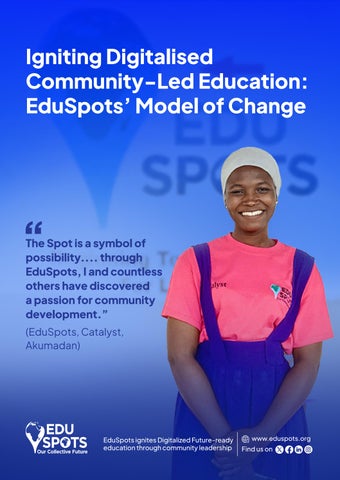
Igniting Digitalised Community-Led Education: EduSpots’ Model of Change
The Spot is a symbol of possibility.... through EduSpots, I and countless others have discovered a passion for community development.” (EduSpots, Catalyst, Akumadan)
EduSpots ignites Digitalized Future-ready education through community leadership
Find us on
EduSpots’ Model of Change 2026
What Drives Our Existence: The Narratives Communities Reshape “At first, my community believed only a powerful authority could bring educational reform. Today, the presence of Dulugu Spot and the community-wide impact ignited by local Catalysts has changed that perception.” (Getrude Akunlibe, Dulugu Spot Founder, now Northern Cluster Regional Coordinator & App Lead)
EduSpots; Challenging Patterns, Reshaping Narratives for Community-Led Model Across Ghana, communities care deeply about education and invest time, energy and creativity into supporting their children’s learning. Yet too often, education systems and interventions are designed for communities rather than with or by them. EduSpots exists to challenge this pattern and to reshape the narratives that shape how change happens.
Community-Led Model Designed With & By
UNTAPPED COMMUNITY KNOWLEDGE AND LEADERSHIP:
Communities hold deep knowledge, lived experience and problemsolving capacity. However, education initiatives have often prioritised external expertise over local leadership, limiting community ownership and weakening longterm impact.
LIMITS OF TOP-DOWN EDUCATION MODELS:
Many education reforms rely on decisions made far from the classrooms and communities they affect. These outside-in approaches can overlook local culture, language and context, resulting in solutions that struggle to take root or be sustained.
THE STRUCTURAL REALITY & COMMUNITY-IDENTIFIED NEEDS PERSISTENT EDUCATIONAL INEQUITY SHAPED BY STRUCTURAL CONDITIONS: While NGOs and government reforms have expanded access to schooling, learning outcomes remain deeply unequal. In rural Ghana, 35% of students do not complete primary school (UNESCO, 2020), and 80% of children do not acquire basic literacy and numeracy skills by the end of primary school (UNESCO, 2022). These figures reflect longstanding structural and historical inequalities in education systems, not a lack of ability, aspiration or commitment within communities. RURAL GHANA PRIMARY COMPLETION (UNESCO 2020)
BASIC LITRACY& NUMERACY SKILLS AT THE END OF PRIMARY
HARMFUL NORMS AFFECTING SAFETY AND WELLBEING:
Communities themselves have identified the need for support in addressing; CORPORAL PUNISHMENT
DRUG ABUSE SEXUAL HARASSMENT AND ABUSE.
BULLYING PERIOD POVERTY
(UNESCO 2020)
80%
35% 65%
20%
COMPLETE
ACQUIRE
DO NOT COMPLETE
DO NOT ACQUIRE
These challenges persist where young people lack safe spaces, trusted adults and collective systems of care.
1
Top-Down Model Designed For
DEFICIT NARRATIVES THAT UNDERMINE AGENCY:
Too often, communities are described through what they lack rather than what they contribute. These narratives obscure resilience and innovation, reinforce harmful stereotypes, and reduce communities to passive recipients rather than active shapers of their own futures.
EduSpots’ Model of Change 2026
A Mechanism for Inside-Out Development “Our Spots have become beacons of knowledge, creativity, and innovation, providing a platform for individuals to grow, share, and learn from one another.” (Adu Boahen Carlos, Catalyst Committee Chair, Akumadan Project Lead)
EduSpots emerged from a simple but powerful moment: a locked, privately owned library in the Ashanti Region prompted community members to ask why learning spaces were inaccessible, and what could be created instead. EduSpots supports communities to design, lead and sustain their own learning spaces, rooted in local ownership, shared responsibility and collective action. By recognising communities as the architects of change, education becomes a civic practice rather than a service delivered from outside. Since 2015, over 700 local voluntary leaders named Catalysts, including students, teachers and community members, have come together to create 50 community-owned learning hubs known as ‘Spots’ – a concept drawn from the Ghanaian idea of a drinking space. Each Spot is unique, shaped by the identity and aspirations of its community; yet, all part of a connected network advancing inclusive, future-ready education. Through the Spots, thousands of learners, or Sparks, take part in playful, community-rooted clubs that spark curiosity, collaboration and civic action. Many Sparks grow into Catalysts themselves, with one in four new Spots now founded by those who first joined as Catalysts. From this cycle of change, a movement is emerging across rural Ghana and beyond.
THE ORIGIN STORY A LOCKED LIBRARY
THE MECHANISM COMMUNITY-LED DESIGN
THE IMPACT: CYCLE OF CHANGE & NETWORK
700+
LOCAL CATALYSTS (voluntary leaders)
50
COMMUNITYOWNED SPOTS (learning hubs)
EduSpots emerged from a simple but powerful moment: a locked, privately owned library in the Ashanti Region prompted community members to ask why learning spaces were inaccessible, and what could be created instead.
EduSpots supports communities to design, lead and sustain their own learning spaces, rooted in local ownership, shared responsibility and collective action. By recognising communities as the architects of change, education becomes a civic practice rather than a service delivered from outside.
2
SPARKS GROW INTO CATALYST 1 in 4 new Spots founded by those who first joined as Catalysts
THOUSANDS OF SPARKS (Learners in Clubs)
A CONNECTED NETWORK ADVANCING INCLUSIVE FUTURE-READY EDUCATION ACROSS RURAL GHANA AND BEYOND
EduSpots’ Model of Change 2026
WHAT DO COMMUNITIES DO IN THIS PROCESS?
APPLY TO JOIN THE NETWORK WITH PEER REVIEW PROCESS
IDENTIFY A SAFE SPACE FOR LEARNING
ENGAGE IN TRAINING IN COMMUNITY LEADERSHIP AND INCLUSIVE PEDAGOGY
JOIN EDUSPOTS’ WHATSAPP SPACES & APP
BUILD A CATALYST TEAM AND SPOT COMMITTEE
ENROL SPARKS IN CLUBS & LEAD MONTHLY CHALLENGES
CREATE A KEEPING SPOTS SAFE CHARTER
LAUNCH A LOCALISED ‘SPOT’ THROUGH LOCALLY-LED COMMUNICATIONS
ENGAGE IN EDUBYTES CERTIFICATES & WIDER COMMUNITY LEADERSHIP PROJECTS
3
CELEBRATE & LEARN ALONGSIDE A NATIONWIDE NETWORK!
EduSpots’ Model of Change 2026
A Pathway to Robust Community Leadership “Before joining EduSpots’ leadership programmes, I was an ordinary headteacher. I returned not just as a school leader, but as a strategic leader, a change maker, community builder and staff-developer.” (Hamidu Kaadri, Headteacher, Yamfo Spot)
EduSpots has a four year multi-staged Community Leadership in Education Programme, that enables Spots to move from a symbol of possibility into a hub for igniting long-lasting locallyled change through education, as part of an increasingly autonomous peer-governed network. All networkwide in-person training takes place in community-based Spots, ensuring that communities are always at the heart of our approach, with methodologies including community walkshops, practical environmental projects and a lot of fun!
Trialling Diverse Types of Spots
SCHOOL-BASED SPOTS
Embedded in government or low-cost private schools
COMMUNITY-BASED SPOTS Overseen by community committees
NGO-LED SPOTS
Embedded in government or low-cost private schools
GOVERNMENT-LED SPOTS Overseen by organisations such as the Ghana Library Authority
4
EduSpots’ Model of Change 2026
A Journey in Community Leadership YEAR 1: IGNITE PHASE PROGRAMME OVERVIEW & APPROACH
IGNITE PHASE TIMELINE & KEY ACTIVITIES
Through the one year Ignite Programme, community-based teams are introduced to EduSpots’ approach and the foundational learnings in leadership and education needed to spring their education Spot into action.
FOUNDATION & LAUNCH
3-DAY IN-PERSON IGNITE ACADEMY
This approach works through in-person and online training, WhatsApp Communities of Practice, peer mentorship and coaching from Regional Coordinators.
DISTRIBUTION OF DIGITAL TOOLS & SUSTAINABLE RESOURCE KITS
MONTH 1 CHALLENGE: COMMUNITY ENGAGEMENT & ASSETS MAPPING
MONTH 2 CHALLENGE: TEAM-BUILDING & VISION BOARDS
MONTH 3 CHALLENGE: DIGITAL TOOLS & CREATING LOCALISED SYSTEMS
IN-PERSON AND ONLINE TRAINING
WHATSAPP COMMUNITIES OF PRACTICE
FLEXIBLE IGNITE GRANT FUNDING (3000 GHS), LED BY COMMUNITIES
MONTH 4 CHALLENGE: CKEEPING SPOTS SAFE CHARTER
MONTH 5 CHALLENGE: COMMUNICATIONS FOR CHANGE
PEER MENTORSHIP AND COACHING FROM REGIONAL COORDINATORS.
Each month, communities move through monthly team-based projects which were created by past or present Catalysts. These are designed to harness indigenous knowledge, and move towards local aspirations through an open-ended project-based approach that centres local autonomy,
MONTH 4 CHALLENGE: RESOURCE MOBILISATION & MANAGEMENT
MONTHS 7-12: INTRODUCTION TO THE EDUCATION HUB & ONE LEARNER STRAND
5
EduSpots’ Model of Change 2026
YEAR 2: CATALYSE PHASE BUILDING ON FOUNDATIONS: DEEPER COLLABORATIVE TRAINGING In year 2, Catalyse involves Catalysts in deeper collaborative training across project management, financial planning and community leadership enabling them to build on the foundations set by the Ignite Programme. PROJECT MANAGEMENT
FINANCIAL PLANNING
COMMUNITY LEADERSHIP
FLEXIBLE MICRO GRANT FUNDING & CATALYSE PROJECT Each Spot is able to access flexible micro grant funding (3000 GHS), to create a tailored action plan known as a “Catalyse Project” to strengthen the Spot’s impact, with guidance from peer mentors.
ASSETS & VISION ACTIVITIES
WHATSAPP LEADERSHIP COMMUNITY
CATALYSE GRANTS DISTRIBUTION
CATALYSE PROJECT DEVELOPMENT
PEER MENTORING & LEARNING
ONLINE CATALYSE WORKSHOPS
SPOT LEARNING VISITS & OBSERVATIONS
PRESENTATIONS & GRADUATIONS
6
5-DAY RESIDENTIAL ACADEMY
EduSpots’ Model of Change 2026
YEARS 3 & 4: THE SUSTAIN PHASE The Sustain Programme represents the third and final stage of the EduSpots Community Leadership in Education Pathway to enable matured Spots to operate as fully independent, community-driven education hubs. The programme ensures that each Spot transitions from reliance on EduSpots’ direct facilitation to self-sustaining leadership, finance, and governance models, supported by a peer-led structure and continuous leadership development through the Hub. This will include:
Creating clear pathways to independence through readiness benchmarks and tailored support.
Establishing a multi-tiered peer governance model led by elected Catalyst Committees.
Introducing local financing and social enterprise frameworks to promote sustainability.
Practical learning in environmental sustainability and leadership to ignite Spots as long-term engines of eco innovation
Embedding peer-led monitoring and annual Sustain Summits to foster transparency and collaboration.
By 2028, the Sustain Programme aims to anchor EduSpots’ long-term vision for existing Spots: a federation of autonomous Spots collaborating through a Catalyst-led peer governance network, with EduSpots HQ serving primarily as an advisory and knowledge-sharing ally.
7
EduSpots’ Model of Change 2026
A Self-Propelling Digitalised Network “EduSpots has realised its vision of community-driven change by empowering an effective network of young people and community members who initiate positive changes and can sustain and expand EduSpots’ work.” (Expectation State, Independent Evaluation 2025)
EduSpots isn’t your standard NGO: it’s a tech-enabled online community, connecting changemakers across some of Ghana’s most remote areas through daily educational conversations.
How do we connect people online? STRATEGIC DIGITAL INFRASTRUCTURE:
15 WHATSAPP CHANNELS:
EDUSPOTS’ APP:
ONLINE TRAININGS:
EDUBYTES:
tablets & wifi kits
providing participatory learning curriculums
a unique system for tracking local activities
Coaching and collaboration via Zoom
Digital skills professional skills training
8
LOCALISATION OF COMMUNICATIONS:
Spots set up local WhatsApp Hubs & Channels
EduSpots’ Model of Change 2026
The Changemakers We Ignite: EduSpots’ Learner Profile “I see a group of people full of passion to make others’ lives better. Even when I’m ready to sleep, I always think about this and it motivates me to do more.” (Seidu Yayha, Catalyst now Regional Coordinator)
EduSpots isn’t just about increasing literacy or numeracy outcomes or improving school-based academic performance: it’s about building the agency and soft skills that enable people of all ages to flourish and champion better futures for all. The learner profile outlines the key qualities, values and competencies that we aim to nurture in Sparks, Catalysts, Peer Mentors and staff through our work, following Catalyst identifying these qualities as key to promoting active citizenship, inclusion and wider community wellbeing.
ACTIVE CITIZENS:
TEAM PLAYERS:
The ultimate goal is to ignite futureoriented active citizens: good ancestors, not just inheritors, of the futures they want to see for themselves, their communities, and the wider world.
Adept collaborators who understand that true leadership means bringing out the best in others through active listening, open mindedness, and working together to drive collaboratively created and sustained changes
CARING: Driven to create a more equitable world through empathy, thoughtfulness and understanding the diverse conditions people need to thrive, partly through taking care of our local and global environments.
CREATIVE PROBLEM-SOLVERS: Confident innovators who seek solutions with potentials unleashed through playful exploration and experimentation to connect ideas in unexpected ways.
ACTIVE CITIZENS:
COMMUNICATORS: Skilled in using their voices to connect, inspire, foster understanding, and break down barriers through various media.
9
LIFELONG INDEPENDENT LEARNERS: Instilled with a love for learning that inspires continuous personal and professional growth both in themselves, and others.
DIGITALLY SKILLED: Proficient across new technologies to thrive in an ever-evolving world; digital creators not just consumers.
EduSpots’ Model of Change 2026
The Education Hub “EduSpots doesn’t just provide resources; they ignited a culture of learning, collaboration and leadership that changed my life.” (Abdul-Raheem, learner now Catalyst, Sakasaka Spot)
Local Decision-Making Following education training, each Spot chooses 1-4 learner strands, based on their interests, needs and aspirations, and enrolls “Sparks” via the EduSpots App, with parental approval. The Catalysts and Sparks choose when to run the clubs, how frequently, and for how long, also adapting content suggestions to their needs and aspirations, with open-ended projects, aiming to strengthen autonomy whilst modelling inclusive pedagogy
The Strands EDUKIDZ
(KG-Basic 3 learners): Early years education activities for learners, led by Catalysts with active parental involvement, focusing on literacy, numeracy, psychomotor, and social-emotional development, and nurturing joyful, collaborative learning rooted in children’s identities, families, and communities. It is the beginning of the EduSpots Learner journey.
DIGILIT
ECOSTEM
IGNITE EQUITY
(Basic 4−6 learners):
(Basic 7−9 learners): Practical STEM education leveraging local resources to explore and connect science and technology with environmental sustainability education and local action
(Basic 8 learners): Focused on youth empowerment and addressing genderbased challenges through sustainable locally-driven solutions across themes such as careers, sexual harassment, menstrual hygiene, social vices, and wider active citizenship.
Literacy & digital skills activities promoting creativity, critical thinking and teamwork also instilling a lifelong love of reading, and an awareness of online safety.
Sparks Transitioning to Catalyst Roles During the Basic 9 year, we offer training to support learners in transitioning into Catalyst roles, including being reading buddies for EduKidz learners, mentors for the Ignite Equity strand, and Eco Champions!
10
EduSpots’ Model of Change 2026
Our Learning Ecosystem “The shift towards more learner-centred, inclusive, and practical teaching methods has transformed school-based pedagogy, making education more relevant and engaging for students.” (Expectation State, Independent Study, 2025) EduSpots’ Education Hub has several unique features that enable communities to take charge of their own learning pathways, with each community adapting the approach to their local context and designing their own activities beyond the scope of the education strands. For example: •
Sakasaka Spot has a dynamic parental WhatsApp hub, who have endorsed local activities and even sewed EcoSTEM lab coats for Sparks.
•
The Dadwen Spot team create weekly reels (short videos) with their EduKidz Sparks, shared widely with parents and Catalysts to spark wider innovation and engagement in early years education.
•
Dulugu Spot has developed a moveable STEM lab that moves across the district promoting practical science with accompanying teacher training.
•
Yamfo Spot took to the streets to campaign for the promotion of reading through an engaging advocacy campaign involving parents, students and teachers.
IN-PERSON TRAINING ACADEMIES:
RESOURCE KITS:
Modelling our playful and purposeful practice throughout
MONTHLY CHALLENGES:
FRIENDLY COMPETITION SYSTEM:
Sustainable resource kits, to support learning experiences.
Practical team-based activities to enliven learning with clear handbooks.
A leadership board across Spots, with meaningful monthly written and oral feedback from experienced staff.
Once a quarter staff or peer Catalysts visit Spots, and learn alongside Catalyst with a self-reflective approach to observation.
WHATSAPP HUBS:
EDUANIMATIONS:
PEER MENTORS:
LEARNING SYSTEM:
RECOGNITION & CELEBRATION:
Across all strands, with daily playful engagements
Cartoons, videos and wider media to keep learning accessible.
Drawn from the Catalyst Network, with experience of local leadership offer empathetic guidance.
Our participatory approach to monitoring, evaluation and learning ensures that Catalyst, Spark and community voice is constantly feeding into our organizational evolution and educational design.
Once a quarter staff or peer Catalysts visit Spots, and learn alongside Catalyst with a self-reflective approach to observation.
11
CLUB OBSERVATIONS:
EduSpots’ Model of Change 2026
How We Spark Learning, Unlearning and Relearning “We’re not just implementing a pre-set model. Our ideas and experiences are actively shaping how EduSpots evolves. It’s truly a collaborative effort.” (Ameyaw Spot Catalyst, Independent Evaluation, 2025) At EduSpots, we believe in the power of embodied and relational learning, where learners and Catalysts connect their bodies, minds, and environment through play-based & participatory pedagogies. These principles, which are rooted in local cultural practices, are the vehicle through which we aim to support learners in their journey towards becoming future-oriented active global citizens, drawing on their own interests and aspirations in this process. 1. Inclusive: We welcome learners from all backgrounds with open arms with activities and resources representing the diverse cultures, languages and experiences in our Spot communities. Every learner & Catalyst has an important voice that deserves to be heard, understood and responded to. 2. Collaborative exploration: Whether solving local problems, creating group presentations or mentoring each other, we take turns to play diverse roles that require effective communication and active listening. Catalysts and staff act as facilitators, guiding productive group discussion rather than being didactic. 3. Creativity and problem-solving: Our learners and Catalysts learn best by actively exploring with their hands and minds. We use art, practical experimentation, movement and outdoor adventures to make sessions come alive. 4. Playful discovery: We inject fun, play and imaginative experiences into learning activities to cultivate joyful exploration and intrinsic motivation to learn. 5. Digital learning: We leverage multimodal media and digital tools to create interactive, participatory encounters that amplify learning. As creators and not just consumers of technology, we embrace the possibilities of catering to diverse learning styles while building digital literacy skills. 6. Community connected: Activities draw from indigenous knowledge and relate to the local context, with an emphasis on environmental awareness and sustainability. 7. Learning for transformative action: We inspire learners to apply their knowledge and skills practically to address pressing issues that they identify in their local communities, thereby empowering them to become active citizens and Catalysts of change. 8. Student leadership: All students are given opportunities to take on meaningful responsibilities, and are constantly involved in decision-making, and shaping the learning process. 9. Subject mastery: We recognise that subject-specific confidence is often the foundation of excellent pedagogy and facilitating, supporting Catalysts and learners in strengthening core subject specific knowledge and skills. 10. Keeping Spots Safe: Safeguarding and promotion of wider well-being is paramount; all Sparks explore collective well-being principles, and understand key abuses that need to be passed on.
12
EduSpots’ Model of Change 2026
Resources That Mirror Their Worlds “For the first time, some learners gained the confidence to tell a Catalyst that they don’t enjoy the foreign books because they don’t understand them.” (Mohamed Fusseini, Dulugu Spot)
EDU-ANIMATIONS:
KWAME’S ADVENTURES
EduSpots co-create animations that reflect the communities and wider context that learners and Catalysts live within, to make learning relevant, engaging and powerful. In 2025, we launched our first Keeping Spots Safe animation exploring online safety, which plans to move these into local languages in 2026.
EduSpots has a series of popular storybooks that reflect the stories and traditions of local Catalysts and learners through the adventures of Kwame the Bird. Since 2018, Kwame has visited Abofour, Akumadan and Tease, with plans to fly to Elmina soon, with stories featuring real life EduSpots Catalysts and local festivals and events, co-written with Sparks and Catalysts.
SPOT DECORATIONS & LOCAL MASCOTS
APPROACH TO RESOURCE DESIGN
Through the Spot Lead challenges, Catalysts and Sparks are encouraged to decorate the Spots in ways that reflect their unique cultures and practices. For example, all Spots feature a local Keeping Spots Safe mascot – an animal that reflects a local approach to safeguarding and well-being.
Across all EduSpots educational resources, photos and images are used of Ghanaian children with deep reflection on the local relevance of all content. 100% of all programmes staff and consultants, and both our Creative Manager and Communications Manager are Ghanaian.
13
EduSpots’ Model of Change 2026
Keeping Spots Safe: Locally-led Safeguarding “Learners have become each other’s keepers. They watch out for their peers’ safety and are very comfortable approaching us and other teachers.” (Catalyst, Bosomadwe Spot) No educational programme can succeed unless children feel safe, valued and protected. At EduSpots, safeguarding is foundational. Through our Keeping Spots Safe strand, we ensure every community Spot is a space where every learners’ wellbeing, inclusion and rights are actively upheld. Each Spot runs child-friendly workshops where children practise saying no, identify trusted adults, explore their rights and use creative methods such as chants, storytelling and mascots to embed safety messages in local culture. KSS also activates the wider ecosystem. Spot teams organise forums with parents, school management committees and traditional leaders to shift attitudes around discipline and safety, including strong messaging against corporal punishment. Together, they create their own Keeping Spots Safe Charter to communicate their own vision for protecting the well-being of all. All Spots display key rights messages in local languages, and we are introducing a safeguarding handbook, digital tools and a KSS Badge to recognise Spots that meet high protection standards, with children as rights-holders, not just beneficiaries.
KSS Quarterly Challenges with activities rooted in local values
Peer Mentoring
Collaborative KSS Training for all Staff, Peer Mentors, Catalysts, Learners
Locally-led Systems for Passing it On
KSS WhatsApp Hub nurturing peer learning
Local Keeping Spots Safe Charter
14
EduSpots’ Model of Change 2026
The Heartbeat of EduSpots: The Principles That Guide Us “I have been working with education and community development NGOs in Ghana for almost 25 years and EduSpots stands out for the quality of its work, the creativity of its model and the integrity of its people.” (Sally Vivyan, Co-Director, Gower Street Trust) As EduSpots has grown, we have recognised the importance of clearly articulating the values that have emerged through our work and that continue to guide our path forward. These values were first collectively shaped at EduSpots’ inaugural Catalyst National Conference in 2018 and have since evolved through lived practice across the network. We work as a team We commit to EduSpots’ shared vision, recognising that meaningful change is collective. We actively explore how our skills, knowledge and experiences, alongside those of others, can best contribute to this vision. Through collaborative decision-making and action, we strengthen both the organisation and community-led Spots, fostering a deep sense of shared ownership. Communities lead the way Communities own and lead their Spots, shaping activities, governance and Catalyst recruitment. Our programmes are built in response to the priorities, knowledge and aspirations of learners and community members, with Catalysts leading delivery in their Spots and actively contributing to programme design and evolution. We are playful Playfulness sits at the heart of our pedagogy and our relationships. We cultivate curiosity, encourage exploration and support creative risk-taking, recognising play as a powerful driver of learning, imagination and innovation. We are daring We recognise that challenging entrenched norms and imagining new possibilities requires courage. We support one another to test new ideas, take thoughtful risks, and remain open to learning from alternative perspectives and approaches. We drive sustainable impact We make decisions that prioritise long-term, community-led change in line with our theory of change. We steward resources responsibly, ensuring that funding and effort are directed towards meaningful impact at the community level, with a consistent focus on the growth and agency of learners and Catalysts. We are caring Creating safe, inclusive learning spaces for learners and Catalysts is fundamental to our work. We take active steps to understand and respond to the wellbeing needs of everyone in our network, nurturing a culture of care and strengthening empathy, trust and mutual respect. We are passionate We do this work because we passionately believe in a world where communities collectively shape their futures. Our commitment is rooted in authenticity, integrity and a shared conviction that local voices, knowledge and leadership truly matter
15
EduSpots’ Model of Change 2026
“EduSpots isn’t like some other organisations that tell people what to do. It inspires everyone to see that they can do whatever they dream of and to build our collective future together.” (Abdul Manaf, Learner & Catalyst, Abofour Spot)
Curious and want to learn more or support our growth? Email us today at info@eduspots.org and help us build #OurCollectiveFuture.
www.eduspots.org
FEATURED BY