Theory of Change
January 2026
Theory of Change
January 2026
THE CALL THE APPROACH
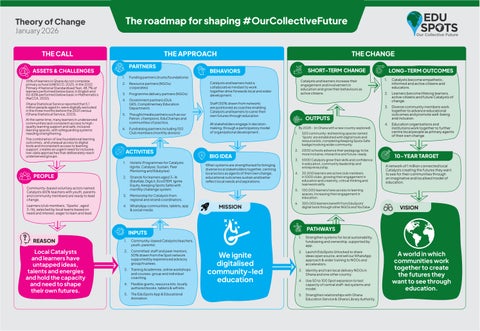
35% of learners in Ghana do not complete primary school (UNESCO, 2021). In the 2022 Primary 4 National Standardised Test, 48.7% of learners performed below basic in English and 50.83% performed below basic in Mathematics (NaCCA, 2022).
Ghana Statistical Service reported that 5.1 million people aged 6+ were digitally excluded in the three months before the 2021 census (Ghana Statistical Service, 2023).
At the same time, many learners in underserved communities lack consistent access to highquality learning support and safe, inclusive learning spaces, with safeguarding systems needing strengthening.
This combination of low foundational learning outcomes, and unequal access to digital tools and inconsistent access to learning support, creates an urgent need for inclusive, low-data approaches that deliberately reach underserved groups.

Community-based voluntary actors named Catalysts (65% teachers with youth, parents and community members) are ready to lead change.
Learners (club members, ‘Sparks’, aged 3-16), selected by local teams based on need and interest, eager to learn and lead.

Local Catalysts and learners have untapped ideas, talents and energies and hold the capacity and need to shape their own futures.

1. Funding partners (trusts/foundations)
2. Resource partners (NGOs/ corporates)
3. Programme delivery partners (NGOs)
4. Government partners (GLA, GES, Complimentary Education Department)
5. Thought/media partners such as our Patron, champions, EduChamps and communities of practice.
6. Fundraising partners including 100 Club members (monthly donors)

1. Holistic Programmes for Catalysts (Ignite, Catalyse, Sustain, Peer Mentoring and Edubytes)
2. Strands for learners aged 3-16 (EduKidz, DigiLit, EcoSTEM, Ignite Equity, Keeping Spots Safe) with monthly challenge system.
3. Mentorship for Catalysts from regional and strand coordinators.
4. WhatsApp communities, tablets, app & social media

1. Community-based Catalysts (teachers, youth, parents)
2. Committed staff and peer mentors, 50% drawn from the Spot network supported by experienced advisory group/trustees.
3. Training Academies, online workshops and courses, group and individual coaching.
4. Flexible grants, resource kits, locally authored books, tablets & wifi kits.
5. The EduSpots App & Educational Animation

Catalysts and learners hold a collaborative mindset to work together drive forwards local and wider development.
Staff (50% drawn from network) are positioned as coaches enabling Catalysts and learners to carve their own futures through education.
All stakeholders engage in decisionmaking, through a participatory model of organizational development.
When systems are strengthened for bringing diverse local stakeholders together, centring local actors as agents of their own change, educational outcomes sustain and better reflect local needs and aspirations.


Catalysts and learners increase their engagement and involvement in education and grow their behaviours as active citizens.

1. 500 community-led learning spaces named ‘Spots’ are established with digital tools and resource kits, completing Keeping Spots Safe badge involving wider community.
2. 2000 schools advance their pedagogy to be more inclusive, interactive and future-ready.
3. 5000 Catalysts grow their skills and confidence in education, community leadership and entrepreneurship.
4. 30,000 learners are active club members in 1000 clubs, growing their engagement in education and creativity, critical thinking and teamwork skills.
5. 100,000 learners have access to learning spaces, increasing their engagement in education.
6. 300,000 learners benefit from EduSpots’ digital tools through other NGOs and YouTube.

1. Catalysts become empathetic, informed and active citizens and educators.
2. Learners become lifelong learners, active citizens and future Catalysts of change.
3. Diverse community members work together to advance educational outcomes and promote well-being and inclusion.
4. Education organisations and institutions work together to further centre local people as primary agents of their own change

A network of 1 million connected local Catalysts creating the futures they want to see for their communities through an imaginative and localised model of education.
1. Strengthen systems for local sustainability, fundraising and ownership, supported by app.
2. Launch EduSpots Unlocked to share ideas open source, and sell our WhatsApp approach & wider training to NGOs and accelerators.
3. Identity and train local delivery NGOs in Ghana and one other country.
4. Use 50 to 100 Spot expansion to test capacity of central staff-led systems and model.
5. Strengthen relationships with Ghana Education Service & Ghana Library Authority.

A world in which communities work together to create the futures they want to see through education.