D I G I T A L
M A G A Z I N E
OCT - DEC 2026 TM
Tempe Elementary Schools Celebrating Local Food, Farmers & Nutrition Education!
E N R I C H M E N T
Our “Fresh” Mission Each day, Tempe Elementary Schools Nutrition Services team serves approximately 2,800 breakfasts, 7,000 lunches, and 540 snacks to students across the district. Each meal is made with care and emulates our dedication to providing quality, nutritious meals to ensure students are equipped with the brain power to do their best in the classroom. Tempe Elementary Schools Student Wellness Policy
This institution is an equal opportunity provider.
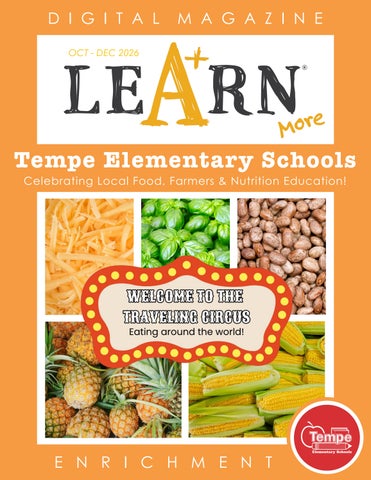
Cheese | Basil Pinto Beans | Pineapple | Sweet Corn
Calcium
Iron
Vitamin K
Vitamin A
Fiber
Cheese Cheese is a dairy product made by separating milk into curds and whey. Thousands of different kinds of cheeses are made around the world. Some of the most popular types of cheeses consumed in the U.S. include mozzarella, cheddar,
parmesan & feta.
Cheese is commonly made from cow’s milk, but can also be made from goats, sheep & more!
It takes around 1.25 gallons of milk to make 1 pound of cheese. Aging changes a cheese’s taste, smell, color & texture.
Different varieties of cheese can age for several weeks to years.
Calcium Calcium supports healthy bones & teeth as well as proper blood & muscle function. Calcium is the 5th most abundant chemical element in the Earth’s crust. Calcium helps keep muscles working properly.
Calcium supports heart health.
99% of the body’s calcium is stored in the bones.
Calcium helps form bones and teeth and keep them healthy.
The other 1% is found in the blood, muscles & other tissues. Calcium helps to heal cuts & wounds.
Calcium is the
MOST
abundant mineral in the human body.
Basil Basil is one of the most popular & common herbs used in cooking. Basil is the main ingredient in pesto, a sauce commonly used in pasta dishes. There are more than 60 varieties of basil with different colors, flavors & aromas!
Basil is known for its strong, fresh fragrance.
Basil grows best in warm weather with plenty of sunlight. Basil plants take 3 - 4 weeks to grow.
Basil should be harvested before it flowers.
Once basil plants start to flower, they begin to lose their flavor.
Vitamin K Vitamin K supports proper blood function, bone growth & kidney health. 2 main forms of vitamin K: K1 and K2. Vitamin K is a fat-soluble vitamin - which means…
The body has the ability to create vitamin K on its own.
Vitamin K helps the body heal from wounds.
It absorbs better into the body when eaten with foods with some fat like olive oil!
Vitamin K helps produce proteins that bind themselves to calcium - this helps build strong bones. Vitamin K supports heart health.
Vitamin K is found throughout the body in the liver, brain, heart, pancreas & bones. Vitamin K plays a role in proper blood function- specifically with clotting.
Beans Beans are the seeds of flowering plants – typically grown in pods.
All beans are a part of the legume family. Pods come in various shades of green, yellow, red & purple.
Beans have been cultivated by humans for 6,000 years. Most Popular Types of Beans: 1. Green Beans 2. Kidney Beans 3. Pinto Beans 4. Lima Beans
The World’s Tallest Bean Plant was over 45 feet tall. Try growing some beans in your garden! There are
40,000+ types of beans.
Equivalent to 3 fullygrown giraffes stacked on top of one another.
Iron Iron carries oxygen in the blood, supports the immune system & proper brain function. Two forms of iron: Heme & Non-heme. Heme comes from animal meat and is easily absorbed into the body after eaten. 80% of the Earth’s crust is composed of iron.
Iron is found in every cell of the human body.
Non-heme comes from plant foods - like beans!
Non-heme sources of iron are best absorbed into the body when eaten with a source of vitamin C, like an orange.
Iron helps muscles function by carrying oxygen to their cells. Blood is RED because of iron and oxygen reacting with each other. The body uses iron to make hemoglobin.
Iron supports a healthy immune system.
Hemoglobin helps carry and transport oxygen in the blood to other parts of the body…like a backpack!
Pineapple Pineapples are a type of tropical fruit.
“Hala Kahiki” It can take up to 3 years for a pineapple plant to fully mature before it begins bearing fruit. Then, it takes up to a year for the actual pineapple to grow. Pineapples are in peak season from March - July. Some pineapple plants can live for 50 years.
Specifically, pineapples are considered to be a type of berry. 1/3 of the world’s pineapples are grown in Hawai’i. Pineapples ripen faster when upside down.
Pineapples are made up of clusters of “fruitlets.” “Fruitlets” are basically individual, small berries. ONE pineapple plant produces only ONE pineapple at a time.
Vitamin A Vitamin A supports good vision, growth & immunity. Vitamin A helps improve eyesight to see better at night and experience more vivid colors during the day. How far can you read down this eye chart?
Vitamin A has antioxidant properties.
Vitamin A can help speed up the healing process of cuts & scrapes.
Vitamin A supports the immune system to fight off infections.
Vitamin A is a fat-soluble vitamin.
Vitamin A is a fat-soluble vitamin – which means it absorbs better into the body when eaten with foods with some fat like avocados!
Sweet Corn Corn is considered a grain, fruit & vegetable.
1 acre of land can produce 14,000 pounds of sweet corn.
The U.S. is the LARGEST producer, consumer & exporter of corn in the world. Humans only eat sweet corn.
Corn is grown on EVERY continent except Antarctica.
There are around
An ear of corn ALWAYS has an even number of rows.
800
kernels on each ear of corn. In many other countries, corn is called “maize.” 1 corn stalk produces 1 - 3 ears of corn. Corn stalks can grow between 7 – 10 feet tall.
Corn is America’s number 1 field crop.
Fiber Fiber supports movement through the digestive system. Fiber is a type of carbohydrate that the body doesn’t digest, it simply passes through. Soluble fiber dissolves in water…it helps regulate blood sugar levels and removes cholesterol from the blood stream.
Insoluble fiber is sometimes referred to as “roughage.” Dairy & meat products do not have any fiber.
2
types of fiber:
1. Soluble fiber 2. Insoluble fiber
Fiber helps to regulate the body’s use of sugar.
Fiber is ONLY found in plant foods.
Insoluble fiber does not dissolve in water…it helps food move throughout the digestive system.
BOTH forms of fiber are important & beneficial to overall health.