D I G I T A L
M A G A Z I N E
2026 - 2027 EDITION
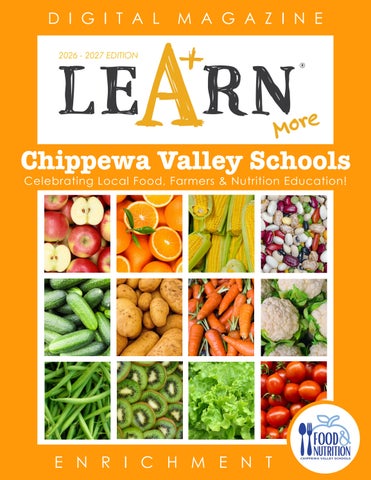
Chippewa Valley Schools Celebrating Local Food, Farmers & Nutrition Education!
E N R I C H M E N T
Fresh Produce Every Day • Healthy Choices • Bright Futures At Chippewa Valley Schools, we're proud to serve nutritious meals that help students learn, grow, and thrive. Every school day, we offer fresh fruits and vegetables, balanced meals, and healthy choices to fuel active minds and strong bodies.
Fiber
Vitamin C
Phosphorous
Iron
B Vitamins
Potassium
Vitamin A
Vitamin K
Calcium
Copper
Hydration
Magnesium
Apples Apples are one of the most widely cultivated tree fruits.
5
of the Most Popular Varieties of Apples:
Most apples are harvested & sold fresh.
The U.S. is home to approximately 322,000 acres of apple orchards.
1. Red Delicious 2. Gala 3. Granny Smith 4. Fuji 5. Golden Delicious
36
There are
2,500+ different varieties of apples are grown in the U.S.
21% of apples are juiced.
Most apples are HAND-PICKED. Apple trees take 4- 8 years to start producing fruit.
An apple blossom is the flower that comes from an apple tree.
Fiber Fiber supports movement through the digestive system. Fiber is a type of carbohydrate that the body doesn’t digest; it simply passes through. Soluble fiber dissolves in water…it helps regulate blood sugar levels and removes cholesterol from the blood stream.
Insoluble fiber is sometimes referred to as “roughage.” Dairy & meat products do not have any fiber.
2
types of fiber:
1. Soluble fiber 2. Insoluble fiber
Fiber helps to regulate the body’s use of sugar.
Fiber is ONLY found in plant foods.
Insoluble fiber does not dissolve in water…it helps food move throughout the digestive system.
BOTH forms of fiber are important & beneficial to overall health.
Oranges Oranges are a type of citrus fruit known for their sweet, juicy pulp & leathery rind.
3
Popular Types of Oranges:
Orange season is 9 months long… from October - June!
1. Navel 2. Hamlin 3. Valencia There are over 600 varieties of oranges.
85% of all oranges are juiced! 3 oranges = one glass of orange juice! Honeybees are the main pollinators for orange trees. One orange tree can grow THOUSANDS of oranges in its lifetime! Sub-tropical climates are ideal for growing oranges.
Vitamin C Vitamin C supports the immune system the body’s defense against infections.
ENERGY booster!
Vitamin C helps to heal wounds.
Vitamin C is also referred to as “ascorbic acid.”
Vitamin C helps keep you happy & healthy! Vitamin C is an antioxidant. Antioxidants help protect against damage caused by exposure to harmful substances in the environment.
The body cannot make vitamin C on its own - it has to come from food.
What do you call a vitamin that improves your eyesight?
A Vitamin C! Vitamin C is a very important vitamin for healthy gums & teeth.
Sweet Corn Corn is considered a grain, fruit & vegetable.
1 acre of land can produce 14,000 pounds of sweet corn.
The U.S. is the LARGEST producer, consumer & exporter of corn in the world. Humans only eat sweet corn.
Corn is grown on EVERY continent except Antarctica.
There are around
An ear of corn ALWAYS has an even number of rows.
800
kernels on each ear of corn. In many other countries, corn is called “maize.” 1 corn stalk produces 1 - 3 ears of corn. Corn stalks can grow between 7 – 10 feet tall.
Corn is America’s number 1 field crop.
Phosphorus Phosphorus supports bone, tissue and cell growth, maintenance and repair.
Phosphorus is found in many different foods – Phosphorus is the second most dairy, whole abundant mineral in the body. grains, meat, legumes & nuts. Minerals, like copper naturally occur in soil, water & rocks. Phosphorus Phosphorus is a mineral. is an essential nutrient. Plants absorb minerals through their roots.
Phosphorus helps manage the body’s energy usage and storage.
Phosphorus helps reduce muscle pain after a workout. Phosphorus works closely with CALCIUM to build strong bones.
85% of the body's phosphorus is found in bones & teeth.
Beans Beans are the seeds of flowering plants – typically grown in pods.
All beans are a part of the legume family. Pods come in various shades of green, yellow, red & purple.
Beans have been cultivated by humans for 6,000 years. Most Popular Types of Beans: 1. Green Beans 2. Kidney Beans 3. Pinto Beans 4. Lima Beans
The World’s Tallest Bean Plant was over 45 feet tall. Try growing some beans in your garden! There are over
40,000
types of beans.
Equivalent to 3 fullygrown giraffes stacked on top of one another.
Iron Iron carries oxygen in the blood, supports the immune system & proper brain function. 2 forms of iron: Heme & Non-heme.
Non-heme comes from plant foods like beans!
Heme comes from animal meat and is easily absorbed into the body after eaten. Iron is found in EVERY cell of the body.
Non-heme sources of iron are best absorbed into the body when eaten with a source of vitamin C, like an orange. Iron helps muscles function by carrying oxygen to their cells.
Supports a healthy immune system.
Human blood is RED because of iron and oxygen reacting with each other. The body uses iron to make hemoglobin.
80% of the Earth’s crust is composed of iron.
Hemoglobin helps carry and transport oxygen in the blood to other parts of the body…like a backpack!
Cucumbers Cucumbers are technically fruits since they are grown from a flower & contain seeds. There are The flavor of cucumbers comes from the seeds. over 100 different World Cucumber types of cucumbers. Day is June 14th! The large leaves on the cucumber plant provides shade for the developing fruit. Cucumbers are
90% water.
Cucumbers grow on vines. 1 vine can produce 25 - 125 cucumbers. Bees are essential for the pollination of cucumbers.
B Vitamins B Vitamins help support the body’s energy levels, brain function & cell metabolism.
8
essential B vitamins: Vitamin B1, Vitamin B2, Vitamin B3, Vitamin B5, Vitamin B6, Vitamin B7, Vitamin B9 & Vitamin B12. Water is needed to help the body absorb B vitamins. B5, B12, C and E knock on your door…what do you do? In-Vitamin!
B vitamins helps the body make energy from food. B vitamins help create red blood cells.
The body cannot store most B vitamins, so they need to be regularly consumed.
B vitamins play a role in serotonin production. Serotonin makes us feel happy.
Potatoes Potatoes are a type of starchy vegetable, specifically a tuber. Tubers are vegetables that are grown underground at the base of the plants root. Potatoes are one of the most eaten vegetables in the U.S.
Billions of pounds of potatoes are grown in the U.S. each year. Potatoes are sometimes referred to as “spuds.”
Multiple potatoes can grow from one potato plant. Potatoes are an annual
Potatoes are grown in all 50 states.
plant meaning they need to be replanted each year.
Potatoes can be brown, red, yellow, purple, pink, or even blue inside!
Potassium Potassium supports balancing fluid in the body & proper function of the muscles and nerves. Once potassium enters the body, it functions as an electrolyte. Electrolytes help balance the amount of water in the body.
Potassium is the THIRD most abundant mineral in the body.
Helps to keep the body hydrated! FUN FACT: The body is made up of approximately 60% water. Potassium helps to regulate the heart rate. Potassium helps to regulate muscle contractions.
Potassium helps promote bone health.
98%
of the body’s potassium is found in its cells.
Many runners eat foods high in potassium like pears before a run to prevent muscle cramps.
Carrots Carrots are a type of root vegetable a vegetable that grows underground. Carrots are made up of 88% water.
Carrots can be orange, purple, red, yellow or white.
Carrots are the second most popular vegetable in the world.
2,000 carrot seeds fit in 1 teaspoon. Carrots thrive in cooler temperatures. Carrots can survive entire WINTERS underground! The world record for the longest carrot is over 19 feet! Carrots are biennials, which means they have a 2-year life cycle.
Vitamin A Vitamin A supports good vision, growth & immunity. Vitamin A helps improve eyesight to see better at night and experience more vivid colors during the day. How far can you read down this eye chart?
Vitamin A has antioxidant properties. Vitamin A is a fat-soluble vitamin.
Vitamin A can help speed up the healing process of cuts & scrapes.
How do you know carrots are good for the eyes? You never see a rabbit wearing glasses! Vitamin A supports the immune system to fight off infections.
Cauliflower Cauliflower is a type of cruciferous vegetable related to broccoli, cabbage, kale & others. Cauliflower is white due to its large leaves protecting it from the sun.
“Cabbage Flower”
Cauliflower is made up of tiny flower buds called “florets.”
The BIGGER the cauliflower head, the BIGGER the flavor! Cauliflower is a coolseason crop & very sensitive to extreme weather.
Cauliflower can be white, green, purple, orange, brown or yellow! Cauliflower takes 50 - 85 days to grow from a seed to being ready to harvest.
Vitamin K Vitamin K supports proper blood function, bone growth & kidney health. 2 main forms of vitamin K: K1 and K2. Vitamin K is a fat-soluble vitamin - which means…
The body has the ability to create vitamin K on its own.
Vitamin K helps the body heal from wounds.
It absorbs better into the body when eaten with foods with some fat like olive oil or avocados!
Vitamin K helps produce proteins that bind themselves to calcium - this helps build strong bones. Vitamin K supports heart health.
Vitamin K is found throughout the body in the liver, brain, heart, pancreas & bones. Vitamin K plays a role in proper blood function- specifically with clotting.
Green Beans Green beans are kidney beans that are harvested at a young age. Green beans taste best when they are thinner than a pencil. Green beans are the 3rd most homegrown vegetable.
Bush & pole are the 2 main types of green beans. 130+ varieties of green beans. Green beans are also known as string or snap beans.
The World’s Tallest Bean Plant was over 45 feet tall.
=
String beans can be green, yellow or purple!
Equivalent to 3 fullygrown giraffes stacked on top of one another.
Calcium Calcium supports healthy bones & teeth as well as proper blood & muscle function. Calcium is the 5th most abundant chemical element in the Earth’s crust. Calcium helps keep muscles working properly.
Calcium supports heart health.
99% of the body’s calcium is stored in the bones.
Calcium helps form bones and teeth and keep them healthy.
The other 1% is found in the blood, muscles & other tissues. Calcium helps to heal cuts & wounds.
Calcium is the
MOST
abundant mineral in the human body.
Kiwifruit Kiwifruit is a type of true berry – a type of berry that grows from one singular flower. 98% of all kiwifruit grown in the ALL kiwifruit is U.S. comes from California. harvested by hand. Over ONE
MILLION TONS
of kiwifruit is grown worldwide each year.
Kiwifruit has a very long growing season of 240 days.
Kiwifruits grow on vines that can reach up to 33 feet long.
Bees are the main pollinators for kiwifruit. Kiwifruit vines can produce fruit for 25+ years.
Copper Copper supports the creation of red blood cells & energy. Red blood cells help carry oxygen throughout the body.
Copper is a mineral.
Minerals, like copper naturally occur in soil, water & rocks.
Plants absorb minerals through their roots.
Most copper in the body is found in the liver, brain, kidneys & skeletal muscles.
Copper helps maintain healthy, strong bones.
Foods like kiwifruit contain minerals because their plants roots absorbed them. Copper helps the brain function properly.
Copper is known as an essential nutrient.
Copper plays a role in helping the body turn food in energy!
Lettuce Lettuce is a type of leafy green vegetable.
Lettuce is a part of the sunflower family.
Darker green lettuce leaves are MORE nutritious than lighter green leaves. MOST
Lettuce is
95% w a t e r.
Because of lettuce’s water %, it must always be eaten
FRESH. Lettuce plants grow to be 6 - 12 inches tall.
LEAST
4
Main Types of Lettuce:
1. Butterhead 2. Crisphead 3. Looseleaf 4. Romaine Lettuce grows best in cooler climates. Iceberg lettuce (also known as crisphead) is the most popular type of lettuce in the U.S.
Hydration Hydration is the process of replacing fluids in the body. Being hydrated helps convert food into energy.
Water is the body’s main source of hydration.
The body’s 6 essential nutrients: carbohydrates, proteins, fats, vitamins, minerals & WATER!
Water helps carry nutrients & oxygen to all the cells in the body. Hydration helps regulate the body’s temperature.
Proper hydration can help to improve moods.
The body is better at fighting off infections when properly hydrated. Sleep quality can improve when the body is hydrated.
Many fruits & vegetables have a high water content, making them hydrating to eat.
Tomatoes Tomatoes are considered to be both a fruit & a vegetable!
3
12,000+ TONS of fresh market tomatoes are grown/year in the U.S.
Popular Types Tomatoes come in a variety of colors of Tomatoes: including yellow, pink, purple & more!
“Wolf peach”
1. Cherry 2. Grape 3. Roma
MANY Americans grow tomatoes in their own garden.
There are 10,000+ different varieties of tomatoes.
Botanically, tomatoes are a fruit! Tomatoes take 60-100 days to grow from seed to fruit.
Tomatoes are a warm season crop that L O V E the sun.
Magnesium Magnesium helps the body make energy, build strong bones & keep muscles working properly. Magnesium is a major mineral, meaning the body needs larger amounts of it. Minerals, like magnesium naturally occur in soil, water & rocks. Foods like soybeans absorb minerals through their roots. Every cell in the body needs magnesium to help produce energy. Magnesium helps the body use other vitamins & minerals more effectively.
Around 60% of the body’s magnesium is found in the bones.
Magnesium helps muscles move and relax. Magnesium helps the body make proteins, which are important for growth & repair. Magnesium helps support a healthy nervous system.
Most fruits & vegetables contain magnesium.