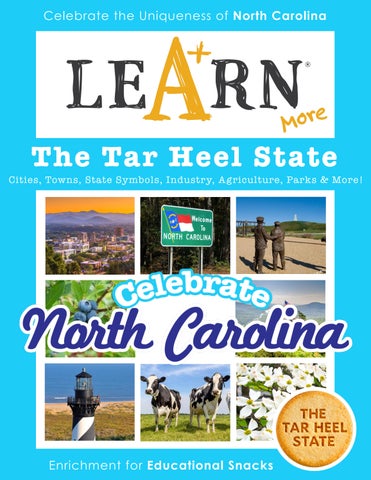
Celebrate the Uniqueness of North Carolina
The Tar Heel State
Cities, Towns, State Symbols, Industry, Agriculture, Parks & More!
Enrichment for Educational Snacks
Big Cities:
Charlotte Raleigh Greensboro Durham Winston-Salem Fayetteville Wilmington Asheville
Corn Soybeans Apples Dairy Wheat Watermelon
Landmarks: Blue Ridge Mountains
Boone Beaufort Waxhaw
Cape Hatteras Wright Brothers National Memorial Whitewater Falls Grandfather Mountain Outer Banks Barrier Islands
Counties:
Parks:
Small Towns:
Wake Mecklenburg Guilford Forsyth Union
State Symbols: Northern Cardinal Pine Dogwood Eastern Gray Squirrel Eastern Box Turtle Honeybee Sweet Potato
Agriculture: Blueberries
Great Smoky Mountain National Park Pisgah National Forest Hanging Rock State Park Chimney Rock State Park
Regions:
Coastal Plains Piedmont Region Mountain Region
Food & Culture:
Research Triangle Bluegrass Music Barbeque Seafood Sweet Tea
Big Cities
BIG CITY
Charlotte Charlotte is the LARGEST city in North Carolina with a population of over 900,000 people. Charlotte is named after Queen Charlotte, the wife of King George III of Great Britain.
Charlotte is nicknamed the “Queen City.” Before the California Gold Rush, Charlotte was one of the main gold mining locations in the U.S.
Charlotte is a major center for NASCAR racing. Charlotte’s downtown area is actually called “Uptown.” Charlotte-Mecklenburg Schools has over 141,000 students. Charlotte is located in the Piedmont region of North Carolina. Charlotte is a very green city with over 200 parks.
CAPITAL CITY
Raleigh
Raleigh is the 2nd largest city in North Carolina with a population of over 480,000 people. Raleigh was founded in 1792 as the capital city of North Carolina.
Raleigh was named after English explorer
The North Carolina state fair is hosted in Raleigh each year.
Sir Walter Raleigh.
Raleigh is part of the
Raleigh is home to the oldest public park in North Carolina!
“City of Oaks”
Research Triangle, one of the largest science & technology areas in the U.S.
Wake County Public School System has over 140,000 students.
BIG CITY
Greensboro Greensboro is the 3rd largest city in North Carolina with a population of 300,000+ people. Greensboro is known for playing a significant role in the Civil Rights Movement. In 1960, Greensboro four college became an students official city of started the North Carolina famous in 1808. Greensboro sit-ins at a lunch counter. Greensboro grew quickly Greensboro is in the 1800s home to several because of colleges and their railroad universities. industry. Guilford County Schools has around 70,000 students. Greensboro was named after American Revolution general Nathanael Greene.
BIG CITY
Durham Durham is the 4th largest city in North Carolina with a population of over 290,000 people.
Durham is part of the
Durham is nicknamed the “City of Medicine” because of its large healthcare industry.
Research Triangle, one of the largest science & technology areas in the U.S. Durham Public Schools has around 34,000 students.
Durham began as a small railroad station in the 1850s known as Durham Station. The city is named after Dr. Bartlett Durham, who donated land for the train station. Durham is home to Duke University, one of the top universities in the U.S.
BIG CITY
Winston-Salem Winston-Salem is the 5th largest city in NC with a population of over 250,000 people. Winston-Salem became a city in 1913 by merging the towns of Winston and Salem. WinstonSalem is often referred to as “twin city.”
WinstonSalem is known for their arts scene & home to the
University of North Carolina School of Arts.
Winston-Salem is famous for their thin & crispy Moravian cookies.
WinstonSalem is recognized as a Bee City USA, meaning the city works to protect bees.
Winston-Salem/Forsyth County Schools has around 50,000 students.
BIG CITY
Fayetteville Fayetteville is the 6th largest city in NC with a population of over 210,000 people. Fayetteville is located very close to Fort Bragg, one of the largest military bases in the world. Fayetteville has a large military population and is often referred to as a “military town.” Fayetteville sits along Cape Fear River.
Fayetteville was founded in 1762 & became an official city in 1783. Fayetteville was named after Marquis de Lafayette, a French general who helped the U.S. during Fayetteville has received the American the All-America City Award. Revolution.
Cumberland County Schools has around 48,000 students.
BIG CITY
Wilmington th largest city in NC Wilmington is the 86th Fayetteville with a population of over 120,000 210,000 people.
Every spring since 1948, Wilmington has hosted the
Wilmington is a historic port city located along the Cape Fear River.
North Carolina Azaelea Festival.
Wilmington is home to one of the largest
historic districts in North Carolina.
Many movies and TV shows have been filmed in Wilmington.
Wilmington is nicknamed
“Hollywood East.”
Wilmington was established in 1739. New Hanover County Schools has around 25,000 students.
BIG CITY
Asheville Asheville Fayetteville is the is the 10th6thlargest largestcity cityininNC NC with a population of over 94,000 210,000people. people. Asheville is located high within the Blue Ridge Mountains & is nicknamed the “Land of the Sky.” Asheville is known for its live music, especially bluegrass, folk, rock & indie.
Asheville is home to the
Baltimore Estate the largest privately owned home in the U.S.
Many people visit Asheville to drive along the famous
Blue Ridge Parkway.
Asheville has many local farmers markets.
Asheville was established as a city in 1797.
Buncombe County Schools has over 22,000 students.
Small Towns
SMALL TOWN
Boone
Boone is a small town in North Carolina with a population of around 19,000 people.
2 MILES 8 MILES
Boone is a popular destination for outdoor adventure - hiking, mountain biking, snow sports & more!
Boone is located 3,300 feet above sea level in North Carolina’s Blue Ridge Mountains. Boone was officially incorporated as a town in 1872. Boone is a part of the
Mountain region.
Boone was named after Daniel Boone, a famous American explorer. Boone is the county seat of Watauga County. Watauga County Schools has around 4,700 students.
SMALL TOWN
Beaufort Beaufort is a small town in North Carolina with a population of around 4,600 people.
Beaufort is known for
wild Banker horses that live on nearby coastal islands. Beaufort is a popular destination for fresh seafood.
Beaufort is a historic coastal town located in North Carolina’s “inner banks” coastal region. Beaufort has been an active coastal port since the early 1700s.
Beaufort has a long history connected to pirates, including Blackbeard. Beaufort County Schools has around 5,700 students. Beaufort became an official town in 1709.
SMALL TOWN
Waxhaw Waxhaw is a small town in North Carolina with a population of around 24,000 people.
The town was named after the
Waxhaw’s downtown historic district is listed on the National Register of Historic Places. Waxhaw was officially incorporated as a town in 1889.
Waxhaw people, a Native American tribe that lived in the area.
Waxhaw’s water tower is a wellknown local landmark.
The
WAXHAW
Waxhaw is a closeknit community.
Seaboard Railroad that arrived in Waxhaw in the late 1800s helped the town grow.
Union County Public Schools has around 40,000 students.
Counties
Wake County Wake County is the most populated county in North Carolina & home to 12 cities & towns. Raleigh is the largest city in Wake County as well as the capital city of North Carolina. Wake County is home to both busy cities and quiet countryside.
Wake County was formed in 1771. Wake County is home to over 250 parks and greenspaces.
Over 1
Wake County hosts all kinds of festivals each year.
Piedmont Region Wake County Public School System is the largest school district in North Carolina with over 150,000 students.
million people live in Wake County.
Mecklenburg County Mecklenburg County is 2nd most populated county in North Carolina & home to 7 cities.
Mecklenburg County is home to the second largest banking city in the U.S.
Over
1 million people live in Mecklenburg County.
The Queen City, Charlotte is the largest city in Mecklenburg County. Mecklenburg County was formed in 1762.
Freedom Park is widely considered one of Mecklenburg Mecklenburg county’s County is known for most popular NASCAR racing. parks.
Piedmont Region
Charlotte-Mecklenburg Schools has over 141,000 students.
Guilford County Guilford County is 3rd most populated county in North Carolina & home to 12 cities & towns.
Guildford County has a rich history in furniture making.
High Point, NC located in Guilford County is known as the “Furniture
Capital of the World.”
Greensboro is the county seat and the largest city in Guilford County. Around
545,000 people live in Guilford County. Guilford county is home to many parks & greenways. Guildford County was formed in 1771.
Piedmont Region Guilford County Schools has around 70,000 students.
Forsyth County Forsyth County is 4th most populated county in North Carolina & home to 7 cities & towns.
Forsyth County is known for its many parks & greenways.
Winston-Salem is the county seat and the largest city in Forsyth County. Forsyth County was formed in 1849.
Over
Tanglewood Park is one Forsyth County hosts all of Forsyth kinds of festivals each year. County’s most popular Piedmont Region parks. Winston-Salem/Forsyth County Schools has around 50,000 students.
380,000 people live in Forsyth County.
Union County Union County is 8th most populated county in North Carolina & home to 13 cities & towns.
Agriculture is a very important part of Union County’s history.
Union County is a mix of small towns, farmland & parks.
Monroe is the county seat and the largest city in Union County. FARMERS MARKET
Union County hosts many local festivals, fairs & farmers markets throughout the year. Around 275,000 people live in Union County. Union County was formed in 1842.
Union County Public Schools has around 40,000 students.
State Symbols
STATE BIRD
Northern Cardinal The Northern Cardinal is the z official state bird of North Carolina.
Male Northern Cardinals are bright red, while females are pale brown with reddish tinges. Northern Cardinals eat various seeds, berries & small insects.
The Northern Cardinal became North Carolina’s official state bird in 1943. BOTH male & female Northern Cardinals sing which is a rare trait in songbirds. Northern Cardinals are one of the first birds to start singing in the morning.
“REDBIRDS” The Northern Cardinal is the state bird in 7 states.
Northern Cardinals do NOT migrate – they can be found in North Carolina year-round!
STATE TREE
Pine
The pine tree is the official state tree of North Carolina.
The three most common types of pine trees in North Carolina are longleaf, loblolly &
The pine tree became North Carolina’s official state tree in 1963. Pine forests cover MILLIONS of acres across North Carolina.
shortleaf pines.
Pine trees grow long, thin needles instead of leaves.
All pine trees are evergreen trees. Pine tree needles help trees hold onto water to survive cold or dry weather. Pinecones hold the seeds of pine trees. Pine forests provide homes & shelter for many kinds of animals.
STATE FLOWER
Dogwood The dogwood is the official state flower of North Carolina.
Dogwood flowers are most commonly white or light pink with four petals.
The dogwood became the official state flower of North Carolina in 1941. Dogwood flowers grow on dogwood trees. Dogwood trees are one of the first trees to bloom in the spring. Dogwood flowers are mainly pollinated by bees & other insects. The “petals” on a dogwood are actually special leaves called bracts. The real flower part of a Many dogwood is the tiny yellowdogwood green cluster in the center. festivals Dogwood trees are are hosted native to North Carolina. each spring in North Carolina.
STATE MAMMAL
Eastern Gray Squirrel The Eastern gray squirrel is the official state mammal of North Carolina. The Eastern gray squirrel became the official state mammal of North Carolina in 1969. Eastern gray squirrels live Eastern gray all across North Carolina. squirrels commonly have gray fur with Eastern gray squirrels’ a white belly. big, fluffy tails help them “Sciurus carolinensis” balance when running & jumping through trees. Gray squirrels are most active during the daytime. Eastern gray squirrels have excellent spatial memory. Gray squirrels eat mostly nuts, acorns, seeds, berries & buds.
STATE REPTILE
Eastern Box Turtle The Eastern box turtle is the official state reptile of North Carolina. The Eastern box turtle became the official state reptile of North Carolina in 1979. Eastern box turtles can be found in forests, fields and backyards across North Carolina. Unlike many other turtles, Eastern box turtles live on land.
Eastern box turtles mainly eat berries, grasses, mushrooms, worms & small insects.
Eastern box turtles have a great sense of direction. Eastern box turtles can live for over 50 years! In the winter, Eastern box turtles hibernate.
The shells of Eastern box turtles are unique to each turtle, like a fingerprint!
STATE INSECT
Honeybee The honeybee is the official state insect of North Carolina. The honeybee became the official state insect of North Carolina in 1973. Like their name suggests, honeybees are known for making honey from flower nectar. One beehive can make 60 100 pounds of honey per year. A beehive is home to a colony of honeybees. Every colony of honeybees has only one QUEEN bee.
Honeybees can fly up to 15 miles per hour.
Honeybees live in very large families called colonies that can have up to 60,000 bees.
Honeybees help pollinate many North Carolina crops like blueberries & watermelon! Honeybees are one of the MOST IMPORTANT insects for Earth’s ecosystem.
STATE VEGETABLE
Sweet Potato The sweet potato is the official state vegetable of North Carolina.
Johnston County is North Carolina’s top sweet potato producing county.
The sweet potato became the official state vegetable of North Carolina in 1995. North Carolina grows hundreds of millions of pounds of sweet potatoes every year. Sweet potatoes are a type of root vegetable.
North Carolina is the
#1 sweet potato producing state in the U.S. About 60% of all U.S. sweet potatoes are grown in North Carolina. Most North Carolina sweet potatoes are grown on the eastern side of the state.
Agriculture
NORTH CAROLINA
Blueberries North Carolina is a top blueberry producing state. North Carolina is home to over 9,000 acres of blueberry fields. The North
Carolina Blueberry Festival is held each year in Burgaw, North Carolina.
North Carolina’s blueberry season is from May through July.
Honeybees are a main pollinator for North Carolina blueberries.
Southern highbush blueberries are the most common type of blueberry grown in North Carolina.
Most of North Carolina’s blueberries are grown on the eastern part of the state.
NORTH CAROLINA
Corn
Corn is grown in every county across North Carolina. The majority of corn grown in North Carolina is field corn.
Sweet corn is grown for human consumption. North Carolina sweet corn is grown at a much smaller scale than field corn.
Field corn (also called Corn is dent corn) considered is mainly a used for vegetable, animal feed. fruit AND a grain!
North Carolina corn is usually harvested from late summer into early fall.
North Carolina harvests about
120-130 Corn is the million number 1 bushels field crop in of corn America. per year. Most of North Carolina’s corn is grown on the eastern part of the state.
NORTH CAROLINA
Soybeans
Over one million acres of soybeans are grown each year in North Carolina.
Most soybeans grown in North Carolina are field soybeans.
Most soybeans in North Carolina are grown on the eastern part of the state. North Carolina soybeans are planted in the spring and harvested in the fall.
Field soybeans are grown to be processed into foods, animal feed & other products. One acre of soybeans can produce over 82,000 crayons!
“Miracle Bean”
Soybeans are a type of legume, which means they grow in pods.
Each soybean pod has 2 - 4 beans inside. Soybeans that are eaten fresh are called edamame.
NORTH CAROLINA
Apples
North Carolina is a top ten apple producing state in the U.S.
Popular apple varieties grown in North Carolina include Red Delicious, Gala, Fuji and Honeycrisp.
YUM!
Henderson County is known as the “Apple Capital of North Carolina.” Around 80% of North Carolina apples are grown in Henderson County.
Hendersonville hosts the annual North Carolina Apple Festival. Apples grow best in North Carolina’s cooler mountain climates.
Millions of bushels of apples are grown each year in North Carolina.
NORTH CAROLINA
Dairy
North Carolina produces around 1 BILLION pounds of milk per year. Iredell, Randolph & Lincoln are North Carolina’s leading dairy counties. North Carolina is home to around 100 dairy farms & 45,000 dairy cows. Holstein cows are the ones with unique black & white spots! Most dairy farms in North Carolina are family-owned. North Carolina dairy farmers
recycle byproducts such as brewers’ grain and whole cottonseed that are consumed by the dairy cows.
Most of the dairy farms in North Carolina are located in the Piedmont region.
The average North Carolina dairy cow produces 6-8 gallons of milk per day.
Holstein cows are the most popular dairy cow breed in North Carolina.
NORTH CAROLINA
Wheat
Around 40 million bushels of North Carolina wheat is harvested each year. There are six classes of wheat grown in the U.S.: Hard Red Winter, Hard Red Spring, Soft Red Winter, Soft Winter, Hard Winter and Durum.
The majority of wheat grown in North Carolina is soft red winter wheat. Soft red winter wheat is commonly used for baking. North Carolina wheat is planted in the fall and harvested in late spring to early summer. North Carolina wheat is often planted after crops like corn & soybeans in a crop rotation system. A large portion of North Carolina’s wheat is used for livestock feed.
NORTH CAROLINA
Watermelon North Carolina is the 5th largest watermelon producing state in the U.S. Around 300 million pounds of watermelon is grown in North Carolina each year.
Seedless watermelon are the most popular variety of watermelon grown in North Carolina.
Honeybees are a main pollinator for North Carolina watermelon. July is National Watermelon Month!
North Carolina watermelons take around 3 months to grow from seed to fruit.
North Carolina’s peak watermelon season is June through August. Most of North Carolina’s watermelon is grown on the eastern part of the state.
Landmarks
Blue Ridge Mountains The Blue Ridge Mountains stretch through western North Carolina & several other states.
North Carolina is home to the tallest peak in the Blue Ridge Mountains,
The Blue Ridge Mountains are famous for their bluish color when viewed from a distance.
Blue Ridge Parkway goes through the Blue Ridge Mountains which is often called “America’s Favorite Drive.”
Mount Mitchell.
The Blue Ridge Mountains are a part of the larger Appalachian Mountain range. Mount Mitchell is
6,684 feet tall.
Millions of people visit the Blue Ridge Mountains every year.
Cape Hatteras Cape Hatteras is known for being home to the famous Cape Hatteras Lighthouse. The Cape Hatteras Lighthouse is one of the most The Cape famous & recognizable lighthouses in the U.S. Hatteras The Cape Lighthouse has Hatteras been used Lighthouse is 210 feet tall, since 1870 to making it the help guide ships & boats tallest brick safely along lighthouse the coast. in the U.S.
Cape Hatteras National Seashore, the FIRST Cape Hatteras National established Seashore is 70+ miles long. seashore in the U.S. Cape Hatteras is located on Hatteras Island, one of the largest barrier islands in the Outer Banks.
Wright Brothers NATIONAL MEMORIAL
The Wright Brothers National Memorial honors Orville Wright & Wilbur Wright.
The Wright Brothers National Memorial is located on North Carolina’s Outer Banks in a town called Kill Devil Hills.
Orville & Wilbur Wright invented & flew the first successful powered airplane in 1903.
The Wright brothers’ first flight lasted just
12 seconds & traveled 120 feet.
The Wright brothers’ airplane was called the Wright Flyer. The Wright Flyer was made from wood & fabric.
The Wright brothers’ chose the Outer Banks for their first flight because of its strong winds & soft sand.
Whitewater Falls Upper Whitewater Falls is the tallest waterfall in North Carolina.
Upper Whitewater Falls drops about
411 feet from top to bottom.
Whitewater Falls is made up of two separate waterfalls: Upper & Lower Whitewater Falls. The Upper Falls are located in North Carolina & the Lower Falls are located in South Carolina.
SC Whitewater Falls is Whitewater Falls flows located in Nantahala National Forest. into the Whitewater River. The falls becomes more powerful after heavy rains. Visitors can take a trail or staircase to scenic overlooks of the falls.
Grandfather Mountain Grandfather Mountain is a part of North Carolina’s Blue Ridge Mountains.
Grandfather Mountain is known for its Mile High
Swinging Bridge.
Grandfather Mountain is located within Grandfather Mountain State Park.
Calloway Peak is the highest point on Grandfather Mountain at 5,946 feet above sea level.
Grandfather 2 MILES Mountain State 8 MILES Park is home to a variety of Grandfather Mountain is wildlife. known for its rugged terrain. Grandfather Mountain State Park has over 13 miles of The park covers hiking trails. 2,400+ acres.
Outer Banks BARRIER ISLANDS
North Carolina’s Outer Banks are a long chain of barrier islands along the Atlantic Ocean. Barrier islands are narrow islands that help protect the mainland from ocean storms. The Outer Banks stretch for about
200 miles.
The Outer Banks are famous for their wide sandy beaches & tall sand dunes.
The Outer Banks change shape over time from waves, tides & storms. Wild mustangs roam freely on parts of the Outer Banks’ northern beaches. The Outer Banks is home to the famous
Cape Hatteras Lighthouse.
Parks
Great Smoky Mountains NATIONAL PARK Great Smoky Mountains National Park is the most visited national park in the U.S.
The park is famous for its
“smoky” fog (mist) that drifts through the mountains. The park protects over 500,000 acres of mountains, forests & rivers.
Nearly half of Great Smoky Mountains National Park is located in North Carolina. The Smoky Mountains are a mountain range part of the
Appalachian Mountains.
Great Smoky Mountains National Park is home to
The Smoky Mountains are commonly over 1,500 called the black bears. “Smokies.” In North Carolina, the park is located mainly in Swain & Haywood counties.
Pisgah
NATIONAL FOREST Pisgah National Forest was the first national forest established in the eastern U.S.
The forest is known for its thick forests filled with hardwood and evergreen trees.
Pisgah National Forest covers over 500,000 acres of land in western North Carolina. Pisgah National Forest is a part of North Carolina’s famous “Land of Waterfalls” region.
The forest is located within the Blue Ridge Mountains. The forest is home to the Cradle of Forestry in America, the first forestry school in the U.S.
Looking Glass Falls is Pisgah National Forests’ most famous waterfall.
Hanging Rock STATE PARK
Hanging Rock State Park protects 9,000+ acres of land in northwestern North Carolina.
Hanging Rock State Park got its name from a large cliff in the park that appears to “hang” over the mountains. Hanging Rock State Park is known for its many waterfalls.
Hanging Rock State Parks is located within the Sauratown Mountains.
2 MILES 8 MILES
Hanging Rock State Park has over 40 miles of hiking trails.
The park was officially established in 1935.
The park has thick forests of oak, pine hickory and maple trees.
Hanging Rock State Park is home to many kinds of wildlife.
Chimney Rock STATE PARK
Chimney Rock State Park protects 8,000+ acres of land in western North Carolina.
The park is named after
Chimney Rock State Park is located within North Carolina’s Blue Ridge Mountain region.
Chimney Rock, a 315-foottall rock tower. Visitors can climb stairs or take an elevator inside the mountain to reach the top of Chimney Rock.
Chimney Rock State Park is home to mountains, forests, rivers & waterfalls. The park is part of Hickory Nut Falls is over 400 feet tall!
Hickory Nut Gorge & home to Hickory Nut Falls.
The park is known for its spring and summer rhododendron blooms.
Regions
Coastal Plains North Carolina’s Coastal Plain Region is the largest land region in the state.
North Carolina’s Coastal Plain is known for its wetlands, swamps & marshes.
North Carolina’s Coastal Plain is divided into two parts - the Inner & Outer Coastal Plain. The Coastal Plain Region covers around 45% of North Carolina’s land area.
Much of the Coastal Plain is flat land. North Carolina’s Many major rivers flow through North Carolina’s Coastal Plain region. The Coastal Plain is home to many charming coastal towns.
seafood industry relies heavily on the Coastal Plain Region.
Piedmont Region North Carolina’s Piedmont Region is the most populated region in the state. The five largest cities in North Carolina The Piedmont are all located in the Piedmont Region.
Region is known for its rolling hills. North Carolina’s Piedmont Region has a mix of big cities, small towns and countryside.
Much of North Carolina’s
business & industry is located in the Piedmont Region.
The word “Piedmont” means “foot of the mountains.” Many forests, lakes and rivers are located in the Piedmont Region.
PIEDMONT
Mountains Region North Carolina’s Mountain Region is home to the famous Blue Ridge Mountains. In addition to its mountains, the Mountain Region is known for its forests, rivers & waterfalls.
Great Smoky Mountains National Park is in the Mountain Region.
Millions of people visit the Mountain Region every year for hiking, camping & sightseeing.
The Mountain Region has a rich history of
bluegrass music.
Asheville, NC is the largest city in the Mountain Region.
North Carolina’s Mountain Region is home to a wide variety of wildlife.
Food & Culture
Research Triangle The Research Triangle is made up of three major cities: Raleigh, Durham & Chapel Hill. North Carolina’s Research Triangle is famous for its education, science, technology & healthcare. The Research Triangle is home to one of the largest research parks in the world. The region is called The Research the Triangle Park was “Triangle” created in 1959. because the three cities form a triangle Many medical shape on discoveries & the map.
technology advancements have come from the Research Triangle region.
The Research Triangle area is home to three major universities: Duke University,
University of North Carolina at Chapel Hill and North Carolina State University.
Bluegrass Music North Carolina has a long history of bluegrass music in its mountains & small towns. Bluegrass music is a style of folk music known for its fast rhythms & string instruments. Bluegrass music got its name from the Blue Grass Boys, a band led by Bill Monroe. Bluegrass music originated in the Appalachian Mountains, making it especially popular in western North Carolina. Bluegrass music became popular across the U.S. during the 1940s.
North Carolina hosts many bluegrass music festivals. Flatpicking guitar is an important style in bluegrass music.
n u o M “
in a t
c” i us M
Bluegrass music often uses instruments like banjos, fiddles, mandolins, guitars & upright basses.
Barbeque North Carolina barbecue is famous for slowcooked pork cooked over wood smoke. North Carolina has two main barbeque styles: Eastern-style and Lexington-style. Eastern-style North Carolina barbecue is usually & Lexingtoncooked “low & slow” for many hours. style barbecue North Carolina barbecue is both use known for its tangy flavor. vinegar-based sauces, but Lexington-style adds tomato to the sauce.
Many North Carolina barbecue restaurants are family-owned. Coleslaw is one of North Carolina’s most popular barbeque side dishes. Hickory and oak are two of the most common woods used to smoke barbecue in North Carolina.
Seafood North Carolina is known for their fresh seafood including blue crabs, shrimp, flounder & more!
North Carolina has 300+ miles of ocean coastline & thousands of miles of coastal waterways that support its seafood industry.
Blue crabs are one of North Carolina’s most valuable seafood catches. North Carolina fishermen catch 70+ different kinds of seafood. Flounder is one of the most popular types of fish caught in North Carolina. Seafood is a very important part of North Carolina’s coastal culture and economy.
Calabashstyle seafood is a famous North Carolina cooking style known for lightly breading & frying seafood.
Sweet Tea Sweet tea is one of the most popular drinks in North Carolina.
The use of black tea gives North Carolina sweet tea its amber color.
Most North Carolina sweet tea is made with black tea & sugar.
“LIQUID SUNSHINE”
Sweet tea is widely recognized as a symbol of Southern hospitality. Sweet tea is one of the most commonly ordered drinks in restaurants across North Carolina. Sweet tea originated in the “American South” in the 1800s. Adding sugar to the tea before it cools is a key step in making sweet tea.
Helping kids eat right, do well in school & be proud of where they are from.