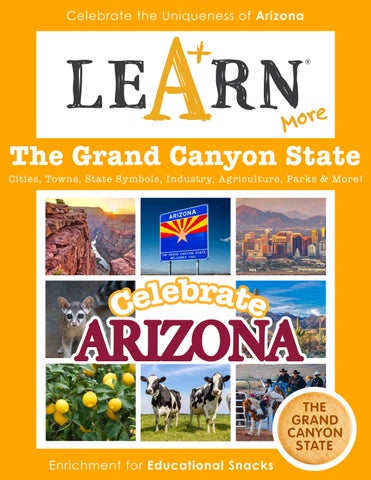
Celebrate the Uniqueness of Arizona
The Grand Canyon State Cities, Towns, State Symbols, Industry, Agriculture, Parks & More!
Enrichment for Educational Snacks
B ig Cities: P h oen ix T ucson M esa Gilber t C h an d ler Glen d ale S cottsd ale S u rp rise
Sm all Tow ns: S ed on a W illiam s Tom bston e
State Sym bols: Palo Verd e C actu s Wren S agu aro C actu s Blossom Rin gtail Rid ge-Nosed R attlesnake A p ach e T rou t C op p er
Industr y: T ravel & Tou rism Aerosp ace F ilm
A g riculture: Dair y L ettu ce
L em on s O ranges Grap efr u it C h ili Pep p ers
Landm ark s: L on d on Brid ge H oover Dam H orseshoe Bend A n telop e C any on Bar ringer Crater Fou r C or n ers M on u m en t L ake Powell S on oran Deser t
Park s: Gran d C any on Nation al Park S agu aro Nation al Park Petrif ied Forest National Park C ocon in o Nation al Forest
Food & Culture: T h e 5 C ’s 2 2 T ribal Nation s C ow boy s & C owgirls Gila M on ster C oy otes H iking S p rin g T rain in g S on oran H ot Dog Deer Valley
Big Cities
CAPITAL CITY
Phoenix Phoenix is the LARGEST city in Arizona with a population of over 1.6 million people.
Phoenix is surrounded by mountains, including the famous Camelback Mountain.
Phoenix became an official city of Arizona in 1881 & then became the capital city in 1889.
Phoenix is the largest
capital city by population in the U.S.
Phoenix gets over 300 sunny days per year!
Phoenix is one of the
hottest Phoenix is located major cities in the in the U.S. Sonoran Desert.
Phoenix #1 Elementary School District has around 5,000 students.
BIG CITY
Tucson Tucson is the 2nd largest city in Arizona with a population of over 545,000 people.
Tucson is one of the
oldest continually inhabited places in the U.S. Tucson is a popular destination for outdoor adventures.
Tucson is known for being located in the heart of the Sonoran Desert. Tucson is one of the world's leading cities for astronomy & space research.
Tucson is famous for its Sonoran hot dogs.
Tucson is surrounded by five mountain ranges. Many movies & TV shows have been filmed in & around Tucson. Tucson Unified School District has over 35,000 students.
BIG CITY
Mesa Mesa is the 3rd largest city in Arizona with a population of over 510,000 people. Mesa is named after the flattopped mesa that the city sits on. “Mesa” is the Spanish word for “table.”
Mesa’s
citrus industry played a major role in the city’s early growth.
Mesa is one of the
largest suburban cities in the U.S.
Mesa is located within the
Mesa is home to hundreds of parks & natural areas.
Sonoran Desert. Mesa Public Schools has over 56,000 students.
BIG CITY
Gilbert Gilbert is the 4th largest city in Arizona with a population of over 280,000 people.
The Gilbert Water Tower is a famous local landmark.
Gilbert has a rich farming history & was known as the “Hay Shipping Capital of the World.”
Gilbert, Arizona was named after
Gilbert started out as a small farming community in 1902.
William Gilbert who donated land to build a railroad. Gilbert had no traffic signals until the 1980s. Gilbert Public Schools has around 31,000 students.
Gilbert is home to over 1,000 acres of parks.
BIG CITY
Chandler Chandler is the 5th largest city in Arizona with a population of over 280,000 people. Chandler is one of Arizona’s leading cities for technology & innovation.
Chandler is known for making tiny computer chips used in phones, computers & cars.
Chandler has a unique
ostrich farming history.
Chandler was founded by veterinarian, Chandler started out as Alexander John Chandler. a farming community. Chandler became an official city in 1920. Chandler Unified School District has over 40,000 students.
BIG CITY
Glendale Glendale is the 6th largest city in Arizona with a population of over 250,000 people.
Palm trees are very common throughout Glendale.
Glendale is home to Arizona's National Football League team, the Arizona Cardinals. Glendale has hosted multiple Super Bowls.
Glendale’s Historic Downtown is known as “Arizona's
Glendale was officially incorporated in 1910. Glendale began as a small farming community.
Antique Capital.”
Cotton & sugar beets were Glendale's first major crops. Glendale Elementary School District has over 8,000 students.
BIG CITY
Scottsdale Scottsdale is the 7th largest city in Arizona with a population of over 240,000 people. Scottsdale is one of Arizona’s most popular vacation destinations. Old Town Scottsdale is Scottsdale’s famous historic downtown known for its Westernstyle shops, restaurants & art galleries
Scottsdale is known for their annual
Parada del Sol Parade celebrating the city’s Western heritage. Scottsdale is home to 200+ golf courses.
Scottsdale is nicknamed “The West's
Most Western Town.”
Scottsdale Unified School District has over 19,000 students.
BIG CITY
Surprise Surprise is the 10th largest city in Arizona with a population of over 154,000 people. Surprise was founded by Flora Mae Statler, one of the only Arizona cities founded by a woman. Surprise began as just Surprise is known for hosting
Major League Baseball Spring Training each year.
one square mile of farmland.
Surprise is home to
over 40 community Baseball is one of Surprise’s parks. most popular attractions. Surprise became an official city of in 1960. Dysart Unified School District has over 23,000 students.
Small Towns
SMALL TOWN
Sedona
Sedona is a small town in Arizona with a population of around 10,000 people.
Sedona is one of the most visited small towns in Arizona.
Sedona is famous for its red rocks made of red and pink sandstone. Sedona is a designated
Dark Sky Community, where limited light pollution makes it easy to see the stars.
Sedona is home to
hundreds of miles of hiking and biking trails.
Sedona is surrounded by the
Coconino National Forest. Sedona-Oak Creek Unified has around 700 students.
SMALL TOWN
Williams Williams is a small town in Arizona with a population of around 3,300 people. Williams is known as the
“Gateway to the Grand Canyon.”
Williams is located along the historic Route 66. Williams has a rich history in the
lumber industry.
Williams is the starting point for the
Grand Canyon Railway.
Williams is one of few Arizona towns that regularly gets snow in the winter. Williams Unified School District has around 650 students.
SMALL TOWN
Tombstone Tombstone is a small town in Arizona with a population of around 1,500 people.
Tombstone is one of America’s
Tombstone was founded in 1879 after rich silver deposits were discovered nearby.
most famous Wild West towns.
Tombstone was named a National
Historic Landmark in 1962.
Much of Tombstone still looks like it did in the 1880s.
The
“The Town Too Tough To Die” Tombstone Unified has around 800 students.
Tombstone Epitaph, is Arizona's oldest continuously published newspaper.
State Symbols
STATE TREE
Palo Verde The palo verde is the official state tree of Arizona. The palo verde became the official state tree of Arizona in 1954. Palo verde trees are sometimes called “nurse trees” because they help protect young desert plants. Palo verde trees are very common in the Sonoran Desert. Palo verde trees got their name from the Spanish words meaning “green stick” because their trunks and branches are all green.
A palo verde tree can grow to be 20-35 feet tall. Palo verde trees bloom in the spring with bright yellow flowers.
STATE BIRD
Cactus Wren The cactus wren is the official state bird of Arizona. The cactus wren became the official state bird of Arizona in 1931. Cactus Wrens eat mostly small insects, berries & seeds.
Saguaro & cholla cacti are cactus wrens’ preferred types of cacti for nesting.
Cactus wrens are not strong longdistance fliers & usually stay in the same general area year-round.
A cactus wren’s wingspan is around 11 inches wide. The call of cactus wrens is known for being loud & raspy.
Cactus wrens live mostly in hot desert areas of southwestern U.S. & Mexico.
STATE FLOWER
Saguaro Cactus Blossom The Saguaro cactus blossom is the official state flower of Arizona.
The blossoms grow on the Saguaro cactus, one of the largest cacti in the U.S.
Saguaro cactus blossoms grow near the tops of the cactus’s arms & trunk.
The Saguaro cactus blossom became the official state flower of Arizona in 1931.
Bats are one of the
main pollinators of Saguaro cactus blossoms.
One Saguaro cactus can produce dozens of After a blossom is blossoms pollinated, it develops in one into a Saguaro fruit. season. Saguaro cactus blossoms usually The blossoms only bloom bloom in the late spring. for about 24 hours.
STATE MAMMAL
Ringtail
The ringtail is the official state mammal of Arizona. The ringtail became the official state mammal of Arizona in 1986. Ringtails live in rocky deserts, canyons, forests & mountains. Ringtails are about the size of a small house cat. A ringtail’s diet includes insects, mice, birds, berries & nuts.
“MINER’S CAT” Ringtails are nocturnal, meaning they are most active at night. A ringtail’s tail has 5-7 black & white rings, which give it its name.
Ringtails can be found in many
western states & parts of Mexico. Ringtails are excellent climbers!
STATE REPTILE
Ridge-Nosed Rattlesnake The Arizona ridge-nosed rattlesnake is the official state reptile of Arizona. The Arizona ridge-nosed rattlesnake became the official state reptile of Arizona in 1988. Arizona Arizona ridge-nosed rattlesnakes are one of ridge-nosed the smallest rattlesnake species in the U.S. rattlesnakes Most Arizona ridge-nosed live high in the rattlesnakes only grow to be cool mountain about 18-24 inches long. forests of southeastern Arizona Arizona, ridge-nosed Arizona ridge-nosed especially in rattlesnakes rattlesnakes often hide the Huachuca under rocks, logs, or leaf mostly eat & Santa Rita small piles for protection. Mountains. animals like mice, lizards The ridge& frogs. nosed rattlesnake got its name from the raised “ridge” of scales on the tip of its nose.
STATE FISH
Apache Trout The Apache trout is the official state fish of Arizona.
Apache trout are native to Arizona & are not naturally found anywhere else in the world!
The Apache trout became the official state fish of Arizona in 1986. Apache trout mostly live in the cool streams and lakes of Arizona’s White Mountains. Most Apache trout grow to be about 10-24 inches long. Apache trout are known for their golden- yellow bodies & dark spots. Apache trout are fast, agile swimmers that can swim upstream against strong currents.
STATE FISH
Healthy Apache trout populations are a sign of clean water. Apache trout eat mostly small insects, crustaceans & fish.
The Apache trout was named after the
Apache people of Arizona.
STATE METAL
Copper
Copper is the official state metal of Arizona.
Copper is a soft,
reddishorange metal used in many everyday things, from jewelry to electrical wires.
Copper became the official state metal of Arizona in 2015. Copper mining has been an important part of Arizona’s economy for 100+ years. Arizona is home to many historic copper mining towns.
“The Copper State”
Morenci Mine in eastern Arizona is one of the largest copper mines in North America.
Copper is one of Arizona’s famous five C’s.
Arizona is the #1
copper producing state in the U.S.
Industry
Travel & Tourism Travel & tourism is one of the largest industries in Arizona. Millions of people visit Arizona each year for its deserts, national parks & vibrant cities. The Grand Canyon is Arizona’s most famous tourist attraction. Phoenix, Arizona’s capital city is the most visited city in Arizona. Arizona is a very popular
snowbird destination.
Snowbirds are people who travel to warmer places during the winter months. Arizona’s national parks attract many
outdoor adventurers.
Aerospace INDUSTRY
Arizona is a leading state in aviation, satellites and space technology. Arizona's aerospace industry designs, builds, tests and repairs aircraft and spacecraft. Over 1,200 Arizona is home to many aerospace airports & military bases. companies operate out of Arizona. Many commercial airplanes are built with parts made in Arizona.
Satellites help people use GPS, predict weather & communicate. Arizona is famous for its large aircraft storage facilities, where retired & inactive airplanes are preserved in the desert.
Thousands of people in Arizona work in aerospace careers, including engineers, mechanics, pilots & scientists.
Film
INDUSTRY Arizona’s film industry to most known for their Western movie productions. Thousands of movies, TV shows, commercials & music videos have been filmed in Arizona.
Old Tucson, near Tucson, Arizona, is a famous Western movie set built in 1939.
Arizona’s climate makes it easier to film outdoors year-round. The diverse landscapes are a big part of what makes Arizona a popular filming destination.
LIGHTS
CAMERA
ACTION
Arizona’s film industry employs thousands of people.
Arizona’s
Monument Valley is one of the world’s most recognizable movie locations.
Agriculture
ARIZONA
Dairy Arizona produces over FOUR BILLION of pounds of milk per year. Most of Arizona’s dairy industry is located in central & southern Arizona. Arizona is home to around 100 dairy farms & 200,000 dairy cows.
Holstein cows are the ones with the unique black & white spots! Most Arizona dairy farms are family-owned. Arizona dairy farmers work hard to keep cows cool & comfortable in Arizona’s hot climate with fans, shade & misters.
Alfalfa is one of Arizona’s most important dairy feed crops. Arizona dairy cows produce around 6 - 8 gallons of milk per day.
Holstein cows are the most popular breed of dairy cow in Arizona.
ARIZONA
Lettuce Around 30% of all lettuce grown in the U.S. comes from Arizona.
Arizona is famous for growing lettuce during the winter.
Arizona's Yuma area is often called the "Winter
Lettuce Capital of the World."
Most Arizona lettuce is grown in the southwestern part of the state near Yuma.
Crisphead lettuce, also called iceberg lettuce, is the most widely grown type of lettuce in Arizona. Lettuce is grown on around 70,000 acres of land in Arizona.
Billions of pounds of lettuce is harvested in Arizona each year.
CRISPHEAD
ARIZONA
Lemons Arizona is one of the top lemon growing states in the U.S. Yuma & Maricopa County are the top lemon producing counties in Arizona. Eureka & Lisbon lemons Tens of thousands of tons of lemons are grown each year in Arizona.
are the most common types of lemons grown in Arizona. Arizona lemons are an important part of the state’s citrus industry - one of Arizona’s five C’s. Arizona’s abundant sunshine helps lemons grow extra bright & flavorful. Arizona’s warm desert climate allows lemon trees to produce fruit year-round.
ARIZONA
Oranges Oranges are a significant part of Arizona’s citrus industry. Most of Arizona's orange groves are located in the central & southwestern parts of the state. Arizona’s Navel & climate & soil Valencia are perfect are the two for growing main types oranges. of oranges grown in Arizona.
Millions of pounds of oranges are grown in Arizona each year.
Orange trees are evergreen.
Many Arizona oranges are grown in the desert, where farmers use irrigation systems to provide water for the trees.
ARIZONA
Grapefruit Arizona is one of the top grapefruit producing states in the U.S. Most of Arizona’s grapefruits are grown in the central & southwestern desert valleys. Arizona’s
abundant sunshine helps its grapefruits grow extra sweet.
Arizona grows several varieties of red grapefruit, including Rio Red, Ruby Red, Flame & Star Ruby. Most grapefruit is harvested by hand.
Millions of pounds of grapefruit are grown in Arizona each year.
Arizona grapefruits are typically harvested from late fall - early spring.
ARIZONA
Chili Peppers Chili pepper are an important and common part of Arizona’s food culture. Arizona's warm and sunny climate is ideal for growing chili peppers. Most of Arizona’s chili peppers are grown in the central & southern part of the state. The heat of chili peppers are measured on a
Scoville scale.
Chili peppers are a type of fruit!
Chilis peppers are eaten fresh, dried, roasted, pickled or powdered.
Capsaicin is the compound in chili peppers that make them spicy. Many kinds of chili peppers are grown in Arizona, including jalapeños, Anaheim peppers, serranos, poblanos, green chiles & more!
Landmarks
London Bridge Arizona’s London Bridge is the original bridge that once crossed the River Thames. The London Bridge was purchased in 1968 by Robert P. McCulloch & moved to Lake Havasu City. The London Arizona’s Bridge was London purchased Bridge to attract crosses the more visitors man-made to Lake Bridgewater Havasu City. Channel. The London Bridge a very popular tourist destination.
“The World’s Largest Antique”
The London Bridge was taken apart stone by stone before being shipped to Arizona.
Arizona's London Bridge took 3 years to rebuild & officially opened in 1971.
Hoover Dam The Hoover Dam is a giant hydroelectric dam located between Arizona & Nevada. The Hoover Dam creates Lake Mead, the largest reservoir in the U.S. by water capacity. More than 5 million people visit Hoover Dam each year.
The Hoover Dam was built to control floods, store water & generate electricity.
The Hoover Dam generates
clean hydroelectric power from water flowing through its turbines.
The Hoover Dam was built across the Colorado River. The Hoover Dam was built during the Great Depression between 1931 & 1936. The Hoover Dam is a designated National Historic Landmark.
Horseshoe Bend Horseshoe Bend is one of Arizona’s most famous natural landmarks.
Horseshoe Bend is located within Glen Canyon.
Millions of people visit Horseshoe Bend each year.
Horseshoe Bend is a horseshoeshaped curve in the Colorado River.
Horseshoe Bend's canyon walls rise about 1,000 feet above the river. Horseshoe Bend’s canyon walls are made of
Horseshoe Bend makes sandstone. a curve of ~ 270 degrees. The Colorado River carved out Horseshoe Bend over millions of years. Horseshoe Bend’s cliffs are known for their beautiful colors at sunrise & sunset.
Antelope Canyon Antelope Canyon is a famous slot canyon, which is a narrow canyon with tall rock walls.
Antelope Canyon is located on land belonging to the
Antelope Canyon’s smooth, wavy walls were carved by flash floods over thousands of years. Antelope Canyon’s walls glow in shades of orange, red, gold & purple as sunlight changes.
Navajo Nation.
Visitors can only explore the canyon with a Navajo guide.
Over a MILLION people visit Antelope Canyon every year. Antelope Canyon’s walls are made of sandstone.
Antelope Canyon is named after the pronghorn antelope that once roamed the area.
Barringer Crater Barringer Crater is one of the bestpreserved meteor impact craters on Earth. Barringer Crater was created when a huge meteorite struck Earth about 50,000 years ago.
The meteorite slammed into the Earth at ~ 26,000
miles per hour.
The meteorite that formed Barringer Crater was mostly made of iron and nickel.
Barringer Crater around 4,000 feet wide & 550 feet deep.
NASA astronauts trained at Barringer Crater before traveling to the Moon. Arizona’s dry climate is a main reason Barringer Crater is so well preserved. Barringer Crater was named after mining engineer Daniel Moreau Barringer.
Four Corners MONUMENT
Four Corners Monument is the only place in the U.S. where four states meet at one point. Utah, Colorado, Arizona & New Mexico are the four states a part of the Four Corners Monument.
UT
Four Corners Monument is located on land belonging to the Navajo Nation.
CO
AZ NM At Four Corners Monument, visitors can stand in all four states at the same time! The Monument’s marker is made of granite & copper. The monument sits on the high desert of the Colorado Plateau.
Many local Navajo artists sell handmade jewelry, pottery and artwork at Four Corners Monument.
Lake Powell Lake Powell is one of the largest human-made lakes in the U.S. Lake Powell was made when the Glen Canyon Lake Powell Dam was built across the Colorado River. was created to store water from the Colorado Lake Powell River water is one of to use during Arizona's dry years most popular and droughts boating in the destinations. Southwest. Lake Powell has nearly
2,000 miles Lake Powell is famous of shoreline. for its bright blue water & red sandstone cliffs. It took about 17 years for Lake Powell to fill with water. Lake Powell helps generate hydroelectric power through the Glen Canyon Dam.
Sonoran Desert The Sonoran Desert is one of the most biologically diverse places in the world.
Most of Arizona’s
Being biologically diverse means a place is home to MANY different kinds of plants & animals. The Sonoran Desert is the ONLY place in the world where
largest cities are located within the Sonoran Desert.
saguaro cacti grow naturally.
100+ kind of reptiles live in the Sonoran Desert.
The Sonoran Desert covers around
100,000 square 2,000+ kinds of miles across plants grow in the Arizona, Sonoran Desert. California, Nevada & Mexico.
“Green Desert”
Parks
Grand Canyon NATIONAL PARK
The Grand Canyon is one of the seven natural wonders of the world. The Grand Canyon is a 277-mile-long canyon carved by the Colorado River.
The canyon is protected as Grand Canyon National Park.
Millions of people visit the Grand Canyon every year!
Scientists believe the Grand Canyon began forming 5-6 million years ago. In some places, the Grand Canyon is over 1 mile deep!
At its widest point, the Grand Canyon stretches about 18 miles across. The Grand Canyon is known for its colorful rock layers shaped by millions of years of erosion.
Saguaro
NATIONAL PARK Saguaro National Park protects native saguaro cacti in the Sonoran Desert. Saguaro National Park covers around 92,000 acres of the Sonoran Desert. Saguaro National Park became a national monument in 1933 & later became a national park in 1994.
Saguaro National Parkis home to
2+ million saguaro cacti.
Mature saguaro cacti can store Saguaro cacti can live for 150 200 years!
hundreds of gallons of water in their stems.
The saguaro cactus blossom is Arizona's official state flower.
Petrified Forest NATIONAL PARK
Petrified Forest is home to one of the world's largest collections of petrified wood. Petrified wood is wood that slowly Most of turned into stone over millions of years. the park’s petrified logs came from trees that Minerals lived about such as 225 million iron and years ago. manganese give petrified wood their bright colors. Many pieces of petrified wood sparkle with minerals like quartz. Petrified Forest was established as a national park in 1962. Petrified Forest National Park is located along Route 66.
Coconino
NATIONAL FOREST Coconino National Forest is one of the most diverse national forests in the U.S. Coconino National Forest covers around Coconino 1.9 million acres of land in northern Arizona. National Forest is home to deserts, mountains, canyons, lakes Coconino & ponderosa National pine forests. Forest
established in 1908 by President Theodore Roosevelt.
Coconino National Forest has 500+ miles of hiking trails.
Coconino National Forest is home to Arizona’s highest mountain,
Humphrey’s Peak.
Culture
The 5 C’s Arizona is famous for its Five C’s: Copper, Cattle, Cotton, Citrus & Climate.
Arizona is known for its
sunny climate, with many areas enjoying over 300 days of sunshine each year!
Arizona’s Five C's have played an important role in the state's history and growth. Today, copper is the largest of Arizona's Five C industries. Arizona’s climate helps their cotton plants & citrus grow. For many Most of the ranches in years, the Arizona raise beef cattle. Five C's were the
The 5 C’s
largest parts of Arizona's economy.
Tribal Nations Arizona is home to 22 federally recognized Tribal Nations. Tribal Nations are groups of Indigenous people with their own governments, cultures & lands.
Each Tribal Tribal lands Arizona’s 22 Tribal Nations: Nation make up about 1. Ak-Chin Indian Community has its own 1/4 of Arizona’s 2. Cocopah Indian Tribe unique land area. 3. Colorado River Indian Tribes* culture, 4. Fort McDowell Yavapai Nation traditions 5. Fort Mojave Indian Tribe* & history. 6. Fort Yuma Quechan Tribe
7. Gila River Indian Community Many Tribal Nations have 8. Havasupai Tribe their own languages. 9. Hopi Tribe 10. Hualapai Tribe 11. Kaibab Band of Paiute Indians 12. Navajo Nation* 13. Pascua Yaqui Tribe 14. Pueblo of Zuni 15. Salt River Pima-Maricopa Indian Community 16. San Carlos Apache Tribe 17. San Juan Southern Paiute Tribe 18. Tohono O'odham Nation 19. Tonto Apache Tribe 20. White Mountain Apache Tribe 21. Yavapai-Apache Tribe The Navajo Nation is the largest Tribal Nation in the U.S. 22. Yavapai-Prescott Indian Tribe
Cowboys & Cowgirls Cowboys & cowgirls played a major role in shaping Arizona's history & culture.
Arizona cowboys & cowgirls learned a lot of their skills & traditions from
Mexican vaqueros.
Many cowboys & cowgirls in Arizona work on ranches, helping herd & care for cattle.
Prescott is known as Arizona's "Cowboy Capital." Prescott, Arizona is home to the World's Oldest Rodeo Arizona is which started in 1888! home to Rodeos celebrate the skills of millions of working cowboys & cowgirls. acres of working ranchland.
Barrel racing is one of the most popular rodeo events for cowgirls.
Gila Monster Gila monsters are one of the most famous reptiles found in Arizona.
Gila monsters are the largest native lizards in the U.S.
In Arizona, Gila monsters are most commonly found in the Sonoran Desert. Gila monsters are one of only a few venomous lizards in the world.
Gila monsters grow to be around 18 to 22 inches long. Gila monsters have forked tongues that help them detect prey. Gila monsters spend most of their lives in underground burrows.
The colorful pattern on Gila monsters, warn predators to stay away.
Gila monsters were named after Arizona’s
Gila River.
Coyotes Coyotes can be found in every major habitat across Arizona.
Coyotes are known for their high-pitched howls, yips & barks.
Coyotes play an important role in Arizona's ecosystems as predators and scavengers. Coyotes are one of the most frequently spotted wild animals in Arizona.
A coyote’s large ears help them stay cool in Arizona's warm climate by releasing excess body heat. Coyotes are most active during dawn & dusk. Coyotes’ diets include plants & animals such as rabbits, rodents, insects, fruits and berries.
A group of coyotes is called a pack. Coyotes can run up to around 40 miles per hour.
Hiking Arizona is home to over 8,000 miles of hiking trails.
Arizona is home to
Arizona's hiking trails range from short desert walks to challenging mountain adventures. Some of Arizona's most famous hiking trails: Bright Angel Trail, South Kaibab Trail, Cathedral Rock Trail, Echo Canyon Trail, Devil's Bridge Trail.
over 30 state parks with hiking trails.
Hiking is a great way to see wildlife in their natural habitat.
The Arizona Trail (AZT) is Arizona's longest hiking trail, stretching 800+ miles.
Spring Training Arizona hosts Spring Training every year for Major League Baseball teams. Spring Training is the time during the offseason when Major League teams practice. Florida hosts Spring Training as part of the Cactus League. Arizona & Florida are the ONLY states that host MLB Spring Training.
During Spring Training, teams play in much smaller stadiums so fans can watch up close!
Arizona has been hosting MLB Spring Training for over 75 years!
There are currently 15 MLB teams that hold their Spring Training in Arizona: 1. Athletics 2. Chicago Cubs 3. Chicago White Sox 4. Cincinnati Reds 5. Cleveland Guardians 6. Colorado Rockies 7. Kansas City Royals 8. Los Angeles Angels 9. Los Angeles Dodgers 10. Milwaukee Brewers 11. San Diego Padres 12. San Francisco Giants 13. Seattle Mariners 14. Texas Rangers 15. AZ Diamondbacks
Sonoran Hot Dog The Sonoran hot dog is one of Arizona’s most famous foods. Throughout Arizona, Tucson is the city most known for Sonoran hot dogs. Sonoran hot dogs originated in A typical Sonoran hot Sonora, Mexico in the 1980s. dog is made The bolillo rolls with a hot used as the bun dog wrapped for Sonoran hot in bacon, a dogs are a popular Sonoran bolillo roll, Mexican bread hot dogs topped with that is crispy on are a pinto beans, the outside & soft popular diced on the inside. street food tomatoes, across chopped Arizona. onions, salsa, mayonnaise & yellow mustard.
YUM!
Sonoran hot dogs are deliciously messy to eat…grab some napkins!
Deer Valley Deer Valley is one of Phoenix’s fifteen designated urban villages. Urban villages are areas of a larger city made up of neighborhoods, parks, schools & businesses. Deer Valley started out as a Phoenix rural farming Deer Valley community. Airport is one of the busiest
general aviation airports in the U.S.
Deer Valley is home to the Deer
Valley Petroglyph Preserve. Deer Valley Unified School District has over 32,000 students. Deer Valley is located about 20 miles north of downtown Phoenix.
Word Search
Celebrate
Chandler
Williams
Ringtail
Phoenix
Glendale
Tombstone
Ridge-Nosed Rattlesnake
Tucson
Scottsdale
Palo Verde
Apache Trout
Mesa
Surprise
Cactus Wren
Copper
Gilbert
Sedona
Saguaro Cactus Blossom
Arizona
Helping kids eat right, do well in school & be proud of where they are from.