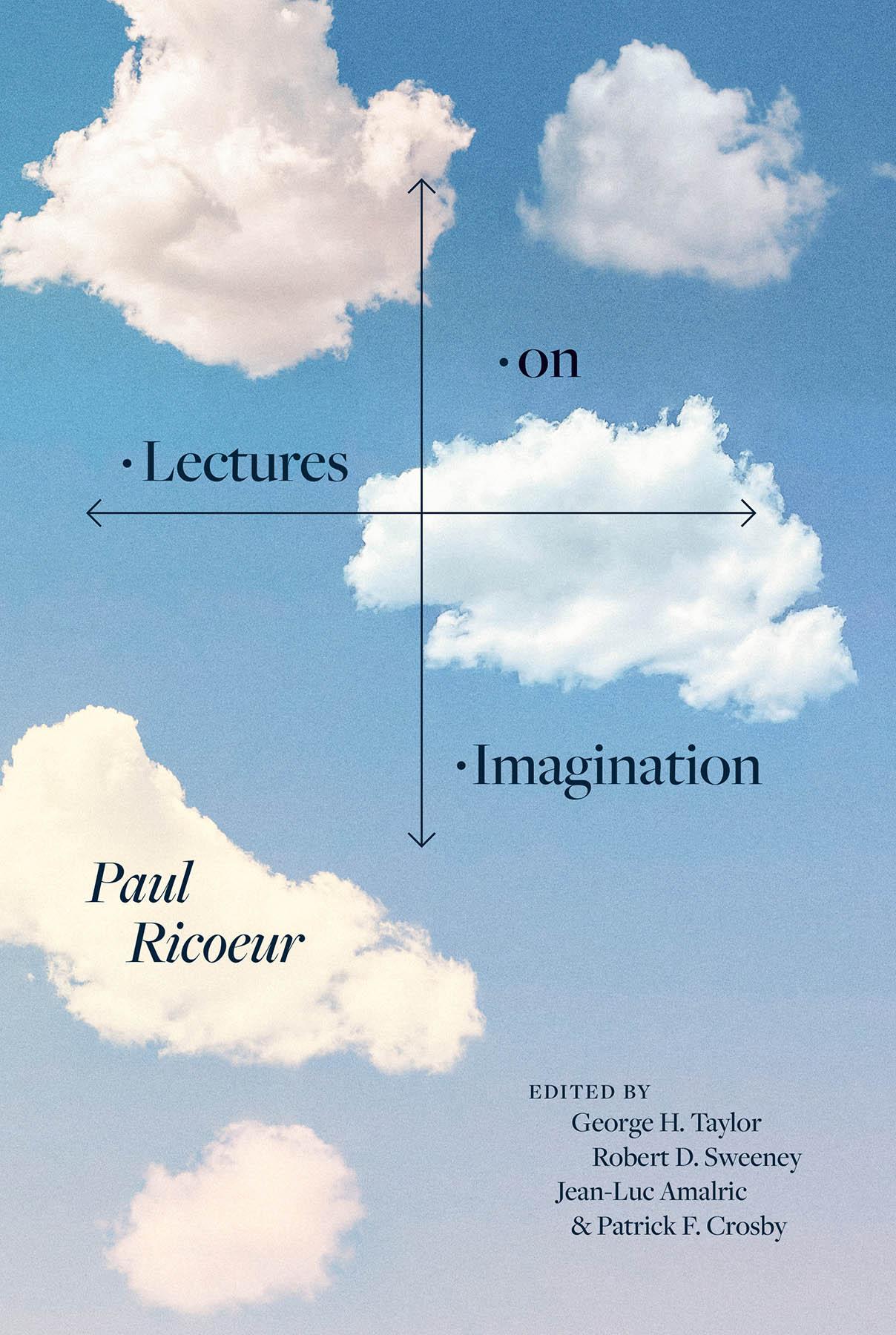
Lectures on Imagination
Paul Ricoeur
Edited by George H. Taylor, Robert D. Sweeney, Jean-Luc Amalric, and Patrick F. Crosby
The University of Chicago Press Chicago and London
The University of Chicago Press, Chicago 60637
The University of Chicago Press, Ltd., London
© 2024 by The University of Chicago
All rights reserved. No part of this book may be used or reproduced in any manner whatsoever without written permission, except in the case of brief quotations in critical articles and reviews. For more information, contact the University of Chicago Press, 1427 E. 60th St., Chicago, IL 60637.
Published 2024
Printed in the United States of America
ISBN-13: 978-0-226-82053-8 (cloth)
ISBN-13: 978-0-226-82054-5 (e-book)
DOI: https://doi.org/10.7208/chicago/9780226820545.001.0001
Library of Congress Cataloging-in-Publication Data
Names: Ricœur, Paul, author. | Taylor, George H. (George Howard), 1951–editor. | Sweeney, Robert D., editor. | Amalric, Jean-Luc, editor. | Crosby, Patrick F., editor.
Title: Lectures on imagination / Paul Ricoeur ; edited by George H. Taylor, Robert D. Sweeney, Jean-Luc Amalric, and Patrick F. Crosby.
Description: Chicago ; London : The University of Chicago Press, 2024. |
Includes bibliographical references and index.
Identifiers: LCCN 2022007566 | ISBN 9780226820538 (cloth) | ISBN 9780226820545 (ebook)
Subjects: LCSH: Imagination (Philosophy) | Fiction. | LCGFT: Lectures.
Classification: LCC BH301.I53 R53 2023 | DDC 128/.3 dc23/eng/20220304
LC record available at https://lccn.loc.gov/2022007566
This paper meets the requirements of ANSI/NISO Z39.48-1992 (Permanence of Paper).
Husserl: Ideas
Sartre (1)
Sartre (2) 14 Sartre (3)
Part Three: Imagination as Fiction
15 Fiction (1): Introduction
16 Fiction (2): Metaphor
17 Fiction (3): Painting
18 Fiction (4): Models
19 Fiction (5): Poetic Language
Notes
Bibliography Index
Editor’s Acknowledgments
George H. Taylor
In editing these course lectures for publication, the editors’ model has been Paul Ricoeur’s LecturesonIdeologyandUtopia, which Ricoeur had the opportunity to review. The goal has been to create a volume that Ricoeur would have approved for publication. The lecture nature of the text also preserves the distinction from Ricoeur’s other works that were written for publication.
Publication of these lectures owes considerably to the original foresight of coeditor Patrick Crosby in realizing the value of recording them, transcribing them in careful, verbatim form, and then preserving the recordings and the transcription. Patrick engaged in the initial editing of the lectures as well. Coeditor Bob Sweeney and I each listened separately to the entire set of recordings and reviewed the transcriptions. Bob and I then engaged together in a close editing of the volume. Coeditor Jean-Luc Amalric, who is based in France, has evaluated the manuscript at several junctures, including in a close reading of its final version. Jean-Luc was also very helpful in locating a number of French bibliographic references. He deserves additional thanks for being the primary translator of the volume into its French edition and for shepherding the translation.
The editors thank Ricoeur’s literary executors, the Editorial Committee at the Fonds Ricoeur in Paris, led by Jean-Paul Ricoeur, for permission to publish this volume. To assist the creation of a more definitive edition of these lectures, the Editorial Committee asked for incorporation of Ricoeur’s lecture notes on imagination, both to help check the accuracy of the transcription and to add anything substantive to the lectures as presented. Some of these notes appear to refer directly to the 1975 course, while others were
taken from various iterations of the course as presented either in the United States or France between 1973 to 1975. We thank the Fonds Ricoeur, Catherine Goldenstein, and Olivier Villemot for having carefully located, classified, and prepared these materials.
The editors also offer our thanks to the Ricoeur family and to Olivier Abel. Nathalie Ricœur-Nicolaï and the entire Ricoeur family have taken over editorial responsibility for publication of works by Paul Ricoeur, and they generously agreed to endorse the present edition. Olivier Abel has been a continuous supporter of this volume and its publication.
The Fonds Ricoeur Editorial Committee invited Jean-Luc and Patricia Lavelle to engage in the initial review of the lecture notes and recommend potential places of insertion in the text. This work required considerable time and effort on their part. I engaged in detailed review of the notes and their suggestions; then working together with Jean-Luc (Patricia having gone on to other projects), we reached agreement on the inclusion of individual notes. In almost all cases, these insertions appear without identification in the text, similar to how notes were incorporated in the Lectureson IdeologyandUtopia.
Also similar to the prior volume, we have deleted student questions asked of Ricoeur during discussion periods and have integrated Ricoeur’s responses into the text. We have also largely deleted Ricoeur’s comments on course administration, such as on the course syllabus, and instead present the course syllabus as part of the bibliography at the end of the text. At a few relevant points we have added Ricoeur’s comments on the syllabus to the endnotes when they offer a substantive contribution.
We have checked all citations. To assist readers, at a number of places we have added page references in the text to primary material when Ricoeur’s reference is sufficiently direct but not explicitly offered by him. We have made no attempt, however, to correlate Ricoeur’s many allusions to his book, TheRuleof Metaphor, in lecture 16. Where Ricoeur offers a general reference to secondary material, we have included the reference in the
bibliography but have not added an endnote. Where Ricoeur offers a more specific reference to a secondary text but does not provide pagination, we have added an endnote citation. Interjections in quotations, which are noted by brackets, are by Ricoeur.
All endnotes are additions by the editors, and we have intentionally kept them to a minimum. The titles of the volume’s parts and chapters are also the editors’ creations.
The bibliography is extended and includes Ricoeur’s course syllabus; a chronology of Ricoeur’s writings on imagination; other works by Ricoeur cited in this text; and secondary works cited.
For their considerable assistance, we thank Vicki DiDomenico, LuAnn Driscoll, Phyllis Gentile, Karen Knochel, Darleen Mocello, and Barb Salopek, all members at various times of the Document Technology Center at the University of Pittsburgh School of Law, my home institution. We also thank Avinash Ram for assistance with the index and Fernando Nascimento and Trent Taylor for very helpful technical assistance.
My own thanks also extend to Jean-Luc, Fernando, Suzi Adams, John Arthos, Eileen Brennan, Morny Joy, Tom McCormick, and Roger Savage for reading and valuably commenting on the Editor’s Introduction, for which I am solely responsible. During the editing process, my ongoing efforts to think through the intellectual contributions of this volume have led to several publications, which I reference in the Editor’s Introduction at appropriate junctures.
It is a source of regret that, due to the length of the editing and publication process, coeditors Bob Sweeney and Patrick Crosby are no longer alive to witness the book’s publication. Their absence does give me the opportunity to thank them for their individual contributions to the volume. I also take this opportunity to correct a prior error on my part when, as a result of a faulty reading and memory of Patrick’s handwritten notation of his name on the recordings of the LecturesonIdeologyandUtopia, I misidentified Patrick’s name in the Editor’s Acknowledgments to that volume. Patrick was the source of the recordings in both courses, and
readers owe a great debt to him for his prescience in anticipating the value of these lectures.
Prior to his passing, Patrick asked that his contribution be offered in memoriam to a friend who died too young, Christopher Loren Albers. For my part, my contribution is offered in memoriam to both Patrick and Bob.
Editor’s Introduction
George H. Taylor
The literature on the human imagination is now vast and continues to increase. The topic has received considerable attention not only in philosophy—the principal focus of this volume—but also in fields such as the arts, cognitive theory, law, literary theory, the natural sciences, psychology, religion, rhetoric, social and political theory, and technology. The present text, Paul Ricoeur’s lectures on imagination, dates to lectures Ricoeur gave in 1975 at the University of Chicago. The lectures remain on the cutting edge of current concerns in their development of a theory of productive—and ultimately of creative—imagination.1 Indeed, their ambition is to show the availability of a productive and creative—rather than simply reproductive—imagination and to argue for its commonality in human thought across the disciplines and so across such fields as poetry and the natural sciences. One of the great powers of Ricoeur’s argument, common to his corpus, is his knowledge of diverse fields and his ability to capture and extend their deeper insights into a theory that is creative and innovative in its own right. The lectures should be of interest, then, not only to those more philosophically inclined but also to those oriented to other fields and seeking the insights of a theory of productive imagination applicable to their own arenas. One goal of this Introduction is to render the structure and value of the lectures in ways more amenable to those without significant philosophical training.
During the autumn of 1975, when Ricoeur delivered the present lectures on imagination as a course at the University of Chicago, he also delivered as a separate course a set of lectures on ideology and utopia, later published as the LecturesonIdeologyandUtopia,
where the imagination is a significant subtext. The year of 1975 marked as well the publication of Ricoeur’s Lamétaphorevive, later translated as TheRuleofMetaphor. As the chronology of Ricoeur’s works on imagination in the present volume’s bibliography attests, Ricoeur was quite immersed in the topic of creativity and the imagination throughout a good part of the 1970s in particular. On the basis of his published works, a number of scholars have written on the significance of the theme of imagination for Ricoeur.2 Some have gone further, arguing for the centrality of this theme in his corpus.3 Several of these writers have likewise lamented that Ricoeur did not offer a more systematic presentation of his general argument on the imagination, particularly the productive imagination. Ricoeur’s lectures on imagination redress that need and provide this systematic architecture.
The lectures presented here offer his general theory of imagination with the goal of developing a distinct theory of the productive imagination. Ricoeur claims that the productive imagination is divided into four subgroups: the social and political imagination, the poetic imagination, the epistemological imagination, and the religious imagination (243). In addition to providing his general theory, the current volume elaborates both the poetic imagination and the epistemological imagination. Ricoeur contends that the LecturesonIdeologyandUtopiadevelop his theory of the social and political imagination, and he leaves discussion of the religious imagination to other of his writings.4 It is vital, then, to appreciate that Ricoeur’s theory of productive imagination runs across both sets of lectures that he gave at Chicago in 1975. The combined structure of the two sets of lectures is quite masterful, just as its reach across different fields is very ambitious in seeking a common theory bridging seemingly quite different domains. It is an unusual thinker whose lectures in one term, let alone across years, encompass intellectual resources as diverse as Marx in one course and, in the other, literary theorist Northrop Frye and philosopher of science Mary Hesse.
This Editor’s Introduction proceeds as follows.5 Part 1 offers an overview of the lectures that follow. Part 2 offers a more delineated view of the themes in each lecture. In the sections prior to Ricoeur’s development of his own theory of productive imagination, each lecture displays Ricoeur’s engagement with the analysis of imagination of each thinker discussed on its own terms. Each of these lectures also signals elements of a theory of imagination from which Ricoeur will depart, whether to build upon, reject, or transform. In Part 2, the particular objective will be to show how each lecture contributes to Ricoeur’s own theory, what that theory contends, and what is its significance. Part 3 returns to elaborate the interrelation between the lectures on imagination and those on ideology and utopia. A claim here is that the ideology lectures inform Ricoeur’s more general theory of productive imagination not only in subject area but in substantive conception. Part 4 situates both the lectures on imagination and the lectures on ideology and utopia in relation to Ricoeur’s subsequent published corpus, especially Time andNarrative. Part of the underlying argument of this Introduction is that Ricoeur’s work on productive imagination offers a decisive and lasting contribution both to his own corpus and more generally to reflections on the imagination and the productive imagination.
An Overview of the Lectures
The philosophic terrain of the lectures should not and does not obscure that Ricoeur’s larger goal is to assess human productivity and creativity across various domains. The first part is composed of five lectures, in which Ricoeur assesses the theory of imagination in five classical philosophers with lectures on Aristotle, Blaise Pascal and Benedict Spinoza, David Hume, and two on Immanuel Kant. The second part turns to more contemporary studies and is divided into three lectures on analytic philosophers of imagination—Gilbert Ryle, H. H. Price, and Ludwig Wittgenstein—and five on continental, phenomenological philosophers of imagination—two lectures on
Edmund Husserl and three on Jean-Paul Sartre. Part three consists of the final five lectures and offers Ricoeur’s own theory of productive imagination.
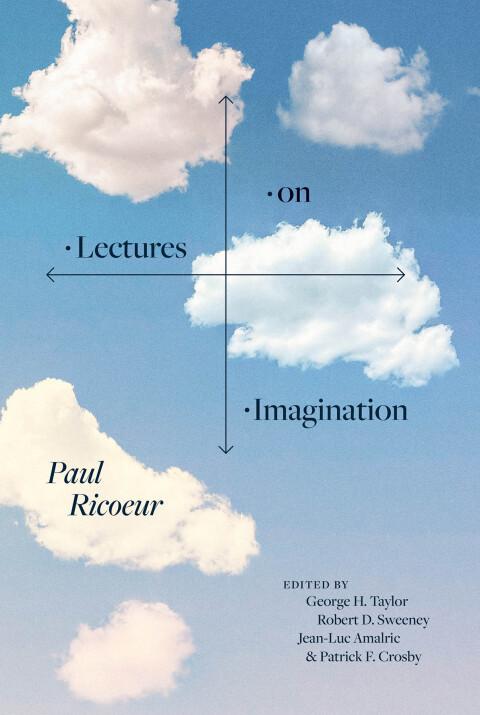
In the first, introductory lecture, Ricoeur considers the topic of imagination in light of two coordinate axes. A first, horizontal axis runs from presence to absence (what he will later refine as the nowhere) and typifies the range from reproductive to productive imagination. A second, vertical axis runs from belief at the bottom— as in hallucination, for example—to unbelief or critical distance at the top. For Ricoeur, fiction is the prototype located in the upper right quadrant of these axes, as it offers an alternative to existing reality (to presence) and so is a form of the productive imagination— of the nowhere in existing reality—that can bring the new to bear into reality and at the same time is not bound by belief and so permits critical distance, an innovative vantage point from which to consider reality. Fiction runs across domains and is not reducible to a literary genre.
In his survey of the history of Western philosophy of imagination in the first and second parts of the text, Ricoeur assesses that all of the philosophers discussed (with some exceptions, as we shall see, in Aristotle and Kant) remain caught up in theories of reproductive imagination. Ricoeur builds upon Kant and to a lesser degree on Aristotle to argue for his own theory of productive imagination. The central problem in the history of the philosophy of imagination is that it principally relies upon a restrictive model where the imagination is derived from the model of the image in perception. (Ricoeur will challenge this theory of perception also.) Under this model, something real exists in external reality, and the mental image derives from and therefore is a weaker version of this reality. The image and the imagination, in turn, are reproductive, lesser versions of the real. By contrast, Ricoeur claims that the “nowhere” in fiction allows us to avoid the model of reproduction and bring something new to reality. In one of the concluding paragraphs of the lectures, Ricoeur argues:
No critical implications concerning reality are implied in the picture, since the picture is the reassertion of reality in an image. The image is entirely dependent on an assumed concept of reality, since the reality of the picture is borrowed entirely from that of its original. Because, however, the fiction has freed itself from the rule of the original, it then provides a new aspect, a new dimension to reality. (285)
It will be the task of the lectures as a whole to detail this argument.
The Lectures
The first, introductory lecture opens with Ricoeur situating his undertaking as a response to what he typifies as the then current “eclipse” of the philosophy of imagination. The lecture moves quickly from this original historical location on to its principal task, which is to set out the hypothesis that the imagination can be assessed across the horizontal and vertical axes already discussed. As the lectures unfold, Ricoeur explicitly returns to the model of the two axes only infrequently. The more overt and continuing discussion in the lectures develops the contrast between reproductive and productive imagination, the subject of the horizontal axis, with the differentiation between belief and critical distance in imagination, the topic of the vertical axis, a more secondary and intermittent source of attention. The lectures offer a framework for a theory of the imagination that remains incisive and innovative in a contemporary period where what was the eclipse of the problem of imagination has itself been eclipsed by the outpouring of attention to the subject.
Lecture 2 is the first of the five lectures on classical philosophies of imagination that constitute Part I. The focus of lecture 2 is Aristotle’s OntheSoul(DeAnima), which provides the West’s “first coherent theory of imagination” (3). Aristotle’s theory seeks to answer two questions: what the imagination is, and why it exists. In
responding to the first, Aristotle places the imagination as an intermediarybetween sense impressions and intellectual intuitions (of the ideal Forms). While locating imagination on this scale has the positive result of sorting out imagination’s distinctiveness, its negative consequence is that imagination is compared negatively to these two functions, each of which is understood to contain truth. Imagination may be false. If philosophy then and now places substantial emphasis on a capacity for truth, then the way is opened for a more disparaging view of imagination as capable of deception or illusion. As to why imagination exists, Aristotle places it within a larger theory of movement and causation. This location also leads to a more critical view of the imagination as a residue or trace of a movement or cause, an image for something else, something as thoughpresent.
As Ricoeur articulates, it will be his challenge, in part building upon Kant, to argue that the role of the imagination should be understood not as a static intermediary but as a function that acts as more dynamic mediationbetween sensations and concepts and so may have a “double allegiance” (19) with both of them and may indeed be a root of both. Kant will also be helpful in opening the door to a freedom of imagination that moves it beyond adequation to existing truth and allows it, as in the fiction, to disclose new dimensions of reality (30–31). Similarly, to circumscribe imagination within a model of causation does not allow the “nothingness” of fiction—the redescription of reality—because causality is oriented to “actual things generating actual things” (28). Late in the lectures Ricoeur will turn to Aristotle’s theory of creative imitation (mimesis) in the Poeticsas a more positive resource for a theory of productive imagination.
In lecture 3, Ricoeur discusses both Pascal and Spinoza. Although their frameworks are different, they share a concentration on imagination as deception, a false presence. For Pascal’s Christian apologetics, the charge is to uncover imagination as a deceptive power. Imagination has power over an individual; the individual is in bondage. Deception is more than error, as error allows for
correction. Deception requires unmasking of an illusion. Spinoza’s philosophy of the fullness of being derives imagination from perception as a quasi-presence, the asif, again a presence that is false. Perception is emphasized as primary, and imagination is secondary, a trace. Spinoza’s philosophy seeks to awaken us from our ordinary dream state, and imagination represents this dream-like state of life. For Ricoeur, both Pascal and Spinoza offer two of the most prominent characterizations of the role of imagination at the bottom of the vertical axis, imagination as belief, of being captured and deceived, a negative sense of the asif. They also narrow the range of imagination. For them imagination covers only its reproductive form. They collapse a distinction between delusion and fiction. Their theories cannot encompass the creative potential of fiction, of an imagination that is not deceived by belief. Moreover, for Spinoza the “nowhere” of fiction is not admissible within his philosophy of the fullness of being. His is a philosophy of presence, and imagination is but an asifpresence, an illusion of presence.
Hume is the subject of lecture 4, and Ricoeur addresses two central themes in Hume’s theory of the imagination. First, Hume represents perhaps the prototype for a philosophical inquiry attempting to derive the image and hence the imagination from experience. Hume begins with what he considers the most actual and present of experience, the sense impression, and the weakened force of the image is derived from and viewed in contrast to the impression’s liveliness. If on the one hand a contrast exists between the vitality of image and impression, on the other hand the image also retains a resemblance to the image as a copy. The image acts as a re-presentation. In Ricoeur’s view, the potential variability in representation or reduplication opens the space for fictions in ways that Hume’s examples seem to permit but that Hume does not adequately incorporate thematically. Part of the intrigue of Ricoeur’s analysis here is his careful attention to Hume’s examples to show how they do not comport with and so place into question his theoretical framework. In what we shall see to be a continuing motif
the implications of which will unfold, Ricoeur also poses whether the impression is a brute fact or, instead, a construct.
The second theme in Hume that Ricoeur discusses is imagination’s function of connection. The connecting power of imagination attempts to resolve both the nature of abstract ideas, where in Hume’s view the imagination connects separate experiences, and causality, where the imagination as connection offers the solution to the problem of inference from one event to another. Hume seeks through the imagination to support the sense of order that is the subject of the natural sciences; yet at the same time he allows that the imagination permits flexibility in connecting past and future. In this context, imagination is no longer a copy of an original but a freer form of projection between past and future. The freer movement of imagination opens the space for the creative function of fiction, although again Hume does not acknowledge this space. “The productive function of imagination is always there even if without a name” (60). Hume’s approach is also notable for its emphasis on imagination as movement, in contrast to the legacy of that part of the Aristotelian model where imagination is a stable intermediary. Imagination now is recognized to have a dynamic quality. What Ricoeur will find to be the decisive approach by Kant to imagination as a synthetic power is a theme introduced by Hume (49).
Lectures 5 and 6 on Kant conclude Ricoeur’s discussion of the classic philosophies of imagination, with Kant’s CritiqueofPure Reason(the first Critique) the subject in lecture 5 and the Critiqueof Judgment(the third Critique) in lecture 6. In lecture 5, Ricoeur stresses that while in the first Critiqueimagination remains an intermediary between sense and reason, between intuition and thought, Kant decisively reorients imagination as a function of mediation, a function of connection between the poles. Imagination has a function of synthesis. Another major element of the first Critiqueis its restriction to understanding, to empirical objectivity. As a consequence, Pascal’s and Spinoza’s concerns about the illusory character of imagination as the asifare set aside as are the
potentialities of the fiction. For Ricoeur, attention to the latter will revive in the third Critique’s turn to aesthetics.
The first Critiquemarks the advent of a distinction between reproductive and productive imagination. Prior theories had attended imagination as reproductive, such as a copy in Hume. In Kant, the imagination’s synthesizing function between intuition and concepts is productive. It is productive even while remaining within the confines of empirical understanding and so, again, not encompassing fiction. The role of imagination as reproductive is reduced to the reproduction of appearances, as in Kant’s example of drawing a line in thought, where the manifold representations must be recaptured one after the other. More prototypically, the imagination is productive and as such plays a constitutiverole in the mediation between the sensible and the intellectual. “Nobody before Kant had thought of a function of imagination related to shaping our world of experience” (69). Characterization of objective reality is a judgment. “The judgment of perception—that this is a tree, that it has such and such characteristics—is an operation of the mind at a high level” (62). The notion of the imagination as copy is fundamentally displaced. Productive imagination is a synthesizing function that is “not at all an alternative to perception but an operation immanent to perception” (67). As we shall see, Ricoeur’s own theory of imagination makes much of imagination’s productive role within perception and the understanding of objective reality, and he will frame the role of imagination as fiction within this larger perspective.
A significant challenge for the function of the productive imagination is that it needs to encompass a faculty that is homogeneous with the very different domains it mediates, the intuition and the concept. Kant offers the schematism as the solution for this difficulty, but as he acknowledges and Ricoeur presses, the schematism offers only the rules for mediation: “the nature of the power of connecting is beyond the Critique’s grasp” (74). A profound subtext of the lectures lies in Ricoeur’s attempt to take up this challenge. In lecture 5, for instance, Ricoeur questions the availability of what Kant describes as an intuitive manifold that is
separable from the conceptual. In Ricoeur’s view, the manifold is never experienced in this fashion but always intertwined with the conceptual. “[T]o put the problem in terms of starting from a manifold and then gathering it, this initial presupposition does not belong to any kind of experience that we may have” (70). Ricoeur argues for a stance that Kant anticipated but retreated from: the imagination acts not only as a mediating function between the sensibility and the understanding but may be “the origin itself of the two functions” (70). There may be a reversal of priority between the imagination and understanding. Productive imagination may precede the understanding; it may be “the source, the matrix, of understanding” (68). We shall follow these hints of Ricoeur’s thesis in lecture 5 as they expand in subsequent lectures.
Lecture 6 both concludes and comprises the “culminating point” (75) of Ricoeur’s discussion of classical philosophies of imagination. He turns here to Kant’s CritiqueofJudgment, and he takes the free play of imagination as the “leading thread” (75) of his analysis. The problem of imagination in Kant is oriented to a contest between rule and play. In the first Critiquethe power of imaginative free play is subordinated to the system of rules that comprise the understanding, while the third Critiquebrings free play to the center. This “wild power” (88) of free play is perhaps most notably exemplified in the experience of the sublime. Yet both Ricoeur and Kant contend that it is misguided to focus in the third Critiqueon the power of imaginative free play alone. The contest between play and rule continues. In the third Critiqueimagination acts as the “interchange between the wild power of imagination and the need for a certain order, for forms” (88). Lecture 6 provides three lessons. First is the availability of imagination as free play. This is a form of productive imagination that goes beyond the confines of empirical understanding and extends imagination’s domain. Although Ricoeur does not use the term fictionin this lecture, the free play of the imagination provides the space for the imagination as fiction to arise. Second, for both Ricoeur and Kant, we never are dealing with a “naked creativity” (78). Imagination is not a “formless power,”
because creativity always involves forms (84). Imagination is always enmeshed with “language, structures, and patterns” (88). We shall return to the significance of this thematic in Ricoeur’s larger argument as we proceed. Third, building on Hans-Georg Gadamer, Ricoeur critiques Kant’s interiorization of aesthetics, his reduction of aesthetics to a subjectivity of order. Although only briefly referenced in lecture 6, Ricoeur’s own approach will undertake the challenge of rebuilding the unity of the theory of imagination, which Kant has split between cognitive and aesthetic functions (64), and show the imagination’s ontological implications.
Lecture 7 initiates Part II and the first of eight lectures on modern theories of imagination. In this section Ricoeur seeks to compare perspectives in Anglo-American analytic philosophy and continental phenomenology, the latter the tradition from which Ricoeur springs. In the first section of lecture 7, he offers an introduction to Part II and indicates that he will attempt to show connections across the analytic and phenomenological fields at three levels. The first problem area involves “the description of the operation of imagining as such” (92) and will compare Ryle and Sartre.6 The issue involves what is a mental image and whether the model of an original in reality and mental image as copy is appropriate. A second problem area will turn to a reconsideration of the relation between imagination and perception and lead to a rethinking of the nature of perception. The proposed discussion of Wittgenstein and Maurice Merleau-Ponty will show perception to be an interpretive process itself. In the third problem area, Ricoeur will analyze the contribution that images may offer to thinking through analysis of H. H. Price and Husserl. If the history of philosophy has rendered problematic concepts’ origin in images, images may still be used to support and illustrate concepts. There is a separation between the philosophy of logic and the philosophy of mind.
While the central orientation of Ricoeur’s outline persists as Part II unfolds, it changes in some significant details. Regrettably, discussion of Merleau-Ponty is dropped, perhaps due to lengthier than anticipated attention to Sartre. Themes that would have been
relevant for development of Merleau-Ponty appear to resurface in the third part of the lectures, in the elaboration of the work of François Dagognet. The discussion first of the Anglo-American philosophers and then of the phenomenologists is maintained, but Price is developed before Wittgenstein and Husserl before Sartre.
What remains of particular interest in the opening pages of lecture 7, beyond its outline of the part to come, is its quite intriguing initial comparison of the methods between the analytic and phenomenological fields. For a long period, the two fields were widely considered as having very distinct orientations, and it is one of the tributes of Ricoeur’s philosophy that in the present text as elsewhere (as in OneselfasAnother), Ricoeur has attempted to bridge the gap. In this volume, Ricoeur acknowledges that the analytic tradition has concentrated on language, while the phenomenological tradition has focused on experience, yet he insists that the two approaches overlap “in the attempt both to describe the experience of what occurs in imagination and to describe it in a more proper language” (91). If the analytic tradition seeks to amend our language, the goal is more accurate description, an effort to be more faithful to experience. If phenomenology begins in experience, the concern is what is meaningful, of what we can provide an account. Our experience must be brought to language. Ricoeur intends to show, then, “how a phenomenology is implied in linguistic analysis and how linguistic structures are always implied in experience” (97).
As significant as is Ricoeur’s consideration of the overlap between these two traditions, it is even more essential to recognize that the theme that Ricoeur addresses here is one that he takes as his own. “The experiential and linguistic sides of the question [of imagination] will be emphasized together” (91). We saw this point raised also in Ricoeur’s lectures on Kant. As in our commentary there, here also we draw out these present clues to where Ricoeur is headed in his own theory of imagination in the third and final part of the lectures. As we shall see, Ricoeur will subsequently offer his own response to
the three themes he uses to compare analytic and phenomenological approaches.
Ricoeur’s introduction to the modern philosophies of imagination takes up the first half of lecture 7, and the second half is devoted to discussion of Ryle, a discussion that concludes in the first half of lecture 8. As anticipated, Ricoeur attends Ryle because of the latter’s development of the operation of imagining. Ryle’s discussion of imagination occurs in TheConceptofMind, a book more generally engaged in a critique of the concept of mind (“the ghost in the machine”). Ryle similarly rejects that images exist in the mind. The mental image is not a picture, so the notion of the image as a copy must be forsaken. Ryle argues that analysis must turn from nouns— the image—to verbs—how we image, how we imagine. The emphasis is on what we do, a behaviorist account. Ricoeur finds in Ryle a paradigmatic account of imagining as pretending, as an actor in a play or a child with a doll. We do not see an image; we only seem to see one. Ryle places seeing an image within quotation marks: we “see,” which is something derivative from actual seeing, as pretending is derivative from and an indirect form of an actual activity. Imaging is a mock action.
Ricoeur views positively Ryle’s account of imagining as an activity rather than something merely passive, a reception of an image. This accords with Ricoeur’s views of the active nature of perception. He also appreciates Ryle’s connection in imagination between not doing, an abstention from performance of the real activity, and an asif doing. As we shall elaborate, Ricoeur considers the conjunction between not doing and asifdoing a fundamental problem in the theory of imagination (110). If previously in Ricoeur’s discussion of Pascal and Spinoza we saw the asifas something negative, as imagination caught by belief, now the turn is to the asifdoing as a more positive aspect of the imagination. But Ricoeur finds Ryle’s own analysis too restrictive, on two grounds. First, Ricoeur criticizes Ryle’s rejection of the imagination as having any form of a mental image. It is quizzical that a philosophy that appeals to ordinary use will simply eliminate the familiar experience of the image as a
picture and so as something that appears. It is notable that Price, to whom the lectures will turn, departs from Ryle on this point. The question, Ricoeur argues, is how to arrive at characterization of objects that do not exist, such as the image, and the lectures will lead to the phenomenology of Husserl and Sartre to develop that issue. Second and similarly, Ricoeur objects to Ryle’s recharacterization of “I imagine something” as “I imagine that I see.” The former has an object, whereas the latter is propositional. The nonverbal element—the object—is eliminated by the verbal expression. Here again, Ricoeur wants to maintain a tension between the verbal and the pictorial—the mental object—that his own theory of imagination will pursue through recourse to phenomenology.
Ricoeur discusses Price in the last half of lecture 8. If in the history of philosophy the relationship between images and concepts has proven to be problematic, Price addresses instead an issue in the philosophy of mind: what it entails to think in or with images. He coins the terms “non-instantive particulars” and “quasi-instantiative particulars” as ways to describe particular examples that are not present, as the drawing or mental image of a dog, that help us think about what the term dogmeans. Price accepts, contrary to Ryle, that in imagining, something in a sense appears without being present in actuality. Price writes of images appearing asifthey were things. He is comfortable accepting that images appear without being disconcerted by the fact that they do not appear in physical space. In subsequent lectures Ricoeur will seek to extend Price’s insights through phenomenological inquiry.
In lecture 9, Ricoeur offers a very sympathetic portrayal of Wittgenstein. He draws on the larger framework of Wittgenstein’s PhilosophicalInvestigationsto inquire more specifically into Wittgenstein’s extended development of the nature of seeingasin that text. In many of Wittgenstein’s examples, such as the famous image of the duck/rabbit, where we see an identical image successively as either a duck or a rabbit, Ricoeur finds Wittgenstein pushing on the limits of language. The examples generate new