■ artIsts on art: The Commentarii of lorenzo Ghiberti 596
■ proBlems and solutIons: linear Perspective 599
■ art and socIety: imitation and emulation in renaissance art 606
■ art and socIety: italian renaissance family Chapel endowments 617
■ artIsts on art: leon Battista alberti’s On the Art of Building 620
■ wrItten sources: The Tomb of doge Pietro Mocenigo 622
■ art and socIety: art in the Princely Courts of renaissance italy 625
■ a second opInIon: Piero della francesca’s Flagellation 627
Map 21-1 renaissance florence 615
THE BIG PICTURE 633
22 Renaissance and Mannerism in Cinquecento Italy 635
FRAMING THE ERA Michelangelo, Pope Julius ii, and the sistine Chapel 635
tImelIne 636
High renaissance 636 Mannerism 668
late renaissance 676
■ artIsts on art: leonardo and Michelangelo on Painting versus sculpture 637
■ materIals and technIques: renaissance drawings 640
■ wrItten sources: Giorgio Vasari’s Lives 648
■ the patron’s voIce: The Council of Trent 654
■ a second opInIon: Giorgione’s Tempest 662
■ art and socIety: Women in the renaissance art World 666
■ artIsts on art: Palma il Giovane on Titian 667
■ proBlems and solutIons: How to impress a Pope 669
■ the patron’s voIce: federigo Gonzaga, Giulio romano, and the Palazzo del Tè 674
■ proBlems and solutIons: rethinking the Basilican Church 682
Map 22-1 rome with renaissance and Baroque monuments 656
THE BIG PICTURE 683
23
High Renaissance and Mannerism in Northern Europe and Spain 685
FRAMING THE ERA netherlandish Mores and the Pursuit of Wealth 685
tImelIne 686
northern europe in the 16th Century 686 Germany 686
The netherlands 697 france 702 spain 705
■ relIGIon and mytholoGy: Catholic versus Protestant Views of salvation 691
■ art and socIety: Witchcraft and the Macabre 693
■ a second opInIon: Hieronymus Bosch’s Garden of Earthly Delights 696
■ the patron’s voIce: francis i, royal art Patron and Collector 703
Map 23-1 europe in the early 16th century 688
THE BIG PICTURE 709
24 The Baroque in Italy
and Spain 711
FRAMING THE ERA Mystical drama in a Baroque Chapel 711
tImelIne 712
“Baroque” art and architecture 712 italy 712
spain and new spain 729
■ proBlems and solutIons: Completing saint Peter’s 714
■ proBlems and solutIons: rethinking the Church facade 717
■ wrItten sources: Giovanni Pietro Bellori on annibale Carracci and Caravaggio 722
■ artIsts on art: The letters of artemisia Gentileschi 725
■ proBlems and solutIons: How to Make a Ceiling disappear 728
■ the patron’s voIce: Velázquez and Philip iV 733
■ a second opInIon: diego Veláquez’s Las Meninas 734
Map 24-1 Vatican City 713
THE BIG PICTURE 737
25
The
Baroque
in Northern Europe 739
FRAMING THE ERA international Trade and art
Patronage in the dutch republic 739
tImelIne 740
War and Trade in northern europe 740
flanders 741
dutch republic 746
france 757
england 767
■ artIsts on art: rubens on Consequences of War 743
■ art and socIety: The art Market in the dutch republic 747
■ proBlems and solutIons: frans Hals’s Group Portraits 748
■ materIals and technIques: rembrandt’s Use of light and shade 751
■ a second opInIon: Johannes Vermeer’s Allegory of the Art of Painting 755
■ art and socIety: The sun king’s Palace at Versailles 759
■ artIsts on art: Poussin’s notes for a Treatise on Painting 762
Map 25-1 europe in 1648 after the Peace of Westphalia 740
THE BIG PICTURE 769
26
Rococo to Neoclassicism:
The 18th Century in Europe and America 771
FRAMING THE ERA The enlightenment, angelica kauffman, and neoclassicism 771
tImelIne 772
a Century of revolutions 772 rococo 772
The enlightenment 778
“natural” art 781
neoclassicism 789
■ wrItten sources: femmes savantes and salon Culture 773
■ art and socIety: Joseph Wright of derby and the industrial revolution 780
■ wrItten sources: diderot on Chardin and Boucher 782
■ art and socIety: Vigée le Brun, labille-Guiard, and the french royal academy 784
■ art and socIety: Grand Manner Portraiture 786
■ art and socIety: The Grand Tour and Veduta Painting 788
■ art and socIety: The excavations of Herculaneum and Pompeii 790
■ wrItten sources: Winckelmann and the History of Classical art 791
■ artIsts on art: Jacques-louis david on Greek style and Public art 792
■ art and socIety: Hagley Park and english Picturesque Gardens 795
■ the patron’s voIce: Thomas Jefferson, Patron and Practitioner 797
THE BIG PICTURE 799
27 Romanticism, Realism,
Photography: Europe and America, 1800 to 1870 801
FRAMING THE ERA napoleon in Jaffa 801
tImelIne 802
Political, industrial, and artistic revolutions 802 art under napoleon 803
romanticism 808
realism 822
architecture 836
Photography 842
■ the patron’s voIce: The Coronation of napoleon 805
■ art and socIety: The romantic spirit in art, Music, and literature 813
■ wrItten sources: friedrich’s Wanderer above a Sea of Mist 817
■ artIsts on art: John Constable on landscape Painting 818
■ proBlems and solutIons: Unleashing the emotive Power of Color 819
■ artIsts on art: Thomas Cole on the american landscape 820
■ artIsts on art: Gustave Courbet on realism 823
■ materIals and technIques: lithography 826
■ a second opInIon: edmonia lewis’s Forever Free 834
■ proBlems and solutIons: What should a Museum look like? 836
■ proBlems and solutIons: Prefabricated architecture 841
■ materIals and technIques: daguerreotypes, Calotypes, and Wet-Plate Photography 842
Map 27-1 The napoleonic empire in 1812 802
Map 27-2 europe around 1850 803
THE BIG PICTURE 847
28 Impressionism, PostImpressionism, Symbolism: Europe and America, 1870 to 1900 849
FRAMING THE ERA impressions of Modern life 849
tImelIne 850
industrialization and Modernism 850 impressionism 850
Post-impressionism 860 symbolism 871
sculpture 876
decorative arts and architecture 878
■ proBlems and solutIons: Painting impressions of light and Color 851
■ art and socIety: academic salons and independent art exhibitions 853
■ artIsts on art: renoir on the art of Painting 856
■ a second opInIon: Manet at the folies-Bergère 857
■ art and socIety: Japonisme 858
■ artIsts on art: Whistler on “artistic arrangements” 859
■ art and socIety: Women impressionists 860
■ materIals and technIques: Pointillism and 19th-Century Color Theory 863
■ artIsts on art: The letters of Vincent van Gogh 865
■ artIsts on art: Gauguin on Where Do We Come From? 867
■ proBlems and solutIons: Making impressionism solid and enduring 869
■ wrItten sources: albert aurier on symbolism 870
■ proBlems and solutIons: Painting Psychic life 874
■ artIsts on art: rodin on Movement in art and Photography 876
■ art and socIety: The arts and Crafts Movement 879
■ proBlems and solutIons: The first skyscrapers 883
Map 28-1 france around 1870 with towns along the seine 852
THE BIG PICTURE 885
29 Modernism in Europe,
1900 to 1945 887
FRAMING THE ERA Picasso disrupts the Western Pictorial Tradition 887
tImelIne 888
Global Upheaval and artistic revolution 888
fauvism 889
German expressionism 891
Cubism 895
Orphism and the Machine aesthetic 902
futurism 904
dada 906
suprematism and Constructivism 910
neue sachlichkeit 912
surrealism 915
de stijl 922
sculpture 923
architecture 926
■ artIsts on art: Henri Matisse on Color 890
■ art and socIety: science and art in the early 20th Century 893
■ art and socIety: Gertrude and leo stein and the avant-Garde 896
■ art and socIety: Primitivism and Colonialism 897
■ artIsts on art: Pablo Picasso on Cubism 899
■ proBlems and solutIons: delaunay, Orphism, and the representation of Modern life 903
■ proBlems and solutIons: léger, the Machine aesthetic, and the representation of Modern life 904
■ artIsts on art: futurist Manifestos 905
■ a second opInIon: Hannah Höch’s dada Photomontage 909
■ wrItten sources: andré Breton’s First Surrealist Manifesto 916
■ art and socIety: degenerate art 918
■ artIsts on art: Piet Mondrian on neoplasticism 922
■ artIsts on art: Brancusi, Hepworth, and Moore on abstract sculpture 924
■ artIsts on art: Walter Gropius and the Bauhaus 928
Map 29-1 europe at the end of World War i 888
THE BIG PICTURE 931
30 Modernism in the United States and Mexico, 1900 to 1945 933
FRAMING THE ERA aaron douglas, europe, africa, and america 933
tImelIne 934
american art at the Turn of the Century 934
Painting 934
Photography and sculpture 947
architecture 950
■ art and socIety: The armory show 935
■ art and socIety: art “Matronage” in the United states 938
■ art and socIety: Jacob lawrence’s Migration of the Negro 942
■ a second opInIon: Grant Wood’s American Gothic 943
■ artIsts on art: diego rivera on art for the People 945
■ artIsts on art: alfred stieglitz on “straight Photography” 947
■ the patron’s voIce: The Museum of Modern art as Collector and Patron 951
■ artIsts on art: frank lloyd Wright on Organic architecture 953
THE BIG PICTURE 955
31 Modernism and Postmodernism in Europe and America, 1945 to 1980 957
FRAMING THE ERA after Modernism: Postmodernist architecture 957
tImelIne 958
The aftermath of World War ii 958
Painting, sculpture, and Photography 958
architecture and site-specific art 987
Performance and Conceptual art and new Media 995
■ artIsts on art: Jean dubuffet on Crude art 960
■ wrItten sources: Greenbergian formalism 962
■ artIsts on art: Jackson Pollock on easel and Mural Painting 963
■ artIsts on art: Helen frankenthaler on Color-field Painting 968
■ artIsts on art: david smith on Outdoor sculpture 970
■ artIsts on art: donald Judd on sculpture and industrial Materials 971
■ art and socIety: Pop art and Consumer Culture 974
■ artIsts on art: roy lichtenstein on Pop art and Comic Books 976
■ artIsts on art: James rosenquist on F-111 978
■ artIsts on art: Chuck Close on Photorealist Portrait Painting 980
■ art and socIety: robert frank’s The Americans 982
■ artIsts on art: Judy Chicago on The Dinner Party 984
■ proBlems and solutIons: robert Venturi and Postmodernist Complexity and Contradiction 991
■ artIsts on art: Philip Johnson on Postmodern architecture 992
■ a second opInIon: The Portland Building 993
■ artIsts on art: robert smithson on Spiral Jetty 994
■ artIsts on art: Carolee schneemann on Painting, Performance art, and art History 996
■ proBlems and solutIons: rethinking “art”: Conceptual art 998
THE BIG PICTURE 1001
32 Contemporary Art
Worldwide 1003
FRAMING THE ERA art as sociopolitical Message 1003
tImelIne 1004
art Today 1004
Personal and Group identity 1004
Political and social Commentary 1013
representation and abstraction 1017
electronic and digital Media 1026
installation and site-specific art 1027
architecture 1034
■ art and socIety: Public funding of Controversial art 1009
■ artIsts on art: shirin neshat on iran after the revolution 1012
■ artIsts on art: leon Golub on Mercenaries 1014
■ art and socIety: damien Hirst’s Wreck of the Unbelievable 1020
■ materIals and technIques: rethinking the shape of Painting 1023
■ art and socIety: Maya lin’s Vietnam Veterans Memorial 1031
■ a second opInIon: richard serra’s Tilted Arc 1033
■ artIsts on art: frank Gehry on architectural design and Materials 1037
■ proBlems and solutIons: norman foster, the Gherkin, and Green architectural design 1040
THE BIG PICTURE 1041
33 South and Southeast Asia,
1200 to 1980 1043
FRAMING THE ERA Painting at the Mughal imperial Court 1043
tImelIne 1044
india 1044
southeast asia 1053
■ the patron’s voIce: The Qutb Minar and the Triumph of islam 1045
■ materIals and technIques: indian Miniature Painting 1047
■ wrItten sources: abd al-Hamid lahori on the Taj Mahal 1049
■ proBlems and solutIons: Victoria Terminus as Cathedral of Modernization 1051
Map 33-1 south and southeast asia, 1200 to 1980 1044
THE BIG PICTURE 1057
34 China and Korea,
1279 to 1980 1059
FRAMING THE ERA The son of Heaven and the forbidden City 1059
tImelIne 1060
China 1060
korea 1071
■ materIals and technIques: Calligraphy and inscriptions on Chinese Paintings 1061
■ materIals and technIques: Chinese Porcelain 1063
■ proBlems and solutIons: Planning an Unplanned Garden 1065
■ materIals and technIques: lacquered Wood 1066
Map 34-1 China during the Ming dynasty 1060
THE BIG PICTURE 1073
35 Japan, 1333 to 1980 1075
FRAMING THE ERA famous Views of edo 1075
tImelIne 1076
Muromachi 1076
Momoyama 1079 edo 1083
Meiji and showa 1088
■ relIGIon and mytholoGy: Zen Buddhism 1077
■ wrItten sources: sesshu Toyo 1078
■ a second opInIon: The rock Garden of ryoanji 1079
■ art and socIety: The Japanese Tea Ceremony 1082
■ materIals and technIques: Japanese Woodblock Prints 1086
Map 35-1 Modern Japan 1076
THE BIG PICTURE 1091
36 Native American Cultures, 1300 to 1980 1093
FRAMING THE ERA The founding of Tenochtitlán 1093
tImelIne 1094
Mesoamerica 1094
south america 1099
north america 1102
■ materIals and technIques: Mesoamerican illustrated Books 1095
■ relIGIon and mytholoGy: aztec religion 1097
■ proBlems and solutIons: inka record-keeping and the khipu 1100
■ art and socIety: Gender roles in native american art 1104
■ art and socIety: kwakwaka’wakw Transformation Masks 1106
Map 36-1 Mixteca-Puebla and aztec sites in Mesoamerica 1094
Map 36-2 inka sites in andean south america 1099
Map 36-3 later native american sites in north america 1103
THE BIG PICTURE 1111
37 Oceania
before 1980 1113
FRAMING THE ERA Maori Men’s Meeting Houses 1113
tImelIne 1114
island Cultures of the south Pacific 1114
australia and Melanesia 1115
Micronesia 1121
Polynesia 1123
■ art and socIety: asmat Headhunting and Bisj Poles 1116
■ art and socIety: Women’s roles in Oceania 1122
■ a second opInIon: The Moai of rapa nui 1123
■ materIals and technIques: Tongan Barkcloth 1124
■ art and socIety: Tattoo in Polynesia 1125
Map 37-1 Oceania 1114
THE BIG PICTURE 1129
38 Africa, 1800 to 1980 1131
FRAMING THE ERA Honoring leaders and ancestors 1131
tImelIne 1132
africa, 1800 to 1980 1132
ancestors and spirits 1133
leadership and royalty 1136
rituals and Masquerades 1141
Costume and Body art 1146
Contemporary art 1148
■ art and socIety: african artists and apprentices 1137
■ art and socIety: Gender roles in african art
Production 1141
■ art and socIety: african Masquerades 1143
■ art and socIety: Mende Women as Maskers 1146
Map 38-1 africa in the early 21st century 1132
THE BIG PICTURE 1149
notes 1150
Glossary 1153
Bibliography 1167
Credits 1182 index 1188
i take great pleasure in introducing the extensively revised and expanded 16th edition of Gardner’s Art through the Ages: A Global History, which, like the 15th edition, is a hybrid art history textbook—the first, and still the only, introductory survey of the history of art of its kind. This innovative new kind of “Gardner” retains all of the best features of traditional books on paper while harnessing 21st-century technology to increase by 25% the number of works examined—without increasing the size or weight of the book itself and at only nominal additional cost to students.
When Helen Gardner published the first edition of Art through the Ages in 1926, she could not have imagined that nearly a century later, instructors all over the world would still be using her textbook (available even in a new Chinese edition, the third time this classic textbook has been translated into Chinese) in their classrooms. indeed, if she were alive today, she would not recognize the book that, even in its traditional form, long ago became—and remains— the world’s most widely read introduction to the history of art and architecture. i hope that instructors and students alike will agree that this new edition lives up to the venerable Gardner tradition and even exceeds their high expectations.
The 16th edition follows the 15th in incorporating an innovative new online component called MindTaptm, which includes, in addition to a host of other features (enumerated below), MindTap Bonus images (with zoom capability) and descriptions of more than 300 additional important works of all eras, from prehistory to the present and worldwide. The printed and online components of the hybrid 16th edition are very closely integrated. for example, each MindTap Bonus image appears as a thumbnail in the traditional textbook, with abbreviated caption, to direct readers to MindTap for additional content, including an in-depth discussion of each image. The integration extends also to the maps, index, glossary, and chapter summaries, which seamlessly merge the printed and online information.
Key Features o F
the 16th e d I t I on in this new edition, in addition to revising the text of every chapter to incorporate the latest research and methodological developments and dividing the former chapter on european and american art from 1900 to 1945 into two chapters, i have added several important features while retaining the basic format and scope of the previous edition. Once again, the hybrid Gardner boasts roughly 1,700 photographs, plans, and drawings, nearly all in color and reproduced according to the highest standards of clarity and color fidelity,
PREFACE
including hundreds of new images, among them a new series of superb photos taken by Jonathan Poore exclusively for Art through the Ages during a photographic campaign in england in 2016 (following similar forays into france, Tuscany, rome, and Germany for the 14th and 15th editions). MindTap also includes custom videos made on these occasions at each site by sharon adams Poore. This extraordinary proprietary Cengage archive of visual material ranges from ancient temples and aqueducts in rome and france; to medieval, renaissance, and Baroque churches in england, france, Germany, and italy and 18th-century landscape architecture in england; to such postmodern masterpieces as the Pompidou Center and the louvre Pyramide in Paris, the neue staatsgalerie in stuttgart, and the Gherkin in london. The 16th edition also features the highly acclaimed architectural drawings of John Burge prepared exclusively for Cengage, as well as Google earth coordinates for all buildings and sites and all known provenances of portal objects. Together, these exclusive photographs, videos, and drawings provide readers with a visual feast unavailable anywhere else.
Once again, scales accompany the photograph of every painting, statue, or other artwork discussed—another innovative feature of the Gardner text. The scales provide students with a quick and effective way to visualize how big or small a given artwork is and its relative size compared with other objects in the same chapter and throughout the book—especially important given that the illustrated works vary in size from tiny to colossal.
also retained in this edition are the Quick-review Captions (brief synopses of the most significant aspects of each artwork or building illustrated) that students have found invaluable when preparing for examinations. These extended captions accompany not only every image in the printed book but also all the digital images in MindTap, where they are also included in a set of interactive electronic flashcards. each chapter also again ends with the highly popular full-page feature called The Big Picture, which sets forth in bullet-point format the most important characteristics of each period or artistic movement discussed in the chapter. also retained from the 15th edition are the timelines summarizing the major artistic and architectural developments during the era treated (again in bullet-point format for easy review) and a chapter-opening essay called Framing the Era, which discusses a characteristic painting, sculpture, or building and is illustrated by four photographs.
another pedagogical tool not found in any other introductory art history textbook is the Before 1300 section that appears at the beginning of the second volume of the paperbound version of the book. Because many students taking the second half of a survey course will not have access to Volume i, i have provided a special (expanded) set of concise primers on architectural terminology
and construction methods in the ancient and medieval worlds, and on mythology and religion—information that is essential for understanding the history of art after 1300 in both the West and the east. The subjects of these special essays are Greco-roman Temple design and the Classical Orders; arches and Vaults; Basilican Churches; Central-Plan Churches; the Gods and Goddesses of Mount Olympus; the life of Jesus in art; early Christian saints and Their attributes; Buddhism and Buddhist iconography; and Hinduism and Hindu iconography. Before 1300 also is included in MindTap for all courses.
feature boxes once again appear throughout the book as well. These features fall under nine broad categories, one of which is new to the 16th edition:
Architectural Basics boxes provide students with a sound foundation for the understanding of architecture. These discussions are concise explanations, with drawings and diagrams, of the major aspects of design and construction. The information included is essential to an understanding of architectural technology and terminology.
Materials and Techniques essays explain the various media that artists have employed from prehistoric to modern times. Because materials and techniques often influence the character of artworks, these discussions contain essential information on why many monuments appear as they do.
Religion and Mythology boxes introduce students to the principal elements of the world’s great religions, past and present, and to the representation of religious and mythological themes in painting and sculpture of all periods and places. These discussions of belief systems and iconography give readers a richer understanding of some of the greatest artworks ever created.
Art and Society essays treat the historical, social, political, cultural, and religious context of art and architecture. in some instances, specific monuments are the basis for a discussion of broader themes.
Written Sources boxes present and discuss key historical documents illuminating important monuments of art and architecture throughout the world. The passages quoted permit voices from the past to speak directly to the reader, providing vivid and unique insights into the creation of artworks in all media.
in the Artists on Art boxes, artists and architects throughout history discuss both their theories and individual works.
The Patron’s Voice essays underscore the important roles played by the individuals and groups who paid for the artworks and buildings in determining the character of those monuments.
Problems and Solutions essays are designed to make students think critically about the decisions that went into the making of every painting, sculpture, and building from the Old stone age to the present. These discussions address questions of how and why various forms developed; the problems that painters, sculptors, and architects confronted; and the solutions they devised to resolve them.
new to the 16th edition are boxes titled A Second Opinion, in which an individual work of art that is the subject of current debate or has recently been reinterpreted is discussed. These essays underscore for students that the history of art and architecture is not a static discipline and that scholars are constantly questioning and rethinking traditional interpretations of paintings, sculptures, and buildings.
Other noteworthy features retained from the 15th edition are the extensive (updated) bibliography of books in english; a glossary containing definitions of all italicized terms introduced in both the printed and online texts; and a complete museum index listing all illustrated artworks by their present location. The host of stateof-the-art resources in the 16th edition version of MindTap for Art through the Ages are enumerated on page xxix).
a c K nowledg M ents
a work as extensive as a global history of art could not be undertaken or completed without the counsel of experts in all areas of world art. as with previous editions, Cengage has enlisted dozens of art historians to review every chapter of Art through the Ages in order to ensure that the text lives up to the Gardner reputation for accuracy as well as readability. i take great pleasure in acknowledging here the important contributions to the 16th edition made by the following: Bradley Bailey, saint louis University; amy Bloch, University at albany; anne-Marie Bouché, florida Gulf Coast University; Betty Brownlee, Macomb Community College; Caroline Bruzelius, duke University; Petra Chu, seton Hall University; kathy Curnow, Cleveland state University; Paola demattè, rhode island school of design; sarah dillon, kingsborough City College, City University of new York; eduardo de Jesús douglas, University of north Carolina-Chapel Hill; sonja drimmer, University of Massachusetts amherst; ingrid furniss, lafayette College; karen Hope Goodchild, Wofford College; Christopher Gregg, George Mason University; Melinda Hartwig, emory University; Joe Hawkins, Hagley Park; Peter Holliday, California state University, long Beach; Craig Houser, City College of new York/ City University of new York; Margaret Jackson, University of new Mexico; Mark J. Johnson, Brigham Young University; lynn Jones, florida state University; Tanja l. Jones, University of alabama Tuscaloosa; nancy klein, Texas a&M; Peri klemm, California state University, northridge; Yu Bong ko, dominican College; Paul lavy, University of Hawai’i at Manoa; John listopad, California state University, sacramento; Gary liu Jr., University of Hawaii at Manoa; nancy Bea Miller, Montgomery County Community College; Michelle Moseley-Christian, Virginia Tech University; evan neely, Pratt institute; Huiping Pang, University of iowa; Benjamin Paul, rutgers University; Julie-anne Plax, University of arizona; stephanie Porras, Tulane University; sharon Pruitts, east Carolina University; kurt r ahmlow, University of north Texas; Julie risser, Minneapolis College of art and design; robyn roslak, University of Minnesota-duluth; susan elizabeth ryan, louisiana state University; nicholas sawicki, lehigh University; nancy serwint, arizona state University; kerri Cox sullivan, University of Texas, austin; James r swensen, Brigham Young University; david s Whitley, University of California, los angeles/asM affiliates; Margaret l. Woodhull, University of Colorado denver.
i am especially indebted to the following for creating the instructor and student materials for the 16th edition: anne McClanan, Portland state University; kerri Cox sullivan, University of Texas, austin.
i am also happy to have this opportunity to express my gratitude to the extraordinary group of people at Cengage involved with the editing, production, and distribution of Art through the Ages. s ome of them i have now worked with on various projects for two decades and feel privileged to count among my friends. The success of the Gardner series in all of its various permutations depends in no small part on the expertise and unflagging commitment of these dedicated professionals, especially Vanessa Manter, senior product manager; l aura Hildebrand, senior content manager; l ianne ames, senior content manager; Paula d ohnal, learning designer; ann Hoffman, intellectual property analyst; Betsy Hathaway, senior intellectual property project manager; l aura kuhlman, marketing manager; sarah Cole, senior designer; as well as sharon adams Poore, former product manager for art; Cate Barr, former senior art director; Jillian Borden,
former senior marketing manager; and sayaka kawano, former product assistant. i also express my deep gratitude to the incomparable group of learning consultants who have passed on to me the welcome advice offered by the hundreds of instructors they speak to daily.
it is a special pleasure also to acknowledge my debt to the following out-of-house contributors to the 16th edition: the peerless quarterback of the entire production process, Joan keyes, dovetail Publishing ser vices; Michele Jones, copy editor extraordinaire; susan Gall, eagle-eyed proofreader; alisha Webber, text and cover designer; lumina datamatics, photo researchers; Jay and John Crowley, Jay’s Publisher ser vices; Cenveo Publisher ser vices; and Jonathan Poore and John Burge, for their superb photos and architectural drawings.
i conclude this long (but no doubt incomplete) list of acknowledgments with an expression of gratitude to my colleagues at Boston University and to the thousands of students and hundreds of teaching fellows in my art history courses since i began teaching in 1975. from them i have learned much that has helped determine the form and content of Art through the Ages and made it a much better book than it otherwise might have been.
Fred S. Kleiner
c hapter-by- c hapter c hanges
I n the 16th e d I t I on
The 16th edition is extensively revised and expanded, as detailed below. instructors will find a very helpful figure number transition guide on the online instructor companion site.
introduction: What is Art History? added the head of the portrait of augustus as pontifex maximus from the Via labicana, rome.
14: l ate Medieval italy. new framing the era essay “duccio di Buoninsegna.” new a s econd Opinion essay “Pietro Cavallini.” new Problems and s olutions essay “Cityscapes and l andscapes as allegories.” Two new photographs of Pietro Cavallini’s Last Judgment in santa Cecilia in Trastevere.
20: l ate Medieval and Early renaissance Northern Europe. reorganized discussion of artworks with three new chapter sections: the french ducal Courts; flanders; and france and the Holy roman empire. added Jacques de Baerze’s Retable de Champmol. new a s econd Opinion essay “Jan van eyck’s Giovanni Arnolfini and His Wife.” new photograph of the full Altarpiece of the Holy Sacrament by dieric Bouts.
21: The renaissance in Quattrocento italy. new a s econd Opinion essay “Piero della francesca’s Flagellation.”
22: renaissance and Mannerism in Cinquecento italy. reorganization of the chapter to place the discussion of Mannerism between the sections on the High and l ate renaissance, and to discuss together all the works of Michelangelo created at different phases of his career. added s ebastiano del Piombo’s Polyphemos. new a s econd Opinion essay “Giorgione’s Tempest.” new photographs of Michelangelo’s Bound Slave, the courtyard of the Palazzo farnese in rome, the Villa rotonda at Vicenza, and the Palazzo del Tè at Mantua (aerial view).
23: High renaissance and Mannerism in Northern Europe and spain. added the Gallery of francis i in the Château of fontainebleau. new framing the era essay “netherlandish Mores and the
Pursuit of Wealth.” new a s econd Opinion essay “Hieronymus Bosch’s Garden of Earthly Delights.”
24: The baroque in italy and spain. added Caravaggio’s The Taking of Christ. new framing the era essay “Mystical drama in a Baroque Chapel.” new a s econd Opinion essay “diego Velázquez’s Las Meninas.” new photographs of Bernini’s Ecstasy of Saint Teresa, Carlo Maderno’s east facade of saint Peter’s in the Vatican, and annibale Carracci’s Loves of the Gods ceiling fresco in the Palazzo farnese in rome.
25: The baroque in Northern Europe. new framing the era essay “international Trade and art Patronage in the dutch republic.” new a s econd Opinion essay “Johannes Vermeer’s Allegory of the Art of Painting.” new photographs of Hals’s Women Regents of the Old Men’s Home at Haarlem, rembrandt’s Night Watch, and Poussin’s Et in Arcadia Ego.
26: ro coco to Neoclassicism: The 18th Century in Europe and America. added st Martin-in-the-fields in london, the rotunda and sham medieval castle at Hagley Park, and the temple of apollo at stourhead Park. new art and s ociety essay “Hagley Park and english Picturesque Gardens.” new photographs of the salon de la Princesse in Paris, the iron bridge at Coalbrookdale, Chiswick House near london, the Temple of Theseus at Hagley Park, the lake and Pantheon at stourhead Park, and the rotunda and l awn of the University of Virginia in Charlottesville.
27: romanticism, realism, Photography: Europe and America, 1800 to 1870. extensive text revisions. added smirke’s st. Mary’s in Bryanston s quare in london, nash’s Marble arch in london, and Burton and Turner’s Palm House at kew Gardens. new framing the era essay “napoleon in Jaffa.” new a s econd Opinion essay “edmonia lewis’s Forever Free.” new photographs of the stainedglass windows of the Houses of Parliament in london and of the exterior of the Bibliothèque sainte-Geneviève in Paris.
28: impressionism, Post-impressionism, sy mbolism: Europe and America, 1870 to 1900. new framing the era essay “impressions of Modern life.” new a s econd Opinion essay “Manet at the folies-Bergère.” new photographs of rodin’s Burghers of Calais, the eiffel Tower in Paris, and Gaudí’s Casa Milá in Barcelona.
29: Modernism in Europe, 1900 to 1945. The chapter in the 15th edition on european and american modernism from 1900 to 1945 has been divided into two chapters, the first on developments in europe and the second on the art and architecture of the same period in the United states and Mexico. added andré derain’s The Turning Road, L’Estaque. new a s econd Opinion essay “Hannah Höch’s dada Photomontage.” new timeline and Big Picture. new photographs of Picasso’s Guitar and duchamp’s Large Glass.
30: Modernism in the United states and Mexico, 1900 to 1945. in this new independent chapter on art and architecture in the United states and Mexico from 1900 to 1945, the discussion of american art has been significantly reorganized and divided by medium: painting, photography, sculpture, and architecture. added stuart davis’s Hot Still-Scape for Six Colors—7th Avenue Style. new framing the era essay “aaron douglas, europe, africa, and america.” new a s econd Opinion essay “Grant Wood’s American Gothic.” new timeline and Big Picture. new photographs of Marcel duchamp’s Nude Descending a Staircase No. 2, alfred stieglitz’s The Steerage, and frank lloyd Wright’s robie House in Chicago.
31: Modernism and Postmodernism in Europe and America, 1945 to 1980. added Mark rothko’s No. 10, louise nevelson’s
Sky Cathedral, and robert frank’s Trolley, New Orleans. new art and s ociety essay “robert frank’s The Americans.” new a s econd Opinion essay “The Portland Building.” new artists on art essay “robert smithson on Spiral Jetty.”
32: Contemporary Art Worldwide. added De Style by kerry James Marshall, Subway Graffiti #3 by faith ringgold, Big Alagba and Sekibo by s okari douglas Camp, Hydra and Kali by damien Hirst, and Shibboleth by doris salcedo. new art and s ociety essay “damien Hirst’s Wreck of the Unbelievable.” new photographs of Maya lin’s Vietnam Veterans Memorial, the interior and exterior of norman foster’s HsBC headquarters in Hong kong, and foster’s Gherkin tower in london.
33: s outh and s outheast Asia, 1200 to 1980. expanded discussion of s outheast asia. added Wat Chai Wattanaram at ayutthaya and Pha That luang at Vientiane. new photographs of the Qutb Minar and alai darvaza at delhi, Victoria Terminus at Mumbai, the Wat Benchamabophit walking Buddha, the Emerald Buddha in Bangkok, and the s chwedagon Pagoda at r angoon.
34: China and Korea, 1279 to 1980. revised discussion of several artworks and boxed essays. new photographs of the noon Gate,
about the author
Fred S. Kleiner
the Hall of supreme Harmony, and the imperial throne room of the forbidden City, and of the Garden of the Master of the fishing nets at suzhou.
35: Japan, 1333 to 1980. new framing the era essay “famous Views of edo.” new a second Opinion essay “The rock Garden of ryoanji.”
36: Native American Cultures, 1300 to 1980. added a san ildefonso jar by María Montoya Martínez in Houston. new framing the era essay “The founding of Tenochtitlán.” new Materials and Techniques essay “Mesoamerican illustrated Books.” new photographs of the Borgia Codex and the Temple of the sun (santo domingo) at Cuzco.
37: oceania before 1980. added a new ireland tatanua helmet mask in Houston and the Maori runanga meeting house at Waitangi. new art and s ociety essay “asmat Headhunting and Bisj Poles.” new a s econd Opinion essay “The Moai of r apa nui.” new photographs of details of the Turanga wharenui at Poverty Bay.
38: Africa, 1800 to 1980. added a kota mbulu ngulu in Boston, a dan ceremonial spoon in Houston, and a samburu “Beautiful l ady” dance mask in a private collection. new photograph of samburu masked dancers.
Fred S. Kleiner (Ph.D., Columbia University) has been the author or coauthor of Gardner’s Art through the Ages beginning with the 10th edition in 1995. He has also published more than a hundred books, articles, and reviews on Greek and Roman art and architecture, including A History of Roman Art, also published by Cengage Learning. Both Art through the Ages and the book on Roman art have been awarded Texty prizes as the outstanding college textbook of the year in the humanities and social sciences, in 2001 and 2007, respectively. Professor Kleiner has taught the art history survey course since 1975, first at the University of Virginia and, since 1978, at Boston University, where he is currently professor of the history of art and architecture and classical archaeology and has served as department chair for five terms, most recently from 2005 to 2014. From 1985 to 1998, he was editor-in-chief of the American Journal of Archaeology
Long acclaimed for his inspiring lectures and devotion to students, Professor Kleiner won Boston University’s Metcalf Award for Excellence in Teaching as well as the College Prize for Undergraduate Advising in the Humanities in 2002, and he is a two-time winner of the Distinguished Teaching Prize in the College of Arts & Sciences Honors Program. In 2007, he was elected a Fellow of the Society of Antiquaries of London, and, in 2009, in recognition of lifetime achievement in publication and teaching, a Fellow of the Text and Academic Authors Association.
Also by Fred Kleiner: A History of Roman Art, Second Edition (Cengage Learning 2018; ISBN 9781337279505), winner of the 2007 Texty Prize for a new college textbook in the humanities and social sciences. In this authoritative and lavishly illustrated volume, Professor Kleiner traces the development of Roman art and architecture from Romulus’s foundation of Rome in the eighth century bce to the death of Constantine in the fourth century ce, with special chapters devoted to Pompeii and Herculaneum, ostia, funerary and provincial art and architecture, and the earliest Christian art, with an introductory chapter on the art and architecture of the Etruscans and of the Greeks of South Italy and Sicily.
RESoURCES FoR STUDENTS AND INSTRUCToRS
M I nd tap F or Art through the Ages
MindTap for Gardner’s Art through the Ages: A Global History, 16th edition, helps students engage with course content and achieve greater comprehension. Highly personalized, fully online, and completely mobile-optimized, the MindTap learning platform presents authoritative Cengage content, assignments, and services.
students
MindTap guides you through your course via a learning path where you can annotate readings and take quizzes. Concepts are brought to life with zoomable versions of close to 1,700 images; videos to reinforce concepts and expand knowledge of particular works or art trends; numerous study tools, including mobile-optimized image flashcards; a glossary complete with an audio pronunciation guide; and more!
instructors
You can easily tailor the presentation of each MindTap course and integrate activities into a learning management system. The resources for Teaching folder in MindTap and the instructor Companion site hold resources such as instructions on how to use the online test bank; Microsoft PowerPoint slides with high-resolution images, which can be used as is or customized by importing personal lecture slides or other material; YouTube playlists organized by chapter; course learning objectives; and more.
M I nd tap Mob I le
Gardner’s Art through the Ages: A Global History, 16th edition, is now more accessible than ever with the MindTap Mobile app, empowering students to learn on their terms—anytime, anywhere, online or off.
• The MindTap ereader provides convenience as students can read or listen to their eBook on their smartphone, take notes, and highlight important passages.
• flashcards and quizzing cultivate confidence. students have instant access to readymade flashcards, study games, and quizzes to engage key concepts and confidently prepare for exams.
• notifications keep students connected. due dates are never forgotten with MindTap Mobile course notifications, which push assignment reminders, score updates, and instructor messages directly to students’ smartphones.
l ecture n otes & s tudy g u I des
The lecture notes & study Guide for each chapter is a lecture companion that allows students to take notes alongside the images shown in class. This resource includes reproductions of the images from the reading, with full captions and space for note-taking either on a computer or on a printout. it also includes a chapter summary, key terms list, and learning objectives checklist.
g oogle e arth
Take a virtual tour of art through the ages! resources for the 16th edition include Google earth coordinates for all works, monuments, and sites discussed in the reading, encouraging students to make geographical connections between places and sites. instructors can use these coordinates to start lectures with a virtual journey to locations all over the globe or take aerial screenshots of important sites to incorporate into lecture materials.
before 1300
Students enrolled in the second semester of a yearlong introductory survey of the history of art may not have access to Volume I. Therefore, Volume II of Art through the Ages: A Global History open with a special set of concise primers on Greco-Roman and medieval architectural terminology and construction methods and on Greco-Roman, Christian, Buddhist, and Hindu iconography—information that is essential for understanding the history of art and architecture after 1300 both in the West and the East.
Contents
■ architectural basics
Greco-Roman Temple Design and the Classical Orders xviii
Arches and Vaults xx
Basilican Churches xxii
Central-Plan Churches xxiv
■ religion and mythology
The Gods and Goddesses of Mount Olympus xxv
The Life of Jesus in Art xxvi
Early Christian Saints and Their Attributes xxviii
Buddhism and Buddhist Iconography xxx
Hinduism and Hindu Iconography xxxi
ar C hite C tural basi C s greco-roman temple design
and the classical orders
The gable-roofed columnar stone temples of the Greeks and romans have had more influence on the later history of architecture in the Western world than any other building type ever devised. Many of the elements of classical temple architecture are present in buildings from the renaissance to the present day.
The basic design principles of Greek and roman temples and the most important components of the classical orders can be summarized as follows.
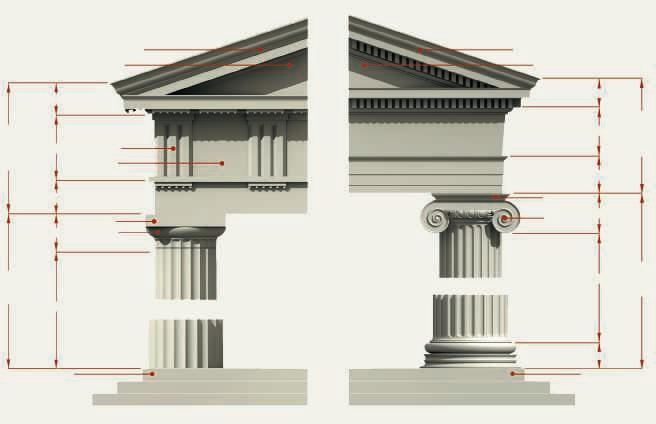
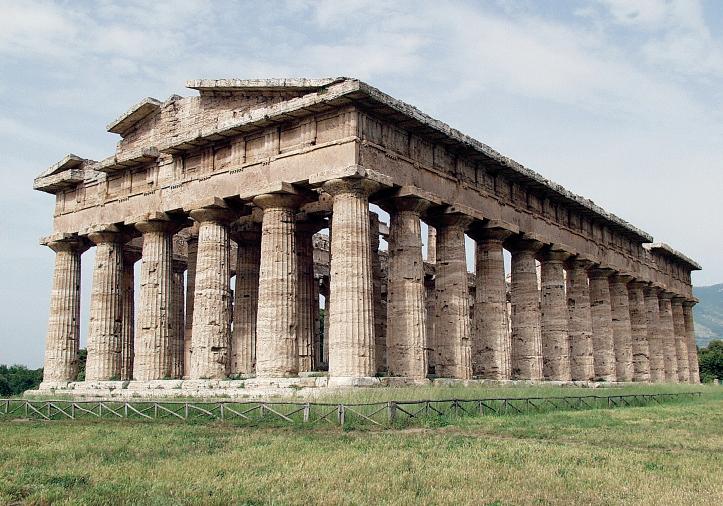
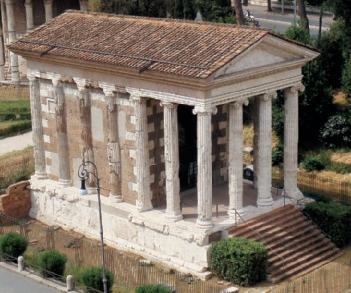
■ Temple design The core of a Greco-roman temple was the cella, a room with no windows that usually housed the statue of the god or goddess to whom the shrine was dedicated. Generally, only the priests, priestesses, and chosen few would enter the cella. Worshipers gathered in front of the building, where sacrifices occurred at open-air altars. In most Greek temples, for example, the temple erected in honor of Hera or Apollo at Paestum, a colonnade was erected all around the cella to form a peristyle by contrast, roman temples, for example, the Temple of Portunus in rome, usually have freestanding columns only in a porch at the front of the building. Sometimes, as in the Portunus temple, engaged (attached) half-columns adorn three sides of the cella to give the building the appearance of a peripteral temple. Architectural historians call this a pseudoperipteral design. The Greeks and
romans also built round temples (called tholos temples), a building type that also had a long afterlife in Western architecture. ■ Classical orders The Greeks developed two basic architectural orders, or design systems: the Doric and the Ionic. The forms of the columns and entablature (superstructure) generally differentiate the orders. Classical columns have two or three parts, depending on the order: the shaft, which is usually marked with vertical channels (flutes); the capital; and, in the Ionic order, the base. The Doric capital consists of a round echinus beneath a square abacus block. Spiral volutes constitute the distinctive feature of the Ionic capital. Classical entablatures have three parts: the architrave, the frieze, and the triangular pediment of the gabled roof, framed by the cornice. In the Doric order, the frieze is subdivided into triglyphs and metopes, whereas in the Ionic, the frieze is left open.
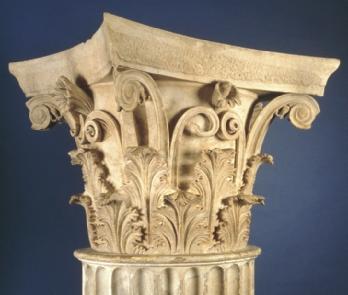
The Corinthian capital, a later Greek invention very popular in roman times, is more ornate than either the Doric or Ionic. It consists of a double row of acanthus leaves, from which tendrils and flowers emerge. Although this capital often is cited as the distinguishing element of the Corinthian order, in strict terms no Corinthian order exists. Architects simply substituted the new capital type for the volute capital in the Ionic order, as in the fourth-century bce tholos temple at epidaurus in Greece.
Sculpture played a major role on the exterior of classical temples, partly to embellish the deity’s shrine and partly to tell something about the deity to those gathered outside. Sculptural ornament was concentrated on the upper part of the building, in the pediment and frieze.
Cornice
Doric and Ionic orders
Greek Doric peripteral temple (Temple of Hera or Apollo, Paestum, Italy, ca. 460 bce)
Roman Ionic pseudoperipteral temple (Temple of Portunus, Rome, Italy, ca. 75 bce)
Corinthian capital (Tholos temple, Epidaurus, Greece, ca. 350 bce)
ar C hite C tural basi C s
arches and Vaults
Although earlier architects used both arches and vaults, the romans employed them more extensively and effectively than any other ancient civilization. The roman forms became staples of architectural design from the Middle Ages until today.
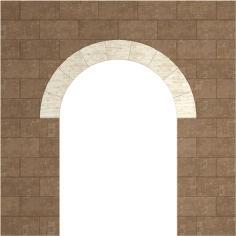
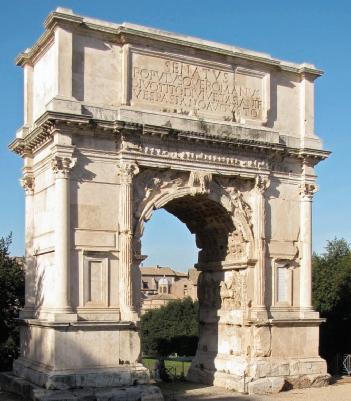
■ Arch The arch is one of several ways of spanning a passageway. The romans preferred it to the post-and-lintel (column-and-architrave) system used in the Greek orders. builders construct arches using wedge-shaped stone blocks called voussoirs. The central voussoir is the arch’s keystone
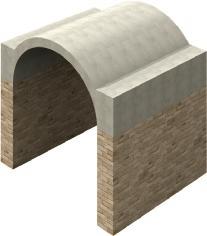
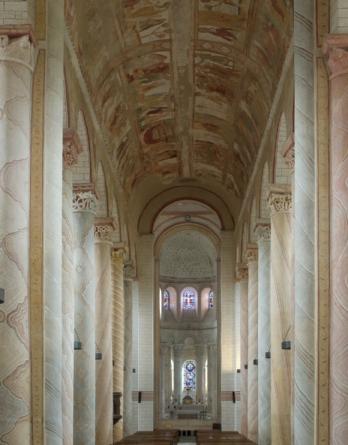
■ Barrel vault Also called the tunnel vault, the barrel vault is an extension of a simple arch, creating a semicylindrical ceiling over parallel walls.
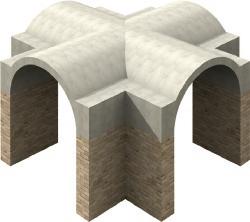
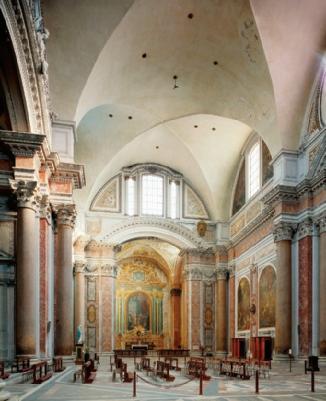
■ Groin vault The groin vault, or cross vault, is formed by the intersection at right angles of two barrel vaults of equal size. When a
series of groin vaults covers an interior hall, the open lateral arches of the vaults function as windows admitting light to the building.
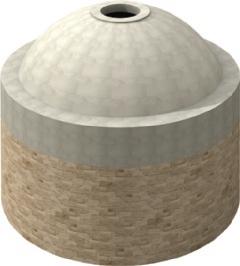
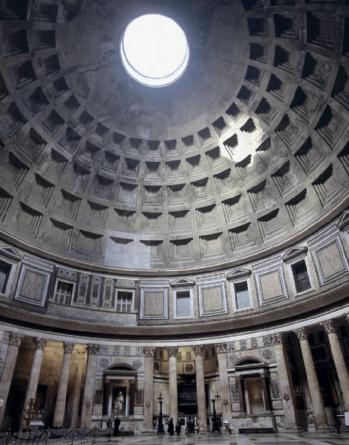
■ Dome The hemispherical dome may be described as a round arch rotated around the full circumference of a circle, usually resting on a cylindrical drum. The romans normally constructed domes using concrete, a mix of lime mortar, volcanic sand, water, and small stones, instead of with large stone blocks. Concrete dries to form a solid mass of great strength, which enabled the romans to puncture the apex of a concrete dome with an oculus (eye), so that much-needed light could reach the interior of the building.
barrel vaults, as noted, resemble tunnels, and groin vaults are usually found in a series covering a similar longitudinally oriented interior space. Domes, in contrast, crown centrally planned buildings, so named because the structure’s parts are of equal or almost equal dimensions around the center.
Arch
Barrel vault
Hemispherical dome with oculus
Groin vault
Roman arch (Arch of Titus, Rome, Italy, ca. 81)
Medieval barrel-vaulted church (Saint-Savin, Saint-Savin-sur-Gartempe, France, ca. 1100)
Roman hall with groin vaults (Baths of Diocletian, now Santa Maria degli Angeli, Rome, Italy, ca. 298–306)
Roman dome with oculus (Pantheon, Rome, Italy, 118–125)
a r C hite C tural b asi C s
basilican churches
Church design during the Middle Ages set the stage for ecclesiastical architecture from the renaissance to the present. both the longitudinal- and central-plan building types of antiquity had a long postclassical history.
In Western Christendom, the typical medieval church had a basilican plan, which evolved from the roman columnar hall, or basilica
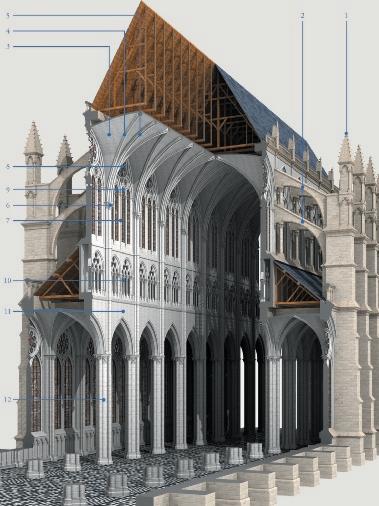
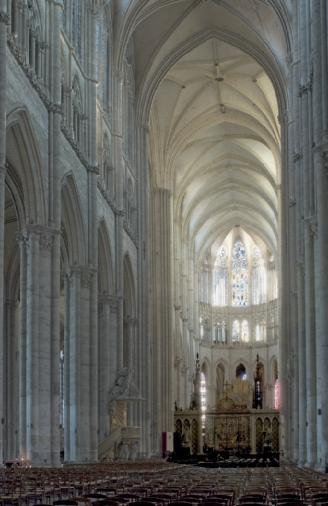
The great european cathedrals of the Gothic age, which were the immediate predecessors of the churches of the renaissance and baroque eras, shared many elements with the earliest basilican churches constructed during the fourth century, including a wide central nave flanked by aisles and ending in an apse. Some basilican churches also have a transept, an area perpendicular to the nave. The nave and transept intersect at the crossing. Gothic churches, however, have many additional features. The key components of Gothic design are labeled in the drawing of a typical french Gothic cathedral, which can be compared to the interior view of Amiens Cathedral and the plan of Chartres Cathedral.
Gothic architects frequently extended the aisles around the apse to form an ambulatory, onto which opened radiating chapels housing sacred relics. Groin vaults formed the ceiling of the nave, aisles, ambulatory, and transept alike, replacing the timber roof of the typical early Christian basilica. These vaults rested on diagonal and transverse ribs in the form of pointed arches on the exterior, flying buttresses held the nave vaults in place. These masonry struts transferred the thrust of the nave vaults across the roofs of the aisles to tall piers frequently capped by pointed ornamental pinnacles. This structural system made it possible to open up the walls above the nave arcade with huge stained-glass windows in the nave clerestory.
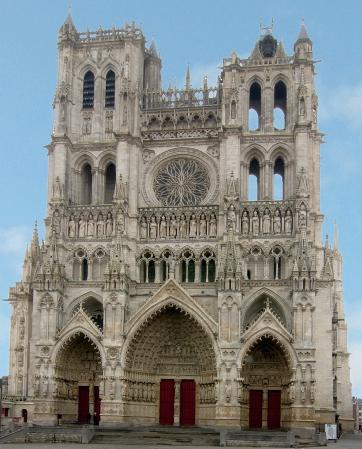
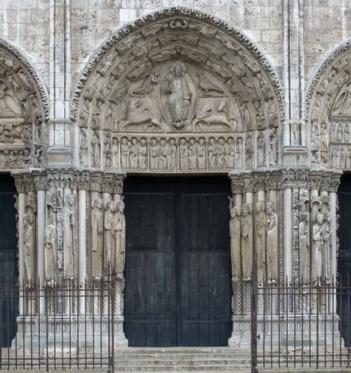
In the later Middle Ages, especially in the great cathedrals of the Gothic age, church facades featured extensive sculptural ornamentation, primarily in the portals beneath the stained-glass rose windows (circular windows with tracery resembling floral petals). The major sculpted areas were the tympanum above the doorway (akin to a Greco-roman temple pediment), the trumeau (central post), and the jambs.
Cutaway view of a typical French Gothic cathedral (1) pinnacle, (2) flying buttress, (3) vaulting web, (4) diagonal rib, (5) transverse rib, (6) springing, (7) clerestory, (8) oculus, (9) lancet, (10) triforium, (11) nave arcade, (12) compound pier with responds
of Amiens Cathedral, France, begun 1220
Nave
Radiating chapels
Ambulatory Apse Aisles
Transept
Transept portals
Ambulatory
Transept
Transept portals
Voussoirs
Plan of Chartres Cathedral, Chartres, France, rebuilt after 1194
Voussoirs
Facade portals
Archivolts
Tympanum
Lintel
Trumeau Jambs Jambs
Central portal, west facade, Chartres Cathedral, ca. 1145–1155
West facade of Amiens Cathedral, Amiens, France, begun 1220
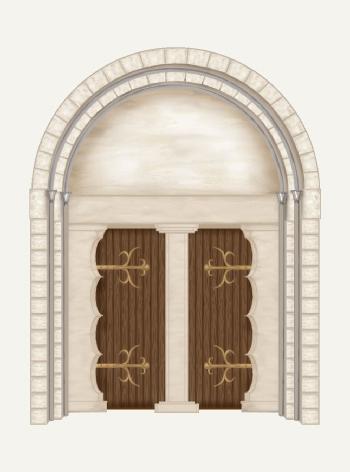
Diagram of medieval portal sculpture
a r C hite C tural b asi C s
central-Plan churches
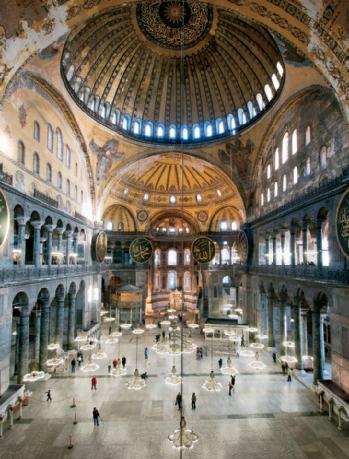
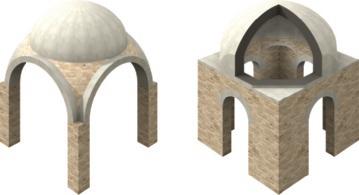
The domed central plan of classical antiquity dominated the architecture of the byzantine empire but with important modifications. because the dome covered the crossing of a byzantine church, architects had to find a way to erect domes on square bases instead of on the circular bases (cylindrical drums) of roman buildings. The solution was pendentive construction in which the dome rests on what is in effect a second, larger dome. The top portion and four segments around the rim of the larger dome are omitted, creating four curved triangles, or pendentives.
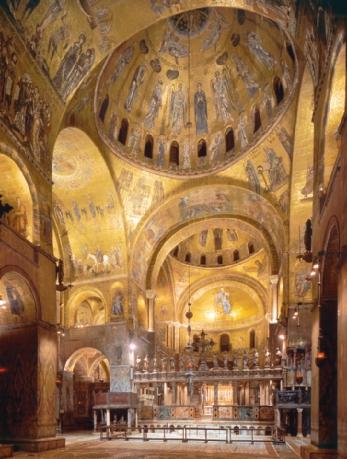
The pendentives join to form a ring and four arches whose planes bound a square. The first use of pendentives on a grand scale occurred in the sixth-century church of Hagia Sophia (Holy Wisdom) in Constantinople. The interiors of byzantine churches differed from those of basilican churches in the West not only in plan and the use of domes but also in the manner in which they were adorned. The original mosaic decoration of Hagia Sophia is lost, but at San Marco (Saint Mark’s) in Venice, some 40,000 square feet of mosaics cover all the walls, arches, vaults, and domes.
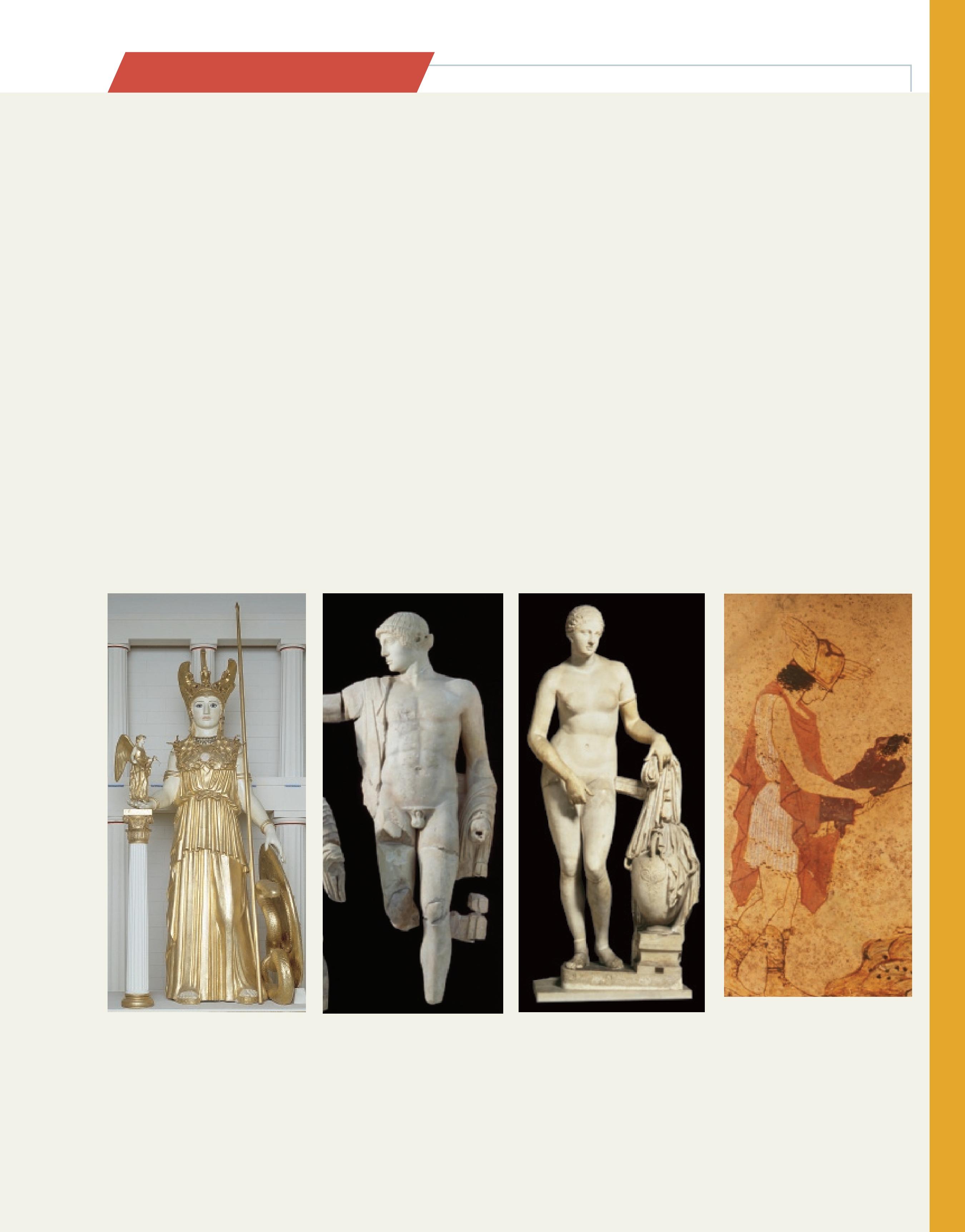
The chief deities of the Greeks ruled the world from their home on Mount olympus, Greece’s highest peak. They figure prominently not only in Greek, etruscan, and roman art but also in art from the renaissance to the present.
The 12 olympian gods (and their roman equivalents) were:
■ Zeus (Jupiter) King of the gods, Zeus ruled the sky and allotted the sea to his brother Poseidon and the Underworld to his other brother, Hades. His weapon was the thunderbolt. Jupiter was also the chief god of the romans.
■ Hera (Juno) Wife and sister of Zeus, Hera was the goddess of marriage.
■ Poseidon (Neptune) Poseidon was lord of the sea. He controlled waves, storms, and earthquakes with his three-pronged pitchfork (trident).
■ Hestia (Vesta) Sister of Zeus, Poseidon, and Hera, Hestia was goddess of the hearth.
■ Demeter (Ceres) Third sister of Zeus, Demeter was the goddess of grain and agriculture.
■ Ares (Mars) God of war, Ares was the son of Zeus and Hera and the lover of Aphrodite. His roman counterpart, Mars, was the father of the twin founders of rome, romulus and remus.
■ Athena (Minerva) Goddess of wisdom and warfare, Athena was a virgin born from the head of her father, Zeus.
■ Hephaistos (Vulcan) God of fire and of metalworking, Hephaistos was the son of Zeus and Hera. born lame and, uncharacteristically for a god, ugly, he married Aphrodite, who was unfaithful to him.
■ Apollo (Apollo) God of light and music and son of Zeus, the young, beautiful Apollo was an expert archer, sometimes identified with the sun (Helios/Sol).
■ Artemis (Diana) Sister of Apollo, Artemis was goddess of the hunt. She was occasionally equated with the moon (Selene/Luna).
■ Aphrodite (Venus) Daughter of Zeus and a nymph (goddess of springs and woods), Aphrodite was the goddess of love and beauty.
■ Hermes (Mercury) Son of Zeus and another nymph, Hermes was the fleet-footed messenger of the gods and possessed winged sandals. He carried the caduceus, a magical herald’s rod. other important Greek gods and goddesses were:
■ Hades (Pluto) Lord of the Underworld and god of the dead. Although the brother of Zeus and Poseidon, Hades never resided on Mount olympus.
■ Dionysos (Bacchus) God of wine, another of Zeus’s sons.
■ Eros (Amor or Cupid) The winged child-god of love, son of Aphrodite and Ares.
■ Asklepios (Aesculapius) God of healing, son of Apollo. His serpent-entwined staff is the emblem of modern medicine.
Apollo, from Olympia, ca. 470–456 bce
Athena, by Phidias, ca. 438 bce
Aphrodite, by Praxiteles, ca. 350–340 bce
Hermes and infant Dionysos, by the Phiale Painter, ca. 440–435 bce
reli G ion an D MY tholo GY
the life of Jesus in art
Christians believe that Jesus of Nazareth is the son of God, the Messiah (Savior, Christ) of the Jews prophesied in Hebrew scripture. His life—his miraculous birth from the womb of a virgin mother, his preaching and miracle working, his execution by the romans and subsequent ascent to Heaven—has been the subject of countless artworks from roman times through the present day.
incarnation and childhood
The first “cycle” of the life of Jesus consists of the events of his conception (incarnation), birth, infancy, and childhood.
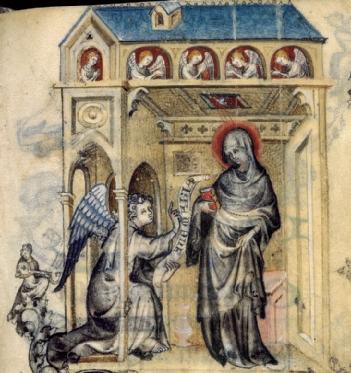
■ Annunciation to Mary The archangel Gabriel announces to the Virgin Mary that she will miraculously conceive and give birth to God’s son, Jesus.
■ Visitation The pregnant Mary visits her cousin elizabeth, who is pregnant with John the baptist. elizabeth is the first to recognize that the baby Mary is bearing is the Son of God.
■ Nativity, Annunciation to the Shepherds, and Adoration of the Shepherds Jesus is born at night in bethlehem and placed in a basket. Mary and her husband, Joseph, marvel at the newborn, while an angel announces the birth of the Savior to shepherds in the field, who rush to adore the infant Jesus.
■ Adoration of the Magi A bright star alerts three wise men (magi) in the east that the King of the Jews has been born. They travel 12 days to present precious gifts to the infant Jesus.
■ Presentation in the Temple In accordance with Jewish tradition, Mary and Joseph bring their firstborn son to the temple in Jerusalem, where the aged Simeon recognizes Jesus as the prophesied savior of humankind.
■ Massacre of the Innocents and Flight into Egypt King Herod, fearful that a rival king has been born, orders the massacre of all infants, but the holy family escapes to egypt.
■ Dispute in the Temple Joseph and Mary travel to Jerusalem for the feast of Passover. Jesus, only a boy, debates the astonished Jewish scholars in the temple, foretelling his ministry.
Public ministry
The public-ministry cycle comprises the teachings of Jesus and the miracles he performed.
■ Baptism Jesus’s public ministry begins with his baptism at age 30 by John the baptist in the Jordan river. God’s voice is heard proclaiming Jesus as his son.
■ Calling of Matthew Jesus summons Matthew, a tax collector, to follow him, and Matthew becomes one of his 12 disciples, or apostles (from the Greek for “messenger”).
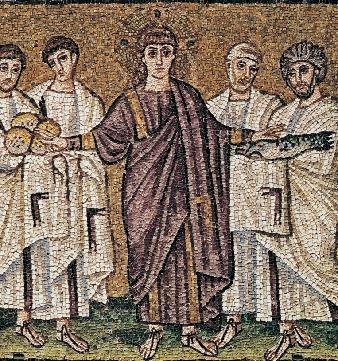
■ Miracles Jesus performs many miracles, revealing his divine nature. These include acts of healing and raising the dead, turning water into wine, walking on water and calming storms, and creating wondrous quantities of food.
■ Delivery of the Keys to Peter Jesus chooses the fisherman Peter (whose name means “rock”) as his successor. He declares that Peter is the rock on which his church will be built and symbolically delivers to Peter the keys to the kingdom of Heaven.
■ Transfiguration Jesus scales a mountain and, in the presence of Peter and two other disciples, is transformed into radiant light. God, speaking from a cloud, discloses that Jesus is his son.
■ Cleansing of the Temple Jesus returns to Jerusalem, where he finds money changers and merchants conducting business in the temple. He rebukes them and drives them out.
Annunciation, by Jean Pucelle, ca. 1325–1328
Miracle of Loaves and Fishes, Sant’Apollinare Nuovo, Ravenna, Italy, ca. 504
Passion
The passion (Latin passio, “suffering”) cycle includes the events leading to Jesus’s trial, death, resurrection, and ascent to Heaven.
■ Entry into Jerusalem on the Sunday before his Crucifixion (Palm Sunday), Jesus rides into Jerusalem on a donkey.
■ Last Supper In Jerusalem, Jesus celebrates Passover with his disciples. During this last supper, Jesus foretells his imminent betrayal, arrest, and death and invites the disciples to remember him when they eat bread (symbol of his body) and drink wine (his blood). This ritual became the celebration of Mass (Eucharist).
■ Agony in the Garden Jesus goes to the Mount of olives in the Garden of Gethsemane, where he struggles to overcome his human fear of death by praying for divine strength.
■ Betrayal and Arrest The disciple Judas Iscariot betrays Jesus to the Jewish authorities for 30 silver coins. Judas identifies Jesus to the soldiers by kissing him, and Jesus is arrested.
■ Trials of Jesus The soldiers bring Jesus before Caiaphas, the Jewish high priest, who interrogates Jesus about his claim to be the Messiah. Jesus is then brought before the roman governor of Judaea, Pontius Pilate, on the charge of treason because he had proclaimed himself king of the Jews. Pilate asks the crowd to choose between freeing Jesus or barabbas, a murderer. The people choose barabbas, and the judge condemns Jesus to death.
■ Flagellation The roman soldiers who hold Jesus captive whip (flagellate) him and mock him by dressing him as king of the Jews and placing a crown of thorns on his head.
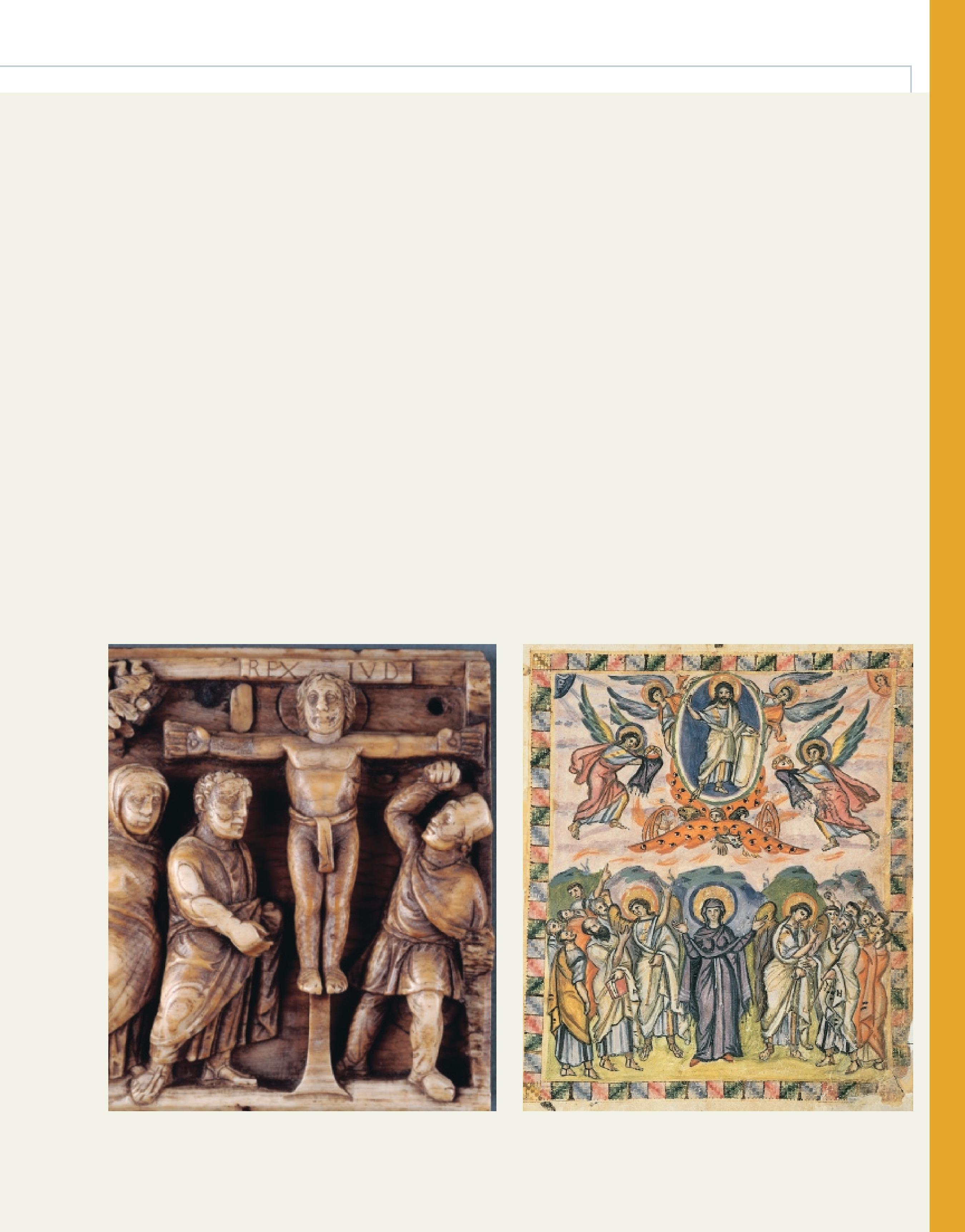
■ Carrying of the Cross, Raising of the Cross, and Crucifixion The romans force Jesus to carry the cross on which he will be crucified
from Jerusalem to Mount Calvary. Soldiers erect the cross and nail Jesus’s hands and feet to it. Jesus’s mother, John the evangelist, and Mary Magdalene mourn at the foot of the cross, while the soldiers torment Jesus. one of them stabs Jesus in the side with a spear. After suffering great pain, Jesus dies on Good friday.
■ Deposition, Lamentation, and Entombment Two disciples, Joseph of Arimathea and Nicodemus, remove Jesus’s body from the cross (Deposition) and take him to his tomb. Joseph, Nicodemus, the Virgin Mary, John the evangelist, and Mary Magdalene mourn over the dead Jesus (Lamentation). (When in art the isolated figure of the Virgin Mary cradles her dead son in her lap, it is called a Pietà—Italian for “pity.”) Then his followers lower Jesus into a sarcophagus in the tomb (entombment).
■ Resurrection and Three Marys at the Tomb on the third day (easter Sunday), Christ rises from the dead and leaves the tomb. The Virgin Mary, Mary Magdalene, and Mary, the mother of James, visit the tomb but find it empty. An angel informs them that Jesus has been resurrected.
■ Noli Me Tangere, Supper at Emmaus, and Doubting of Thomas During the 40 days between Christ’s resurrection and his ascent to Heaven, he appears on several occasions to his followers. Christ warns Mary Magdalene, weeping at his tomb, with the words “Don’t touch me” (Noli me tangere in Latin). At emmaus he eats supper with two astonished disciples. Later, Christ invites Thomas, who cannot believe Christ has risen, to touch the wound in his side inflicted at his Crucifixion.
■ Ascension on the 40th day, on the Mount of olives, with his mother and apostles as witnesses, Christ gloriously ascends to Heaven in a cloud.
Ascension of Christ, Rabbula Gospels, 586
Crucifixion, ivory plaque, Italy, early fifth century
reli G ion an D MY tholo GY
early christian saints and their attributes
A distinctive feature of Christianity is the veneration accorded to saints (from the Latin word for “holy”—sanctus), a practice dating to the second century. Most of the earliest Christian saints were martyrs who died for their faith at the hands of the roman authorities, often after suffering cruel torture. During the first millennium of the Church, the designation of sainthood, or canonization, was an informal process, but in the late 12th century, Pope Alexander III (r. 1159–1181) ruled that only the papacy could designate individuals as saints, and only after a protracted review of the life, character, deeds, and miracles of the person under consideration. A preliminary stage is beatification, the official determination that a deceased individual is a beatus (blessed person).
In Christian art, saints almost always have halos around their heads. To distinguish individual saints, artists commonly depicted them with one or more characteristic attributes—often the means of their martyrdom, although saintly attributes take a wide variety of forms.
The most important saints during the early centuries of Christianity were contemporaries of Jesus. They may be classified in three general categories.
Family oF Jesus and mary
■ Anne The parents of the Virgin Mary were Anne and Joachim, a childless couple after 20 years of marriage. Angels separately announced to them that Anne would give birth.
■ Elizabeth A cousin of Anne, elizabeth was also an older barren woman. The angel Gabriel announced to her husband, the priest Zacharias, that she would give birth to a son named John. Six months later, Gabriel informed Mary that she would become the mother of the son of God (Annunciation), whereupon Mary visited elizabeth (Visitation), and in elizabeth’s womb the future John the baptist leaped for joy at the approach of the Mother of God.
■ Joseph Although a modest craftsman, Joseph was a descendant of King David. An elderly widower, he was chosen among several suitors to wed the much younger Mary when his staff miraculously blossomed. Joseph’s principal attributes are the flowering staff and carpentry tools.
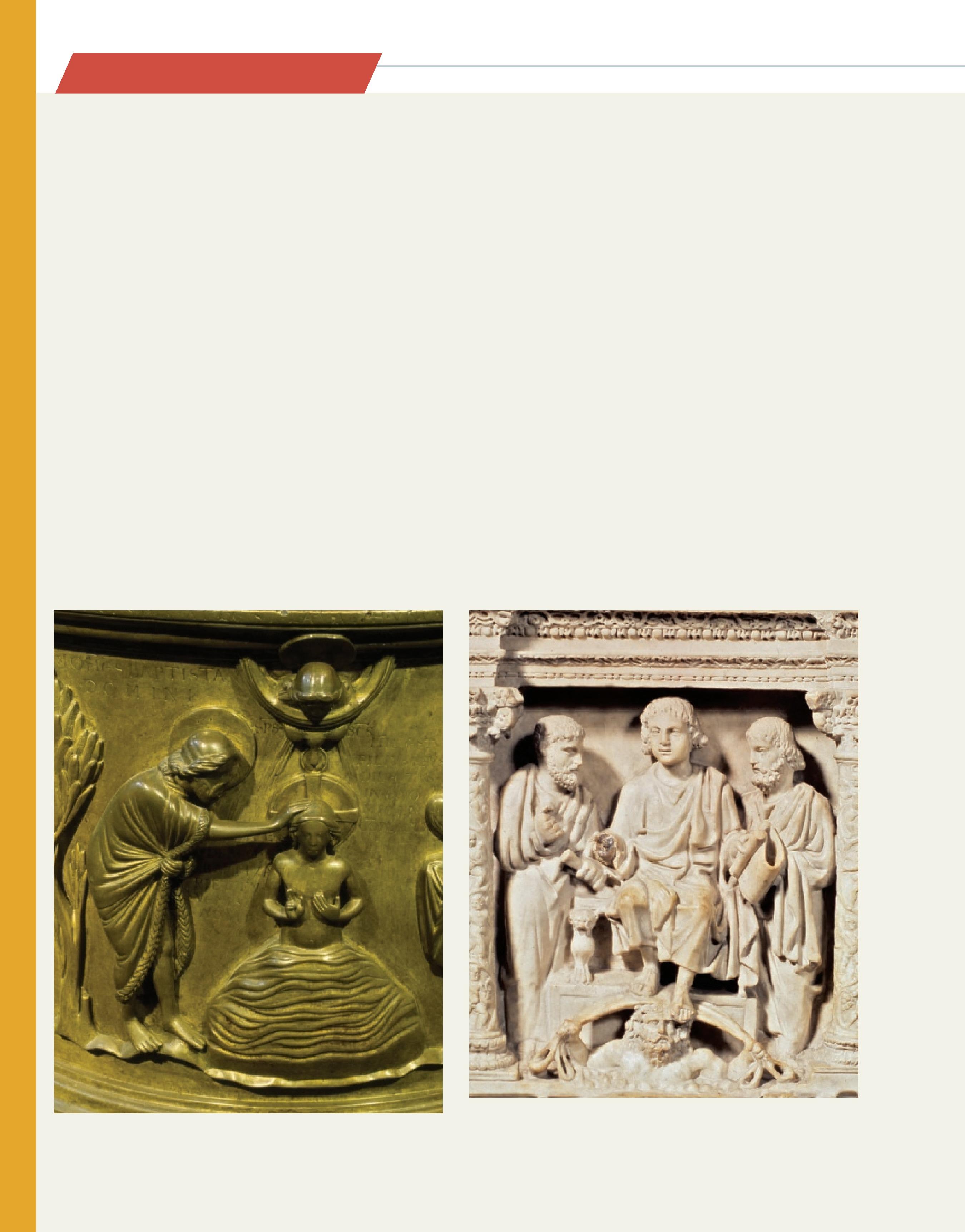
■ John the Baptist elizabeth’s son, John, became a preacher who promoted baptism as a means of cleansing Jews of their sins in preparation for the Messiah. John most often appears in art as a bearded hermit baptizing a much younger Jesus in the Jordan river, even though John was only six months older. His attribute is a lamb.
aPostles
During the course of his ministry, Jesus called 12 men to be his apostles, or messengers, to spread the news of the coming of the son of God. All 12 apostles were present at the Last Supper. After Judas’s betrayal and suicide, the remaining 11 witnessed Jesus’s Ascension and chose another follower of Jesus to replace Judas. At the Pentecost, the Holy
John the Baptist baptizing Jesus, Liège, Belgium, 1118
Christ between Saints Peter and Paul, Sarcophagus of Junius Bassus, Rome, ca. 359
Spirit assigned the 12 apostles the mission of spreading the Gospel throughout the world. All but John the evangelist eventually suffered martyrdom. four of the apostles figure prominently in the history of art.
■ Peter The “prince of apostles,” Peter was a fisherman whom Jesus designated as the rock on which he would found his Church. The Savior presented the apostle with the keys to the kingdom of Heaven. Peter was the first bishop of rome and the head of the long line of popes. He was crucified upside down because he insisted that he was unworthy to die as Jesus did. Peter’s chief attributes are the keys.
■ John the Evangelist Another fisherman, John was the youngest apostle and “the disciple whom Jesus loved.” He was one of two apostles who became evangelists—those who recorded Jesus’s life in the Gospels. John also wrote the book of revelation. His attribute is an eagle.
■ Matthew The second evangelist among the apostles, Matthew was a Jewish tax collector. Different accounts say that he was either stabbed to death or beheaded while saying Mass. Matthew appears most frequently in art as a seated robed figure writing his Gospel. His attribute is a winged man.
■ James The brother of John the evangelist and also a fisherman, James was the first apostle to be martyred—by beheading. According to tradition, before his martyrdom he preached the Gospel in Spain. James’s attribute is a scallop shell, the emblem of pilgrims to his shrine at Santiago de Compostela.
other early saints
Several other saints who died before Constantine ended the persecution of Christians have also frequently been the subjects of artworks:
■ Paul born a Jew named Saul, Paul fervently opposed Christian teaching until Christ spoke to him in a blinding burst of light. Paul became the “Apostle to the Gentiles,” preaching the Gospel to non-Jews as well as Jews. His Epistles are the foundation of Christian theology. In early Christian art, he holds a scroll and often appears with Peter flanking Christ, although, unlike the original apostles, Paul never met Jesus. In later representations he may hold the sword of his martyrdom.
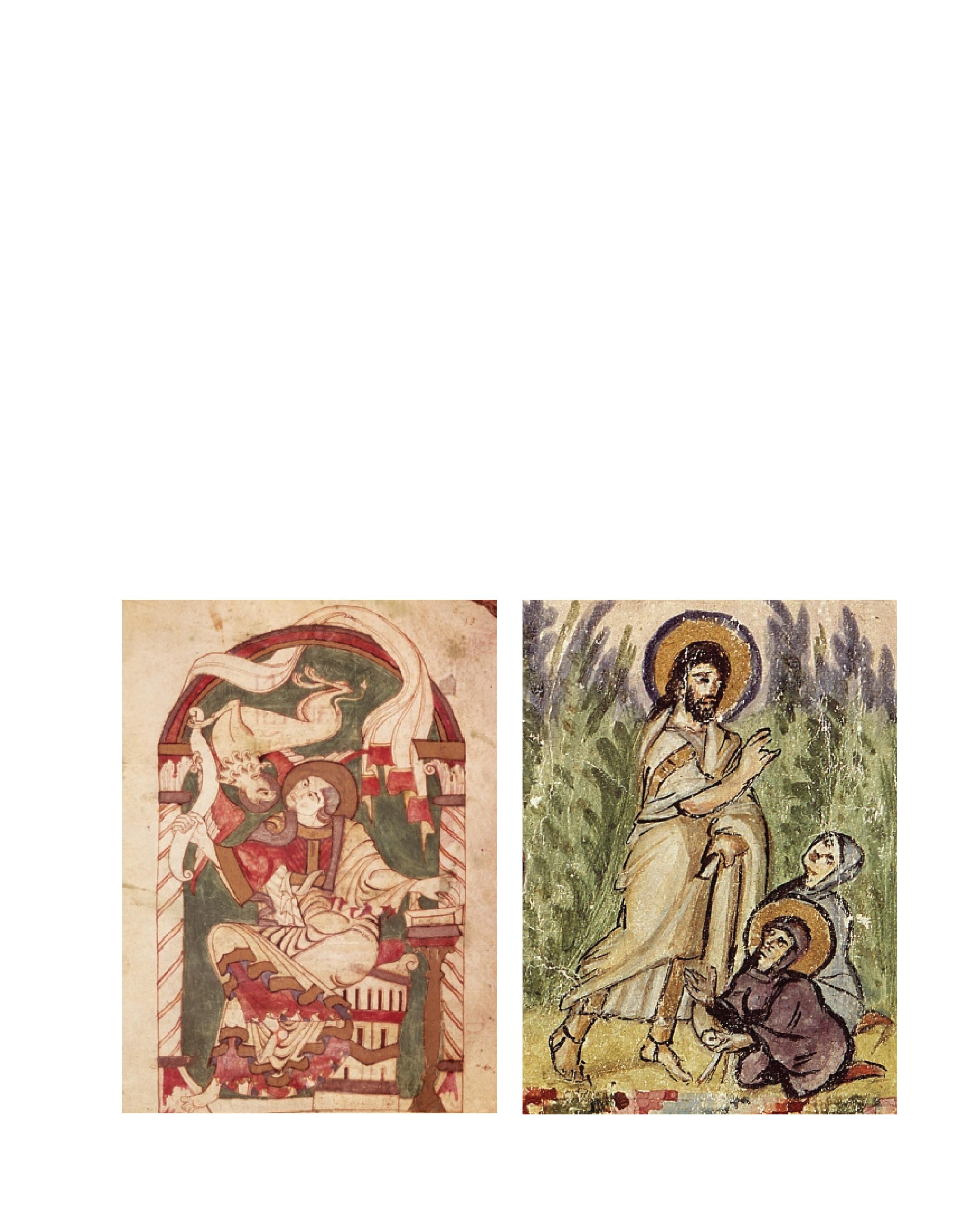
■ Mark one of the two evangelists who were not apostles, Mark accompanied Paul on his earliest missionary journey and became the first bishop of Alexandria, where he was martyred by being dragged with a rope around his neck. The Venetians acquired Mark’s remains in 828. The saint’s attribute—a lion—is the emblem of Venice to this day.
■ Luke A Gentile physician in addition to being a Gospel author, Luke painted a portrait of Mary and the infant Jesus, and consequently became the patron saint of artists as well as doctors. His attribute is an ox.
■ Mary Magdalene born in Magdala on the Sea of Galilee, Mary Magdalene washed Jesus’s feet with her tears and dried them with her hair. She was the first to discover Christ’s empty tomb and to encounter the resurrected Savior. Mary’s major attribute is her long hair.
Mark, with his lion, writing his Gospel, Corbie Gospels, ca. 1120
Mary Magdalene and the resurrected Christ, Rabbula Gospels, 586
reli G ion an D MY tholo GY
buddhism and buddhist iconography
The buddha (enlightened one) was born around 563 bce as Prince Siddhartha Gautama. When he was 29, he renounced his opulent life and became a wandering ascetic searching for knowledge through meditation. Six years later, he achieved complete enlightenment, or buddhahood, while meditating beneath a pipal tree (the bodhi tree) at bodh Gaya (place of enlightenment) in eastern India. The buddha preached his first sermon in the Deer Park at Sarnath. There he set into motion the Wheel (chakra) of the Law (dharma) and expounded the four Noble Truths: (1) life is suffering; (2) the cause of suffering is desire; (3) one can overcome and extinguish desire; (4) the way to conquer desire and end suffering is to follow the buddha’s eightfold Path of right understanding, right thought, right speech, right action, right livelihood, right effort, right mindfulness, and right concentration. The buddha’s path leads to nirvana, the cessation of the endless cycle of painful life, death, and rebirth. The buddha continued to preach until his death at age 80 at Kushinagara.
The earliest form of buddhism is called Theravada (Path of the elders) buddhism. The second major school of buddhist thought, Mahayana (Great Path) buddhism, emerged around the beginning of the Christian era. Mahayana buddhists refer to Theravada buddhism as Hinayana (Lesser Path) buddhism and believe in a larger goal than nirvana for an individual—namely, buddhahood for all. Mahayana buddhists also revere bodhisattvas (buddhas-to-be), exemplars of compassion who restrain themselves at the threshold of nirvana to aid others in earning merit and achieving buddhahood. A third important buddhist
sect, especially popular in east Asia, venerates the Amitabha buddha (Amida in Japanese), the buddha of Infinite Light and Life. The devotees of this buddha hope to be reborn in the Pure Land Paradise of the West, where the Amitabha resides and can grant them salvation.
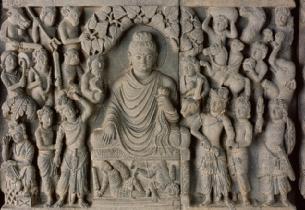
The earliest (first century ce) known depictions of the buddha in human form show him as a robed monk. Artists distinguished the enlightened one from monks and bodhisattvas by lakshanas, body attributes indicating the buddha’s suprahuman nature. These distinguishing marks include an urna, or curl of hair between the eyebrows; an ushnisha, or cranial bump; and, less frequently, palms of hands and soles of feet imprinted with a wheel. The buddha is also recognizable by his elongated ears, the result of wearing heavy royal jewelry in his youth.
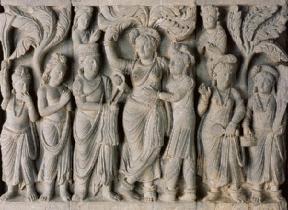
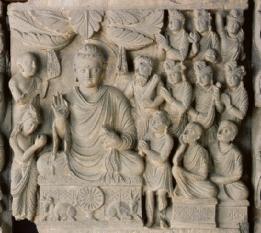
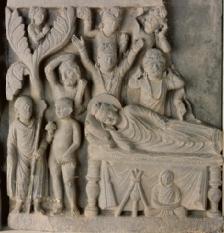
representations of the buddha also feature a repertory of mudras, or hand gestures. These include the dhyana (meditation) mudra, with the right hand over the left, palms upward; the bhumisparsha (earthtouching) mudra, right hand down reaching to the ground, calling the earth to witness the buddha’s enlightenment; the dharmachakra (Wheel of the Law, or teaching) mudra, a two-handed gesture with right thumb and index finger forming a circle; and the abhaya (do not fear) mudra, right hand up, palm outward, a gesture of protection or blessing. episodes from the buddha’s life are among the most popular subjects in all buddhist artistic traditions. four of the most important events are his birth at Lumbini from the side of his mother; his achievement of buddhahood while meditating beneath the bodhi tree; his first sermon at Sarnath; and his attainment of nirvana when he died (parinirvana) at Kushinagara.
Life and death of the Buddha, from Gandhara, second century. (a) Birth at Lumbini, (b) enlightenment at Bodh Gaya, (c) first sermon at Sarnath, (d) death at Kushinagara (parinirvana)