ediTOrial cONveNTiONs
Throughout I have distinguished the East India Company by referring to it as the Company, with an initial capital.
Warships are distinguished by their number of guns, e.g. (60), after the name; merchant ships of the Company by their tonnage, e.g. (600).
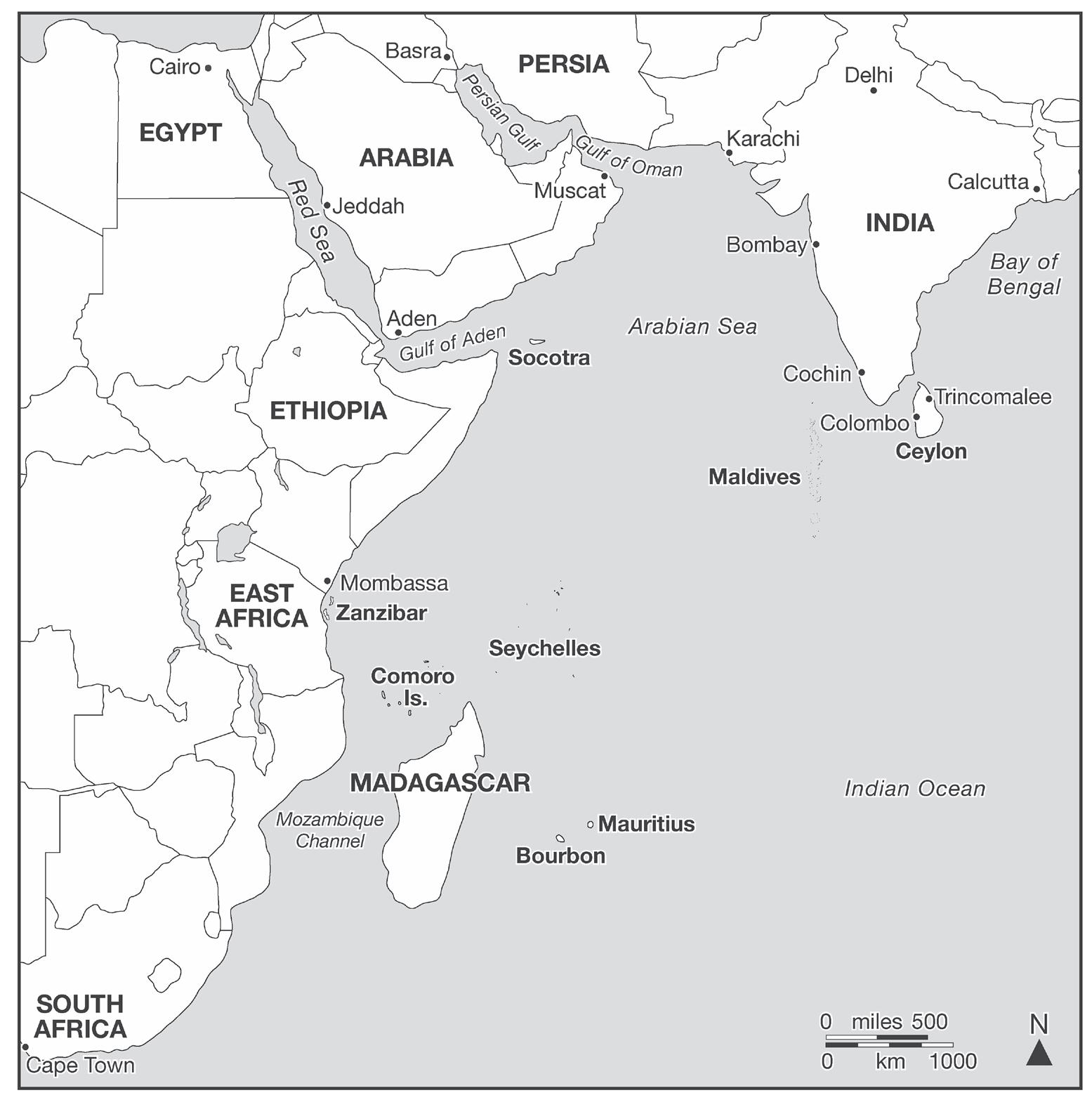
Map 1. The Western Indian Ocean.
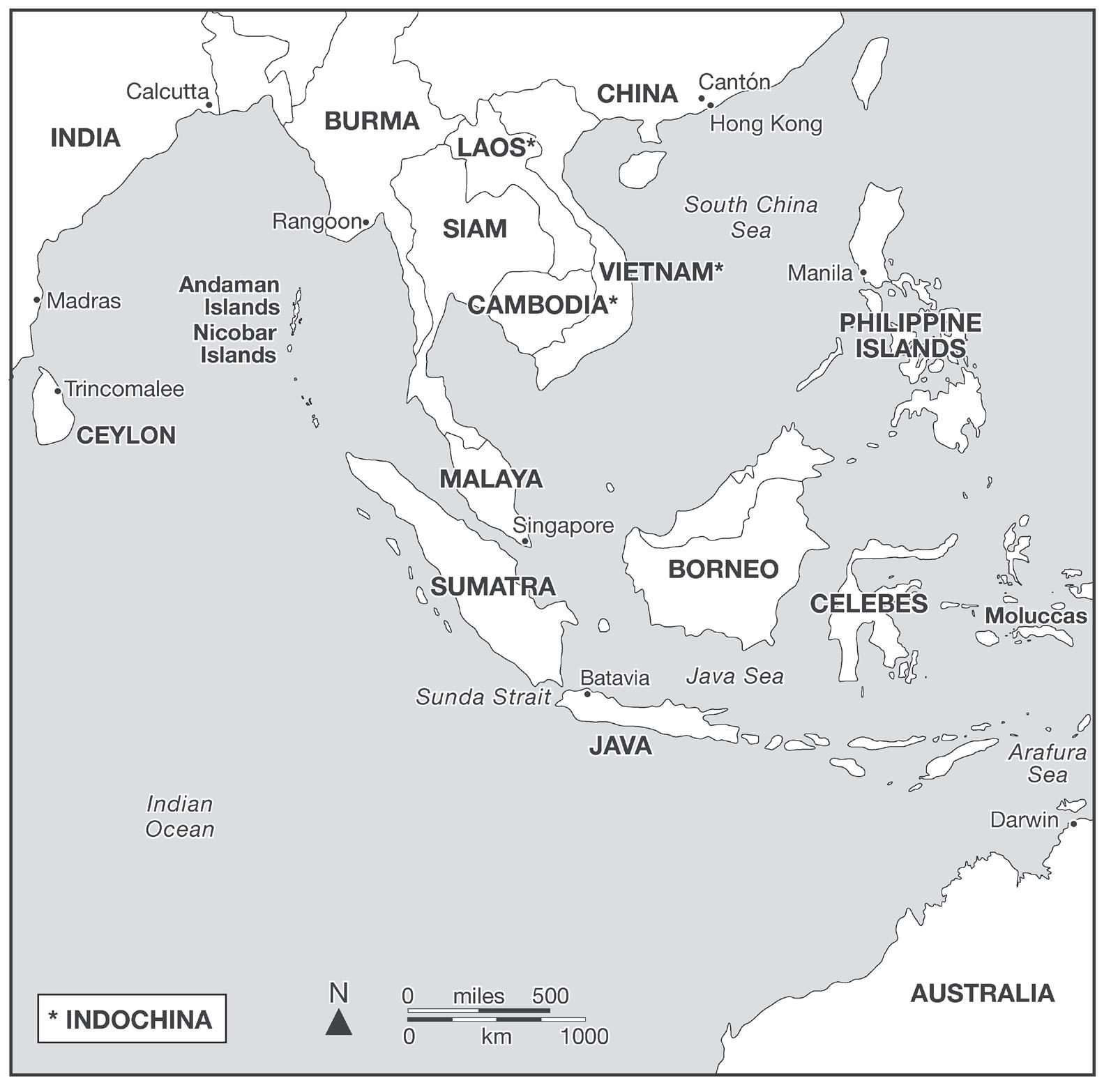
Map 2. The Eastern Indian Ocean.
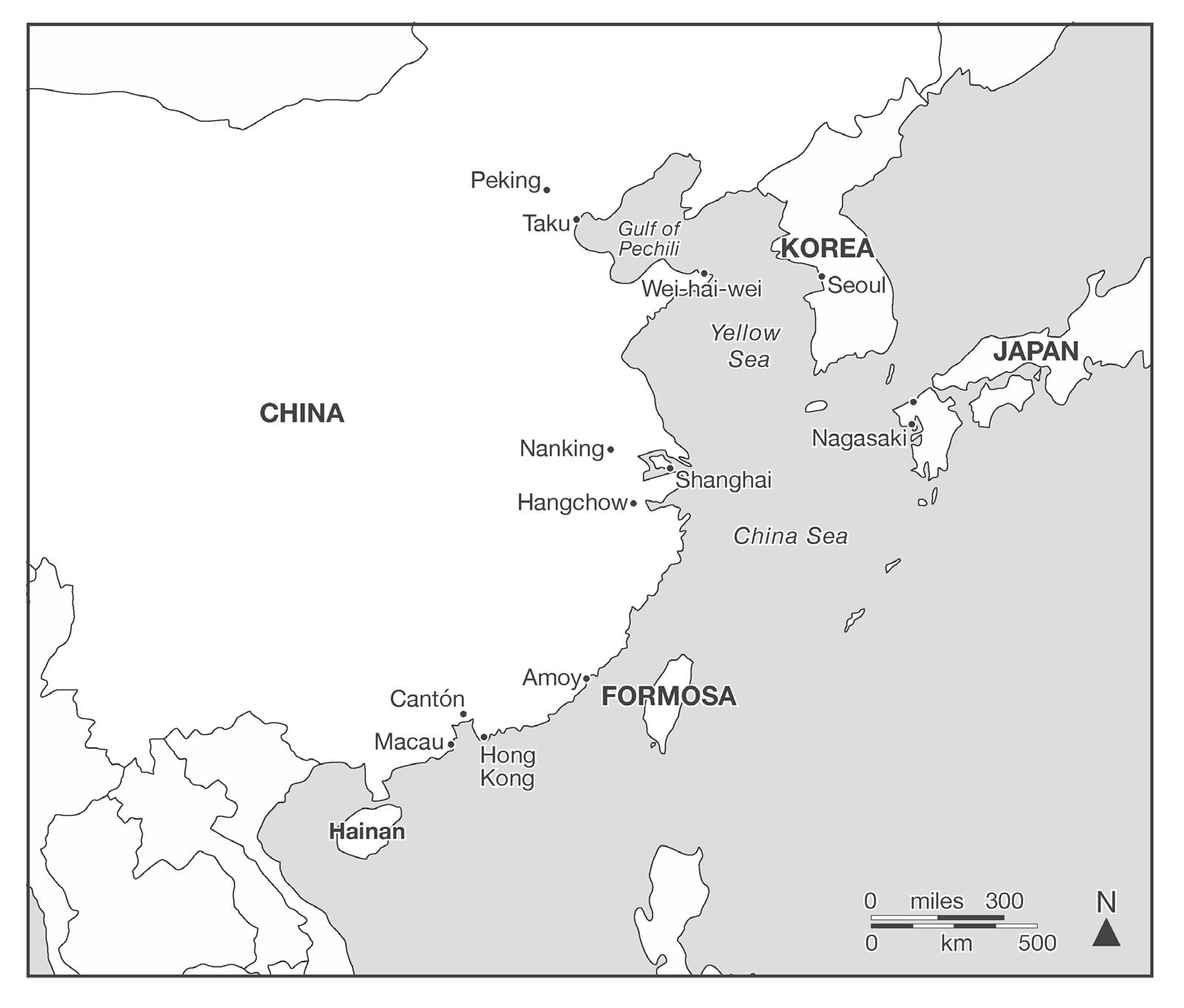
Map 3. The South China Sea.
Introduction
The subject of this book is the activities of the British Royal Navy in the Indian and the western Pacific Oceans, that is, in over half the world, from the Cape of Good Hope to China and Japan. Neither of these oceans and the lands they gave access to were known to European before the ‘Age of Discoveries’, though they were well enough known to many inhabitants of these regions, and certainly rumours and hints had reached Europeans of their existence. It was, of course, difficult for any European ships to penetrate into these oceans even in the century or so after the initial Portuguese explorations had reached them. This was in contrast to the accessibility of the contemporary revelation of the American continents, which seemed to be, by comparison, relatively easy to reach. It was clearly possible for English, French, and Dutch ships to get across the Atlantic and to interrupt Spanish activities in the Caribbean, and perhaps in West Africa and Brazil, but to reach the Pacific Ocean or the Indian Ocean required a voyage of years, far more courage and endurance, and a greater financial investment, than was involved in sailing to the east coast of America. It was not at first known whether this could be done at all. Vasco da Gama, following Bartholomew Diaz and a long list of earlier Portuguese sailors, reached the Indian Ocean in 1498. The Portuguese had been moving slowly down the coast of Africa for a century before then, and had established a precarious control over the coast and its trade from Morocco southwards.1 They had even established a presence on the coast of eastern South America – Brazil –discovered in about 1500, and were gaining some control there. They did not wish any other Europeans to interfere with the profits they had been making in the Indian and Spice Island trades, any more than the Spaniards wanted others to interfere in the Caribbean. The two states had a treaty to that effect, ratified by the Pope, though no other country recognised it. Nonetheless this was the foundation of their empires. When other Europeans’ ships actually reached the Indian Ocean, they found that the main ports were already under Portuguese control – though there were always other ports which they could use.2
1 J.W. Blake, European Beginnings in West Africa, 1454–1578, London 1937; Peter Russell, Prince Henry ‘the Navigator’: A Life, New Haven 2000; C.R. Boxer, The Portuguese Seaborne Empire 1415–1825, London 1969; Eric Axelson, Congo to Cape: Early Portuguese Explorations, London 1973.
2 R.S. Whiteway, The Rise of the Portuguese Power in India, 2nd ed., London 1967; Sanjay Subrahmanyam, Improvising Empire: Portuguese Trade and Settlement in the Bay of Bengal, 1500–1700, Delhi 1990.
Equally, to reach the Pacific by sailing westwards one had first of all to evade the Spaniards and the Portuguese, and then find a way round the long American double-continent. Numerous attempts sent out from Britain had failed in searching for a North-West Passage north of America, or a North-East Passage north of Asia, so the only recourse was to go south, where a passage through the American continent did exist, known since the time of Magellan, and another, somewhat easier, in the Southern Ocean, past Cape Horn. But the passages were fearfully difficult, the Cape Horn Passage was the scene of great storms, and the Magellan route led into the largest ocean in the world, where the prevailing winds and currents perversely took ships clear of all, or almost all, the islands where refreshment could be obtained.3
For a century after the discoveries of the 1490s and after, therefore, the Spaniards and the Portuguese largely had these oceans to themselves, without any serious interruption to their trading and conquering from other Europeans. But it was this very success in trading and conquering (and looting) which alerted other Europeans to the possibilities of also getting rich. Mexican and Peruvian silver, spices from the Indonesian islands, riches from India and Japan and China – all these were quite sufficient temptation for European sailors to risk the wrath of Spain and Portugal, a long voyage in an unhealthy ship, and the strong possibility of death at any time, from disease, battle, storm, or starvation.
And so the first English sailor to reach the Pacific, Francis Drake, did so with the express intention of looting his way along the Spanish coast of western America, and the first English expedition into the Portuguese Indian Ocean, commanded by James Lancaster, fought his way into that ocean, attacking Portuguese ships wherever he found them.4 The cost of such behaviour as it turned out, was very great, in sailors’ lives and in ships: although Drake returned rich, Lancaster did not. Between them they lost six ships and the great majority of their crews. And yet it was Lancaster’s voyage, and its apparent failure, which was the inspiration for the next stage in the British exploitation of eastern waters. The real value of these two voyages, and the circumnavigation by Thomas Cavendish in the 1580s, was to show that the voyages could be done, even at great cost, and, by returning, they brought back valuable information about the oceans and the lands surrounding them.
Cavendish had set out to emulate Drake, which he did as far as the Pacific coast of Mexico. There he captured the Manila Galleon, released the crew, and took his pick of the cargo before burning the ship. He also kept a few of the galleon’s passengers, two Japanese, a Filipino, and the Spanish pilot, and took them back across the Pacific. He travelled by a more northerly route than
3 Magellan’s voyage was the archetype; most later voyagers followed his route and suffered much the same fate; J.C. Beaglehole, The Exploration of the Pacific, 3rd ed., London 1966, ch. 2; O.H.K. Spate, The Spanish Lake, Minneapolis 1979.
4 See chapter 1.
Drake, reached and refreshed at Guam Island, inspected the Philippines, and returned home, like Drake, by way of the Indian Ocean. Between them these three voyages had revealed several possible routes of entry into the two oceans for their successors to follow.
Drake, Lancaster, and Cavendish were not, of course, in the Royal Navy, if such a term can be used at this time, though the first two fought against the Armada in 1588. And yet all these voyages did have a semi-official air about them, as Drake’s reception and knighting by Queen Elizabeth at Greenwich on his return demonstrated; the follow-up to Lancaster’s voyage, more productively, was the foundation of the East India Company, which, like Drake’s exploit, was a semi-official organisation from the time it received its Royal Charter, through which the Company claimed a monopoly on trade by the English in its chosen region. This was granted by the English government, and the Company was linked very closely with the foreign affairs of England, and later Britain, from the start – Spain and Portugal (linked in a single monarchy at the time) were active enemies in these years. Indeed, the Company later became an actual and overt official organ of the British government, which only emphasised the situation as it already existed, but hardly changed it. It seems therefore reasonable to begin this account with these three men’s voyages (chapter 1). Their successors, as did these men, used their guns to gain access to trade which was blocked, where possible, by the Portuguese.
Between them these men had revealed the broad outlines of the Pacific and Indian Oceans, located some of the best places for acquiring goods, notably silks, cottons, and spices. Putting the stories of the voyages together, as did Richard Hakluyt in his Principal Navigations, 5 it was possible for the keen merchant, or an intelligent sailor, to understand the basic weather patterns and currents of the oceans, and to locate the most favourable time of year to sail, the best routes to follow, and the best trading places to which to sail.
For a century after these early voyages, therefore, the primary English presence in eastern waters was that of the ships and traders of the East India Company, which had to fight its own battles against Indians, Japanese, Chinese, Portuguese, and Dutch enemies, against pirates and empires, as well as against ‘interlopers’ and rivals from Britain itself. At the same time its men were seeking, or fighting, to maintain its fragile monopoly of trade between England and the Indian Ocean countries. Only after all this did a decisive change in its organisation, and in the attitude of the British government, led it into less dangerous waters. This coincided with the union of England and Scotland to form the United Kingdom, not really accidentally. In the meantime, the Company fell into conflict with yet other enemies, above all the French, but also with Indian powers. The increasing inter-mixture of Company and government in the eighteenth century led inevitably in the end to the Company’s subordina-
5 Richard Hakluyt, The Principal Navigations of the English Nation, Glasgow 1904; the continuation is Samuel Purchas, His Pilgrims, Glasgow 1905–1906.
tion to the British government; by that time they were both imperial powers, and during the next half-century and more the Company’s purpose gradually shifted away from commerce to the problems of ruling its conquests. The Company had repeatedly to adapt itself to new and changing conditions from its very beginning, both at home and in the east, and its own activities helped to bring those changes about.
The Company had necessarily been a naval power from the start, and as such, and as a pseudo-agent of the English state, then the United Kingdom, it earns its place as a precursor in eastern waters of the British Royal Navy.
The result of the gradual series of changes which the Company underwent is that the naval history of Britain in the east is a similar gradual evolution from isolated exploratory campaigns (by Drake and Lancaster). It began with the Company’s early, similarly isolated, exploits, then to the Company as a naval power, through its great trading ships and its Bombay Marine, and finally, by way of the Royal Navy rendering assistance to the Company, to the Indian Navy, which, like the Bombay Marine, was always subsidiary to the Royal Navy. This gradual alteration follows the adaptations by the Company, and is reflected in the organisation of this book, in which the East India Company, the Bombay Marine, the Royal Indian Navy, and the Royal Navy must be seen as a continuous sequence of overlapping naval powers and activities, active from the Tudor period to the achievement of Indian independence, and from St Helena in the South Atlantic to Alaska and Chile in the ‘eastern waters’ of the Pacific – and with a continuing, if fairly minor, presence and activity in these waters to this day.
The Company’s Early Struggles (1600–1625)
The great circumnavigation voyage of Francis Drake between 1577 and 1580 took him across the Pacific to the Spice Islands, then across the Indian Ocean to South Africa, and north along the length of the Atlantic to triumph and a knighthood at Greenwich, with his one remaining ship ballasted and loaded with gold and spices. This was the first seaman-like view of the Pacific and Indian Oceans by an English captain. The first voyage of James Lancaster between 1591 and 1594 went in the opposite direction, south along the length of the Atlantic, round the Cape of Good Hope, into the Indian Ocean and across to Indonesia, returning much the same way. It produced no wealth, and came back with a small sickly crew in a ruined ship, though Lancaster did gain a knighthood eventually. Drake had lost four out of his original five ships one way and another; Lancaster’s voyage started with three ships and ended with one. And yet, despite the contrast in their immediate fortunes, there was no follow-up to Drake’s voyage, other than some looting expeditions which were less than successful, and Cavendish’s circumnavigation, which was useful and profitable. Lancaster’s voyage, on the other hand, was the origin of one of the most remarkable and successful commercial ventures in world history, for it led to the formation of the East India Company. Drake had followed Magellan’s route to Patagonia, then through the Strait which his predecessor had discovered, north along the Spanish South American Pacific coast, looting and burning towns, capturing ships, and filling his hold with stolen wealth. This part of the voyage was in relatively familiar territory by this time, as his activities showed. If he is to be credited with an exploratory voyage, it was only after Mexico that he found anything new. He careened his ship somewhere on the upper Californian coast, possibly near San Francisco Bay (which he missed), and from there struck out across the Pacific for the Spice Islands, which he located by an admirable feat of navigation. He started this Pacific crossing further north than the Spanish ships usually did, and sailed by the trade wind route, briefly calling at the Palau Islands, and then at Mindanao in the Philippines. He made no wholly new discoveries in that island-littered Ocean. He investigated the Portuguese and Spanish positions in the Spice Islands, made friendly contact with the Sultan of Ternate, and secured a cargo of spices. Then he struck out directly across the Indian Ocean for South Africa. In navigational terms this was a remarkable voyage,
for he reached his Indonesian and African destinations with no difficulty at all, but then he was travelling in worn paths from the Philippines onwards.1
Lancaster set out over a decade after Drake had returned, but his purpose was to investigate trading conditions in a particular region of the world, the Indian Ocean. Like Drake any new discoveries he made were quite inadvertent. Drake may have attacked any Spanish ship he came across and sacked Spanish towns, so that since England and Spain were at peace during his voyage he was necessarily classified as a pirate. Lancaster sailed once the war between England and Spain/Portugal had broken out (he had fought in the Armada campaign), and he was therefore entitled to attack any Spanish or Portuguese ship he met, and he did so. He did not necessarily seek them out, but rather seized the opportunity to loot them when they came into his view. He also, in some desperation for want of food, attacked some Arab ships he came across.
Drake’s exploit had firmly pinned the Spice Islands onto the map as known in England, and he had discovered something of the methods of trade by which he and other interlopers into this Portuguese private domain could acquire spices. Lancaster’s voyage went into more detail about the Indian Ocean, even though his outward voyage was accomplished only by a series of mistakes. He sailed round the Cape of Good Hope and north through the Mozambique Passage between the mainland and Madagascar, which later became the favoured route for English ships heading for India and Arabia and Iran. After a call for refreshment and repairs at Zanzibar he followed the East African coast almost to Socotra Island before catching a north-west wind. He missed India and Ceylon, though he had intended to waylay any Portuguese ships off the southern point of Ceylon; instead he sailed directly east towards Sumatra. He visited Malaya and Acheh in northern Sumatra, and in Acheh he found a cheerful sultan willing to trade. He captured and looted several Portuguese vessels, one of them very large. His aim all along was to seize Portuguese ships and their cargoes rather than seek out a cargo to purchase. The fact that the sultan of Acheh was willing to trade seems to have been a lucky accident.2 The circumnavigation by Thomas Cavendish (1586–1588) had added more useful information about the Philippines than Drake had supplied, and discovered a good deal about Japan and China as well; both Chinese and Japanese ships and merchants were present in the Philippines; he had also taken a Japanese sailor from a Spanish ship captured near Mexico back across the Pacific.3 Between them these three – Drake, Cavendish, and Lancaster – had collectively revealed to English merchants’ eyes a good deal of the possibilities of trade in the Indian Ocean region in many other goods besides spices. They
1 Kenneth R. Andrews, Drake’s Voyages, London 1967, ch. 4, with a listing of sources on p. 75; also G.M. Thomson, Sir Francis Drake, London 1972, ch. 10.
2 Michael Franks, The Basingstoke Admiral: A Life of Sir James Lancaster, Salisbury 2006, 64–77; Bailey W. Diffie and George D. Winnow, Foundations of the Portuguese Empire, 1415–1580, Minneapolis 1977.
3 Sir William Foster, England’s Quest of Eastern Trade, London 1933, ch. 11.
were travelling through a busy and well-populated trading area, where not just the Portuguese, but many other peoples were actively sailing and trading. It was the Portuguese, however, who were the main problem, for they claimed the exclusive right of trading by Europeans along the ocean’s coasts, while at the same time enforcing their control over local Asian trading.
It is worth remembering that even the Portuguese were late-comers to Indian Ocean navigation. The ‘secret’ of the monsoon climatic regime had been ‘discovered’ by Greek sailors in the second century BC, though in fact, like the Europeans later, their discovery was actually the realisation that Arab and Indian sailors were utilising the monsoon winds. Throughout the centuries since then trading voyaging had been constant, by every community along the shores of the ocean, from local fishing to trans-ocean expeditions.4 Even the Chinese had come to be involved in the first half of the fifteenth century, characteristically sending enormous expeditions which the emperors fondly believed were establishing Chinese supremacy, though they were forgotten by the locals as soon as the ships returned to China. Since they gave out presents and accepted ‘tribute’, the voyages were expensive and could easily be discontinued; this was no way to establish a permanent presence or interest in the Indian Ocean where the basis of relationships was trade. The voyages were abruptly discontinued in 1433, and had no long-term effect.5
Lancaster discovered that the Portuguese had built themselves a powerful position in India and further east based on their sea power. In the Indonesian area their centre was at Malacca (Melaka), from which their ships could reach most of the islands, and north to the Chinese coast and on to Japan. In India Goa was the seat of their viceroy, and from there they operated a system of aiming to control all seaborne traffic in the Indian Ocean – or as much as they could reach. Their posts, from East Africa, where Mombasa was their centre, along with Sofala in Mozambique, to the Moluccas, were collectively the Estado da India. The system was the forced selling of cartazes, passports whose possession supposedly guaranteed the possessor against theft, piracy, and looting, at least by Portuguese ships.6 This had become the major source of the Estado’s revenues, alongside profits from trade. Besides Goa, the Estado included several port cities along the Indian western coast.7 In many ways the later Europeans – the Dutch and English particularly – followed the Portuguese both in their geographical and economic activities and practices. What
4 George F. Hourani, Arab Seafaring (ed. by John Carswell) Princeton, NJ 1995; Admiral G.A. Barnard, Rulers of the Indian Ocean, Boston and New York 1928, ch. 1.
5 Louise Levathes, When China ruled the Seas: The Treasure Fleet of the Dragon Throne, 1405–1433, Oxford 1994.
6 K.S. Mathew, ‘Trade in the Indian Ocean and the Portuguese System of Cartazes’, in Malyn Newitt (ed.), The First Portuguese Colonial Empire, Exeter 1986, 69–84.
7 N.K. Chaudhuri, Trade and Civilisation in the Indian Ocean: An Economic History from the Rise of Islam to 1750, Cambridge 1985, ch. 3; Anthony Disney, ‘Goa in the Seventeenth Century’, in Newitt (ed.) First Portuguese Colonial Empire, 85–98.
these English (and Dutch) voyagers were discovering was not so much the ‘new’ lands and seas of the east as the Portuguese system of imperialism in the east.
Drake and Cavendish had found that the Spaniards had built their own equivalent system by taking control of parts of the Philippines, and by the institution of the ‘Manila Galleon’. The galleon, a huge vessel designed mainly to carry as much merchandise as possible, sailed west from Mexico – Acapulco was the preferred starting point – to Manila in the Philippines, following a route close to the Equator, using the South Equatorial Current and the accompanying trade wind – much the same route which Drake and Cavendish followed; for a sailing ship of the time it was the only practicable one.
The Spaniards under Miguel Lopez de Legazpi had established a degree of control over part of the Philippine archipelago, and had quickly worked out the system of trans-Pacific trade winds. At Manila a great market and fair had developed to which came merchants and their goods from China, Japan, and South-East Asia, as well as the Spaniards from America. The Spaniards purchased what they wanted with silver dollars – the silver having been mined by Peruvian and Mexican slaves at Potosi and Zacatecas. The galleon – stuffed full of silks, spices, gold, ivory, precious stones, elegant pottery, and so on – sailed back to Mexico, using the North Equatorial Current and its accompanying wind. In both directions the journey was a killer, and more than one of the annual galleons lost most of its crew to thirst, starvation, and disease. It was the capture of just one of these galleons each by Drake and Cavendish which made their fortunes. From Acapulco the merchandise was transported to a fair held near Mexico City, whence some of it at least went to Vera Cruz on the Atlantic side, and then, pirates permitting, to Spain.8
Both Portugal and Spain, therefore, had fixed on methods of enrichment which had allowed them to profit from the existing trades in Asian waters, without involving themselves too deeply in the affairs of the mainland states. The Portuguese had taken over a series of coastal bases and had begun to annoy both the Ming regime in China and the growing Mughal Empire in India by their assertiveness. The Mughals had expanded their control over north India during the sixteenth century, and objected to the cartazes being levied on Mughal ships (that is, ships of Mughal subjects) and above all on ships carrying the pilgrim traffic to Mecca. The empire was still expanding, and during the seventeenth century it spread its power south into the Deccan. It was during that time of expansion that the East India Company’s ships began to arrive to trade, discovering that the political situation in India was constantly
8 Ernest S. Dodge, Islands and Empires: Western Impact on the Pacific and East Asia, Minneapolis 1976, for an outline of the system, pages 234–237. The museum in the fortress of Acapulco shows samples of the goods received from China, which clearly did not go any further; the Spaniards in Mexico benefited very well from this trade, often purchasing Chinese goods cheaply.
changing, and that while the Mughal authorities objected to the Portuguese, the Portuguese objected to both the English and to the Dutch who arrived at much the same time as the Company.
The expeditions of the first English voyagers are the best known of the early English exploratory reaches into the Indian and Pacific regions, but there were others, including a trading voyage by James Welsh who returned to London in 1591 with a cargo including pepper and elephant tusks (though he may have only gone as far as West Africa – he also had a cargo of palm oil). Ralph Fitch travelled to India and other parts of Asia overland in the 1580s, and his report was the more valuable in that he could indicate some of the political issues involved in dealing with the mainland states.9 Altogether the merchants of London, Plymouth, Bristol, and Southampton – and the English government –could accumulate a considerable quantity of information about the lands around the Indian Ocean, some of it at first hand from sailors and travellers, some at second hand from travellers’ tales, or from the published accounts of Portuguese or Dutch voyages.
A voyage to visit China under Benjamin Wood set out in 1596, carrying letters from the Queen to introduce the merchants, but it was not heard of again after passing West Africa. This vanishing, and the high costs of the earlier voyages, emphasised the difficulties involved even if the potential profits, as Drake and Cavendish showed, were great. But then a second voyage by Cavendish was also lost. The Portuguese carracks Sao Felipe and Madre de Deos, captured by the English in the last stages of their voyages home during the Armada War in 1587 and 1592, demonstrated the great wealth that was available in the eastern trading regions. The most important lure, however, was not the information these voyages and travels collected, which those in England must have known was incomplete and probably often inaccurate in details, nor the minimal wages paid to sailors, but the riches which seemed to be available to be gained by the men in England who stayed at home and invested their money in trading voyages. The return of Dutch voyages to the Spice Islands during the 1590s further enhanced the reputation for wealth.10
Sufficient wealth had been collected by English merchants, above all in London over the previous generation or so, to justify the funding of a trading voyage into the Indian Ocean. The wealth was derived above all from the profit on trades in Europe and the Mediterranean – notably trade with Russia and Morocco, and especially with the Levant; loot acquired by such men as Drake and Cavendish helped as well, as did the profits gained from privateering against Spanish shipping on both sides of the Atlantic. Each of the trades had been organised as a chartered company after some exploratory voyages, the company being granted monopoly rights to the trade of a particular region, as
9 Foster, England’s Quest, chs 7, 8, 9.
10 Ibid, 136–137, 144; C.R. Boxer, The Dutch Seaborne Empire, London 1965, 24–25.
a means of ensuring profits, which, of course, were taxable. Even the privateering voyages were organised on a company basis.
Those involved in trade with the eastern Mediterranean as members of the Levant Company were the men particularly behind the urge to trade directly with India and Indonesia. They knew the value of the goods involved and understood to some extent how they were transported; they also understood the great mark-up and customs costs which they were charged in getting the goods through the corrupt officialdom of the Ottoman Empire in Iraq, Syria, and Egypt. The Levant Company had organised regular fleet voyages to the lands of the Ottoman Empire, where they bought produce which had been brought from further east. It was therefore very natural that the new Company which they set up, the East India Company, should adopt a similar pattern of organisation and practices to those used in the Levant Company. The aim was to sell English produce – woollen cloth, lead, and tin were the goods most usually exported – and to buy whatever was available, but they were most seriously thinking in terms of spices, perhaps jewels, and Indian cotton cloth. These goods were to be bought close to the sources of production, and therefore at a lower price than that paid in the Mediterranean by cutting out the numerous middlemen involved in the Indian Ocean crossing.
The experience of the exploratory voyage by Lancaster demanded that a careful preparation be made by the Company for its own voyages. (The first Dutch voyages also saw very high costs, as was well known in London.) This required a good spread of investors, so that none of them need be ruined if the venture failed, large, well-armed ships, an experienced and imaginative commander (Lancaster was the obvious choice), and a defined aim, though not one which was too restrictive. The organisers were about two hundred merchants, many of whom had experience in the difficult trade of the Levant Company. The process of organisation took some time, because of all these factors, but in September 1600 the investors constituted themselves as a formal group, and on the last day of the year (and of the century) they received their charter from the queen. Goods valued at £27,000 were loaded in the four ships, which were to make the voyage: Red Dragon (600 tons), Hector (300), Ascension (260), and Susan (240), altogether crewed by about five hundred men; a victualler was to accompany them part way. It had been clear from earlier attempts that the voyage would take several months to reach the east; Lancaster had been away three years, and the Dutch voyages had taken about the same. The merchants were clearly risking a lot, for their investment might never be repaid, never mind not attract any profit; the men were risking their lives.11
11 A brief account of the formation of the Company is in John Keay, The Honourable Company: A History of the English East India Company, London 1991, 9–14; a recent discussion, in much more detail, is Rupali Mishra, A Business of State: Commerce, Politics, and the Birth of the East India Company, Cambridge, MA 2018; the London merchant background is discussed in Robert Brenner, Merchants and
The initial costs, besides the freight, included the purchase of the four ships, which would need to be armed. Not only were the Portuguese hostile, claiming their monopoly of all trade between Europe and the Indian Ocean, but, as their successful voyages showed, the Dutch were becoming active in that region as well. (The Dutch East India Company (the VOC) was organised by 1602.) James Lancaster had been the obvious man to command the First Voyage, and he had with him John Davis, well known as an Arctic explorer, but who had already, like Lancaster, been to the Spice Islands, in his case as a member of one of the Dutch crews.
This First Voyage was a modest success. The ships stopped at Table Bay in South Africa to refresh – a fifth of the crews were already dead by that time, though the men on Lancaster’s ship, Red Dragon, who had been dosed with lemon juice as a regular duty, were mainly healthy – and the sick recovered with fresh food and rest on shore. Supplies were bought cheaply from the local Africans, and when a small Portuguese ship was captured the supplies on board were annexed. The victualler was sent back to England, and when the voyage resumed further stops to refresh and resupply were made at Madagascar, the Comoro Islands, and Zanzibar; then Lancaster took the fleet directly across the Indian Ocean to Sumatra.
Lancaster reached Acheh, where he had been welcomed on his earlier voyage. The ships he led sought out Portuguese vessels and seized their cargoes, so that soon two of his ships could be sent back to England loaded with spices; the other two, the largest ships, Red Dragon and Hector, moved on to establish a base, later called a factory, at Bantam in western Java, and collected a further spice cargo there. Lancaster also sent his ships on to Prianam on the Sumatran west coast for still more spices, and a locally acquired pinnace went to buy cloves at Tidore and Ternate, the archetypal Spice Islands. The ship failed to reach either island; instead they bought a cargo of nutmeg at the island of Pulo Run nearby.
The capture of Portuguese vessels is a process glossed as ‘privateering’ or ‘piracy’ by modern historians, but since England was still at war with Portugal/Spain at the time the captures were perfectly legitimate. But this practice was not going to be a dependable method of providing cargoes to be taken to England in the long run, since the Portuguese ships would simply keep to the ports, or fight back; they also had well-developed bases from which to operate. Lancaster was no doubt aware of this, hence his copying of the basic Portuguese organisation by establishing the factory at Bantam and trading at forts and islands not occupied by any European power. He brought back both of his larger ships after three years, this time carrying a substantial cargo.12
Revolution: Commercial Change, Political Conflict, and London’s Overseas Traders, 1550–1653, London 2003.
12 Franks, Basingstoke Admiral, ch. 9; Foster, England’s Quest, ch. 15; Keay, Honourable Company, 14–25.
The voyage paid a return on investment of 98 per cent. It was followed by a Second Voyage, separately financed, but using two of the same ships; a further profit was made.13 This therefore became the initial pattern of trading: each voyage was separately financed (though investors were often constrained to carry forward their investment to one of the subsequent voyages). Later, as confidence grew, voyages overlapped, but this had the result that the voyages competed with each other to buy cargoes, which of course increased the prices paid at the source; another was an oversupply of particular eastern goods reaching England, which reduced the selling price. Combined, this sensibly reduced the Company’s investors’ profits.14
It was only during the Third Voyage (1607–1609) that one of the Company’s ships called at Indian port. Surat was the main westward maritime outlet for the Mughal Empire. More research had evidently been done by the English, and the Company had decided that good relations with the Mughal Emperor were to its advantage. The captain of Hector, William Hawkins, had a letter from King James I for the emperor, but this brought him into collision with the governor of Surat, who exercised his gubernatorial right to take some of Hawkins’ cargo and personal baggage as his fee. Hawkins found, or claimed, that the Portuguese in the city had access to the governor and had egged him on into hostility to the English – unless Hawkins, a hasty man, decided that this was the reason for the governor’s actions, which indeed were customary. Hawkins aimed at sowing dissension in the relationship between the Mughals and the Portuguese, not a difficult task.15
There had been clashes with the Portuguese at sea even during Lancaster’s preliminary voyage, so it would hardly be surprising if the word had spread that the English were hostile, and that the governor of Surat should know about their poor relations. It made no odds that, as Hawkins pointed out, England and Spain/Portugal were now at peace in Europe; he was discovering that the relations between European countries in the east were rarely influenced by those ‘at home’, especially if, by ignoring the situation in Europe, advantage could be gained in the east.
The Company found itself in conflict not only with the Portuguese, who were apparently solidly established in the region, but also with the Dutch, who were also hostile to the Portuguese. There were also the states of Indonesia and India, numerous rajahs and sultans in Indonesia, the growing Mughal Empire in India, and the substantial states of South India, and in the Middle East the Shah of Persia and the Ottoman Empire. Not every one of these powers and states was hostile, or at least was not hostile all the time, but they were not necessarily friendly all the time either. By adopting Surat as its principal trading base the Company was preferring the friendship of the Mughals to that
13 Foster, England’s Quest, 160–172.
14 Keay, Honourable Company, 99–100.
15 Ibid, 76–80; Foster, England’s Quest, 184–189.
with any other Indian state – though this would automatically entail the other Indian powers’ hostility.
There was therefore great possibilities of alliances, intrigues, fights, and betrayals in the political affairs of the east. The Dutch, for example, could at times be counted on as allies against the Portuguese; the Mughal Emperors were becoming increasingly hostile to the Portuguese, so that alliances were clearly possible. The greater land powers tended to find the merchants a nuisance and ignored their presence until something happened which directly affected their empire. There was plenty of scope for temporary alliances of convenience almost anywhere. But such alliances required the Company to be armed and ready, and this would limit its trading activities, and, of course, affect its profits –and the Directors in London soon made it clear that it was profits realised in London they were interested in, an attitude they maintained throughout the next two centuries. Therefore, from the very start the Company found itself in a bind in its eastern operations – having at times to decide whether to trade or to fight, to buy or to negotiate, or to cut and run. Just one of these powers, the Portuguese, was consistently hostile for the Company’s first thirty years, but as the established seapower in the Indian Ocean, they were everybody’s enemy, and they were finished off fairly quickly and reduced to a power which would finally come under English protection (as was the Portuguese homeland from the 1660s in Europe). This left the conflict between Dutch and English exposed, and that was a very different matter.
From the start, therefore, the East India Company had to perform two very different tasks in the Indian Ocean: it had to trade, which may be taken as its primary function, but it had also to fight, which was largely a consequence of its attempts to trade. Furthermore, as it became successful in its trading, and the producer and possessor of considerable wealth, it had to fight a different, political, battle in England, where governments were always short of money and repeatedly seized on some of its reserves, usually in the form of loans which were never repaid; in addition, merchants excluded from its activities became jealous of its wealth, hence intrigue in England as well as in the east.
The close relationship, for want of a better word, between government and Company in England meant that whatever it did anywhere in the world was of interest at home. In the Indian Ocean the fact that it was a commercial company scarcely registered; it was always taken to be what it was in reality, a branch of the English state, whereas in England it was regarded by both government and people with considerable suspicion. It was a private organisation which deployed heavily armed ships in pursuit of great gain, and was very wealthy. The early modern state generally frowned on independent armed power within its borders, and great wealth always excited similar suspicion, not to mention governmental avarice. The consequences of that in England were frequently unpleasant: the Wars of the Roses, rebellions against Henry VIII, Edward VI, and Elizabeth I in various regions, were enough to convey a clear warning. It is something of a surprise to find that the Company actually