
Contrast
Cultural and Artistic Education (CKV)
Senior years havo / vwo
Authors
Jappe Groenendijk
Zippora Elders Pien School
Hanke Sjamsoedin Floor den Uyl
Editor
Jappe Groenendijk
S taal & R oeland BV
Dimensions
9
Tradition & innovation
Innovation as tradition
A tradition is a custom that is passed on from one generation to the next. Some artists deliberately work according to a tradition. The architectural style of classical antiquity, for example, was taken as the starting point in various later periods, such as the Renaissance in the fifteenth century, Classicism in the seventeenth century and Neoclassicism in the late eighteenth century. These days, modern housing districts are sometimes built based on an architectural style from the 1930s. But artists can also reject a particular tradition and look for new ideas. We call the development and implementation of new ideas and processes innovation.
From the end of the nineteenth century, rejecting the current traditions increasingly became a goal in its own right. These innovative artists are called the avant-garde, literally the ‘advance troops’. They experimented with new forms, sounds, techniques and materials. Everything had to change. From that point on, nearly everything could count as art: found objects, poems with nonexistent words and dancers stamping their feet on the stage. To this day, artists have tried to revitalize their respective disciplines in various ways. The urge to innovate has become a kind of tradition in its own right. New technological possibilities play a key role here.
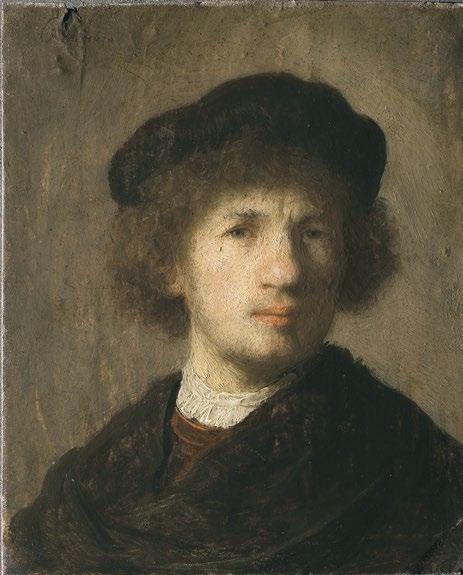
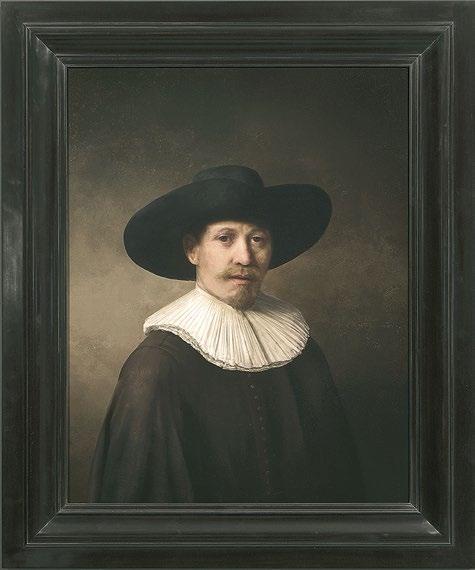
A new Rembrandt The seventeenth-century artist Rembrandt van Rijn worked in the Baroque tradition, which is characterized by the use of chiaroscuro — big contrasts between dark and light. Past traditions were an important source of inspiration for Rembrandt, but he was also highly innovative. Unlike many of his fellow artists, he experimented a lot. Sometimes he used thick layers of paint on the canvas and at other times transparent layers. He also varied between precise details and sketchy brushstrokes. His exploratory approach is also evident
in more than a hundred self-portraits he painted, most of which were probably studies. Rembrandt has now become one of the most famous painters in art history. Interestingly, he is still the subject of innovation. In 2016, digital scans were made of all his portraits, which were then analysed by a computer. Based on all that data, the computer created a new painting entirely in the style of the artist. This was then printed in 3D so that even Rembrandt’s use of impasto could be represented.
Rembrandt van Rijn, Self-portrait (1630) ING and Microsoft, The Next Rembrandt (2016)
Old and new traditions
Some traditions are centuries old whereas others have only arisen recently. Traditions are not static; they usually evolve very slowly. New traditions can arise when innovative ideas become more widely accepted.
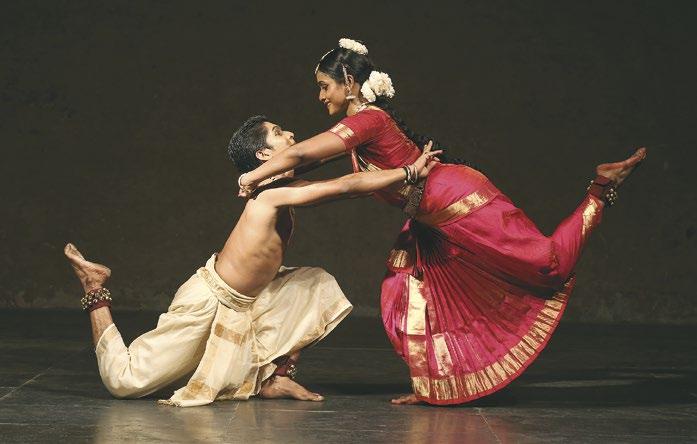
Indian dance at a Hague festival In 2016 couple Renjith & Vijna performed at the India Dance Festival in The Hague. Their style of dance, the bharatanatyam, is a South Indian classical dance style. A traditional performance often starts with a prayer to the god Ganesh, who will remove all obstacles. This is followed by a dance programme designed to suit the time of day. Some dances focus on technique, with elegant poses and the feet beating fast rhythms. In others, the emphasis is on the story and expression.
In one dance, Renjith & Vijna tell the story of the mischievous god Krishna who tries to seduce a dairymaid. She doesn’t trust him at first, but he eventually seduces her with his flute music … The story is told using facial expressions and
Renjith & Vijna, Sammargam (2014) 9.3
mudras — symbolic gestures of the hands. You can also see these hand gestures in pictures of the Hindu gods. The couple wear richly decorated Indian costumes for their performances. People have been performing the bharatanatyam for more than two thousand years. Even so, it is debatable how much the current dance resembles the original, which started in the temple. Female temple dancers performed ritual dances before the image of a god during processions. This dance took on a new form as a stage performance from 1947 onwards. Renjith & Vijna perform traditional dances, but also use the dance language of the bharatanatyam in modern dance. They keep the tradition alive and are innovative at the same time.
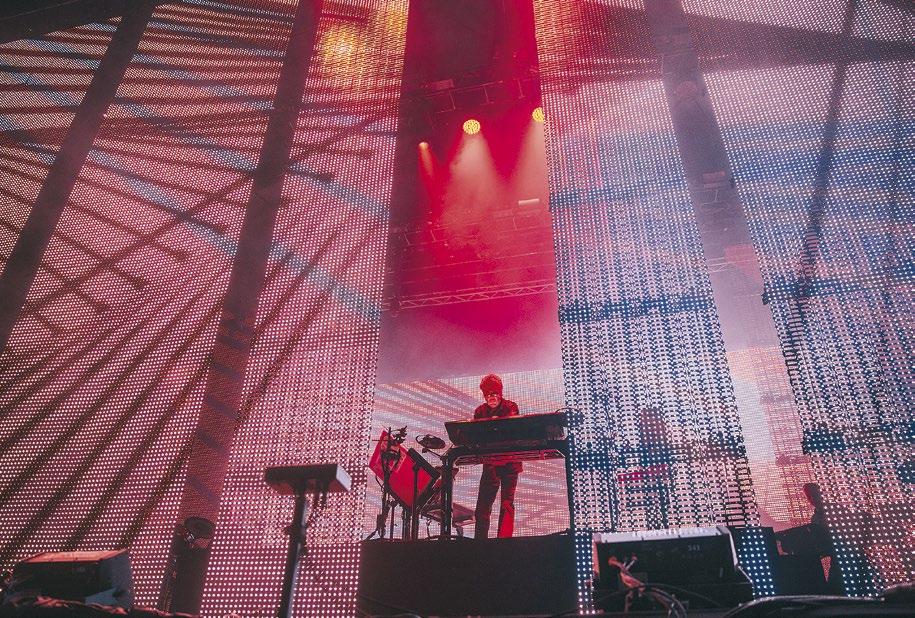
Jean-Michel Jarre, Electronica 2 The Heart of Noise, Bluedot Festival Berlin (2016)
A modern tradition ‘The difference between noise and music is in what the musician does with the sounds.’ This is how Jean-Michel Jarre describes his profession. Jarre makes electronic music. Electronic music appeared at the beginning of the twentieth century, but only really developed from the 1950s onwards. It comprises all music that is produced by electronic devices and is often produced in a different way to classical music or pop music. Jarre, for example, does not use standard musical notation for his compositions. He takes various randomly chosen sounds and combines them using electronic instruments such as synthesizers and samplers. This gives Jarre unlimited opportunities to experiment and innovate. It has led him to the forefront of various genres of electronic music such as ambient and
New Age. He often uses a ‘ laser harp’ in his performances, a device that projects various parallel laser beams that can be played like a musical instrument. Light and laser shows like these were new in the seventies, but a dance event without them would be inconceivable today.
Jarre released his album Oxygen in 1976. It made him internationally famous and inspired many musicians who followed. Armin van Buuren also drew inspiration from Jarre and they recorded a number together in 2014. Jarre continued to experiment with electronic music and released the new album Oxygen III, for which he toured through Europe, in 2016. Thanks to Jarre and others, electronic music has grown from a radical new music style into its own tradition.
History as inspiration
Artists regularly make references to art history in their work. Sometimes they do so with a deliberate feel for the tradition, and sometimes very much in their own way. Using new techniques or thinking up surprising combinations also allows works of art from the past to be reinvented in an innovative way.
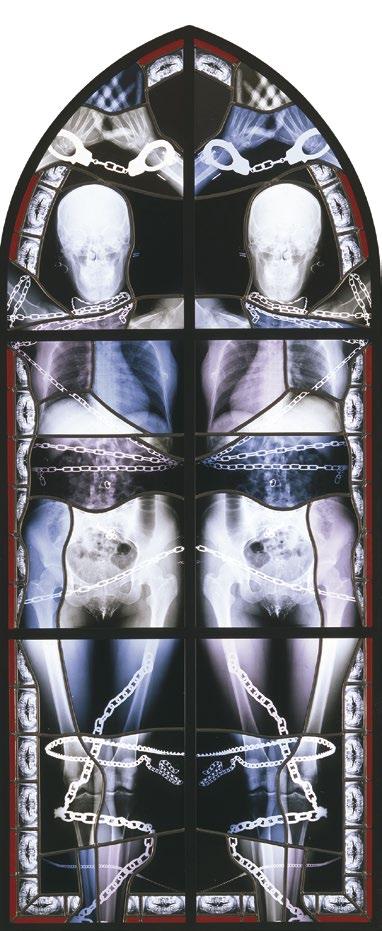
Tradition as inspiration The Gothic tradition appeared in the late middle ages and produced numerous Christian buildings and images. This style is characterized by thin walls, pointed arches, large stained-glass windows and rich ornamentation. In the nineteenth century people were inspired by it once again and a lot of churches were built in the Neogothic style. The modern Flemish artist Wim Delvoye also draws inspiration from this tradition. He is interested not only in the stylistic features, but also in the strict rules and philosophies of medieval Christianity that are reflected in artworks of the time.
That is why Delvoye makes sculptures that include features of Gothic cathedrals. His sculptures have organic shapes and sometimes look like modern vehicles. They are made of steel and are incredibly detailed. Lasers enable him to create works that are hollow and without seams. Delvoye is also building a kind of Gothic chapel in which he has placed stained-glass windows. These include X-ray photographs of people in chains or making love. The X-ray technique makes them look like skeletons. Some people find this a shocking thing to see. The images of skeletons and skulls also fit in neatly with another age-old tradition, a type of still life called a vanitas in which an artist depicts objects that symbolize the finiteness of life, such as skulls and candles. In his work, Delvoye refers to the beauty of age-old traditions while resisting the strict rules of early Christianity.
Wim Delvoye, Nine Muses — Calliope (2001–2002)
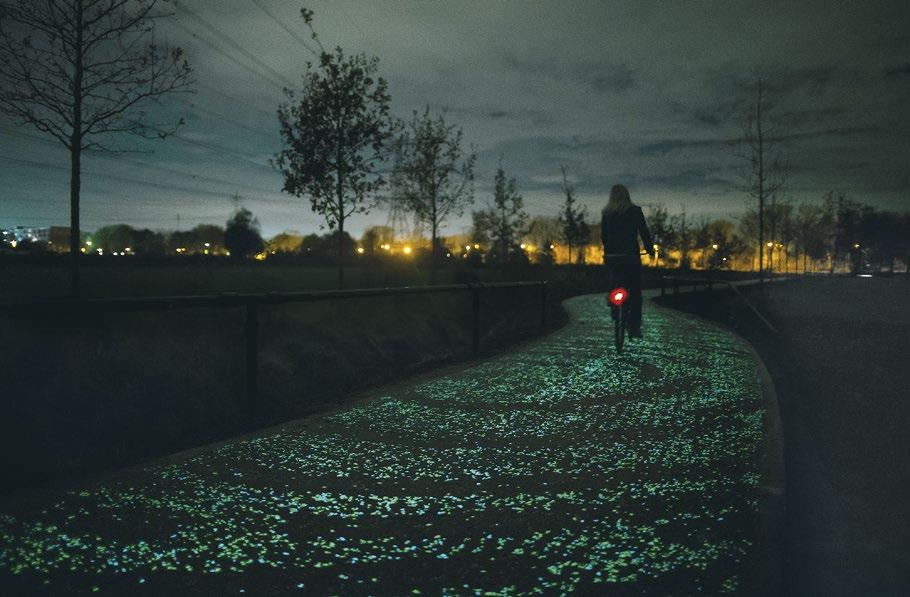
Innovative design For Studio Roosegaarde, innovative technology forms the building blocks of their art. Front man Daan Roosegaarde works with designers, universities and companies to create innovative art that will speak to people’s imagination.
Almost all Studio Roosegaarde’s projects have a special relationship with the place where they can be seen. The Smog Free Tower stands in a park in Beijing, for instance. It is a dust-extracting tower that cleans the city’s polluted air, thereby attempting to help this particular city’s smog problems. So their projects are sometimes socially engaged, but always focused on innovation.
Because innovation seems to dominate, it may perhaps seem that Studio Roosegaarde distances itself from traditional art forms, but that is not the case. For the Van Gogh Path, Roosegaarde drew inspiration from the painting The Starry Night (1889) by Vincent van Gogh. The sky in this painting consists entirely of stripes and spots in various colours, making the starry sky appear to be in swirling motion. Roosegaarde used this distinctive pattern and applied it to the stones in a bicycle path in Nuenen, where Van Gogh used to live. The material used by Roosegaarde glows in the dark. This allows cyclists not only to see where they are going, but also literally to cycle through Van Gogh’s starry night.
Studio Roosegaarde, Van Gogh Path (2012–2015)
Assignments
Explore
1 Using your own words, describe what tradition means to you. Then describe three traditional artworks that you have seen. Say which tradition those works belong to.
Expand
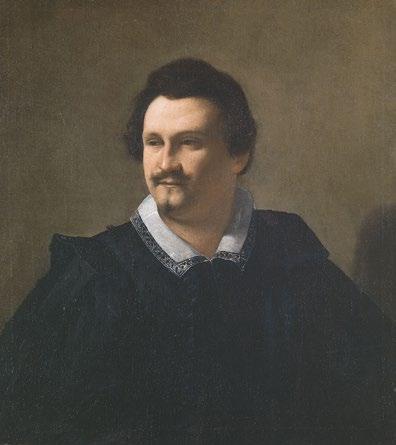
2 Take a look at images 9.1 and 9.7. Rembrandt probably drew inspiration from the work of Michelangelo Merisi da Caravaggio (1571–1610), an influential Italian painter. Compare the two portraits and list three similarities and three differences in composition and design.
3 Watch the first minute of V901, a performance of the traditional bharatanatyam by Renjith & Vijna. Then watch V902. This shows a modern dance that was inspired by a traditional dance style. Compare the videos and state a difference in terms of the movements, costumes and music.
4 Watch V903 (12:30–18:10). This is JeanMichel Jarre in his studio. He sees electronic music as the ethnic music of Europe. What does he mean by that?
5 Jean-Michel Jarre’s music is discussed in this chapter from the point of view of Tradition & innovation. Explain how his work could be approached from the dimension of Recognition & alienation
6 Go to Wim Delvoye’s website and click on Gothic works and then Nine Muses. You will see various stained-glass windows. Choose one window and give two reasons why these images conflict with the rules and regulations for Christianity in the Middle Ages.
7 Watch V904 (20:00–24:26). Daan Roosegaarde is the guest on College Tour and talks about what he thinks intellectual property and innovation mean. First explain his position in your own words, and then give a response. Why do you agree or disagree with Roosegaarde? Discuss the answers in class.
Deepen
8 Find a traditional artwork that is associated with your own region or province. Describe the tradition used in this work of art and how that tradition arose. You could for instance think of the local brass band or traditional pottery such as Delft Blue. Find out whether this is still a common way of working. If not, why has the tradition disappeared? If so, why do you think the tradition has been maintained?
Michelangelo Merisi da Caravaggio, Portrait of a gentleman (1598–1604)
9 Watch V905. You are listening to the number Oxygen IV by Jean-Michel Jarre. Jarre collects, makes and mixes various sounds to create a new piece of music. Working alone or in a group, create a piece of music about one minute long in the way Jarre does, using ‘found’ sounds. Use your phone to record the various sounds. Make sure that the piece has a clear rhythm. It helps if you record different kinds of sounds, for instance loud and soft, high-pitched and low. You can mix the sounds on the computer, or play them on several phones at the same time and record that.
10 Work in a group to design six stained-glass windows. Take a work of art from this book as your starting point. Study the artwork, describe its theme and note the key aspects of composition and design. Look at traditional stained-glass windows for inspiration too. Draw the windows on separate sheets of paper. Remember that all the lines have to be connected together. Then cut out the individual pieces and stick coloured (or painted) paper behind them. Make sure that the windows form a whole. Finally, present your design against the window.
11 Find a vanitas still life from the seventeenth century and compare it with a vanitas still life by a contemporary artist. You could consider the following artists: Maria Volokhova, Richard Kuiper, Patricia Kamps or Tjalf Sparnaay. What similarities and what differences can you find? List at least four objects that symbolize transience or death. Then make a still life of your own. Find things from your own surroundings that symbolize transience for you. Make a suitable composition and take a photograph of the still life. You could perhaps simulate the typical chiaroscuro of the seventeenth century.
12 Watch V901, a fragment from the dance performance by Renjith & Vijna. Working as a group, design a decor that fits this performance. Study Indian visual culture and the story the performance tells. Present your design as a (digital) drawing or scale model.
13 Studio Job is a design collective that creates daring and sometimes provocative objects. You will regularly find references to the past in their work. Go to the Studio Job website and search for the following two works:
v Sickle, Craft
v The Last Supper Delftware
Analyse the objects using references from the Design chapter. Then describe which tradition (or traditions) the objects refer to and why.
14 In a group, design a new layout for a corridor in your school. The aim of the design is for the pupils to get more physical exercise between the lessons and to make the corridor more attractive. Choose an original way of moving — hopping, jumping or climbing, for instance — and select an art movement that appeals to you. Search for inspiration on the Internet if necessary, and turn your design into a drawing or a scale model. Make a short pitch to try to convince your classmates of the quality of your idea. What would be needed to implement your idea in practice?
Connect
15 Either alone or in pairs, make a vlog that shows a traditional or innovative work of art to your viewers. Give background information and explain why this work fits in a tradition and / or why the work is innovative. Explain whether this chapter has changed your way of looking at traditions. Watch the vlogs in class.
Film 17
A film is a series of stationary photographs that give the illusion of a moving image when projected in rapid succession. The idea of using moving pictures to tell a story is timeless. People tried to depict the motion of running horses on rock walls more than 30,000 years ago. Projection, the technique of using light to display an image on a screen, was discovered in the eighteenth century. And with the invention of
photography, people first succeeded in making movement from a series of images in 1895. Because the equipment was heavy, the first films only lasted a few seconds. Early films were also silent (without a soundtrack). Synchronizing sound and images became possible from the 1920s. And digital films have been made since the 1990s. This chapter will take a look at five important film genres.
Five genres
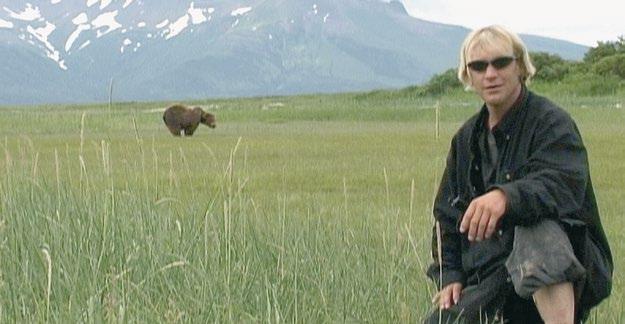
Documentary A documentary is non-fiction: a situation from the real world is portrayed with the intention of providing information for the viewer. This could for instance be a moment in history, a political issue, a social problem or someone’s life story — as in a biopic. Werner Herzog is a German film maker who looks for unusual subjects: people with impossible dreams or unexpected talents, or bizarre natural phenomena. Grizzly Man is about Timothy Treadwell, an American who loved bears and devoted his life to these animals, but was ultimately killed and eaten by a bear.
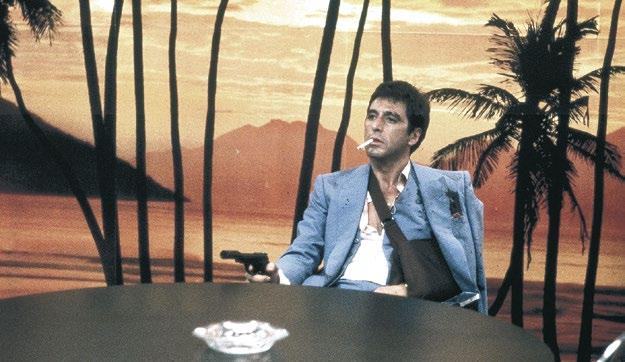
Drama A drama film is primarily about emotional themes and problems between people. Film makers do their best to get viewers to feel what the characters are going through. War films, costume dramas, detective stories and biographies are typical drama films. Action films are more about the action than personal drama, but different genres can often overlap. One well-known gangster movie is Scarface, which is about the rise and fall of the drugs criminal Tony Montana. This crime film contains elements of an action film and a thriller, as well as a great deal of personal drama.
Brian de Palma, Scarface (1983)
Werner Herzog, Grizzly Man (2005)
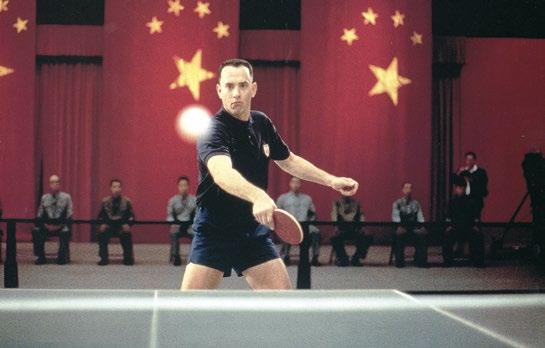
Comedy A comedy film puts the emphasis on humour. As in theatre comedy, people’s characteristics are often exaggerated in order to amuse the audience. Humour is universal and easy to communicate, even without sound. Some of the first silent films are comedies, showing characters tripping over their own shoelaces or walking into a door. Longer comedy films often have an element of drama too, as in Forrest Gump. In that film, the life history of Forrest, a man with a low IQ, is shown in parallel with important moments in the history of North America.
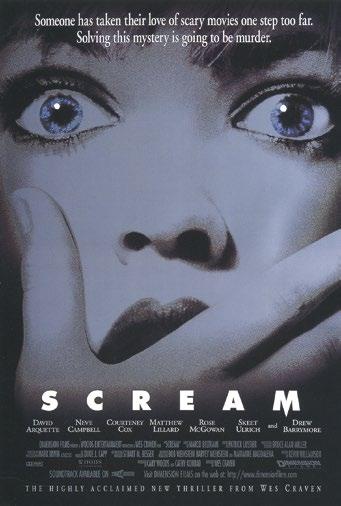
Horror and thriller Because films often seem so real, they can give us a good scare. Thrillers make the audience feel fear, tension and surprise. Suspense is important: slowly things happen that the audience already suspects are inevitable. The story progresses to a climax and is full of plot twists and distractions. Horror films are even more about fear and (of course) horror. The genre often has clichés of its own; the Scream trilogy is a clear example of this. A small group or an individual often ends up facing a danger, such as a murderer, aliens or ghosts.
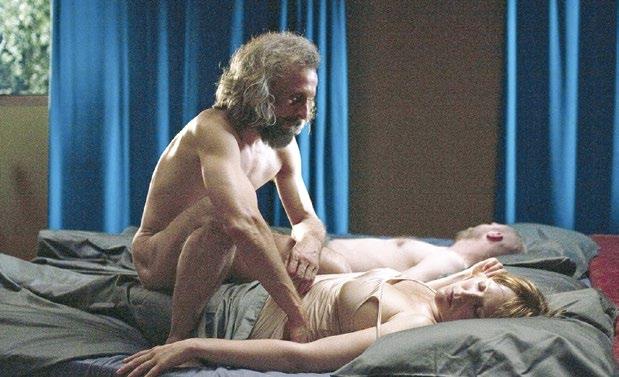
Art house Art house films are primarily meant to be artistic. The storyline is experimental and often more difficult to follow. These films are less commercial: they do not have to reach a large audience, they are less dependent on the major production companies and they are financed more simply, sometimes by the film makers themselves. In Borgman, the comfortable lives of a rich family are shaken up by the arrival of an outsider who encourages the family members to commit macabre deeds. The film makes the audience laugh a lot, while also evoking an ominous feeling: exactly what is going on remains unclear.
Alex van Warmerdam, Borgman (2013)
Wes Craven, Scream (1996)
Robert Zemeckis, Forrest Gump (1994)
Six key features
The words ‘film’ and ‘cinema’ can refer to either the film industry or the cinema. Film is also a technique involving many aspects. Making a film is a complex and expensive process on which a team of specialists often work for years. We describe six key features below that film makers have to deal with: narrating and directing, camera and framing, montage, sound design, set design and special effects.
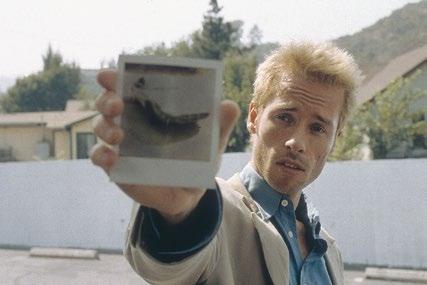
Narrating and directing Film is a time-based discipline: you need time to watch a film. There is generally a narrative: a composite story in which characters are placed in specific situations, have unusual experiences and face conflicts. Film scenes can follow one another in chronological order. But films regularly jump back and forth through time using flashbacks and flashforwards. Take Memento (2000), for example, in which the main character suffers from memory loss and tries to find out who killed his wife. A high degree of realism is often important in movies. Film makers aim to bring the narrative across as realistically as possible, using the scenario, images and sounds. The scriptwriter creates the story and the producer handles the practical aspects of making the film. The director brings it all together: they decide the camera positions, choose the sound design and direct the acting in order to encourage the actors to make their characters lifelike.
Christopher Nolan, Memento (2000)
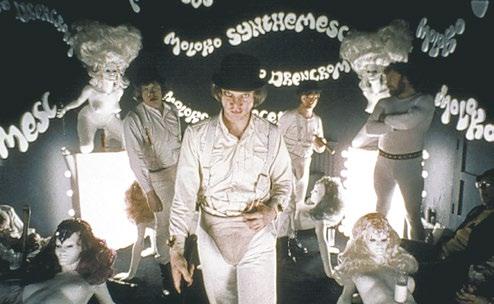
Camera and framing The camera shows the storyline in images that are defined by the camera positions and framing. The framing is the section of the overall scene that the viewers get to see on the screen. The camera positions then determine the angle of view or the perspective. If you see things through the eyes of a character, then the camera position is subjective. If you see scenes from a neutral position, the camera placement is objective. Zooming in and out brings the camera closer in or further away. We distinguish between distant shots (far away), close-ups (nearby) and total shots. The tilt is a shot in which the camera angle moves upwards. A rotating camera is called a pan or panorama shot. In a lift, the camera moves vertically up and down on a crane. If it moves horizontally however, this is mostly done on a dolly wagon, a small trolley on rails. You can see this in the opening scene of A Clockwork Orange (1971). The camera starts with a close-up of the main character, a young criminal, and moves slowly to a total shot of his disturbing surroundings.
17.7
17.6
Stanley Kubrick, A Clockwork Orange (1971)
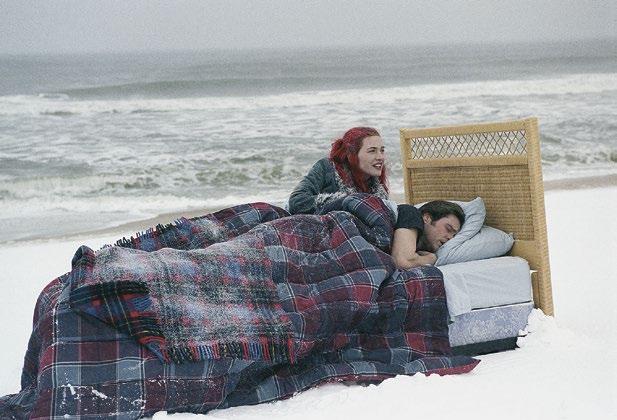
Editing Scenes are rarely shot in their final sequence. Film makers generally approach their work practically, taking factors such as the weather, travelling distances and the availability of the actors into account. The separately filmed shots only become meaningful once they have been stuck together in sequence during the editing or montage. At the beginning of the twentieth century this was quite literally done by cutting strips of film and gluing them together again; nowadays it is done using computer programmes. Eternal Sunshine of the Spotless Mind is an example of the editing being used to harshly disrupt the continuity of the storyline. This strengthens the narrative, in which two former lovers attempt to wipe out their memories of each other. The viewers are made to jump around between various moments in their memories. The stages after the recording are called postproduction: editing the pictures and the sound, adding special effects, and then adjusting the colours in the camera department.
Michel Gondry, Eternal Sunshine of the Spotless Mind (2004)
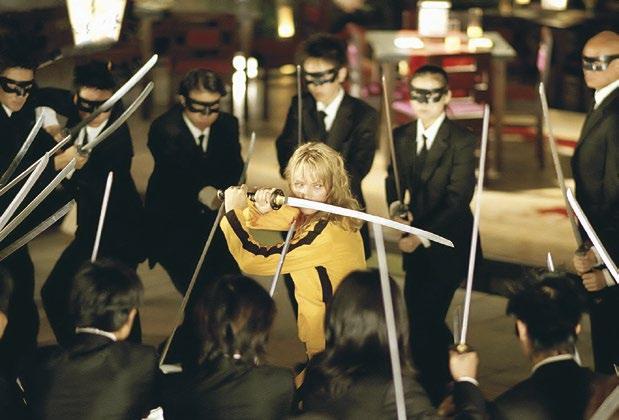
Sound design Film makers try to make the sound track as realistic as possible. This means that they often have to mimic all kinds of noises. We call this sound design. Kill Bill is an action film full of fight scenes with a wide variety of weapons. The viewer experiences it all from close by: the swish of a sword, a dagger stabbing, blows with sticks and someone being kicked in the face. The sound designers record some of the sounds separately after the filming. These sound fragments are edited in and referred to as foley sound. Recording sound in natural surroundings is called phonography. The background music and the title song make up the sound track or music track. We hear Asian music in Kill Bill, because the film in fact plays homage to classic martial arts films from China and Japan. A disturbing siren sound also builds up when the main character gets angry: a reference to American westerns and action films.
Quentin Tarantino, Kill Bill Volume 1 (2003)
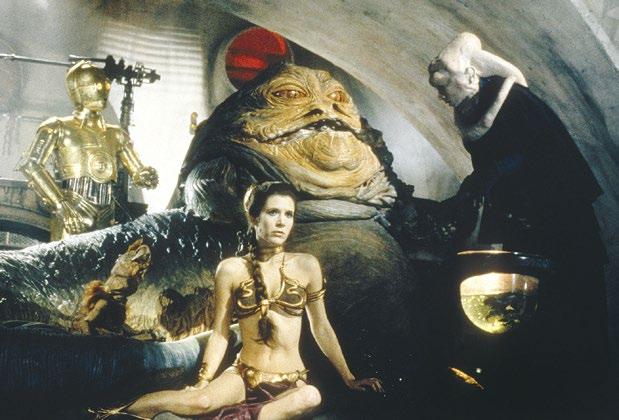
Set design Traditionally, a film attempts to represent a situation as realistically as possible. What appears in the picture and how it is done is referred to as the set design or styling. The design for a film scene is similar to that in theatre: a set decor is needed, along with costumes, lighting and actors. Filming may be done on location or in a studio. Everything that takes place within the camera frame is called the mise-en-scène. It takes a lot of time and money to make the set as accurate as possible. A careful eye has to be kept on the continuity: that no equipment is in the shot, that a plate of food is just as full for the next camera shot and that the actors are still wearing exactly the same clothes. Set design is a field in itself. Unique costumes and decor were made for Star Wars: Return of the Jedi. The scene with Jabba the Hutt and Princess Leia in a bikini is world-famous.
Richard Marquand, Star Wars: Return of the Jedi (1983)
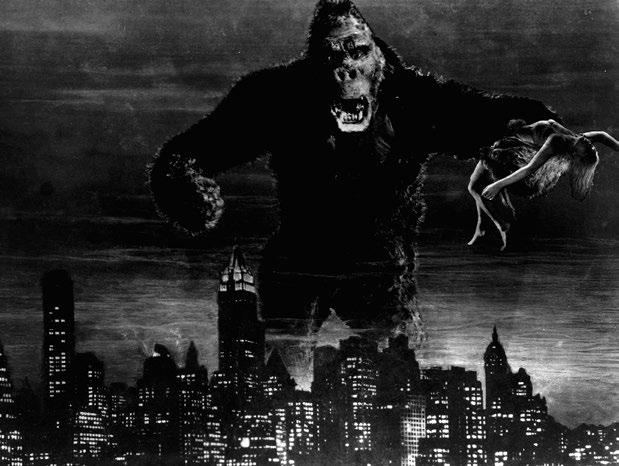
Special effects For a long time, special effects were added during filming — a fake fire or fake snow, for example. Thanks to computer techniques, it is nowadays largely done during the editing (montage). The scene may for example be played out in front of a green screen, allowing the green backdrop wall to be filled in digitally using other images afterwards. If you compare the original King Kong from 1933 with the 2005 version, you will see a huge difference. The first version used models and stop-motion techniques in a reconstructed miniature jungle. The remake has animation that looks extremely like a genuine gorilla. The ape was nevertheless played by an actor. During recording, he was in makeup for two hours every day getting all the electrodes and costume parts applied. These allowed his movements and acting to be tracked for the animation that was later added to the images.
Merian C. Cooper & Ernest B. Schoedsack, King Kong (1933)
Assignments
Explore
1 Make a list of your three favourite films. Classify them according to the genres that are listed in this chapter. State two arguments for each of them (with examples from the films) and explain why they belong to that genre.
Expand
2 Watch V1701, a fragment from Forrest Gump. Give three examples of why this scene is typical of the comedy genre.
3 Watch V1702 and V1703, two fragments from Scarface. The main character, Tony Montana, develops dramatically in this film. Describe the differences in his character and appearance in the two fragments in terms of the theatrical characteristics of body (mimicry, posture and movement), use of voice and acting style.
4 Watch V1704 from 0:43. The film Memento plays with time in an unusual way. This is immediately clear in the opening scene. Explain how time is dealt with in this scene and how tension is built up in the story.
5 Watch V1705 and V1706. The first fragment comes from the King Kong of 1933 and the second from the 2005 version. The makers of both films have used various cinematic techniques to make the giant ape appear imposing and frightening. Compare the fragments and explain how the film makers have achieved this using the camera positions, the sound design, the special effects and the set design.
Deepen
6 Some directors use as few special effects as possible in their films. Watch V1707. Michael Gondry, the director of the film Eternal Sunshine of the Spotless Mind, gives an example of a special effect that does not require any digital manipulation. Write a short film scene for two or three people that needs a special effect. Download a free special effects app for mobile videos (such as e.g. FXGuru: Movie FX director), or think up a creative way of recording the special effect that does not require digital tools. Record the scene using a mobile phone with a few of your classmates. Then use the app if necessary to add the special effect to the scene. Present the scene in class.
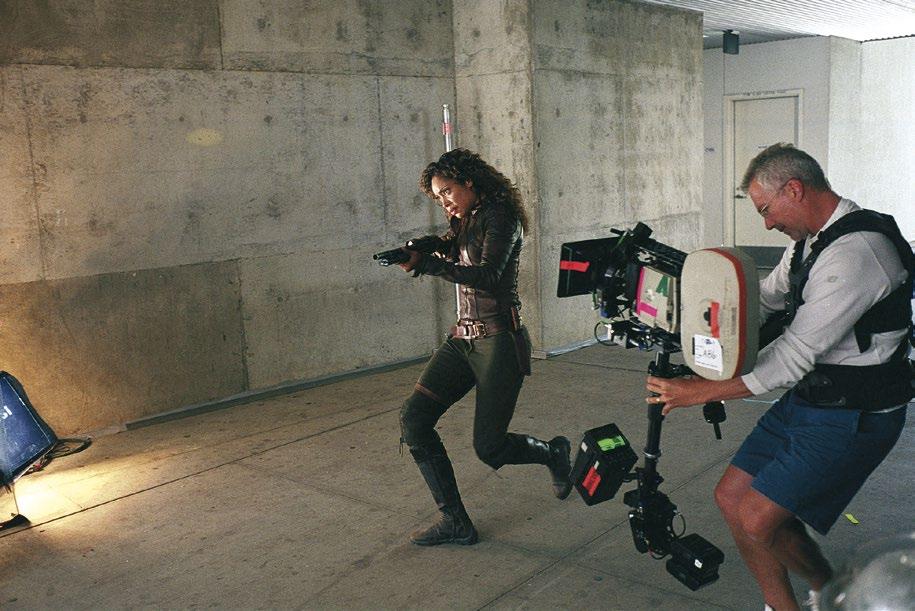
7 Watch V1708, the opening scene of A Clockwork Orange. A dolly has been used to allow the camera to float. There are also cameras that can move without wheels, known as steadycams. Watch V1709 to get an impression of the images that can be taken with this type of camera. Do some online research to find out how a steadycam works. What effect does using it in films have on the viewer? Explain your answer in reference to three films.
8 Split the class into groups of six. Select a subject for a documentary, for instance an unusual sport or hobby of someone you know, or something interesting that has happened in your town or local area. Think of two different angles for approaching the subjects and divide each group into two. In each group of three, make a storyboard for a mini-documentary lasting no more than three minutes. Record the documentary using a mobile
phone or camera. Compare the two films. Show the results in class, next to each other. Explain the working process and your findings in a short presentation.
9 Two specific art house movements are the Nouvelle Vague and films made according to the principles of the Dogma 95 manifesto. Find out who the founders of both movements were, when and where the movement arose, and what ‘rules’ these film makers adhere to. For each of the movements, find a film and discuss a scene from each of them that is typical for the movement. Choose your own way of presenting your research.
Connect
10 Select one of the three films that you chose in question 1 and watch it again, keeping the information from this chapter in mind. Write a review of about 500 words that includes at least three of the six key features mentioned.
Cameraman with a steadycam on the set of Serenity
© 2018 Staal & Roeland BV, Groningen,
The Netherlands
Behoudens de in of krachtens de Auteurswet van 1912 gestelde uitzonderingen mag niets van deze uitgave worden verveelvoudigd, opgeslagen in een geautomatiseerd gegevensbestand of openbaar gemaakt, in enige vorm of op enige wijze, hetzij elektronisch, mechanisch, door fotokopieën, opname of enige andere manier zonder voorafgaande schriftelijke toestemming van de uitgever.
All rights reserved. No part of this publication may be reproduced, stored in a retrieval system, or transmitted, in any form or by any means, electronic, mechanical, recording or otherwise without prior written permission of the publisher
Acknowledgements
dr. Emiel Heijnen (lector Art Education, AHK), dr. Melissa Bremmer (lector Art Education, AHK), dr. Talita Groenendijk (senior lecturer Research, master Art Education, AHK), Steffen Keuning (teacher Veluws College Walterbosch), Famke Sinninghe Damsté (teacher Het Baarnsch Lyceum), Hanne van de Vrie (music consultant).
The assessment rubric for Research was developed with the help of Talita Groenendijk, Claire Goedman (senior lecturer Cultural History and CKV, Breitner Academie), Lorentine van Tijn (Hoosh Educatie), and all participants in the course CKV Verdiept at the Amsterdam University of the Arts (AHK).
Translation
Louise Vines, Angie Sullivan, Rosalie Steinmann, Clare Wilkinson, Mike Wilkinson, Vanessa Goad, Jenny Zonneveld, Marleen Weel
Proof reading
Charlotte Journée
Illustration coordination
RoelKooisterVerbeeldingskracht, Amsterdam
Illustration acquisition
Imago Mediabuilders, Amersfoort
Book design
René van der Vooren, Amsterdam
Printing & binding
Wilco Art Books, Amersfoort
www.staal-roeland.nl
ISBN 978 94 9200 072 9