September 2026
Inspiring Careers Programme
Choices
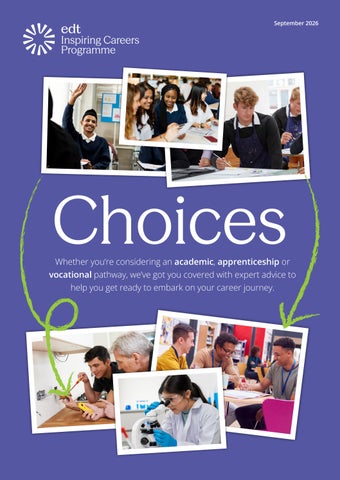
Whether you’re considering an academic, apprenticeship or vocational pathway, we’ve got you covered with expert advice to help you get ready to embark on your career journey.
Welcome to the latest edition of Choices magazine! Choices magazine is dedicated to helping you make important decisions after turning 16. Although it has been written for Year 11s, it may also be useful for Year 12s in sixth form or college. We have also included some information for your parents or carers. Making post-16 choices can be both daunting and exciting. To help, we have included links to many useful sites. As ever, if you have any questions, speak to a Careers Adviser, do your research and always have a backup plan. Your Careers Adviser at school can give you information, advice and guidance on: •
Qualifications and subjects
•
Choosing a sixth form, college or an apprenticeship
•
Choosing a career
•
CVs, job applications and interviews
•
University
For free impartial advice via phone, email or secure web chat, you can also contact the National Careers Service. Visit nationalcareers.service.gov.uk or call 0800 100 900.
CHOICES 2026-27
Contents Choices I Your choices
2
Work and skills in a changing world
3
Academic 5 Apprenticeships 8 Vocational 11 Entering the world of work
14
Celebrating neurodiversity
17
Advertising yourself
19
TOP TIPS for applications
20
TOP TIPS for interviews
22
Financial support
23
Advice for parents and carers
25
Useful resources
26
1
Your choices In Year 11 (or Year 12, if you are doing a one-year course), you will have to make some big decisions about your future. You will likely choose one of three pathways:
Academic
Apprenticeship
Vocational
When to choose a career path? You must continue in education or training until at least your 18th birthday. From here, you have lots of options. You can continue at school, go to college, get an apprenticeship or traineeship, or even start your own business.
Making your choice Before you decide what direction you want to go in, you can try answering the following questions: •
What am I good at?
•
What do I enjoy?
•
What are my favourite subjects at school?
•
What are my current career ideas and plans?
Next, you need to find out about the opportunities available to you, the different routes you can take, and how and when to apply. You can check the websites of schools, universities or businesses, or give them a call about the best way to apply. If you are unsure about what you want to do, you may have access to online career programmes through your school to help you decide. To find out more information, flip to the resources section at the back of this magazine.
Consider the following questions to help you start thinking about your plans:
2
•
What are your favourite subjects?
•
What are your expected grades?
•
Do you have any career ideas yet?
•
What might stop you from achieving your career goals?
ide This magazine is a gu but there are many other places to get e support. Check out th . resources on page 26
CHOICES 2026-27
Work and skills in a changing world When you are thinking about what job you would like to do, consider the changes happening in the world of work right now. We use labour market information (LMI) to make sense of these changes and to predict future trends.
Changes in the world of work The world of work is changing rapidly. Advances in technology, including artificial intelligence (AI), are transforming the way many jobs are carried out, while new opportunities are emerging across sectors such as digital, health and social care, green industries, engineering and logistics. Flexible and hybrid working remain important features of many workplaces, although some roles still require employees to be on site. This is particularly true in sectors such as health and social care, hospitality, education, retail, construction, and transport and logistics. Understanding LMI can help you explore opportunities and make informed decisions about your future education, training and career pathways.
People are living longer Medicine and healthcare continue to advance, helping people live longer and healthier lives. As the population ages, there is an increasing need for skilled workers to support the health and wellbeing of older people and those with complex care needs. This creates a range of career opportunities across health, care and life sciences. Job areas that are important to this include:
Green jobs in demand The UK aims to reach net zero emissions by 2050. To achieve this, more renewable and low-carbon technologies are needed. This is creating new jobs and increasing demand for skills in areas such as: •
wind turbine engineers
•
solar panel installers
•
smart meter installers
•
heat pump engineers
•
electric vehicle technicians.
Medical apprenticeships It is now possible under the NHS to become a medical doctor through the apprenticeship path and make a difference in people’s lives without taking the traditional route.
New technologies Technology is constantly changing. New jobs are being created because of it, but advances in technology also make other jobs redundant. Artificial intelligence (AI), robotics and mobile devices such as smartphones have created new lines of work. Some of the new jobs that have emerged are:
•
healthcare
•
social care
•
iOS developer
•
bioscience
•
social media and digital marketing manager
•
pharmacology
•
cybersecurity analyst
•
leisure, sport and wellbeing.
•
big data architect.
3
What skills are in demand? Employers value people who can use their skills and strengths in different situations. These are called transferable skills because they can be used in many jobs and areas of life. Here are some of the transferable skills that employers look for: •
numeracy
•
literacy and communication
•
digital literacy
•
creativity
•
leadership.
How to demonstrate your skills You use transferable skills all the time. This could be at home, at school or by taking part in activities or hobbies. Writing these down is useful as you can then use them on a CV, on an application form, or in an interview to demonstrate how you have used a particular skill. Look at the examples below: Example: Timekeeping – I attend a dance school at weekends and some evenings. When I have classes or performances, I ensure that I am on time, allowing myself enough time to get where I need to be and to get changed into my costume. Example: Written communication – I write articles for the school newsletter. When I do this, I make sure that my writing is clear and easily understood.
4
CHOICES 2026-27
Academic If you enjoy studying academic subjects in a classroom setting and perform well in exams, this route is the one for you. It is the most popular route to university and for some degree courses, A-levels are the only acceptable qualification. On the next page are the main routes available to all Year 11s who wish to pursue the academic pathway. They include examples of basic entry requirements and the main qualifications on offer.
International Baccalaureate (IB) This is an academically challenging programme with final examinations that prepare students for university and working life. You choose one subject from each of five groups. This includes two languages, social sciences, experimental sciences, and mathematics. You also choose either an arts subject from a sixth group or another subject from groups one to five.
As well as moving up the levels, you can also move across the routes, for example from A-levels to a degree apprenticeship.
The programme includes: •
an extended essay based on your own research and in-depth study, focused on one of the subjects you are studying
How to choose
•
theory of knowledge focusing on critical thinking and learning across your chosen subjects
If you are not sure what you would like to do, we advise that you go with subjects you are likely to do well at and that you enjoy!
•
creativity, action and service enhance students’ personal and interpersonal development. They combine activities and academic study of the arts and creative thinking as well as physical activity and community service.
What qualifications are needed? Some university courses require you to have specific qualifications. Speak to your Careers Adviser to see what requirements you need to meet.
A-levels The most common academic qualifications are A-levels. With A-levels, most students study at least three subjects. There are more than 40 A-level subjects, and the range available to you will depend on your school or college. At some schools and colleges, you can even study a mix of A-levels and BTEC Level 3 qualifications.
Core Maths Core Maths is a generic title for a range of different Level 3 mathematical qualifications; it is not a qualification title in itself. Their key purpose is to widen participation in the study of mathematics from age 16. They also support the development of mathematical skills for higher education and employment. The qualifications are an opportunity for students not studying AS- or A-level mathematics to enrol in a Level 3 mathematics course alongside their main programme of study. They also offer a different range of progression opportunities to AS- or A-level mathematics. They will be useful for those progressing to higher education courses with a specific mathematical content. This includes psychology, geography, business, and management. 5
Before applying to sixth form or college
Routes through learning
Before making your choice of a college course or applying for sixth form, it is important to research your ideas. For detailed information about courses, visit the school or college website or read their prospectus.
Level
Many schools and colleges have open days/ evenings or virtual events for students. These are great opportunities to ask questions and get a feel for what it will be like to study there. If you are applying for entry in September 2027, make sure that you get your applications in as early as possible. Some courses are very popular and will fill up quickly. You may need to apply by the Easter holidays of 2027. Some popular schools/colleges even have application deadlines as early as December 2026.
6
Examples of the qualifications and training available from entry to Level 8.
8 7 6 5 4 3 2 1
Qualification Doctorate - PhD, DPhil Entry = degree and often Master’s or postgraduate study
Master’s degree MA, MSc, MPhil Entry = degree or professional experience/other qualifications
Degree and other graduate certificates/diplomas/Level 6 qualifications Entry = Level 3 qualification
Foundation degree, HND, DipHE and other Level 5 certificates/diplomas, etc Entry = Level 3 qualification
Higher National certificate (HNC)/Level 4 certificates/ diplomas/NVQs Entry = Level 3 qualification
A-levels and IB diploma Entry = 5/6 GCSEs grades 9-4 minimum
GCSEs grades 9-4
GCSEs grades 3-1
CHOICES 2026-27
Applying for university The subjects you choose at Level 3 could be very important for your university application, so make sure to plan carefully. Some university courses need you to take specific subjects or achieve certain grades. Some also ask that you show any work experience you may have before making an application. All university applications are made through UCAS (the Universities and Colleges Admissions Service). There is one application form and you can apply to up to five courses. The UCAS deadline is 13th January 2027. For applications to the University of Oxford and Cambridge, and courses in medicine, veterinary medicine/science and dentistry, the deadline is 15th October 2026.
Did you know? During 2024/25, there were nearly 3 million students enrolled on a higher education course in the UK. There are more than 50,000 undergraduate courses registered with more than 395 higher education providers. The most popular course in 2024/25 was business and management, which saw over 586,000 student enrolments. Other popular courses were: •
subjects allied to medicine
•
social sciences
•
computing
•
engineering and technology.
You can also study some higher education courses at a college. There are more than 240 colleges in the UK that offer a range of higher education courses.
Consider the following questions to help you plan your application for sixth form or
college:
•
What university or courses am I interested in?
•
What are the entry requirements for these courses?
•
When is the application deadline?
7
Apprenticeships If you know what you want to do as a job or career and are ready for full-time work, an apprenticeship is an excellent option. It combines on-the-job training with practical studies and demands real commitment. The structure of an apprenticeship typically follows the 80-20 ratios, where 80% of the time is dedicated to on-the-job training, which includes hands on work experience and practical training with an Employer. This is complimented by 20% of the time being spent on off the job training, which can include coursework, workshops, functional skills and college days. This ensures that you receive a balanced education that prepares you for future careers. You won’t have to pay for your learning. Your employer and the government cover the cost and it can take between one and five years to complete an apprenticeship. This depends on its level and whether it is full-time or part-time. You can start an apprenticeship directly after GCSEs, A-levels, BTECs or T Levels. You can also move up the levels, from Intermediate to Advanced or Higher to Degree. To find useful information involving apprenticeships, flip to the resources section.
Levels of apprenticeship There are different levels of apprenticeship. The level that you start at will be determined by your experience, qualifications and what is available locally. You can search for apprenticeships on gov.uk/applyapprenticeship and you can register and apply online.
Intermediate apprenticeships There are no set requirements here, but some GCSEs at grade 3 or above may be expected. You will be employed, earn a wage and gain a qualification.
Advanced apprenticeships Usually require four GCSEs grades 9-4. You will be employed, will earn a wage and may gain a qualification.
Higher apprenticeships Require a Level 3 qualification, e.g. A-levels or BTEC. You will be employed, will earn a wage and may gain a qualification.
Higher technical qualifications HTQs are technical qualifications that have been developed by employers and awarding bodies so that students can develop the skills to do well in the workplace. They last between 1 and 2 years full-time, with part-time and distance learning options available. HTQs are available across sectors such as digital, health and science, construction, business and admin, and education and early years. By 2026, there will be even more sectors available.
Degree apprenticeships Require a Level 3 qualification, for example A-levels or BTEC, and allow you to combine practical, workplace training with a university degree. They can lead to a Level 7 qualification, depending on the apprenticeship you are doing. 8
CHOICES 2026-27
Medical apprenticeships The NHS offers apprenticeships that lead into more than 350 career pathways through a mix of on-the-job training and classroom learning. Many NHS employers will pay more than the minimum wage and if you are aged 16+ to 18 in your first year of an apprenticeship, the minimum you should receive is £8 an hour. Most medical apprenticeships should take between one and five years to complete. For more information regarding medical apprenticeships offered by the NHS, visit healthcareers.nhs.uk/career-planning/studyand-training/nhs-apprenticeships
Employers offering apprenticeships Check out some employers who offer apprenticeships in England •
BBC
•
British Army
•
Dunelm
•
EY
•
IBM
•
Met Police
•
Morrisons
•
Nestle
•
Pret
•
Specsavers
•
Tesco
•
Virgin Media O2.
More examples can be found at amazingapprenticeships.com/meet-theemployer
Routes through learning Examples of the qualifications and training available from entry to Level 8.
Level
7 6 5 4 3 2 1
Qualification Master’s Level Entry = degree or professional experience/other qualifications
Degree apprenticeship Entry = Level 3 qualification
Higher Technical Qualifications (HTQs) Entry = usually a Level 3 qualification
Higher apprenticeship Entry = usually a Level 3 qualification
Advanced apprenticeship Entry = 4 GCSEs grades 9-4 or Level 2 qualification
Intermediate apprenticeship Entry = some GCSEs grade 3 or above or Level 1 qualification Traineeship Entry = interview and/or assessment
9
What you will learn Over a week, you’re likely to spend the equivalent of four days on work placement and one day at a training centre or college. During this time, you will develop your skills, including English and maths. At the end of your apprenticeship, you will gain a competence qualification (based on what you can do in the workplace) and a knowledge qualification, or a qualification combining both. There is a National Minimum Wage (NMW) for apprentices. All apprentices are paid a minimum of £8 per hour. This applies to all 16 to 18-year-olds and to those aged 19 and over in the first year of their apprenticeship. For further information see gov.uk/nationalminimum-wage-rates
Did you know? In the 2024/25 academic year, there were over 170,000 people under 25 years old who started an apprenticeship in England. There are over 900 approved apprenticeship standards (can 900 approved apprenticeship standards be linked to this skillsengland. education.gov.uk/apprenticeships) covering a wide range of occupations and industries. The top five apprenticeship starts by subject area during 2024/25 in England were: •
business, administration and law
•
health, public services and care
•
engineering and manufacturing technologies
•
digital technology
•
retail and commercial enterprise.
Consider the following questions to help you plan your application for an apprenticeship:
10
•
What job or career am I interested in?
•
Which organisations offer this as an apprenticeship programme?
•
When is the application deadline?
CHOICES 2026-27
Vocational Vocational qualifications like BTECs can be studied at further education colleges or schools and sixth forms. You now have the option to study for one of the T levels. These are equivalent to three A levels. Find out more about T levels at tlevels.gov.uk/students. New Level 3 vocational qualifications launching in selected subjects from 2027.
What are V Levels Designed to sit alongside A levels and T levels, they simplify the current qualification landscape and provide learners with flexible, future-focused options.
Why V Levels matter Broaden opportunities: Help students explore sectors by putting work-relevant skills into practice. Applied and rigorous: Proposed to be the same size as A levels, covering essential sector knowledge and skills. Flexible combinations: Students can take V levels alongside other V levels, A levels or Level 2 English and Maths. Clear progression routes: Content linked to occupational standards to support higher education, apprenticeships, and employment.
How to choose As with the academic pathway, we recommend you choose a course or subject you are interested in and feel like you can do well in. Vocational courses also tend to be preferred by students who prefer practical learning. If this is true for you and you already have a specific career in mind, the vocational pathway could be for you!
What courses and qualifications are available? Levels 1, 2 and 3 Vocational or work-related courses train you for a specific job, like catering, hairdressing, carpentry, bricklaying, motor mechanics or childcare. Vocational qualifications include those at Levels 1, 2 and 3 and others such as City & Guilds qualifications. They are provided by colleges, training providers, employers and some schools and sixth forms. During your vocational course, you will be assessed on your practical skills and on how well you do the job. A lot of the time, students will enrol part-time as part of an apprenticeship.
Vocational qualifications are always tied to a particular area of work. They are especially suited to those who enjoy handson, practical experience.
11
BTEC courses BTEC courses are work-related qualifications which are a great way to combine theory with practice. They are ideal for students who are interested in a vocational role such as health and social care, travel and tourism, engineering, sport, business, art and design, performing arts, and public services. There are over 2,000 BTEC qualifications available across 16 sectors. BTEC courses have compulsory and optional units and may include additional work experience. They are available at Levels 1, 2 and 3, and entry will depend on the GCSE or BTEC grades you gain at the end of Year 11. Once you have finished your BTEC course, you may wish to continue studying at university (after Level 3), start an apprenticeship or go straight into employment.
12
Routes through learning Examples of the qualifications and training available from entry to Level 8.
Level
8 7 6 5 4 3 2 1
Qualification Postgraduate diplomas and other professional qualifications Entry = degree and often Master’s or postgraduate study Postgraduate diplomas and other professional qualifications Entry = degree or professional experience/ other qualifications Degree and other graduate certificates/ diplomas/Level 6 qualifications Entry = Level 3 qualification Foundation degree, HND, DipHE and other Level 5 certificates/diplomas/NVQs etc Entry = Level 3 qualification Higher National certificate (HNC)/Level 4 certificates/diplomas/NVQs Entry = Level 3 qualification Level 3 entry (diploma; extended diploma; BTEC; CACHE; C&G; NVQ; OCR; UAL quals) Entry = 4 GCSEs grades 9-4, Level 2 qualification or T Levels Level 2 certificates and diplomas (BTEC; CACHE; C&G; NVQ; OCR; UAL quals) Entry = generally 3/4 GCSEs grade 3 or above, or Level 1 qualification BTEC Level 1, GCSE grades 2-1 including English & Maths or entry Level 3 qualification Entry = interview or assessment
CHOICES 2026-27
Institutes of Technology Institutes of Technology (IoT) deliver higher technical training and education. They are a national network of experienced education providers and leading industry employers. There are currently 21 IoTs in England. IoTs offer a range of training from level 3 (T-levels) to level 7 (Master’s degrees). They specialise in level 4 and 5 technical skills delivering Higher Technical Qualifications (HTQs), professional training and higher and degree apprenticeships.
Did you know? There are over 2,000 different subjects available across the different Vocational Technical Qualifications (VTQs). NVQs are available in a range of subjects in almost every sector from healthcare to hairdressing. Some other subjects include: •
social care
•
teaching and childcare
•
health and beauty
•
business and management
•
construction and property
Subject areas include:
•
marketing.
•
aerospace
•
creative
•
digital
More information can be found here skillsforcareers.education. gov.uk/pages/training-choice/vtqvocational-technical-qualification
•
energy
•
food and drink
•
healthcare
•
manufacturing
•
maritime
•
science
•
transport.
Level 4 and 5 qualifications give students technical skills and occupational abilities that show employers they are ready for work. Qualified learners should be familiar with the workplace environment, equipment and procedures required for a role in their chosen sector.
Find out more information here institutesoftechnology.org.uk/
Consider the following questions to help you plan your application for a vocational
course:
•
What job or career am I interested in?
•
ional course? Which schools, colleges or employers offer this vocat
•
When is the application deadline?
13
Entering the world of work Work experience Why is work experience important? Participating in any kind of work experience will give you an insight into the industry you are interested in. This way you will discover more about your own skills, talents, and knowledge. Through work experience, you will learn about the skills required in working life and about the realities of starting a career. At the same time, you will identify the skills and talents you already have as well as those you will need to develop for the future. By the end of your work experience, you will feel more confident, have interacted with different people and taken on responsibility yourself. These new skills are great to list on your CV!
How to find placements There are many ways of finding your ideal work placement, but here are a few suggestions: •
Speak to your family, friends and school.
•
Contact employers directly and send them your CV and a cover letter. You need to clearly outline why you wish to complete your work experience with them.
Many others may apply for work experience at the same time as you, so don’t become disheartened. Sometimes it can take a while to secure the placement that you want.
How to choose a work experience placement When choosing a work placement, reflect on your interests, skills and the type of person you are. Ask yourself: •
What are my career hopes for the future?
•
How will a placement help me achieve my goals?
•
How does the placement link to my studies and interests?
There are different ways of undertaking work experience, but you might consider one or more of the following – volunteering, part-time employment, or internships and traineeships.
14
CHOICES 2026-27
Part-time employment Many students take on a part-time job while at school or college, to gain experience and to earn some money. Part-time opportunities are often found in shops, supermarkets, cafés or catering companies. However, they are not always advertised, so always keep an eye and an ear out in your personal network. Depending on the type of work, you might need to be at least 16 years old and have a National Insurance number. Your National Insurance number should arrive automatically in the post just before your 16th birthday. If it doesn’t arrive, telephone 0300 200 3500 or visit gov.uk/apply-national-insurancenumber for help. Any part-time work must not interfere with your school studies. There are guidelines about the hours you can work and restrictions on the type of work you can do. See gov.uk/child-employment
“I have developed my understanding of what takes place when you work in retail, improving my communication and teamwork skills. I had to speak to and listen to a lot of different people which helped me learn about the work place I was in. I showed them to the different aisles to get what they needed.” One of our work experience students - North East
Volunteering Anyone can volunteer. It can be very rewarding and it is a great way to:
Here are a few tips for finding a part-time job:
•
meet new people
•
ask your family, friends and neighbours if they know of any vacancies
•
gain new skills or develop existing ones
•
get work experience
•
write or update your CV, and draft a cover letter
•
make a big difference in your community, and
•
contact employers directly – visit or phone them to find out about current vacancies.
•
develop skills which employers look for.
“When working in an Architect office we were given a project to complete. We had to finish all of the tasks to the deadlines written on the information sheet. We had to follow instructions, make phone calls and create a report to hand in about all of the tasks – My team won!”
There are many ways to volunteer and help others. From working in your local area or making a regular commitment to volunteer with a charity or community group. There are several organisations that can help you find a way to volunteer that suits you. Doit.life is a database of UK volunteering opportunities. You can search more than a million opportunities by interest, activity or location and then apply online. Young people can also volunteer either at school or in their own time. There are many organisations that offer volunteering, so take a look at our resources to find out more.
One of our work experience students - London
15
Internships An internship allows you to gain work experience with an employer. You can immerse yourself in a particular sector and job through hands-on experience and it can last from anywhere between a week to a year. Not all internships are paid, so you will have to check with your employer, but many will offer the National Minimum wage.
How to find an internship: •
speak to your teacher or Careers Adviser about existing employer partnerships
•
reach out to employers directly to ask if they offer any intern programmes (more advice on applying online on page 20)
•
Search for opportunities on specialist internship websites (see resources section on page 26 for more information).
You can complete an internship as a student or graduate to build your professional skills. An internship can also lead to full-time employment with the same employer.
Supported internships A supported internship is an unpaid work-based study programme that lasts for at least six months. It should include an extended work placement. Supported internships are for young people aged 16-24 with learning difficulties or disabilities with an Education Health and Care Plan. As an intern, you will spend most of your time on work placements with an employer, while getting support from a trained job coach. You will also complete a personalised study programme at a school or college. This might include the chance to study for relevant qualifications. You can apply for supported internships through your school or college. For more information visit nationalcareers.service.gov.uk/explore-youreducation-and-training-choices/supportedinternship
Consider the following questions to help you plan for an internship:
16
•
What kind of experience or skills do I want to gain?
•
What internship would best suit my career path?
•
Are there any companies or organisations I admire/would like to work with?
CHOICES 2026-27
Celebrating neurodiversity What is neurodiversity? Neurodiversity simply means the different ways peoples’ brains work - we are all neurodiverse. Neurodivergent is when someone’s brain processes, senses and learns differently from what is considered ‘typical’. Some of the most common neurotypes are ADHD, autism, dyslexia, dyspraxia, and Tourette’s Syndrome. However, acquired neurodivergence through health conditions including mental health are also increasingly falling under this umbrella term.
Accessing support at university Many universities have learning support plans in place to help you get the most out of your studies and adapt the course to your needs. If you are unsure of what support is available, reach out to your university to find out more.
How to spot a neurodiverse employer When looking for work, check if the organisation is Disability Confident. Do not hesitate to ask about the support they offer to employees who are neurodivergent.
17
Neurodivergent strengths Neurodivergent people have many significant strengths. However, they may face specific struggles in workplaces that are not inclusive. They might need longer to process information, struggle with time management or with navigating team dynamics. Employers are becoming more aware that embracing neurodiversity is important. Having a diverse group of people improves employee morale, increases customer loyalty, brings different viewpoints to the table, and positively impacts corporate culture. Benefits of neurodiversity in the workplace:
•
providing a unique perspective.
Dyscalculia Verbal skills
al
rb Ve
Innovative thinking
Dyslexia Visual thinking Creativity 3D mechanical skills
Empathy
Creativity
Intuition
Hyper-focus
lls
Au
i sk
th
Verbal skills
ADHD (Attention Deficit Hyperactivity Disorder)
DCD/Dyspraxia
Energy and passion
Honesty
ASC (Autism Spectrum Condition)
Empathy
g
Adaptability
en es s
aw ar y or ns
in
Acquired Neurodiversity
Creativity
nk
Se
Cognitive control
i th
Expression
Observational skills
e tiv va no
Depth of thinking
Resilience
Mental health
Tourette Syndrome
In
Fine detail processing Memory
Hyper-focus
Neurodivergent strengths
Concentration
18
ity
loyalty to people, a cause or an organisation
tic
•
en
problem-solving
Creativity
•
CHOICES 2026-27
Advertising yourself In the age of social media and smartphones, we are always connected and use these tools to present ourselves to the outside world. People increasingly use social media to search for jobs or to start their own brand, especially in the creative industries. It’s important to know how to navigate these online spaces and what to look out for once you are ready to enter the professional world.
Your online profile
Search for opportunities
Have you ever Googled yourself? The results that come back say a lot about you. Making sure the online ‘you’ is positive and professional is important when looking for work. Enable the correct privacy settings for your social media accounts. Also, think carefully before posting anything that you would not like future employers to see.
Many companies post vacancies on their website and social media feeds first, so it can be helpful to follow those you would like to work for. Registering with specialist websites aimed at school-leavers like ‘Get My First Job’, ‘Not Going to Uni’ and ‘Rate My Apprenticeship’ can also be beneficial.
Building your network Platforms like LinkedIn or X (formerly Twitter) are great places to build your network and connect with other people. At the same time, you can join online groups and networks relating to careers that you are interested in. They are a good way to make connections with employers and hear about vacancies. Remember to always keep your profile up to date with work experience, training and qualifications undertaken.
Your online presence When browsing on social media, you will likely come across people who have built their own brands and made this their career. There are many ways to build your own brand and create a following on social media. It requires a lot of knowledge and consistency. However, if you are passionate about sharing a hobby or an aspect of your life with others, digital media marketing could be a great way to challenge yourself. There even are free courses available online to get you started, such as Google’s Digital Garage or HubSpot Academy.
Consider the following questions to help you build your professional network: •
What skill would I like to learn?
•
Which profession would I like to know more about?
•
Who is an expert in this field that I could approach?
•
cts? What apps or tools can I use to reach out to new conta
19
TOP TIPS for applications Online application forms
Cover emails
Most applications are now online, where you need to write answers or record video responses to set questions. Here are our top tips for completing your next application:
You will always need a cover email when sending a CV. It should tell the employer why you are contacting them and very briefly highlight the qualification, experience or skills that are most relevant to the employer and/or its vacancy.
• • •
• •
•
visit the company’s website and social media to learn as much as possible.
•
which of your qualifications ‘fit’ the skills, duties and specifications wanted
Keep everything short and simple - no essays are needed here!
•
check your spelling, punctuation, capitalisation and grammar, as well as any dates in your application
Focus on the vacancy and include a sentence or two about the company to show you’ve done your research.
•
in video applications, practice your answers to minimise the ‘umms’ and ‘aahs’
If you don’t have the name of a person, start the email with ‘Dear Team’.
•
Finish the email with: ‘I look forward to hearing from you’.
•
Highlight your skills/qualities and how they will help you in the job you are applying for.
•
Get someone else to check your cover email for errors and to suggest improvements.
save your application on your computer to remind yourself of your answers before an interview double-check every answer before pressing the ‘submit’ button.
nts, To apply for placeme jobs, apprenticeships and lete you may need to comp form, an online application record an application video or submit a CV and covering email.
20
CHOICES 2026-27
Writing a CV Not all employers use online applications, so you will still need a CV. A CV can also be used to promote yourself to a business in the hope that they might have a vacancy. When preparing your CV: •
refer to online guides but make sure to use one that is designed for UK school leavers
•
check, and re-check, your spelling, punctuation, capitalisation, grammar and dates
•
get someone else to check your CV for errors and to make further suggestions
•
use positive language throughout.
Do’s of using AI for CV writing
Don’ts of using AI for CV writing
•
•
Always personalise it to reflect your own experiences and voice.
•
Watch for Americanisms: If you are applying in the UK, ensure that the language used is appropriate for the local market. Adjust settings in AI tools to UK English if possible
•
While AI can assist in the writing process, it should not replace your input. Employers can often spot AI-generated content. Or email generated through AI.
•
Avoid using overused generic buzzwords and phrases that can make your CV sound generic.
•
Personalise your language to stand out.
•
Ensure proper formatting, spacing and alignment before submission.
•
•
•
•
Use AI for keyword optimisation: AI tools can help identify and incorporate relevant keywords from job descriptions, increasing your chances of passing Applicant Tracking Systems (ATS). Tailor your CV for each job: Customise your CV for each application by leveraging AI to generate content that aligns with the specific requirements of the role. Start with a draft: Use AI to create a first draft of your CV, then heavily edit and personalise it to reflect your unique voice and experiences. Proofread and refine: Utilise AI tools like Grammarly or Hemingway to check for grammar, clarity and readability, ensuring your CV is polished and professional. Maintain a professional tone: Use AI to help refine your language, but ensure it remains authentic and avoids overly complex or robotic phrasing.
Summary By following these do’s and don’ts, you can effectively leverage AI tools to enhance your CV while maintaining authenticity and professionalism. Always remember that your CV should reflect your unique skills and experiences, and AI should serve as a helpful assistant in that process.
21
TOP TIPS for interviews Interview preparation
During your interview
•
•
Remember it is an interview, so switch off your phone and don’t chew gum.
•
Gain an understanding of the organisation you’re applying to. A Google search or browse of their website can help. Also, take some time to re-read the role description and person specification.
Greet your interviewer in a friendly but professional manner – smile, say good morning/good afternoon.
•
Always be polite.
•
Check your application to ensure that you can answer questions on the information you provided. A friend, parent/carer or your Careers Adviser can also help you practice your answers to common interview questions.
Body language is important – make eye contact and sit up straight to show you are engaged and listening.
•
Give full answers to the questions – don’t just say ‘yes’ or ‘no’.
•
Choose clothes that are smart and neat – it is better to be too smart than too casual. This goes for online interviews too.
Don’t be tempted to make things up to make your answers sound better - tell the truth.
•
Ask relevant questions about the job and the training (avoid asking about pay, as it could look as if that is all you are interested in).
•
Thank the interviewer at the end of the interview.
•
•
•
Find out where the interview is held and plan how to get there – a practice run is very useful. If you are doing an online interview, have a trial run with the software in advance.
Face-to-face interview •
Get ready in plenty of time.
•
Check you have everything you need – the letter inviting you for the interview, directions to the company, and any paperwork they may have requested.
•
Give yourself enough time to get there; if you get held up, make sure you phone to say you are going to be late.
•
When you arrive, introduce yourself and ask for the person you are going to see.
Virtual interview
22
•
Ensure you are in a quiet space where you will not be disturbed.
•
Place your device so you have a neutral background behind you or put on a blur filter.
•
Whether you are logging in from your phone or PC, ensure that the device is fully charged.
•
Make sure you have a stable internet connection to avoid disconnecting mid-interview.
Assessment centre Some employers or courses use assessment centres as part of the application process. You will probably be given the details of what an assessment centre involves if you are invited to attend one. This could include you working on presentations, group activities and discussions. Activities will be designed to see how well you would work in a team and how you fit the role, so make sure that you participate.
CHOICES 2026-27
Financial support The 16-19 bursary
Care to Learn
If you are aged 16-19 years old and need help with the costs of continuing with full-time education or training, you may be entitled to receive a bursary.
You can claim Care to Learn if you are under 20, caring for your child, and doing a school and college course or training programme that receives public funding (fathers are eligible if they are the main carers). An application can be made as soon as you have a confirmed place on a learning programme.
Students who are most in need will be eligible to receive a bursary of up to £1,200 a year. This group includes: •
people in care
•
care leavers
•
people claiming income support or receiving Universal Credit
•
those who get Disability Living Allowance (DLA) in their name and either Employment and Support Allowance (ESA) or Universal Credit
•
those who receive Personal Independence Payment (PIP) in their name and either ESA or Universal Credit.
Other students facing financial difficulties may be awarded a bursary at the discretion of their school, college or training provider. Schools, colleges and training providers are responsible for awarding bursaries to students. Except for the £1,200 bursaries for students most in need, they decide on the amount. They will also decide when bursaries are paid and will set conditions that students should meet to receive a bursary, for example, regular attendance. For more information, see gov.uk/government/ publications/16-to-19-bursary-fund-providerguide/16-to-19-bursary-fund-guide-2025-to-2026
Funding is available for childcare costs, any registration fee where charged, any childcare fees you must pay in holidays and any additional travel costs you must pay to take your child to the carer. Your childcare provider must be registered with Ofsted. Find out more at gov.uk/care-to-learn.
Further education residential support You may be interested in studying a course that is not available within a reasonable travelling distance from your home. This is sometimes the case for young people wanting to study specialist courses, for example in dance, agriculture/horticulture, music, or art and design. This may mean living away from home at a residential college. Payments are for a maximum of three years. Contact the college you are interested in directly or find more information on financial support at gov.uk/residential-supportscheme.
23
Child benefits and child tax credits If you are continuing your studies or on an approved traineeship, your parents or carers will still be able to receive child benefit (if they are eligible). There is more information at gov.uk/childbenefit or call the helpline on 0300 200 3100. They will also still get child tax credits and any other dependants’ benefits they may receive for you. Check out the HMRC site on gov.uk/government/ organisations/hm-revenue-customs to find out more information on both child benefit and tax credits. For tax credits help, call 0345 300 3900. If you have no parent or carer to support you, you may be entitled to claim benefits yourself. See your Careers Adviser or speak to Jobcentre Plus for advice. Other support may be available for students with learning difficulties or disabilities. See your Adviser for more details.
Other financial support Learning providers, such as colleges and training providers, have access to additional funding to support those facing difficulties in paying for books, equipment or field trips. If you face difficulties, speak to your tutor, or student support/welfare department.
Travel support In London Apply online at tfl.gov.uk/fares/free-anddiscounted-travel or at post offices in London.
Outside London If you are not in London, you will need to check with your school, college or local authority for any available help with travel costs. Your local council will have information on the services, discounts and concessions available in your area for travel to school sixth form or college. 24
CHOICES 2026-27
Advice for parents and carers How you can support your young person There is such a wide choice of post-16 options, so here is a summary of key areas for you to consider when encouraging your young person to investigate further. •
Read the information that they will have received from the school.
•
Talk to people who can help them, like teachers, Careers Advisers and people who run the courses (such as college lecturers and subject teachers in schools).
•
Attend college and school open days/events and check application deadlines. Be aware that popular courses fill up quite quickly.
•
Research apprenticeships, as these can provide an alternative career route. Look at amazingapprenticeships.com/parents. Apprenticeships can lead to degreelevel study through higher apprenticeships and degree apprenticeships.
•
Remind them that better qualifications can improve job prospects and that there are fewer jobs available that don’t require any qualifications.
•
Help them to see that their choices now will influence their immediate and long-term future. The ‘best’ choices are those that keep their options open for longer.
•
If they have a career in mind, they may need to take specific subjects and get specific grades and qualifications, in addition to doing relevant work experience.
•
They can find out about specific career requirements, by talking to their adviser or by looking online at nationalcareers.service.gov.uk/explore-careers.
•
Encourage them to have a backup plan, just in case. It will help them – and you – feel that there are other options and will give them a sense of having more control over their lives.
•
Access additional resources created specifically for parents and carers from The Careers & Enterprise Company: resources.careersandenterprise.co.uk/resources/ engaging-parents-careers-guidance-innovations-practice and from Youth Employment UK: youthemployment.org.uk/careers-advice-for-parents.
n For more informatio e on careers and advic it vis aimed at parents, the National Careers Service website
25
Useful resources Welcome to the resources section. Here you will find additional information on anything we have covered in this magazine.
Making your choice
Vocational pathway
16 Personalities
T Levels
Find out who you are and why you do things the way you do. This can help you understand what career paths may suit you.
A workplace skills programme equivalent to three A-levels. tlevels.gov.uk/students
16personalities.com Institutes of Technology (IoT) Kudos by CASCAID ask your Careers Adviser for access.
Offer high-level courses and qualifications in STEM sectors.
National Careers Service
gov.uk/government/publications/institutesof-technology--2/institutes-of-technology
Discover your skills and career options. nationalcareers.service.gov.uk/ discover-your-skills-and-careers
Apprenticeship pathway
Academic pathway
gov.uk/national-minimum-wage-rates
The Universities and Colleges Admissions Service (UCAS)
Institute for Apprenticeships
Information on how to apply for higher education courses, what courses are available and links to colleges and universities. digital.ucas.com/search
Find general information on apprenticeships including Medical Doctor Degree Apprenticeships. instituteforapprenticeships.org/apprenticeshipstandards/doctor-degree-v1-0
TikTok: ucas_online
Education Hub
YouTube: @Ucasonlineofficial Instagram: ucas_online
A blog forum discussing all things Medical Doctor Degree Apprenticeships.
The Russell Group
educationhub.blog.gov.uk/2023/05/16/nhs-doctorapprenticeships-everything-you-need-to-know
Access advice on the A-levels universities want for different degrees.
NHS apprenticeships
informedchoices.ac.uk/
Discover medical apprenticeships from levels 2 to 7.
GCSE grading scale
healthcareers.nhs.uk/career-planning/ study-and-training/nhs-apprenticeships
Information about the GCSE grades for parents, employers and further and higher education providers. gov.uk/government/publications/gcsenew-grading-scale-factsheets
26
National Minimum Wage (NMW) for apprentices
CHOICES 2026-27
Work experience
Advertising yourself
Vinspired
Google Digital Garage
A volunteering charity for 14–25-year-olds. vinspired.com
Provides free digital marketing courses to complete online and in your own time.
YouTube: @vinspired
learndigital.withgoogle.com/digitalgarage
The King’s Trust
HubSpot Academy
Offers a range of support, including local personal development programmes and help with starting your own business.
Complete quick, practical courses or enrol in comprehensive certifications. academy.hubspot.com
kingstrust.org.uk YouTube: @princestrust
Financial support
Instagram: @princestrust
16-19 Bursary Fund
The Duke of Edinburgh’s Award The world’s leading youth achievement award dofe.org/do YouTube: @theDofEUK Instagram: @dofeuk Careermap Explore apprenticeship programmes, degree courses, internships and other career opportunities. careermap.co.uk GetMyFirstJob Search for job opportunities specifically for career starters. getmyfirstjob.co.uk
gov.uk/1619-bursary-fund Care to learn gov.uk/care-to-learn Funding for college accommodation gov.uk/residential-support-scheme Child Benefit gov.uk/child-benefit HM Revenue & Customs (HMRC) gov.uk/government/organisations/ hm-revenue-customs Transport for London tfl.gov.uk/fares/free-and-discounted-travel
Sources Page 3
NHS Health Careers, Explore roles (site accessed 22/07/2026) NHS England, Evolving to meet a changing world (site accessed 22/07/2026) Gov. uk, Department for Energy Security and Net Zero Assessment of the clean energy skills challenge (site accessed 22/07/2026) Gov. uk, Department for Science, Innovation and Technology AI Skills for Life and Work: Labour market and skills projections (site accessed 22/07/2026)
Page 4
UK Government, The UK’s Modern Industrial Strategy, published November 2025 (site accessed 21/07/2026)
Page 7
Higher Education Statistics Agency: UK, 2024/25 (site accessed 21/07/2026)
Page 10
Gov.uk, National Minimum Wage and National Living Wage rates (site accessed 21/07/2026) Amazing Apprenticeships, Meet the employer (site accessed 22/07/2026) Gov.UK, Explore education stats, Apprenticeship starts England - Academic year 2024/25 (site accessed 21/07/2026)
27
e Not found what you’r looking for? Speak to your Careers Adviser or school/college for more information.
Written and produced by Education Development Trust. Choices Magazine has been carefully compiled and we believe the content to be accurate at the time of going to press. No part of this publication may be reproduced, distributed, published online or transmitted in any form or by any means without prior permission from Education Development Trust. If you have any comments or feedback on Choices, please email us at careersinfo@edt.org