October 2016 -
W e s t e r n C ow m a n
1
2
W e s t e r n C ow m a n
-
O c t o b e r 2 0 1 6
UPCOMING 2016 FALL MARKETING EVENTS
TUESDAY, OCTOBER 18TH Special Feeder Sale TUESDAY, NOVEMBER 1ST Special Feeder Sale TUESDAY, NOVEMBER 15TH Special Feeder Sale TUESDAY, DECEMBER 12TH 10th Annual Special Feeder Sale & Customer Appreciation Day WWW.TURLOCKLIVESTOCK.COM
CALL TODAY TO CONSIGN YOUR CATTLE TO THESE
Thursday, October 27th Shasta Livestock Auction Cottonwood, CA Wednesday, November 30th Nugget Casino & Resort Reno, NV Market Report: (209) 634-4326 Max Olvera: (209) 277-2063/(209) 632-2544 Steve Faria: (209) 988-7180/(209) 723-9269 Eddie Nunes: (209) 604-6848 Brandon Babba: (209) 480-1267 Chuck Cozzi: (209) 652-4479 Jake Bettencourt: (209) 262-4019 John Luiz: (209) 480-5101 Bud Cozzi: (209) 652-4480 Tim Sisal: (290) 631-6054 STOCKYARDS: (209) 634-4326 OR (209) 667-0811
October 2016 -
W e s t e r n C ow m a n
3
36
6
21
F E A T U R E S
6
14
14
Nevada Agriculture Foundation Supporting Nevada’s Agriculture future. By Tierra Kessler
18
Four Decades Strong This superior Reno restaurant is always a hot spot. By KayDee Gilkey
21
Three Sister Land & Cattle Co. Located in Cochise County, this ranch has loads of history. By Heather Smith-Thomas
26
Vision & Value The World of Bulls Sale is making it’s 48th year in California. By Kindra Gordon
31
Taste & Tradition El Charro Cafe dates back to 1922, check out this Tucson favorite. By Kindra Gordon
20
18
Tuesday’s at the Livestock Exchange If it’s Tuesday in Fallon, the cattlemen can be found at the Exchange. By Heather Smith-Thomas
26
re g u l ars 36
Index
The Bull Board
Thank you for your great advertising support.
5
Trails
38
10
Ridin’ Drag
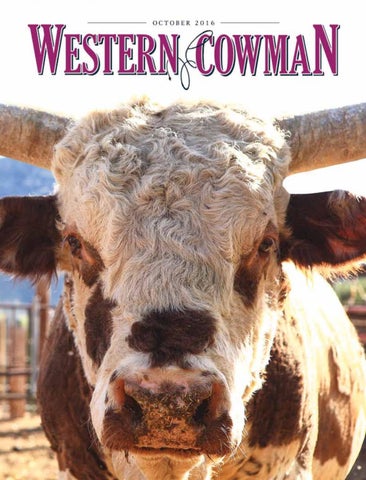
COVER
“Cool Breeze.” By Sherry Danekas
“Glory Days.” By Tyrell Marchant
4
W e s t e r n C ow m a n
-
O c t o b e r 2 0 1 6
Always Interacting.
“Up close, and personal.”
26
31
BUSINESS&ADVERTISING
TR AILS An acre of performance is worth a whole world of promise.
Editor
Sherry Danekas sherry@jdaonline.com
Associate Editor
Mercedes Danekas-Lohse mercedes@jdaonline.com
Advertising
Mercedes Danekas-Lohse (916) 837-1432 (916) 685-8980
Graphic Artist
Circulation
Hannah Ballard hannah@jdaonline.com Morgan Fryer morgan@jdaonline.com
Mailing Address P.O. Box 8629, Woodland, CA 95776 Office Phone P (530) 668-1224 National Sales Representative. THE POWELL GROUP, INC. 4162-B Carmichael Court Montgomery, AL 36106 (334) 271-6100 Attn: Davy Taff
Website www.westerncowman.com
Western Cowman, is owned and published monthly except May/June and July/ August combined by James Danekas & Associates, Inc., P.O. Box 8629, Woodland, CA 95776. Subscriptions are $20.00 per year. Presort Standard U.S. Postage Paid: Tucson, Arizona. Address corrections requested. contributing writers: Sherry Danekas, Heather Smith-Thomas, Tierra Kessler, KayDee Gilkey, Kindra Gordon, and Tyrell Marchant.
~ William Howells ~ In early September we had an event in Couerd’Alene, Idaho, and what a scenic place to visit; it was encircled by a picturesque lake and the weather was nothing short of spectacular also, fall was evident everywhere. I was basking in the cooler weather and it was even raining as we made our departure and you can only imagine our chagrin when we landed and it was ninety seven degrees with a hot north wind blowing. Things did not improve until yesterday when autumn started easing its way here, as the temperatures dropped and a cool breeze finally settled in. I’m eagerly waiting for the first storms to move in and settle the dust along our long drive into the ranch and in the valley. Between the harvesting and the tractors tilling the dust has become a fine layer on the horizon. Unfortunately there has been no dust turned up at my home site, although the plans are moving (slowly) through the channels of permits. What I’m learning is that none is this will take place on my time schedule and patience might actually become a virtue of mine before I walk through my front door. I still believe in my contractor (this month) and will continue to prod and push to get things done, although today through our mounting text messages he claimed he may have to be put out to pasture after we’re done, and didn’t even add lol at the end of his text message. I have a feeling this is going to be an interesting experience. Also interesting is what you’re going to get in this October issue. We begin our expedition in Nevada at the Fallon Livestock yards and meet and greet the folks who own and run the livestock market; be sure and take a gander at “Tuesday’s at the Livestock Exchange”. We then venture west and meet the group called the Nevada Agricultural Foundation who provides the Ag students of Nevada with many scholarship opportunities. This is a very special foundation that you’ll enjoy knowing more about. We settle in Reno to partake at the four decades strong Rapscallion restaurant, this is a special restaurant and it’s truly made its mark not only in Reno but Nevada as well. We circle back to California for a very special piece about the World of Bulls sale that is hailing in 48 years this coming November 5th and is only one of two auctions in the state of California that caters to all breeds that can claim that title. It was Jack Parnell who began this truly remarkable sale and three generations later there is still a Parnell holding the reins. Don’t miss this special piece titled “Vision & Value”. From California we journey southwest to Arizona where we find ourselves in Cochise County at “Three Sister Land & Cattle Company”, this is a unique piece that I know you’ll enjoy. After all the traveling it was time to wet our whistles at the famed El Charro Café in Tucson. This café is the oldest Mexican restaurant in the U.S. under continuous operation by the same family, and the food they serve up will definitely light up your taste buds. Also in this issue we’re also introducing to you a new member of the team Tyrell Marchant and his editorial page titled “Ridin’ Drag”, I think you’re going to enjoy his fresh takes and thoughtprovoking viewpoints. Just to let you know the photos from the 2016 Western Cowman Photo Contest are being judged as I write this and the outcomes will be in next month’s issue. Once again some very beautiful photos and impressive shots; you’re going to enjoy viewing the results. I’m staying on the trail of my contractor, the storms, and the special trail were on awaiting Mercedes’ calving date on November 14th, can’t wait to meet my grandson. This trail also leads us in to the month of giving thanks in November and I have much to be thankful for and one of those are you our readers, thanks again for staying the trail and may your Autumn trails be happy….. While waiting for the vet to arrive last week I took this photo on my cell phone, my home site is located on this side of the windmill, hopefully this landscape is a bit different next month!!
October 2016 -
W e s t e r n C ow m a n
5
T
here are only two livestock auction markets in the state of Nevada, and both of them are in Fallon. Brad Hall and his brother Clay Hall are co-owners of the Fallon Livestock Exchange, which was built in 1991. Their parents owned it until their father, Lee Hall, passed away a couple years ago. “He was in the cattle business for 55 years, and he and my mom purchased the Fallon Livestock Exchange about 12 years ago from Gary Snow,” says Brad. Manager of this sale yard is Monte Bruck. “Monte has run it ever since my dad bought it. He and my dad were good friends for a long time. Monte used to be a sales rep for Superior Livestock Auction and that’s how my dad met him. My parents had a couple ranches at Dayville, Oregon and Dad met Monte at a sale in Vale, Oregon about 25 years ago. Video auctions were a new thing back then, but my dad was never afraid to try something new. He tried selling some cattle that way, and the video marketing worked out pretty well. He was happy with it, and he and Monte, myself and my brother all got to be friends. We hunted together and traveled together,” Brad says. Monte Bruck was born and raised in the livestock industry and bought and sold a lot of cattle. “I used to auctioneer and do 5 sales a
6
W e s t e r n C ow m a n
-
By Heather Smith-Thomas
week. I’ve done nothing but the livestock industry all my life,” he says. Monte and Lee Hall made a great team. “My dad and Monte really hit it off, with Monte being a sales rep for Superior and my dad being a buyer and a seller,” says Brad. “When this opportunity came along and my dad bought the sale yard, he needed someone to run it. They made a deal and Monte decided to leave the video sale industry and run this auction. Monte had quite a background; he’d been involved with sale yards all his life, and the cattle business. and is also an auctioneer. He knew the cattle business inside and out, so he was the perfect guy to run it. Monte lived in Ontario, Oregon at that time, but he and my dad came together and worked out a plan of operation. Monte would move to Fallon and run the yard—and he has
O c t o b e r 2 0 1 6
been running it ever since. This sale yard was originally built in 1991-1992 by a gentleman in California and was open for a while and then closed. It had been up for sale before, but hadn’t sold. “Gary Snow in Fallon reopened it, and ran it for about 6 or 7 years, and then he wanted to sell it, so we got in touch with Gary,” says Monte. “When I found out it was for sale again, I called Lee Hall to tell him about it, and he decided to buy it. Lee and I had a great relationship. I talked him into buying this yard, because of the friendship we had, and it has worked out very well. Lee Hall was a prince of a man, and I thought the world of him.” Brad says, “This was a perfect deal for my dad; he had been in the cattle business a long time and had multiple ranches. He also leased
ranches in Oregon, Nevada and other western states. He was a Cal Poly graduate and the cattle business was his life. My brother and I both live in California, and my dad lived in California most of the time while he had the sale yard, and he depended on Monte to take care of it.” “My dad was always improving the Livestock Exchange after he purchased it—putting in new pens, concrete feed bunks, improving the sale ring, putting in a new computer system, etc. He always tried to make everything better, so now it’s a topnotch set-up,” says Brad. Monte says that the Livestock Exchange is the newest and most modern yard of the two in Nevada. “It’s all steel and concrete, rather than wood. It’s been a good deal for Lee and his family, and for myself. The people here are great--in and
around the Fallon community, and the state of Nevada,” says Monte. The Fallon Livestock Exchange draws cattle (and buyers) from a large area. There are many sale yards in California, and a few in Idaho, but for most ranchers in Nevada it’s much closer to take their livestock to Fallon. “We draw cattle out of northern California (off the Sierras), Nevada, and southeastern Oregon,” says Monte. The sale yard has a regular sale every Tuesday, selling all classes of livestock, and a few special sales in the fall and in the spring. “We have special feeder sales on Saturdays in September, October, November, December and January,” he says. The Nevada Cattlemen’s Association all-breed bull sale is held at Fallon Livestock Exchange every year in mid-February. “This sale is run by
the Nevada Cattlemen’s Association but we host it at our yard. This sale has been around a long time,” says Brad. The sale has been going on for 50 years, but has been held at the Fallon Livestock Exchange for the past 8 years. “In December we host the Nevada Cattlemen’s Association feeder sale and call it the Silver State Classic,” says Monte. “We generally sell about 2200 to 2500 calves and yearlings at that sale, for the Nevada Cattlemen’s Association members.” The weekly Tuesday sales take in everything—sheep, goats, horses, etc. as well as cattle—whatever anyone wants to sell. “We start each sale with the sheep, goats and pigs at 11 a.m. and start on the cattle at 1 p.m. We also handle a lot of cattle on what we call truck-throughs. If the road gets closed in the | Continued on page 8
October 2016 -
W e s t e r n C ow m a n
7
fall or winter, going over the mountains, the truckers will off-load their cattle here--where they can be fed, watered and rested. There are a lot of cattle going to California in the fall, and if bad weather shuts down those mountain passes, truckers come here to off-load the cattle until the road is open again,” says Monte. The auction yard has one fulltime employee, Kevin Hancock, who keeps things going on sale day. “He is there 5 days a week, and on call as we need him. We have a dozen or more part time employees. On average we employ about 15 people working here on sale days,” he says. June Young is the office manager, accountant and bookkeeper. Monte is the auctioneer for the regular Tuesday sales but sometimes has other auctioneers come in for the special sales. There is also a restaurant connected with the sale yard, called the Running Iron Café. “We don’t run it, but we lease it out to the people who do—and they do a great job. This café is open every day and not just on sale day, and stays pretty busy. The Running Iron Cafe is open 7 days a week for breakfast and lunch. They open at 6 a.m. and close at 2 p.m.” says Monte. A lot of people in the community come here for breakfast or lunch, and it’s also very handy on sale days. “We provide a full service for our customers. We handle and take care of all the cattle when they arrive; they go on feed and water immediately. Some of them come from quite a ways, some as far as 350 miles to come to our yard. We have a big area we draw from,” says Monte. “Livestock auctions serve an important role in the cattle business and in our local area. Fallon Livestock Exchange is a key market for the livestock industry in the Silver State and in the surrounding areas. It provides producers a way to market livestock with a professional staff with over 50 years’ experience in the livestock marketing business.”
Continued from page 7 |
8
W e s t e r n C ow m a n
-
O c t o b e r 2 0 1 6
i i
Wagyu Experience
2017
October 2016 -
W e s t e r n C ow m a n
9
The Glory Days
The other day, while rummaging through my closet trying to decide which of my zillion plaid shirts to don for the day, I received a bit of a blast from the past. Hanging way back in the farthest reaches of the closet, where no one ever bothers to look and daylight dares not enter, was my old high school letterman’s jacket. Feeling a bit of nostalgia, I pulled it out and slid my arms into the sleeves. Surprisingly, it still fit reasonably well and actually felt pretty comfortable. I walked over to the mirror to check my bad self out. I looked like an idiot. It was no fault of the jacket’s; it’s still in good shape and offers a fairly timeless look. No, it was all me. I mean, what kind of grown man goes around dressed like that? A narcissistic man-child clinging to his glory days, that’s who. I try not to judge people based on appearance, but let’s be honest: If I see a guy a decade or more removed from high school wearing a letterman’s jacket—even at a class reunion—my first thought is going to be, What a tool. Even a kid who
graduated last year and is back to watch the homecoming game probably shouldn’t be wearing his jacket out in public. So I put the jacket back on its hanger and hung it back in its dark corner. Thirty seconds later, I was putting my belt on and happened to glance down at the buckle, which I won at a team sorting between my junior and senior years of high school. It’s big and shiny (if a little
tarnished) and screams “cowboy” even when it’s paired with a T-shirt and sneakers. It’s a tangible reminder of long-past success, a wearable trophy—much like a letterman’s jacket. Yet, an old belt buckle is a perfectly reasonable fashion choice for anyone who is or ever has been a cowboy. So, what’s the difference? Why do you cringe when a mulleted Uncle Rico type starts in on another play-by-play of the ’79 state title game, but lean back and smile when an old bareback rider spends 20 minutes recounting the eight seconds of fury aboard Scorpion Sally that won him a buckle in Flagstaff back in the day? Having devoted an inordinate amount of time and thought to this query, I’ve come up with a bit of a theory. While letterman’s jackets and other high school relics ostensibly say, “I’m clinging desperately to how good I used to be at something,” a belt buckle proudly and
simply proclaims, “This is who I am.” A belt buckle represents not only a moment of past victory, but of things far more enduring: a career, a lifestyle, a lineage, a family. I’ve won three buckles in my life, and each came when I was a teenager. The first is the aforementioned sorting buckle, which was won by a team made up of my grandfather, my uncle and myself. The other two I won showing market steers at the county fair, aided by countless hours of practice and encouragement from my parents and
siblings. Those are things I’m happy and proud to hang on to. More than serving as tokens of triumph, those buckles tell a story of who I am and what I do. Don’t get me wrong—high school sports like football and basketball are wonderful and can teach kids powerful life lessons; they did for me. But today, nobody—myself included—cares how many points I scored (not many) or how many games we won (even fewer). Frankly, unless you played water polo (because that’s incredible no matter how many years pass), reasonable people don’t care one whit what
high school sports any adult participated in. What does intrigue people, though, is hearing about livestock shows and rodeos and a way of life most folks will only ever get a brief glance at. The self-assuredness that comes with sporting a heavy silver buckle isn’t rooted in the knowledge that the wearer was at one point really great at something; it comes from knowing that what he or she did was really great, no matter the success rate. So go ahead: Strap on that buckle you won at a ranch rodeo Kanab in the glory days and bask in the aura it gives you. Just remember to shave off that mullet before you go out; there’s nothing glorious about that.
By Tyrell Marchant
10
W e s t e r n C ow m a n
-
O c t o b e r 2 0 1 6
SANTA CRUZ ANIMAL HEALTH
Helping Maintain a Healthy Herd with Vaccines, Dewormers, Insecticides, Reproduction Products, and more!
Introducing
UltraCruz
®
Supplements • Grooming • Critical Care
featuring
UltraCruz® Cattle Copper Bolus
800.457.3801 Ext. 3
www.scahealth.com October 2016 -
W e s t e r n C ow m a n
11
Friday, November 4, 2016 Red Western Classic Show Saturday, November 5, 2016 Bet on Red Auction
Join us for the Cattleman’s Symposium Thursday, November 3, 2016 Topics include: Value and benefit of year-round supplementation Value of carcass ultrasound Sponsored by:
Platinum Event Sponsor & Sale Day Lunch Host Sale sponsored by the Northwest Red Angus Assn.
www.northwestredangus.com
For more information, contact Mark Peacemaker: (530) 340-0223
12
W e s t e r n C ow m a n
-
O c t o b e r 2 0 1 6
All attendees of the Cattleman’s Symposium can enter to win a Weatherby SA08 12 Gauge Semi Automatic shotgun. Donated by all the Montana breeders participating in the 2016 Bet on Red!
These premier Red Angus females from the Northwest sell November 5th!
Complete catalog available online at: www.redcows.net Auction management by:
Make your reservations now: 775-325-7401 Use group code REDANG6 when making reservations. Group rate reserved until October 11, 2016.
Kyle and Lisa Gilchrist Kyle: 641/919-1077 • Lisa: 515/669-9945 14075 120th St. • Douds, IA 52551 redcowseller@yahoo.com
October 2016 -
W e s t e r n C ow m a n
13
By: Tierra Kessler
A
passion for agriculture and tradition in Nevada drove the organization of the Nevada Agricultural Foundation (NAF) by University of Nevada, Reno alumni in 1976. Since that start, approximately $1.7 million in scholarships, grants, and other awards have been distributed by the Foundation. The future of Agriculture in Nevada is crucial to the well being of many families and the state’s economy. Preserving this lifestyle for the generations to come was deemed extremely important by the educators, farmers, ranchers, and ag businesses who created the Foundation. During the late 1970’s, there was a growing concern
14
W e s t e r n C ow m a n
-
that funding would be cut for the support of the Nevada agriculture industry and future education of students at the University of Nevada, Reno, the state’s Land Grant University. Strengthening and supporting the future of agriculture in Nevada is carried out through financial assistance to groups and individuals directly involved in research and education. Each year the Foundation distributes Educational Assistance Awards to deserving students who graduate from Nevada high schools. In 2016, new and continuing students were awarded $70,000 by NAF. To receive assistance from NAF, students have to graduate from a high school in Nevada, however they can at-
O c t o b e r 2 0 1 6
tend college anywhere in the United States while pursuing a degree in an agricultural field of study. Applications are due in March and the Foundation then gives two four-year awards and multiple one-year awards. Students who have previously received a one-year award may reapply, and sometimes end up receiving assistance all four years of college. Awards range from $2,000 to $4,000 per year per student, with 30 students currently receiving support. A committee of Directors and Trustees review applications and select recipients along with the amount and duration of their awards. Students who have 4-H or FFA experience are given priority, along with those who have ca-
reer aspirations in agriculture. Since the Foundation supports the future of agriculture, they seek out students with experience in leadership, community service, academic success and a likeliness that they will contribute to agriculture and give back to their state. “Students that stand out typically are those who have shown initiative and drive to succeed,” Sue Hoffman, NAF Executive Director said. “They have not just done well in school, but have also been active in projects.” There are many projects that a qualified applicant could choose to be involved in, and the Foundation does not focus on any one segment of agriculture. Of the two four-year award winners in 2016, one plans to become a large animal veterinarian. While in high school this student developed their own flock of sheep, served as 4-H club president, qualified for Honor Society and worked an internship along with other school and volunteer experience. However, the other recipient was home schooled and gained experience through working on the family ranch, participating in Nevada’s annual Youth Range Camp and the Society for Range Management’s Youth Forum. There’s no “right way” to be involved in agriculture, and students from all facets and interests are encouraged to apply. The Foundation gives more than just scholarships; they also give grants, fund research, and Excellence in Education Awards to outstanding educators each year. Excellence in Education awards recognize outstanding educators with $1,000 to be used on the purchase of teaching supplies. The Nevada Cattlemen’s Association, Nevada FFA Foundation, Nevada 4-H, and Nevada Ag In The Classroom each nominate recipients for their respective awards for teachers, instructors and volunteers. The accomplishments of students in agriculture can be heavily dependant upon the people they look up to in teaching and leadership positions. Therefore, the Foundation decided to start recognizing those who go above and beyond to ensure the success of young people in agriculture. There are also opportunities for those involved in research and agriculture awareness to gain funding from NAF through grant applications.
Those who are helping enhance agricultural knowledge through efforts such as university research, Ag in the Classroom demonstrations, and FFA projects are eligible to receive funding. “NAF is currently involved in the development of Ag in the Classroom materials pertaining to water and agriculture in Nevada,” Hoffman said. “In 2015 we received grant funding to help support local Ag in the Classroom programs. Also last year we obtained a grant where we were able to provide funds to Nevada FFA students and programs to support or augment their projects.” The Foundation has funded many research projects that relate directly to the success and advancement of agriculture within the state. These projects have included the topics of Range Management, Evaluation and Development of Low Water Use Crops and Forage Grasses, and Animal Nutrition. The success of NAF would not be possible without the generosity of those who sponsor its work. The Foundation has steadily grown assets through charitable donations and professional investment of trust funds to currently have assets of just under $3 million. Distributions of funds annually are based on NAF earnings, donations, and gifts. Donations to the Foundation are encouraged to continue the expansion of their projects, aiding in serving their mission. The mission of NAF is “To Promote and Strengthen Agriculture in Nevada by providing Financial Assistance to Deserving Groups or Individuals Involved in Research or Education.” Continued support of this organization will provide them with more
opportunities to carry out that mission resulting in a more productive agricultural industry for the state of Nevada. According to the NAF website, they “believe in fostering education and research to benefit both the agricultural producers and leaders of today as well as those of the generations to follow. This is accomplished by generating revenues to fund our two main areas of involvement: The funding of pertinent, quality research to help educate our current producers as well as the public; and the granting of education assistance awards to deserving individuals who are seeking future careers relating to agriculture, including careers in bio-technologies and animal health.” As consumers continue to become drawn to locally grown foods and high intensity production develops further to feed more people, Nevada agriculturalists will need help adapting to changes in farming methods and consumer relations. The Foundation will continue to aid in the building of future leaders to help take the industry through the upcoming years successfully. Continued donations by those who also believe in the NAF mission and future of Nevada agriculture will aid the Foundation in increasing financial support of Nevada students in college agriculture programs, educators, and research projects that enhance agriculture practices. Those interested in more information on the Foundation or donating to the future of Nevada agriculture can visit their website at NevadaAgriculturalFoundation.org.
October 2016 -
W e s t e r n C ow m a n
15
16
(530) 668-1224
W e s t e r n C ow m a n
-
O c t o b e r 2 0 1 6
Join us for these upcoming events: January 18, 2017 • Mile High Wagyu Experience Sale • Denver, CO May 7, 2017 • Northwest Breeders Female Sale • Madras, OR May 13, 2017 • California Angus Breeders Female Sale • Escalon, CA May 20, 2017 • Lone Mountain Cattle Co. Production Sale • Albuquerque, NM June 10, 2017 • Passion for Prime Wagyu Sale • Springfield MO October 2016 -
W e s t e r n C ow m a n
17
By: KayDee Gilkey -WC-
By KayDee Gilkey
A
ccording to therestuarantbrokers.com website, the average restaurant possesses a lifespan of five years, with nearly 90 percent of independently owned restaurants closing their doors within the first year. That is certainly not the case for Reno’s Rapscallion Seafood House which has been a local favorite to celebrate birthdays, anniversaries and other important occasions for the past 39 years. In fact it consistently is rated as Reno’s best seafood restaurant year after year featuring more than 20 varieties of fresh fish daily. What does it take for a restaurant to be successful landmark within Reno’s eating establishments? Rapscallion’s General Manager Patrick Dalton said, “We provide our customers with a high quality meal for a reasonable price. Our employees are excellent and we are always looking to bring new menu items, yet maintain our customers’ favorites.” In 1977 the original owner John Leonudakis had just sold several Portland restaurants and had intended to go to Utah and start a new restaurant
18
W e s t e r n C ow m a n
-
O c t o b e r 2 0 1 6
there. However, when he and his restaurant designer Pat Kuleto stopped to eat lunch in Reno they learned that the building that had housed the Posie Butterfield restaurant was for sale. They visited the building and thought it work well for their goal of a new restaurant and did never made it to Utah. The brick building was built in the 1940s and has seen several remodels over the years. While working to updating the building prior to the opening of the restaurant, one of the workers fondly called Kuleto a rapscallion. Both Leonudakis and Kuleto thought the term — which means scoundrel or a mischievous person — would make a good moniker for the restaurant. To celebrate their 39th-year, each Tuesday there is a Celebration Menu of $39 for two which includes: two salad choices, four amazing and hard-to-pickfrom entrees and two yummy-sounding dessert options. Giving Back One way that Rapscallion gives back to their community is through their charity of the month program. They have raised more than $1 million for amazing non-profits within the Reno area through the program in the nearly four decades that they have been fundraising for local charities. When patrons come in during a featured charity’s month and they mention that non-profit, 20 percent of their food bill is donated to the designated charity. “It is a great way for us to support the good work of our many charities and for our customers to come in, have a great meal and help give to a worthy non-profit,” Dalton explained. Prior to the charity of the month program, Rapscallion had held an annual golf tournament for more than 35 years. “Giving back to our community has always been an important element for us. We moved to focusing on 11 charities a year and have heard positive feedback from our customers that it is a good way to help those organizations that are assisting those in need in our community,” said Dalton. Although seafood is in the restaurant’s name, when looking to expanding their beef menu choices 11 years ago, Rapscallion began serving Certified Angus Beef. “We were looking
for a consistent high quality product that would please our customers at every dining experience,” Dalton said. In addition to serving CAB, they recently purchased a steer from Van Norman ranch. “We are always looking for ways to localize our menu and several months ago our broker really went out of his way to help us find a local supplier in the Van Norman ranch near Tuscarora, Nevada. We quickly ran out of ribeye and filets, but in June we featured a Van Norman avocado bacon cheese burger. Our executive chef, Richard LaCounte, even made stock soup out of the bones and we are featuring menu items | Continued on page 20
October 2016 -
W e s t e r n C ow m a n
19
Continued from page 19 |
well,” he said.
using the stock as
A Delicate Balance Since January of this year there are 20 new restaurants in the Reno area, Rapscallion has a long history with the community, but that history sometimes becomes the known and familiar rather than the new and exciting. There is a delicate balance Dalton said between bringing in new menu items and maintaining those items that keep customers returning back and that they expect to enjoy each time they
visit. “We once thought we would try a new bread recipe to replace the one we used since we opened 39 years ago. That was one misstep that we quickly fixed after hearing loud and clear from the customers that it was the old recipe they preferred,” he said. “We do rotate our seafood selection throughout the year, depending on what is in season. For example, Halibut is only on our menu during its season from March to November. We do not use frozen fish that have been in storage for months,” said Dalton. “Our seafood purveyor Sierra Gold is a locally owned
company that makes several trips to Los Angeles to pick up fresh seafood product throughout the week.” “We are environmental conscious. We no longer serve Chilean Sea Bass as it has been over harvested. We feel a responsibility to do what is right and and have that reflected in what we serve,” he said. When Dalton was hired 11 years ago, it was in a marketing role. “Then we did a lot of print and radio advertising. Today, we are very active on social media. We recently revamped our website and are considering a new platform. We get a lot more feedback now via social media, which is great. It is more dynamic and we quickly learn what our customers think,” he said. There are 47 employees at Rapscallion. A handful have more than 30 years of service with the restaurant — which is practically unheard of in the restaurant industry. “We all work hard, but we have fun too. We really consider our employees family. Though the restaurant business can be fast paced, stressful and challenging at times — it is also fun. Our employees enjoy what they do and it shows,” said Dalton. As Rapscallion looks at opportunities for growth, they have increased their patio space, and now have three private dinning rooms for private parties for 20 to 40 people. “We also recently have begun catering events as a way to expand our business,” he said. For those who have had the pleasure of eating at Rapscallion, you know about the attention to detail and the fresh ingredients combined into the delicious meals served by professional and friendly staff. If you haven’t yet had the opportunity to go Rapscallion, Dalton suggests you begin at a Happy Hour. Dalton said, “We have really good food and the same amount of focus and detail goes into our appetizers as in our meals. Sometimes we hear that folks think we are a staunchy, expensive restaurant — nothing is further from the truth. We have a very casual laid back attitude — excellent food but also very approachable as far as dining environments go. I invite you to stop by the next time you are in Reno and enjoy our excellent food and great service.” If you want to learn more about Rapscallion Seafood House you can go to their website www.rapscallion.com or like them on Facebook. -WC-
20
W e s t e r n C ow m a n
-
O c t o b e r 2 0 1 6
Arizona ~WC~
By Heather Smith-Thomas October 2016 -
W e s t e r n C ow m a n
21
D
wight Babcock was originally from Chicago, Illinois, but fell in love with the Southwest when he came to the University of Arizona to play baseball. “I always enjoyed the outdoors. I grew up in Riverside, a suburb north of Chicago that was next to the Forest Reserve. As kids, my siblings and I were always out in the woods hiking and playing,” he says. “When I finished college I became involved in the insurance and software business in Tucson, Arizona and had some early success automating major insurance carriers around the world. This provided me with the financial ability to look for and purchase a second home, to escape the hot summers of Tucson. Most people from here go up into the mountains toward the White Mountains or to Flagstaff but that’s a long drive, so I went south to Cochise County,” says Babcock. He was looking for a 40-acre parcel in the middle of a forest where he could build or find a home and not have any neighbors. “In my investigation and evaluation of the land around that area I found that the only available options for purchase were ranch properties and mining permits. I had started riding horses by then, and was drawn toward the ranching lifestyle, so I decided to look at ranches. I ended up buying a large ranch in the Dragoon Mountains—the original home of Cochise (chief of the local Chiricahua tribe of Apaches, who led several battles against the Army during the 1860’s),” he says. This is also the location of Council Rock where Cochise signed over the land to the government (in 1872, after making a peace treaty and being granted a reservation for his people). “That took place right here, adjoining this ranch,” says Babcock. The ranch itself dates back to the 1880’s. “I have some of the original papers from Teddy Roosevelt, giving the land to the settlers at that time, before Arizona became a state,” he says. This area has a lot of interesting history as well as rugged landscape. This was the setting for the movie “Buffalo Soldiers” starring Danny Glover, and for the remake of the “Magnificent Seven” series. The Three Sisters ranch is quite isolated, yet just an hour’s drive south of Tucson, in mountainous country between 5000 and 7000 feet elevation.
22
W e s t e r n C ow m a n
-
Dwight Babcock owns and works the ranch.
Three Sisters Ranch horses grazing in pasture.
Elaine Babcock is a working partner on the ranch.
On average, the temperature is 15 degrees cooler than at Tucson. “We sometimes get as much as 10 inches of snow in the winter over a couple different snowfalls, yet it melts within a day except on the north-facing slopes.” It’s a very pleasant climate year round, with mild winters and fairly cool summers. “I bought the ranch in 1982. The young lady who owned it hit hard times after her father (who had purchased the ranch) suddenly passed away. I was able to work her out of the financial problems she had, because she was going to lose everything. We got the ranch paid off for her and worked out a strategy so she would have some money and not have to file bankruptcy,” says Babcock. “At that time the ranch had no remaining livestock and I began developing a fairly large Quarter Horse operation. We ultimately had about 80 broodmares. They were Jim Bar bloodlines, bred for cutting, team penning and roping. Our main goal was to raise cutting horses, since I’d always wanted to raise the kind of horse that would allow me to compete in a sport that I could participate in, as opposed to something like horse racing. I loved to ride, and this was a key to having our horse operation,” he says. Babcock also reintroduced cattle to the ranch. “In our area the typical cow
O c t o b e r 2 0 1 6
was an F1 Brahman-Hereford cross. We had Salers bulls, then switched a couple of times to other breeds before changing over to Black Angus. We also got out of the horse business after a few years, and no longer raise horses except for what we need for the ranch. It’s about 20,000 acres with a lot of mountains and only one road across it, so a person needs horses to check on the cattle. Everything is done by horseback,” he says. The horses run free in big pastures. “Even when we were raising horses, they ran loose because I don’t like to have horses in stalls. I don’t like the behavior of horses that have to live in stalls. Whenever I leave the ranch and I’m not there for a while, our horses are turned out on 6000 acres in the mountains. They come in when we want them, coming to a whistle. I sometimes bring them in just to eat down the grass in the corrals,” says Babcock. The horses are always fit and healthy, running in the mountains. “This was the way I raised our foals when I was in the Quarter Horse business because they grew up sane and sound. They are used to everything— rain, lightning, other animals, and varied terrain. When you get those youngsters in, to start training them, none of them try to buck. I could climb on one that had never been ridden, and that’s
has just dropped a baby she’ll come right at you! These black cattle work the country all over, and go high up on the mountains, so they’ve done well,” he says.
what I really liked about them—they have such a sound mind.” The horses are comfortable out in the real world, not being raised in artificial conditions. “We probably weren’t the best marketers for our well-bred horses to the general public; we sold them to trainers. We showed our horses to potential buyers as yearlings, right out in the pasture, and they weren’t all pumped up and polished in a sale barn. Ours were big-boned and a little short (14.2 to 15 hands), but after someone bought them and started feeding them up they would bulk up as 2-year-olds and be tremendously good-looking horses,” says Babcock. “We enjoyed raising them out on large pastures, and have also taken in a few rescue horses from several families that were leaving the area and couldn’t take their horses. We just took the shoes off those horses and turned them out for about 12 to 18 months to run free and learn to be a horse again.” He no longer raises horses except an occasional one now and then for his own use. The cattle on this ranch also do well roaming out on mountain pastures. “We switched over to Angus about 10 years ago. We thought that the Angus breed had done a better job of marketing and the economics were better. I was initially concerned, however, about how good these cows would be out there as mothers, in the mountains with predators—and whether they would be as protective as horned cows. I found out that the Angus were equal to or better than the horned cows at protecting their calves. If you come up to one of those Angus mamas that
MARKETING THE BEEF “In merchandizing, we’re becoming known for the quality of the cattle we grow. I recently retired as the CEO and Chairman of the Board of a public company. I am now planning to expand our herd and looking at a different method of bringing aged natural beef to the consumer, direct to their home—on request, for the cuts they want from their purchased inventory,” Babcock explains. Consumers can soon check this out at www.agednaturalbeef.com “We’ve come up with a concept that’s a little different than most direct marketers. Everyone who buys beef this way thinks they need to have a freezer or a locker someplace and have a place to store it before they can order a quarter, half or whole. But with our program, they simply have an inventory on their phone of the cuts they bought in that quarter, half or whole, and they can call us up and order what they want from th inventory. A customer might call and say they have some guests coming next Friday and we can overnight ship the cuts they want. It’s not the same animal each time; it’s a fresh animal, and a just-in-time delivery concept, sending the package by Fed-Ex to their home,” says Babcock. “Our beef is aged natural beef, with no hormones or antibiotics. We think this will be an interesting project. The plan is to use the University of Arizona Ag school to do the harvest and processing. We will be working in concert with them,” he says. “We grain finish ours, currently, but I am talking with a group of other ranchers who grass finish their beef. It’s a different type of aging process for grass-finished beef, however. It’s a wet aged solution versus a dry aged process. I probably will eventually have some different options available for the customer. We may not try to finish our calves both ways, but instead work with other local ranchers who are grass finishing. I have been talking with one packer who is promoting grass finished beef,” he says. “I don’t think we compete with the local ranchers who are selling beef lo-
cally to folks who come and get it or the ranchers who will deliver it locally to people who have a freezer. We are trying to take away all that risk. People who understand what aged beef is will find our kind of option attractive when they want things delivered to them rather than having to go to the grocery store to shop. And our price will be similar to what someone would pay for a quarter, half or whole steer,” explains Babcock. Marketing is a big part of the equation, and a lot depends whether a person has the time and energy to engage in direct marketing. His plans for the future are to pursue this kind of marketing. “We will utilize our own product and bring in other local producers who meet the criteria of what we need to produce as a certain level of prime beef. I think this will be good for producers in our area. With our technique, we can go beyond the 50 mile range and be national. We can ship our beef and have it tomorrow in New York, Chicago or Los Angeles. We are doing it a little different than Omaha Beef that sells a 6 ounce fillet for $50. You might be talking about the equivalent of $150 per pound and I don’t think very many people can afford this every week or monthly.” His system makes it more affordable, and people get a full complement of cuts available from their quarter, half or whole purchase. “We can also help them with some cuts they don’t understand, with some recipe ideas. At the end of the year, what they don’t use (from the quarter, half, or whole beef they purchased) we can make available to local charity giving, and they get a deduction for it. We are trying to make it simple. We are not trying to find sources to send out our secondary cuts to restaurants or local butchers. We are telling our customer that it’s all theirs and they can have the prime cuts (that might otherwise cost $25 per pound at local stores and $150 per pound from mail order houses) for $11 to $12 per pound, sent direct to their home. They don’t need to have a big freezer and risk losing the meat if there’s a power outage, and they don’t have to drive somewhere to pick up the meat. We think there will be some attraction there, and we can teach them how to use some of the other cuts that they are not as familiar with,” he explains. This creates a win-win situation. “In Tucson, in | Continued on page 24
October 2016 -
W e s t e r n C ow m a n
23
Three Sisters road and home.
Continued from page 23 | our neighborhood at Christmastime a number of neighbors would bake cookies, or gift a fruit basket, etc. My wife Elaine would put together a gift package of ground beef and a steak or two in a basket to reciprocate to friends. People wondered why it tasted so good, so much better and different than their store bought beef!” Prime aged beef was clearly the difference.
RANCH MANAGEMENT The cattle management on his ranch has changed. He used to leave the bulls out year round and the cows calved over a wider time frame. “I felt
that half a calf (a very young one) was better than no calf. In the last few years I’ve switched to a shorter calving season, with the cows calving in DecemberFebruary,” he says. The climate is mild enough to have the cows raising babies during winter. “It can be as low as 15 degrees at night in the winter and up to 70 degrees during the day. Our cold weather is not severe and it’s not long-term. The cows are not walking through snow!” he says. He and his wife Elaine take care of the cattle themselves. “She’s a rock sculptor artist and does large projects. She is well known for her life-size boots made of alabaster. She has also taken a 500-pound piece of marble and turned it into a 125-pound horse’s head.” You can view her work on www.RockingEstudios.com “We used to have a ranch manager and a staff of people when we were raising horses, but when the last family moved away, when their kids were getting out of high school, I never replaced them. I was able to do all the cattle work myself, with the exception of roundups where some local ranchers help. I also have some other ventures with other herds of cattle elsewhere— with another rancher—and his crew comes over to help me with anything major that I need,” he says. The livestock are well trained to
THE RANCH NAME People have asked how the ranch got its name, and the story is a bit ironic. “One of the early families that lived on this land was the Sala family—and it was called the Sala Ranch. When I bought the ranch in 1982 I named it the Three Sisters Land and Cattle Company after my three daughters (Jenna, Nicole, and Amy),” says Babcock. There’s an interesting twist. “The main pasture has a big rock face behind it, called Sheep’s Head, in the middle of that mountain range. To the left of that rock face are three peaks, and some people were already calling those peaks the Three Sisters, but we didn’t know it,” says Babcock. “A lot of rock climbers and recreationists come out here and some do some very technical climbing. A couple of guys from New Mexico were coming down off the mountain one day when my wife and I were riding out there in our pasture. We asked them if they climbed Sheep’s Head. They said no, they were climbing the Three Sisters.” “We asked them if they were calling it that because they were on the Three Sisters Ranch. They said no, those peaks were listed in a rock-climbing book (written in 1964) as Big, Middle and Little. They showed me the rock climbing book, and the map of the three peaks to the left of Sheep’s Head. They explained that in 1964 a tradition was started in which whenever a person climbs a mountain for the first time and makes a line up the mountain so to speak, they get to name it. Someone had already named this the Three Sisters before I named my ranch. This was quite a coincidence!” Babcock says.
24
W e s t e r n C ow m a n
-
O c t o b e r 2 0 1 6
be user-friendly. He can whistle for the horses and they come running, in their big pasture. “I can drive along one road and throw some feed out for the cattle and honk the horn, and they come running from 5 miles away. I can see a lot of them that way, and see if there are any issues that need to be addressed. If there are, I can go out there horseback to resolve those, if I have to. But I’ve made this an easily maintainable operation which one or two people can handle. The cattle are not wild, so they are easy to work with. We can walk among them and they aren’t running away from us,” says Babcock. “Another thing that makes it work better for me now is water. Early on, the water sources on this ranch were dirt tanks, but you can’t raise cattle in Arizona if you are depending on dirt tanks. You never know when there is going to be water in them and they are not reliable. To do the land justice and take care of it, you need to do something else. To look at our land today, compared with what it looked like 30 years ago, I think I am a great environmentalist!” He put in about 20 miles of underground piping for alternate water sources, and also has windmills and a spring. The spring only produces about 6 gallons a minute, but he piped it downhill about 6000 feet with gravity flow that produces 200 pounds of pressure. This water source feeds multiple permanent tanks and troughs in various locations. All the pipes are poly and underground, and maintenancefree. The cows can take care of themselves if they have water and feed. The forage is green for about 4 to 5 months and then dries out, but there is still a lot of feed. “We have love grass, side oats and gramma grasses. The feed is good all through winter and we don’t have to supplement. Sometimes I provide some liquid supplement, but often I just use a little supplement to move the cows. My wife and I take it out and just honk the horn, and 95% of the cows will come through a gate to come to the supplement. We used to call it the Ford Three-Quarter Ton Roundup!” he says. Cows are very trainable. “If you haven’t been aggressive with them or sic dogs on them, they trust you. We just work with them, and slow and easy is the best.”
CAll tO COnSign the theSe uPCOMing WeSteRn viDeO MARket SAleS: internet Sale: Oct. 27 Reno Sale: nov. 30
THD ©
WAtCh AnD BiD live eveRy WeDneSDAy:
CAttleuSA.COM
Join Us Ringside at Galt annUaL FaLL PaIR & BRED COW SaLE Friday, november 4: 2 p.m.
Join us for Our Annual Social Following the Sale
48th annUaL ‘WORLD OF BULLS SaLE’
Friday, nov. 4: Bull grading at 9 a.m. Saturday, nov. 5: ‘World of Bulls’ Sale at 12 noon
Representatives
Jake Parnell .....916-662-1298 george gookin..209-482-1648 Mark Fischer ....209-768-6522 Rex Whittle .......209-996-6994 Joe gates .........707-694-3063 Abel Jimenez ....209-401-2515 Jason Dailey .....916-439-7761
For more on upcoming sales and market reports, visit www.clmgalt.com. (209) 745-1515 Office (209) 745-1582 Fax 12495 Stockton Blvd. galt, California 95632
Central California 48th Annual
W rld ofbulls
Saturday, november 5
galt, California
SPECIaL FaLL FEEEDER SaLES Wednesdays at Galt
October 26 • November 9 November 30 • December 14 October 2016 -
W e s t e r n C ow m a n
THD ©
25
Jack and Randy Parnell in Galt.
lowing and fills an industry need. “We cater mostly to smaller producers – a place where they can sell or buy the bulls they need for their operation.” The sale is held in conjunction with large replacement female sale on the first Friday in November at CLM; Bulls sell at 1 p.m. on Saturday. Being held on the first weekend in November also ties nicely to bull turn-out in the state. “Many buyers can purchase a bull and send it straight out to the cows for breeding season when they get it home,” he notes. Fitting the needs of cattlemen is exactly what brought about the consignment sale in the first place when it was initiated six decades ago.
“Once upon a time….and one hundred years ago” is how many a good story begins, and that’s exactly how Jack Parnell good-naturedly describes how the Central California All Breed Bulls Sale got its start in late 1960’s in Stockton, CA. Parnell founded the sale, which has gone on to stand the test of time and was later managed by his son Randy Parnell, and is today managed by his grandson Jake Parnell. While the name and location of the sale has Jack’s Vision changed over the years, the family’s The founding of a bull sale showdedication to serving bull consignors casing multiple breeds came about in and buyers has not wavered. As well, a circuitous manner. It was the 1960’s Sally Semas has served as secretary and Jack Parnell tells that he had of the sale since its inception. On Nobeen a field editor for the Stockman’s vember 5, 2016, the 48th Annual CenWeekly and Pacific Stockman magatral California World of Bulls Sale will zine. He was then invited to look at be held at the Cattlemen’s Livestock purchasing the California Cattleman Market (CLM) in Galt, CA. Magazine. “I thought, ‘I could have About 110-120 head will be ofmy own magazine,’” he recalls. fered representing several breeds; Indeed. He took the magazine breeds consigned in 2015 included over, but found it was quite a transiAngus, Hereford and Polled Herford, Charolais, Limflex, Red Angus, Shorthorn, and SimAngus. Current manager Jake Parnell notes that the sale has changed over the years with changes in the industry. At its peak, nearly 500 bulls were consigned and sold. Today, more seedstock producers hold their own production sales. In spite of that, Jake says the World of 2 Bulls still has a fol6 sale W e s t e r n C ow m a n - O c t o b e r 2 0 1 6
tion. Parnell had been accustomed to selling to a large circulation. Now he owned a publication that’s largest issue had been 12 pages with a circulation of 2,500 people. For the first issue, Parnell and his editorial team put together a “Bull Buyer’s Guide,” which was an impressive 96 pages and 75 percent of the issue was advertising. He tells, “I had to develop a story of why to advertise.” He used the analogy suggesting, “You don’t hunt birds with a single shot, you use a shotgun and hit a broad audience.” From that, Parnell pursued a survey of his readership – everything from how many jeans people bought and where they bought them from, to information on their bull purchases. He tells, “We asked where you purchase your bulls, do you like to buy them off the ranch, how many breeds of bulls do you buy, etc.” They got a good response rate to the survey, and Parnell’s wheels began to turn when he reviewed the bull buying information. He says, “Those results pointed out a significant number of cattlemen were buying three breeds of bulls at that time for different reasons like milk or heifer calving
in their herds. And, there was some indication that buyers would be interested in an all-breed sale as opposed to sales off the ranch.” That led Parnell to establish the Central California All Breed Bull Sale in 1969 at the Stockton Union Stockyards, which was owned by the railroad and managed by Leo Fitzgerald. Thirty to 45 graders were invited to evaluate the bulls independently before the sale. “When the graders came into the office, we’d take out the extreme bottom and extreme top scores for a consistent average,” Jack Parnell tells. He also reminisces about the barbecue and dance that were held the evening prior to the sale. On the Friday prior to the sale, the yard was also open for “private treaty” business up to a certain time. “It was a lot of fun…It was a whole lot more fun than some other things I did,” Jack Parnell says with a chuckle. He eventually left the auction business for public service in the state of California, serving in several roles and eventually tapped as California’s Secretary of Agriculture from 1987 to 1989. He served during the George H.W. Bush administration from 19891991 as United States Deputy Secretary of Agriculture, and briefly as acting Secretary of Agriculture. Changing Times Over the years the name of the sale changed to the Stockton Bull Sale, and given Parnell’s political duties, his son Randy took on sale management duties in 1986. That same year, the yard was sold and became the Stockton Livestock Ex- | Continued on page 28 October 2016 -
W e s t e r n C ow m a n
27
change owned by John Bourdet. Sally Semas, as the sale secretary recalls the early years of the sale saying, “…we sold a lot of bulls in the three figures; $1200 was a good average. From 1979 to 1989, the sale averaged over 400 bulls consigned.” She adds, “We invited 20 to 30 graders who also were bull buyers. Everything was done by hand – a typewriter and a calculator, no computers.” In 1992 the sale was moved to its present home at the Cattlemen’s Livestock Market at Galt. At that time, the name of the event was also changed to the World of Bulls Sale. Semas tells that through the 90’s computers were in use and less graders were needed. During the 90’s more breeders also began having their own sales, and consignment numbers tapered off. Randy Parnell managed the sale for the final time in 2008, and since 2009 to present, his son – and Jack’s grandson – Jake has been the manager. Semas notes that not only has it been neat to have a family managing the sale for three generations, but many of the buyers are children and grandchildren of original buyers. Bull grading still takes place on Friday morning; private treaty trading is offered for a short time on Friday, and a social is held Friday evening. Jack says he is pleased that the sale is still going and that Jake is at the helm. He notes, “The industry has changed a lot, but the sale filled a gap and it still does. It’s been good for our family and the industry.” Likewise, Jake takes pride in the family history tied to the event. He says, “It’s neat that Sally has been secretary since the beginning. I can remember late nights as a kid in the office calculating the graders numbers with Sally and my grandma Susan and stapling the sale orders together. I also remember working in the alleyways as a kid. He also takes pride in the service to industry. Jake concludes, “We have our returning customers, and it’s an event the industry still needs.” On November 5, 2016, the 48th Annual Central California World of Bulls Sale will be held at the Cattlemen’s Livestock Market (CLM) in Galt, CA.
Continued from page 27 |
The grader list from 1976 when Jack Parnell became Secretary.
Consignors of the 2015
Champion Bull & Champion Pen of 3
This year we are
offering 10 Angus Bulls
November 5th, 2016 Galt, California
View Bulls online At : www.CAttleAndsheep.Com ranches t s e b e th er whywest use our ulls v o c s i D in the eh B elBVi g & Angus 28
W e s t e r n C ow m a n
-
KeVin potter 208-365-3621
O c t o b e r 2 0 1 6
emmett, idAho
Kpotter@q.Com
Built tough &
BACK AGAIN to the
7 Bulls Ready to WoRk • Utah Born & raised •
Bull Sale
November 5th, 2016
November 5th, 2016
Bulls Sired By:
Galt, California
GAR Composure, Connealy Confidence 0100, & Thomas Top Hand 0536
wine Bar ranch
2405 loWeR BouldeR Road BouldeR, ut 84716 taBor dahl • 435/335/7466 taBor@wineBarranch.com
RON & CATHY TOBIN • Flournoy, CA (530) 833-9961 • okherefs@gmail.com
5th, 2016 the toP 3 of our Bull Pen November Galt, California 1 PT Net Profit 115 04-10-15
18532555
Full Sib to the 2015 Klamath Falls Bull Sale Champion Pen Bull
BW: 77 • WW: 975 • YW: 1300
2 PT Addictive Pride 415 07-15-15
Bull Sale 3 PT Class Act 515
18515617
07-25-15
Sire was a Reserve Grand Champion at the National Western Stock Show
18516714
Dam is a proven donor and her progeny have topped many sales and won many shows.
BW: 81 • WW: 802 • YW: 1324
BW: 78 • WW: 815 • YW: 1361
Pheasant trek Woodland, CA
Danekas - Lohse Family • 916-849-2725 October 2016 -
W e s t e r n C ow m a n
29
7
top Quality BullS with MuScle, Balance & perforMance!
ShaSta all Breed Bull Sst,ale
November 1 2016 November 5 th, 2016 Cottonwood, California
Galt, California
SireS repreSented
connealy final product, Soo line Motive, McKellar acton & tara BricKMaKer connealy final product
Joel & ruth popKen
6861 State Highway 32 Orland, CA 95963 (530) 865-3600 • tarafarms@att.net
GREATER GAINS BY THE BARREL
ANGUS MEANS BUSINESS. A reliable business partner is difficult to come by. Contact your regional manager to locate Angus genetics, select marketing options tailored to your needs, and to access Association programs and services. Put the business breed to work for you. To subscribe to the Angus Journal, call 816.383.5200. Watch The Angus Report on RFD-TV Monday mornings at 7:30 CST.
Stress can rob your calves of fast, healthy gains and proper lifetime development. CRYSTALYX® Brigade® Stress Fighting Formula and CRYSTALYX® Battalion® are highly palatable self-fed supplements that help calves overcome nutritional stress associated with weaning, shipping and the receiving process.
RESULTS BY THE BARREL®
Crystalyx.com l 800.727.2502
Jake Troutt, Regional Manager
Terry Cotton, Regional Manager
6344 Beacon Light Road Eagle, ID 83616 208.921.6774 jtroutt@angus.org
3201 Frederick Avenue St. Joseph, MO 64506 816.390.3227 tcotton@angusjournal.com
Idaho Oregon Washington Hawaii
Arizona California Nevada Utah
3201 Frederick Ave. | St. Joseph, MO 64506 816.383.5100 | www.ANGUS.org © 2016-2017 American Angus Association
30
W e s t e r n C ow m a n
-
O c t o b e r 2 0 1 6
By Kindra Gordon
I
n the American Southwest, authentic Mexican food is a savory staple that is loved by locals and tourists alike. Among the most well-known restaurants serving up such food is Tucson’s El Charro Café, which was established in 1922 and is the oldest Mexican restaurant in the United States under continuous operation by the same family. All recipes are handcrafted and based on traditional Sonoran ingredients, and the restaurant proclaims: “We are not the best because we are the oldest. We are the oldest because we are the best.” El Charro Café history dates back to 1922 when it was started by Tia Monica Flin, who came to Tucson from France in the 1800s when her father – a famous stone mason – was commissioned to build the city’s St. Augustine Cathedral. Today, Jules’ mason work can still be seen throughout Tucson’s Historic District. He also built his family residence in 1896 – and that building is now home to the original downtown El Charro Café located on Court Avenue. (Two additional El Charro locations have been added over the years, one in Tucson’s “Oro Valley” and the other in “Ventana.”) Today, chef Carlotta Flores is the great-grandniece of Flin and is carrying on the family tradition of running the restaurant. Home of the Chimichanga When it started in 1922, El Charro Café was unique in that it was a woman-owned business. It was also a onewoman-show. Tia Monica was the chef, waitress and hostess. She is also credited with being “the inventor of the chimichanga.” As the story goes, while frying her El Charro ground beef tacos, she ac-
cidentally dropped one into the frying pan and when the oil splashed up she was about to lash out a common Spanish cuss word starting with “Ch.” However, because she was amongst her young nieces and nephews changed it to “Chimichanga,” the equivalent of “thingamajig.” Over the years the family has said: “Thankfully for all of us, Monica was a controlled and creative cuss.” Today, the restaurant is no-longer a one-woman show, nor is it a one location venue. Chef Carlotta and family own and operate three Tucson-area locations, a full service catering division, and are the Official Mexican Food Restaurants of the U of A Wildcats. Featuring Sonoran and innovative Tucson-style Mexican food, El Charro has become one of the most critically acclaimed restaurant brands in the U.S. with features in Bon Appétit, Gourmet Magazine, USA Today, The NBC Today Show, Parade Magazine, the New York and LA Times and the The New York Post. During Tucson’s busy winter and spring season, tourists – many of whom are snowbirds - often wait an hour to sample the café’s fare. The menu features an assortment of Mexican dishes and boasts fresh, local ingredients including vegetables, chicken, beef, pork ad seafood. One of the most raved about items is Charro’s carne seca—a spicy, dried beef that has come to be known as a specialty of the house. You can find it in tacos, enchiladas, chimichangas and just about anything else. Some additional tempting entrees include: • Grass Fed Charro Steak: Marinated and grilled local Arizona grass fed steak with a chile relleno, queso blanco
enchilada and pico salsa. Served with frijoles charros, arroz sonora and choice of tortillas • Smoked “Costillas” Ribs Adobada: Half pound of tender smoked pork ribs charred in a tangy Mexican adobada barbecue sauce with a handmade corn tamal and applewood bacon topped charro beans. • Tamale Stuffed Chicken: Grilled cage free chicken breast stuffed with melted queso casero and corn tamale. Topped with creamy raja sauce and fireroasted green chile, avocado-corn salsa It’s evident that attention to tastetempting ingredients and customer satisfaction have been a recipe for success for El Charro Café. Editor’s Note: The word “Charro” is “a name given to the peasants of the province of Salamanca.” This word was adapted in 1857 and applied in Mexico to good, able horsemen, recognized by the costume or uniform they wear, especially the high-crowned, wide brimmed hat. See the café’s menu at www.elcharrocafe.com.
October 2016 -
W e s t e r n C ow m a n
31
Trent Stewart
809 N. Main • Colfax, WA 99111 (509) 397-4434 Cell: (509) 989-2855 Email: cartha@colfax.com
Auctioneer
(541) 325-3662 tsauctions@gmail.com
ANGUS
• Bred Ready • Born Proven • • Balanced Genetically •
Ron and Barbara Jones 685 King Ave. Ontario, OR 97914 541/889-4563
P.O. Box 12822 Everett, WA 98206 425-350-1455 rollin_carlson@msn.com
Quality Angus Bulls & Females available at the Ranch
Home of Quality Calving-Ease and Growth Bulls David & Jeanene Dal Porto 694 Bartlett Ct. • Brentwood, CA 94513
925/634-0933
2001 CBCIA Seedstock Producer of the Year
32
W e s t e r n C ow m a n
-
O c t o b e r 2 0 1 6
Sires:
Consensus, Hoover Dam, Brilliance, Mytty in Focus, and New Design 878
WESTERN REGION FIELD REPRESENTATIVE AZ, CA, ID, NV, OR, UT, WA (208) 369-7425 mholt@hereford.org
ANGUS
Ken & Sandy Coleman
7337 Northwest Ryegrass Rd.
Prineville, OR 97739 541/749-8986
the
PROFITABLE WEIGH
is the SILLER WAY…
The Home of Generations of National Champions st
Use Siller Profitable Weigh ANGUS BULLS
Production Sale
1 Saturday in November
Salmon, ID 83467 Clyde Nelson 208/756-2454
Bulls, Project Calves and Females Available
Steve Herbst 208/756-4748
Kay Siller 1453 Bogue Road Yuba City, CA 95993 530/674-7136 • 530/755-7357 kzangus@neteze.com
Beef Up The Range With
WENDELL STARKE, CURTIS GAY & FAMILY
www.pristinespringsangus.com
619 East 400 South • Jerome, Idaho 83338 (208) 308-8220
pristinespringsangus@yahoo.com
Jim Coleman, Owner Doug Worthington, Manager
Brian & Joan, Managers “Angus Cattle With Practical Balanced Genetics”
2702 Scenic Bend • Modesto, CA 95355 209/521-0537 • www.vintageangusranch.com
3623 W. King Road Kuna, ID 83634 (208) 465-4516 (208) 899-0530
ANGUS BULLS November 19, 2016 Producers Livestock Auction Jerome, Idaho
Tehama Angus Ranch “Generations of Performance” 23820 Tehama Ave. • Gerber, CA 96035 Ranch: 530-385-1570 • Kevin: 530-624-6564 Mike: 530-736-3428 • Bryce: 530-526-9404 • Bill: 530-384-2788 tehamaranch@gmail.com • www.tehamaangus.com
TLC Angus
Willis & Cindy Kinder • Laura Hooper • Roderick Atwood 2225 S. 1200 E., Bliss, ID 83314 • 208.358.2322 Email: tlcangus@hotmail.com
Sugar Top
Doug, Jackie & Jake Kohntopp 1078 Hwy 25, Jerome, ID 83338 • 208.324.5342 Email: j.kohntopp@yahoo.com
October 2016 -
W e s t e r n C ow m a n
33
BR ANGUS
CHAROL AIS
Romans Brangus Production Sale March 14th, 2017
Bulls with Beef.
Bulls available at the ranch Carolyn Belden 1483 Lone Tree Rd. Oroville, CA 95695 530-534-0585
Registered Brangus Bulls and Females Greg Romans Cell: (541) 212-1790 Vale, OR • 541/473-3822
150 Bulls • Westfall, Oregon Ask us about our Bull Buyer Incentive Program with Agri Beef
Bill & Cindy Romans 541-358-2921 Jeff & Julie Romans 541-358-2905
www.romanscharolais.com
MULTI BREEDERS
hereford
Annual Bull Sale
February 11th, 2017 Composite Bulls Make Optimizing Heterosis Easy
Mike, Margo & Crystal Alley Steve & Katey Farley
87925 SW Green Dr., Culver, OR 97734 mike@barckcattle.com • www.barckcattle.com
541-948-3521 FEEDLOT
GELBVIEH
Angus • Sim-Angus • Gelbvieh-Angus Composite Cattle Available Tom Price 541-969-8970 43215 Old Wingville Road, Baker City, OR 97814 Email: interwest@wtechlink.us WAGY U
Customized Feeding Experience Management Modern Facilities • Great Location Satisfied Customers
Snyder Livestock Company, Inc. Lucy Rechel • Eddie Snyder P.O. Box 550 • Yerington, NV 89447 Office (775) 463-2677 Home (775) 463-4924 Fax (775) 463-4319 Web Site: www.slcnv.com
Registered & Commercial
Cattle in Volume
lease program Performance Tested •Bull •Semen and Embryos from birth to plate
•Cow rental
50 Years of working with the
Registered & Commercial Industry
Feeder Contracts available
Dr. Neal Dow•PH/FAX (541) 477-3332 28000 SE Paulina Hwy•Prineville, OR 97754 Contact: R.L. Freeborn•PH (541) 480-2471 RLFreeborn@aol.com
SALE MANAGEMENT
RED ANGUS
Double Eagle Ranch
Livestock Sale Management
The finest in Red Angus genetics.
Producing Quality, Dependable Red Angus Bulls & Heifers Mark Peacemaker
1704 Gregory Mountain Road, Montague, CA 96064
530-340-0223 • pbarranch@sbcglobal.net 34
W e s t e r n C ow m a n
-
O c t o b e r 2 0 1 6
Over 42 Years Experience! Make your next event a JDA sanctioned event. Brown Alliance X7795 Reg# 1384813 Doug, Betty, Dave Dunn
9695 Lowerbridge Way Terrebonne, OR
541-923-1705 doubleeagle@uci.net
Contact JDA at............. (916) 837-1432
www.jdaonline.com
AUC TION YARD
Competitive Livestock Marketing Weekly Auction Schedule Monday – Beef Wednesday - Dairy Friday - Small Animals
Miguel A. Machado President
Representatives
JAKE PARNELL........................... (916) 662-1298 GEORGE GOOKIN....................... (209) 482-1648 MARK FISHER............................. (209) 768-6522 REX WHITTLE.............................. (209) 996-6994 JOE GATES.................................. (707) 694-3063 ABLE JIMENEZ............................ (209) 401-2515 JASON DAILEY............................ (916) 439-7761
25525 E. Lone Tree Road • Escalon, CA 95320 Office: (209) 838-7011 • Fax (209) 838-1535 Cellular (209) 595-2014
12495 STOCKTON BLVD., GALT, CA 95632 (209) 745-1515 Office • (209) 745-1582 Fax Web: www.clmgalt.com
HEREFORD
INSUR ANCE
Top Quality Hereford Bulls for Sale at Leading Sales and Private Treaty
Livestock Mortality Insurance
Put your trust in this Emblem.
James F Bessler Inc Livestock Mortalit y Insurance
Your American Livestock Insurance Company
321 Brownstone Dr. St. Charles, IL 60174-2843
SHERRY DANEKAS
Carl, Susan & Tracy (530) 846-4354
Steven, Amanda & Joseph (530) 864-2855
P.O. Box 410, Wilton, CA 95693 (916) 685-8980
P.O. Box 391 • Gridley, CA 95948 e-mail: ricencows@schohr.com www.schohrherefords.com
630/945.3483 Office 815/762.2641 Cell 630/945.3584 Fax jim@jamesfbessler.com www.jamesfbessler.com
SUPPLY
SEMEN
FENCING
1 800-207-3115 KLP2@charter.net
SORTING FLAGS
SORTING POLES
(flexible style) 52-inch & 60-inch: $10.25 & $10.75 With print add $1.00 each
$5.20 each per 100 for the 4 1/2 ft. golf grip pole with 8-inch decal. 9 colors to choose from.
Semen & Embryo Sales • AI & ET Equipment Sales • AI Consulting AI/Palpation Clinics • Professional Exporting • Semen & Embryo Warehousing
SORTING PADDLES With print from $8.50 - $10.00.
SEMEN STOR AGE
Universal Semen Sales, Inc.
Convenient custom collection in the stud or at the ranch. Certified semen service Approved lab providing semen eligible for domestic or foreign markets. Secure and sheltered sire housing and collection facilities.
Logan • Semen, Storage and shipping • Liquid Nitrogen, tanks and A.I. supplies available • Semen marketing assistance through Hoffman A.I. Breeders sire directory
Doug Coombs 435/245-4325
1950 S. Hwy. 89-91 Logan, UT 84321
435/753-7883 (phone) • 435/753-2951(fax) hoffmanaibreeders@gmail.com
GIF TS
• • • • • •
Co mp l e te B re e d L i st i ngs & Pri c e s On l i ne E PD C o m pa ri so ns by B re e d CI DR’s & Suppl i e s Syn chro n i z e d B re e di ng S e r v i c e s Se me n Ta n k s & S t o ra ge A.I . Ce rti fi c a t e s
To Order A Sire Directory, Call: 1-800-227-8774 • 406-453-0374 OR view our Complete Catalog Online!
www.universalsemensales.com October 2016 -
W e s t e r n C ow m a n
35
IN DE MA
A US
Make Plans
to attend
69 th Annual
ll strap Durable pu sleek, easy n Light, to use see bright n Easy to s green loop g in p n No crim e egre n 360 d icator tension ind loop n Large akes opening m easy placement rong’ n No ‘W way to load
n
December 27, 2016 thru January 1, 2017
DELAYED CASTRATION
• • •
n HUMANE n BLOODLESS n DRUG FREE
the loop
CallicrateBanders.com
• • • •
5J Angus ...................................................32 A.L. Gilbert Company ...............................2 Arizona Natioanl ......................................36 American Angus Association.....................30 Bar CK......................................................34 Bet On Red Red Angus Sale............... 12, 13 Bovine Elite LLC .....................................35 Broken Arrow Angus Ranch ...................32 Buchanan Angus ......................................32 Cattle Vision..............................................30 Cattlemen’s Livestock Market...............25, 35 C.D. “Butch” Booker................................32 Crystalyx ..................................................30 Dal Porto Livestock ................................. 32 Dar J EZ Weigh ........................................36 Double Eagle Ranch.................................34 DOW Ranches..........................................34 Escalon Livestock Market...................20, 35 Fallon Livestock Exchange, Inc................35 Genoa Livestock........................................34 Herd Word ...............................................37 Hoffman AI Breeders...............................35 James F. Bessler Inc. ................................35 JDA Sales Management......................17, 34 KC Angus..................................................33 Kerndt Livestock Products.......................35 Kessler Angus...........................................33 Lewis Livestock.........................................32 Livestock Mortality Insurance .................35 Lone Mountain Cattle Company ............39 Mark Holt.................................................32
36
W e s t e r n C ow m a n
-
The the ! Vacation Show Growinge! r
Junior Entries Due October 31, 2016 Open Entries Due November 15, 2016 Junior Heifer Judge Dr. Daniel Shike, Sadorus, IL Open Cattle Judge – Blake Bloomberg, Stillwater, OK Club Calves & Sun Classic Heifer Judge – Cody Green, Fayetteville, AR Supreme Champion Cow Calf Pair AND Reserve Supreme Cow Calf Pair Cattlemen's Day – December 29, 2016
Mile High Wagyu Experience Sale ............9 Nelson Angus Ranch................................33 No Bull Enterprises .................................36 Oak Knoll Herefords ...............................29 P Bar Ranch..............................................34 Pheasant Trek.....................................29, 33 Potter’s Emmett Valley Ranch .................28 Prestige Angus..........................................33 Price Cattle Company...............................34 Pristine Springs Angus.............................33 Rancher Lives Matter.........................16, 32 Red Angus Association .............................11 Reynolds Brothers....................................33 Romans Brangus......................................34 Romans Ranches Charolais......................34 San Juan Ranch........................................34 Santa Cruz Animal Health .......................11 Schohr Herefords..................................... 35 Siller Ponderosa Angus ............................33 Snyder Livestock Company, Inc. .............34 Southwest Fence & Supply ......................35 Tara Farms ...............................................30 Tehama Angus Ranch .............................. 33 TLC - Sugar Top Angus...........................33 Trent Stewart............................................32 Turlock Livestock Auction..........................3 Universal Semen Sales............................. 35 Vintage Angus Ranch...............................33 Western Cowman Cookbook..............35, 40 Wine Bar Ranch ......................................29 Wyman Creek Brangus.............................34
O c t o b e r 2 0 1 6
Futu
InformatIon@anls.org www.anls.org
602-258-8568
The Most Economical E-Blast Promotion Around!
Call or e-mail us today!
(530) 668-1224
receptionist@jdaonline.com October 2016 -
W e s t e r n C ow m a n
37
38
W e s t e r n C ow m a n
-
O c t o b e r 2 0 1 6
FeMale ProDuctioN Sale
May 20th, 2017
albuquerque, NM
Save the Date Lone Mountain Cattle Co. is committed to preserving and enhancing the integrity of the Wagyu breed by providing the wider Wagyu community with the best producing females to supplement your herd.
Robert & Mary Lloyd Estrin, Owners Golden, NM (505) 281-1432 www.LoneMountainCattle.com
October 2016 -
W e s t e r n C ow m a n
39
prst standard u.s. postage paid Tucson, AZ Permit No. 271
c/o James Danekas & Associates, Inc. P.O. Box 8629 Woodland, CA 95776
40
W e s t e r n C ow m a n
-
O c t o b e r 2 0 1 6