The Virginia VOLUME 36 NUMBER 4
THE VIRGINIA CATTLEMAN–APRIL 2014–PAGE 1
Cattleman
CIRCULATION 8,000
APRIL 2014
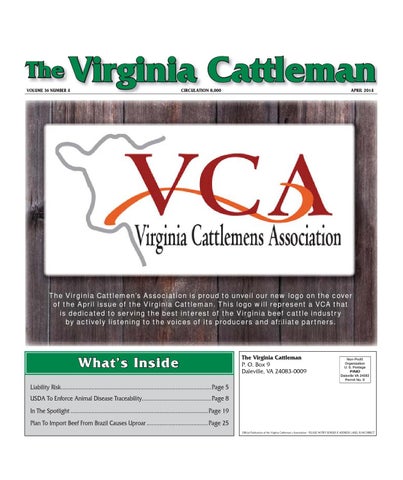
The Virginia Cattlemen’s Association is proud to unveil our new logo on the cover of the April issue of the Virginia Cattleman. This logo will represent a VCA that is dedicated to serving the best interest of the Virginia beef cattle industry by actively listening to the voices of its producers and affiliate partners.
What’s Inside
The Virginia Cattleman P. O. Box 9 Daleville, VA 24083-0009
Non-Profit Organization U. S. Postage PAID Daleville VA 24083 Permit No. 8
Liability Risk .............................................................................................Page 5 USDA To Enforce Animal Disease Traceability...........................................Page 8 In The Spotlight .....................................................................................Page 19 Plan To Import Beef From Brazil Causes Uproar ......................................Page 25 Official Publication of the Virginia Cattleman’s Association • PLEASE NOTIFY SENDER IF ADDRESS LABEL IS INCORRECT
PAGE 2–APRIL 2014–THE VIRGINIA CATTLEMAN
Opportunities Jason Carter Executive Secretary
“Ever notice how arbitrary the dates of the seasons seem to be? Here I sit at my desk and look out the window, nearly a week into spring of course, and the snow is falling over a blanket already laid down the night before. I sometimes wonder what happened to the “old wives tales” that were standards of planning and advice for many generations. Things like gauging soil temperature for corn planting by the blooming of the dogwoods and waiting to plant beets after you could sleep a night without the blankets on the bed. I don’t mean to discount technology that provides us means to be more precise and advanced in our decision making of course, technology is a cornerstone of our safe and reliable American food system, however what I do mean to emphasize
here is experience. Paying attention to the past to develop signals for preparation and decision making is a practice that was meant to partner with embracing new knowledge and technology. Think about how the past has shaped the big picture of your world today and don’t become robotic relying on a script to always do business. Self-assessment is a valuable exercise that often leads to selfimprovement.” Talk about deja vu, that first paragraph is verbatim what I wrote almost exactly a year ago and again within a week we see 45 degree temperature swings and the threat of snow on the ground while officially into spring. They say March goes in like a lion and out like a lamb. Generally speaking the cattle business seems more lion than lamb nowadays. There are a myriad of factors that directly and indirectly influence not only how we operate now but also how we should anticipate
operating in the future. The prices for feeder cattle have been good to Virginia producers for over a year now. In all fairness, they have been good for longer than that, particularly for those who can track their costs of production. A wise and seasoned market operator recently told me that it is harder to sell cattle and please producers when prices are high than when they are low. He said a producer will come into the yard to pick up their check in a low market hoping to get $155 for their five weights and be pleasantly surprised if they get $157. Now that same producer will come pick up the check in today’s market and those same five weights will have sold for $207. That market operator pointed his finger and said you can bet your behind they will want to know why they didn’t bring $217. Gaging success is a fi nicky thing. The first step is always to get educated. What is realistic for anyone much less you or the organization you are a part of? Another wise man once told me that having a plan is often better
than knowing the direction you are heading because we can resign ourselves to complacency when we don’t plan to change. The second step is to set goals. Again, if complacency is the breeder of contempt, then we should not expect more until we aspire to have more. In this good feeder cattle market that we live in today, that environment was partly created by a lot of hard work by many before me that I am appreciative of. There are some important relationships that have been cultivated over time providing a consistent market for Virginia feeder cattle. There are also programs here that have successfully allowed producers to expect to comingle weaned and preconditioned calves for a premium payday. That premium is relevant of course, but when you live in a $12 – 20 spread within weights, being in the front end of that spread is the cat bird seat in any market environment. Those good things, relationships and marketing programs, have fueled an expectation for marketing security that
should prompt commercial cattle producers to get further educated, set goals for growth and develop a plan. Part of that plan also needs to be planned breeding. Some of the great marketing programs that we have are built on reputation of quality and service. We all can agree that has allowed some inferior calves, from time to time, to get sold as well as the good ones. We sometimes get burned, but consistent quality allows for plenty of forgiveness too, with some finagling. My point is, there has never been a better time in the cow/calf business to invest in good genetics to continue to produce quality cattle. Cull cow and bull prices are tremendous and there is a lot of genetic horsepower in this state being sold very reasonably when you look at the returns. Our feeder cattle program in Virginia is enviable and that has been earned. Continue to think of marketing as work and don’t allow the reliability of reputation programs to substitute for progressive breeding in this high cattle market.
Proudly serving farmers since 1916. We’ve been financing the needs of farmers for nearly a century and we’re ready to finance the needs of rural America for generations to come. Give us a call today to find out more about how we can help you keep growing.
Loans for: Livestock | Land | Farms | Equipment | Homes | Agribusinesses and More
800.919.FARM FarmCredit.com NMLS# 456965
THE VIRGINIA CATTLEMAN–APRIL 2014–PAGE 3
33RD MYSTIC HILL FARM BULL SALE with Guest Consignors
Lazy Lane Farm • CR Tanner Sons Also selling Purebred and Commercial Females
Saturday • April 26, 2014 • 11 a.m.
CULPEPER AGRICULTURAL ENTERPRISE, CULPEPER, VA Sale Day Phone: (540) 825-7360 Sons and Grandsons Sell Cedar Ridge IV Hoover Dam
BW +0 WW +51 YW +94 MILK +35
Final Answer
BW -.2 WW +51 YW +84 MILK +27
Sitz Dash 10277
Nichols Extra H6 Mystic Hill Right Time HA Image Maker 0415 Ha Program 5652 Apex Windy 078 Chisum Sitz Dash Sitz Upward 307R
BW +2.5 WW +71YW +133 MILK +41
D806
Coleman Regis 904
BW -1.2 WW +56 YW +89 MILK +33
“Outcross genetics!” Connealy Consensus 7229
BW +2.2 WW +64 YW +104 MILK +34
BW -1.0 WW +61 YW +103 MILK +25
SAV Final Answer 0035
50+ Performance-Tested Bulls – Angus, Braunvieh, BraunAngus and Hereford bulls will sell! Semen Tested • Complete Performance and Ultrasound Data 100+ Females – Selling Purebred & Commercial, Bred and Open Heifers, Cows & Cow/Calf Pairs. Females consigned by Mystic Hill, Lazy Lane Farm and CR Tanner Sons.
EPDs as of 2/17/2014
If you or your customers sell cattle by the pound or keep replacement females, these genetics fit the equation! $ensible Genetics • $ensible Value • $ensible Investment “These bulls represent our commitment to produce the ‘right kind’ for the cow/calf producer that will weigh up and pay up and leave you with heifers you will want to keep.”
Mystic Hill Farm Tommy Clark, Mgr. 540-937-0029
12227 Mystic Hill Lane Culpeper, VA 22701 (540) 825-7360 www.mystichillfarms.com
Lazy Lane Farms Jim Wylie (540) 379-3604
PAGE 4–APRIL 2014–THE VIRGINIA CATTLEMAN
Implanting Calves PreWeaning Equals Easy Pounds & Easy Money Wes Ishmael, BEEF Magazine Implanting nursing calves with a growth stimulant is one of the most economically justifiable practices available in the beef industry,” says Lawton Stewart, University of Georgia Extension beef cattle specialist. Stewart points to research trials where daily gain from birth to weaning increases by 4%-6% in nursing beef calves that receive a single implant. Other research suggests the response can be even higher. Stewart also notes that growth response is about 20% greater in heifers than steers. For the sake of illustration, assume that implanting calves on the cow increases gain by 5%. Figure 15-30 lbs. more weaning weight. In today’s market (basis $1.80) that’s worth $27-$54/ head. The cost of the implant and labor is routinely less than $2/head. Yet, only a minority of cow-calf producers utilizes implants in their pre-weaned calves. In fact, according to the most recent National Animal Health Monitoring Service “Beef” study published for 20072008, only 11.9% of operations surveyed had implanted any calves prior to, or at, weaning during the previous year. Even for producers with 200 cows or more, only 31.1% reported implanting at least some calves. If Superior Auction data is any indication, implant use by cow-calf producers continues to trend lower over time. In 1995, 64.3% of the lots sold through Superior Livestock Video Auction were implanted. Only 26.5% were implanted in 2009. In 2011 and 2012 combined, 31% were implanted. Data for those last two years include 11,350 lots and 1.11 million head of cattle, says Michael King, a Kansas State University (KSU) research assistant (see Figure 1). King has provided the analysis since Superior first began sharing the data in 1995. Merck Animal Health sponsors the analysis.
No difference to calf price “I would argue much of the decline in implanting in the Superior data has to do with the development of ‘natural’ beef programs,” says Ken Odde, head of the KSU Department of Animal Sciences and Industry. He worked with King to develop the initial analysis in 1995. Producers’ rationale for not using implants typically revolves around fear that buyContinued on Page 7
FEED EFFICIENCY BULL & FEMALE SALE Friday • APRIL 25, 2014 • 5 p.m. at the farm • Louisa, Virginia
QHF Blackcap 6E2 of4V16 4355 [DDF]
BW +.8 WW +77 YW +132 Ê +32 CW +63 MB +.59
RE +1.06 >ÌÊ +.026 $W +52.11 f Ê +78.80 $G +35.38 $B +111.13
Selling maternal brothers sired by , Ê*À Ìi}iÊvÀ Ê >V V>«ÊÈ Ó]Ê the dam of the ABS featured sires, +Õ> iÀÊ Ê,> «>}iÊä ÎÈÊ> `Ê+Õ> iÀÊ Ê Ã `iÊ/À>V °Ê Ã ÊÃi }Ê> Ê 8 ,Ê
i ÛiÀÊ i viÀÊV> vÊ ÕÌÊ vÊ >V V>«ÊÈ ÓÊÊ > `Êi LÀÞ ÃÊLÞÊ,> «>}i½ÃÊyÕà Êà ÃÌiÀÊ LÞÊ ,Ê*À « iÌ°
- Ài\Ê `i> Ê{ÎxxÊ vÊä/ÓÈÊÓ{{äÊUÊ > \Ê+ Ê >V V>«Ê{6£ÈÊ vÊ£ n
40 Bulls - Angus, Simmental & SimAngus® Many coming 2-year-olds
100 Females - Registered Angus & Commercial Fall Pairs, Spring Pairs and Bred Heifers
Quaker Hill Farm
5728 Poindexter Rd • Louisa, VA 23093 Farm 540.967.1045 • Fax 540.967.1674 Charles cell 540-894-3523 E-mail: crosson@quakerhillfarm.com
Please visit www.quakerhillfarm.com for more information and to view the book online. SALE 131 Robin Ct. MANAGED Howell, MI 48855 BY: 517-546-6374 www.cotton-associates.com
THE VIRGINIA CATTLEMAN–APRIL 2014–PAGE 5
The Virginia Cattlemen’s Association Affiliated with the National Cattlemen’s Beef Assoc.
P.O. Box 9 Daleville, Va 24083-0009 540/992-1009 www.vacattlemen.org Steve Furrow .................................... President Rocky Mount Glenn Wheeler ...........................1st Vice Pres. FEEDER CATTLE Atkins Jason Pratt ..................................1st Vice Pres. SEEDSTOCK Atkins Mike Henry ...............................1st Vice Pres. INDUSTRY Amelia Gene Copenhaver............................. Treasurer Meadowview Alan Spivey ......................................Past Pres. Aroda Jason Carter ............................ Exec. Secretary Stuarts Draft Butch Foster .....................................Fieldman Bristol Troy Lawson .....................................Fieldman Churchville
BOARD OF DIRECTORS Region I Glenn Wheeler, Atkins Region II Chris King, Wytheville Region III Joe Meek, Dublin Region IV Forrest Ashby, Staunton Region V Rick Matthews, Browntown Region VI Steve Hopkins, Louisa Tom Nixon, Orange Region VII Lin Jones, New Canton Angus Steve Furrow, Rocky Mount Charolais William Anderson, Altavista Dairymen Mark Sowers, Floyd Hereford Charles Williams, Fairfield Simmental Ferrell Jones, Marion Markets David Coleman, Amelia Veterinarians Dr. Bobby Franck, Montpelier BCIA Jason Pratt, Dublin CattleWomen Terri Doyle, Emporia Cattle Feeders Jerry Burner, Luray Industry Gene Copenhaver, Meadowview County Cattlemen Assoc. Mike Henry, Amelia Brett Stratton, Appomattox Ex Officio John Beahm Bill Jones VA/NCBA Director Dave Norford
The Virginia Cattleman 540/992-1011 540/992-4632 - FAX published monthly by the Virginia Cattlemen’s Association
Editor...................................... Jason Carter jcarter@vacattlemen.org Publication Coordinator.. Jacquelynn Davis jdavis@vacattlemen.org Issued the first week of each month. Copy deadline the 15th of the previous month. The Virginia Cattleman is sent to members of the Virginia Cattlemen’s Association. Annual dues are $50/year or participation in the Association’s Feeder Cattle marketing Program. Complimentary copies are sent to various supporters of the Virginia Cattle Industry. A Member of:
LPC LIVESTOCK PUBLICATIONS COUNCIL
Liability Risk Is Beginning To Flow Down The Beef Production Chain The whole topic of liability is a frustrating one for cow-calf producers. After all, a cow-calf producer has no way of controlling what happens to the product once it leaves the ranch. However, in today’s litigious world, someone is going to be sued if a problem develops. Retailers, packers, and feeders tend to be much larger enterprises; thus, they’re much more appealing targets from a trial lawyer’s viewpoint. That doesn’t mean, however, that cow-calf producers are immune from such legal action. Lawyers at the retailer and packer levels understandably work hard to protect their clients. Increasingly, they are asking for affidavits or some other form of guarantee that the products or cattle they procure haven’t been fed animal byproducts and that withdrawal guidelines, etc., have been followed. Meanwhile, the hotel, restaurant and institutional (HRI) sector has created additional value by making specific claims regarding those product. That value, however, has potential risk associated with it, as one misstep can create big problems. That means the HRI trade and retailers are demanding assurances from packers in order to limit any liability exposure. Not surprisingly, as the packers have been forced to accept that liability, their lawyers are demanding assurances from their suppliers. Now, the feedlots and auction markets are going to be demanding those assurances from their suppliers as well. It can be argued that this is a good thing, and it’s certainly understandable. Thus, everyone will be very cognizant of meeting standards while animals are under their control; they’ll also demand that guidelines have been followed prior to their taking control of the animal. Of course, it also means that liability will be pushed back to the cow-calf sector as well. The challenge becomes making sure these assurances can be made, while not impeding the rate and flow of commerce. I don’t envy the logistics and paperwork of a sale barn, for instance, that sells a load of cows and must have 25 different owners sign an affidavit and store it on file. Eventually, it
will be understood that any time an animal changes hands, assurances will have to be made; it will simply be seen as a necessary cost of doing business – like brand inspections and health papers. In the short term, it will pose challenges, especially for the sale barns across the country. Perhaps, to make it easier, the industry needs to standardize and create such forms. Currently, we have different buyers with different forms, even though they are essentially the same. Perhaps some entrepreneur will come up with a phone app that will enable producers to fill out and sign these forms electronically and store them on a cloud somewhere so they can be easily accessed. This week, USDA’s Animal and Plant Health Inspection Service announced its plans for moving forward with its traceability initiative. There’s been a lot of concern in the country about traceability, but the marketplace is beginning
to demand it to a degree that the argument is shifting. Without question, there is a cost associated
with this degree of record keeping. But the debate is no longer Continued on Page 21
Relationships Built To Last Our business has been built on providing rural America with innovative financial products delivered by knowledgeable and experienced agricultural specialists. Ranked Among the Top Agricultural Lenders in the Country.* Our Agricultural Lenders are available to serve you. $ELQJGRQ +DUULVRQEXUJ &KULVWLDQVEXUJ 6WDXQWRQ /\QFKEXUJ %ULGJHZDWHU :\WKHYLOOH 5LFKPRQG -RKQVRQ &LW\ 71 :LQFKHVWHU
First Bank & Trust Company Agricultural Lending Division ZZZ ÀUVWEDQN FRP *February 2013 American Banker. Based on year-end 2012 FDIC reports.
Member FDIC
PAGE 6–APRIL 2014–THE VIRGINIA CATTLEMAN
Cows Witnessing Wolf Attacks Suffer Symptoms Similar To PTSD BURNS, Ore. – Unlike cows that haven't ever had a run-in with wolves, ones that have can experience stress-related illnesses and have a harder time getting pregnant – meaning decreased profits for ranchers, according to a new study by Oregon State University. "When wolves kill or injure livestock, ranchers can document the financial loss," said Reinaldo Cooke, an animal scientist in OSU's College of Agricultural Sciences. “But wolf attacks also create bad memories in the herd and cause a stress response known to result in decreased pregnancy rates, lighter calves and a greater likelihood of getting sick. It’s much like post-traumatic stress disorder – PTSD – for cows." After a reintroduction to Yellowstone National Park in the last two decades, grey wolves have dispersed through the West and have hunted in livestock grazing areas. Since then, OSU researchers
have heard anecdotes from ranchers that cows that have come in contact with wolves are more aggressive, sickly and eat less. To measure the stress of a wolf attack on cows – and estimate its lingering effects – researchers simulated a wolf encounter with 100 cows. Half of them had never seen a wolf, and the other half had been part of a herd that was previously attacked on the range. Cows were gathered in a pen scented with wolf urine while pre-recorded wolf howls played over a stereo. Three trained dogs – German Shepherds closely resembling wolves – walked outside the pen. Researchers found that cortisol, a stress hormone, increased by 30 percent in cows that had previously been exposed to wolves. They bunched up in a corner, formed a protective circle and acted agitated. Their body temperatures also increased rapidly, another indicator of stress. Yet
the cows previously unfamiliar with wolves were curious about the dogs and did not show signs of stress. Multiple studies from Cooke and other researchers have established a link between cow stress and poor performance traits that can cost ranchers. A 2010 OSU economic analysis estimated that wolves in northeastern Oregon could cost ranchers up to $261 per head of cattle, including $55 for weight loss and $67 for lower pregnancy rates, according to John Williams, an OSU extension agent in Wallowa County who conducted that study. It can be read online at: http://bit. ly/OSU_WolfCowReport. “In a herd, if you are not raising calves, your cows are not making you money,” said David Bohnert, an expert in ruminant nutrition at OSU’s Eastern Oregon Agriculture Research Center in Burns. “With stress likely decreasing the proportion of those getting pregnant
and causing lighter calves from those that do, a wolf attack can have negative financial ripple effects for some time.” Both researchers call for further research into ways of successfully managing both wolves and livestock so they can co-exist.
SMITH REASOR, AUCTIONEER REASOR SIMMENTALS
276-620-3123 skrlkr@embarqmail.com “Upcoming Auctions” 4/5 Grassy Valley Angus Sale 12 pm- Greenville, TN 4/5 Lawson Family Farm Angus Sale 5pm- Ewing, VA 4/19 SWVAA DoubleHeader Angus Sale- Abingdon, VA 5/2 Greene Co Angus Assoc Sale Greenville, TN 5/3 VT Surplus Property Auction Blacksburg, VA Call for information or assistance!
A HEALTHY FARM STARTS WITH HEALTHY CATTLE
PREPARE FOR FLY SEASON WITH THESE FEED ESSENTIALS MINERALS 50 Lb. Cattleman’s Pride Fly Stop Hi-Mag 50 Lb. Cattleman’s Pride Fly Stop with Altosid and Aureo 50 Lb. Cattleman’s Pride Weathershed Beef Breeder with OTM++/Altosid+ 50 Lb. Cattleman’s Pride Weathershed Beef Breeder with OTM++/Altosid/Aureo+ 50 Lb. Cattleman’s Pride Fly Stop Hi-Mag/Bvt 50 Lb. Cattleman’s Pride Fly Stop Hi-Mag with Aureo 50 Lb. Cattleman’s Beef Mineral (Altosid)
*Offer ends 9/30/2014. Subject to approved credit on John Deere Financial™ multi-use account, a service of John Deere Financial, f.s.b. Offer limited to qualifying products. After promotional period, interest charge will begin to accrue at the regular John Deere Financial multi-use account rate. Available at participating merchants. For Agricultural and Commercial use. Merchants use plan #22448 which is valid through 9/30/2014.
QUESTIONS OR COMMENTS: 888-221-8987 OR SSCFEEDQUESTIONS@SSCOOP.COM
The wolf-cow simulated encounter study, which was funded by the Oregon Beef Council, was published in the Journal of Animal Science and co-authored by Cooke and Bohnert. The text is available at http://bit.ly/OSU_CowWolfStudy.
THE VIRGINIA CATTLEMAN–APRIL 2014–PAGE 7
Researchers Use DNA From Exceptional Carcass To Produce Donor Cow Beef researchers in Texas are just a month away from producing a large number of embryos from recently cloned male and female cattle -- all part of an ongoing, historic project using Somatic Cell Nuclear Transfer (SCNT) reproductive technology to create cloned calves. The public-private partnership between West Texas A&M University and industry professionals is more than three years in the making, and researchers hope to successfully reproduce cattle from animals graded Prime, Yield Grade 1, the highest quality and most sought after animals
in the beef industry. Ideally the clones would be used to breed a line of cattle that could produce USDA’s highest grade beef in a shorter amount of time using fewer feed resources. The researchers, led by Dean Hawkins, head of WTAMU’s Department of Agricultural Sciences, presented their findings to date in December at the Range Beef Cow Symposium in Rapid City, S.D. Since 2010, the researchers have identified very few exceptional carcasses. “Of the 20 possible combinations of quality (Prime, Choice, Select, Standard) and
Implanting Continued from Page 4 ers will discount their calves. Some fear that implanting makes their calves less valuable to the buyer by removing the “natural� option. That makes logical sense, but reality suggests no loss in value (read on). Others have heard that buyers discount implanted calves because they under-perform in the feedlot compared to non-implanted peers. Whether that’s an old wife’s tale or the casual comment of a zealous buyer, there is nothing to support that notion. Fact is, when used appropriately, according to Stewart and others, there is no research suggesting that calves implanted before weaning will perform less than non-implanted peers. “Implanting calves during the nursing phase hasn’t been shown to decrease subsequent performance or affect carcass characteristics,� Stewart explains. “Calves should not be discounted at weaning if they have been administered an implant. Studies show that calves implanted prior to weaning and three times during the finishing phase don’t show any decrease in performance compared with calves administered implants only during the finishing period.� So, buyers shouldn’t care if calves are implanted. In fact, contrary to the common perception and the growth in natural programs mentioned earlier, Superior data says buyers don’t care if calves
are implanted. Prices paid in the Superior data are the same, regardless of implant status. Incidentally, Odde believes the Superior data should be viewed as representative of producers with approximately 300 cows or more. That’s the size herd that has the number of similarweight, same-sex calves to sell as load lots through Superior. “Implanting nursing calves is one of the most underutilized, but proven management practices in the beef industry,� Stewart emphasizes. Moreover, Odde says, “The Superior data suggests there’s more opportunity for cow-calf producers to utilize this technology.�
ANGUS MEANS BUSINESS. A reliable business TEVXRIV MW HMJ½GYPX XS GSQI F] %X XLI %QIVMGER %RKYW %WWSGMEXMSRŽ E XIEQ SJ WOMPPIH 6IKMSREP 1EREKIVW GER KYMHI ]SYV STIVEXMSR XS[EVH WYGGIWW 'SRXEGX 'LVMW .IJJGSEX XS PSGEXI %RKYW KIRIXMGW WIPIGX QEVOIXMRK options tailored XS ]SYV RIIHW ERH XS EGGIWW %WWSGMEXMSR TVSKVEQW ERH WIVZMGIW 4YX XLI business breed to [SVO JSV ]SY
yield (1, 2, 3, 4, 5) grades that occur within the young fed beef population, the probability of a Prime, yield grade 1 carcass is approximately 0.03 percent of the fed beef in the U.S. just 29 out of thousands of cattle carcasses rated as
Prime, Grade Yield 1,� they wrote. “The progeny from this mating will be tested for DNA markers for carcass merit and growth efficiency. A portion of the resulting progeny will be feed at the university feedlot and slaughtered to
determine their quality and yield grade,� they added. “Additional cows will be inseminated with semen from Alpha or a purebred bull with known EPD’s to determine if Alpha is truly genetically superior.�
Southwest Virginia Angus Double Header Sale
6$785'$< $35,/
ANGUS IN THE HIGHLANDS FEMALE SALE 12 noon ‡ :DVKLQJWRQ &RXQW\ )DLUJURXQGV $ELQJGRQ 9$ )HPDOH /RWV ‡ &RZ &DOI 3DLUV %UHG DQG 2SHQ +HLIHUV
SWVAA PERFORMANCE TESTED ANGUS BULL SALE ,PPHGLDWHO\ )ROORZLQJ )HPDOH 6DOH %XOOV 6HOO ‡ PRQWKV RI DJH 2XWVWDQGLQJ OLQHXS RI EXOOV WKLV \HDU VQA BULLS WILL SELL AT THIS SALE SALE SPONSORED BY
Chris Jeffcoat, Regional Manager 282 Saint Lukes Road Littlestown, PA 17340 717.476.1496 cjeffcoat@angus.org Northeast Region
3201 Frederick Ave. • St. Joseph, MO 64506 816.383.5100 • www.ANGUS.org 8S WYFWGVMFI XS XLI Angus Journal GEPP ;EXGL The Angus Report SR 6*( 8: 1SRHE] QSVRMRKW EX '78 Š 2013-2014 American Angus Association
Southwest Virginia Angus Association Catalog available at www.swvaangus.org Internet bidding available @cowbuyer.com SALE COORDINATOR: *HRUJH -RKQVWRQH -U ‡ RU AUCTIONEER: 6PLWK 5HDVRU ‡ ¹ 9$ /LF SWVAA PRESIDENT: )UHGGLH 0XOOLQV ‡
PAGE 8–APRIL 2014–THE VIRGINIA CATTLEMAN
USDA Ready To Enforce Animal Disease Traceability Regulations Rita Jane Gabbett, The Meating Place USDA’s Animal and Plant Health Inspection Service issued a bulletin outlining the next phase of implementing Animal Disease Traceability (ADT) regulations including enforcement actions when needed. “We know that sometimes taking enforcement action is necessary to make sure a system as important as ADT is successful,” APHIS Administrator Kevin Shea said in a note to stakeholders. “When and where necessary, we will take that action. As a standard practice, we will continue to notify first-time offenders when they do not meet the regulatory requirements to ensure they understand the regulation and what they need to do to comply. Additionally, we will now pursue appropriate penalties in situations where an individual repeatedly fails to comply with the regulatory requirements.”
The ADT program was finalized in March 2013 to hasten response to a disease outbreak and lessen its economic impact, as well to provide the information and assurances trading partners expect. Shea said progress in 2013 and through today is now making it easier for producers to participate. The number of authorized tag distributors has expanded, a greater variety of official identification devices are on the market, and several states are working to make health certificates more mobile for use in the field. APHIS will now begin exercising and testing the system by making sure all animals moved interstate have the proper identification. This spring, as APHIS identifies issues with identification of livestock moved interstate, the agency will begin identifying individuals who aren’t meeting the program’s requirements. Local Veterinary Services area
district directors will contact them in writing to help guide them through the process for
meeting the program requirements, including providing them with details on how to obtain the
ONLY FROM Beef Greats ACCELERATED GENETICS!
S A V THUNDERBIRD 9061
014AN00351 REG#:16396499 FINAL ANSWER X BISMARCK CED
9
BW
-.2
WW
70
YW
120
APEX WINDY 078
Customized Embroidery Let Us Personalize Jackets, Windbreakers, Sweatshirts, or Hats for You and Your Farm (276) 780-0452 • Chilhowie, VA -Shipping Available
014AN00366 REG#:16237970 WINDY 702 X MTN FRONT CED
-1
BW
3.9
WW
72
YW
114
MR ISHEE SUPERSTOUT 014
014SM03072 REG#:2560245 RIGHT ON X LUCKY DICE CED
Division of Ashby Herd Health Services, Inc. 2420 Grace Chapel Road Harrisonburg, VA 22801 Day/Night (540) 433-0430 1-800-296-COWS (2697) Randall H. Hinshaw, D.V.M. (540) 246-2697 Sarah S. Whitman, M.S., D.V.M.
necessary official identification devices or movement documentation.
8.7
BW
4.3
WW
85.7
YW
134.2
A A R TEN X 7008 S A
014AN00377 REG#:15719841 IN FOCUS X ADAPTOR CED
8
BW
.1
WW
67
YW
136
S A V PLATINUM 0010
014AN00370 REG#:16687592 PIONEER X TRAVELER 004 CED
14
BW
-1.5
WW
72
YW
118
TH 223 71I VICTOR 755T
014HP01027 REG#:42800887 VICTOR 71I X WRANGLER CED
2.8
BW
1.6
WW
58
YW
97
CONTACT YOUR AREA ACCELERATED GENETICS REPRESENTATIVE TODAY!
RST TIME'S A WASTIN' 0124
ROBERT WHITACRE, Regional Beef Specialist, P:540-247-4282 TIM BARBOUR, Chatham, P: 434-841-5230 MIKE BAZZLE, Harrisonburg, P: 540-421-7411 JEREMY COLLINS, Nickesville, P: 423-914-6192 CHAD JOINES, Blacksburg, P: 540-557-7263
014HH00108 REG#:43123163 ABOUT TIME X BLAZER CED
5.2
BW
.3
WW
49
YW
85
Call today for your FREE copy of the 2014 Beef Sire Directory! EPD (INFO AS OF 3/13/2014)
THE VIRGINIA CATTLEMAN–APRIL 2014–PAGE 9
Obsessed about weed control?
It doesn’t have to come to this. ForeFront® HL herbicide provides long-lasting, broadspectrum control of more than 90 tough pasture weeds. What’s more, it has no livestock grazing restrictions† and most states require no license to purchase or apply it.1 So instead of weeds weeds, start thinking about the money you’ll you ll save growing more grass and buying less feed. Relax and leave the weed control to us. Learn more at www.RangeAndPasture.com.
Label precautions apply to forage treated with ForeFront HL and to manure from animals that have consumed treated forage within the last three days. Consult the label for full details.
†
Some states require an individual be licensed if involved in the recommendation, handling or application of any pesticide. Consult your local Extension office for information regarding licensing requirements.
1
Trademark of The Dow Chemical Company (“Dow”) or an affiliated company of Dow. ForeFront HL is not registered for sale or use in all states. Contact your state pesticide regulatory agency to determine if a egdYjXi ^h gZ\^hiZgZY [dg hVaZ dg jhZ ^c ndjg hiViZ# 6alVnh gZVY VcY [daadl aVWZa Y^gZXi^dch# '%&) 9dl 6\gdHX^ZcXZh AA8 G(-ľ(.(ľ%%* %&$&) 7G %&%ľ*,.,& 96GEG6C<(%+)
®
PAGE 10–APRIL 2014–THE VIRGINIA CATTLEMAN
WITH SEASON-LONG CONTROL, YOUR CATTLE
will look so good
THE NEIGHBORS WILL STARE.
Nothing else comes close to the control of LONGRANGE.2,5-7*
LONGRANGE with up to 100 to 150 days of parasite control in a single dose.1
CYDECTIN® (moxidectin) Injectable
LONGRANGE Injectable
DECTOMAX® (doramectin) Injectable
SMALL INTESTINAL WORM (C. oncophora) SMALL INTESTINAL WORM (C. punctata) STOMACH HAIRWORM
A pasture full of thicker, slicker cattle is a beautiful sight. Get the look with LONGRANGE. Its unique THERAPHASETM formulation gives you up to 100 to 150 days of parasite control in a single dose.2 Break the parasite life cycle and see the performance benefits all season.3,4 Ask your veterinarian for prescription LONGRANGE.
BARBER’S POLE WORM NODULAR WORM BROWN STOMACH WORM (O. ostertagi) BROWN STOMACH WORM (O. lyrata) LUNGWORM 0
30
60
DAYS
90
®
*SAFE-GUARD has no demonstrated persistent activity.
For more information, visit
120
150 Available in 500 mL, 250 mL and 50 mL bottles. Administer subcutaneously at 1 mL/110 lbs.
theLONGRANGElook.com
IMPORTANT SAFETY INFORMATION: Do not treat within 48 days of slaughter. Not for use in female dairy cattle 20 months of age or older, including dry dairy cows, or in veal calves. Post-injection site damage (e.g., granulomas, necrosis) can occur. These reactions have disappeared without treatment. 1 2
®LONGRANGE and the Cattle Head Logo are registered trademarks, and TM THERAPHASE is a trademark, of Merial. All other marks are the property of their respective owners. ©2014 Merial Limited, Duluth, GA. All rights reserved. RUMIELR1213-E (01/14)
Dependent upon parasite species, as referenced in FOI summary and LONGRANGE product label.
LONGRANGE product label. Morley FH, Donald AD. Farm management and systems of helminth control. Vet Parasitol. 1980;6:105-134. Brunsdon RV. Principles of helminth control. Vet Parasitol. 1980;6:185-215 CYDECTIN® Injectable product label. 6 DECTOMAX® Injectable product label. 7 SAFE-GUARD® product label. 3 4 5
THE VIRGINIA CATTLEMAN–APRIL 2014–PAGE 11
A Dirt Road Diary – Fire In The Wire Steve Lucas In 1888, a Texan named David Wilson built a 30 mile stretch of electric fence powered by a water wheel on the XIT ranch. The fence design reduced the number of fence posts needed, and was easier on cattle than barbed wire. Cowboys remained unconvinced, and the project was deemed unworkable. Today, fence chargers are as common on farms and ranches as horses and cows. Cowboys are expected to be more skilled in electric fence construction and troubleshooting than digging post holes and repairing broken strands of barbed wire. Large boundaries and continuous grazing have been abandoned and management intensive and mob grazing are becoming the norm thanks to the technological improvements in electric fence equipment. The issue has become the gate; where there was one woven wire or barbed wire fence to go through; now there may be two, or three, or four highly charged electric fences to negotiate with gates and gaps sometimes inconveniently located. Stepping over or squeezing through charged wires has become the alternative method of avoiding gates and providing the shortest route for a brave stockperson. When the ground is dry, a pair of thick soled rubber boots can provide enough insulation to reduce the shock to a tingle when pushing down a wire for a step over. When it is wet underfoot and boot soles are thin, only the foolhardy attempt the push down maneuver unless they are willing to use their hat to press down the wire. Even then, if the wire slips off the hat, footing is lost, the back arches too high or a leg is not lifted high enough, the risk of a substantial jolt is ever present. If you use electric fencing, you have experienced the heart stopping shocks that comes from a well-grounded contact with the fire that runs
through the wire. We fuss at the cattle when they break a wire to get to new spring grass,
then we have to decide whether to disconnect the charger or try to fix the broken wire hot, and
whether the repair will hold or if the wire should be replaced all together. Meanwhile, the
cows watch from afar, unconvinced, deeming the project unworkable.
7th Annual Production Sale Saturday • NOON • Louisburg, NC
May 10, 2014
Selling 65 lots of Donors, ETs, Yearlings, Bred Heifers and more than 35 Pairs
R ita 0M5 of R ita 5F56 PRED Reg. No. 16453585 (DDF) • Calved 11/04/2009 #B/R New Design 036 [DDC-AMF-XF] #GAR Predestined [DDC-AMF-XF] #+GAR Ext 4206
#VDAR New Trend 315 [AMF-CAF-XF] B/R Blackcap Empress 76 #N Bar Emulation EXT [AMF-CAF-XF] +GAR 6807 Traveler 1432 #CA Future Direction 5321 [AMC-NHC-XF] #GAR Precision 1680 [AMC-NHC] +Rita 5F56 of 1I98 FD [AMF-DDF-NHF] CA Miss Power Fix 308 [AMF] +Rita 1I98 of 2536 Rito 6I6 [AMF] #Rito 6I6 of 4B20 6807 [AMF-CAF-XF] GAR Precision 2536 [AMC-NHF] CED BW WW YW MILK Marb RE Fat $W $F $G $B +7 +2.8 +49 +91 +25 +1.26 +1.16 +.065 +31.39 +36.75 +50.51 +114.31
Full sister to Rito 9M25. One of Rita 5F56 greatest accomplishments to date! Selling her open ready to flush with a heifer calf by Prophet on her side.
Deer Valley Blackcap 8025 Reg. No. 16260609 (AMF-DDF-NHF) • Calved: 12/12/2008 #B/R New Design 036 [DDC-AMF-XF] #GAR Predestined [DDC-AMF-XF] #+GAR Ext 4206
#VDAR New Trend 315 [AMF-CAF-XF] B/R Blackcap Empress 76 #N Bar Emulation EXT [AMF-CAF-XF] +GAR 6807 Traveler 1432 #Rito 6I6 of 4B20 6807 [AMF-CAF-XF] #DHD Traveler 6807 [AMF-M1F-NHF] +Rita 1I98 of 2536 Rito 6I6 [AMF] +Rita 4B20 of 0FB1 Bando GAR Precision 2536 [AMC-NHF] #GAR Precision 1680 [AMC-NHC] +GAR Ext 2104 CED BW WW YW MILK Marb RE Fat $W $F $G $B +0 +3.8 +54 +99 +20 +1.13 +.48 +.005 +28.45 +44.77 +48.88 +100.49
A maternal sister to the great Rita 5F56 by Predestined that is extra-long spined and attractive and sells with a new heifer calf on her side by Tailor Made.
R iverbend Lucy U902 Reg. No. 16125870 (AMF-DDF-NHF) • Calved: 07/15/2008 #B/R New Design 036 [DDC-AMF-XF] #GAR Predestined [DDC-AMF-XF] #+GAR Ext 4206
#VDAR New Trend 315 [AMF-CAF-XF] B/R Blackcap Empress 76 #N Bar Emulation EXT [AMF-CAF-XF] +GAR 6807 Traveler 1432 #GAR Precision 1680 [AMC-NHC] CA Miss Power Fix 308 [AMF] #Basin Max 602C [AMF-CAF-XF] #Basin Lucy 855A [CAF] CED BW WW YW MILK Marb RE Fat $W $F $G $B +7 +3.0 +58 +99 +30 +1.06 +.90 +.087 +41.53 +42.69 +40.68 +102.97
#CA Future Direction 5321 [AMC-NHC-XF] +Basin Lucy 3829 [AMF-NHF] Basin Lucy 178E
This daughter of 3829 is super powerful and excellent uddered. Sells bred to calve in the fall.
R iverbend Lady U959 Reg. No. 16128184 (AMF-NHF) • Calved: 08/14/2008 #DHD Traveler 6807 [AMF-M1F-NHF] #+OCC Emblazon 854E [CAF-DDF-M1F] Dixie Erica of CH 1019
#QAS Traveler 23-4 [AMF-CAF-XF] #Bemindful Maid DHD 0807 #PBC 707 1M F0203 Dixie Erica of CH 615 #N Bar Emulation EXT [AMF-CAF-XF] Wulffs Erica Dianna C116 #DHD Traveler 6807 [AMF-M1F-NHF] EE 4286 of Ideal 2240 1254 CED BW WW YW MILK Marb RE Fat $W $F $G $B +10 +1.7 +49 +81 +18 +.04 +1.08 -.024 +39.18 +24.00 +21.05 +71.90
#+Wulffs Ext 6106 +Riverbend Lady R637 [AMF-NHF] +Ideal 4465 of 6807 4286 [AMF-NHF]
A super attractive, big bodied Emblazon daughter back to Ideal 4465 that will sell as a fall 3-n-1 pair.
Springfield Angus 104 Springfield Lane • Louisburg, NC 27549 Phil Goodson • Cell (919) 880-9062 Daniel Reynolds • (919) 270-3881 Farm (919) 496-6722 www.springfieldangus.com
Parker 254-413-2420 parkerfriedrich@earthlink.net
PAGE 12–APRIL 2014–THE VIRGINIA CATTLEMAN
April Herd Management Advisor Scott P. Greiner & Mark A. McCann Extension Beef Specialists, Virginia Tech After a cold and snowy winter, spring always offers a new perspective to daily chores and activities. This new perspective is also something to apply to cattle enterprises. The industry is operating at record prices along with reduced input costs compared to recent times, creating a situation where we have no history to lean on. The near term outlook is very favorable and shows no major change from where we are today. The playing field of revenues vs. costs suggests that some management practices may need to be revaluated. The perennial statement “if it cost more than it returns, then don’t do it” is based on both costs and returns, and the relationship between these two factors has changed over the course of the last several months. The value of today’s calf crop justifies a reexamination of return on investment for spending additional dollars to obtain an additional calf born, or put on an extra pound of weaning weight. Management practices which impact return to estrus, pregnancy rate and weaning weight should be reconsidered in terms of the present economic climate. Spring Calving Herds (JanuaryMarch) General • Calving season winding down. Continue to observe late calving cows frequently. • Tag, tattoo, record birth weight, calving ease score, teat/udder score and mothering ability of dam. Keep accurate records at birth to comply with age and source verification requirements. • Monitor young calves for scours. Keep calving area and paddocks with pairs clean and well drained. Move pairs to new pastures or locations and reduce commingling of newborn calves with older calves to help reduce exposure and transfer of scours. Nutrition and Forages • Continue to offer a high magnesium mineral to prevent grass tetany. Monitor intake to insure cows are consuming the recommended amount. No other source of salt or minerals should be avail-
able. • Evaluate growth of yearling heifers with goal of reaching 6065% of mature weight by breeding. Depending on forage quality, supplementation maybe needed to meet weight gain target. • Offer medium quality hay as cows are turned out on pasture and use hay disappearance as a barometer of dry matter needs of the herd. • New forage growth is very digestible, high in protein and high in moisture content. Herd Health • Consult with your veterinarian concerning pre-breeding vaccination schedule for cow herd, yearling heifers, and bulls. Plan early to
allow 30-day vaccination window prior to breeding season. • Monitor calf health closely, particularly for signs of scours and pneumonia, have treatment supplies on hand. • Observe newborn calves to ensure colostrum intake first few hours of life. Provide selenium and vitamin A & D injections to newborn calves. Castrate commercial calves at birth. Reproduction • Finalize plans and protocols for breeding season. Establish calendar to map timing of synchronization program to be used during breeding season. Have supplies and semen on hand. • Breed heifers 2-4 weeks ahead
of mature cows to allow longer post-partum interval prior to second breeding season. • Schedule and conduct breeding soundness exams on herd sires, including annual vaccinations. • Manage newly acquired herd sires properly to prepare them for the breeding season. Yearling bulls often lose 100+ pounds during their first breeding season. Adjust them to the feed and environment of their new home, and commingle bulls of same age/weight for a period of time prior to turnout. Ample exercise, in combination with a proper nutritional program, is essential to make them physically fit for the breeding season Genetics
• Finalize genetic goals and selection criteria for upcoming breeding season (both AI and natural service sires). • Collect remaining yearling performance data (weight, height, scrotal, ultrasound) in seedstock herds. Fall Calving Herds (September-November) General • Schedule and conduct pregnancy diagnosis with veterinarian 45-60 days following breeding season. • Evaluate potential options for marketing of calf crop, including timing of weaning to meet operaContinued on Page 17
THE VIRGINIA CATTLEMAN–APRIL 2014–PAGE 13
Kansas Farm Boys Put Ag In National Spotlight With Parody Videos “We are seriously just normal guys,” said Greg Peterson, the oldest of the three “Peterson brothers.” The Kansas farm boys have put agriculture in the national spotlight by producing and starring in farming parody videos of top music hits. Peterson said the boys think it is “hilarious” that fellow agriculturalists are treating them like celebrities. “We are just down-to-earth Kansas farm kids,” he said. It all started June of 2012, when “I’m Farming and I Grow it” hit YouTube.com. Greg, an agricultural communications major at Kansas State said, “Professors were always challenging us to find new ways to advocate for agriculture. I was browsing YouTube one day and noticed that the most popular YouTube videos were music videos. At that point I decided I wanted to make a farming music video with my brothers.” After hearing “I’m Sexy and I Know it,” Greg jokingly changed it to “I’m Farming and I Grow it.” The idea caught fire and after writing the song, he took it home to his brothers and they filmed their first humorous mock video. The Peterson brothers have several videos on their YouTube channel, the latest being “Chore.” They have over 29 million views on Youtube, which equals over 89 years of viewing time. The story of American’s farmers and ranchers through the Peterson Brothers is reaching consumers in over 232 countries. Not only do they share their story on YouTube but they have over 125,000 Facebook followers, a Twitter and Instagram following as well. “I knew at the beginning that it was important to advocate for agriculture, but I think I underestimated the importance. Not only that, but I feel like the need is growing with every day that goes by. If we in the agriculture community don’t do a better job of communicating to consumers, we are going to be in some real trouble down the road,” explains Greg about the importance of daily advocating. Greg states,” The most important thing is to assure the consumer that their food is safe to eat and dispel any fear they may have about the products they consume. I mean, we have the safest, most abundant food supply in the his-
tory of the world and I see consumers complaining all of the time and wondering if what they are eating is safe. Other than that, I think there are many myths about agriculture that need to be corrected and explained. For instance, the terms, “factory farming,” “monoculture,” “big-ag,” “industrial agriculture,” are all very misunderstood.” With a consumer population that is farther and farther removed from the farm, the Peterson Brothers are opening that door for communication. They make themselves available to give presentations and their farm is YouTube proof, its real and the consumer appreciates that fact. While Kansas is home, and Kansas State is their school of choice, so far, the brothers have had a unique opportunity to travel and tell their story beyond the screen. Their life got flipped when the first video came out in June 2012 and they took a quick trip to appear on the Today show. Little did they know it wouldn’t stop there. “I’ve been to over 30 states since the video came out, so obviously it’s changed my life quite a bit. I think my favorite has to be when I spoke on a panel in Hanover, Germany at the largest
farm show in the world, the Agritechnica. I was sitting alongside farmers from all over Europe discussing the similarities and differences in our farming practices and the challenges all of us face with connecting to consumers,” explains Greg. While traveling and making videos is what we have come to expect from the brothers, they will be the first to declare, “Kansas is awesome! We love it.” “Farming with your family in the Midwest is about as good as it gets,” said Greg. The future for The Peterson brothers includes farming, advocating and making videos. Just like a typical farm family they are running 90 miles an hour. Kendal is still in high school and is a three sport athlete and is involved in numerous clubs and activities. Nathan is a college student living in a different town than the rest of us during the school year, and Greg embarked on a full time speaking career as well as helping out “fulltime” as much as he can on the family farm. Greg explains that a video may be in the near future, “But we will continue to do our best to advocate through videos Continued on Page 17
“If we in the agriculture community don’t do a better job of communicating to consumers, we are going to be in some real trouble down the road.” - Greg Peterson (l). Also pictured, Nathan and Kendal. Photo by Creative Passions Photography
PAGE 14–APRIL 2014–THE VIRGINIA CATTLEMAN
Flowing Spring Gelbvieh 6235 Lee Hwy. Atkins, VA 24311 CHARLES E. ATKINS, OWNER
(276) 783-6100
Money Making Mathematics:
2+2=5 Add as much as $1,000 over the life of a crossbred cow with planned crossbreeding. HETEROSIS IS YOUR KEY TO PROFITABILITY
2157 Black Lick Rural Retreat, VA 24368
Judith A. Sweeten Registered No. 48890 Home: 276-228-6347 Cell: 401-714-6812
SOUTHFORK FARMS GELBVIEH & BALANCER CATTLE Nathan and Sue Ellen Haver 969 Little River Rd. Goshen, Va. 24439
Gelbvieh x British cow with a Balancer® sired calf.
LITTLE WINDY HILL Farms Doug & Sue Hughes 6916 Peppers Ferry Road Max Meadows, VA 24360
H 276/637-3916 O 276/637-4271
Triple D Registered Gelbvieh Red and Black Polled Bulls 13052 Ivor Rd., Sedley, VA 23878 Willie Diggs 770/591-3454 Alan Diggs 757/653-0174 Milton Diggs (Home) 757/859-6118 Milton Diggs (Cell) 757/328-8459 Email: tridlaser@yahoo.com www.wd-trid.com
Treble W Ranch Registered Gelbvieh Cattle 17462 Fenton Drive Abingdon, Va. 24210 Dr. Daryl Wilson/Tyler Wilson (276) 676-2242 Joe & Gwen Wilson (276) 628-4163
540-997-5376 540-997-5358 (Fax) 866-580-5335 (toll free) email- nate@southforkfarms.com
treblewranch@aol.com
Balancer® is a Gelbvieh x Angus or Red Angus registered hybrid. James D. Bennett (434) 376-3567
Paul S. Bennett (434) 276-5675
Crossbreeding is smart and easy. www.GELBVIEH.org
17659 Red House Road Red House, Virginia 23963
Office (434) 376-3567 Fax (434) 376-7008 Jim G. Bennett (434) 376-5760
To find a Gelbvieh or Balancer® breeder near you contact a member of the Gelbvieh Breeders of Virginia
Brian R. Bennett (434) 376-5309
LAST CALL GTomELBVIEH Lavelle, DVM 2984 Peppers Ferry Rd. Wytheville, Va. 24382 (O) 276-223-4488 (H) 276-223-0104
Gelbvieh Breeders of Virginia, Inc. 2157 Black Lick Road Rural Retreat, VA 24368
President: Nathan Haver - 540-997-5376 Vice President: Tom Lavelle - 276-223-4488 Secretary: Joe Wilson - 276-628-4163 Treasurer:Judith Sweeten - 276-228-6347
Handfula Gelbviehs Black, Polled, Purebred & Balancer Gelbvieh Cattle Stephen, Vivian, Megan & Caitlin Fanning 7287 East Blue Grass Trail Bland, VA 24315 (276) 722-2034 (276) 620-0054
REGISTERED POLLED GELBVIEH
C.H. Morris & Sons 928 Morris Road Appomattox, VA 24522 Roger L. Morris (434) 574-6592 (434) 315-4294
THE VIRGINIA CATTLEMAN–APRIL 2014–PAGE 15
PAGE 16–APRIL 2014–THE VIRGINIA CATTLEMAN
KNOLL CREST FARM JAMES, PAUL, JIM, BRIAN BENNETT 17659 RED HOUSE RD. RED HOUSE, VA 23963 434-376-3567 OFFICE 434-376-7008 FAX JAMES BENNETT - 434-376-7299 PAUL BENNETT 434-376-5675 JIM BENNETT 434-376-5760 BRIAN BENNETT 434-376-5309
MAPLEWOOD FARM
MOUNTAIN LION MEADOW
OAK CREEK FARM
JOHN AND KAREN FLEISHMAN DANIEL AND ELIZABETH 5442 Daniel Cupp Road Dayton, VA 22821 John - 540-421-9511 Daniel - 540-383-1688 jdfdeere@att.net
TODD, LYDIA, LAYLA AND LILLY SCOTT 1191 Spring Mill Road Concord, VA 24538 434-665-1224 434-993-2502
BILLY AND JACKIE KOONTZ 25840 Independence Road Unionville, VA 22567 540-854-6567 oakcreekfarm@gmail.com
POTTS CREEK FARM JASPER & ALICE PERSINGER, JR. 2917 POTTS CREEK ROAD COVINGTON, VA 24426 540-747-3261 PottsCreekFarm@ntelos.net
ROLLING HILLS FARM
HARRY & BARBARA KNABE 2074 Gravel Hill Rd. DILLWYN, VA 23936 (434) 983-3110 2.2 MI. EAST of U.S. 15 on 617
420 NORTH HAYFIELD RD. WINCHESTER, VA 22603 Sid & Dorothy Rogers HOME - 540-888-3134 CELL - 540-539-3352 sidsrollinghills@hughes.net
FAUQUIER FARM
DIAMOND “W” FARM
6470 BEVERLYS MILL ROAD BROAD RUN, VA 20137 HOME 540-347-4343 OFFICE 540-347-7188 NORTHERN VA area CATTLE FOR SALE rfkube@verizon.net
Ken & Doris Worley 25052 Rich Valley Rd. Abingdon, VA 24210 276-944-3458 cell: 276-356-3458 kworley123@earthlink.net
DEER TRACK FARM
CEDAR PLAINS FARM R.E. BALTIMORE, OWNER, MANAGER, FIELD HAND 150 Cartersville Ext. Cartersville, VA 23027 (H) 804-375-3071 (O) 804-399-7409
3320 Deer Track Rd., Spotsylvania, VA 22551 BOB SCHAFFER 540-582-9234 (FARM) bob@deertrackfarm.com www.deertrackfarm.com
“All Cattle Made In America”
“Virginia Finest” Performance Tested Bulls for sale.
COTTAGE HILL FARM HICKORY SPRINGS FARM
MIKE TAYLOR 20 Cottage Hill Road Petersburg, WV 26847
JOHN BRASUK RT. 2 BOX 211-A FAIRMONT, W.VA. 26554 304-363-5918 jhb470@aol.com
mwta.ylor@frontiernet.net 304-257-1557 (home) 304-668-0580 (cell)
BAY BROOK FARM RODNEY & BARBARA PHILLIPS 4277 FACTORY MILL ROAD DABNEYS, VA 23102 804-556-3810 rodney@baybrookherefords.com
NORVUE FARM JACK SHEEHAN 4442 Factory Mill Rd. Dabneys, VA 23102 Telephone: 804-556-4947 email: norvujack@gmail.com
“Hereford Bulls for sale at all times.”
DUNROVIN DON & SHEILA RICHARDSON 3473 DUNROVIN FARM CROZET, VA 22932 434-823-4438 e-mail: dunrovinva@hotmail.com THICK, DARK RED, HEAVY MILKING COWS DR WORLD CLASS DR MR. CONSERVATIVE
FROGTOWN ACRES JERRY & REBECCA FUNKHOUSER 417 Frogtown Lane Edinburg, VA 22824 Home: 540-984-8833 Jerry Cell: 540-333-1019 Rebecca Cell: 540-333-1019 email: jerry@shentel.net
MEADOW RIDGE FARMS, INC. DOUG & MELISSA HARRISON 2184 Hillyard Drive Broadway, VA 22815 540-896-5004 harrisonmeadow@aol.com
PIONEER FARMS
ROCK MILLS HEREFORDS
HEREFORD HILLS FARM
CHARLES, MEREDITH AND OLIVIA WILLIAMS 485 Hereford Crossing Fairfield, VA 24435 herefordxing@gmail.com 540-460-8803
PAUL AND KIM NOVAK 240 THUNDER VALLEY LANE Castleton, VA 22716 540-937-5553 rockmillsfarm@hughes.net
ROY AND KIM DEAN 9311 BRADY LANE Harrisonburg, Virginia 22802 (540) 432-9805 royandkim@wildblue.net
WILLINGHAM FARM Daron Culbertson P.O. Box 91 Remington, VA 22734 540-270-2185 culbertsondl@yahoo.com “In memory of Alton Willingham”
THE VIRGINIA CATTLEMAN–APRIL 2014–PAGE 17
Farm Boys Continued from Page 13 and through our Facebook page and Twitter, and we hope to do another parody video either over Spring Break or the beginning of next summer!” Fans watching the latest Peterson Brother video, “Chore” will notice a new face. Their little sister makes an appearance. “Laura helps us film our video and even has a solo in our last one, “Chore.” She likes helping them out but would rather be behind the scenes. Whenever they get the opportunity to go on speaking trips, Laura loves to tag along.” Greg gives credit where its due, “My parents have been huge in our upbringing and who we all are, and are both hardworking, caring individuals. We don’t really know the future plans to be honest. Other than the brothers do plan to all farm together in the future.”
Herd Mgmt. Continued from Page 12 tional goals. Calculate break-evens on various marketing options and consider risk management strategies. • Reimplant commercial calves. Nutrition and Forages • Begin creep feeding or creep grazing calves if desired. • Cows are entering latter portion of lactation, above average to good quality hay should meet nutritional requirements. • Although pasture green-up is beginning, hay should be continued to be offered until consumption declines significantly. • Reserve high quality hay and a pasture area for calves postweaning. Herd Health • Consult with veterinarian on vaccination protocol for calf crop. Design vaccination and weaning program around marketing goals and objectives. Genetics • Collect weaning weights on calf crop at optimum time (AHIR age range 120-280 days), along with cow weights, hip heights and body condition scores (cow mature size data taken within 45 days of calf weaning measure).
Highest Futures Ever
On February 26, 2014 fed cattle futures for April delivery rose 1.5 percent to settle at $1.44525 a pound at 1 p.m. on Wednesday February 26,
2014 on the Chicago Mercantile Exchange. After the close, the price reached $1.453, the highest for a most-active contract since the commod-
ity debuted in 1964. Trading almost doubled compared with the 100-day average for this time, according to data compiled by Bloomberg.
PAGE 18–APRIL 2014–THE VIRGINIA CATTLEMAN
Virginia Simmental Association
Virginia Simmental Association’s
BF Vidalia
HPF Melody X309
SimSensation Sale Saturday, April 19, 2014 Rockingham Fair Grounds, Harrisonburg, VA Selling breds, pairs, opens, bulls and genetic lots both Simmental and SimAngusTM
Selling embryos by Upper Class and Wide Track JF Lady 865U
Selling embryos by Hooks Yukon and Wide Track FBF1 Combustible
Consignments still open, call today. Doug and Debbie Parke Drew and Holli Hatmaker 153 Bourbon Hills • Paris, KY 40361 859-987-5758 • 423-506-8844 • 859-421-6100 Cell pleent@aol.com • www.parkelivestock.com
MEMBER APPLICATION ACTIVE MEMBERSHIP - $35 PER YEAR ASSOCIATE MEMBERSHIP - $15 PER YEAR MEMBERSHIP NOT ENTITLED TO VOTE OR HOLD OFFICE JUNIOR MEMBERSHIP - $10 PER YEAR MEMBERSHIP UP TO 21 YEARS OF AGE
Selling a son of Upgrade
FULL ADDRESS______________________________________________ ____________________________________________________________ ASA MEMBERSHIP #_____________________________________ TELEPHONE #___________________________________________ E-MAIL ADDRESS _______________________________________ SIMMENTAL INTERESTS (I.E. FULL BLOOD, PUREBREDS, BLACKS, REDS, CROSSBREEDING) ________________________________________________________
FARM NAME_______________________________________________ PERSONAL NAME__________________________________________ JUNIORS NAMES___________________________________________ ___________________________________________________________
His influence sells
RETURN TO: VIRGINIA SIMMENTAL ASSOCIATION, INC. 4311 BLUEGRASS TRAIL, BLAND, VA 24315 PHONE 276-688-6188 PENLEYFARM@CATTLE-TODAY.COM
___________________________________________________________
www.virginiasimmental.com
VIRGINIA SIMMENTAL ASSOCIATION Kathy Penley, Secretary 4311 East Blue Grass Trail Bland, VA 24315 276-688-6188 540-922-3592 penleyfarm@cattle-today.com
THE VIRGINIA CATTLEMAN–APRIL 2014–PAGE 19
In The Spotlight
Meet Robert Harper, Cattle Producer Laura Siegle Virginia Cooperative Extension – Amelia County
Extended-Release Injectable Parasiticide 5% Sterile Solution NADA 141-327, Approved by FDA for subcutaneous injection For the Treatment and Control of Internal and External Parasites of Cattle on Pasture with Persistent Effectiveness CAUTION: Federal law restricts this drug to use by or on the order of a licensed veterinarian. INDICATIONS FOR USE LONGRANGE, when administered at the recommended dose volume of 1 mL per 110 lb (50 kg) body weight, is effective in the treatment and control of 20 species and stages of internal and external parasites of cattle:
Gastrointestinal Roundworms Cooperia oncophora – Adults and L4
Lungworms Dictyocaulus viviparus – Adults
Cooperia punctata – Adults and L4 Cooperia surnabada – Adults and L4 Haemonchus placei – Adults
Grubs Hypoderma bovis
Oesophagostomum radiatum – Adults Ostertagia lyrata – Adults Ostertagia ostertagi – Adults, L4, and inhibited L4
Mites Sarcoptes scabiei var. bovis
Trichostrongylus axei – Adults and L4 Trichostrongylus colubriformis – Adults Parasites
Robert manages cattle as part of a partnership called Cross River Farms, LLC. Robert’s operation is located at Dungeness Farm, which has fascinating roots in early American history. Dungeness was built by Isham Randolph in the early 1700s, and Thomas Jefferson’s mother was raised there. Today at the Goochland farm, Robert specializes in several aspects of cattle production. In addition to running a cow-calf operation that includes Red Angus cattle, he custom-raises Holstein heifers for a nearby dairy farm. He also manages a group of females for the Amelia Area Cattlemen Heifer Development Program. Heifers in this program are produced and owned by individual livestock producers from across the region, but they are brought together to live at Cross River after they are weaned. They are bred in December and undergo
further development through the winter. In the spring, most return to the herds on their home farms where they were born. A few are sold in April to buyers looking for high-quality females for their cow-calf herds. To keep up with so many cattle, Robert must carefully manage his feeding program to ensure that he has adequate pasture and hay available to the cattle throughout the year. Because each set of cattle on his farm has a unique purpose, Robert must tailor his feeding and management to suit the needs of each particular group. His brood cows in his cow-calf herd need enough energy and protein from feed to produce milk for their calves from birth until weaning. The calves, in turn, need to grow steadily before and after weaning so that they will perform well at a finishing operation later in life and provide high-quality beef for
Durations of Persistent Effectiveness
Gastrointestinal Roundworms Cooperia oncophora Cooperia punctata Haemonchus placei Oesophagostomum radiatum Ostertagia lyrata Ostertagia ostertagi Trichostrongylus axei Lungworms Dictyocaulus viviparus
100 days 100 days 120 days 120 days 120 days 120 days 100 days 150 days
DOSAGE AND ADMINISTRATION LONGRANGE® (eprinomectin) should be given only by subcutaneous injection in front of the shoulder at the recommended dosage level of 1 mg eprinomectin per kg body weight (1 mL per 110 lb body weight). WARNINGS AND PRECAUTIONS Withdrawal Periods and Residue Warnings Animals intended for human consumption must not be slaughtered within 48 days of the last treatment. This drug product is not approved for use in female dairy cattle 20 months of age or older, including dry dairy cows. Use in these cattle may cause drug residues in milk and/or in calves born to these cows. A withdrawal period has not been established for pre-ruminating calves. Do not use in calves to be processed for veal. Animal Safety Warnings and Precautions The product is likely to cause tissue damage at the site of injection, including possible granulomas and necrosis. These reactions have disappeared without treatment. Local tissue reaction may result in trim loss of edible tissue at slaughter. Observe cattle for injection site reactions. If injection site reactions are suspected, consult your veterinarian. This product is not for intravenous or intramuscular use. Protect product from light. LONGRANGE® (eprinomectin) has been developed specifically for use in cattle only. This product should not be used in other animal species. When to Treat Cattle with Grubs LONGRANGE effectively controls all stages of cattle grubs. However, proper timing of treatment is important. For the most effective results, cattle should be treated as soon as possible after the end of the heel fly (warble fly) season. Environmental Hazards Not for use in cattle managed in feedlots or under intensive rotational grazing because the environmental impact has not been evaluated for these scenarios. Other Warnings: Underdosing and/or subtherapeutic concentrations of extended-release anthelmintic products may encourage the development of parasite resistance. It is recommended that parasite resistance be monitored following the use of any anthelmintic with the use of a fecal egg count reduction test program. TARGET ANIMAL SAFETY Clinical studies have demonstrated the wide margin of safety of LONGRANGE® (eprinomectin). Overdosing at 3 to 5 times the recommended dose resulted in a statistically significant reduction in average weight gain when compared to the group tested at label dose. Treatment-related lesions observed in most cattle administered the product included swelling, hyperemia, or necrosis in the subcutaneous tissue of the skin. The administration of LONGRANGE at 3 times the recommended therapeutic dose had no adverse reproductive effects on beef cows at all stages of breeding or pregnancy or on their calves. Not for use in bulls, as reproductive safety testing has not been conducted in males intended for breeding or actively breeding. Not for use in calves less than 3 months of age because safety testing has not been conducted in calves less than 3 months of age. STORAGE Store at 77° F (25° C) with excursions between 59° and 86° F (15° and 30° C). Protect from light. Made in Canada. Manufactured for Merial Limited, Duluth, GA, USA. ®LONGRANGE and the Cattle Head Logo are registered trademarks of Merial. ©2013 Merial. All rights reserved. 1050-2889-02, Rev. 05/2012
Instant Savings! Bring in this ad for a special discount during the month of May.
consumers. However, the young female calves in the heifer development herd require a different approach. Unlike their counterparts that will not remain in a herd for many years and must instead reach a robust “finished” weight in a timely fashion, the heifers need to grow at a more moderate pace. The young heifers must build bone, fat, and muscle tissue at a rate that promotes longevity and sound reproductive traits in preparation for a future career living on pasture and raising their own calves on a cow-calf breeding operation. To meet this goal, the heifers are run on pasture and receive a daily ration of silage, commodity feeds, hay and grain to grow and mature in preparation for breeding. Robert periodically weighs the Cross River heifers to gauge Continued on Page 23
PAGE 20–APRIL 2014–THE VIRGINIA CATTLEMAN
Definition Of Beef Sustainability HUCKLEBERRY BEEF Covers Considerable Ground Production Cow Sale Sustainability could mean increasing efficiency. It could also mean effective land management. But one thing’s clear: not everyone has the same definition. “Many of us in the cattle business grew up thinking of sustainability as making enough money to keep ranching the next year,” says Nebraska cattleman Bill Rishel. “Of course that meant we had to care for our natural resources and manage them in a responsible way. “That’s not as obvious to today’s consumer,” he said, “so we need to be part of this movement to redefine the concept.” The National Cattlemen’s Beef Association recently completed an assessment on the topic, and issued a comprehensive report last year – including a providing a definition. Beef sustainability means different things to different people – roundtable aims to sort things outBeef sustainability means different things to different people – roundtable aims to sort things out. “We define sustainability as balancing environmental responsibility, economic opportunity and social diligence,” said NCBA’s Kim Stackhouse-Lawson. “To the producers at home, this is really about continuing to leave ranches from generation to generation, improving their livelihoods and contributing and providing for local communities.” Still, it’s hard to reconcile the way each industry segment defines the buzzword and its perception for consumers. At the recent Cattle Industry Convention in Nashville, Tenn., a McDonalds Corp. vice president of sustainability Bob Langert said that’s why his company helped start the Global Roundtable for Sustainable Beef (www.grsbeef. org). “If we don’t invest in sustainability, we’re not going to have all the customers we want in the future,” Langert said. “We know what we’re good at, and we know what we’re not good at. What we’re good at is running restaurants, but we need to rely upon beef ranchers, processors, the industry to figure out what sustainability means.” Langert hopes the roundtable can synthe-
size a common standard from the many perspectives of its members. “Let’s come up with a definition of beef sustainability for all of us that’s based on science and is going to help drive our businesses forward,” he said. The GRSB’s beef community, environmental and food business leaders share knowledge and resources that support sound, responsible and viable beef production. The group goes beyond reducing costs and maximizing production to focus on the environment, animal care and food quality. While global in nature, the GRSB outlines measurable actions at regional and local levels. Key strategies include providing forums for discussion and problem solving. GRSB is the only global forum dedicated to connecting local, regional and global initiatives. “Sustainability is a common goal of the beef community,” said Certified Angus Beef Vice President of Production Mark McCully “Working together through the GRSB, we can bring all viewpoints to the conversation and help ensure the best possible care of the resources.” The GRSB envisions a world in which all aspects of the beef value chain are environmentally sound, socially responsible and economically viable. However, in a March analysis for Farm Progress, retired Penn State University Beef Specialist Harold Harpster had a different take on what’s ultimately driving big box beef buyers: “You’d have to be truly naïve to think we aren’t steadily moving toward being told how we’ll be permitted to produce livestock – beef, pork and poultry. This might not be so troubling if those directives were coming from those with realworld experience. “Sustainable” sounds good. But no one knows how the industry can sink its teeth into it. Those trying to call the shots have no firsthand knowledge of livestock production. And when those shot-callers have their own notso-hidden agendas, it becomes much more troubling. This is the age of the Humane Society
of the United States, People for the Ethical Treatment of Animals and consumer perception, says Harpster, a cow-calf producer in Centre County, Pa. Those with the most financial backing and most TV sound bites rule the day. In response to that clamor, McDonald’s put the beef industry on notice in early January that McD intends to put real teeth into dictating how beef they buy will be raised. Here’s “McDonald’s Three-Part Plan for Sustainable Beef”: Our aspiration: A world in which all beef in our supply chain comes from verified sustainable sources. • Support development of global principles and criteria in
1st Saturday each December
Commercial bull sales Each spring
Out of AI sires & dams All home bred & raised
Our young stock program makes the difference. For further information call: Curtis Sowers @ 540-230-6957 Randall Nester @ 540-392-1826 Mark Sowers @ 540-230-0177 1145 WILLS RIDGE RD, FLOYD, VA 24091
HuckleberryCattle.com Quality Breeding Stock you can count on.
Continued on Page 21
We Feed What We Sell Economically priced and more feed value for your money.
PERFORMANCE FEEDS YOUR PROFITABLE FEED SOLUTION *16% Performance Extra *Soyhull Pellets *Corn Gluten Pellets Coleman Farm Supply Appomattox, VA 434-352-7298 G E Feeds George Winn Gretna, VA, 434-489-4458 Lucas Farms Joe Lucas Blacksburg, VA 540-449-5997 - Cell 540-552-5997
*14% Performance Plus *13% Commodity Pellet *Bull Developer
Hominy, Cottonseed Hulls, Peanut Hulls and other feed ingredients
Find the Dealer nearest you: Moneta Farm & Home Center Stuart Woodford Moneta, VA 540-297-5558 Crop Production Services David Brankley South Hill, VA 434-447-7603
PB Farms Laurel Fork, VA (704) 425-7114 Don Price Crewe, VA 434-294-1772 R.G. Cattle Company Randell Gearhart Check, VA 540-651-8626
A.W. Tomlin Madison Heights, VA 434-316-3054 Frank Walton Amherst, VA • 434-944-1830 West End Feeds Chris Umberger Wytheville, VA 276-620-1821 • 294-1772 Spangler Farm Supply Scottsville, VA 434-286-3200
Call toll free 888/777-5912 Family owned and operated Mark Pendleton Jason Pendleton
Non bagged bulk feed available for delivery • MUST order a min. of 3 tons • Call for pricing and scheduling 45 Years of Profitable Stocker Cattle Operation Visit www.performancefeedco.com
THE VIRGINIA CATTLEMAN–APRIL 2014–PAGE 21
Beef Sustainability Continued from Page 20 2014. • Develop targets for purchasing verified sustainable beef. • Begin purchasing verified sustainable beef during 2016. Our vision: McDonald’s beef comes from farmers and processors who create economic value and nutritious protein through verifiable, diverse production systems that: • Optimize cattle’s impact within ecosystems and nutrient cycles; • Positively impact lives of their employees and communities they operate in; • Care for the welfare of the cattle throughout their lives. Our approach: Create principles and criteria for sustainable beef production: • Identify and test sustainable beef production practices. • Lead with transparency and engagement. • Work closely with our suppliers and other partners for industry change. Last fall, Walmart announced an expanded program and a standard of excellence that’ll involve at least half of the cattle industry by the end of 2016. The guidelines reportedly will
include how producers care for land, reduce manure emissions and improve water quality. That plan envisions sourcing15% of
beef� is, points out Harpster. “Today, it’s about animal welfare and the environment. It’s now about what consumers perceive is the best way you should raise your animals.� No one seems to know
how “sustainable beef� will be verified or what the criteria will be. Yet the beef that McDonald’s and Walmart purchasing programs want in 2016 will be born this year.
MEADE TRACTOR,PROUDLY SERVING SOUTHWEST VA. AND THE NEW RIVER VALLEY. 6D SERIES TRACTORS. STOP BY YOUR LOCAL MEADE TRACTOR TODAY AND CHECK OUT THE JOHN DEERE 6 SERIES FAMILY OF TRACTORS. WITH PTO HORSEPOWER FROM 90 TO 175, THE POSSIBILITIES ARE ENDLESS. IN THESE TRACTORS YOU WILL FIND THE VERSATILITY AND DEPENDABILITY THAT YOUR OPERATION REQUIRES.
60 MONTHS THE QUALITY YOU EXPECT AT A PRICE YOU CAN AFFORD.
Liability Risk
JOHN DEERE 9 SERIES ROUND BALER
XUV 825i S4 Gator
0.0% for 48 Months
0.0% Financing for 36 Months
• DEMO ONE TODAY. • MEGAWIDE PLUS PICKUP. • SILAGE SPECIAL MODELS. • COVEREDGE NETWRAP. • BALETRAK PRO MONITORS. • ADJUSTABLE HITCH. • DIAMOND CHAINS.
• DEMO ONE TODAY. • GAS OR DIESEL ENGINE. • 2 OR 4 PASSENGER. • GAS MODEL UP TO 44 MPH • INDEPENDENT SUSPENSION • OPTION:RADIAL TIRES • MANY CAB OPTIONS.
b^118
Continued from Page 5 about whether or not it is going to be required, as the consumer has spoken. The question is how do we create a system that minimizes the costs and does not impede the flow of commerce? With mandatory country-oforigin labeling, the great debate was whether it should be voluntary or mandatory. In regard to traceability, we have debated how the data should be stored, who will have access, and the degree to which the government should be involved. The marketplace is answering those questions by instituting a mandatory/voluntary program. Of course, you have a right not to sign the affidavits. However, if you exercise that right, you also have to understand that those buyers will exercise their right to not buy your cattle.
Walmart’s beef supply under new environmental criteria by 2023. A key problem remains. After years of discussion, there’s no beef, pork or poultry industry or USDA definition as to what “sustainable
*a38
www.JohnDeere.com
MEADE TRACTOR 1258 HIGHWAY 16 MARION, VA 24354 (276) 783-4122
MEADE TRACTOR 161 MATILDA PLACE BLUEFIELD, WV 24701 (304) 327-8531
MEADE TRACTOR 1521 RADFORD ROAD CHRISTIANSBURG, VA 24073 (540) 382-3521
MEADE TRACTOR 19226 LEE HIGHWAY ABINGDON, VA 24210 (276) 628-5126
0GGFS FOET "QSJM 0GGFS FOET GPS NPOUIT 7BMJE POMZ BU QBSUJDJQBUJOH 64 EFBMFST 4VCKFDU UP BQQSPWFE JOTUBMMNFOU DSFEJU XJUI +PIO %FFSF 'JOBODJBM 4PNF SFTUSJDUJPOT BQQMZ PUIFS TQFDJBM SBUFT BOE UFSNT NBZ CF BWBJMBCMF TP TFF ZPVS EFBMFS GPS EFUBJMT BOE PUIFS GJOBODJOH PQUJPOT "13 JT GPS NPOUIT POMZ 6QPO EFGBVMU UIF JOUFSFTU SBUF NBZ JODSFBTF UP "13 4VCKFDU UP BQQSPWFE DSFEJU PO 3FWPMWJOH QMBO B TFSWJDF PG +PIO %FFSF 'JOBODJBM G T C 4PNF SFTUSJDUJPOT BQQMZ PUIFS TQFDJBM SBUFT BOE UFSNT NBZ CF BWBJMBCMF TP TFF ZPVS EFBMFS GPS EFUBJMT BOE PUIFS GJOBODJOH PQUJPOT "WBJMBCMF BU QBSUJDJQBUJOH EFBMFST 1SJDFT BOE NPEFMT NBZ WBSZ CZ EFBMFS
C
?
B
AF2KKCU1A96347-00406886
PAGE 22–APRIL 2014–THE VIRGINIA CATTLEMAN
Virginia Angus Association Virginia Angus Breeders Page Felicia G Roberts Office Manager Felicia G. Roberts, Office Manager President - C.S. Fitzgerald, Raphine P.O. Box 209 Fishersville, VA P.O. Box 209 Fishersville, VA 1IPOF t 'BY 1IPOF t 'BY Email: vaangus@vaangus.org Email: vaangus@vaangus.org Website: www.vaangus.org Website: www.vaangus.org
All Cattle Available by Private Treaty!
CSF Cattle Company 7725 North Lee Highway Raphine, VA 24472 & 6 )it]geraOG, 2wner ‡ 54 4 47 &hanFe 6nyGer, HerGVPan ‡ 54 2 7
csfcattleco@yahoo.com
Family owne & operat d ed
come We wel t your visi
Hill Crest Farm
Poor House Angus Jerry & Connie Hall PO Box 528 Upperville, VA 20185 540-364-2875 Fax: 540-364-3315 Cell: 540-454-1512
The John Rucker Family 2394 Deleplane Grade Rd. Delaplane, VA 20144 540-364-2875
Cattle Available by Private Treaty Watch for our consignments in Virginia Sales
We MEAT your needs!! We MEAT your needs!! W d !!
PLEASE MAKE A NOTE...... PLEASE MAKE A NOTE...... ‡Virginia Angus Association will hold our Annual Meeting on Saturday, February 2, 2013 at the StonewallAngus Jackson Hotel in Staunton, VA Virginia Association
Events for April 2014
‡Virginia Angus *iIt Sale is ASril 1 , 2013 at the Rockingham Co. Fairgrounds, Harrisonburg, VA. Consignment formsApril are available 4 on our website at www.vaangus.org. They have also been mailed Echo Turnout withRidge the 2013 Spring membership dues. NOM,NAT,ON 'EA'L,NE Bull Sale, Atkins2 1 2013 Form will arrive with dues UPCOMING AprilEVENTS 5 8 - 10Farms, LawsonMarch Family MAJAC Show - H’burg, VA
Ewing March 14
Southside Assoc. Ann Mtg, Keysville, VA
John Thurman 540-493-6025
703 Woodman Rd. Rock Mount, VA 24151
Jason Thurman 540-493-4813
The Arehart’s 2835 Shutterlee Mill Rd. Staunton, VA 24401 (540) 885-8732 Cell (540) 290-2240 Cell (540) 290-4251
Bulls & Heifers available Private Treaty
Annual Spring Bull & Female Sale Last Friday in April
Annual Fall Bull & Female Sale First Friday in November
Quaker Hill Farm Charles and Lee Rosson 572 3oinde[ter Road ‡ LoXisa, VA 2 )arm 54 . 7. 45 Charles 54 . 4. 52 crosson@TXaNerhillfarm.com www.TXaNerhillfarm.com
March 16
BCIA Southwest Performance Tested Bull Sale Culpeper, VA
April 25 2 Sale, QuakerMarch Hill Bull Echo Ridge “Spring Turnout� Bull Sale Atkins, VA Trevillians
James D. Bennett (434) 376-3567 Jim G. Bennett (434) 376-5760
(434) 735-8161 * (434) 736-9407 zach@spauldingequipment.net www.fourlocustangus.com
The Program with A Plan The Plan with A Purpose
April 12 23 Bull Sale, Knoll CrestMarch Spring Whitestone Farm Pasture Performance Sale Red House Aldie, VA
Steve Furrow 540-520-4804
Zach, Dara & Dalton Tucker 211 Four Locust Lake Lane Keysville, VA 23947
ngus
Headquarters for Hindquarters Sale, Harrisonburg, VA
March 23 Family Business Since 1960
rehart
**Look for Edgewood Bulls in the BCIA Sale or call us to visit and look at our On Farm Private Treaty Bulls!** Edgewood Angus The Pete Henderson Family Mailing Address:400 Angus Lane, Williamsburg, VA 23188 Farm Address: 28225 King William Hwy., West Point, VA 23181 Pete¡s &ell: 5 880 2 4 ‡ Sete#hendersoninF.Fom
Paul S. Bennett (434) 376-5675 Brian R. Bennett (434) 376-5309 ANGUS FARM
“Serving the Beef Industry Since 1944â€? 17659 Red House Rd. Red House, VA 23963 2fÂżce 4 4 ‡ )D[ 4 4 Private Treaty Female Inquires Welcomed
Dennis J. Pearson 8459 March Wales Road Warrenton, Virginia 20186 (540) 326-2222 Email:SoldiersHillAngusFarm@hughes.net Website: www.soldiershillangusfarm.com
THE VIRGINIA CATTLEMAN–APRIL 2014–PAGE 23
Robert Harper Continued from Page 19 their growth and make management decisions. Once the heifers reach an appropriate age and body size and undergo a reproductive soundness check from a veterinarian, they are ready to be bred. Robert Harper and the rest of his fellow cattle producers in Virginia have the option to use a live bull for breeding or rely on artificial insemination. Both options follow the natural cycle for cattle reproduction, allowing females to produce one calf each year as they would do if left to their own devices. After breeding, cows remain pregnant for nine months before calving, and the calf nurses the cow on pasture for several months before it is weaned. Unlike most horses and sheep which only can be bred during certain seasons, cattle cycle naturally throughout the entire year. However, instead of leaving the bull with the herd full-time and allowing heifers and cows to get pregnant and calve sporadically, producers aim to confine calving to a single season, often the fall, so that calves within a herd are all of approximately the same age and can receive the same health treatments such as vaccinations at the same time. This practice reduces stress on the animals by limiting the number of times that the herd must be brought in close proximity to humans for handling. For these reasons, Robert and the Amelia Area Cattlemen choose to breed the heifers at Cross River in December so that they will calve during the following fall season.
W L
To ensure that the animals can all be bred around the same time, they follow a heat synchronization program that causes all of the heifers to cycle on the same schedule. Once the group of heifers collectively comes into heat, they are bred. This herd is first bred using artificial insemination. This advanced, well-studied reproductive method puts little stress on the heifers and allows herd managers to bring cuttingedge genetics into the herd from bulls all over the country. If a producer wants to use a live bull, he or she will not have to spend time synchronizing cow and heifer cycles or watching animals for signs of heat—the bull takes on this job himself. However, a locally-purchased bull’s genetic traits may not always be predictable, and the producer will need to rotate a new bull into the herd every few years to ensure that the quality of the herd and its collective genetic potential continue to progress. If producers choose instead to buy units of semen from a company that offers a catalog of bulls available for artificial insemination, they can select semen from bulls with well-documented performance traits that match their goals to improve traits like mothering ability, meat quality, animal build, or a plethora of other factors. Bulls that selected for use in an artificial insemination program are considered the “top of the line” in the industry and are subject to extensive performance testing and offspring data collection. Hence,
producers like Robert Harper and members of the Amelia Area Cattlemen who choose to breed via artificial insemination have the means to improve their herds far more quickly and increase their genetic diversity far more easily than they could with a live bull. However, old-fashioned bulls still have their place and there are still many high-quality bulls sold locally that may never be featured in a semen company catalog. These animals are useful even to a herd that relies on artificial insemination, as not every heifer will successfully conceive
through this means. Hence, the “cleanup bull” is turned out with the artificially-inseminated heifers so those that do not “catch,” or get pregnant, come back into heat and have the opportunity to get bred by the bull. Like many producers, Robert likes to stay on top of the curve and adopt progressive practices that improve the health, performance, and longevity of his animals and the animals he custom-raises for fellow cattlemen across the region. His creative edge has allowed him to increase the scope of his operation over the years, but anyone
who visits the Cross River Farms partnership at Dungeness can easily sense that Robert’s passion for working hard to raise high-quality cattle has been the ultimate force driving his success. Be sure to check out the (Central Virginia Ag Spotlight Blog) http://blogs.ext.vt.edu/central-virginia-ag-spotlight/ If you are interested in being “In The Spot Light” of the Virginia Cattlemen Newspaper please contact Jacquelynn Davis at the Virginia Cattlemen’s Association Office 540-992-1009 or jdavis@ vacattlemen.org
H
F
Little Windy Hill Farms
QUALITY GELBVIEH, BALANCER AND ANGUS CATTLE
6916 Peppers Ferry Road Max Meadows, Va 24360
Doug & Sue Hughes
H 276-637-3916 LWHF@Wiredog.com Cell 276-620-4271
and Virginia
PAGE 24–APRIL 2014–THE VIRGINIA CATTLEMAN
VIRGINIA CHAROLAIS ASSOCIATION
The Charolais breed can give you increased red meat yield, optimum growth, moderate stature, hybrid vigor, consistent breed identity, breed productive efficiency and docility. There is a report on the Drovers Cattle Network website dated Feb 13, 2014. The headline is “More Pounds. More Money.” It stated that recent research documents Charolais and Charolaisinfluenced genetics lead all major beef breeds compared for both weaning and yearling weights. “More pounds. More profit. Simple Math.” You may log onto the American International Charolais Association website (www. charolaisusa.com) and click the “Business Side of Beef” link to access more information. The new Expo date was not a good date for the VA Charolais breed this year. We will work on a better date for next year. We are already working on our annual November “Fall Herd Improvement Sale” at Virginia Tech.
2013-2014 VCA Officers Bill Thompson – President 1295 Park Avenue Clifton Forge, VA 24422 540-968-1987 Kaitlin Smith – Vice President 454 Old Farm Road Lexington, VA 24450 540-463-6778 Deidre Harmon – Secretary 1445 Pipers Gap Road Galax, VA 24333 276-233-8852 Walt Winkler – Treasurer 124 Kindig Road Waynesboro, VA 22980 540-943-6144 Rob Farmer – Past President 8030 Greenwich Road Catlett, VA 20119 540-270-3886 Chad Joines – Southwest Director Junior Advisor Virginia Tech Dept of Animal & Poultry Science Blacksburg, VA 24061 540-557-7263
All members of the Virginia Charolais Association are entitled to join all the sales we sponsor.
We would like to invite anyone interested in becoming a member of our association to call one of the officers listed above.
River Croft Charolais Breeding Polled-Registered Performance Charolais Cell 540-968-1987 Fax 540-962-7508
William and Agnes Anderson P.O. Box 304 Altavista, VA 24517 (434) 369-5366 “Keeping the commercial producers in mind”
Charolais bulls for the most discriminating buyer 124 Kindig Road Waynesboro, VA 22980 Walt Winkler (540) 943-6144
Cross Mountain Cattle Co.
Robert Farmer 8030 Greenwich Rd. Catlett, VA 201195 540-270-3886 Gerry Scott 540-379-1975
CREWS FARMS Registered Charolais 784 Payneton Rd Chatham, VA Billy Crews, Barry Crews Billy C. Crews, Brent Crews (434) 656-2361 (434) 656-3771
THE VIRGINIA CATTLEMAN–APRIL 2014–PAGE 25
Plan To Import Beef From Brazil Causes Uproar Mike McGraw, Kansas City Star Foot and mouth disease is so highly contagious it can be spread on a gentle breeze or the tires of farm machinery. The disease, which affects cattle and other hooved animals, was eradicated in the U.S. more than 80 years ago. But a government proposal to import fresh beef from Brazil — where the disease is still active — has ignited fears of a new epidemic that could cost the U.S. cattle industry billions of dollars. The idea is “ludicrous,” South Dakota rancher Tracy Trask wrote on a government website where the proposal was posted. “Have you lost your freakin’ minds? What would be the economic benefit that would outweigh the decimation of the cattle industry in this country...?” The proposal has united factions within the U.S. beef industry that rarely agree on anything. Of the more than 500 comments posted on the website as of Tuesday, nearly all are negative. The National Cattlemen’s Beef Association, whose members include large beef packers that could benefit from the proposal, says it shares those concerns. The group, which opposes such imports as long as foot and mouth remains a problem in Brazil, has asked the government for “a potload of documents” on the proposal, said Colin Woodall, the association’s vice president for government affairs. The proposal, from the U.S. Department of Agriculture’s Animal and Plant Health Inspection Service, showed up on the agency’s website two days before Christmas last year. USDA experts said in the proposal that they would limit imports to beef from Brazilian states that have had no recent cases of foot and mouth disease. “We are aware of the concerns of ranchers,” an APHIS
spokeswoman told The Kansas City Star. “USDA bases its import decisions on science and will continue to protect the health of U.S. agriculture through appropriate importation eligibility requirements.” Officials said they based their assessment that imports would not reignite the disease here at least in part on information provided by Brazil’s Ministry of Agriculture, Livestock and Food Supply, and on site visits by U.S. experts in Brazil. “We concluded that Brazil has infrastructure and emergency response capabilities adequate to effectively contain and eradicate FMD in the event of an outbreak and to comply with U.S. import restrictions on products from affected areas,” USDA said in the proposal. The Brazilian government requested that the U.S. conduct a review of import restrictions after U.S. and Brazilian officials announced that they would work to lift trade barriers between the two countries. The USDA originally closed public comments on the proposal two weeks ago, but it reopened comments Thursday after the proposal was met with swift and negative reactions. Eight U.S. senators, including Kansas Republicans Pat Roberts and Jerry Moran, wrote Secretary of Agriculture Tom Vilsack last month to request a 60-day extension of the public comment period, saying they were “concerned about the possible risk of Foot-and-Mouth Disease (FMD) being brought into the United States.” USDA officials extended the comment period until April 22, after which they could amend or withdraw the proposal. The U.S. had nine outbreaks of the disease between 1870 and 1929, the most serious in 1914, infecting 170,000 cattle, sheep and swine in 3,500 herds. A 1924 outbreak required the slaughter and disposal of 109,000 farm animals and an
estimated 22,000 deer. The last outbreak, in 1929, started in hogs that had eaten infected meat scraps thrown out by a tourist steamship carrying meat from Argentina. Foot and mouth today remains one of the most economically damaging diseases in the world, with scores of countries still working to eradicate it. Humans do not contract the disease, but they can carry it in their nostrils and on their clothing and pass it on to animals. Its effects are devastating to livestock, causing high fevers, excessive slobbering, going off their feed, lameness and, in some cases, death. And the disease can survive in fresh beef from infected animals, said Bob Larson, a veterinarian and professor at Kansas State University’s College of Veterinary Medicine. It could possibly spread from there to live animals here, he said. Although that would require a series of unlikely events to occur, it’s not impossible, he added. “It is probably a pretty small risk,” Larson said, “but the question people are asking is, is that an appropriate amount of risk for the trade benefits we would receive?” Juergen Richt, a veterinary microbiologist at Kansas State, agrees that if infection from Brazilian meat were to reach a susceptible animal in the U.S., “yes, we will have a problem.” If that occurred, Richt said, the U.S.
would quickly be designated as a foot-and-mouth-positive country and would have to stop exporting meat, costing the meat industry here billions of dollars. In their objection to the proposal, the Kansas Cattlemen’s Association cited a K-State report that found that a foot and mouth outbreak in Kansas alone would cost the state nearly $1 billion. Richt compared
the effects of a potential outbreak of foot and mouth here to a 2003 incident in which one cow in Washington state was found to have bovine spongiform encephalopathy, or “mad cow disease.” That incident immediately closed more than 50 countries to U.S. beef imports and cost the cattle industry billions of dollars. In the end, said Richt, foot Continued on Page 30
Complete Working Facilities for Cattle and Bison Heavy, rugged construction – Built to last!
Quality Equipment at Competitive Prices
New ”Rancher” Hydraulic Squeeze Chute Information or Brochures: Peter Hostetler • 1-540-810-4605
PAGE 26–APRIL 2014–THE VIRGINIA CATTLEMAN
Grazing For Profit Greg Henderson, Beef Today Editorial Director The market rally has increased more than just the value of calves. It’s increased the value of your management, too. Want to increase your payday next fall? The grazing plans you implement in the next few weeks will have a dramatic impact on the success of your business this year and in years to come. That’s because, in good years and bad, no ranch strategy has a greater
influence on your bottom line than grazing management. Grazing versus feeding. The cattle market rally during the past few months has increased more than just the value of your calves. It’s also dramatically raised the value of your management. For instance, weaned calves are projected to be 30% higher this fall, which means each additional pound you add to those calves through grazing management is worth 30% more than last year. According to university research,
feed and forage costs represent 50% to 70% of your annual cow costs, so placing more emphasis on grazing management threduces total cow costs will improve your profitability. What’s startling about cow operating costs is the wide variation between low-cost producers and high-cost producers. USDA’s Economic Research Service, for instance, found national total operating costs of $610 per cow in 2012. The low-cost producers in that national survey were found
in the Gulf Coast region, where cow costs averaged $387 per cow. High-cost producers were found in the Northern Great Plains, where cow costs averaged $884 per cow. It’s no coincidence the nearly $500 difference between low- and high-cost operations is due in large part to the longer grazing season in the Gulf Coast region, compared to the shorter grazing season in the Northern Great Plains. Even within states, however, dramatic variances are found in cow operating costs. In Kansas,
for instance, the Kansas Farm Management Association (KFMA) cow-calf enterprise analysis reports the average cow cost for 2012 was $487 for the 93 ranches participating. “But considerable variability existed as costs ranged from less than $200 per cow to more than $800 per cow,” says Kevin Dhuyvetter, Kansas State University farm management Extension specialist. KFMA has compiled data on cow costs for 30 years, but since Continued on Page 27
Offering approximately 50 bred heifers and young/cow calf pairs from the heart of our Replacement Females. C.H. Morris and Sons will be consigning a Gelbvieh and a Balancer bull Friday, April 25, 2014 @ 7:00 p.m. Lynchburg Livestock Market, Lynchburg VA E.B. Harris, Auctioneer
Contact: (434) 969-4261 or Visit: www.Buckinghamcattlemensassociation.org Videos of sale lots will be available on the website prior to the sale.
THE VIRGINIA CATTLEMAN–APRIL 2014–PAGE 27
Grazing Continued from Page 26 2009, pasture costs and nonpasture costs have been split to provide a better understanding of how management can affect total costs. Not surprisingly, “producers who rely more on pasture and less on non-pasture feeds tend to have lower-than-average total feed costs,” Dhuyvetter says. “That’s
where livestock graze one portion of a pasture that has been divided into several paddocks. Livestock are systematically moved from paddock to paddock based on the stage of growth of the forages and on the objectives of the grazing system. While one paddock is being grazed, the remaining pasture
grass is 4” tall in spring versus waiting until we’re closer to a 12” level, the total seasonal yield of that paddock is reduced by a quarter ton of forage,” says Gene Schriefer, University of Wisconsin Extension ag agent. “With current hay market prices in the $100 to $120 per ton range, we’re losing $25 to $30 per acre in lower forage production from turning out too early, either in fewer days grazing or lower stocking rates.” Schriefer says spring turn-out is also influenced by how pastures
SIZE FULL PAGE consistent with the common belief that we should let the cow harvest as much of her feed as possible.” Grazing management. Recognizing that you’ll lower annual cow costs and improve profitability by increasing the number of days your cows graze, however, is just the start to improving your ranch’s grazing program. Range and forage specialists say you must commit to goals that: • Meet the nutritional needs of your cattle from standing forage for as many days as possible each year. • Harvest forage as efficiently as possible. Proper grazing management requires an emphasis on management, and pasture and rangeland specialists suggest grazing animals be used in a management intensive or rotational grazing system. "Grazing management is an art, but it is based in science," says Jim Gerrish with American Grazing Lands Services LLC in May, Idaho. "Livestock intensively graze by nature; only people can intensively manage." Gerrish, who spent 22 years in forages and grazing systems at the University of Missouri’s Forage Systems Research Center in Linneus, Mo., believes ranchers will find many benefits from adopting management intensive grazing practices. Management intensive grazing or rotational grazing is a system
rests. This rest and recovery time allows plants to stay in vigorous growth. There are many benefits to management intensive or rotational grazing, researchers say: improved forage production, improved rainfall infiltration, reduced runoff, improved soil health, reduced soil erosion, diverse wildlife habitat, improved carbon sequestration, reduced costs of production, reduced fuel use, reduced machinery use, reduced fertilizer and pesticide use, reduced labor and improved animal health. Regardless of the environment your cows live in, Gerrish says management intensive grazing delivers on those promises. "I have yet to travel to any environment where managed grazing was not being successfully implemented." Spring turn-out. Management intensive grazing makes you responsible for more decisions about how your cattle will harvest the forage on your ranch. Rain and grass growth will dictate when cattle are moved and when pastures are rested. The first day of grazing each year, for instance, can vary significantly. Research at University of Wisconsin’s Dairy Forage Research Center found substantial reductions in forage production when cows were turned out too early. “If we turn cows loose when
were managed last fall. “Fall is the season when grasses are developing buds for next spring,” he says. “If we grazed tight and forced cattle to clean up the pasture down to a height of 1.5” or less in the fall, we may be grazing next spring’s dormant buds,” he says. “This will delay the average 12” growth date by about two weeks. That’s an additional 1⁄4-ton of feed that we will need to supply or fewer head our pasture can carry.” How producers graze their
DIMENSION 5 COL. 11-1/2’’ 5 COL. X 11-1/2” WITH COLOR 3 COL. X 11-1/2’’ 4 COL. X 11-1/2’’ 5 COL. X 7-1/2’’ ANY 2/3 PAGE WITH COLOR 3 COL. X 9’’ 4 COL. X 7” 5 COL. X 5-1/2” ANY ½ PAGE WITH COLOR 3 COL. X 6” 4 COL. X 4-1/2” 5 COL. X 3-1/2” ANY 1/3 PAGE WITH COLOR 3 COL. X 4-1/2’’ 4 COL. X 3-1/2’’ 5 COL. X 3” ANY ¼ PAGE WITH COLOR 2 COL. X 4” 3 COL. X 2-1/2’ ANY 1/8 PAGE WITH COLOR 2 COL. X 3’ ANY 1/12 PAGE WITH COLOR 1 COL. X 3’ 2 COL. X 1-1/2’ ANY 1/24 PAGE WITH COLOR
2/3 PAGE
½ PAGE
1/3 PAGE
COLOR 1/3 ¼ PAGE
COLOR ¼ 1/8 PAGE COLOR 1/8 1/12 PAGE COLOR 1/12 1/24 PAGE COLOR 1/24
ATTENTION ALL
pastures in the spring will have an impact on grass growth in the summer, and how pastures are grazed in the summer will have an impact on fall forage growth. “When 50% of the grass is grazed, only 2% to 4% of the roots stop growing,” Schriefer says. “At 60% grazed, 50% of the roots stop growing. As we get above 75% defoliation, 100% of the roots stop growing.” Grazing and genetics. Forage specialists and many ranchers Continued on Page 28
AD RATES $570.00 $730.00 $375.00
$535.00 $300.00
$460.00 $210.00
$370.00 $170.00
$330.00 $95.00 $255.00 $60.00 $220.00 $35.00 $195.00
BREEDER^!!!!
SEND US YOU BUSINESS CARDS AND ADVERTISE ON A BREEDER’S BULLETIN BOARD FOR $30.00 “DON’T MISS OUT ON OUR DISCOUNTS” 10% OFF FOR THIS YEAR OR 5% FOR 6 MONTHS
Jacquelynn Davis • 540-992-1009
PAGE 28–APRIL 2014–THE VIRGINIA CATTLEMAN
How You Feed Impacts AI Success; Gaining Diets Improve Results Kerry Halladay, Associate Editor Despite the perceptions of the mainstream population, those in agriculture are a technologically advanced lot. Cutting-edge? Try bleeding edge. Technological advancement and adoption of the most recent science—particularly in the pursuit of the best genetics—is par for the course on many ranching operations. But the benefit of technology is dependent upon proper use and technique. Deal improperly with a vehicle and you get a poorly- or nonfunctional vehicle at best or a big, deadly mess at worse. Similarly, certain management choices with artificial insemination (AI) can turn a great opportunity into an expense that doesn’t produce the desired results. How you feed your AI-bred replacement heifers can be the difference between conception and a costly task. According to a recent study, what and how much beef heifers are fed immediately after being AIed has a large impact on their conception rate and the quality of those early-stage embryos. The report—“Nutritional management post-AI to enhanced pregnancy outcomes”—was compiled following an experiment conducted cooperatively between researchers at the University of Wyoming, the University of Minnesota, Purdue University, and South Dakota State University. The researchers noted that common practice among beef producers utilizing estrus synchronization and AI is to keep heifers on a feedlotlike system to get up to the proper breeding weight. Once inseminated, heifers are then immediately moved from this setting to pasture, as transport at a later date can compromise conception rates. But the nutritional change from gain-focused feedlot feeding to pasture in those early days postinsemination may cause similar problems as later transport. “We sometimes forget that high-concentrate diets can put heifers at a disadvantage when they go back to an allforage diet. Heifers bred in the spring may be turned out on grass that is washy, too. They can’t get the calories they are used to,” Scott Lake,
Beef Cattle Extension Specialist at the University of Wyoming and the primary author listed on the report, told audiences at the Range Beef Cow Symposium where the paper was first presented. “A drop to a maintenance diet can put them on a negative plane of nutrition immediately after AI, and it can result in lower pregnancy rates.” The researchers hypothesized that maintaining the same plane of gain-focused nutrition used before insemination through to at least day 25 post-insemination would result in an increase to first service conception rates. The results of their experiment seem to support their hypothesis. The experiment took several groups of heifers in a couple different locations and fed them on a gaining diet on drylot. Following insemination, the original groups were broken into groups of three based on different nutritional planes. One group at each location was kept on the gaining diet used prebreeding, or 125 percent of maintenance requirements. A second group was put on a maintenance diet of 100 percent maintenance requirements, and the third was put on a losing diet of 80 percent maintenance requirements. At the end of the experiment, the 21-day post-insemination data for the heifers according to feed groups was combined due to small sample numbers at the two different test locations: University of Wyoming and Purdue University. The results of the study, which was supported by past similar studies, showed a notable increase in conception rates for the heifers on a gaining diet. The gaining heifers, which gained between 1.44-2.09 pounds of gain per day on average, had a combined AI pregnancy rate of 77.4 percent. The maintenance diet heifers had a combined AI pregnancy rate of 56.3 percent, and the losing heifers had a combined AI pregnancy rate of 60.8 percent. Lake noted at the symposium when presenting the data that the diets had an impact on second service conception rates, as well. “To me, what’s even just as telling, if we didn’t get them bred in that first cycle, our second service conception rates were terrible.” According to the data Lake
presented, combined second service conception rates were 58.3 percent for the gain-fed group, 23.8 percent for the maintenancefed group, and 35 percent for the loss-fed group. “So that means whatever physiologically we’re affecting them so they wouldn’t breed the first time, we’re not getting them bred the second time either. So it could have tremendous impact in setting us back. When we talk about AI programs, that’s an investment.” The experiment also included an embryo quality portion with a different, though similarly treated, group of heifers. At South Dakota State University and the University of Minnesota, heifers
were similarly fed a gaining diet before being AIed, then switched to one of two feeding groups: gain or lose. At six days post-insemination, the embryos were flushed using non-surgical methods and examined for quality. The examination of the recovered embryos showed that embryos from the gainfed heifers were larger, higher quality, at a more advanced state of development, and had fewer dead cells than did the embryos of lossfed heifers. “These results suggest that the early embryo, oviduct, and uterus are sensitive to immediate changes in nutrition,” the researchers concluded. “It is proposed that the immediate retardation of em-
bryonic development observed is likely responsible for reduced pregnancy rates due to an inability of the embryo to successfully signal maternal recognition of pregnancy at later stages of development.” “We’re having a huge impact in how we feed these cattle. If we go from a feedlot diet to grass, that change is huge and metabolically speaking, we’re causing a huge train wreck,” said Lake to the symposium audience in closing. “Unquestionably, nutrition impacts reproduction. We know that we’re affecting those embryos in as little as six days of diet change.”
high-performance animals, but pasture and forage management strategies have not been adjusted to take advantage of that genetic potential, he says. When modern cattle’s nutritional needs are not consistently met, their production efficiency is greatly reduced. “Nutrient deficiency in cattle diets for two weeks results in calf weaning weights below potential and high annual expenses for cow maintenance,” Manske says. “The effects are severe as the period of deficiency increases. With traditional management practices, cattle diets lack adequate nutrients 40% to 60% of the days in a year.” Effective management strategies for modern high-performance
livestock, Manske says, provide nutrients at the times and in the amounts required during each production period to maintain efficient conversion of the nutrients into salable commodities such as calf weight. Manske says grazing management can be improved by coordinating haying and grazing periods that match plant growth stages to better meet livestock’s biological and nutritional requirements. The result is lower costs per unit of weight of nutrients, land area per animal unit, feed costs per day and cost per pound of weight gain. To contact Greg Henderson, e-mail ghenderson@farmjournal. com.
— Kerry Halladay, WLJ Editor
Grazing Continued from Page 27 often suggest that cows are a marketing system for photosynthesis. The point they are making is that without healthy soil and forages, cattle won’t perform, and a ranch won’t be successful. Cattle, however, have changed over the past few years, and that may require changes to your grazing strategies. “The traditional pasture-forage management practices used in the Northern Plains were developed during the era of lowperformance livestock,” explains Llewellyn Manske, a North Dakota State University range scientist. Cattle have become fast-growing,
We have a new logo!! We have Virginia Cattlemen’s Association hats and button up shirts with our new logo on them. Get yours ordered today! Shirts $45.00, Hats $15.00. Give us a call at 540-992-1009 or send in order form. ( ) shirt ( ) hat Shirt sizes ( ) Small ( ) medium ( ) large ( ) xlarge ( ) xxlarge ( ) if you need larger or taller size please call Name ______________________________________ Address: _____________________________________________________________________________ _____________________________________________________________________________________ Phone: _____________________________ Email: ______________________________
THE VIRGINIA CATTLEMAN–APRIL 2014–PAGE 29
Beef Buzz
VBIC Provides In-Depth Understanding Of Beef Industry Valerie Van Dyke At the end of March, VBIC brought a dozen retail influencers on a farm-to-fork beef camp at Virginia Tech. These sales reps and meat merchandisers work with many independent retailers throughout the state and are responsible for selling beef to these stores, providing merchandising information, and being a beef resource for store owners. Beef camp attendees began at the Virginia Tech Beef Center to learn about the beef lifecycle, cattle diets, and the technology used during production to help produce high quality beef. They then participated in a merchandising class to educate the group on the value of beef in retail and some specific techniques in working with some of their largest ethnic groups: Hispanic & Korean. Following the classroom session,
attendees competed in a group Cook-Off by preparing three stirfry inspired beef recipes for lunch. Reps went on a feedlot tour via FaceTime video conference with the Nebraska Beef Council, and concluded their day with a meatcutting workshop at the Virginia Tech Meat Center. The goal of foodservice and retail driven beef camps is to enhance the knowledge and confidence of those responsible for educating many people on the importance of beef in a healthy diet. Attendees are measured through a pre-assessment survey and again after the camp. In addition to increasing awareness about cattle production and beef cuts, patrons are also informed about how to answer hot-button issues such as antibiotic use and questions surrounding beef options such as grass-fed or natural.
C O T T O N W O O D Greg W. Keeler (formerly Kline Commercial Realty) o. 540.437.3650 c. 540.478.5232 h. 540.886.3727 greg.keeler@cottonwood.com 1954 Evelyn Byrd Avenue • Harrisonburg, VA 22801 Cottonwood.com
Commercial Specializing in marketing farms in the Shenandoah Valley and Central Virginia. Whether you are buying or selling, give me a call. I can assist you with selling your farm or help you locate the property you are looking for.
PAT CHARLTON BROKER VA. CERT. APPRAISER 4001-001609
886 Little Mountain Rd. New Castle, VA 24127 Off. Email: chardp@tds.net email: pkcharlton@pemtel.net
Res.: (540) 544-7748 Off.: (540) 864-6900 Cell: (540) 589-5258 www.charltonassociates.net
-BSHF 4FMFDUJPO PG /FX BOE 6TFE 'PSE 5SBDUPS 1BSUT BOE &RVJQNFOU
$SULO 6SHFLDO 4VO 5IJO 7FSNFFS 5XJOF 7FSNFFS /FU 8SBQ QFS 3PMM
PAGE 30–APRIL 2014–THE VIRGINIA CATTLEMAN
Brazil Continued from Page 25 and mouth disease “is one of the most contagious agents in the animal kingdom.” It is so efficient and dangerous, said Richt, who also directs the Department of Homeland Security’s Center of Excellence for Emerging and Zoonotic Animal Diseases at K-State, that U.S officials are aware of its potential as a weapon of terrorism. Some think importing fresh beef from Brazil could help shore up sagging U.S. supplies and help drive down sky-high beef prices in the U.S. “There are clear economic signals” to pursue importing more beef, said Glynn Tonsor, an agricultural economist at Kansas State. However, the amount anticipated by the Brazilian proposal, at least at this point, is miniscule. The USDA says it anticipates somewhere between 20,000 and 65,000 metric tons of Brazilian beef would come into the U.S. — less than a 1 percent increase in total U.S. beef imports. Bill Bullard, head of the Montana-based Ranchers-Cattlemen Action Legal Fund, said he thinks the real driver behind the proposal is JBS, S.A., a Brazilian beef company that has set up shop in the U.S. Bullard, whose group believes big packers and foreign beef are driving small ranchers out of business, said the USDA is just “kowtowing” to JBS, the world’s largest beef producer and the third largest U.S. beef packer. “JBS wants to import higher-risk cattle and beef into the United States, without regard to the well-being of the U.S. cattle industry and the safety of U.S. consumers,” Bullard said. He thinks JBS, which contributes large amounts to U.S.
ROANOKE-HOLLINS STOCKYARD HOLLINS, VIRGINIA
Sales Every Monday 2:00 P.M.
Quality Feeder Cattle Graded Steers, Bulls and Heifers Weekly Chris Theimer, Manager
540-992-1112
and Brazilian politicians and which benefits from Brazilian government loans, is at least partly behind the Brazilian government’s push for the proposal. USDA officials said JBS did not lobby them over the issue, and the company denies they are behind the initiative. The company said in a statement Friday that it “played no role whatsoever
in this negotiation process between two sovereign governments.” The company added that it supports “transparent, predictable international trading conditions based on sound science. We believe any effort to eliminate trade barriers ... and enhance cooperation between our two countries is a positive for the people of both Nations.” Bullard
and others note, however, that JBS and Brazil have had their share of trade and import problems. Last year, Brazilian officials acknowledged a two-year delay in reporting an “atypical” BSE-positive cow in that nation’s beef herd, which would have stopped exports to many countries. Brazilian officials blamed the delay on a “logistical
anomaly” at its laboratory. And in 2010, the USDA’s Food Safety and Inspection Service recalled 258,000 pounds of cooked beef from a Chicago-based JBS plant. The beef had been imported from Brazil despite a U.S. ban on such imports because of high levels of vermifuge, a drug used to control intestinal worms in cattle.
Beef Promotion Update
A Monthly report on your Checkoff Dollars at work from the Virginia Beef Industry Council
April 2014
Beef! It’s What’s For Dinner!®
www.vabeef.org
2014 Richmond Southern Women’s Show Virginia’s beef producers were well represented at the Richmond Southern Women’s Show in March. The show traditionally attracts nearly 20,000 women (and men) from the greater Richmond area. At the beef booth visitors received new recipes and ideas for preparing beef, potholders, spice packs and signed up to win a summer grilling pack including a $25 beef certificate redeemable at their local meat department. They also enjoyed tasting microwavable beef pot roast and shredded beef while asking a variety of questions about beef from cooking issues to concerns about beef nutrition and safety. The crowd also enjoyed a demonstration on the cooking stage where they learned how to prepare quick, easy and nutritious beef dishes.
Virginia Beef Council • P.O. Box 9 • Daleville, VA 24083 • 540.992.1992
THE VIRGINIA CATTLEMAN–APRIL 2014–PAGE 31
Price Of Grindings Rising Sharply Cow slaughter this year combined with record high fed cattle/ wholesale beef prices, has led to a sharp appreciation in the price of lean grinding beef. On February 28th, the benchmark 90CL boneless beef price, central US basis, was quoted at an alltime record high of $250.68/cwt, 16% higher than a year earlier and about 31% higher than the market low last fall. The sharp appreciation in the value of lean grinding beef has significant costing implications for a wide range of US end users, both on the retail and foodservice end. Most US beef is consumed in ground form and costing formulations for the largest fast food companies in the US are benchmarked, in part, off the lean grinding beef component. It is something that is watched closely each day and directly impacts the bottom line of some of the best known names in the food industry. So what is happening with lean grinding beef and what are the implications for the market going forward. First of all, it is important to recognize the seasonal aspect 90CL boneless beef prices. We opted to show the price performance for the last 5 years but you can go back 20 years and find a strong price seasonality. The seasonality is driven by a) a distinct variation in the flow of cows to market (more come in the fall) which tends to impact supplies and pricing; and b) a steady improvement in demand for ground beef after January 1, first as retailers transition from holiday items and then as warming weather encourages backyard grilling. In 2010, 2011 and 2012, the price of 90 CL boneless beef appreciated by about 40% from the fall seasonal trough to the spring seasonal peak. And as cattle values have steadily increased in the last five years, this has meant that the seasonal peaks each year continued to push to all time record highs. Last year was somewhat of an anomaly and the seasonal increase was cut short. Cow slaughter numbers in the spring were quite a bit higher than expected, which brought more supply in the market and put a
cap on lean beef price appreciation. Also, fed cattle prices collapsed in the spring of 2013 and the price of lean and extra lean fed beef cuts (knuckles, insides, flats) dropped below grinding value. This pushed more lean beef cuts into the grinder, adding to the supply available. This year, a picture opposite to what happened last year is emerging. Total US cow slaughter was running about 14% below year ago levels in the first quarter. This number is based off the daily USDA slaughter statistics. The official cow slaughter number is published with a two week lag and it has suggested total dairy and beef cow slaughter down 8% from a year ago with numbers expected to become even tighter. Record dairy prices have dramatically improved margins for dairy producers and this has limited the number of dairy cows coming to market. Beef cow slaughter also is tracking well below year ago levels as cow-calf operator margins are some of the best in years. The spike in prices has come much faster than expected and given the seasonal tendency, prices could climb even further in March and April. Imported beef supplies have increased modestly but so far the rally has
been driven by retailers. We could see demand for lean imported beef increase significantly in the spring, especially if foodservice demand recovers. For now, end users remain rattled by grinding beef prices that now are double what they were paying less than 5 years ago. When considering the spike in the price of US lean grinding beef, the role that imported beef plays in the overall US supply picture needs consideration as well. Most of imported beef coming into the US, especially beef from Australia, New Zealand, Uruguay and Central America, tends to be lean grinding beef. Traditionally, this supply has accounted for a significant portion of the overall US lean grinding beef supply, especially for US fast food operators. Different from retailers, who tend to prefer fresh lean grinding beef for their ground beef packages, foodservice operators have no problem using frozen lean beef. The implementation of COOL rules, which only apply to retail labels, has further limited the use of imported grinding beef at retail outlets. The fact that retailers are now much more reluctant to include imported grinding beef due to the excessive COOL regulation certainly makes for a more explosive domestic lean
beef market. Also, keep in mind that the removal of Lean Finely Textured Beef, which was an extra lean component, further has further increased the demand for domestic lean grinding beef. As a result, the spread between imported and domestic lean beef now stands at almost 40 cents per pound and when you account for freight to move lean beef to either East or West Coast, the spread between imported and domestic may be as high as 45-50 cents per pound. These are some incredibly large spreads but not completely unprecedented. The rally in the lean beef market so far has been driven by cuts in domestic supply, high priced fed beef and retail demand. The big wild card is what happens with foodservice demand once weather warms up in heavily populated areas and consumers start moving around more. Will imported beef be there to fill the gap? Through the end of February, the supply of imported beef coming to the US remains below year ago levels and it will likely track below last year at least through the first half of 2014. Last year, a major drought in New Zealand increased the supply of lean beef coming to the US. Moisture conditions there are much better than a year ago and
record global dairy prices will likely limit New Zealand slaughter. As for Australia, producers there continue to struggle with drought conditions and slaughter numbers in the last few months have increased by about 15%. And yet, shipments to the US have been limited largely because of the entry of a major buyer in the global beef market—China. China has managed in a matter of 18 months to become one of the largest world beef importers. Chinese monthly beef imports were running at less than 1700 MT/month in 2011 and first half of 2012. In the last six months of 2013, however, Chinese beef imports averaged about 28,000 MT/ month. The increase in imports has made China the third largest market for Australia, soaking up all the increase in their production. China is also now the top market for Uruguay. A stronger US dollar and high grinding beef prices normally should lead to an increase in US beef imports. COOL rules, however, will likely keep the spread between domestic and imported quite large. And if Australia supplies slow down, maybe higher prices may be required to successfully compete with Asian markets for a shrinking supply. Now when will Brazil start shipping to the US?
PAGE 32–APRIL 2014–THE VIRGINIA CATTLEMAN
Fewer Cattle Feeding Operations Trend Continues Tod Kalous, Cattle Fax According to the data reported by the USDA last month, the total number of cattle feeding operations in the U.S. dropped again last year by 2,010 operations and now totals 73,090 feedlots. The number of cattle feeding operations has declined or been flat in each of the last 11 years since 2003. Furthermore, compared to 2002, the last year to show an increase in feedyard numbers, the total number of U.S. cattle feeding operations has declined by over 22,000 operations. Nearly all of the feedyards removed from operation last year and since 2002 are feedyard with 1,000 head or less one time capacity. Over the last several years, the feedyard consolidation has led to a higher percentage of the U.S. fed cattle supply being marketed through the larger capacity yards. Interestingly, even with the decline in the number of feedyards under 1,000 head capacity last year, their percentage of the total U.S. market-
ings actually increased from 11.5 percent to 12.2 percent. The percent of marketings in feedyards with capacities from 1,000 head to 32,000 head were mostly flat to lower in 2013, while feedyards with 50,000 plus capacity increased their marketing share from 32.8% in 2012 to 34.3% last year. The net result of the smaller feedyards shutting down is the continued trend of cattle feeding consolidation. The amount of capital required to operate has increased substantially in recent years – with record high cattle prices, the value of a fed steer has increase 70-90% in just the last five years and has more than doubled since 2002. Additionally, a continued declining cow herd has resulted in strong competition between feedyards trying to maintain profitable occupancy levels. These conditions will continue to be major factors in the cattle feeding industry as available cattle supplies are not expected to increase until late 2015 and into 2016.
You Can’t Afford the Risk of Bloat! Let SWEETLIX® Bloat Guard® help you guard against potential losses and uncertainties from frothy bloat in pastures with an abundance of clover. A highly palatable delivery is key with lush forages and there is no better draw than Bloat Guard® pressed blocks or loose minerals from SWEETLIX®. When it comes to safely grazing spring pastures, protect your valuable herd with SWEETLIX® Bloat Guard®.
Bloat Guard® Help prevent DEADLY frothy bloat in lush, spring pastures. (available in mineral or pressed block form).
www.sweetlix.com • 1-87-SWEETLIX
THE VIRGINIA CATTLEMAN–APRIL 2014–PAGE 33
Drones Await FAA Clearance To Serve Farmers Jenny Hopkinson, POLITICO Drones are poised to go from the battlefield to the cornfield. But first the FAA needs to clear a path. The high-flying unmanned devices are best known for their use in providing aerial intelligence and striking lethal blows in hostile war-time situations, often causing controversy as in the not-so-long ago report of an attack on a wedding party in Yemen that killed 12 and wounded 15. Amazon CEO Jeff Bezos has talked about using drones to deliver packages in the U.S., something that seems like a far-off reality. However, the manufacturers of drones — which prefer their devices be referred to as “Unmanned Aerial Systems”— have a more realistic peace-time application in mind. They could be the next big thing in farming, with applications for determining soil quality, nutrient deficiencies, pest locations, drainage issues and fertilizer needs, and also for the spreading of fertilizers and pesticides. Fitted with cameras and other sensors, drones can spot potential problems early, helping farmers to save resources and reduce chemical stressors on the environment. They can locate livestock on large ranches and check the status of far-flung fences, as well as other structural issues. A March 2013 report by the As-
sociation for Unmanned Vehicle Systems International, the group that represents drone manufacturers, suggests that precision agriculture has the potential to account for almost 90 percent of all civilian uses of these devices by 2020. The remaining 10 percent of use largely could come from public safety applications, such as search-and-rescue operations, the group says. Domestic drones could be a $13 billion industry by 2017, creating 70,240 jobs, the AUVSI report predicts. Other countries already allow drones to perform all of the uses envisioned for farmers. In Japan, drones have been in use for more than 20 years, spraying pesticides and gathering information from fields. More than 2,500 Yamaha RMAX helicopters are now being flown over 2.5 million acres of rice fields in the country, the Western Farm Press reports. But drones have yet to make much of an appearance over U.S. fields. Why? Kevin Price, a professor of agriculture at Kansas State University, blamed the FAA. “FAA regulations have basically put the United States behind by 20 years as compared to other countries,” he said. Under an exception for model aircraft, the FAA currently does allow farmers to fly small, informationgathering drones, which are just large enough to hold a camera and
Don’t Just Buy a Bull…. Invest in a Program Buy or lease a Roseda Black Angus bull and
Buy or lease a Roseda Black Angus bull and become a become a partner in an innovative branded beef partner in an innovative branded beef program. Roseda program. Roseda Farm will purchase your Roseda Farm will purchase your Roseda sired calves at comsired calves competitive a premium petitive pricesat plus a premiumprices basedplus on your level of based on your ofkeeping. management andatrecord management andlevel record Bulls start $1200 keeping. Bulls atstart at $2000 with bull leasesconat with bull leases $500/season. For information $1000/season. For information contact: tact:
Dean Bryant Roseda Farm 410-472-2697 www.roseda.com roseda@roseda.com
several other sensors, over their own land, as long as they avoid “careless and reckless operations,” explained an FAA spokesman. The idea of every farmer owning his
or her own drone for such uses is not practical, however. A small, approximately 10-pound device available for private farm use can run from $10,000 to $12,000, though
a simple drone can be as cheap as a few hundred dollars. Also, as Price noted, farmers are not experts, nor Continued on Page 34
Exciting Opportunity through the NRV Cattle Producers Association Do you have questions concerning international marketing and trade, the use of antibiotics, how environmental regulations will affect your farm, how you can impact legislation that affects the cattle industry, or what cattle producers can do about the Death Tax? Come out to visit with Forrest Roberts, CEO of the National Cattlemen’s Beef Association. NCBA is the voice of the cattle industry. NCBA serves as an advocate for farmers’ economic and social interests.
Thursday, April 10, 2014 6:00 p.m. - 8 p.m.
Alphin-Stuart Arena Dinners will be served for $10 Please RSVP to 540-980-7761, no later than April 3! NRV Cattle Producers Association c/o 143 Third Street, NW—Suite 3 Pulaski, VA 24301
Quest
Quality for
2nd Annual Bull & Female Sale
For more information contact: Gerry Scott 540-379-1975 Rob Farmer 540-270-3886 Dennis Adams 979-229-4472 Sale Manager Every breed is known for a different quality and every commercial cattleman is looking to combine those qualities. Here is your chance to find that bull and cow to combine quality and pounds to your next calf crop.
Bull & Female Sale
Yearling Charolais, Hereford, Angus and Red Angus Bulls Several Charolais females, Red Angus females & Commercial Open Heifers All bulls will be feed performance tested, ultrasounded and will have passed its Breeding Soundness Exam Don't miss it - Friday, April 18, 2014 at 1 pm Please note the time change to 1 pm! Rockingham County Fairgrounds 4808 South Valley Pike, Harrisonburg, VA 22801 Check for updates at www.crossmountaincattle.com
PAGE 34–APRIL 2014–THE VIRGINIA CATTLEMAN
Drones Continued from Page 33 do they want to be experts on the technology. “Farmers are farmers because they like farming ‌ they aren’t remote sensing specialists,â€? he said. But the FAA makes renting a drone to fly over another farm’s land much more difficult. It requires a commercial license, which must be approved on a case-bycase basis by the administration, as well as a certified aircraft and a licensed pilot. Additionally, for crop spraying, a farmer must have operational approval, which requires the aircraft to maintain at least a restricted category-type certificate. To date, only one operation has met these commercial criteria: a flight coordinated jointly by the oil giant ConocoPhillips and several federal and international agencies to view marine mammals and survey ice in the Arctic Circle. The drone and agriculture industries are pushing for FAA to allow the technology to be used for commercial purposes in the national airspace, dropping the current system that allows them only under seldom-granted exceptions. The FAA Modernization and Reform Act of 2012, signed by President Barack Obama in February 2012, requires FAA to fully integrate the use of drones into the national airspace by September 2015. However, FAA officials have long hedged on how to accomplish that aim, and have said it is unlikely they will meet that deadline. The hesitancy by FAA to allowing the widespread use of commercial drones comes down to a question of safety, said Michael Toscano, AUVSI’s president. “The FAA is only responsible for two things: Basically anything that goes into the national airspace has to be able to see and avoid other things in the national airspace and not fall out of the national airspace,â€? Toscano said. “Flying more UASes into the airspace only increases the concerns of FAA ‌ which gets none of the benefits of the technology and is only brought in when something goes bad.â€? However, agricultural uses of the technology present a relatively low-risk application that could pave the way for more broad adoption, Toscano added. “The low-hanging fruit for this technology is going to be precision
agriculture, because in the middle of 100 acres of corn, safety isn’t an issue,â€? Toscano said. “Flying these vehicles over a corn field is much less risky than flying one over New York City.â€? “I think it’s just an overly cautious approach to this thing,â€? agreed Price. “They need to go ahead and open up the rural areas so that people can start using these things. ‌ The risk is just so low, that for the FAA to keep holding this up is really aggravating.â€? But the FAA isn’t sitting still. It has approved six test sites for the purpose of conducting research on domestic drone use, seeking information on their safety, command and control issues, their capability to detect and avoid other airborne objects, and their potential effects on populations and the environment. “Meeting the challenges for realizing this potential will take a concerted effort and must achieve the requisite balance of maximizing the technological benefits, while maintaining safety and efficiency of the national airspace system,â€? Michael Huerta, FAA administrator, testified to the Senate Committee on Commerce, Science and Transportation during a Jan. 15 hearing on domestic
drone use. Meanwhile, farmers are enthusiastic to incorporate drones into their production practices. Price said he gets about three to four requests per week to talk about drones’ agricultural applications at agriculture-related events. “The first questions out of their mouths are how much do they cost and where can I buy one,� Price said. “There is tremendous interest — I’ve never seen anything like it.� “Especially for high-value crops [such as sugar beets and potatoes], this is a big deal,� said North Dakota Agriculture Commissioner Doug Goehring. “I always look at this as not only being more effective but being more efficient,� Goehring said. “There are so many applications that can be utilized with this. I think it can really help agriculture.� “We are very supportive of them for use in agriculture,� said Mary Kay Thatcher, senior director of congressional relations for the American Farm Bureau Federation. However, the agriculture industry does have its own concerns about drones. Farmers worry, in particular, about the unmanned surveillance devices being used
Looking to Buy or Sell? Our Nationwide Network of Marketing Services Can Assist You With Your Needs
www.brubakersales.com "VDUJPOFFS t 4BMF .BOBHFNFOU t 1SJWBUF 5SFBUZ 4BMFT &MFDUSPOJD .BSLFUJOH t "EWFSUJTJOH t 1IPUPHSBQIZ
by EPA and other agencies to enforce regulations while violating their privacy. Drones should be governed in such a way that “they are used properly. ‌ We want to make sure that the land owner has given the person who’s flying permission to gain data,â€? Thatcher said. In the summer of 2012, rumor spread that EPA was using drones to spy on Midwest-
ern farms to look for Clean Water Act violations. Though the story was debunked, the agricultural community is still so concerned that it has pushed lawmakers in Missouri, Iowa and Maryland to introduce bills this year that would require a warrant or consent from farm owners before government agencies can use drones to inspect their facilities.
HIGH ROAD LIVESTOCK PHOTOGRAPHY & VIDEO MARTIN MACQUEEN www.highroad.photoreflect.com
101 Pioneer Road • Covington, VA 24426 • 540.965.2199
Double J Livestock LLC WEEKLY BUYING STATION
4176 Silling Rd., Dayton,VA 7145 Polly Pitcher Hwy, Greencastle, PA
540-879-BULL (2855)
Direct Agents for Slaughter & Feeder Cattle Sales NEED GRAZING CATTLE? We purchase & sell “Farm Fresh� calves to meet your needs. JBS FED Cattle Buying Station
Grade and Yield Your Fed Cattle HERE. Mike Allen • 540-476-4680 - Load Lots James Housden • 540-476-0269 • Feeder/Fats Barry Wilkins, Jr. • 540-607-6032 • Feeder/Fats
Ken Brubaker )BSSJTPOCVSH 7" t LFO!CSVCBLFSTBMFT DPN
PUREBRED GREY BRAHMAN BULLS “FOR SALE OR LEASE� Produce F1 Calves & gain pounds + Heterosis Bulls $2000-$2500 or lease $500 until spring “Will also buy calves back @ top market price� Scott Strosnider - Stephens City, VA @ (540) 877-7182
THE VIRGINIA CATTLEMAN–APRIL 2014–PAGE 35
Getting A Grasp On Meat Labels Spend any amount of time in a grocery store and you’ll see foods labeled in separate categories. Organic, all-natural, naturally raised, grass-fed and grain-fed labels supply shelves and meat counters. While each one of these categories has its own market, confusion can occur on what defines qualifications for the label. Organic “Organically labeled meat means that the animal’s diet can consist of any grain or forage product as long as those feed items are certified organic,” says University of Nebraska-Lincoln Extension Educator Lindsay Chichester. “This program is the most strict with the most guidelines, and is governed by the USDA’s National Organic Program (NOP).” According to the most recent Organic Market Overview, this niche market is gaining steam in sales and now takes up more than 3 percent of U.S. food sales. For a meat product to qualify as certified organic, livestock must live an antibiotic and hormone-free life (all food naturally contains hormones, this refers to administered). In addition, feed resources are also regulated. “To be certified organic, a grain or forage resource must not have had synthetic fertilizers, sewage sludge, irradiation applied, and/or had genetically engineered products produced on that ground in three or more years,” she says. Something that has potential to confuse consumers is that organic only certifies the livestock’s feed resources, not the finished product. This means that colorant products can be added to the meat during processing. Chichester is also quick to point out that there is no research confirming organic foods are healthier than conventionally raised foods. Because of lack of preservative use, organically grown products have the possibility of increased contamination of bacteria, parasite and pathogens. “However, people who may have food allergies, chemical allergies, or intolerance to preservatives may prefer organic food products,” she says. “Addition-
ally, organically produced strawberries, corn, and marionberries may be higher in antioxidants than the conventionally raised form.” All-natural “Meat, poultry, and eggs that carry the “natural” label cannot be altered during processing;
this would include the addition of artificial ingredients (spices, marinades, sauces, etc.), the addition of colorants, the additional of chemical preservatives, making the meat minimally processed,” says Chichester. Unlike all-natural, naturally raised beef must be raised without growth hormones and antibiotics
BBB
and must be certified by USDA’s Agricultural Market Service. The meat product is also mini-
mally processed and does not contain artificial ingredients or colorants.
434/286-2743 Office 434/286-3620 Fax 434/286-2423 Residence • Paul M. Coleman
If you are anticipating an on-farm equipment or livestock sale, call for a free, no obligation visit.
BBB
BBB
McDonald Farms 2070 Walnut Springs Road Blacksburg, VA 24060 540-552-2520 * 540-552-2947
www.mcdonaldfarms.com BLACK POLLED SIMMENTAL and ANGUS CATTLE
“Our cows work for us; so our bulls will work for you!”
McIntire Blue Ridge Herefords Cattle Company FREEyour BULLS FOR Increase cow herd’s fuelSALE mileage
Positive contributions toward temperament, fertility and cowherd retention makesfor for Black a strong case to utilize USDA Line1 Bulls Cow Herds P.O. Box 103 Andy McIntire Heterosis in the many Black cowherds of Virginia. Berryville, VA 22611 (540) 955-0066performance and Complete data Polled Hereford Bulls with completecarcass performance and carcass data for sale. Call for current date and video. R. J. Lester, Axton, VA Main Anjou • Show Calves • Breeding Cattle R JTop LESTER • BLUE RIDGE HEREFORDS • AXTON, VIRGINIA 434-334-1376 - •day • 276-650-8445 - night Sires Distributor Renaissance Livestock Minerals
434-334-1376
TRIO FARMS, INC. 3070 US HWY BSN 340 Luray, VA 22835 Jerry Burner (540) 743-3446 www.triofarmsinc.com
SUPPLYING QUALITY CATTLE SINCE 1971 Y AR Private Treaty Sales of RO EAR YE ND U U bulls, heifers, cows & embryos ND RO Bulls and Females Available
AVAILABLE NOW:
EXCEPTIONAL BULLS FOR SALE Exceptional Simmental Bulls and Fancy Genetic Packages
3691 S. Middle Rd., Quicksburg, VA 22847 • (540) 335-1885 • lisaz1@shentel.net Visit www.shenandoahvalleysimmentals.com to view bull videos Home of “the keepin’ kind”
FOR SALE
Double J Farm LLC
Chestnut Ridge Farm
Registered Polled Herefords Located in Traphill, N.C. “Quality Cattle for Quality People”
222 acres Augusta Co. 9 tax parcels, Barns, Silo and 1780 Log and Frame House Owner, Agent Owen Thomas III, Chestnut Ridge Road, Staunton, VA 24401
(540) 337-1847 or (540) 480-4817 (cell)
Headquarters 134 Thorncliff Drive Fayetteville, NC 28303
John Wheeler 910/489-0024 jhwheeler@metlife.com
PAGE 36–APRIL 2014–THE VIRGINIA CATTLEMAN
Obituary
William David Wampler William David “Bill” Wampler of Bridgewater, a local and national leader in the poultry and beef cattle industries whose civic involvements included higher education, 4-H, Future Farmers of America and church work, died March 14, 2014 at the age of 85. Mr. Wampler was born April 9, 1928, a son of the late Charles W. Wampler Sr. and Zola H. Wampler. His father pioneered the modern poultry industry, establishing the legacy of contributions to agriculture that his family has maintained through the decades. Mr. Wampler is survived by his wife, the former Bonnie Lou May, whom he married on Sept. 22, 1951. Also surviving are a daughter, Melinda Wampler Smith of Laguna Hills, Calif.; a son, Dr. Charles W. Wampler II and his wife Vani of Birmingham, Mich.; four grandchildren, Nathan A. Smith and wife Barbara and Eric R. Smith, all of Laguna Hills, Calif., and Megan N. Wampler and Anne M. Wampler, both of Birmingham, Mich.; a great-grandchild, Nolan P. Smith of Laguna Hills, Calif.; a brother, Charles W. Wampler Jr. of Harrisonburg; two sisters, Elizabeth W. Custer of Hinton and Margaret W. Strate of Harrisonburg. In addition to his parents, he was predeceased by two children, William “David” Wampler Jr. and Suzanne Wampler Masiello; four sisters, Catherine W. Bowers, Ruth W. Clark, Edna W. Logan and Zola Farley Bowers; and a brother, Donald H. Wampler.
Active in business throughout his life, Mr. Wampler was a stockholder and partner in his family’s businesses, including Wampler Feed & Seed Inc., Wampler Feeds Inc., Virginia Valley Processors Inc., Farley-Wampler Brothers, Wampler-Bryan Co. and Sunny Slope Farm Hatchery. He formerly was secretary and treasurer of Massanutten Hatchery, vice president of Wampler Foods Inc. and senior vice president and second chairman of the board of WLR Foods Inc. He continued to serve as president and treasurer of May Meadows Farms Inc. and as managing partner of Charles W. Wampler and Sons, a farm that, at its peak, had a herd of 75 purebred Aberdeen Angus brood cows while also backgrounding about 300 steers annually and growing some 240,000 tom turkeys and 4,000 turkey breeders a year. While Mr. Wampler was in charge of the turkey breeding program, Charles W. Wampler and Sons developed Wamplers’ Big White Turkeys, bronze turkeys with white feathers. The Wamplers raised Charolais cattle when they were virtually unknown in the Shenandoah Valley, and Bill Wampler was the first president of the Virginia Charolais Association and president of the Virginia-Carolina Charolais Association. He also helped to organize
and served as the first president of the Rockingham County Sheep and Wool Producers Association. The Wamplers’ herd of Cheviot sheep at one time was believed by Charles Wampler Sr. to be the largest herd of that breed east of the Mississippi River. Mr. Wampler served as president of the Virginia Angus Association and twice had the top three Angus bulls at the Culpeper Bull Test Station. He served the Virginia State Poultry Federation as president in 1965, after receiving its Distinguished Service Award in 1962. He also was president of the National Turkey Federation in 1966 and was a speaker at numerous state turkey conventions, including those in Missouri, Texas and Utah. While serving on the Staunton Production Credit Association and the Staunton Land Bank Association, he was appointed by President Jimmy Carter to the Federal Farm Credit Board and was its chairman in 1986. Earlier, he had been an advisor to Orville Freeman, secretary of the U.S. Department of Agriculture under Presidents Kennedy and Johnson. Bill Wampler’s leadership skills were evident early in his life. He was elected president of his Dayton High School Class of 1946 three times and served as permanent class president, organizing an annual reunion each year since graduating. His high school basketball team had three undefeated seasons. He was president of the Future Farmers of America chapter for three years, served on the state FFA executive committee, won the state public
Come Join us!
speaking contest and earned all of the FFA degrees, including the top one, the American Farmer Degree. A member of the 4-H club as a youth, he served as state 4-H president in 1947. Both he and his wife Bonnie Lou continued as active supporters of 4-H and received state and national recognition for their involvement. Mr. Wampler attended Bridgewater College from 1946-48 and graduated from Virginia Polytechnic Institute and State University in 1950 with a Bachelor of Science degree in poultry husbandry. Now a life member of the Bridgewater College Board of Trustees, he has served on the board since 1983 and chaired one of the college’s major fundraising campaigns, Projection 21, which exceeded its $60 million goal by more than $2 million. The college recognized him with its Outstanding Service Award in 2000, and one of the college’s Wampler Towers, a student residence complex, was dedicated in recognition of Mr. Wampler and his wife. As a student at Virginia Tech, he was elected to four honorary fraternities. As a Tech alumnus, he served on the advisory committee for the Department of Poultry and Animal Science and on an advisory committee to the dean of the College of Agriculture and Life Sciences. He and his wife received the Ut Prosim Society Award which recognizes philanthropic support. Both Bridgewater College and Virginia Tech athletics have been beneficiaries of the Wamplers’ fan loyalty.
Many community programs and institutions also benefited from his involvement and generosity. He served on the foundation and operating boards of the Bridgewater Retirement Community, where he and Mrs. Wampler were cochairs of the campaign to build the Wampler Assisted Living Building. In addition to his generosity to Bridgewater College and Virginia Tech, he provided major support to Rockingham Memorial Hospital, the Valley Brethren-Mennonite Heritage Center, Habitat for Humanity, the Rockingham County Fair, and United Way. Mr. Wampler joined the Dayton Ruritan Club in 1953 and served as its president in 1955. He was a member of the Harrisonburg BPOE Elks Lodge 450, the ACCA Temple Shrine and the Valley Shrine Club as well as a 32nd degree mason in the MasonsEureka Lodge No. 0195. He and Mrs. Wampler traveled widely and also enjoyed hosting international visitors and farm-city-swap couples in their home. As a long-time member of Dayton Church of the Brethren, he served in many capacities, including as a deacon, trustee, board member and on the stewardship commission. After retiring from the farm and moving to Bridgewater, in 2013 he joined the Bridgewater Church of the Brethren, where a memorial service was conducted 2:00 p.m. Sunday, March 23, 2014. Mr. Wampler requested that, in lieu of flowers, memorial donations may be made to Bridgewater Retirement Community, 302 N. Second St., Bridgewater, Va. 22812.
Complete Stock Pest Control Fully Automatic
for the
Halifax County Junior Livestock Show and Sale There will be 19 top quality beef steers and heifers in addition to lambs and goats sold at auction.
Saturday May 17th, 2014 Halifax County Fairgrounds, behind the Speedway 1188 James D. Hagood Highway (U.S. 360), South Boston, VA Show begins 10:00am and sale at 7:00pm For more information, call the Halifax County Extension Office at 434-476-2147.
FACE FLY FIGHTER WITH MINERAL FEEDER AND SCRATCHER Want Positive Fly & Lice Control All Year Long? Model 1500 The Del-Mar Fly Fighter, Mineral Feeder and Cattle Scratcher aids in the control of face and horn flies, mosquitos, lice and other pests. Del-Mar has an automatic self-treated insecticide applicator. Del-Mar’s Fly Fighter is safe on Dairy and Beef Cattle. DEL-MAR DISTRIBUTING CO.P.O. BOX 783 DUBLIN, VA 24084
540-674-4248 CALL FOR MORE INFORMATION 1-800-672-1937
THE VIRGINIA CATTLEMAN–APRIL 2014–PAGE 37
What Will The Future Of Preconditioning Look Like? Heather Hamilton Maude Preconditioning has been utilized since the 1960s. It’s commonly defined as having calves weaned for three weeks, bunk broke, and on a comprehensive health program. But what else is encompassed under the ideal definition of preconditioning, and what impacts and expectations will face the cow-calf producer who chooses to utilize this management tool in the future? Darr Feedlot Inc., in Cozad, NE, feeds about 100,000 head of cattle annually. Partner Craig Uden says successful preconditioning is a by-product of overall herd management. He adds that while the industry has made rapid advances in the last 30 years, the science of preconditioning demands additional progress, particularly in the areas of health, accountability and transparency. “Independence is cattlemen’s greatest asset, but it’s often also their greatest challenge. We have to communicate and acknowledge that we aren’t only cow-calf, feedlot or seedstock producers, but food producers. That has never been more important than right now,” Uden says. The push for improved communication is driven both by the need to maximize returns and the fact that today’s consumers want to not only know where their
food comes from, but how it was managed from birth to plate. The ability to provide that information will increase marketability, but also efficiency and profitability for the cow-calf sector. “One example is that we’re still overusing vaccines because we don’t have a good history from one segment to the other of what cattle have had. So, we’re each covering our end and revaccinating. We need to have more open communication so that we’re not duplicating and using what is today’s common shotgun approach. We have too much cost in these cattle to be duplicating unnecessarily,” Uden notes. Such duplication is also of concern to many consumers, who are pushing for a reduction of vaccine and/or antibiotic use in livestock production. Uden says more inter-sector communication would better enable the beef industry to combat activist groups as well as implement a more consumerfavored “holistic” approach to raising cattle. “We’ll need to focus more on nutrition going forward, and less on drugs,” he adds. Overall, herd health on a yearround basis is where the production of a healthier feeder animal that can maximize available nutrition and minimize the need for drugs begins. “Preconditioning health starts pre-calving through
managing the lifecycle of the cow. Those people that do a better job with their cows have a much tighter breed-up and they’re giving shots on time in the spring,” Uden says. Uden says his operation has traced many problems to calves that weren’t vaccinated in the spring. “Those spring shots are more important than what’s given in the fall. I still want the calves given shots in the fall because they won’t have enough immunity once they leave the cow and meet that stress without them. However, those branding-day vaccinations will result in fewer health problems in that calf’s future,” he says. While improved health management across an entire herd will result in fewer health issues in a given calf crop, it’s hardly a catch-all that will prevent any and all sickness. “I’m not saying calves won’t get sick in the future; as we know it sometimes will be 60° above on a Monday and -60° on Wednesday, and those cattle have to live through that stress. But when cattle do get sick, those that are managed well throughout that cow’s life cycle tend to respond better to one shot. That’s a real benefit and value for us,” he explains. Uden bases his statement on data derived from the tracking system
Darr Feedlot has on all cattle fed in their facilities. The system provides real-time information on animals under their care, and insight as to why they are, or are not, performing optimally. Looking ahead, technology use and data-based decision making will continue gaining momentum. Not only in better documenting communication regarding animal
management prior to leaving the ranch, but also in identifying unforeseen hiccups that may impact future calf health and performance. One example that Uden provides is the transportation component, during which neither the producer nor the feeder typically are in control. “We do trace and note any transportation issues on cattle Continued on Page 38
Virginia Cattle Company Radiant, VA 540/672-1760
Graded Feeder Cattle Sale Every Tuesday10:30 a.m. Tel-O-Auction Hook-up Available *** Consign your LOAD LOT Cattle with US!!! ***
Board Cattle and Private Treaty Sales Also Available
Get our weekly market report & graded cattle prices emailed to you - Send a request to info@wythelivestock.com or our website at www.wythelivestock.com
Gary Vance 540/622-4889
Please visit our website to get our 2014 Goat & Sheep Sale Dates
REGULAR LIVESTOCK AUCTIONS EVERY THURSDAY @ 1:00 P.M. Graded sale every Thursday THANK YOU FOR YOUR BUSINESS!!
PAGE 38–APRIL 2014–THE VIRGINIA CATTLEMAN
MAPLE-BACON BEER BURGER • Total Recipe Time: 20 to 25 minutes • Makes 4 servings Test Kitchen Tips Cooking times are for fresh or thoroughly thawed Ground Beef. Color is not a reliable indicator of Ground Beef doneness.
INGREDIENTS 1. 2. 3. 4. 5. 6.
1 pound Ground Beef 1/4 cup beer 2 tablespoons Worcestershire sauce 4 whole wheat hamburger buns, split 4 slices reduced-fat Cheddar cheese 4 extra-thick slices Maplewood smoked bacon, cut in half, cooked crisp
1. Combine Ground Beef, beer and Worcestershire sauce in medium bowl, mixing lightly but thoroughly. Shape into four 1/2-inch thick patties. 2. Place patties on grid over medium, ash-covered coals. Grill, covered, 8 to 10 minutes (over medium heat on preheated gas grill, 7 to 9 minutes) until instantread thermometer inserted horizontally into center registers 160°F, turning occasionally. About 2 minutes before burgers are done, place buns, cut-side down, on
Preconditioning Continued from Page 37 arriving at our facilities because there’s nothing more frustrating than you doing your job and me doing mine and a bad trucking job putting those cattle in jeopardy,� Uden says. However, that doesn’t change the fact that, in some instances, the basics aren’t being adequately covered at the ranch level. A quality vaccination program is a must in getting cattle started right. That means not only proper timing and dosage but ensuring that vaccine products are handled correctly to maximize their effectiveness. Learning to handle cattle in a lowstress manner on foot is another, as are good facilities. These are additional key components of management that will pay back in dividends, perhaps to a larger degree in the future than has ever been witnessed in the past, he says. “As there is more pressure from above, as in government entities or consumer advocates, I think adhering to Beef Quality Assurance (BQA) guidelines, and being able to tell people this is a BQA facility will be instrumental,� says Uden of where he sees the future of accountability regarding basic management decisions heading. Utilizing DNA technology, as it becomes more accurate and affordable to identify and
produce animals with the highest degree of disease resistance, is another future preconditioning tool that Uden suggests producers begin familiarizing themselves with today. For those within the cow-calf sector willing to go the extra mile regarding preconditioning, a significant increase in return is attainable. “We feed 100,000 cattle, and we can find the good ones. Right now, the market is really good, but we are still seeing a $10-$20/cwt. difference in cattle. The reason is that the guys who are managing their cows and the entire program, and telling the story of what they’re doing and passing that on to the second owner of those cattle, are making more money. Right now, if you’re talking $20/cwt. from high to low on 500-weight calves and you sell 100 of them, that’s a $100 bill each or an additional $10,000 you could have had,� Uden says. Managing herd health yearround, optimizing and balancing costs (vs. focusing on simply being low cost), striving for prevention over responsive treatment, and implementing low-stress handling to the highest degree possible are all key strategies that will be demanded in exchange for that additional $100 bill going forward. “Change is ongoing. If you don’t
‚
&XVWRP 0HDW 3URFHVVLQJ 0HDW 6DOHV $BNQHSPVOE 3PBE #SJTUPM 7JSHJOJB
1IPOF
like change, you’re in the wrong business, and I think consumers will drive that change. That pressure is already at the meat retailer and packer, and will go down to the feedlot; it won’t be long before that pressure is down to the cowcalf segment,� Uden says.
grid. Grill until lightly toasted. During last minute of grilling, top each burger with cheese.
3 Place burgers on bottom of buns; top with bacon slices. Close sandwiches.
2014 Dublin Feeder Cattle Spring Sale Schedule April 9, 2014 May 14, 2014 All Breed Steer/Heifer All Sales held at Pulaski Livestock Market Dublin, VA 540-674-5311 Sale time 7:30 p.m. For Info Contact: Joe Meek 540-674-6080 H, 540-674-5311 O Dublin Feeder Cattle Assoc. P.O. Box 370 Dublin, VA 24084
“Distributor for both Virginia and North Carolina�
1J;OF>CHA #KOCJG?HN is a full service farm equipment dealership in Southside Virginia that has been in business for over ďŹ fty years. We carry numerous product lines in order to match the right product to your needs. 5B?NB?L SIO H??> ; NL;=NIL CGJF?G?HN IL MNI=E NL;CF?L Q?bFF <? AF;> NI B?FJ
1. 3*"',% #KOCJG?HN !IGJ;HS
0/ "OX s #LOVER 6!
&!8
QQQ MJ;OF>CHA?KOCJG?HN H?N
THE VIRGINIA CATTLEMAN–APRIL 2014–PAGE 39
NO NO NO CONFINING
HANDLING
New delivery system for effective control of horn flies The first-of-its-kind delivery system, the VetGun, provides precise dosing with the pull of a trigger. The topical insecticide, AiM-L VetCaps, can be applied from as far away as 30 feet with no handling or stress to you or your cattle, saving you time, money and labor. AgriLabs.com/VetGun
STRESS
Text “VETGUN” to 283342 to see the video.
developed by
www.smartvet.com
distributed by
www.agrilabs.com
Check with your animal health supplier for availability. AgriLabs and AiM-L are trademarks of Agri Laboratories Ltd. VetGun is a trademark of SmartVet. © 2014 All rights reserved. AIML031050P327AVB
PAGE 40–APRIL 2014–THE VIRGINIA CATTLEMAN
ALL IN 7AN379
#17307074 Ten X x Upward ‡ One of the most unique genetic offerings in the breed today ‡ Timely pedigree featuring Ten X, Upward and Objective 2345 ‡ Use to improve virtually every E3D trait with no sacriÀces in phenotype CED 15 BW -0.6 WW 69 YW 131 $W 58.78 $B 123.01 From Deer Valley Farm, TN, Ken McMichael & Bridges Angus Farm LLC, GA
TRACTION 7AN394
#17262374 Top Game x Predominant
‡ Offers outcross performance genetics like few can ‡ Combines an incredible EPD tabulation with exciting phenotype ‡ Wide-based and sound with added depth and thickness CED 13 BW 0.5 WW 73 YW 121 $W 63.47 $B 109.77 From Joel & Mary Bunker, KS; Baldridge-Tiedeman Angus, NE; Trowbridge Farms Inc., NY and Deer Valley Farm, TN
BEACON 7AN345
#16687591 Bismarck x Net Worth
‡ One of the most physically impressive bulls in our lineup ‡ DeÀes the odds from birth to yearling while increasing $W and $B ‡ A crowd-pleaser siring stunning progeny with a powerful look and high performance CED 9 BW 2.3 WW 71 YW 114 $W 48.97 $B 87.26 From Schaff’s Angus Valley, ND
HEISMAN 7AN367
#16944751 Dash x Game Day
‡ Moderate framed tank who is loaded with total dimension ‡ Expect super replacement females and heavy calves at weaning ‡ Near-perfect feet and legs and ample rib from a cowmaker pedigree CED 15 BW -2.0 WW 56 YW 93 $W 57.79 $B 59.35 From Gartner-Denowh Angus Ranch and Chad Denowh, MT EPDs as of 3/14/14
Conception. Calving Ease. Carcass. Cows. Select Sire Power, Inc. 0 / $RAWER s 2OCKY -OUNT 6! 0HONE s &AX s OFlCE SELECTSIREPOWER COM