Flow cards
Instructions
Eva Benso
Activities to enhance cognitive skills, executive function and emotional self-regulation using the Benso Method

Metodo Benso
Eva Benso
Activities to enhance cognitive skills, executive function and emotional self-regulation using the Benso Method
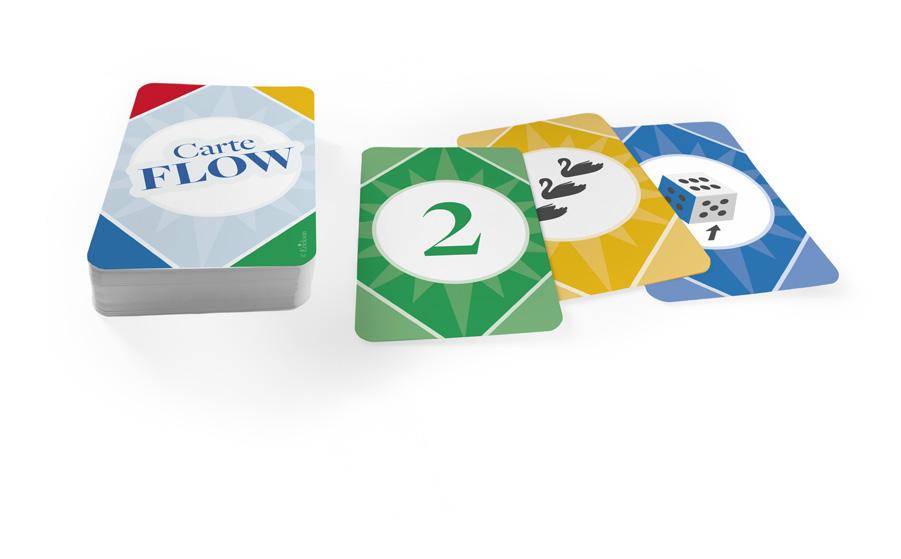
258 cards, divided into:
• 72 matching number cards from 0 to 5 (card colour matches the colour of the content)
• 12 non-matching number cards from 0 to 5 (card colour differs from the colour of the content)
• 12 swap cards
• 4 jolly cards
• 26 strop cards (numbers and letters)
• 16 matching symbol cards (card colour matches symbol colour)
• 4 mismatched symbol cards (card colour differs from symbol colour)
• 20 matching animal cards (card colour matches animal colour)
• 10 mismatched animal cards (coloured card with black animal)
• 20 dice cards
• 20 matching number cards from 6 to 1030
• double-syllable cards
• 12 blank customisable cards
edited by Francesco and Eva Benso
The Benso Method® is an open methodology that adapts to the individual, their pace, and their developmental and clinical needs. It derives directly from models proposed by cognitive neuroscience, which show that strengthening cognitive and executive functions promotes the development and consolidation of all forms of learning, including academic learning. Consequently, the Method is often described as a ‘meta-method’ because it rigorously applies the paradigms found in the literature whilst being flexibly structured to accommodate the significant changes that may arise during new experiments (including our own). It soon becomes clear that this is not simply a ‘package’ with instructions for use (self-contained), but a set of carefully designed, justified and tested procedures that can be adapted to any well-organised material (even beyond that specific to the Method) and to various contexts of application. From these theoretical premises, in the late 1990s, the Integrated Cognitive Treatment (ICT) was developed, a rehabilitation intervention that combines, in a coordinated manner, the enhancement of executive cognitive/attentional functions, high-level central systems and more specific ones (various types of learning, such as reading, writing, etc.).
This training is described as adaptive, as it constantly uses user feedback – observed, mediated and interpreted by the practitioner – to adjust the difficulty of the exercises in real time, keeping the individual within the optimal zone of challenge. Once the appropriate level has been identified, the practitioner manages the difficulty dynamically. Therefore, the complexity of the task must increase
gradually: maintaining the same level of difficulty at all times does not train (and may even weaken) cognitive/attentional systems (Metzler & Baddeley, 2017; Benso & Benso, 2023).
The practitioner is central to the Method: through their expertise, rapport and ‘empathic guidance’, they sustain motivation, regulate the pace of work and facilitate entry into and maintenance of the state of flow, the ideal mental condition for learning.
The interventions are personalised and tailored, adapted to the individual’s cognitive profile and specific needs. The activities offered – verbal, pen-and-paper, motor skills and computer-based – can be used across a range of contexts and throughout the entire life cycle. In the clinical setting, ICT is applicable to:
• neurodevelopmental disorders,
• ranging from cognitive delay to giftedness;
• the effects of trauma in adults;
• cognitive decline in the elderly.
Thanks to its flexible structure and its focus on functions that cut across all types of learning, in addition to the clinical context, it also finds application in the following areas:
• educational,
• artistic,
• sporting,
• recreational
• everyday life.
It is important to recognise and bear in mind that, in particularly serious cases, this is one of several stimulation therapies incorporated into treatment protocols drawn from a range of disciplines.
• To create the ideal conditions for tackling a difficult or demanding task more effectively and, once this state has been achieved, to facilitate the consolidation of various types of learning (cognitive and motor), particularly academic learning.
• To stimulate and enhance attention and executive functions.
• To give participants a sense of being in a state of flow—an experience they may not have had much opportunity to experience— and to gradually accustom them to maintaining this state as much as possible during important performances.
The cards, designed to trigger and transition seamlessly into the enhancement phase, facilitate a state of flow (Csikszentmihalyi, 1990) – that is, an optimal state of attention and performance in which the individual is fully immersed in the task, motivated and able to perform at their best, learning in a natural and fluid manner.
From a neuroscientific perspective, flow is associated with:
• frontoparietal attentional-executive networks that balance a high level of focused attention (the Anterior Cingulate Cortex –
ACC – also appears to be involved in conflict monitoring) with a reduction in top-down control (transient hypofrontality), allowing for more automatic and fluid execution (depending on the type of activity, the motor cortex and cerebellum also appear to be engaged).
• Awareness in the ‘here and now’, immediate feedback processing and, at the same time, deep concentration, with total absorption in the activity itself (Goleman, 2015);
• Reduction in internal distractions/daydreaming (Default Mode Network; DMN) and loss of sense of time (time seems to fly).
• A state of psychophysical well-being: an autotelic experience, i.e. one that is rewarding in itself regardless of the outcome.
• To enter a state of flow, it is essential that the level of challenge in the activity is appropriate: if the challenge is too low, the person becomes bored, loses interest and motivation, and their attention wanes; if the challenge is too high, frustration grows and there is a risk of abandoning the task.
The Benso® Method and ICT focus precisely on this optimal adjustment of difficulty, regulated through continuous feedback and the practitioner’s guidance. When the challenge is correctly calibrated, the individual feels a sense of achievement, maintains their focus, improves their self-efficacy and enters a state of flow more easily – the ideal condition for learning and cognitive enhancement. Remaining in this state is important for increasing the subject’s willingness to persist with a task; this may be very low at the start, but it is essential that it improves gradually over time (one can begin with very simple situations, which should not immediately prompt judgement on the part of the practitioner). As is well known in martial arts training, where knowledge of manoeuvres and states derived from Zen is also utilised, ‘if you keep watching the seed to check its growth, the plant will die’. Assessment takes place after a
certain period of training or treatment. Therefore, when the flow emerges, it is best to preserve it and not interrupt it with trivial corrections, but to continue as long as it is possible to maintain that state. The practitioner’s non-judgemental gaze and empathetic encouragement make such exercises much easier and more enjoyable. Therefore, the optimal conditions for these activities involve a oneto-one interaction between the practitioner and the individual, so that the individual – particularly those with severe attention difficulties – can be engaged and supported, maintaining a fast pace where possible or introducing ad hoc micro-pauses (adjustments made by the practitioner). An individual user could also use the cards to effectively self-activate or stimulate themselves only if they have a good level of basic motivation and follow a gradual, progressive training plan.
(just a few of the proposed ones)
• Selective, divided and sustained attention.
• Arousal and alertness (from phasic to tonic).
• Updating of working memory.
• Cognitive flexibility and task switching.
• Control and self-regulation.
Benefits
• Greater concentration and sustained attention.
• Improved executive functions relating to attention.
• Error control and management of distractions.
• Improved ability to tackle complex or uninspiring tasks.
• Increased intrinsic motivation when undertaking cognitive tasks.
• Transfer, in due course, of the enhanced skills to different areas of learning.
Flow Cards are a specific tool of the Integrated Cognitive Training (ICT) component of the Benso® Method and represent the so-called Activation Cards and Enhancement Cards of the training programme itself. Detailed theoretical and practical references can be found in the text by Benso, F., & Benso, E. (2023). “The neuroscientific principles of cognitive training. Applications of the Benso® Method in clinical, educational, neuromotor, sporting and artistic contexts”. Hogrefe.
• They are designed to help you quickly enter a state of focused alertness without overloading your systems.
• They take effect within just a few minutes: it is not possible to specify an exact time, but 3–5 minutes of continuous use is often sufficient.
• Their purpose is not prolonged training, but to ‘switch on’ your attention, prepare your mind and facilitate entry into a state of flow.
• They are designed to specifically train attentional and executive
systems, as well as certain specific aspects or modules (reading/fusion and serial calculation/subitising).
• They require a longer duration to be effective, typically 15–20 minutes, which may vary depending on the person’s age and profile.
• The aim is to maintain flow, gradually increase complexity and achieve stable enhancement.
Note: this dual function makes them one of the key elements of the Benso® Method, useful both for initiating learning under optimal conditions and for enhancing it and subsequently generalising it in clinical, educational, domestic and artistic-sporting contexts, always with supervision or guidance where necessary.
A)The cards are primarily aimed at those who benefit directly from cognitive training, in one-to-one and small-group settings:
• children and young people with attention difficulties, concentration problems or neurodevelopmental and learning disorders (SLD, SEN, etc.).
• School-age students who wish to improve their attention, working memory and executive functions.
• Head injuries, particularly frontal lobe injuries (which gave rise to the Method).
• Adults wishing to enhance their concentration, mental organisation and learning ability.
• Older adults to stimulate attention, memory and cognitive functions, and to slow cognitive decline.
• Athletes wishing to train their attention, mental alertness and
ability to concentrate during physical or competitive activity.
B)The cards are also designed to be purchased and used by those who support the learner:
• Professionals: psychologists, speech and language therapists, special educational needs and disability practitioners (TNPEE), specialist educators, support teachers, mental coaches/ athletic trainers.
• Parents: to support guided learning and cognitive training at home.
• Teachers: to actively engage pupils and stimulate attention and executive functions during targeted teaching activities.
Before starting: The facilitator selects the type and number of cards they intend to use and gathers them into a small stack, usually of around 20–30 cards, which they will reveal to the participant sitting opposite them over several rounds.
Please note: before proceeding with the activation cards, it is essential to have already organised and prepared the next task, so as not to interrupt the state of activation that has been triggered.
Duration of the activity: Approximately 3–5 minutes for the activation cards, and approximately 15–20 minutes for the enhancement cards. The activity is carried out at a brisk pace, tailored to the individual (see below), without stopping if the subject makes mistakes, but with the ability to adjust the rate at which the cards are dealt on an ad hoc basis, including possible slowdowns and speed-ups (genuine feedback).
Frequency and timing: it is advisable to carry out these activities on an almost daily basis. Use the activation cards whenever there is a need to facilitate engagement with a complex task (clinical enhancement training, schoolwork, active sports breaks), and incorporate the enhancement cards (which are generally preceded by the activation cards) at a specific time of day, thereby creating a routine; this in itself constitutes a form of enhancement. They can be integrated with other enhancement exercises (cognitive/attentional/ motor, etc.) in more severe clinical cases.
To use the Flow cards effectively, it is essential to consider their intended purpose, as they can be used either solely as a mindfulness exercise or as a training tool, by varying the complexity and duration of the tasks. Consequently, this set of 258 cards can be used for both purposes, and the practitioner must therefore manage the dynamics and timing of the sessions and skilfully adjust the level of difficulty
Calibration: test and adjust the pace at which you present the different types of cards you intend to use, first identifying the baseline response rate (which varies from person to person) and, starting from that baseline, gradually increasing the speed and pace, without, however, eliciting a response with a high error rate from the participant.
Activation cards: Within a few minutes, introduce a variety of exercise routines, without pauses, increasing in complexity, without overloading the system, always starting with the ‘simple’ and gradually guiding the person towards more complex levels. Approximately 20–30 cards per round.
Enhancement cards: these are generally carried out immediately after the activation cards, without a break, and involve greater variety (types of exercises and/or variations), complexity (working memory load) and duration (10–15 minutes in addition to the initial activation period). Number of cards: from around 20–30 per round upwards (reaching 40, 50, 60... per round, even by mixing cards from multiple decks).
Activation cards: “I will now turn over cards in front of you featuring symbols (numbers, objects, animals) and colours, and I will ask you to name them – for example, the number – as quickly as you can. If you make a mistake, don’t worry; just try to get back on track as soon as possible by naming the next card I turn over, as I won’t be able to stop.”
Please note: in the event of an error, the operator does not stop, but does not ‘leave the subject behind’, as they may introduce slight pauses to re-synchronise the card with the subject’s response, thereby helping them to regain the flow of naming, and where possible, will try to press on again. Furthermore, functional error management will be promoted, focusing the Subject on the task of re-engaging, despite the inevitable peak of frustration related to the mistake made (which in many subjects then compromises their entire performance).
A typical delivery en route: Once the tasks have begun and the basic rules have been explained, at each round of cards, between one task and the next, there is only time to shuffle the cards and reiterate the same instruction (e.g. name the colours and clap
your right hand if yellow appears) or give a new one (e.g. name the colours and clap your right hand if red appears). The operator may provide motivational and empathetic feedback through eye contact, preferably at the end of the round of cards so as not to interfere with the task (the subject must look at the cards), or through very measured verbal encouragement (again, so as not to distract them) to maintain the rapport with the subject.
Activation or Enhancement? The line is blurred, in that for one person, simply naming stimuli quickly can be stimulating, and adding one or two tasks (dual motor or verbal tasks, or switching or inhibitory tasks) can constitute the actual training (the enhancement phase), whereas for another person, naming with a couple of dual tasks could constitute substantial activation, which would become even more complex if that individual, in addition to being activated, also wished to enhance their performance.
Therefore, in the operational proposals outlined here, it is not possible to strictly separate the activation cards from the enhancement cards; each activity, using the same cards, can involve infinite variations, an increase in tasks and cards which, depending on the individual, allow a transition from activation to enhancement.
This deck forms the core of the activities, which are then expanded upon and adapted in the other decks. The standard deck, when in use, consists of around 30 cards.
The operator sets the task to be performed, revealing one card at a time and placing them one on top of the other, at a brisk pace that is still comfortable for the user.
• Name the number or colour of the card
• Number denomination.
• Colour denomination.
Option 1: add +1 to the card shown.
Option 2: name the penultimate card (the one just covered by the next card).
Option 3 towards expansion: name the penultimate card (the one just covered by the next card) and, if it is lower or higher than the current card, clap your hands on the table.
Option 4 towards expansion: with the inclusion of cards that may have mixed colours (red number and blue background), ask players to name only the colour of the number or the background, or assign an additional task to these cards, such as a gesture or word.
Option 5 towards expansion: use of special cards, such as the ‘switch’ card, to alternate between the two naming tasks, or
the ‘wildcard’ (compass) to introduce a specific task (see special cards).
Option 6 towards expansion: add/multiply the last two cards – that is, the most recently turned card and the penultimate card (which remains face down) – as in the APE10 procedure (Benso & Benso, 2023), using calculations performed automatically by the subject (to be calibrated beforehand).
The facilitator sets the task to be performed, for example, “name the colour (or number) and, at the same time, tap your right hand on the table when the card is red”.
Variation for more advanced practice: keep the same rules and add one or more tasks (e.g. add “tap your left hand if a yellow card appears”), or use special cards (see below).
Colour name (or number) +

Clap your right hand with the colour... RED! (from a varia tion)
“silence”:
The facilitator sets the task to be carried out, for example, “name the colour (or number) of the card and remain silent when the colour ‘yellow’ appears”.
Variation towards expansion: use the same rule but apply
it to multiple colours, or apply it to specific numbers (e.g. if a 3 comes up, stay silent)
220 Number denomination + with the colour... YELLOW! (from a variation) “As quite as the grave”
The facilitator sets the task to be carried out in turn, for example, “name the number on the first card and the colour of the second”, and so on, alternating the task with each card.
Option: Use the same rule, but alternate every two cards dealt.
220
220
1st card: denomination and number;
2nd card: denomination and colour; and so on, alternating with each card
1st and 2nd card: denomination and num ber;
3rd and 4th card: denomination and num ber; and so on, alternating within 2 cards
Number/colour denominations on two
The facilitator arranges the cards into two small piles side by side, designating the first pile for numbers and the second for colours. Turn over one card at a time, at random from each pile, maintaining a steady pace tailored to the participant (e.g. turn over three cards in a row from the left-hand pile, then one from the right-hand pile, and continue at random until the end of the deck).
Option 1: Arrange the cards into three piles, each with a specific task: in the first pile, name the number; in the middle pile, say your favourite dish/footballer/animal (“lasagne”); in the third pile, name the colour. Also, change the order of the tasks associated with each pile. 0 0 2 2 6 2
Number denomination “2” J
Arrange the cards into 2 random piles
Colour denomination L “BLUE”
2-motor option: Arrange the cards into two small piles, turning over one card at a time, and ask the subject to hold their hands just below the two piles. Ask them to clap their hands when they see the higher or lower card (if the two numbers are the same, they should clap both hands).
When this card is revealed, you can remain silent and switch the task from the next card onwards: if I was naming the number, I move on to the colour, and so on. The difficulty can be adjusted by varying the number of changes. Start with 2–3 changes and increase from there.
Option 1 towards expansion: use the same rule, but apply it to any card, not just the one you’re swapping (when you come across a ‘2’, swap it immediately).
Option 2 towards expansion: perform the switch by adding or multiplying the last two cards – that is, the most recently turned card and the penultimate card (which remains face down) – as in the APE10 procedure (Benso & Benso, 2023).
When this card is revealed, a gesture to be made or a word to be said is associated with it.
• Any association: say “MOUSE”
• make a gesture
• ...

Option: The jolly card could mean that a previously established rule is suspended; in other words, once it is revealed, you no longer have to clap your right hand when a red card is drawn (if that rule had been in place previously).
All types of decks can be used with the same instructions and objecti ves as the basic number/colour deck (including double tasks, switches, etc.), whilst managing various specific criteria (colour, quantity, etc.). Furthermore, these cards, belonging to different decks, can be mixed to increase the number of cards that can be turned over at a time, further vary the tasks, and make the activity less monotonous. For example, you can combine the basic deck with numbers (0–5) with the animal cards and ask players to name the index relating to the colour or number again (read ‘5’ or state the number of fish, ‘3’).
C 2 2 2
Indexes: numbers/quantities/colours/letters.
Examples of tasks: Name the number shown (in the example, say “2”) or the number of numbers (in the example, say “3” – Stroop effect), or name the colour.
Option 1: Depending on the colour, name the letter at the bottom (e.g. name the colours and, when blue appears, read the letter).
Option 1 towards expansion: Depending on the colour, read out the number or the quantity (with red, say how many numbers there are; with the other colours, read out the number shown, or vice versa).
Option 3 towards expansion: Insert a switch card to move from one index to another.
Option 4 towards expansion: Depending on the colour – for example, yellow – look at the letter at the bottom and say a name that begins with that letter.
Please note: this final activity should be regarded not so much as a warm-up exercise but as a reinforcement exercise for individuals with a language difficulty or disorder. Therefore, use it in a carefully calibrated manner, both in terms of pace and the tasks set, without exposing the individual to an excessively high level of difficulty or frustration.
Cards with matching symbols (card colour matches symbol colour) and non-matching symbols (card colour differs from symbol colour)
Indexes: geometric symbols/quantities/uniform and non-uniform colours. These geometric symbols are shown with the adult as well as with the child.
Examples of tasks: name the symbol shown, or the quantity, or the colour, using the 16 cards with uniform symbols.
Option 1: Place the 4 cards with the mismatched colour symbols face up, and when they appear, either state only the differing quantity, or state the total quantity and combine this with a secondary task (e.g. clapping your hands) or remain silent (inhibition and control).
Option 2 towards expansion: insert the switch card to switch between the different tabs (quantity/colour/shape name...).
Option 3 towards expansion: use these quantities in more advanced serial counting tasks (ICT’s APE10, Benso & Benso, 2023) as well as with number cards, ensuring that the arithmetic operations are correctly performed.
Indexes: symbols of animals/quantities/uniform and non-uniform colours/direction.
Examples of tasks: Name the animal (a high-frequency word), or the quantity, or the colour of the card.
Option 1: if the animals are black, state their name; if they are coloured, state their colour.
Option 2 towards expansion: if the animal is looking to the right, say its name; if it is looking to the left, say its colour (or say how many there are).
Option 3 towards expansion: insert a switch card to move from one index to another. Alternatively, combine this with a dual
task (e.g. clapping your hands when the fish appear) or remain silent, e.g. when the card is blue or the animal is black (inhibition and control).
Option 4 towards expansion: use these quantities in more advanced serial counting tasks (ICT’s APE10, Benso & Benso, 2023) as well as with number cards, ensuring that the arithmetic operations are correctly performed.
Indexes: quantity/colour with the arrow’s influence.
Examples of tasks: name the quantity shown on the coloured face of the die (subitising activity), or the quantity indicated by the arrow (which may not always match), or the colour.
Option 1: only name the colour when the coloured face and the arrow do not match (or vice versa).
Option 2 towards expansion: say which number is higher or lower, and if there is an arrow, say “BUM”.
Option 3 towards expansion: state the quantity when the coloured face and the arrow match (or vice versa); if they do not match, state the quantity of the face without the arrow and without colour.
Option 4 towards expansion: say the number shown on the coloured side of the dice from the previous card, and if it is lower or higher than the current card, slap your hand on the table.
Option 5 towards expansion: use these quantities in more advanced serial counting tasks (ICT’s APE10, Benso & Benso, 2023) as well as with number cards, ensuring that the arithmetic operations are correctly performed.
Please note: certain activities involving quantities should be regarded not so much as a form of stimulation but rather as a means of strengthening skills for individuals with a difficulty or disorder in arithmetic. Therefore, they should be used in a carefully calibrated manner, both in terms of pace and the demands placed on the individual, without exposing them to an excessively high level of difficulty or frustration.
Customisable cards, which can be used in addition to or instead of others, featuring a coloured border and blank space to be used as required.
Number/colour cards to complete the basic deck (1–5). For quick identification, it is advisable not to use the 6 and the 9, especially if the patient finds them difficult to distinguish.
Indexes: individual syllables or their combination/colour/direction and arrow colour.
Examples of tasks: read the syllable indicated by the arrow, or combine the syllables following the direction of the arrow.
Option 1: use the black arrow to read the syllable indicated; use the red arrow to read the opposite syllable.
Option 2 towards expansion: read the syllable indicated by the arrow and tap the table where the arrow points (or just tap your hand without reading it out loud – this is a motor skill exercise).

Eva Benso
Level III Attentive/Cognitive Trainer and instructor of the “Benso Method”. Psychologist, holder of a Level II Master’s degree in Specific Learning Disorders and other neurodevelopmental disorders (D’Annunzio University, Chieti) and specialisation in neuro-enhancement for wellbeing (Catholic University, Milan), Master’s degree in Visual Arts with specialisation in editorial graphics, SMAART practitioner of the Feuerstein Method, she works in rehabilitation and assessment, practising privately in Turin and, as a lecturer, at public and private institutions (schools, local health authorities and universities) throughout Italy. She is an adjunct professor of Psychometrics on the TNPEE degree course (University of Turin), coordinator and lecturer on the Level I Master’s in Cognitive Rehabilitation (San Raffaele University, Rome), and a lecturer at the ISPEB Specialisation School (John Bowlby, Modica). A former lecturer in Psychology of Art (Brera Academy, Milan), she is the author of the books “Dyslexia” (Leone Verde, 2011) and “The Neuroscientific Principles of Cognitive Training” (Hogrefe, 2023).

A research consultant specialising in attentional and executive functions at the University of Trento, he is a lecturer, trainer and consultant in cognitive and clinical neuroscience throughout Italy. He is the creator of a wide range of tests, including Measures of Executive Attention (MEA; Hogrefe, 2018), and treatment programmes (The Neuroscientific Principles of Cognitive Training, Hogrefe, 2023). His research focuses primarily on the development and application of neurocognitive models. He has previously taught on official courses in Physiological Psychology, Psychology of Attention and Psychobiology at the University of Genoa, and in Executive Functions and Learning at the University of Trento. He has been appointed as a training lecturer at the National Educational Sports Centre (CSEN) of CONI. He is the Scientific Director of the Master’s programme in Cognitive Rehabilitation run by the Humanitas Consortium and San Raffaele University, and has numerous national and international publications to his credit.

4 4 4 4
4