MINISTERUL EDUCAȚIEI ȘI CERCETĂRII
Patrick Howarth Patricia Reilly Olivia Johnston Laura Stanciu Valentina Barabaș
Manualul este prezentat în variantă tipărită și în variantă digitală. Varianta digitală are un conținut similar celei tipărite. În plus, cuprinde o serie de activități multimedia interactive de învățare
Manual pentru clasa a VIII-a
Oana Băjenaru
animații, filme, simulări).
Educația nu schimbă lumea. Schimbă oamenii care vor schimba lumea. Paulo Freire
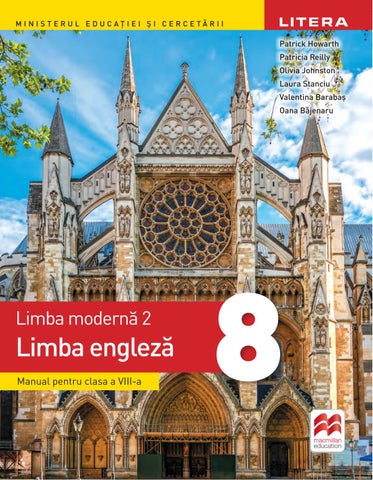
Limba modernă 2 • Limba engleză
(exerciții interactive, jocuri educaționale,
Limba modernă 2
Limba engleză Manual pentru clasa a VIII-a
ISBN 978-630-355-300-9
9 786303 55300 9
8
Patrick Howarth Patricia Reilly Olivia Johnston Laura Stanciu Valentina Barabaș Oana Băjenaru
Manualul școlar școlaraafost fostaprobat aprobatde prin ordinul Educației ministrului educației prin și cercetării Manualul Ministerul și Cercetării Ordinul nr. de xxx/xx.xx.2026. ministru nr. ....................... Manualul este distribuit elevilor în mod gratuit, atât în format tipărit, cât și digital, și este transmisibil timp de patru ani școlari, începând cu anul școlar 2025–2026. Inspectoratul școlar ....................................................................................................................................................................................................................................................................... Școala/Colegiul/Liceul .................................................................................................................................................................................................................................................................. ACEST MANUAL A FOST FOLOSIT: Aspectul manualului* Anul
Numele elevului
Clasa
Anul școlar
format tipărit la primire
1 2 3 4
* Pentru precizarea aspectului manualului se va folosi unul dintre următorii termeni: nou, bun, îngrijit, neîngrijit, deteriorat. • Cadrele didactice vor verifica dacă informațiile înscrise în tabelul de mai sus sunt corecte. • Elevii nu vor face niciun fel de însemnări pe manual.
Limba modernă 2. Engleză. Manual pentru clasa a VIII-a Patrick Howarth, Patricia Reilly, Olivia Johnston, Laura Stanciu, Valentina Barabaș, Oana Băjenaru Referenți științifici: prof. grad didactic I Daniela Tănăsescu, Colegiul Național „I.L. Caragiale”, București prof. dr. Roxana-Cristina Petcu, Universitatea din București, Facultatea de limbi și literaturi străine, Departamentul de limba engleză Prelucrare după: Motivate, Student’s Book 4 © Macmillan Publishers Limited/ Patrick Howarth și Patricia Reilly, 2013 Motivate, Workbook 4 © Macmillan Publishers Limited/ Olivia Johnston, 2013 Ediție publicată sub licență. Edițiile originale au fost publicate pentru prima dată în 2013 de Macmillan Publishers Limited.
Copyright © 2025 Litera Educațional Toate drepturile rezervate
Editura Litera tel.: 0374 82 66 35; 021 319 63 90; 031 425 16 19 e-mail: contact@litera.ro www.litera.ro Editor: Vidrașcu și fiii Redactori: Carolina Marcu Corector: Carmen Bîtlan Credite foto: arhiva Litera, Shutterstock Copertă: Lorena Ionică Tehnoredactare și prepress: Codruț Radu
la predare
Programa școlară pentru disciplina LIMBA MODERNĂ 2, clasa a VIII-a School curriculum for MODERN LANGUAGE 2, 8th grade Competențe generale
General competences
1. Receptarea de mesaje orale simple
1. Recognize simple oral messages
2. Exprimarea orală în situaţii de comunicare uzuală
2. Oral communication in routine exchanges
3. Receptarea de mesaje scrise simple
3. Recognize simple written messages
4. Redactarea de mesaje simple în situaţii de comunicare uzuală
4. Write simple messages in routine exchanges
Competențe specifice
Specific competences
1.1. Identificarea semnificației unor schimburi verbale pe teme familiare, clar articulate
1.1. Identifying the meaning of verbal interactions on clearly articulated familiar topics
1.2. Sesizarea detaliilor principale din mesaje și anunțuri clare și simple
1.2. Noticing the main details in clear and simple messages and announcements
1.3. Manifestarea interesului pentru diversitatea culturală
1.3. Expressing interest for cultural diversity
2.1. Exprimarea unei opinii în legătură cu un subiect familiar / situație cunoscută
2.1. Expressing an opinion on a familiar topic / known situation
2.2. Participarea la scurte interacțiuni verbale, cu sprijin din partea interlocutorilor
2.2. Participating in short verbal interactions, with the support of the interlocutors
2.3. Realizarea unor expuneri scurte, exersate, a unui subiect familiar
2.3. Making short, practiced presentations of a familiar topic
2.4. Participarea la schimbul verbal fără teama de eșec
2.4. Participating in verbal exchanges without fear of failure
3.1. Identificarea informațiilor de care are nevoie din liste sau din texte funcționale simple (pliante, meniuri, orare)
3.1. Identificating the necessary information from lists or simple functional texts (leaflets, menus, timetables)
3.2. Extragerea informațiilor dintr-un text clar structurat (articole de ziar / digitale simple, broșuri), în care numerele și numele joacă un rol important
3.2. Extracting information from clearly structured text (simple newspaper / digital articles, brochures), where numbers and names play an important role
3.3. Extragerea de informații din reclame de mici dimensiuni
3.3. Extracting information from small advertisements
3.4. Manifestarea disponibilității pentru informare prin lectură
3.4. Expressing willingness to obtain information from reading materials
4.1. Completarea unui formular cu informații de identificare (educație, interese, competențe)
4.1. Filling in forms with identifying information (education, interests, abilities)
4.2. Prezentarea unei activități în scris, utilizând cuvinte de legătură („și”, „dar”, „pentru că”)
4.2. Presenting an activity in writing, using connectors (“and”, “but”, “because”)
4.3. Depășirea fricii de eșec în redactare / schimbul de mesaje scrise
4.3. Overcoming the fear of failure in writing / exchanging written messages
3
What’s in this textbook for you? Take a tour! Ce cuprinde acest manual? Să facem o trecere în revistă! This textbook is designed both to fulfil the students’ linguistic and communicative competences and to develop their skills in all specific competences as well. The textbook offers flexible learning by providing language and content with a complete range of components and use of up-to-date technology. It is an attractive and motivating course with clearly-structured activities and grammar syllabus, and a focus on natural communication.
Lucrarea oferă flexibilitate în învățare, limbaj și conținut cu o gamă completă de componente și utilizarea tehnologiei moderne. Este un manual atractiv și motivant, cu activități de vocabular și gramatică bine structurate, fiind centrat pe comunicarea naturală.
Students become aware, confident learners, excellent communicators and achieve success – at school, in exams and throughout their life!
Elevii devin conștienți, încrezători în procesul de învățare, vorbitori excelenți, descoperind calea spre succes – la școală, la examene și pe tot parcursul vieții!
This Textbook includes:
Manualul include:
√ a starter module of three pages; √ eight modules of 11 pages; √ eight pages of Self-checks, one after each module; √ three Projects, one in every Revision; √ twelve pages of Revisions; √ eight pages of Grammar guides; √ eight pages of CLIL;
√ un modul introductiv de trei pagini; √ opt module de 11 pagini; √ opt Teste de autoevaluare, câte unul după fiecare modul; √ trei Proiecte de grup, câte unul pentru fiecare Recapitulare; √ douăsprezece pagini de Recapitulări; √ opt pagini de trimiteri la Noțiuni de gramatică; √ opt pagini de CLIL – Învățare integrată a conținutului și limbajului; √ două pagini de verbe neregulate. √ manualul în format digital.
Acest manual este conceput atât pentru a structura competențele lingvistice și de comunicare ale elevilor, cât și pentru a le dezvolta abilitățile în toate competențele specifice.
√ two pages of irregular verbs. √ a Digibook. Reading Sporting greats
MODULE 4
Unit
4a
1
Vocabulary 1 Match four of the verbs in the box to pictures 1–4. Use your dictionary to check the meaning of any unknown words.
2
4 Complete the sentences with verbs in exercise 1. They’re going to hold a sports day at my school. 1 I want to … squash – I’ve heard it’s great fun. 2 I think Usain Bolt will … the world record. 3 They’re going to … the world championships. I’m going to watch them at home. 4 I have a tennis match next week so my dad is going to … me. He’s really good at tennis. 5 I predict that England will … against Norway and the score will be 2–1 to England. 6 I … Manchester United, but my brother is a Manchester City fan.
televise score a goal hold (an event) win get a medal support a team break a record take up (a sport) lose set a record draw coach
Listening
2
52
4
Listen and repeat.
3 Choose the correct verbs. 1 I came third in the race so I got / set the bronze medal. 2 Ronaldo scored a goal / held an event and Real Madrid won the match. 3 Experts coach / support top athlets and help them remain the best. 4 The final was incredible; the Russian runner broke / set a new world record. 5 Barcelona lost / drew 2–2 against Inter Milan. 6 My favourite team lost / won the match – I was really upset.
The first conditional
Here are my top three sporting memories. What are yours? WHAT: Men’s 100 metres final WHEN: 16th August 2008 4 WHERE: Olympic® Stadium, Beijing WHY: I’ve watched this race so many times and it’s still amazing. Usain Bolt wins the race so easily – it’s incredible. His time of 9.69 seconds broke the world record and if you watch the race you can see that he’s slowing down at the end! He then went on to win the 200 metres gold medal a few days later and set another world record. Usain has broken lots of Olympic® records, and might break even more in the future.
5
Listen to James and David. Which sport does David want to take up?
6
INTERFACE Work in pairs. Ask and answer the questions. What sport would you like to take up? Why?
I’d like to take up tennis because … .
WHAT: The World Cup 6 WHEN: 12th July 2010 WHERE: Soccer City Stadium, Johannesburg WHY: Football’s my favourite sport, so I love the World Cup. In 2010 Spain were the tournament favourites and the best team in the world. England were terrible so I was supporting Spain. In the final, which was played in front of 84,490 fans, Spain played The Netherlands. Like many millions of others, I was watching on TV. Spain were the better side but they just couldn’t score. After 90 minutes the score was 0–0, so the teams played extra time. There were still no goals and I thought there would be a penalty shoot-out. Then amazingly, Andres Iniesta scored in the 116th minute. I was so happy I screamed.
WHAT: 2008 Wimbledon Men’s Singles Final WHEN: 6th July 2008 5 WHERE: Wimbledon, London WHY: I love tennis and I think this was the greatest match ever. The match was between Roger Federer and Rafael Nadal. Federer was number 1 in the world and Nadal number 2. Nadal won the first two sets 6–4, 6–4. Rain delayed the third set but Federer won the tie-break. He then won the fourth set, also in a tie-break. The scores were equal. Then it rained again! Nadal finally won the fifth set 9–7 to take the title. The match lasted four hours 48 minutes, the longest final ever. It was so close that Nadal only won five points more than Federer in the whole match. I’ll never forget it!
7 Look at pictures 4–6. What do you know about
first conditional If you’re a talented footballer,
If she studies (study) hard, she will become a doctor. 1 If my Dad … (work) hard, he’ll get promoted. 2 She … (not get) paid if she’s late for work. 3 If she … (not lend) you the money, I will. 4 I … (improve) my French if I move to France. 5 If you … (need) a job, my sister can ask her boss.
4 Complete the sentences using the first conditional. If you don’t work (not work) harder, you won’t pass (not pass) your exams. 1 If you … (not pass) your exams, you … (not get) a job. 2 If you … (not get) a job, you … (not earn) any money. 3 If you … (not earn) any money, you … (not have) enough money for a holiday. 4 If you … (not have) enough money for a holiday, we … (not be able) to go away together.
a) sporting competition b) team c) game d) be the winner e) excellent f) going more slowly
Pronunciation
Sentence stress and contractions
a
Listen and repeat the sentences. Which syllables have the main stress? 1 If she’s late for work, she’ll lose her job. 2 If I tell you the truth, you won’t believe me.
b
INTERFACE Work in pairs. Ask and answer the questions. What was your favourite sporting event? Why?
5 Will you ask for help 6 Will you pay me back next week
a) if I save enough money. b) she won’t get it. c) will you please remind me? d) if you have a problem? e) if I lend you €100? f) I’ll buy a motorbike.
6 Choose the correct answers.
correct form of the verbs in brackets.
1 Fernando Alonso was … at the end of the race. He still won it. 2 We’re having a basketball … at my school next week. 3 I watched a fantastic rugby … on TV last night. 4 I think Venus Williams is … . She’s the best. 5 I play for the local football … in my village. 6 I think Andy Murray will take the … next year.
13
4 I’ll go to China
First conditional sentences talk about the past / present and future.
12 Complete the sentences with words from exercise 11.
Read and listen. Were your ideas correct?
false? Correct the false sentences.
2 If I get a new job, 3 If I forget,
3 Complete the first conditional sentences with the
definitions a–f.
these events?
you’ll be successful.
5 Match 1–6 with a–f to make sentences. 1 If your sister doesn’t apply for the job,
2 Choose the correct answer to complete the rule.
11 Find words 1–6 in the text and match them with
9 Read the text again. Are the sentences true or 1 Usain Bolt didn’t set a new world record. 2 It rained during the tennis match. 3 Nadal won the final easily. 4 Susan supported England in the 2010 World Cup. 5 Susan screamed at the end of the game.
meaning.
1 How many people were at the World Cup final? 2 Who scored the winning goal? 3 Who did everyone expect to win the Wimbledon final? 4 What record did the tennis player break at the tennis final? 5 How many gold medals did Usain Bolt get? 6 What has he done since the Olympic® Games?
Reading
8
1 Look at the sentence in the table. Explain the
10 Answer the questions.
1 match 2 take the title 3 side 4 slowing down 5 amazing 6 tournament
Work and money
Grammar
Susan says: Sporting memories
Sporting memories 3
Vocabulary
Grammar MODULE 6
MODULE 4
Sporting greats
53
Listen and repeat the sentences. How many words are there in each sentence? How many words are stressed?
I’ve always wanted to be a vet. It’s my dream job. I know exactly what I have to do to become one. If I pass my exams when I’m older, I (1) ’ll study / study sciences for the next two years. If I (2) want / ’ll want to go to university, I (3) ’ll need / needs to get good marks, so I need to work hard. But that’s OK. I (4) ’ll / read lots of novels this summer if I have any free time. If I (5) have / will have enough money, I’ll go to Africa this summer if it isn’t too expensive. I’d love to see wild lions. If I (6) save /’ll save my allowance, I’ll be able to afford it.
7 Circle the correct words. If you will apply / apply for this job, I’m sure you will get it. 1 My father wears / will wear a suit if they give him an interview. 2 If my sister gets an application form, will you help / do you help her fill it in? 3 He will lose his job if he won’t stop / doesn’t stop being late for work. 4 If they will offer / offer her a job, will she take it? 5 You don’t regret / won’t regret it if you go and work for them. 6 If she doesn’t get / won’t get that job, she will be very disappointed.
8 Complete the sentences with the correct form of the verbs in brackets. 1 I have a new dress If Mark ... (invite) me to the party, I … (wear) my new dress. 2 Their favourite food is pizza They ... (order) pizza if they ... (go) to the restaurant tonight. 3 They’re trying to save money. If they … (save) enough money, they … (buy) a car. 4 He’s a good student If he … (work) hard, he … (pass) the exams.
Pronunciation
78
The Vocabulary is introduced through representative pictures and recorded so that students can practice the pronunciation.
Vocabularul este prezentat prin intermediul unor imagini reprezentative și înregistrat astfel încât elevii să poată exersa pronunția.
The Reading texts are informative and interesting and show the language in context. All the readings are recorded.
Textele de Exersarea citirii sunt bogate în informații interesante și ilustrează limba în context. Toate textele sunt înregistrate.
The Grammar is presented with clear grammar tables. Graded exercises help students practise the form and meaning of the grammar.
Gramatica este prezentată în tabele clare. Exerciții cu grade diferite de dificultate îi ajută pe elevi să exerseze noțiunile de gramatică predate.
The Pronunciation box appears in every unit.
Caseta Pronunție apare la fiecare unitate.
Culture The world around us
MODULE 3
Speaking
Speaking task
Making a list
Step 1
1 Look at the picture. What are David and James doing?
3
Think about different ways of helping the environment and choose your favourite ideas. How will you prioritize them?
Listen to the first part of David and James’s conversation. Are the statements true or false? 1 James wants to make a list of things they can do to save money. 2 James wants to take the bus to school instead of walking. 3 David says they need the light on.
An informal e-mail
Famous green organizations
Freecycle
1
What is Freecycle?
It’s important to (1) … .
Yes. We can watch less TV. That will save energy.
Oh! I’d rather use the computer less than watch less TV.
about in order. a) Elena’s family b) her teachers c) a concert d) learning the guitar e) doing a sport f) her new school 1
Do you? For me, the most important thing is travelling by (2) … .
Language Informal expressions Hi Elena! How are you doing? / How are things? What’s new? / What’s new with you? / What have you been up to? Write soon! / I can’t wait to hear all your news! Love, / Lots of love, / Bye for now,
Step 2 Think about what you will suggest.
Let’s (3) … . Then we’ll have less rubbish.
I’d rather buy less packaging than … . For me the most important thing is … .
Yeah, that’s really important. OK, so let’s try those three things … saving energy, travelling by public transport and recycling packaging.
Practise 4 Listen again and act out the dialogue.
Think about how your friend responds.
6 Write sentences to give your opinion. 1 think / install solar panels / as important / recycling. 2 for me / most important thing / reduce / my carbon footprint. 3 rather / save water / watch less TV. 4 think / buying fewer things / more important / saving energy.
3 Look at the Language focus. Match the informal
I agree. I don’t agree. Oh, I think recycling is more important than … .
5 Match meanings 1–4 with sentences a–d in the
Functional language box. 1 In my opinion, these two things are equally important. 2 My preference is the first thing, not the second. 3 In my opinion, one thing is greater in importance. 4 I think this thing is the top priority.
Hi, Elena! How are you doing? I started at my new school last month! I thought moving and changing schools would be awful, but it was OK. I’m making lots of new friends. I went to a great concert on Saturday with them – the Kaiser Chiefs played. They were brilliant! I’m in year nine now (can you believe it?!) and I’m really enjoying my classes this year. I like my history teacher a lot and my Spanish teacher is great! He gives us loads of homework, but the classes are fun. Next time I’ll write to you in Spanish! What else is new? I’m in a volleyball club and it’s great fun. I used to hate sports, but volleyball is different. I’m learning the guitar, too. What about you? What have you been up to? I can’t wait to hear all your news. What about your family, are they all OK? Write soon! Lots of love, Megan xxx PS Here’s a photo of me at the concert!
How to Freecycle Find your local group online and join. Before buying anything new, check if anyone in the group has one they want to give away. Before you throw anything out, offer it to the group. Post your offer or request online. Arrange with the other person when to collect it. It’s that simple!
We can do both, but I think recycling is more important.
I don’t agree. I think recycling is as important as saving energy.
2 Put the things that Megan writes
On 1st May 2003, Deron Beal started the Freecycle Network™ in Tucson, Arizona (USA). Deron worked for a small recycling organization. Often they were given unwanted items and Deron used to drive around the area offering them to local non-profit groups. He thought there had to be a better way of informing people what was available. He set up the first e-mail group. It soon spread to other areas and then other countries. As a result, the organization now keeps around 850,000 kilos a day out of landfill – that’s 13 times the height of Mt. Everest!
recycle packaging save energy public transport
Read and listen. Answer the questions. 1 What things are new in Megan’s life? 2 What questions does Megan ask Elena? 3 Where do you think Elena lives?
Freecycle is an online network where people give and get things for free. Its aim is for people to reuse things in order to reduce rubbish and the amount of things that go to landfill. It exists in 110 countries around the world. There are now 4,951 local groups with 8,500,000 members. It is a non-profit group and it’s free to join.
History
Listen to the second part of the conversation and complete the dialogue with the words in the box. What three things do David and James decide to do?
Changing lives
Writing
Culture
Write a new dialogue between you and a friend.
Listen 2
MODULE 3
The world around us
Speaking
Writing MODULE 1
expressions with formal expressions 1–4. Dear Elena,
Step 3 7 Listen and fill in the table.
Write your dialogue.
Prioritizing ideas
name of organisation
Step 4
a) For me, the most important thing is recycling. b) I think recycling is more important than saving energy. c) I think recycling is as important as saving energy. d) I’d rather use the computer less than watch less TV.
number of countries
when it started
where it started
how can you offer
4 Put the words in order to make expressions.
Work in pairs. Practise your dialogues.
8
1 doing / you / How / are / ? 2 hear / can’t / wait / I / to / you / from / ! 3 now / Bye / for / . 4 to / have / What / you / been / up / ? 5 else / What / new / is / ?
Read and listen. Answer the questions. 1 Do you have to pay to join Freecycle? 2 How many people are members? 3 How long has the network existed?
9 Is there a Freecycle group in your area?
40
Hi, Elena!
1 How are you? 2 What have you done recently? 3 I am looking forward to hearing all your news. 4 Yours sincerely,
5 Write an e-mail to a friend describing some of the changes in your life and what you did last weekend (150–170 words).
Writing an informal e-mail Step 1 Plan Think about recent events in your life and make notes. Decide who you are writing to, which changes you want to describe and what you did at the weekend.
Step 2 Write Write your first draft. Use Megan’s e-mail to help you. Write three paragraphs.
Step 3 Check Check your writing for errors. Have you used informal expressions?
Step 4 Write Write your final copy and hand in your work.
6 Read your deskmate’s e-mail. Is it similar to yours?
20
41
The Speaking section introduces the foreign language in routine exchanges.
Pagina dedicată Exprimării orale introduce limba modernă în situații de comunicare uzuală.
The Culture section highlights different aspects of life in a variety of English – speaking countries.
Textele din secțiunea Cultură evidențiază diverse aspecte ale vieții din țări în care se vorbește limba engleză.
The Writing page provides a model for different text types.
Paginile de Redactare oferă un model pentru diferite tipuri de texte.
Self-check Present perfect + still, yet, already, just
Self-check 3 Saving environmental resources a) water b) rechargeable batteries c) car journeys d) packaging e) by public transport f) food waste g) ligths h) solar panels i) windows j) old clothes
---- / 20
Prefixes 2 Complete the sentences with the correct form of the verb and a suitable prefix. 1 I didn’t understand what he said – I … (understand). 2 I can’t eat another thing! In fact, I’ve … (eat). 3 I want to organize this information again. I’m going to … (organize) it tomorrow. 4 Peter can’t find his glasses. He has … (place) them somewhere. 5 They don’t pay people enough. I think they … (pay) them. 6 I’ve lost my mobile phone. I’ll have to … (place) it. 7 Don’t put the bookcase here! It will … (crowd) the room. 8 He … (estimate) the power of the waves and the ship sank.
Revision 3
Revision 3
CLIL
1 I / not do / my homework. (yet) 2 Sally / phone / her father. (already) 3 We / see / Paul. (just) 4 Mark / not listen to / his new CD. (still) 5 you / be to / the new nightclub? (yet) 6 They / not have / their lunch. (yet) 7 Simon / win / the race. (just) 8 I / go to / the gym. (already)
Talk about someone who …
Present perfect + for and since 5 Write sentences using the words in brackets and for or since. 1 I live here now. I moved here in 2003. (live / 2003) 2 I am here now. I arrived at 9 o'clock. (be / 9 o’clock) 3 We are here now. We arrived ten minutes ago. (be / ten minutes) 4 Kate met Rachel five years ago. They are best friends now. (be / five years) 5 I know Carla. I met her in 2008. (know / 2008) 6 They work here. They started a few months ago. (work / a few months) 7 I teach Japanese. I started teaching it in 2022. (teach / 2022) 8 I know the truth. We heard the news yesterday. (know / yesterday)
---- / 16
Sell, sell, sell!
… never puts their clothes away.
---- / 16
… is … is glamorous. glamorous. glamorous.
Sport
Acceleration =
WWF is one of the most famous environmental organizations in the world. It has existed (1) since / for 1961 when a group of scientists, naturalists, businessmen and political leaders (2) started / have started the organization. The first office (3) was / has been in Switzerland. Over five million people have (4) still / already joined and together they (5) achieved / have achieved many things. It (6) supports / is supporting about 1,300 conservation and environmental projects around the world. In fact, (7) for / since 1985 WWF (8) was investing / has invested over $1.165 billion in more than 11,000 projects in 130 countries.
---- / 16 Total ---- / 100
Don’t forget to complete the Self-observation observation sheet according to the example on page 7!
… earns …of earns a lot money. a lot of money. a lot of money. … works parttime.
time taken
Read and listen. Answer the question. Why don’t tennis players wear as much protective clothing as cricketers?
Vocabulary guide 1 Ideas What sort of product do you want to sell? Use the ideas in the photos or think of your own. Which product would most people want to buy? Which is most useful? Which is the most interesting?
… gives … gives clothes away. clothes away. clothes away. … can … can afford to go afford to go out tonight. afford to go out tonight. out tonight.
velocity at the end – velocity at the beginning
Force Force is measured in newtons (N). A heavy mass with a high acceleration, such as a fast cricket ball, has a lot more force on impact than a lighter mass with a lower acceleration. A fast cricket ball may have a force of 6000N, which is the equivalent of 600kg!
… has moved house recently.
6 Choose the correct answers.
( Force = mass x acceleration )
In order to calculate acceleration, we need to know the velocity of the ball at the beginning and at the end of its journey, and also the time taken to make the journey:
… is … is formal. formal. formal.
---- / 16
F = ma Mass
Acceleration
… buys a lot of clothes.
… is planning to live abroad.
A hard solid leather ball is used to play cricket. Cricket balls typically travel at speeds of over 100 kilometres per hour. If a cricket ball hits an unprotected player, it could seriously injure them. To understand the force of the ball and the injury it could cause, we need to understand Sir Isaac Newton’s second law of motion:
Mass is how heavy something is and it is measured in grams and kilograms. Most cricket balls have a mass of about 160g. Tennis balls, on the other hand, have a mass of about 56g.
… spends … of spends a lot money. a lot of money. a lot of money.
Grammar build up
---- / 16
1 I have studied English for ten years. 2 Mike has had his mp3 player for two weeks. 3 Jim and Angela have lived here since 2009. 4 I’ve wanted to be a biologist all my life. 5 Amy has known Joe since she was five years old. 6 My teacher has worked at this school for six years. 7 They have played for this team since 2015. 8 He has been in the doctor’s office for some time.
MODULE 4
Sporting greats
Why do cricketers wear protective clothing?
Present perfect + How long … ? 3 Write questions for these answers. Use How long … ?
46
Project
4 Write sentences.
1 Match 1–6 with a–f to make expressions. 1 compost 2 recycle 3 save 4 mend 5 share 6 install 7 use 8 travel 9 turn off 10 insulate
Revisions
The world around us
MODULE 3
3 Write
5 Visuals Find photos or draw pictures of your product.
115
draw break a record get a medal hold (an event) lose score a goal set a record support a team take up (sport) televise coach win
4 Check
Write an advertisement for the product. Remember to describe what the product is like, why it is useful and why people should buy it.
… is a famous criminal.
2 Group work Choose one product each to sell. Think about: • what sort of people might buy it; • how to describe your product; • how much your product will cost.
Look at the pictures and choose the right words or phrases.
Swap your writing with a partner and check punctuation, spelling, word order and interesting vocabulary.
6 Display Make a poster or choose another way of displaying your work, such as a presentation. Include your text, photos and artwork. Show your project to the class.
118
61
Every module is followed by a Self-check to revise and evaluate vocabulary and grammar.
După fiecare modul există o pagină de Autoevaluare menită să recapituleze și să evalueze vocabularul și noțiunile de gramatică predate.
The Revision pages invite students to revise and consolidate the vocabulary and grammar from all the modules.
Paginile de Recapitulare invită elevii să repete și să consolideze noțiunile de vocabular și gramatică predate.
The Projects are a chance for students to work in groups, create a poster together and present it.
Proiectele oferă elevilor ocazia de a lucra în echipă pentru a realiza și a prezenta posterul grupului.
The CLIL (Content and Language Integrated Learning) sections present interesting facts on various topics like science, literature, history, sports or art.
Secțiunile CLIL, de învățate integrată a conținutului și limbajului, prezintă informații interesante din domenii variate, cum ar fi știința, literatura, istoria, sportul sau arta.
The Digibook The content of the digital version of the Student’s book (The Digibook) is similar to the one in the printed version and it also includes a range of interactive multimedia learning activities (static, animated, interactive).
IMLA static AMII static
IMLA animated AMII animat
Varianta digitală Forma digitală a manualului școlar are un conținut similar variantei tipărite a manualului și cuprinde, în plus, o serie de activități multimedia interactive de învățare: statice, animate, interactive.
IMLA interactive AMII interactiv
5
Module
Vocabulary
Starter module page 8 Module
Changing lives
Grammar
Introductions
Vocabulary
Literature
Classroom language
Life-changing events
Present simple Past simple, used to Countable, uncountable nouns and irregular plurals Verb + preposition
Sentence stress
Literary genres Compound nouns
Past simple and past continuous Present and past tenses
/ǝʊ/ /ɒ/ /ɔː/ /uː/ /ʌ/
Saving environmental resources Prefixes
Present perfect + for / since / how long? Present perfect and past simple Time expressions with the present perfect: still, yet, already, just
Word stress
page 11
Module
Grammar
Pronunciation
page 23
Module
The world around us page 35
Revision 1 Module
page 47
Sporting greats
Vocabulary
Grammar
Followers of fashion
Present perfect continuous Short answers with present perfect continuous Present perfect simple and present perfect continuous
/ɑː/ /ɜː/ /iː/ /ɪ/ /æ/ /e/
Fashion and style
Time adverbs some / any / no compounds The future Phrasal verbs: clothes
Phonemes
The world of work Work verbs
The first conditional to -ing verbs
Sentence stress and contractions
page 63
Module
Work and money
Project
Sporting memories Confusing verbs
page 51
Module
Sketch
page 75
Revision 2 page 87 Module Crime doesn’t pay
Vocabulary
Grammar
Sketch
Project
Crimes and criminals Crime words and expressions
Modals of possibility, probability, necessity and advice Time clauses
/aɪ/ /eɪ/ /ɪə/ /eə/ /ɔɪ/
The written word
Tense review Tense review: question forms Adjectives with -able and -ible
Intonation
page 91
Module
Communicate page 103
Self-check
pages 22, 34, 46, 62, 74, 86, 102, 114
Revision 3
page 115
Grammar guide
page 119
Irregular verbs
page 127
6
Vocabulary
Grammar
Sketch
Project
Reading
Then and now: Johnny Depp My new life
Listening
Lifestyle changes
Speaking
Talking about photos Describing a photo
Writing
Culture and CLIL
An informal e-mail Informal expressions
Famous journeys Science
Dog Star: a short story A success story
A life without rubbish Feeding our cities
Book or film?
Buy Nothing Day
Talking about books Asking for and giving opinions
A book evaluation Describing books
Making a list Prioritizing ideas
Personal reflection Linkers of addition and result
Famous writers Literature Famous green organizations Music
Susan says: Sporting memories A question of sport
Fashionable feet! What are you going to wear?
The best job in the world Try an apprenticeship!
Sporting heroes
A famous young designer
Part-time jobs
Making suggestions Giving and responding to advice
A biography Using topic sentences
Complimenting people Giving and responding to compliments
A comparison Linkers of contrast
Talking about work Evaluating a situation
Filling out forms Personal exchange form
Famous sporting events Sport Famous design and designers Art Famous financial institutions History
Watch out for animal smugglers! The United California Bank Robbery
Crime news
Written texts The man behind the chickens
Communications quiz
Witnessing a crime Showing interest
A narrative Using adjectives
Famous laws and lawmakers Art
Talking about news Showing interest and sympathizing
A blog post Checking your work
Famous communication innovations ICT
When you finish studying each module, assess the activities you have carried out and how you felt while going through these lessons. Create your self-observation sheet by completing the table below. Collect the sheets from each module in your portfolio to monitor your progress. SELF-OBSERVATION SHEET Self-assessment I showed interest in learning. I followed the instructions. I worked individually. I asked for help when needed. When I made mistakes I wanted to learn how to correct them. I participated actively in activities.
Never
Sometimes
Often
Always
7
STARTER MODULE
Starter module
Hi, I’m James and these are my friends Rachel and David.
Introductions 1 Look at the picture, match the people with the names and then describe them.
2 Complete the questions with the words in the box. are can
does
has
is
1 How old … he / she? 2 Where … he / she live? 3 How many brothers and sisters … he / she got? 4 What … her / his hobbies? 5 How many languages … he / she speak?
3
Read and listen to David. Choose the correct words. Hello, I’m David. I (1) ’m / have 15 years old. I (2) go / goes to school with Rachel and James. James is my best friend. He’s 16 years old. We both (3) live / lives in Bury, a small town near Manchester. I (4) haven’t / hasn’t got any brothers or sisters, but James has one brother and two sisters. My hobbies (5) is / are playing sports, especially tennis. I also like computers but I (6) don’t like / not like computer games. I can (7) to speak / speak English and Italian – my mum (8) is / are from Rome.
8
4
INTERFACE Work in pairs. Tell your friend about your daily routine.
Vocabulary 5 Look at the words in the box and match them to categories 1–8. tennis apple train bread football maths rugby French bus car meat history France theatre hot boring India shop cloudy easy Canada fun rainy sports centre 1 Food 2 School subjects 3 Sport 4 Transport 5 Countries 6 Adjectives 7 Weather 8 Places
STARTER MODULE Grammar
8 Complete the questions with the question words in the box. Then answer the questions so they are true for you.
6 Complete the sentences with the correct form of the verbs in brackets. Use the present continuous. Gina, what (1) … you … (do)? I (2) … (study) for an exam. What (3) … your sister … (do)? She (4) … (not do) anything important. She (5) … (speak) to her friend on the phone. Mum Oh. Well, where are your brothers? Gina In the living room. They (6) … (watch) TV. Mum Well, what (7) … they … (watch)? Gina A film. Why? Mum I (8) … (do) the washing up. Can you help me? Gina But Mum, I (9) … (do) my homework!
Why Who What What time Which Where When How
Mum Gina Mum Gina
1 … is your favourite actor? 2 … do you get up on Sunday mornings? 3 … do you travel to school? 4 … is your favourite food? 5 … football team do you support? 6 … are you learning English? 7 … is your birthday? 8 … do you come from?
9
7 Choose the correct tenses. Hi, I’m Rachel. I’m 16 and I (1) go / ‘m going to Granton School. I (2) live / ’m living in Manchester, a big city in the north of England. It’s famous for its football teams. I (3) love / ’m loving Manchester City but my Dad (4) likes / is liking Manchester United. I’ve got one sister, Mary, she’s two years older than me. Today is the last day of the summer holidays, so I (5) get / ’m getting ready to go back to school tomorrow. Mary (6) do / is doing her GCSEs this year – really important exams! I'll have to do them one day, too… I (7) don’t look / ’m not looking forward to them!
INTERFACE Work in pairs. Ask and answer the questions in exercise 8.
10 Write the questions. 1 How often / you / go / to the gym? 2 What book / you / read /at the moment? 3 Who / your / favourite / singer? 4 What time / your sister / go to bed? 5 What / your / favourite subject / at school?
11
INTERFACE Work in pairs. Ask and answer the questions in exercise 10.
12 Read the sentences about Rachel, David and James. Are they true or false? Correct the false sentences. 1 James is not as old as David. 2 James’s family is bigger than David’s. 3 Rachel’s family is not as small as David’s. 4 Rachel is as old as James. 5 David is not younger than Rachel.
13 Look at the pictures and complete the sentences.
a
a
is the biggest. 1 ... is the smallest. 2 ... is the cheapest. 3 ... is the oldest.
b
c
4 ... is as expensive as ... . 5 ... is not as old as c.
9
STARTER MODULE 14 Circle the correct verbs. My name’s Oliver Riley and I (0) am living / live in Camden Town in north London. Camden is a great area of London. I (1) love / is loving it. At weekends a lot of tourists (2) come / are coming to Camden because of its famous market. It’s Saturday today and (3) I’m watching / I watch the market from my window. I can (4) seeing / see a lot of tourists. Two girls (5) look / are looking at some earrings and their friends (6) are taking / take photos of the canal. (7) I’m not looking / I don’t look forward to Monday because it’s the first day of the new school year. My school day (8) starts / is starting at eight thirty and (9) is finishing / finishes at four.
15 Complete the dialogue with the present continuous form of the verbs in brackets. Toby Liam Toby Liam
Toby Liam Toby Liam Toby Liam Toby
10
Hi, is that Liam? Yes. How are you, Toby? OK. What (0) are you doing (you / do) at the moment? (1) ... (you / use) your bike? No, Josh and I (2) ... (stay) at home today. We (3) ... (watch) the match on TV at the moment. It’s great. For once United (4) ... (not win). (5) ... (they / play) badly? Yes, really badly. What (6) ... (Adam / do) at the moment? He (7) ... (make) our lunch. Anyway, Toby, I want to get back to the match. You can come and get my bike any time. I (8) ... (think) about it, Liam. Maybe I can come and watch TV with you. Sure. No problem. Great! Er… just one more thing… er… (9) ... (Adam / make) enough food for four people?
16 Write questions for these answers.
Who is your favourite film star? My favourite film star is Robert Pattinson. 1 I wash my hair once a week. 2 At the moment Jo is talking on the phone. 3 No, I haven’t got a computer in my room. 4 My best friend lives in Park Road. 5 My mother’s birthday is November 11th.
Classroom language 17 Match the questions and answers. 1 How do you say cutremur in English? 2 How do you spell the word hungry? 3 Can I borrow your dictionary? 4 What does sport mean? 5 How do you pronounce bought? a) Yes, here you are. b) /bɔːt/ c) Sport is an activity such as football or tennis. d) H-U-N-G-R-Y e) Earthquake
18 Complete the questions with the words in the box. Then match them with answers a–e. borrow think
mean
pronounce
1 How do you spell imˈpɒsəbəl? 2 Can I … your pen, please? 3 How do you … cough? 4 What do you … ? 5 What does boiling … ? a) Sorry, I’m using it. b) I-M-P-O-S-S-I-B-L-E. c) I’m not sure but I think it’s kɒf. d) Here’s a dictionary. Look it up. e) I disagree.
spell
b
CHANGING LIVES
MODULE
1
Vocabulary • Life-changing events
Find the page numbers for:
Grammar
Ø a famous actress
IN THIS MODULE YOU WILL LEARN: • Present simple • Past simple • used to • Countable, uncountable nouns and irregular plurals • Verb + preposition
Reading
• Then and now: Johnny Depp • My new life
Speaking
• Talking about photos • Describing a photo
Writing
• An informal e-mail • Informal expressions
Culture
• Famous journeys
CLIL
• Science
Ø a red telephone box Ø people wearing masks
Specific competences: 1.1, 1.2, 1.3, 2.1, 2.2, 2.3, 2.4, 3.2, 3.4, 4.1 4.2, 4.3.
11
Changing lives
MODULE 1
Unit
1a
Life-changing events
5 A few years ago, Mark retired / got into trouble because he bullied some other students. He changed school / had an accident and he’s much happier now. 6 Lucy dropped out of university / moved house because she didn’t like studying maths. She settled down / went for a job interview last month and now she’s working as a chef. 7 My elder brother took a gap year / became rich before he started university. He retired / went abroad and worked as a volunteer in a school in Africa. 8 John’s really successful – he became rich / changed school after starting his own business, and he even had an accident / won an award last month.
Vocabulary 1 Explain the meaning of the phrases in the box. Use a dictionary if necessary. change school take a gap year retire start your own business win an award go for a job interview move house have an accident make new friends drop out of university settle down get into trouble become rich go abroad
2
4
1 When James went abroad it made him think differently about things. 2 David had an accident that changed his life. 3 Rachel took a gap year last year.
Listen and repeat.
3 Choose the correct answers. 1 Are your parents bored of working for someone else? They should think about starting their own business / winning an award. 2 Tom retired / had an accident last year. Now he isn’t working. He’s got more time to see his grandchildren. 3 My elder brother moved house / got into trouble from Leeds to London. He dropped out / made new friends quickly and he’s even settled down / won an award with his wife. 4 Amy had an accident / went abroad yesterday – she broke her leg.
12
Listen to the conversation. Are the sentences true or false?
Every year around 30,000 British teenagers take a gap year before they start work or university.
5
INTERFACE Work in pairs. Ask and answer the question. What event has changed your life most?
Changing lives
&
Then
now W
Reading 6 Look at the pictures and the title of the text. What do you think the text is about? 1 Johnny Depp’s life. 2 Films that Johnny Depp has starred in.
7
Read and listen. Check your answer and complete the table.
name
job
children
name of first band
8 Read the text again and choose the correct words. 1 Johnny was / wasn’t very happy when he was a child. 2 Johnny did / didn’t do well at school. 3 Johnny went / didn’t go to university. 4 Johnny changed / didn’t change job when he was younger. 5 Johnny has got / hasn’t got two children.
9 Answer the questions. 1 Where does Johnny own houses? 2 What happened after his parents got divorced? 3 Why did he leave school? 4 Who encouraged him to change his job? 5 Has Johnny won any awards?
10 Find words and phrases 1–5 in the text and match
MODULE 1
… and this week, it’s JOHNNY DEPP
HEN MOST PEOPLE think of Johnny Depp, they think of a successful, talented actor who’s really cool. He’s the star of films like Pirates of the Caribbean and The Tourist. He doesn’t make films if he thinks they’re boring. He often travels to exotic locations to act in films. He owns an island in the Bahamas, as well as houses in France and Los Angeles. He has a daughter named Lily-Rose and a son named Jack. However, Johnny’s life wasn’t always like this. Johnny didn’t have an easy childhood. His family used to move house a lot and each time he had to change school and make new friends. Johnny moved so often (over 30 times!) that he didn’t use to introduce himself to the other students when he started a new school – he knew he’d probably move again soon. He didn’t do well at school and, after his parents got divorced, he got into trouble for stealing and vandalism. As a teenager, Johnny felt unhappy, lonely and insecure. He almost didn’t become an actor. When he was younger he wanted to be a rock star. He used to play in a band called The Kids and he dropped out of school when he was 16 to go to Los Angeles and try to get a recording contract. However, the band soon broke up and Johnny worked with other bands for a few years. None of the bands were very successful, though. Then he met the actor Nicolas Cage who advised him to change jobs and become an actor. Luckily, Johnny took his advice! At first, he worked on TV, but he quickly became famous after starring in Edward Scissorhands, a fantasy film about a boy who has scissors instead of hands. Since then, he’s acted in many films and won several awards. It seems that Johnny will continue to be happy and successful – and no doubt he’ll continue to be cool, too!
them to definitions a–e. 1 childhood 2 stealing 3 got divorced
4 broke up 5 advised
a) separated, stopped being together b) stopped being married c) gave someone your opinion about the best thing to do d) the years when you are a child e) the crime of taking things without paying or without permission
11
CLASS VOTE Do you think Johnny Depp made the right decision when he changed job? False friends are words with a similar spelling but different meaning in another language. Bathroom can be a false friend as it can have different meanings in British and American English. Check the possible different meanings.
13
Changing lives
MODULE 1
Grammar
4 Look at the sentences in the table and answer the questions.
Present and past
1 Do we use the past simple for finished actions in the past or for actions in progress at a specific time in the past? 2 Which verbs are regular and which are irregular? How do you know? 3 What time expressions do we use with the past simple: yesterday, last week, two years ago or every morning, twice a week?
present simple +
He often travels to exotic locations.
–
He doesn’t make films if he thinks they’re boring.
?
Do they live in France? Yes, they do. No, they don’t.
1 Look at the sentences in the table. Choose the correct words to complete the rules. a) We use the present simple to talk about habits and routines / actions happening now. b) We often / never use adverbs of frequency (such as always and usually) with the present simple.
2 Write questions using the present simple.
5 Complete the text with the correct form of the verbs in brackets. Use the past simple.
*
DID YO U KNOW …?
Cruz (0) was * Penelope born (be born) in Spain
*
how often / you / go dancing?
How often do you go dancing? 1 what time / you / usually / go to sleep? 2 you / ever / go cycling? 3 you / usually / have a good time / with your friends? 4 how often / you / get angry? 5 how often / you / have a siesta?
3
INTERFACE Work in pairs. Ask and answer the questions in exercise 2 then share your answers with the class.
* * * *
Carla often goes dancing. She usually goes on Saturday with her friends.
past simple +
He wanted to be a rock star. The band soon broke up.
–
He didn’t have an easy childhood.
?
Did he leave school at 16? Yes, he did. No, he didn’t.
Irregular verbs page 127
14
in 1974. When she was younger she (1) … (want) to be a ballet dancer, and she (2) … (study) ballet for nine years. Then she (3) … (decide) to become an actor. She (4) … (appear) in a pop video for the group Mecano when she (5) … (be) only 15. She (6) … (make) her first film in 1992 at the age of 17 and (7) … (become) famous as a result. She (8) … (win) an Oscar for Best Supporting Actress for the film Vicky Cristina Barcelona in 2008. She (9) … (start) going out with actor Javier Bardem in 2007 and they (10) … (get) married in 2010 and had a baby.
used to +
He used to play in a band.
–
He didn’t use to introduce himself to the other students.
?
Did he use to get into trouble? Yes, he did. No, he didn’t.
6 Look at the sentences in the table and then complete the rules with used to or the past simple. a) We use … to talk about past habits and states that are different from now. b) We cannot use … to talk about single finished actions in the past. We must use … for that.
MODULE 1
Changing lives 7 Complete the text using the correct form of the
Listening
verbs in brackets. Choose between used to + verb or the correct form of the present simple.
Our lifestyles have changed a lot thanks to computers, the internet and mobile phones. People (0) used to look for (look for) information in reference books such as encyclopedias, but now they (1) … (use) the internet. They (2) … (write) letters and communication (3) … (take) days or weeks, but now they (4) … (send) e-mails or text messages and communication (5) … (be) instant. 30 years ago, people (6) … (not have) mobile phones, they (7) … (use) landlines or phone boxes. It’s true that communication (8) … (be) easier and faster now, but people (9) … (spend) more time talking face-to-face. Don’t let technology stop you communicating!
Lifestyle changes 10 Look at the pictures. How do you think people’s lifestyles change at these ages? in their 20s
11
3 Gary
people / write letters?
Did people use to write letters? Yes, they did.
4 Helen 5 Ivan
a) usually cycles twice a week b) stopped working eight months ago c) used to go out a lot but doesn’t go out much now d) used to go on holiday with her parents e) started his own business last year
13 Listen again and complete the sentences with the correct number.
9 Complete the dialogues with the correct form
2
2.5 3 4 5 10 9 26 40 Emma went to Ibiza with 5 friends for 10 days. 1 Frank is in his …s and he bought a bike … years ago. 2 Gary is … years old and he finished university … years ago. 3 Helen had a baby … years ago. The last time she did any art was … years ago. 4 Ivan has … grandchildren.
of the verbs in brackets. Use the present simple, past simple or used to + verb.
Grammar guide 1 page 119
Listen to the radio programme. Do they mention any of your ideas?
1 Emma 2 Frank
to. Then answer the questions.
1 A What sort of films did you use to watch when you were a child? B I used to watch (watch) a lot of adventure films, but now I prefer comedies. I often … (watch) cartoons, too. 2 A When … you … (move) to London? B I … (move) last year. I … (live) in Bolton before that. 3 A Where … you … (go) on holiday when you were a child? B We … (go) to Devon in England every year. I … (go) back last year and I really … (enjoy) it. 4 A … you … (read) a lot when you were a child? B Yes, I … (read) lots of books! Actually, I still … (read) a lot now. I usually … (read) at night before I go to sleep.
in their 60s
12 Listen again and match the people to the activities.
8 Read the text again. Write questions with used
1 people / use the internet / 20 years ago? 2 communication / be instant? 3 people / send e-mails? 4 people / make phone calls from phone boxes?
in their 40s
14
INTERFACE Work in pairs. Ask and answer the question. What has changed in your life during the past five years?
I used to go on holiday with my parents, but last year I went on holiday with my friends.
15
MODULE 1
Changing lives
Speaking
Talking about photos Listen 1 Look at the picture. Where and when can you see people wearing masks like these?
2
Listen to the first part of David and Rachel’s conversation and answer the questions. 1 Who sent David the photos? 2 Where did David go on holiday? 3 Who did David go with? 4 Who is Enrico?
3
Listen to the second part of the conversation and complete the description with the words in the box. on the left on the right look looks like in the middle there are
This is a photo of me at the Venice Carnival. My friend Chris is standing (0) on the left and my cousin Daniela is (1) … . I’m (2) … . We’re all wearing fancy dress costumes because it’s Carnival. You can’t tell, but Chris (3) … the actor Orlando Bloom – it’s impossible to see under the mask. We all (4) … very serious, but we’re having a great time! In the background (5) … some beautiful buildings.
Practise 4 Listen again and act out. 5 Order the words to make sentences. 1 a box / of / bottom / There’s / the / the photo / at / . 2 standing / John / is / next / table / the / to / . 3 on / right / Lucy / is / the / . 4 angry / He / looks / really / . 5 a dog / of / There’s / in / photo / the / middle / the / .
16
Describing a photo On the left / right … . In the middle … . At the top / bottom … . There is / are … . He / She looks happy / sad / funny / bored. He / She looks like Matt Damon / a serious person.
MODULE 1
Changing lives
Speaking task
Culture
Write a new dialogue between you and a friend.
Step 1 Choose one of the photos below to describe or use one of your own.
Famous journeys
World War evacuees When Britain declared war with Germany on 3rd September 1939, 1.5 million women and children left the major cities for the countryside. In the next two days, thousands more departed. The British government ordered the evacuation because they thought the cities would be the first target for Hitler’s Luftwaffe, and children would be safer in rural areas. The 1939 evacuation was the biggest movement of people in British history.
Taking the train Hundreds of thousands of children left their
Step 2 Think about how to describe the photo. Make notes. This is a photo of … and … . They’re all … because … . They’re at / in … . Think about what your friend says. Where was the photo taken? Who’s that? What is she doing?
Step 3 Write your dialogue.
Step 4 Work in pairs. Practise your dialogues.
homes in cities and went by train to stay in small towns and villages in the countryside. The children didn’t know where they were going or when they were coming back – some even thought they were going on holiday. The children often went with their teachers and wore the name of their destination on a sign around their necks. When they arrived in the towns or villages, they went to live with local families and they went to school there. It was a journey which dramatically changed the lives of all the children.
Country life Through evacuation, many city children had
their first experience of life in the countryside. They played in the woods and learnt that milk came from cows. Some evacuees had very happy times with their host families, but some were not treated well and were very homesick. In fact, the bombing didn’t begin until nearly a year later and some children returned home. When the bombing did begin, the children were evacuated again. By the end of the Second World War in 1945, about 3.5 million people lived the unforgettable experience of evacuation.
6
Read and listen. Answer the questions. 1 Who ordered the evacuation in 1939? 2 How did the children travel? 3 Who travelled with them on their journey? 4 What did the children learn?
7 Can you think of any similar event in your country or around the world? Tell your friend.
17
Changing lives
MODULE 1
Life experiences
Unit
1b
Grammar
Reading 6 Look at the pictures and the title of the text. Which life change do you think the text describes? Why? a) changing jobs
Verb + preposition 1 Explain the meaning of the phrases in the box. Use a dictionary if necessary.
7
1 Where does Aminata live now? 2 Where did she use to live? 3 What did Aminata think the USA would be like? 4 What happened when Aminata started school? 5 Who did she miss when she moved to the USA? 6 Who helped her at school? 7 What did Aminata start with her friends? 8 What does she like about her new life?
2 Listen and repeat. 3 Complete the questions with the correct prepositions.
4
INTERFACE Work in pairs. Ask and answer the questions in exercise 3.
Read and listen. Check your answer.
8 Read the text again and answer the questions.
worry about depend on agree about listen to argue about talk to wait for argue with participate in look forward to dream about agree with
1 Who do you talk … when you have problems? 2 What music do you like listening … ? 3 What do you dream … doing in the future? 4 Do you usually agree … your friends? 5 Do you often participate … activities in class? 6 Which things do you argue … ? 7 Do you and John agree … anything? 8 Can your friends depend … you?
b) going abroad
9
INTERFACE Work in pairs. One of you is an interviewer, one of you is Aminata. Roleplay the interview using the questions in exercise 8. You can also add your own questions. Diversity groups promote the equality of people from minority groups of all kinds, including race, gender, disability and religion. They exist in some schools and communities in the USA.
5 Choose the correct answers. 1 My brother and I have different opinions about everything. I often argue with / argue about him. 2 I’m at the train station. I’m waiting for / looking forward to a train. 3 Who’s on the phone? Who are you talking to / participating in? 4 Pete is a nervous person. He depends on / worries about absolutely everything.
Pronunciation Sentence stress
a
Listen and repeat the sentences. Which syllables have the main stress? 1 Do you dream about travelling the world? 2 We’re looking forward to the party. 3 He used to play in a band. 4 He didn’t have an easy childhood.
18
b
Listen and repeat the sentences.
My new life My name is Aminata and I’m 14 years old. I live in Chicago in the USA. I used to live in Senegal in Africa but I moved here three years ago with my family. When I was younger, I used to dream about living in America, so when my parents told me we were moving I was really looking forward to it. I thought everything would be easy here and that everyone would be kind and I’d have a good time. I didn’t realize how wrong I was. When I started school, some of the other students were really awful to me. They said things like, ‘Why don’t you go back to where you came from?’ I was shocked and upset, but I didn’t listen to them.
MODULE 1
Changing lives
Grammar
Countable, uncountable nouns and irregular plurals
11 Look at the words in the table and find the differences between them. IRREGULAR PLURALS
one = a / an
a lot of = many
man
men
woman
women
child
children
mouse
mice
fish
fish
sheep
sheep
foot
feet
tooth
teeth
countable nouns a plane – two planes The teacher is young. – The teachers are young. uncountable nouns butter – butters a milk – two milk Money doesn’t grow on trees. irregular plurals deer – deer person – people tooth – teeth
10 Complete the rules with countable or uncountable. a) ... nouns have plural forms (book – books, idea – ideas). b) We can’t use a / an before ... nouns. c) ... nouns have no plural form (juice, flour, information, money, homework). d) We can use a / an before ... nouns.
12 Complete the sentences with the correct form of the words in brackets. There are four children (child) in the classroom. 1 Three little ... (mouse) are running in the garden. 2 I like ... (carrot). They are my favourite vegetables. 3 My parents have got twenty ... (fish) in their fish tank. 4 Sarah reads a lot of adventure ... (book). 5 How many ... (tooth) has a shark got? 6 In spring there are colourful ... (butterfly) everywhere. 7 Most of my teachers are ... (woman).
I realized that most of the students at my school were ignorant about other countries and cultures, but that isn’t an excuse for treating others badly. Diversity makes the world an interesting place and we can all learn a lot from each other. It was really hard at first because I missed my friends from Senegal, but I was lucky – I made some new friends and they helped me a lot. We started a diversity club at school to embrace the differences between others and ourselves. Being an immigrant is hard, but now I know that you should respect other people’s differences. I’ve also had some great experiences since I moved to the USA. The school system here is good and teenagers can be very independent. It’s fun getting to know new people who enjoy my company because of who I am.
13 Read the sentences below and write C for countable and U for uncountable for the underlined words. I am allergic to milk. U 1 These cherries are very sweet. 2 How much sugar do you usually put in your tea? p on their 3 My grandparents have got many sheep farm. 4 I need to buy a dress for the party. 5. My little sister loves strawberry juice. Grammar guide 1 page 119
19
Changing lives
MODULE 1
Writing
An informal e-mail 1
Read and listen. Answer the questions. 1 What things are new in Megan’s life? 2 What questions does Megan ask Elena? 3 Where do you think Elena lives?
2 Put the things that Megan writes about in order. a) Elena’s family b) her teachers c) a concert d) learning the guitar e) doing a sport f) her new school 1
Hi, Elena! How are you doing? I started at my new school last month! I thought moving and changing schools would be awful, but it was OK. I’m making lots of new friends. I went to a great concert on Saturday with them – the Kaiser Chiefs played. They were brilliant! I’m in year nine now (can you believe it?!) and I’m really enjoying my classes this year. I like my history teacher a lot and my Spanish teacher is great! He gives us loads of homework, but the classes are fun. Next time I’ll write to you in Spanish! What else is new? I’m in a volleyball club and it’s great fun. I used to hate sports, but volleyball is different. I’m learning the guitar, too. What about you? What have you been up to? I can’t wait to hear all your news. What about your family, are they all OK? Write soon! Lots of love, Megan xxx PS Here’s a photo of me at the concert!
Language Informal expressions Hi Elena! How are you doing? / How are things? What’s new? / What’s new with you? / What have you been up to? Write soon! / I can’t wait to hear all your news! Love, / Lots of love, / Bye for now,
3 Look at the Language focus. Match the informal expressions with formal expressions 1–4. Dear Elena,
Hi, Elena!
1 How are you? 2 What have you done recently? 3 I am looking forward to hearing all your news. 4 Yours sincerely,
4 Put the words in order to make expressions. 1 doing / you / How / are / ? 2 hear / can’t / wait / I / to / you / from / ! 3 now / Bye / for / . 4 to / have / What / you / been / up / ? 5 else / What / new / is / ?
20
5 Write an e-mail to a friend describing some of the changes in your life and what you did last weekend (150–170 words).
Writing an informal e-mail Step 1 Plan Think about recent events in your life and make notes. Decide who you are writing to, which changes you want to describe and what you did at the weekend.
Step 2 Write Write your first draft. Use Megan’s e-mail to help you. Write three paragraphs.
Step 3 Check Check your writing for errors. Have you used informal expressions?
Step 4 Write Write your final copy and hand in your work.
6 Read your deskmate’s e-mail. Is it similar to yours?
MODULE 1
Changing lives
Science
Animal migration Many species in the animal kingdom migrate, including birds, fish, mammals and reptiles. They often travel great distances to reach another part of the world. Humpback whales swim more than 8,000 kilometres in one direction, while one species of bird flies 11,000 kilometres non-stop in just eight days. Animals migrate because they need to find food (some plants or animals may only be available in a certain area at particular times of the year), a better climate (the winter may be very cold) or the best place to reproduce. The migration cycle may happen every time the seasons change, once a year, or perhaps just once in the animal’s lifetime. For example, Scottish salmon are born in freshwater rivers. Then they may swim thousands of kilometres north to find food in the Atlantic Ocean. When it’s time for the salmon to reproduce, it swims back to the river where it was born. After it lays its eggs there, it dies. Read or listen to the text and answer the questions.
Atlantic Ocean
How often does the migration cycle happen? Are there any species in your country that migrate when the seasons change?
Why do Scottish salmon migrate?
Vocabulary guide Look at the pictures and choose the right expression. settle down take a gap year drop out of university change school have an accident win an award go for a job interview make new friends get into trouble go abroad retire become rich start your own business move house
1 ...
2 ...
3 ...
4 ...
5 ...
6 ...
7 ...
8 ...
9 ...
10 ...
11 ...
12 ...
13 ...
14 ...
21
Changing lives
MODULE 1
5 Complete the questions and answers with the
Self-check 1
correct form of the verbs in brackets.
1 (1) … (you / live) in a different town or city? Yes, I (2) … (live) in London, but I (3) … (move) to Paris two months ago. 2 (4) … (Sue / like) vegetables? No, she (5) … (not like) them, but now she (6) … (be) a vegetarian. 3 What (7) … (Tony / do) every Saturday? He (8) … (go) swimming, but last year he (9) … (start) playing football. 4 Where (10) … (they / work)? They (11) … (work) in an office, but they (12) … (start) their own business earlier this year. 5 How often (13) … (Kate / go) dancing? She (14) … (go) dancing every Friday night, but she (15) … (not go) very often now. ---- / 30
Life-changing events 1 Match 1–5 with a–e to make sentences. 1 Dan and Mandy moved 2 They decided to start 3 Mike made 4 Kathy said that she wanted to take 5 They got a) their own business. b) a gap year before university. c) house last year. d) new friends after he changed school. e) into trouble with the police.
---- / 10
Verb + preposition
6 Read the sentences and choose the correct words.
2 Complete the expressions with the correct prepositions. 1 agree … someone 2 talk … something 3 look forward … something 4 dream … someone / something 5 depend … someone
---- / 10
Present and past
1 Don’t let the dog in the house! Its foot / feet are dirty! 2 There is a mouse / mice under the sofa. 3 I have a lot of homework / homeworks to do for tomorrow. 4 The child / children are playing hide-and-seek. 5 For this recipe we need two cups of oil / oils.
---- / 10
Grammar build up
3 Choose the correct answers. 1 I move / moved to France three years ago. 2 I love cycling. I usually go / went twice a week. 3 Last weekend I go / went shopping but I don’t buy / didn’t buy anything. 4 What do / did you usually do at the weekend? 5 Peter gets / got married last week.
4 Match 1–5 with a–e to make sentences.
Countable, uncountable nouns and irregular plurals
---- / 10
1 I used to have long hair, 2 Paul didn’t use to like football, 3 I used to be single, 4 Peter used to live in Newcastle, 5 We didn’t use to do much exercise, a) but now he’s a Manchester United fan. b) but now I have short hair. I got it cut two years ago. c) but he lives in Oxford now. He moved last year. d) but now we often go cycling. e) but now I’m married. I got married last year.
7 Choose the correct answers. Nick (1) wins / won the lottery last month and now his life (2) is / was very different. Before, he (3) gets up / got up early, but now he usually (4) gets up / got up very late – yesterday he (5) gets up / got up at 12 o’clock! In his old life, he (6) works / worked very hard, but he (7) doesn’t work / didn’t work now. To get to work he (8) takes / used to take the bus, but last Saturday he (9) buys / bought a new car and now he (10) travels / travelled everywhere in his car. Nick didn’t have much money and he wasn’t very happy, but now it’s a different story!
---- / 10
22
Don’t forget to complete the Self-observation sheet according to the example on page 7!
---- / 20 Total ---- / 100
MODULE 2
Literature
MODULE
2
LITERATURE
IN THIS MODULE YOU WILL LEARN: Vocabulary
• Literary genres • Compound nouns
Grammar
• Past simple and past continuous • Present and past tenses
Reading
• Dog Star: a short story • A success story
Speaking
• Talking about books • Asking for and giving opinions
Writing
• A book evaluation • Describing books
Culture
• Famous writers
CLIL
• Literature
Find the page numbers for: Ø an astronaut in space Ø young people buying books Ø a boy working on his computer
Specific competences: 1.1, 1.2, 1.3, 2.1, 2.2, 2.3, 2.4, 3.2, 3.4, 4.2, 4.3.
23
Literature
MODULE 2
Unit
2a
Literary genres
4 Choose the correct words. 1 My brother’s really interested in space – he’s always reading crime / science fiction books. 2 We’re studying adventure / poetry by Lorca at school. 3 I just read a great crime / fantasy book – the main character was a dragon! 4 My dad’s a policeman, but he hates adventure / crime novels – they remind him of work! 5 She wrote an adventure / thriller story about an expedition to China. 6 I don’t enjoy stories at all – I prefer historical fiction / non-fiction.
Vocabulary 1 Look at the words in the box. Which literary genre is illustrated on this page? Use your dictionary to help you. play adventure romantic novel biography science fiction fantasy thriller non-fiction poetry comic autobiography crime short story historical fiction
2
5
1 David 2 James 3 Rachel
Listen and repeat.
3 Look at the sentences. Which genre should each person read? There are two possible answers for one of the questions.
6
I love going to the theatre.
You should read a play. 1 I enjoy books that are set in different periods, for example in the 18th century. 2 I prefer to read illustrated stories – I love looking at the pictures. 3 I like exciting stories, but not ones about crime. 4 I love books about real people’s lives. 5 I like reading but I can’t concentrate for long.
24
Listen to the conversation. Match the speakers with the last thing they read. a) an adventure story b) a comic c) a play
INTERFACE Work in pairs. Ask and answer the questions.
What was the last book you read? Was it good? It was a science fiction book about life on Mars. It was great!
7
CLASS VOTE What is your favourite literary genre?
MODULE 2
Literature
Dog Star: a short story by Arthur C. Clarke After a few months of training, she became the only dog to be allowed into the Observatory. She was beautiful and intelligent: she even seemed to understand when I was talking about stellar evolution with my colleagues.
Laika was barking frantically. “Quiet!” I protested as I turned over in my sleep. A moment later I was awake and cold with fear. I didn’t dare open my eyes. Reason told me that there were no dogs in this world and that a quarter of a million miles of space and five years of time separated us. “Open your eyes, you fool. You’re dreaming,” I told myself.
I hated leaving her for more than a few days at a time, so she accompanied me on short journeys. On one of these trips we were staying with friends but they weren’t too happy at the idea of a large dog in their home. “She’s very good, she won’t make a noise,” I said, but in the middle of the night she woke us all up.
I looked around the tiny room and felt lonely and sad. I remembered the first time that I saw Laika back on Earth. I found her one summer evening while I was driving to Palomar and it was impossible to leave the tiny puppy by the side of the road. I picked her up and by the time I arrived home at the astronomers’ residence, I knew I wanted to keep her.
Laika was barking frantically and trying to get out. I raced to open the door and let her out into the foggy night. The Earth suddenly started to move and all I could think was “I never knew that earthquakes made such a noise.”
10
Reading 8 Read the words below and check the meaning of any unknown words. What do you think the text is about? earthquake Moon dog space suit astronomer
observatory
The Red Cross helicopter didn’t rescue me until quite late the next morning because I refused to leave Laika behind. Looking at the shattered house containing the bodies of my friends, I knew I owed her my life. After that Laika and I were always together and we used to go on long walks in the mountains. Those walks came to an end with my transfer to the new Observatory on the Moon, because Laika couldn’t go with me. Sadly, she died just a few weeks after I left. But five years later on the far side of the Moon, Laika was barking in my dream. Her warning gave me time to put on my emergency suit and press the alarm, as the tremor cracked the Observatory walls.
Read and listen to the text and put the events in the correct order. a) The writer took Laika on a trip to stay with friends. b) The writer went to the Observatory on the Moon. c) Laika woke up in the night and started barking. d) There was a tremor on the Moon. e) The writer found Laika by the side of a road. 1 f) Laika died. g) The writer had a dream about Laika. h) The writer followed Laika out of his friends’ house and then it fell down in an earthquake.
11 Are the statements true or false? Correct the false 9 Read the text quickly and choose the correct answers. 1 The story happens … a) only on the Moon. b) on Earth and on the Moon. 2 Laika is … a) the name of a dog. b) the name of the writer’s friend. 3 Laika saves the writer … a) once. b) twice.
sentences. 1 The writer found Laika in Palomar. 2 Laika often went to work with the writer. 3 The writer was outside his friends’ house when the earthquake happened so he survived. 4 The Red Cross helicopter rescued the writer immediately after the earthquake. 5 Laika died a long time after the writer went to work on the Moon. 6 The writer was sleeping when the tremor started on the Moon. 7 Laika saved the writer twice. 8 The writer didn’t have time to press the alarm.
25
Literature
MODULE 2
Grammar
4 Look at the verbs in brackets from the text in
Past simple and past continuous past simple and past continuous Laika was barking and trying to get out of the house. I found her while I was driving to Palomar. When I got home, I decided to keep her.
1 Look at the sentences in the table. Match them to time lines a–c. past continuous a) past simple
now
b) past simple
past simple
now
c) past continuous
now
2 Look at the sentences again. Complete the rules with past simple or past continuous. a) We use the … to describe a completed action or series of actions. b) We use the … to describe an action in progress in the past, often interrupted by another action. c) We use the … to talk about finished past states that lasted some time.
3 Choose the correct answers. 1 While I wrote / was writing a text message, my phone rang / was ringing. 2 He bought / was buying a ticket and then he got / was getting on the train. 3 Sally arrived / was arriving and then we had / were having a pizza. 4 When we arrived home, Peter listened / was listening to music. He didn’t watch / wasn’t watching TV. 5 I walked / was walking along the road when I saw / was seeing my friend. 6 While they wrote / were writing the film script, the director looked / was looking for the actors. 7 I cleaned / was cleaning the kitchen floor and then the dog ran / was running across it! 8 Paul made / was making a model when he realized he didn’t have / wasn’t having any glue.
26
Irregular verbs page 127
exercise 5. Which verbs are regular? Which are irregular?
5 Complete the text with the correct form of the verbs in brackets. Use the past simple or the past continuous. Underline the clues in the sentences.
Arthur C. Clarke (0) was (be) a writer and inventor. He was born in Minehead in England in 1917. In 1936 he (1) … (move) to London. While he (2) … (live) in London, he (3) … (start) writing science fiction. He (4) … (fight) in the Second World War. He (5) … (not write) any stories while he (6) … (fight), but after he returned to London he wrote about some of his experiences. A magazine (7) … (publish) his first story in 1946. He (8) … (go) on to write more than seventy books. Clarke also (9) … (work) on a TV series about space and on film scripts with the director Stanley Kubrik. While he (10) … (work) on the script for 2001: A Space Odyssey, he (11) … (have) an idea for a sequel, so he wrote that, too. Clarke (12) … (not write) only science fiction, he also (13) … (write) non-fiction books and scientific papers. He (14) … (help) scientists and engineers in America to design spaceships and a global satellite system. He (15) … (win) several scientific awards for his work. He died in 2008.
6 Write questions for the answers. Then write two questions and answers of your own. He was a writer and inventor. (Who … ?)
Who was Arthur C. Clarke? 1 He moved to London in 1936. (When … ?) 2 He was living in London when he started writing. (Where … ?) 3 He wrote over 70 books. (How many … ?) 4 A magazine published his first story in 1946. (When … ?) 5 He was working on the script when he had the idea for a sequel. (What ... ?) We usually use the past simple after when and the past continuous after while. When I arrived home, I did my homework. I listened to music while I was doing my homework.
MODULE 2
Literature 7 Choose the correct answers.
? ?? ? ?
Listening
1 What did you do / were you doing at 6.30 this morning? 2 What did you do / were you doing after you finished breakfast?
Book or film? 9 Look at the pictures below. What do you think the conversation will be about?
3 What did you do / were you doing last Saturday night?
10
4 What was / was being the last book you read?
11
5 What did you do / were you doing before you started this exercise?
8
Pronunciation /ǝʊ/ /ɒ/ /ɔː/ /uː/ /ʌ/
a
Listen and repeat the words.
/ǝʊ/ no, show, slow, won’t, open /ɒ/ novel, body, possible, wrong, on /ɔː/ story, short, more, morning, awful /uː/ do, new, through, blue, you /ʌ/ London, love, under, up, tough
b
Listen and repeat the sentences.
c Write the sentences. E-books are becoming more and more popular. In 2011, sales of e-books were higher than sales of paperback books in the USA.
Books
Listen again. Are the sentences true or false? Correct the false sentences. 1 Mark liked the Lord of the Rings films. 2 Mark read the Lord of the Rings books before he saw the films. 3 Lydia liked the fact that the films didn’t include everything in the books. 4 Mark preferred the book version of The Last Song to the film. 5 Mark often used to read books about teenagers growing up. 6 The story of The Last Song is about a teenage girl called Veronica whose father died when she was a child. 7 Lydia is interested in reading The Last Song. 8 Mark liked the book because it was about music as well as things that teenagers find interesting.
INTERFACE Work in pairs. Ask and answer the questions in exercise 7. Grammar guide 2 page 120
Listen and check your answer.
12
INTERFACE Work in pairs. Do you prefer books or films? Why? I prefer books because you have to use your imagination more.
I think films are better because you get to see lots of exciting special effects.
Films
27
Literature
MODULE 2
Speaking
Talking about books Listen 1 Look at the picture. Where are James and Rachel? 2
Listen to the first part of James and Rachel’s conversation. Choose the correct answers. 1 Rachel wants / doesn’t want to go to the bookshop. 2 James wants to buy / exchange a book. 3 James knows / doesn’t know what sort of book he wants to buy.
3
Listen to the second part of the conversation and complete the dialogue with the words in the box. What book does James decide to buy? adventure stories historical fiction crime stories autobiography romantic novels I love (1) ... . What do you think of it?
Yeah, they can be exciting. What about (3) ... ?
Don’t you agree that (4) ... are great?
What? I don’t agree at all! In my opinion, you’re totally wrong.
Practise
To be honest, I think it’s a bit boring. I prefer (2) ... .
If you ask me, they’re all the same. I prefer science fiction to crime stories.
Romantic novels? I reckon they’re the most boring books in the world!
Well, I’m going to buy this (5) ... by the athlete Usain Bolt. It looks really interesting.
4 Listen again and act out the dialogue. 5 Complete each sentence with one appropriate word. Then look at the Functional language box and check your answers.
I reckon that comics are the most fun to read. 1 To be … , I think biographies are boring. 2 If you … me, adventure stories are fascinating. 3 Don’t you … that crime stories are interesting? 4 In my … , historical fiction is exciting. 5 What do you … of thrillers?
28
Asking for and giving opinions What do you think of … ? Don’t you agree that … ? To be honest, I think … . If you ask me, … .
I reckon … . In my opinion … . I prefer … to … .
MODULE 2
Literature
Speaking task
Culture
Write a new dialogue between you and a friend.
Step 1 Think about these genres. Do you like them? Why / why not?
Famous writers
FAMOUS WRITERS ALICE WALKER (1944–) Alice Walker is an African-American writer of novels, short stories and poetry. Many of her books are about problems such as racism or sexism. She is most famous for her book The Color Purple which won the Pulitzer Prize for Fiction, one of the most important literary prizes in the world. There is a film version of The Color Purple, Purple, directed by Steven Spielberg.
ALEXANDER McCALL SMITH (1948–) One of the most popular writers of crime fiction today is Alexander McCall Smith, creator of ‘The No. 1 Ladies’ Detective Agency’ series. There are eleven novels set in Gaborone, the capital of Botswana. The main character is Mma Precious Ramotswe, ‘the first female private investigator in Botswana’. McCall Smith is Scottish but he was born and grew up in Zimbabwe. As well as being a successful writer, he is also a professor at the University of Edinburgh and an expert in medical law.
ZADIE SMITH (1975–)
Step 2 Think about which type of book you want to ask your friend about. What do you think of comics? Don’t you agree that crime stories are really interesting? Think about how your friend responds. Try to use different adjectives. I reckon they’re really boring. I prefer fantasy stories. If you ask me, they’re brilliant / fantastic / exciting / terrifying / amazing.
Step 3 Write your dialogue.
Step 4 Work in pairs. Practise your dialogues.
Zadie Smith is one of the most talented young British writers at the moment. Her mother is from Jamaica and her father is English and her first book, White Teeth, Teeth, was about multi-culturalism in the modern world. She finished it in her last year at university and it immediately became a best-seller. She won several prizes for White Teeth and it was made into a TV series. She has written three more books since then – The Autograph Man, On Beauty and N-W.
6 Listen and fill in the table. Author
7
Nationality
Name of book(s)
What the book is about
Read and listen. Answer the questions. 1 What is Alice Walker’s most famous book? 2 How many books are in Alexander McCall Smith’s series? 3 What was Zadie Smith’s first book? Was it popular?
8 Tell your partner about a writer you admire.
29
Literature
MODULE 2
Unit
2b
Life stories
Reading 6 Look at the picture and the title of the text.
Vocabulary
Compound nouns 1
Listen to the words in the box then explain them to your partner. Use the dictionary if necessary. school holiday best-seller popular press book deal secondary school postcard computer program public library graphic novel bookshop love letter text message social life audiobook
2 Copy and complete the table with the compound nouns from exercise 1.
noun + noun
adjective + noun
book deal
social life
3 Complete the sentences with compound nouns from exercise 1. The publishers offered the writer a good book deal. 1 My cousin sent me a ... from Paris. 2 I bought three books and a comic in the … . 3 Lucy usually borrows books from a ... . 4 I listen to an ... daily to improve my English. 5 After I leave … I want to go to university.
4 Form compound nouns using one word from box A and one word from box B. Then match them with definitions 1–5.
A
B school graphic card program love computer post holiday letter novel
1 a holiday from school 2 a program for your computer 3 a letter that you write to someone you love 4 a novel that is drawn 5 a card that you can send in the post
5
30
CLASS VOTE Do you prefer to buy books or to borrow them from a public library?
Which of these things do you think is not true about Alexandra? 1 She has written a best-seller. 2 She doesn’t have time for friends.
7 Read and check your answers. 8 Read the text again and answer the questions. 1 Were Alexandra’s first three books successful? How do you know? 2 Where is she from? 3 How old was Alexandra when she wrote her first book? 4 What is different about her fourth book? 5 What has she learnt since writing her first book?
✒A success story Alexandra Adornetto is currently writing her next book. There’s nothing unusual about that, you might think. However, Alexandra is 32 years old now. Before she turned 16, she published three best-sellers for children and she became a successful author in her home country, Australia. Alexandra wrote her first novel when she was just 13. After she wrote about half of it and revised it, she decided she was ready to get a book deal. She made a list of publishers and sent it to them. She was confident that they would accept her books – and she was right. Two years later she published her book The Shadow Thief. Thief. After that, she wrote two more books, The Lampo Circus and Von Gobstopper’s Arcade. Arcade. Next, she decided to write a love story for teenagers because it was something she wanted to do for a long time.
MODULE 2
Literature
Grammar
11 Complete the text with the correct form of the verbs in brackets. Use the present simple, present continuous, past simple or past continuous.
Present and past tenses 9 What tenses are the underlined verbs? Write present simple, present continuous, past simple or past continuous. Why are you wearing that silly hat?
present continuous 1 I always wear a hat in the sun. 2 Did you get it in Florida? 3 Yes, I bought it at a market. 4 What were you doing in Florida? 5 My parents took me there on holiday. 6 Do you go there every year? 7 No. We went there last year because my uncle was living there. 8 Where’s he living now? 9 Scotland. I want to go there for New Year.
10 Match the sentence beginnings with the endings. Then complete the beginnings with the correct form of the verbs in brackets. 1 While I wasn’t looking (not look), 2 What ... (you / do) 3 She ... (drop) all the plates 4 He always ... (wear) a suit and tie 5 Look at them! They ... (smile) 6 I ... (crash) the car last year 7 Josie ... (not speak) today a) because I was driving too fast. b) because someone is taking their photo. c) my little sister hid my keys under my bed. d) when he goes to work. e) because she’s got a sore throat. f) when she heard the terrible news.
c
Last summer, I (0) was staying (stay) in my little house by the sea when something very strange (1) ... (happen). I (2) ... (watch) the sunset when, suddenly, a boy of about ten (3) ... (appear) from nowhere. He (4) ... (hold) a big white towel and his hair was wet. I (5) ... (notice) a chain around his neck with the letter ‘C’ on it. He said, ‘My sister, Gaby, swam out to Burnt Island. Now she (6) ... (try) to swim back, but the current is very strong. She (7) ... (drown). Please do something.’ I (8) ... (go) to my boat but the boy (9) ... (not come) with me. Suddenly, he wasn’t there. I (10) ... (take) the boat towards Burnt Island and (11) ... (find) Gaby. She (12) ... (not swim) and she (13) ... (lie) with her face in the water. I (14) ... (pull) her into the boat. She was very weak, but she was alive. ‘Thank you,’ she said, ‘I (15) ... (drown). You (16) ... (save) my life.’ ‘Your brother did,’ I (17) ... (answer). ‘He (18) ... (tell) me to help you.’ Gaby (19) ... (start) to cry. ‘I haven’t got a brother,’ she said. ‘Charlie (20) ... (drown) near Burnt Island last year. He was only ten years old. I (21) ... (think) about him every day. This was his chain. I always (22) ... (wear) it.’ She (23) ... (show) me the chain around her neck. It was the same chain as the boy’s.
g) when you found the scorpion in your tent?
So, how does Alexandra manage to write and still enjoy her life? She works hard at making time for friends and other interests. ‘I didn’t know how to balance everything when I was writing my first book,’ she explained. ‘Now, I’ve learnt to maintain a social life and do other things. I work in the morning and go out with friends at night.’
Grammar guide 2 page 120
31
Literature
MODULE 2
Writing
A book evaluation 1
Read and listen. Answer the questions. 1 What kind of book is The Giver? 2 What is the name of the author? And the main character? 3 What prize has the book won? 4 Did Martin like it?
2 Read the text again and match descriptions 1–3 with a–c. 1 Introduction 2 Main paragraph 3 Conclusion
The Giver The Giver is an enjoyable book that also makes you think. It is a science fiction story by American author Lois Lowry, published in 1993. It won the Newberry Medal and it has sold millions of copies worldwide. It is set in a future society where people feel no emotion and all live similar lives which are controlled by society. It tells the story of a boy called Jonas. The story starts when the main character, Jonas, is chosen to become the new ‘Receiver of Memory’ – the person who keeps all past memories. As Jonas receives the memories, he discovers that people are only happy because they know nothing about a better life. Then Jonas has to make a decision: should he stay and live a life without emotion or knowledge, or should he try to find a place where he can live happily? In conclusion, I would recommend this book. I liked it because it makes you think about our society. If you like science fiction stories and interesting ideas, then you will enjoy it.
a) Say if you recommend the book or not and who you recommend it to. b) Give basic information about the book: author, genre, setting, publication date, Martin prizes, general story. c) Say who is / are the main character(s) and describe the main aspects of the plot.
Language Describing books It was written by … . It was published in … . It is set in ... . The book tells the story of … . The main characters are ... . The story starts when … . In conclusion … . I liked it because … . If you like … then you will love it.
3 Order the words to make sentences. 1 recommend / would / conclusion / definitely / book / In / I / this / . 2 The / characters / are / called / main / Ryan and Seth / two teenagers / . 3 liked it / because / I / it is about / problems / have / teenagers / . 4 The / about / is / story / Ryan / the first time / falls in love / . 5 set / in London / The book / is / in the 1980s / .
32
4 Write a description of your favourite book (150–170 words).
Writing about your favourite book Step 1 Plan Choose a book to write about. What genre is it? What happens in the book? Why did you like it? Make notes.
Step 2 Write Write a first draft. Follow the paragraph structure in the text.
Step 3 Check Check your work. Check you have organized it into paragraphs. Have you included a recommendation?
Step 4 Write Write your final copy and hand in your work.
5 Read your friend’s book description. Does it follow the paragraph structure? Does it have a recommendation?
MODULE 2
Literature
Literature
Literary devices Journalists, novelists, playwrights and poets often use literary devices to make their writing more interesting. Here are some examples: Alliteration is the use of the same letter or sound at the beginning of a sentence. Look at these newspaper headlines:
‘Strong Storms Strike Stratford!’ ‘Bold Burglar Breaks into Burning Building!’
Onomatopoeia is the use of words such as ‘buzz’ and ‘thud’ that sound like the noise which they refer to. Hark! Now I hear them – Ding, dong, bell. In this example from William Shakespeare’s The Tempest, ‘Ding, dong’ is onomatopoeic because it describes the sound that the bell makes. A paradox is a statement consisting of two ideas that seem to mean the opposite of each other. Charles Dickens began his novel A Tale of Two Cities with a paradox: It was the best of times, it was the worst of times.
Read or listen to the information and answer the question. When Shakespeare’s character Hamlet says, ‘I must be cruel to be kind’, what literary device does he use?
Vocabulary guide Look at the pictures and choose the right literary genre. short story poetry romantic novel science fiction biography historical fiction thriller adventure non-fiction play
comic
autobiography
fantasy
1 ...
2 ...
3 ...
4 ...
5 ...
6 ...
7 ...
8 ...
9 ...
10 ...
11 ...
12 ...
13 ...
14 ...
crime
33
Literature
MODULE 2
4 Write questions for the answers. Use the past
Self-check 2
simple or past continuous.
Literary genres 1 Write the name of a genre for each definition. 1 A book someone writes about their life. 2 A book someone writes about another person’s life. 3 A story that shows a lot of imagination and is very different from real life. 4 A book about imaginary future events, often about life in space. 5 A book that contains stories told in a series of pictures. 6 A book where a detective tries to solve a mystery.
---- / 12
Compound nouns 2 Complete the sentences with the compound nouns in the box. text message popular press audio book book deal public library computer program postcards graphic novels best-seller book shop 1 I like reading (1) … because I like looking at the art, too. That’s why I often visit the (2) ... next to my house. 2 What sort of newspapers do you prefer, the (3) … or serious papers like The Times? Well, I love reading The Times and I even go to the (4) ... to look for older issues. 3 I always write (5) … when I’m on holiday to send to my friends. I find them more interesting than just sending a (6) ... . 4 That book sold millions of copies. It was a (7) … . I’m looking forward to buying the (8) ... and listening to it. 5 Did the author manage to get a (9) … with a publisher? Yes, they have signed the contract and now they are using the newest (10) ... to design the cover.
---- / 20
Past simple and past continuous 3 Choose the correct answers. Last Saturday I (1) decided / was deciding to go into town because I (2) wanted / was wanting to buy a book. I (3) went / was going to my favourite shop. While I (4) looked / was looking for a book I (5) noticed / was noticing a man. He (6) sat / was sitting at a desk and he (7) signed / was signing copies of books. Suddenly I (8) realized / was realizing that the man was one of my favourite authors! I (9) bought / was buying his new book and (10) asked / was asking him to sign it. Now I have a signed copy of his book!
1 I was watching TV at 7 o’clock last night. (What … ?) 2 I went to the cinema on Saturday. (Where … ?) 3 I read an adventure story last week. (When … ?) 4 We were listening to some music when Kate arrived. (What … ?) 5 I was talking to my mother when my mobile phone stopped working. (Who … ?) 6 They bought three comics yesterday. (When … ?)
---- / 12
Present and past tenses 5 Write sentences using the present simple, present continuous, past simple or past continuous. 1 Nicky / watch a DVD / when / her friend / arrive. 2 I / look for my friends / now. 3 We / not relax / at the moment. 4 Maggie / go swimming / twice a week. 5 They / not usually eat / meat. 6 While / they / swim / they / see a shark.
---- / 12
Grammar build up
6 Choose the correct words. Todd Endris (1) works / is working in a laboratory, but he usually (2) goes / is going surfing in his free time. He loves (3) surfing / surfed! One day last summer while he (4) is surfing / was surfing at Marina Beach, an enormous white shark (5) attacked / was attacking him. Todd (6) hit / was hitting the shark on the nose, but it (7) didn’t release / wasn’t releasing him. He (8) got / was getting desperate when suddenly six dolphins attacked the shark and Todd escaped. Two other surfers helped Todd to the beach and (9) call / called an ambulance. Todd (10) was / were in hospital for a long time, but he recovered. After a shark attack most people are (11) frightening / frightened of surfing again, but not Todd. What (12) does he do / is he doing at the moment? Surfing, of course!
---- / 20
34
Don’t forget to complete the Self-observation sheet according to the example on page 7!
---- / 24 Total ---- / 100
THE WORLD AROUND US
MODULE
3
IN THIS MODULE YOU WILL LEARN: Vocabulary Grammar
• Saving environmental resources • Prefixes • Present perfect + for / since / how long? • Present perfect and past simple • Time expressions with the present perfect: still, yet, already, just
Reading
• A life without rubbish • Feeding our cities
Speaking
• Making a list • Prioritizing ideas
Writing
• Personal reflection • Linkers of addition and result
Culture
• Famous green organizations
CLIL
• Music
Find the page numbers for: Ø a girl recycling Ø two girls shopping Ø a skyscraper
Specific competences: 1.1, 1.2, 1.3, 2.1, 2.2, 2.3, 2.4, 3.1, 3.2, 4.2, 4.3.
35
The world around us
MODULE 3 Unit
Saving enviromental resources
3a
2
1
4
3
4 Order the letters to complete the quiz. Then
install solar panels share car journeys recycle packaging ride a bike save water turn off lights compost food waste use rechargeable batteries insulate windows travel by public transport mend old clothes
2
Listen and repeat.
How many people … (drie a ebik) to work every day in London? a 200 b 9,000 c 1 million
5
Listen to Rachel and David. What do they think is the best way of saving resources?
6
INTERFACE Work in pairs. Which of the activities in exercise 1 do you think is the most important way of saving resources?
exercise 1.
Installing … (ralos naslep) is an environmentally friendly way to generate energy. How many square metres of them are there in the world? a 4 million b 90 million c 180 million 5c
36
Not enough people use … (grecbleearha tabseteri) in their electronic equipment. What percentage of batteries sold in the UK are rechargeable? a 5% b 15% c 60%
4 5
3 Complete the sentences with activities from 1 I like to … so I take the bus to school. 2 We’re going to … the … in my bedroom. Then it won’t be so cold in winter. 3 My brother always has a shower instead of a bath to … . 4 I always … lights when I leave the room. 5 Our neighbours … their food … instead of throwing it away. 6 I prefer to … rather than buying new ones.
Which type of packaging is it most difficult to … (lyercce)? a plastic b paper c aluminium
3a 4b
you see in pictures 1–4? Use your dictionary to check the meaning of the other words.
Sharing … (rac ynjuroes) is cheaper than having your own car. How much money can you save every year? a £50 b £650 c £1000
2a
1 Look at the words in the box. Which activities can
1 2 3
ANSWERS
Vocabulary
answer the questions.
I think insulating windows is the most important way of saving resources. Do you agree?
MODULE 3
The world around us
Reading 7 Do you think it’s possible to live rubbish-free?
A life without rubbish How much rubbish do you throw away every day? Go on, be honest! If you’re like most people, then you probably don’t recycle that much. But could you imagine not producing any rubbish at all? Impossible? The Reid family – Dave and his wife Lisa and their daughter Rosie (14) and son Andy (10) – decided to prove it was possible. Like most people, the Reids didn’t use to recycle much. Then, last January they decided to go rubbishfree for a year. Since then, they’ve reduced their rubbish to a minimum and Lisa is writing a blog about their experience. They’ve recycled as much as possible for the past few months. Their local council collects paper, tins and plastic bottles and the Reids take glass, aluminium and cartons to a recycling depot. They compost vegetable waste, too. They’ve started growing a lot of their own fruit and vegetables. They’ve learnt new skills, too – Lisa now makes her own soap, toothpaste and cheese. Dave and Rosie have just been on a course to learn about repurposing things, or making new things from old items. Dave’s already made a lamp from pieces of old metal and Rosie is making a chair for her bedroom from a bicycle. They’ve also started mending their old clothes instead of buying new ones.
8
Read and listen. Put the information in the order that it appears in the text. ... Rosie got her mobile phone from Freecycle. ... Lisa makes her own soap. ... The Reids went rubbish-free. ... The family compost vegetable waste. ... They only have one box of rubbish.
9 Read the text again. Are the sentences true or false? Correct the false sentences. 1 Lisa is writing a diary about their experience. 2 The local council collects paper and tins. 3 Dave has made a table from old metal. 4 Andy goes to burger bars with his friends. 5 They think they’ll continue the project.
The Reids have started growing their own fruit and vegetables.
‘Getting new things is difficult,’ explains Andy. ‘All my friends buy new mobile phones, computer games and CDs, but they’ve all got lots of packaging.’ Both Rosie and Andy now download all their music and films from the internet and they’re members of Freecycle.* ‘I got my mobile phone from there,’ says Rosie. ‘It’s really cool. I also swap computer games with my friends. It’s a good idea because we all have fun and we spend less.’ For Andy the hardest thing was not eating fast food. ‘My friends go to burger bars a lot, but fast food has got so much packaging!’ Both the kids think it’s possible to live a greener life and still have fun. ‘With a bit of planning, you can do it,’ they say. The Reids are optimistic about the future. Since they started on January 6th, they’ve reduced their rubbish dramatically. They only have one small box of rubbish. ‘I think we’re going to continue even after the year finishes,’ says Dave. ‘We’re making a difference and that’s a fabulous feeling.’ *Freecycle = an online organization where people offer things they don’t use any more to other members.
10 Match 1–5 with definitions a–e. 1 prove 2 local council 3 soap 4 swap 5 greener
a) a substance you use with water to wash your body b) more environmentally friendly c) exchange d) the organization of politicians who govern a city or town e) provide evidence to show the truth
The average American throws out 2 kilograms of rubbish every day. That’s almost twice as much as 40 years ago.
37
The world around us
MODULE 3
Grammar
4 Write questions. Use How long … ?. you / know / your best friend?
Present perfect
How long have you known your best friend? 1 you / be / at this school? 2 you / have / this book? 3 you / know / about recycling? 4 you / live / in your house? 5 you / study / English?
present perfect + for / since / how long … ? They’ve recycled as much as possible for the past few months. Since January, they have reduced their rubbish dramatically. How long have they lived rubbish-free?
1 Look at the sentences in the table. Complete the
5
INTERFACE Work in pairs. Ask and answer the questions in exercise 4. Use for and since. How long have you known your best friend?
rules with the words in the box. since
how long
for
a) We use … + present perfect to ask about the duration of the action. b) We use … to talk about a period of time. c) We use … to talk about a point in time. We can also use since with the past simple. I’ve learnt a lot since I started. Since I left school, I’ve worked in an office.
2 Complete the sentences with the correct form of the verbs in brackets. Use the present perfect. I have walked (walk) to school instead of taking the bus since September. 1 They … (not recycle) much for the past two weeks. 2 Maggie … (be) rubbish-free for a month. 3 … (John / turn off) the lights? 4 I … (not swap) CDs with my friends for months. 5 My mum (share) car journeys with our neighbour for two years.
3 Complete the sentences with for or since. We’ve had our blog for six months. 1 I have learned a lot … I started this project in May. 2 They have grown their own vegetables … two years. 3 Anna has tried to recycle more … last month. 4 Mark has known about the project … three days. 5 I’ve been cycling to school … January.
38
I’ve known her for six years. We met at primary school.
present perfect and past simple They started the project in January. They’ve started to grow their own food. Last July, they decided to go rubbish-free for a year. I’ve decided to recycle more.
6 Look at the sentences in the table. Complete the rules with past simple or present perfect. a) We use the … to talk about complete actions at a definite time in the past. b) We use the … to talk about experiences or actions in the past when we don’t mention the exact time.
7 Choose the sentence with the same meaning. 1 I’ve lived in Spain for ten years. a) I live in Spain now. b) I don’t live in Spain now. 2 I lived in France for ten years. a) I live in France now. b) I don’t live in France now. 3 He’s had his computer for two weeks. a) He got the computer two weeks ago and he has it now. b) He owned a computer for two weeks but now he doesn’t have one. 4 I read that book. a) I finished it in the past. b) I did this at an indefinite time in the past. 5 I’ve read that book. a) I finished it at a definite time in the past. b) I read it at an indefinite time in the past and the experience is relevant now.
MODULE 3
The world around us 8 Complete the text with the correct form of the
Listening
verbs in brackets. Use the past simple or the present perfect.
Buy Nothing Day
My friend Suzy is really green. She (0) has recycled (recycle) as much as possible for years.
Last year she (1) … (write) a great article for the school magazine about recycling. Since then, the students (2) … (try) to recycle all the paper and plastic we use at school. We (3) … (not throw away) any paper since then! For the past year, Suzy (4) … (buy) green presents for everyone. For my last birthday she (5) … (buy) me some organic chocolate and a Fairtrade T-shirt. The chocolate (6) … (be) delicious and I (7) … (wear) the T-shirt a lot since I got it. I (8) … (wear) it last week to a party and everyone (9) … (think) it was great. I’m going to try and be greener this year like Suzy! present perfect + just
11 Look at the pictures. What do you think Buy Nothing Day is? a) An event which highlights the environmental consequences of shopping. b) An event which encourages people to stop shopping completely.
12
13 Listen again. Are the sentences true or false? Correct the false sentences.
Dave and Rosie have just been on a course. Lizzie has just bought a new bike.
1 If you participate in Buy Nothing Day, you don’t buy anything for 12 hours. 2 Buy Nothing Day is on the last Saturday in November. 3 Buy Nothing Day is an international event that happens in many countries. 4 At swap days, people sell items that they don’t use. 5 At workshops in Brighton, people learned to make presents from rubbish. 6 On Buy Nothing Day some participants write to supermarkets to ask them to use less packaging. 7 Paper packaging is damaging for the environment because it doesn’t decompose.
9 Look at the sentences in the table. What does just mean? How do you say the sentences in your language?
10 Write sentences with just. John / speak / to his sister.
John has just spoken to his sister. 1 Martin / buy a computer. 2 Our teacher / ask / a question. 3 Maggie / win / the race. 4 Simon and Sue / wake up. 5 Kate / see / her friend. Grammar guide 3 page 121 In Britain, everyone has recycling bins. They are collected once a week and recycling is now compulsory in some areas. The average recycling rate for the country is 27 per cent.
Listen and check your answers.
14
CLASS VOTE Would you participate in Buy Nothing Day? Why / Why not?
15
INTERFACE Ask and answer the question. Do you think shopping is always bad for the environment?
39
The world around us
MODULE 3
Speaking
Making a list Listen 1 Look at the picture. What are David and James doing? 2
Listen to the first part of David and James’s conversation. Are the statements true or false? 1 James wants to make a list of things they can do to save money. 2 James wants to take the bus to school instead of walking. 3 David says they need the light on.
3
Listen to the second part of the conversation and complete the dialogue with the words in the box. What three things do David and James decide to do? recycle packaging
save energy
public transport
It’s important to (1) … .
Oh! I’d rather use the computer less than watch less TV.
I don’t agree. I think recycling is as important as saving energy.
Let’s (3) … . Then we’ll have less rubbish.
Practise 4 Listen again and act out the dialogue.
Yes. We can watch less TV. That will save energy.
We can do both, but I think recycling is more important.
Do you? For me, the most important thing is travelling by (2) … .
Yeah, that’s really important. OK, so let’s try those three things… saving energy, travelling by public transport and recycling packaging.
5 Match meanings 1–4 with sentences a–d in the
Functional language box. 1 In my opinion, these two things are equally important. 2 My preference is the first thing, not the second. 3 In my opinion, one thing is greater in importance. 4 I think this thing is the top priority.
6 Write sentences to give your opinion. 1 think / install solar panels / as important / recycling. 2 for me / most important thing / reduce / my carbon footprint. 3 rather / save water / watch less TV. 4 think / buying fewer things / more important / saving energy.
40
Prioritizing ideas a) For me, the most important thing is recycling. b) I think recycling is more important than saving energy. c) I think recycling is as important as saving energy. d) I’d rather use the computer less than watch less TV.
MODULE 3
The world around us
Speaking task
Culture
Famous green organizations
Write a new dialogue between you and a friend.
Step 1 Think about different ways of helping the environment and choose your favourite ideas. How will you prioritize them?
Freecycle What is Freecycle? Freecycle is an online network where people give and get things for free. Its aim is for people to reuse things in order to reduce rubbish and the amount of things that go to landfill. It exists in 110 countries around the world. There are now 4,951 local groups with 8,500,000 members. It is a non-profit group and it’s free to join.
History On 1st May 2003, Deron Beal started the Freecycle Network™ in Tucson, Arizona (USA). Deron worked for a small recycling organization. Often they were given unwanted items and Deron used to drive around the area offering them to local non-profit groups. He thought there had to be a better way of informing people what was available. He set up the first e-mail group. It soon spread to other areas and then other countries. As a result, the organization now keeps around 850,000 kilos a day out of landfill – that’s 13 times the height of Mt. Everest!
How to Freecycle Find your local group online and join. Before buying anything new, check if anyone in the group has one they want to give away. Before you throw anything out, offer it to the group. Post your offer or request online. Arrange with the other person when to collect it. It’s that simple!
Step 2 Think about what you will suggest. I’d rather buy less packaging than … . For me the most important thing is … . Think about how your friend responds. I agree. I don’t agree. Oh, I think recycling is more important than … .
Step 3 Write your dialogue.
7 Listen and fill in the table. name of organisation
Step 4
number of countries
when it started
where it started
how can you offer
Work in pairs. Practise your dialogues.
8
Read and listen. Answer the questions. 1 Do you have to pay to join Freecycle? 2 How many people are members? 3 How long has the network existed?
9 Is there a Freecycle group in your area?
41
The world around us
MODULE 3 Unit
Crowded cities
3b
5
INTERFACE Work in pairs. Ask and answer the questions. Do you ever replay songs again and again? Which ones?
Vocabulary Prefixes
Reading 6 Look at picture 2 and the title of the text. What do you think the building is for?
I need to reorganize!
I’ve overeaten!
a) Providing more places to live. b) Producing food for the city inhabitants.
I think I misunderstood
Oh no! It’s undercooked!
1 Look at the pictures. Then match prefixes 1–4 to
Feeding our cities
our cities
1
2
meanings a–d. 1 re2 mis3 over4 under-
a) do something to excess b) do something again c) do something less than necessary d) do something incorrectly
2 Look at the verbs in the box. Use your dictionary to check the meaning of any unknown words. How do you say these words in your language? reorganize underpay overcrowd misplace recycle overeat misunderstand underestimate misinform undercook underuse replace overpopulate replay
3
Listen and repeat.
4 Complete the sentences with the verbs in the box. overcrowded replace underestimate
misplaced
1 The radio is broken. We need to … it. 2 There were too many people there, it was … . 3 I have … my bag. I can’t find it anywhere. 4 Don’t … Ellen, she’s more intelligent than she appears to be.
42
O
ur cities are overcrowded places. They are ecological nightmares because they use huge amounts of resources. Nowadays, more people live in cities than in the country, so one of the biggest problems is providing food. As food isn’t grown in cities, it must be transported over long distances. Scientists have been aware of the problem for years, but they still haven’t found a solution. Professor Dickson Despommier, of Columbia University in the USA, is convinced that farms in skyscrapers could be the solution. In many cities, people have already built vertical gardens – gardens that grow up walls. Despommier’s idea takes this one step further. The idea would be to replace traditional skyscrapers with special skyscrapers that contain farms. The farms would produce crops, chicken and fish in a controlled environment using existing technology. Not only that, they could recycle the water that people use. Solar power could provide all the heat and electricity. This means that everyone in cities could get enough food and safe, clean water. Vertical farms could also be built in countries that don’t have any agriculture, such as Iceland, and countries with big populations such as India and China. Despommier has designed a prototype, but he hasn’t been able to build a vertical farm yet. He is sure his idea would be successful. He believes that at the moment technology is underused and we could make our cities more environmentally-friendly and greener places to live with very little effort. It would surely be a mistake not to try.
MODULE 3
The world around us 7
Read and listen. Check your answer.
10 Choose the correct answers. 1 We have already / still taken 50 kilos of glass for recycling. 2 Have you made the list yet / still? 3 Peter already / still hasn’t phoned. 4 They haven’t arrived already / yet. They should be here soon. 5 They have yet / already been to the supermarket.
8 Read the text again and answer the questions. 1 Do more people live in cities or in the country? 2 Why does food have to be transported to cities? 3 What does Despommier think is the solution? 4 What things could the farms produce? 5 Where would the heat and electricity for these farms come from? 6 In which countries are the farms needed most?
11 Look at Jack’s list and write questions. Then answer the questions using the words in brackets.
Has he joined Freecycle yet? (already) Yes, he has already joined Freecycle.
Pronunciation
1 (still) 2 (yet)
Word stress
a How many syllables do these words have?
3 (already) 4 (yet)
Which syllable is stressed?
b
organize reorganize organization
populate overpopulate population
environment environmental
insulate insulation
TO DO
✓ join Freecycle ✗ recycle the old newspapers ✗ buy energy-saving light bulbs ✓ phone the recycling company ✗ sort out the rubbish
Listen, repeat and check your answers.
Grammar
Time expressions with the present perfect
12 Write a list of things you have done recently and things you want to do this weekend.
seee the Brad P itt film • se • buy a new mobile phone
present perfect + still / yet / already They haven’t found a solution yet. People have already built vertical gardens. Despommier still hasn’t built a prototype. Have they found a solution yet?
9 Look at the sentences in the table. Choose the
13
INTERFACE Work in pairs. Ask and answer questions about your lists. Use still, yet and already.
correct answers to complete the rules. a) We use yet / already in positive sentences. It goes before the main verb. b) We use yet / already in negative sentences and questions. It always goes at the end of the sentence. c) We use still / already in negative sentences. It goes before the auxiliary verb.
Have you seen the new Brad Pitt film yet?
Yes, I’ve already seen it. I went last week. Grammar guide 3 page 121
43
The world around us
MODULE 3
Writing
Personal reflection 1
Read and listen. Answer the questions. 1 Why do people produce more rubbish now? 2 Why don’t people recycle? 3 Is recycling compulsory in all cities in Britain?
2 Read the text again and match the two columns. Introduction
Bring arguments and give examples
Main body
Restate your opinion, using different words
Conclusion
State your opinion clearly
Language Linkers of addition and result ✚ ✚
Landfill sites are filling up quickly. What’s more, they are ugly and dangerous. Compulsory recycling is good for the environment. Furthermore, it is good for local councils. Recycling is not obligatory. Consequently, many people do not recycle at all. In some cities, recycling is compulsory. As a result, recycling has increased dramatically.
3 Choose the correct linker. In some countries such as Switzerland people have to pay for each bag of rubbish. (1) What’s more / As a result they throw away as little rubbish as possible. (2) What’s more / Consequently, the local council has made recycling free. (3) Furthermore / Consequently, people recycle more. (4) As a result, / Furthermore, the Swiss recycle 90% of their glass. (5) Furthermore / As a result, the Swiss recycle more than the British.
Recycling should be compulsory. Do you agree?
At present, recycling is not obligatory in most countries. Consequently, many people do not recycle at all. In my opinion, it would be better for the environment if people had to recycle. Firstly, people produce more rubbish now than in the past because we use a lot more packaging. Our landfill sites are filling up very quickly. What’s more, these landfills are ugly and dangerous for wildlife. Secondly, although most cities and towns collect recycling, people still don’t recycle because they are too lazy. Making it compulsory is the only way to ensure people always recycle. In some cities in Britain, recycling is now compulsory. As a result, the amount of recycling has increased dramatically and the local councils are spending less on landfills. This experience has shown that obligatory recycling produces good results. In conclusion, I believe compulsory recycling would be good for the environment. Furthermore, it would also be good for local councils because it is cheaper.
4 Write a blog entry on the following topic (150–170 words). ‘People should pay for each bag of rubbish they throw away.’
5 Read your friend’s blog entry. Does it have linkers?
Writing a blog entry Step 1 Plan Brainstorm on the topic. Why do you think it’s a good or a bad idea? Make notes.
Step 2 Write Write your first draft. Organize your ideas into three paragraphs.
Step 3 Check Check your writing for errors. Have you used linkers from the Language focus?
Step 4 Write
44
Write your final copy and hand in your work.
MODULE 3
The world around us
Music
Contemporary protest songs Folk music is the traditional music of a country, region or community. Traditional folk music is played on local instruments, such as the bagpipes in Scotland or the sitar in India. However, in the 1960s, contemporary folk singers like Bob Dylan, Joni Mitchell and Joan Baez appeared in the USA. These folk musicians played guitars and sang about personal subjects like love and marriage, or about more social and political concerns like war and work. When Bob Dylan released the song Blowin’ in the Wind in 1963, it soon became the anthem for the very active American Civil Rights Movement and the anti-war demonstrations taking place in the USA at the time. In the song, Dylan asks questions about war, peace and freedom. He sings that the answers to all our questions are ‘blowing in the wind’. But who can catch the wind to find the answer? Read and listen. Answer the question. What things does Bob Dylan ask questions about in his song Blowin’ in the Wind?
Vocabulary guide Look at the pictures and choose the right phrases. ride a bike share car journeys turn off lights recycle packaging insulate windows compost food waste travel by public transport use rechargeable batteries install solar panels mend old clothes save water
1 ...
7 ...
2 ...
8 ...
3 ...
4 ...
9 ...
5 ...
10 ...
6 ...
11 ...
45
The world around us
MODULE 3
Present perfect + still, yet, already, just
Self-check 3
4 Write sentences.
Saving environmental resources 1 Match 1–6 with a–f to make expressions. 1 compost 2 recycle 3 save 4 mend 5 share 6 install 7 use 8 travel 9 turn off 10 insulate
a) water b) rechargeable batteries c) car journeys d) packaging e) by public transport f) food waste g) ligths h) solar panels i) windows j) old clothes
---- / 20
Prefixes 2 Complete the sentences with the correct form of the verb and a suitable prefix. 1 I didn’t understand what he said – I … (understand). 2 I can’t eat another thing! In fact, I’ve … (eat). 3 I want to organize this information again. I’m going to … (organize) it tomorrow. 4 Peter can’t find his glasses. He has … (place) them somewhere. 5 They don’t pay people enough. I think they … (pay) them. 6 I’ve lost my mobile phone. I’ll have to … (place) it. 7 Don’t put the bookcase here! It will … (crowd) the room. 8 He … (estimate) the power of the waves and the ship sank.
1 I / not do / my homework. (yet) 2 Sally / phone / her father. (already) 3 We / see / Paul. (just) 4 Mark / not listen to / his new CD. (still) 5 you / be to / the new nightclub? (yet) 6 They / not have / their lunch. (yet) 7 Simon / win / the race. (just) 8 I / go to / the gym. (already)
---- / 16
Present perfect + for and since 5 Write sentences using the words in brackets and for or since. 1 I live here now. I moved here in 2003. (live / 2003) 2 I am here now. I arrived at 9 o'clock. (be / 9 o’clock) 3 We are here now. We arrived ten minutes ago. (be / ten minutes) 4 Kate met Rachel five years ago. They are best friends now. (be / five years) 5 I know Carla. I met her in 2008. (know / 2008) 6 They work here. They started a few months ago. (work / a few months) 7 I teach Japanese. I started teaching it in 2022. (teach / 2022) 8 I know the truth. We heard the news yesterday. (know / yesterday)
---- / 16
Grammar build up 6 Choose the correct answers.
---- / 16
Present perfect + How long … ? 3 Write questions for these answers. Use How long … ? 1 I have studied English for ten years. 2 Mike has had his mp3 player for two weeks. 3 Jim and Angela have lived here since 2009. 4 I’ve wanted to be a biologist all my life. 5 Amy has known Joe since she was five years old. 6 My teacher has worked at this school for six years. 7 They have played for this team since 2015. 8 He has been in the doctor’s office for some time.
---- / 16
WWF is one of the most famous environmental organizations in the world. It has existed (1) since / for 1961 when a group of scientists, naturalists, businessmen and political leaders (2) started / have started the organization. The first office (3) was / has been in Switzerland. Over five million people have (4) still / already joined and together they (5) achieved / have achieved many things. It (6) supports / is supporting about 1,300 conservation and environmental projects around the world. In fact, (7) for / since 1985 WWF (8) was investing / has invested over $1.165 billion in more than 11,000 projects in 130 countries.
---- / 16 Total ---- / 100
46
Don’t forget to complete the Self-observation sheet according to the example on page 7!
Revision 1 Play the game.
Which A is a book about yourself? (13)
Start Which BS is a very successful book? (4, 6) Which MP do we use to make calls? (6, 5)
Which O means too many people in a place? (11) Which L do we send to a friend to keep in touch? (6) Which SF are stories set in the future? (7, 7)
Which P did Shakespeare write? (4)
Finish
What R do we sort before throwing it away? (7)
Which SP can we install in our homes? (5, 6)
Which W do we need to save? (5)
Which SL is when we go out with friends? (6, 4)
47
Revision 1 1 Choose the correct words.
Literary agents Everybody reads best-sellers. We (1) know / have known the names of famous writers like J.K. Rowling, John Grisham and Agatha Christie. We (2) used to read / have read their life stories. J.K. Rowling (3) was working / worked as an English teacher and Grisham (4) used to be / has been a lawyer. Then thanks to lots of talent and even more good luck they (5) sell / sold lots of books, became very famous and very rich. But most writers (6) haven’t become / don’t become famous on their own. They need help. They need a literary agent. So what does a literary agent do? They represent authors and help them find a publisher and get a book deal. Then when an author (7) became / becomes successful, the agent negotiates a better contract, so the writer gets richer. The literary agent usually (8) has got / gets 15% of the writer’s money, so the agent gets richer, too. If that seems a lot of money, remember that it is very difficult to get published without the help of a literary agent. Many publishing companies only read a manuscript if an agent (9) had sent / has sent it to them. Many agents (10) have received / receive more than fifty manuscripts a week so they need to be able to realize that a manuscript is a potential best-seller. Even J.K. Rowling (11) needed / was needing a literary agent. She (12) spent / was spending five years writing her first novel (13) before / until she sent it to Christopher Little Literary Agents in London in 1995. He liked it and agreed to represent her. It (14) takes / took a year to find her a publisher and the rest is history. Christopher Little (15) has worked / is working very closely with Rowling since 1995 and he (16) has helped / was helping her to become incredibly successful. Literary agents are not a modern phenomenon. They (17) have been / were around for over 100 years. Agatha Christie’s agent was Edmund Cork. Harold Ober represented H.G. Wells in the early 1900s. Even Charles Dickens had an agent, George Hogarth, his father-in-law. So, when you (18)’ve written / writes your first book, what do you do? Find a literary agent!
48
2 Correct the sentences. There are two errors in each sentence. 1 I live in Paris since two years and I love it. 2 I hasn’t finished all my homework already, but I’ve done my maths. 3 I used to buy a new phone last year but it’s yet broken. 4 I haven’t read an Agatha Christie novel before but I really was liking it. 5 I was watched TV last night when Gareth has called me. 6 My dad had gone to school in Morocco until he had been 14.
3 Order the words to make questions. 1 long / your best friend / have you / How / known / ? 2 Who / the play / wrote / Hamlet / ? 3 you / Who / did / yesterday / write to / ? 4 in the shop / Who / did / argue with / he / ? 5 argued with / Who / him / in the shop / ? 6 How / long / a dog / have / they / had / ?
Revision 1 1 Listen. Which three things do the students find? a) a photo b) a hairbrush
c) a baseball cap d) a school uniform
e) an old pencil case f) a party invitation
2 Listen and read. Check your answers.
Do you remember this? Sam Tony Brian Sam Fran Sam
Hey everyone, look what I’ve just found. What? Yeah, let’s have a look. It’s a box of old stuff from primary school. Oh no, how embarrassing! Oh, look! Here’s a photo of the school trip to the Tower of London. Brian Oh, wow. We look so young. Tony We were young. It was 5 years ago. Fran Where’s Brian? You went on the trip, I remember. Brian That’s me. There on the right. Fran I don’t believe it. I forgot you used to have blond hair. Sam You looked so sweet, Brian. Brian What else have you found? (Tony pulls something out of the box) Tony I remember this baseball cap. You used to wear it to school everyday. Sam I know. I really loved it. I haven’t worn it for years. Fran So why don’t you wear it now? Sam Because you told me I looked really stupid in it.
Fran Oh yeah. Sorry. (Tony pulls something else out of the box) Tony Hey, look. It’s an invitation to my 8th birthday party. Fran Now that was a great party. Brian Was it? Sam Yeah, don’t you remember? Tony’s mum had organized a barbecue and Tony’s dog ate all the burgers. It was so funny. Tony Mum didn’t think so. Fran No, she was really angry. Don’t you remember, Brian? Brian I didn’t go. We hadn’t become friends yet. Tony Hey, that’s right. It’s strange to think how some things have changed and some things haven’t. Sam I know I’d rather be 14 than 8. It was awful. Fran No, it wasn’t. We had lots of fun. Tony Hey, I’ve had an idea. What do you think about taking all this stuff into school on Monday and showing the others? Sam I reckon that’s a great idea. Fran Yeah, great. Brian OK, but can you leave the photo at home? I hate my blond hair!
3 Work in groups of four. Practise and perform the sketch. • Learn your lines. • Think about what objects (props) you need. • Remember to speak clearly for the audience to hear you.
49
Revision 1 An environmentally-friendly school
1 Ideas Think about ways your school can become more environmentally friendly and save resources. Which ideas are suitable for a school? Why? Which ideas are most suitable for your school? Which ideas save the most resources?
2 Group work Tell everyone about your ideas. Which ideas does everyone like? Why? Which would be the easiest to introduce? What can students do to help?
3 Write Choose one idea each. Write some sentences to tell people about your idea. Remember to describe why it will help to save resources, why it is easy to introduce and how people can help.
4 Check Swap your writing with a partner and check punctuation, spelling, word order and interesting vocabulary.
5 Visuals Find photos or draw pictures of your idea.
6 Display Make a poster or choose another way of displaying your work, such as a presentation. Include your text, photos and artwork. Show your project to the class.
50
SPORTING GREATS
MODULE
4
IN THIS MODULE YOU WILL LEARN: Vocabulary Grammar
• Sporting memories • Confusing verbs • Present perfect continuous • Short answers with present perfect continuous • Present perfect simple and present perfect continuous
Reading
• Susan says: Sporting memories • A question of sport
Speaking
• Making suggestions • Giving and responding to advice
Writing
• A biography • Using topic sentences
Culture
• Famous sporting events
CLIL
• Sport
Find the page numbers for: Ø champions holding their medals Ø an old photo of a man winning a race Ø a horse race
Specific competences: 1.1, 1.2, 1.3, 2.1, 2.2, 2.3, 2.4, 3.2, 3.4, 4.2, 4.3.
51
Sporting greats
MODULE 4
Unit
4a
Sporting memories 3
1
Vocabulary 1 Match four of the verbs in the box to pictures 1–4. Use your dictionary to check the meaning of any unknown words.
2
4 Complete the sentences with verbs in exercise 1. They’re going to hold a sports day at my school. 1 I want to … squash – I’ve heard it’s great fun. 2 I think Usain Bolt will … the world record. 3 They’re going to … the world championships. I’m going to watch them at home. 4 I have a tennis match next week so my dad is going to … me. He’s really good at tennis. 5 I predict that England will … against Norway and the score will be 2–1 to England. 6 I … Manchester United, but my brother is a Manchester City fan.
televise score a goal hold (an event) win get a medal support a team break a record take up (a sport) lose set a record draw coach
2
Listen and repeat.
3 Choose the correct verbs.
52
1 I came third in the race so I got / set the bronze medal. 2 Ronaldo scored a goal / held an event and Real Madrid won the match. 3 Experts coach / support top athlets and help them remain the best. 4 The final was incredible; the Russian runner broke / set a new world record. 5 Barcelona lost / drew 2–2 against Inter Milan. 6 My favourite team lost / won the match – I was really upset.
5
Listen to James and David. Which sport does David want to take up?
6
INTERFACE Work in pairs. Ask and answer the questions. What sport would you like to take up? Why?
I’d like to take up tennis because … .
MODULE 4
Sporting greats
Susan says: Sporting memories Here are my top three sporting memories. What are yours? WHAT: Men’s 100 metres final WHEN: 16th August 2008 4 WHERE: Olympic® Stadium, Beijing WHY: I’ve watched this race so many times and it’s still amazing. Usain Bolt wins the race so easily – it’s incredible. His time of 9.69 seconds broke the world record and if you watch the race you can see that he’s slowing down at the end! He then went on to win the 200 metres gold medal a few days later and set another world record. Usain has broken lots of Olympic® records, and might break even more in the future. WHAT: The World Cup 6 WHEN: 12th July 2010 WHERE: Soccer City Stadium, Johannesburg WHY: Football’s my favourite sport, so I love the World Cup. In 2010 Spain were the tournament favourites and the best team in the world. England were terrible so I was supporting Spain. In the final, which was played in front of 84,490 fans, Spain played The Netherlands. Like many millions of others, I was watching on TV. Spain were the better side but they just couldn’t score. After 90 minutes the score was 0–0, so the teams played extra time. There were still no goals and I thought there would be a penalty shoot-out. Then amazingly, Andres Iniesta scored in the 116th minute. I was so happy I screamed.
WHAT: 2008 Wimbledon Men’s Singles Final WHEN: 6th July 2008 5 WHERE: Wimbledon, London WHY: I love tennis and I think this was the greatest match ever. The match was between Roger Federer and Rafael Nadal. Federer was number 1 in the world and Nadal number 2. Nadal won the first two sets 6–4, 6–4. Rain delayed the third set but Federer won the tie-break. He then won the fourth set, also in a tie-break. The scores were equal. Then it rained again! Nadal finally won the fifth set 9–7 to take the title. The match lasted four hours 48 minutes, the longest final ever. It was so close that Nadal only won five points more than Federer in the whole match. I’ll never forget it!
10 Answer the questions. 1 How many people were at the World Cup final? 2 Who scored the winning goal? 3 Who did everyone expect to win the Wimbledon final? 4 What record did the tennis player break at the tennis final? 5 How many gold medals did Usain Bolt get? 6 What has he done since the Olympic® Games?
11 Find words 1–6 in the text and match them with definitions a–f. 1 match 2 take the title 3 side 4 slowing down 5 amazing 6 tournament
Reading 7 Look at pictures 4–6. What do you know about
12 Complete the sentences with words from exercise 11. 1 Fernando Alonso was … at the end of the race. He still won it. 2 We’re having a basketball … at my school next week. 3 I watched a fantastic rugby … on TV last night. 4 I think Venus Williams is … . She’s the best. 5 I play for the local football … in my village. 6 I think Andy Murray will take the … next year.
these events?
8
Read and listen. Were your ideas correct?
9 Read the text again. Are the sentences true or false? Correct the false sentences. 1 Usain Bolt didn’t set a new world record. 2 It rained during the tennis match. 3 Nadal won the final easily. 4 Susan supported England in the 2010 World Cup. 5 Susan screamed at the end of the game.
a) sporting competition b) team c) game d) be the winner e) excellent f) going more slowly
13
INTERFACE Work in pairs. Ask and answer the questions. What was your favourite sporting event? Why?
53
Sporting greats
MODULE 4
Grammar
Present perfect continuous +
Athletes have been competing in the Olympics® since 1896.
–
We haven’t been watching the game on TV for very long.
?
Have they been playing this match for more than one hour? Yes, they have. / No, they haven’t.
1 Look at the sentences in the table. Choose the correct words to complete the rules. a) We use present perfect continuous to show that an action started in the past and has continued up to the present moment / past. b) We use present perfect continuous to show the duration, or the amount of time / place that an action has been taking place.
2 Complete the sentences using the present perfect continuous form of the verbs in brackets. 1 The marathon runner … (train) for the competition since January. 2 Football players … (use) vulcanized rubber footballs since 1838. 3 She’s tired because she … (swim) for almost two hours. 4 The two teams … (play) for more than half an hour, but nobody has scored yet. 5 He … (cycle) for ten minutes and he’s close to the finish line! 6 They … (win) medals since the competition started.
3 Complete the sentences using the present perfect continuous form of the verbs in brackets. People (1) … (enjoy) football matches for hundreds of years. Many people think that footbal is a men’s sport, but women (2) … (play) footbal for as long as it has existed. The FIFA Women’s World Cup™ is an internation competition which (3) … (take) place since 1991. The finals were in China. Surprisingly, countries famous for football skills like Brazil or Germany didn’t get good results. The final took place in Guangzhou between the United States and Norway. The American side beat Norway and the score was 1–2. Michelle Akers scored both American goals and she
54
also received the Golden Boot for scoring most goals in the competition. Michelle Akers retired in 2000, but she (4) … (promote) the game of football as a spokesperson on various platforms. For many years she (5) … (encourage) girls and women to play football.
4 Order the words to make sentences. 1 chess / he / since / My / has / playing / teenager / been / grandpa / was / a / . 2 training / for / been / the / How / you / have / long / competition / the / ? 3 been / lot / exercising / a / She / has / recently / . 4 have / been/ for / my / for / one / friends / I / looking / hour / . 5 Tuesday / the / test / for / They / been / studying / have / since / . 6 lately / hard / been / He / hasn’t / working / .
5 Complete the sentences using present perfect continuous. 1 They can’t play outside because it … (rain) for three hours. 2 He … (work) as a coach since 2015. 3 Mark … (go) to the gym every day for the past three months. 4 I … (wait) for the game to start since 4 o’clock. 5 They … (talk) on the phone for thirty minutes. 6 We … (try) to fix the computer all morning. 7 My mum … (cook) since she came home.
Short answers with present perfect continuous Have you been watching the game since it started?
Yes, I have. / No, I haven’t.
Have they been playing volleyball for half an hour?
Yes, they have. / No, they haven’t.
Has he been training hard for the championship next year?
Yes, he has. / No, he hasn’t.
6 Read the questions and complete the short answers. 1 Have you been watching the race on TV? Yes, … . 2 Have they been giving free tickets to the match? No, … . 3 Has she been playing tennis since she was 6? Yes, … . 4 Have journalists been interviewing her since she won? Yes, … . 5 Has it been snowing since Monday? No, … . 6 Have we been cycling for two hours? No, … .
MODULE 4
Sporting greats 7 Read the questions and write answers that are true
Listening
for you.
Sporting heroes
1 Have you been living in this town / city for a long time? 2 How long have you been learning English? 3 How long has your best friend been studying a foreign language? 4 How long have you and your deskmate been going to the same school? 5 What have you been doing for the past ten minutes? 6 Have you been supporting the same football team since you were little?
8
INTERFACE Work in pairs. Ask and answer the questions from exercise 7. The early Olympic® Games were a religious festival celebrating the Greek god Zeus, the father of the Greek gods and goddesses. It took place in Olympia and athlets competed in these games from 776 B.C. until 393 A.D. The Olympics® returned 1503 years later, in 1894, when Baron Pierre de Coubertin founded the International Olympic Committee.
11 Look at the pictures. Who are they? What sports do they play?
12
13 Listen again. Choose the correct answers. 1 Who does the interviewer think is the greatest tennis player? a) Federer b) Nadal c) McEnroe 2 When did Argentina win the World Cup? a) 1918 b) 1986 c) 1910 3 Why does the woman like Johann Cruyff? a) he was also a successful manager b) he never won the World Cup c) he’s from Holland 4 How many Olympic® Games did Carl Lewis compete at? a) 2 b) 3 c) 4 5 Which event did Jackie Joyner-Kersee win twice? a) the long jump b) the heptathlon c) the pentathlon 6 How many gold medals did Paavo Nurmi win? a) 3 b) 9 c) 32
9 Complete the sentences with for, since or how long. 1 I have been cleaning my room ... this morning. 2 No, he hasn’t been writing ... he got to school. 3 ... has it been snowing? 4 He has been living in London ... December. 5 We have been painting the living room ... two weeks. 6 ... has he been watching that game on TV? 7 The Chinese gymnast has been training ... five years. 8 They have been building their new house ... last year.
10 Read and choose the correct verbs. Everyone has heard of the Olympic® Games, but what about the Olimpick Games? The Olimpicks (1) started / have started many years ago, in 1612. Robert Dover, a local lawyer (2) organised / scored these games because he (3) won / believed that physical exercise was very important. People (4) may / had to be strong so that they could defend their land. Unlike the Olympics®, which (5) start / take place every four years, the Olimpicks (6) are / run every year. Local people (7) organize / get the games in the English village of Chipping Camden and they celebrated the 400th games in 2012. Every year, they (8) arrange / coach a whole week of festivities. You won’t see any 100 metre races at the Olimpicks – the events are much more unusual!
Listen and check your answers.
14
CLASS VOTE Who do you think is the greatest sportsperson? Why? The UK is home to the two oldest national football teams in the world: both the English and Scottish teams were formed in 1872.
Grammar guide 4 page 122
55
Sporting greats
MODULE 4
Speaking
Making suggestions Listen 1 Look at the picture of David and Rachel. What is Rachel doing?
2
Listen to the first part of David and Rachel’s conversation. What is Rachel’s problem?
3
Listen to the second part of the conversation. Complete David’s suggestions with the sports below. tennis swimming
cycling
karate
4 Read and listen again. Check your answers. Well, why don’t you take up (1) … ?
I know! You should try (2) … . It’s great fun.
How about a more unusual sport, then? If I were you, I’d take up (3) … .
Hmmm… How about (4) … ? It’s really good exercise.
That’s a great idea, but I can’t afford a bike.
No, that’s no good. Tennis is so boring.
You must be joking! It’s far too violent for me.
That’s a great idea! I always swim on holiday but I never go to the pool in England. Thanks, David.
Practise 5 Listen again and act out the dialogue. 6 Order the words to make sentences. 1 football / Why / you / take up / don’t / ? 2 really / exercise / It’s / good / . 3 You / karate / start / learning / should / . 4 You / be / joking / must / . 5 great / That’s / idea / a / .
56
Giving and responding to advice You should / shouldn’t … . That’s a great idea, but … . Why don’t you … .
You must be joking. No, that’s no good.
MODULE 4
Sporting greats
Speaking task Write a new dialogue between you and a friend.
Step 1 Think about the advantages and disadvantages of taking up these sports.
Step 2 Give your friend advice about which sport to take up. You should take up rugby. It’s really exciting. Why don’t you try … ? How about … ?
Culture
Famous sporting events The Grand National
The Grand National is a famous horse race. Many people believe it is the greatest – and the most dangerous – one in the world. It takes place every year at Aintree, a race course outside Liverpool in the UK. It is on a Saturday in early April. THE RACE’S HISTORY Historians don’t agree about the date of the first race. However, it was probably in 1836 and a horse called The Duke was the winner. The race was the idea of William Lynn, who was the owner of a hotel in Liverpool. At first, it was a small local event but when they built the railway to Liverpool was in 1839, the race became ‘national’. THE RACE The race is 4 miles 856 yards (7,242 metres) long. It is a National Hunt race, which means the horses have to jump over fences while they race. Traditionally, these were races where riders used to choose a special place in the centre of town to race to. They rode across the countryside jumping fences, and the winner was the first horse to reach the special place. THE COURSE The Aintree race course is triangular and the horses and riders ride round it twice. The course is famous for its high fences, especially Becher’s Brook (1.47m high) and The Chair (1.57m high). In the past, many horses injured themselves jumping over the fences but now they are less dangerous. WINNERS The total prize money for the race is about £1,285,000. The winner receives around £400,000. But riders don’t want to win it for the money – most of it goes to the horse’s owner anyway! Winning the Grand National makes you part of history. Everyone will remember your horse’s name with other famous winners like Red Rum, the only horse to win the race three times – in 1973, 1974 and 1977.
Think about how your friend responds. You must be joking! It’s too violent. That’s a great idea, but … .
Step 3 Write your dialogue.
Step 4 Work in pairs. Practise your dialogues.
7 Read and answer the questions. 1 Where does the race take place? 2 Which horse won the first race? 3 What are Becher’s Brook and The Chair? 4 Why do riders want to win the race?
8 Are there any famous races in your country?
57
Sporting greats
MODULE 4 Unit
4b
Sports wonders Vocabulary
Confusing verbs
Reading
A question of sport 6 Look at the text and the pictures. Which sporting events do you think they show?
7
Read and listen to the quiz. Answer the questions.
8
INTERFACE Work in pairs. Ask and answer the questions.
1 Look at the words in the box. Find six pairs of verbs that are often confused. hope win practise remember teach spend beat remind waste train play expect
2
Which sports do you watch? Which do you play?
Listen, check and repeat.
3 Choose the correct verbs. 1 Sharapova won / beat the French Open in 2012. She won / beat Errani in the final. 2 I play / practise the trumpet in the school orchestra and I play / practise for 3 hours every day at home. 3 My dad taught / trained me to play tennis but now my coach teaches / trains me. 4 I hope / expect to pass my exams but I don’t think I will. I hope / expect my sister will get top marks – she always does well in her exams. 5 I never remember / remind her phone number. Can you remember / remind me what it is? 6 I spent / wasted a lot of money on a new phone but I’ve lost it so I spent / wasted my money.
4 Complete the sentences with the verbs in the box. reminding spend beat won remember expect She (1) … the 200 metres race at the championships and set a new world record. She (2) … her opponents by five metres. I (3) … her winning a silver medal at the last Olympics® so I (4) … she will win a gold medal next time. As for me, I need to (5) … more time training if I’m going to be a good runner – my dad’s always (6) … me to train!
5
58
INTERFACE Work in pairs. Ask and answer the question. Do you ever waste time?
How much do you know about sports?
Take the quiz and find out!
1 2 3 4
Which team did they beat in the 2010 World Cup Final? a Germany b Uruguay c The Netherlands
5 6
Where was the 2011 Champions League final? a Milan b Moscow c London
7
Who set the record for running one mile in less than
Who taught Rafael Nadal to play tennis? a his father b his aunt c his uncle Where will they hold the 2016 Olympic® Games? a Rio b Mexico City c London How often do the World Swimming Championships take place? a every 2 years
b every 3 years
c every 4 years
Who is nicknamed “El Nano”? a Fernando Alonso b Xabi Alonso c Alberto Contador
four minutes? a Sebastian Coe c Emil Zátopek
b Roger Bannister
MODULE 4
Sporting greats
Grammar
Present perfect simple and present perfect continuous
continuous when the focus is on the result of the finished action (has cleaned) and we use present perfect simple / present perfect continuous when the focus is on the duration of the action (has been cleaning).
11 Choose the correct verbs.
9 Look at the sentences in the table. What are the
1 The runner has won / has been winning three Olympic® medals so far. 2 He has scored / has been scoring five goals since the beginning of the match. 3 We are tired because we have swum / have been swimming since we came to the pool. 4 She has finished / has been finishing the race, so she can talk to her fans. 5 He has broken / has been breaking the 100 metres world record. 6 The champion has talked / has been talking to reporters for twenty minutes.
differences between them? present perfect simple
present perfect continuous
He has written five letters since 8 o’clock. I’ve read the book the teacher recommended.
He has been writing letters since 8 o’clock. I’ve been reading the book the teacher recommended. She’s been cleaning her room, so she’s tired.
She’s cleaned her room, so she can relax now.
10 Choose the correct answers to complete the rules. a) We use present perfect simple / present perfect continuous when we focus on a number or quantity and we use present perfect simple / present perfect continuous when we focus on duration. b) We use present perfect simple / present perfect continuous for a recently completed action (I’ve read) and we use present perfect simple / present perfect continuous for an action which started in the past and continues up to the present. (I’ve been reading). c) We use present perfect simple / present perfect
8 9 10
When did they organize the first Tour de France? a 1893 b 1903 c 1923
11 12
How many world records did Usain Bolt break? a 1 b 2 c 3
Who was named ’His Airness’? a Maradona b Michael Jordan
12 Complete the sentences with the right form of the verbs in brackets. 1 He … (take up) football. 2 She … (train) for the event for five months. 3 They … (build) the new gym since February. 4 He … (eat) three sandwiches since we came to this restaurant. 5 It … (rain) since last night.
13 Match the sentence beginnings with the endings. 1 They haven’t won 2 At Wimbledon, tennis players have always 3 The two teams have been playing the game 4 The captain of the team 5 Fans have been coming to the stadium 6 They have’t announced
c Carl Lewis
a) for more than two hours. b) has hurt his leg. c) played on grass courts. d) any medals yes. e) the results yet. f) since it opened this morning.
In which sport do the teams play for the Ashes trophy? a horse riding
b baseball
c cricket
Grammar guide 4 page 122
Where was Sergio Ramos born? a Madrid b Malaga c Seville
Now check the answers with your teacher.
What’s your score?
Pronunciation /ɑː/ /ɜː/ /iː/ /ɪ/ /æ/ /e/
a
0–3 You’re obviously not a sports fan! 4–6 You probably like one or two sports but don’t know much about others. 7–9 You’re a good all-rounder! 10–12 You’re a sports genius!
b
Listen and repeat the sounds and words. Which sounds are long and which are short? /ɑː/ can’t, car, fast /ɜː/ her, work, worst /iː/ dream, genius, teach /ɪ/ Olympic, win, condition /æ/ practise, match, fan /e/ medal, record, expenses Listen and repeat the sentences.
59
Sporting greats
MODULE 4
Writing
A biography 1
Read and listen. Who is Kumi Yokoyama?
2 Answer the questions. 1 Who does Kumi play for? 2 What do people call her? 3 When did she score an impressive goal? 4 What happened after she scored the goal? 5 What does she do when she isn’t playing football?
3 Use topic sentences a–d to complete the paragraphs. a) The FIFA under-17s Women’s World CupTM made Kumi famous. b) Fame has not changed Kumi’s lifestyle yet. c) There’s a new Maradona in the world of football. d) Judges nominated Kumi for the best goal of the year in 2010.
(1) … She was born in Tokyo and her name is Kumi Yokoyama. Although she is still only a student, she plays for the national Japanese women’s football team. Like Maradona when he started playing, Kumi wears the number 17 shirt. She’s also small, strong and very skilful, so in Japan people call her the ‘female Maradona’! (2) … It was during the 2010 tournament that she scored six goals and received global media attention. Even though Japan lost the final to South Korea, Kumi won the Adidas Silver Ball as second best player in the competition. (3) … She scored a fantastic ‘wonder-goal’ in the World CupTM semi-final against North Korea. The video of this goal quickly became a YouTube hit. Along with goals from other stars such as Lionel Messi, Kumi’s goal was a contender for the FIFA Puskás Award for the best goal of the year. (4) … In spite of all the international attention, Kumi has continued her studies at a high school in Tokyo. Journalists predict that she could be football’s first female superstar – no doubt that will change her life!
Language Using topic sentences We use topic sentences at the start of a paragraph to show the reader what the paragraph is about. The FIFA under-17s Women’s World CupTM made Kumi famous.
4 Read the text again. Match topic sentences 1–4 with the information they introduce. 1 Fame has not changed Kumi’s lifestyle yet. 2 There’s a new Maradona in the world of football. 3 The FIFA under-17s Women’s World CupTM made Kumi famous. 4 Judges nominated Kumi for the best goal of the year in 2010. a) the FIFA Women’s World CupTM b) life away from football c) similarities with Maradona d) the ‘wonder-goal’
60
5 Write a biography of a young sportsman or sportswoman (150–170 words).
6 Read your friend’s biography. Does it include information about the sportsperson’s achievements and daily life?
Writing a biography Step 1 Plan Choose a sportsperson to write about. What do you know about his / her life? How did he / she become famous? Make notes.
Step 2 Write Write your first draft. Include information about the sportsperson’s achievements and daily life.
Step 3 Check Check your work. Have you used topic sentences?
Step 4 Write Write your final copy and hand in your work.
MODULE 4
Sporting greats
Sport
Why do cricketers wear protective clothing? A hard solid leather ball is used to play cricket. Cricket balls typically travel at speeds of over 100 kilometres per hour. If a cricket ball hits an unprotected player, it could seriously injure them. To understand the force of the ball and the injury it could cause, we need to understand Sir Isaac Newton’s second law of motion: F = ma
( Force = mass x acceleration )
Mass Mass is how heavy something is and it is measured in grams and kilograms. Most cricket balls have a mass of about 160g. Tennis balls, on the other hand, have a mass of about 56g. Acceleration In order to calculate acceleration, we need to know the velocity of the ball at the beginning and at the end of its journey, and also the time taken to make the journey: Acceleration =
velocity at the end – velocity at the beginning time taken
Force Force is measured in newtons (N). A heavy mass with a high acceleration, such as a fast cricket ball, has a lot more force on impact than a lighter mass with a lower acceleration. A fast cricket ball may have a force of 6000N, which is the equivalent of 600kg! Read and listen. Answer the question. Why don’t tennis players wear as much protective clothing as cricketers?
Vocabulary guide Look at the pictures and choose the right words or phrases. televise coach support a team draw take up (sport) hold (an event) lose set a record score a goal
break a record
win
get a medal
1 ...
2 ...
3 ...
4 ...
5 ...
6 ...
7 ...
8 ...
9 ...
10 ...
11 ...
12 ...
61
Sporting greats
MODULE 4
Present perfect and present perfect continuous
Self-check 4
4 Choose the correct verbs. 1 He has read / has been reading five books since October. 2 They have watched / have been watching TV for more than two hours. 3 She is very happy – she has won / has been winning the game! 4 We have bought / have been buying a new house. 5 Have they run / have they been running for ten minutes? 6 You haven’t done / haven’t been doing the exercise yet.
Sports verbs 1 Match 1–6 with a–f to make sentences. 1 I think I’ll take up 2 My mum’s coaching 3 I’m supporting 4 Usain Bolt has set 5 The Women’s World Cup 6 I got a bronze a) is going to be televised next year. b) medal for coming third in the 50m race. c) a new world record in the 200m. d) Liverpool in the final. I hope they beat Milan. e) golf on the weekends. It’s good exercise. f) my brother for the New York Marathon.
---- / 24
Grammar build up 5 Choose the correct answers.
---- / 12
Confusing verbs 2 Choose the correct verb. 1 Can you remind / remember me to phone Michael? 2 Munich beat / won Manchester in the final to beat / win the cup. 3 I hope / suspect Gary wins the race. 4 My mum is training / teaching me to play squash. 5 I used to practise / play yoga to help me relax. 6 I spent / wasted £2 on that book – it was so cheap!
---- / 24
3 Complete the sentences with the words in the box. beat play remember remind teach win 1 Please try to ... the make of the car the thieves were driving. 2 I really wish I could ... the guitar. It looks like fun! 3 They are the better team so I think they will ... . 4 Do you ... people if they forget your birthday? 5 They lost. We ... them. 6 When we’re at the beach, I’ll ... you to stand on your head.
Jen Steve Jen Steve Jen Steve Jen Steve Jen Steve Jen Steve
Hi Steve. You look tired! I am. I (1) … five sets of tennis this morning. Wow! It’s only 10.30. You (2) … be fit. It’s the final of the club championships on Friday. If I (3) … hard, I think I’ll win. Who (4) … in the final? Harry. Is he good? He (5) … better than me but now I’m better. Why? What (6) … to him? He stopped (7) … and his game got worse. Why? He met my sister, Jo, and now he spends all his time with her.
1 a) played b) ’m playing c) ’ve played 2 a) can’t b) might c) must 3 a) train b) ’ll train c) trained 4 a) did you play b) are you playing c) will you play 5 a) is b) used to be c) was being 6 a) happened b) has it happen c) did it happens 7 a) to practise b) practise c) practising
---- / 12
62
Don’t forget to complete the Self-observation sheet according to the example on page 7!
---- / 28 Total ---- / 100
FOLLOWERS OF FASHION
MODULE
5
IN THIS MODULE YOU WILL LEARN: Vocabulary
• Fashion and style
Grammar
• Time adverbs • some / any / no compounds • The future • Phrasal verbs: clothes
Reading
• Fashionable feet! • What are you going to wear?
Speaking
• Complimenting people • Giving and responding to compliments
Writing
• A comparison • Linkers of contrast
Culture
• Famous design and designers
CLIL
• Art
Find the page numbers for: Ø a popular clothes shop Ø a girl wearing a grey jacket Ø a royal wedding dress
Specific competences: 1.1, 1.2, 1.3, 2.1, 2.2, 2.3, 2.4, 3.1, 3.2, 3.3, 4.2, 4.3.
63
Followers of fashion
MODULE 5 2
Unit
Fashion and style
5a
4
3 1
4 Choose the correct adjectives. My aunt loves shoes. She’s got so many pairs, it’s unbelievable. She buys new shoes every week. She goes to the gym every day, so she has lots of trainers, which are all (1) sporty / old-fashioned. They’re also very (2) trendy / conventional because she always buys the latest designs by famous brands. Her favourite shoes are the high heels she wears on Saturday nights – they’re really (3) casual / glamorous but so (4) sporty / impractical. I tried them on and I couldn’t walk! Finally, she has her work shoes. She’s a business woman, so she wears very (5) formal / cool shoes. She has to stand up a lot at work, so her shoes are (6) comfortable / uncomfortable – they can’t be too (7) conventional / tight. What does she do? She owns a shoe shop, of course!
Vocabulary 1 Explain the meaning of the adjectives in the box. Use a dictionary if necessary. Which can you use to describe the pictures?
The trainers are very sporty. trendy casual fashionable sporty impractical colourful old-fashioned conventional formal glamorous comfortable loose tight
2
Listen to David and Rachel. What sort of shoes does she have? Why does she like them?
6
INTERFACE Work in pairs. Ask and answer the questions using the words in exercise 1.
Listen and repeat.
3 Complete the sentences with adjectives in the box. 1 I don’t like wearing boring black and brown clothes – I prefer … designs. 2 Those plain leather shoes are very … – I prefer more unconventional designs. 3 My dad isn’t allowed to wear … clothes at work. His office is very formal, so he wears a suit. 4 My sister always follows the latest fashions. She never wears anything … ! 5 This skirt is too … – I need a smaller size.
64
5
What sort of shoes do you have?
Why do you like them?
The most expensive shoes ever were a pair of crystal slippers inspired by Cinderella. Made by Stuart Weitzman, they were sold for $1.6 million in 2004.
MODULE 5
Followers of fashion 6
7 5
oes
Reading
A shor t history of sh
FASHIONABLE FEET!
7 Read the text quickly and choose the best title.
L
ook at the people around you. Now look at their feet. What type of shoes are they wearing? What do the shoes have in common? Colour? Material? Design? The basic design of shoes has not changed much. Most shoes have a sole on the bottom, a heel at the back and an upper, the piece of material that covers the foot. However, fashion designers have found many creative ways to make shoes look different. Let’s start with heels. They can be low or incredibly high. In the 1950s, Italian designers created a glamorous new shoe: the stiletto, which has a very thin pointed heel. Shoemakers around the world loved the design and stilettos are still popular today. The ultimate pair must be the 40.5 cm high stilettos produced by LadyBWear
8
High heels are bad for you
in the UK. Heels don’t have to be thin to look different though: one American designer has created huge heels filled with water and toy goldfish! Of course, Lady Gaga is famous for wearing the ‘heelless shoes’ made for her by Noritake Tatehana of Tokyo. These shoes have a high sole but no heel, so they’re very difficult to walk in. Shoe designers have also had creative ideas for soles. Platform boots became trendy in the 1970s when lots of glam rock bands such as Kiss began to wear them. Recently, shoe designer Christian Louboutin famously decided to paint the soles of all his shoes bright red to make them instantly recognizable and extremely glamorous. Soles can also be made to look unusual. What about a pair of grass flip flops? The grass is real and you have to water it!
Read and listen to the text. Are the sentences true or false? Correct the false sentences.
10 Match words and expressions 1–5 with meanings a–e. 1 in common
1 Designers try to make shoes that are unusual.
2 ultimate
2 Stilettos have only recently become popular.
3 heelless
3 Noritake Tatehana makes shoes for Lady Gaga.
4 to water
4 Nike make shoes that look like human hands.
5 melting
5 Sarah Jessica Parker owns 3000 pairs of shoes.
9 Read the text again and answer the questions.
Finally, designers can make the uppers fashionable. Sports brand Nike® has produced shoes that look like human feet. Then there are trainers that look like melting ice cream! But if you want something really original, some websites allow you to design your own shoes. With all these creative fashion ideas for shoes, it’s not surprising that people begin to collect them. Well-known shoe collectors include Madonna and Sarah Jessica Parker. But no one has a bigger shoe collection than the woman who owned around 3000 pairs: Imelda Marcos, the wife of a former president of the Philippines. She had so many shoes that she even opened a shoe museum in Manila! Many of the shoes in the exhibitions have never even been worn – it would have taken her over seven years to wear all her shoes.
11
1 What is an upper? 2 How high are the world’s highest stilettos?
a) changing from solid to liquid in the heat b) without heels c) to give water to (a plant) d) sharing the same qualities e) the greatest / most amazing
INTERFACE Work in pairs. Ask and answer the questions. How many pairs of shoes do you have?
3 Why are Noritake Tatehana’s shoes difficult to walk in?
Do you have a favourite type of shoe?
4 Where can you design your own shoes? 5 Why do people collect shoes? 6 How long would it take Imelda Marcos to wear all her shoes?
12
CLASS VOTE Did Imelda Marcos have too many shoes?
65
Followers of fashion
MODULE 5
Grammar Time adverbs present simple: always, usually, often, sometimes, never I usually go to school by bus. present continuous: today, at the moment, now All the children are playing basketball at the moment. past simple: in 1989, yesterday, 100 years ago, then My grandmother made a delicious cake yesterday. past continuous: yesterday at 5.00 pm, when, while The teacher was writing on the board yesterday at 5.00 pm. present perfect simple: still, yet, already, just He has just come back from school. present perfect continuous: since, for, how long I have been studying English for five years.
1 Choose the correct time adverb. I yet / never watch TV in the evening. 1 We are playing cards often / at the moment. 2 Paula won and I lost the tennis match yesterday / already. 3 My brother now / usually rides his bike to school. 4 Our friends have been watching TV for two hours / at the moment. 5 We are not playing at Katie’s house today / yesterday.
4 Complete the sentences with the correct time adverb: in 1947, ever, last month, every day, since, when, ago. You’ve probably bought a T-shirt or some jeans from H&M, as many teenagers (0) usually do, but have you (1) … heard the story of this popular clothes shop? Read on to find out more. Erling Persson is the man who started the company more than 70 years (2) … . The first shop opened in Västerås in Sweden (3) … . (4) … Persson opened his first shop it was an instant success. (5) … then thousands of employees have been working for the company. I started working there (6) … and now I am part of the 100 designers team that H&M employs to design new clothes (7) … . The company owns 2,000 shops and it sells clothes, shoes and cosmetics.
5
INTERFACE Work in pairs. Ask and answer the questions. What do you usually have for breakfast / lunch / dinner? What’s the name of a person in your family who always makes you laugh?
2 Match 1–5 with a–e to make sentences. 1 Be quiet! My little sister 2 I was having lunch
a) and I bought an adventure book. b) you been waiting for the bus? 3 Yesterday I went to c) when you called the bookshop me. 4 I have lived in Spain d) is sleeping. 5 How long have e) since I graduated University.
3 Complete the sentences with the correct time adverbs: already, often, yesterday, how long, usually, when.
How long have you been working on your project?
66
1 I was sunbathing on an incredible beach … the storm started. 2 Josh lost his wallet … . 3 I have … tidied my room. 4 Sheila … travels abroad because she loves sightseeing. 5 Sarah … drinks coffee in the morning because she doesn’t like tea.
some / any / no compounds 6 Look at the sentences in the table. What is the difference between them? I want to buy something really original. I never go anywhere without my mobile phone. No one has a bigger shoe collection than Imelda Marcos.
7 Look at the table again and complete the rules with the words in the box. places
people
things
a) We use someone, anyone and no one to talk about … . b) We use somewhere, anywhere and nowhere to talk about … . c) We use something, anything and nothing to talk about … .
MODULE 5
Followers of fashion
Listening
8 Choose the correct some / any / no compounds. 1 My uncle is in New York. He’s staying somewhere / someone near Central Park. 2 No one / Nothing liked my new trainers. I was really upset. 3 I haven’t bought anything / anyone for my mum’s birthday. 4 Do you know anything / anywhere that sells English magazines? 5 Something / Someone phoned you while you were in the bath. 6 I’ve had nothing / nowhere to eat today. I’m so hungry.
A famous young designer 2
1
9 Complete the rules with the words in the box. negative
any
questions
no
affirmative
a) We use some and no compounds with … verbs. b) We use any compounds with … verbs and in … . c) We use ... and ... to make negative sentences.
10 Complete the dialogue with the correct some,
13 Look at the pictures. Who is the woman in picture 1? What is her job?
14
Listen to the first part of the interview. Check your answers.
15
Listen to the second part of the interview and answer the questions.
any or no compounds. Amy I’m going out tonight for my dad’s birthday and I need to buy a new pair of shoes. Do you know (1) … that sells cheap shoes? Jo Well, there’s (2) … in town. All the shoe shops are really expensive. Amy Oh no. I’ve got to get (3) … . My old shoes are broken. Jo Well, perhaps I can lend you (4) … . What do you need? Amy Some formal black shoes. (5) … very trendy or glamorous – I want a simple design. Jo I haven’t got (6) … like that but I know (7) … who does. Amy Who? Jo Kerry. She’s got lots of shoes. She’ll lend you (8) … . Amy Great idea. Let’s phone her.
1 Where did she grow up? a) in London b) near London 2 What sort of school did she go to? a) an expensive private school b) the local school 3 When did she become interested in fashion? a) when she was a teenager b) when her mother died 4 Where did she study fashion? a) in Paris b) in London 5 Who modelled at her first fashion show? a) Kate Moss b) Claudia Schiffer 6 When did she start working for Chloe? a) 1997 b) 2001 7 Who did she design a wedding dress for in 2000? a) Kate Moss b) Madonna
11 Complete the sentences so they are true for you. 1 … I know lives in London. 2 I have never been anywhere … . 3 … in my family plays tennis. 4 There’s nowhere to buy … in my town.
12
INTERFACE Work in pairs. Discuss your sentences in exercise 11. Someone I know lives in London. My cousin works there. Really? No one I know lives in London.
8 Why doesn’t she use leather or fur? a) because she doesn’t believe in animal cruelty b) because they are very expensive
16
INTERFACE Work in pairs. Ask and answer the question.
Do you think it’s easier to be successful if your parents are rich and famous?
Grammar guide 5 page 123
67
Followers of fashion
MODULE 5
Speaking
Complimenting people Listen 1 Look at the picture. Describe Rachel and James’s clothes.
2
Listen to the first part of Rachel and James’s conversation and choose the correct answers. 1 James thinks Rachel looks good / happy. 2 He likes her dress / jacket. 3 Rachel bought it yesterday / last week.
3
Listen to them talking about their clothes and complete the dialogue with the words in the box. think boots
style
trendy
4 Read, listen again and check your answers. That style of jacket suits you. Do you really (1) … so? Yeah, it’s really cool. Thanks. I love your new (2) … , by the way.
Oh thanks, they were a birthday present from my mum. I wasn’t sure about the (3) … at first but now I like them.
Yeah, I think they’re very (4) … .
Thanks, I’m pleased with them – they’re better than the awful jumper my mum bought me last year!
Your mum’s taste has improved a lot!
Practise 5 Listen again and act out the dialogue. 6 Complete the sentences with the words in the box. thank so
fantastic
love
pleased
1 What … jeans! I love them. 2 They really … you. 3 And I … your sunglasses. 4 Thanks. I’m really … with them. 5 Oh, … you! 6 Do you really think … ?
68
suit
Giving and responding to compliments Giving You look great. What a fantastic jacket! I love your jeans. It / They really suit(s) you.
Responding Oh, thank you! Thanks. I’m really pleased with it / them. Do you really think so? I’m glad you like it / them.
MODULE 5
Followers of fashion
Speaking task
Culture
Famous design and designers
Write a new dialogue between you and a friend.
Step 1 Choose a piece of clothing to compliment or use your own ideas.
A dress for a princess On 29 April 2011, millions of people world wide waited to see the dress that Kate Middleton chose for her marriage to Prince William. It was worth the wait: the royal wedding dress was stunning. Kate’s white satin dress was classic and elegant. A tiara held a veil in place and lace covered her shoulders.
A British designer The name of the designer was one of the best-kept secrets during the wedding preparations: Sarah Burton at the design label Alexander McQueen. It is not the first time that Burton has designed for prestigious clients; she has also created designs for Michelle Obama and Lady Gaga. However, Burton said that designing the royal wedding dress was “the experience of a lifetime”.
Handmade lace
Step 2 Think about what compliments to give. Make notes. What great trainers! I love your coat. It really suits you. Think about how your friend responds. Thanks, I’m really pleased with them. I’m glad you like it.
A spokesman said Kate chose the McQueen label because of its “respect for traditional workmanship and technical construction”. Workers washed their hands every 30 minutes to keep the lace as clean and white as possible. The design had a British theme with the rose of England, thistle of Scotland, daffodil of Wales and shamrock of Ireland.
Buy your own Burton also designed the dress for the maid of honour, Kate’s sister Philippa. Within hours of the wedding, other brides and bridesmaids around the world could buy copies of the dresses.
Step 3 Write your dialogue.
Step 4 Work in pairs. Practise your dialogues.
7
Read and listen to the text. Answer the questions. 1 Who designed Kate’s wedding dress? 2 Why did workers have to wash their hands? 3 Which traditional symbols featured on the dress? 4 What could you buy after the wedding?
8 Which fashion designers are famous in your country?
69
Followers of fashion
MODULE 5 Unit
5b
Grammar
Phrasal verbs: clothes
1
Explain the meaning of the phrasal verbs in the box. Use a dictionary if necessary. Then listen and repeat. separable: give away take off pick out pick up put away put on throw away try on wear out inseparable: get into go with look for
2 Rewrite the sentences using five of the verbs in the box instead of the words in bold. This jumper’s too small! I can’t fit into it. get into 1 This T-shirt’s really old – I’m going to put it in the bin. 2 I like this jumper. I’m going to find out if it fits. 3 I love the sales. I always find good bargains in the shops. 4 Does this jacket look good with these trousers? They’re both black. 5 I’m not going to wear these shoes so often. I don’t want them to deteriorate.
3 Complete the sentences with the other phrasal verbs in the box from exercise 1. 1 I don’t know what to wear. Can you … something … for me? 2 When my room’s untidy, my mum tells me to … my clothes … . 3 It’s so hot in here. I’m going to … my jacket … . 4 Do you want this belt? I want to … it … . 5 It’s cold outside. … your coat … .
4
70
Reading
Followers of fashion
CLASS VOTE Would you rather give away your old clothes or throw them away? Why?
What are you going to wear? 5 Look at the messages. What is happening on Saturday evening? Lucy Hi, Anna! Anna Hi, Lucy. Lucy Are you going to Jenny’s party tonight? Anna Yeah. Are you? Lucy Yeah, I’m really excited! What are you going to wear? Anna I don’t know. I might wear my new black jeans. How about you? Lucy I’m going to wear my new green dress. Anna OK. I’ll wear the black dress I wore to your party instead. Lucy Cool! I like that one. You’ll look great. Anna Thanks. So will you. Lucy I’ve never been to Atlantis before but I read a great review of it. Anna Yeah, me, too. Jenny told me there’s a great DJ, so it’s going to be a cool party. Lucy Yes, it will be fun. Anna Yeah. How are you getting there? Lucy My dad’s driving me. Anna Can he give me a lift too, please? Lucy Sure. I’ll ask him. What time? Anna 7.30 pm? Lucy OK. See you later. Anna Thanks! Bye. Lucy Bye.
6
Read and listen to the texts. Are the sentences true or false? Correct the false sentences. 1 Anna is going to Jenny’s party. 2 Lucy has been to Atlantis before. 3 The girls are getting the bus to the party. 4 Atlantis is a disco. 5 Atlantis has two dance floors. 6 The party starts at 8.00 pm.
7 Read the texts again and answer the questions. 1 Why is Jenny having a party? 2 What does Anna decide to wear? 3 What does Lucy think about Anna’s clothes? 4 Where is Atlantis? 5 What time do the girls arrange to meet? 6 Who plays the music at Atlantis?
MODULE 5
Followers of fashion If you’re looking for a new place to party, try Atlantis on Felton Street. The city centre finally has a new club! Atlantis has three different dance floors, a fantastic light and sound system and a chill out room. The club’s owner Jamie Thomas promises regular guest DJs and live performances from local bands. The club is available for parties.
‘I’ll ask him’ is an example of ‘will’ for a spontaneous decision or offer.
10 Choose the correct answers.
th ay! It’s Jenny’s 14 birthd st party ever.
th her at the be Come and celebrate wi tis 0 pm WHERE: Atlan WHEN: Saturday at 8.0 : dance DRESS: cool MUSIC
Pronunciation Phonemes
a
Jill
Listen and repeat the sounds and words.
/ʤ/ jeans, Jerry, soldier, DJ /ʧ/ chair, catch, teacher, check /j/ yes, year, yellow, yesterday /h/ hospital, hello, hot, hungry b
Listen and repeat the sentences.
Grammar The future
8 Look at the sentences in the table. What is the
Come on, Carla, which dress (1) will you / are you going to buy? Carla Oh, I don’t know. I (2) might / will buy the pink one but I really like the green one, too. Jill Make a decision! We have to go, we (3) will meet / ’re meeting Ed at 6.00 pm. Carla OK. (4) I’ll get / I’m getting the green one. Wait, no… the pink one. Jill Look, the shop (5) will / is going to close in a minute. We need to go! Carla OK. Let’s go. I (6) I’m coming / I might come back tomorrow with my mum, I can decide then. We’ve arranged to go shopping.
11 Complete the sentences with the correct future form of the verbs in brackets.
difference between them?
1 I … (visit) my cousins next weekend. 2 I … (meet) Norma at the cinema at 8.00 pm. 3 What … you … (do) tonight? 4 Look at the clouds. I think it … (rain). 5 I think Mike … (be) a millionaire before he’s 30. 6 I don’t think I … (pass) my driving test.
future forms My dad’s driving me. I’m going to wear my new green dress. You’ll look great. There’s a great DJ so it’s going to be a cool party. I might wear my new black jeans. The plane takes off at 7. I will come to you when I finish school.
12 Answer the questions. Write full sentences. 1 Where do you think you’ll live when you’re older? 2 What are you going to do when you leave school? 3 Who are you going to see this weekend? 4 Are you doing anything special this evening? 5 Who do you think will win the next World Cup? 6 Where might you go on holiday next year?
9 Look at the sentences in the box and match them with uses 1–7. 1 will for a future prediction 2 be going to for a future event based on present evidence 3 present continuous for a definite arrangement 4 be going to for a future intention 5 might for a future possibility 6 present simple for timetables (future meaning) 7 present simple in time clauses (after when, before, as soon as, etc.)
13
INTERFACE Work in pairs. Ask and answer the questions in exercise 12. Grammar guide 5 page 123
71
Followers of fashion
MODULE 5
Writing
A comparison 1
Read and listen. Answer the questions. 1 Who wrote the article? 2 Who did she write about? 3 What does Phoebe look like? 4 What is she like? 5 How is Phoebe different at the weekend? 6 How are Phoebe and Samantha different?
&
Brothers sisters Every week we chat to a reader about their siblings. This week Samantha Costello tells us about her sister Phoebe.
“Phoebe’s my elder sister. She’s 29. She’s tall, blonde and beautiful. She’s kind, funny and clever, but she’s also quite adventurous. During the week, Phoebe works in an office in the centre of Manchester. She’s an accountant. And from Monday to Friday she’s a typical accountant. She wears suits to work; usually black trousers or a skirt with a black jacket. She wears her hair in a ponytail. She always looks professional and conventional. But at the weekend, she’s a different person. She loves fashion and enjoys shopping at markets and looking for vintage clothes from other eras. She also makes her own clothes – she’s so creative! Linkers of contrast Our styles are completely different. While Phoebe likes She’s kind and funny, but she’s also really bright, colourful clothes that are quite unusual, my quite adventurous! clothes are really casual and sporty. Unlike Phoebe, I find Although we’re very different, we’re great shopping for clothes really boring – I prefer to go walking at friends. the weekend, whereas Phoebe loves shopping with friends. While Phoebe likes really bright, colourful Although we’re very different, we’re great friends. I love clothes, my style is really casual and sporty. her style and I think she’s the coolest person on the planet.” I prefer to go walking, whereas Phoebe loves shopping. 4 Write a comparison of your style and that of a member of your family or a friend (150–170 2 Choose the correct linkers. words).
Language
1 I like sporty clothes, but / while I don’t like tracksuits. 2 While / Although it was cold, I didn’t wear a coat. 3 I enjoy watching TV, whereas / although my brother likes reading books. 4 But / While I wear jeans all the time, she always wears a skirt.
3 Complete the sentences with linkers from the Language focus. 1 I enjoy going to the theatre, … my brother prefers the cinema. 2 John is kind and funny, … he’s also quite shy. 3 … I live in England, I really don’t like cold weather! 4 … Joanna likes rock music, her sister listens to classical music.
72
Writing a comparison Step 1 Plan What does the person look like? What is their style like? Make notes.
Step 2 Write Write a first draft. Use information from the article and the Language focus to help you.
Step 3 Check Check your work. Have you used linkers?
Step 4 Write Write your final copy and hand in your work.
MODULE 5
Followers of fashion
Art
The Victoria and Albert Museum The Victoria and Albert Museum, commonly known as the V&A, is a museum of art and design in London. It was established in 1852 and is named after Queen Victoria and her husband, Prince Albert. The museum’s collections cover a wide variety of art forms from different historical periods and from all around the world. These include architecture, ceramics, paintings, design and fashion among many others. Visitors can see everything from medieval sculpture to oriental carpets. Many famous British designers have their work on display in the popular fashion collection. There are designs by Vivienne Westwood, miniskirts created by Mary Quant and a selection of boots by Biba, the iconic London fashion boutique of the 1960s and 1970s. As well as contemporary clothes, there are fashion designs from previous centuries, including King James II’s wedding suit from his 1637 marriage to Mary of Modena. Special exhibitions are also held at the V&A. In 2007, there was an exhibition called Kylie – The Exhibition, a display of Kylie Minogue’s extravagant costumes from her concert tours. Read and listen. Answer the question. Where can you find Vivienne Westwood’s designs in the V&A?
Vocabulary guide Look at the pictures and choose the right words. glamorous sporty casual tight comfortable trendy old-fashioned fashionable formal impractical
1 ...
2 ...
8 ...
3 ...
9 ...
4 ...
10 ...
colourful
loose
5 ...
11 ...
conventional
6 ...
12 ...
7 ...
13 ...
73
Followers of fashion
MODULE 5
some / any / no compounds
Self-check 5
4 Complete the sentences with the correct compounds.
Style adjectives 1 Complete the sentences with style adjectives. 1 I love Marilyn Monroe. She was so g… . 2 Heelless shoes look great but they’re very i… . 3 I hate going to weddings because I have to wear f… clothes. 4 My old trainers are too t… . I’ll have to buy a bigger pair. 5 My dad’s very c… . He even wears a suit at the weekend. 6 My sister isn’t very t… . She is not interested in fashion. 7 My son prefers s... clothes when he meets his friends. 8 Linda always dreeses in c... clothes when she goes to work. She doesn’t like formal clothes.
---- / 16
Phrasal verbs: clothes 2 Match 1–6 with a–f to make sentences. 1 Can I try 2 I can’t get 3 Why don’t you take 4 I’m giving this T-shirt 5 I’ve worn 6 Pick 7 I’m looking 8 This T-shirt doesn’t go
1 Where are my sunglasses? I can’t find them … . 2 I want to go … hot this summer. I need some sunshine. 3 Did you get … nice for your birthday? 4 I didn’t know you were ill. … told me. 5 The shop is … near here. We’ll have to go on the bus. 6 There is ... at the door. Can you open it, please? 7 I’ve been looking for my glasses but they seem to be ... . 8 Let me tell you ... about this city.
---- / 16
The future 5 Choose the correct answers. 1 Be careful with that football. You will / are going to break a window. 2 Who will win / is winning the next Champions League, do you think? 3 When are you going to / might you take me out to dinner? 4 What time are we meeting / going to meet tonight? 5 Where will you go / are you going tomorrow? 6 We might / will go out tonight. We’ll decide later. 7 The train leaves / will leave at 5 o’clock. 8 I will tell him the news when I will see / see him. 9 My sister is pregnant. She will / is going to have a baby.
---- / 18
Grammar build up
a) out my jeans. I’ll have to buy a new pair. b) away. Do you want it? c) up your clothes and put them in the wardrobe! d) on these shoes, please? e) into these shoes. They’re too small. f) off your jacket? You look very hot! g) with your skirt. Try another one. h) for my glasses. Have you seen them anywhere?
---- / 16
Time adverbs 3 Fill in with the correct time adverb: when, how long, for, yet, already, often, usually, at the moment, since. 1 I have known my English teacher … 2021. 2 My mother is cooking a delicious meal … . 3 We were watching TV … John arrived. 4 … have you been waiting for your friend? 5 Tom has … seen Jurassic Park. 6 Have you done your homework … ? 7 I … sing when I have a shower. 8 My parents have been married … 15 years. 9 Alex … watches TV in the evening, but not today.
6 Choose the correct answer. Jo Hey, Karen. Karen Hi, Jo. Hey, cool jeans. Where (1) got / did you get them from? Jo They were a present. Karen Really! Who (2) gave / was giving them to you? Jo My grandma. Well, she gave me the money and I (3) used to buy / bought them. Karen Lucky you. Your grandma is really generous. Jo Yeah, she (4) used to give / gives me a present for my birthday but now she gives me money. It’s much better. Karen When was your birthday? Jo Last weekend. Karen (5) Did you have / Are you going to have a party? Jo No, I haven’t had it (6) already / yet . Don’t worry. I (7) ’m going to / won’t invite you. I’m sure we (8) ’ll have / have a wonderful time.
---- / 18
74
Don’t forget to complete the Self-observation sheet according to the example on page 7!
---- / 16 Total ---- / 100
MODULE 6
Work and money
WORK AND MONEY
MODULE
6
IN THIS MODULE YOU WILL LEARN: Vocabulary
• The world of work • Work verbs
Grammar
• The first conditional • to -ing verbs
Reading
• The best job in the world • Try an apprenticeship!
Speaking
• Talking about work • Evaluating a situation
Writing
• Filling out forms • Personal exchange form
Culture
• Famous financial institutions
CLIL
• History
Find the page numbers for: Ø a man holding a key Ø a guitar shop Ø children having a tennis lesson
Specific competences: 1.1, 1.2, 1.3, 2.1, 2.2, 2.3, 2.4, 3.1, 3.2, 3.3, 3.4, 4.1, 4.2, 4.3.
75
Work and money
MODULE 6
Unit
6a
The world of work
4 Complete the sentences with the words in the box.
Vocabulary
allowance benefits pay rise pension promotion expenses apprenticeship work experience
1 Explain the meaning of the words in the box. Use
My brother wants a job with a good pension, so he’ll have enough money when he retires.
a dictionary if necessary. apprenticeship salary pay rise bonus application form job advertisement contract conditions benefits promotion expenses allowance pension work experience
2
1 My dad travels a lot for business. His company pay all his … such as flights and hotels. 2 My parents give my elder sister a monthly … to buy clothes and pay for her mobile phone. 3 My sister has been given a … at work. She’s going to be a Senior Manager now. 4 My brother’s doing an … . He’s training to be an electrician. 5 My uncle gets great … at his new job, including medical insurance and a company car. 6 My mum's boss was so pleased with her work that he’s given her a … . She’ll get £2000 more a year! 7 I want to be a nurse so I’m going to do … at a hospital this summer.
Listen and repeat.
3 Choose the correct words. Hi Greg! Guess what? I’ve got a part-time job! I’m a shop assistant in a bookshop in town. I'll only work there on Saturday afternoons so I'll still have time for school and homework. I saw the (1) pension / job advertisement in the shop window so I went in and asked how to apply. I had to fill in (2) a contract / an application form and then I had an interview this morning and they offered me the job. I’m going tomorrow to sign my (3) contract / promotion. The working (4) expenses / conditions are great (I get a free lunch!) and the (5) salary / promotion is quite good, too. And if I sell a lot of books, I’ll get a (6) salary / bonus! Isn’t it great? Speak soon,
5
Listen to James and Rachel. Does she get an allowance? What does she spend it on?
6
INTERFACE Work in pairs. Ask and answer the questions. Do you get an allowance? No, but I have a job. What do you spend your salary on?
Diana I usually buy video games.
76
MODULE 6
Work and money
The BEST job in the world
H
What do you think is the ‘best job in the world’? Film star? International footballer? Politician? The problem is that you can’t apply for these jobs. If you’re a talented footballer, you’ll be successful. If you aren’t, you won’t. Music and acting are the same.
owever, in 2009 the Australian state of Queensland advertised what became known as ‘the best job in the world’ and people from all over the world could apply. The only job requirement was that applicants had to be able to speak English. So what was the job? Caretaker of Hamilton Island, a tropical paradise in the Great Barrier Reef. Duties included sunbathing, walking on the beach and cleaning the swimming pool. But the most important tasks were to write a blog post once a week and to keep a video diary. The aim of the job was to promote tourism in Queensland. The contract was for six months and in return the caretaker received a generous salary of over €73,000 and lived in a multi-million dollar beach house. It was certainly a job with excellent working conditions. Over 30,000 people filled in application forms for the post, and 16 of them had an interview. Queensland offered the job to
10 Find 1–5 in the text and match them with
Reading
definitions a–e. 1 requirement 2 applicants 3 aim 4 filled in 5 speech
7 Look at the pictures and the title of the text. What do you think Ben’s job is? Why? a) lifeguard
8
b) caretaker
Ben Southall, a 34 year old charity worker from the UK. However, the world’s best job was also quite a difficult job. Ben often worked 19 hours a day, seven days a week. He visited 90 exotic locations, made 47 video diaries, and gave more than 250 media interviews – including one with famous TV presenter Oprah Winfrey. He spoke with local politicians, gave speeches, held meetings with travel industry representatives, and shook hands with thousands of tourists. He wrote more than 75,000 words in 60 separate blog posts, uploaded more than 2,000 photos, and wrote more than 730 tweets. After he finished, Ben was so tired he needed a holiday! Now Ben has a new job as Queensland’s international tourism ambassador. He’s still earning a great salary, and now he’s travelling the world to promote the state. He’s very busy again, but if he has time he’ll write a book about his experience on the island. It should be an interesting story!
c) footballer
Read and listen. Choose the correct answers.
11 Answer the questions. Write full sentences. 1 Who advertised ‘the best job in the world’? 2 Why was the job created? 3 Why was it called ‘the best job in the world’? 4 What was difficult about the job? 5 What does Ben do now?
1 Queensland is in the USA / Australia. 2 The caretaker had to swim / write a blog. 3 The contract was for six months / one year. 4 Ben is from the UK / the USA. 5 Ben made 47 / 60 video diaries.
9 Read the text again. Are the sentences true or
12
false? Correct the false sentences. 1 The job applicants had to be English. 2 The job was a six-month contract. 3 Only 16 people applied for the job. 4 Ben spoke to Oprah Winfrey. 5 Ben doesn’t earn a lot of money now.
a) a long talk about a topic b) something necessary c) completed d) candidates for a job e) purpose
INTERFACE Work in pairs. Ask and answer the questions. What do you think is the best job in the world? Why?
13
CLASS VOTE Would you like to do the ‘best job in the world’? Why?
77
Work and money
MODULE 6
Grammar The first conditional 1 Look at the sentence in the table. Explain the meaning. first conditional If you’re a talented footballer,
you’ll be successful.
5 Match 1–6 with a–f to make sentences. 1 If your sister doesn’t apply for the job, 2 If I get a new job, 3 If I forget, 4 I’ll go to China 5 Will you ask for help 6 Will you pay me back next week
a) if I save enough money. b) she won’t get it. c) will you please remind me? d) if you have a problem? e) if I lend you €100? f) I’ll buy a motorbike.
6 Choose the correct answers.
2 Choose the correct answer to complete the rule. First conditional sentences talk about the past / present and future.
3 Complete the first conditional sentences with the correct form of the verbs in brackets. If she studies (study) hard, she will become a doctor. 1 If my Dad … (work) hard, he’ll get promoted. 2 She … (not get) paid if she’s late for work. 3 If she … (not lend) you the money, I will. 4 I … (improve) my French if I move to France. 5 If you … (need) a job, my sister can ask her boss.
4 Complete the sentences using the first conditional. If you don’t work (not work) harder, you won’t pass (not pass) your exams. 1 If you … (not pass) your exams, you … (not get) a job. 2 If you … (not get) a job, you … (not earn) any money. 3 If you … (not earn) any money, you … (not have) enough money for a holiday. 4 If you … (not have) enough money for a holiday, we … (not be able) to go away together.
Pronunciation
Sentence stress and contractions
a
Listen and repeat the sentences. Which syllables have the main stress? 1 If she’s late for work, she’ll lose her job. 2 If I tell you the truth, you won’t believe me.
b
78
Listen and repeat the sentences. How many words are there in each sentence? How many words are stressed?
I’ve always wanted to be a vet. It’s my dream job. I know exactly what I have to do to become one. If I pass my exams when I’m older, I (1) ’ll study / study sciences for the next two years. If I (2) want / ’ll want to go to university, I (3) ’ll need / needs to get good marks, so I need to work hard. But that’s OK. I (4) ’ll / read lots of novels this summer if I have any free time. If I (5) have / will have enough money, I’ll go to Africa this summer if it isn’t too expensive. I’d love to see wild lions. If I (6) save /’ll save my allowance, I’ll be able to afford it.
7 Circle the correct words. If you will apply / apply for this job, I’m sure you will get it. 1 My father wears / will wear a suit if they give him an interview. 2 If my sister gets an application form, will you help / do you help her fill it in? 3 He will lose his job if he won’t stop / doesn’t stop being late for work. 4 If they will offer / offer her a job, will she take it? 5 You don’t regret / won’t regret it if you go and work for them. 6 If she doesn’t get / won’t get that job, she will be very disappointed.
8 Complete the sentences with the correct form of the verbs in brackets. 1 I have a new dress If Mark ... (invite) me to the party, I … (wear) my new dress. 2 Their favourite food is pizza They ... (order) pizza if they ... (go) to the restaurant tonight. 3 They’re trying to save money. If they … (save) enough money, they … (buy) a car. 4 He’s a good student If he … (work) hard, he … (pass) the exams.
MODULE 6
Work and money 9 Look at the table. How do we form
Listening
conditional questions? question
condition
What will you watch
if you go to the cinema later?
3
Part-time jobs 1
2
10 Choose the correct word. What does / will he eat if he goes to the restaurant this evening?
1 What will / do you study if you go to university? 2 What will / does you say if you met a new friend? 3 Where will you travel if you will go / go on holiday this summer? 4. What will she do if you give / will give her a present? 5. If it’s sunny this weekend, what will / do you do?
13 Look at the pictures and the phrases in the box. What tasks do you think the people in the pictures do at work? play music at a party make coffee serve customers give customers advice sell clothes do the washing up make a playlist
11 Order the words to make questions. 1. will / What / parents / give / he / his / buy / him / if / money / some / ? 2 you / What / will / study / you / go to / if / university / ? 3 will / you / go out / see / this weekend / if / you / Who / ? 4. they / rainy / spend / weekend / it’s / if / their / Where / will / ? 5. he / has / a / will / him / if / help / Who / problem / ? 6. if / she / the / misses / bus / When / school / she / to / get / will / ?
12
14
1 Jimmy (Speaker 1) 2 Charlotte (Speaker 2) 3 Rob (Speaker 3)
1 Jimmy plays music in a disco / at parties. 2 Jimmy earns £15 / £50 for each event. 3 Charlotte works for eight hours every Saturday / Sunday. 4 Charlotte likes / doesn’t like getting an allowance from her parents. 5 Rob enjoys selling CDs / helping customers.
16 Listen again. Are the sentences true or false? 1 Jimmy makes sure people want to dance. 2 Charlotte doesn’t do the washing up. 3 The customers in Charlotte’s café are unfriendly. 4 Rob’s shop sells magazines. 5 Rob bought a guitar.
Who will you meet if you go out on Saturday? What film will you watch if you go to the cinema tomorrow?
17 There is no minimum wage for under 16s in the UK. The minimum wage for 16–18 year olds is approximately £3.70 an hour.
a) shop assistant b) DJ c) waitress
15 Listen again and choose the correct answers.
INTERFACE Work in pairs. Ask and answer the questions. What will you do if you go the park this weekend?
Listen to the radio programme and match the speakers to the jobs.
INTERFACE Work in pairs. Ask and answer the questions. What part-time job would you like to do?
Grammar guide 6 page 124
79
Work and money
MODULE 6
Speaking
Talking about work Listen 1 Look at the picture. Where are David and Rachel? 2
Listen to the first part of David and Rachel’s conversation. What has David been doing?
3
Listen to the second part of their conversation. Which parts of the job does David like? Which does he dislike? the hours the food
his colleagues the customers
the wages the work
4 Read, listen again and check your answers. Complete the dialogue with the words in the box. the best thing the worst bad aspects the downside on the upside
Well, it’s got good and (1) ... , really.
(2) ... there are my colleagues – they’re really friendly.
Well, (3) ... is definitely the food. The pizzas are great.
I don’t like working long hours. But (5) ... thing is…
What do you mean?
That sounds great. What else do you like about it?
Excellent! I’ll have to try one. So, what’s (4) ... ?
Yes, what’s the worst thing?
Being a waiter is actually quite boring!
Practise 5 Listen again and act out the dialogue. 6 Order the words to make sentences.
80
1 I / like / it / What / are / the / about / hours / . 2 money / best / is / the / The / thing / . 3 the / colleagues / On / there / are / my / upside / . 4 The / boss / worst / about / it / is / thing / my /. 5 So, / the / downside / what’s / ?
Evaluating a situation What I like / don’t like about it is … . The best / worst thing is … . On the downside / upside there’s … . So, what’s the downside / upside? What’s the best / worst thing?
MODULE 6
Work and money
Speaking task
Culture
Famous financial institutions
Write a new dialogue between you and a friend.
Step 1 Choose a part-time job or use your own ideas.
Job: part-time shop assistant in a clothes shop Likes: salary – it’s well paid Best thing: discount on clothes Dislikes: long hours – very tiring Worst thing: the customers – sometimes rude Job: holiday sports coach at a summer camp Likes: playing sport all day – it’s great fun! Best thing: being outside Dislikes: coaching young children – it can be difficult Worst thing: salary – €4.50 an hour
The City of London The City of London is London’s financial district. Most of the world’s most important financial institutions, banks and large companies have offices there. The City, as it is usually called, is also the oldest part of London and this is why it became the financial centre of the UK.
The Bank of England The Bank of England is one of the most famous banks in the world. The bank opened in 1694, so it is also one of the oldest banks in the world. Since 1734 the bank’s address has been Threadneedle Street – it doesn’t have a number, it’s too famous. In fact, the bank is often called ‘The Old Lady of Threadneedle Street’. The main responsibility of the bank is to issue new coins and notes. It also guards the UK’s gold reserves. The bank has never been robbed in real life, although it was robbed in the famous book Around the World in 80 Days!
The Royal Mint The Bank of England does not make new coins and notes, this is the job of The Royal Mint. The first London Mint was started in 886 by King Alfred the Great. For many years the Mint was situated in the Tower of London and it became The Royal Mint in the 16th century. However, the Royal Mint is now in Llantrisant, Wales, after it moved from London in 1968. As well as manufacturing currency for the UK, the Royal Mint makes money for over 60 other countries.
Step 2 Think about what you say. I work as a shop assistant. I like … . The best thing about my job is … . Think about how your friend responds. What do you dislike about your job? How many hours do you work every day?
Step 3 Write your dialogue.
Step 4 Work in pairs. Practise your dialogues.
7
Read and listen. Answer the questions. 1 Why did the City become a financial centre? 2 Where is the Bank of England? 3 Has the bank ever been robbed? 4 What does The Royal Mint do? 5 Where is the Mint today?
8 What’s the most important bank in your country? Why do you consider it the most important?
81
Work and money
MODULE 6 Unit
6b
Reading
A full-time job
6 Look at the pictures. What are the teenagers
Vocabulary
doing?
Work verbs 1
2
7
Read and listen. What is an apprenticeship? a) a full-time job b) a way to learn about a job and get experience c) a way to earn a lot of money
3
Try an apprenticeship! 1 Match pictures 1–3 with verbs in the box. Use your dictionary to check the meaning of any unknown words. be unemployed have a full-time job have an interview claim expenses earn a salary fill in an application form get a job get a pension lose a job work part-time apply for a job
2
Listen and repeat.
3 Match 1–6 with a–f to make sentences. 1 My uncle always wears a suit when he has 2 My mum loves her job. She can claim 3 My elder brother’s got a new job. He signed 4 Can you help me fill in 5 My brother is 6 My sister lost a) unemployed. But he’s got an interview today. b) this application form for a weekend job? c) her job when the company closed down. d) expenses for all her meals and travel. e) job interviews. f) the contract this morning.
4 Complete the questions with the verbs in the box. have works
get
earn
applied
get
1 Do you know anyone who … part-time? 2 Do you want to … a high salary? 3 Why is it important to … a pension? 4 Have your parents ever … for a job? 5 Is it difficult to … a job where you live? 6 Is it better to … a full-time or a part-time job?
5
82
INTERFACE Ask and answer the questions with a partner.
F
inding a job can be difficult when you have no experience of the world of work. So before applying for a job, why don’t you get some work experience while you’re still at school?
You can do a summer apprenticeship! Why? ■ you can learn new skills, such as computer programming or hairdressing ■ you can get work experience in the summer holidays ■ you can earn a small salary Summer apprenticeships might involve some training, as well as practical experience of working in a job you think you might enjoy. Your boss will supervise your work and help you learn new skills. There are lots of different job opportunities to choose from. Think about the skills you have and what types of jobs you might enjoy. Do you enjoy working with animals? You could apply to do an apprenticeship at the local zoo. Or if you love playing football and tennis, you might want to work as a sports coach for children at a summer camp. Gemma from Manchester is 16 and did an apprenticeship as a baker last summer. ‘I learned how to make bread and cakes. As well as baking, I also helped to serve customers in the shop. It was a great experience and I might apply for a job as a baker when I leave school’. Apprenticeships usually last for one month, and there are apprenticeship schemes all over the UK for students aged 16–18.
What are you waiting for? Apply for an apprenticeship now!
MODULE 6
Work and money 8 Read the text again and answer the questions.
11 Complete the sentences with the correct form of the verbs in brackets
1 What can you learn from an apprenticeship? 2 What does an apprenticeship involve? 3 Which jobs does the leaflet mention? 4 What did Gemma learn? 5 Who can do an apprenticeship?
1 My dad really enjoys … (play) golf. 2 I wanted … (watch) the film but it was too frightening. 3 I would really like … (go) out tonight. 4 I can’t afford … (buy) a new pair of shoes. 5 I’m really looking forward to … (see) Daniel Craig’s new film.
Grammar to -ing verbs
12 Choose the correct verbs. Sara Mum, can you help me? I don’t know what to wear for my job interview. What about (0) to wear / wearing my new jeans? Mum I’m not sure (1) going / to go in jeans will impress the interviewers. I think you need (2) to wear / wearing something more formal. Sara Yes, I suppose you’re right. (3) To look / Looking smart is all part of making a good impression, I guess. I’ll wear my blue skirt. Mum Yes and (4) to be / being on time for the interview is also important. Sara Oh dear! I’m a bit late. Mum Is that the time? It is difficult (5) seeing / to see how you will get there on time… Sara Oh Mum! Would you like (6) giving / to give me a lift? I can’t afford (7) to take / taking a taxi. Mum Come on, of course I’ll take you!
9 Look at the examples in the tables and then match them with the sentences below. verb + -ing as the subject of a sentence Finding a job can be difficult. verb + -ing after verbs Do you enjoy working with animals? verb + -ing after prepositions Before applying for jobs, do some work experience. to + verb after verbs Did you learn to speak Italian at school? to + verb after adjectives He’s happy to meet you at 10 o’clock. 1 When did you decide to get married? 2 Do you like swimming? 3 Listening to him sing is a real pleasure. 4 He isn’t very good at passing exams. 5 They were pleased to see us.
10 Use the correct form of the verbs in the box to
Some words have more than one meaning and are known as homonyms. Lift is a homonym. Can you give me a lift? Find other meanings of lift.
form the subject of the sentences below. Use verb + -ing or to + verb. see live
travel
work
be
Being rich doesn’t make you happy. 1 I want … that film. 2 … long hours makes me feel tired. 3 … in a house in London is very expensive. 4 He’d like … to Asia. Grammar guide 6 page 124
13
INTERFACE Work in pairs. Ask and answer the question. What do you want to do when you leave school? I want to do an apprenticeship.
83
Work and money
MODULE 6
Writing
Filling out forms 1
Read and listen. Why is Louise writing to Universal Computers? Label the paragraphs with the following: closing remarks, age / qualifications, opening remaks / reason(s) for writing, experience, personal qualities, other information.
2 Read the letter again and answer the questions. 1 What does Louise want to do in the future? 2 How long has she been interested in computers? 3 What relevant skills does Louise have? 4 What personal qualities does she have? 5 What does Louise ask for? 6 What is she sending with her letter?
3 Read and fill in information in the Personal file. Personal file
Dear Sir / Madam, I am writing to apply for a work experience position at Universal Computers. I am 14 years old and currently in Year 9 at Highfields School in Lincoln. I am taking my exams in May and plan to continue studying at school for the next four years. In the future, I would like to study Business Studies at university. I have been interested in computers since I was eight years old. I can use Word, PowerPoint and Excel, and I am also learning to write computer programmes. My favourite subjects at school are ICT and art, especially graphic design. I am a hard-working and responsible person and I am sure that I would learn a lot from working with your company for two weeks. I would be very grateful if you could send me more information about your company and the work experience position. I am enclosing my CV and a reference from my ICT teacher. I am available to attend an interview. I look forward to hearing from you. Yours faithfully, Louise Greene
Name Surname Age
5 Write a letter to apply for an exchange
School Computer skills Favourite subjects
programme at a school in another country (150–170 words).
Qualities
Language Personal exchange form Dear Sir / Madam, I am writing to apply for … . I would be very grateful if … . I am enclosing … . I look forward to hearing from you. Yours faithfully,
4 Order the words to make sentences. 1 look / I / hearing / to / you / forward / from / . 2 for / I / am / to / your café / apply / a job / writing / in / . 3 some information / I / very grateful / if / would be / you could / send me / . 4 I / my / am / CV / enclosing / . 5 available / am / I / attend / an interview / to / .
84
Writing a personal exchange form Step 1 Plan Decide what school you want to write to. What interests do you have and what do you want to achieve? Think about what information you want from them and what to send with the letter.
Step 2 Write Write a first draft. Include information about your experience and personal qualities.
Step 3 Check Check your work. Have you concluded your letter appropriately?
Step 4 Write Write your final copy and hand in your work.
MODULE 6
Work and money
History
The Great Depression in the USA The stock market crash on 29th October 1929, or Black Tuesday, marked the end of wealth and optimism in the USA and the beginning of the Great Depression. Many people, banks and businesses lost most of their money in this crash. Some factories reduced their workers’ hours and wages, while others closed down. Many people became unemployed. In previous depressions, farmers survived on food from their land. However, there was a drought in the 1930s and their fields became dry and the crops died. In the centre of the USA, heavy storms blew dust over great distances destroying any remaining crops. New crops didn’t grow in the dry soil. Farmers couldn’t afford to pay their bills and got into debt. Many lost both their homes and their farms. The situation improved gradually during the 1930s, but the Great Depression only ended after the USA entered the Second World War. Weapons, ships and planes had to be built quickly, so there were many more jobs. Men went to fight, women worked in the factories and farmers grew food for people in the USA and abroad. Read and listen. Answer the question. How did the Great Depression end?
Vocabulary guide Look at the pictures and choose the right words. contract expenses job advertisement pay rise pension application form benefits allowance conditions work experience bonus apprenticeship
promotion
salary
1 ...
2 ...
3 ...
4 ...
5 ...
6 ...
7 ...
8 ...
9 ...
10 ...
11 ...
12 ...
13 ...
14 ...
85
Work and money
MODULE 6 to -ing verbs
Self-check 6
4 Are the sentences correct or incorrect? Correct the incorrect sentences.
The world of work 1 Choose the correct word. 1 Jo’s salary / apprenticeship is £25,000 a year. 2 My parents give me a bonus / an allowance if I help with the housework. 3 My grandparents get their pension / pay rise every two weeks. 4 My brother is looking for a job with good conditions / expenses.
---- / 16
Work verbs 2 Complete the sentences with the words in the box. lost signed
filled
claimed
has
worked
1 My mother … a full-time job and looks after five children. 2 Li has … a contract to play football for Chelsea. 3 I … my job because I was late for work so often. 4 My grandfather … part-time in the library after he retired.
---- / 16
The first conditional 3 Complete the sentences using the correct form of the verbs in brackets. 1 If I … (become) a doctor, I’ll earn a lot of money. 2 If he saves his money, he … (be) able to go on holiday. 3 What … (do) if they offer you a job? 4 We … (go) to the park if the weather is nice.
1 I enjoy playing golf with my dad. It’s great fun. 2 He spends so much time talk on the phone. 3 I’ve arranged meeting Monica at 8.30 pm. 4 I don’t want see that film. It looks boring. 5 She’s decided not leaving school next year.
---- / 20
Grammar build up
5 Choose the correct answer. Ben Hi, Jan. You look great. Where (1) … ? Jan My grandma’s having a party. She (2) … today. Ben Really? Jan Yes, she’s a cook. She (3) … in the same restaurant for 33 years. Today’s her last day. Ben Wow. So is she sad about retiring? Jan No, she’s really excited. She’s got lots of plans. She (4) … travel and learn Italian. Ben So where’s the party? Jan In the restaurant where she (5) … , of course! Ben Who (6) … the party? Jan Her boss. He’s giving her a present, too. Ben What is he going to give her? Jan I don’t know. But I hope it’s not a cookery book. If he (7) … her a cookery book, she’ll be really angry! Ben Why? Jan Because she (8) … to write a cookery book now she’s retired. It’s one of her plans. 1 a) are you going 2 a) retire 3 a) ’s worked 4 a) will 5 a) was working 6 a) did organize 7 a) will give 8 a) ‘s going to
b) do you go b) ’s retiring b) works b) goes to b) works b) does organize b) gave b) might
---- / 16
86
Don’t forget to complete the Self-observation sheet according to the example on page 7!
c) will you go c) retires c) worked. c) ’s going to c) will work c) has organized c) gives c) will work
---- / 32 Total ---- / 100
Revision 2 1 Choose the correct words. Then find them in the wordsquare.
1 2 3 4 5 6 7 8 9 10
U
H
E
B
Z
F
L
E
X
I
B
L
E
A
M
P
A
B
L
O
G
F
I
S
H
T
R
R
E
L
I
A
B
L
E
A
Y
P
E
T
X
B
D
A
E
Y
U
Q
T
L
L
L
I
E
E
D
U
A
Q
N
F
R
G
E
E
C
N
A
W
V
C
D
O
P
A
A
Q
V
L
E
T
A
L
K
A
T
I
I
E
I
I
E
R
H
H
E
A
D
L
I
N
E
S
S
L
G
B
R
E
I
K
Q
E
I
A
L
E
E
R
U
M
O
U
R
I
G
N
W
E
L
P
T
S
P
E
N
T
T
T
G
O
K
A
A
N
N
O
U
N
C
E
D
D
E
N
T
P
R
O
M
I
S
E
D
K
M
N
Z
R
I hope they will televise / draw the football match. I want to watch it at home. I’m going to do a sponsored swim. My dad’s training / teaching me. I have to go now. I promised / suggested not to be late. Mary announced / told her engagement to Tom yesterday. I read the headlines / cartoons in the newspapers every day before school. Kim is so irresponsible / reliable – she always arrives on time. I read a really interesting advert / article about the Olympics® yesterday. I spent / wasted £25 on a new dress yesterday – I love it! It’s important to be acceptable / flexible, because changes often happen. I wrote a new blog / website post last night.
87
Revision 2 1 Circle the correct words to complete the text. Have you got the energy to stay up late playing computer games? Yet (1) do you find / were you finding it difficult to get up in the morning? (2) Do people call / Did people called you lazy because of this? Well, it isn’t be laziness or bad behaviour that is (3) causing / will cause your sleepiness in the morning. It could be your biology. Since 1958, scientists (4) knew / have known that a hormone called melatonin helps us (5) falling / to fall asleep. Most adults (6) start / are starting producing melatonin at 10.00 pm. But when researchers (7) were studying / have studied teenagers in a sleep laboratory, they found that they only (8) started / have started producing it at 1.00 am. On the one hand, this might be caused by the way teenagers (9) behave / won’t behave; if teenagers (10) won’t stay / don’t stay up late playing computer games, their brains aren’t stimulated at night and their melatonin (11) can’t / can be released earlier. On the other hand, it’s possible that melatonin release (12) happens / happened later in teenagers than adults because it’s a time when all their hormones (13) are changing / has changed. So, even if they (14) change / were changing their behaviour and (15) go / went to bed early, they still won’t produce melatonin at 10.00 pm. We interviewed a psychologist (16) who works / isn’t working with teenagers. She said that a lot of teenagers (17) weren’t getting / haven’t got enough sleep. She explained that teenagers (18) needed / were needing more sleep than children and adults but usually (19) have got / got less. She added that lack of sleep (20) was / has causing bad moods and depression in some teenagers. In America, some schools (21) have changed / changed their hours and now start an hour later. Apparently their students, who (22) are now getting / will now get an extra hour in bed, (23) have started / were starting to get much better results.
88
2 Correct the sentences. There are two errors in each sentence. 1 If my dad earned more money, he has bought me a new bike. 2 I went to France on holiday next year if I can’t afford it. 3 I’m not go to Amy’s party because I will visit Tom this weekend. 4 I need buy those shoes which I will try on yesterday. 5 If I getting the job, I’ll lending you the money. 6 They don’t answering the phone, so need be out.
3 Order the words to make sentences. 1 / have/ I / if / I / the / might / to / cinema / time / go / . 2 picture / she / magazine / her / was / While / reading / the / she / saw / . 3 back / he / from / gets / does / when / he / do / What / work / ? 4 in / the / How / will / ideas / future / exchange / people / ? 5 of / so / articles / hundreds / written / He / has / far / . 6 weekend / doing / What / you / are / this / ?
Revision 2 1 Listen. Are the sentences true or false? 1 Mark has bought a DVD player. 2 It cost £25. 3 He bought it in a shop.
4 He can’t hear Jane. 5 They decide to phone the police.
2 Listen and read. Check your answers.
The smartphone Mark Katy Jane
Hey everyone, look what I’ve just bought. Oh, a mobile phone. Boring. That’s not just a mobile phone, Katy. That’s the latest smartphone! Luke Wow, that’s fantastic. How much did it cost? Mark Only £25. Jane £25 for a smartphone! You must be joking. Mark No, honestly, it was £25. Katy Where did you buy it, Mark? Mark I bought it from a man who was selling them in the café. I got the last one. Katy Congratulations. Luke Errr… have you used it, Mark? Mark No, not yet. But I’m going to right now. Jane Wait, let me get something first. (Jane exits and reenters) My dad’s got a smartphone. I asked him if we could borrow it. Katy Great idea, now you can phone Mark. Mark Yeah, great. I’ll switch my phone on. Jane What’s your number? Mark 769 510 338 Jane OK, I’m calling you. Mark Hello? Nothing’s happening. There’s no picture.
Katy Mark Luke Mark Luke Mark Jane Katy Luke Mark Jane Mark
Luke Mark Luke Jane Katy Mark Jane
Have you switched it on? Yes, of course. Can I have a look, Mark? Yes, here you go. I’m really sorry Mark, but I don’t think this is a real smartphone. What? I’m sorry, Mark, but I think Luke’s right. What do you mean? I think the man in the café tricked Mark. But he said it was a smartphone. Did the phone work in the café? No, no. He explained that it wouldn’t work in the café because there wasn’t a signal. But he said it would be fine outside. You should go back to the café and ask for your money back, Mark. No, that’s no good. He left the café when I did. He promised me it would be OK. I’m really sorry, Mark, but you should always buy gadgets in shops. It’s much safer. Phone the police. That’s a good idea. Can you describe the man, Mark? Yes, I can. OK, let’s phone the police. Here. You can borrow my dad’s phone.
3 Work in groups of four. Practise and perform the sketch. • Learn your lines. • Think about what objects you need. • Remember to speak clearly for the audience to hear you.
89
Revision 2 Your school’s book of records
1 Ideas Write a list of different fun activities. Use the pictures to help you. Which activities would be popular with students at your school? Which are easy to organize? Which are safe?
2 Group work Which ideas does everyone in the group like? Why? Which ideas would be the best for your school? Which would be the easiest to organize? Which could have a ‘school’ record?
3 Write Each person in the group chooses one activity to research. Is there a world record in your activity? Write about your idea. Remember to describe the activity, how people can participate and where and when it will take place.
5 Visuals Find photos or draw pictures of your activity.
4 Check Swap your writing with a partner and check punctuation, spelling, word order and interesting vocabulary.
6 Display Make a poster or choose another way of displaying your work, such as a presentation. Include your text, photos and artwork. Show your project to the class.
90
CRIME DOESN’T PAY
MODULE
7
IN THIS MODULE YOU WILL LEARN: Vocabulary Grammar
• Crimes and criminals • Crime words and expressions • Modals of possibility, probability, necessity and advice • Time clauses
Reading
• Watch out for animal smugglers! • The United California Bank Robbery
Speaking
• Witnessing a crime • Showing interest
Writing
• A narrative • Using adjectives
Culture
• Famous laws and lawmakers
CLIL
• Art
Find the page numbers for: Ø young people doing community service Ø a baby tiger Ø a famous writer of detective novels
Specific competences: 1.1, 1.2, 2.1, 2.2, 2.3, 2.4, 3.1, 3.2, 3.4, 4.2, 4.3.
91
Crime doesn’t pay
MODULE 7
1
Unit
7a
Crimes and criminals
2
3
4
4 Choose the correct words. Perhaps the most mysterious crimes in British history were the Jack the Ripper murders. Somebody killed five women in Whitechapel, East London during three months in 1888. The police never (1) committed / solved the crimes. They (2) looked for / caught and found many clues and (3) suspected / questioned suspects but nothing helped them. The detective who (4) committed / investigated the murders, Inspector Frederick Abberline, never (5) suspected / caught the murderer – he never even (6) solved / arrested anyone. No one ever (7) paid a fine / went to prison for the murders. Even today we have no idea who was (8) innocent / guilty of the terrible crimes.
Vocabulary 1 Explain the meaning of the words and expressions in the box. Use a dictionary if necessary. go on trial do community service pay a fine arrest a suspect suspect someone solve a crime catch a thief be innocent be guilty investigate a crime question a suspect look for clues commit a crime go to prison
2
Listen to James and Rachel. What crime are they talking about?
6
INTERFACE Work in pairs. Ask and answer the question.
Listen and repeat.
3 Which actions do criminals do and which do the police do? Copy and complete the table with the words in the box. One word doesn’t fit.
92
5
criminals
the police
be guilty
arrest a suspect
Have you ever seen someone commit a crime? Yes, I have. I saw a man stealing a car. I phoned the police.
MODULE 7
Crime doesn’t pay
Watch out for
ANIMAL SMUGGLERS SMUGGLERS!!
Imagine this situation. You’re at the airport waiting to collect your suitcase. A man is standing next to you. He picks up a large leather suitcase from the baggage carousel. His bag moves.
What do you think? a) There might be something alive inside his bag. b) It’s none of my business. You look closely at the suitcase. It moves again.
What could it be? a) It is too small to be a person. b) I don’t know and I don’t care. He picks up the bag and looks around him. He looks nervous.
Tiger smuggling in Thailand Police caught a 31-year-old woman trying to smuggle a baby tiger into Thailand. The tiger cub was inside a suitcase with a toy tiger. Although the woman drugged the animal to keep it quiet, airport officials noticed that one of the two tigers was moving when they scanned her suitcase. The smuggler went to prison for six years.
Who is he? a) He might be an animal smuggler. b) Sorry, I’ve got no idea. The bag moves again.
What do you do? a) Call a customs officer. b) Nothing.
We need YOUR help to stop animal smuggling. If you see something suspicious, REPORT IT!
THE CORRECT ANSWER TO ALL THESE QUESTIONS IS A.
Animal smuggling is a crime. Many of Animal smuggling is a crime. Buying the animals that people smuggle are endangered species, such as monkeys and crocodiles. A large number of the animals die during the journey because they travel in boxes, suitcases, or even inside people’s clothes.
and collecting smuggled animals is illegal. Punishments include heavy fines and imprisonment.
Animal smuggling is increasing. It’s the second most profitable illegal activity in the world. Only drug smuggling makes more money.
CITES (The Convention on International Trade of Endangered Species of Wild Flora and Fauna) is an agreement that is trying to stop animal smuggling.
Reading 10 Find 1–4 in the text and match them with 7 Look at the poster. What do you know about animal smuggling? What sort of animals do people smuggle? Why?
8
Read and listen. Check your answers.
9 Are the sentences true or false? Correct the false sentences. 1 Many smuggled animals are very rare. 2 The journey kills many animals. 3 Animal smuggling is more profitable than drug smuggling. 4 Criminals smuggle dangerous animals. 5 The woman was smuggling two tigers into Thailand.
definitions a–d. 1 baggage carousel 2 endangered species
3 profitable 4 heavy fines
a) large sums of money paid as punishments b) where you get your bags in an airport c) species at risk of dying completely d) making lots of money
11 Complete the sentences with words from exercise 10. 1 Lions are an … – there aren’t many left in the wild. 2 The man paid … for buying a smuggled snake. 3 Smuggling is very … . There’s a lot of money involved. 4 I picked my suitcase up from the … .
93
Crime doesn’t pay
MODULE 7
Grammar
4 Read sentences 1–6 and match them with a–f. 1 She speaks French really well. 2 You need to take your passport when you travel abroad. 3 If you see something suspicious, you should report it. 4 I think Sheila likes dogs, but I’m not sure. 5 I think I saw him on television yesterday. 6 We should protect wildlife.
Modals of possibility, probability, necessity and advice modals of possibility and probability He might be Jessica’s brother. They look alike. She isn’t home. She could be at the gym.
a) My advice is to talk to the police. b) Endangered species will die if we don’t protect them. c) She might be French. d) He might be an actor. e) It is necessary to take this document with you. f) That could be Sheila’s dog.
modals of necessity We need to go shopping. There’s no milk left. modals of advice It’s cloudy outside. You should take your umbrella.
1 Look at the sentences in the table and complete the rules. a) We use ... , ... when we believe that something is possible or probable. b) We use ... when we give advice. c) We use ... when we know that something is necessary.
2 Match the deductions to their meanings. 1 He might be a pickpocket. 2 He could be an animal smuggler. 3 After we land we need to take our suitcase from the baggage carousel. 4 You should take care of your wallet in crowded places.
5 Look at the pictures of stolen items. Then complete the sentences with correct modal verb. 1 The headphones ... be Jane’s. She always listens to music. 2 The sunglasses ... be Pete’s. I think I saw him wearing them. 3 The money ... be Jane’s, but it ... be Pete’s, too. 4 The camera ... be Pete’s. I know he likes taking pictures. 5 The book ... be Pete’s or Jane’s. They both love reading. 6 The earrings ... be Jane’s. They are her style.
a) I advise you to take care of your wallet in crowded places. b) It is probable that he is an animal smuggler. c) It is possible that he is a pickpocket. d) I know it’s necessary to take our suitcase from the baggage carousel.
3 Choose the correct modals. They could / should take an umbrella. It’s raining outside.
1 He could / need be guilty. He has no alibi. 2 There need / could be a dog in that bag. It’s moving. 3 You should / could read this novel. It’s for the final exam. 4 We could / need to pay the fine by the end of the month. 5 Ask John. He need / might know the answer.
94
6
INTERFACE Work in pairs. Ask and answer the questions. It’s 10 in the morning. Your mother is at work. You see something suspicious in your neighbour’s backyard. What should you do? You are in the supermarket. You see a person putting something in his pocket. What do you need to do?
MODULE 7
Crime doesn’t pay 7 Choose the correct modal verbs. Hey, look! That’s Vince Vogue, the actor. Cath Who? Jack Vince Vogue. He’s in Crime Squad on TV. Cath No, I am sure it isn’t him! Jack Why not? He (1) might / need live near here. Cath No way! Vince Vogue lives in California. Jack Well, he (2) should / could be here making a film. Cath That man isn’t Vince! He’s wearing glasses. Jack He (3) should / might wear glasses in real life. Hey, look he’s coming this way. Vince Excuse me. I don’t know this area. I (4) need / might be lost. Can you help me? Jack Of, course. Are you Vince Vogue, the actor? Vince Yes, I am. You (5) might / should watch the new episode of Crime Squad.
Listening
Jack
Crime news 2 1
3
9 Look at the pictures. What could thieves steal from 8
INTERFACE Think of a friend. What are they doing now? Write sentences using modal verbs. Then discuss your sentences with a partner.
these places?
10
What is Carlos doing now?
Listen to the three news stories. Put the robberies in order. a) an art theft
b) a jewellery theft
c) a bank robbery
11 Listen again and answer the questions. He could be on holiday in Tenerife, because he went there on Sunday. He might be at the beach.
Pronunciation /aɪ/ /eɪ/ /ɪə/ /eə/ /ɔɪ/
a
12 Listen again and complete the sentences. 1 Police investigated the bank robbery for … days. 2 The court found Mr. Johnson ... . 3 Somebody stole the painting from ... . 4 Security guards found the painting after … minutes. 5 The diamonds were worth more than … euros. 6 Mandeville got out of prison … weeks ago.
Listen and repeat the sounds and words. /aɪ/ crime, fine, trial, tiger, crocodile, fire /eɪ/ pay, take, strange, snake, danger, eight /ɪə/ fear, near, year /eə/ airport, chair, there /ɔɪ/ boy, noisy, toy
b
1 Where was the bank robbery? 2 What happened to the bank robbers? 3 How long was the painting missing for? 4 Who did the painting belong to? 5 What did Horatio Mandeville steal? 6 How many times have the judges found him guilty before?
Listen and repeat the sentences. Grammar guide 7 page 125
13
INTERFACE Work in pairs. Ask and answer the questions. Have you heard about any robberies in the news recently? What happened?
95
Crime doesn’t pay
MODULE 7
Speaking
Witnessing a crime Listen 1 Look at the picture. Where are David, James and Rachel?
2
Listen to the first part of David, James and Rachel’s conversation. What has happened?
3
Listen to the second part of the conversation. Answer the questions. 1 When did the thief steal the bike? 2 Where did he steal the bike from? 3 What did David hear? 4 What did he do?
4 Read and listen again. Complete the dialogues with the words: reported it, happened, has stolen, report crimes, sounds.
Hi, guess what… someone (1) ... my bike!
You’re joking! When did that happen?
It happened last night.
Really? Tell me what (2) ... .
Well, they stole it from outside my house.
That (3) ... awful!
I know! I heard a noise and when I looked out of my window, my bike wasn’t there.
That’s absolutely incredible. I can’t believe someone would do that. What did you do?
Well, I (4) ... to the police.
I agree. I hope the police find my bike.
Good for you – it’s really important to (5) ... .
Practise 5 Listen again and act out the dialogue. 6 Use the words absolutely, sounds, believe, joking, happened to complete the expressions. 1 That’s … incredible. 4 That … awful! 2 You’re … ! 5 Tell me what … . 3 I can’t … it.
96
Showing interest I can’t believe it. Really? You’re joking! That sounds awful! Tell me what happened. That’s absolutely incredible.
MODULE 7
Crime doesn’t pay
Speaking task
Culture
Famous laws and lawmakers
Write a new dialogue between you and a friend.
Step 1 Choose a fact file or use your own ideas to describe a crime you witnessed. CRIME: robbery at a supermarket CRIMINALS: three thieves EQUIPMENT: masks ACTIVITY: stealing cash ACTION: told the security guards aurant
CRIME: mugging outside a rest CRIMINALS: one man EQUIPMENT: none
handbag ACTIVITY: stealing a woman’s an ambulance ACTION: called the police and
CRIME: animal smuggling CRIMINALS: two smugglers EQUIPMENT: a suitcase ACTIVITY: smuggling a snake onto an aeroplane ACTION: told customs officials
Step 2 Think about what you saw. I saw a robbery last night at … . The thief stole … . I called … . Think about what your friend says. You’re joking! Tell me more. What happened next? I can’t believe it.
Step 3 Write your dialogue.
Step 4 Work in pairs. Practise your dialogues.
The Magna Carta
A
t the beginning of the thirteenth century, King John ruled England but he was a very unpopular king. He demanded more and more taxes and imprisoned innocent people so that he could take their land and money. Legend has it that Robin Hood lived at the same time as King John. Whether Robin Hood really did exist is open to debate, but we know that the noblemen of the time got so angry with the behaviour of the king that they formed an army and forced the king to meet them to agree to their demands. The noblemen wanted to limit the power of the king and find a way of protecting the rights of his subjects: no one, not even a king, could be above the law. The result was the Magna Carta, a list of all the laws which the king had to obey. The king was furious but he signed it in 1215 and it became the basis of many laws in the following centuries. It reminded people that the king had to obey the law just like everyone else and that he had to rule with the agreement of his noblemen. The document was written in Latin because the language used by rulers at this time was either Latin or French: not English. King John died a year after signing the Magna Carta but it was reissued and signed by other kings and it has influenced laws and lawmakers in both Britain and America.
7
Read and listen. Answer the questions. 1 Why was King John unpopular? 2 Did Robin Hood exist? 3 When did King John sign the Magna Carta? 4 What happened to King John after he signed it?
8 What laws do you know in your country?
97
Crime doesn’t pay
MODULE 7
Everyone makes mistakes
Unit
7b
Vocabulary
6 Look at the title and the pictures. Who are the
Crime words and expressions 1 Explain the meaning of the words and expressions in the box. Use a dictionary if necessary. kidnapper robber pickpocket thief pickpocketing murder theft kidnapping robbery vandal murderer vandalism
2
exercise 1.
crime
criminal
theft
thief
4 Complete the sentences with words from the table. 1 A … stole my bicycle from outside school. 2 I think … is the most serious crime. Killing someone is terrible! 3 A … stole my mp3 player from my pocket when I was on the metro. 4 The police caught the … after he released the victim. No one knew where she was for days! 5 I think graffiti is a form of … . 6 I saw three … running away from the bank yesterday. They stole £10,000! 7 There has been an increase in … recently. Someone broke all the windows at the sports centre. 8 Be careful with your wallet on the bus. … is a real problem. INTERFACE Work in a group. Ask and answer the question. Which crimes are a problem where you live? Vandalism is a problem in my area, especially near the train station.
98
men? What do you think the story is about?
7 Read the story. Were your ideas correct? 8 Read the text again and answer the questions. 1 How many robbers were there? 2 What four mistakes did the robbers make? 3 How much did they steal in California? 4 Where did the police find fingerprints? 5 How did the police prove the men knew each other?
Listen, check and repeat.
3 Copy and complete the table using the words in
5
Reading
The United California Bank Robbery Everyone makes mistakes – especially criminals It’s the wrong bank…
D
Let’s do it again!
etectives who are investigating crimes look for clues like fingerprints which can identify the criminals. Why? Because police officers know that all criminals sometimes make mistakes. A good example was the United California Bank Robbery in 1972. The first mistake the seven bank robbers made was that they went to the wrong bank. They went to a bank in Laguna Niguel instead of San Clemente. The robbers successfully stole $12 million but their plan was to get $30 million. They didn’t go to the correct bank, so they made their second mistake – robbing another bank. So they did the same robbery again a few months later at a bank in Ohio. They
MODULE 7
Crime doesn’t pay
10 Complete the sentences with the time adverbs in
Grammar
the box.
Time clauses
until
time clauses The police will catch them when they find the fingerprints. The alarm will sound as soon as the thief touches the jewelry. After they catch the animal smuggler, they will free the tigers. The policeman must question the suspect before he arrests him. The detective is going to look for clues until he finds the robbers.
9 Look at the sentences in the table. Choose the right words to complete the rules. a) When we use time adverbs to join two clauses, we should / shouldn’t repeat the future form. b) After time adverbs such as when, as soon as, after, before or until we use the present tense forms / future tense forms to talk about the future.
I’m not doing the washing up.
Let’s all fly together.
as soon as
before
after
when
1 He did community service … a witness saw him steal the purse. 2 … they catch the person who made the graffiti, he will have to pay a fine. 3 … the police find the fingerprints, they will arrest the criminal. 4 … I find who stole the money, I will let you know. 5 The police won’t stop … they solve the crime.
11 Choose the correct verbs. 1 He will cook dinner when he gets / will get home. 2 The detective is going to question suspects until he will find / finds the stolen bike. 3 She calls / will call you as soon as she sees the result. 4 After he finishes / will finish his homework, he will go out. 5 We are going to brush our teeth before we go / are going to go to bed. 6 I might watch TV until they come / will come back.
12 Put the words in the right order. 1 stole / he / the / find out / that / police / When / he / the / will / go / money / jail / to / . 2 will / As / soon / arrest / him / the / judge / finds / him / as / guilty / the / police / . 3 novel / he / decided / After / mystery / to / become / he / read / the / detective / . 4 allowed / to / He / drive / won’t / be / until / pays / fine / the / he / . 5 The / witness / they / question / the / man / go / before / to / prison / won’t / .
13 Complete the sentences with the correct form of the verbs in the brackets.
were successful again. However, FBI detectives noticed that the two crimes were very similar. They found a house in Ohio which was the gang’s headquarters. The police searched the house and found nothing until they looked in the dishwasher. It was full of dirty plates covered in fingerprints. Mistake number three – the thieves didn’t do their washing up, to clean their fingerprints from the plates. The fingerprints belonged to seven men. Flight records showed that the men flew to California on the same flight just before the first robbery – mistake number four. They flew together, so the police had proof that they were friends. The police arrested all seven immediately and they went to prison for a long time.
Agatha Christie (1) … (write) 80 detective novels. But where did she get the ideas for her books? During World Wars I and II she worked in a hospital pharmacy. When she (2) … (work) there, she (3) … (learn) a lot about poisons. She used her knowledge in her books. Her second husband was an archaeologist and she travelled with him. After she (4) … (not visit) countries like Egypt, she (5) … (be able) to describe them so well in her novels. Her most famous detective is Hercule Poirot, the Belgian policeman. But why was he Belgian? Because Belgium (6) … (fight) with Britain in the First World War. Agatha Christie was a brilliant novelist and her books have sold more than 100 million copies all over the world. Grammar guide 7 page 125
99
Crime doesn’t pay
MODULE 7
Writing
A narrative
To:
Kirsty
From:
Mike
Subject:
1
Read and listen. What happened to Mike on Saturday?
2 Read the e-mail again and answer the questions. 1 Who was Mike with? 2 What happened when they were walking down the street? 3 Why could he not describe the man very well? 4 What did the man look like? 5 What did Mike do after he saw the man?
Hi Kirsty, I have to tell you about what happened last Saturday night. It was about 8.00 pm and I was walking home from a friend’s house with my brother Adam. We were going down a really dark street when we heard an alarm start ringing. Suddenly we saw a shadowy figure climbing over the wall behind the supermarket. The figure jumped down from the wall and ran towards us. It was a cloudy night and there aren’t many street lights in Downing Lane, so I couldn’t see very clearly at first. However, because he ran towards us I realized that it was a man. I only saw him for a second, so I didn’t get a good look at him. He was probably in his thirties. He was quite small and he was wearing a black coat and a woollen hat, which hid his face. He was carrying a big bag, which looked heavy. As he ran past us he shouted, ‘Get out of my way, you two!’ He stopped at the corner, got into a blue car and drove off. Adam had his mobile phone so we called the police. It was pretty scary! Mike
4 Write an e-mail to a friend describing a crime you
Language
witnessed (150–170 words).
Using adjectives We can use adjectives to make a narrative more interesting. For example, in Mike’s story he uses different words to show that there wasn’t a lot of light: a really dark street; a shadowy figure; a cloudy night.
3 Use the adjectives in the box to replace nice in the text. kind pretty
friendly
tastiest
lovely
Mrs Franks is a really (1) nice woman. She lives in a (2) nice cottage in our village with her pet Labrador Spot, who is a really (3) nice dog. She’s a very good cook and she makes the (4) nicest cakes I’ve ever eaten. She always gives me a cake when she has made some, which is really (5) nice of her.
100
Saturday night
5 Read your friend’s e-mail. Count the adjectives. Do the adjectives make the story more interesting?
Writing a narrative Step 1 Plan Think about where you were and why. What did you see? What did you do? Make notes.
Step 2 Write Write your first draft. Include adjectives to make your story more interesting.
Step 3 Check Check your work. Have you described the criminals?
Step 4 Write Write your final copy and hand in your work.
MODULE 7
Crime doesn’t pay
Art
Graffiti – inside or outside the law? Graffiti is an art If art is a painting or a drawing that someone creates to be beautiful or to express ideas, then graffiti is art. Major art museums, collectors and celebrities pay thousands of pounds for works by famous graffiti artists such as the English artist Banksy. When Banksy painted a mural of two Hollywood actors near a London underground station, art critics said that it could be worth £300,000. But the transport authorities disagreed: it was their property and Banksy didn’t have their permission, so they painted over the mural. Banksy, Los Angeles, 2011
Graffiti is a crime Graffiti artists rarely have permission to paint or draw, so if the graffiti damages a property, then this is vandalism. In the UK, vandals can receive an ASBO (an Anti-Social Behaviour Order), a fine or even a prison sentence. Transport for London (TfL), the organization which runs the public transport system in London, spends millions of pounds a year to remove graffiti from their trains, platforms and bus stops. Read and listen. Answer the question. If you draw a picture on a bus stop, is this a crime?
Vocabulary guide Look at the pictures and choose the right phrase. solve a crime pay a fine suspect someone look for clues arrest a suspect be guilty go to prison investigate a crime be innocent catch a thief question a suspect do community service go on trial commit a crime
1 ...
2 ...
3 ...
4 ...
5 ...
6 ...
7 ...
8 ...
9 ...
10 ...
11 ...
12 ...
13 ...
14 ...
101
Crime doesn’t pay
MODULE 7 Time clauses
Self-check 7
4 Complete the sentences with the correct form of the verbs in the brackets.
Crime verbs 1 Match 1–6 with a–f to make sentences. 1 The man who stole the painting is going 2 The vandals have to do 3 He had to pay 4 The police are investigating 5 Interpol have arrested 6 A security guard caught a) five men for drug smuggling. b) the kidnapping of Grant Jones. c) a woman stealing DVDs. d) community service for six months. e) to prison for ten years. f) a £100 fine because he parked his car illegally.
---- / 12
Crimes and criminals
---- / 18
Grammar build up
5 Choose the correct answer. The police (1) … a recent increase in pickpocketing on buses in Birmingham. In February, pickpockets (2) … 57 wallets on buses, and 20 more people (3) … stolen mp3 players. Last week, Edna Thomas witnessed a pickpocket in action on the number 25 bus. ‘One man (4) … on the bus at the same time as me. He looked ordinary – he (5) … a pair of jeans and a T-shirt. The bus was full so he (6) … up. Suddenly, I saw him move his hand slightly. I didn’t realize what (7) … , but when he got off at the next stop, the woman next to him (8) … that her purse was missing.’
2 Which criminals do these crimes? 1 theft – 2 vandalism – 3 kidnapping –
1 She … (do) the washing-up as soon as the party finishes. 2 When the police arrest him, he … (confess) his crime. 3 After he … (finish) the graffiti, he will sell it to an exhibition of street art. 4 She is going to listen to music until her sister … (get) home. 5 They have to set the table before their guests … (arrive). 6 When she hears the news, she … (be) very happy.
4 murder – 5 pickpocketing – 6 robbery –
---- / 12
Modals of probability, necessity and advice 3 Choose the correct modal verb. 1 He could / need be Australian. He’s got a strange accent. 2 She might / should be Ann’s sister. They look quite similar. 3 It need / could be his book. It’s got his name in it. 4 He should / needs to water the plants or they will die. 5 You should / need wear a seatbelt. It might save your life. 6 You need / might be thirsty. It’s very hot outside.
1 a) are investigating b) investigated c) have investigated 2 a) stolen b) stole c) are stealing 3 a) are reporting b) reported c) report 4 a) is getting b) got c) has got 5 a) wore b) was wearing c) has worn 6 a) stood b) is standing c) has stood 7 a) happens b) is happening c) happened 8 a) realized b) was realizing c) has realized
---- / 18
102
Don’t forget to complete the Self-observation sheet according to the example on page 7!
---- / 40 Total ---- / 100
MODULE 8
Communicate
MODULE
8
COMMUNICATE
IN THIS MODULE YOU WILL LEARN: Vocabulary
• The written word
Grammar
• Tense review • Tense review: question forms • Adjectives with -able and -ible
Reading
• Written texts • The man behind the chickens
Speaking
• Talking about news • Showing interest and sympathizing
Writing
• A blog post • Checking your work
Culture
• Famous communication innovations
CLIL
• ICT
Find the page numbers for: Ø an actor winning an Oscar Ø a pigeon carrying a message Ø a stamp showing the head of Queen Victoria
Specific competences: 1.1, 1.2, 1.3, 2.1, 2.2, 2.3, 3.1, 3.2, 3.3, 3.4, 4.1, 4.2, 4.3.
103
Communicate
MODULE 8
Unit
8a
•
‘
The written word d
Joanna17: I’m buying a new car! I’m so excited – I’m going to buy it tomorrow.
RECEIPT
a
–––– –––– –––– –––– –––– –––– –––– –––– –––– –––– –––– ––––
2.16 PM Nov 6th
oblem in The single biggest pr illusion communication is the . that it has taken place (1856–1950) George Bernard Shaw
c
b 2 APPLES 5 BANANAS
’
Vocabulary
Date: 12/05/2012 Time: 10.27 THANK YOU FOR YOUR CUSTOM
4
Listen and repeat.
Listen to the conversation and answer the questions. 1 How often does Rachel write blog posts? 2 Does she ever send tweets? 3 Does she usually read instruction manuals? 4 How often does she read adverts?
Use a dictionary if necessary. review instruction manual cartoon poem receipt dictionary entry blog travel guide advert quote recipe article tweet label
£0.70 £2.00
£1.00 1kg POTATOES –––– –––– –––– –––– –––– –––– –––– –––– –––– –––– –––– –––– 0 £3.7 L: TOTA –––– –––– –––– –––– –––– –––– –––– –––– –––– –––– –––– ––––
1 Match text types a–i with words in the box.
2
Carter’s Fruit and Vegetable Shop
5
INTERFACE Work in pairs. Ask and answer questions about the text types in exercise 1. How often do you read travel guides?
3 Choose the correct nouns. Then answer the questions in pairs. 1 Do you know any quotes / adverts by Shakespeare? 2 Do you usually follow recipes / receipts when you cook or do you invent your own? 3 Do you usually read blogs / articles in a newspaper or do you only look at the cartoons / labels? 4 Do you usually read the dictionary entry / instruction manual when you buy a new gadget or do you try to work it out on your own? 5 When you go on holiday do you take a poem / a travel guide or not? 6 Do you usually read the reviews / labels before you see a film? 7 If you take a gap year, will you write a blog / tweet?
104
I hardly ever read travel guides. Do you ever read articles in a newspaper?
Twitter is a social networking website which began in the USA in 2006. Members ‘tweet’ – they send short messages of 140 characters or less.
6 Read the texts and find out: 1 What someone bought on 12.05.2012. 2 The price of a week’s holiday in Europe. 3 The quantity of butter you need to make smoked salmon paté.
MODULE 8
Communicate e
FLOWERS Some men never think of it. You did. You’d come along And say you’d nearly brought me flowers But something had gone wrong.
Smoked salmon paté
f
450 g smoked salmon, chopped in small pieces 1tsp chopped fresh thyme Juice of 1 small lemon 2 tbsp butter 85g soft cream cheese
The shop was closed. Or you had doubts – The sort that minds like ours Dream up incessantly. You thought I might not want your flowers. It made me smile and hug you then. Now I can only smile. But, look, the flowers you nearly brought Have lasted all this while.
1 Mix the smoked salmon, thyme and lemon juice in a food processor. 2 Add the butter and cheese. Season with paprika. 3 Process again until the mixture is smooth. 4 Chill in the fridge overnight. Serve with fresh bread.
WENDY COPE
Colin Firth wins an Oscar!
h
g
ride /raɪd/ (past tense rode, past part iciple ridden) 1 to sit on an animal, especially a horse, and control its movements ♦ John used to ride his horse every weekend, but he hasn’t got time now . 2 to travel in a car, train, plane etc. ♦ They were riding on the subway when the train brok e down. 3 to take part in a race on a horse, bicycle, motorbike etc. ♦ Peter is going to ride in the race tomorrow. I hope he wins! rider /ˈraɪdǝ(r)/ noun
After the huge success of his film The King’s Speech, it was no surprise that Colin Firth won the Oscar for best actor for his starring role as King George VI. Since the film was released in January 2011, it has made over £7 million at the box office. Firth is currently working on new projects. WINNER: Firth with his Oscar
Reading 7 Look at the texts. Which one do you think looks the most interesting? Why?
8
Read and listen to the texts. Are the sentences true or false? Give reasons for your answer. 1 Text e: The man in the poem bought some flowers for the woman. 2 Text a: Joanna has bought a new car. 3 Text g: The film The King’s Speech hasn’t been a success. 4 Text i: Taylor’s Travel sell expensive holidays. 5 Text h: The dictionary entry only gives information about the meaning of the word. 6 Text d: Someone spent £3.70 on fruit and vegetables. 7 Text b: George Bernard Shaw thinks that communication is easy. 8 Text f: You have to make the salmon paté one day before you want to eat it.
BARGAIN BREAKS WITH TAYLOR’S TRAVEL Need a holiday but can’t afford an expensive trip abroad? Think again… you can with Taylor’s! With a week’s holiday in Europe costing from just £200 per person including flights and accommodation, your dream destination could be cheaper than you ever thought possible.
•
•
Call 0345 761987 TODAY to find out more!
i
9 Find the words or phrases in the texts for definitions 1–6. 1 a false or wrong belief or idea (text b) 2 put your arms around someone to show love or friendship (text e) 3 cut into tiny pieces (text f) 4 metro (text h) 5 a place to stay (text i) 6 the main part in a play, film or TV series (text g)
10
CLASS VOTE What do you think? Do you agree with the quote (text b)?
105
Communicate
MODULE 8
Grammar
Tense review 1 Read these sentences from the texts on page 105. Match the verbs in bold to the tense uses a–h. 1 You thought I might not want your flowers. 2 The flowers you nearly bought have lasted all this time. 3 The biggest problem in communication is the illusion that it has taken place. 4 I’m buying a new car! 5 Firth is currently working on his new film. 6 Some men never think of buying flowers. 7 They were riding on the subway when the train broke down. 8 I’m going to buy a new car tomorrow. a) present simple for habits b) present continuous for an action happening now c) past simple for an action in the past d) past continuous for an action in progress in the past e) present perfect for an action that started in the past and continues until now f) present perfect for an action at an indefinite time in the past g) present continuous for fixed arrangements in the near future h) going to to talk about a future plan
The present 2 Choose the correct verbs.
Nowadays, the internet (1) is / is being one of the most popular forms of communication. More than one billion people in the world usually (2) use / are using computers every day. Nobody (3) knows / is knowing exactly how many people have internet access, but experts (4) believe / are believing it is around 29% of the world’s population. Chat rooms and social networking sites (5) become / are becoming more and more popular among all age groups. At the moment, IT specialists (6) try / are trying to improve internet connections to make our experience better.
106
3
INTERFACE Complete the sentences about yourself. Then ask and answer questions about them in pairs. 1 I often … . 5 These days I’m … . 2 I … every day. 6 I’m not … now. 3 I don’t usually … . 7 I have never … . 4 At the moment 8 I have … for many I’m … . years. Marta often writes blog posts. She isn’t using a computer now, she’s … .
Present and past 4 Complete the sentences with the correct form of the verbs in brackets. Use the past simple, past continuous, present perfect or present perfect continuous. 1 Debbie has just written (just / write) her first blog post. She … (never / write) one before. 2 I … (not listen) to any radio broadcasts yesterday, but I … (hear) an interesting one two days ago. 3 While I … (read) an article in the paper my friend … (arrive). 4 I … (already listen) to my voicemail message from Sarah, but I … (not have) time to phone her before she … (phone) me again. 5 I … (be) a member of MySpace for three years but I … (not use) it much since 2010. 6 She … (look) for that word in the dictionary for two minutes, but she still … (not find) it.
5 Complete the text with the correct form of the verbs in brackets. Use the past simple, past continuous, present perfect or present perfect continuous. The inventor Guglielmo Marconi (0) sent (send) and (1) … (receive) the first radio signal in Italy in 1895. James Clerk Maxwell predicted the existence of radio waves during the 1860s but nobody (2) … (be able) to use them to transmit sound until Marconi. Marconi (3) … (work) in Italy when he (4) … (invent) the first radio transmitter, but he couldn’t get money there to develop it, so he (5) … (go) to Britain. He (6) … (start) a broadcasting company there which is now the BBC (British Broadcasting Company), one of the most famous broadcasting companies in the world. Radio technology (7) … (grow) considerably since its early development. The first radio station (8) … (start) broadcasting in 1902, but many stations (9) … (begin) since then. People all around the world (10) … (listen) to the radio ever since. Nowadays there are millions of stations. For the past few years it (11) … (be) possible to listen to the radio online.
MODULE 8
Communicate The future
Listening
6 Choose the correct words. Frank I’ve had an argument with my friend. I (1) ’ll meet / ’m meeting her later, but I’m a bit nervous. Jessie Where are you going to meet? Frank I’m not sure. We (2) will probably meet / are probably meeting in the nightclub. Jessie I think you should meet somewhere quiet, then you can talk. Frank Good idea, I (3) will text / am texting her soon and arrange to meet at a café. Jessie Do you know what you want to say to her? Frank Yes, I’ve thought about it, I know what I (4) am saying / am going to say. I think I (5) will apologize / am apologizing for forgetting her birthday. Jessie Good idea. Frank And I’ve bought some flowers. I (6) am giving / am going to give them to her. Jessie Good luck! Don’t forget to take her the flowers. Frank Don’t worry. I (7) won’t forget / am not forgetting. Thanks.
7 Complete the sentences with the correct form of the verbs in brackets. Use will, be going to or the present continuous. 1 Scientists predict that in the future communication … (be) even faster. They say people … (not have to) speak face to face if they don’t want to. 2 I … (meet) Bill later, I’ve just arranged it. We … (write) our article for the school newspaper together. 3 I … (not do) anything at all next weekend, I haven’t made any arrangements at all. I … (relax)! 4 Experts say that the internet … (grow) even bigger over the next few years and soon people … (not be able) to imagine life without it. 5 Don’t interrupt me, I’m writing an e-mail and I … (send) it in a few seconds. I … (talk) to you after that. The present simple is used to talk about timetables in the future. The train to London leaves at 18.50. The film finishes in 15 minutes.
Grammar guide 8 page 126
Communications quiz
8 Look at the words in the box. What do they mean? What do they all have in common? hieroglyphics the printing press the microphone the telephone the postal service homing pigeons the alphabet newspapers the typewriter the telegraph
9
Listen to the quiz. Put the words in the box in the order they are mentioned.
10 Listen again and choose the correct answers. 1 The … developed the first alphabet. a) Egyptians b) Greeks c) Phoenicians 2 The first recorded use of using homing pigeons to send a message was in … . a) England b) Greece c) China 3 The … established the first postal service. a) Romans b) Chinese c) Egyptians 4 Newspapers first appeared in Europe in … . a) 1450 b) 1550 c) 1650 5 Henry Mill patented the … in 1714. a) telephone b) telegraph c) typewriter 6 Emile Berliner invented a box that could reproduce … in 1876. a) sound b) images c) text
11 Listen again. Are the sentences true or false? 1 The Greeks started using homing pigeons around 1775 BC. 2 The first message sent by pigeon was about an invasion. 3 The first daily newspaper appeared in 1650 in Germany. 4 Henry Mill invented the telephone. 5 Emile Berliner invented the microphone.
107
Communicate
MODULE 8
Speaking
Talking about news Listen 1 Look at the picture. What is Rachel holding in her hand?
2
Listen to the first part of James and Rachel’s conversation. Answer the questions. 1 Where did Rachel have a job interview? 2 Why didn’t she get the job?
3
Listen to the second part of the conversation. What is Rachel doing tomorrow?
4 Read and listen again. Complete the dialogue with the words in the box. would enjoy
see
will even get
was
Who (1) ... on the phone?
Congratulations, Rachel! That’s great news.
I hope so, too. I think that you (2) ... the job in the jewellery shop more anyway.
Let’s wait and (4) ... what they say tomorrow first! I’m really pleased for you, anyway.
It was the jewellery shop in town. They asked me to go for a job interview tomorrow afternoon!
Thanks! I really hope I get the job this time.
Yes, I think so! It would definitely be more interesting – and maybe I (3) ... some free jewellery!
Thanks, James!
Practise 5 Listen again and act out. 6 Read the sentences and write a response. 1 I’ve failed my exams. 2 I’ve won the lottery! 3 I’ve had a fight with my best friend. 4 I’ve lost my mobile phone. 5 I’ve passed my driving test. 6 I’ve got a new job.
108
Showing interest and sympathizing Congratulations! That’s great / wonderful / fantastic news! I’m really pleased / happy / delighted for you. Oh, no! How terrible / awful. I’m sorry to hear that.
MODULE 8
Communicate
Speaking task
Culture
Famous communication innovations
Write a new dialogue between you and a friend.
Step 1 Choose a situation or use your own ideas.
I’ve failed my exams.
Before the stamp Before stamps existed, people stamped letters by hand. Letters were very expensive to send: one letter could cost as much as a working man earned in one day. The price of postage depended on the distance the letter had to travel. Usually the person who received the letter paid, not the sender. People wrote on a piece of paper and folded it because there were no envelopes.
Rowland Hill and postal reform Rowland Hill was a teacher who campaigned for reform of the postal service. In 1837, Hill proposed the idea of putting a letter in an extra piece of paper (now called an envelope) and paying for a stamp before sending. The cost of postage would depend on weight, not distance. Hill invented the first adhesive postage stamp, the Penny Black, in 1837, but on 6th May 1840 they sold the first stamps.
I’ve got tickets for the music festival!
The Penny Black
Step 2 Think about what you say. I’ve had some bad news. I … . There’s some good news, too. I … . Think about how your friend responds. Oh no! How terrible. Congratulations, that’s wonderful news!
Step 3 Write your dialogue.
Step 4 Work in pairs. Practise your dialogues.
The Penny Black cost one penny. It showed the head of Queen Victoria and the head of the king or queen has appeared on British stamps since then. Because it was the world’s first stamp, it didn’t show a country of origin – today British stamps are the only stamps in the world that do not name their country of origin. The Penny Black was replaced with a Penny Red after one year so around 68,000,000 Penny Blacks were printed – you can buy a used one for between £15–250, but an unused one can cost more than £1800.
7
Read and listen. Answer the questions. 1 How did people send letters in the past? 2 When did Hill invent the Penny Black stamp? 3 Why don’t British stamps show the country of origin? 4 How long have people been using the Penny Black?
8 How much does it cost to send a letter in your country?
109
Communicate
MODULE 8
Cartoon comics
Unit
8b
Grammar
Adjectives with -able and -ible 1 Complete the definitions with the adjectives in the box. acceptable flexible bearable reliable responsible reasonable visible A person or thing that you can see is visible. 1 A person who can deal with a lot of responsibility is … . 2 A person you can rely on is … . 3 A person who shows reason is … . 4 A person who adapts quickly to new situations is … . 5 A situation that you can bear is … . 6 A situation or thing that you can accept is … .
2 Match the adjectives from exercise 1 with their opposites in the box. irresponsible invisible unacceptable inflexible unbearable unreasonable unreliable
acceptable – unacceptable 3
Listen, check and repeat.
4 Complete the sentences with words from exercise 2. Lucy never does anything she says she will do. She’s very unreliable. 1 We complained because their behaviour was … and … – they completely destroyed the house. 2 The magician made the rabbit … . You couldn’t see it at all! 3 This situation is awful. It’s really … – I just can’t tolerate it any more. 4 John is very … . He doesn’t like changes. 5 My mum said I couldn’t go to the party – she’s so … .
110
Reading 5 Look at the cartoon self-portrait. What three questions would you ask the cartoonist?
6
Read and listen. Did you have similar questions?
7 Read the text again. Are the statements true or false? Correct the false sentences. 1 Doug Savage has created a webcomic. 2 Doug had a creative job. 3 He has always read comics. 4 Doug draws his cartoons on the computer. 5 He has drawn 1000 cartoons. 6 Doug wants to try writing a graphic novel.
The man behind the chickens Cartoonists are some of the most adaptable and creative people when it comes to communicating a complex idea in a small space. Doug Savage is best-known for his Savage Chickens webcomic – he draws each cartoon on one single sticky note! Here he tells us all about himself.
Why do you draw chickens? I drew cartoons a lot when I was younger, but when I started working in an office, I slowly lost the ability to draw. When I started drawing cartoons again, chickens were the only thing that I remembered how to draw!
A self-portrait of the artist
When did you start drawing chickens? chickens? I started drawing the chickens in autumn 2004 and I began posting them online in January 2005. Why did you decide to start a webcomic? I wasn’t enjoying my office job because it wasn’t very creative, so I was looking for some sort of artistic activity. A lot of people were starting blogs at the time. I thought it would be fun to create one too, so I started putting my comics on the web. Did you read comics when you were younger? Yes, I did. As a child, I read all of the comic strips I could find at the local library - especially Peanuts. I’ve always enjoyed authors who combine art and storytelling, such as Richard Scarry, Dr. Seuss and Raymond Briggs.
MODULE 8
Communicate
Grammar
9 Order the words to make questions. 1 you / write / will / a blog post / later today / ? 2 what / you / were / reading / when / arrived / your teacher / ? 3 you / what / do / did / before / you / came to school / ? 4 send / you / yesterday / did / any e-mails / ? 5 ever / you / have / written / for a newspaper / an article / ? 6 you / usually / do / the headlines / read / ?
Tense review: question forms question forms Why do you draw chickens? Did you read comics when you were younger? What inspires you? What has been your biggest achievement so far?
8 Look at the table and answer the questions.
10 Complete the questions with the correct form of the verbs in brackets. Which tenses are they?
1 Which are information questions? 2 Do all the questions use an auxiliary?
1 What … (your friends / do) when you arrived at school? 2 … (you / ever / make) a podcast? 3 Where … (you / go) on holiday last summer? 4 Have you made any arrangements for this weekend? What … (you / do)? 5 … (you / buy) a new bike later this year? 6 What … (you / do) at the moment?
11 Write questions for these answers. Which tenses are they? Then complete the answers. Are you learning a language? Yes, I am. I’m learning Russian . 1 … ? Yes, I did. I … . 2 … ? No, I wasn’t. I was … -ing when … . 3 … ? No, I haven’t. I have never … . 4 … ? Yes, I will. I … .
What do you draw on? I draw on actual yellow sticky notes, just like the ones you can find in an office. Then, I scan them and edit the images on the computer.
Pronunciation Intonation
a
1 Did you get the job? 2 Congratulations! That’s wonderful! 3 Have you had an argument? 4 Oh, no! I’m really sorry to hear that!
What inspires you? Everything, but mostly human behaviour. People are so funny, and the world can be a very silly place. What has been your biggest achievement so far? A collection of my cartoons has been published in a book, which is incredible. But I’m also very proud of all the work that I’ve created over the past few years. I’m amazed that I’ve drawn over 1600 cartoons! What are your plans for the future? I hope to publish more books and do more animation. And I’m always experimenting with new techniques, so I’d like to try more painting and maybe even write a graphic novel. I want to keep trying new things!
Listen and repeat with similar intonation.
b
Listen and repeat. Then write the sentences.
12
INTERFACE Work in pairs. Ask and answer the questions in exercise 10. Grammar guide 8 page 126
111
Communicate
MODULE 8
Writing
A blog post 1
Read and listen. Answer the questions. 1 What forms of communication does Joanne mention? 2 What does she think is the best way of communicating with friends? 3 What is the advantage of social networking sites?
2 Match the mistakes in sentences 1–4 with descriptions a–e. Then correct the mistakes.
The best way to communicate is face to face. What is your opinion? I’ve been thinking about the different ways we communicate. On my blog today, I’m discussing the best method of communication. In the past, people communicated only in person or by letter. However, nowadays there are many different ways to communicate such as e-mail, phone and chat rooms. As I see it, different forms of communication are most appropriate at different times. For example, it’s better to spend time with your friends in person because you can enjoy their company. What’s more, the best way to solve problems is face to face. However, when you are out and you need to give someone some information, then the quickest and easiest option is to send a text message. Finally, e-mail and social networking sites are a good way of keeping in touch with a lot of people, especially if they live far away. To conclude, in my opinion you should choose the best way to communicate depending on the circumstances. What do you think? Joanne
To conclude, I think sending texts is very easy... c 1 Text messaging is an option cheap, so many young people use it. 2 I believe sending texts is a good way to comunicate because it’s cheap. 3 People used texts a lot since they invented them. 4 I think texts are useful and you can make many other things with your mobile phone. a) spelling b) word order c) punctuation
d) wrong word e) grammar mistake
3 Rewrite the sentences using the words in the box. firstly as a result I believe finally on the other hand secondly whereas furthermore Sending texts is easy. It is cheap. (linker of addition)
Sending texts is easy. Furthermore, it is cheap. 1 Some teenagers stay up too late sending messages. (opinion expression) 2 Text are easy to send. Some people send far too many. (linker of result) 3 Making phone calls can be expensive. Sending texts is cheap. (linker of contrast) 4 There are several advantages of sending texts. Texts are cheap. You can send them from anywhere. They don’t take long to write. (3 linkers of sequencing) 5 One the one hand, texts are easy to send. They can become addictive. (linker of contrast)
112
Language Checking your work 1 Check that you have used correct grammar, word order, spelling and punctuation. 2 Check you have used linkers. 3 Check that you have used appropriate expressions to give your opinion.
4 Write a blog post (150–170 words). Too many young people are addicted to social networking. What is your opinion?
Writing a blog post Step 1 Plan Decide your opinion. What are the advantages and disadvanatges of social networking?
Step 2 Write Write your first draft. Write three paragraphs. Think about what to include in each paragraph.
Step 3 Check Check your work. Have you used linkers and sequencing words?
Step 4 Write Write your final copy and hand in your work.
MODULE 8
Communicate
ICT
A normal mobile phone or a smartphone? Apart from making phone calls, most modern mobile phones can take photos, send messages and store information. So, what exactly is the difference between a normal mobile phone and a smartphone? A normal mobile phone
A smartphone
• Take photos and upload them onto a computer.
• Take photos, retouch photos and upload photos to social networking sites. • Write text messages using a computer-style keypad. Use instant messaging and chat to friends in real time. Access your e-mail account.
• Write text messages using the number keypad.
• Synchronize your smartphone and computer so you can access your files. This means you can do your homework on the bus or on the beach!
• Store contacts, their birthdays and other information.
• Connect to the web and listen to music or watch videos online.
• Listen to music and watch videos stored in the memory.
• Instant fast access to the web if you connect through 3G (a broadband for mobile phones).
• Limited access to the web.
• Download applications (apps). These are software programs which allow you to play games, read books, watch films, find out football scores, etc.
• Play games stored on the phone.
Read and listen. Answer the question. Can you check your e-mails on a smartphone?
Vocabulary guide Look at the pictures and choose the right words or phrases. recipe advert quote travel guide article blog poem dictionary entry review instruction manual label
receipt
cartoon
tweet
1 ...
2 ...
3 ...
4 ...
5 ...
6 ...
7 ...
8 ...
9 ...
10 ...
11 ...
12 ...
13 ...
14 ...
113
Communicate
MODULE 8
4 Complete the text with the correct form of the verbs in brackets.
Self-check 8 The written word 1 Complete the sentences with the nouns in the box. adverts articles recipe headlines instruction manual travel guide
If you (1) … (love) computer games, you (2) … (be) happy to hear that Fusion (3) … (release) an exciting new games console next month. The console (4) … (have) lots of innovative new features. Fusion (5) … (design) other consoles in the past, including the BS-20 which players (6) … (buy) in Europe.
---- / 18
5 Write questions for these answers.
1 When I read a newspaper, I look at the … first to get an idea of what all the … are about. 2 I don’t usually watch the … on TV because most of them are boring. 3 This soup tastes horrible – I should have used a better … . 4 I don’t understand how to work my mp3 player. Have you seen the … ? 5 I’m going to France on holiday next week. I need to buy a … .
---- / 10
Adjectives with -able and -ible 2 Choose the correct adjectives to complete the sentences. 1 She’s late again! That’s completely acceptable / unacceptable. 2 He wouldn’t share his pizza with me – he’s so reasonable / unreasonable. 3 He didn’t see me in the street yesterday – maybe I’m invisible / visible! 4 My sister is absolutely bearable / unbearable – she’s so noisy, and she always steals my clothes. 5 We’re looking for a reliable / irresponsible shop assistant. We need someone who can work every weekend and who is never late.
---- / 10
Tense review 3 Choose the correct verbs. 1 Yesterday I read / have read the newspaper. 2 I think I will send / are sending an e-mail tomorrow if we don’t hear / didn’t hear from Pete. 3 I usually listen / am listening to the radio every morning before school. 4 They have / did already seen the cartoon before I showed it to them. 5 We don’t go / aren’t going to the museum next week.
1 Yes, I have written lots of articles. 2 No, I won’t use that recipe. 3 No, I wasn’t reading that travel guide when you arrived. 4 Yes, I have been reading the instruction manual for ten minutes. 5 No, I’m not going to start a blog.
---- / 10
6 Write questions. Then answer them. 1 what / you / do / yesterday / ? 2 what / you / do / next weekend / ? 3 how long / you / have / your mobile phone / ? 4 what / you / do / now / ? 5 what / you / do / at 10 o’clock yesterday morning / ? 6 how do you think / people / communicate / in the future / ?
---- / 18
Grammar build up 7 Choose the corect form of the verbs. How much (1) do you know / are you knowing about text messages? Also known as SMS, an engineer called Neil Pepworth (2) sent / send the first one in December 1992. Since then, text messaging (3) is becoming / has become popular all over the world. Text messages (4) are / have been an easy way to communicate, especially when it’s difficult to make phone calls. In a recent survey, 18% of the people who were asked said that they (5) has sent / sent text messages during a wedding ceremony! Sending text messages can be dangerous though: some people (6) admitted / are admitting that they sent text messages while driving. Text messages (7) are still developing / will still develop. You can now send photos by text message. Who knows what (8) is happening / will happen in the future?
---- / 10
114
Don’t forget to complete the Self-observation sheet according to the example on page 7!
---- / 24 Total ---- / 100
Revision 3 Talk about someone who …
… never puts their clothes away.
… is glamorous.
… spends a lot of money.
… is planning to live abroad.
… buys a lot of clothes.
… is formal. … has moved house recently.
… earns a lot of money.
… works parttime.
… gives clothes away.
… can afford to go out tonight.
… is a famous criminal.
115
Revision 3 1 Choose the correct words.
Headhunters Hundreds of years ago headhunters (1) are / were people who hunted and collected human heads. However, nowadays headhunters are slightly more conventional. They are recruitment consultants – people who (2) help / will help other people find the right job. In fact, many people believe that you cannot get a good job without a headhunter. But it’s not only employees that (3) use / using them, employers do, too. If a top company (4) wanted / wants the best person for the job, then it (5) will use / to use a headhunter. Why? Because the best employees go to headhunters when they’re planning (6) to apply / applying for a new job. The employer and the employee want (7) to meet / meeting, so the headhunter arranges it. So what sort of people (8) become / becoming headhunters? Well, it’s quite a glamorous job and they’re often very sociable. Headhunters are hardworking people who will keep (9) to try / trying to find the right person for the job. They are often graduates from famous universities and have worked as managers in well-known international top companies. Most of all, they (10) knowing/ know lots of people. If you want to be a successful headhunter, you (11) ’ll need / needed to have a lot of contacts all around the country. Who (12) do / does headhunters work for? All sorts of companies, including financial services, technology and manufacturing industries. And are they successful? Well, yes. If they (13) won’t / aren’t, companies won’t use them. And most employees are satisfied because a headhunter (14) helped / help them (15) will get / get a well-paid job. But what about the future? Most people believe that headhunting agencies (16) will continue / are continuing to do well in the future. Globalization, environmental change and technological change (17) will mean / is meaning that more people will be looking for top jobs. But the problem (18) is / was there might be fewer top jobs in the future. Anyway, I know that my Mum is going (19) to talk / talking to a headhunter the next time she needs a job. In fact, she (20) ’s meeting / meeting one tomorrow. Don’t tell her boss!
116
2 Read and correct the sentences. There are two mistakes in each sentence. 1 I has written much articles this year. 2 What were you done when I have called you yesterday? 3 She is going to started a blog as soon as she get home. 4 If you not give me the book, I won’t talked to you again. 5 He has bought a bike last week because he wants to cycled to school.
3 Order the words to make questions. 1 are / What / do / planning / to / you / this weekend / ? 2 the / she / robbery / police / saw / bank / as / she / As / soon / called / the / . 3 enough money / Will / lend / me / 10 euros / if you / you / have / ? 4 What / tomorrow / the weather / be / will / like / ? 5 for a meal / Do / you / going out / tonight / fancy / ? 6 back / to / will / take / them / paintings / they / stolen / find / the / museum / the / After / they / .
Revision 3 1 Listen. Are the sentences true or false? 1 The friends are going to see a film. 2 They are waiting for a taxi. 3 Karen has decided what to wear and is ready to go. 4 Karen is always late for things. 5 Karen decides to wear her dress.
2 Listen and read. Check your answers.
What am I going to wear? Harry I’m really looking forward to the party. Gill Yeah, it’s going to be great. John What time do we need to leave? Gill Soon. A taxi’s coming in two minutes. Harry Well, I’m ready. John Yes, but Karen isn’t. Where is she? Gill She’s getting ready. (Karen enters) Karen I don’t know what to wear. Help me, Gill. Gill OK. Don’t worry. What ideas have you got? Karen Well, I might wear my leggings and a skirt or I might be a bit more glamorous and wear a dress. Gill What do you think, boys? Harry Yeah, great. That sounds really interesting. Karen Which? The leggings or the dress? John Erm… the dress. Harry No, no, the leggings. Karen Oh, you’re hopeless. Gill Well, which do you prefer? Karen Well, what I like about the leggings and the skirt is that they’re quite casual. But what I really like about the dress is that it’s a bit more fashionable.
Harry I think you should wear what you’re wearing now. Karen You must be joking. John But the taxi’s waiting outside. It’s time to go. Karen Don’t worry, I’ve decided what to do. I’ll be back in a minute. (Karen leaves) Harry We’re going to be late. Gill Oh, be patient. She won’t be long. John Yes, she will. She’s always late. Gill Yes, you’re right. Wait… I think she’s coming. (Karen re-enters) Gill Wow, you look great. John Yeah, absolutely amazing! Harry But what are you wearing? Karen I’m wearing my dress and my leggings. Good idea, hey? Oh, and I’m also borrowing your leather jacket, Harry. I think it matches perfectly with the outfit! Gill Yeah, absolutely. Harry Give me my jacket back!
3 Work in groups of four. Practise and perform the sketch. ■ ■ ■
Learn your lines. Think about what objects and costumes you need. Remember to speak clearly for the audience to hear you.
117
Revision 3 Sell, sell, sell!
1 Ideas What sort of product do you want to sell? Use the ideas in the photos or think of your own. Which product would most people want to buy? Which is most useful? Which is the most interesting?
3 Write Write an advertisement for the product. Remember to describe what the product is like, why it is useful and why people should buy it.
5 Visuals Find photos or draw pictures of your product.
118
2 Group work Choose one product each to sell. Think about: • what sort of people might buy it; • how to describe your product; • how much your product will cost.
4 Check Swap your writing with a partner and check punctuation, spelling, word order and interesting vocabulary.
6 Display Make a poster or choose another way of displaying your work, such as a presentation. Include your text, photos and artwork. Show your project to the class.
Grammar guide – Module 1 Present simple
Present continuous
base form of the verb (+ -s / -es for 3rd person sg.) +
–
?
am / are / is + verb + -ing
I / You
live
+
I’m waiting for the bus.
He / She / It
lives
–
He isn’t talking to Louise.
We / You / They
live
I / You
don’t live
?
Are they worrying about the exam? Yes, they are. No, they aren’t.
He / She / It
doesn’t live
We / You / They
don’t live
in France.
Do you live in France? Yes, I do. No, I don’t.
We use the present simple for: – daily routines, repeated actions, and habits; – permanent states. Time expressions used with the present simple: – every day / morning / week / year / summer, etc.; – always, usually, often, sometimes, rarely, seldom, never; – on Mondays, in December, in winter, etc.; – in the morning, at noon, in the afternoon, in the evening, at night, etc.
Countable, uncountable nouns and irregular plurals
We use the present continuous for: – actions happening now, at the moment of speaking; – actions happening around the time of speaking; – temporary situations. Time expressions used with the present continuous: now, at the moment, at present, nowadays, these days, today, tonight, etc.
used to +
He used to play in a band.
–
He didn’t use to play in a band.
?
Did he use to play in a band? Yes, he did. No, he didn’t.
countable nouns a plane – two planes The teacher is young. – The teachers are young.
We use used to to talk about past habits and states that are different from now.
uncountable nouns butter – butters a milk – two milk Money doesn’t grow on trees. irregular plurals deer – deer person – people tooth – teeth Most uncountable nouns relate to: – liquids (milk, water); – abstract ideas (advice, chaos, motivation); – powder and grain (rice, wheat, sand); – mass nouns (furniture, hair, transportation); – natural phenomena (sunshine, snow, rain, weather); – states of being (sleep, stress, childhood); – feelings (anger, happiness, enthusiasm, courage); – gas (oxygen, air).
119
Grammar guide – Module 2 Past simple and past continuous past continuous
now
past simple
past simple
She was falling towards the ground when her main parachute didn’t open.
when and while
verb + -ed / 2nd form of the verb
–
?
I / You
moved house.
He / She / It
moved house.
We / You / They
moved house.
I / You
didn’t move house.
He / She / It
didn’t move house.
We / You / They
didn’t move house.
He was running away when the bear attacked. While he was running away, the bear attacked. We use the past continuous for: – an action which was in progress at a stated past time; – for a past action which was in progress when another action interrupted it.
Did you move house? Yes, I did. No, I didn’t.
We use past continuous for the action in progress (the longer action) and past simple for the action which interrupted it (the shorter action).
We use the past simple for: – actions which happened at a stated time in the past; – actions which started and finished in the past. Time expressions used with the past simple: yesterday, last week / month / year / Tuesday / Christmas, etc. two hours ago, one week / month, etc. ago, in 2015, when, etc. past simple
120
continuous
I / You He / She / It We / You / They
walked. walked. walked.
I You He / She / It We / You / They
was walking. were walking. was walking. were walking.
I / You He / She / It We / You / They
didn’t walk. didn’t walk. didn’t walk.
I You He / She / It We / You / They
wasn’t walking. weren’t walking. wasn’t walking. weren’t walking.
Did Did Did
now
Joan crashed into the ground and her heart stopped.
Past simple
+
past simple
I / you he / she / it we / you / they
walk? walk? walk?
Was Were Was Were
I you he / she / it we / you / they
walking? walking? walking? walking?
Grammar guide – Module 3 Present perfect
for, since and how long … ?
have / has + past participle
+
–
?
I / You
have ridden
He / She / It
has ridden
We / You / They
have ridden
I / You
haven’t ridden
He / She / It
hasn’t ridden
We / You / They
haven’t ridden
How long have you lived in Bristol? a bike.
I’ve lived in Bristol for two years. I’ve lived in Bristol since 2010.
a bike.
Have you ridden a bike? Yes, I have. No, I haven’t.
We use the present perfect to talk about: – recently finished actions whose results are visible in the present; – actions which started in the past and are still continuing in the present; – actions which happened in the past at a time we don’t mention or don’t know; – experiences.
Present perfect and past simple We use the present perfect to talk about experiences or actions in the past when we don’t mention (or we don’t know) the exact time.
I’ve been to Amsterdam.
We use for with a period of time. We use since with a point in time.
just Paul has just left the house. We use just to talk about something we’ve done a short time before the moment of speaking.
still, yet and already I still haven’t recycled the plastic bottles. He hasn’t mended his shoes yet. Has he mended his shoes yet? We’ve already bought rechargeable batteries. We use still and yet in negative sentences to talk about things we haven’t done. We also use yet in questions to ask if something has been done. We use already in affirmative sentences to talk about things we have done.
We use the past simple to talk about completed actions in the when the time is mentioned.
I went to Amsterdam last year.
121
Grammar guide – Module 4 Present perfect continuous +
He has been working as a coach for ten years.
–
We haven’t been waiting for more than half an hour.
?
Has she been reading this article since 4 o’clock? Yes, she has. / No, she hasn’t.
We use present perfect continuous for: – actions which started in the past and continue up to the present; – an action which has recently finished and we can see its result; – when we want to show the duration of a recent action.
Time expressions with the present perfect continuous: for, since, how long.
Short answers with present perfect continuous Have you been waiting for her for fifteen minutes?
Yes, I have. / No, I haven’t.
Have they been studying for two hours?
Yes, they have. / No, they haven’t.
Has she been cooking since 5.30?
Yes, she has. / No, she hasn’t.
Present perfect simple and present perfect continuous He has played three games since the competition started.
He has been playing since the competition started.
I’ve washed the dishes.
I’ve been washing dishes since I got home.
They’ve painted the kitchen, it looks very nice.
They’ve been painting the kitchen all day and they are tired.
We use present perfect simple when we focus on a number or quantity and we use present perfect continuous when we focus on duration. We use present perfect simple for a recently completed action (I’ve read) and we use present perfect continuous for an action which started in the past and continues up to the present (I’ve been reading). We use present perfect simple when the focus is on the result of the finished action (has cleaned) and we use present perfect continuous when the focus is on the duration of the action (has been cleaning).
122
Grammar guide – Module 5 Time adverbs
some / any / no compounds
present simple: always, usually, often, sometimes, never
people
I usually go to school by bus. present continuous: today, at the moment, now All the children are playing basketball at the moment. past simple: in 1989, yesterday, 100 years ago, then
places
things
someone
somewhere
something
anyone
anywhere
anything
no one
nowhere
nothing
My grandmother made a delicious cake yesterday. past continuous: yesterday at 5.00 pm, when, while
We can also replace -one with -body.
The teacher was writing on the board yesterday at 5.00 pm.
Somebody has stolen my bike. There’s nobody here! Did anybody watch the news last night?
present perfect simple: still, yet, already, just, ever, never He has just come back from school. present perfect continuous: since, for, how long I have been studying English for five years.
+
I eat some bread for brekfast.
–
I don’t eat any bread for breakfast. I eat no bread for breakfast.
?
Do you eat any bread for breakfast?
The future will
be going to
She’ll come
with us to the cinema.
I’m going to buy
a new dress.
You’ll be
late home.
We’re going to bring
Dan’s birthday present.
We use the future to talk about: – predictions that we make based on what we believe or imagine will happen; – decisions taken at the moment of speaking (on-the-spot decisions); – promises, hopes, fears, warnings, requests, predictions, etc. especially with: hope, believe, expect, I’m sure, I’m afraid, probably etc.
We use be going to when we talk about: – future plans and intentions; – predictions that we make based on what we can see or hear. present continuous for future He’s making
pizza for the party.
They’re leaving
at 9 o’clock.
might I might
have a birthday party.
They might
go on holiday to Ibiza.
We use might when we talk about a future possibility.
We use present continuous for future to talk about: – fixed arrangements in the near future, especially when we have decided the time and place.
123
Grammar guide – Module 6 The first conditional if clause If you’re a great singer,
main clause You’ll get a record contract
main clause you’ll get a record contract.
if clause if you’re a great singer.
The first conditional expresses a real, possible situation in the present or future.
When the if-clause is first, we separate the two clauses with a comma (,). We do not normally use will in an if-clause.
to -ing verbs verb + -ing as the subject of a sentence
to + verb after verbs
Making cakes is easy if you have a good recipe.
Do you know how to play the piano?
verb + -ing after verbs I like singing in the shower.
to + verb after adjectives She wasn’t pleased to see the dog in the garden.
verb + -ing after prepositions After watching the film, they had an ice cream. Common verbs followed by a gerund admit explain picture advise fancy practice allow fear put off anticipate feel like recall appreciate finish recommend avoid forgive report can’t help give up (stop) resist celebrate keep (continue) resume confess keep on risk consider mention suggest discuss mind (object to) support dislike miss tolerate enjoy omit understand escape permit
124
Common verbs followed by a infinitive agree fail refuse appear get remain arrange grow (up) request ask hesitate say attempt hope seek can / can’t hurry seem afford learn struggle can / can’t wait manage swear care mean tend chance need threaten choose offer turn out come pay volunteer consent plan wait decide prepare want demand pretend wish deserve promise would like expect prove
Grammar guide – Module 7 Time clauses time clauses I will give you the book when I finish reading it.
Modals of possibility, probability, necessity and advice modals of possibility and probability
She will call me as soon as she finds out the result.
He might be Jessica’s brother. They look alike.
After she puts on her new dress, she will go to the party.
She isn’t home. She could be at the gym.
You have to check your essay before you hand it in.
We need to go shopping. There’s no milk left.
He is going to watch TV until the film finishes. When we use time adverbs to join two clauses, we don’t repeat the future form. After time adverbs such as when, as soon as, after, before or until we use the present tense forms to talk about the future.
modals of necessity modals of advice It’s cloudy outside. You should take your umbrella. We use might or could to show that something is possible or probable in a certain situation. might, could = it’s possible, it’s probable, it’s likely, perhaps We use need to show that something is necessary. need = it’s necessary We use should to express advice. should = advice, suggestion, recommendation
125
Grammar guide – Module 8 Tense review present simple
past simple
+
I play basketball.
+
I lived in France for two years.
–
He doesn’t like rock music.
–
She didn’t watch the tennis match.
?
Do they eat dinner at 7 pm? Yes, they do. / No, they don’t.
?
Did he read the book? Yes, he did. / No, he didn’t.
present continuous
past continuous
+
I’m waiting for the bus.
+
I was listening to a CD.
–
He isn’t talking to Louise.
–
She wasn’t reading a book.
?
Are they worrying about the exam? Yes, they are. / No, they aren’t.
?
Were they playing football? Yes, they were. / No, they weren’t.
present perfect +
I have spoken to Jenny.
–
She hasn’t bought a new car.
?
Have you seen Brad Pitt’s new film? Yes, I have. / No, I haven’t.
present perfect continuous +
He has been talking on the phone for half an hour.
–
They haven’t been working for this company since 2018.
?
Has she been washing dishes since 2:30? Yes, she has. / No, she hasn’t.
will I will go to university in London.
+
I’m going to watch a film.
–
She won’t be late.
–
He isn’t going to sell his car.
?
Will they move house next year? Yes, they will. / No, they won’t.
?
Are you going to speak to John? Yes, I am. / No, I’m not.
first conditional If you lose your job, what will you do? If I lose my job, I’ll apply for a new one.
126
be going to
+
question forms What is your name? How long have you been interested in music? What sports did you play when you were younger? What are you doing now? What are you going to do next? Will you go on holiday next year?
/ beat /biːt /bɪˈkʌm/ become ɪˈɡɪn/ begin /b t/ aɪ /b e bit reɪk/ break /b ŋ/ rɪ /b g n ri b ɪld/ build /b
Irregular verbs
Infinitive
Past simple
Past participle
be /biː/
was, were /wɒz, wɜː(r)/
been /biːn/
beat /biːt/
beat /biːt/
beaten /ˈbiːt(ə)n/
become /bɪˈkʌm/
became /bɪˈkeɪm/
become /bɪˈkʌm/
begin /bɪˈɡɪn/
began /bɪˈɡæn/
begun /bɪˈɡʌn/
bite /baɪt/
bit /bɪt/
bitten /ˈbɪt(ə)n/
break /breɪk/
broke /brəʊk/
broken /ˈbrəʊkən/
bring /brɪŋ/
brought /brɔːt/
brought /brɔːt/
build /bɪld/
built /bɪlt/
built /bɪlt/
buy /baɪ/
bought /bɔːt/
bought /bɔːt/
catch /kætʃ/
caught /kɔːt/
caught /kɔːt/
choose /tʃuːz/
chose /tʃəʊz/
chosen /ˈtʃəʊz(ə)n/
come /kʌm/
came /keɪm/
come /kʌm/
cost /kɒst/
cost /kɒst/
cost /kɒst/
cut /kʌt/
cut /kʌt/
cut /kʌt/
do /duː/
did /dɪd/
done /dʌn/
draw /drɔː/
drew /druː/
drawn /drɔːn/
dream /driːm/
dreamt, dreamed /dremt, driːmd/
dreamt, dreamed /dremt, driːmd/
drink /drɪŋk/
drank /dræŋk/
drunk /drʌŋk/
drive /draɪv/
drove /drəʊv/
driven /ˈdrɪv(ə)n/
eat /iːt/
ate /eɪt/
eaten /ˈiːt(ə)n/
fall /fɔːl/
fell /fel/
fallen /ˈfɔːlən/
feed /fiːd/
fed /fed/
fed /fed/
feel /fiːl/
felt /felt/
felt /felt/
fight /faɪt/
fought /fɔːt/
fought /fɔːt/
find /faɪnd/
found /faʊnd/
found /faʊnd/
fly /flaɪ/
flew /fluː/
flown /fləʊn/
forget /fə(r)ˈɡet/
forgot /fə(r)ˈɡɒt/
forgotten /fə(r)ˈɡɒt(ə)n/
get /ɡet/
got /ɡɒt/
got /ɡɒt/
give /ɡɪv/
gave /ɡeɪv/
given /ˈɡɪv(ə)n/
go /ɡəʊ/
went /went/
gone /ɡɒn/
grow /ɡrəʊ/
grew /ɡruː/
grown /ɡrəʊn/
have /hæv/
had /hæd/
had /hæd/
hear /hɪə(r)/
heard /hɜː(r)d/
heard /hɜː(r)d/
hide /haɪd/
hid /hɪd/
hidden /ˈhɪd(ə)n/
hit /hɪt/
hit /hɪt/
hit /hɪt/
hold /həʊld/
held /held/
held /held/
hurt /hɜː(r)t/
hurt /hɜː(r)t/
hurt /hɜː(r)t/
keep /kiːp/
kept /kept/
kept /kept/
know /nəʊ/
knew /njuː/
known /nəʊn/
127
128
learn /lɜː(r)n/
learnt, learned /lɜː(r)nt, lɜː(r)nd/
learnt, learned /lɜː(r)nt, lɜː(r)nd/
leave /liːv/
left /left/
left /left/
lend /lend/
lent /lent/
lent /lent/
let /let/
let /let/
let /let/
lose /luːz/
lost /lɒst/
lost /lɒst/
make /meɪk/
made /meɪd/
made /meɪd/
mean /miːn/
meant /ment/
meant /ment/
meet /miːt/
met /met/
met /met/
pay /peɪ/
paid /peɪd/
paid /peɪd/
put /pʊt/
put /pʊt/
put /pʊt/
read /riːd/
read /red/
read /red/
ring /rɪŋ/
rang /ræŋ/
rung /rʌŋ/
run /rʌn/
ran /ræn/
run /rʌn/
say /seɪ/
said /sed/
said /sed/
see /siː/
saw /sɔː/
seen /siːn/
sell /sel/
sold /səʊld/
sold /səʊld/
send /send/
sent /sent/
sent /sent/
shine /ʃaɪn/
shone /ʃoʊn/
shone /ʃoʊn/
shoot /ʃuːt/
shot /ʃɒt/
shot /ʃɒt/
show /ʃəʊ/
showed /ʃəʊd/
shown /ʃəʊn/
shut /ʃʌt/
shut /ʃʌt/
shut /ʃʌt/
sing /sɪŋ/
sang /sɒŋ/
sung /sæŋ/
sit /sɪt/
sat /sæt/
sat /sæt/
sleep /sliːp/
slept /slɛpt/
slept /slɛpt/
speak /spiːk/
spoke /spəʊk/
spoken /ˈspəʊkən/
spell /spel/
spelt /spelt/
spelt /spelt/
spend /spend/
spent /spent/
spent /spent/
stand /stænd/
stood /stʊd/
stood /stʊd/
steal /stiːl/
stole /stəʊl/
stolen /stəʊl(ə)n/
swim /swɪm/
swam /swæm/
swum /swʌm/
take /teɪk/
took /tʊk/
taken /ˈteɪkən/
teach /tiːtʃ/
taught /kɔːt/
taught /kɔːt/
tell /tel/
told /təʊld/
told /təʊld/
think /θɪŋk/
thought /θɔːt/
thought /θɔːt/
throw /θrəʊ/
threw /θruː/
thrown /θrəʊn/
understand /ˌʌndə(r)ˈstænd/
understood /ˌʌn dərˈstʊd/
understood /ˌʌn dərˈstʊd/
wake /weɪk/
woke /woʊk/
woken /ˈwoʊ kən/
wear /weə(r)/
wore /wɔː(r)/
worn /wɔː(r)n/
win /wɪn/
won /wʌn/
won /wʌn/
write /raɪt/
wrote /rəʊt/
written /ˈrɪt(ə)n/