Wavelength Longitud de onda Cristina Lucas
Cristina Lucas is one of the most significant artists in today’s art scene, both inside and outside of Spain, as demonstrated by her career in art. She is a committed artist who casts doubt on many of the aspects which compose and define today’s society, bearing witness to its troubles and contradictions without taking any part of it for granted. These are just a few of the reasons which have led Mudam Luxembourg, the OK Center for Contemporary Art and the Autonomous Regional Government of Madrid to join forces and co-produce this publication, bringing together the work she has created over the last decade. This is not the customary catalogue, though it does include the works which have been displayed at the exhibitions which each of these institutions has held on her work, but rather a comprehensive study of her entire career, with contributions by important art critics and exhibition curators who are very familiar with the artist’s intentions, which they examine in depth within their texts. For her exhibition in Luxembourg, Cristina Lucas decided to continue the work she has already been engaged in for several years on the influence of the capitalist system on our relationship to the world and to others. The title of her exhibition at Mudam Luxembourg, celebrated from 8 October 2016 to 14 May 2017 and curated by Clément Minighetti, is an eloquent one: Trading Transcendence. It perfectly sums up the artist’s feelings about the importance of belief in the proper functioning of the market economy. Her work pertinently questions capitalism’s need to produce meaning and symbolism. The exhibition features the video installation Philosophical Capitalism, a gallery of portraits that highlights the appropriation of ethical values and philosophical concepts by capitalist ideology. The artist wanted to complete this work, which was originally produced in Spain, with five interviews with major players in Luxembourg society. In collaboration with Mudam she has also produced three new works specially devised for this project. They complement and refine the description of capitalism to which the artist has devoted herself in recent years, dealing with new themes such as the attribution of a market value to all the components of the material world (Elemental Order) and the importance of the symbolism of colours used in logos in the construction of a visual identity, through a set of ten paintings (Monochromes). Finally, in the installation Clockwise, Cristina Lucas highlights
4
the rationalization of a concept such as time in its spatiality and standardized measure, essential to the proper functioning of a globalized system. Global Edges, the solo exhibition of the work of Cristina Lucas at OK Center for Contemporary Art, curated by Genoveva Rückert and celebrated from 2 December 2016 to 30 April 2017, is her first major retrospective in the German-speaking region. Through the seventeen works included in it, the exhibition demonstrates the potential of art for our society. The OK also shows works specifically for Linz, where Cristina Lucas was able to complete or continue some of her projects like the Nudes in the Museum series with the local performer Patrik Huber. With her intense and yet highly aesthetic examination of our world in times of globalization, she reminds us that art is meant not only to seduce but also to take a stand on what is happening in society, acting as a means of emancipation and enlightenment. Lucas links historical references with present-day findings. In her version of Eugène Delacroix’s Liberty Leading the People, the symbolic figure of freedom is sacrificed by the following revolutionaries. This nearly 200-year-old picture is a day-to-day commentary of a fragile and growing democracy. Cristina Lucas can also create a contact with the present, as she does in Unending Lightning, the impressive, cinematic cartography of all air raids with civilian victims. She has researched them extensively around the world and completed (as far as this can be said for a project like this) especially for the presentation. Lucas makes democracy and the mechanisms of power the content of her works. She attentively analyzes fundamental structures in politics and business, revealing the contradictions that exist between official historiography, real history and collective memory. She wants to know what’s behind the power structures: Global issues such as the mechanisms of economics are the subject of her multimedia work and the associated meticulous research. What is the name of money or sex around the world? How could the gold be replaced by the equity market? The current meaning of the word capital is not only the subject of the 3-part video installation Surplus Value of the manuscripts by Marx, but also of numerous works that talk about of intangible transactions and their values. Lucas deals in her works with cultural, social and political power structures while managing to conjoin open criticism with an almost playful
Introduction
approach. Rather than seeking facile answers, she instead spurs us to ask the right questions. The Sala Alcalá 31 exhibition hall in the Autonomous Region of Madrid has become one of the few spaces within today’s visual arts scene where artists like Cristina Lucas, representatives of an essential generation of Spanish art in recent decades, can make their work more prominent through large-format exhibitions. The Autonomous Region of Madrid, through its most emblematic exhibition space, does this to show its support for today’s artistic creations so that they can be shared and enjoyed by all of the people. Back in the year of 2009, the Autonomous Region of Madrid’s Centro de Arte Dos de Mayo already held an exhibition of work by Cristina Lucas. Its curator, Inti Guerrero, brought together a significant set of works by the artist from the six preceding years. The exhibit, which clearly critiqued the discrimination withstood by women in the power structure and the limitations on their visibility and social mobility in the public realm, included such emblematic works as Talk and Rousseau & Sophie, in addition to two productions made specifically for this show, La Liberté raisonnée and Light Years, which have formed part of the Autonomous Region of Madrid collection since then. That exhibition was named after the installation titled Light Years, a work which constructs a world map chronologically, using the dates when each different state instated universal suffrage as the map’s point of reference. Eight years later, the Autonomous Region of Madrid is planning an exhibition for Cristina Lucas in which her main work, the core feature of the show, is also a map of the world. The exhibition at Sala Alcalá 31, Stains on Silence, curated by Gerardo Mosquera, will be on display throughout the month of September to November of 2017 and features a large video research installation called Unending Lightning, which constructs a historical tale which analyses the comparative documentation on aerial bombardments that have caused civilian victims since 1912, the year when the first such event took place. It consists of three large screens, one of which reveals specific data. Another shows a map of these barbaric acts, and the third contains documentary photos. This research is unfathomable and endless, because such acts of war have not always been documented, and because unfortunately new bombings continue to take place in the present and will endure into the future.
Yet again, it is art used as a means for research on society, culture and history, though on this occasion the irony and sarcasm which we witness in prior works by Lucas has lessened, giving way to a more intense and direct denunciation of the violence intrinsic to human beings. History, time and violence are three pivotal features of the historiographical research in Unending Lightning and the other pieces and installations. Piper Prometheus, a work from 2013 that serves as a direct predecessor, is a reference to the achievement of flying, a dream sought by man since the dawn of time. However, like with all great scientific conquests, its improper use can work to humanity’s own detriment. Tufting is a newly produced series for the exhibition, related to Unending Lightning. It is composed of a series of large-sized fabrics with maps drawn on them, showing black spots that represent the exact places that have undergone these sorts of indiscriminate bombings. Some cities and areas have suffered so many impacts that the black-stained spaces overlap, one on top of the other. In many cases, the fabric is embroidered at these points, instilling the ensemble image with the warmth of a hand-crafted work reminiscent of other examples from art history, in contrast with the brutality of the acts themselves. Last of all, the installation Clockwise, which could be seen previously at Mudam Luxembourg, now overlooks the top floor at Sala Alcalá 31. The installation adds a renewed impact, both troubling and violent, to the works already in place there. 360 clocks run in unison to mark the passage of something as abstract as it is symbolic: time. The unique nature of each of the exhibitions dedicated to her work, rendering them mutually complementary, has also made it possible to outline the path these exhibits have followed in the book we are now introducing, thereby demonstrating the commitment to contemporary art made by all three of the institutions that have cooperated on its publication.
Introduction
Mudam Luxembourg OK Center for Contemporary Art Regional Government of Madrid
5
Cristina Lucas es una de las artistas más relevantes del panorama artístico actual, tanto dentro como fuera de España. Su trayectoria así lo demuestra. Se trata de una artista comprometida que pone en cuestión muchos de los aspectos que configuran y definen la sociedad actual, evidenciando sus problemas y contradicciones sin dar nada por hecho. Estas son algunas de las razones que han llevado a que el Mudam Luxembourg, el OK Center for Contemporary Art y la Comunidad de Madrid nos hayamos unido para coproducir esta publicación que recoge su trabajo en la última década. No es un catálogo al uso, aunque recoge las obras que se han mostrado en las exposiciones que cada una de las instituciones le ha dedicado, sino un estudio comprensivo de toda su trayectoria en el que participan importantes críticos y comisarios de exposiciones que conocen muy bien las intenciones de la artista y las desgranan en sus textos. Para su exposición en Luxemburgo, Cristina Lucas ha decidido continuar con el trabajo con el que ha estado comprometida durante años sobre la influencia del sistema capitalista en nuestra relación con el mundo y los demás. El título de su exposición en el Mudam Luxembourg, celebrada entre el 8 de octubre de 2016 y el 14 de mayo de 2017 y comisariada por Clément Minighetti, es muy elocuente: Trading Transcendence. Resume perfectamente los sentimientos de la artista sobre la importancia que tiene la creencia en el adecuado funcionamiento de la economía de mercado. Su obra cuestiona pertinentemente la necesidad del capitalismo de producir significado y símbolos. La muestra incluye la videoinstalación Capitalismo filosófico, una galería de retratos que subrayaba la apropiación de valores éticos y conceptos ideológicos por parte de la ideología capitalista. La artista quiso completar esta obra, que fue producida originalmente en España, con cinco entrevistas a personajes relevantes de la sociedad luxemburguesa. En colaboración con el Mudam, ha producido también tres obras nuevas concebidas especialmente para este proyecto. Complementan y refinan la descripción del capitalismo que la artista ha desarrollado en años recientes, tratando nuevos temas como la atribución de un valor de mercado a todos los componentes del mundo material (Elemental Order) y la importancia del simbolismo del color utilizado para construir una identidad visual en los logotipos, a través de una serie de diez pinturas (Monocromos). Finalmente, en la instalación Clockwise, Cristina Lucas destaca la
6
racionalización de un concepto como el tiempo en su espacialidad y su medida estandarizada, esencial para el correcto funcionamiento de un sistema globalizado. Global Edges, la exposición de Cristina Lucas en el OK Center for Contemporary Art de Linz, comisariada por Genoveva Rückert y celebrada entre el 2 de diciembre de 2016 y el 30 de abril de 2017, es su primera gran retrospectiva en una región de habla alemana. A través de las diecisiete obras incluidas, la exposición demuestra el potencial del arte en nuestra sociedad. OK también presenta obras específicamente preparadas para Linz, en las que Cristina Lucas ha sido capaz de completar o dar continuidad a algunos de sus proyectos, como la serie Desnudos en el museo, con el artista local Patrik Huber. Con su investigación, intensa y también muy estética, sobre nuestro mundo en la época de la globalización, nos recuerda que el arte no es solo un medio para seducir sino también para hacernos conscientes de lo que está sucediendo en nuestra sociedad, actuando como un instrumento de emancipación e iluminación. Lucas es capaz de encontrar descubrimientos actuales en referencias históricas. En su versión de La Libertad guiando al pueblo de Eugène Delacroix, la figura simbólica de la libertad es sacrificada por sus seguidores revolucionarios. Este cuadro de casi doscientos años de antigüedad se convierte un comentario cercano a una democracia frágil y en crecimiento. Además, también puede establecer un vínculo propio con el presente, como sucede con El rayo que no cesa, la impresionante y cinemática cartografía de todos los ataques aéreos contra víctimas civiles. La artista las ha investigado a lo largo de todo el globo y ha completado su obra (en la medida en que una obra así puede ser completada) especialmente para la muestra de Linz. Lucas hace de la democracia y los mecanismos de poder el contenido de su trabajo. Analiza estructuras fundamentales en la política y la economía, revelando las contradicciones que existen entre la historiografía oficial, la historia real y la memoria colectiva. Lo que desea, en el fondo, es saber qué se oculta tras las estructuras de poder: problemas globales como los mecanismos económicos son objeto de su trabajo multimedia y de la meticulosa investigación que lo acompaña. ¿Qué nombre reciben el dinero o el sexo a lo largo del mundo?, ¿cómo pudo ser sustituido el oro por el mercado de valores? El significado actual de la palabra capital no solo está en el origen de Plusvalía, una videoinstalación en tres partes acerca de los manuscritos de Marx, sino también de múltiples obras
Presentación
que hablan de sobre la parte intangible de las transacciones y de su valor. Cristina Lucas estudia en sus obras las estructuras de poder culturales, sociales y políticas logrando reunir una crítica abierta con una aproximación que podríamos calificar casi de juguetona. Más que buscar respuestas fáciles, nos empuja a hacernos las preguntas correctas. La Sala Alcalá 31 de la Comunidad de Madrid se ha convertido en uno de los pocos espacios dentro del panorama actual de las artes visuales en el que artistas como Cristina Lucas, representantes de una generación fundamental del arte español de las últimas décadas, pueden dar a conocer su obra en muestras de gran formato. La Comunidad de Madrid, a través de su sala más emblemática, materializa de este modo su apoyo a la creación artística actual para que pueda ser compartida y disfrutada por todos los ciudadanos. Ya en el año 2009 el Centro de Arte Dos de Mayo de la Comunidad de Madrid programó una exposición de Cristina Lucas donde su comisario, Inti Guerrero, reunió un grupo significativo de obras de los últimos seis años de la artista. La muestra, una clara crítica a la discriminación que han sufrido las mujeres en la estructura del poder y su limitación de visibilidad y movilidad social en la esfera pública, incluyó obras tan emblemáticas como Habla o Rousseau y Sophie, a las que se sumaron dos producciones realizadas específicamente para esa muestra, La Liberté raisonnée y Light Years, que pertenecen desde entonces a la colección de la Comunidad de Madrid. Aquella exposición llevó por título el nombre de la instalación Light Years, una obra que construye cronológicamente el mapa mundial tomando como referencia la adopción del sufragio universal en los diferentes estados. Ocho años después, la Comunidad de Madrid vuelve a programar una exposición de Cristina Lucas donde la obra central, el eje de la muestra, vuelve a ser el mapa del mundo. La muestra de la Sala Alcalá 31, titulada Manchas en el silencio, comisariada por Gerardo Mosquera y que puede verse durante los meses de septiembre a noviembre de 2017, alberga la gran vídeo-investigación-instalación El rayo que no cesa, que construye un relato histórico que analiza la documentación contrastada de los bombardeos aéreos que han provocado víctimas civiles desde 1912, fecha en que se da el primer caso. Se compone de tres grandes pantallas, donde una revela datos concretos, otra la cartografía de las barbaries y, la tercera, fotos documentales. Una investigación inabarcable e intermi-
nable, puesto que no siempre han sido documentados este tipo de actos bélicos y porque, lamentablemente, se siguen dando casos en la actualidad y se seguirán repitiendo en el futuro. De nuevo, el arte utilizado como medio de investigación de la sociedad, de la cultura y de la historia, aunque en esta ocasión la ironía o el sarcasmo que habíamos visto en anteriores trabajos de Lucas se pierde para dar paso a una denuncia más grave y directa hacia la violencia intrínseca al ser humano. Historia, tiempo y violencia son los tres ejes de la investigación historiográfica de El rayo que no cesa y del resto de piezas e instalaciones. Piper Prometeo, obra de 2013 que funciona como precedente directo, hace referencia al logro de volar, sueño ansiado por el hombre desde el origen de los tiempos. Pero, al igual que con todos las grandes conquistas científicas, su mal uso puede ir en contra de la propia humanidad. Tufting es una serie de nueva producción para la muestra que está vinculada a El rayo que no cesa. Se trata de unas telas de gran tamaño con mapas dibujados encima, con manchas negras que representan los lugares exactos que han recibido esta clase de bombardeos indiscriminados. Algunas ciudades o zonas han sufrido tantos impactos que en el mapa se agolpan las manchas, unas encima de otras. En muchos casos, la tela aparece bordada en esos puntos, dando al conjunto una calidez artesanal y una reminiscencia de otros ejemplos de la historia del arte que contrasta con la brutalidad de los actos. Por último, la instalación Clockwise, que pudo verse anteriormente en el Mudam Luxembourg, ahora preside el piso superior de la Sala Alcalá 31. La instalación añade a las anteriores piezas un nuevo impacto inquietante y violento: 360 manecillas de relojes marcando al unísono el paso de algo tan abstracto pero simbólico como el tiempo. El carácter único de cada una las muestras que se le han dedicado, y que las hace complementarias, ha permitido también trazar este recorrido en el libro que ahora presentamos y que expresa el compromiso con el arte contemporáneo de las tres instituciones que colaboramos en su realización.
Presentación
Mudam Luxembourg OK Center for Contemporary Art Comunidad de Madrid
7
Essays /Ensayos
Works / Obras
Aesthetic Transaction / Transacciones estéticas Cristina Lucas
Page / Pág.
11 23
Philosophical Capitalism / Capitalismo filosófico (2014–16) Monochromes / Monocromos (2016) Figures / Figuras (2017) Surplus Value / Plusvalía (2014–16)
34 38 44 46
History, Time, Violence / 51 Historia, tiempo, violencia 57 Gerardo Mosquera
Unending Lighting / El rayo que no cesa (2015–) 62 Piper Prometheus / Piper Prometeo (2013) 66 Clockwise (2016) 68
Towards a Critical Cartography / 73 Hacia una cartografía crítica 87 Katerina Gregos Pantone (2007) Masculine World, Feminine World / Mundo masculino, Mundo femenino (2010) People’s Economic World / Mundo económico popular (2010–16) Elemental Order (2016) Simultaneities / Simultaneidades Estrella de Diego
100 102 104 106 109 115
Walk Through the Universe / Paseo por el universo (2010–14) 120 Vexillology / Vexilología (2015) 124 Gestalt 5 (2015) 126
Contents / Índice
Essays /Ensayos
Works / Obras
Page / Pág.
The Disconnect / 129 La desconexión 139 Chantal Pontbriand
To the Wild / Hacia lo salvaje (2012) 150 Be Fit, Transform Yourself (2015) 154 Europleasure International Ltd.: Touch and Go (2010) 156
Perverse Laughter / Una risa perversa Inti Guerrero
161 165
Rousseau & Sophie (2007) La Liberté raisonnée (2009) Light Years (2009–)
170 172 176
Hammering with Heels / 179 Martilleando con tacones 187 Jimena Blázquez
Alicia (2009) 194 You Can Walk Too / Tú también puedes caminar (2006) 196 Talk / Habla (2008) 198
Against Genius / 201 Contra el genio 207 Sergio Rubira
Nudes in the Museum / Desnudos en el museo (2010–) Abstraction Licking (2013) Eve’s Daughters / Las hijas de Eva (2008)
Contents / Índice
212 216 218
Treasure Vault (Spain, Perspectives I and II) / La cámara del tesoro (España, Perspectivas I y II), 2014, colour photographs / fotografías a color, 175 x 190 and/y 175 x 250 cm [C.L.: page 18 / pág. 30]
10
Aesthetic Transactions Cristina Lucas
philosophical capitalism Amartya Sen, in his book On Ethics and Economics, mentions as a very significant fact that Adam Smith was the senior professor of Moral Philosophy at Glasgow University. He asserts an idea which now seems foreign to us: that for a long time this discipline was considered a branch of ethics, because one of its purposes was to respond to the age-old Socratic question: how should we live? Macroeconomics has always shaped our lives, though its strategies and codes were subjects beyond the common people’s grasp. In contrast, since the 2008 crisis it has been impossible to escape from the topic, because in all of the media and every gathering with family and friends, people began to talk about “the crisis” as if it were some exceptional situation, as if the history of humankind had not been built upon perpetual crises. What has been completely new, however, is the way in which this subject matter is handled by the media and the systems of coercion and expression used by the powers that be. In 2014, I was interviewed for the programme Résistance, première partie | Arte Creative appearing on the television channel Arte. The fundamental questions I was posed revolved around whether I would like the work La Liberté raisonnée (2009) to be remembered as a piece representing this era of indignation.
11
page 172
Aesthetic Transactions
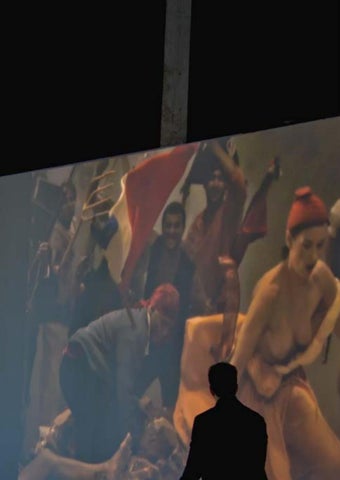
Obviously, nobody could be pleased that the tragic death of the classical iconographic figure for Liberty might become the representation of our era, but the piece was obviously inspired by its times, also referred to as the New Apocalypse. The 2008 crisis was not only economic in nature, but also about values. The humanistic goals of the Enlightenment are now in mutation, or have simply fallen into disuse. We are showing disdain for the basic foundations of the society created in that era and replacing it with an unfettered market economy. Liberty (in all but its economic forms) proves awkward; it perishes to give life to its sinister body-double, which has triumphantly been named neoliberalism. The most popular media outlets have foisted upon us an explanation of how the lexicon of macroeconomic machinery works, in the style of a new social programming tool. We have been exposed to formerly unheard of concepts such as the “market risk premium” (trustworthiness) “subprime” (uncertainty), “real estate bubble” (speculation), etc. The resulting exercise in collective linguistic abstraction affects our lives in a very tangible and personal way. In the work Philosophical Capitalism (2014), I subvert this exercise. Concepts such as art, beauty, truth, fear, justice, death, space, citizenship, time, life and pain, traditional concerns amongst contemporary Westerners, are formalised, specified and, ultimately, commercialised through companies which, as they all do, seek an economic profit. To represent this, the work consisted of selecting five to ten companies for each of the leitmotivs, each of which gets its own chapter. For example, in the chapter on beauty, interviews were requested with companies in that field, including several modelling agencies, a cosmetic doctor, a plastic surgeon, a luxury car company… We asked them to have someone they considered to be a representative speaker of their company answer our questions. This normally turned out to be the company’s director. They were told the interview would form part of an artwork, that their logo and
12
page 34
Cristina Lucas
website would appear visibly in the interview and that the interview would consist of an informal conversation about the type of work they do. One of the direct questions was to define the concept being examined, in this case beauty. It is precisely this part of the interview, in which these individuals reflect upon a purely philosophical topic, that is of interest to us. What appears in the work, along with all the other definitions offered by the various participants from the same economic sector, is a sort of corporate maieutics. The sum of these responses is helpful in trying to understand what it is they actually sell and what it is we are actually buying, in other words how our need to have an abstract imaginary has always been mediated by an economic transaction and in what way its existence is popularly enmeshed in a consumer-buyer relationship. The truth is that there are as many different definitions as there are companies. We have stumbled upon truth understood as a sum of materially extant contexts, a sum which is impossible to comprehend. It is at this point where viewers must formulate their own idea and concept, because none of the versions offered can any longer be extricated from its relationship with the economy, which is now distanced from morality. informal colors Boris Groys, in the chapter titled “Weak Universalism� from his book Going Public, talks about the advent of the Russian avantgarde movements and the radical destruction of artistic tradition at the hands of progress. Early twentieth-century Russian society was subjected to a new political/economic order of such a magnitude that all order existing prior to the Bolshevik Revolution vanished completely, including art. Groys explains that the vanguardists asked themselves how they could overcome this difficult juncture, how they could become trans-historical, constant change being the only reality. He upholds that these artists attempted to do so by
13
Aesthetic Transactions
reducing cultural symbols to a minimum. In that way they could span across fashions and trends. Therefore, from then on, they began to produce images that appeared so empty and succinct that they could survive any historical catastrophe. In 1911, Kandinsky published On the Spiritual in Art, in which he speaks about the reduction of all pictorial mimesis, all representation of the world, “reduction which reveals that all paintings are really revelations of colours and forms.” He wants to ensure the survival of his view of painting through every possible cultural transformation in the future, including the most revolutionary. […] The world that painting represents may disappear, but not its combination of colours and forms. Kandinsky did not wish to use his own style, but rather to use his painting to educate the viewers’ way of seeing, an education that would allow them to perceive all of the invariable components in all artistic variations.1
However, this initial link to the revolution soon disappeared. Kandinsky did not stay in the Soviet Union, and in Germany he published Point and Line to Plane in 1926 while teaching at the Bauhaus. Our current political and economic order is overwhelmed by an endless number of links, networks, excess information, colours, forms… and no longer just those involved in art, as Kandinsky explained: consumption is also expressed in aesthetic terms through advertising, using all imaginable media for distribution. Nor should we forget that companies, corporations, institutions, political parties and entities in general have always walked hand-in-hand with the brands and logos that highlight their own character, in something that resembles a key to identity revealing the deep virtues or intentions of the organisation which they represent. Since the Bauhaus era, such studies were immediately taken over by the advertising design industry, and the great designers, publicists and neuroscientists have performed in-depth studies of how we truly react to certain colours and forms. Kandinsky himself, on the
14
1. Boris Groys, “El universalismo débil”, Volverse público. Transformaciones del arte en el ágora contemporánea, Buenos Aires, Caja Negra, 2014, p. 109 [English translation: “Weak Universalism,” Going Public, Berlin, Sternberg Press, 2010].
Cristina Lucas
first page of his book, warns that “the questions which I have posed concerning the beginning of the Science of Art […] pass beyond the boundaries of painting, and finally of art altogether.”2 Whether or not it is true that the rays cast by certain light waves onto optical nerve receptors have an effect on our emotions, it is certain that the chromatic message has been theorised and researched since the times of Newton and Goethe, while many more continue attempting to do so. Wittgenstein, in his last work written before dying, Remarks on Colour, talks about colour as a language and explains that it is colour’s use which gives it meaning. For instance, red is known to symbolise blood and passion; perhaps that is why it represents the Communist workers’ struggle, though of course it also represents Coca-Cola, Vodafone, Pinterest and many other brands. All we know about the colour red is that it is an indefinite sum of nuances. Red is no longer an entity in and of itself, but instead all of these meaningful layers at once. The activity in the series Monochromes (2016) and Figures (2017) is oriented towards analysing and classifying a language of colours and forms which I have taken from everyday life, capturing all of the many logos that would leap out before my eyes, with the end goal of sticking them inside a display case and offering them up to viewers. At heart, these are new revisions of the codes used to decipher the aesthetic elements all around us, with which we engage in dialogue on a daily basis: any product that we use, plus any product that we see in the streets… In addition to this, of course, our dialogue, our relationship, is also created in the digital realm, through the Internet and its search logarithms on Google, Bing and Yahoo. The sum of all accessible contexts in which this search appears is added to the expanded, re-constructed idea of colour making up the surface of the “canvas,” with hundreds of brush strokes taken from the spectrum of our reality, like a vital contemporary agora. These are countless, though finite, as they are not simply made up. They originate in our reality, which is why they lead us towards the
15
2. Wassily Kandinsky, “Advertencia”, Punto y línea sobre el plano. Contribución al análisis de los elementos pictóricos, Barcelona, Paidós, 2012, p.13 [English translation: “Foreword,” Point and Line to Plane, Dover, Dover Publications, 1980].
pages 38, 44
Aesthetic Transactions
true meaning of colour and form which we might offer today to the contemporary subject. Classification by colours and forms provides a little bit of order in the midst of this immense jungle of data. In fact, just as the different species of animals each has a different way of adapting to the environment and is not the result of chance but instead of natural selection, the logos in campaigns, designed by advertisers and marketing experts, are created in response to an efficiency that relates with emotions intended for consumption and the survival of corporations and companies. Each colour and shape has been assigned a set of attitudes and adjectives taken from different contexts which have gradually developed over time, having been inherited from philosophy (Goethe, Theory of Colour; Wittgenstein, Remarks on Colour), art (Kandinsky, Point and Line to Plane), sociology (Eva Heller, Psychology of Colour) and advertising (Luc Dupont, 1001 Advertising Tips), thereby contributing to their symbolic capital. marxist fetish “There is a definite social relation between men, that assumes, in their eyes, the fantastic form of a relation between things. In order, therefore, to find an analogy, we must have recourse to the mist-enveloped regions of the religious world. In that world, the productions of the human brain appear as independent beings endowed with life, and entering into relation both with one another and the human race. So it is in the world of commodities with the products of men’s hands. This I call the Fetishism which attaches itself to the products of labour, so soon as they are produced as commodities, and which is therefore inseparable from the production of commodities.”3 We are not attempting to perform a re-examination of these passages, as they are already very well-known. Suffice it here to suggest a few critical points: a) Above all after the intervention of Georg Lukács, the lineage of Marxist fetish has had a tendency to regard this “analogy” as an epistemological description. Accepting Marxian irony about “the suprasensitive thing” as right, Lukács defines a whole channel of Western
16
Cristina Lucas
critical thought by inferring from this analysis the idea that the capitalist economy produces a “reified consciousness,” in which Kant’s categories of time and space, or in other words the conditions for the possibility of experience, are gradually fragmented and subjected to a rational order, which results in the correlation between an “objectivity” and a series of “forms of subjectivity” in capitalist society. Commodities, in the analysis by Lukács, become “the universal category of all social beings,” and the world is transformed into a uniform field of alienated domination of “things” over human beings, the main subjective modality of which is “contemplation”4 of a world foreign to the relationship between desire, will, consciousness and experience. Subject to a reified, fragmented structure of experience and —in line with Weber— gradually subjected to a structure of calculation and abstraction, Lukács argues that “the subject’s behaviour grows ever more contemplative in the philosophical sense.”5
From a very early age, Karl Marx was a hero who decided to change the world, and not just think about it. This is why he leaves nobody indifferent. At some point, the entire world was divided into Marxists and anti-Marxists, and the consequences of his thought are still alive today in the twenty-first century, though they came from the 1800’s. He put down all of his writings using a quill and ink, so we must ask ourselves: where are the manuscripts that Marx produced for the publication of Capital? Who safeguards them? And how much would these manuscripts be worth today? I decided to give the name Surplus Value (2014–16) to the work in which I researched this. It consists of a video installation that tells the story of the odyssey of these papers. Appearing in the video are Marx’s actual writings, and in the installation there is a replica of the manuscripts. It is exciting to see the ink-scrawled drafts covered in coffee stains, words crossed out, notes in the margins. Studying them, you can almost hear the sound of his pen sliding across the 3. Karl Marx, El capital, Book One, T. I, Vol. I, Buenos Aires, Siglo XXI, (1975) 2005, p. 89 [English translation: Capital: A Critique of Political Economy, v. 1, London, Penguin Classics, 1990]. 4. Georg Lukács, “La cosificación y la conciencia del proletariado,” Historia y conciencia de clase, t. II, Madrid, Sarpe, 1984, pp. 7-11 [English translation: History and Class Consciousness: Studies in Marxist Dialectics, London, MIT Press, 1971].
17
5. Cuauhtémoc Medina and Mariana Botey, “En defensa del fetiche” (“In Defence of Fetish”), El espectro rojo, Madrid, CA2M, May 2010.
page 46
Aesthetic Transactions
paper, because it possesses “the products of the human hand.” It is no surprise that these are some of the most frequently studied manuscripts in history. For decades, experts from around the world have gone on pilgrimages to the iisg, or Internationaal Instituut voor Sociale Geschiedenis (International Institute of Social History) in Amsterdam to study them and reveal any truths which have yet to be found inside some hidden fold in the pages. The documents are displayed with a video narrated by Marien van der Heijden. It tells the story of the manuscripts in full detail, from their creation to their bequeathal and arrival at the iisg, as well as the sums people were willing to pay for them. The video ends with statements by the senior director of Sotheby’s in London, Andrea Jungmann, who reveals the market value of these manuscripts at the present time. To determine this, they are “objectively” appraised by the institution most qualified to do so, and the fetish is truly subjected to a structure of calculations and abstraction performed by the world’s most famous auction house. Thus we happen to witness one of history’s most unexpected reversals of fortune, as the manuscripts which theorise upon this fetish end up subjected to that very process, when Capital is appraised for sale. gold! Gold ceased to be used as a hard currency after the Bretton Woods Agreement reached in 1944, until its convertibility into gold coin was permanently discontinued in 1971. The world changed transcendentally as of that moment, because money was turned into a form of credit based solely on itself and is nothing more than a reflection of itself. The place where it is housed continues to be a mysterious, sacred site where the god of metals once dwelled. The treatment of this space and its sparkling ingots is the photographic motif for
18
pages 10, 22
Cristina Lucas
the series on these treasure chambers including the photos I have managed to amass in Spain and Holland. The documentation of this impenetrable, idealised place becomes a matter of State: it is no longer shown in an economic sense, but instead is displayed aesthetically, revealing the nature of its essence in relation to the sacred metal. The series is not complete, because additions will continue as more secure vaults are visited, which will reveal not the number of bars kept on their shelves (information of little importance) but the nature of the temple which stores gold within. Despite its abandonment in macroeconomic terms, the truth is that the world’s attraction to gold has always been obsessive. Even Newton spent some time devoted to alchemy, and until today gold has remained one of the most active commodities traded in the securities market. Its value in financial markets is reported in real time, even though it is not the most expensive of the elements that make up our world. new order Our world is made up of elements generated from the second generation of stars, which is why our Earth’s crust contains elements from atomic number 1, hydrogen, to number 92, plutonium; gold’s atomic number is 79. More complex elements than plutonium do not exist in a natural form on our planet, though they can be created in the laboratory. Of all the scientists of his time, Mendeleev saw clearly how to organise the complexity of these elements, and his famous periodic table heralded the nineteenth-century birth of modern chemistry. Today the stock market rules our world. This is a new order created through the laws of supply and demand. Based on this, a piece titled Elemental Order (2016) was produced for the exhibition Trading Transcendence at Mudam Luxembourg. It positions the ninety-two elements on the periodic table found
19
page 106
Aesthetic Transactions
in natural form on our planet, but does so by ordering them according to their market value, which is shown on an led screen with all units translated into euros/kilo. To calculate the values of the elements traded in the market, we relied on the assistance of metal trader Carlos GraĂąa. Through his mediation, we were also given assistance from metalprices.com and the London Metal Exchange. For those elements not traded in markets, Mari Cruz CastaĂąeda, a mining engineer from the Universidad PolitĂŠcnica in Madrid, collaborated with me, obtaining market prices from reputable suppliers in the international market. The led screen is updated in real time through a live connection with the websites of all the companies that have allowed us to use their current market price data. Thus, the system is updated every thirty seconds, because it must also take into account the conversion of different currencies into euros. The official status of these sources is fundamental to the project, which is why all of the sources scroll across the upper part of the screen along with the date and time. The constant updating of these figures turns the screen into a living ensemble, because the elements are positioned unpredictably, and the order varies as a result of its own trade-based nature. Those elements whose prices rise are displayed in green, and those whose market value drops are shown in red, while those that remain steady stay orange. The two most expensive elements in the world are rubidium and caesium, which fight for the first and second rankings, followed at a distance by promethium and osmium, all of which are used in high-tech industries. The value of highly cherished gold fluctuates regularly, but its ranking in the market has remained more or less constant at sixth. There is also a section containing six elements with no commercial value: because they are radioactive, industry has not yet learned to deal with them.
20
Cristina Lucas
stockpiles The photographic series Mountains (2012–) is an ongoing project, as well. It consists of taking photographs of large stockpiles of raw materials used in industry. These stockpiles, selected for their practical uses, show us how the form of a mountain, with workers appearing at its side, not only reveals their scale and cyclopean size, but also reminds us of the vision of the German Romantics, who established the connection between man, mountain and contemplation as a commonplace element of contemporary existence. The first mountain in the series is made of salt, which, besides holding religious meaning, has also historically been considered “the first currency”. Also depicted are mountains of coal, clay, cement, waste, marble…, each the epitome of a specific moment in the planet’s economic history. Now more than ever, we can observe that our new relationship with nature necessarily means exploiting it. These stockpiles are the settings for our new unsustainable economic landscape. ◊◊◊
21
pages 79, 85, 86, 94