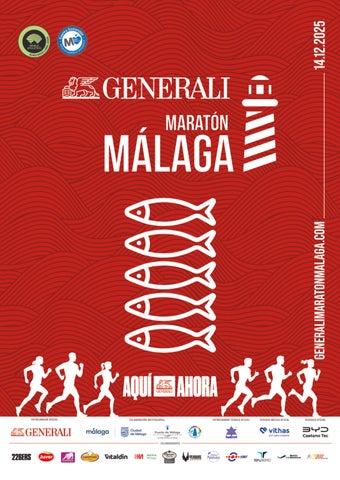
Málaga os saluda Malaga welcomes you Nuestra ciudad vuelve a convertirse en epicentro del deporte el próximo domingo 14 de diciembre con la celebración de una nueva edición del Generali Maratón de Málaga. Una cita que la afición al running afronta con ilusión, ya sea en los 21,097 kilómetros de la media o en los 42,195 de la maratón completa. La prueba continúa creciendo y este año vuelve a batir registros con más de 22.000 corredores, distribuidos prácticamente al 50% entre ambas distancias. Además, hay un dato que habla por sí solo de la proyección internacional de Málaga, pues el 63% de los participantes procede del extranjero, representando a más de 77 nacionalidades. Es una diversidad que nos honra y que convierte este evento deportivo en un auténtico escaparate de nuestra ciudad. La 15ª edición llega también con mejoras destacadas en el recorrido. Un trazado más llano, sin bucles, pensado para favorecer el ritmo de los corredores y, al mismo tiempo, mantener el paso por algunos de los rincones más bellos y emblemáticos de Málaga. Además, la señal televisiva internacional, producida por Athletics TV, llevará la carrera a toda Europa y buena parte de América, con retransmisión en español e inglés para acercarla a un público cada vez más amplio. A todos los participantes, quiero transmitiros mi deseo de que disfrutéis de cada kilómetro en el Generali Maratón de Málaga. Mucha fuerza, ánimo y reconocimiento por un esfuerzo que siempre merece un final a la altura. Finalizo recordando que el deporte no sólo es competición, es salud, es vida y es una manera de entender la ciudad que queremos, más activa, más abierta y más humana.
Once again our city will become the epicentre of sport on Sunday 14th of December with the new edition of the Generali Malaga Marathon. An event that running enthusiasts eagerly await, whether for the 21.097 kilometres of the half marathon or the 42.195 kilometres of the full marathon. The event keeps growing and this year it is going to break a new record with more than 22,000 runners, distributed almost equally between the two distances. In addition, there is one fact that speaks for itself about Malaga’s international profile: 63% of the participants come from abroad, representing more than 77 nationalities. This diversity makes us proud and makes this sporting event a true showcase for our city. The 15th edition also comes with notable improvements to the course. A flatter circuit, without loops, designed to favour the runners’ pace and, at the same time, maintain the route through some of the most beautiful and emblematic corners of Malaga. Moreover, the international TV broadcasting, produced by Athletics TV, will bring the race to the whole of Europe and much of America, with coverage in both Spanish and English to reach an ever-wider audience. To all the participants, I would like to convey my wish that you enjoy every kilometre of the Generali Malaga Marathon. Stay strong, keep your spirits up and you will get the recognition that your effort deserves with a fitting finish. I would like to conclude by reminding you that sport is not just about competition, it is also about health, it is about life, and it is a way of understanding the city we want: a more active, more open and more humane city.
Francisco de la Torre Alcalde de Málaga
Francisco de la Torre Mayor of Malaga
3
Reglamento_ Regulations_ REGLAMENTO 42K / 42K REGULATIONS https://www.generalimaratonmalaga.com/reglamento-maraton-malaga/
REGLAMENTO 21K / 21 K REGULATIONS https://www.generalimaratonmalaga.com/reglamento_media_maraton_malaga/
4
5
Información básica_ · DÍA: 14 DE DICIEMBRE DE 2025. · HORA DE SALIDA (MARATÓN Y MEDIO MARATÓN): 8:30H
· LUGAR DE SALIDA Y META: PASEO DEL PARQUE, FRENTE AL AYUNTAMIENTO DE MÁLAGA. LA META DEL MEDIO MARATÓN ESTARÁ UBICADA EN LA AVENIDA CÁNOVAS DEL CASTILLO. · TIEMPO MÁXIMO: 5H30 (MARATÓN) Y 2H45 (MEDIO MARATÓN). · AVITUALLAMIENTOS: AGUA E ISOTÓNICO CADA 5 KILÓMETROS. SÓLIDO EN ALGUNOS PUNTOS DE AVITUALLAMIENTO A PARTIR DEL KILÓMETRO 20.
· GUARDARROPA: LA ORGANIZACIÓN DISPONDRÁ DE UN SERVICIO DE GUARDARROPA. EL DEL MARATÓN SE UBICARÁ EN LA EXPLANADA DEL POMPIDOU Y EL DEL MEDIO MARATÓN ESTARÁ EN LA PLAZA DE TOROS. · HORARIO FERIA DE LA CARRERA (RECOGIDA DE DORSALES): VIERNES 12 DE DICIEMBRE DE 10:00 A 20:00 HORAS. SÁBADO 13 DE DICIEMBRE DE 10:00 A 20:00 HORAS.
· SALIDA POR OLEADAS: HORA
TIEMPO OBJETIVO 42K
TIEMPO OBJETIVO 21K
PRIMERA
8:30H
DE ÉLITE A 3H00/3H15
DE ÉLITE A 1H15/1h30
SEGUNDA
8:35H
DE 3h15/3h30 A 3h45/4h00
DE 1H30 A 1H45
TERCERA
8:45H
DE 4H00/4H15 A 5H15/5H30
DE 1H45/2H00 A 2H15/2H30
OLEADA
6
· LIEBRES: MARATÓN
MEDIO MARATÓN
3h00 3h15 3h30 3h45 4h00 4h15 4h30
1h30 1h38 1h45 1h53 2h00 2h08 2h15
Basic information_
· DATE: 14TH OF DECEMBER 2025. · STARTING TIME (MARATHON AND HALF MARATHON): 8:30 A.M.
· BAGGAGE DROP:
· START AND FINISH LOCATION:
PASEO DEL PARQUE, IN FRONT OF MALAGA CITY COUNCIL. THE HALF MARATHON FINISH LINE WILL BE LOCATED ON CÁNOVAS DEL CASTILLO AVENUE.
· MAXIMUM ALLOWED TIME:
5 HOURS 30 MINUTES (MARATHON) AND 2 HOURS 45 MINUTES (HALF MARATHON).
· DRINKS STATIONS:
WATER AND ISOTONIC DRINKS EVERY 5 KILOMETRES. SOLID FOOD AT SOME DRINKS STATIONS FROM KILOMETRE 20 ONWARDS.
· START WAVE:
· TIMETABLE FOR THE RACE EXPO (BIB NUMBER COLLECTION): FRIDAY 12TH DECEMBER FROM 10:00 TO 20:00. SATURDAY 13TH DECEMBER FROM 10:00 TO 20:00.
· PACERS:
TIME
TIME GOAL 42K
TIME GOAL 21K
FIRST
8:30H
FROM ELITE TO 3H00/3H15
FROM ELITE TO 1H15/1h30
SECOND
8:35H
FROM 3h15/3h30 TO 3h45/4h00
FROM 1H30 TO 1H45
THIRD
8:45H
FROM 4H00/4H15 TO 5H15/5H30
FROM 1H45/2H00 TO 2H15/2H30
WAVE
THE ORGANISERS WILL PROVIDE A BAGGAGE DROP SERVICE. THE MARATHON BAGGAGE DROP WILL BE LOCATED ON THE ESPLANADE OF THE POMPIDOU AND THE HALF MARATHON BAGGAGE DROP WILL BE IN THE BULLRING.
MARATHON
HALF MARATHON
3h00 3h15 3h30 3h45 4h00 4h15 4h30
1h30 1h38 1h45 1h53 2h00 2h08 2h15
7
VER RECORRIDOS: SEE ROUTES:
Más llano, más lineal, más rápido_ Flatter, straighter, faster El recorrido del Generali Maratón de Málaga se modifica para ser más rápido, lineal y cómodo para todos los participantes. The course of the Generali Malaga Marathon has been modified to make it faster, straighter and more comfortable for all participants. Otra de las grandes claves de esta edición es la adaptación del recorrido al récord de participación. Con miles de corredores preparados para tomar las calles, la organización ha rediseñado el circuito con el fin de garantizar la máxima comodidad y una fluidez constante desde los primeros metros. Este planteamiento busca reducir aglomeraciones, permitir un ritmo más estable y, al mismo tiempo, minimizar el impacto en el funcionamiento diario de la ciudad. Las modificaciones responden a un análisis profundo de los puntos más sensibles del trazado anterior. Se han eliminado giros innecesarios, estrechamientos y tramos que podían generar cuellos de botella, apostando ahora por un recorrido mucho más lineal y llano. El resultado será una experiencia más limpia y dinámica para todos los participantes, tanto para quienes buscan mejorar sus marcas como para quienes simplemente desean disfrutar de Málaga de una forma diferente. El cambio más destacado llega en el tramo final, completamente renovado con el objetivo de hacerlo más rápido y accesible. Desaparecen algunas de las zonas tradicionalmente más duras y se introduce un cierre más recto y fluido, pensado para que los corredores puedan mantener el ritmo y rematar la prueba con sensaciones óptimas. Todo ello convierte a esta edición en la más propicia para volar sobre el asfalto malagueño. Aun con los ajustes, la vistosidad del circuito se mantiene intacta. Los participantes seguirán disfrutando de puntos icónicos como La Malagueta, La Farola, el centro histórico y el ya mítico paso del kilómetro 41 por la Calle Larios, que lucirá una vez más sus espectaculares luces navideñas para recibir a los corredores en la recta final.
8
Another key feature of this year’s event is the adaptation of the route to accommodate record participation. With thousands of runners ready to take to the streets, the organisers have redesigned the circuit to ensure maximum comfort and a constant flow from the start. This approach aims to reduce the formation of crowds, allowing a more stable pace and, at the same time, minimise the impact on the day-to-day of the city. The modifications are the result of an in-depth analysis of the most sensitive points of the previous route. Unnecessary turns, narrow streets and sections that could cause bottlenecks have been eliminated, with the focus now on a much more linear and flat route. The result will be a simpler and more dynamic experience for all participants, both for those looking to improve their times and for those who simply want to enjoy Malaga in a different way. The most notable change comes in the final section, which has been completely redesigned to make it faster and more accessible. Some of the traditionally toughest areas have been removed and a straighter finish has been introduced, designed to allow runners to maintain their pace and finish the race with a great feeling. All of these changes make this edition the ideal time to fly over the asphalt of Malaga. Even with the aforementioned adjustments, the circuit’s visual appeal remains intact. Participants will continue to enjoy iconic spots such as La Malagueta, La Farola, the historical centre and the now legendary 41-kilometre mark on Larios Street, which, once again, will display spectacular Christmas lights to welcome the runners in the final stretch.
Más rápido, más internacional, más festivo_ Faster, more international, more festive_ El Generali Maratón de Málaga 2025 se prepara para vivir su edición más ambiciosa y multitudinaria. Confirmado ya el récord histórico de participación, con más de 22.000 corredores inscritos entre las dos distancias, esta cifra no solo consolida el evento como uno de los grandes referentes del calendario nacional, sino que lo posiciona firmemente en el panorama internacional.
10
The Generali Malaga Marathon 2025 is preparing for its most ambitious and popular edition yet. With a record number of participants already confirmed, more than 22,000 runners registered for the two distances, this figure not only consolidates the event as one of the major highlights of the national calendar, but it also firmly positions this marathon on the international scene.
· Nuevo circuito: más rápido, más plano y más espectacular
· New course: faster, flatter and more spectacular
Entre las grandes novedades de este año destaca el estreno de un recorrido completamente renovado, más plano y rápido, diseñado para favorecer las mejores marcas tanto de corredores populares como de atletas de élite. Además, el circuito elimina los tradicionales bucles, lo que permitirá una experiencia más fluida y cómoda para los participantes. Pese a la reconfiguración, el trazado mantiene el atractivo visual que caracteriza al evento: transcurre por varios de los espacios más emblemáticos de Málaga, integrando deporte y ciudad en una misma experiencia.
Among the main new features this year, it is worth highlighting the debut of a completely redesigned, flatter and faster course, designed to achieve the best times for both amateur runners and elite athletes. Besides, the traditional loops have been removed, allowing for a smoother and more comfortable experience for participants. Despite the changes, the route retains the visual appeal that characterises the event: it goes through several of Malaga’s most emblematic areas, integrating sport and city into a single experience.
·U n salto internacional: señal televisiva global El 2025 supondrá también un salto cualitativo en la proyección internacional de la prueba. Por primera vez, el maratón contará con señal de televisión distribuida a cadenas y plataformas de Europa, América y otras regiones, incluyendo Athletics TV. La retransmisión se ofrecerá en inglés y castellano, con una gran cobertura audiovisual que permitirá seguir la carrera desde múltiples ángulos y para un público global. Además el evento reunirá participantes de 77 países, con un notable 63% de presencia extranjera, confirmando el atractivo global de Málaga como destino deportivo y turístico.
· An international leap: global TV coverage 2025 will also mark a qualitative leap in the international profile of the event. For the first time, the marathon will be broadcasted on channels and platforms in Europe, America and other regions, including Athletics TV. The broadcast will be available in English and Spanish, with extensive audiovisual coverage, allowing the race to be followed from multiple angles and by a global audience. Moreover, the event will bring together participants from 77 countries, with a remarkable 63% foreign participation, confirming Malaga’s global appeal as a sporting and tourist destination.
· Medal Party: un final de fiesta para los finishers
· Medal Party: a party finale for finishers
Los finishers del maratón podrán celebrar su logro en la Medal Party, un evento abierto y festivo que tendrá lugar el domingo, de 14:00 a 18:00, en el recinto exterior de la Feria del Corredor. Una cita pensada para relajarse, compartir la experiencia y cerrar la jornada con música y gastronomía.
Marathon finishers will be able to celebrate their achievement at the Medal Party, an open and festive event that will take place on Sunday from 2:00 p.m. to 6:00 p.m. in the outdoor area of the Runner’s Expo. An event designed to relax, to share the experience and to end the day surrounded by music and food.
· Nuevas ubicaciones de servicios para corredores
· New locations for runner services
En el apartado logístico también se introducen mejoras y novedades: - El guardarropa del maratón se ubicará en la Explanada del Pompidou, facilitando accesos y circulación. - El guardarropa de la media maratón se mantendrá, como en ediciones anteriores, en la Plaza de Toros.
In terms of logistics, improvements and new features have also been introduced: - The marathon baggage drop will be located on the Pompidou Esplanade, facilitating access and easing the traffic. - The half marathon baggage drop will remain, as in previous editions, in Malaga’s bullring.
11
Fiesta de jueves a domingo_ Party from Thursday to Sunday_ El festival ‘You Rock Málaga’, el Brunch Run, la Kids Race y la nueva Medal Party serán algunas de las actividades desde el jueves y hasta el domingo. The “You Rock Malaga” festival, the Brunch Run, the Kids Race and the new Medal Party will be some of the activities taking place from Thursday to Sunday.
12
Brunch Run y Kids Race
Brunch Run and Kids Race
El día previo al maratón tienes una cita con la carrera de 5 kilómetros y la carrera para menores. Como cada año desde la edición celebrada en 2017, el Generali Maratón de Málaga contará con una intensa jornada previa al maratón. Todos los aficionados al running podrán disfrutar de un Brunch Run de casi 5 kilómetros y los más pequeños harán lo propio en pruebas para menores organizadas en la Carrera de las Familias. Será el sábado 13 de diciembre a las 12:00h en el entorno del Puerto de Málaga cuando se dé la salida de este Brunch Run, una prueba que se plantea como un entrenamiento previo al gran reto. Las inscripciones, que incluyen una camiseta de la prueba tanto en el Brunch Run como en las carreras infantiles, están disponibles a través de los códigos QR que puedes ver en esta página o en la feria del corredor durante la jornada del viernes 12 de diciembre.
The day before the marathon, you can join the 5-kilometre race and a race for children. As every year since the 2017 edition, the Generali Malaga Marathon will have an intense day leading up to the marathon. All running enthusiasts can enjoy a Brunch Run of almost 5 kilometres, and the younger ones can do the same in races organised as part of the Family Race. The Brunch Run will take place on Saturday 13th of December at noon in the area around the Port of Malaga. This event is intended as a training session for the big challenge ahead. Registration, which includes a race T-shirt for both the Brunch Run and the Kids race, is available on the following QR codes on this page or at the Race Expo on Friday 12th of December.
You Rock Málaga
You Rock Malaga
El Generali Maratón Málaga es mucho más que una carrera. Con ‘You Rock Málaga’, que este año se expande para convertirse en un auténtico festival deportivo y musical de cuatro días, la organización de la prueba quiere ofrecer un mayor atractivo a todos los participantes y sus acompañantes. Desde el jueves (un día antes de la apertura de la feria de la carrera) y hasta el domingo, corredores, visitantes y habitantes de la ciudad podrán disfrutar de bandas en directo, sesiones de DJ, animación y un ambiente que fusiona deporte, entretenimiento y gastronomía, pues este año se suma al festival ‘The Burger Cup’, el campeonato de burgers más salvaje de España. Todo ello en el entorno del Puerto de Málaga, junto a la Terminal de Cruceros donde se realiza la feria de la carrera.
The Generali Malaga Marathon is much more than just a race. With “You Rock Malaga”, which this year is expanding to become a four-day sports and music festival, the race organisers want to make it even more attractive to all participants and their companions. From Thursday (the day before the Race Expo opens) until Sunday, runners, visitors and city residents will be able to enjoy live bands, DJ sessions, entertainment and an atmosphere that combines sport, entertainment and gastronomy, as this year’s festival will also feature “The Burger Cup”, Spain’s wildest burger championship. All these events will take place in the area around the Port of Malaga, next to the Cruise Terminal, where the Race Expo is held.
Medal Party
Medal Party
La gran novedad de esta edición 2025 será la Medal Party que se celebrará después del Generali Maratón Málaga. Los finishers del maratón y el medio maratón podrán celebrar su logro en la Medal Party, un evento abierto y festivo que tendrá lugar el domingo, de 14:00 a 18:00, en el recinto exterior de la Feria del Corredor. Una cita pensada para relajarse, compartir la experiencia y cerrar la jornada con música y gastronomía.
The big news for the 2025 edition will be the Medal Party to be held after the Generali Malaga Marathon. Finishers of the marathon and half marathon will be able to celebrate their achievement at the Medal Party, an open and festive event that will take place on Sunday from 2:00 p.m. to 6:00 p.m. in the outdoor area of the Race Expo. An event designed to relax, to share the experience and to end the day surrounded by music and food.
13
¿Cuándo hay que tomar los geles en un maratón? Esta es una cuestión fundamental que ronda cada vez más la cabeza de los corredores, incluso de los más experimentados. El objetivo es rendir mejor y tener claro dónde tomar los geles, porque este hecho puede condicionar para bien o para mal el rendimiento y resistencia en una prueba como el Generali Maratón de Málaga. La tecnología también está presente en el mundo de la nutrición, aportando productos más limpios, sin gluten ni GMO y de rápida absorción, con carbohidratos de última generación como la Ciclodextrina, que no dañan el estómago y dejan de ser un problema a la hora de enfrentarse a un maratón. Aún así, hay que planear bien cuántos vas a
llevar y consumir y dónde, ya no solo por el tiempo que llevas en carrera, sino por la orografía del recorrido. Es fundamental tener una buena estrategia. Hay una regla no escrita que dice que deberías tomar un gel por cada hora de carrera, y esto no está mal como orientación, pero no todos los geles tienen la misma cantidad de carbohidratos ni todos los corredores necesitan la misma cantidad por hora al tener una constitución y masa corporal diferente. Recientes pruebas en el ciclismo profesional han comprobado que los deportistas de élite pueden llegar a tomar hasta 100 gramos de carbohidrato
14 SI QUIERES SABER MÁS, ABRE ESTE CÓDIGO QR Y ESCUCHA ESTE PÓDCAST.
por hora, algo impensable hace unos años, pero lo normal es que el cuerpo de un corredor tolere entre 50 y 80 gramos por hora. Y esto ya sería más que suficiente. Por ejemplo, un corredor de unos 75 kg puede quemar unas 70 kilocalorías por kilómetro (si no hace frío), y si pretende correr un maratón en 3:30 podría quemar unas 3000 kilocalorías o más. El cuerpo almacena unas 2000 kilocalorías de glucógeno entre el hígado y musculatura, y con esto llegas solo hasta ‹el muro›, alrededor del kilómetro 32 del maratón, dependiendo de cada individuo. Te faltan 10 kilómetros hasta llegar a meta y no puedes esperar a ese punto para reponer los hidratos necesarios que se tienen que descomponer en el metabolismo para convertirse en glucógeno y que esa energía se transforme en movimiento en el músculo. Hay que adelantarse y empezar a reponer pronto para evitar que salte la alerta de «deposito en reserva», como en tu coche.
When should you take gels during a marathon? Gels are necessary in marathons such as Malaga’s, even if your goal is not ambitious. Glycogen gets depleted and it must be replenished. This is a fundamental question that is increasingly on the minds of even the most experienced runners. The objective is to perform better and to be clear about when to take gels, because this decision can have a positive or negative impact on performance and endurance in a race like the Generali Malaga Marathon. Technology is also present in the world of nutrition, providing cleaner, gluten-free, GMO-free and rapidly absorbed products with stateof-the-art carbohydrates such as Cyclodextrin, which do not harm the stomach and are no longer a problem
when running a marathon. Even so, you have to plan well how many you are going to have on you and also how many and where you will consume them. It is essential to have a good strategy. You need to have in mind how long you are going to run for and also the course. There is an unwritten rule that says you should take one gel for every hour of running. This is not a bad guideline, but not all gels have the same amount of carbohydrates, nor do all runners need the same amount per hour as there are different body types. Recent tests in professional cycling have shown that elite athletes can consume up to 100 grams of carbohydrates per hour, something unthinkable a few years ago. However, an average runner’s body can tolerate between 50 and 80 grams per hour. And this should be more than enough.
For example, a runner with a weight of around 75 kg can burn around 70 kilocalories per kilometre (if it is not cold). If the aim is to run a marathon in 3:30, he/she could burn around 3000 kilocalories or more. The body stores around 2,000 kilocalories of glycogen in the liver and muscles, and this will only get you to “the wall”, around kilometre 32 of the marathon, depending on the person. You still have 10 kilometres to go to reach the finish line, and you cannot wait until then to replenish the necessary carbohydrates that still have to be processed by your metabolism to turn them into glycogen and for that energy to be transformed into movement in your muscles. You have to get ahead of the game and start replenishing early to avoid triggering the “reserve tank” warning, just like in your car.
15 IF YOU WANT TO KNOW MORE, SCAN THIS QR CODE AND LISTEN TO THIS PODCAST.
AQUÍ AHORA E Y U R ST N CO E S O R U T FU EL . A OR H A AQUÍ Y Ahora, miles de personas están apostando por su sueño y otras muchas por una nueva vida. Por eso contamos con 10.000 asesores para escucharte, 16 aconsejarte y proteger lo que más te importa.
Protegiendo tu salud: cómo correr evitando lesiones_ Lo más importante a la hora de preparar una prueba exigente como la GENERALI Maratón de Málaga es asegurarnos que llegamos en las mejores condiciones posibles al momento de la salida. Para ello, es clave cuidar nuestra alimentación y planificar el entrenamiento, sin olvidarse de proteger nuestra salud evitando sufrir daños y lesiones. Si te gusta correr, te recomendamos que sigas estos 10 consejos que te permitirán tener lejos el “fantasma” de las lesiones y disfrutar al máximo de carreras y maratones populares como la GENERALI Maratón de Málaga.
10 claves para evitar lesiones corriendo No corras todos los días Ni los profesionales lo hacen. Por ejemplo, para preparar carreras de 10 kilómetros, 3 días de running a la semana y siempre alternos (4 si ya tienes un nivel alto) son suficientes. El descanso es tan importante, tanto para asimilar el entrenamiento como para prevenir lesiones, que se le llama “el entrenamiento invisible”. Si los días que no corres, necesitas actividad física para sentirte bien, puedes nadar, montar en bici, patinar, gimnasio…otras actividades que además complementan el running y te permiten tener a punto otros puntos de tu musculatura que no trabajas cuando corres. Vigila la intensidad Sesiones de gran intensidad en corredores con poca experiencia y sin una base importante de kilómetros y semanas de entrenamiento, llevan directamente a la lesión. Si eres principiante, nada de correr más de una hora ni de hacer series.
Protect Your Health: How to Run Injury-Free_ Usa zapatillas con mucha amortiguación No te dejes llevar por los colores o por la ligereza a la hora de elegir tu calzado. Acude a una tienda especializada dónde te van a recomendar el modelo que mejor se adapta a tu tipo de pisada (seas pronador, supinador o con pisada neutra). Importante: no uses en exceso las zapatillas. Por fuera pueden parecer que están bien, pero cuando has corrido con ellas más de 750 kilómetros han perdido ya muchas de sus propiedades de amortiguación. Mantén tus músculos a punto Un error habitual del corredor popular es que se engancha al running y sólo piensa ya en correr. Nuestros músculos son nuestros “amortiguadores” y hay que tenerlos siempre a punto. Trabaja la fuerza al menos una vez a la semana Cuanto más fuerte y elástico sea el músculo, menor es el riesgo de lesión ya que va a aguantar mejor las fuerzas de impacto del suelo. El tono muscular es clave también para evitar fracturas por sobrecarga, que pueden ocurrir en el hueso metatarsiano o en el tercio distal de la tibia. Un corredor tiene que trabajar en el gimnasio con poco peso y muchas repeticiones ya que el objetivo no es ganar volumen sino fuerza/potencia.
Intenta entrenar por asfalto lo menos posible Es una superficie en la que el impacto para tus articulaciones y músculos es mucho mayor. Lo ideal es entrenar corriendo en pistas de tierra compactadas como las que encontramos en la mayoría de los parques. Correr en exceso sobre superficies duras puede provocar problemas de periostitis, de fascitis, de rodillas o de talón.
Potencia tu core Unos abdominales tonificados en un seguro anti-lesiones para todo corredor. La debilidad de los músculos centrales provocará oscilaciones en el tronco de adelante hacia atrás y de lado a lado, con el consiguiente desplazamiento del centro de masa del cuerpo, con un mayor riesgo de problemas en la parte baja de la espalda.
Cuidado con los errores en el calentamiento
18
Si se estira demasiado fuerte en frío se pueden producir desgarros musculares. Por prisas o por desidia, se suelen eliminar partes del entrenamiento que sirven para calentar y se empieza a entrenar demasiado, lo que hace fácil sufrir distensiones musculares. Es importante comenzar cada sesión corriendo muy suave 10 minutos para luego hacer unos entrenamientos muy ligeros y con poca tensión. Es muy importante hacer una serie completa de estiramientos al terminar de correr, cuando tenemos el músculo caliente y cuando estos ejercicios nos van a ayudar a recuperarlos ya que se acortan durante la carrera. Los estiramientos son imprescindibles para evitar lesiones y acelerar la recuperación para el siguiente día que salgamos a correr.
Ante el dolor, actúa Es un grave error negar el dolor muscular, articular o tendinoso. Hay que parar con los primeros síntomas. Mejorar para dos días que aguantar el dolor y luego tener que parar dos meses. Corre descalzo Aunque parezca una locura, correr sobre hierba una vez a la semana 500-1.000 metros ayudará a mejorar la flexibilidad de tus tobillos y a fortalecer tus pies. Corriendo descalzo los pies trabajan más en cada impulsión y aterrizaje y así estarán mejor «entrenados».
Preparing for a demanding race like the GENERALI Málaga Marathon means arriving at the starting line in peak condition. To achieve this, it’s essential to maintain a balanced diet, follow a structured training plan, and—most importantly—protect your health by preventing injuries. If you love running, these 10 expert tips will help you keep injuries at bay and enjoy popular races and marathons to the fullest.
10 Essential Tips to Avoid Running Injuries
Choose the Right Shoes
Don’t pick shoes for color or weight. Visit a specialty store to find the best model for your gait (pronator, supinator, or neutral). Replace shoes after about 750 km—even if they look fine—because cushioning deteriorates over time.
Don’t Run Every Day
Even elite runners take rest days. For a 10K race, three alternate running days per week (four if you’re advanced) are enough. Rest is crucial for recovery and injury prevention— often called ‘invisible training.’ On non-running days, try swimming, cycling, skating, or gym workouts to stay active and strengthen muscles that running doesn’t target. Control Your Intensity
High-intensity sessions without a solid training base can lead straight to injury. Beginners should avoid running for more than an hour or doing interval workouts. Limit Asphalt Training
Hard surfaces increase impact on joints and muscles. Whenever possible, run on compact dirt trails, like those in parks. Excessive running on asphalt can cause shin splints, plantar fasciitis, knee pain, or heel issues. Warm Up Properly
Skipping warm-ups or stretching aggressively when cold can cause muscle tears. Start each session with 10 minutes of easy jogging, followed by gentle dynamic exercises. After running, stretch thoroughly while muscles are warm to aid recovery and prevent injuries.
Keep Muscles Strong
Running alone isn’t enough. Muscles act as shock absorbers, so keep them conditioned. Strength Train Weekly
Strong, elastic muscles reduce injury risk and absorb impact better. Strength training also prevents stress fractures in bones like the metatarsals or tibia. Focus on light weights and high repetitions for power, not bulk. Build Core Stability
A strong core prevents excessive trunk movement and reduces strain on the lower back. Core weakness increases injury risk—especially during long runs. Listen to Pain Signals
Ignoring pain is a mistake. Stop at the first signs of discomfort. Resting for two days is better than being sidelined for two months. Try Barefoot Running
Running 500–1,000 meters on grass once a week improves ankle flexibility and strengthens feet. Barefoot running engages foot muscles more during push-off and landing.
INVIERTE EN TU SALUD Vivir de forma saludable es una inversión a largo plazo que tendrá un impacto positivo en el bienestar de la persona. En GENERALI tenemos una gran variedad de Seguros de Salud para que elijas el que mejor se adapte a tus necesidades y cuides de tu salud. Los seguros de Salud de GENERALI ponen a tu alcance la mayor red médica privada del país, con más de 51.000 especialistas y la mejor calidad de servicios sanitarios. Aprovecha nuestro Programa de Bienestar que te da acceso a gimnasios, spas, y sesiones de fisioterapia y otros especialistas sanitarios. Además, con nuestros seguros de Salud te damos acceso al servicio doctor 24 horas, para que puedas resolver todas tus dudas a través de una llamada o videoconferencia. Si no tienes claro cuál es la mejor modalidad para ti, consúltanos sin compromiso y te asesoraremos.
INVEST IN YOUR HEALTH A healthy lifestyle is a long-term investment in your well-being. At GENERALI, we offer a wide range of Health Insurance plans tailored to your needs, giving you access to the country’s largest private medical network with over 51,000 specialists and premium healthcare services. Enjoy our Wellness Program, which includes gyms, spas, physiotherapy, and more. Plus, our 24-hour doctor service lets you resolve doubts via phone or video call. Not sure which plan suits you best? Contact us for personalized advice—no obligation.
19
ESTADIO LA ROSALEDA
CASTILLO DE GIBRALFARO ALCAZABA DE MÁLAGA
PLAZA DE LA CONSTITUCIÓN CATEDRAL DE MÁLAGA
PLAZA
PLAY LA M LA FAROLA DE MÁLAGA
PUERTO DE MÁLAGA
PLAYA DE LA MISERICORDIA
20
PALACIO DEPORTES J.M. MARTÍN CARPENA
ESTADIO ATLETISMO CIUDAD DE MÁLAGA
TERMINAL DE CRUCEROS
PEDREGALEJO
A DE TOROS
YA DE MALAGUETA
LEYENDA MAPA / MAP LEGEND SALIDA START KILOMETRO DE RECORRIDO COURSE KILOMETER META MEDIA MARATÓN HALF MARATHON FINISH LINE META MARATÓN MARATHON FINISH LINE AVITUALLAMIENTO AID STATION SERVICIO MÉDICO MEDICAL SERVICE PARKING PARKING PUNTO DE INTERÉS POINT OF INTEREST AVITUALLAMIENTO 226ERS AID STATION 226ERS
PUNTOS DE AVITUALLAMIENTOS / AID STATIONS PK 5
AGUA, FRUTA E ISOTÓNICA
WATER, FRUTI AND ISOTONIC DRINK
PK 9,5 PK 15,5
AGUA, FRUTA E ISOTÓNICA
WATER, FRUTI AND ISOTONIC DRINK
PK 18 PK 21,5
AGUA, FRUTA E ISOTÓNICA
PK 25
AGUA, FRUTA E ISOTÓNICA
WATER, FRUTI AND ISOTONIC DRINK WATER, FRUTI AND ISOTONIC DRINK
PK 27,5 PK 30
AGUA, FRUTA, ISOTÓNICA Y 226ERS
WATER, FRUTI, ISOTONIC DRINK AND 226ERS
PK 32 PK 35 PK 37 PK 40
AGUA, FRUTA E ISOTÓNICA
WATER, FRUTI AND ISOTONIC DRINK
21
Zapatillas de carbono: ¿más maratones al año? Carbon plate running shoes: more marathons per year? Una pregunta muy habitual en los amantes de los 42 kilómetros: ¿Nos permiten las placas de carbono y las espumas de última generación encadenar 2, 3 o hasta 4 maratones sin tanto castigo físico? A very common question among 42-kilometre enthusiasts: do carbon plate running shoes and state-ofthe-art foams allow us to string together 2, 3 or even 4 marathons without so much physical punishment?
22
Un corredor antes solía marcar en rojo dos maratones al año. Uno en primavera, otro en otoño. El resto era entrenar, rodar, algún medio, varios 10K, pero nada de abusar del cuerpo. Ahora, con las zapatillas de carbono, surge la duda. La ciencia empieza a dar respuestas, y el debate ya está en la calle, en los parques y en cada run club. Durante décadas, el consenso era claro: un maratón exige meses de preparación y deja un peaje muscular y articular que no se paga en días. Pero la irrupción de estas zapatillas ultraligeras, con su combinación de espumas reactivas y placas de carbono, está reescribiendo la conversación.
Runners used to mark in red on their calendars two marathons a year . One in spring, another in autumn. The rest of the time was spent training, jogging, running a few half marathons, several 10Ks, but nothing that would put too much strain on the body. Now, with carbon plate running shoes, the doubt arises. Science is beginning to provide answers, and the debate is already out in the open, in parks and in every running club. For decades, the consensus was clear: a marathon requires months of preparation and takes a toll on muscles and joints that cannot be recovered in a matter of days. But the emergence of these ultra-lightweight trainers, with their combination of reactive foams and carbon plates, is rewriting the conversation.
¿Qué hacen realmente las zapatillas de carbono? •
Mejoran la economía de carrera entre un 3% y un 4%.
•
Disminuyen la percepción de fatiga al reducir la vibración muscular.
•
Alteran la distribución de cargas, protegiendo ciertos grupos musculares (como los gemelos) pero sobrecargando otros (como los flexores de cadera).
What do carbon plate running shoes actually do? • • •
They improve running economy by 3% to 4%. They decrease the perception of fatigue by reducing muscle vibration. They alter load distribution, protecting certain muscle groups (such as the calves) but overloading others (such as the hip flexors).
El corredor de antes vs. el corredor de ahora
Old timers vs. today’s runners
Hasta hace poco, el maratoniano popular se manejaba en el clásico “uno en primavera, otro en otoño”. La preparación, la carga de kilómetros y el castigo posterior imponían un límite natural. Hoy vemos corredores que encadenan tres o cuatro maratones al año, convencidos de que las zapatillas reducen el desgaste. Pero ojo: la fatiga invisible (microlesiones musculares, tendinosas, articulares) sigue estando ahí, aunque no la notemos tanto.
Until recently, the average marathon runner followed the classic “one in spring, one in autumn” approach. Preparation, mileage and the subsequent punishment imposed a natural limit. Today, we see runners who complete three or four marathons a year, convinced that trainers reduce wear and tear. But beware: invisible fatigue (micro-injuries to muscles, tendons and joints) is still there, even if we don’t notice it as much. Real benefit: psychological recovery
Beneficio real: la recuperación psicológica Más allá de lo físico, hay otro factor clave: la sensación subjetiva. Quien corre con carbono suele acabar con menos dolor y una percepción de esfuerzo más llevadera. Eso permite volver antes al rodaje suave y, sobre todo, sentirse capaz de preparar otra maratón en cuestión de semanas. ¿Entonces, cuántos maratones al año son “seguros”? Aquí no hay fórmula mágica. Lo razonable, según entrenadores y fisiólogos, sigue siendo mantener el tope en dos maratones anuales, con una recuperación adecuada. A partir de ahí, cada corredor debe escuchar a su cuerpo y a sus analíticas, no solo a su entusiasmo ni al brillo de unas zapatillas nuevas. El carbono ayuda, pero no hace milagros Las zapatillas de placa de carbono son una revolución tecnológica que nos hacen correr más rápido y acabar menos fatigados. Pero no convierten el maratón en un paseo dominical. El límite no lo marcan solo los pies, sino los músculos, tendones, huesos y hasta la mente. ¿Podemos correr más maratones al año que antes? Tal vez uno más, en algunos casos. Pero la prudencia sigue siendo la mejor compañera de viaje.
Beyond the physical aspect, there is another key factor: subjective feeling. Those who run with carbon plate shoes tend to end up with less pain and a more bearable perception of effort. This allows them to return to light jogging sooner and, above all, to feel capable of preparing for another marathon in a matter of weeks. So, how many marathons per year are “safe”? There is no magic formula here. According to coaches and physiologists, it is still reasonable to limit yourself to two marathons a year, with adequate recovery. From there, each runner must listen to their own body and their blood tests, not just their enthusiasm or the shine of a new pair of trainers. Carbon plates help, but they don’t work miracles Carbon plate running shoes are a technological revolution that make us run faster and finish less tired. But they don’t turn the marathon into a Sunday stroll. The limit is not set only by your feet, but also by your muscles, tendons, bones and even your mind. Can we run more marathons per year than before? Maybe one more, in some cases. Err on the side of caution.
23
Voluntarios: héroes invisibles
24
Tengo por norma no quejarme en ninguna carrera. Jamás. Ni aunque se haya batido la plusmarca universal de ineficacia organizativa. Mi naturaleza peleona, habituada a la batalla dialéctica cuando el sinsentido se apodera del ambiente, se muestra comprensiva en estos casos. Primero porque le concedo al atletismo vocacional la importancia que tiene, muy relativa; en la parte media-baja de la lista de prioridades de cualquier persona con la cabeza mínimamente amueblada. Segundo porque pienso en ellos, los invisibles. Esa raza de hombres y mujeres que batallan durante meses para ofrecer al participante un espectáculo de pocas horas. Apuestan todo a una carta, sabiendo que la incertidumbre es el único juez. Hay decenas de agentes externos habilitados para hacer añicos su esfuerzo: un aguacero, un vendaval, un fallo humano, uno tecnológico… Viven sabiendo que el error se magnifica y la excelencia, en comparación, apenas es ponderada. Temerosos de la tiranía de las redes sociales, de los que arrojan piedras y esconden manos, de los que denuncian sin decir estos son mis nombres y mis apellidos, este mi DNI. Muchas veces reflexiono si les merecerá la pena. Acostumbran a hacerlo gratis, por una bolsa con camiseta y un par de refrescos. Algo en su interior les impulsa a amanecer en
festivo -bastante antes de lo que acostumbran entre semana- para apostarse en un cruce, mover vallas, entregar dorsales o repartir avituallamiento. El día que decidan abandonarse al calor de las sábanas la viabilidad económica del noventa por ciento (quizás me queda corto) de las carreras españolas va a ser un chiste de escuela de finanzas. Por eso me irrita comprobar cómo aguantan estoicos la mezquindad de los que creen que el precio de la inscripción da derecho al insulto, a dejarse el respeto en el guardarropa y hacer gala de una prepotencia digna del más sonoro de los sopapos (el que nunca les daremos la gente de las carreras populares porque, a pesar de todo, siempre ha habido clases). Ellos, los voluntarios, sonrisa en ristre, siempre te dicen lo mismo. Que es normal, que ahora somos muchos más, que lógicamente el número de energúmenos ha crecido, como en cualquier ámbito de la vida en el que se reúna un buen puñado de congéneres. Y claro, no queda otra que aceptar pulpo… Con los organizadores tres cuartos de lo mismo. El personal echa la cuenta fácil (a tanto el dorsal) y
Siempre están ahí, aunque pasemos al lado ignorantes de su tremenda labor. Seres discretos que hacen posible el milagro. Sin ellos, que nadie se engañe, el boom del running sería apenas un petardo en una calle desierta.
salen unos números de impresión. Como si el cronometraje, la megafonía, las estructuras… fueran gratis. Ah, perdón, la publicidad; siento decirles que cada logo del arco de salida no se traduce en miles de euros. Es cierto, también hay empresas -algunas de tamaño considerable- en este ramo. Ganan dinero, como es lógico y lícito, aunque la palabra lucro, pronunciada con la boca tan abierta como lo hacen los críticos, se antoja un tanto exagerada. Ofrecer un servicio profesional implica trabajar con personal cualificado, que lógicamente recibe un salario decente. Implica una logística, unos gastos… Vamos, que en los más de veinte años que llevo en esto aun no he conocido a un organizador de carreras millonario. Así que, cuando me acerco a sudar de manera reglada y algo no sale como esperaba, procuro alterarme lo mínimo. Respiro hondo y me acuerdo de esa gente movida por la pasión que ha tejido una red infinita de puntos donde poner a prueba la tenacidad de nuestras piernas. Esa gente a la que las matemáticas no dan la razón. Locos sin los que esta maravilla habría sido imposible.
Volunteers: invisible heroes
They are always there, even when we pass by unaware of their tremendous work. Discreet beings who make miracles possible. Without them, don’t let anyone fool you, the running boom would be nothing more than a firecracker on an empty street. I have a rule: do not complain during any race. Ever. Not even when the universal record for organisational inefficiency has been broken. My combative nature, accustomed to dialectical arguments, tends to be more understanding in these cases. Firstly, because I give vocational athletics the importance it deserves, which is very relative; somewhere in the mid-lower part of the list of priorities of anyone with half a brain. Secondly, because I think of them, those who are invisible. That breed of men and women who work for months to offer participants a spectacle that lasts a few hours. They bet everything on one card, knowing that uncertainty is the only judge. There are dozens of external factors that could shatter their efforts: a downpour, a gale, human error, technological issues... They live knowing that mistakes are magnified and excellence, in comparison, is barely considered. They
fear the tyranny of social media, those who throw stones and hide their hands, those who denounce without saying “this is my name and surname, these are my details”. I often wonder if it’s worth it for them. They usually do it for free, for a bag with a T-shirt and a couple of soft drinks. Something inside them drives them to get up at dawn on their day off—much earlier than they usually do on weekdays—to stand at a crossroads, move barriers, hand out bib numbers or distribute refreshments. The day they decide to have a lie in, the economic viability of 90% (perhaps I am underestimating) of Spanish running races will become a joke.
It’s much the same with the organisers. Some people do some simple maths (so and so per bib number) and they come up with impressive figures. As if the chip timing, the P.A system, the facilities, and so on... were free. Oh, sorry, advertising; I’m sorry to say that every logo on the arch of the starting line doesn’t translate into thousands of euros. It’s true, there are also companies—some of them of considerable size—in this sector. They make money, it is both logical and lawful, although the word “profit”, uttered with such open mouths as critics do, seems somewhat exaggerated.
That’s why it annoys me to see how stoically they endure the pettiness of those who believe that the registration fee entitles them to insult others, leave their respect in the baggage drop and display an arrogance worthy of the loudest of insults (something the people Involved in organising popular races will never do, because, despite everything, there are still people with class). They, the volunteers, with smiles on their faces, always say the same thing. That it’s normal, that there are many more of us now, that logically the number of hotheads has grown, as in any area of life where a good handful of fellow human beings gather. And of course, that there’s no choice but to accept it.
Offering a professional service means working with qualified staff, who logically receive a decent salary. It involves logistics, expenses... Let’s face it, in the more than twenty years I’ve been doing this, I’ve yet to meet a millionaire race organiser. So, when I go out there to sweat in a regulated manner and something doesn’t go as expected, I try not to get too upset. I take a deep breath and remember those people driven by passion who have woven an infinite network of points where we can test the tenacity of our legs. Those people who defy mathematics. Crazy people without whom this marvel would have been impossible.
25
Tres sitios para disfrutar de Málaga a la carrera Three places to enjoy Malaga on the run
26
El running en Málaga va mucho más allá del Generali Maratón Málaga. La ciudad ofrece un sinfín de lugares donde disfrutar de este deporte durante todo el año gracias a su clima privilegiado, su mezcla de naturaleza y litoral, y una comunidad muy activa que convierte cada entrenamiento en una experiencia especial. Tanto si buscas sumar kilómetros a ritmo constante como si prefieres retos con desnivel, Málaga tiene un recorrido para ti. Y para que lo descubras por tus propios medios, aquí te dejamos tres lugares en los que disfrutar de tu deporte favorito en la ciudad y en su entorno. Algunos son evidentes, pero otros seguro que te descubren un lugar que no esperabas. Paseo Marítimo: El lugar más emblemático de la ciudad para practicar el deporte que más nos gusta. Totalmente plano, junto al mar y con más de 15 kilómetros para dar rienda suelta a nuestra pasión. El Puerto de Málaga, la Playa de la Malagueta o la Misericordia serán algunos de los puntos de referencia que podrás observar en este lugar. Desembocadura del Río Guadalhorce: En la zona sur de la ciudad, cerca del aeropuerto, encontrarás 15 kilómetros de pista totalmente planos en los que recorrerás el curso final del Río Guadalhorce. Una zona en la que los corredores de Málaga suelen acumular kilómetros gracias a su tranquilidad. Montes de Málaga: A poco más de 10 kilómetros de la ciudad encontrarás un entorno natural ideal para dar rienda suelta a tus ganas de acumular kilómetros. Eso sí, te avisamos de que este terreno es muy diferente a los anteriores, ya que nos encontramos en una zona donde el desnivel es bastante preponderante y en la que los entrenamientos se suelen hacer duros. ¡Pero merece la pena!
Running in Malaga goes far beyond the Generali Malaga Marathon. The city offers endless places to enjoy this sport all year round thanks to its privileged weather, its mix of nature and coastline, and a very active community that makes every training session a special experience. Whether you’re looking to rack up the miles at a steady pace or prefer more steep challenges, Malaga has a route for you. And, for you to discover them by yourself, here are three places where you can enjoy your favourite sport in the city and its surroundings. Some are obvious, but others are sure to reveal a place you didn’t expect. The promenade: The most emblematic place in the city to practise the sport we love the most. Completely flat, next to the sea and with more than 15 kilometres to enjoy. The Port of Malaga, La Malagueta Beach and La Misericordia beach are some of the landmarks you will be able to see there. The mouth of the Guadalhorce River: In the southern part of the city, near the airport, you will find a 15-kilometre path, completely flat, where you can run along the final stretch of the Guadalhorce River. This is an area where runners in Malaga often rack up kilometres thanks to its tranquillity. Málaga Hills: Just about 10 kilometres away from the city, you will find an ideal natural environment to fulfill your desire to accumulate kilometres. However, we should warn you that this terrain is very different from the previous ones, as we are in an area where the gradient is quite steep and training sessions tend to be tough. But it’s worth it!
27
El muro del maratón: ¿cómo puedes evitarlo? El muro del maratón es ese momento en el que, en mitad de una carrera, notas un gran agotamiento físico y mental. Por suerte, se puede evitar y como queremos que el Generali Maratón de Málaga 2025 no sea uno de los que te hagan chocar contra el muro, a continuación te traemos una serie de consejos para sortearlo.
El muro del maratón es uno de los momentos más temidos por los corredores. Cuando empiezas una carrera debes saber distribuir bien tus fuerzas para lograr retrasarlo y que nunca se produzca. El muro del maratón es ese umbral de agotamiento físico y mental que se experimenta durante una carrera y que puede llegar a provocar tu retirada.
28
Causas del muro del maratón El muro del maratón no se produce solo durante las carreras, también en cualquier otro deporte de resistencia. Fisiológicamente, tiene lugar cuando se agotan las reservas de glucógeno en el organismo. Estas son las responsables de darte la dosis necesaria de energía y, por lo tanto, de aumentar tu rendimiento. Cuando se acaban, el cuerpo trata de obtener la energía de las grasas, pero el proceso es mucho más lento y se produce ese agotamiento físico, junto con la falta de concentración y motivación. Una mala preparación física, una baja potencia muscular y un entrenamiento pobre aceleran la aparición del muro del maratón. ¿Se puede evitar el muro del maratón? Hay ciertas pautas que puedes seguir para tratar de evitar, o al menos retrasar, la aparición del muro del maratón: Antes de la competición. No puedes llegar a una carrera sin una buena preparación previa. Esto no solo incluye el ejercicio diario,
sino que tu entrenamiento esté orientado a la prueba que vas a desarrollar. Céntrate sobre todo en la resistencia para tener un mayor aguante y los días previos a la carrera opta por el tapering. La alimentación también tiene un papel muy importante. Aumenta el consumo de hidratos de carbono y reduce el de fibras y grasas. Durante la competición. Tienes que saber controlar bien los ritmos durante la carrera. Empezar muy fuerte no te ayudará, de hecho, la mayoría de los corredores mantienen una velocidad constante durante toda la carrera y, tal vez, si se encuentran con energía, dan el sprint final cuando queda poco tiempo o unos metros de distancia. Después de la competición. Tanto si has sufrido el muro del maratón como si has podido terminar la carrera con la energía bien alta, es esencial llevar a cabo un pequeño proceso de recuperación, de cara a mejorar el factor psicológico y motivacional en las siguientes competiciones. Tampoco te olvides de hacer estiramientos para bajar la temperatura de los músculos y ducharte con agua fría después de las carreras.
The marathon wall: how can you avoid it? The marathon wall is that moment in the middle of a race when you feel completely physically and mentally exhausted. Fortunately, it can be avoided and, as we don’t want the 2025 Generali Malaga Marathon to be one of those races that makes you hit the wall, here are some tips on how to get around it. The marathon wall is one of the most feared moments for runners. When you start a race, you need to know how to pace yourself properly in order to delay it and prevent it from happening. Hitting the wall is that threshold of physical and mental exhaustion that you experience during a race and that can cause you to drop out. Causes of the marathon wall Hitting the wall does not only occur during races; it could also happen in any other endurance sport. Physiologically, it occurs when the body’s glycogen reserves get depleted. These reserves are responsible for providing you with the necessary dose of energy and, therefore, for increasing your performance. When they get depleted, the body tries to obtain energy from fat, but this process is much slower and it is when physical exhaustion occurs, along with a lack of concentration and motivation. Poor physical preparation, low muscle power and inadequate training accelerate the causes of you hitting the wall. Can you avoid hitting the wall in a marathon? There are certain guidelines you can follow to try to avoid, or at least delay, hitting the wall in a marathon: Before the competition. You cannot go into a race without proper preparation. This not only includes daily exercise, but also training specifically geared towards the event you are going to run. Focus mainly on endurance training to increase your stamina and opt for tapering in the days leading up to the race. Nutrition also plays a very important role. Increase your carbohydrate intake and reduce your fibre and fat intake. During the competition. You need to know how to pace yourself during the race. Starting too fast will not help you. In fact, most runners maintain a constant speed throughout the race and, if they still have energy, they sprint at the end when there is little time or distance left. After the competition. Whether you hit the wall during the marathon or were able to finish the race with plenty of energy left, it is essential to go through a short recovery process in order to improve your psychological and motivational state for future competitions. Don’t forget to stretch to lower your muscle temperature and take a cold shower after races.
29
30
31
32