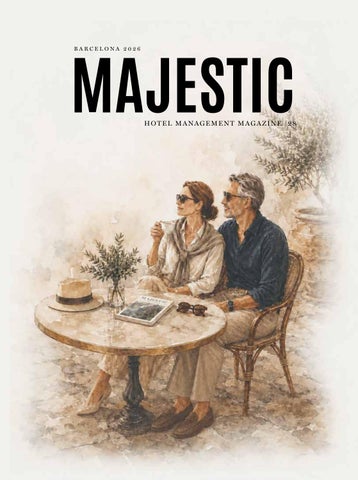
BARCELONA 2026
HOTEL MANAGEMENT MAGAZINE |28
SUMARIO SUMMARY
- Bienvenida - Welcome
4
- Sobre Majestic Hotel Management - About Majestic Hotel Management
9
- Presentación Majestic Hotel & Spa Barcelona - Presentation Majestic Hotel & Spa Barcelona
15
27
GASTRONOMÍA GASTRONOMY
- Ruta del Oro líquido - The liquid Gold Route
VIAJES TRIPS
- 48 horas en Sevilla - 48 hours in Seville Mas allá de los mapas. - Conectar con el mundo viajando solo: El Japón rural - Connecting with the world throug solo travel: Rural Japan - Hot Spot - Hot Spot
CULTURA CULTURE
- El Dragón de piedra - The Stone Dragon
56 HOGAR HOME
27
32
- Terrazas que respiran - Terraces that breathe
56
- Lujo sin reforma - Luxury without renovation
61
BIENESTAR WELLNESS
- Lo que comes, lo que luces - You glow what you eat
64
- Rucking, la revolución fitness más antigua del mundo - Rucking, the world’s oldest fitness revolution
67
38
46
48
67 MODA FASHION
48
- La línea más fina - The thinnest line
70
- Adiós castaño, bienvenido dirty blonde - Goodbye brown, hello dirty blonde
72
Edita: Majestic Hotel Management Producción editorial: Editorial Mic Textos: Desiré Alija Comunicación: Santiago Martín
4
BIENVENIDA / WELCOME
/
BIENVENIDOS
Quiero empezar dándole las gracias por elegirnos y confiar en nosotros para acompañarle en esta estancia con nosotros. Es un honor presentarle nuestros hoteles y apartamentos, cada uno pensado para ofrecerle experiencias únicas y adaptadas a sus gustos. En el corazón de Barcelona, nuestro emblemático Majestic Hotel & Spa Barcelona lleva más de 100 años siendo un icono de la hotelería de esta ciudad donde los viajeros más exigentes pueden disfrutar de una experiencia inigualable. Sabemos que la gastronomía es parte esencial de cualquier viaje. Por eso, bajo la guía del chef David Romero, le invitamos a saborear cada rincón del Majestic: desde un aperitivo fresco en la terraza La Dolce Vitae con espectaculares vistas de la ciudad, hasta un almuerzo en El Restaurant SOLC, sin olvidar nuestro famoso Brunch Gourmet del Majestic los domingos, ideal para compartir con amigos, en pareja o en familia. Para quienes buscan independencia y privacidad, ponemos a su disposición los exclusivos apartamentos de Majestic Residence o Murmuri Residence, con los edificios de los pasajes Mercader y Concepció. En pleno centro de Barcelona encontrará una cuidada selección de hoteles desde los que descubrir la ciudad: Hotel Midmost, con su estilo vintage y su deliciosa propuesta de desayunos saludables; Hotel Denit, un acogedor establecimiento de 3 estrellas con una ubicación privilegiada en el Barrio Gótico; Casa Teva, que, con un ambiente cálido y una gastronomía inspirada en las tradicionales casas de comidas, hace honor a su nombre invitando a sentirse como en casa; y las más recientes incorporaciones, Círculo Condal y Hotel Arco, dos nuevas propuestas para disfrutar de Barcelona desde el corazón de la ciudad.
es un espacio gastronómico exclusivo donde el chef Jordi Vilà reinterpreta la tradición catalana con técnica, sensibilidad y producto local. Aquí, cada plato es una experiencia que rinde homenaje al mar y a la tierra, en un entorno inigualable dentro de Finca Victoria Hotel & Spa
Si está pensando en la capital andaluza, en Sevilla le proponemos diferentes opciones: Hotel Palacio Pinello, una pequeña joya junto a la catedral; Honest Sevilla, que combina confort, ubicación y hospitalidad; Casa Teva Rooms Sevilla, donde el diseño, la cultura y la funcionalidad van de la mano; y Hotel Florida, otra excelente alternativa para disfrutar de la ciudad. En Granada, Honest Hotel Granada ofrece una estancia cómoda y acogedora desde la que descubrir sus principales atractivos.
El Hotel Palacio de los Ángeles, en el corazón de Haro, capital del vino de Rioja, recupera la grandeza de un palacio barroco del siglo XVIII. Un espacio donde la historia, el confort y la cultura del vino se fusionan para ofrecer una experiencia única de enoturismo en La Rioja Alta. La gastronomía de los Hermanos Echapresto, premiados por las guías Michelin y Repsol con la Venta Moncalvillo, completa una estancia inolvidable para los amantes del vino, la cocina riojana y el arte del buen vivir.
En Begur, La Finca Victoria es la propuesta de lujo perfecta, que revive el espíritu de los veranos de los años 70 de la Costa Brava, un refugio situado junto al mar donde la tradición, el diseño y el espíritu mediterráneo se unen en perfecta armonía. Una villa catalana restaurada, a pocos pasos de las playas más icónicas de la Costa Brava. Ubicado en la playa de Sa Riera, Begur, con una arquitectura inspirada en las casas tradicionales de la región y un diseño que combina la elegancia contemporánea con materiales naturales, este destino ofrece una experiencia única para los viajeros más exigentes. Su restaurante AlKostat del Mar
Sea cual sea su elección, nuestro objetivo es que cada momento de su estancia con nosotros se convierta en un recuerdo memorable. Gracias por ser parte de la familia Majestic Hotel Management y, sobre todo, ¡disfrute de cada detalle! ¡Feliz estancia y buena lectura! Malco Par Cebrián Director General
5
6
BIENVENIDA / WELCOME
WELCOME
I would like to begin by thanking you for choosing us and trusting us to accompany you during your stay with us. It is an honour to present our hotels and apartments, each designed to offer you unique experiences tailored to your tastes. In the heart of Barcelona, our emblematic Majestic Hotel & Spa Barcelona has been an icon of the city’s hotel industry for over 100 years, offering discerning travellers an unrivalled experience. We know that gastronomy is an essential part of any trip. That’s why, under the guidance of chef David Romero, we invite you to savour every corner of the Majestic: from a fresh aperitif on the La Dolce Vitae terrace with spectacular views of the city, to lunch at El Restaurant SOLC, not to mention our famous Majestic Gourmet Brunch on Sundays, ideal for sharing with friends, as a couple or with the family. For those seeking greater independence and privacy, we offer the exclusive Majestic Residence and Murmuri Residence apartments, located in the charming Mercader and Concepció passages. In the heart of Barcelona, you will also find a carefully curated collection of hotels from which to explore the city: Hotel Midmost, with its vintage style and delicious healthy breakfast offering; Hotel Denit, a welcoming three-star hotel in a prime location in the Gothic Quarter; Casa Teva, whose warm atmosphere and cuisine inspired by traditional casas de comidas make guests feel right at home; and our latest additions, Círculo Condal and Hotel Arco, two new hotels offering an ideal base from which to experience Barcelona from the very heart of the city. If you are planning a trip to the Andalusian capital, Seville offers a variety of outstanding accommodation options: Hotel Palacio Pinello, a hidden gem just steps from the cathedral; Honest Sevilla, combining comfort, a prime location and warm hospitality; Casa Teva Rooms Sevilla, where design, culture and functionality come together; and Hotel Florida, another excellent choice for enjoying the city. In Granada, Honest Hotel Granada provides a welcoming and comfortable base from which to discover the city’s most iconic attractions.
In Begur, The Finca Victoria is the perfect luxury option, reviving the spirit of 1970s summers on the Costa Brava, a seaside retreat where tradition, design and the Mediterranean spirit come together in perfect harmony. A restored Catalan villa, just a few steps from the most iconic beaches of the Costa Brava. Located on Sa Riera beach in Begur, with architecture inspired by the traditional houses of the region and a design that combines contemporary elegance with natural materials, this destination offers a unique experience for the most discerning travellers. Its restaurant, AlKostat del Mar, is an exclusive gastronomic space where chef Jordi Vilà reinterprets Catalan tradition with technique, sensitivity and local produce. Here, each dish is an experience that pays homage to the sea and the land, in an unrivalled setting within Finca Victoria Hotel & Spa. At Casa Teva, we can highlight Arraval, its restaurant, with its concept of honest and contemporary Catalan cuisine from the Raval neighbourhood, and the Hotel Palacio de los Ángeles, in the heart of Haro, the wine capital of Rioja, which recovers the grandeur of a 18th-century Baroque palace. A space where history, comfort and wine culture come together to offer a unique wine tourism experience in La Rioja Alta. The cuisine of the Echapresto brothers, awarded by the Michelin and Repsol guides with the Venta Moncalvillo, completes an unforgettable stay for lovers of wine, Rioja cuisine and the art of good living. Whatever your choice, our goal is to make every moment of your stay with us a memorable one. Thank you for being part of the Majestic Hotel Management family and, above all, enjoy every detail! Have a pleasant stay and enjoy your reading! Malco Par Cebrián General Manager
8
MAJESTIC
MAJESTIC
9
SOBRE MAJESTIC HOTEL MANAGEMENT ABOUT MA JESTIC HOTEL MANAGEMENT
El grupo hotelero, además del Majestic Hotel & SPA Barcelona, que constituye el núcleo original y buque insignia del grupo de 5 estrellas, incluye otros hoteles y apartamentos en diferentes ubicaciones. The hotel group, in addition to the Majestic Hotel & SPA Barcelona, which is the original core and flagship of the 5-star group, includes other hotels and apartments in different locations.
MIDMOST HOTEL BARCELONA El Midmost Hotel Barcelona se encuentra en el corazón de Barcelona, cerca de lugares emblemáticos como Plaça Catalunya y Las Ramblas. Refleja la filosofía de una Barcelona comprometida con tiendas de autor, comercio justo y cultura alternativa. Este boutique hotel de 4 estrellas, ubicado en un edificio de 1919 y recientemente renovado, ofrece una estancia agradable con un servicio personalizado y exclusivo en el centro de la ciudad. The Midmost Hotel Barcelona is located in the heart of Barcelona, close to emblematic places such as Plaça Catalunya and Las Ramblas. It reflects the philosophy of a Barcelona committed to signature stores, fair trade and alternative culture. This 4-star boutique hotel, located in a 1919 building and recently renovated, offers a pleasant stay with personalized and exclusive service in the center of the city.
10 MAJESTIC
MAJESTIC 11
MAJESTIC RESIDENCE Majestic Residence ofrece lujosos apartamentos en Paseo de Gracia, Barcelona, con acabados de alta calidad y decoración elegante. Con tamaños de una a cuatro habitaciones, estos apartamentos están completamente equipados con cocinas modernas y amplios baños con jacuzzi. Es un lugar ideal para estancias de negocios o placer, con comodidades y ubicación privilegiada en el corazón de la ciudad. Majestic Residence offers luxurious apartments in Paseo de Gracia, Barcelona, with high quality finishes and elegant decor. Ranging in size from one to four bedrooms, these apartments are fully equipped with modern kitchens and spacious bathrooms with Jacuzzi tubs. It is an ideal place for business or leisure stays, with amenities and a privileged location in the heart of the city.
HOTEL DENIT BARCELONA Denit Barcelona es un oasis de paz situado en el Barrio Gótico de Barcelona, cerca de Plaza Cataluña, Paseo de Gracia y las Ramblas. El hotel, ubicado en una finca reformada con fachada Art Decó, ofrece tranquilidad a pocos pasos de la bulliciosa Barcelona. Su excelente ubicación facilita el acceso a las principales zonas comerciales y restaurantes de la ciudad, así como a los icónicos edificios diseñados por arquitectos famosos como Gaudí. Los huéspedes pueden disfrutar de una experiencia única en el centro urbano, cerca de lugares emblemáticos como la Pedrera, la Casa Batlló y el mercado de la Boquería. Denit Barcelona is an oasis of peace located in Barcelona’s Gothic Quarter, close to Plaza Cataluña, Paseo de Gracia and Las Ramblas. The hotel, located in a renovated building with an Art Deco façade, offers tranquility within walking distance of bustling Barcelona. Its excellent location provides easy access to the city’s main shopping areas and restaurants, as well as the iconic buildings designed by famous architects such as Gaudí. Guests can enjoy a unique experience in the city center, close to iconic landmarks such as La Pedrera, Casa Batlló and the Boquería market.
12 MAJESTIC
MAJESTIC 13
CASA TEVA HOTEL Ubicado en el corazón del distrito de Ciutat Vella, a pocos pasos de Las Ramblas, el Barrio Gótico y el Gran Teatro del Liceo, el Hotel Casa Teva combina la esencia de un edificio típico de Barcelona renovado con comodidades modernas.
MURMURI RESIDENCE MERCADER Se trata del lujoso edificio de apartamentos en Passatge Mercader, 13 de Barcelona, con categoría de 4 estrellas. Ubicado en el distrito de l’Eixample, cerca de importantes emblemas modernistas como La Pedrera y Casa Batlló, este alojamiento ofrece apartamentos de lujo con énfasis en seguridad y confort para sus huéspedes. This is the luxury apartment building at Passatge Mercader, 13 in Barcelona, with 4-star category. Located in the Eixample district, close to important modernist landmarks such as La Pedrera and Casa Batlló, this accommodation offers luxury apartments with an emphasis on safety and comfort for its guests.
MURMURI RESIDENCE CONCEPCIÓ Murmuri Residence Concepció, un referente de elegancia y exclusividad en el centro de Barcelona, reformado completamente en colaboración con el prestigioso estudio de interiorismo Luzio Studio. Este proyecto eleva la experiencia de lujo del establecimiento mediante una estética vanguardista, ambientes personalizados y nuevas comodidades excepcionales adaptadas a los huéspedes más exigentes. Incorpora prácticas sostenibles en línea con el compromiso ambiental compartido por Luzio y Murmuri Residence Concepció. Murmuri Residence Concepció, a benchmark of elegance and exclusivity in the center of Barcelona, completely refurbished in collaboration with the prestigious interior design studio Luzio Studio. This project elevates the luxury experience of the establishment through avant-garde aesthetics, personalized environments and exceptional new amenities tailored to the most discerning guests. It incorporates sustainable practices in line with the environmental commitment shared by Luzio and Murmuri Residence Concepció.
Sus habitaciones, diseñadas con madera de roble y materiales cuidadosamente seleccionados, crean un ambiente cálido y cosmopolita donde cada detalle invita a la comodidad. Con servicios como cajas fuertes individuales y espacios acogedores, Casa Teva es el lugar perfecto para descubrir la Barcelona más vibrante mientras te sientes como en casa.
vinos naturales, pensados para acompañar cada plato con coherencia y sensibilidad. Located in the heart of the Ciutat Vella district, just steps away from Las Ramblas, the Gothic Quarter, and the Gran Teatre del Liceu, the Casa Teva Hotel blends the essence of a typical Barcelona building with modern comforts. Its rooms, crafted with oak wood and carefully selected materials, create a warm and cosmopolitan atmosphere where every detail invites relaxation. With features such as individual safes and cozy spaces, Casa Teva is the perfect place to explore the vibrant side of Barcelona while feeling right at home.
UNA EXPERIENCIA GASTRONÓMICA INOLVIDABLE El desayuno en Casa Teva se disfruta como en casa, sin prisas y con el placer de lo bien hecho. Una selección cuidada de productos frescos y locales —panes artesanales, frutas de temporada, embutidos tradicionales y opciones calientes— se acompaña de café de especialidad, té matcha y zumos naturales. Un desayuno honesto y auténtico, pensado para empezar el día a tu propio ritmo.
AN UNFORGETTABLE CULINARY EXPERIENCE Breakfast at Casa Teva is enjoyed as if you were at home, without rushing and with the pleasure of a job well done. A careful selection of fresh, local products—artisan breads, seasonal fruits, traditional cold cuts and hot options—is accompanied by speciality coffee, matcha tea and fresh juices. An honest and authentic breakfast, designed to start the day at your own pace.
La experiencia gastronómica de Casa Teva va más allá del desayuno. En Arraval, su propuesta culinaria, se celebra una cocina catalana ravalera, honesta y contemporánea, que evoca la calidez de una mesa compartida y la alegría de comer en compañía. Una cocina guiada por el fuego, el sofrito, las especias y la memoria, que parte de la tradición catalana para reinterpretarla desde un Raval diverso, vivo y en constante mezcla, sin perder nunca el respeto por el origen.
The gastronomic experience at Casa Teva goes beyond breakfast. Arraval, its culinary offering, celebrates honest, contemporary Catalan cuisine from the Raval neighbourhood, evoking the warmth of a shared table and the joy of eating in company. A cuisine guided by fire, sofrito, spices and memory, which takes Catalan tradition as its starting point and reinterprets it from a diverse, lively and constantly changing Raval, without ever losing respect for its origins.
Detrás de los fogones trabajan Àlex, Marcos y Jordi, tres cocineros formados en la escuela de Jordi Vilà, donde aprendieron a priorizar el producto, las bases y el sabor por encima de todo. Para completar la experiencia, Casa Teva propone una cuidada selección de
Behind the stoves are Àlex, Marcos and Jordi, three chefs trained at Jordi Vilà’s school, where they learned to prioritise the product, the basics and flavour above all else. To complete the experience, Casa Teva offers a careful selection of natural wines, designed to accompany each dish with consistency and sensitivity.
CÍRCULO CONDAL Construido en 1891, este edificio de La Rambla forma parte de la historia de Barcelona desde hace más de un siglo. Por sus espacios han pasado generaciones, encuentros y distintas maneras de vivir la ciudad. Hoy comienza una nueva etapa como Círculo Condal, un hotel de 29 habitaciones en el que la arquitectura original dialoga con un diseño contemporáneo. Pensado para quienes buscan una experiencia más local, serena y conectada con el entorno, Círculo Condal ocupa una ubicación privilegiada en el corazón de Barcelona sin renunciar a la tranquilidad. Una forma diferente de descubrir La Rambla: viviéndola desde dentro. Built in 1891, this landmark building on La Rambla has been part of Barcelona’s story for more than a century. Over the years, it has witnessed generations, countless encounters and the city’s ever-evolving way of life. Today, it begins a new chapter as Círculo Condal, a 29-room hotel where original architecture blends seamlessly with contemporary design. Created for travellers seeking a more authentic, peaceful and locally inspired stay, Círculo Condal enjoys a privileged location in the heart of Barcelona while offering a welcome sense of calm. A different way to experience La Rambla—from the inside.
14 Presentación / Presentation
Presentación / Presentation 15
MAJESTIC HOTEL & SPA BARCELONA M A J E S T I C H O T E L & S PA B A R C E L O N A
En el corazón de Barcelona, en pleno Paseo de Gracia, se levanta un majestuoso edificio de estilo neoclásico francés que se ha convertido en uno de los emblemas de la ciudad Condal: Majestic Hotel & Spa Barcelona. Abierto en 1918, se trata de un auténtico símbolo de Barcelona que, tras concluir un ambicioso proyecto de renovación, es hoy todo un referente de estilo elegante y atemporal, propio de los más prestigiosos hoteles internacionales. Durante sus más de cien años de vida, el Majestic, propiedad de la familia Soldevila-Casals, ha sido testigo de importantes eventos políticos, culturales e históricos que lo han dotado de una impronta y personalidad propias que se refleja en cada pequeño detalle de lujo y confort. Majestic Hotel & Spa Barcelona debe su fama de hospitalidad a la eficacia de unos empleados discretos y profesionales que durante décadas han convertido la estancia de sus huéspedes en una experiencia única e inolvidable.
In the heart of Barcelona, in the Paseo de Gracia, stands a majestic French neoclassical building that has become one of the emblems of the city: Majestic Hotel & Spa Barcelona. Opened in 1918, it is a true symbol of Barcelona which, after completing an ambitious renovation project, is now a benchmark of elegant and timeless style, typical of the most prestigious international hotels. During its more than hundred years of life, the Majestic, owned by the Soldevila-Casals family, has witnessed important political, cultural and historical events that have given it its own imprint and personality, which is reflected in every little detail of luxury and comfort. Majestic Hotel & Spa Barcelona owes its reputation for hospitality to the efficiency of its discreet and professional staff, who for decades have made its guests’ stay a unique and unforgettable experience.
Siempre en el centro de la escena cultural y artística barcelonesa, por sus habitaciones han pasado estrellas de cine, artistas, políticos, figuras del deporte y empresarios de prestigio, quienes han podido disfrutar de la calidad de sus instalaciones y la profesionalidad de un servicio discreto y eficaz. Nombres como el de la Reina Victoria Eugenia, los poetas Antonio Machado, León Felipe y Federico García Lorca, los pintores Joan Miró y Pablo Ruíz Picasso, los cantantes Charles Trenet y Josephine Baker, la soprano Renata Tebaldi o el Premio Nobel de literatura Ernest Hemingway, han ayudado a crear la enorme reputación del Majestic.
Always at the centre of Barcelona’s cultural and artistic scene, its rooms have been visited by film stars, artists, politicians, sports figures and prestigious businessmen, who have been able to enjoy the quality of its facilities and the professionalism of its discreet and efficient service. Names such as Queen Victoria Eugenia, the poets Antonio Machado, León Felipe and Federico García Lorca, the painters Joan Miró and Pablo Ruíz Picasso, the singers Charles Trenet and Josephine Baker, the soprano Renata Tebaldi and the Nobel Prize winner Ernest Hemingway, have helped to create the enormous reputation of the Majestic.
Una ciudad cosmopolita, creativa, innovadora, hermosa y viva como Barcelona necesita de un hotel a la altura de su fama mundial que contribuya al crecimiento de su prestigio: Majestic Hotel & Spa Barcelona es esa pieza clave que nutre a la ciudad de lujo y exclusividad. Bañada por las cálidas aguas del Mediterráneo, con más de cinco kilómetros de playas, así como algunos de los monumentos, edificios y museos más importantes del país, la capital catalana recibe al visitante con un sinfín de propuestas culturales y de ocio, que harán las delicias de aquellos con ganas de exprimir al máximo la Barcelona más auténtica. El Majestic, emplazado en su corazón histórico, conforma el mejor bastión desde el que conquistar los alrededores.
A cosmopolitan, creative, innovative, beautiful and lively city like Barcelona needs a hotel that lives up to its worldwide fame and contributes to the growth of its prestige: Majestic Hotel & Spa Barcelona is the key element that nourishes the city with luxury and exclusivity. Bathed by the warm waters of the Mediterranean, with more than five kilometres of beaches, as well as some of the most important monuments, buildings and museums in the country, the Catalan capital welcomes visitors with a host of cultural and leisure activities that will delight those who want to make the most of the most authentic Barcelona. The Majestic, located in its historic heart, is the best bastion from which to conquer the surrounding area.
16 Presentación / Presentation
Presentación / Presentation 17
HOTEL PALACIO DE LOS ÁNGELES H A R O, L A R I O JA
UNA NUEVA JOYA DEL ENOTURISMO Y LA HOSPITALIDAD CONTEMPORÁNEA A new jewel of wine tourism and contemporary hospitality El Palacio de los Ángeles emerge en el corazón de Haro como uno de los proyectos hoteleros más ambiciosos y sofisticados de La Rioja. Este antiguo palacio barroco del Siglo XVIII, tras décadas en desuso, renace convertido en un hotel boutique de cinco estrellas donde patrimonio, diseño y cultura vinícola dialogan con elegancia y naturalidad. Se trata de un proyecto que aúna historia, arquitectura, gastronomía y bienestar, posicionándose como un nuevo referente del lujo silencioso y experiencial en la región.
Desde su apertura en 1918, el Majestic ocupa el histórico edificio de los números 68–70 del Paseo de Gracia, propiedad de Martín Casals, fundador y abuelo de los actuales propietarios, quien supo ver las posibilidades de futuro de esa nueva ubicación hacia la que miraban la aristocracia y la alta burguesía.
Since its opening in 1918, the Majestic has occupied the historic building at numbers 68-70 Paseo de Gracia, owned by Martín Casals, founder and grandfather of the current owners, who was able to see the future possibilities of this new location, towards which the aristocracy and the upper middle class were looking.
En pleno Quadrat d’Or de Barcelona se encuentra el elegante y señorial Paseo de Gracia, cuna de la Barcelona modernista, en el que se encuentran algunos de los edificios más bellos de la ciudad, ideados por reconocidos arquitectos como Gaudí, Puig i Cadafalch, Domènec i Montaner. En este entorno se alza la espectacular arquitectura de Majestic Hotel & Spa Barcelona con sus balcones de hierro forjado y demás detalles neoclásicos que lo convierten en una obra de arte más.
In the heart of Barcelona’s Quadrat d’Or is the elegant and stately Paseo de Gracia, the cradle of modernist Barcelona, home to some of the city’s most beautiful buildings, designed by renowned architects such as Gaudí, Puig i Cadafalch, Domènec i Montaner. The spectacular architecture of the Majestic Hotel & Spa Barcelona stands in this setting, wrought-iron balconies and other neoclassic details that make it yet another work of art.
La envidiable localización del Majestic en pleno centro urbano de Barcelona, a muy poca distancia de edificios tan emblemáticos como la Pedrera o la Casa Batlló, las concurridas Ramblas, el mercado de la Boquería o el Gran Teatro del Liceo, lo convierte en el lugar perfecto desde el que descubrir la ciudad, realizar compras en las exclusivas tiendas de firmas internacionales que motean la zona y disfrutar de las terrazas y restaurantes más prestigiosos de Barcelona.
The Majestic’s enviable location in the heart of Barcelona’s city centre, within walking distance of such emblematic buildings as La Pedrera and Casa Batlló, the busy Ramblas, the Boquería market and the Gran Teatro del Liceo, makes it the perfect place from which to discover the city, shop in the exclusive international boutiques that dot the area and enjoy Barcelona’s most prestigious terraces and restaurants.
The Palacio de los Ángeles emerges in the heart of Haro as one of the most ambitious and sophisticated hotel projects in La Rioja. This former 18th-century Baroque palace, after decades of disuse, has been reborn as a five-star boutique hotel where heritage, design and wine culture come together with elegance and naturalness. This project combines history, architecture, gastronomy and wellbeing, positioning itself as a new benchmark for quiet, experiential luxury in the region.
18 Presentación / Presentation
Presentación / Presentation 19
Frente al hotel se ubica un nuevo edificio con 10 exclusivos apartamentos de uno y dos dormitorios, ideales para estancias prolongadas o viajes en familia. Cada uno mantiene la estética de materiales nobles del hotel e incluye cocina integrada y sala de estar, sin renunciar a los servicios completos de un 5 estrellas. El spa, íntimo y sensorial, está situado en una antigua estancia del palacio y propone un ambiente cálido gracias al uso de piedra, madera y cerámica manual. Dispone de dos cabinas de masaje, sauna seca y de vapor, jacuzzi interior y zona de relajación, todo concebido para la desconexión absoluta.
El palacio, antaño hogar de familias nobles, conserva su carácter monumental gracias a una restauración meticulosa que respeta la estructura original y pone en valor la piedra, los artesonados y la memoria del edificio. La intervención arquitectónica —liderada por Inarsa con interiorismo de Trenchs Studio— mantiene la fachada barroca y crea un patio central contemporáneo que articula las circulaciones del hotel. El resultado es un equilibrio perfecto entre herencia y modernidad: cada espacio revela la historia sin renunciar al confort, la luz y la sofisticación actuales. El concepto creativo se basa en reinterpretar el barroco sin competir con él. El lobby funciona como un gran salón, cálido y elegante, con techos artesonados en madera oscura, muros de piedra y mobiliario contemporáneo. Una mesa de anticuario da la bienvenida y una chimenea encendida actúa como foco emocional. El palacio con la certificación VERDE del Green Building Council España, reflejo de su compromiso con la eficiencia energética, el uso responsable de recursos y la reconstrucción sostenible del edificio histórico. Los espacios comunes, desde el restaurante hasta el wine bar, emplean materiales nobles, texturas naturales y una iluminación cuidada que construyen una atmósfera íntima y sofisticada. El hotel cuenta con 38 habitaciones en las que muros de piedra, tonos
neutros, madera en espiga y artesonados oscuros crean un refugio de calma. Tecnológicamente equipadas y diseñadas para el descanso, mantienen una narrativa coherente con todo el proyecto. Algunas suites incorporan bañeras exentas y camas con dosel que aportan un toque romántico. Las estancias evocan la esencia riojana a través de detalles artesanales y fotografías de paisajes de la región.
The palace, once home to noble families, retains its monumental character thanks to a meticulous restoration that respects the original structure and highlights the stonework, coffered ceilings and history of the building. The architectural intervention—led by Inarsa with interior design by Trenchs Studio—maintains the Baroque façade and creates a contemporary central courtyard that articulates the hotel’s circulation. The result is a perfect balance between heritage and modernity: each space reveals history without sacrificing contemporary comfort, light and sophistication. The creative concept is based on reinterpreting the Baroque without competing with it. The lobby functions as a large, warm and elegant living room, with dark wood cof fered ceilings, stone walls and contemporary furniture. An antique table welcomes guests and a lit fireplace acts as an emotional focal point. The palace has been awarded GREEN certification by the Green Building Council Spain, reflecting its commitment to energy efficiency, responsible use of resources and sustainable reconstruction of the historic building. The common areas, from the restaurant to the wine bar, use fine materials, natural textures and careful lighting to create an intimate and sophisticated atmosphere.
El jardín del Palacio de los Ángeles es un espacio singular en Haro: un entorno privado rodeado por la piedra histórica del edificio, con zonas de restauración al aire libre, mobiliario en tonos naturales y un bar exterior que recuerda a antiguos pabellones. La piscina climatizada completa este refugio urbano, perfecto para cualquier época del año. The hotel has 38 rooms in which stone walls, neutral tones, herringbone wood and dark coffered ceilings create a haven of calm. Technologically equipped and designed for rest, they maintain a narrative consistent with the entire project. Some suites feature freestanding bathtubs and canopy beds that add a romantic touch. The rooms evoke the essence of La Rioja through handcrafted details and photographs of the region’s landscapes. Opposite the hotel is a new building with 10 exclusive one- and two-bedroom apartments, ideal for extended stays or family trips. Each one maintains the hotel’s aesthetic of fine materials and includes an integrated kitchen and living room, without sacrificing the full services of a 5-star hotel. The intimate and sensory spa is located in a former room of the palace and offers a warm atmosphere thanks to the use of stone, wood and handmade ceramics. It has two massage rooms, a dry and steam sauna, an indoor jacuzzi and a relaxation area, all designed for complete relaxation. The garden of the Palacio de los Ángeles is a unique space in Haro: a private setting surrounded by the historic stone of the building, with outdoor dining areas, natural-toned furniture and an outdoor bar reminiscent of ancient pavilions. The heated swimming pool completes this urban retreat, perfect for any time of year.
20 Presentación / Presentation
casabotines.es
C
M
Y
CM
MY
CY
CMY
K
WINE BAR Y CONCEPTO ENOGASTRONÓMICO El hotel redefine la cultura vinícola de La Rioja con un wine bar que combina tradición y contemporaneidad: bodega perimetral de hierro y vidrio, barra central de madera oscura y ambiente íntimo. Cada mañana alberga un desayuno bufé presentado sobre una imponente mesa de mármol. La gastronomía está liderada por los hermanos Ignacio y Carlos Echapresto, del reconocido restaurante Venta Moncalvillo (2 estrellas Michelin). Su propuesta no es una asesoría, sino un proyecto gastronómico propio dentro del hotel, centrado en una cocina auténtica, basada en el producto y diseñada para acompañar la experiencia vinícola. La carta incluirá parte de la huerta de Venta Moncalvillo y una selección espectacular de vinos, con especial protagonismo para La Rioja. Los Echapresto aspiran a convertirse en un referente del enoturismo en Haro, redondeando la experiencia del hotel con un servicio excepcional y un mensaje claro: “A La Rioja se viene a comer, a beber y a disfrutar del arte del bien vivir.”
WINE BAR AND ENOGASTRONOMIC CONCEPT The hotel redefines the wine culture of La Rioja with a wine bar that combines tradition and modernity: an iron and glass perimeter wine cellar, a central dark wood bar and an intimate atmosphere. Every morning, it hosts a buffet breakfast presented on an imposing marble table. The cuisine is led by brothers Ignacio and Carlos Echapresto, from the renowned Venta Moncalvillo restaurant (2 Michelin stars). Their proposal is not a consultancy, but rather their own gastronomic project within the hotel, focused on authentic cuisine, based on the product and designed to accompany the wine experience. The menu will include produce from the Venta Moncalvillo vegetable garden and a spectacular selection of wines, with a special focus on La Rioja. The Echaprestos aspire to become a benchmark for wine tourism in Haro, rounding off the hotel experience with exceptional service and a clear message: “People come to La Rioja to eat, drink and enjoy the art of good living.”
22 Presentación / Presentation
Presentación / Presentation 23
CUATRO MANERAS DE VIVIR SEVILLA
C A S A T E VA R O O M S SEVILLA
F O U R WA Y S T O E X P E R I E N C E S E V I L L E WITH PERSONAL STYLE
HONEST SEVILLA ELEGANCIA BOUTIQUE EN EL CORAZÓN HISTÓRICO Ubicado en una casa señorial del siglo XIX completamente restaurada, The Honest es un hotel boutique que aúna lujo, confort y una ubicación privilegiada. En pleno centro histórico de Sevilla, invita a descubrir los iconos de la ciudad —la Catedral, la Giralda o el barrio de Santa Cruz— a solo unos pasos. Ideal para viajeros que buscan una experiencia auténtica, refinada y con alma andaluza. BOUTIQUE ELEGANCE IN THE HISTORIC HEART Set in a fully restored 19th-century noble house, The Honest is a boutique hotel that blends luxury, comfort, and a privileged location. Situated in Seville’s historic center, it invites guests to discover the city’s iconic landmarks —the Cathedral, the Giralda, and the Santa Cruz district— just steps away. Perfect for travelers seeking an authentic, refined experience with Andalusian soul.
PALACIO PINELLO
CASA BAILÉN APARTMENTS
DORMIR EN LA HISTORIA VIVA DE SEVILLA Alojarse en el Palacio Pinello es hacerlo en un monumento con más de cinco siglos de historia. Este palacio original del siglo XV fue la residencia de Francisco Pinelo, mecenas de Cristóbal Colón y figura clave en la Sevilla del Renacimiento. Hoy, declarado Bien de Interés Cultural, el edificio conserva su esplendor patrimonial con una cuidada rehabilitación que ofrece a los huéspedes una experiencia singular entre patios mudéjares, artesonados y piedra antigua.
ESENCIA ANDALUZA CON DISEÑO
SLEEP WITHIN SEVILLE’S LIVING LISTORY Staying at Palacio Pinello means staying in a monument with over five centuries of history. This original 15th-century palace was once home to Francisco Pinelo, a patron of Christopher Columbus and a key figure in Renaissance Seville. Now declared a Site of Cultural Interest, the building retains its heritage splendor thanks to a meticulous restoration, offering guests a unique stay among Mudejar courtyards, coffered ceilings, and ancient stonework.
En una de las calles más emblemáticas de Sevilla, Casa Bailén Apartments ofrece nueve apartamentos con encanto que giran en torno a un mágico patio andaluz. Cada espacio ha sido diseñado con mimo para ofrecer una estancia cómoda y llena de detalles, ideal para quienes desean independencia sin renunciar al estilo. Un refugio íntimo y luminoso para saborear Sevilla como en casa. ANDALUSIAN ESSENCE WITH DESIGN Located on one of Seville’s most emblematic streets, Casa Bailén Apartments offers nine charming units arranged around a magical Andalusian courtyard. Each space has been thoughtfully designed to provide a comfortable, detail-rich stay —ideal for those who want independence without sacrificing style. An intimate, light-filled retreat for savoring Seville as if it were home.
El nuevo Hotel Casa Teva Rooms Sevilla es un edificio típico de la capital andaluza, recién renovado, ubicado en el corazón de la ciudad que ofrece una experiencia única con comodidades modernas. Sus habitaciones diseñadas con máximo atención al detalle creando un ambiente acogedor y cosmopolita. The new Hotel Casa Teva Rooms Sevilla is a typical building in the Andalusian capital, recently renovated and located in the heart of the city, offering a unique experience with modern amenities. Its rooms have been designed with the utmost attention to detail, creating a welcoming and cosmopolitan atmosphere.
24 Presentación / Presentation
Presentación / Presentation 25
HONEST HOTEL GRANADA
FINCA VICTORIA E L N U E V O L U J O M E D I T E R R Á N E O E N L A C O S TA B R AVA T H E N E W M E D I T E R R A N E A N L U X U RY O N T H E C O S TA B R AVA
UN HOTEL CON ALMA EN EL CENTRO HISTÓRICO A hotel with soul in the historic center En Honest Hotel Granada unimos historia, cercanía y confort. Nuestros patios andaluces, las galerías interiores y los detalles originales del edificio crean un ambiente cálido y tranquilo en medio del bullicio del centro. Aquí puedes salir a explorar la ciudad y volver después a un refugio sereno, con un trato cercano y sincero.
Located in the iconic Sa Riera cove in Begur, Finca Victoria opens its doors as an exclusive five-star retreat redefining luxury on the Costa Brava. This historic family estate, carefully restored with architectural sensitivity, becomes an oasis where tradition and innovation coexist in perfect harmony. The hotel features 38 uniquely designed rooms —12 of them suites— equipped with outdoor showers, private pools, terraces, and privileged views. The jewel of the property is the La Torre Suite, housed in the original tower of the estate, offering 360º panoramic views.
Ubicado en la emblemática cala de Sa Riera, en Begur, Finca Victoria abre sus puertas como un exclusivo refugio de cinco estrellas que redefine el lujo en la Costa Brava. Esta histórica finca familiar, restaurada con mimo y sensibilidad arquitectónica, se convierte en un oasis donde tradición y vanguardia conviven en armonía. El hotel cuenta con 38 habitaciones de diseño único, 12 de ellas suites, equipadas con duchas exteriores, piscinas privadas, terrazas y vistas privilegiadas. La joya del alojamiento es la Suite La Torre, situada en la torre original de la casa, con vistas panorámicas de 360º.
At Honest Hotel Granada, we combine history, proximity, and comfort. Our Andalusian courtyards, interior galleries, and original architectural details create a warm and peaceful atmosphere amid the hustle and bustle of the city center. Here, you can set out to explore the city and then return to a serene retreat, where you will receive friendly and sincere service.
El alma de Finca Victoria se articula en torno a espacios vibrantes y sensoriales: un SPA con circuito de aguas, gimnasio, clases de yoga en la playa, piscina exterior, y el relajante Listening Room. En el plano culinario, la experiencia gastronómica lleva la firma del chef estrella Michelin Jordi Vilà, con dos propuestas: Al Kostat del Mar, cocina catalana tradicional con toques contemporáneos; y Cala Bar, un espacio informal con cócteles y platos ligeros. A pie de playa, La Caseta del Mar, nuestra casa de la playa donde encontrar toallas, tumbonas, bebidas frías y mucho más. Gestionado por Majestic Hotel Group y miembro de Design Hotels by Marriott, Finca Victoria está concebido como un hotel solo para adultos, pensado para quienes buscan privacidad, autenticidad y belleza natural. Este nuevo emblema de By Salomon Hospitality consolida su apuesta por el lujo sereno y mediterráneo, en un enclave que rinde homenaje a la Costa Brava de los años 70.
The soul of Finca Victoria is shaped by vibrant and sensorial spaces: a spa with hydrotherapy circuit, gym, beach yoga classes, outdoor swimming pool, and a serene Listening Room. On the culinary front, the gastronomic experience bears the signature of Michelinstarred chef Jordi Vilà, with two offerings: Al Kostat del Mar, serving traditional Catalan cuisine with contemporary touches; and Cala Bar, a relaxed space offering cocktails and light bites. On the beachfront La Caseta del Mar, our beach house where you will find towels, sun loungers, cold drinks and much more. Managed by Majestic Hotel Group and a member of Design Hotels by Marriott, Finca Victoria is conceived as an adults-only hotel, tailored for those seeking privacy, authenticity, and natural beauty. This new flagship of By Salomon Hospitality reinforces its commitment to serene, Mediterranean luxury in a setting that pays homage to the Costa Brava of the 1970s.
26 Presentación / Presentation
GASTRONOMÍA / GASTRONOMY 27
RUTA DEL ORO LÍQUIDO THE LIQUID GOLD ROUTE
HOTEL VILLA SORO El edificio, de estilo inglés, fue construido como casa familiar en el siglo XIX y es Patrimonio Histórico de la Ciudad de San Sebastián. El hotel, por su parte, mantiene intacto el espíritu de la época, con sus amplios salones, techos altos, chimeneas, una escalinata de madera tallada, un oratorio y una vidriera en el techo que representa el linaje familiar. Cuenta con 25 habitaciones, 15 en la villa principal y 10 construidas tras la rehabilitación y acondicionamiento de las antiguas caballerizas. Permanecen los materiales nobles de las zonas comunes, como el suelo de pinotea y mármol de la entrada, o su imponente escalera principal de madera de roble. Como toda la villa, la decoración de las habitaciones está cuidada con mucho gusto e, independientemente del nivel de la estancia, todas siguen una misma línea estética; clásica, elegante y sobria. Es el único hotel de San Sebastián que ofrece la sensación de estar en medio del campo, a pesar de estar ubicado en uno de los barrios más dinámicos de la ciudad, el barrio de Gros, a pocos pasos de la playa, de la zona comercial, de renombrados restaurantes y de bares de pintxos emblemáticos.
The building, designed in an English style, was originally constructed as a family home in the 19th century and is a Historic Heritage Site of the city of San Sebastián. The hotel has preserved the spirit of the era, with its spacious lounges, high ceilings, fireplaces, a carved wooden staircase, an oratory, and a stained glass ceiling depicting the family lineage. It features 25 rooms, 15 located in the main villa and 10 in the former stables, which were rehabilitated and repurposed. The noble materials of the common areas remain intact, such as the pinewood and
marble flooring in the entrance hall and the imposing oak staircase. Like the rest of the villa, the room décor is tastefully curated. Regardless of the room category, all adhere to the same aesthetic: classic, elegant, and understated. Villa Soro is the only hotel in San Sebastián that offers the feeling of being in the countryside while being located in one of the city’s most vibrant neighborhoods, Gros. It is just steps away from the beach, shopping areas, renowned restaurants, and iconic pintxo bars.
-
-
E L A C E I T E D E O L I VA V I R G E N E X T R A E S PA Ñ O L : EL LUJO GASTRONÓMICO MÁS COTIDIANO DEL MUNDO
S PA N I S H E X T R A V I R G I N O L I V E O I L : THE WORLD’S MOST EVERYDAY GASTRONOMIC LUXURY
28 GASTRONOMÍA / GASTRONOMY
GASTRONOMÍA / GASTRONOMY 29
-D OHay productos que llevan tanto tiempo sobre la mesa que han dejado de verse. El aceite de oliva virgen extra español es el más paradigmático de todos ellos. El país que produce entre el cuarenta y el cincuenta por ciento del aceite de oliva del mundo entero lleva siglos sin terminar de entender que lo que tiene en sus almazaras no es un condimento, sino un argumento. Un argumento cultural, histórico, gastronómico y, en los últimos años, también económico: el aceite de oliva virgen extra de alta gama ha entrado en el mercado del lujo alimentario igual que el vino español conquistó las mesas del mundo hace tres décadas. España es el primer productor mundial de aceite de oliva. No por un margen estrecho: Andalucía sola concentra el ochenta por ciento de la producción española, y Jaén —una sola provincia— produce más aceite que cualquier otro país del planeta, incluida Italia, que es su competidor histórico más directo en los mercados internacionales. Son cifras que impresionan hasta que se pone en contexto lo que implican: millones de olivos centenarios en paisajes que la UNESCO ha reconocido como patrimonio, y un saber hacer acumulado durante más de tres mil años de cultivo ininterrumpido desde los fenicios. Y, sin embargo, hasta hace muy poco, la mayor parte de ese aceite se exportaba a granel, sin marca y sin historia, para ser embotellado y etiquetado en Italia como producto italiano. El mundo pagaba por lo italiano sin saber que lo español era, con frecuencia, la materia prima que lo hacía posible. Eso ha cambiado. La generación de olivicultores que ha tomado el relevo en los últimos veinte años ha entendido que el valor está en la identidad, en la variedad, en la almazara, en la cosecha temprana y en el número de lote. El aceite español de alta gama ha dejado de ser un secreto de mercado y se ha convertido en un argumento de mesa. Los números que definen un virgen extra de calidad son precisos y no admiten aproximaciones: acidez inferior a 0,3 grados, índice de peróxidos bajo, polifenoles en concentración alta y ausencia de cualquier defecto organoléptico. Lo que queda, cuando todos esos factores se alinean, es un líquido de color que va del verde intenso al dorado cálido según la variedad y el momento de la cosecha, con aromas que pueden evocar la hierba recién cortada, la almendra verde, el tomate, el plátano o las especias, y un amargor y un picor en el fondo de la garganta que los catadores llaman atributos positivos y que son la señal más fiable de que los polifenoles antioxidantes están presentes en cantidad suficiente. En ese amargor está la salud. En ese picor está la calidad.
There are products that have been on the table for so long that we no longer notice them. Spanish extra virgin olive oil is the most paradigmatic of them all. The country that produces between forty and fifty per cent of the world’s olive oil has for centuries failed to fully grasp that what it has in its oil mills is not merely a condiment, but a selling point. A cultural, historical, gastronomic and, in recent years, economic selling point: high-end extra virgin olive oil has entered the luxury food market just as Spanish wine conquered the world’s dining tables three decades ago. Spain is the world’s leading producer of olive oil. And not by a narrow margin: Andalusia alone accounts for eighty per cent of Spanish production, and Jaén—a single province—produces more oil than any other country on the planet, including Italy, which is its most direct historical competitor in international markets. These are impressive figures until one considers what they imply: millions of centuries-old olive trees in landscapes recognised by UNESCO as World Heritage sites, and expertise accumulated over more than three thousand years of uninterrupted cultivation dating back to the Phoenicians. And yet, until very recently, most of that oil was exported in bulk, unbranded and without a story, to be bottled and labelled in Italy as an Italian product. The world paid for the Italian product without realising that the Spanish oil was, often, the raw material that made it possible. That has changed. The generation of olive growers who have taken over in the last twenty years has understood that value lies in identity, in variety, in the mill, in early harvesting and in the batch number. High-end Spanish olive oil is no longer a market secret and has become a talking point at the dinner table. The figures that define a quality extra virgin olive oil are precise and allow for no approximations: acidity below 0.3 per mille, a low peroxide value, high polyphenol concentration and the absence of any organoleptic defects. What remains, when all these factors come together, is a liquid ranging in colour from deep green to warm gold depending on the variety and time of harvest, with aromas that may evoke freshly cut grass, green almonds, tomatoes, banana or spices, and a distinct bitterness and a tingling sensation at the back of the throat that tasters call positive attributes and which are the most reliable sign that antioxidant polyphenols are present in sufficient quantities. In that bitterness lies health. In that tingling sensation lies quality.
30 GASTRONOMÍA / GASTRONOMY
GASTRONOMÍA / GASTRONOMY 31
- ANDALUCÍA / ANDALUSIA -
DONDE NACE EL OCHENTA POR CIENTO DEL MUNDO
DO Estepa · Sevilla La Denominación de Origen Estepa es, en el consenso de los especialistas, una de las más sólidas y mejor gestionadas de España. La cooperativa Oleoestepa, fundada en 1975, fue pionera en entender que la calidad colectiva vale más que la cantidad individual: sus aceites han acumulado premios internacionales durante décadas y se encuentran en las cartas de algunos de los mejores restaurantes del mundo. La hojiblanca, variedad autóctona de la zona, produce un aceite de frutado maduro, suave, con notas de manzana y almendra que lo hacen especialmente versátil en cocina. La picual, más robusta y con mayor contenido en polifenoles, produce aceites de cosecha temprana que son los más valorados por los conocedores: intensos, herbáceos, con ese amargor y ese picor que en la cultura del aceite fino son exactamente tan deseables como el tanino en un gran vino tinto. El municipio de Estepa, a menos de noventa minutos de Sevilla por la autovía A-92, merece una visita que combine la almazara con el casco histórico: su torre del Homenaje, su colegiata y sus calles de arquitectura sevillana aportan a la experiencia una dimensión cultural que convierte el viaje en algo más que una excursión gastronómica. DO Aceite de Granada Granada produce uno de los aceites más singulares de España por una razón geográfica precisa: los olivares se cultivan a altitudes que en muchos casos superan los ochocientos metros, en las laderas de Sierra Nevada y en el Poniente granadino. El frío de la noche y el calor del día crean un estrés térmico en la aceituna que concentra los azúcares y los polifenoles de manera única. El resultado son aceites de gran complejidad aromática y una estabilidad oxidativa excepcional, lo que en la práctica significa que duran más tiempo en condiciones óptimas que los aceites de zonas más cálidas. La variedad loaime es la gran rareza: un cultivar autóctona de Granada prácticamente desconocida fuera de la provincia, que produce aceites de perfil único con notas de hierba fresca, higuera y especias que no se encuentran en ningún otro aceite español. Algunas almazaras de la zona —como Olivesú en el municipio de Íllora, a menos de cuarenta minutos de Granada capital— ofrecen visitas guiadas a los olivares y catas que son en sí mismas una experiencia sensorial de primer orden.
- CATALUÑA / CATALONIA -
WHERE EIGHTY PER CENT OF THE WORLD’S IS PRODUCED
EL ACEITE QUE CRECE JUNTO AL MAR
THE OIL THAT GROWS BY THE SEA
DO Estepa · Seville
DO Oli de l’Empordà
DO Oli de l’Empordà
The Estepa Designation of Origin is, by consensus among specialists, one of the most robust and best-managed in Spain. The Oleoestepa cooperative, founded in 1975, was a pioneer in understanding that collective quality is worth more than individual quantity: its oils have won international awards for decades and feature on the menus of some of the world’s finest restaurants. The Hojiblanca, a native variety of the area, produces a mature, smooth, fruity oil with notes of apple and almond, making it particularly versatile in the kitchen. The Picual, more robust and with a higher polyphenol content, produces early-harvest oils that are most prized by connoisseurs: intense, herbaceous, with that bitterness and piquancy which, in the culture of fine oil, are just as desirable as tannin in a great red wine. The town of Estepa, less than ninety minutes from Seville via the A-92 motorway, is well worth a visit that combines the oil mill with the historic centre: its keep, its collegiate church and its streets featuring Sevillian architecture add a cultural dimension to the experience that makes the trip more than just a gastronomic excursion.
La Denominación de Origen Oli de l’Empordà es la más cercana geográficamente a Finca Victoria y la que mejor encaja con el espíritu mediterráneo del hotel. La arbequina del Empordà es una variedad de aceituna pequeña, de rendimiento bajo y personalidad alta: produce aceites suaves, afrutados, con notas de almendra, plátano y frutos secos, con un amargor delicado y un picor contenido que los hacen extraordinariamente versátiles en la cocina catalana de producto. No es un aceite que compita en potencia con los grandes monovarietales andaluces; es un aceite que seduce por la elegancia y por la manera en que desaparece en el plato sin eclipsar nada. Es, en ese sentido, el aceite perfecto para la filosofía de cocina de Jordi Vilà en AlKostat del Mar. Las masías olivareras del Empordà, con sus paisajes de olivares entre viñedos y el mar al fondo, son uno de los argumentos visuales más poderosos de la oleicultura española. La cosecha, que en esta zona suele realizarse entre noviembre y diciembre, es una experiencia que algunos productores abren al visitante con la misma vocación de ecoturismo que llevan décadas practicando las bodegas de la zona.
The Oli de l’Empordà Designation of Origin is the closest geographically to Finca Victoria and the one that best fits the hotel’s Mediterranean spirit. The Empordà arbequina is a small olive variety, with low yield and high character: it produces smooth, fruity oils with notes of almond, banana and nuts, with a delicate bitterness and a subtle piquancy that make them extraordinarily versatile in Catalan cuisine. It is not an oil that competes in intensity with the great Andalusian single-varietal oils; it is an oil that captivates through its elegance and the way it blends into the dish without overshadowing anything. In that sense, it is the perfect oil for Jordi Vilà’s culinary philosophy at AlKostat del Mar. The olive-growing estates of the Empordà, with their landscapes of olive groves nestled between vineyards and the sea in the background, are one of the most striking visual features of Spanish olive cultivation. The harvest, which in this area usually takes place between November and December, is an experience that some producers open up to visitors with the same commitment to ecotourism that the region’s wineries have been practising for decades.
DO Granada Olive Oil Granada produces one of Spain’s most distinctive olive oils for a specific geographical reason: the olive groves are cultivated at altitudes that in many cases exceed 800 metres, on the slopes of the Sierra Nevada and in the Poniente region of Granada. The cold of the night and the heat of the day create thermal stress in the olive, which concentrates the sugars and polyphenols in a unique way. The result is oils of great aromatic complexity and exceptional oxidative stability, which in practice means they last longer under optimal conditions than oils from warmer regions. The Loaime variety is a true rarity: a native cultivar of Granada virtually unknown outside the province, which produces oils with a unique profile featuring notes of fresh grass, fig tree and spices not found in any other Spanish oil. Some local oil mills—such as Olivesú in the municipality of Íllora, less than forty minutes from Granada city— offer guided tours of the olive groves and tastings that are in themselves a first-rate sensory experience.
DO Les Garrigues · Lleida Les Garrigues ostenta un título histórico que merece ser mencionado: fue la primera Denominación de Origen de aceite de oliva de Cataluña, reconocida en 1975, lo que la convierte en pionera del movimiento de calidad olivarera española. Su territorio, al sur de la provincia de Lleida, tiene un carácter interior y continental que contrasta con el Empordà: los olivares crecen en un paisaje de piedra seca, inviernos fríos y veranos secos que produce aceites de mayor intensidad y concentración que los de la costa. La arbequina de Les Garrigues es considerada por muchos catadores la expresión más pura y compleja de esta variedad en España.
DO Les Garrigues · Lleida Les Garrigues holds a historic title worthy of mention: it was Catalonia’s first Designation of Origin for olive oil, recognised in 1975, making it a pioneer of the Spanish olive-growing quality movement. Its territory, in the south of the province of Lleida, has an inland, continental character that contrasts with the Empordà: the olive groves grow in a landscape of dry stone, cold winters and dry summers, producing oils of greater intensity and concentration than those from the coast. The Arbequina from Les Garrigues is considered by many tasters to be the purest and most complex expression of this variety in Spain.
32 GASTRONOMÍA / GASTRONOMY
GASTRONOMÍA / GASTRONOMY 33
CÓMO RECONOCER UN GRAN ACEITE HOW TO RECOGNISE A GREAT OIL
EL MARIDAJE PERFECTO THE PERFECT PAIRING
Hay tres preguntas que separan un aceite de oliva virgen extra de calidad de uno que simplemente cumple la normativa. La primera: ¿cuándo se cosechó? Los mejores aceites son de cosecha temprana, realizados entre octubre y noviembre cuando la aceituna aún no ha madurado del todo: tienen más polifenoles, más color verde, más amargor y más picor, y son los que mejor aguantan el paso del tiempo. La segunda: ¿qué variedad? La variedad de aceituna define el perfil aromático del aceite tanto como la uva define el perfil de un vino. Picual, hojiblanca, arbequina, cornicabra, empeltre, loaime: cada una tiene una personalidad propia que no se puede sustituir. La tercera: ¿qué acidez? No porque la acidez se note en el sabor —no se nota— sino porque es el indicador más fiable de la calidad del proceso de elaboración. Por debajo de 0,3 grados, el aceite es excelente. Por debajo de 0,2, es excepcional.
Aceite de cosecha temprana con pan de masa madre
El aceite de oliva virgen extra de alta gama no necesita nada. No necesita calor, no necesita mezclas, no necesita disimulo. Necesita pan, necesita tiempo y necesita la atención de quien lo prueba. Es, en ese sentido, el producto gastronómico más honesto de la despensa mediterránea: no engorda el sabor de nada, lo revela. Y cuando es bueno de verdad —cuando viene de una almazara que sabe lo que tiene, de una variedad que ha crecido en el suelo correcto, cosechado en el momento exacto— lo que hay en la botella no es un aceite. Es un paisaje. There are three questions that distinguish a quality extra virgin olive oil from one that merely meets the regulations. The first: when was it harvested? The best oils are early harvests, produced between October and November when the olives have not yet fully ripened: they have more polyphenols, a greener colour, more bitterness and more pungency, and they are the ones that stand the test of time best. The second: which variety? The olive variety defines the oil’s aromatic profile just as much as the grape defines a wine’s profile. Picual, Hojiblanca, Arbequina, Cornicabra, Empeltre, Loaime: each has its own distinct character that cannot be replicated. The third: what acidity? Not because the acidity is noticeable in the flavour — it isn’t — but because it is the most reliable indicator of the quality of the production process. Below 0.3 degrees, the oil is excellent. Below 0.2, it is exceptional. Top-quality extra virgin olive oil needs nothing. It needs no heat, no blending, no pretence. It needs bread, it needs time, and it needs the attention of the person tasting it. In that sense, it is the most honest gastronomic product in the Mediterranean pantry: it does not mask the flavour of anything, it reveals it. And when it is truly good — when it comes from an oil mill that knows its stuff, from a variety that has grown in the right soil, harvested at just the right moment — what is in the bottle is not just oil. It is a landscape.
tostado y sal en escamas. Con anchoas del Cantábrico. Con un tartar de atún. La intensidad del aceite necesita ingredientes que la soporten y la dialoguen, no que la neutralicen. Early harvest oil with toasted sourdough bread and flaked salt. With Cantabrian anchovies. With a tuna tartare. The intensity of the oil needs ingredients that support it and engage with it, not ones that neutralise it.
- LA RIOJA -
—
con queso manchego curado, con jamón ibérico de bellota, con almendras crudas. Su suavidad y sus notas de manzana y fruto seco lo convierten en el aceite de las tablas de embutido y queso de mayor elegancia. Hojiblanca oil with mature Manchego cheese, with acornfed Iberian ham, with raw almonds. Its smoothness and notes of apple and nuts make it the most elegant oil for charcuterie and cheese platters. Aceite de hojiblanca
EL ACEITE QUE CRECE A LA SOMBRA DEL VINO
THE OIL THAT GROWS IN THE SHADOW OF WINE
Haro es la capital del vino de La Rioja. Es también, aunque muy pocos lo saben, una ciudad rodeada de olivares. La Indicación Geográfica Protegida Aceite de La Rioja es la menos conocida de las que vinculan los hoteles del grupo Majestic con el mundo del aceite de oliva, y precisamente por eso es la más interesante como argumento editorial: es el aceite que nadie busca pero que aparece, y que cuando aparece sorprende.
Haro is the wine capital of La Rioja. It is also, though very few people know it, a town surrounded by olive groves. The Protected Geographical Indication ‘Aceite de La Rioja’ is the least well-known of those linking the Majestic group’s hotels to the world of olive oil from La Rioja, and precisely for that reason it is the most interesting as an editorial angle: it is the oil that nobody looks for but which turns up, and which, when it does, surprises.
La producción riojana de aceite es marginal en volumen comparada con Andalucía o incluso con Cataluña, pero los olivares de la Rioja Baja —la zona más cálida y meridional de la comunidad— producen aceites de carácter propio, con la influencia del clima mediterráneo que sube por el valle del Ebro. Para el viajero que llega al Hotel Palacio de los Ángeles en Haro con la mente puesta en el vino, descubrir que La Rioja también tiene aceite es una de esas sorpresas que hacen que un viaje gastronómico valga la pena. El maridaje entre un aceite riojano y un vino de la Rioja Alta, propuesto por los hermanos Echapresto en el restaurante del hotel, es una experiencia que ninguna guía recoge todavía porque nadie ha pensado en buscarla.
La Rioja’s olive oil production is marginal in volume compared to Andalusia or even Catalonia, but the olive groves of the Rioja Baja — the warmest and southernmost part of the region — produce oils with a character all of their own, influenced by the Mediterranean climate that sweeps up the Ebro Valley. For the traveller arriving at the Hotel Palacio de los Ángeles in Haro with their mind set on wine, discovering that La Rioja also has olive oil is one of those surprises that make a gastronomic trip worthwhile. The pairing of a Rioja olive oil with a wine from the Rioja Alta, proposed by the Echapresto brothers in the hotel’s restaurant, is an experience that no guidebook has yet recorded because no one has thought to look for it.
—
Aceite de arbequina con pescado blanco a la plancha, con
verduras de temporada, con un carpaccio de vieiras. Es el aceite de la delicadeza: no compite con el producto, lo eleva sin que se note. Arbequina olive oil with grilled white fish, with seasonal vegetables, with a scallop carpaccio. It is the oil of delicacy: it does not compete with the dish, but elevates it without being noticed. —
Aceite nuevo. Solo. En un plato hondo, con pan blanco sin tostar. El aceite nuevo —el primer prensado de la cosecha, verde intenso y con el amargor y el picor en su punto más alto— no necesita nada más. Es la experiencia más pura que el olivar puede ofrecer. New oil. On its own. In a deep dish, with untoasted white bread. New oil — the first pressing of the harvest, intensely green and with bitterness and heat at their peak — needs nothing else. It is the purest experience the olive grove can offer.
—
-
-
Con vino. Un virgen extra de picual de cosecha temprana marida con la misma lógica que un vino tinto con taninos: necesita tiempo en el paladar y un alimento con grasa o proteína que equilibre su potencia. Un arbequina suave funciona como un blanco mineral: limpio, fresco, capaz de acompañar casi cualquier plato sin imponerse. With wine. An early-harvest Picual extra virgin olive oil pairs with the same logic as a tannic red wine: it needs time on the palate and a dish containing fat or protein to balance its intensity. A mild Arbequina works like a mineral white wine: clean, fresh, capable of accompanying almost any dish without overpowering it.
34 VIAJES / TRIPS
VIAJES / TRIPS 35
FLASH TRIP 48 HORAS EN SEVILLA / 48 HOURS IN SEVILLE
DÍA 1 · LLEGADA Y PRIMERA INMERSIÓN
DAY 1 · ARRIVAL AND FIRST IMMERSION
◆ Barrio de Santa Cruz. El corazón histórico de Sevilla se entiende mejor a pie y sin prisa, a primera hora, antes de que el calor y los grupos turísticos se instalen. Callejuelas que no aparecen en ningún mapa, patios con naranjos que se asoman entre rejas, fachadas blanqueadas y el rumor lejano de una guitarra. Es el Sevilla más íntimo, el que no ha cambiado en siglos.
◆ Santa Cruz district. The historic heart of Seville is best explored on foot and at a leisurely pace, first thing in the morning, before the heat and the tour groups arrive. Narrow streets that don’t appear on any map, courtyards with orange trees peeking through iron railings, whitewashed façades and the distant sound of a guitar. This is the most intimate side of Seville, the one that hasn’t changed in centuries.
◆ Real Alcázar. Uno de los palacios más extraordinarios de Europa y el más antiguo en uso activo del continente. Sus jardines, sus patios mudéjares y la sala de los Embajadores concentran siglos de historia islámica, cristiana y renacentista en un espacio que exige tiempo y mirada lenta. Conviene reservar entrada con antelación. ◆ Tapeo en la Alfalfa. El barrio de la Alfalfa concentra algunas de las tabernas más antiguas y queridas de Sevilla. Las espinacas con garbanzos, el “pescaíto” frito y el montadito de “pringá” son el lenguaje gastronómico de una ciudad que entiende la barra como espacio social irrenunciable. El Rinconcillo —fundado en 1670, el bar más antiguo de la ciudad— es parada obligatoria. ◆ La Giralda y la Catedral. La catedral gótica más grande del mundo y el minarete almohade que la corona merecen al menos dos horas. La subida a la Giralda ofrece las mejores vistas sobre los tejados de la ciudad. ◆ Plaza de España. Construida para la Exposición Iberoamericana de 1929, la Plaza de España es uno de los ejercicios arquitectónicos más ambiciosos y hermosos del siglo XX español. Su semicírculo de 170 metros, el canal con barcas de remo, los azulejos que representan las 48 provincias españolas y la cerámica de Triana que reviste cada detalle componen un espacio que abruma por su escala y enamora por su precisión ornamental. Conviene visitarla a última hora de la tarde, cuando la luz rasante dora la piedra y los turistas empiezan a marcharse. ◆ Atardecer en las azoteas. La luz de Sevilla al caer el día es la mejor razón para quedarse una noche más: ese dorado intenso que convierte cualquier fachada en una naturaleza muerta perfecta. Desde cualquier azotea del centro, la ciudad se revela imponente. ◆ Cena en el barrio de San Lorenzo. Los restaurantes de este barrio residencial, alejados del circuito turístico, son donde cena Sevilla cuando quiere cenar bien sin aspavientos.
◆ Real Alcázar. One of the most extraordinary palaces in Europe and the oldest still in active use on the continent. Its gardens, its Mudejar courtyards and the Hall of Ambassadors encapsulate centuries of Islamic, Christian and Renaissance history in a space that demands time and a leisurely gaze. It is advisable to book tickets in advance. ◆ Tapas in La Alfalfa. The Alfalfa neighbourhood is home to some of Seville’s oldest and most beloved taverns. Spinach with chickpeas, fried ‘pescaíto’ and the ‘pringá’ montadito are the gastronomic language of a city that sees the bar as an indispensable social space. El Rinconcillo —founded in 1670, the city’s oldest bar— is a must-visit. ◆ La Giralda and the Cathedral. The world’s largest Gothic cathedral and the Almohad minaret that crowns it are well worth at least two hours of your time. The climb up La Giralda offers the best views over the city’s rooftops. ◆ Plaza de España. Built for the 1929 Ibero-American Exposition, the Plaza de España is one of the most ambitious and beautiful architectural achievements of 20th-century Spain. Its 170-metre semicircle, the canal with rowing boats, the tiles representing the 48 Spanish provinces and the Triana pottery adorning every detail combine to create a space that overwhelms with its scale and enchants with its ornamental precision. It’s best to visit in the late afternoon, when the low-angled light bathes the stone in gold and the tourists begin to leave. ◆ Sunset on the rooftops. The light in Seville as night falls is the best reason to stay one more night: that intense golden glow that turns any façade into a perfect still life. From any rooftop in the city centre, the city reveals itself in all its grandeur. ◆ Dinner in the San Lorenzo neighbourhood. The restaurants in this residential neighbourhood, away from the tourist trail, are where Sevillians go for dinner when they want to eat well without any fuss.
36 VIAJES / TRIPS
VIAJES / TRIPS 37
D Í A 2 · T R I A N A Y E L G UA D A L Q U I V I R
DÍA 3 · DESPEDIDA SEVILL ANA
◆ Mercado de Triana. Al otro lado del Guadalquivir, el mercado del barrio de Triana es la mejor introducción a la despensa sevillana: los chocos frescos, las aceitunas aliñadas, el queso de cabra de la sierra, el jamón de Jabugo. Las barras del mercado sirven el desayuno más honesto de la ciudad. Cruzar el puente de Isabel II a pie es ya el comienzo de otro Sevilla.
◆ Desayuno en la Plaza de la Encarnación. Las Setas de Sevilla —la estructura de madera laminada más grande del mundo, obra de Jürgen Mayer— son el símbolo más contemporáneo de la ciudad. La terraza del mirador ofrece una vista aérea del casco histórico que ningún otro punto de la ciudad puede igualar. El desayuno en cualquiera de las barras de la plaza de abajo es el ritual perfecto para el último día.
◆ Barrio de Triana. El barrio que dio origen al flamenco y a la cerámica sevillana merece un paseo sin destino fijo: las tiendas de azulejos artesanales, las capillas escondidas, el ambiente de un barrio que sigue siendo de sus vecinos. La calle Betis, frente al río, es una de las estampas más fotografiadas de la ciudad por algo. ◆ Almuerzo junto al río. Las terrazas de la orilla del Guadalquivir ofrecen una de las experiencias más placenteras de Sevilla en verano: la brisa del río, el bullicio contenido y una cocina que no necesita artificios para convencer. El gazpacho, el salmorejo con virutas de jamón ibérico y el atún de almadraba son los platos que definen la temporada. ◆ Palacio de las Dueñas. La residencia sevillana de la Casa de Alba, abierta al público desde 2016, es uno de los secretos mejor guardados de la ciudad. Sus patios renacentistas, su colección de arte y los objetos personales de la duquesa componen una experiencia que mezcla historia, intimidad y una cierta melancolía elegante que pocas visitas en España ofrecen. ◆ Basílica de la Macarena. Más allá de su dimensión religiosa, la Macarena es una pieza central de la identidad sevillana. Su manto, sus joyas y la expresión de la imagen —considerada por muchos la talla más bella de la Semana Santa española— tienen una carga emocional que trasciende la fe y alcanza lo puramente estético. ◆ Noche flamenca. Sevilla es uno de los pocos lugares del mundo donde el flamenco todavía ocurre de verdad, no como espectáculo para turistas sino como expresión viva de una cultura. Los tablaos de referencia —El Arenal, Casa de la Memoria— ofrecen actuaciones de nivel donde el cante jondo y el baile recuperan toda su densidad emocional.
DAY 2 · TRIANA AND THE GUADALQUIVIR ◆ Triana Market. On the other side of the Guadalquivir, the market in the Triana neighbourhood is the best introduction to Seville’s pantry: fresh cuttlefish, marinated olives, goat’s cheese from the mountains, Jabugo ham. The market stalls serve the city’s most authentic breakfast. Crossing the Isabel II Bridge on foot marks the start of another side of Seville. ◆ Triana district. The neighbourhood that gave rise to flamenco and Sevillian pottery is well worth a stroll with no fixed destination: the shops selling handmade tiles, the hidden chapels, the atmosphere of a neighbourhood that remains true to its residents. Calle Betis, facing the river, is one of the city’s most photographed scenes for good reason. ◆ Lunch by the river. The terraces along the banks of the Guadalquivir offer one of Seville’s most delightful experiences in summer: the river breeze, the gentle bustle and cuisine that needs no frills to win you over. Gazpacho, salmorejo with shavings of Iberian ham and almadraba tuna are the dishes that define the season. ◆ Palacio de las Dueñas. The Sevillian residence of the House of Alba, open to the public since 2016, is one of the city’s bestkept secrets. Its Renaissance courtyards, art collection and the Duchess’s personal belongings combine to create an experience that blends history, intimacy and a certain elegant melancholy that few visits in Spain offer. ◆ Basilica of La Macarena. Beyond its religious significance, La Macarena is a central part of Seville’s identity. Her mantle, her jewels and the expression on the statue—considered by many to be the most beautiful carving of Spanish Holy Week—carry an emotional weight that transcends faith and reaches the purely aesthetic. ◆ Flamenco night. Seville is one of the few places in the world where flamenco still happens for real, not as a show for tourists but as a living expression of a culture. The leading tablaos —El Arenal, Casa de la Memoria— offer top-class performances where cante jondo and dance regain their full emotional depth.
◆ Museo de Bellas Artes. El segundo museo más importante de España después del Prado, y uno de los menos masificados. Su colección de pintura barroca sevillana —Murillo, Zurbarán, Valdés Leal— está instalada en un convento del siglo XVII que es en sí mismo una obra de arte. Una visita que requiere calma y que recompensa con creces. ◆ Última comida en el centro histórico. La cocina sevillana en su versión más clásica: el rabo de toro estofado, los boquerones en vinagre o el pan cateto con aceite de la sierra son la despedida más elegante que la ciudad puede ofrecer. ◆ Despedida desde el río. El viaje termina como debe terminar todo viaje sevillano: a orillas del Guadalquivir, con una última mirada al puente de Triana y las luces comenzando a encenderse sobre el agua. Sevilla no se abandona del todo; se lleva consigo, en ese olor a azahar que aparece sin avisar meses después, en cualquier ciudad del mundo. DAY 3 · SEVILLE FAREWELL ◆ Breakfast in the Plaza de la Encarnación. Seville’s Las Setas —the world’s largest laminated timber structure, designed by Jürgen Mayer— is the city’s most contemporary symbol. The viewing terrace offers a bird’s-eye view of the historic centre that no other spot in the city can match. Breakfast at any of the bars in the square below is the perfect ritual for the final day. ◆ Museum of Fine Arts. Spain’s second most important museum after the Prado, and one of the least crowded. Its collection of Sevillian Baroque paintings — Murillo, Zurbarán, Valdés Leal — is housed in a 17th-century convent that is itself a work of art. A visit that requires a leisurely pace and is richly rewarding. ◆ Final meal in the historic centre. Sevillian cuisine at its most classic: braised oxtail, anchovies in vinegar or country bread with olive oil from the mountains are the most elegant farewell the city has to offer. ◆ A farewell by the river. The journey ends as every trip to Seville should: on the banks of the Guadalquivir, with a final glance at the Triana Bridge and the lights beginning to come on over the water. You never truly leave Seville behind; you carry it with you, in that scent of orange blossom that appears without warning months later, in any city in the world.
38 VIAJES / TRIPS
VIAJES / TRIPS 39
MÁS ALLÁ DE LOS MAPAS BEYOND THE MAPS
CONECTAR CON EL MUNDO VIA JANDO SOLO: EL JAPÓN RURAL Connecting with the world whilst travelling alone: rural Japan
Dentro de Japón hay una distinción fundamental que casi ningún viajero occidental entiende hasta que la ha vivido: la diferencia entre el Japón urbano —Tokio, Osaka, Kioto en sus avenidas principales— y el Japón rural, el que crece entre montañas de pinos y arrozales, el que duerme en ryokan de madera centenaria, el que ha preservado durante siglos un modo de vida que la modernidad ha rodeado sin penetrar del todo. Ese Japón, el de los Alpes japoneses y la ruta Nakasendo, es el destino más perfecto para viajar solo que existe. No porque sea fácil, sino porque es exactamente tan exigente como el viajero decida que sea. EL JAPÓN POR DESCUBRIR
Los Alpes japoneses —Nihon Arupusu en japonés— son tres cadenas montañosas paralelas que atraviesan el centro de Honshū, la isla principal de Japón, de norte a sur: los Alpes Hida al norte, los Kiso en el centro y los Akaishi al sur, con cumbres que superan los tres mil metros y valles que guardan algunos de los pueblos más preservados del archipiélago. Son el espacio donde la naturaleza japonesa alcanza su expresión más dramática: los bosques de cedro y pinabete que descienden hacia los ríos, la nieve que cubre los tejados de paja durante cinco meses al año, las aguas termales que brotan del subsuelo volcánico y que los ryokan aprovechan en sus onsen desde hace siglos.
Within Japan there is a fundamental distinction that almost no Western traveller understands until they have experienced it: the difference between urban Japan — Tokyo, Osaka, Kyoto on their main thoroughfares — and rural Japan, the Japan that grows amongst mountains of pine trees and rice paddies, the Japan where one sleeps in ryokans made of centuries-old timber, the Japan that has preserved for centuries a way of life that modernity has encircled without fully penetrating. That Japan, home to the Japanese Alps and the Nakasendo route, is the most perfect destination for solo travel that exists. Not because it is easy, but because it is exactly as demanding as the traveller decides it should be. J A PA N WA I T I N G TO B E D I S C OV E R E D
The Japanese Alps — Nihon Arupusu in Japanese — are three parallel mountain ranges running through the centre of Honshū, Japan’s main island, from north to south: the Hida Alps in the north, the Kiso in the centre and the Akaishi in the south, with peaks exceeding three thousand metres and valleys home to some of the archipelago’s best-preserved villages. This is where Japanese nature reaches its most dramatic expression: the cedar and Japanese white pine forests that slope down to the rivers, the snow that covers the thatched roofs for five months of the year,
40 VIAJES / TRIPS
La ruta Nakasendo es el eje sobre el que se organiza el viaje más coherente por el Japón interior. Era uno de los dos grandes caminos que conectaban Edo —el Tokio feudal— con Kioto durante el período Edo (1603-1868): quinientos kilómetros de camino de montaña jalonados por sesenta y nueve postas — juku— donde los viajeros, los mensajeros y los daimyō con sus comitivas se detenían a descansar, comer y pernoctar. La mayor parte de ese camino ha desaparecido bajo la modernización, pero hay tramos que se conservan casi intactos desde el siglo XVII, y recorrerlos a pie —con las mismas piedras bajo los pies que pisaron los samuráis y los mercaderes de hace cuatrocientos años— es una de las experiencias de viaje más completas que el mundo ofrece hoy. El tramo más célebre y mejor conservado es el que conecta Magome con Tsumago, en la prefectura de Nagano: ocho kilómetros de camino de tierra entre bosques de bambú y cedar, con casas de posada que no han cambiado su estructura exterior desde la era Meiji, sin cables eléctricos visibles, sin señales de coches, sin ningún elemento que rompa la ilusión de haber retrocedido en el tiempo. Tsumago fue, en 1968, el primer pueblo de Japón en ser designado distrito de conservación histórica: sus habitantes decidieron colectivamente no vender ni demoler ningún edificio histórico sin permiso de la comunidad. El resultado, más de medio siglo después, es uno de los lugares más perfectamente preservados de Asia. E L RYO KA N LA EXPERIENCIA QUE LO DEFINE TODO
No se puede entender el Japón rural sin entender el ryokan. No es un hotel: es un sistema de hospitalidad que lleva más de mil años en continua evolución y que ha llegado al siglo XXI con una precisión y una sofisticación que muy pocos hoteles de lujo occidentales pueden igualar. La estructura es siempre la misma y siempre diferente: una entrada donde se dejan los zapatos y se cambian por zapatillas de casa, una habitación de tatami con futones que se guardan en el armario durante el día, un yukata —la bata de algodón ligera que se usa dentro del ryokan y que se puede llevar también a pasear por el pueblo—, el onsen compartido con agua termal que llega directa del subsuelo, y la cena kaiseki: un desfile de platos pequeños y perfectos que documenta la temporada, el territorio y el criterio del cocinero con una precisión que ninguna otra cocina del mundo replica. El kaiseki es la gastronomía japonesa en su forma más elevada y sintética: cada plato tiene el tamaño justo para que el sabor llegue limpio, sin que la cantidad lo enturbie. Hay sopa de miso con tofu de seda, hay sashimi del río o del mar dependiendo de la ubicación del ryokan, hay tempura de verduras de temporada, hay arroz cocinado en olla de hierro fundido, hay encurtidos que llevan meses macerándose en la despensa de la casa… Todo llega en cerámica artesanal, lacado o madera, con una atención al contenedor que en Japón es tan importante como la atención al contenido. La cena en un ryokan de los Alpes japoneses —con
VIAJES / TRIPS 41
and the hot springs that bubble up from the volcanic subsoil and which ryokans have been using in their onsen for centuries.
YO U C A N N O T U N D E R S TA N D RU R A L JA -
The Nakasendo route is the backbone around which the most coherent journey through inland Japan is organised. It was one of the two great roads connecting Edo — feudal Tokyo — with Kyoto during the Edo period (1603–1868): five hundred kilometres of mountain track marked by sixty-nine post stations — juku — where travellers, messengers and daimyō with their retinues would stop to rest, eat and spend the night. Most of that road has vanished in the wake of modernisation, but there are sections that have remained almost intact since the 17th century, and walking them – with the same stones beneath your feet that samurai and merchants trod upon four hundred years ago – is one of the most complete travel experiences the world has to offer today.
RYOKAN. IT IS A SYSTEM OF HOSPITA-
PA N
TICATION
THAT
VERY
HOTELS CAN MATCH.
T H E RYO KA N T H E E X P E R I E N C E T H AT D E F I N E S I T A L L
Kaiseki is Japanese gastronomy in its most elevated and refined form: each dish is just the right size for the flavour to come through clearly, without the quantity overwhelming it. There is miso soup with silken tofu, there is sashimi from the river or the sea depending on the ryokan’s location, there is tempura of seasonal vegetables, there is rice cooked in a cast-iron pot, there are pickles that have been maturing for months in the house’s pantry… Everything is served in handmade pottery, lacquerware or wood, with an attention to the vessel that in Japan is as important as the attention to the contents. Dinner at a ryokan in the Japanese Alps
UNDERSTANDING
THE
LITY WITH A PRECISION AND SOPHIS-
The most famous and best-preserved section is the one connecting Magome with Tsumago, in Nagano Prefecture: eight kilometres of dirt track through bamboo and cedar forests, with inns whose exterior structure has remained unchanged since the Meiji era, with no visible power lines, no signs of cars, and nothing to shatter the illusion of having stepped back in time. In 1968, Tsumago became the first village in Japan to be designated a historic preservation district: its inhabitants collectively decided not to sell or demolish any historic building without the community’s permission. The result, more than half a century later, is one of the most perfectly preserved places in Asia.
You cannot understand rural Japan without understanding the ryokan. It is not a hotel: it is a system of hospitality that has been evolving continuously for over a thousand years and has entered the 21st century with a precision and sophistication that very few Western luxury hotels can match. The structure is always the same and always different: an entrance where you leave your shoes and swap them for slippers, a tatami room with futons that are stored in the cupboard during the day, a yukata — the light cotton robe worn inside the ryokan and which can also be worn for a stroll through the village —, the communal onsen with thermal water flowing directly from the ground, and the kaiseki dinner: a parade of small, perfect dishes that reflect the season, the region and the chef ’s vision with a precision that no other cuisine in the world can replicate.
WITHOUT
N O S E P U E D E E N T E N D E R E L JA P Ó N RU RAL SIN ENTENDER EL RYOKAN. ES UN SISTEMA DE HOSPITALIDAD CON UNA PRECISIÓN Y UNA SOFISTICACIÓN QUE MUY POCOS HOTELES DE LUJO PUEDEN IGUALAR.
FEW
LUXURY
42 VIAJES / TRIPS
VIAJES / TRIPS 43
la nieve cayendo al otro lado de la pantalla de papel de arroz y el onsen esperando después— es una experiencia que no tiene equivalente en ningún otro lugar del mundo.
— with snow falling on the other side of the rice paper screen and the onsen waiting afterwards — is an experience that has no equivalent anywhere else in the world.
Para el viajero solo, el ryokan tiene una ventaja adicional que los hoteles convencionales no pueden ofrecer: la mesa de la cena es a veces compartida, y en esa mesa se producen las conversaciones más improbables e interesantes de todo el viaje. Los ryokan japoneses reciben viajeros de todo el mundo y sus dueños —los ryokan suelen ser negocios familiares, con frecuencia de varias generaciones— tienen una capacidad para hacer sentir cómodo al extranjero solo que ha sido cultivada y afinada durante décadas de práctica.
For the solo traveller, the ryokan has an added advantage that conventional hotels cannot offer: the dinner table is sometimes shared, and it is at that table that the most unlikely and interesting conversations of the entire trip take place. Japanese ryokans welcome travellers from all over the world, and their owners— ryokans are usually family-run businesses, often spanning several generations—have a knack for putting the solo foreigner at ease that has been cultivated and honed over decades of practice.
LOS ALPES JAPONESES M O N TA Ñ A , O N S E N Y S I L E N C I O
Matsumoto es la puerta de entrada a los Alpes japoneses y una ciudad que merece dos días por sí misma. Su castillo — Matsumoto-jō, el Úgarasu-jō o Castillo del Cuervo Negro, por el color de su madera lacada— es uno de los doce castillos originales que quedan en Japón, construido en el siglo XVI y conservado sin reconstrucciones significativas. La ciudad tiene la escala perfecta para el viajero solo: lo suficientemente grande para tener vida cultural propia, lo suficientemente pequeña para recorrerse a pie en un día. Su barrio de Nawate, junto al río Metoba, con sus cafeterías independientes y sus tiendas de antigüedades, es uno de los rincones más inesperadamente agradables de todo el interior de Japón.
PA R A
EL
VIAJERO
SOLO,
EL
RYOKAN
T I E N E U NA V E N TA JA A D I C I O NA L Q U E LOS
HOTELES
PUEDEN
CONVENCIONALES
OFRECER:
LA
MESA
DE
NO LA
C E N A E S A V E C E S C O M PA R T I D A . FOR
THE
RYOKAN
SOLO
HAS
AN
T R AV E L L E R , ADDED
THE
A D VA N TA G E
THAT CONVENTIONAL HOTELS CANNOT OFFER: THE DINNER TABLE IS SOMETIMES SHARED.
Desde Matsumoto, el tren hacia el norte lleva a Kamikōchi, el valle alpino más espectacular de Japón y uno de los paisajes más fotografiados del país. El valle está cerrado a los vehículos privados, lo que le ha preservado una calidad del aire y un silencio que en el resto de Japón son difíciles de encontrar. El río Azusa, de un azul glaciar que parece imposible, discurre entre abetos y sauces frente a las caías verticales del monte Hotaka. Walter Weston, el alpinista inglés que popularizó el alpinismo en Japón a finales del siglo XIX, escribió sobre Kamikōchi con la intensidad de quien sabe que ha encontrado uno de los lugares más hermosos del mundo. No exageraba. Shirakawa-go y Gokayama son los dos pueblos con arquitectura gasshō-zukuri —literalmente, “manos juntas en oración”— declarados Patrimonio de la Humanidad por la UNESCO en 1995. Sus casas de techo de paja a dos aguas muy pronunciadas, diseñadas para soportar el peso de la nieve en invierno, son el símbolo visual más reconocible del Japón rural. En invierno, cuando la nieve cubre los tejados y las farolas de bambú iluminan la oscuridad, el paisaje tiene una calidad de grabado ukiyo-e que parece sacada directamente del siglo XVIII. Shirakawa-go es el más visitado de los dos; Gokayama, más pequeño y remoto, conserva una calma que el turismo todavía no ha terminado de alcanzar.
T H E J A PA N E S E A L P S M O U N TA I N S , O N S E N A N D S I L E N C E
Matsumoto is the gateway to the Japanese Alps and a city that deserves two days all to itself. Its castle—Matsumoto-jō, also known as Ugarasu-jō or Black Crow Castle, due to the colour of its lacquered wood—is one of the twelve original castles remaining in Japan, built in the 16th century and preserved without any significant reconstruction. The city is the perfect size for the solo traveller: large enough to have a cultural life of its own, yet small enough to explore on foot in a day. Its Nawate district, beside the Metoba River, with its independent cafés and antique shops, is one of the most unexpectedly charming corners of the Japanese hinterland. From Matsumoto, the train northwards takes you to Kamikōchi, Japan’s most spectacular alpine valley and one of the country’s most photographed landscapes. The valley is closed to private vehicles, which has preserved a quality of air and a silence that are hard to find elsewhere in Japan. The Azusa River, a glacierblue colour that seems impossible, flows between firs and willows against the sheer cliffs of Mount Hotaka. Walter Weston, the English mountaineer who popularised mountaineering in Japan in the late 19th century, wrote about Kamikōchi with the intensity of someone who knows they have found one of the most beautiful places in the world. He was not exaggerating. Shirakawa-go and Gokayama are the two villages featuring gasshō-zukuri architecture — literally, ‘hands joined in prayer’ — designated UNESCO World Heritage Sites in 1995. Their thatched houses with steep gabled roofs, designed to bear the weight of snow in winter, are the most recognisable visual symbol of rural Japan. In winter, when snow covers the roofs and bamboo lanterns light up the darkness, the landscape has the quality of a ukiyo-e print that seems to have been plucked straight from the 18th century. Shirakawa-go is the more visited of the two; Gokayama, smaller and more remote, retains a tranquillity that tourism has not yet fully reached.
44 VIAJES / TRIPS
VIAJES / TRIPS 45
PA R A D A S E S E N C I A L E S D E L A R U TA ESSENTIAL STOPS ALONG THE ROUTE
MA LA PAUSA QUE DA SENTIDO A TODO
Hay una palabra japonesa para la que no existe traducción directa en ninguna lengua europea: ma. Se traduce aproximadamente como pausa, espacio entre las cosas o el silencio que da sentido al sonido. Es un concepto estético y filosófico que aparece en la arquitectura, en la música, en la ceremonia del té, en la manera en que un maestro de ikebana coloca una sola flor en un jarrón. Y es, también, la mejor descripción de lo que el viajero solo experimenta en el Japón rural: no la soledad del aislamiento, sino el ma de estar consigo mismo en un entorno que lo invita y lo facilita. THE PAUSE THAT GIVES MEANING TO EVERYTHING
Matsumoto
Kamikōchi
Shirakawa-go
Takayama
Magome
Tsumago
Puerta de los Alpes japoneses. El Castillo del Cuervo Negro, el barrio de Nawate y el acceso a Kamikōchi. Base ideal para dos noches antes de entrar en montaña.
El valle alpino más espectacular de Japón. Cerrado al tráfico privado. El río Azusa y el monte Hotaka. Senderismo de uno a varios días según la forma física. Alojamiento en ryokan dentro del valle.
Pueblo con arquitectura gasshō-zukuri declarado Patrimonio de la Humanidad. En invierno, el paisaje más fotográfico de todo el interior de Japón. Visitar también Gokayama para escapar del turismo organizado.
La ciudad más perfectamente conservada del Japón interior. Su barrio de Sanmachi Suji, con casas de comerciantes del siglo XVII, sus bodegas de sake y su mercado matutino de Jinyamae son los argumentos más sólidos de toda la ruta.
El inicio del tramo más famoso de la ruta Nakasendo. Pueblo de posta en ladera de montaña, con casas de madera ennegrecida y faroles de papel. El punto de partida del camino a Tsumago.
A village with gasshōzukuri architecture, a UNESCO World Heritage Site. In winter, the most photogenic landscape in the whole of inland Japan. Also visit Gokayama to escape organised tourism.
The best-preserved town in inland Japan. Its Sanmachi Suji district, with 17thcentury merchant houses, its sake breweries and its Jinyamae morning market are the highlights of the entire route.
El destino del tramo Magome-Tsumago. Ocho kilómetros de camino histórico entre bosques de cédar y bambú. El primer pueblo protegido de Japón. Sin cables eléctricos visibles, sin coches, sin nada que rompa la ilusión de haber retrocedido cuatro siglos.
Gateway to the Japanese Alps. The Black Crow Castle, the Nawate district and the entrance to Kamikōchi. An ideal base for two nights before heading into the mountains.
Japan’s most spectacular alpine valley. Closed to private traffic. The Azusa River and Mount Hotaka. Hiking trips lasting from one to several days, depending on fitness levels. Accommodation in a ryokan within the valley.
Kioto Los templos al amanecer La llegada a Kioto desde la ruta Nakasendo es la conclusión lógica del viaje. No el Kioto de Arashiyama a mediodía con miles de turistas, sino el Kioto de Fushimi Inari a las cinco de la mañana, cuando los zorros de piedra y los torii naranjas pertenecen todavía a quien madruga.
Arriving in Kyoto via the Nakasendo route is the logical conclusion to the journey. Not the Kyoto of Arashiyama at midday with thousands of tourists, but the Kyoto of Fushimi Inari at five in the morning, when the stone foxes and orange torii gates still belong to the early risers.
The start of the most famous section of the Nakasendo route. A mountain-side post town with blackened wooden houses and paper lanterns. The starting point of the path to Tsumago.
The destination of the Magome-Tsumago section. Eight kilometres of historic path through cedar and bamboo forests. Japan’s first designated historic town. No visible power lines, no cars, nothing to break the illusion of having travelled back four centuries.
There is a Japanese word for which there is no direct translation in any European language: ma. It can be roughly translated as a pause, the space between things, or the silence that gives meaning to sound. It is an aesthetic and philosophical concept that appears in architecture, in music, in the tea ceremony, and in the way an ikebana master places a single flower in a vase. And it is, too, the best description of what the solitary traveller experiences in rural Japan: not the loneliness of isolation, but the ma of being at one with oneself in an environment that invites and facilitates it.
OHITORI-SAMA LA PERSONA QUE VIENE SOLA
La comida en un restaurante solo no genera en Japón ningún tipo de incomodidad social. Es una práctica común y completamente aceptada que los japoneses denominan ohitori-sama —la persona que viene sola—, con una palabra que implica respeto y no lástima. Lo mismo aplica al ryokan, al onsen y a cualquier experiencia que en Occidente se asocia automáticamente con la compañía. En Japón, viajar solo no es una carencia: es una elección completamente válida y reconocida como tal por la cultura. THE PERSON WHO COMES ALONE
Eating alone in a restaurant in Japan does not cause any social awkwardness. It is a common and fully accepted practice that the Japanese refer to as ohitori-sama — the person who comes alone — a term that implies respect rather than pity. The same applies to ryokans, onsens and any experience that in the West is automatically associated with company. In Japan, travelling alone is not a shortcoming: it is a perfectly valid choice and recognised as such by the culture.
46 VIAJES / TRIPS
VIAJES / TRIPS 47
HOT SPOT LOS 10 RINCONES MÁS ESPECIALES DE BARCELONA DONDE LEER Y BAJAR EL RITMO The Barcelona’s 10 most special spots for reading and unwinding
BIBLIOTECA DE CATALUNYA CATALAN LIBRARY
Instalada en el antiguo Hospital de la Santa Creu —un conjunto gótico del siglo XV en pleno Raval—, la Biblioteca de Catalunya es uno de los espacios arquitectónicos más impresionantes de la ciudad y, paradójicamente, uno de los menos frecuentados por el turismo. Sus salas de lectura, con techos abovedados y luz natural filtrada, son el lugar donde el tiempo se detiene de otra manera. Housed in the former Hospital de la Santa Creu —a 15th-century Gothic complex in the heart of the Raval district—, the Library of Catalonia is one of the city’s most impressive architectural spaces and, paradoxically, one of the least visited by tourists. Its reading rooms, with vaulted ceilings and filtered natural light, are a place where time stands still in a different way. Carrer de l’Hospital, 56 · El Raval
CASA ÀSIA CASA ÀSIA
Instalada en el Palau del Baró de Quadras —una joya modernista de Puig i Cadafalch—, Casa Àsia alberga una biblioteca especializada en Asia y un jardín interior que es uno de los rincones más silenciosos del Eixample. Entrada libre. Housed in the Palau del Baró de Quadras —a Modernist gem by Puig i Cadafalch—, Casa Àsia features a library specialising in Asia and an interior garden that is one of the quietest spots in the Eixample. Free entry. Av. Diagonal, 373 · Eixample
BIBLIOTECA PÚBLICA ARÚS
NORMA COMICS
Fundada en 1895, es uno de los espacios más extraordinarios de la ciudad. La biblioteca, privada de acceso semipúblico, posee colecciones de francmasonería, librepensamiento y prensa histórica que conviven con una arquitectura modernista que parece detenida en el tiempo. No es una biblioteca cualquiera: es una cápsula del tiempo. Founded in 1895, it is one of the city’s most extraordinary spaces. The library, a private institution with semi-public access, houses collections on Freemasonry, free thought and historical newspapers, all set against a backdrop of Modernist architecture that seems frozen in time. It is not just any library: it is a time capsule. Passeig de Sant Joan, 26 · Eixample
Norma es más que una librería: es una institución. Cuatro plantas dedicadas al cómic, la novela gráfica, la ilustración y el manga, con un fondo que incluye ediciones raras, coleccionables y novedades internacionales que no se encuentran en ningún otro sitio de la ciudad. Para quien quiere detenerse en la imagen antes que en la palabra. Norma is more than just a bookshop: it’s an institution. Four floors dedicated to comics, graphic novels, illustration and manga, with a collection that includes rare editions, collectables and international new releases you won’t find anywhere else in the city. For those who prefer to linger over the image rather than the word. Passeig de Sant Joan, 7 · Eixample
ARÚS PUBLIC LIBRARY
NORMA COMICS
LAIE LIBRERÍA CAFÈ LAIE BOOKSHOP & CAFÉ
Laie lleva décadas siendo el punto de encuentro de la Barcelona lectora. Su fondo en humanidades, arte, arquitectura y ciencias sociales es de los más completos de la ciudad. Pero lo que la distingue es su cafetería integrada: aquí se puede pasar dos horas hojeando libros, desayunar y salir con tres títulos bajo el brazo. El ritual barcelonés de las mañanas de sábado. Laie has been a meeting place for Barcelona’s book-loving community for decades. Its collection in the humanities, art, architecture and social sciences is among the most comprehensive in the city. But what sets it apart is its integrated café: here you can spend two hours browsing through books, having breakfast and leaving with three titles under your arm. The quintessential Barcelona Saturday morning ritual. Carrer de Pau Claris, 85 · Eixample
LLIBRERIA FINESTRES FINESTRES BOOKSHOP
Finestres nació con vocación de ser algo más que una librería: un espacio cultural donde la lectura ocupa el centro de la vida cotidiana. Su selección combina narrativa contemporánea, ensayo, poesía, pensamiento y una agenda literaria que la ha convertido en uno de los nuevos referentes de la ciudad. El interior invita a quedarse sin mirar el reloj: hojear, descubrir, escuchar una conversación o salir con un libro que no se venía buscando. Una parada imprescindible para entender la Barcelona lectora de hoy. Finestres was founded with the aim of being more than just a bookshop: a cultural space where reading takes centre stage in everyday life. Its selection combines contemporary fiction, essays, poetry, philosophy and a literary programme that has made it one of the city’s new landmarks. The interior invites you to linger without watching the clock: to browse, discover, listen to a conversation or leave with a book you weren’t even looking for. An essential stop to understand today’s book-loving Barcelona. Carrer de la Diputació, 249 · Eixample
FNAC RAMBLES FNAC RAMBLES
Trasladada en 2025 desde su histórica ubicación en Triangle, Fnac Rambles mantiene en pleno centro de Barcelona su vocación de punto de encuentro para lectores, melómanos y amantes de la cultura. Libros, música, cine, tecnología, prensa internacional y una agenda constante de presentaciones y actividades conviven en un espacio pensado para entrar sin prisa y salir con algún hallazgo inesperado. Having moved in 2025 from its historic location in the Triangle, FNAC Rambles maintains its role as a meeting place for readers, music lovers and culture enthusiasts right in the heart of Barcelona. Books, music, film, technology, international press and a constant programme of presentations and activities coexist in a space designed for you to wander in at your leisure and leave with an unexpected find. La Rambla de Canaletes, 131 · Barcelona
LLIBRERIA CALDERS
MERCAT DOMINICAL DE SANT ANTONI
ARÚS PUBLIC LIBRARY
SANT ANTONI SUNDAY MARKET
Cada domingo, alrededor del Mercat de Sant Antoni, este mercado reúne puestos especializados en libros de ocasión, cómics, revistas, cromos, sellos y otros objetos de cultura impresa. Una de las ferias de libro antiguo y de ocasión más emblemáticas de la ciudad, donde la lectura se convierte en paseo, hallazgo y ritual de domingo. Every Sunday, around the Mercat de Sant Antoni, this market brings together stalls specialising in second-hand books, comics, magazines, trading cards, stamps and other items of printed culture. One of the city’s most iconic antique and second-hand book fairs, where reading becomes a stroll, a discovery and a Sunday ritual. Ronda de Sant Antoni, 54 · Sant Antoni
ALTAÏR ALTAÏR
Cuatro plantas dedicadas a libros de viaje, cartografía, guías, narrativa de exploración y revistas geográficas de todo el mundo. El lugar donde preparar el próximo viaje con tiempo y sin prisa. Una visita que siempre acaba con más libros de los previstos. Four floors dedicated to travel books, maps, guidebooks, exploration narratives and geographical magazines from all over the world. The place to plan your next trip at your leisure. A visit that always ends with more books than you bargained for. Gran Via de les Corts Catalanes, 616
En el corazón del barrio de Sant Antoni, Calders es una librería independiente con criterio propio y una selección que prioriza la literatura de autor, el ensayo y la narrativa traducida de calidad. Su terraza interior es uno de los secretos mejor guardados del barrio: un patio tranquilo donde se puede leer con un café sin que nadie te apure. In the heart of the Sant Antoni neighbourhood, Calders is an independent bookshop with its own distinct vision and a selection that prioritises literary fiction, essays and high-quality translated fiction. Its indoor terrace is one of the neighbourhood’s best-kept secrets: a quiet courtyard where you can read over a coffee without anyone rushing you. Carrer del Parlament, 37 · Sant Antoni
48 CULTURA / CULTURE
CULTURA / CULTURE 49
EL DRAGÓN DE PIEDRA THE STONE DRAGON
LA GRAN MURALLA CHINA: VEINTIÚN MIL KILÓMETROS DE HISTORIA, PODER Y SUBLIME OBSTINACIÓN HUMANA The Great Wall of China: twenty-one thousand kilometres of history, power and sublime human determination
Ninguna obra humana ha sido construida durante más tiempo, por más manos ni a lo largo de más territorio que la Gran Muralla China. Veintiún mil kilómetros de piedra, tierra, ladrillo y madera que atraviesan desiertos, escalan montañas imposibles y descienden hasta el mar. Más de dos mil años de construcción ininterrumpida. Cientos de miles de vidas entregadas a una idea que era, simultáneamente, arquitectónica, militar, filosófica y simbólica. Viajar a la Gran Muralla es acercarse al umbral de una civilización que entendió el mundo de una manera radicalmente diferente a todo lo que Occidente ha conocido. Y cuando uno se detiene sobre sus almenas, con el horizonte abriéndose en todas las direcciones y el viento bajando de las montañas del norte, comprende por qué los chinos la llaman, con una sencillez que lo contiene todo, Wànlî Chángchéng: la Muralla de los Diez Mil Li. La muralla sin fin.
No human structure has been built over a longer period, by more hands or across a wider expanse of land than the Great Wall of China. Twenty-one thousand kilometres of stone, earth, brick and timber that cross deserts, scale impossible mountains and descend to the sea. More than two thousand years of uninterrupted construction. Hundreds of thousands of lives devoted to an idea that was, simultaneously, architectural, military, philosophical and symbolic. To travel to the Great Wall is to approach the threshold of a civilisation that understood the world in a way radically different from anything the West has known. And when one pauses upon its battlements, with the horizon stretching out in every direction and the wind blowing down from the northern mountains, one understands why the Chinese call it, with a simplicity that encompasses everything, Wànlî Chángchéng: the Ten-Thousand-Li Wall. The endless wall.
Decir que la Gran Muralla China es el monumento más grande del mundo es, técnicamente, correcto y, conceptualmente, insuficiente. La muralla no es un objeto, es un proceso. Su construcción comenzó en el siglo VII a.C., cuando los primeros estados feudales del norte de China levantaron barreras de tierra apisonada para protegerse unos de otros. Qin Shi Huang, el primer emperador unificador de China, ordenó en el año 221 a.C. conectar y ampliar esas murallas dispersas para crear una línea defensiva continua contra las incursiones de los xiongnu, los pueblos nómadas de las estepas. El general Meng Tian dirigió esa primera gran empresa con un ejército de más de trescientos mil trabajadores, entre soldados, campesinos reclutados forzosamente y prisioneros. Se calcula que decenas de miles murieron durante la construcción y fueron enterrados directamente en la propia muralla: la tierra que los sostenía se convirtió en su sepultura.
To say that the Great Wall of China is the world’s greatest monument is, technically, correct and, conceptually, insufficient. The Wall is not an object; it is a process. Its construction began in the 7th century BC, when the first feudal states of northern China erected ramparts of rammed earth to protect themselves from one another. Qin Shi Huang, China’s first unifying emperor, ordered in 221 BC that these scattered walls be connected and extended to create a continuous defensive line against incursions by the Xiongnu, the nomadic peoples of the steppes. General Meng Tian led this first great undertaking with an army of over three hundred thousand workers, comprising soldiers, forcibly conscripted peasants and prisoners. It is estimated that tens of thousands died during construction and were buried directly within the wall itself: the earth that supported them became their grave.
DEC IR QUE L A GRAN MURAL L A C HINA ES EL MON UMEN TO MÁS GRAN DE DEL MUN DO ES, TÉC N IC AMEN TE, C ORREC TO Y, C ON C EP TUAL MEN TE, IN SUFIC IEN TE. L A MURAL L A N O ES UN OBJETO, ES UN PROC ESO.
TO SAY THAT THE GREAT WAL L OF C HINA IS THE WORL D’ S GREATEST MON UMEN T IS, TEC HN IC AL LY, C ORREC T AN D, C ON C EP TUAL LY, IN SUFFIC IEN T. THE WAL L IS N OT AN OBJEC T; IT IS A PROC ESS.
50 CULTURA / CULTURE
CULTURA / CULTURE 51
Pero la muralla que conocemos hoy —la que aparece en las fotografías, la que recorren los viajeros, la de las torres cuadradas y las almenas de ladrillo gris— no es la de Qin Shi Huang. Es la de los Ming. La dinastía Ming, que gobernó China entre 1368 y 1644, emprendió la reconstrucción y extensión más ambiciosa de la muralla en la historia: durante más de doscientos años, movilizaron a más de un millón de trabajadores para levantar la versión en ladrillo y piedra que hoy constituye el ochenta por ciento de los tramos visitables. Los Ming no construían solo para defenderse: construían para impresionar, para demarcar el límite entre la civilización y la barbarie, entre el mundo ordenado del Hijo del Cielo y el caos de las estepas del norte.
But the wall we know today—the one that appears in photographs, the one travellers walk along, the one with square towers and grey brick battlements—is not Qin Shi Huang’s. It is the Ming’s. The Ming dynasty, which ruled China between 1368 and 1644, undertook the most ambitious reconstruction and extension of the wall in history: over more than two hundred years, they mobilised over a million workers to erect the brick-and-stone version that today constitutes eighty per cent of the sections open to visitors. The Ming did not build merely to defend themselves: they built to impress, to mark the boundary between civilisation and barbarism, between the orderly world of the Son of Heaven and the chaos of the northern steppes.
El resultado es una obra de ingeniería cuya ambición no tiene parangón en la historia de la arquitectura militar. La muralla incorpora, a lo largo de su trazado, más de 25.000 torres vigía, casi 15.000 puestos de señales de humo, y un sistema de comunicación que permitía transmitir una alerta desde el extremo occidental del desierto de Gobi hasta Pekín en menos de veinticuatro horas, usando señales de humo durante el día y fuego durante la noche. Cada columna de humo significaba algo preciso: una torre, un centenar de enemigos; dos torres, quinientos; tres torres, mil. Era un protocolo de comunicación codificado que operó durante siglos con una eficacia que muchos sistemas modernos envidiarían.
The result is an engineering feat whose ambition is unparalleled in the history of military architecture. Along its length, the wall incorporates more than 25,000 watchtowers, nearly 15,000 smoke signal posts, and a communication system that allowed an alert to be transmitted from the western edge of the Gobi Desert to Beijing in less than twenty-four hours, using smoke signals by day and fire by night. Each column of smoke signified something precise: one tower, a hundred enemies; two towers, five hundred; three towers, a thousand. It was a coded communication protocol that operated for centuries with an efficiency that many modern systems would envy.
LA GEOGRAFÍA COMO ARGUMENTO
La Gran Muralla no es recta. No podría serlo: sigue la cresta de las montañas, se adapta a los valles, abraza los ríos y cruza los desiertos con una lógica topográfica que cualquier ingeniero moderno reconocería como brillante. En su tramo más septentrional, en la región de Gansu, la muralla atraviesa el desierto de Gobi construida en tierra apisonada y paja —los materiales que había—, y allí se deshace lentamente bajo el sol y el viento en formas que los fotógrafos han comparado con dunas o con organismos vivos. Es, paradójicamente, el tramo más antiguo y el más frágil, y también el más hermoso.
GEOGRAPHY AS A NARRATIVE
En Mutianyu, a noventa kilómetros al noreste de Pekín, la muralla escala la cordillera de Yanshan con una inclinación que en algunos puntos supera los cuarenta y cinco grados. Las escaleras —porque hay escaleras, no solo camino— tienen peldaños de alturas irregulares que obligan al caminante a una atención constante, casi meditativa. En otoño, cuando los bosques de la montaña se tiñen de rojo y ocre, el contraste con el gris de la piedra y el azul del cielo crea un paisaje que ninguna fotografía reproduce con fidelidad. Hay cosas que solo existen en cuerpo presente.
The Great Wall is not straight. It could not be: it follows the ridges of the mountains, adapts to the valleys, hugs the rivers and crosses the deserts with a topographical logic that any modern engineer would recognise as brilliant. In its northernmost section, in the Gansu region, the wall crosses the Gobi Desert, built of rammed earth and straw—the materials that were available—and there it slowly crumbles under the sun and wind into shapes that photographers have compared to dunes or living organisms. It is, paradoxically, the oldest and most fragile section, and also the most beautiful.
En Jinshanling, a ciento cuarenta kilómetros de la capital, la muralla conserva tramos parcialmente restaurados junto a otros en ruinas, y esa convivencia entre la piedra viva y la piedra que vuelve a la montaña tiene una cualidad estética que los tramos completamente restaurados no pueden ofrecer. El fotógrafo Michael Yamashita, que documentó la muralla durante tres años para National Geographic, definió Jinshanling como “el lugar donde la muralla recuerda que es parte de la naturaleza, no una imposición sobre ella”. La definición es exacta.
At Mutianyu, ninety kilometres north-east of Beijing, the Wall climbs the Yanshan mountain range at an angle that in some places exceeds forty-five degrees. The staircases—for there are staircases, not just a path—have steps of irregular heights that demand the walker’s constant, almost meditative attention. In autumn, when the mountain forests are tinged with red and ochre, the contrast with the grey of the stone and the blue of the sky creates a landscape that no photograph can faithfully capture. There are things that exist only in person.
52 CULTURA / CULTURE
CULTURA / CULTURE 53
At Jinshanling, 140 kilometres from the capital, the Wall retains sections that have been partially restored alongside others in ruins, and this coexistence between living stone and stone returning to the mountain has an aesthetic quality that fully restored sections cannot offer. The photographer Michael Yamashita, who documented the Wall for three years for National Geographic, described Jinshanling as ‘the place where the Wall reminds us that it is part of nature, not an imposition upon it’. The description is spot on. The Jiayuguan section, at the western end, marks the historic end of the Wall and the beginning of the lawless world: beyond its imposing 14th-century fortress, the Gobi Desert stretches uninterrupted towards the horizon. The soldiers stationed here during the Ming Dynasty knew that beyond those gates there was nothing to protect them. Jiayuguan was, literally, the end of the known world. Today, in that very spot, the silence is so complete that it seems to have a volume of its own. THE INVISIBLE BUILDERS
El tramo de Jiayuguan, en el extremo occidental, marca el final histórico de la muralla y el comienzo del mundo sin ley: más allá de su impresionante fortaleza del siglo XIV, el desierto de Gobi se extiende hacia el horizonte sin interrupción. Los soldados destinados aquí durante la dinastía Ming sabían que más allá de esas puertas no había nada que los protegiera. Jiayuguan era, literalmente, el fin del mundo conocido. Hoy, en ese mismo lugar, el silencio es tan completo que parece tener volumen propio. LOS CONSTRUCTORES INVISIBLES
Hay un poema chino del siglo II a.C. que cuenta la historia de Meng Jiangnu, una mujer cuyo marido fue reclutado para construir la muralla bajo el primer emperador Qin. Meng Jiangnu viajó miles de kilómetros para llevarle ropa de invierno, solo para descubrir que su marido había muerto durante la construcción y había sido enterrado dentro de los cimientos. Lloró durante días con tal intensidad que la muralla se derrumbó ante ella, revelando los huesos de su esposo. La leyenda de Meng Jiangnu es una de las cuatro grandes historias del folclore chino, y su persistencia durante más de dos mil años dice algo esencial sobre cómo China recuerda su muralla: no solo como hazaña, sino como trauma. Los registros históricos de la dinastía Ming documentan con precisión burocrática lo que las leyendas expresan emocionalmente. Los trabajadores recibían una ración diaria de arroz, sal y verduras. Trabajaban desde el alba hasta el ocaso. Si un tramo de muralla colapsaba en los primeros años tras su construcción, los responsables de esa sección podían ser ejecutados. La calidad del trabajo se garantizaba, literalmente, con la vida: se han encontrado ladrillos de la época Ming con el nombre del artesano grabado, un sistema de trazabilidad que aseguraba la rendición de cuentas generación tras generación.
There is a Chinese poem from the 2nd century BC that tells the story of Meng Jiangnu, a woman whose husband was conscripted to build the Wall under the first Emperor Qin. Meng Jiangnu travelled thousands of kilometres to bring him winter clothes, only to discover that her husband had died during construction and had been buried within the foundations. She wept for days with such intensity that the wall collapsed before her, revealing her husband’s bones. The legend of Meng Jiangnu is one of the four great tales of Chinese folklore, and its survival for over two thousand years says something essential about how China remembers its wall: not merely as a feat, but as a trauma. Historical records from the Ming dynasty document with bureaucratic precision what the legends express emotionally. Workers received a daily ration of rice, salt and vegetables. They worked from dawn until dusk. If a section of the wall collapsed in the first few years after its construction, those responsible for that section could be executed. The quality of the work was literally guaranteed with one’s life: bricks from the Ming era have been found with the craftsman’s name engraved on them, a traceability system that ensured accountability generation after generation.
PEKÍN
BEIJING
Ningún viaje a la Gran Muralla debería comenzar sin al menos tres días en Pekín. No por razones logísticas —aunque la capital es el hub natural para acceder a los mejores tramos—, sino porque la ciudad es el contexto sin el cual la muralla pierde la mitad de su sentido. La Ciudad Prohibida, construida entre 1406 y 1420 bajo la misma dinastía Ming que levantó el tramo más célebre de la muralla, es su contraparte perfecta: si la muralla define el límite exterior del imperio, la Ciudad Prohibida define su núcleo. El mismo impulso de control absoluto del espacio y del acceso opera en ambas.
No trip to the Great Wall should begin without at least three days in Beijing. Not for logistical reasons—though the capital is the natural hub for accessing the best sections—but because the city is the context without which the Wall loses half its meaning. The Forbidden City, built between 1406 and 1420 under the same Ming dynasty that erected the wall’s most famous section, is its perfect counterpart: if the wall defines the empire’s outer boundary, the Forbidden City defines its core. The same drive for absolute control over space and access operates in both.
El Palacio de Verano, a quince kilómetros del centro, ofrece otra perspectiva. La China imperial en su dimensión estética y contemplativa, con sus jardines diseñados para reproducir en miniatura los paisajes del paraíso taoísta. Y el Templo del Cielo, donde los emperadores realizaban cada año los rituales que garantizaban las cosechas y el orden cósmico, introduce al viajero en el sistema de pensamiento que hizo posible la muralla: la idea de que el emperador era el mediador entre el cielo y la tierra, y que su deber era mantener ambos en equilibrio. La muralla no era solo ingeniería: era cosmología hecha piedra.
The Summer Palace, fifteen kilometres from the centre, offers another perspective. Imperial China in its aesthetic and contemplative dimension, with its gardens designed to reproduce in miniature the landscapes of the Taoist paradise. And the Temple of Heaven, where the emperors performed annual rituals to ensure bountiful harvests and cosmic order, introduces the traveller to the system of thought that made the Wall possible: the idea that the emperor was the mediator between heaven and earth, and that his duty was to keep both in balance. The Wall was not merely engineering: it was cosmology set in stone.
Para el viajero que busca alojamiento a la altura de la experiencia, Pekín tiene hoy una oferta hotelera que compite con cualquier capital europea. El Rosewood Beijing, en el distrito de Chaoyang, combina arquitectura contemporánea con arte chino de primer nivel. El Mandarin Oriental Wangfujing ocupa una posición privilegiada frente al eje imperial que une la Ciudad Prohibida con la Plaza de Tiananmen. Y para quienes prefieren la escala más íntima, los hutong hotels —pequeños establecimientos instalados en las antiguas casas de los callejones tradicionales del centro histórico— ofrecen una experiencia de inmersión que los grandes hoteles no pueden replicar.
For travellers seeking accommodation that matches the calibre of the experience, Beijing now boasts a range of hotels that rivals that of any European capital. The Rosewood Beijing, in the Chaoyang district, combines contemporary architecture with first-rate Chinese art. The Mandarin Oriental Wangfujing occupies a prime location opposite the imperial axis linking the Forbidden City with Tiananmen Square. And for those who prefer a more intimate setting, the hutong hotels — small establishments housed in the old houses of the traditional alleyways in the historic centre — offer an immersive experience that large hotels cannot replicate.
54 CULTURA / CULTURE
CULTURA / CULTURE 55
DOCE TRAMOS IMPRESCINDIBLES T W E LV E M U S T - S E E S T R E T C H E S
01.
05.
07.
09.
El tramo más visitado del mundo —más de diez millones de visitantes anuales— y también el más restaurado. Imprescindible para entender la escala de la muralla, aunque la experiencia puede resultar masificada en temporada alta. Llegar antes de las ocho de la mañana en días laborables.
El tramo más salvaje y menos accesible de los alrededores de la capital. Sin restauración, con torres en ruinas y pendientes que exigen equipo de senderismo. Para viajeros experimentados. Las vistas desde la Torre del Ojo de Aguila al amanecer son de las más impresionantes de toda la muralla.
Conocida como la “Muralla de los tigres y los dragones” por su paisaje escarpado. Incorpora un laberinto de secciones interiores de uso militar original. A dos horas de Pekín, raramente masificado.
El extremo occidental de la muralla Ming y la fortaleza más imponente del sistema defensivo. Más allá, el desierto de Gobi. El museo local documenta con precisión los sistemas de señales de fuego y humo. A cuatro horas en tren bala desde Xian.
The most visited section in the world—over ten million visitors a year—and also the most restored. A must-see to grasp the scale of the Wall, though it can get very crowded in high season. Arrive before 8 am on weekdays.
The wildest and least accessible section in the vicinity of the capital. Unrestored, with ruined watchtowers and slopes requiring hiking gear. For experienced travellers. The views from Eagle’s Eye Watchtower at dawn are among the most impressive along the entire Wall.
Badaling, Pekín
Jiankou, Pekín
The westernmost point of the Ming Wall and the most imposing fortress in the defensive system. Beyond lies the Gobi Desert. The local museum provides a detailed account of the fire and smoke signalling systems. A four-hour bullet train ride from Xi’an.
Donde la muralla Han —de tierra apisonada, dos mil años anterior a la Ming— sobrevive en fragmentos que el desierto está absorbiendo lentamente. Las Grutas de Mogao, a veinticinco kilómetros, contienen más de cuarenta y cinco mil metros cuadrados de frescos budistas del siglo IV al XIV: la mayor biblioteca de arte rupestre del mundo.
La “Puerta de Jade”, el paso más occidental de la Ruta de la Seda, donde la muralla Han controlaba el acceso al comercio entre China y Occidente. Un lugar casi desconocido para el turismo europeo, a cuatro horas de Dunhuang, que ofrece la experiencia más pura de soledad y desasosiego ante la inmensidad del paisaje.
Where the Han Wall—made of rammed earth, two thousand years older than the Ming Wall—survives in fragments that the desert is slowly swallowing up. The Mogao Caves, twenty-five kilometres away, contain over forty-five thousand square metres of Buddhist frescoes dating from the 4th to the 14th centuries: the world’s largest library of rock art.
Yumenguan, Gansu
The ‘Jade Gate’, the westernmost pass on the Silk Road, where the Han Wall controlled access to trade between China and the West. A place almost unknown to European tourists, four hours from Dunhuang, offering the purest experience of solitude and unease in the face of the vastness of the landscape.
03.
Jinshanling, Hebei
Simatai, Hebei
06. Gubeikou, Hebei
08. Shanhaiguan, Hebei
08.
11.
A noventa kilómetros de la capital, ofrece vistas espectaculares sin la masificación de Badaling. Acceso por telecabina o a pie por sendero escarpado. En octubre, el follaje otoñal convierte este tramo en uno de los paisajes más fotografiados de Asia.
El favorito de los fotógrafos y de los viajeros que buscan autenticidad. Torres parcialmente en ruinas conviven con tramos restaurados. La caminata de diez kilómetros hasta Simatai es una de las mejores excursiones de un día desde Pekín.
Un tramo de las dinastías Qi y Ming que muestra dos períodos constructivos en el mismo trayecto. Relativamente desconocido por el turismo internacional. El pueblo de Gubeikou, a los pies de la muralla, conserva una arquitectura tradicional casi intacta.
Ninety kilometres from the capital, it offers spectacular views without the crowds of Badaling. Access is by cable car or on foot via a steep path. In October, the autumn foliage makes this section one of the most photographed landscapes in Asia.
A favourite with photographers and travellers seeking authenticity. Partially ruined towers stand alongside restored sections. The ten-kilometre walk to Simatai is one of the best day trips from Beijing.
Declarado Patrimonio de la Humanidad en su estado de conservación original. Acceso nocturno los fines de semana permite contemplar la muralla iluminada sobre el valle: una experiencia visual sin equivalente. El hotel Commune by the Great Wall, adyacente al tramo, es referencia obligada de arquitectura contemporánea.
“El primer paso bajo el cielo”, donde la muralla llega al mar de Bohai. La fortaleza de Shanhaiguan, construida en 1381, es una de las mejor conservadas de la dinastía Ming. El punto donde la muralla entra en el mar es uno de los lugares más emocionalmente cargados de todo el trazado.
No es la muralla, sino lo que hay bajo ella: el Ejército de Terracota del primer emperador Qin, el mismo que ordenó construir la primera muralla unificada. Ocho mil soldados de terracota enterrados desde el año 210 a.C. Una visita que reencuadra todo lo que se sabe sobre la escala de la ambición imperial china.
Existe un momento en todos los viajes a la Gran Muralla que ningún libro anticipa del todo. Es el momento en que el viajero, de pie sobre las almenas, mira en ambas direcciones y la muralla desaparece en el horizonte a derecha e izquierda, sin principio ni fin visibles, y comprende en el cuerpo —no en la mente, en el cuerpo— lo que significa una escala que supera la capacidad humana de comprensión. No es el vértigo del alpinista ante el vacío. Es algo más quieto y más profundo: la conciencia súbita de que uno es infinitesimalmente pequeño, y de que esa pequeñez, lejos de ser humillante, es liberadora.
It is not the wall itself, but what lies beneath it: the Terracotta Army of the first Qin emperor, the very same who ordered the construction of the first unified wall. Eight thousand terracotta soldiers buried since 210 BC. A visit that puts everything we know about the scale of Chinese imperial ambition into perspective.
There is a moment on every trip to the Great Wall that no book can quite capture. It is the moment when the traveller, standing on the battlements, looks in both directions and sees the wall stretching away to the horizon on both sides, with no visible beginning or end, and realises in their body—not in their mind, but in their body—what it means to be faced with a scale that exceeds the human capacity for comprehension. It is not the mountaineer’s vertigo in the face of the void. It is something more still and more profound: the sudden realisation that one is infinitesimally small, and that this smallness, far from being humiliating, is liberating.
Designated a World Heritage Site in its original state of preservation. Weekend night-time access allows visitors to admire the illuminated wall overlooking the valley: a visual experience without equal. The Commune by the Great Wall hotel, adjacent to the section, is a must-see example of contemporary architecture.
06.
Known as the ‘Wall of Tigers and Dragons’ due to its rugged landscape. It features a labyrinth of inner sections originally built for military use. Two hours from Beijing, it is rarely crowded.
Jiayuguan, Gansu
12.
Dunhuang, Gansu
02.
Mutianyu, Pekín
04.
Huangyaguan, Tianjin
10.
A section dating from the Qi and Ming dynasties that showcases two construction periods along the same stretch. Relatively unknown to international tourists. The village of Gubeikou, at the foot of the Wall, preserves its traditional architecture almost intact.
‘The First Pass Under Heaven’, where the Wall reaches the Bohai Sea. Shanhaiguan Fortress, built in 1381, is one of the bestpreserved from the Ming Dynasty. The point where the Wall meets the sea is one of the most emotionally charged spots along the entire route.
11. Xian, Shaanxi
56 HOGAR / HOME
HOGAR / HOME 57
TERRAZAS TERRACES THAT BREATHE
QUE RESPIRAN
CLAVES PARA CONVERTIR EL EXTERIOR DE CASA EN UN OASIS PRIVADO Tips for turning your outdoor space into a private oasis
Antes de comprar un solo cojín, una sola maceta o un solo farolillo, hay que responder una pregunta que la mayoría de la gente se salta: ¿qué vas a hacer realmente en esta terraza? No qué te gustaría hacer en una terraza ideal, sino qué harás tú, con tu agenda, tu clima y tu forma de estar en casa. Hay terrazas para cenar, terrazas para leer a solas, terrazas para tomar el primer café del día en pijama, terrazas para recibir y terrazas que son, sobre todo, para mirar desde dentro. Cada una de estas funciones exige decisiones de diseño radicalmente distintas. Una terraza para cenar pide una mesa generosa, iluminación cálida y privacidad. Una terraza para leer pide una tumbona bien orientada, sombra regulable y ninguna mesa que estorbe. Definir el uso antes de decorar es el paso que separa los espacios que se viven de los que se fotografían y se abandonan.
Before buying a single cushion, a single plant pot or a single lantern, you need to answer a question that most people skip: what are you actually going to do on this terrace? Not what you’d like to do on an ideal terrace, but what you will do, given your schedule, your climate and the way you spend time at home. There are terraces for dining, terraces for reading alone, terraces for having your first coffee of the day in your pyjamas, terraces for entertaining, and terraces that are, above all, for looking out from inside. Each of these functions demands radically different design decisions. A terrace for dining calls for a generous table, warm lighting and privacy. A terrace for reading calls for a wellpositioned lounger, adjustable shade and no table to get in the way. Defining the use before decorating is the step that separates spaces that are lived in from those that are photographed and then abandoned.
01.
VEGETACIÓN, EL ELEMENTO QUE LO CAMBIA TODO Las plantas son el único material de decoración que respira, crece y cambia con las estaciones. Son también el elemento que más transforma una terraza con menos inversión económica —aunque sí requieren inversión de tiempo y atención—. La clave no es la cantidad sino la escala: una planta grande y bien elegida hace más por un espacio que diez plantas pequeñas colocadas sin criterio. El olivo en maceta, el bambú en jardinera alta como divisor natural, la buganvilla que coloniza una pared blanca, el romero que perfuma y se puede comer: las plantas con doble función —decorativa y sensorial— multiplican su valor en el espacio exterior. Para terrazas con poca luz directa, el helecho, la aralia o el spathiphyllum mantienen el verde sin necesitar sol intenso. Para terrazas muy soleadas y con poco riego disponible, las suculentas, el agave y la lavanda son aliados imbatibles. Y para quien quiere resultados inmediatos sin comprometerse con el mantenimiento, las plantas de exterior de hoja perenne ofrecen estructura y volumen durante todo el año con un cuidado mínimo. Plants are the only decorative material that breathes, grows and changes with the seasons. They are also the element that most transforms a terrace with the least financial investment — although they do require an investment of time and attention. The key is not quantity but scale: one large, well-chosen plant does more for a space than ten small plants placed haphazardly. A potted olive tree, bamboo in a tall planter as a natural divider, bougainvillea climbing a white wall, rosemary that scents the air and can be eaten: plants with a dual function—decorative and sensory—multiply their value in the outdoor space. For terraces with little direct light, ferns, aralia or spathiphyllum maintain their greenery without needing intense sun. For very sunny terraces with limited watering available, succulents, agave and lavender are unbeatable allies. And for those who want immediate results without committing to maintenance, evergreen outdoor plants offer structure and volume all year round with minimal care.
GREENERY, THE ELEMENT THAT CHANGES EVERYTHING
58 HOGAR / HOME
HOGAR / HOME 59
02.
CIELO Y TIERRA, SUELO Y LUZ
SKY AND EARTH, SOIL AND LIGHT
03.
EL ARTE DE LA DURABILIDAD
THE ART OF DURABILITY
El suelo es la primera decisión y la más difícil de corregir. La madera de exterior —teca, bambú composite, pino tratado— aporta calidez inmediata y funciona bien en casi todos los estilos. Las baldosas de gran formato en tonos neutros amplían visualmente el espacio y aguantan mejor el paso del tiempo y los cambios de temperatura. Las tarimas de composite de nueva generación imitan la madera con una durabilidad superior y un mantenimiento casi nulo: la opción más pragmática para quienes no quieren preocuparse. Sea cual sea el material elegido, el color del suelo debe conversar con el de las paredes y la vegetación: los tonos cálidos —crema, arena, terracota— crean una atmósfera más íntima y mediterránea; los fríos —gris, antracita, blanco— dan más luminosidad y un carácter más contemporáneo.
El error más común en decoración de exterior es usar textiles de interior que no aguantan la humedad, el sol ni el polvo. Los tejidos outdoor de última generación —Sunbrella, Tempotest, soluciones de acrílico tratado— han avanzado tanto en los últimos años que ya no hay excusa para renunciar ni al color ni a la suavidad por razones de durabilidad. Los cojines en terracota, verde salvia, azul mediterráneo o arena añaden color sin gritar, y se pueden cambiar de temporada en temporada con una inversión mínima. Para los muebles, el ratán natural —que requiere protección en invierno— o el ratán sintético de calidad, el aluminio lacado y la teca certificada son las opciones que mejor envejecen. Los muebles de exterior deben ser, ante todo, cómodos: una terraza con sillas en las que no se puede estar más de veinte minutos no es una terraza que se vive.
La iluminación exterior es, junto a las plantas, la inversión con mayor retorno emocional. Una terraza bien iluminada de noche se convierte en un espacio completamente distinto al que existe durante el día. Las tiras LED bajo los peldaños o en el perímetro crean un efecto de suelo flotante muy elegante. Las guirnaldas de bombillas cálidas —las llamadas fairy lights— son un clásico inagotable que funciona en todos los estilos y todos los presupuestos. Las velas en farolillos de vidrio o metal añaden movimiento y calidez que ningún punto de luz fijo puede replicar. La norma de oro de la iluminación exterior: nunca luz fría, siempre a la altura de los ojos o por debajo, y varias fuentes de luz pequeñas en lugar de una sola fuente central.
La terraza como oasis privado no es una cuestión de metros cuadrados ni de presupuesto. Es una cuestión de atención. Atención a cómo entra la luz en cada hora del día, al olor, a la temperatura o a la textura que buscas bajo los pies. Las terrazas que realmente se viven son aquellas en las que alguien tomó decisiones deliberadas sobre lo que quería sentir allí. El resto son, simplemente, metros cuadrados al aire libre esperando que les prestes atención.
The flooring is the first decision and the hardest to change. Outdoor timber — teak, composite bamboo, treated pine — brings instant warmth and works well with almost any style. Large-format tiles in neutral tones visually expand the space and withstand the passage of time and temperature changes better. New-generation composite decking mimics wood with superior durability and virtually no maintenance: the most practical option for those who don’t want the hassle. Whatever material you choose, the colour of the flooring should complement that of the walls and the plants: warm tones—cream, sand, terracotta—create a more intimate, Mediterranean atmosphere; cool tones—grey, anthracite, white—bring more light and a more contemporary feel. Outdoor lighting, alongside plants, is the investment with the greatest emotional return. A terrace well-lit at night becomes a completely different space from what it is during the day. LED strips under the steps or around the perimeter create a very elegant floating floor effect. Strings of warm bulbs—so-called fairy lights—are a timeless classic that works with all styles and all budgets. Candles in glass or metal lanterns add movement and warmth that no fixed light source can replicate. The golden rule of outdoor lighting: never use cold light, always position lights at eye level or below, and use several small light sources rather than a single central one.
The most common mistake in outdoor décor is using indoor textiles that cannot withstand moisture, sun or dust. State-of-the-art outdoor fabrics — Sunbrella, Tempotest, treated acrylic solutions — have advanced so much in recent years that there is no longer any excuse to sacrifice colour or softness for the sake of durability. Cushions in terracotta, sage green, Mediterranean blue or sand add colour without being garish, and can be changed from season to season at minimal cost. For furniture, natural rattan—which requires protection in winter—or high-quality synthetic rattan, lacquered aluminium and certified teak are the options that age best. Outdoor furniture must, above all, be comfortable: a terrace with chairs you can’t sit in for more than twenty minutes isn’t a terrace you can really enjoy. The terrace as a private oasis is not a question of square metres or budget. It is a question of attention. Attention to how the light falls at every hour of the day, to the scent, the temperature, or the texture you seek beneath your feet. The terraces that are truly lived in are those where someone made deliberate decisions about what they wanted to feel there. The rest are simply square metres of open air waiting for you to pay them any mind.
60 HOGAR / HOME
La reforma total es, con frecuencia, una trampa de abundancia. Se empieza queriendo renovar la cocina y se acaba conviviendo durante meses con polvo, plásticos y decisiones sobre muestras de mármol bajo una luz fluorescente. Pero existe otro camino que los mejores interioristas conocen bien y que los grandes hoteles de diseño llevan décadas practicando: transformar un espacio por completo sin tocar la estructura. Solo con lo que se ve, se toca y se huele. Toda transformación real de un espacio empieza por apreciarlo meticulosamente. El primer ejercicio es detenerse en el umbral de cada habitación como si fuera la primera vez. ¿Qué ve el ojo primero? ¿Qué produce ruido visual? ¿Qué falta? La respuesta a esas tres preguntas vale más que cualquier catálogo de tendencias.
HOGAR / HOME 61
A complete renovation is often a trap of excess. You start out wanting to renovate the kitchen and end up living for months amidst dust, plastic sheeting and decisions about marble samples under fluorescent lighting. But there is another way that the best interior designers know well and that leading designer hotels have been practising for decades: transforming a space completely without altering the structure. Using only what you can see, touch and smell. Any real transformation of a space begins with a meticulous appreciation of it. The first exercise is to pause on the threshold of
La mayoría de los hogares no necesitan más, necesitan menos y mejor. El exceso de objetos sobre una superficie no crea riqueza visual; crea ruido. La edición —decidir qué se queda, qué se guarda y qué desaparece— es la primera y más difícil operación del diseño de interiores sin obra. Un aparador vacío en el que descansa un único objeto de cerámica de autor dice más sobre el gusto de quien vive allí que una vitrina llena de recuerdos sin criterio. Si hay un elemento que transforma un espacio de manera radical sin tocar una pared, ese elemento es la luz. No la luz que ya hay — que rara vez es la correcta— sino la luz que se elige. En un hogar, la regla que más transforma con menos inversión es también la más ignorada: nunca una sola fuente de luz central. La lámpara de techo es el enemigo del ambiente. Sustituirla o complementarla con tres o cuatro fuentes de luz a distintas alturas —una lámpara de pie, apliques de pared, iluminación puntual sobre obra de arte o librería— cambia la temperatura emocional de una habitación de manera que ningún cambio de pintura puede igualar. La temperatura de color es igualmente crítica: 2.700 K para espacios de vida y dormitorio, nunca más fría. La luz blanca o azulada envejece los materiales, endurece los rostros y elimina toda sensación de intimidad. each room as if it were the first time. What does the eye see first? What creates visual clutter? What is missing? The answer to those three questions is worth more than any trends catalogue. Most homes don’t need more; they need less and better. An excess of objects on a surface does not create visual richness; it creates visual clutter. Curation—deciding what stays, what is stored away and what disappears—is the first and most difficult step in interior design without building work. An empty sideboard on which rests a single piece of designer ceramics says more about the taste of the person living there than a display cabinet full of haphazard mementos. If there is one element that radically transforms a space without touching a wall, that element is light. Not the light that is already there—which is rarely the right one—but the light that is chosen. In a home, the rule that transforms the most with the least investment is also the most ignored: never a single central light
LUJO SIN
LUXURY WITHOUT RENOVATION
REFOR MA
GUÍA PARA RENOVAR EL HOGAR SIN HACER OBRA A guide to revamping your home without building work
62 HOGAR / HOME
HOGAR / HOME 63
El diseño de interiores convencional trabaja sobre lo visible. El diseño de interiores de autor trabaja sobre todo lo que se percibe, incluido lo que no se ve. Es por eso que el aroma es el elemento más transformador y más económico disponible: una mezcla de incienso japonés —el kōdō, la ceremonia del incienso, es una disciplina estética milenaria—, de difusor de aceites esenciales con jazmín, madera de cedro o neroli, o simplemente de flores frescas cambia la percepción de un espacio de manera más inmediata que cualquier cambio visual. El cerebro procesa el olfato antes que la vista: entramos en una habitación y la nariz decide si queremos quedarnos antes de que los ojos hayan terminado de evaluar. No debemos olvidarnos tampoco de la acústica doméstica. Las superficies duras —suelos de mármol, paredes sin revestir, techos altos sin tratamiento— crean reverberaciones que producen fatiga auditiva sin que el habitante sea consciente de ello. Las alfombras, las librerías con libros, los textiles en pared y los paneles acústicos de diseño son soluciones que absorben frecuencias y crean esa sensación de silencio cálido que solo los mejores hoteles y las mejores casas tienen. No es silencio: es control del sonido.
Las velas, subestimadas por su asociación con lo romántico o lo decorativo, son en realidad el instrumento de iluminación más sofisticado disponible: su temperatura de color es de aproximadamente 1.800 K —más cálida que cualquier bombilla del mercado—, su parpadeo introduce movimiento orgánico en el espacio y su perfume, si se elige con criterio, activa la memoria y la emoción de una manera que ningún otro elemento de decoración puede replicar. Por otro lado, pocos materiales tienen mayor poder de transformación por metro cuadrado que el tejido. Una cortina que llega del techo al suelo —aunque la ventana sea pequeña, aunque el techo no sea alto— eleva la proporción visual de una habitación de manera inmediata y sin necesidad de ninguna intervención estructural. El truco es conocido en interiorismo y rara vez aplicado en hogares privados: colgar el riel o la barra de cortina a diez o quince centímetros del techo, independientemente de dónde esté el hueco de la ventana, y dejar que el tejido caiga hasta el suelo. El efecto es arquitectónico. Los textiles en lino lavado, cachemira, velvet o bouclé tienen propiedades táctiles que crean una percepción de calidez y confort que influye directamente en la experiencia del espacio. No es sentimentalismo; está documentado que la presencia de tejidos de alta calidad en una habitación reduce la percepción de ruido ambiental, aumenta la sensación térmica de bienestar y mejora la calidad del descanso. La cama, en particular, merece la misma atención que un hotel de cinco estrellas presta a la suya: ropa de cama de percal egipcio de más de quinientos hilos, almohadas en distintas firmezas, una manta de lana de merino o de cachemira como capa final. Es la inversión con mayor retorno en términos de calidad de vida doméstica.
blanket as the final layer. It is the investment with the greatest return in terms of domestic quality of life. Conventional interior design focuses on the visible. Signature interior design focuses on everything that is perceived, including what cannot be seen. That is why scent is the most transformative and most economical element available: a blend of Japanese incense — kōdō, the incense ceremony, is an ancient aesthetic discipline —, an essential oil diffuser with jasmine, cedarwood or neroli, or simply fresh flowers changes the perception of a space more immediately than any visual change. The brain processes smell before sight: we enter a room and our nose decides whether we want to stay before our eyes have finished assessing it. Nor should we overlook domestic acoustics. Hard surfaces—marble floors, unclad walls, untreated high ceilings—create reverberations that cause auditory fatigue without the occupant even realising it. Carpets, bookshelves filled with books, wall textiles and designer acoustic panels are solutions that absorb frequencies and create that sense of warm silence found only in the finest hotels and homes. It is not silence: it is sound control.
C I N C O I N T E R V E N C I O N E S D E A LT O I M P A C T O F I V E H I G H - I M PACT I N T E RV E N T I O N S
source. The ceiling light is the enemy of the atmosphere. Replacing it or complementing it with three or four light sources at different heights—a floor lamp, wall sconces, spot lighting on a work of art or bookshelf—changes the emotional temperature of a room in a way that no change of paint can match. Colour temperature is equally critical: 2,700 K for living spaces and bedrooms, never cooler. White or bluish light ages materials, hardens faces and eliminates any sense of intimacy. Candles, underestimated because of their association with romance or decoration, are in fact the most sophisticated lighting tool available: their colour temperature is approximately 1,800 K —warmer than any light bulb on the market—, their flickering introduces organic movement into the space, and their scent, if chosen wisely, triggers memory and emotion in a way that no other decorative element can replicate. On the other hand, few materials have greater transformative power per square metre than fabric. A curtain that hangs from ceiling to floor — even if the window is small, even if the ceiling is not high — immediately enhances the visual proportions of a room without the need for any structural alterations. The trick is well known in interior design yet rarely applied in private homes: hang the curtain rail or rod ten or fifteen centimetres from the ceiling, regardless of where the window opening is, and let the fabric fall to the floor. The effect is architectural. Textiles in washed linen, cashmere, velvet or bouclé have tactile properties that create a sense of warmth and comfort which directly influences the experience of the space. This is not sentimentality; it is documented that the presence of high-quality fabrics in a room reduces the perception of ambient noise, increases the thermal sensation of well-being and improves the quality of rest. The bed, in particular, deserves the same attention that a five-star hotel pays to its own: Egyptian cotton bed linen with a thread count of over 500, pillows of varying firmness, and a merino wool or cashmere
01.
02.
03.
04.
05.
Cambiar todas las bombillas a 2.700 K o menos y eliminar la fuente de luz central como única iluminación. Change all light bulbs to 2,700 K or lower and remove the central light source as the sole lighting.
Colgar las cortinas desde el techo hasta el suelo, con tejido de caída pesada en lino o terciopelo. Hang curtains from the ceiling to the floor, using heavydrape fabric in linen or velvet.
Reducir los objetos expuestos en todas las superficies horizontales a la mitad. Guardar el resto durante un mes y evaluar si se echa de menos. Reduce the number of objects on display on all horizontal surfaces by half. Put the rest away for a month and see if you miss them.
Invertir en ropa de cama de calidad. Invest in quality bed linen.
05 · Introducir un aroma de ambiente constante y consciente: difusor, velas o flores frescas. El cerebro decide si quiere quedarse por el olfato, no por la vista. Introduce a consistent and deliberate room scent: a diffuser, candles or fresh flowers. The brain decides whether to stay based on smell, not sight.
64 BIENESTAR / WELLNESS
BIENESTAR / WELLNESS 65
LO QUE COMES, LO QUE LUCES YOU GLOW WHAT YOU EAT Existe una conversación que se sostiene en voz baja, pero con creciente convicción en las clínicas de dermatología, en treatment rooms o en los despachos de los nutricionistas más rigurosos. No es una conversación nueva, pero nunca antes había contado con tanto respaldo clínico ni con tanta urgencia cultural. Su premisa es tan sencilla como incómoda para una industria que factura fortunas en texturas y promesas: el skincare más sofisticado y costoso del mundo es impotente frente a lo que ocurre en el interior del cuerpo. La piel es un órgano vivo. Y los órganos vivos se construyen —o se destruyen— con lo que se come.
EL CUIDADO DE LA PIEL EMPIEZA EN EL PLATO Skin care starts on your plate
El modelo outside-in —depositar sobre la piel aquello que necesita— sigue siendo legítimo e insustituible en determinados contextos. Pero es una respuesta incompleta sin su contraparte esencial: el inside-out beauty, la inteligencia de nutrir desde la profundidad lo que se aspira a ver reflejado en la superficie. La inflamación crónica de bajo grado es el adversario más tenaz de la piel sana. Y esa inflamación, en la mayoría de los casos, se origina y se sostiene en el intestino. El eje fisiológico que conecta el microbioma intestinal con el comportamiento del órgano cutáneo es hoy uno de los territorios de investigación más activos y prometedores de la dermatología molecular. La evidencia acumulada es inequívoca: el acné, la rosácea, el eczema atópico y el envejecimiento cutáneo acelerado guardan una relación directa y documentada con la disbiosis intestinal. La piel sana se construye desde dentro, y los ingredientes para hacerlo no son ni exóticos ni costosos. El colágeno —la proteína que da firmeza y elasticidad a la dermis— no se puede absorber en crema, pero sí se puede estimular su síntesis comiendo proteína de calidad y vitamina C real: pescado azul, legumbres, pimiento rojo, kiwi o fresas. Los collagen drinks y beauty foods del mercado tienen más de marketing que de ciencia. La versión más eficaz y más barata lleva siglos en la dieta mediterránea. Los omega-3 del salmón salvaje, las sardinas y las nueces son el segundo gran aliado: reducen la inflamación, refuerzan la barrera cutánea y mejoran la hidratación desde dentro. Es, junto al zinc de las ostras, el selenio de dos nueces de Brasil y la vitamina E del aceite de oliva en crudo,
There is a conversation taking place in hushed tones, yet with growing conviction, in dermatology clinics, treatment rooms and the offices of the most rigorous nutritionists. It is not a new conversation, but never before has it had such clinical backing or such cultural urgency. Its premise is as simple as it is uncomfortable for an industry that makes fortunes from textures and promises: the world’s most sophisticated and expensive skincare is powerless against what happens inside the body. The skin is a living organ. And living organs are built—or destroyed—by what you eat. The outside-in model—applying to the skin what it needs—remains legitimate and irreplaceable in certain contexts. But it is an incomplete answer without its essential counterpart: inside-out beauty, the wisdom of nourishing from within what one hopes to see reflected on the surface. Low-grade chronic inflammation is the most tenacious enemy of healthy skin. And that inflammation, in most cases, originates and is sustained in the gut. The physiological link between the gut microbiome and the behaviour of the skin is now one of the most active and promising areas of research in molecular dermatology. The accumulated evidence is unequivocal: acne, rosacea, atopic eczema and accelerated skin ageing have a direct and documented link to gut dysbiosis. Healthy skin is built from within, and the ingredients to achieve this are neither exotic nor expensive. Collagen—the protein that gives the dermis its firmness and elasticity—cannot be absorbed through a cream, but its synthesis can be stimulated by eating high-quality protein and real vitamin C: oily fish, pulses, red peppers, kiwis or strawberries. The collagen drinks and beauty foods on the market are more about marketing than science. The most effective and cheapest version has been part of the Mediterranean diet for centuries. The omega-3s found in wild salmon, sardines and walnuts are the second great ally: they reduce inflammation, strengthen the skin barrier and improve hydration from within. Together with the zinc in oysters, the selenium in two Brazil nuts and the vitamin E in raw olive oil, this is the anti-inflammatory regimen that the most
66 BIENESTAR / WELLNESS
el protocolo antiinflamatorio que los dermatólogos más avanzados prescriben antes que cualquier sérum. Y luego está la hidratación, el capítulo más malentendido del skincare. Las cremas hidratantes no hidratan: sellan la humedad que ya hay. La hidratación real llega por dentro —agua, caldos, matcha, té blanco— y su ausencia se nota antes de que ningún análisis lo confirme: textura apagada, líneas más marcadas, pérdida del plump característico de la piel en óptimas condiciones. La conclusión es incómoda para una industria que vive de lo contrario: los mejores ingredientes para la piel no están en ninguna farmacia. Están en el plato.
BIENESTAR / WELLNESS 67
advanced dermatologists prescribe before any serum. And then there is hydration, the most misunderstood aspect of skincare. Moisturisers do not hydrate: they seal in the moisture that is already there. Real hydration comes from within — water, broths, matcha, white tea — and its absence is noticeable before any test confirms it: a dull complexion, more pronounced lines, loss of the plumpness characteristic of skin in optimal condition. The conclusion is uncomfortable for an industry that thrives on the opposite: the best ingredients for the skin aren’t found in any pharmacy. They’re on your plate.
LA DIMENSIÓN MENOS GLAMUROSA DEL INSIDEO U T B E A U T Y: C U AT R O I N G R E D I E N T E S Q U E L A PIEL NO PERDONA T H E L E S S G L A M O R O U S S I D E O F I N S I D E - O U T B E AU TY: F O U R INGREDIENTS THE SKIN WON’T FORGIVE
E L P L AT O D E B E L L E Z A PERFECTO THE PERFECT BEAUTY PLATE
Salmón salvaje · sardinas en temporada— Omega-3 de alta biodisponibilidad. Barrera lipídica, antiinflamación sistémica, hidratación transepidérmica.
RUCKING
Wild salmon · in-season sardines— Highly bioavailable omega-3. Lipid barrier, systemic antiinflammation, transepidermal hydration.
LA REVOLUCIÓN FITNESS MÁS ANTIGUA DEL MUNDO The world’s oldest fitness revolution
Pimiento rojo crudo · kiwi · fresas— Vitamina C real y bioflavonoides. Cofactores insustituibles para la síntesis de colágeno y la antioxidación celular. Raw red pepper · kiwi · strawberries— Real vitamin C and bioflavonoids. Indispensable cofactors for collagen synthesis and cellular antioxidant defence. Dos nueces de Brasil al día— Selenio en dosis exacta. Protección frente al daño oxidativo inducido por UV. Elasticidad y firmeza dérmicas.
El azúcar refinado encabeza todas las listas con unanimidad indiscutible: su consumo desencadena la glicación, produciendo ese apagamiento de la luminosidad y esa pérdida del plump que la dermatología anglosajona llama skin dulling y que ningún tratamiento tópico ni procedimiento estético puede deshacer una vez establecido. El alcohol, incluso en las dosis que la cultura social considera moderadas, opera como vasodilatador crónico e induce deshidratación celular profunda al suprimir la secreción de hormona antidiurética. Los ultraprocesados, saturados de aceites vegetales refinados omega-6, desplazan el equilibrio hacia rutas proinflamatorias y deterioran de manera sistemática la barrera lipídica de la epidermis. Y los lácteos industrializados mantienen una relación documentada con el acné hormonal adulto, mediada por los factores de crecimiento insulínicos presentes en la leche convencional. Refined sugar tops every list with undisputed unanimity: its consumption triggers glycation, causing that loss of radiance and plumpness that Anglo-Saxon dermatology calls ‘skin dulling’ and which no topical treatment or cosmetic procedure can reverse once established. Alcohol, even in doses that social norms consider moderate, acts as a chronic vasodilator and induces deep cellular dehydration by suppressing the secretion of antidiuretic hormone. Ultra-processed foods, saturated with refined omega-6 vegetable oils, shift the balance towards pro-inflammatory pathways and systematically damage the epidermis’s lipid barrier. And industrialised dairy products have a documented link to adult hormonal acne, mediated by the insulin-like growth factors present in conventional milk.
Two Brazil nuts a day— the perfect dose of selenium. Protection against UV-induced oxidative damage. Skin elasticity and firmness. Aceite de oliva virgen extra en crudo — Vitamina E en forma de tocoferol. Escualeno. Efecto antiinflamatorio sistémico documentado. Raw extra virgin olive oil — Vitamin E in the form of tocopherol. Squalene. Documented systemic anti-inflammatory effect. Matcha ceremonial · té blanco de brote— EGCG y polifenoles de alta concentración. Fotoprotección interna. Modulación del microbioma intestinal. Ceremonial matcha · white bud tea — High concentrations of EGCG and polyphenols. Internal photoprotection. Modulation of the gut microbiome.
68 BIENESTAR / WELLNESS
BIENESTAR / WELLNESS 69
¿POR QUÉ AHORA?
En un momento en que el fitness oscila entre el exceso y su reacción contraria, ha emergido una práctica que no es nueva en absoluto. Que tiene, de hecho, miles de años. Y que los científicos que estudian la longevidad, los coaches de élite y las comunidades de wellness más avanzadas del mundo están señalando con inusual unanimidad: el rucking. Caminar con peso en la espalda. Así de sencillo. Así de transformador.
El rucking llega en el momento preciso. No inventa, restituye un patrón de movimiento para el que ya estábamos diseñados, con la precisión añadida de la ciencia moderna para dosificarlo correctamente. Obliga a salir, a caminar sobre terreno real bajo luz natural, con el peso del mundo en la espalda y sin más distracción que el esfuerzo y el paisaje. En un universo fitness que ha migrado con entusiasmo hacia las pantallas, los entrenamientos en casa y el ejercicio “gamificado”, hay algo radicalmente contracultural en ponerse una mochila con diez kilos y desaparecer unas horas. Quienes lo practican describen, con una consistencia que ya tiene respaldo en la literatura sobre bienestar psicológico, una claridad mental y una reducción del cortisol que ninguna HIIT session, por bien diseñada que esté, genera de la misma manera. El rucking no es solo un método de entrenamiento. Es también, y quizás sobre todo, una forma de estar en el mundo.
El término viene de ruck, la mochila táctica que los soldados de las fuerzas especiales cargan durante marchas que pueden superar los cincuenta kilómetros. El rucking tiene, en ese sentido, una genealogía impecable: lo practicaron los legionarios romanos, que cubrían más de treinta kilómetros diarios con armadura y equipamiento de hasta veinte kilos; los exploradores del siglo XIX; y las fuerzas de élite modernas, cuya condición física no se construye en gimnasios sino en caminos con peso a la espalda. La diferencia es que hoy la ciencia del ejercicio ha puesto números concretos a lo que los militares sabían por experiencia: caminar con carga es uno de los métodos de entrenamiento con mejor relación entre beneficio fisiológico y riesgo de lesión conocidos. El rucking civil nació formalmente en 2008 y ya se ha convertido en el término fitness con mayor crecimiento de búsqueda en Google a nivel global, superando al HIIT y al pilates reformer. Añadir carga a una marcha eleva el gasto calórico entre un 30 y un 45% respecto a caminar sin peso, sin el impacto articular que implica correr a la misma intensidad metabólica. Es el detalle que explica por qué los médicos del deporte lo recomiendan con especial entusiasmo a quienes no toleran bien el running. El efecto sobre la composición corporal va más allá del cardio convencional. La carga activa de manera significativa el core, los glúteos, los erectores espinales y el trapecio —músculos que el cardio habitual apenas involucra—, convirtiendo el rucking en lo que los investigadores llaman un ejercicio híbrido capaz de mejorar simultáneamente el VO2 máximo, la densidad ósea y la masa muscular funcional. ¿CÓMO EMPIEZO?
Su accesibilidad es parte del atractivo, pero la progresión importa. El punto de entrada recomendado es entre el cuatro y el seis por ciento del peso corporal durante treinta minutos sobre terreno llano. El peso debe distribuirse alto en la mochila, pegado a las escápulas: una carga mal posicionada altera la postura y convierte un ejercicio beneficioso en generador de dolor lumbar. La progresión óptima es aumentar el peso o la distancia —nunca ambos simultáneamente— en incrementos del diez por ciento por semana. El benchmark de nivel intermedio, popularizado por la comunidad GORUCK: seis kilómetros en noventa minutos con el diez por ciento del peso corporal, a una velocidad de marcha de entre cinco y siete kilómetros por hora, en zona cardíaca 2. El punto donde los beneficios se consolidan de manera significativa.
At a time when fitness swings between excess and its opposite, a practice has emerged that is by no means new. It is, in fact, thousands of years old. And scientists studying longevity, elite coaches and the world’s most advanced wellness communities are pointing to it with unusual unanimity: rucking. Walking with a weight on your back. It’s that simple. It’s that transformative. The term comes from ‘ruck’, the tactical rucksack that special forces soldiers carry during marches that can exceed fifty kilometres. In that sense, rucking has an impeccable pedigree: it was practised by Roman legionaries, who covered more than thirty kilometres a day in armour and with equipment weighing up to twenty kilos; by 19th-century explorers; and by modern elite forces, whose physical fitness is built not in gyms but on trails with weight on their backs. The difference is that today, exercise science has put concrete figures to what the military knew from experience: walking with a load is one of the training methods with the best known ratio of physiological benefit to risk of injury. Civilian rucking was formally established in 2008 and has already become the fastest-growing fitness term in Google searches globally, surpassing HIIT and Pilates reformer. Adding a load to a walk increases calorie expenditure by between 30 and 45% compared to walking without weight, without the joint impact involved in running at the same metabolic intensity. This is
the detail that explains why sports doctors recommend it with particular enthusiasm to those who do not tolerate running well. The effect on body composition goes beyond conventional cardio. The load significantly activates the core, glutes, erector spinae and trapezius — muscles that regular cardio barely engages — making rucking what researchers call a hybrid exercise capable of simultaneously improving VO2 max, bone density and functional muscle mass. HOW DO I GET STARTED?
Its accessibility is part of the appeal, but progression matters. The recommended starting point is between four and six per cent of body weight for thirty minutes on flat ground. The weight should be distributed high up in the rucksack, close to the shoulder blades: a poorly positioned load— —alters posture and turns a beneficial exercise into a source of lower back pain. The optimal progression is to increase either the weight or the distance — never both simultaneously — in increments of ten per cent per week. The intermediate-level benchmark, popularised by the GORUCK community: six kilometres in ninety minutes carrying ten per cent of body weight, at a walking speed of between five and seven kilometres per hour, in heart rate zone 2. This is the point at which the benefits become significantly established. WHY NOW?
Rucking comes at just the right time. It doesn’t invent anything; it restores a movement pattern for which we were already designed, with the added precision of modern science to dose it correctly. It forces you to get out, to walk on real terrain in natural light, with the weight of the world on your back and no distraction other than the effort and the landscape. In a fitness world that has enthusiastically migrated towards screens, home workouts and ‘gamified’ exercise, there is something radically counter-cultural about slinging a ten-kilo rucksack over your shoulders and disappearing for a few hours. Those who practise it describe, with a consistency already backed up by the literature on psychological wellbeing, a mental clarity and a reduction in cortisol that no HIIT session, however well designed, can generate in the same way. Rucking is not just a training method. It is also, and perhaps above all, a way of being in the world.
70 MODA / FASHION
MODA / FASHION 71
clásica medía entre tres y cinco milímetros. La micro french no supera el milímetro, a veces menos. Es una sugerencia, no una declaración. Una línea tan fina que a distancia la uña parece natural, y solo de cerca revela que hay una decisión estética detrás. Su regreso no fue anunciado por ninguna campaña ni lanzamiento de marca. Emergió, como las mejores tendencias, desde abajo: en las manos de las modelos en los desfiles de The Row, Bottega Veneta y Jil Sander durante las temporadas 2024. En los dedos de Hailey Bieber en un aeropuerto de Los Ángeles o en los tableros de Pinterest, donde las búsquedas de micro french crecieron un 340% en doce meses. La industria tardó en reaccionar. El público, no.
LA LÍNEA MÁS FINA THE THINNEST LINE
LA MANICURA MICRO FRENCH HA VUELTO PARA QUEDARSE The micro French manicure is back to stay
La french manicure original llegó en 1978 de la mano del empresario Jeff Pink, fundador de Orly, que la creó para resolver un problema práctico en los rodajes de Hollywood: las actrices cambiaban de vestuario constantemente y necesitaban una manicura que combinara con cualquier look sin tener que rehacerla entre escena y escena. La solución fue elegante en su sencillez: base nude, punta blanca. Natural pero pulida. Invisible pero presente. Durante décadas fue el estándar de la feminidad bien arreglada, hasta que los años 2010 la enviaron al ostracismo con el veredicto de “demasiado noventera”.
The original French manicure arrived in 1978 courtesy of entrepreneur Jeff Pink, founder of Orly, who created it to solve a practical problem on Hollywood film sets: actresses were constantly changing costumes and needed a manicure that would match any look without having to redo it between scenes. The solution was elegant in its simplicity: a nude base, white tips. Natural yet polished. Invisible yet present. For decades it was the standard of well-groomed femininity, until the 2010s consigned it to the scrapheap with the verdict that it was ‘too nineties’.
Lo que ha regresado en 2026 no es exactamente esa french, es su destilación: la micro french, también llamada thin french, baby french o whisper french. La diferencia es de escala y de filosofía. La punta blanca
What has returned in 2026 is not exactly that French manicure, but a distillation of it: the micro French, also known as the thin French, baby French or whisper French. The difference lies in scale and philosophy.
The classic white tip measured between three and five millimetres. The micro French does not exceed one millimetre, sometimes less. It is a suggestion, not a statement. A line so fine that from a distance the nail looks natural, and only up close does it reveal that there is an aesthetic decision behind it. Its return was not heralded by any campaign or brand launch. It emerged, like the best trends, from the grassroots: on the hands of models at The Row, Bottega Veneta and Jil Sander shows during the 2024 seasons. On Hailey Bieber’s fingers at a Los Angeles airport or on Pinterest boards, where searches for ‘micro French’ rose by 340% in twelve months. The industry was slow to react. The public, not so.
El timing de este regreso no es casual. La micro french vuelve en un momento de saturación visual sin precedentes en las redes sociales, y lo hace proponiendo exactamente lo contrario: la sustracción como acto de sofisticación. Es la misma lógica que explica el éxito del quiet luxury en moda, del skinimalism en cuidado de la piel y de la vuelta al perfume de nicho frente al blockbuster comercial. El lujo se ha desplazado hacia lo que no se ve inmediatamente, hacia lo que exige atención para ser apreciado.
The timing of this comeback is no coincidence. The micro French manicure returns at a time of unprecedented visual saturation on social media, and it does so by proposing exactly the opposite: subtraction as an act of sophistication. It is the same logic that explains the success of ‘quiet luxury’ in fashion, ‘skinimalism’ in skincare, and the return to niche perfumes over commercial blockbusters. Luxury has shifted towards what is not immediately visible, towards what demands attention to be appreciated.
Lo que empezó siendo la elección de un segmento muy específico — la mujer con criterio propio que no necesita que su manicura hable por ella— es ya la manicura de referencia en los mejores salones de Londres, París, Milán y Nueva York.
What began as the choice of a very specific segment — the woman with her own sense of style who doesn’t need her manicure to speak for her — is now the go-to manicure in the best salons in London, Paris, Milan and New York.
Hay también una dimensión práctica que no conviene ignorar. La micro french es, junto a las uñas desnudas bien hidratadas, la manicura más versátil que existe: funciona igual con un blazer sastre que con un vestido de noche, con ropa de oficina que con el look más casual del fin de semana. No compite con nada. Complementa todo. Es, en ese sentido, la antítesis del nail art de declaración: no pide protagonismo porque no lo necesita.
There is also a practical dimension that should not be overlooked. The micro French manicure is, alongside well-moisturised bare nails, the most versatile manicure there is: it works just as well with a tailored blazer as with an evening gown, with office wear as with the most casual weekend look. It doesn’t compete with anything. It complements everything. In that sense, it is the antithesis of statement nail art: it doesn’t demand the limelight because it doesn’t need it.
La paradoja de la micro french es que su aparente sencillez exige una ejecución técnica más precisa que cualquier diseño elaborado. Una línea de un milímetro no perdona: si tiembla, si no es perfectamente uniforme, si el color elegido no es exactamente el correcto para el tono de piel, el resultado pierde toda su gracia.
The paradox of the micro French manicure is that its apparent simplicity demands a more precise technical execution than any elaborate design. A one-millimetre line is unforgiving: if it wobbles, if it isn’t perfectly even, if the chosen colour isn’t exactly right for the skin tone, the result loses all its charm.
El trazo se aplica con un pincel liner ultrafino —de uno a dos milímetros de punta— con gel de color o esmalte de alta pigmentación. El color de la línea es la primera decisión y la más determinante: el blanco clásico sigue funcionando sobre pieles muy claras, pero la tendencia más actual apunta hacia tonos que la industria llama off-white — crema, marfil, blanco roto— o hacia colores inesperados en escala micro: un trazo de rojo barely-there que desde lejos parece natural, un milímetro de negro sobre uña nude que evoca la french más canalla, o el champagne dorado que Bottega Veneta popularizó en sus desfiles y que hoy es la petición más repetida en los salones de alta gama.
The line is applied with an ultra-fine liner brush — with a tip of one to two millimetres — using coloured gel or highly pigmented nail polish. The colour of the line is the first and most crucial decision: classic white still works on very fair skin, but the latest trend leans towards shades the industry calls off-white —cream, ivory, off-white— or towards unexpected colours on a micro scale: a barely-there stroke of red that looks natural from a distance, a millimetre of black on a nude nail evoking the most roguish French manicure, or the golden champagne that Bottega Veneta popularised in its shows and which is now the most frequently requested shade in high-end salons.
La micro french ha llegado al momento perfecto para recordarnos algo que la saturación estética de los últimos años había hecho olvidar: que la elegancia no necesita superficie. Que el detalle más pequeño, ejecutado con precisión y con criterio, dice más sobre el gusto de quien lo lleva que el gesto más aparatoso.
The micro French manicure has arrived at the perfect moment to remind us of something that the aesthetic overload of recent years had made us forget: that elegance does not require a large surface area. That the smallest detail, executed with precision and discernment, says more about the wearer’s taste than the most ostentatious gesture.
72 MODA / FASHION
MODA / FASHION 73
El dirty blonde no es un color. Es una actitud cromática. Su territorio está en la frontera exacta entre el castaño claro que se ilumina y el rubio oscuro que se enfría: ese espacio ambiguo, ligeramente irregular, donde conviven mechas de trigo con fondos de miel envejecida y sombras de avellana que asoman en las raíces como si llevaran años creciendo así. Lo que lo hace irresistible —y lo que lo distingue de la generación anterior de rubios— es precisamente su rechazo a la uniformidad. El dirty blonde no borra la historia del cabello, la reescribe con más matices.
Dirty blonde isn’t a colour. It’s a chromatic attitude. Its territory lies on the exact border between light brown that brightens and dark blonde that cools: that ambiguous, slightly irregular space where wheat-coloured highlights coexist with aged honey undertones and hazelnut shadows peeking out at the roots as if they’d been growing that way for years. What makes it irresistible — and what sets it apart from the previous generation of blondes — is precisely its rejection of uniformity. Dirty blonde doesn’t erase the hair’s history; it rewrites it with more nuance.
El rubio más bello es siempre el que te hace pensar que esa persona nació con él. El dirty blonde es el único tono que consigue ese efecto en casi todos los tipos de piel, porque su variedad de matices se adapta sin violentar. La clave está precisamente ahí, en negociar con el tono base de cada cabello y encontrar su versión más luminosa sin borrarlo.
The most beautiful blonde is always the one that makes you think the person was born with it. Dirty blonde is the only shade that achieves this effect on almost every skin tone, because its range of nuances adapts without clashing. The key lies precisely there, in working with each hair’s base tone and finding its most luminous version without erasing it.
ADIÓS CASTAÑO, BIENVENIDO DIRTY BLONDE
GOODBYE BROWN, HELLO DIRTY BLONDE
74 MODA / FASHION
75
La cuestión es, ¿por qué abandona tanta mujer el castaño precisamente ahora que el pelo virgen era tendencia? La respuesta tiene que ver con el momento cultural tanto como con la química del color. El castaño —profundo, uniforme, de bajo mantenimiento— fue durante años la respuesta lógica al agotamiento de los rubios extremos de la primera década del siglo. Era la sobriedad después del exceso. Pero la sobriedad, cuando se prolonga demasiado, empieza a sentirse como renuncia. Y el dirty blonde ofrece exactamente lo contrario al castaño sin el esfuerzo ni la artificialidad del rubio tradicional: luz sin pérdida de personalidad, luminosidad sin sacrificio de la profundidad.
The question is, why are so many women abandoning brown hair just when virgin hair was on trend? The answer has as much to do with the cultural moment as with the chemistry of colour. Brown hair—deep, uniform, low-maintenance—was for years the logical response to the exhaustion of the extreme blondes of the first decade of the century. It was sobriety after excess. But sobriety, when it goes on too long, begins to feel like a sacrifice. And dirty blonde offers exactly the opposite of brown without the effort or artificiality of traditional blonde: light without losing personality, luminosity without sacrificing depth.
Hay también un componente de piel. El castaño oscuro y uniforme puede endurecer las facciones y restar luminosidad al rostro a medida que la tez cambia con los años. El dirty blonde, con sus variaciones de tono y su tendencia a aclarar naturalmente alrededor del rostro, actúa como lo que los coloristas llaman un marco de luz: ilumina sin que el ojo sepa exactamente por qué. Es el equivalente capilar de una iluminadora bien difuminada: nadie detecta el truco, pero el efecto es inequívoco.
There is also a skin tone component. Dark, uniform brown can harden the features and rob the face of luminosity as the complexion changes with age. Dirty blonde, with its variations in tone and its tendency to lighten naturally around the face, acts as what colourists call a ‘frame of light’: it illuminates without the eye knowing exactly why. It is the hair equivalent of a well-blended highlighter: no one spots the trick, but the effect is unmistakable.
La influencia de la moda y del cine no es anecdótica en este cambio. La temporada de otoño-invierno de los grandes desfiles europeos trajo consigo una procesión de cabelleras en ese espacio indeterminado entre el castaño y el rubio que los estilistas de pasarela llevan describiendo como “el tono natural elevado”. Y en la pantalla, una nueva generación de actrices —Zendaya, Daisy Edgar-Jones, Florence Pugh, Sydney Sweeney…— ha popularizado un rubio que se ve vivido, texturizado, real.
The influence of fashion and cinema is no mere coincidence in this shift. The autumn-winter season of the major European fashion shows brought with it a parade of hairstyles in that indeterminate space between brown and blonde that catwalk stylists have been describing as ‘the elevated natural shade’. And on screen, a new generation of actresses — Zendaya, Daisy Edgar-Jones, Florence Pugh, Sydney Sweeney… — has popularised a blonde that looks lived-in, textured, real.
LA TÉCNICA THE TECHNIQUE
El dirty blonde no es un tinte: es una técnica, o más exactamente, una suma de técnicas que trabajan juntas para construir esa apariencia de color natural sin origen evidente. Las babylights son la base más frecuente. Sobre ellas, los coloristas añaden una segunda capa de trabajo con mechas más gruesas en tonos ligeramente distintos que crean la variación tonal característica. El gloss es el paso final que unifica sin igualar: añade transparencia y movimiento al color sin aplanarlo. Aplicado en un tono ligeramente más frío que el conjunto, evita el amarillamiento y mantiene esa vibración ceniza que lo distingue del rubio dorado convencional. Dirty blonde isn’t a dye: it’s a technique, or more precisely, a combination of techniques that work together to create that natural-looking colour with no obvious origin. Babylights are the most common base. On top of these, colourists add a second layer of work with thicker highlights in slightly different shades that create the characteristic tonal variation. The gloss is the final step that unifies without evening out: it adds transparency and movement to the colour without flattening it. Applied in a shade slightly cooler than the overall look, it prevents yellowing and maintains that ash undertone that sets it apart from conventional golden blonde. C A S A B A I L É N A PA R T M E N T S - S E V I L L A