2026 OTOÑO | AUTUMN N.0 270
I N F L I G H T M AG A Z I N E
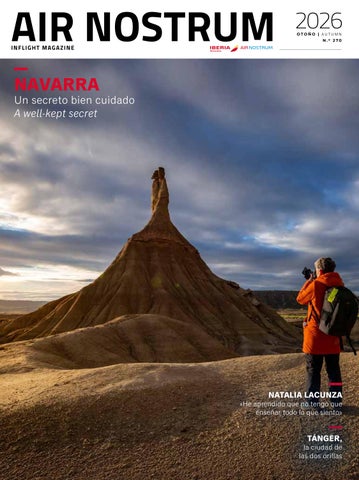
NAVARRA
Un secreto bien cuidado A well-kept secret
NATALIA LACUNZA
«He aprendido que no tengo que enseñar todo lo que siento»
TÁNGER,
la ciudad de las dos orillas
CARTA DEL PRESIDENTE | LETTER FROM THE PRESIDENT | 3
CARLOS BERTOMEU
BIENVENIDOS A BORDO Welcome on board!
No es casualidad que la portada de la revista que ahora tiene entre sus manos esté dedicada a la Comunidad Foral de Navarra. El 25 de octubre estrenamos la ruta Barcelona-Pamplona, multiplicando así las oportunidades para que ustedes, nuestros clientes, puedan disfrutar de los atractivos turísticos de este territorio único al que también volamos desde Madrid. Air Nostrum ya operó la ruta Pamplona-Barcelona entre 1997 y 2012 y también entre 2022 y 2023, llegando a transportar 95 000 pasajeros al año. En esta nueva etapa, los pasajeros navarros disponen de tres frecuencias semanales para acercarse a la Ciudad Condal –los martes, viernes y domingos- con la excelente conectividad que ofrece el segundo aeropuerto de España. Desde El Prat nuestros usuarios también pueden enlazar con 16 destinos nacionales y 34 internacionales gracias al acuerdo de código compartido que Air Nostrum ha suscrito con Vueling. Asimismo, aquellos que se desplacen desde el aeropuerto del Prat también podrán volar a Noáin esos mismos días. Una oportunidad excelente para los amantes de la naturaleza, ya que la paleta de colores del otoño navarro abarca desde el verde intenso de los valles pirenaicos hasta los tonos ocres y rojizos de sus hayedos y bosques de ribera. ¿Sabía usted que Navarra es la comunidad autónoma con más espacios protegidos por kilómetro cuadrado? Pues sí, el 33 % de su superficie forma parte de este tipo de espacios naturales. Y si, además, es amigo del senderismo tiene, nada más y nada menos, que cinco caminos diferentes para peregrinar a Santiago de Compostela atravesando la comunidad. El año 2027 es Año Jacobeo, anímese y pruebe alguno de ellos. La primera vez que pisé Navarra fue en 1982. Viajé entonces con unos compañeros de universidad y me sorprendió la calidez de su gente y su increíble gastronomía. Les confieso que conocía la fama de sus chistorras y chuletones, pero me deslumbró el poderío de su increíble huerta. Entonces hice algunos descubrimientos que aún frecuento en sus restaurantes como las acelgas, las borrajas o el cardo y me reafirmé en ese repóker de ases que conforman las pochas, los pimientos, los guisantes, los tomates y, por supuesto, los espárragos que aún compro frescos cuando voy por allí y cuezo en mi casa. Pamplona, para mí, son recuerdos de Sanfermines de juventud y de pinchos compartidos con navarros de ley. Brindo por ellos. No dejen de visitar Navarra y que disfruten del vuelo.
It is no coincidence that the magazine that you are holding in your hands features the Chartered Community of Navarra on its cover. On 25 October, we will launch the Barcelona-Pamplona route, giving our customers even more opportunities to explore the sights of this unique region, which we also serve from Madrid. Air Nostrum previously operated the Pamplona-Barcelona route from 1997 to 2012 and again from 2022 to 2023, carrying 95,000 passengers a year. In this new phase, passengers from Navarra can fly to Barcelona three times a week–on Tuesdays, Fridays and Sundays– and benefit from the excellent connections available at Spain’s second-largest airport. From El Prat, our customers can also connect to 16 domestic and 34 international destinations thanks to Air Nostrum’s codeshare agreement with Vueling. Travellers departing from El Prat airport can likewise fly to Noáin on the same days. This is an excellent opportunity for nature lovers, as Navarra’s autumn landscape comes alive with colour, from the deep greens of the Pyrenean valleys to the ochre and red hues of its beech woods and riverside forests. Did you know that Navarra has more protected areas per square kilometre than any other autonomous community in Spain? In fact, they cover 33% of the region. And if you are a hiking enthusiast, you can choose from no less than five different routes to make a pilgrimage to Santiago de Compostela across the region. With 2027 marking a Jacobean Holy Year, take the first step and explore some of them. I first visited Navarra in 1982 when I was travelling with a group of college friends and I was struck by the warmth of its people and its remarkable gastronomy. I must confess that I already knew about its famous chistorra sausage and T-bone steaks, but the abundance of its market gardens was a revelation. I also came across some ingredients that I still seek out in their restaurants such as chard, borage and cardoon, and renewed my appreciation for the fantastic five–green beans, peppers, peas, tomatoes and, of course, asparagus, which I still buy fresh whenever I visit to later cook at home. For me, Pamplona brings back memories of the Sanfermines in my youth and of sharing pinchos with true locals. I raise my glass to them. Make sure you visit Navarra–and enjoy the flight.
Edita / Publisher Air Nostrum Líneas Aéreas Presidente/President Carlos Bertomeu Director Comunicación Air Nostrum / Communications Director Antonio de Nó Coordinador Air Nostrum Air Nostrum Coordination Jorge Aguadé prensa@airnostrum.com
SU
Dirección editorial / Editorial Director Ana I. Martínez Dirección de Marketing / Marketing Director Francisco Robles Dirección de Publicidad / Advertising Director Benita Espadas y Virginia Calvo
Traducción / Translation Adriana Pallero Singleton Firmas invitadas / Guest contributors Paz Ferrer, Javier Ortega Diagramación y Diseño Layout and design Clara Prieto, Óscar Rodríguez, Carmina Canseco, Marta Menéndez, Lydia Medina, Esperanza Prieto, Cristina Pangua Fotografía / Photography J. C. Barberà Archivo Editorial MIC, Agencias Publicidad / Advertising Tel. 646 019 658 – 902 271 902 comunicacion@editorialmic.com Correspondencia / Contact mic@editorialmic.com Producción editorial / Editorial production Editorial MIC www.editorialmic.com
DL V1978-2017
MARIO SUMMARY
GASTRONOMÍA | GASTRONOMY
LA COCINA DEL EQUILIBRIO CUISINE OF BALANCE
38 12
Dirección ejecutiva / Executive Director Fernando Santos Vicente
Redacción / Editors Editorial MIC: Gerard Olivares, Luis Tejedor, Desiré Alija, Diego Álvarez, Anna Burgstaller, Markel Sierra, Pablo Santamarta, Sandra Robles, Diego Rodríguez, Ana Fernández.
N.º 270 | OTOÑO | AUTUMN | 2026
FLASH TRIP | TÁNGER
LA CIUDAD DE LAS DOS ORILLAS A city of two shores
CARTA DEL PRESIDENTE
LETTER FROM THE PRESIDENT
3
48
DESTINO NAVARRA CHECK IN NAVARRA
Un secreto bien cuidado A well-kept secret
12 AGENDA
TOP 6 ENTREVISTA | INTERVIEW MIKEL ZABALZA NATALIA LACUNZA
26
OPORTO, LA CIUDAD DEL DUERO Y EL ATLÁNTICO PORTO, WHERE THE DOURO MEETS THE ATLANTIC
56
60
66
LLEGADAS | SLEEP NIGHT
96
ENTRE LETRAS | LETTERS
LAB | SCIENCE MARE NOSTRUM
HOTEL PALACIO DE LOS ÁNGELES
De los bits a los cúbits From bits to qubits
120
102
CARMEN MOLA
102
OUTSIDERS
FRANK SINATRA, A SU MANERA HIS WAY
AIR CARE | PRODUCTOS
76
124 MOTOR | FIAT GRANDE PANDA
BEAUTY ADVISOR by
EL REGRESO DEL ICONO EN GASOLINA, HÍBRIDO Y ELÉCTRICO THE RETURN OF THE ICONIC MODEL IN PETROL, HYBRID AND ELECTRIC VERSIONS
PAZ FERRER
ICONOS ARQUITECTÓNICOS ARCHITECTURAL ICONS
NOTICIAS | NEWS
Tres hoteles en tres Navarras Three hotels in the three Navarras
RINCONES CON ENCANTO | CHARMING PLACES VILLA DIODATI
82
110
88
ENTREVISTA | INTERVIEW
LUZ CASAL
130
VENTA A BORDO BUY ON BOARD
138 NUESTRA COMPAÑÍA | CREW
140
PEDRO MONJE
“Pilotar un avión es una coreografía perfectamente ensayada”
116
“Flying a plane is a perfectly rehearsed choreography”
TRAVEL MEMORIES
FIRMA INVITADA
ROALD AMUNDSEN Un hombre, dos polos One man vs. the Poles
ALGO MÁS QUE FOTOS
RELATOS DE VIAJE |
146
MORE THAN JUST PICTURES
Elvira Graullera Moróder
12 | DESTINO NAVARRA | CHECK IN NAVARRA
CON ESPACIOS NATURALES COMO LA SELVA DE IRATI, LA HUERTA DE LA RIBERA RECONOCIDA EN TODO EL TERRITORIO NACIONAL Y MONUMENTOS ARQUITECTÓNICOS ÚNICOS E INCOMPARABLES COMO EL PALACIO REAL DE OLITE O LA IGLESIA DE SANTA MARÍA DE EUNATE, NAVARRA PUEDE ESTAR ORGULLOSA DE LO QUE FUE, ES Y SERÁ.
Texto: Markel Sierra Ballesteros, Turismo de Navarra
A WELL-KEPT SECRET UN SECRETO BIEN CUIDADO
UN MOSAICO DE HISTORIA, NATURALEZA Y SABORES A M O S A I C O F H I S T O R Y, N AT U R E , A N D F L A V O U R S
DESTINO NAVARRA | CHECK IN NAVARRA | 13
Elizondo WITH NATURAL AREAS SUCH AS THE IRATI FOREST, THE NATIONALLY RENOWNED RIBERA VEGETABLE GARDENS, AND OUTSTANDING ARCHITECTURAL LANDMARKS SUCH AS THE ROYAL PALACE OF OLITE AND THE CHURCH OF SANTA MARIA DE EUNATE, NAVARRA CAN TAKE PRIDE IN ITS PAST, PRESENT, AND FUTURE.
H
ace millones de años, mucho antes de que los homínidos pasearan por territorio vascón, las caprichosas voluntades geológicas y tectónicas crearon una tierra llena de contrastes de los que tanto presume Navarra. Visitarla es abrir un catálogo y seleccionar entre todo el abanico de posibilidades paisajísticas, culturales y gastronómicas.
Navarra cuenta con hasta cuatro climas diferentes y es precisamente eso lo que la hace un país en miniatura. Las Bardenas Reales son un paisaje desértico casi lunar que ha protagonizado innumerables películas y series como Juego de Tronos, mientras que, en el extremo norte, encontramos extensos hayedos, como el de Quinto Real o la selva de Irati, que es el segundo hayedo más grande de Europa. Las verdes praderas húmedas de los valles pirenaicos están salpicadas de las famosas ovejas latxas y los caseríos o baserris tradicionales. Hay que empaparse de esta atmósfera rural en los pueblos de Ziga, Arizkun, Erratzu, Ochagavía e Isaba, ejemplos del paisaje característico y tradicional del norte de Navarra. Más al sur, Artajona, Estella-Lizarra, Corella (también con arquitectura barroca) y Viana están entre las poblaciones
M
illions of years ago, long before hominids walked across Vasconian territory, fickle geological and tectonic forces shaped a land of striking contrasts that Navarra proudly boasts of. Visiting the region is like browsing a catalogue and choosing from a myriad of scenic, cultural, and gastronomic options. Navarra has up to four different climates and that is precisely what makes it a country in miniature. The Bardenas Reales create an almost lunar desert landscape that has starred in countless films and TV series, including Game of Thrones. In the far north, by contrast, we find extensive beech woods, such as Quinto Real and the second-largest beech forest in Europe, Irati Forest. The lush, rain-fed meadows of the Pyrenean valleys are dotted with the famous Latxa sheep and traditional farmhouses, or baserris. You can soak up this rural atmosphere in villages such as Ziga, Arizkun, Erratzu, Ochagavía, and Isaba, which capture this distinctive and traditional landscape of northern Navarra. Farther south, Artajona, Estella-Lizarra, Corella (with Baroque architecture) and Viana are among the finest examples
14 | PAISAJES | LANDSCAPES
más representativas de la arquitectura más propia del sur de la comunidad. Este valor paisajístico enorme es capital y hace de Navarra el territorio de la península con más espacios naturales protegidos por kilómetro cuadrado. El 33 % de la superficie de Navarra forma parte de espacios protegidos, prueba del patrimonio natural que posee y el compromiso para su conservación. En aras de fomentar la sostenibilidad, Navarra ofrece innumerables opciones de senderismo y cicloturismo. Algunos de los senderos imprescindibles son el de la cascada de Oinaska (entre castaños y robles centenarios), el del nacedero del Urederra (río de aguas azules) y el Hayedo Encantado (para aprender también sobre los carboneros), todos ellos asequibles como actividad familiar. Para los ciclistas,
¡ORGANIZA EXCURSIONES Y PLANES A TU MEDIDA! Escanea este código para consultar el catálogo completo de aventuras que Navarra ofrece:
Navarra no se queda atrás, pues hay más de una forma de recorrerla en bici: gravel en las Bardenas Reales, mountain bike (con más de 3000 km de pistas), vías verdes (entre ellas las del Plazaola) y, por último, el Camino de Santiago, que cruza la región por cinco rutas diferentes, que conectan con las rutas EuroVelo1 y EuroVelo 3. Cuatro formas únicas de recorrer la comunidad sobre dos ruedas.
Se hace camino al andar
Caminante, no hay camino, hay caminos: dos vertientes del Camino Francés , el Camino del Baztán, el del Ebro y el de la Sakana. Estos cinco caminos atraviesan la comunidad para dirigir a los peregrinos hacia Santiago de Compostela. Desde Luzaide/Valcarlos entra el Camino Francés, el más famoso y tradicional de una de las mayores rutas de
P LA N YO U R O W N TA I LO R - M A D E T RI PS A N D O U T I N G S! Scan this code to explore the full catalogue of adventures Navarra has to offer
DESTINO NAVARRA | CHECK IN NAVARRA | 15
peregrinación del mundo, que recorre la comunidad desde los Pirineos hasta La Rioja, visitando Orreaga/Roncesvalles, Pamplona y Puente la Reina, entre otros sitios destacables. A medida que el camino discurre, los verdes de las montañas pirenaicas se transforman en ocres y rojos de los viñedos. Durante el Jacobeo 2027, los peregrinos que lleguen a la catedral podrán obtener la indulgencia plenaria, de acuerdo con la fe cristiana. Esta importancia capital que tuvo la ciudad de Santiago en la Edad Media ayudó a construir una red humana, artística y cultural que ha quedado reflejada a ambos lados del camino, con manifestaciones patentes en Navarra. ¡Buen camino!
of the region’s characteristic southern architecture. This exceptional landscape is of great value and makes Navarra the region with the highest concentration of protected natural areas per square kilometre on the Iberian Peninsula. Protected areas in Navarra cover 33% of its surface, reflecting its natural heritage and commitment to its conservation. To promote sustainability, Navarra offers countless hiking and cycling routes. Highlights include the Oinaska waterfall (among chestnut groves and centuries-old oaks), the Urederra River’s source (river of blue waters) and the Enchanted Beech Forest (where you can also learn about the charcoal
Air Nostrum vuela desde Navarra Bosque del Nacedero del Urederra. Turismo de Navarra
3 vuelos diarios con Madrid durante toda la temporada de invierno. 3 vuelos semanales con Barcelona los martes, viernes y domingos.
16 | DESTINO NAVARRA | CHECK IN NAVARRA
EL VALLE DE BAZTÁN: UN FIN DE SEMANA DE MONTAÑA, GASTRONOMÍA, CULTURA E HISTORIA Situado en los Pirineos navarros, este valle es el enclave en el que se basa la Trilogía del Baztán de Dolores Redondo. Para los amantes de la historia, aquí se encuentra el último bastión de resistencia navarro ante la conquista castellana, el castillo de Amaiur. Aunque poco queda de ese castillo, es conveniente visitar, por un lado, las ruinas y la exposición sobre el mismo y su historia, y, por otro lado, las casas típicas y algunos palacetes de localidades como Elizondo, Arraioz o Irurita, una visita muy recomendada. Si, en cambio, se busca estar en contacto con la naturaleza, es aconsejable dar un agradable paseo hasta la cascada de Xorroxin, uno de los nacederos del río Bidasoa, o adentrarse en la cueva de Zugarramurdi, donde también se puede conocer la historia de la brujería. No es conveniente caer rendido sin antes haber comido. Las delicias del Batzan son múltiples: chuletas, platos de caza, patés, setas, licores, txantxigorris, cuajada y el célebre queso; comida de todos los sabores para todos los gustos. Con la tripa ya llena, solo queda absorber la cultura que exuda el valle: danzas, deporte rural, folklore y tradiciones por doquier. Mejor vivirlo que leerlo. BAZTÁN VALLEY: A WEEKEND OF MOUNTAINS, GASTRONOMY, CULTURE, AND HISTORY Set in Navarra’s Pyrenees, this valley provides the backdrop for Dolores Redondo’s Baztán Trilogy. History enthusiasts can visit the last stronghold of Navarra’s resistance to the Castilian conquest, Amaiur Castle. Little of the castle remains, but the ruins and the exhibition about its history, as well as the traditional houses and palaces in towns such as Elizondo, Arraioz and Irurita are well worth a visit.
Senderistas en la Ruta de la cascada de Oinaska Elizondo-Elbete
If you would rather connect with nature, you can take the pleasant walk to Xorroxin waterfall, one of the sources of the Bidasoa River, or explore Zugarramurdi cave, where you can also learn about the history of witchcraft. No visit is complete without sampling Baztán’s delicacies: chops, game, pâtés, mushrooms, liqueurs, txantxigorris, junket, and its famous cheese: food of all flavours to suit every taste. With a full belly, you can then immerse yourself in the valley’s rich culture of dances, rural sports, folklore, and traditions. Better to experience it than to read about it.
Camino de acceso al santuario de Aralar
Valle de Baztán, Francis Vaquero. Turismo de Navarra
DESTINO NAVARRA | CHECK IN NAVARRA | 17
making), all of them suitable for the whole family. For cyclists, Navarre is equally rewarding, with more than one way to explore it by bike: gravel riding in the Bardenas Reales, mountain biking (with more than 3,000 km of trails), greenways –including the Plazaola route– and, finally, the Camino de Santiago, which crosses the region along five different routes connecting with EuroVelo 1 and EuroVelo 3. Four unique ways to discover Navarre on two wheels.
You find your way as you go along
Casas de duendes en la ruta de los dólmenes de Oderitz, Navarra. Mikel Muruzabal
Traveller, there is no road, there are roads: two branches of the French Way, the Camino del Baztán, the Camino del Ebro, and the Camino de la Sakana. These five routes cross the region, guiding pilgrims towards Santiago de Compostela. From Luzaide/Valcarlos, the French Way enters Navarra. The most famous and traditional of one of the largest pilgrimage routes in the world, it runs through the region from the Pyrenees to La Rioja, stopping at Orreaga/Roncesvalles, Pamplona and Puente la Reina, among other remarkable sites. Along the way, the greens of the Pyrenean mountains are transformed into the ochres and reds of vineyards. During the 2027 Jacobean Holy Year, pilgrims who arrive at the cathedral will be able to obtain the plenary indulgence as per the Christian faith. The importance of the city of Santiago in the Middle Ages helped create a human, artistic and cultural network that has been reflected on both sides of the route, with manifestations evident in Navarra. Have a good journey!
18 | DESTINO NAVARRA | CHECK IN NAVARRA
El sabor de la diversidad
La despensa navarra está llena de productos de su propia huerta: entre otros, espárragos, alcachofas, pochas, alubias, tomates y pimientos; no en vano Tudela, la capital de la merindad, es conocida como la Capital de la Verdura. Las cocinas y los restaurantes siempre rebosan de productos locales y producen cocina de proximidad gracias a proyectos como Del campo a la mesa-Larretik mahaira. Se trata de una iniciativa para fortalecer la unión entre la hostelería y el sector primario de toda la geografía navarra. A todas las cocinas de la geografía llegan los perretxikos y hongos recogidos en el valle de Ultzama, así como las castañas de Quinto Real, sabores tradicionales de la Navarra otoñal. Ya en invierno, más al sur, en Tierra Estella, es posible recolectar las preciadas trufas, apodadas «diamantes negros navarros». El frío, sin embargo, no interrumpe la producción, ya que en los campos abundan las inverduras, deliciosas verduras que crecen en invierno, cuando las demás se esconden: brócoli, coliflor, apio, acelga, borraja, cardo, berza o calabaza. Una vez en la cocina, nacen grandes clásicos de la gastronomía navarra: las pochas de Sangüesa, las migas de pastor y las garrapiñadas de Ujué, la menestra navarra, los cogollos de Tudela, el cardo a la navarra, el cordero al chilindrón, el chuletón, la emblemática txistorra y quesos con Denominación de Origen Idiazábal y Roncal, y, para los más golosos, la costrada de Aoiz, la cuajada y los canutillos.
The taste of diversity
Navarra’s pantry is stocked with produce from its own vegetable gardens, including asparagus, artichokes, string beans, white beans, tomatoes, peppers, and cherries from Ribera. Not in vain Tudela, the capital of the merindad, is known as the vegetable capital of Spain. Kitchens and restaurants are always full of local produce and ingredients through projects such as Del campo a la mesa - Larretik mahaira. This initiative strengthens ties between the hospitality industry and the primary sector throughout Navarre. Across the whole geography, menus feature perretxikos and mushrooms collected in the Ultzama Valley, as well as chestnuts from Quinto Real, both traditional flavours of Navarra’s autumn. In winter, farther south, in Tierra Estella, prized truffles known as “Navarra’s black diamonds” can be harvested. The cold does not halt production, as in the fields there is an abundance of inverduras or winter vegetables, true delicacies that thrive when other vegetables are scarce such as broccoli, cauliflower, celery, chard, borage, cardoon, collard greens, and squash. In the kitchen, these ingredients are transformed into some of Navarra’s great classics: Sangüesa green beans, migas de pastor, Ujué caramelised almonds, vegetable stews, Tudela lettuce hearts, Navarra-style cardoon, chilindrón lamb, T-bone steak, the iconic txistorra sausage, and Idiazabal and Roncal PDO cheeses, and, for dessert, junket, Aoiz costrada pastry cake, and canutillos. Dishes can be enjoyed with a fine cider–at the cry of txotx, the bottle (or barrel) is opened and served straight away. Navarra also produces wines under both the Rioja and Navarra Designations of Origin. And what better way to round off the meal than with a glass of patxarán? This traditional Navarrese liqueur is made by macerating sloe berries in anise liqueur, which gives
DESTINO NAVARRA | CHECK IN NAVARRA | 19
OTROS REGALOS DE INVIERNO: OLENTZERO Los más pequeños reciben la visita del afable Olentzero, un hombre que vive aislado en la montaña y que, durante el año, dedica su vida a hacer carbón vegetal. En Nochebuena, baja de las montañas con su burro para repartir regalos y felicidad a los que se han portado bien; a los que no…
OT HE R WI NT E R GI F TS : OL E NT ZE RO Little ones receive the visit of the friendly Olentzero, who lives alone in the mountains and spends the year making charcoal. On Christmas Eve, he comes down from the mountains with his donkey to bring gifts and joy to those who have behaved well–and as for those who have not…
La historia de este personaje mitológico se remonta a la era precristiana, cuando se asociaba con el solsticio de invierno y la llegada de la luz. Desfila por el pueblo, los niños le cantan canciones, hay música de txistus y gaitas, cuentacuentos, danzas… Para ver llegar a Olentzero, se puede visitar Lesaka, de donde se considera originario, o también las granjas escuela Basere, Ultzama, Xuberoa, Hartiz Berri, Gure Sustraiak o Naturalia.
The story of this mythological figure dates to pre-Christian times, when he was linked to the winter solstice and the return of light. As he parades through the village, children sing, txistus and bagpipes play, and storytelling and dancing fill the streets. To welcome Olentzero, you can visit Lesaka, regarded as his place of origin, or the Basere, Ultzama, Xuberoa, Hartiz Berri, Gure Sustraiak, and Naturalia teaching farms.
La Navidad es una buena excusa para alojarse en Navarra en cualquiera de sus casas rurales y celebrarlas en buena compañía, al calor del fuego bajo.
Para poder pasar la comida, es posible acompañar los platos con una buena sidra; al grito de «txotx», se abre la botella (o la barrica) y se escancia al momento. Además, en Navarra se producen vinos con Denominación de Origen Rioja y Navarra. Al terminar, qué mejor para bajar la comida que una copica de patxarán, licor tradicional navarro hecho con anís macerado en endrinas (o arañones) que se vuelve rojo pasión. El equilibrio entre dulzor y carácter delata los siglos de tradición y refleja a la perfección el paisaje de Navarra. Es posible, y muy recomendable, experimentar la gastronomía de más cerca. En la página web oficial de Turismo de Navarra (https://www.visitnavarra.es/es/home) se detallan toda clase de visitas inmersivas y catas en queserías, bodegas, destilerías, trujales, museos y salineras. Entre todas ellas, destaca la experiencia prémium en la destilería Zoco (en Dicastillo), donde es posible descu-
Christmas is a good excuse to stay in one of Navarra’s rural houses and celebrate in good company beside a warm hearth.
brir la historia del patxarán y sus secretos mejor guardados. Una hora y media en la que se ve, se toca, se huele y se prueba la tradición, paseando entre endrinos, elaborando patxarán y degustando los mejores cócteles elaborados durante la visita.
it its unique deep-red colour. Its balance of sweetness and character perfectly reflects centuries of tradition and the landscape of Navarra. For an even closer look at Navarra’s gastronomy, the region’s official tourism website (https://www. visitnavarra.es/es/home) details all
PEQUEÑOS BOCADOS, GRANDES SABORES Aunque es posible disfrutar de los pintxos en toda la geografía navarra y en cualquier momento, en el Casco Antiguo de Pamplona –lo Viejo– y Tudela existe la costumbre de ir de pintxos.
SM A L L B I T E S , GRE AT F L AV OURS You can enjoy pintxos throughout Navarra’s geography at any time, but in Pamplona’s old town (Lo Viejo) and Tudela it’s customary to go out for pintxos.
20 | DESTINO NAVARRA | CHECK IN NAVARRA
Piedra a piedra
La geología y el clima no son las únicas fuerzas que han moldeado el paisaje de la comunidad; el ser humano también ha dejado su impronta. Navarra es tierra de monumentos megalíticos, por su variedad y concentración. Los dólmenes de Artajona y la gran concentración de la sierra de Aralar son claros ejemplos. El patrimonio arquitectónico de Navarra, no obstante, va mucho más allá. Siglos después, los romanos construyeron termas, templos, foros, mosaicos… En definitiva, fundaron ciudades, entre las que se incluye la capital, Pompaelo, y la emblemática Santa Criz de Eslava, la mejor conservada de toda la comunidad.
Al pasear por este yacimiento, es posible ver el antiguo foro y la necrópolis. Con la Reconquista, Pamplona ganó fuerza hasta convertirse en reino. Durante esta época dorada se construyeron algunos de los más insignes edificios navarros. Entre los monasterios destacan el de Fitero, el de La Oliva, el de Urdax y el de Leyre; este último es conjunto monástico románico, único en la península, cuya existencia ya estaba documentada en el siglo ix, una joya arquitectónica que mezcla varios estilos, entre ellos un temprano románico muy bien conservado. Todavía hoy pueden escucharse los
Iglesia de Santa María de Eunate, Francis Vaquero. Turismo de Navarra
cantos. gregorianos de los monjes que lo habitan. Otra obra maestra del románico es la Iglesia de Santa María de Eunate. La imperfecta planta centralizada y octogonal está situada donde se juntan las dos vertientes del Camino de Santiago Francés y atrae a estudiosos y visitantes por igual. El horario cambia según el mes, por lo que se recomienda consultar la página oficial, donde también se indican los precios y las opciones de visita. Tras avanzar unas etapas en el Camino, se halla otra peculiar iglesia octogonal, la Iglesia del Santo Sepulcro, en Torres del Río.
DESTINO NAVARRA | CHECK IN NAVARRA | 21
kinds of immersive experiences and tastings in cheese shops, wineries, distilleries, oil mills, museums, and salt mines. A highlight is the premium experience at the Zoco distillery in Dicastillo, where visitors can discover the history of patxarán and its best-kept secrets. During the 90-minute visit you can see, touch, smell and taste the tradition, walking among sloe bushes, making patxarán, and tasting the best cocktails prepared during the visit.
Palacio Real de Olite, Francis Vaquero. Turismo de Navarra
Illunbetako Arrate. Miguel Sierra
Aralar, Artzabal. Miguel Sierra
Monasterio de San Salvador de Leyre, Francis Vaquero. Turismo de Navarra
Stone upon stone
Geology and climate are not the only forces to have shaped the region’s landscape; human beings have also left their mark. Navarra is a land rich in megalithic monuments, both in their variety and concentration. The dolmens of Artajona and the many remains found in the Sierra de Aralar are clear examples. Yet Navarra’s architectural heritage goes much further. Centuries later, the Romans built baths, temples, forums, and mosaics, founding towns such as Pompaelo, now the regional capital, and the iconic Santa Criz de Eslava, the best-preserved Roman town in the region, where visitors can look at the former forum and necropolis. During the Reconquista, Pamplona grew in power and eventually became a kingdom. This golden age produced some of Navarra’s most famous buildings. Among the monasteries are Fitero, Oliva, Urdax, and Leyre; the latter is a unique Romanesque monastic complex on the Iberian Peninsula whose existence was already documented as early as the 9th century. It is an architectural gem that blends several styles, including very well preserved early Romanesque elements. Today visitors can still enjoy the Gregorian chants performed by the resident monks. Another Romanesque masterpiece is the church of Santa María de Eunate. Its irregular centralised, octagonal plant stands where the two branches of the French Way meet, attracting scholars and visitors alike. The opening hours vary
22 | DESTINO NAVARRA | CHECK IN NAVARRA
NAVARRA MONUMENTAL: ESTELLA-LIZARRA, ARTAJONA Y JAVIER Estella-Lizarra, la estrella medieval, es una ciudad llena de historia que creció alrededor del Camino de Santiago. Esta localidad cuenta con tesoros románicos sin parangón, entre los que destacan el palacio de los reyes de Navarra (cuyos capiteles historiados son joyas que deben pasarse por alto), la portada norte de la iglesia de San Miguel (con un conjunto escultórico del románico tardío) y, por supuesto, la iglesia de San Pedro de la Rúa (con influencias árabes y un claustro del siglo xii). Artajona es hoy un pueblo rodeado por completo de murallas fortificadas y torres medievales, el conocido como Cerco de Artajona. Es símbolo de la resistencia de la Navarra medieval, que luchaba por no ser anexada a Castilla. Tal fue el poderío defensivo de Artajona que, durante unos años, a mediados del siglo xii, fue reino independiente. Aparte de la legendaria arquitectura, también no pueden dejar de verse los famosos dólmenes, que son tumbas de galería de la Edad del Bronce, características del Mediterráneo occidental. El castillo de Javier es otra de las innumerables fortificaciones que otrora defendieron el reyno. Esta, no obstante, tiene un significado mucho más central en la identidad navarra. Aquí nació en 1506 san Francisco Javier, copatrono de la comunidad foral.
El emblemático Palacio Real de Olite, renovado en el siglo xv por Carlos III, el Noble, fue una de las residencias oficiales de los reyes de Navarra y de él se decía que tenía «tantas habitaciones como días tiene el año». Su peculiar silueta resalta sobre Olite por ser un conjunto anárquico de torres, jardines, galerías y patios. Las visitas teatralizadas ofrecen una experiencia mucho más inmersiva y amena. Para completar el día, es recomendable probar las migas de pastor y las almendras garrapiñadas de la vecina Ujué, unos de los pueblos más bonitos de España. ¡Con suerte, puede verse el castillo de Olite desde la iglesia fortaleza de Santa María de Ujué! Naturaleza, cultura y tradición conviven en armonía en Navarra para ofrecer una experiencia sorprendente, inolvidable y llena de matices. Siempre hay una forma nueva de visitar Navarra y las puertas siempre están abiertas a quienes ya han decidido vivir o revivir la riqueza de un antiguo reino.
Castillo de Javier, Francis Vaquero. Turismo de Navarra
by month, so it is recommended to check the official website, where prices and tour options are also shown. A few stages farther along the route, you will find another peculiar octagonal church, the Church of the Holy Sepulchre in Torres del Río. MO NUM E NTA L NA VA R R A : E ST E LL A - L I ZA R R A, AR TA JO NA , A ND J A V I ER Estella-Lizarra, the medieval icon, is a town steeped in history that grew around the Camino de Santiago. It boasts unparalleled Romanesque treasures, such as the Palace of the Kings of Navarre (whose historiated capitals are not to be missed), the north portal of the Church of San Miguel (with a late Romanesque sculptural ensemble); and, of course, the Church of San Pedro de la Rúa (with Arab influences and a 12th-century cloister). Artajona is a village surrounded entirely by fortified walls and medieval towers known as the Cerco de Artajona. It symbolises medieval Navarra’s resistance to annexation by Castile. The defensive power of Artajona was so powerful that, for a few years in the mid-12th century, Artajona was its own independent kingdom. Beyond its legendary architecture, we also recommend visiting the famous dolmens, which are Bronze Age gallery tombs characteristic of the western Mediterranean. The Castle of Javier is another of the countless fortifications that once defended the kingdom, but it holds particular significance in Navarrese identity. Saint Francis Xavier, co-patron of the region, was born here in 1506.
The iconic Royal Palace of Olite, renovated by Charles III the Noble in the 15th century, was one of the official residences of the kings of Navarre and was said to have “as many rooms as there are days in the year”. Its peculiar silhouette rises above Olite in a haphazard arrangement of towers, gardens, galleries and courtyards. Dramatised tours offer a much more immersive and enjoyable experience. To round off the day, try the migas del pastor and the caramelised almonds of the neighboring Ujué, one of the most beautiful villages in Spain. Let’s see if you can spot Olite Castle from the fortress church of Santa Maria de Ujué! In Navarra, nature, culture, and tradition come together in harmony to offer an unforgettable, surprising experience full of nuances. There is always a new way to discover the region, which warmly welcomes both first-time visitors and those returning to relive the wealth of this ancient kingdom.
ZABALZA 26 | ENTREVISTA | INTERVIEW
MIKEL TEXTO: Luis Tejedor
«LA LLAMA DE LA ESCALADA NUNCA SE HA APAGADO PARA MÍ» “MY PASSION FOR CLIMBING HAS NEVER WANED”
Zabalza siempre acaba regresando a las montañas que tiene cerca de casa. Todo un Ulises navarro que se reconoce, ante todo, como un enamorado de los Pirineos. Desde allí ha forjado una trayectoria legendaria que lo ha llevado al mítico K2 y a las grandes paredes de medio mundo. También ha dedicado buena parte de su experiencia a formar a otros: durante trece años dirigió el Equipo Español de Alpinismo masculino. Hoy sigue mirando las montañas con la misma apetencia que le azuzó a ellas cuando era niño.
Zabalza always ends up going back to the mountains near home. A true Navarraborn Ulysses, he considers himself first and foremost a lover of the Pyrenees. He has built an impressive career from there that has taken him to the legendary K2 and big walls across the world. He has also devoted much of his experience to training others, leading the Spanish Men’s Alpinist Team for thirteen years. Today, he continues to look at the mountains with the same eagerness that first drew him to them as a child.
ENTREVISTA | INTERVIEW | 27
Parece que los navarros llevan de serie el amor por la montaña… Es una tierra en la que hay mucha tradición montañera. Siempre la he vivido desde pequeño. Cada generación, además, ha tenido sus referentes. En mi caso, fueron Mari Ábrego, Josema Casimiro o Iñaki Aldaya. Eso en cuanto a grandes alpinistas. También aquí hubo grandes escaladores como Berazaluce o Melero. ¿Cómo nació en usted esta atracción? Tengo entendido que tuvo que demostrar tesón desde pequeño… Con diez años ya me apunté a un club de montaña por iniciativa propia, no fue cosa de mis padres. Mis padres me llevaban al campo o al pueblo de mi abuela, no al monte. En ese club empecé con las primeras excursiones y el contacto con las cuerdas. Durante años trabajaba arduamente para financiarse sus escaladas. ¡Difícil de explicar a quien no es de este mundillo! Sí que lo es. Te mueve la pasión por acceder a estos entornos salvajes y vivir aventuras. No me importó mucho dónde me ganaba la vida porque mi objetivo principal era ganar tiempo y dinero para escalar en lugares remotos; cuanto más lejos, más me llamaba la atención. Así fue durante muchos años. Me empleaba en trabajos verticales o montando un invernadero, por ejemplo. Todo para ganar dinero. Cuarenta expediciones fuera de Europa y sigue siendo un acérrimo pirineísta. ¿Qué tiene esta cordillera que no tenga el Karakórum? Aunque el Karakórum está muy bien, las montañas más cercanas a nuestra casa son las que más queremos. Las siento parte de mí mismo. Para amar mucho un lugar, tienes que conocerlo bien. En mi caso, he explorado muchos rincones del Pirineo occidental, que tiene auténticos tesoros. De hecho, mis mejores escaladas invernales han sido en los Pirineos occidentales.
It seems that people from Navarra have an innate love for the mountains. It’s a region with a strong mountaineering tradition. I’ve always been familiar with it since I was a child. Each generation has had its own heroes. Mine included Mari Ábrego, Josema Casimiro, and Iñaki Aldaya. That’s in terms of great alpinists. There are also outstanding climbers, such as Berazaluce and Melero. How was that spark first kindled in you? From what I understand, you showed determination from a very young age. When I was ten, I joined a mountain club on my own initiative, not because of my parents. My parents would take me to the countryside or to my grandmother’s village, but not to the mountains. Through that club I went on my first outings and had my first rope climbing experience. For years, you worked hard to fund your climbs. That must be hard to explain to people outside this world! Yes, it is. You’re driven by the passion to reach these wild settings and live those adventures. I didn’t care much about how I earned a living because my main goal was to find the time and money to climb in remote places–the farther away, the more they appealed to me. It was like that for many years. I took jobs such as rope access work and greenhouse installation, for example. All to make money. After forty expeditions outside Europe, you remain a staunch lover of the Pyrenees. What does this mountain range offer that the Karakoram does not? Although the Karakoram is great, the mountains closest to home are the ones we love the most. I feel they are part of me. To truly love a place, you must know it well. In my case, I have explored many corners of the western Pyrenees, which have true gems.
28 | ENTREVISTA | INTERVIEW
Cuando se coronan monstruos como el K2, ¿la cabeza sigue dando vueltas a esa escalada o ya pone el ojo en otra meta? En mi caso, yo vuelvo con muchas ganas de escalar en roca. Se aviva la llama que llevas dentro. Hay veces, claro, que necesitas descansar, pero la llama de la escalada nunca se ha apagado para mí.
y voy a escalar de manera muy lúdica. En otras ocasiones, afronto escaladas en las que estoy cerca de mi límite y son un gran desafío para mí. Hay muchas cosas que me motivan, como el reto o la belleza del itinerario. También la compañía importa, claro. Es bonito cuando esa persona que te acompaña descubre un lugar que ya conoces.
Se habla mucho del valor del alpinista, pero poco de su miedo. ¿Con los años uno se acostumbra? El miedo es intrínseco al ser humano y una buena herramienta para estar alerta. Cuando algo nos da temor puede ser positivo, porque aguza los sentidos. Eso sí, es importante dominar el miedo para que no te deje colapsado. Para mí es algo bueno para mantenerse alerta.
Usted dirigió el Equipo Español de Alpinismo y pasaron por sus manos chavales que están en primera línea. ¿Orgulloso? Fue una etapa buenísima en mi vida. Me llena de orgullo ver a aquellos chicos que entraron en el equipo y que ahora hacen actividades tan punteras. Rubén San Martín, Manu Córdoba y tantos otros… Gente que ha demostrado un gran talento. No me voy a atribuir el mérito de las actividades que hacen, pero me siento satisfecho de haberlos dirigido en esos primeros estadios, en actividades de gran alpinismo.
¿Qué le ha enseñado la montaña sobre usted mismo? Es una pregunta difícil. La escalada me divierte muchísimo. Yo vivo cerca de las paredes de la Peña de Etxauri
In fact, my best winter climbs have been in the western Pyrenees. After summiting a giant like K2, does your mind keep focusing on that climb, or does it immediately turn towards the next goal? In my case, I always return eager to go rock climbing. The flame that you carry inside is rekindled. There are times, of course, when you need to rest, but my passion for climbing has never waned. People often talk about an alpinist’s courage, but rarely about his fears. Do you get used to them over the years? Fear is intrinsic to human beings and a great tool to remain alert. Being afraid of something can be positive because it sharpens your senses. Of course, it’s important to master those fears so that they don’t paralyse you. For me, it’s a good way to stay alert. What have the mountains taught you about yourself? That’s a difficult question. Climbing gives me great enjoyment. I live close to the walls of Peña de Etxauri and I climb there in a very playful way. At other times, I tackle climbs where I am close to my limits and are a big challenge for me. Many things motivate me, such as the challenge itself or the beauty of the route. The company also matters, of course. It’s nice when your companions discover a place that you already know.
ENTREVISTA | INTERVIEW | 29
En 2001 comenzó a colaborar con Al filo de lo imposible, aquel mítico programa de televisión. ¿Cómo se cuenta bien una escalada a un tipo que la ve desde el sofá? Para transmitir lo que sentimos, habría que ser un buen escritor. Efectivamente, 2001 fue el año de mi primera expedición y fuimos a unas rocas en la Antártida. Fue, seguramente, el lugar más mágico de cuantos he visitado en mi vida. Fue un privilegio ir con ese soporte. El lugar era inaccesible económicamente para mí, claro, y fue un cambio grande. Pasé de trabajar y ahorrar para poder escalar a ganar dinero con ello. ¿A dónde se llevaría usted, en Navarra, a una persona que no ha pisado una montaña en su vida? Tenemos el privilegio de contar con un entorno natural maravilloso y hay muchísimas opciones. Por ejemplo, el monte Beriain tiene unas vistas increíbles y está cerca de Pamplona.
You led the Spanish alpinism team and trained climbers who are now at the forefront. Does that make you proud? It was a wonderful period of my life. I’m proud to see those who joined the team now undertaking such cutting-edge projects. Rubén San Martín, Manu Córdoba, and so many others–people who have shown great talent. I would never claim credit for their achievements, but I’m satisfied to have guided them through those early stages and great alpinism experiences. In 2001, you began collaborating with the iconic TV show Al Filo de lo Imposible. How can you narrate well a climb to someone watching from their sofa? To convey what we really feel, you’d have to be a good writer. Indeed, 2001 was the year of my first expedition and we travelled to some rock formations in Antarctica. It was probably the most magical place I have ever visited. It was a privilege to go with that support. I could never have afforded it on my own, so it was obviously a big change–I went from working and saving money so I could climb to making money with it. Where in Navarra would you take someone who has never set foot on a mountain? We have the privilege of having a wonderful natural environment with countless options. For example, Mount Beriain offers stunning views and is close to Pamplona.
32 | ENTREVISTA | INTERVIEW
H AY L U G A R E S Q U E U N O D E J A AT R Á S S I N Q U E T E R M I N E N D E I R S E D E L TO D O. E N L A M Ú S I C A D E N ATA L I A L A C U N Z A , N A C I D A E N PA M P LO N A E N 1 9 9 9 , L A M E M O R I A T I E N E A LG O D E E S E M O V I M I E N TO. S U S E G U N D O Á L B U M , N 2 STA L 5 I A , V U E LV E L A M I R A D A H A C I A S O N I D O S D E OT R A S É P O C A S D E S D E U N A V O Z Q U E S E M U E V E C O N L I B E R TA D E N T R E L A S E N S I B I L I D A D A LT E R N AT I VA Y E L P O P, S I N D E M A S I A D A O B E D I E N C I A A L A S E T I Q U E TA S . Y C U A N D O H A B L A D E N AVA R R A , E L PA I S A J E S E V U E LV E C E R C A N O, C A S I D O M É ST I C O, C O M O S I R E G R E S A R C O N S I ST I E R A S I M P L E M E N T E E N R E C O N O C E R LO S L U G A R E S Q U E TO D AV Í A S E N T I M O S N U E ST R O S .
S O M E P L A C E S J U S T S TAY W I T H YO U AFTER YOU LEAVE THEM. IN THE M U S I C O F N ATA L I A L A C U N Z A , B O R N I N PA M P LO N A I N 1 9 9 9 , M E M O R Y C A R R I E S T H A T S A M E S E N S E O F M O V E M E N T. H E R S E C O N D A L B U M , N 2 STA L 5 I A , R E V I S I TS THE SOUNDS FROM EARLIER ERAS T H R O U G H A V O I C E T H A T M O V E S E A S I LY BETWEEN A LT E R N A T I V E SENSITIVITY A N D P O P, U N C O N C E R N E D B Y L A B E L S . W H E N S H E TA L K S A B O U T N AVA R R A , T H E L A N D S C A P E F E E LS I N T I M AT E , A L M O ST D O M E S T I C , A S I F R E T U R N I N G S I M P LY M E A N T R E C O G N I S I N G T H E P L A C E S T H AT STILL FEEL LIKE OUR OWN.
NATALIA
LACUNZA
ENTREVISTA | INTERVIEW | 33
«HE APRENDIDO QUE NO TENGO QUE ENSEÑAR TODO LO QUE SIENTO»
“I’VE LEARNT THAT I DON’T HAVE TO SHOW EVERYTHING I FEEL”
34 | ENTREVISTA | INTERVIEW
TEXTO: Luis Tejedor FOTOS: María Caparrós
¿Una carrera musical se planifica o se deja venir? No parece que a usted la ciegue el bling bling… Creo que hay una mezcla. Hay cosas que sí tienes que currarte y pensar, pero también hay una parte de dejarte llevar y ver qué te pasa por el camino. Yo intento no obsesionarme demasiado con construir una carrera perfecta porque, además, no creo que exista. Pero sí me esfuerzo en todos los pasos que doy. Y el bling bling como forma de vida me da bastante pereza. Soy más de estar tranquila, comer bien y estar en casa. En N2STAL5IA, su último álbum, se fue a las cadencias de Jeanette y coló un guiño a Radio Futura. ¿Se puede echar de menos una época que no ha vivido? Quizás no echar de menos, pero sí rendir homenaje y valorar una serie de sonidos con los que has crecido porque se han convertido en banda sonora de varias generaciones. Creo que puedes echar de menos una época que has construido en tu cabeza a través de la música, las películas, las fotos… Hay algo en la nostalgia que no necesita haber sido vivido. A mí me pasa mucho con determinadas canciones; siento que me llevan a un sitio en el que nunca he estado. Y eso es bastante mágico.
Can a musical career be planned, or does it just happen? You don’t seem dazzled by the bling. I think it’s a mix of both. Some things require careful thought, but there’s also a part of letting go and seeing what happens along the way. I try not to obsess over building a perfect career because, besides, I don’t think it exists. But I put my all into every step I take. And I’m not really drawn to bling as a lifestyle. I’d rather chill, eat well, and stay at home. In N2STAL5IA, your latest album, you draw on Jeanette’s cadences and make a nod to Radio Futura. Can you miss an era you never lived through? Perhaps not miss it, but you can pay tribute to and appreciate a series of sounds you grew up with because they have become the soundtrack of several generations. I think you can long for a time that you’ve imagined through music, movies, photos… Nostalgia that doesn’t always need lived experience. Some songs make me feel as if they’re taking me somewhere I’ve never been, and that’s pretty magical. A creative process like yours brings to light all insecurities. Would learning to protect yourself a little help you deal with this? Would it be worth it? If you make music from a very emotional place, you inevitably expose
ENTREVISTA | INTERVIEW | 35
Un proceso creativo como el suyo saca a la luz todas las inseguridades. ¿Aprender a protegerse un poco sería el final del asunto? ¿Compensaría? Si haces música desde un sitio muy emocional, inevitablemente te expones. He aprendido que no tengo que enseñar todo lo que siento y que poner límites no significa dejar de ser vulnerable. Al final, se trata de elegir qué parte de ti quieres compartir y cuál te pertenece solo a ti.
Escribe para desahogarse de lo que le duele. ¿Qué hace con lo que le duele cuando no sale una canción? Lo hablo muchísimo. Con mis amigas, con mi gente, conmigo misma… También intento no darle siempre una utilidad a lo que siento. A veces estás triste y ya está; no tienes que convertir la tristeza en una canción preciosa. Hay emociones que simplemente tienes que atravesar y otras que, con suerte, un día se convierten en algo. Al principio de una carrera musical se dice que sí a casi todo. ¿Cuál fue el primer «no» que no le costó decir? Fue cuando entendí que decir que no no significaba que estuviera desaprovechando una oportunidad. Creo que ese fue el cambio. Al principio tienes muchísimo miedo de que, si no aceptas algo, no vuelva a aparecer nada. Luego aprendes que también estás construyendo una carrera al decir que no a las cosas que no te representan. Una vez se describió como una señora octogenaria que hace táperes y se acuesta a las once. ¿Eso es compatible con una furgoneta y catorce bolos? Es complicado, pero lo intento. La señora octogenaria vive dentro de mí y exige sus horas de sueño. La furgoneta es más bien la parte aventurera de mi personalidad. Supongo que el equilibrio está en hacer un montón de conciertos y, después, disfrutar del tiempo en casa, de los paseos, de la comida casera y de no hablar mucho con nadie. Dice ser alguien muy sociable y muy bien educada para hacerles la vida agradable a los demás, y también dice ser una intensa. ¿Cuál de las dos se sube al escenario? La intensa, sin duda. La sociable intenta que todo el mundo esté cómodo, pero cuando estoy haciendo música me interesa más ser honesta que resultar agradable. Creo que sobre un escenario tiene que haber también un poquito de peligro, aunque sea emocional.
yourself. I’ve learnt that I don’t have to show everything I feel, and that setting boundaries doesn’t mean stopping being vulnerable. In the end, it’s about choosing which part of yourself you want to share and which belongs only to you. You write songs to free yourself from what hurts. What do you do with the pain when it doesn’t become a song? I talk about it a lot–with my friends, with the people close to me, and with myself. I also try not to think that everything I feel must serve a purpose. Sometimes you’re just sad; you don’t have to turn that sadness into a beautiful song. Some emotions just need to be felt, while others, hopefully, one day might become something. At the beginning of a musical career, you tend to say yes to almost everything. What was the first “no” that came easily? It was when I realised that saying no didn’t mean that I was wasting an opportunity. I think that was the turning point. At first, you’re very afraid that if you don’t accept something, nothing else will come along. Then you learn that you’re also building a career by saying no to the things that don’t represent you. You once described yourself as an octogenarian lady who does batch cooking and goes to bed at eleven. Is that compatible with life in a van and fourteen gigs? It’s complicated, but I try. The octogenarian lady living inside me needs her sleep. The van is the adventurous part of my personality. I guess the balance lies in doing a lot of gigs and then enjoying the time at home: the walks, the homemade food, and not talking to anyone for a while. You say you’re very sociable and were raised to make life pleasant for others, but you also describe yourself as intense. Which side of you gets on stage? The intense one, no doubt. My sociable side tries to make everyone feel comfortable, but when
36 | ENTREVISTA | INTERVIEW
Alguna vez se ha imaginado carpintera. Si mañana lo dejara todo, ¿a qué se dedicaría? ¿Hay plan B? No me imagino sin hacer música ni componer. No concibo vivir sin eso. Algún desinformado todavía cree que Pamplona es San Fermín y poco más. ¿Adónde llevaría a alguien para desmontarle esa idea? Le llevaría a pasear por el río, por la mañana y, después, a tomar una cerveza a Navarrería y a comer en La Inopia. Pasaría un rato en la Taconera con un café. Luego quizá iría a la biblioteca de San Francisco a leer un rato y ojear libros de fotografía. Vería el atardecer desde la Ciudadela con unos pinchos de huevo para llevar. No puede salir mal. Ha bromeado con que acabaremos todos en un pueblo montando una comunidad. Si tuviera que elegir un pueblo navarro para esa utopía colectiva, ¿cuál recomienda? Cualquiera del valle de Ollo. Hay muchos pueblitos cerca y paisajes preciosos.
I’m making music, I’m more interested in being honest than agreeable. I think that there must also be a little danger up on stage, even if it’s only emotional. You’ve imagined yourself as a carpenter. If you gave everything up tomorrow, what would you do? Is there a plan B? I can’t imagine my life without making music or composing. I can’t imagine living without that. Some uninformed people still believe that Pamplona is all San Fermín and little else. Where would you take someone to prove otherwise? I’d start with a walk along the river in the morning, then a beer in Navarrería and some food at La Inopia. I’d spend some time at La Taconera over coffee, and then maybe visit the San Francisco library to read and browse through photography books. I’d watch the sunset from the Citadel with some takeaway egg pinchos. It can’t go wrong. You once joked that we’ll all end up in a village setting up a community. If you had to choose a village in Navarra for this collective utopia, which one would you choose? Any village in the Ollo Valley. There are many villages nearby with beautiful landscapes.
38 | GASTRONOMÍA | GASTRONOMY
CUISINE OF BALANCE
LA COCINA
DEL EQUILIBRIO D A V I D YÁ R N O Z D E S A R R O L L A E N
MOLINO DE URDÁNIZ
UNA PROPUESTA LIGADA AL PRODUCTO, EL TERRITORIO Y LA TRADICIÓN NAVARRA D A V I D YÁ R N O Z C R E AT E S AT
MOLINO DE URDÁNIZ A CUISINE ROOTED IN NAVARRA’S PRODUCE, T E R R I T O R Y, AND TRADITIONS
TEXTO: Luis Tejedor
GASTRONOMÍA | GASTRONOMY | 39
MOLINO DE URDÁNIZ SE ENTIENDE MEJOR SI SE MIRA HACIA ATRÁS. DAVID YÁRNOZ EMPEZÓ EN LA SALA, SE FORMÓ ENTRE VINOS Y FOGONES Y REGRESÓ AL PAISAJE NAVARRO PARA CONVERTIRLO EN DESPENSA Y LENGUAJE. DOS ESTRELLAS MICHELIN DESPUÉS, LA CASA SIGUE DEFENDIENDO UNA IDEA SENCILLA DE FORMULAR Y DIFÍCIL DE EJECUTAR: QUE NADA SOBRE Y NADA SE IMPONGA.
MOLINO DE URDÁNIZ IS BEST UNDERSTOOD BY LOOKING BACK. DAVID YÁRNOZ STARTED WORKING FRONT OF HOUSE, THEN TRAINED IN BOTH WINE AND COOKING, AND EVENTUALLY WENT BACK TO THE NAVARRESE LANDSCAPE TO TURN IT INTO BOTH PANTRY AND LANGUAGE. TWO MICHELIN STARS LATER, THE RESTAURANT CONTINUES TO CHAMPION A SIMPLE IDEA THAT’S EASY TO ARTICULATE YET DIFFICULT TO EXECUTE: NOTHING IS WASTED, NOTHING DOMINATES.
L
a historia de este local no es la de uno de esos templos con pedigree gastronómico. Es mucho más bonita que todo eso. A principios de los dorados años noventa, los padres de David Yárnoz asentaron sus reales en Urdániz, una pequeña localidad del valle de Esteribar, para montar un buen bar cuyo respetable público estaba formado por cazadores, pescadores y excursionistas, parroquianos que demandaban una oferta contundente. Haciendo menosprecio de corte y alabanza de aldea, Yárnoz, alma mater del asunto, sostiene que «vivir y cocinar en este lugar me ha enseñado a observar antes de intervenir. Aquí aprendes que las cosas tienen su momento». En 2004, el chef pamplonés tomó las riendas del negocio familiar y su debut no pudo ser más estruendoso: ese mismo año fue reconocido como cocinero revelación en Madrid Fusión. Un recién ascendido jugando en la Champions League de la gastronomía española. A partir de ahí, cada ladrillo de este proyecto fue un paso más en el escalafón. Tres años después se hizo con la primera estrella Michelin y la segunda caería en 2018.
T
his is not a place with the history of a temple boasting a distinguished gastronomic pedigree; its story is far more appealing. In the golden era of the early 1990s, David Yárnoz’s parents settled in Urdániz, a small village in the Esteribar Valley, to open a welcoming eatery catering to a loyal clientele of hunters, fishermen, and hikers in search of a hearty meal. In contempt for the court and praise of the village, Yárnoz, the mastermind behind the project, argues: “Living and cooking here has taught me to observe before intervening. Here, you learn that everything has its moment.” In 2004, the Pamplona-born chef took over the family business, and his debut was nothing short of remarkable: that same year Madrid Fusión named him Revelation Chef. He was a newcomer stepping into the Champions League of Spanish gastronomy. From then on, each milestone moved the project forward. He earned his first Michelin star three years later and his second in 2018. He has retained both ever since, a testament to Yárnoz’s commitment to the cuisine he envisions.
De ahí no ha bajado, buena señal del compromiso de Yárnoz con la cocina que se trae entre manos. Lejos de ser un hijo descastado, de los que arrugan la nariz ante su cuna, el chef abraza el origen de Molino de Urdániz. Insiste en que «queda más de lo que pueda parecer. El espacio y la cocina han evolucionado muchísimo, pero siguen teniendo algo de aquel lugar sencillo al que la gente llegaba, se sentaba y encontraba hospitalidad. No quiero que las dos estrellas Michelin creen una distancia con quien viene a visitarnos. Al contrario, todo lo que hacemos tiene sentido cuando alguien cruza la puerta y, durante unas horas, conseguimos que se sienta cómodo». Tanto es así que la antigua casa de comidas sobrevive, al menos en espíritu, dentro del mismo edificio. En la planta de arriba se ubica Molino y en la de abajo funciona Origen, el restaurante que hace un guiño a aquella cocina popular y acogedora, tan de toda la vida, reinterpretada al gusto de Yárnoz, contento de vivir dos amores a la vez y no estar loco, que diría el bolero. Y más todavía: desde 2019, el cocinero cuenta con una réplica de Molino de Urdániz en Taipéi y, desde 2025, también con un Origen, donde ha adaptado la esencia de la casa al paladar local.
De la sala a los fogones
A lo largo de su iter profesional, hay una peculiaridad que explica su visión del restaurante. No comenzó como cocinero, sino que hizo callo trabajando en sala. Cuando sus padres abrieron el negocio familiar, empezó en el servicio y desarrolló un especial interés por el vino. Se forjó como sumiller en la Escuela Navarra de Cata y de aquellos tiempos le quedó la costumbre de «pensar en términos de acidez, persistencia, matices…, conceptos que trasladé de una manera bastante natural a la cocina». A los veintiséis años, el gusto –o el destino inevitable– le llevó a convertirse en cocinero. Para hacer las cosas como Dios manda, se trasladó
Far from being an ungrateful son and rejecting his roots, the chef embraces Molino de Urdániz’s origins. He insists that “more of it remains than it may seem. The space and the kitchen have evolved greatly, but they still retain something of that simple place where people came, sat down, and found hospitality. I don’t want the two Michelin stars to create a distance between us and those who come to visit. On the contrary, everything we do only makes sense when someone walks through the door and we make them feel at home for a few hours.” So much so that the traditional eatery survives, at least in spirit,
inside the same building. Molino occupies the upper floor, while Origen, downstairs, makes a nod to that popular, comforting traditional cuisine reinterpreted through Yárnoz’s taste. He happily balances these two culinary loves without going mad, as the bolero says. Since 2019, he has also operated a sister restaurant of Molino de Urdániz in Taipei and, since 2025, an Origen one as well, adapting the restaurant’s essence to local tastes.
From the dining area to the kitchen
One detail in Yárnoz’s professional journey helps explain his vision of the restaurant: he did not start as a cook but learnt his trade in
GASTRONOMÍA | GASTRONOMY | 41
en 2000 a San Sebastián y estudió en la escuela de Luis Irizar, más que maestro –y casi un sensei– del cocinero navarro. Tal es el respeto que siente hacia su mentor que no vacila al asegurar que «Luis me enseñó rigor, humildad, oficio y respeto. Respeto por el producto, por quien trabaja contigo y por quien se sienta a la mesa. También me enseñó que, antes de querer hacer algo nuevo, hay que aprender a hacer bien lo esencial». Su vuelta a Urdániz resulta tan importante como su salida. Fue después de este aprendizaje cuando comenzó a contemplar con otra mirada el paisaje que rodeaba al restaurante. Lo que antes era simplemente el entorno pasó a ser
the dining area. When his parents opened the family business, he worked front of house and developed a keen interest in wine. He trained as a sommelier at the Navarra School of Tasting, acquiring the habit of “thinking in terms of acidity, persistence, and nuance– concepts that I later transferred quite naturally to the kitchen”.
42 | GASTRONOMÍA | GASTRONOMY
una posible despensa: frutos silvestres, huertas y productores. Al fin y al cabo, Yárnoz es una consecuencia de su periplo iniciático y de su regreso, como héroe, al hogar. Homero pasado por Navarra.
El concepto es el concepto
La expresión con la que el cocinero ha construido el discurso de Molino de Urdániz es «la cocina del equilibrio». No es la fórmula promocional de un avieso departamento de marketing, sino un concepto con varias dimensiones. Lo primero es el plato, en el que ningún elemento debería imponerse gratuitamente sobre otro, aunque «el equilibrio no significa que todo tenga la misma intensidad; puede haber un sabor muy potente, pero tiene que existir algo que le dé contraste y sentido». A la hora de trabajar un plato, no lo da por terminado hasta preguntarse qué sobra. Bajo su lupa, menos es más, porque «interesa mucho más quitar que añadir. Hay un momento en el que un plato empieza a explicarse solo y cualquier elemento nuevo lo empeora». Además, el equilibrio también tiene que ver con el menú completo. Un plato puede ser, por sí solo, magnífico y no funcionar como parte de un recorrido. Lo mejor del tapiz no está a la vista: todo el equipo de Molino porfía en «que haya intensidad, descanso, temperatura, textura… sin que el comensal perciba el esfuerzo que hay detrás». El concepto de identidad pesa casi tanto como el de equilibrio. Para él, una cocina reconocible se construye mediante la trayectoria del cocinero y del lugar en el que trabaja. En este caso, la
At twenty-six, taste–or perhaps destiny–led him to become a chef. Determined to learn the craft properly, he moved to San Sebastián in 2000 to study at Luis Irizar’s school. Irizar became more than a teacher–almost a sensei–to the Navarrese chef. Such is the respect he feels towards his mentor that he unhesitantly says: “Luis taught me
rigour, humility, craftsmanship, and respect: for the product, for those who work with you, and for those who sit at the table. He also taught me that before creating something new, you must first master the essentials.” His return to Urdániz was as important as his departure. After this learning journey, he began to look at the landscape that surround-
GASTRONOMÍA | GASTRONOMY | 43
ed the restaurant with fresh eyes. What used to be simply the surroundings became a potential pantry of wild fruits, orchards, and producers. After all, Yárnoz is shaped by both his formative journey and his heroic return home. Homer by way of Navarra.
The concept is the concept
The expression around which the chef has built Molino de Urdániz’s narrative is “cuisine of balance”. This is not a slogan dreamt up by a devious marketing department, but a concept with several layers. First comes the dish, in which no element should dominate without purpose, although “balance does not mean that everything has the same intensity; there may be a very powerful flavour, but there must be something that gives it contrast and meaning”. When developing a dish, the process is not complete until you wonder what can be removed. Under his magnifying glass, less is more, because “it is better to remove than to add. There’s a time
when a dish starts to speak for itself, and any new element only makes it worse.” Balance also has to do with the menu as a whole. A dish may be excellent on its own but not work as part of a sequence. The best parts of the tapestry are hidden from view: the entire Molino team strives to “bring intensity, rest, temperature, and texture without the diner noticing the effort behind it”. The concept of identity carries almost as much weight as the concept of balance. For him, a recognisable cuisine is built through the chef’s trajectory and the place where he works. In his case, that identity is rooted in Navarra’s landscape and gastronomic tradition. The clearest expression of this philosophy is the current menu, “Classics and Evolution”, which is presented as a fourteen-course timeline of the restaurant’s cuisine, with dishes that have defined different stages of Molino and more recent creations. This
celebratory collection features the glazed Baztán trout, pickled cucumber with oyster cream and Roncal cheese, and, obviously, paprika candy stuffed with chistorra mousse. Yárnoz is especially fond of this creation: “After so many years, it still conveys very well my way of understanding cooking. This dish might look simple, but its construction is not. Its technique is at the service of the story I want to tell.” The gastronomic experience is completed by a wine cellar with more than five hundred wines, structured around emotions, not varietal parameters. It bears the stamp of Jaione Echarri, Molino’s sommelier and the chef’s wife, who has played a vital role in consolidating the project. At Molino, the kitchen, dining room, and wine cellar work in harmony in both means and purpose, embodying the balance pursued.
44 | GASTRONOMÍA | GASTRONOMY
construyen el paisaje de Navarra y la tradición gastronómica de su paisanaje. La expresión más clara de esta filosofía es el actual menú, denominado «Clásicos y evolución». El restaurante lo presenta como una línea temporal de su propia cocina en catorce pases, con platos que han definido distintas etapas de Molino y otros recientes. En esta gozosa recopilación conviven la trucha del Baztán glaseada, el pepino encurtido con crema de ostra y queso de Roncal y, faltaría más, el caramelo de pimentón relleno de mousse de chistorra. Yárnoz le tiene un cariño especial a esta
creación suya: «Tantos años después sigue explicando muy bien mi manera de entender la cocina. Este plato es sencillo en apariencia, pero no en su construcción. Su técnica está al servicio de lo que quiero contar». La experiencia gastronómica se completa con una bodega de más de quinientas referencias, estructurada en torno a emociones, no a parámetros varietales. Es el sello de Jaione Echarri, la sumiller de Molino y esposa del chef, figura fundamental en la consolidación del proyecto. En él, cocina, sala y bodega, fieles al equilibrio perseguido, hacen de la armonía medio y fin.
GASTRONOMÍA | GASTRONOMY | 45
48 | FLASH TRIP | TÁNGER
LA CIUDAD DE LAS DOS ORILLAS
TÁNGER
FLASH TRIP | TÁNGER | 49
TANGIER. A CITY OF TWO SHORES TEXTO: Diego R.
E
ntre el Mediterráneo y el Atlántico, a la vista de la costa europea, Tánger ha hecho del cruce su forma de ser. Medina marroquí, antigua ciudad internacional y puerto de viajeros, superpone en unas pocas calles palacios, zocos, iglesias, cafés y huellas de ambas orillas del Estrecho.
B
etween the Mediterranean and the Atlantic, within sight of the European coast, Tangier has made a way of life out of the crossing. A Moroccan medina, a former international city and a ferry hub, it packs palaces, souks, churches, cafés and traces of both sides of the Strait into just a few streets.
50 | FLASH TRIP | TÁNGER
TÁNGER DE DÍA DÍA 1 | DAY 1 LA MEDINA El corazón antiguo de la ciudad se descubre a pie, desde el bullicio de los zocos hasta las murallas de la kasbah. The old heart of the city is best explored on foot, from the bustle of the souks to the walls of the kasbah. • Grand Socco y jardines de la Mendoubia: puerta de entrada a la medina, entre comercios, talleres y casas encaladas. El cercano Petit Socco conserva sus cafés de siempre. The natural gateway to the medina, lined with shops, workshops, and whitewashed houses. The nearby Petit Socco still retains its long-standing cafés.
• Museo de la Kasbah de las Culturas Mediterráneas: instalado en Dar al-Majzén, palacio del sultán levantado en el siglo XVIII, reúne colecciones arqueológicas y etnográficas entre patios, jardines y zellige de tradición marroquí. Housed in Dar al-Makhzen, the sultan’s palace in its 18th-century form, it brings together archaeological and ethnographic collections among courtyards, gardens, and traditional Moroccan zellige.
• Borj En-Naâm: rehabilitada como espacio dedicado a Ibn Battuta, la fortificación alta de la medina recuerda con mapas y rutas las casi tres décadas de viajes del explorador tangerino. Restored as a space devoted to Ibn Battuta, the fort at the top of the medina traces, through maps and itineraries, the nearly three decades of travel made by the Tangier-born explorer.
• Paseo por la kasbah: callejuelas, puertas fortificadas y miradores sobre el Estrecho. Narrow lanes, fortified gates, and viewpoints over the Strait.
FLASH TRIP | TÁNGER | 51
DÍA 2 | DAY 2 LA INTERNACIONAL INTERNATIONAL TANGIER Durante buena parte del siglo XX, diplomáticos, artistas y expatriados hicieron de Tánger una ciudad excepcionalmente cosmopolita. For much of the 20th century, diplomats, artists, and expatriates made Tangier an exceptionally cosmopolitan city. •
Legación estadounidense: cedida por el sultán a Estados Unidos en 1821, es hoy museo y el único National Historic Landmark estadounidense fuera del país. Granted by the sultan to the United States in 1821, the building is now a museum and the only American National Historic Landmark outside the US. • Iglesia de Saint Andrew: templo anglicano que mezcla arquitectura europea y formas marroquíes: campanario en apariencia de alminar y decoración interior islámica. An Anglican church that blends European architecture with Moroccan forms, featuring a bell tower shaped like a minaret and Islamic-style interior decoration. • Gran Teatro Cervantes: inaugurado en 1913 por iniciativa española, fue el primer gran teatro de Marruecos. En rehabilitación, su fachada sigue siendo un testimonio mayor de la Tánger internacional. Opened in 1913 on Spanish initiative, it was the first great theatre in Morocco. Now undergoing restoration, its façade remains a major reminder of Tangier’s international past. • Villa Harris: la residencia de Walter Burton Harris, corresponsal de The Times a finales del siglo XIX, es hoy museo de dos siglos de arte marroquí. The home of Walter Burton Harris, The Times correspondent in the late 19th century, is now a museum covering two centuries of Moroccan art.
DÍA 3 | DAY 3 DOS MARES TWO SEAS A pocos kilómetros del centro, Tánger deja las calles estrechas y se abre al bosque y al horizonte. A few kilometres from downtown, Tangier leaves the narrow streets behind and opens out onto forest and the horizon. • Bosque de Rmilat y Palacio Perdicaris: construido en 1878 sobre una colina con vistas al Estrecho, alberga un centro de interpretación. Built in 1878 on a hilltop overlooking the Strait, it houses an interpretation centre.
• Cabo Espartel: a unos 14 kilómetros al oeste, señala el
paso entre el Atlántico y el Mediterráneo. Su faro, encendido en 1864, es el más antiguo de Marruecos y puede visitarse con su museo marítimo. Some 14 kilometres west of the city, it marks the passage between the Atlantic and the Mediterranean. Its lighthouse, first lit in 1864, is the oldest in Morocco and can be visited along with its maritime museum.
• Cuevas de Hércules: naturaleza y leyenda en el litoral de Achakar, camino del cabo. Nature and legend along the Achakar shoreline, on the way to the cape.
52 | FLASH TRIP | TÁNGER
AIR NOSTRUM VUELA A TÁNGER… AIR NOSTRUM FLIES TO TANGIER… Un vuelo diario con Madrid con salida de Barajas a las 11:25 horas y regreso desde Tánger a las 12:25 horas.
TÁNGER DE NOCHE
TÁNGER BY NIGHT
NOCHE 1 | NIGHT 1 EL ESTRECHO THE STRAIT
Entender la geografía de Tánger es sencillo si uno se sienta frente al mar antes del atardecer. Café Hafa, abierto en 1921 sobre los acantilados de Marshan, escalona sus terrazas hacia el Estrecho: té a la menta, horizonte y una historia ligada a escritores, músicos y viajeros. La cena puede quedarse arriba, en Le Salon Bleu, que sirve cocina marroquí en una sucesión de terrazas asomadas a la plaza de la Kasbah. Tangier’s geography makes sense as soon as you sit facing the sea before sunset. Café Hafa, open since 1921 on the Marshan cliffs, with terraces stepping down towards the Strait: mint tea, an open horizon, and a history tied to writers, musicians, and travellers. Dinner can be enjoyed up here, at Le Salon Bleu, which serves Moroccan cuisine across a series of terraces above the kasbah square.
NOCHE 3 | NIGHT 3 NOCHE 2 | NIGHT 2 LA CIUDAD INTERNACIONAL THE INTERNATIONAL CITY
La Tánger cosmopolita mantiene su propio horario nocturno entre la ciudad nueva y la entrada de la kasbah. El paseo empieza en el Boulevard Pasteur, con parada en el Gran Café de París, abierto en 1927. Ya en la kasbah, El Morocco Club ocupa una casa de los años treinta: cocina marroquí y mediterránea arriba y, debajo, un piano bar con música en directo, heredero del mítico club de jazz neoyorquino. Conviene reservar. Cosmopolitan Tangier keeps its own nighttime rhythm, between the new town and the entrance to the kasbah. The evening begins on Boulevard Pasteur, with a stop at the Gran Café de Paris, open since 1927. Inside the kasbah, the Morocco Club–named after the legendary New York jazz club–occupies a 1930s house: Moroccan and Mediterranean food upstairs and a piano bar with live music downstairs. Reservations are advised.
SABORES DEL NORTE NORTHERN FLAVOURS
Tánger mira al mar también en la mesa, entre pescados y especialidades del norte del país. Junto al Minzah, el Saveur de Poisson lleva décadas sirviendo un único menú de pescado del día, sin carta; en la medina abundan los tayines y la pastela de pescado. Quedan dos bocados populares: la bissara, crema espesa de habas, y el caliente, horneado de harina de garbanzo cuyo nombre viene de la haketía, el habla judeoespañola del norte de Marruecos. El Petit Socco es un buen final, con té entre las luces de la medina. Tangier´s seaward gaze is also found at the table, with fish and specialties from the north of the country. Near the Minzah, Saveur de Poisson has spent decades serving a single set menu built on the day’s catch, with nothing à la carte; in the medina, tagines and fish pastela are everywhere. Two popular bites are worth seeking out: bissara, a thick fava bean purée, and caliente, a baked chickpea-flour slice whose name comes from Haketia, the Judeo-Spanish language once spoken in northern Morocco. Petit Socco makes the perfect ending, with tea among the lights of the medina.
TOP 6
56 | AGENDA
FRANCIA
TEXTOS: Desiré Alija
LES UTOPIALES: LA CITA INTERNACIONAL DE LA CIENCIA FICCIÓN Fecha: del 29 de octubre al 2 de noviembre de 2026 Lugar: La Cité des Congrès de Nantes Más info en: www.utopiales.org
ESPAÑA ESPAÑA
52 SUPER SERIES VALENCIA SAILING WEEK Fecha: del 5 al 10 de octubre de 2026 Lugar: La Marina de Valencia Más info en: www.52superseries.com Considerado el mejor circuito de regatas de barcos monocascos del mundo, 52 SUPER SERIES despedirá su decimocuarta temporada en Valencia con la flota más numerosa de su historia: dieciséis equipos de once nacionalidades. A bordo competirán algunos de los nombres más destacados de la vela internacional, medallistas olímpicos y figuras de la Copa América. Los boxes, situados a los pies del edificio Veles e Vents, ofrecerán además una oportunidad excepcional para acercarse a la competición y descubrir desde dentro el exigente mundo de la vela profesional. Widely regarded as the world’s leading monohull yacht racing circuit, the 52 SUPER SERIES will wrap up its fourteenth season in Valencia with the largest fleet in its history: sixteen teams from eleven different nationalities. Leading figures in international sailing, including Olympic medallists, and top America’s Cup competitors will be racing. The team bases, located at the foot of the Veles e Vents building, will also offer a unique chance to get close to the competition and experience the demanding world of professional sailing from the inside.
MALQUERIDA Fecha: 30 de octubre de 2026 Lugar: Auditorio del Centro Niemeyer, Avilés Más info en: centroniemeyer.es Aitana Sánchez-Gijón encabeza el reparto de este clásico de Jacinto Benavente. La obra traslada a una hacienda en la que una celebración familiar se convierte en tragedia cuando el joven aparece asesinado la noche de la pedida de mano de Acacia y Faustino. A partir de ese momento, sospechas, rivalidades y sentimientos ocultos van estrechando el cerco sobre sus protagonistas hasta sacar a la luz los deseos prohibidos que amenazan con destruir a la familia. Aitana Sánchez-Gijón leads the cast of this restaging of Jacinto Benavente’s classic. The play unfolds on a hacienda, where a family celebration turns into tragedy when Faustino is murdered on the night of his engagement party to Acacia. From then on, suspicions, rivalries, and hidden feelings step up the pressure on the characters, exposing forbidden desires that threaten to tear the family apart.
Nantes vuelve a convertirse en punto de encuentro para los amantes de la ciencia ficción con Les Utopiales, uno de los festivales de referencia del género en Europa. La cita reúne a escritores, científicos, investigadores, cineastas, ilustradores y artistas para explorar, desde distintas disciplinas, los grandes interrogantes del presente y los mundos que podría deparar el futuro. Encuentros, debates, propuestas cinematográficas, exposiciones y actividades en las que ciencia e imaginación se dan la mano, una oportunidad para descubrir nuevas voces y perspectivas, acercarse a los universos de la literatura fantástica y dejarse llevar por esa capacidad de la ciencia ficción para anticipar, cuestionar y reinventar la realidad. Nantes once again becomes a meeting place for science fiction enthusiasts with Les Utopiales, one of Europe’s biggest festivals dedicated to the genre. The event brings together writers, scientists, researchers, filmmakers, illustrators, and artists to explore today’s major questions from different disciplines and imagine the worlds that the future may bring. Through talks, debates, film screenings, exhibitions, and activities where science meets imagination, it offers an opportunity to discover new voices and perspectives, engage with the universes of fantasy literature, and be carried away by science fiction’s power to anticipate, question, and reinvent reality.
ESPAÑA ANDORRA
SHOP IN ANDORRA FESTIVAL Fecha: noviembre de 2026 Lugar: Principado de Andorra Más info en: Visit Andorra Durante el mes de noviembre, tiendas y calles se llenan de propuestas que combinan las últimas tendencias con música, arte urbano, gastronomía, actividades para todos los públicos y promociones especiales. Más allá de renovar el armario o descubrir novedades en moda, belleza, electrónica y complementos, el festival propone disfrutar de las compras como una parte más de la oferta turística del país. Una cita que cada otoño anima el ambiente comercial y ofrece otra forma de dar la bienvenida a la temporada de invierno. Throughout November, shops and streets come alive with activities combining the latest trends with music, urban art, gastronomy, all-ages entertainment, and special offers. More than a chance to refresh your wardrobe or discover the latest in fashion, beauty, electronics, and accessories, the festival invites you to enjoy shopping as part of the country’s tourism offering. An event that every autumn livens up the shopping atmosphere, it offers another way to welcome the winter season.
GAUDÍ: EL DESPERTAR DEL GENI Fecha: del 15 de noviembre de 2026 al 24 de enero de 2027 Lugar: Teatre Poliorama, Barcelona Más info en: www.gaudieldespertardelgeni.cat En el centenario de la muerte de Antoni Gaudí, esta actividad propone una forma diferente de conocer al arquitecto, adentrándose en su infancia para descubrir los orígenes de una imaginación que acabaría transformando Barcelona. Con fantasía, humor y ternura, la obra aborda su lucha contra la enfermedad, su estrecha relación con la naturaleza y el despertar de una creatividad capaz de encontrar vida y belleza donde nadie parece apreciarla. Pensado para disfrutar en familia, el espectáculo combina teatro y música en una banda sonora que reúne pop, rock, música clásica y canciones tradicionales catalanas. On the centenary of Antoni Gaudí’s death, this musical offers a different way of getting to know the architect by looking back to his childhood to explore the roots of the imagination that would later transform Barcelona. With fantasy, humour, and tenderness, the play portrays his struggle with illness, his deep connection to nature, and the awakening of a creativity able to find life and beauty where others see none. Created to be enjoyed by the whole family, the show blends theatre and music with a soundtrack featuring pop, rock, classical pieces, and traditional Catalan songs.
ALEMANIA
FESTIVAL DE INVIERNO DE TOLLWOOD Fecha: del 24 de noviembre al 23 de diciembre de 2026 Lugar: Theresienwiese, Múnich Más info en: www.tollwood.de Cada invierno, la emblemática Theresienwiese de Múnich cambia la Oktoberfest por la atmósfera festiva de Tollwood, una cita cultural que se ha ganado fama como el «mercado navideño alternativo» de la ciudad. La programación combina espectáculos internacionales, teatro de calle, música, circo contemporáneo y propuestas para todos los públicos con un mercado de artesanía y gastronomía ecológica procedente de distintos rincones del mundo. Entre luces, instalaciones artísticas y puestos del Mercado de las Ideas, el festival invita a disfrutar de una Navidad diferente, marcada por la creatividad, la diversidad cultural y el compromiso con la sostenibilidad y el comercio justo. Every winter, Munich’s iconic Theresienwiese swaps Oktoberfest for the festive atmosphere of Tollwood, a cultural event that has gained fame as the city’s “alternative Christmas market”. Its programme brings together international acts, street theatre, music, contemporary circus, and activities for all ages, alongside a craft market and organic dishes from around the world. Amid lights, art installations and the stalls of the Market of Ideas, the festival offers a different kind of Christmas experience, shaped by creativity, cultural diversity, and a commitment to sustainability and fair trade.
60 | PAISAJES | LANDSCAPES
PORTO: WHERE THE DOURO MEETS THE ATLANTIC
OPORTO, LA CIUDAD DEL DUERO Y EL ATLÁNTICO
TEXTO: Miguel Sánchez IMÁGENES: Associação de Turismo do Porto e Norte, AR
ANTES DE ENTREGARSE AL ATLÁNTICO, EL DUERO ALIMENTA VIÑEDOS, QUINTAS Y MUELLES EN LAS ORILLAS DONDE EL CURSO DE LAS AGUAS Y EL TRASIEGO DEL VINO FORJARON UNA IDENTIDAD ABIERTA Y COSMOPOLITA. EN PLENO SIGLO XXI, OPORTO, SU RIBERA Y SU COSTA SE ABREN AL MUNDO NUTRIDAS POR LA SAVIA DE SUS RAÍCES.
Iglesia y Torre de los Clérigos
PAISAJES | LANDSCAPES | 61
B E F O R E F LO W I N G I N T O T H E AT L A N T I C , T H E D O U R O R I V E R W I N D S I T S W AY PA S T V I N E YA R D S , Q U I N TA S , A N D D O C K S A LO N G T H E S H O R E L I N E W H E R E I T S COURSE AND THE WINE TRADE HAVE FORGED AN O P E N A N D C O S M O P O L I TA N I D E N T I T Y. I N T H E 2 1 S T C E N T U R Y, P O R T O ’ S R I V E R B A N K S A N D C O A S T L I N E O P E N T H E M S E LV E S TO T H E W O R L D N O U R I S H E D BY THE SAP OF THEIR ROOTS.
E
T
Trabajar estas vides exige sujetar la tierra y adaptar cada plantación a un terreno abrupto y exigente. Con un método paciente, las bodegas elaboran vinos intensos y aromáticos, capaces de seducir a cocineros y gastrónomos de medio mundo. Por ello, la Unesco incluyó en 2001 la región vitícola del Alto Duero en la Lista del Patrimonio Mundial.
Working these vines requires securing the soil and adapting each planting to an abrupt, demanding terrain. Through patient work, the wineries produce intense, aromatic wines that captivate chefs and gourmets worldwide. For this reason, UNESCO included the Alto Douro Wine Region on the World Heritage List in 2001.
l Duero llega a Oporto cargado de historias. Mucho antes de reflejar las fachadas y los puentes de la Ribeira, atraviesa uno de los paisajes vitivinícolas más singulares de Europa. En el Alto Duero, las laderas caen hacia el río nacido en Soria en una cascada de terrazas moldeadas por generaciones de viticultores.
Cauce de vino y agua
El curso del Duero conecta la tradición agrícola del interior con la vocación comercial de los puertos atlánticos. Antes de iniciar su viaje por mar, las barricas descendían hasta Oporto y Vila Nova de Gaia en los rabelos, ideales para la navegación fluvial con sus velas cuadradas y su fondo plano. Tras añadir aguardiente durante la fermentación para ganar en cuerpo, dulzura y graduación alcohólica, el vino de Oporto se transformó en algo similar a los densos sherris sack, lo que aupó su demanda en Inglaterra desde el siglo XVII hasta la actualidad. En 1756, el negocio había adquirido tal importancia que se hizo necesario de-
he Douro reaches Porto carrying many stories. Long before reflecting the facades and bridges of the Ribeira, it flows through one of the most unique wine-growing regions in Europe. In the Alto Douro, terraced slopes shaped by generations of winegrowers descend towards the river that originates in Soria.
Where wine and water flow
The Douro connects the inland agricultural traditions with the commercial vocation of the Atlantic ports. Before starting their journey by sea, the barrels travel downstream to Porto and Vila Nova de Gaia aboard rabelos, flat-bottomed boats fitted with square sails, ideally suited for river navigation. After spirits were added during fermentation for a greater body, sweetness, and alcohol content, port wine came to resemble the rich Sherris sack, which grew increasingly popular in England from the 17th century onwards. By 1756, the trade had acquired such importance that it was necessary to define a demarcation to control its origin, quality, and sale.
Quinta da Paheca
62 | PAISAJES | LANDSCAPES
marcar la región para controlar su origen, calidad y comercialización. Mientras, la hostilidad entre Inglaterra y Francia no hacía sino acrecentar la producción en el área de Oporto, fiel aliada de las islas británicas a la hora de lubricar gaznates, tabernas y despensas desde los tiempos de Carlos II. Con el auge del consumo, florecieron muelles y almacenes frente a los caseríos de Oporto y Vila Nova de Gaia, unidos en 1886 por el inmenso puente de Luis I. Esta ingeniosa estructura metálica, hija de su tiempo, se convirtió en el elemento más reconocible en la panorámica que Oporto exhibe frente al Duero, con su maciza catedral medieval y la esbelta Torre de los Clérigos, perfil de una ciudad donde la cultura contemporánea florece sin olvidar un legado agrícola e industrial enfocado a los placeres de la buena mesa (y la mejor sobremesa).
De Inglaterra a Brasil, una ciudad abierta al mundo
Más allá de sus vinos o el reflejo en las aguas del Duero, Oporto también se pinta con el blanco y azul de sus azulejos, los tonos cálidos de sus cafés o la intensa luz de unas playas abiertas al brillo del océano. Los paneles de azulejo son un elemento fundamental para la identidad portuguesa. Presentes desde su introducción por los árabes bajo el nombre de al-zulayj, su tradición marida con la arquitectura vanguardista de la Casa da Música gracias a una de sus salas. Su canon cromático fijado a finales del siglo XVII, con influencias de la porcelana china y la cerámica holandesa, habla del comercio colonial, de un tiempo en el que los barcos portugueses dominaban las rutas marítimas a Asia con
Vista de Oporto desde el río Duero
EL PAISAJE DE OPORTO SUMA CAFÉS HISTÓRICOS, MUELLES Y AZULEJOS PARA CONTAR UNA HISTORIA CENTENARIA QUE VA DE LONDRES A BRASIL sus bodegas cargadas de valiosas especias y objetos exóticos.
THE LANDSCAPE OF PORTO WEAVES TOGETHER HISTORIC CAFÉS, DOCKS, AND TILES THAT TELL A CENTURIES-OLD STORY THAT STRETCHES FROM LONDON TO BRAZIL
Durante el siglo XIX, el trasiego comercial con Brasil extendió la cultura de los cafés, convertidos en referentes para la Oporto burguesa y liberal. De su importancia habla la decoración modernista del Café Majestic, a cuyas tertulias acudían polemistas y conversadores que, a buen seguro, encontraron muchas de sus lecturas en la histórica librería Lello, fundada en 1906.
Capela das Almas
Con ecos y acentos de Asia, Inglaterra o Brasil, Oporto es nudo y puerto de historias, sabores y gentes entre el Duero y el Atlántico. Una ciudad que, como las vides del Duero, crece hacia el futuro desde la savia de sus raíces.
PAISAJES | LANDSCAPES | 63
Tile panels are a fundamental part of Portuguese identity. Introduced by the Arabs as al-zulayj, this tradition blends with the avant-garde architecture of the Casa da Música thanks to one of its rooms. Its chromatic range set at the end of the 17th century, influenced by Chinese porcelain and Dutch ceramics, speaks of colonial trade–a time when Portuguese ships dominated the sea routes to Asia, their holds loaded with valuable spices and exotic goods. During the 19th century, commercial activity with Brazil spread the café culture, which became a
hallmark of Porto’s bourgeois, liberal society. The Art Nouveau decoration of Café Majestic reflects its significance. This café was frequented by controversialists and debaters, many of whom surely found their reading material at the historic Lello Bookshop, founded in 1906. With echoes and accents from Asia, England, and Brazil, Porto is a hub and crossroads of stories, flavours, and people between the Douro and the Atlantic. This city, like the vines of the Douro Valley, grows towards the future while drawing from the sap of its roots.
Meanwhile, the hostility between England and France further boosted production in the Porto area, which had been a loyal ally of the British Isles since the time of Charles II when it came to wetting their whistles and supplying taverns and pantries. As demand grew, docks and warehouses sprang up along the waterfronts of Porto and Vila Nova de Gaia. In 1886, the two cities were connected by the imposing Dom Luís I Bridge. This ingenious metal structure, a product of its time, became the most recognisable feature of Porto’s Douro skyline, alongside its sturdy medieval cathedral and the slender Clérigos Tower. Together, they make up the profile of a city where contemporary culture thrives without losing sight of an agricultural and industrial past focused on the pleasures of good food–and the best after-meal conversation.
From England to Brazil: a city open to the world
Beyond its wines and its reflection on the Douro, Porto is also painted with the white and blue of its tiles, the warm hues of its cafés, and the vibrant light of its beaches facing the brightness of the ocean.
Café Brasileira
A SU MANER
66 | OUTSIDERS
HIS WAY
CANCIONES, AMORES Y REGLAS PROPIAS: ASÍ VIVIÓ FRANK SINATRA SONGS, LOVERS, AND HIS OWN RULES: HOW FRANK SINATRA LIVED TEXTO: Luis Tejedor
Foto: Pal Joey publicity photo
C A N TÓ C O M O S I E L M I C R Ó F O N O FUERA UNA CONFIDENCIA Y VIVIÓ COMO SI CADA NOCHE PUDIERA S E R L A Ú LT I M A . F R A N K S I N AT R A CONVIRTIÓ EL CAPRICHO EN UNA F O R M A D E C A R Á C T E R Y PA S Ó POR LA VIDA CON LA SEGURIDAD D E Q U I E N R A R A V E Z A C E P TA Q U E L A S R E G L A S TA M B I É N E STÁ N H E C H A S PA R A É L . C O N LO S A Ñ O S , ACABÓ ENCONTRANDO UNA C A N C I Ó N Q U E PA R E C Í A E S C R I TA PA R A J U ST I F I C A R LO TO D O. HE SANG AS IF THE MICROPHONE WERE HIS CONFIDANT AND LIVED A S I F E V E RY N I G H T M I G H T B E H I S L A ST. F R A N K S I N AT R A T U R N E D F I C K L E N E S S I N TO A W AY O F L I F E , BREEZING THROUGH IT WITH THE CONFIDENCE OF A MAN WHO R A R E LY B E L I E V E S T H AT R U L E S A LS O A P P LY TO H I M . O V E R T H E YEARS, HE ENDED UP FINDING A S O N G T H AT S E E M E D W R I T T E N TO J U ST I F Y I T A L L .
Foto:MGM publicity photo
OUTSIDERS | 67
T
T
El chico al que bautizaron mal
The boy given the wrong name
orremolinos, 17 de septiembre de 1964. Una habitación de hotel está cerrada por dentro y el hombre que hay al otro lado no piensa abrir. Abajo, en la sala de fiestas del Pez Espada, queda el rastro del estropicio: un fotógrafo al que le han arrancado el carrete, la actriz cubana Ondina Cañibano indignada por la negativa amorosa del caballero y una copa volcada en pleno barullo. La policía española, que no estaba para pamplinas, espera en el pasillo. Dentro está la voz más famosa del planeta y no tiene intención de usarla. Frank Sinatra hace exactamente lo que le da la gana: no va a declarar.
Hoboken ocupa la orilla equivocada del Hudson. Desde allí Manhattan se ve inalcanzable: la mejor educación para quien
orremolinos, 17 September 1964. A man has locked himself inside a hotel room and refuses to open the door. Downstairs, in the Hotel Pez Espada ballroom, the aftermath: a photographer whose reel has been ripped, Cuban actress Ondina Cañibano outraged by the gentleman’s romantic rejection, a spilled drink amid the commotion, and Spanish police officers, not in a mood for nonsense, waiting in the hallway. Inside the room is the most famous voice on the planet, and he has no intention of using it. Frank Sinatra does exactly as he pleases: he won’t testify.
Hoboken lies on the wrong side of the Hudson. From there, Manhattan looks unreachable– the best education for anyone hungry for the spotlight. Sinatra was born there on 12 December 1915. His father had boxed before becoming a firefighter. His mother, Dolly, was a midwife, a Democratic ward leader, and performed clandestine abortions. During Prohibition, his family ran a bar. Nobody waited for permission there, and no one expected the boy to end up as a librarian. Two events must be considered together. At his baptism, the godfather gave the priest his own name instead of the one chosen by the family, leaving the child misregistered for life. He was expelled from high school after just forty-seven days for causing trouble. The man who got his own way was actually unable to even choose his first name. A microphone, a downfall, and a soldier He was lucky enough to be born at the right moment. Electric microphones freed singers from screaming over the orchestra,
68 | OUTSIDERS
tiene hambre de focos. Allí nació, el 12 de diciembre de 1915. Su padre boxeaba antes de hacerse bombero. Su madre, Dolly, era partera, mandaba en el distrito por el Partido Demócrata y practicaba abortos clandestinos. Durante la ley seca, la familia llevó un bar. Allí nadie esperaba permiso para nada. Nadie le presagiaba un futuro de bibliotecario. Hay dos episodios que conviene leer juntos. En el bautizo, el padrino dio al cura su propio nombre en vez del que la familia había elegido, y el niño quedó mal inscrito para siempre. Después lo expulsaron del instituto a los cuarenta y siete días por alborotador. El hombre que se salió con la suya empezó sin poder imponer ni su nombre de pila.
Un micrófono, una caída y un soldado
Tuvo la suerte de nacer a tiempo. El micrófono eléctrico liberó al cantante de gritar por encima de la orquesta y le permitió susurrar a dos mil personas a la vez. Aprendió a administrar el aire mirando cómo fraseaba Tommy Dorsey con el trombón. El resto fue física y química. En octubre de 1944, treinta mil chicas con calcetines blancos –un mar de Peggy Sues y Mary Janes– colapsaron Times Square porque no cabían en el Paramount. Bing Crosby, su ídolo convertido en competencia, lo lamentó con envidia de oficio: «Un cantante así aparece una vez en la vida. ¿Por qué tuvo que aparecer en la mía?». Y, como a un Ícaro guaperas, le llegó el desplome. A comienzos de los cincuenta perdió sus contratos de disco y cine y acabó cantando en tugurios cada vez más pequeños. En 1953 peleó por el papel del soldado Maggio en De aquí a la eternidad. Cobró una miseria, pero ganó el Óscar. Ese año fichó por Capitol y grabó los discos por los que se le recuerda: el swing dejó de ser música de baile para convertirse en la respiración de un adulto que ha vivido. Vendía álbumes enteros cuando el mundo compraba canciones sueltas.
allowing him to whisper to 2,000 people at once. He learnt breath control by watching Tommy Dorsey phrasing on the trombone. The rest was physics and chemistry. In October 1944, 30,000 girls in white socks–a sea of Peggy Sues and Mary Janes–flooded Times Square because they didn’t fit inside the Paramount. Bing Crosby, his idol turned rival, complained with envy: “A singer like this comes along once in a lifetime. Why did he have to come in mine?” Yet, like a handsome Icarus, he fell. In the early 1950s, he lost his recording and film deals and ended up singing in ever-smaller venues. In 1953, he fought for the role of Private Maggio in From Here to Eternity. He earned very little but won an Oscar. That year, he signed with Capitol and made the records for which he is best remembered:
Foto: William P. Gottlieb
OUTSIDERS | 69
swing became more than dance music, it was the breathing of a seasoned adult. He sold whole albums at a time when the world was buying singles. Five guys in Las Vegas They did not choose the name. It came from Humphrey Bogart’s circle, after Lauren Bacall saw that group of drunken revellers and said that they looked like a pack of rats. The Rat Pack was born. After Bogart died, the baton passed to Sinatra without a vote. It was clear who was the alpha of that unruly herd. The winter of 1960 marks the moment Las Vegas became Las Vegas. By day, Sinatra, Dean Martin, Sammy Davis Jr., Peter Lawford, and Joey Bishop were filming Ocean’s 11. By night, they would head to the Sands’ Copa Room to do whatever they wanted: half-singing, interrupting one another, drinking on stage. They called it the Summit, mocking the one planned by the Soviets and Americans in Paris. Dean Martin put it without a hint of modesty: “It’s Sinatra’s world. We just live in it.”
Frank Sinatra y Ava Gardner. Foto: Ben van Meerendonk Cinco tipos en Las Vegas
El nombre no lo eligieron ellos. Venía del círculo de Humphrey Bogart, donde Lauren Bacall contempló aquella reunión de resacosos y dictaminó que parecían una pandilla de ratas. Había nacido el Rat Pack. Muerto Bogey, el cetro pasó a Sinatra sin votación. Estaba claro quién era el alfa de aquella manada de golfos. El invierno de 1960 es el momento exacto en que Las Vegas se convierte en Las Vegas. Sinatra, Dean Martin, Sammy Davis Jr., Peter Lawford y Joey Bishop rodaban Ocean’s 11 de día y, por la noche, salían al Copa Room del Sands a hacer lo que les viniera en gana: cantar a medias, interrumpirse, beber en escena. Lo llamaron «la Cumbre», en burla de la que preparaban soviéticos y estadounidenses en París. Dean Martin
lo explicó sin excesiva modestia: «Es el mundo de Sinatra. Nosotros solo vivimos en él». Aquella ciudad todavía no dejaba dormir a los artistas negros en los hoteles donde los hacía cantar. Sinatra avisó de que se llevaba el espectáculo si Sammy Davis Jr. no tenía habitación como cualquiera, y Davis durmió en su suite. El mismo hombre hacía a costa de su amigo chistes racistas que hoy no resisten la transcripción. Nunca fue una sola cosa, y ahí naufragan quienes intentan convertirlo en estampa. Preguntado en 1963 por sus creencias, dijo estar a favor de «cualquier cosa que te ayude a pasar la noche: la oración, los tranquilizantes o una botella de Jack Daniel’s». No suena edificante, pero le ayudó a vivir.
At that time, Las Vegas still barred Black performers from staying in the hotels where they had to sing. Sinatra warned that the show would not go on unless Sammy Davis Jr. was given a room like everyone else, and Davis stayed in his suite. Yet he would also make racist jokes that sound really wrong today at his friend’s expense. He was never just one thing, and those who try to reduce him to a single label fail. Asked about his beliefs in 1963, he said he was “for anything that gets you through the night–be it prayer, tranquilizers or a bottle of Jack Daniels.” It may not sound edifying, but it helped him get through. The woman and the off-hook telephone Of his four marriages, only one left a scar. In May 1950, he landed in Barcelona while Ava Gardner was filming in Tossa de Mar. Bullfighter Mario Cabré had proclaimed his
70 | OUTSIDERS
La mujer del teléfono descolgado
De sus cuatro matrimonios, solo uno dejó cicatriz. En mayo de 1950 aterrizó en Barcelona: Ava Gardner rodaba en Tossa de Mar y el torero Mario Cabré proclamaba su amor por ella en los periódicos con una falta de discreción impropia de un caballero. Sinatra se presentó en el hotel La Gavina, en S’Agaró, con un collar de esmeraldas de diez mil dólares y un humor de perros. El amor eterno les duró seis días. Él se largó a París sin escuchar explicaciones y ella lo despidió mandándolo al carajo. Dos días después, voló detrás de él. Así funcionaban: ni contigo ni sin ti. Ava lo resumió en sus memorias: «Los quise a todos, pero quizá nunca entendí a ninguno». La mejor escena española de Sinatra no tuvo fotógrafos. Primavera de 1956, hotel Felipe II de El Escorial, tras una jornada de rodaje. Llamó a Ava a Madrid, dejó el auricular descolgado, se sentó al piano y estuvo más de una hora cantándole baladas a un aparato de baquelita, convencido de que ella escuchaba a ochenta kilómetros. Cuando acabó, oyó su voz a la espalda. Había cogido un taxi para reunirse con él. Ocho años después está atrincherado en aquella habitación de Torremolinos. Salió hacia comisaría y con una multa de veinticinco mil pesetas, un dineral para la época, por desacato a la autoridad. El informe policial anota con satisfacción funcionarial que el castigo gustó al público más por el ambiente antinorteamericano del momento que por el incidente. Kitty Kelley sostiene que se marchó jurando no volver jamás a España. Cumplió su palabra durante veintidós años. En 1969 grabó My Way y entregó al mundo el himno de los hombres que hacen lo que les da la gana. Su hija Tina ha contado que a él la canción le parecía egoísta y autocomplaciente. En la lápida tampoco quiso ponerla. Eligió el título de otra: Lo mejor está por llegar.
Frank Sinatra, 1961
love for her in the newspapers with ungentlemanly discretion. Sinatra turned up at the Gavina Hotel in S’Agaró, with a $10,000 emerald necklace and a foul temper. Their eternal love lasted six days. He left for Paris without hearing her explanations and she dismissed him with a few nasty words. Two days later, she flew after him. This was their pattern: unable to live together or apart. Ava later summed it up in her memoirs: “I loved them all but maybe I never understood any of them.” Sinatra’s best moment in Spain wasn’t witnessed by photographers. In the spring of 1956, after a day of filming at the Felipe II hotel in El Escorial, he called Ava in Madrid, left the receiver off the hook, sat at the piano and spent more than an hour singing ballads into the Bakelite device, convinced she was listening 80 kilometres away. When he finished, he heard her
voice behind him. She had taken a taxi to see him. Eight years later, he barricaded himself in that Torremolinos hotel room. He was taken to the police station and fined 25,000 pesetas–quite the sum at the time–for contempt of authority. The police report noted with bureaucratic satisfaction that the public welcomed the punishment because of the anti-American sentiment at the time rather than because of the actual incident. According to Kitty Kelley, he left vowing never to return to Spain. He kept his word for 22 years. In 1969, he recorded My Way and gave the world an anthem for men who live on their own terms. His daughter Tina said he found the song selfish and self-indulgent. He did not want its title on his gravestone, either. He chose another song: The Best is Yet to Come.
76 | AIR CARE
ESTE OTOÑO, THIS AUTUMN, MORE BLUSH AND MÁS RUBOR Y LESS DRAMA MENOS DRAMA LAS CLAVES DE BELLEZA THE KEY AUTUMN/WINTER DEL OTOÑO-INVIERNO
BEAUTY TRENDS
Este otoño, la belleza recupera el color, la personalidad y el placer de maquillarse sin complicaciones. La piel se mantiene luminosa y natural mientras vuelven los ojos ahumados, los labios cereza y vino, las mejillas en tonos cranberry y el cabello con volumen. Pequeños gestos… grandes resultados.
This autumn, beauty brings back colour, personality, and the joy of effortless makeup. Skin looks radiant and naturally bright, while smoky eyes, cherry- and winehued lips, cranberry-toned cheeks, and voluminous hair make a comeback. Small gestures–great results.
Las tendencias de belleza del otoño-invierno 2026 tienen algo deliciosamente liberador: no buscan que la mujer parezca perfecta, sino interesante. En Nueva York, Londres, Milán y París se han visto pieles naturales, ojos difuminados, labios imperfectos y cabellos que parecen haber sobrevivido a una noche estupenda.
The autumn-winter 2026 beauty trends bring something delightfully liberating: they do not seek to make women look perfect, but interesting. From New York and London to Milan and Paris, the runways have featured natural-looking skin, blurred eyes, imperfect lips, and hair that seems to have survived a great night out.
ELLE ha bautizado esta tendencia como lazy beauty: menos tiempo intentando que cada pelo esté en su sitio y más actitud.
ELLE has dubbed this trend lazy beauty: less time spent coaxing every strand of hair into place, and more attitude.
BEAUTY ADVISOR by PAZ FERRER
1. PIEL QUE PAREZCA PIEL
Bases ligeras que unifican sin ocultar. El acabado es fresco, natural y con luz. Este otoño la piel debe verse hidratada, luminosa y ligeramente imperfecta. DIOR FOREVER SKIN GLOW. Precio aprox.: 57 € Por qué me gusta: deja una piel luminosa y fresca sin dar sensación de máscara. Es de esos productos que hacen que el rostro se vea más bonito sin que se note demasiado el maquillaje.
1. NATURAL-LOOKING SKIN
Lightweight bases that even out without concealing. The finish is fresh, natural, and barely there. This autumn, skin should look hydrated, luminous, and slightly imperfect.
DIOR Forever Skin Glow. Approx. price: €57 Why I like it: It leaves the skin looking luminous and fresh without a masklike feeling. It is one of those products that enhances facial features while keeping makeup understated.
AIR CARE | 77
2. COLOR ESTRELLA: CRANBERRY
Es ese precioso punto intermedio entre frambuesa, cereza y vino que hace que la cara parezca inmediatamente más sofisticada. Aporta buena cara al instante y funciona también en labios.
2. FEATURED COLOUR: CRANBERRY It strikes the perfect balance between raspberry, cherry, and wine, making the face look more sophisticated straight away. It brings colour to your face instantly and works on the lips too.
RARE BEAUTY SOFT PINCH BLUSH. Precio aprox.: 28 €
RARE BEAUTY Soft Pinch Blush. Approx. price: €28
Por qué me gusta: con muy poca cantidad consigue un color precioso y saludable. El tono cranberry resulta especialmente favorecedor en otoño y también queda genial aplicado suavemente sobre los labios.
Why I like it: A little goes a long way for a beautiful, healthy-looking flush. The cranberry shade is especially flattering in autumn and looks equally great when applied gently onto the lips.
3. OJOS AHUMADOS CON ESTILO
3. SMOKY EYES WITH STYLE
Sombras en tonos, marrones, grises y bronce para una mirada más profunda y sofisticada. La clave en 2026 es no hacer una raya geométrica perfecta. Queremos profundidad, no un dibujo técnico.
Eye shadows in grey, brown, and bronze hues for a deeper, more sophisticated look. The key in 2026 is not to make a perfect, geometric line. The goal is depth–not a technical drawing.
NARS Voyageur Eyeshadow palette. Precio aprox.: 49 €
NARS Voyageur Eyeshadow Palette. Approx. price: €49
Por qué me gusta: reúne los tonos que realmente vamos a utilizar esta temporada y permite crear desde un maquillaje discreto hasta un ahumado más intenso. Los marrones y bronces dan profundidad a la mirada sin endurecerla.
Why I like it: It features shades that we’ll be reaching for this season, offering endless possibilities–from understated makeup to more intense smoky looks. Brown and bronze tones add depth to the look without hardening it.
4. LABIOS EFECTO BESO
Este es probablemente el look más sexy y menos laborioso de la temporada. El labio perfectamente perfilado pierde protagonismo frente al efecto makeout lips: color aplicado de manera irregular, ligeramente difuminado y concentrado en el centro. Colores difuminados, cereza y vino. Sensuales, imperfectos y muy favorecedores.
4. JUST-KISSED LIPS This might be the sexiest–and most effortless–look of the season. The perfectly defined lip loses prominence against the makeout lips look: colour applied irregularly, softly blurred, and concentrated at the centre. Blurred cherry and wine colours. Sensual, imperfect, and very flattering.
CHARLOTTE TILBURY Matte Revolution. Precio aprox.: 34 €
CHARLOTTE TILBURY Matte Revolution. Approx. price: €34
Por qué me gusta: tiene ese punto sofisticado de los labios en tonos cereza y vino, pero resulta muy fácil de llevar. Aplicado ligeramente difuminado consigue exactamente ese efecto de labios recién besados que emociona en esta temporada.
Why I like it: It adds a sophisticated touch to the lips in cherry and wine tones, while remaining very easy to wear. When applied with a slightly blurred edge, it does create the season’s signature just-kissed lips trend.
78 | AIR CARE
5. Y PARA EL PELO, VUELVE LA RAYA LATERAL
5. AS FOR HAIR, THE SIDE PARTING IS BACK
Y no vuelve tímidamente: aparece acompañada de volumen en la raíz, ondas, brushing y melenas que se mueven, con un aire desenfadado. La idea es recuperar el cabello con cuerpo, movimiento y un cierto aire de mujer espectacular que acaba de entrar en un hotel cinco estrellas.
And it does it making a statement: paired with root volume, brushed-out waves, and long, flowing locks, for a relaxed look. The idea is to bring back hair with body and bounce, capturing the aura of a stunning woman who has just arrived at a five-star hotel.
ORIBE Dry texturizing Spray. Precio aprox.: 52 €
ORIBE Dry Texturizing Spray. Approx. price: €52
Por qué me gusta: aporta volumen y textura sin dejar el cabello excesivamente rígido. Es perfecto para conseguir esa melena con movimiento y la raya lateral con un acabado un poco desenfadado.
6. UÑAS EN TONOS PROFUNDOS
Las uñas abandonan el minimalismo, colores borgoña, ciruela, chocolate… El detalle perfecto para un look otoñal. CHANEL Le Vernis Rouge Noir. Precio aprox.: 33 € Por qué me gusta: el rouge noir es uno de esos colores que nunca pasan de moda y este otoño vuelve a estar de plena actualidad. Elegante, profundo y muy fácil de combinar, transforma una manicura sencilla en un auténtico accesorio.
7. EL EXTRA: UN TOQUE DORADO
Para la noche, un iluminador champagne o dorado aporta luz y sofisticación. La regla: un único punto de luz y dejar que sea el protagonista. DIOR FOREVER Couture luminizer. Precio aprox.: 55 € Por qué me gusta: aporta luz de una forma muy elegante, sin convertir el rostro en un escaparate de purpurina. Un toque en los pómulos o en el lagrimal es suficiente para conseguir ese punto especial que pide la noche.
Why I like it: It adds volume and texture without leaving the hair feeling excessively stiff. It is perfect to get those bouncy locks and a side parting with a slightly casual finish.
6. NAILS IN DEEP TONES
Nails are leaving minimalism behind. Burgundy, plum, chocolate–the perfect finishing touch to an autumn look. CHANEL Le Vernis Rouge Noir. Approx. price: €33 Why I like it: Rouge noir is one of those colours that never go out of style, and this autumn, it’s back in the spotlight. Elegant, deep and very easy to combine, it transforms a simple manicure into a true fashion accessory.
7. THE EXTRA: A TOUCH OF GOLD
In the evening, a champagne or gold highlighter adds light and sophistication. The rule: choose a single point of light and let it take centre stage.
DIOR FOREVER Couture Luminizer. Approx. price: €55 Why I like it: It catches the light in a very elegant way, without turning the face into a glitter show. A touch on the cheekbones or on the corner of the eyes is all it takes to create that special something the evening look calls for.
82 | ICONOS ARQUITECTÓNICOS | ARCHITECTURAL ICONS
TRES HOTELES EN
TRES NAVARRAS The vision of
JAVIER ORTEGA FIGUEIRAL
THREE HOTELS IN T H E T H R E E N A V A R R AS
N
avarra es un territorio que cabe entero en una sola provincia y, sin embargo, contiene paisajes que parecen pertenecer a mundos distintos. En sus 10 391 km2 y 272 municipios conviven tanto el desierto de las Bardenas, la piedra centenaria de Pamplona o las hileras infinitas de viñedos de la Ribera, sin olvidar los valles pirenaicos que quedan más al norte, siempre verdes y húmedos. Esa capacidad de contener geografías tan opuestas en un territorio tan pequeño es, quizá, la seña de identidad más honesta de esta comunidad foral, un lugar donde en apenas dos horas de coche se pasa del secano árido al bosque atlántico, y de ahí al viñedo, sin transición aparente. Para recorrerlas hemos elegido tres hoteles tan distintos como los territorios que habitan: Aire de Bardenas, La Perla y Pago de Cirsus. Ninguno se parece al otro en arquitectura, en historia ni en vocación, y esa es precisamente la mejor prueba de la diversidad de esta tierra que cabe en un solo mapa y, sin embargo, es imposible resumir en un solo paisaje.
ICONOS ARQUITECTÓNICOS | ARCHITECTURAL ICONS | 83
Aire de Bárdenas, en el desierto
En el término municipal de Tudela, donde el paisaje se vuelve casi lunar, se levanta, poquito, Aire de Bardenas, un hotel que parece flotar sobre la nada. Sus volúmenes blancos y su arquitectura minimalista, obra de los arquitectos Emiliano López y Mónica Rivera, dialogan con el entorno de las Bardenas Reales, un parque natural de cárcavas, cabezos y barrancos esculpidos por la erosión durante milenios sobre arcillas, yesos y areniscas. Es un paisaje tan singular que ha servido de escenario para producciones internacionales y que esconde, además, una curiosidad poco conocida por el viajero:
N
buena parte de estas tierras acoge desde hace décadas un polígono de tiro y un campo de maniobras utilizado por la Fuerza Aérea española y por aliados de la OTAN para ejercicios de vuelo, tiro y adiestramiento aéreo, un uso militar que convive, paradójicamente, con la quietud casi mística del paraje y con su reciente declaración como Reserva de la Biosfera por la Unesco, un reconocimiento internacional. El hotel, con sus habitaciones de líneas depuradas, materiales locales y grandes ventanales orientados a la inmensidad, convierte la austeridad en lujo y el silencio del desierto en el gran protagonista indiscutible de la estancia, noche tras noche.
avarra is a territory that fits entirely within a single province, yet its landscapes feel like they belong to different worlds. Across its 10,391 km2 and 272 municipalities, the Bardenas Reales desert, Pamplona’s centuries-old stone, and the Ribera’s endless rows of vineyards all coexist, alongside the lush and humid Pyrenean valleys that lie farther north. This ability to hold such contrasting geographies within so small a territory is perhaps this region’s truest signature: in just a two-hour drive, you go from arid lands to Atlantic forests, and then on to vineyards, with barely any noticeable transition. To explore it, we have chosen three hotels as distinct as the territories they inhabit: Aire de Bardenas, La Perla, and Pago de Cirsus. None resembles the other in architecture, history, or purpose, and that is precisely the clearest proof of the diversity of this region, which fits on a single map yet cannot be reduced to a single landscape.
Aire de Bardenas, in the desert
In the town of Tudela, where the landscape takes on an almost lunar quality, Aire de Bardenas appears on the horizon, almost floating in the middle of nowhere. Its white volumes and minimalist lines, designed by architects Emiliano López and Mónica Rivera, engage in conversation with the surrounding Bardenas Reales, a natural park consisting of gullies, plateaus, and ravines shaped by millennia of erosion on clay, gypsum, and sandstone. It is such a unique landscape that it has featured on international productions, while hiding a little-known story: for decades, a good part of these lands has been used as a firing and manoeuvre range by the Spanish Air Force and NATO allies for flight, shooting, and aerial training exercises. That military use exists, paradoxically, alongside the almost mystical stillness of the place, recently recognised by UNESCO as a Biosphere Reserve. Inside the hotel, its rooms feature clean lines, local materials, and large windows looking out to the vastness, turning austerity into luxury and the desert’s silence into the main protagonist of the stay, night after night.
84 | ICONOS ARQUITECTÓNICOS | ARCHITECTURAL ICONS
La Perla, en el corazón de Pamplona
En pleno centro histórico, con vistas a la Plaza del Castillo, La Perla es la memoria de la ciudad hecha hotel. Inaugurado en 1881, es el establecimiento hotelero más antiguo de Pamplona y ha sido testigo de casi un siglo y medio de vida ciudadana, desde los Sanfermines hasta las tertulias literarias y políticas que marcaron la vida local. Su arquitectura clásica, restaurada con esmero en una reforma que respetó el trazado original del edificio, conserva molduras, techos
La Perla, in the heart of Pamplona
Right in the historic centre and overlooking the Plaza del Castillo, La Perla is Pamplona’s history embodied in a hotel. Opened in 1881, it is the city’s oldest hotel and has witnessed almost a century and a half of the city’s everyday life, from the Sanfermines to the literary and political gatherings that marked local life. Its classic architecture, carefully restored while preserving the building’s original layout, boasts mouldings, high ceilings, grand staircases, and that nineteenth-century charm that reminds us of the bourgeois Pamplona of the late nineteenth century. There is, however, a myth that must be debunked with journalistic rigor: despite what guides and conversations often claim, Ernest Hemingway never stayed at La Perla during his visits to the city; his connection with the hotel is more literary than real, fuelled over time by the Sanfermines legend, by the subsequent tourism marketing, and by the fame that the writer himself brought to Pamplona through his novels and accounts. The truth is–which is certainly worth noting–that few buildings capture the elegant, traditional urban character of Pamplona’s old town quite like La Perla, whether or not the writer ever signed its guest book.
altos, escaleras señoriales y ese aire decimonónico que remite a la Pamplona burguesa de finales del siglo XIX. Existe, sin embargo, un mito que conviene desmentir con rigor periodístico: pese a lo que suele repetirse en guías y conversaciones, Ernest Hemingway nunca se alojó en La Perla durante sus visitas a la ciudad; su vínculo con el hotel es más literario que real, alimentado con el tiempo por la propia leyenda sanferminera, por el marketing turístico posterior y por la fama que el propio escritor dio a Pamplona en sus novelas y crónicas. Lo cierto, y suficiente mérito tiene, es que La Perla representa como pocos edificios el
urbanismo elegante y castizo del casco viejo pamplonés, con o sin la firma del escritor en su libro de huéspedes.
ICONOS ARQUITECTÓNICOS | ARCHITECTURAL ICONS | 85
Pago de Cirsus, amid vineyards
Surrounded by its own vineyards in the heart of Navarra’s Ribera in Ablitas, Pago de Cirsus embodies a third Navarra: wine heritage and agricultural landscape transformed into a hotel experience. The hotel is found within a family-run winery with a long tradition, and its contemporary architecture, with horizontal lines, fine materials, and large windows, blends deliberately with rows of vineyards stretching towards the horizon, almost seamlessly. Here, exclusivity comes not from isolation but from integration. Each room opens up to the wine estate, and all activities revolve around viniculture, with guided tastings, walks among vines, and farm-totable cuisine created to be enjoyed, drink in hand, alongside the winery’s own production throughout every season of the year. Facing the Bardenas Reales desert and Pamplona’s urban environment, Pago de Cirsus showcases the fertile and farmed Navarra’s Ribera, where the land produces what is later served at the table. Three hotels, three architectures, and three landscapes that, together, create a region impossible to be summed up in a single image, a single flavour, or a single word. Navarra.
Pago de Cirsus, entre viñedos
En Ablitas, rodeado de viñedos propios en plena Ribera navarra, Pago de Cirsus propone una tercera Navarra: la del vino y el paisaje agrícola transformado en experiencia hotelera. El hotel forma parte de una bodega familiar de tradición y su arquitectura contemporánea, de líneas horizontales, materiales nobles y grandes cristaleras, se funde deliberadamente con las hileras de vides que se extienden hasta el horizonte, casi sin interrupción visual. Aquí la exclusividad no está en el aislamiento sino en la integración: cada habitación se abre a la explotación vitivinícola y las actividades giran en torno a la cultura del vino, con catas guiadas, paseos entre cepas y una gastronomía de kilómetro cero pensada para acompañar, copa en mano, la producción propia de la bodega en cada una de las estaciones del año. Frente al desierto de las Bardenas y el entorno urbano de Pamplona, Pago de Cirsus ofrece la Navarra fértil y cultivada, la de la Ribera que produce aquello que después se sirve en la mesa. Tres hoteles, tres arquitecturas y tres paisajes que, juntos, dibujan una comunidad imposible de resumir en una sola imagen, en un solo sabor o en una sola palabra. Navarra.
88 | ENTREVISTA | INTERVIEW
MI VIDA ESTÁ LLENA DE CONTRADICCIONES DESDE QUE HE LLEGADO A ESTE MUNDO
MY LIFE HAS BEEN FULL OF CONTRADICTIONS SINCE THE DAY I WAS BORN
LUZ CASAL ENTREVISTA | INTERVIEW | 89
Tiene una larga carrera a su espalda y puede presumir de no haber perdido ni un poco de autenticidad. Luz es mucha Luz… Cerca de cumplir cinco décadas sobre los escenarios, la artista gallega sigue defendiendo la libertad de no dejarse encerrar en etiquetas. Su último disco, Me voy a permitir, resume bien ese momento vital y creativo: menos peso en la mochila, más instinto y la misma exigencia. TEXTO: Luis Tejedor FOTOS: Javier Biosca
With a long career under her belt, she can proudly say that she hasn’t lost an ounce of her authenticity. Luz shines bright. After nearly five decades on stage, the Galician artist still champions the freedom of not being confined by labels. Her latest album, Me voy a permitir, perfectly captures this personal and creative chapter: a lighter load, sharper instincts, and the same discipline.
90 | ENTREVISTA | INTERVIEW
Ha dicho que ahora puede interpretar sentimientos que no le son propios. ¿Dónde está la frontera entre cantar bien una canción ajena y llegar a apropiársela? No hago distinciones entre cantar una canción ajena y una propia. Cuando elijo cantar una canción compuesta y escrita por otras personas es porque hay algo en ella que me conmueve, me excita o me refleja.
You have said that you can now convey feelings that are not your own. Where is the line between performing someone else’s song well and truly making it your own? I make no distinction between singing another artist’s song and singing one of my own. If I choose a song composed and written by others, it’s because something in it moves me, excites me, or resonates with me.
A propósito de apropiaciones felices, usted se ha prodigado en estilos diferentes, pero cada canción que canta tiene su personalidad. ¿Cómo diablos se consigue esto? Es una pregunta sin fácil respuesta. Tengo unas características físicas y vocales determinadas y una manera de ser y estar en la que el trabajo, la entrega y la aventura en la música son parte esencial de mi vida.
Speaking of happy appropriations–you’ve embraced many different styles, yet every song you perform bears your distinctive mark. How on earth do you manage that? There’s no simple answer to that question. I have certain physical and vocal qualities, and a way of being that means that hard work, dedication, and a sense of adventure in music are an essential part of my life.
Ser solista es no pedirle permiso a nadie. ¿Qué se echa de menos cuando no hay con quién discutir una decisión? Afortunadamente, tengo confianza en los distintos colaboradores con los que trabajo y he trabajado. Por otro lado, tengo bastante instinto para intuir por dónde sí y por dónde no.
ENTREVISTA | INTERVIEW | 91
La voz es el único instrumento que madura a la vez que quien lo usa. ¿Qué sabe hacer hoy con la suya que no sabía hacer a los treinta? Creo que soy más expresiva, más sutil. Creo que exprimo mejor las palabras y juego más con el tiempo. Una canción se da por terminada porque alguien lo decide. ¿En qué señal se fija usted para saber que ya suena como tenía que sonar? No tengo reglas ni fórmulas fijas. A veces, tardas años en rematar una canción y la grabas incluso de formas diferentes. En cambio, otras aparecen de forma inesperada, completas, y señalan con precisión cuál es el camino y el paisaje sonoro.
Being a solo artist means not having to ask anyone’s permission. What do you miss when there’s no one to discuss a decision with? Fortunately, I trust the various collaborators I work with and have worked with. I also rely on my instincts to sense which paths I need to follow and which to avoid. The voice is the only instrument that matures at the same time as the person using it. What can you do with yours now that you could not do at thirty? I think I’m more expressive and subtle now; I draw more from the words and play more freely with timing. A song is finished when someone decides it is. What tells you that one of your songs finally sounds as it should? I follow no set rules or fixed formulas. Some songs take years to come together, and then, I even record them in different ways. Yet there are others that arrive unexpectedly, already whole, specifically pointing out what direction and soundscape they need.
92 | ENTREVISTA | INTERVIEW
¿Cambia el repertorio según el país? ¿Qué le enseña un público que no entiende lo que dicen sus letras? Ahí entra en juego la emoción pura y la expresividad física y gestual. También, a veces, una pequeña introducción sobre lo que dice la letra.
Aviones, hoteles, pruebas de sonido, madrugones. ¿Qué necesita para que un día de gira le salga bien? Saber que hay gente que espera por nosotros, que se ha desplazado para vernos y oírnos y que, además, se ha gastado su dinero.
¿Cómo se lleva esa alma rockera que aún tiene con el marquesado que le concedieron el año pasado? Conviven muy bien. Me siento honrada. Mi vida está llena de contradicciones desde que llegué a este mundo.
Entre el camerino y la parte de atrás del escenario hay un minuto de trayecto. ¿Qué ocurre en ese minuto? Besos y abrazos con los músicos.
CREO QUE SOY MÁS EXPRESIVA, MÁS SUTIL. CREO QUE EXPRIMO MEJOR LAS PALABRAS Y JUEGO MÁS CON EL TIEMPO
I THINK I’M MORE EXPRESSIVE AND SUBTLE NOW; I DRAW MORE FROM THE WORDS AND PLAY M O R E F R E E LY WITH TIMING Does your repertoire change from country to country? What can you learn from an audience that doesn’t understand the lyrics? Pure emotion comes into play, as do physical and gestural expressions. Sometimes, I also give a brief introduction to explain the lyrics. How does your rock-and-roll spirit reconcile with becoming a marchioness last year? They coexist perfectly well. I feel honoured. My life has been full of contradictions since the day I was born. Flights, hotels, soundchecks, and early starts. What do you need for a day on tour to go well? Knowing that there are people waiting for us, people who have travelled to see us and hear us, and who have spent their money. There’s a one-minute journey from the dressing room to backstage. What happens during that minute? Kisses and hugs with the musicians.
ENTREVISTA | INTERVIEW | 93
96 | LLEGADAS | SLEEP NIGHT
U
na hipótesis triple: de aterrizar con este mismo avión en el que vuela en Pamplona-Noáin, el lugar del que le vamos a hablar en estas páginas quedaría a 120 kilómetros del aeropuerto navarro. Si el aterrizaje fuese en Logroño-Agoncillo, a sólo 59, y si
HOTEL PALACIO DE LOS ÁNGELES DISTINCIÓN EN HARO TEXTO: JAVIER ORTEGA FIGUEIRAL
A
three-part hypothesis: if this plane lands at Navarra’s Pamplona-Noáin airport, the place described in these pages would be 120 kilometres from there. If the landing was at Logroño-Agoncillo, it would be 59 kilometres away, and if this aircraft
LLEGADAS | SLEEP NIGHT | 97
este aparato le dejase en la terminal de Foronda, en Vitoria-Gasteiz, estaría a 50. Hablamos de un palacio en Haro. Antiguo y a la vez muy nuevo, recién despertado de una larga rehabilitación.
dropped you off at the Foronda terminal in Vitoria-Gasteiz, only 50. The place in question is a palace in Haro–an old yet very modern building after having undergone a lengthy restoration.
El edificio, un palacio barroco del siglo XVIII con fachada de piedra dorada y escudo nobiliario sobre la puerta, alberga desde marzo el Palacio de los Ángeles, un boutique hotel de cinco estrellas gestionado por Majestic Hotel Management, el prestigioso grupo hotelero barcelonés que suma así un nuevo destino a su cartera fuera de Cataluña, donde gestiona algunos de los hoteles urbanos más reconocidos de la ciudad, y confirma su apuesta por el enoturismo de La Rioja Alta, una región que hasta ahora carecía de un establecimiento de este nivel.
The 18th-century baroque palace, with its golden stone facade and noble coat of arms above the entrance, has housed the Palacio de los Ángeles since March. This five-star boutique hotel is managed by Majestic Hotel Management, the prestigious Barcelona hotel group that manages some of the city’s most renowned urban hotels and now adds a new destination to its portfolio outside of Catalonia, reinforcing its commitment to wine tourism in La Rioja Alta, a region that had lacked a hotel of this calibre.
El proyecto arquitectónico, firmado por Inar, y con interiorismo de Trenchs Studio reinterpreta el lenguaje barroco original de la casa: la madera de roble, la piedra local y los estucos neutros están mezclados con luz contemporánea en 38 habitaciones repartidas en varias categorías, desde las Design hasta la
The architectural project by Inar, with interiors by Trenchs Studio, reinterprets the house’s original Baroque language. Oak wood, local stone, and neutral stucco are paired with contemporary lighting across 38 rooms in several categories–from Design and Superior, to Deluxe, Privilege, and the Palace Suite–plus ten residences in an annex building. Designed for long stays
98 | LLEGADAS | SLEEP NIGHT
Suite Palacio, pasando por las Superior, Deluxe y Privilege, más diez residences en un edificio anexo, con cocina y salón propios y acceso a todas las instalaciones del hotel, pensadas para estancias largas o familias. El comer y beber corre a cargo de dos hermanos: Carlos e Ignacio Echapresto, del restaurante Venta Moncalvillo, distinguido con dos estrellas Michelin. En el hotel gestionan un restaurante más informal, el Ventilla, centrado en producto local y en la ruta de la trashumancia, además de llevar las riendas de un bar de vinos abierto todo el día y una despensa propia con aceites, mermeladas y conservas que los huéspedes pueden llevarse a casa. El hotel tiene zona de bienestar con jacuzzi y tratamientos de Natura Bissé, gimnasio y espacios singulares como El Calado, una antigua bodega subterránea excavada en piedra entre los siglos XV y XVI, o The Palace Library, biblioteca y zona de coworking bajo el lucernario original del palacio, que también acoge lecturas y encuentros literarios.
La terraza ajardinada, con piscina climatizada de mayo a octubre, y experiencias propias como vuelos en globo al amanecer sobre los viñedos o catas guiadas por el sumiller Carlos Echapresto en bodegas seleccionadas de la zona completan la oferta de un hotel certificado como edificio verde por el Green Building Council España y miembro de The Leading Hotels of the World, la colección de hoteles de lujo independientes más exclusivos del mundo. Y todo esto tan especial queda a un tiro de piedra de tres aeropuertos a los que vuela Air Nostrum.
or families, each residence has its own kitchen and living room and offers access to all hotel facilities. Food and drink are overseen by brothers Carlos and Ignacio Echapresto of Venta Moncalvillo, a two-Michelin-starred restaurant. At the hotel, they run a more relaxed dining concept, Ventilla, which is focused on local produce and the transhumance route. They also manage an all-day wine bar and a pantry stocked with their own oil, jams, and preserves for guests to take home. The hotel boasts a wellness area with jacuzzi, Natura Bissé treatments, and a gym. The property also features unique spaces such as El Calado, an old underground cellar carved in stone dating from the 15th and 16th centuries, and The Palace Library, a library and coworking area set beneath the palace’s original skylight, where literary readings and gatherings are hosted. A garden terrace with a heated pool open from May to October, and curated experiences such as balloon rides at dawn over the vineyards and tastings hosted by sommelier Carlos Echapresto in selected local wineries round off the hotel’s offering. Certified as a green building by the Green Building Council Spain, the hotel is a member of The Leading Hotels of the World, the world’s most exclusive collection of independent luxury hotels–and such a special place is just a stone’s throw away from three airports served by Air Nostrum.
102 | ENTRE LETRAS | LETTERS
TEXTO: Luis Tejedor FOTOS: Javier Ocaña
“AS CITIZENS, WE PREFER THE GOOD GUYS; AS AUTHORS, THE BAD ONES”
ARMEN MOL
ENTRE LETRAS | LETTERS | 103
JORGE DÍAZ, AGUSTÍN MARTÍNEZ Y ANTONIO M E R C E R O L L E VA N A Ñ O S E S C R I B I E N D O B A J O U N S O LO N O M B R E , C A R M E N M O L A , Y C O N S T R U Y E N D O NOVELAS EN LAS QUE CADA GIRO SE MIDE ANTES D E L L E G A R A L A PÁ G I N A . LO S H U É R FA N O S V U E LV E A P O N E R A P R U E B A E S E E N G R A N A J E , E S TA V E Z D E S D E E L L A D O Q U E S U E L E O C U PA R E L E N E M I G O . M A R B E L L A P R E S TA A L A H I S T O R I A S U D O B L E F O N D O , C O N U N A SUPERFICIE LUMINOSA Y UNA VIDA CLANDESTINA QUE EL THRILLER SE ENCARGA DE SACAR A LA LUZ. FOR YEARS, JORGE DÍAZ, AGUSTÍN MARTÍNEZ, AND ANTONIO MERCERO HAVE BEEN WRITING UNDER ONE NAME, CARMEN MOLA, CRAFTING NOVELS IN WHICH EVERY TWIST IS CAREFULLY PLANNED BEFORE IT HITS THE PAGE. LOS HUÉRFANOS PUTS THAT METHOD TO THE TEST AGAIN, THIS TIME GIVING THE ENEMY CENTRE STAGE. MARBELLA PROVIDES THE SETTING WITH ITS DUAL IDENTITY: A SHINY SURFACE AND A HIDDEN UNDERBELLY THAT THIS THRILLER BRINGS TO LIGHT.
104 | ENTRE LETRAS | LETTERS
En Los huérfanos se viaja de Belfast a Marbella y hasta el Hong Kong de los años ochenta. ¿Qué debe tener un lugar para que ustedes piensen «aquí hay novela»? Es posible que en todas las ciudades haya una novela, aunque algunas sean más literarias que otras. Por ejemplo, Nueva York ha aparecido en miles de novelas. Hay algo en esa ciudad –como en Buenos Aires, Barcelona o París– que no tienen otras. A nosotros nos interesa Marbella por el contraste entre el paraíso de vacaciones, el lujo y la calidad de vida y, a la vez, el hecho de ser escenario de muchas tramas de crimen organizado. Belfast y Hong Kong, en el caso de Los huérfanos, fueron más instrumentales; necesitábamos que la trama pasara por allí. Levantan escaletas de hasta cien páginas antes de escribir una línea. Sabiendo ya todos los giros, ¿les queda alguna sorpresa por el camino? Sorprendentemente, siempre hay sorpresas. Siempre surge una idea en el último momento que puede cambiar incluso el bloque final de la novela. Con Los huérfanos no ha pasado, pero sí nos ha ocurrido con otras. Eso sí, si esa idea aparece, tenemos que reunirnos y discutirla. La escaleta no se cambia si no estamos muy seguros. Aquí los protagonistas son los malos. ¿Eso da más libertad o más vértigo? Es muy divertido escribir a los malos. Siempre son más creativos, siempre tienen la posibilidad de sorprender y están menos sujetos a convenciones. Como ciudadanos, preferimos a los buenos; como autores, a los malos. Da más libertad. Con los buenos hay que ser más cuidadoso. Marbella suele venderse al viajero como playa y lujo; ustedes han decidido mirar detrás de esa postal. ¿Les atrae más lo que enseña o lo que intenta esconder? Marbella tiene una cara maravillosa y creo que es con la que uno debe quedarse. La otra Marbella está en el subsuelo y casi nunca aparece. Se pueden vivir allí años sin que emerja, pero existe. Nosotros somos escritores de thriller y la retratamos; si fuéramos cronistas de sociedad, tal vez en nuestras páginas solo apareciera la Marbella bonita y lujosa. Es una cuestión de punto de vista. La Guardia Civil los llevó por lo que ellos llaman «la ruta del mal». ¿Qué vieron ese día que no se han atrevido a meter en la novela? Como buenos escritores, somos un poco noveleros cuando hablamos de la «ruta del
ENTRE LETRAS | LETTERS | 105
«COMO CIUDADANOS, PREFERIMOS A LOS BUENOS; COMO AUTORES, A LOS MALOS» mal». Los agentes nos contaron lo más interesante sentados delante de un café. Debemos estar orgullosos de su nivel de preparación y conocimiento. Si no fuera por ellos, la situación sería mucho peor, no solo en Marbella, sino en toda España. Claro que vimos algunas cosas de las que no se puede hablar, pero no por censura, sino por discreción: sistemas de vigilancia, información, operativos… Pero vamos, que no nos vimos inmersos en un tiroteo… La persona más poderosa de la novela es una mujer menuda que pasa las tardes ante una tragaperras. ¿Por qué el poder de verdad casi nunca tiene el aspecto que esperamos? Suponemos que la ficción, tanto la literatura como el cine, ha ido perfilando a lo largo del tiempo un arquetipo de los personajes poderosos y de los malvados. Quizá sea eso lo que nos hace pensar en los poderosos como seres mucho más exhibicionistas o histriónicos, y en los malvados como seres siniestros que disfrutan haciendo el mal. Sin embargo, tanto el poder como el mal pueden ser grises. La realidad es que, a veces, están en manos de personas que no son tan diferentes de nosotros. Personas normales, aficionadas a las tragaperras, como la Hermana Mei, o buenos padres, como Alberto Pastor.
Los Huérfanos travels from Belfast to Marbella and 1980s Hong Kong. What is it about a place that makes you think “there’s a novel there”? Every city may contain a novel, although some feel more literary than others. For example, New York has appeared in thousands of novels. There’s something about that city– as with Buenos Aires, Barcelona or Paris–that makes it unique. Marbella interested us because of the contrast between holiday paradise, luxury and quality of life, and its backdrop of organised crime. In Los Huérfanos, Belfast and Hong Kong were more functional: we needed the plot to go through them. You create outlines of up to a hundred pages before writing a single line. If every twist is already planned, do you find any surprises along the way? Surprisingly, yes. A last-minute idea can still arise and even change the novel’s final section. That didn’t happen with Los Huérfanos, but it has happened with other novels. Of course, if such an idea appears, we meet and discuss it. We don’t change the outline unless we’re absolutely sure. Here the protagonists are the bad guys. Does that give you more freedom or more vertigo? Villains are great fun to write. They’re always more creative, always capable of surprising you, and less bound by convention. As citizens, we prefer the good guys; as authors, the bad ones. They offer greater freedom. With the good guys, you have to be more careful. Marbella is usually sold to visitors as a beach and luxury destination; you have decided to look beyond that postcard image. Are you more drawn to what a place shows or to what it tries to hide? Marbella has a wonderful side, and I think it’s the one you should stay with. The other Marbella is underground and hardly ever surfaces. You could live there for years without seeing it, but it exists. We write thrillers and we portray that side; if we were society chroniclers, perhaps our pages would only show
the beautiful, luxurious Marbella. It’s just a matter of perspective. The Civil Guard took you along what they call “the route of evil.” What did you see that day that you did not dare to include in the novel? As writers, we’re certainly a bit dramatic when we call it the “route of evil”. In fact, the officers told us the most interesting stuff over coffee. We should be proud of their level of preparation and knowledge. If it were not for them, the situation would be much worse, not only in Marbella but across Spain. Of course, we saw some things that can’t be discussed–not because of censorship, but out of discretion–including surveillance systems, intel, and operations. But really, it’s not as if we were caught in a shoot-out. The most powerful person in the novel is a tiny woman who spends her evenings at a slot machine. Why does real power almost never look the way we expect it to? I suppose that fiction–both literature and cinema–have gradually shaped an archetype of the powerful, evil character. Perhaps that’s what makes us think of the powerful as much more flamboyant or histrionic, and of evil people as sinister beings who enjoy doing evil. However, both power and evil can be grey. The reality is that sometimes they’re in the hands of people who aren’t so different from us: ordinary slot-machine enthusiasts like Sister Mei, or devoted parents like Alberto Pastor. Strummer, Burke, Griffin, a pub called Orphan’s… How do you choose a gangster’s name? Naming an important character or place in a novel is always difficult, whether it’s a gangster or Marbella’s most dangerous bar. We always consider many options until we fall in love with the name, until we feel that it fits with what we have imagined and sounds right. That was true of Orphan’s and Laura Pastor. I don’t know how many names we tried before finding hers. With three writers, inspiration for names can come from many places: a fictional character, a friend, an acquaintance, or even a pet.
106 | ENTRE LETRAS | LETTERS
Strummer, Burke, Griffin, un pub llamado Orphan’s… ¿Cómo se bautiza a un mafioso? Siempre es difícil ponerle nombre a un personaje o a un lugar importante de una novela, ya se trate de un mafioso o del bar más peligroso de Marbella. En nuestro caso, barajamos siempre muchas opciones hasta que nos enamoramos del nombre, hasta que sentimos que encaja con lo que hemos imaginado y, además, tiene una buena sonoridad. Es el caso de los Huérfanos, pero también de Laura Pastor. No sé cuántos nombres probamos hasta que dimos con él. Al ser tres, el origen de estos nombres puede estar en muchos sitios: un personaje de ficción, un amigo o conocido, una mascota… Dicen que al lector lo fideliza la emoción, no la violencia. ¿Qué escena les costó más escribir? Estamos completamente de acuerdo con esa idea. La trama, con sus giros y situaciones de tensión, no se sostendría si no te importaran los personajes, si te diera igual lo que les sucede. Nosotros pusimos especial atención en esos capítulos, en los pasajes dedicados a la construcción emocional de los personajes, desde el pasado de cada uno hasta los momentos más cotidianos de la Hermana Mei, los Huérfanos, Aras o los Pastor. Es posible que fueran los capítulos en los que se encuentran Laura y Alberto los que más revisiones tuvieron, porque nos parecía que ahí está el verdadero corazón de la novela. Según ustedes, todos tenemos un precio, y no siempre es dinero. ¿Han averiguado el suyo escribiendo esta novela? Por suerte, la escritura de Los huérfanos no nos ha llevado tan al límite. No hemos tenido que renunciar a nada para conseguir acabarla. Creo que, en la escritura, y en concreto en Carmen Mola, lo que podría hacernos abandonar sería perder la capacidad de disfrutar del proceso de creación de cada novela. Ese sería el precio, no el dinero. En la vida, no hace falta
llegar a vivir una situación para imaginar que la seguridad de las personas a las que quieres, de tu familia, estaría por delante de muchos límites morales que ahora nos parecerían imposibles de rebasar. A un amigo no le toleraríamos ciertas cosas y a un hermano sí. ¿La familia aún tiene barra libre? Un poco sí. Pero no hay que verlo de forma del todo negativa. Hay cosas que no le consentirías a un amigo, pero que un hermano te puede hacer o decir porque sabe que eso no romperá la relación. No puedes borrar los lazos que te unen a la familia. Y, a veces, eso está bien: alguien te tiene que decir las cosas que nadie se atreve a decirte. Quizá porque no le importas tanto como a un hermano. Si tiramos del refranero, me acuerdo de este: «Quien bien te quiere te hará llorar».
People say readers become loyal through emotion, not violence. Which scene was the hardest to write? We completely agree. The plot, with its twists and tension, wouldn’t work unless readers care about the characters and what happens to them. We paid special attention to these chapters, to the passages dedicated to building the characters’ emotional lives–from their past to the everyday moments of Sister Mei, the orphans, Aras, and the Pastors. The chapters featuring Laura and Alberto probably underwent the most revisions, because it seemed to us that they contain the novel’s true heart. According to you, we all have a price, and it’s not always money. Have you found out yours while writing this novel? Fortunately, writing Los Huérfanos didn’t push us to the limit. We sacrificed nothing to get it finished. I think that, in writing, and specifically in our work as Carmen Mola, the one thing that could make us abandon would be losing the ability to enjoy the process of creating each novel. That would be the price, not money. In life, you don’t need to face such a choice to imagine that to protect your family and your loved ones you might cross many moral boundaries that once seemed impossible. We accept things from siblings that we would never tolerate from friends. Does family still get a free pass? To some extent, yes. But it shouldn’t be seen in an entirely negative way. There are things that you wouldn’t accept from a friend, but that a sibling can do or say to you because they know that it won’t break the relationship. You can’t erase the ties that bind you to your family. Sometimes that’s fine: someone needs to tell you the things that nobody else dares to say, maybe because they don’t care as much about you as a sibling would. As the saying goes: “You’ve got to be cruel to be kind.”
110 | RINCONES CON ENCANTO | CHARMING PLACES
VILLA DIODATI
H O G A R PA R A A L U M B R A R M O N S T R U O S TEXTO: Ana Fernández
BIRTHPLACE OF MONSTERS
RINCONES CON ENCANTO | CHARMING PLACES | 111
U
A
El lago Lemán, compartido por Suiza y Francia, es el mayor lago de Europa occidental. Tiene unos 580 km2 de superficie, alcanza los 309 m de profundidad y se extiende unos 73 km de extremo a extremo. En Ginebra se estrecha hasta formar el Petit Lac, antes de que sus aguas continúen recorrido hacia el Ródano.
Shared between Switzerland and France, Lake Geneva is the largest lake in Western Europe. It covers about 580 km2, reaches a depth of 309 m, and stretches for about 73 km. At Geneva, it narrows into the Petit Lac before its waters continue flowing towards the Rhône.
na erupción en Indonesia, un verano frío y lluvioso junto al lago Lemán y un juego entre jóvenes escritores. En 1816, una cadena de casualidades convirtió esta elegante villa de Cologny en el punto de partida de dos grandes mitos del terror: Frankenstein y el vampiro moderno.
Villa Diodati se alza en la ladera de Cologny, a pocos kilómetros del centro de Ginebra, sobre la orilla izquierda del lago. Desde la finca se aprecian el Petit Lac, la parte occidental del lago, y la rada ginebrina; al fondo, cuando el cielo lo permite, aparecen el Jura y las cumbres alpinas. Cologny ocupa precisamente esa posición privilegiada entre la ciudad y el lago, una colina residencial desde la que el paisaje se abre sobre el agua. La casa fue levantada en 1710 para Gabriel Diodati. Su volumen cúbico, las galerías, los balcones sostenidos por una columnata y el
volcanic eruption in Indonesia, a cold, wet summer by Lake Geneva, and a challenge among young writers: in 1816, this unlikely chain of events turned an elegant villa in Cologny into the birthplace of two great horror icons–Frankenstein and the modern vampire.
Villa Diodati is perched on the slopes of Cologny, a few kilometres from central Geneva, on the lake’s left bank. The estate overlooks the Petit Lac, the western part of the lake, and Geneva’s waterfront. When the weather permits, the Jura and Alpine peaks are visible in the distance. Cologny occupies that privileged position between the city and the lake, a residential hill from which the landscape opens up across the water. The house was built in 1710 for Gabriel Diodati. Its cubic shapes, galleries, colonnaded balconies, and terraced gardens face the lake, creating an image of clean, orderly
112 | RINCONES CON ENCANTO | CHARMING PLACES
jardín escalonado, abierto al lago, componen una estampa de líneas claras y ordenadas, más cercana al ensueño que a la pesadilla. Su arquitectura y su localización ya bastarían para hacerla especial. Sin embargo, la fama llegó por un efecto mariposa cuyo primer aleteo ocurrió al otro lado del mundo. En abril de 1815, el volcán Tambora protagonizó una de las mayores erupciones documentadas. Los aerosoles que alcanzaron la estratosfera alteraron el clima e hicieron de 1816 el año sin verano.
El verano de los monstruos
Lord Byron alquiló la villa Diodati en junio de 1816, tras abandonar Inglaterra entre deudas y escándalos, y se instaló allí con John William Polidori, su joven médico. Muy cerca, en la maison Chapuis, se alojaron Percy Shelley, Mary Godwin –la futura Mary Shelley– y Claire Clairmont, hermanastra de Mary. La lluvia y el frío de este desapacible año frustraron sus planes estivales. Durante las veladas resguardados en el interior de Diodati, los cinco intelectuales leyeron relatos de fantasmas, hasta que Byron lanzó el reto: cada cual escribiría su propia historia de terror. Byron y Percy abandonaron
lines, more reminiscent of a peaceful dream than a nightmare. Its architecture and location alone would make it remarkable, but its fame grew from a butterfly effect, with the first flutter taking place on the other side of the world. In April 1815, Mount Tambora was the site of one of the largest volcanic eruptions ever recorded. Aerosols that reached the stratosphere disrupted the climate, turning 1816 into the Year Without a Summer.
The summer of monsters
In June 1816, Lord Byron rented Villa Diodati after leaving England amid debts and scandal, lodging there with John William Polidori, his young physician. Nearby, at Maison Chapuis, stayed Percy Shelley, Mary Godwin–the future Mary Shelley–and Mary’s stepsister, Claire Clairmont. The rain and cold of that unpleasant year thwarted their summer plans. During the evenings sheltered inside Villa Diodati, the five intellectuals read ghost stories until Byron proposed a challenge: each would write their own horror story. Byron and Percy soon abandoned their efforts, Polidori’s
ANTES DE LLAMARSE VILLA DIODATI, LA CASA ERA CONOCIDA COMO VILLA BELLE RIVE. EN FRANKENSTEIN, LA FAMILIA DE VICTOR POSEE UNA RESIDENCIA DE CAMPO LLAMADA BELRIVE, UN POSIBLE ECO DE AQUEL NOMBRE.
BEFORE IT BECAME KNOWN AS VILLA DIODATI, THE HOUSE WAS CALLED VILLA BELLE RIVE. IN FRANKENSTEIN, VICTOR’S FA M I LY O W N S A COUNTRY HOUSE CALLED BELRIVE, WHICH MAY HAVE BEEN INSPIRED BY THAT NAME.
RINCONES CON ENCANTO | CHARMING PLACES | 113
Flickr (Fred PO)
pronto, la primera idea de Polidori tampoco prosperó, y Mary pasó varios días entre dudas y frustraciones. Hasta que llegaron las criaturas.
first attempt didn’t succeed either, and Mary struggled for days amid doubts and frustration–until the creatures showed up.
Una noche, entre el sueño y la vigilia, Mary visualizó a un estudiante inclinado sobre la criatura que había construido, observando cómo comenzaba a moverse. A la mañana siguiente empezó un cuento breve que, animada por Percy, acabaría convirtiendo en Frankenstein o el moderno Prometeo, publicado finalmente en 1818.
One night, caught between wakefulness and sleep, Mary imagined a student leaning over the creature he had created, watching it stir to life. The following morning, she started writing a short story that, encouraged by Percy, would eventually become Frankenstein; or, The Modern Prometheus, published in 1818.
Polidori siguió un camino menos directo. Retomó el fragmento vampírico que Byron había dejado inconcluso y lo transformó en El vampiro, publicado en 1819 y atribuido inicialmente al poeta. Su lord Ruthven fijó la imagen del vampiro aristocrático, seductor y destructivo que después heredarían Carmilla, Drácula y buena parte de la cultura popular.
Polidori took a less direct route. Drawing on Byron’s unfinished vampire fragment, he transformed it into The Vampyre, published in 1819 and initially attributed to the poet. His Lord Ruthven established the image of the aristocratic, seductive, and destructive vampire that Carmilla, Dracula and much of popular culture would later inherit.
Villa Diodati, protegida como bien de importancia nacional, continúa siendo una residencia privada y no admite visitas. Quienes se acercan al Lemán deben conformarse con contemplarla a distancia, desde sus alrededores, atraídos por la historia que guarda. Tal vez Frankenstein y el vampiro moderno fueran el resultado final de aquella improbable cadena de casualidades. O quizá, tras las contraventanas, la villa conserve aún alguna historia esperando despertar.
Villa Diodati, protected as a property of national importance, remains a private residence and does not allow visitors. Those who come to Lake Geneva drawn by its history must be content to contemplate it from afar, from its surroundings. Perhaps Frankenstein and the modern vampire were just the outcome of that unlikely chain of events–or perhaps, behind its shutters, the villa still hides a story waiting to be awakened.
EL DIRECTOR GONZALO SUÁREZ RECREÓ LO VIVIDO E N D I O D AT I AQUEL VERANO EN SU PELÍCULA REMANDO AL VIENTO (1988), P R OTA G O N I Z A D A P O R H U G H G R A N T.
FILM DIRECTOR GONZALO SUÁREZ RECREATED THE EVENTS OF THAT SUMMER AT DIODATI IN HIS FILM 1988 ROWING WITH THE WIND, STARRING H U G H G R A N T.
114 | RELATOS DE VIAJE | TRAVEL MEMORIES
116 | RELATOS DE VIAJE | TRAVEL MEMORIES
ROALD AMUNDSEN U N H O M B R E , D O S P O LO S
ONE MAN VS. THE POLES
RELATOS DE VIAJE | TRAVEL MEMORIES | 117
R O A L D A M U N D S E N C O N V I R T I Ó LO S C O N F I N E S D E L P L A N E TA E N E L E S C E N A R I O D E S U V I D A . A L L Í D O N D E E L M A PA S E V O LV Í A B L A N C O Y E L H O R I Z O N T E PA R E C Í A N O T E N E R F I N , E N C O N T R Ó S U S M AYO R E S DESAFÍOS. EL FRÍO, LA INCERTIDUMBRE Y UN TERRITORIO INDÓMITO FORJARON E L C A R Á C T E R Q U E LO L L E V Ó D E L A A N TÁ R T I D A A L Á R T I C O .
R
R O A L D A M U N D S E N T U R N E D T H E FA R T H E S T R E A C H E S O F T H E P L A N E T I N T O T H E S TA G E OF HIS LIFE’S ADVENTURES. WHERE THE M A P FA D E D T O W H I T E A N D T H E H O R I Z O N SEEMED ENDLESS, HE FOUND HIS BIGGEST C H A L L E N G E S . C O L D , U N C E R TA I N T Y, A N D U N TA M E D W I L D E R N E S S F O R G E D T H E C H A R A C T E R T H AT C A R R I E D H I M F R O M A N TA R C T I C A T O T H E A R C T I C .
TEXTO: Markel Sierra Ballesteros
oald Engelbregt Gravning Amundsen nació en Borge, Noruega, en 1872. Desde muy joven mostró una decidida vocación exploradora. A los 22 años cruzó en pleno invierno parte del interior de Noruega en una travesía que estuvo a punto de costarle la vida. Tres años después, en 1897, se unió a la tripulación del Belgica, navío de la expedición belga que exploró la Antártida. Un lustro más tarde emprendió otro desafío: atravesar el paso del Noroeste, la ruta marítima que comunica los océanos Atlántico y Pacífico a través del archipiélago ártico canadiense. Cada viaje fue también un aprendizaje, del que extrajo conocimientos y experiencias esenciales para afrontar futuras expediciones y sobrevivir en condiciones extremas.
R
oald Engelbregt Gravning Amundsen was born in Borge, Norway, in 1872. From a very young age, he showed a strong determination to explore. At 22, he crossed part of inland Norway during the winter in a journey that almost cost his life. Three years later, in 1897, he joined the crew of the Belgian expedition that explored Antarctica. Five years later, he undertook another challenge: crossing the Northwest Passage, the maritime route that connects the Atlantic and Pacific oceans through the Canadian Arctic Archipelago. Each trip was also a learning curve, giving him essential knowledge and expertise to face future expeditions and survive in extreme conditions.
Conquistando el sur
Conquering the South
Para esta travesía puso en práctica lo aprendido en sus viajes anteriores: durante la expedición del paso del Noroeste había asimilado técnicas de desplazamiento con trineos y perros y el uso de prendas adecuadas para el frío extremo; de su primera experiencia en la Antártida, la importancia de calcular con precisión las raciones. Las condiciones meteorológicas fueron favorables y sus decisiones logísticas, incluida la elección de una ruta propia, llevaron al equipo a Polheim («hogar del polo») el 14 de diciembre de 1911. Allí levantaron el campamento y, tras dejar un mensaje para la expedición británica, emprendieron el regreso a la bahía de las Ballenas, de donde habían partido.
For this journey, Amundsen put into practice what he learnt in his previous travels. During the Northwest Passage expedition, he mastered techniques such as using dog sleds for transportation and wearing clothing suitable for the extreme cold. His first experience in Antarctica taught him the importance of accurately calculating rations. The weather conditions were favourable, and his logistical decisions, including choosing his own route, led the team to Polheim (Home of the Pole) on 14 December 1911. There they set up camp and, after leaving a message for the British expedition, began their journey back to the Bay of Whales, from where they had departed.
Recuperando el norte
Recovering the North
Amundsen se había propuesto ser el primero en llegar al polo norte. Sin embargo, antes de emprender la expedición, el estadounidense Robert Peary aseguró haberlo alcanzado. Tras perder el norte, cambió de destino y fijó su atención en el sur: nadie se le adelantaría. En 1911, dos expediciones competían por llegar al punto más austral del planeta: la de Amundsen y la del británico Robert Falcon Scott. Ambas alcanzaron el polo sur, pero la expedición noruega llegó primero, con algo más de un mes de ventaja.
En la década de 1920, Amundsen retomó su objetivo inicial de alcanzar el polo norte, ya que persistían las dudas sobre la expedición de Peary. Esta vez decidió intentarlo
Amundsen had set out to become the first person to reach the North Pole. However, before embarking on the expedition, American explorer Robert Peary claimed to have reached it. After losing the North, he changed course and set his sights on the South: no one would beat him. In 1911, two expeditions were competing to reach the southernmost point of the planet: Amundsen’s and Robert Falcon Scott’s. Both expeditions reached the South Pole, but the Norwegian team arrived first, by just over a month.
In 1920, Amundsen resumed his initial goal of reaching the North Pole, as doubts continued to surround Peary’s expedition. This time he decided to try it
118 | RELATOS DE VIAJE | TRAVEL MEMORIES
C A D A V I A J E F U E TA M B I É N UN APRENDIZAJE, DEL QUE EXTRAJO C O N O C I M I E N TO S Y EXPERIENCIAS E S E N C I A L E S PA R A A F R O N TA R F U T U R A S EXPEDICIONES Y SOBREVIVIR EN CONDICIONES EXTREMAS
E A C H T R I P W A S A LS O A LEARNING CURVE, GIVING HIM ESSENTIAL KNOWLEDGE AND E X P E R T I S E TO FA C E FUTURE EXPEDITIONS AND SURVIVE IN EXTREME CONDITIONS Perros favoritos de Amundsen, Fix y Lassesin (Library of Congress)
por vía aérea. El nuevo medio de transporte planteaba sus propios desafíos, entre ellos la limitada capacidad de carga de los hidroaviones Dornier Wal, que obligó a prescindir de material considerado no esencial, como el equipo de radio. En mayo de 1925, tras varios retrasos, Amundsen y sus compañeros despegaron de Ny-Ålesund, en Svalbard, a bordo de dos hidroaviones. Después de más de ocho horas de vuelo y con aproximadamente la mitad del combustible consumido, decidieron aterrizar sobre el hielo para determinar con mayor precisión su posición. Los aparatos quedaron separados y uno de ellos, el N24, resultó inutilizable. Una vez reunidos, los seis expedicionarios concentraron sus esfuerzos en el N25. Con raciones mínimas y herramientas rudimentarias, trabajaron durante más de tres semanas para acondicionar una pista de despegue sobre el hielo. El 15 de junio consiguieron emprender el vuelo de regreso y alcanzar de nuevo Svalbard, cuando muchos ya los daban por muertos. Motivado por aquel intento fallido, un año más tarde Amundsen
–junto con Lincoln Ellsworth, Umberto Nobile y Oscar Wisting, que también lo había acompañado al polo sur, entre otros– sobrevoló el polo norte en el dirigible Norge, diseñado por Nobile. También en esta ocasión hubo competencia: el estadounidense Richard Byrd aseguró haber sobrevolado el polo apenas unos días antes, aunque posteriormente surgieron dudas sobre la exactitud de su recorrido. El viaje del Norge tampoco estuvo exento de dificultades. El hielo comenzó a acumularse en la envolvente y en las hélices del dirigible. Pese a ello, la expedición completó la travesía y, unas 72 horas después del despegue, aterrizó cerca de Teller, en Alaska. La falta de pruebas concluyentes y las discrepancias que rodean a algunas expediciones anteriores hacen que el vuelo del Norge sea considerado por numerosos historiadores la primera travesía plenamente acreditada sobre el polo norte. De este modo, Amundsen y Wisting se convirtieron en los primeros hombres que habían alcanzado ambos polos.
by air. The new mode of transport posed its own challenges, including the limited cargo capacity of the Dornier Wal flying boats, which forced them to dispense with material considered non-essential, such as radio equipment. In May 1925, after several setbacks, Amundsen and his companions took off from Ny-Ålesund, in Svalbard, aboard two flying boats. After more than eight hours of flight and with about half their fuel consumed, they decided to land on the ice to determine their position more accurately. The seaplanes became separated, and one of them, the N-24, was rendered unusable. Once together, the six members of the expedition concentrated their efforts on the N-25. With minimal rations and rudimentary tools, they worked for more than three weeks to carve a runway on ice. On 15 June, they managed to get the aircraft into the air again and reach Svalbard again, when many already considered them dead. Spurred by that failed attempt, a year later Amundsen–along with Lincoln Ellsworth, Umberto Nobile and Oscar Wisting, who had also
RELATOS DE VIAJE | TRAVEL MEMORIES | 119
TRAS PERDER EL NORTE, C A M B I Ó D E D E ST I N O Y F I J Ó S U AT E N C I Ó N E N E L S U R : N A D I E S E L E A D E L A N TA R Í A A F T E R LO S I N G T H E N O R T H , HE CHANGED COURSE AND S E T H I S S I G H TS O N T H E SOUTH: NO ONE WOULD B E AT H I M
Polheim, 1911
Latham 47 Roald Amundsen, 1928
Roald Amundsen Svalbard, 1925
accompanied him to the South Pole, among others–flew over the North Pole aboard the Norge, an airship designed by Nobile. This time, too, he faced competition: American explorer Richard Byrd claimed to have flown over the pole just a few days earlier, although doubts arose about the accuracy of his route. The Norge’s journey was also far from easy. The ice began to accumulate in the airship’s envelope and propellers. However, the expedition completed the journey, landing near Teller, Alaska, approximately 72 hours after takeoff. The lack of conclusive evidence and the discrepancies surrounding earlier expeditions meant that the Norge’s flight is considered by many historians the first fully accredited journey over the North Pole, making Amundsen and Wisting the first men to reach both poles.
120 | LAB | MARENOSTRUM, DE LOS BITS A LOS CÚBITS
A C O M I E N Z O S D E L S I G LO X X I , U N O D E LO S G R A N D E S C E N T R O S E U R O P E O S D E S U P E R C O M P U TA C I Ó N E M E R G I Ó E N B A R C E LO N A E N T R E LO S M U R O S D E UNA ANTIGUA CAPILLA. DOS DÉCADAS D E S P U É S , M A R E N O ST R U M C O M B I N A S I ST E M A S D E A LTO R E N D I M I E N TO C O N T E C N O LO G Í A C U Á N T I C A PA R A A B R I R V Í A S D E I N V E ST I G A C I Ó N S O B R E E L C L I M A , LO S M AT E R I A L E S , L A M E D I C I N A O L A INTELIGENCIA ARTIFICIAL.
AT THE START OF THE 21ST CENTURY, ONE OF EUROPE’S LEADING SUPERCOMPUTING CENTRES TOOK SHAPE WITHIN THE WALLS OF A F O R M E R C H A P E L I N B A R C E LO N A . T W O D E C A D E S L AT E R , M A R E N O ST R U M B R I N G S TO G E T H E R H I G H - P E R F O R M A N C E SY ST E M S W I T H Q U A N T U M T E C H N O LO GY TO O P E N AV E N U E S F O R R E S E A R C H I N C L I M AT E S C I E N C E , M AT E R I A LS , M E D I C I N E , A N D ARTIFICIAL INTELLIGENCE.
MARENOSTR TEXTO: Miguel Sánchez IMÁGENES: BSC-CNS
EN CONJUNTO, MARENOSTRUM 5 ALCANZA UNA POTENCIA MÁXIMA TEÓRICA DE 314 PETAFLOPS, HASTA 314 000 BILLONES DE OPERACIONES DE COMA FLOTANTE POR SEGUNDO. ON THE WHOLE, ITS THEORETICAL PEAK PERFORMANCE IS 314 PETAFLOPS, OR 314 QUADRILLION FLOATING-POINT OPERATIONS PER SECOND.
LAB | MARENOSTRUM, DE LOS BITS A LOS CÚBITS | 121
D
esde fuera, la capilla de Torre Girona conserva la apariencia serena de un edificio histórico. En su interior, procesadores, cables y sistemas de refrigeración ocupan el lugar de los antiguos bancos. Aquí se instalaron las cuatro primeras generaciones de MareNostrum, una familia de super-
RUM DE LOS BITS A LOS CÚBITS
FROM BITS TO QUBITS
computadores capaz de distribuir cálculos de enorme complejidad entre miles de procesadores. El primero entró en funcionamiento en 2004 y en noviembre de aquel año ocupó el cuarto puesto de la lista TOP500, clasificación mundial que ordena los supercomputadores mediante una prueba estandarizada de cálculo.
Cuatro generaciones bajo una capilla
MareNostrum es una infraestructura en transformación. La primera generación se amplió en 2006 para dar lugar a MareNostrum 2. En 2012 llegó MareNostrum 3, con más de 48 000 núcleos y un rendimiento medido próximo al petaflop, equivalente a mil billones de operaciones de coma flotante por segundo. Cinco años después comenzó a operar MareNostrum 4, cuya potencia máxima teórica era de 11,1 petaflops. Durante sus primeros meses se destinó a investigaciones sobre el cambio climático, una vacuna contra el sida, el estudio de las ondas gravitacionales, la investigación de nuevos tratamientos radioterápicos contra el cáncer o simulaciones relacionadas con la energía de fusión.
Una máquina de 314 petaflops
Los principales sistemas de MareNostrum 5, inaugurado en diciembre de 2023, se instalaron en el nuevo centro de datos del Barcelona Supercomputing Center-Centro Nacional de Supercomputación (BSC-CNS). En conjunto, su potencia máxima teórica es de 314 petaflops, equivalentes a 314 000 billones de operaciones de coma flotante por segundo. La evolución más reciente de MareNostrum conduce de nuevo a Torre Girona, pues la antigua capilla alberga una infraestructura de computación cuántica integrada con MareNostrum 5 para estudiar cómo pueden colaborar ambos modelos de procesamiento. La computación cuántica aprovecha propiedades de la materia a
F
rom the outside, the Torre Girona chapel evokes the serenity of a historic building. Inside, processors, cables, and cooling systems have replaced old pews.
The first four generations of MareNostrum were installed here. These supercomputers can distribute highly complex calculations across thousands of processors. The first one came into operation in 2004 and, that November, ranked fourth on the TOP500 list, a global ranking of supercomputers based on a standardised calculation test.
Four generations beneath a chapel
MareNostrum is an infrastructure that is constantly evolving. The first generation was upgraded in 2006 to make way for MareNostrum 2. MareNostrum 3 followed in 2012, with more than 48,000 cores and a measured performance approaching one petaflop–equivalent to one quadrillion floating-point operations per second. Five years later, MareNostrum 4 began operating with a theoretical peak performance of 11.1 petaflops. During its first months, it was used to conduct research into climate change, an AIDS vaccine, gravitational waves, new radiotherapy treatments for cancer, and simulations related to fusion energy.
A 314-petaflop machine
MareNostrum 5’s main systems, inaugurated in December 2023, were installed in the new data centre of the Barcelona Supercomputing Center-Centro Nacional de Supercomputación (BSC-CNS). On the whole, its theoretical peak performance is 314 petaflops, or 314 quadrillion floating-point operations per second. The latest evolution of MareNostrum brings it back to Torre Girona, as the former chapel now houses a quantum computing infrastructure integrated with MareNostrum 5 to explore how the two processing models can work in tandem.
122 | LAB | MARENOSTRUM, DE LOS BITS A LOS CÚBITS
escala atómica y subatómica para procesar información de una manera distinta. A diferencia del bit convencional, que adopta el valor cero o uno, un cúbit puede prepararse en una superposición de los estados asociados a ambos valores. Cuando se mide, ofrece un resultado clásico: cero o uno. Los algoritmos cuánticos manipulan estos estados y aprovechan fenómenos como la superposición, el entrelazamiento y la interferencia para abordar determinados problemas mediante estrategias diferentes a las de la informática clásica. Las máquinas actuales aún tienen capacidades limitadas, son sensibles a los errores y permanecen, en buena medida, en fase experimental.
Cerca del cero absoluto
La infraestructura cuántica del BSC-CNS incluye sistemas digitales basados en cúbits superconductores. Para preservar sus propiedades, el procesador se aloja en un refrigerador de dilución que emplea helio-3 y helio-4 para alcanzar temperaturas muy próximas al cero absoluto. Este límite, situado en −273,15 °C, representa la temperatura más baja posible. El intenso enfriamiento reduce el ruido térmico que podría alterar el estado de los cúbits, aunque siguen siendo sensibles a otras perturbaciones externas.
Pensar de manera híbrida
Los procesadores cuánticos se integran con MareNostrum 5 en una arquitectura híbrida. En este flujo de trabajo, el supercomputador clásico prepara los datos, controla la ejecución y analiza los resultados, mientras que el dispositivo cuántico interviene en determinadas fases del cálculo. La computación cuántica abre posibles líneas de investigación en química computacional (simulación de reacciones moleculares para el desarrollo de medicamentos o materiales antes de su ensayo en el laboratorio), inteligencia
artificial o criptografía. Por ahora, estas aplicaciones representan áreas de estudio destinadas a determinar qué problemas se podrían beneficiar del procesamiento cuántico.
on superconducting qubits. To preserve their properties, the processor is housed in a dilution refrigerator that uses a mix of helium-3 and helium-4 to reach temperatures close to absolute zero.
Bajo los arcos de Torre Girona conviven la memoria de los primeros supercomputadores MareNostrum y una tecnología cuántica aún incipiente. Del bit al cúbit, la historia continúa con una búsqueda paciente de respuestas a nuevas y apasionantes preguntas.
At −273.15 °C, absolute zero is the lowest possible temperature. Extreme cooling reduces thermal noise that could disrupt the state of qubits, although they remain sensitive to other external disturbances.
Quantum computing harnesses the properties of matter at the atomic and subatomic scales to process information in a different way. Unlike a conventional bit, which can have a value of either zero or one, a qubit can be prepared in a superposition of the two basis states. When measured, however, it yields a classical result: either zero or one. Quantum algorithms manipulate these states and leverage phenomena such as superposition, entanglement, and interference to tackle certain problems using strategies different from those of classical computing. Today’s quantum machines still have limited capabilities, are prone to error, and remain largely in the experimental phase.
Near absolute zero
The BSC-CNS quantum infrastructure includes digital systems built
Hybrid thinking
Quantum processors are connected to MareNostrum 5 in a hybrid architecture. In this workflow, the classical supercomputer prepares the data, controls the execution, and analyses the results, while the quantum device intervenes at selected stages of the calculation. Quantum computing is opening new avenues of research in areas such as computational chemistry (simulating molecular reactions to develop drugs or materials before laboratory testing), as well as artificial intelligence and cryptography. For now, these applications are fields of study aimed at determining which problems might benefit from quantum processing. Beneath the arches of Torre Girona, the legacy of the first MareNostrum supercomputers coexists with an emerging quantum technology. From bit to qubit, the story continues through the patient pursuit of answers to new and exciting questions.
124 | MOTOR
FIAT GRANDE PANDA EL REGRESO DEL ICONO EN GASOLINA, HÍBRIDO Y ELÉCTRICO THE RETURN OF THE ICONIC MODEL IN PETROL, HYBRID AND ELECTRIC VERSIONS TEXTO: Diego Álvarez
GALARDONADO COMO AUTO EUROPA 2026, EL MODELO TURINÉS DEMUESTRA QUE INNOVACIÓN, ESPACIO Y EFICIENCIA CABEN EN MENOS DE CUATRO METROS NAMED AUTO EUROPA 2026, THE TURIN-BUILT MODEL PROVES THAT INNOVATION, SPACE AND EFFICIENCY CAN FIT IN UNDER FOUR METRES
EL PANDA VUELVE A MARCAR UN ANTES Y UN DESPUÉS EN EL SEGMENTO B, Y LO HACE EN GASOLINA, HÍBRIDO Y ELÉCTRICO. CON SU VERSIÓN HÍBRIDA COMO BANDERA, EL NUEVO GRANDE PANDA DE FIAT COMBINA UN MOTOR ELECTRIFICADO DE 110 CV, UN MALETERO LÍDER EN SU CATEGORÍA Y UNA FILOSOFÍA DE DISEÑO QUE MIRA AL PASADO SIN RENUNCIAR AL FUTURO. EL RECONOCIMIENTO ACABA DE LLEGAR: LA MARCA ITALIANA SUMA SU NOVENA VICTORIA EN LOS PRESTIGIOSOS PREMIOS AUTO EUROPA. THE PANDA ONCE AGAIN MARKS A TURNING POINT IN THE B-SEGMENT, AND IT DOES SO WITH PETROL, HYBRID AND ELECTRIC MODELS. LED BY ITS HYBRID VERSION, THE NEW FIAT GRANDE PANDA PAIRS A 110HP ELECTRIFIED POWERTRAIN WITH A CLASS-LEADING BOOT, AND A DESIGN PHILOSOPHY THAT EMBRACES ITS HERITAGE WHILE LOOKING AHEAD. RECOGNITION HAS FOLLOWED: THE ITALIAN BRAND HAS SECURED ITS NINTH VICTORY AT THE PRESTIGIOUS AUTO EUROPA AWARDS.
E
s difícil encontrar un coche que resuma tan bien la identidad de una marca como el Fiat Grande Panda. Heredero directo del Panda original de 1980 –obra de Giorgetto Giugiaro–, reinterpretado hoy en clave retrofuturista, este modelo se ha convertido en la piedra angular de la nueva familia global de FIAT. No sorprende, por tanto, que la UIGA (Unión Italiana de Periodistas del Automóvil) le haya otorgado el título de Auto Europa 2026, tras una votación combinada entre periodistas especializados, un jurado de 160 líderes de opinión del sector y el público. Un galardón que reconoce, según sus responsables, un enfoque «contemporáneo, accesible y centrado en las personas», y que supone la novena vez que FIAT triunfa en esta distinción desde el Fiat Tipo de 1989.
Un corazón electrificado con carácter propio
Bajo el capó de la variante híbrida late el T-Gen3, un bloque turbo de 1,2 litros y tres cilindros con ciclo Miller que entrega 110 CV (81 kW). Trabaja en sinergia con un sistema eléctrico de 48 voltios y una batería de iones de litio, integrados en una caja de cambios automática eDCT
I
MOTOR | 125
t is hard to find a car that sums up the identity of a brand as well as the Fiat Grande Panda. A direct descendant of Giorgetto Giugiaro’s original 1980 Panda, now reimagined in a retro-futuristic style, this model has become the cornerstone of FIAT’s new global range. It is not surprising, therefore, that the UIGA (Italian Union of Automotive Journalists) has awarded it the Auto Europa 2026 title, following a vote by specialist journalists, a jury of 160 industry opinion leaders, and the public. According to the organisers, the award recognises the “contemporary, accessible and people-centred” approach, marking FIAT’s ninth win since the Fiat Tipo claimed the title in 1989.
An electrified heart with its own character
Under the hood of the hybrid variant beats the T-Gen3, a 1.2-litre, three-cylinder turbocharged engine that uses the Miller cycle to deliver 110 hp (81 kW). It works in synergy with a 48-volt electrical system and lithium-ion battery integrated into a six-speed eDCT automatic transmission with a 21-kW electric motor. The result is a
126 | MOTOR
de seis velocidades con un motor eléctrico de 21 kW. El resultado es un sistema capaz de realizar arranques en modo eléctrico (e-launch) y de circular hasta un kilómetro en modo 100 % eléctrico por debajo de 30 km/h, ideal para atascos y maniobras de aparcamiento. En la práctica, esta hibridación se traduce en un consumo homologado de 5,1 l/100 km WLTP, una cifra que en pruebas reales se sitúa en torno a 5,5 l/100 km en ciudad y 6 l/100 km en carretera, según ha podido comprobar la prensa especializada tras más de 1 000 kilómetros de prueba. Gracias a ello, el Grande Panda Híbrido luce la codiciada etiqueta ECO de la DGT, con acceso garantizado a las Zonas de Bajas Emisiones.
Espacio y sostenibilidad en cada detalle
Con solo 3,99 metros de longitud, 1,76 m de anchura y 1,58 m de altura, el Grande Panda desafía las reglas de su segmento: su arquitectura permite que cinco adultos viajen con un nivel de confort notable, y su maletero de 412 litros lo sitúa a la cabeza de su categoría, una cifra más propia de un vehículo del segmento superior. El interior es también un ejercicio de coherencia con los valores de la marca. El salpicadero, inspirado en la mítica pista de pruebas de Lingotto, incorpora materiales reciclados: cada unidad reutiliza componentes equivalentes a 140 envases de cartón. En el acabado La Prima, el tapizado Bambox suma un 33 % de fibra de bambú natural. La tecnología tampoco se queda atrás: doble pantalla, un cuadro de instrumentos digital de 10 pulgadas y una central táctil de 10,25 pulgadas, además de un completo paquete de asistentes ADAS (control de crucero, mantenimiento de carril, frenada automática de emergencia y reconocimiento de señales).
Toda la gama, libertad de elección
El Fiat Grande Panda Híbrido no viaja solo. FIAT completa la oferta del Grande Panda con una versión de
system supporting e-launch that can run for up to one kilometre in fully electric mode at speeds below 30 km/h–ideal for traffic jams and parking manoeuvres. In practice, this hybrid system delivers an official WLTP fuel consumption of 5.1 l/100 km. In real-world tests, this means around 5.5 l/100 km in urban driving and 6 l/100 km on the road, as the specialist press was able to verify after more than 1,000 kilometres of testing. As a result, the Grande Panda Hybrid wears the coveted DGT’s ECO label, with guaranteed access to low-emission zones.
Space and sustainability in every detail
At just 3.99 m long, 1.76 m wide and 1.58 m high, the Grande Panda defies the rules of its segment: its design allows five adults to travel with a remarkable level of comfort, while its 412-litre boot leads its category and rivals the capacity of vehicles in the upper segment. The cabin reflects the brand’s values just as consistently. Inspired by Lingotto’s legendary test track, the dashboard incorporates recycled materials: each vehicle reuses components equivalent to 140 beverage cartons. In La Prima trim, the Bambox upholstery contains 33% natural bamboo fibre. The technology is cutting-edge too: dual-screen layout with a 10-inch digital instrument cluster and a 10.25-inch touch control unit, plus a full suite of ADAS features (cruise control, lane-keeping assist, automatic emergency braking, and traffic-sign recognition).
The full range, freedom of choice
The Grande Panda Hybrid does not travel alone. FIAT completes the Grande Panda line-up with a fuel version (100-hp 1.2-litre turbo engine and manual transmission, with C label, starting at €14,950) and a fully electric 113-hp version, with a 44 kWh LFP battery, up to 320 km of WLTP range, and zero-emissions label. Three fuel options, so that every driver is free to choose the one that best suits their daily life. The three trims–
MOTOR | 127
ITS 48 V MILD-HYBRID SYSTEM LETS YOU START, PARK, AND MOVE THROUGH SLOW STOP-AND-GO TRAFFIC IN ELECTRIC MODE WITHOUT RELYING ON THE PETROL ENGINE
SU SISTEMA MICROHÍBRIDO DE 48V PERMITE ARRANCAR, APARCAR O AVANZAR EN ATASCOS EN MODO ELÉCTRICO, SIN DEPENDER DEL MOTOR DE GASOLINA
128 | MOTOR
gasolina (motor 1.2 turbo de 100 CV y cambio manual, etiqueta C, desde 14.950 euros) y una variante 100 % eléctrica con 113 CV, batería LFP de 44 kWh y hasta 320 km de autonomía WLTP, con etiqueta Cero Emisiones. Tres energías para que cada conductor elija con libertad la que mejor encaja con su día a día. Los tres acabados – Pop, Icon y La Prima– permiten escalar el equipamiento desde lo esencial hasta detalles premium como llantas de 17 pulgadas, cargador inalámbrico o navegador integrado. El Grande Panda Híbrido se mueve en un rango de precios que va desde los 18 150 euros del acabado Pop hasta cerca de 25 000 euros en el La Prima, con la ventaja añadida de un mantenimiento sencillo y un coste operativo reducido. Fabricado en la planta serbia de Kragujevac sobre la plataforma STLA Smart de Stellantis, compartida con el Citroën C3 y el Opel Corsa, el Grande Panda no es solo un relanzamiento nostálgico: es la demostración de que FIAT sabe combinar herencia, tecnología y sentido común. Con el premio Auto Europa 2026 bajo el brazo y una gama que permite elegir entre gasolina, híbrido y eléctrico, el pequeño italiano tiene motivos de sobra para presumir.
FICHA TÉCNICA – FIAT GRANDE PANDA HÍBRIDO TECH SPECS – FIAT GRANDE PANDA HYBRID Motor / Powertrain Potencia / Total output Transmisión / Transmission
1.2 Turbo 3 cil. ciclo Miller + eléctrico 48V / 1.2-litre three-cylinder turbo, Miller cycle, with 48V electric assistance 110 CV (81 kW) / 110 hp (81 kW) Automática eDCT de 6 velocidades / 6-speed automatic eDCT
Dimensiones (L/An/Al) / Dimensions (L x W x H)
3,99 m / 1,76 m / 1,58 m / 3.99 m / 1.76 m / 1.58 m
Maletero / Boot capacity
412 litros / 412 litres
Consumo homologado (WLTP) / Official fuel consumption (WLTP) Etiqueta DGT / DGT label Precio / Price
5,1 l/100 km / 5.1 l/100 km ECO / ECO Desde 18.150 € / From €18,150
Pop, Icon and La Prima–allow you to take the equipment from essentials to premium features such as 17-inch wheels, a wireless charger, and integrated navigation. The Grande Panda Hybrid prices range from €18,150 for the Pop trim to about €25,000 for the La Prima, with the added advantage of straightforward maintenance and reduced running costs. Manufactured at the Kragujevac plant in Serbia on Stellantis’s STLA Smart platform (shared with the Citroën C3 and Opel Corsa), the Grande Panda is not just a nostalgic relaunch: it shows that FIAT knows how to combine heritage, technology, and common sense. With the Auto Europa 2026 award under its belt and a range offering a choice between petrol, hybrid and electric models, this little Italian car has plenty of reasons to show off.
130 | NOTICIAS | NEWS
AIR NOSTRUM
REDUCE EN 2026 MÁS DE 2900 TONELADAS DE CO2
CON VUELOS MÁS EFICIENTES AIR NOSTRUM CUT OVER 2,900 TONNES OF CO₂ IN 2026 THROUGH MORE EFFICIENT FLIGHTS La compañía impulsa una operación más sostenible con el apoyo de SkyBreathe y la implicación de sus tripulaciones The airline is driving a more sustainable operation with the support of SkyBreathe and the commitment of its crews Cada vez que un avión despega, decenas de decisiones influyen en que el vuelo sea más eficiente, consuma menos combustible y reduzca su impacto ambiental. En Air Nostrum, el compromiso con una operación más sostenible tiene un importante aliado tecnológico: SkyBreathe, herramienta que permite analizar cada vuelo y detectar oportunidades para ahorrar combustible y reducir emisiones. Los resultados hablan por sí solos. Gracias a la aplicación de buenas prácticas operativas apoyadas por esta tecnología, la compañía ha evitado la emisión de más de 2900 toneladas de CO₂ en los meses
analizados de 2026. Una cifra que equivale a las emisiones anuales de cientos de hogares y que refleja el impacto real que pueden tener pequeños cambios cuando se aplican de forma constante en miles de operaciones. SkyBreathe recopila información procedente de los planes de vuelo, los sistemas operacionales y los datos registrados durante cada trayecto. Después, analiza qué prácticas de eficiencia se han aplicado y cuánto combustible se ha conseguido ahorrar. Esta información permite a Air Nostrum revisar procedimientos, identificar oportunidades de mejora y seguir evo-
Every aircraft take-off involves dozens of decisions that can improve flight efficiency, reduce fuel consumption, and limit environmental impact. Air Nostrum’s commitment to more sustainable operations is supported by a major technological ally: SkyBreathe, a tool that analyses each flight and identifies opportunities to save fuel and cut emissions. The results speak for themselves. By applying effective operating practices supported by this technology, the company avoided more than 2,900 tonnes of CO₂ emissions during the months analysed in 2026. This is equivalent to the annual emissions of hundreds of households and demonstrates the real impact that small changes can have when applied consistently across thousands of operations.
Adrián Ruiz y Dionisio Martínez, junto a CRJ10000 en el hangar de Air Nostrum en Valencia
lucionando hacia una operación cada vez más eficiente. Los pilotos cuentan además con MyFuelCoach, aplicación que les permite consultar de forma individual cómo han aplicado determinadas prácticas de ahorro en sus vuelos. Cada profesional tiene acceso únicamente a sus propios datos y puede comprobar qué acciones han contribuido a reducir el consumo y dónde existe margen para seguir mejorando.
Tripulaciones implicadas
La implicación de las tripulaciones está siendo fundamental. Los informes mensuales muestran una evolución muy positiva durante este año. La adhesión a las prácticas de eficiencia pasó del 34 % en enero al 48 % en abril, manteniéndose posteriormente en torno al
SkyBreathe collects information from flight plans, operational systems, and data recorded during each journey. It then analyses which efficiency measures were applied and how much fuel they saved. This information allows Air Nostrum to review its procedures, identify areas for improvement, and continue increasing operational efficiency. Pilots also use MyFuelCoach, an application that allows them to see how they have applied specific fuel-saving practices on their flights. Each pilot can access only their own data, see what actions have contributed to reducing consumption, and identify further opportunities to improve.
Crew engagement
Crew engagement is crucial. Monthly reports show a very pos-
itive development during this year. Adherence to fuel-efficiency practices rose from 34% in January to 48% in April, remaining at around 47%, significantly higher than in 2025. Dionisio Martínez de Velasco, captain and Flight Operations liaison officer at Air Nostrum, highlighted “the pilots’ commitment to adapt to this cultural shift in order to achieve the sustainability goals that we have set ourselves as a company”. Adrián Ruiz, Head of Air Nostrum’s Fuel Efficiency Department, explained: “Since the department was created, its main goal has been to create a culture of energy efficiency, so that operational sustainability does not become a passing trend that is forgotten over time. This culture
132 | NOTICIAS | NEWS
47 %, una cifra significativamente superior a la registrada durante 2025. Dionisio Martínez de Velasco, comandante y enlace con operaciones de vuelo en Air Nostrum, resaltó «la implicación que han tenido los pilotos para adaptarse a este cambio de cultura de cara a conseguir los objetivos de sostenibilidad que nos hemos marcado como compañía». Adrián Ruiz, responsable del departamento de Eficiencia en Combustible de Air Nostrum, explicó que «desde su creación, el objetivo principal del departamento ha sido generar una cultura de eficiencia energética, que la sostenibilidad de la operación no se quede en una moda del momento que se olvida con el tiempo. Y no solo en los pilotos, también en la planificación de los vuelos y todo el personal operativo implicado. Es importante entender que los kilogramos ahorrados de CO2 provienen de cada uno de los vuelos realizados. Cada vuelo cuenta, cada decisión operacional cuenta». Entre las medidas que más contribuyen al ahorro se encuentran la gestión optimizada del combustible embarcado, la reducción del uso de la unidad auxiliar de potencia (APU) cuando las condiciones lo permiten, el rodaje con un solo motor y determinados ajustes en los perfiles de ascenso. Son acciones que para el pasajero pasan completamente desapercibidas, pero que, sumadas vuelo tras vuelo, generan un efecto muy relevante.
must extend beyond pilots to flight planning teams and all the operational staff involved. It is important to understand that the CO₂ savings come from each operated flight. Every flight and every operational decision count.” Among the measures that contribute most to these savings are optimising onboard fuel management, reducing the use of the auxiliary power unit (APU) when conditions allow it, single-engine taxiing, and adjusting climbing profiles. These are actions that go completely unnoticed by passengers, but their cumulative effect, flight after flight, is significant.
VUELVE LA RUTA
PAMPLONABARCELONA PAMPLONA-BARCELONA ROUTE RETURNS
Air Nostrum inaugura el 25 de octubre la ruta entre Pamplona y Barcelona. La conexión, respaldada por la Comunidad Foral de Navarra mediante un acuerdo de promoción, contará con tres frecuencias semanales –martes, viernes y domingos– y será operada con los reactores CRJ1000 de cien plazas. El estreno tendrá lugar con un vuelo que despegará de Barcelona a las 9:15 horas y aterrizará en Noáin a las 10:15. El regreso partirá de Pamplona a las 10:45 y llegará al aeropuerto de El Prat a las 11:50. Los horarios serán los mismos en las tres jornadas de operación previstas cada semana. La programación facilitará a los pasajeros navarros el acceso a la conectividad del aeropuerto de Barcelona, desde donde podrán enlazar con dieciséis destinos nacionales y treinta y cuatro internacionales gracias al acuerdo de código compartido suscrito entre Air Nostrum y Vueling. La aerolínea ya operó este enlace entre 1997 y 2012 y también entre 2022 y 2023. En su anterior etapa llegó a transportar 95.000 pasajeros al año con una oferta de cuatro frecuencias semanales.
Air Nostrum will launch its Pamplona-Barcelona route on 25 October. Supported by the regional government of Navarra through a promotional agreement, the service will operate three times a week–on Tuesdays, Fridays and Sundays–using 100-seat CRJ1000 aircraft. The inaugural flight will depart from Barcelona at 9:15 and land in Noáin at 10:15. The return flight will leave Pamplona at 10:45 and arrive at El Prat airport at 11:50. These times will apply on all three weekly operating days. The service schedule will give passengers from Navarra access to Barcelona’s airport network, with connections to 16 domestic and 34 international destinations thanks to the codeshare agreement signed between Air Nostrum and Vueling. The airline previously operated the route from 1997 to 2012, and again from 2022 to 2023. During its earlier operation, it transported 95,000 passengers a year with four weekly flights.
134 | NOSOTROS DESTINO NAVARRA | US | CHECK IN NAVARRA
DESTINOS Destinations
Air Nostrum opera más de 200 vuelos diarios con origen o destino a más de 50 aeropuertos en 9 países de Europa y el norte de África. Air Nostrum operates more than 200 daily flights originating in or destined for over 50 airports in 9 countries in Europe and the north of Africa.
NANTES
A CORUÑA ASTURIAS
SANTIAGO DE COMPOSTELA
BURDEOS SANTANDER
LEÓN
BILBAO VIGO
VALLADOLID
OPORTO
TOULOUSE LA RIOJA PAMPLONA ANDORRA-LA SEU
LLEIDA BARCELONA LISBOA
BADAJOZ
MADRID
CASTELLÓN
VALENCIA
MENORCA
SEVILLA ALICANTE GRANADA
JEREZ MÁLAGA
TENERIFE
ALMERÍA TÁNGER
GRAN CANARIA
MELILLA CASABLANCA
rutas nacionales / national routes rutas internacionales / international routes Rutas especiales de Navidad/ special Christmas routes
IBIZA
MALLORCA
CRJ 1000 DESTINO NAVARRA | CHECK IN NAVARRA | 135
AMSTERDAM
DÜSSELDORF BRUSELAS
CRJ 1000 Longitud / Overall length: 39,1 m Envergadura / Wingspan: 26,1 m Núm. de asientos / No. of seats: 100 Alcance / Range: 2.761 km
FRANKFURT
ESTRASBURGO
MÚNICH
LYON
GINEBRA
TURÍN
VENECIA BOLONIA
MARSELLA
NIZA
+info sobre reservas y destinos: Serviberia: 900.111.500 | www.iberia.com
ATR 72-600 Longitud / Overall length: 27 m Envergadura / Wingspan: 27 m Núm. de asientos / No. of seats: 72 Alcance / Range: 1.665 km
136 | LAB | SVALBARD
DESTINO NAVARRA | CHECK IN NAVARRA 138 | VENTA A BORDO | BUY ON BOARD
FRAGANCIAS
22,00 € CALVIN KLEIN SHEER BEAUTY Eau de toilette · 50 ml
FRAGRANCES
22,00 €
CALVIN KLEIN CK FREE
LACOSTE
Eau de toilette · 50 ml
ESSENTIAL Eau de toilette · 75 ml
34,00 € 28,00 € LANCÔME Trésor Eau de parfum · 30 ml
COSMÉTICOS COSMETICS
30,00 €
38,00 €
Huile Prodigieuse® Paris edition · 100 ml
NUXE
ERBORIAN CC Cream
20,00 € ELIZABETH ARDEN Trío de cápsulas de ceramida Ceramide capsules trial.
25,00 €
SOL DE JANEIRO. CHEIROSA 62
20,00 €
3 x 7 caps
ELIZABETH ARDEN Crema hidratante refinadora Visible difference refining moisture cream complex · 100 ml.
Bruma perfumada · 90 ml Perfumed mist · 90 ml
19,00 €
29,00 €
SOL DE JANEIRO.
LANCASTER
Brazilian Bum Bum Cream
Trío de viaje para el cuidado solar Sun care travel trio
Crema reafirmante corporal · 75 ml Skin-firming body cream
36,00 €
L’ORÉAL PARIS Look On The Go Trex Trio Nude
Parisian Look Nude
DESTINO NAVARRA | CHECK IN NAVARRA | 139
REGALOS
30,00 € OKKIA – GIOVANNI
Gafas de sol / Sunglasses
GIFTS 40,00 € CASIO
Reloj vintage Vintage watch
La Casa
Pistachos con chocolate con leche Milk chocolate-coated pistachios · 100 g
8,00 €*
35,00 € BELKIN
Auriculares con cancelación de ruido ANC Noise-Cancelling Earbuds
7,00 €*
Avión de peluche solidario Solidarity soft toy plane*
5,00 €* Llavero solidario Solidarity keyring* * El total recaudado se destinará íntegramente a proyectos solidarios de Aviación Sin Fronteras. All proceeds will be donated to charity projects of Aviation Without Borders. Precios y pagos en euros y el máximo permitido por compra y/o cliente será de 150€. Se aceptan pagos en efectivo y con tarjetas de crédito y débito. No se aceptan tarjetas de prepago. No se aceptan billetes de importe superior a 50€. Solo se aceptan billetes en buen estado (sin roturas, marcas o daños visibles). El IVA y otros impuestos indirectos incluidos en los precios de este catálogo se aplican conforme a la normativa vigente, dependiendo de la ruta y del origen de vuelo. Para descargar su recibo, por favor, diríjase a la siguiente página web: www.airnostrumreceipts.com. Para cualquier información sobre su compra o devoluciones de productos, por favor, contáctenos por correo electrónico a airnostrumshop@newrest.eu con una copia de su recibo. Tenga en cuenta que no podemos proporcionar devoluciones a bordo. Los productos de venta a bordo están disponibles solo en algunos vuelos. Por favor, pregunte a la tripulación de cabina qué productos están disponibles para la compra. Los productos de la carta pueden variar o ser sustituidos por otros, para más información consulte a la tripulación. Si ocasionalmente un producto de los que aparecen en la carta no se encontrara disponible a bordo, la tripulación le sugerirá un producto alternativo. Rogamos disculpe si puntualmente su elección no pudiera ser atendida. Las fotografías de esta carta muestran sugerencias de presentación. Prices and payments are in Euros, and the maximum allowed per purchase and/or customer is €150. Cash and credit/debit card payments are accepted. Prepaid cards are not accepted. Banknotes larger than €50 are not accepted. Only banknotes in good condition (no tears, marks, or visible damage) will be accepted. VAT and other indirect taxes included in the prices of this catalog are applied in accordance with current regulations, depending on the flight route and origin. To download your receipt, please visit the following website: www.airnostrumreceipts.com. For any information about your purchase or product returns, please contact us by email at airnostrumshop@newrest.eu and include a copy of your receipt. Please note that we cannot process returns on board. Onboard sales products are only available on certain flights. Please ask the cabin crew which products are available for purchase. Items on the menu may vary or be replaced with alternatives–please consult the crew for more information. If a listed product is occasionally unavailable on board, the crew will suggest an alternative. We apologize if your preferred choice is not available at a given time. The photographs in this menu are presentation suggestions.
140 | CREW
PEDRO MONJE
PRIMER OFICIAL DE AIR NOSTRUM EN FLOTA CRK
C R K F I R ST O F F I C E R AT A I R N O ST R U M
“Pilotar un avión es una coreografía perfectamente ensayada” “Flying a plane is a perfectly rehearsed choreography” FOTOS: Juan Carlos Barberá
De pequeño soñaba con volar mientras bailaba. Después de una primera etapa profesional girando por el mundo, Pedro Monje encontró en la aviación una nueva forma de vida. Lleva siete años en la compañía y asegura que se siente orgulloso y feliz de formar parte de la aerolínea. “Air Nostrum me ha dado la oportunidad de cumplir un sueño de pequeño”, afirma en esta entrevista, en la que habla de su camino hasta la cabina del CRK, de la disciplina y de lo que une el baile con pilotar un avión.
As a child, he dreamt of flying while he danced. After starting out his professional career touring the world on stage, Pedro Monje found a new way of life in aviation. He has been with the company for seven years and says he feels proud and happy to be part of the airline. “Air Nostrum has given me the chance to fulfil a childhood dream,” he says in this interview, where he shares his journey to the CRK cockpit, while discussing discipline and the link between dancing and flying a plane.
La suya no ha sido una carrera habitual. Llegó a la aviación más tarde de lo normal. Es evidente que empecé a trabajar de piloto un poco más tarde que la media actual en la que se incorporan nuevos compañeros. Pero yo no diría que llegase tarde a este negocio. Creo que llegué en el mejor momento para ser maduro en la responsabilidad de pilotar un avión y dejar mi etapa como bailarín en un nivel decente. Tuve la oportunidad de ser piloto cuando era más joven, pero no quise renunciar a mi carrera como bailarín tan pronto.
Your career has taken an unconventional path–you entered aviation later than most. It’s clear that I started my career as a pilot a little later than many new colleagues do today, yet I wouldn’t say I was late to the profession. I think I arrived at the right time: mature enough to take on the responsibility of flying a plane, while closing my chapter as a dancer on a high note. I had the chance to become a pilot when I was younger, but I didn’t want to give up my career in dance so soon.
¿Desde cuándo supo que quería ser piloto cuando dejara el mundo del baile? Desde pequeño me gustaban mucho los aviones y me fascinaba verlos aterrizar o despegar cuando mi padre me llevaba al aeropuerto de Barajas. Pero, por otro lado, también me gustaba mucho bailar. Empecé a hacerlo en las extraescolares cuando era bien pequeño. Cuando tenía nueve años me admitieron en el Real Conservatorio de Danza Mariemma, donde terminé toda la formación de bailarín, y eso fue marcando mi camino hasta llevarme a bailar con fantásticas compañías profesionales en numerosos países. En cambio, la aviación la tuve siempre presente desde que me monté en el primer avión que
When did you realise you wanted to become a pilot after your dance career? I’ve loved airplanes since I was a child. I was fascinated by watching them land and take off when my father took me to Barajas airport. At the same time, I also really enjoyed dancing. I started taking dance lessons as an extracurricular activity when I was very young. When I was nine years old, I was admitted to the Mariemma Royal Conservatory of Dance, where I completed my training as a dancer that eventually led me to perform with fantastic professional companies in many countries. Aviation has always been present in my life, ever since I took my first flight to China. Every time I travelled by air on tour or saw a plane, I knew that one day I’d have to be flying one.
Did you ever consider becoming a pilot instead of a dancer? I never imagined a life without being a dancer. I’m very grateful to the world of dance for everything it has given me; it helped me become the person I am today. Being a pilot was initially a life project that I planned as an alternative to my dance career, and it has ended up being my way of life, just as dance once was. Did you plan the transition from one profession to the other, or did you decide to do it all at once after ending your dance journey? I started pilot training at 23, when I managed to have some financial stability to cover the cost and I felt established enough in my dance career. A family member encouraged me to start training and I enrolled in the modular private pilot course just before I went on another tour. From then on, almost all the money I earned from dancing went into my studies and, slowly but surely, I went through the courses. I wasn’t in a hurry to stop dancing, so I was doing it at a slow pace, taking it as a hobby. It was a wonderful time, although not an easy one. You’ve been with Air Nostrum for seven years now. What has aviation given you? Air Nostrum gave me the chance to fulfil a childhood dream and to belong to an airline I’m very proud to be part of, where I feel very happy. Aviation is a profession that allows me to find personal growth, and it still excites me every day as much as it did when I started. How has working as a pilot impacted your life the most? The biggest challenge for me as a pilot has been balancing the job with family and friends. There are moments when you wish you could be there, but you have to miss them. I’m lucky that my family was already used to my travels a bit, so the change hasn’t been too drastic. Still, I must admit that it’s not always easy for them.
142 | CREW
me llevó a China. Cada vez que viajaba por vía aérea en las giras o veía un avión, sabía que un día tendría que estar pilotando uno. ¿Se planteó ser piloto y descartar la opción de ser bailarín? Nunca se me pasó por la cabeza no ser bailarín. Estoy muy agradecido al mundo de la danza por todo lo que me ha dado y, gracias a ella, puedo ser la persona que soy hoy en día. Ser piloto era al principio un proyecto de vida que planeaba como alternativa a mi carrera como bailarín y que ha terminado siendo mi forma de vida actual, al igual que fue la danza en su momento. ¿Fue preparando su paso de una profesión a otra o decidió hacerlo todo una vez terminado su periplo como bailarín? Empecé a formarme a los 23 años. Fue cuando logré disponer de algo de solvencia económica para afrontar el coste de la formación y tenía un poco asegurada mi carrera como bailarín. Un familiar me
animó a dar el paso para empezar la formación y matricularme en el curso modular de piloto privado justo antes de irme a otra gira. Desde ese momento, casi todo el dinero que ganaba bailando lo invertía en mis estudios y poco a poco iba sacando los cursos adelante. Como no tenía prisa por dejar de bailar, lo iba haciendo poco a poco, tomándomelo como un hobby, y fue una etapa muy bonita, aunque no fácil. Lleva siete años en Air Nostrum. ¿Qué le ha dado la aviación? Air Nostrum me ha dado la oportunidad de cumplir el sueño que tenía desde pequeño y de pertenecer a una compañía de la que me siento muy orgulloso de formar parte y en la que me siento muy feliz. La aviación es una profesión que me permite realizarme como persona y que me ilusiona cada día como el primero. ¿Qué es lo que más le ha impactado de su vida como piloto? Lo que más me ha impactado en mi etapa como piloto es que no es
fácil conciliar con tu familia y amigos. Hay algunos momentos en los que te gustaría estar, pero te los pierdes. En mi caso, tengo la suerte de que ya estaban un poco acostumbrados a mis viajes y el cambio no ha sido tan drástico. Pero he de reconocer que no tiene que ser fácil para ellos. ¿Y lo que más echa de menos de su anterior trabajo? Si te soy sincero, subirte a un escenario y sentir el calor del público cuando recibes una ovación es difícil de encontrar en otros sitios. Pero cuando tu profesión actual te encanta, no echas de menos los escenarios ni el trabajo que dejas. Simplemente lo recuerdas con mucho cariño y orgullo. ¿Tiene alguna semejanza la aviación con el baile? Aunque parezcan dos mundos distintos, he encontrado cosas en común. Lo primero es que cuando estoy pilotando es como una coreografía perfectamente ensayada: aunque no haya música ni nos movamos del asiento, nos vamos
And what do you miss most about your previous job? If I’m honest, stepping onto a stage and feeling the audience’s warmth during an ovation is hard to find elsewhere. But when you love your current profession, you don’t miss the stage or the job you left behind–you simply look back on it with great affection and pride. Do you find any similarities between flying and dancing? They may seem like completely different worlds, but I’ve found many things in common. The first thing is that when I’m flying it feels like a perfectly rehearsed choreography: there’s no music and we don’t move from our seats, yet we’re synchronising our procedures so as not to get in each other’s way. There’s also the coordination of hands and feet when flying manually–you need to know exactly when to move them to land in poor weather. Last but not least, there’s the situational awareness that dance gives you. When you dance, your brain is processing dozens of things at once. Flying, especially during approaches or in the airport terminal area, feels quite similar to when you’re part of a company of 20 dancers moving in perfect synchrony. Has your previous job helped you adapt better to the pilot life? Absolutely. The life of a professional dancer is very dynamic and you’re moving from one place to another or travelling from one country to another almost every day. As a pilot, I don’t miss my previous life because they’re quite similar in that respect. Discipline, perseverance, and sacrifice for what you’re passionate about are very good principles that dance teaches you, and in aviation I keep relying on them.
144 | CREW
sincronizando en nuestros procedimientos para no pisarnos. Otra comparación es la coordinación de las manos y los pies a la hora de volar manualmente. Tienes que saber muy bien cuándo moverlos a tiempo para aterrizar cuando la meteorología no es buena. Y, por último, pero no menos importante, está la conciencia situacional que te da la danza. Cuando bailas, tu cerebro está pensando en decenas de cosas a la vez. Y eso, cuando estoy volando, sobre todo en las aproximaciones o en el área terminal del aeropuerto, se asemeja bastante a cuando formas parte de un cuerpo de baile de 20 personas y tenéis que estar perfectamente sincronizados. ¿Le ha servido de algo su anterior trabajo para adaptarse mejor al de piloto? Por supuesto. Gracias a que la vida de bailarín profesional es muy di-
námica y casi todos los días estás de un sitio a otro o viajando de un país a otro, ahora como piloto no echo de menos mi vida anterior porque se parecen bastante en ese aspecto. La disciplina, la constancia y el sacrificio por lo que te apasiona son una muy buena base que la danza te enseña y que en la aviación sigo teniendo en cuenta. Y al revés, si volviera a bailar, ¿qué se llevaría de su profesión de piloto para mejorar? No me había planteado nunca esa pregunta. Dentro del mundo de la danza hay unos estilos que, aunque estén definidos, son un arte y, como tal, son muy subjetivos. En cambio, la aviación es muy objetiva. Me llevaría la perfección en la forma de proceder en todo lo relacionado con el mundo de la aviación. El mundo de la danza es muy disciplinado para poder representar una actuación en los escena-
rios. Pero es que en la aviación es increíble el nivel de excelencia que hay que tener en la forma de operar para formar parte del medio de transporte más seguro del mundo. And the other way around: if you went back to dancing, what would you bring from your experience as a pilot? I’d never asked myself that before. In dance, there are styles that, even though they’re defined, are still an art form and, as such, are very subjective. By contrast, aviation is very objective. I’d bring the sense of precision in procedures in everything related to the world of aviation. Dance requires a lot of discipline to bring a performance to life on stage. In aviation, you need an extraordinary level of operational excellence to be one of the safest means of transport in the world.
146 | FIRMA INVITADA
Elvira Graullera Moróder Delegada Europa Press Comunitat Valenciana Europa Press editor for the Valencian Community
ALGO MÁS QUE FOTOS
MORE THAN JUST PICTURES Subir a un avión, aunque sea para trabajar, siempre me transporta a los viajes, a momentos felices. Pero ¡cómo ha cambiado la forma de viajar! Ahora volar está al alcance de casi todos, hay chollos e infinidad de lugares conectados. Pero con todos los destinos que hay en el mundo, ¿cómo es posible que se ponga de moda uno y todos queramos ir allí? También ha cambiado las formas de mirar los lugares. Muchos, sobre todo los jóvenes, viajan en busca de un lugar y una foto de Instagram para que se vea lo felices y agraciados que son por estar en el punto de moda, cosa que me parece estupenda si no fuera porque muchos solo ven eso y no se adentran en el placer de pasear, descubrir y disfrutar lugares. En Bali, cuando fuimos a Nusa Penida, recorrimos con un conductor la pequeña isla para aprovechar el escaso tiempo que teníamos. Cuando llegamos a Kelingking Beach, a uno de los miradores más famosos, nos acercamos para tomar la foto y encontramos un hueco que nos pareció estupendo, quizás no el mejor, pero adecuado. Cuando estábamos ahí se acerca el conductor y con aspavientos nos dice que le sigamos. Nuestra interlocución era complicada. Pues resulta
que entre los conductores/ guías tienen tomado el lugar perfecto para la foto y hacen cola entre ellos. ¡Alucinante! Esta vez nos benefició, sin haberlo previsto. Una vez hecha la foto, nos quedamos observando la cola. Lo que más nos sorprendió fue ver a muchas personas, la mayoría chicas, que iban vestidas con ropa imposible para un lugar como ese, pero estéticamente perfectas para una foto de impacto y estudiada. Eso mismo nos pasó en algunas cascadas. En las más famosas, había largas colas. En una de ellas, hablando con uno de los que gestionan el lugar, nos comentó que ese punto empezó a masificarse hace tres años después de que «triunfara» en Instagram. Pero otras, menos conocidas, tampoco se salvan porque a ellas acuden jóvenes a hacerse sesiones de fotos para las que se llevan diferentes modelos de bikinis, bañadores y ropa con el fin de cambiarse y tener versiones diferentes. Desde luego no estoy en contra de hacerse fotos en lugares bonitos, las imágenes son las que nos van a transportar siempre al viaje y recordar lo vivido, pero si se focaliza solo en las fotos la experiencia se quedará con poco que recordar, algo vacía.
Getting on a plane, even for work, always takes me back to those travelling and happy moments. But my, has travel changed! Flying is now accessible to almost everyone, with great deals and plenty of connected places. Yet with so many places to visit in the world, how does one destination suddenly become trendy and make us all want to go there? The way we look at places has changed too. Many travellers, especially young people, search for that perfect spot and Instagram photo to show how happy and lucky they are to be in the latest viral destination. I’d say that’s great, except many only see that and miss the joy of walking around, exploring, and truly enjoying a place. In Bali, when we visited Nusa Penida, we toured the small island with a driver to make the most of the little time we had. When we arrived at Kelingking Beach to one of the most famous viewpoints, we went over to take a photo and found a spot that seemed great–perhaps not the best, but good enough. While we were there, the driver came over, excitedly waving at us to follow him; communicating was not easy. As it turns out, the drivers and guides have found the perfect spot for a picture and queue on behalf of visitors. Amazing! It was a nice little bonus we hadn’t expected. Once the photo was taken, we watched the queue. What surprised us most was seeing so many people, mostly girls, wearing outfits that were definitely not practical for a place like that, yet aesthetically perfect for a carefully staged, impactful photo. We noticed the same thing at some waterfalls, with long queues at the most popular ones. At one of them, one of the locals managing the place told us that the place started getting crowded about three years ago after it went viral on Instagram. Even the lesser-known waterfalls are not spared because young people arrive for photo shoots with a bunch of bikinis, swimsuits, and clothes so they can get changed and create different versions of the same scene. Of course, I’m not against taking pictures in beautiful places. Images will always transport us back to a trip and help us remember our experience, but if we focus only on taking pictures, our experience risks becoming empty, with little to remember.