Contents
Soft Leadership: We Are All the Branches of One 04 Tree By Professor M.S. Rao, Ph.D.
The Startup Economy in Africa: What We Can Learn 08 From Each Other By Jumanne Rajabu Mtambalike
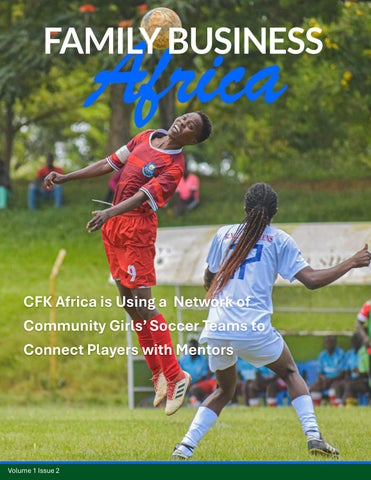
CFK Africa is Using a Ready-made Network of 12 Community Girls’ Soccer Teams to Connect Players with Mentors By Jeffrey Okoro
the World, City by City 16 ByBridging Jonathan Kendrick EdTech Intel: 6 Ways AI is Revolutionizing Online 20 Learning By Scott Duffy
Managing the Tradition VS. Innovation Conflict in 24 the Family Business By Dennis Oteng, DBA, MBA, MS
Value of Exceptional People for your Business 30 ByTheAngelo Biasi Governance of a Family Enterprise: Recapping the 36 Africa Family Business Summit 2023 The Ameri-STEAM Journey: Shaping a Successful 40 Future for Disadvantaged Girls in a Highly Digitized STEAM World By Sylvie Tanflotien
Family Business Africa / Volume 1 Issue 2 Editor and Publisher Managing Editor Associate Editor Digital Services
Dennis O. Oteng, DBA, MBA, MS Charles Sosnik Ian Egan Max Shulman
© 2023 Ravens Consulting GH. Family Business Africa Magazine is published four times per year by Ravens Consulting GH. It is available free of charge to subscribers as well as interested business executives worldwide. To start your free subscription, visit http://familybusinessafrica.com/subscribe. Articles submitted to Family Business Africa Magazine may be edited for style and content prior to publication. Views expressed are those of the authors and do not necessarily represent Family Business Africa Magazine policies or positions. Please seek permission from the publisher before reproducing articles.
Soft Leadership: We Are All the Branches of One Tree By Professor M.S. Rao, Ph.D.
We must take a pledge to promote fraternity and universal brotherhood. To inculcate universal brotherhood, we must create a feeling that the entire world is one family.
Growing intolerance globally There are several reasons for the current growing intolerance and conflicts globally. Here are some of them. People are very impatient. They want immediate results. They lack patience and perseverance. They fail to empathize with others. They try to prove their point right rather than looking at the points from others’ perspectives. They want to resort to shortcuts leading to conflicts. They want to win their case through win-lose, not through win-win.
Need for soft leadership The present global scenario calls for a new leadership perspective emphasizing respect for all regions, religions, communities, creeds, and ethnicities. It calls for a new leadership perspective involving negotiation and persuasion with an emphasis on empathy. It calls for partnership, not followership. Hence, this article emphasizes innovative leadership “soft leadership” to resolve various conflicts globally through discussion, dialogue, persuasion, and negotiation. This new leadership perspective can also be adopted to ensure fraternity and universal brotherhood. Leadership basically depends on three aspects ― how you communicate with others; how you make decisions; and how you take action. When you can execute these three activities effectively you become a successful leader. However, to evolve as a soft leader, you must communicate with an emphasis on soft skills; make decisions by blending your head, heart, and gut; and take action keeping the ground realities and goals in your view without compromising people’s orientation. Hence, soft leadership can be
We are all the branches of one tree. The root is one. The world is our root, branches are the nations and leaves are the people. defined as the process of setting goals; influencing people through persuasion; building strong teams; negotiating with them with a win-win attitude; respecting their failures; handholding them; motivating them constantly; aligning their energies and efforts; recognizing and appreciating their contribution in accomplishing organizational goals and objectives with an emphasis on soft skills. It is based on the right mindset, skillset, and toolset. Soft leadership helps unite people of all creeds, religions, races, and communities into one platform. It helps greatly to unite people globally into one platform. It helps convert the world into one family. When we treat the entire world as one family, all the conflicts in the world will be resolved amicably. When we think that we are the brothers and sisters of the world, all problems in the world will be resolved. Differences usually arise in the world when we don’t treat others with respect. The differences arise when we look at differences, not commonalities.
5
Mahatma Gandhi and non-violence The person who puts up with an attack is stronger than the person who attacks. The person who has the endurance to bear pain is stronger than the person who inflicts pain. The person who pioneers non-violence is stronger than the person who practices violence as Mahatma Gandhi rightly remarked, “Nonviolence is a weapon of the strong.” Hence, it is more desirable to preach and practice nonviolence than violence. Although man is violent by nature he must transform himself with the growing civilization to stand out from animals. Additionally, we must develop compassion toward others. Mahatma Gandhi’s principles are not only confined to India’s freedom struggle but also relevant to the world. Martin Luther King Jr. once remarked, “If humanity is to progress, Gandhi is inescapable. He lived, thought, acted, and was inspired by the vision of humanity evolving toward a world of peace and harmony.” Currently, the world is encountering several challenges including intolerance, impatience, and terrorism. Hence, it is essential to follow the ideas and ideals of Mahatma Gandhi, especially truth and non-violence to achieve international peace and prosperity.
Replace religion with love See good in others. Improve your attitude to make this world a better place to live. Grow as a global citizen with a universal mindset. Treat all religions as equal and respect them. Remember, no religion preaches violence. It is the misguided elements who spread wrong messages in the name of religion to create ill will among individuals. Above all, we must remember that given the choice between sword About the author
and spirit, it is the spirit that is always stronger than the sword. Hence, develop the spirit and replace religion with love to promote world peace.
We are all the branches of one tree Hatred doesn’t have any place in the world. Love is the only way to connect with the world. It breaks all barriers including cultural, racial, religious, and community barriers. We are all the branches of one tree. The root is one. The world is our root, branches are the nations and leaves are the people. Let us appreciate that we all have originated from one place and we all belong to one family. To summarize, the whole world is one family. We are separated by regions, nations, and borders. People remain the same at the core level. The children are born innocent but the environment brings them up as per their faiths, regions, religions, and nations. Hence, let us focus on bringing children with a global mindset with a universal brotherhood to achieve the ultimate objective of global peace and prosperity. Let us explore soft leadership to achieve our objectives.
Professor M.S. Rao, Ph.D. is the Father of “Soft Leadership” and the Founder of MSR Leadership Consultants, India. He is an International Leadership Guru with forty-two years of experience and the author of fifty-two books including the award-winning ‘See the Light in You’ URL: https://www.amazon.com/See-Light-You-Spiritual-Mindfulness/dp/1949003132. He is a C-Suite advisor and global keynote speaker and brings a strategic eye and long-range vision given his multifaceted professional experience including military, teaching, training, research, consultancy, and philosophy. He is passionate about serving and making a difference in the lives of others. Professor Rao is a regular contributor to Entrepreneur Magazine, and trains a new generation of leaders through leadership education and publications. His vision is to build one million students as global leaders by 2030.
6
The Startup Economy in Africa: What We Can Learn From Each Other By Jumanne Rajabu Mtambalike
This article is a recap of the startup policy dialogues organized by I4Policy and partners as part of the Transform Africa Summit 2023 #TAS2023. The information shared in the article is based on comments and feedback from leaders and champions of the startup ecosystem on the continent.
It has been a busy two weeks; On my way to Helsinki and Turku, Finland, I wanted to recap what I learned at the Transform Africa Summit. A few years ago, discussion about startups was a thing of young and desperate youths exploring alternatives to formal employment in Africa. Fast forward now, Presidents and Ministers of State have officially recognized that “digital” and “startup” are the current and future, and they have to do something about it.
It Was Great Cruising the Zambezi River After a Long Week It was great to hear about the progress made by countries such as Tunisia, Nigeria, Algeria, Rwanda, Congo, and Estonia in creating policies that create a conducive environment for the growth of the startup economy. It was fascinating to hear about the different approaches adopted by the countries to localize the concept to fit in with their legal and regulatory environments while considering the local and international markets’ needs. The discussions covered political sponsorship, committed entities, agile environments,
collaborative processes, cross-border collaborations, localization of legal tools, and financing mechanisms for startups in Africa. One clear thing, the intention is to build friendly and robust legal and regulatory systems to support startups on the continent. In comparison, some countries have made massive progress, like Nigeria, which passed its act in October 2022 and Tunisia, which is currently reviewing the first five years of the Tunisia Startup Act. The second version of the Tunisia Startup Act addresses the inadequacies of the first one. Countries like Rwanda and Algeria are taking a different approach in which, among other things, they are incorporating provisions for startup issues into existing acts such as income and procurement laws to favor startup companies.
Tunisia Lessons The critical success factor of the Startup Acts has been the effective integration of the acts with the existing legal and regulatory systems. Sometimes considered “VIP SMEs”, startups
9
seem to be a complicated beast to tame since they involve complex interactions between public entities with diverse legal and regulatory mandates. Sharing the experience of Tunisia, the challenge of engaging public entities with separate legal franchises is still there. Even after the successful implementation of the act, several engagements with the central bank and other government entities need to be carried out to ensure the effective adoption and implementation of the Acts. The key word is “agile”—creating agile policy systems for startups is the next challenging puzzle to solve for most African countries taking this path.
Nigeria Lessons The lessons from Nigeria were based on two key issues; the importance of having political sponsors and a collaborative process. The path towards realizing the act in Nigeria involved all critical actors in the ecosystem who have
mentioned or engaged with the keywords “Startup Act”. The goal was to ensure no one was left behind to avoid future obstacles by assessing all possible challenges the act might face during the implementation process. All processes, including the initial timelines, have been captured on the dedicated web portal, Nigeria Startup Act. The crucial lesson in Nigeria is political will and champions. If there isn’t one of the two, there is no act. For countries like Nigeria with state political structures, it is vital to have strategies for integrating the show at the national and state levels.
Rwanda Lessons The Ministry of ICT and Innovation in Rwanda is taking a slightly different approach towards addressing startup policy challenges in the country. The country has conducted consultative meetings with stakeholders to reflect on the Startup Act by prioritizing integrating
In creating a startup act is always friction between what the startup intends to do and what the policymaker “regulator” is mandated to do. The primary goal is to create policies and regulations that favours people solving the most complex problems facing our society today — Oswald Osarentin Guobadia
startup issues into existing and new legal and regulatory frameworks. Crucial issues facing startups are addressed in the review of the procurement and income laws of the country. One of the main issues Rwanda is currently addressing is the localization of the definition of startup to ensure that the proposed policies 10
reflect the needs of local startups. The country is also revie¶wing all startup-related fees and visa requirements for startups. Rwanda is keenly exploring approaches around artificial intelligence, intellectual property, and other emerging issues related to startups.
Algeria Lessons The Algerian government is working on a new set of bills to address startup challenges in the country. The bills are expected to address crosscutting issues affecting startups in the country. The Algerian government has a dedicated ministry for startups, the Ministry of Knowledge Economy, Startups, and Microenterprises. Some key priorities the country is looking to address include; access to funding for startups, retaining Algerian talents to build startups from home, cross-border collaborations, and creating supporting infrastructure for startups. The government has established the Algerian Startup Fund, designed bills directly affecting startups, promoted and started incubators, and entered into bilateral agreements with Tunisia to encourage collaboration between Algeria and Tunisia’s startup ecosystem.
Congo Lessons
in the past few years. Startup Estonia is a governmental initiative to supercharge the Estonian startup ecosystem. The platform provides information, tools, and resources to individuals and organizations looking to engage with the Estonian startup ecosystem.
Tools and Resources During the sessions, there were multiple reports, publications, and tools that I4Policy and partners shared to help African governments and startup ecosystem stakeholders fast-track the process of designing and implementing legal and regulatory frameworks favoring the continent’s startup economy. The tools included: • • •
It was great to hear The Democratic Republic of Congo (DRC) startup bill has been approved. The Bill is part of the national digitalization plan “Vision Congo Digital 2025”. The startup bill was signed into law on September 20, 2022, by President Felix Tshisekedi and published in the government’s official journal. At the Transform Africa Summit, the Minister affirmed the DRC’s commitment to the digital economy and supporting youth through digital businesses. The things addressed include mobility and IP issues, among other things.
Estonia Lessons As part of the discussions, there were lessons shared by innovation ecosystem builders in Estonia, building a case on how a small European country has created many unicorns
• •
Innovation For Policy Foundation Benchmarking Small Business Acts and Startup Acts Innovation For Policy Foundation Entrepreneurship Policy Toolkit 2023 Innovation Policy Foundation’s One-Day Policy Hackathon Approach (ADDIS Tool) Nigeria Startup Act Toolkit. Tunisia Startup Act.
Way Forward Moving forward, African countries are looking beyond addressing policy issues at the national level to address challenges facing startups to scale in secondary markets within the continents. Countries such as Algeria and Tunisia have already signed agreements encouraging the movement of talents and solutions between the two countries. Also, how to effectively integrate startup acts with existing local and regional legal structures. The second version of the Tunisia Startup Act is looking to address some of these issues. We must learn from each other to avoid unnecessary mistakes in the future.
About the author Jumanne Rajabu Mtambalike is Chief Executive Officer at Sahara Ventures. Jumanne Mtambalike is an innovator and technology enthusiast, He is an Ideation (concepts development), Program Development and Project Management Expert. Jumanne is also a technology blogger and community reformer. He likes to work with youth initiatives in areas of innovation, technology entrepreneurship and youths capacity building programs.
11
CFK Africa is Using a Ready-made Network of Community Girls’ Soccer Teams to Connect Players with Mentors By Jeffrey Okoro
“They come to our programs to learn dribbling, passing, and shooting, but they leave knowing about how to get a job and navigate the trials of young adulthood in some of the harshest living conditions.”
--Jeffrey Okoro
A girls soccer team in Kibera celebrates their win of CFK Africa's June 2023 soccer exhibition. Photo credit: Thomas Bwire.
When the Women’s World Cup held its finals, it wasn’t just Spain that was celebrating. Girls and young women everywhere were watching and learning a powerful lesson. The Spanish team’s win — its first ever — was celebrated around the world as a milestone for a country where women had to play on underground teams as recently as the 1970s because soccer was considered just for men. Beyond the recent headlines, however, the Women’s World Cup serves an even more important role in helping connect atrisk girls and young women with mentors, serving as an entry point to education, and even helping them overcome deeply rooted ethnic divisions like here in Kenya. I saw this firsthand on a recent Saturday in Kibera, the largest informal settlement in Kenya on the outskirts of Nairobi where I grew up and now manage a leading non-governmental organization, CFK Africa. It was the triumphant win of the Kibera Girls School Soccer Academy (KGSA), the first girls’ team from Kibera to make it to the highly competitive Kenyan Women’s Premier League. Founded by Abdul Kassim, the KGSA team, which CFK Africa has been supporting, is one of a half-dozen young women’s soccer leagues in the community and is made up of 17- to 23-yearolds. They had come to play the final match as the official champions of Kenya’s Division 1 League before moving up to the Premier League. Among the crowd were girls just a few years younger than the ones on the field. Their faces were lit up with possibility as they watched the
older players weave around each other on the field. Kenya has one of the oldest national women’s soccer teams, having started in 1985, the same year as the U.S. and just five years after Spain’s national team. It was a time when very few countries even had a national women’s soccer team. The Kenya women’s national soccer team, known as the Harambee Starlets, didn’t make it to the World Cup this year, but with more opportunities for young girls to play soccer in our communities, it’s just a matter of time. As we often say at CFK Africa, talent is universal, but opportunity is not. Even if they never become semi-professional athletes, young women in Kibera and in other informal settlements in Kenya benefit immensely from playing on these soccer teams. The legendary Kenyan soccer player Rose Achieng first started playing girls soccer in 13
Kibera in 2002 when she was just 10 years old. It was during a time when there were no other girls’ teams in Kibera, so they mostly played against boys. Achieng, whose successful career in soccer was portrayed in the popular children’s book “Remarkable Rose,” told me she learned more than just the game on that team. It also introduced her to lifelong friends from different backgrounds and even helped her land a scholarship to pay her school fees so she could graduate from high school, when few families in Kibera could afford this kind of education. At CFK Africa, we use the readymade network of community girls’ soccer teams to connect players with mentors and peer counselors, leading workshops on basic 14
hygiene, health education — including sexual and reproductive health — and advocacy rights for girls. They come to our programs to learn dribbling, passing, and shooting, but they leave knowing about how to get a job and navigate the trials
In fact, I was first drawn to volunteer for CFK Africa by the youth sports tournaments it sponsors after I saw up close how they helped reduce ethnic tension in the wake of the disputed presidential election of 2007. On the soccer field, these divisions melt away as players focus on working together. Soccer is, by its nature, a team sport. No single player can make it all the way down the field to score, and every defense requires a coordinated effort. The same can be said of fighting economic disparity and gender equality in our community and around the world. Soccer teaches us that we can do great things when we work as a team and women’s soccer shows girls and young women that means them, too. So as we all continue to watch the global phenomenon of women’s soccer, think of all the girls and young women around the world watching along with you. And as we look forward to the next Women’s World Cup in 2027, who knows, some of them may even be out on the field.
of young adulthood in some of the harshest living conditions.
About the author
Soccer can be used not just as a gateway to education, but to also help bridge ethnic barriers. Like Kibera, the women’s team I watched at that recent game and its fans were made up of various ethnic groups from Kenya, laughing and cheering, side by side. It was a stark contrast to the recent wave of protests last month in our community over tax hikes and soaring inflation, which left dozens dead, including many residents of Kibera, a sprawling area where hundreds of thousands of people live with little to no regular government services.
Jeffrey Okoro is executive director of CFK Africa, which was founded in 2001 and works to improve public health and economic prosperity in informal settlements in Kenya through integrated health and youth leadership initiatives. Using a participatory development approach, the organization works directly with community residents to develop and implement sustainable programs. To learn more, visit www.cfkafrica.org.
15
Bridging the World,
City by City By Jonathan Kendrick
ROKiT has undertaken a mission to provide Internet connectivity to underprivileged communities worldwide through ROKiT Cities, recognizing the significance of bridging the digital divide and empowering individuals with access to essential online resources.
ROKiT Cities is an initiative that leverages mesh networking technology to establish affordable and widespread Internet connectivity in underserved areas. By deploying a network of interconnected Wi-Fi hotspots, ROKiT Cities enables entire communities to access the Internet, thereby facilitating educational opportunities, economic empowerment and social inclusion. As the co-founder and chairman of ROKiT, I have made it my mission to be instrumental in advancing the vision of ROKiT Cities. With a deep understanding of the potential impact of connectivity on communities, our team has championed the initiative of providing affordable and reliable internet access to underprivileged areas. Through ROKiT Cities, the brand aims to empower individuals with the tools and resources necessary to thrive in the digital age and bridge the digital divide. Our primary initiative is to serve communities in need, enabling them to overcome barriers and unlock their full potential in today’s interconnected world.
So far, ROKiT Cities has been fortunate to play a pivotal role in transformative change among communities by providing them with Internet connectivity. This shift has resulted in a significant increase in digital consumption, particularly in the areas of e-learning, e-commerce, and international trade. By offering access to online educational resources, ROKiT Cities has empowered individuals in these communities to acquire the knowledge and skills they needed to make a significant impact, knowledge that was previously out of reach. This has opened new avenues for personal and professional development, fostering economic growth and social progress, including e-commerce activities within these communities. Individuals can now participate in online marketplaces, reaching a broader customer base and expanding their businesses. This has not only stimulated local entrepreneurship but has also contributed to
17
the growth of the overall economy. Moreover, with the inclusion of international trade, community members can engage in crossborder transactions, leveraging the currency values to their advantage. This enables them to generate income in foreign currencies, particularly in U.S. Dollars (USD), thereby injecting additional resources into the local economy and driving further development. ROKiT Cities believes the African continent now represents the world’s most important area for connectivity and growth, and Internet connectivity is the most important step in unlocking the amazing creativity and potential of the African peoples, both in its family businesses and in its primary and secondary education. It is currently working in Senegal and Lebanon, with many additional areas under consideration.
According to a recent report, approximately two thirds of the world’s school-age children do not have access to Internet connectivity. Globally, less than 1 in 20 school-age children from lowincome countries have Internet connection at home, compared to the 9 in 10 children from high-income countries that have access to the Internet. Lack of connectivity can have a variety of negative consequences, including limited access to important educational resources and employment opportunities, as many academic and career resources are now available online. The lack of connectivity does not just prohibit these individuals from being able to virtually connect with each other, it also prevents them from competing in the modern economy and isolates them from the world. In the unfortunate event of school closures, such as the ones that occurred world-wide during the COVID-19 pandemic, individuals without access to the Internet were left with zero options for education. Nearly a quarter of a billion students worldwide were affected by school closures during the COVID-19 pandemic. Hundreds of millions of students were forced to rely on virtual learning during this time. For those with no Internet access, education was entirely out of reach when their education was shifted to a virtual method. Simply put, lack of access to the Internet is putting individuals within underserved communities at a huge disadvantage and is causing them to fall behind their peers both academically and professionally. These communities need city broadband, because the exorbitant cost of cellular data makes it an impractical option for many individuals. Furthermore, cellular data imposes limitations on upload speeds, hindering efficient data transmission. Implementing city broadband will effectively address these issues. One approach is to utilize mesh Wi-Fi technology, which enables us to simultaneously reduce the price and enhance Internet performance for the entire population residing in these cities. By adopting city broadband, we can overcome the drawbacks of expensive and limited cellular data, providing affordable and high-speed connectivity to benefit the community as a whole.
18
City broadband offers a compelling connectivity solution to the challenges that have been observed on a global scale. The widespread implementation of city broadband addresses the problems associated with expensive and limited cellular data, which are prevalent in many countries worldwide. By providing affordable and high-speed connectivity to urban areas, city broadband empowers individuals, businesses and communities to fully leverage the digital landscape for various purposes such as education, entrepreneurship, telecommuting and innovation. It also promotes social inclusion by bridging the digital divide. It ensures that all members of society, regardless of their socio-economic backgrounds, have equal access to digital resources, information and services. This fosters digital literacy, enhances educational opportunities, and facilitates the exchange of knowledge and ideas among individuals and communities. It also plays a crucial role in improving public services and infrastructure, enabling the implementation of smart city initiatives, such as efficient transportation systems, smart grids and remote healthcare services. These advancements enhance the quality of life for residents, optimize resource utilization and contribute to sustainable urban development.
Having experienced both the pre-Internet era and the current digital age driven by the Internet, AI, and technology, I deeply understand the importance of providing Internet access to underserved communities. My personal journey as an international expert and business owner has allowed me to witness first-hand the transformative power of these technologies in education, communication, and economics. The Internet has become a great equalizer, breaking down barriers and providing opportunities for individuals to learn, connect, and thrive on a global scale. Through my travels around the world, I have gained a global mindset and have had the privilege of encountering the incredible ideas and talents present in underserved areas. However, I have also witnessed the limitations faced by people in these communities due to the lack of access to the digital ecosystem. I find it disheartening to see individuals with immense potential unable to fully participate and benefit from the opportunities offered by the Internet due to factors like cost and infrastructure. This personal experience fuels my passion for bridging the digital divide and making access more accessible and affordable for everyone. I strongly believe that by providing quality internet connectivity to communities who need it, ROKiT Cities can unlock untapped potential, empower individuals and create a more inclusive and equitable world, harnessing the benefits of the digital age.
About the author Jonathan Kendrick is the Co-founder and Chairman of the ROKiT Group of Companies. As a serial entrepreneur, Jonathan began his business career through securing the European rights to then-unknown Yokohama tires brand (which, having successfully brought to market, he sold back to Yokohama). Recognizing, early on, the enormous potential of the mobile industry, Jonathan founded ROK to create the technology to simplify the process of pre-paid vouchers for mobile phones. Jonathan sold ROK’s electronic voucher technology to a leading mobile industry player in 2002, while still retaining the ROK brand – which he re-launched later on. Over the next decade Jonathan began to focus on the telecommunications world by providing mobile television to network providers around the world. In 2007 Jonathan streamed the world’s first live music concert over mass-market 2.5G via GPRS to mobile and was streamed across a 4-hour period, live and exclusive, to mobile operator AIS’s ROK TV service. Due to the success in Thailand it led to the formation of ROK TV. ROK TV was deployed in over 50 countries by 2013. Partners included China mobile, AIS Thailand, Telenor in Pakistan, American Movil in Latin America, Celcom in Malaysia, and the world’s first free tv mobile service offered globally called Freebe tv. In 2018, Jonathan created ROKiT, a people-first telecoms company selling a selection of value-driven mobile handsets, paired with vital-life services such as telemedicine and roadside assistance as well as smart phones featuring glasses-free 3D screens. In Fall of 2018, came the introduction of ROKiT Cities, a wide area mesh networking Wi-Fi XL service to help connect some of the poorest communities around the world, starting with 27 of the largest cities in India.
19
EdTech Intel: 6 WAYS AI is Revolutionizing Online Learning By Scott Duffy
After years of steadily picking up steam, online learning is experiencing undeniable explosive growth. The market is racing toward $1 trillion, with the corporate e-learning space expected to skyrocket 250 percent in the coming years. As e-learning continues to expand beyond the walls of academia, another game-changing phenomenon is going mainstream in a big way: artificial intelligence (AI).
That completion rate boost means more ROI for creators, who in 2022 spent $320 billion on courses that 97 of 100 students never finished. Better completion also improves learning outcomes and opens the door to the transformative experiences that students deserve. Read on for six ways that AI and behavioral science are powering the world’s most effective online learning programs.
AI has dominated headlines in the first nine months of 2023. Thanks in no small part to ChatGPT, the AI narrative has shifted from a story about human obsolescence to something a lot more exciting: how AI helps us complete tasks faster and, in many cases, better. Deloitte found that more than 50% of companies will utilize AI and/or automation technologies in 2023. Meanwhile, workers across industries are embracing generative AI. When one Fortune 500 firm paired employees with AI tools, those workers reported more job satisfaction.
Using AI and behavioral science to unlock higher engagement and real ROI
It’s difficult to name an industry that won’t be enhanced by AI. That includes e-learning. However, the real innovation is in pairing AI with behavioral science. By doing so, we can understand what truly motivates online learners, build courses optimized for the digital realm and, ultimately, crack the code on the “completion rate problem”—raising the percentage of learners who finish a course from just 3.1% to 65 percent or more.
Like the online learning market itself, the e-learning AI space is on a tear. Today, AI tools for online learning represent $1 billion in value; by 2030, that number will eclipse $80 billion. But despite that hockey stick growth curve, there’s an even bigger opportunity at play: Pairing AI with behavioral science. Why the need for behavioral science? Because AI alone isn’t enough to determine what motivates someone to purchase and complete an online course. To answer that question—and solve the “completion rate problem”—the most successful people building AI businesses are leveraging open large language models (LLMs) similar to the ones you find with OpenAI. This is the foundation; the next step is building vertical solutions on top. These LLMs are then trained on aspects such as sentiment analysis and empathy categories. When layered on top of AI, this achieves a vertically integrated solution.
21
Through this pairing of AI and behavioral science, we’re finally able to optimize courses for completion, delivering real ROI for creators and unlocking unlimited intellectual potential. Here’s how you can leverage this innovation right now to build the world’s best online learning program. Reduce your risk by aligning with your audience With completion rates stuck at just 3.1 percent, brands are seeing incredibly low ROI—that is, if they’re lucky enough to see any at all. This missed potential stems from investing in the wrong curriculum. By leveraging AI and behavioral science, creators can learn what to build before spending a single dollar on course development. 1. Understand what motivates your audience: Whether it’s a student body, a segment of a workforce or a customer base in need of training, it’s critical to understand your audience before creating your course. Today’s AI insight engines help creators take a deep dive into who their learners are as people. The insights go well beyond surfacelevel demographics. By pairing leadingedge AI with behavioral models, the most
22
effective tools can pinpoint an audience’s ambitions, goals, motivational factors and other forces that impact their likelihood of sticking with a course. 2. Know what to build: The combination of AI and behavioral science is also helping creators design programs aligned with what their end users really want. The most advanced tools can even identify which business models work best in each creator’s industry, category and segment—allowing you to invest in what will deliver real ROI.
Structure your course for completion Along with alignment, the other component of high-performing online courses is ascension, or a structure that allows students to reach the desired end result. This is another area in which AI and behavioral science are transforming e-learning outcomes. 3. Build an optimally-structured course: A decade of research has taught us that what works in person doesn’t necessarily work online. Thanks to AI tools, there’s no more guesswork—and no more replicating classroom curriculum with the hopes that it’ll deliver the same experience in the
digital arena. AI course builders can now identify the precise structure that will boost completion and engagement rates by up to 17X. This paves the way for true ascension.
Optimize completion and course performance A major benefit of online learning is the ability to continually improve and optimize curriculum. With AI, creators can not only identify friction points but generate optimized content that quickly boosts performance. 4. Analyze performance in real-time: The most effective AI tools are combining behavioral science models with performance data from a creator’s LMS. Using this realtime data, AI can identify friction and dropoff points—and identify key enhancements to boost completion. 5. Optimize content using generative AI: Creating content can be incredibly timeconsuming, and more course creators than ever lack an education background. Luckily, generative AI has stepped in to automate content creation. Generative AI tools are now capable of rewriting scripts, editing content and implementing suggestions. The result? Underperforming content can be quickly overhauled and optimized. 6. Prevent learners from heading to Google: Learners often turn to search engines to find answers rather than waiting or revisiting previous sections of a course. We’re seeing the emergence of ChatGPTlike tools designed to curb this dropoff. These in-course chatbots give learners real-time answers based exclusively on an organization’s training data—eliminating the need to run to Google. The most successful AI startups work directly with Learning and Development Departments to create custom LLMs that consist solely of the creator’s existing
content library, training materials and data sets. AI and machine learning tools organize the data, which allows chatbots to provide real-time answers to learners straight from the organization’s content library. As recently as a few months ago, a course completion rate of 65 percent was unheard of. So was reaping real ROI from online learning programs. But, with advanced AI tools, these goals aren’t just possible; they’re fully replicable. Through a combination of advanced AI and proprietary behavioral science, e-learning innovators are helping creators build the world’s most powerful online learning courses, certificates and curriculum—the kind that generate real ROI, increase engagement and transform learners by teaching them lifechanging skills.
About the author Scott Duffy is an entrepreneur and business strategist. He is the Founder and CEO of Courus, an AI and Machine Learning Platform that helps creators build online courses, improve engagement, and increase ROI. Connect with him at www.courus.ai.
Sources: https://www.gminsights.com/industry-analysis/ elearning-market-size https://www2.deloitte.com/us/en/pages/consulting/articles/state-of-ai-2022.html https://fortune.com/2023/04/24/chatgpt-ai-worker-productivity-fortune-500-study/ https://www.insidehighered.com/digital-learning/article/2019/01/16/study-offers-data-showmoocs-didnt-achieve-their-goals https://link.springer.com/article/10.1007/s12528018-9179-z
23
Managing the Tradition VS. Innovation Conflict in the Family Business By Dennis Oteng, DBA, MBA, MS
Technological advancement has created a generational gap in the Family Business (FB). Today’s tech savvy youth are taking full advantage of a wide range of tools and apps that were unimaginable as the senior generation was growing the business.
24
This generational gap sometimes leads to conflict between the older folks and next generation of the family business. Often, the senior generation does not understand the demands of the younger generation while the younger generation seemingly does not understand the “archaic” style of the older generation. Take, for example, the family business owner who tried to arrange a trip with his daughter to introduce her to the various business properties that she would eventually inherit. His daughter was reluctant to make the physical trip when she could quite easily see the properties virtually by viewing them on Google Maps. This created some friction between father and daughter. “How on earth will a google map help her understand a legacy,” thought the father. This story illustrates how the older generation tends to hold on to traditional ways of doing things to keep the legacy alive, while the younger generation typically wants to embrace innovation. While tradition and innovation are often seen as opposites, a successful family
business is one that finds a way to blend aspects of tradition with the ever-changing opportunities that innovation can create. In their 2016 study, De Massis et al conceptualized a new innovation strategy called Innovation Through Tradition (ITT). They postulated that firms that build long-lasting and intimate links with their traditions can be extremely innovative while remaining firmly anchored to the lessons of the past. This article also relates tradition to the Baby Boomers and innovation to the Millennials. Let’s discuss the difference between Boomers and Millennials and the implication for the family business.
Boomer Parents and Millennial Children Mark McCrindle in his book The ABC of XYZ, Understanding the Global Generations, outlined the classes of generation and the range of their birth years as follows: • •
Federation Generation (1901 – 1924) Builders Generation (1925 – 1945)
25
• • • • •
Baby Boomers (1946 – 1964) Generation X (1965 – 1979) Generation Y (1980 – 1994) Generation Z (1995 – 2009) Generation Alpha (2010 – 2022)
The current elderly leaders of the FB are mostly Baby Boomers and their successors are mostly Millennials. Technological savviness magnifies the difference in these two generations. The Baby Boomer generation is known for creating their own future. With fewer options of secure jobs following World War II, many founded their own business. Boomers set high expectations for themselves and because of their determination to make something of their lives, they were often referred to as the “me” generation. They had a strong work ethic and worked long hours to achieve their goals. Millennials, on the other hand, are the first generation to grow up surrounded by digital media. They are sociable, optimistic, talented, well-educated, collaborative, open-minded, influential and achievement-oriented. They have always been closely supported by their helicopter parents (parents hovering over their children), so expect to continue to feel sought
26
after, needed, and indispensable. They arrived in the workplace with higher expectations than previous generations. If their expectations are not met, they are so well-connected that they can tell thousands of their cohorts with one click of the mouse. Their characteristics translate into a generation of employees with a different outlook. They are confident and want their voices to be heard. They speak their mind rather than go by the “obey before complain” discipline. Also, they want to be included in the decision-making process of the business. Typically, they dislike menial work, lack the skills for dealing with difficult people, and can be impatient to get the experience needed to move up the ladder. They have high expectations of their role in the FB; they want to work with positive people, to be challenged, to be treated respectfully, to gain new knowledge and skills, to work in friendly environments, to have flexible schedules and to be paid well. All these characteristics describe the ideal situation for the majority of nextgens. Family business leaders should be aware of generational differences and adopt strategies to manage the challenges that are created because of the generational gap.
How to Manage Millennials Innovation is necessary for the survival of a business, and Millennials have a flair for innovation which stems from the era in which they were born. They are sometimes referred to as the Dot.com generation because of growing up when the Internet, cell phones and other digital technologies hit mainstream. With the speed of technological innovation over the past few decades, it’s not surprising that this generation sees innovation as a must. Notwithstanding, traditions highlight the foundation of a business. Traditions help people know and understand the customs or beliefs of the business family that have been passed on from generation to generation. It is expedient for millennials to recognize and celebrate these traditions while innovating into the future. At the same time, it is imperative that the senior generation accepts the need for innovation to address complacency and ensure regeneration of the family business.
Twist the Leadership Approach for the Next Generation Today’s youth are extensively connected to and shaped by their peers. McCrindle’s research found that while nearly all the generations have the same number of close friends (an average of 13), Millennials have almost twice as many social media friends than other generations. And so, the network that influences them is greater numerically, geographically and, being technology based, is connected 24/7. The social definition of today’s youth calls for a different leadership approach. Unlike previous generations who are very comfortable with verbal communication, employing visuals results in more effective communication with Millennials. Millennials don’t want to just sit and listen; they want to see and do. Don’t dictate to them but rather allow them to build experience through trying.
27
The way to foster learning in this rising generation is to facilitate the process but not to be the teacher. In the work environment, it is better to coach them than to instruct them. They must be guided to build knowledge by themselves. This implies that they should be guided through the learning process but not bombarded with content or instructions. Note that their propensity for social connection shows they need to feel they belong and will try to avoid situations that may subject them to rejection.
Debunk the Handbasket Theory The handbasket theory is an adage that says, “Today’s kids are going to hell in a handbasket,” meaning that “kids just ain’t no good these days.” There is a myth that today’s youth are rude and don’t learn morals in school. They are described as having no respect. Admittedly, there are some bad Millennials, just as there are bad examples in every generation. Some beliefs about today’s youth are fact-less and may be accounted for by their curious nature. Generally speaking, Millennials represent the active working group in the FB. Family Business 28
leaders should look at the positive attributes that millennials can bring into the business. This generation is highly globalized and has the mindset to push the business across borders. Millennials are the first generation to be fully global. Through technology, they are more culturally diverse in their music, movies, fashion, food, online entertainment, social trends, and communications. Even the “must watch YouTube videos and memes” are global as never before. Blocking the possibilities of innovating across borders because of myths is harmful. Myths are widely-held but false beliefs or ideas. Myths create stereotypes for the exuberant youth and this may cause them to chart their own path rather than follow the traditions of the family. They want to be accepted, but believing in myths may push them away. These kids are not bad as the handbasket theory suggests. They are gifted and want the opportunity to show what they can do. Managers should create an acceptance culture within the organization. There should be moments where the younger members are given the opportunity to convene meetings with the older generation. Let them be heard. Don’t push them away else they will
form allies outside the family which may be difficult to change. Give them Challenging Tasks. Millennials dislike menial work and multitasking is an inherent skill. Millennials want learning opportunities. They are looking for growth, development and a career path. They want to be challenged in the workplace. The saying that “a tea bag is just a bag until it is put in hot water” describes the daring abilities of millennials. Leaders of Millennials should mentor them to develop their talents. They should be guided on the benefits of traditions and values. Their potential can be harnessed when they are given challenging tasks. Allow them to try new things and assign them to projects which help them learn. For example, set up a reverse mentoring program for members of the rising generation. Business owners can learn from companies that set up tutoring for middle–aged executives where young newcomers helped these executives navigate the internet and other technologies. Jack Welch of General Electric fame says that “e-business knowledge is usually inversely proportional to age and rank.” GE matched 1,000 managers with 1,000 young employees. Even though the younger cohort had just joined the firm, they understood new technologies better than GE’s finest. A reverse mentoring program like this can be a way to challenge younger generations and result in better succession.
The Next Generation can be your Strategic Advantage Today’s business environment is VUCA -volatile, uncertain, complex, and ambiguous. In this highly competitive business environment, family businesses need to recognize that their biggest differentiator is their people. Organizational life cycles have become shorter and steeper, and there is no time to slow down after a successful change or transition of leadership. Businesses are advised to use their human capital resources to gain a competitive advantage. As millennials grew up in a complex world where there was a burgeoning of fast food, fast Internet, fast trains and fast
everything, they can be extremely valuable in the FB’s bid to survive and thrive. Organizations that emerge as winners in the battle for talent will have had their fingers on the pulse of the new generation. They will have designed specific techniques for recruiting, managing, motivating and retaining them. It is said that the higher you want to go, the deeper you must be grounded. Millennials who understand tradition and can marry that tradition with innovation are well-grounded. They will have many of the traditional attributes: love, kindness, honesty, commitment, integrity and perseverance. By emphasizing and developing their strengths, Millennials will have a future of hope and opportunity and overcome any of their generation’s weaknesses and shortfalls. They will grow as individuals and future leaders while becoming committed to the future success of the family business.
About the author
Dennis Oteng, DBA, MBA, MS is the Chief Executive Officer at Ravens Consulting GH (Family Business Consultancy)
References De Massis, A., Frattini, F., Kotlar, J., Petruzzelli, A. M., & Wright, M. (2016). Innovation through tradition: Lessons from innovative family businesses and directions for future research. Academy of management Perspectives, 30(1), 93-116. McCrindle, M., & Wolfinger, E. (2009). The ABC of XYZ: Understanding the global generations. University of New South Wales Press: Sydney.
29
The Value of Exceptional People for your Business By Angelo Biasi
The degree and speed of any business’ success depends, largely, on the quality of its people. After all, it is people who start, operate, and grow businesses. Yet, so many business owner-managers settle for less than exceptional people, or A Players, which can lead to wasted time, energy, money and, sanity, among other things. Why is that? 30
I learned of the value of quality employees early on. In my family’s 24x7 diner business of 30+ employees, skill barriers to employability and the pay were generally low, making turnover and attrition exceptionally high. A new short-order cook or waitress could be easily trained and they had many choices among area employers. Roles were therefore mostly transitory, and the quality of work varied. Understanding this, management had to plan accordingly and “always be hiring”. This had an inherent cost and variable risk to the business due to the ongoing uncertainty. Nonetheless, there was a core group of employees that worked for my parents for the majority of my childhood years. We often talked about them at the dinner table as if they were a part of our family. They attended personal events like birthdays and graduations. I admired the fact that there was always a mutual respect, trust, and loyalty among them and my parents, their employer. When I started working at the diner at a very young age, it was obvious that those employees performed their jobs well, some with unwavering purpose, loyalty, and dependability, and emanated the values that were important to my parents. In turn, they received a competitive salary, appreciation, security, and opportunities within the company, especially as it continued to grow. On the surface, it seemed like a fair trade. However, I am certain that my parents’ business would not
have thrived, or even survived, without this core group of high performing, loyal A Players. After starting, running, and exiting my own businesses over several years, I further understand and appreciate the value of A Players. Unfortunately, I had to learn the hard way, however, through a myriad of poor recruiting and retention decisions, as well as cycling through the five dysfunctions of a team (see Patrick Lencioni “Five Dysfunctions to a Team”). I naturally blamed everyone but myself at the time when, in fact, I simply did not know any better. It wasn’t until I did some soul searching, studied A Player recruitment and retention best practices, and created a culture aligned to important core values, bought into by key stakeholders, that I was able to experience a magical team that moved mountains. So, what makes up an A Player? How can you successfully recruit and retain them? And, why is this necessary for any business?
Defining A Players A Players are the high-performing individuals who possess not just the right skills and experience to produce, but also embody the core values and vision of your organization. They usually perform in the top 10 percent among peers in a specific role or position. A Players form the backbone of successful
31
organizations. They drive innovation, propel growth, and foster a culture of excellence. Having a team of A Players not only improves your company’s performance, but also attracts other top talents, creating a virtuous cycle of success. These individuals align with your vision, possess a growth mindset, and consistently deliver exceptional results. A Players not only get things done but also elevate the performance of those around them, making your entire organization stronger. A Players like to be surrounded by other A Players and they get frustrated when they are not. They expect management to remove barriers to their performance. And, they require clear expectations.
What Employees and Employers Want As in any relationship, it is important to know what you and your partner want, and do not want, before engaging. An employee/employer relationship is no different. One might think this is simple, right? Certainly, both parties want security, fairness, and through-put. But it goes much deeper than this. What employers want (not necessarily in order of priority)
32
1. Employees who have the right skills to perform the job 2. Employees who have the will to perform 3. Employees with values that match the company’s values 4. Employees who can deliver the desired results What employees want 1. A job that plays to their strengths 2. A job that is in the line of site to the greater company vision/mission/strategy & a pathway to advancement 3. A sense of appreciation 4. Fair compensation It’s fair to say that these two lists are quite different yet somewhat similar. It wasn’t until I learned this lesson, that I was able to focus and be more proactive overall in attracting and retaining A Players. Some examples of understanding this, in action: •
If employees come to you asking for more compensation, it is likely you did not accomplish points 1-3 on the list of what
33
•
•
employees want, above. #3 is the easiest to do and do often. A simple “thank you” goes a long way, especially in business (Be sure to thank your parents if you learned this early on in life!) Knowing and communicating your core values during the hiring process will help you avoid hiring employees who are NOT a fit with your company’s vision and overall culture. When I interview candidates, I expect to ask the question: “What is important to you in a company’s core values?” And, I expect to answer the following: “What are the company’s core values?” and “Give me one example on how you (interviewer, or any employee for that matter) lived one of them this past month?” Having the right person in the wrong seat doing the wrong things will not satisfy the employer or the employee. Sometimes, the relationship starts out correctly (the right person in the right seat doing the right things) but the seat, and/or the desired outcomes and role, can often change.
Assessing Your Current Team for A Players It’s easy to do a quick assessment of your existing team for A Players, according to ScalingUp. They offer two suggestions: •
34
Answer this question: Would you enthusiastically re-hire all your current employees?
•
Chart a graph with 4 quadrants (forming a cross on the page). Label the X axis at the bottom of the page as “Productivity” and the Y axis with “Core Values” with values of 0 – 10 starting from the bottom left of the page going up and across. Start plotting your current staff on the graph. Those who place in the upper right quadrant are A Players. Those in the upper left are B Players who can likely be coached up. Team members who fall in the bottom right quadrant have the remote possibility, yet are less likely to be coached up. And, those in the lower left quadrant decisively need to be coached out of the organization.
In doing these two simple exercises, it is easy to quickly understand your company’s people profile. And, if you are to improve the business, with better people decisions you will know where and with whom to start.
How to Recruit and Retain A Players Following are a few tips according to ScalingUp and TopGrading, to improve your recruitment and retention of A Players. Tip 1: Define Your Company’s Core Values and Vision: Articulate your company’s mission and values, and make sure they align with top performers. When your vision resonates with potential candidates, it attracts the right talent. Tip 2: Establish a Rigorous Hiring Process: Recruiting A Players demands a rigorous and meticulous hiring process of defining specific
roles, identifying the key traits, and conducting interviews that assess both skills and cultural fit. Incorporate behavioral and situational questions to gauge a candidate’s problemsolving abilities and alignment with your values. Leverage multiple interviewers to gain diverse perspectives with comprehensive evaluations. Remember, hiring the wrong candidate can be detrimental, so investing time and effort in your recruitment process is huge for building a winning team. Tip 3: Create a Compelling Company Culture: Foster an engaging and positive environment where autonomy, growth, and recognition are encouraged. Support open communication and transparency, as well as provide opportunities for development and advancement. Celebrate success and acknowledge/reward contributions. A vibrant company culture not only attracts top talent but also fosters loyalty and commitment, reducing the likelihood of turnover. Tip 4: Provide Meaningful Challenges and Opportunities: A Players are driven by a desire to tackle meaningful challenges and reach their full potential. Provide opportunities to take on significant responsibilities and stretch their capabilities. Set clear expectations with ambitious goals that challenge them and incentivize them to reach new levels of success. Tip 5: Invest in Employee Development and Well-being: Invest in employee development and well-being. Offer training programs, mentorship opportunities, and access to resources that help them grow professionally. Demonstrate that you care about their personal growth and are committed to supporting their career aspirations. Additionally, prioritize work-life balance and create a healthy work environment that fosters physical and mental well-being.
What Not to Do While attracting and retaining A Players is vital, there are common pitfalls that companies should steer clear of. These include: 1. Ignoring Cultural Fit: Hiring solely based on skills without considering cultural fit can lead to friction within the team and hinder collaboration.
2. Failing to Adapt and Grow: The business landscape is dynamic, and A Players seek growth opportunities. Failure to adapt and provide new challenges may cause them to seek opportunities elsewhere. 3. Inadequate Recognition and Rewards: A lack of recognition and appropriate rewards can demotivate even the most talented individuals. 4. Tolerating Mediocrity: This is so important! I am amazed at how many currently settle for less than exceptional. By allowing underperforming employees to remain in the organization, it can demoralize A Players and compromise team productivity. 5. Neglecting Feedback, Transparency, and Communication: Regular feedback and open, transparent communication are vital for fostering a culture of trust and continuous improvement. Hiring and retaining A Player talent clears a path to success for you and your business. Being proactive with knowing what everyone wants, where they stand, and how to best recruit and retain A Players will further separate you from your competition. Little did I know that my employer-parents, given their business’ market constraints, had most of this figured out.
About the Author Angelo Biasi is an exited/serial entrepreneur-turned business performance coach. He is passionate about helping business leaders, committed to change, scale their businesses efficiently while reaching their personal and professional potential. Angelo is currently accepting applications for a unique 6-month Founder’s Forum journey for a cohort of likeminded business Owner-Founders. Learn more at www. angelobiasi.com or Email him at abiasi@angelobiasi. com.
Sources: Harnish, Verne, “Scaling Up – How a Few Companies Make It… And, Why the Rest Don’t,” Forbes Books, 2022 Smart, Bradford D., “TopGrading,” Penguin Group, 2012
Your Host: Dr. Dennis Oteng, CEO at Ravens Consulting GH
Governance of a Family Enterprise: Recapping the Africa Family Business Summit 2023
Governance is the process of making decisions and the process by which decisions are implemented. It is the heartbeat of every organization. In other words, governance is the influencing factor to which the people in organization are being led as well as the allocation of resources. Good governance practices strengthen companies by building relationships among investors, boards of directors, managers, and employees. Implementing corporate governance guidelines allows businesses to obtain capital at lower cost, enhances business strategy, and attracts the
The topic of governance is hot. Shareholders, managers, and business advisors are demanding improved governance of (typically public) companies by strengthening their boards of directors and developing more responsive shareholder relations. But what happens when your board of directors is also your family? The governance of a family business is more complicated than it is for non-family-owned companies because of the central role of the family that owns and typically leads the business. In a family business, the business, the family, and the ownership group all need
best human capital.
governance.
This past June, Some of Africa’s top family business executives attended The Africa Family Business Summit. The theme, “Family Business Governance – A key Strategy for Continuity,” captivated audiences for two full days of fun professional development at the Kempinski Hotel at Gold Coast City, Accra.
Family businesses need to learn the basics of governance and apply the best practices that exist in family business governance. At the second edition of the Africa Family Business Summit, produced by Ravens Consulting GH, helped families identify an effective overall governance of a family enterprise.
Austin Somuah & Kafui Dey - Master Of Ceremony
37
38
The Role Of Family Business Professionals In Building A Proper Governance Structure By Andrea Benkenstein Kruger (Associate Director, PwC, South Africa GH)
Global Perspective On Long-Term Family Business Success Keynote Presentation By Martin Roll
39
The Ameri-STEAM Journey: Shaping a Successful Future for Disadvantaged Girls in a Highly Digitized STEAM World By Sylvie Tanflotien
40
This quote by Maya Angelou has guided me throughout my journey as an advocate for youth education, and especially girls. In a world that is evolving at an unprecedented pace, bridging the gender gap in STEM fields has become not just a necessity, but a moral obligation. The journey that led me to found Ameri-STEAM and its transformative boot camps was fueled by a deep-seated passion to empower girls, equip them with the tools they need, and guide them towards self-empowerment. This is a story of inspiration, dedication, and the incredible impact of my pledge to give back.
My Story I was born in Côte d’Ivoire, West Africa and migrated to the US in the early 1990s. I hold a Bachelor of Arts degree in biological science and a master’s degree in science education from Rutgers University, New Jersey. I also hold a master’s degree in Teacher of Students with Disabilities from Rowan University in New Jersey. My Ameri-STEAM Program journey was born out of a deep conviction in the importance of educating young girls in the fields of science, technology, engineering, arts, and mathematics, commonly referred to as STEAM. I witnessed the challenges that girls face in staying in school to pursue knowledge and empowerment within the Ivorian educational system. Persistent inequalities, gender stereotypes, and socioeconomic obstacles often hinder their access to quality educational opportunities. Having taught for more than 15 years in public schools and universities in New Jersey, I saw similarities in the struggles for young girls to stay in school and graduate. To even think of starting a career in science or engineering was beyond imagination. The idea of creating a leadership academy program specifically targeting young girls and equipping them with the skills needed to excel in the digital world began to take shape. Thus, the Ameri-STEAM Program was born, aimed at encouraging young girls to become competent and confident leaders in an ever-changing digital world.
“I’ve learned that people will forget what you said, people will forget what you did, but people will never forget how you made them feel”, therefore I “try to be a rainbow in someone’s cloud” ~ -- Dr. Maya Angelou Ameri-STEAM Boot Camps Ameri-STEAM is comprised of 10-day boot camps for participants. The class on Digital Exploration, taught by seasoned computer programmers, introduces the basics of computer coding using Alice and Greenfoot all the while stimulating creativity. It encourages logical thinking and problem-solving through projects dealing with complex problems using Java applications. The instructor spends two days introducing JAVA language, explaining the most basic concepts with examples. Another section focuses on mobile development, providing participants with in-depth training in mobile app development and female leadership. This intensive program equips learners with the skills to design, develop, and deploy mobile applications, covering fundamentals, user interface design, multiplatform development, feature integration and testing/debugging. In addition to digital exploration, AmeriSTEAM boot camp involves training the girls on leadership and mentorship matters. The program builds self-confidence and the ability to inspire others. During their time at the camp, girls participate in leadership training sessions with both local and international guest speakers online. In previous camps, over ten American women shared life experiences with the girls during video sessions and engaged in candid discussions about what it takes to be a true leader. They tackled issues ranging from community involvement to race and gender-
41
related challenges, emphasizing the importance of resilience, effective communication, problemsolving, and teamwork. Inspiring female leaders from Oracle served as mentors, sharing their experiences and insights, guiding participants on their own leadership paths. Ameri-STEAM also uses dance and sport to encourage physical activity and coordination, help relax and reduce stress and teach the girls teamwork, mutual trust and a healthy lifestyle. We also conduct morning and evening meditations to help start and end their days in peace. In this connected world, the English language is an essential skill to have. Computer programming and most of the technologies today require English proficiency because the entire code science and technologies are documented in that language. For that reason, Ameri-STEAM seeks to create an environment that integrates English into all activities. Whether it’s dancing, singing inspirational music or watching a movie, the girls test their knowledge of English. That ease with the English language will come in handy when they decide to study abroad, or during their professional career when they attend international conferences.
42
What’s more, to explore the girls’ other hidden potentials, Ameri-STEAM introduces art and interior decoration. It gives them the opportunity to express their individual artistic talent, develop visual creations and 3-D design skills, discover basic interior design decoration, and stimulate the creation of different aesthetic and functional spaces. Finally, the girls work together on team projects, discuss, and address their real-world problems with innovative technical solutions. These projects encourage creativity, teamwork and problem-solving. To promote well-being and team spirit, we organize outdoor activities every morning and evening, such as dance and sports. We conclude the camp with an outdoor campfire night during which the girls dance, sing, and share stories and tales. These experiences contribute to strengthening teamwork, camaraderie, selfconfidence and trust in themselves and their team.
The Program’s Impacts on Young Girls More than four years after the first boot camp in 2019, most of the girls are continuing their studies at universities and prestigious
institutions all around the world. Some are now in Canada, France, Morocco, Rwanda, and here in Côte d’Ivoire, pursuing various fields. They are studying computer science, medicine, law, human resources, commerce, logistics and transportation, as well as business administration, just to name a few.
Testimony from participant, Diomande: 14 years old in 2019, “I have improved my sociability and developed a love for programming. Now 18 years old, I am a first-year student engineer at Efrei, Paris (France).”
The impact is truly significant because girls who had no idea about their future discovered new passions and callings during the boot camp, which allowed them to make ambitious career choices. Many of them revealed that they used to be shy, but now they are more open, confident, and proactive. They are no longer afraid to express themselves and take initiative.
As we reflect on the strides we’ve made, our eyes are firmly set on the future. Our goal is not only to expand our reach and impact many more girls, but to foster a shift in the narrative surrounding women in STEM. We envision a world where girls don’t just dream of STEM careers but actively pursue and thrive in them. Ameri-STEAM is committed to providing continuous support, mentorship, and opportunities that will enable these dreams to become a tangible reality.
Furthermore, the boot camp enabled them to form a network of like-minded girls that remains connected and very active today. This network continues to expand with new girls joining each year. Testimony from participant, Elsa: “My name is Elsa Trazié, and I am 19 years old. In 2019, as a 15-year-old boot camp alum, I grappled with a demanding routine of early mornings, sports, conferences, coding, and English classes. This experience became transformative, instilling confidence and the keys to success through leadership courses and inspiring speakers.
Looking Ahead
Ameri-STEAM is more than just a program—it is a catalyst for change. It is a beacon of hope, illuminating a path that was previously obscured for the girls we touch. It is a tribute to the power of a targeted and impactful initiative. As we forge ahead, let us remember that every girl’s success story is a testament to what is possible and how we can achieve a more just society. About the author
Four years later in 2023, I returned as an alumna, eager to share my growth. Over two sessions spanning more than 10 days, I witnessed the same spirit that had ignited my passion for learning: introducing girls to coding, nurturing a love for English, and fostering leadership. But it wasn’t just about sharing; I learned extensively. I grasped organizational dynamics, professional insight, and the value of helping. I became a photographer, counselor, and big sister, learning to embrace spontaneity and seek knowledge when faced with the unknown. What made this experience exceptional was the people I met, starting with the remarkable Madame Sylvie and every camp participant. Their impact on my life is immeasurable, contributing significantly to my personal and professional growth.”
Sylvie Tanflotien is President of the Ameri-STEAM Program. Throughout her career, she has demonstrated a commitment to student-centered instruction and the integration of technology in the classroom. I am skilled in designing and implementing ICT-driven STEM curriculum, leveraging technology resources to track progress, and providing valuable feedback to teachers. Sylvie’s passion for education extends beyond the classroom. As the Deputy Country Project Manager for the African Digital School of Distinction (ADSI) under the Global E-Schools and Communities Initiative, she played a crucial role in promoting digital education in Côte d’Ivoire. This experience allowed her to work on a global scale and make a meaningful impact in bridging the digital divide.
43
44