Volume 60 - Issue 9 November 11, 2026 theeyeopener.com @theeyewideopen Since 1967
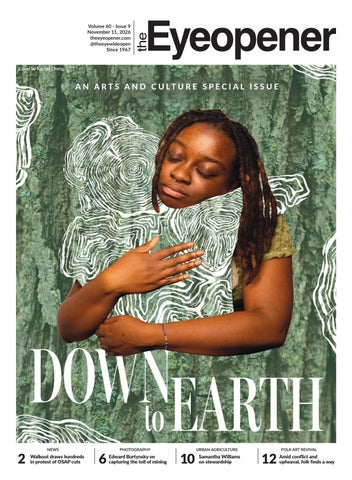
Cover by Rachel Cheng
2
NEWS
Walkout draws hundreds in protest of OSAP cuts
6
PHOTOGRAPHY
Edward Burtynsky on capturing the toll of mining
10
URBAN AGRICULTURE
Samantha Williams on stewardship
12
FOLK ART REVIVAL
Amid conflict and upheaval, folk finds a way
News
Next Week: Dozing off between classes? We've got good news for you...
THE EYEOPENER WEDNESDAY, NOVEMBER 11, 2026 theeyeopener.com/news
DANIEL OPASINIS/THE EYEOPENER
Students say 'enough is enough' at walkout The CFS–O led action saw of TMU students walk out of class to protest Ford's changes to OSAP Zanoah Plummer news editor
Edward Lander editor - in - chief
pick up multiple jobs, struggling to afford rent, groceries and other basic necessities.” TMSU vice-president education Teresa Baricevic stressed the importance of students coming together in a speech. “Showing up is really the most important thing, showing the government that we will not just sit back and blindly accept these changes and these cuts that impact all students,” she said. “An attack on one student is an attack on all students and we need to continue to organize to show the government we will not take this anymore.”
Backlash to provincial cuts to post-secondary grants reached a boiling point on Nov. 5 with a campus walkout that saw hundreds of attendees. The Toronto Metropolitan Students’ Union (TMSU) backed the protest alongside other student organizations, including the Toronto Metropolitan Association of Part-time Students and the graduate students’ union. The walkout saw students leave class at 1 p.m. and gather at Lake Devo. In total, the protest lasted for nearly two hours. The protest was just one of 15 planned at universities across the province on a day of action organized by the Canadian Federation of Students–Ontario (CFS–O). The walkout was largely in response to sweeping changes to the Ontario Student Assistance Program (OSAP) announced in February. Now in effect, these changes saw the amount of grants the program provides lowered from 85 per cent to 25 per cent.
NDP politicians attend walkout Toronto Centre MPP Kristyn Wong-Tam and provincial NDP leader, Marit Stiles—who is also leader of Ontario’s official opposition—attended the walkout. In an interview with The Eyeopener, Stiles applauded students for attending. “My message to students today is thank you. Sometimes you got to take the fight to the streets, you got to take the fight to the doorsteps,” she said. “And we can make this change happen.”
CFS-O, TMSU call on Ford to reverse changes Omar Mousa, national executive representative of CFS–O, attended the walkout. In a speech, he said students have had enough when it comes to education cuts. “Students have been paying the price of a post-secondary education system that has been chronically underfunded,” he said. “Students are going into debt to access education, they’re being forced to
Secondary school teacher brings comparisons to past movements Chris Chandler, a secondary school teacher and an executive officer in the Ontario Secondary School Teachers Federation, also spoke at the walkout. “I bring the greetings and solidarity of 60,000 teachers and education workers from across the province who support your cause,” he said.
Chandler asked attendees to look back on the history of the student movement in Canada. This included a mention of the 2012 Quebec student strike, which saw post-secondary students launch an indefinite strike in protest of a hike in tuition fees. During the strike, then-premier Jean Charest called a provincial election, largely related to the issue of the tuition hike, which resulted in his party’s loss and his own resignation. “2012 in Quebec started just like this,” he said. “Students fought back one group at a time, and at the end of their fight, they brought down a provincial government.” Chandler also connected the walkout to the other student movements globally, such as in France, Indonesia and Brazil. SJP calls out TMU administration A representative from Students for Justice in Palestine (SJP) at TMU also spoke at the walkout, calling out the university administration. “We can’t afford to pay for our school and they are sending our tuition to fund a genocide,” said the spokesperson. “Our governments strip away our OSAP while they withhold visas from Palestinian students who have been admitted to Canadian universities.” According to the Palestinian Students and Scholars at Risk Network, over 130 Palestinian students have been accepted into Canadian universities but have been unable to start their studies. The network cites issues with obtaining study permits as a reason for their inability to attend classes.
Students attend in protest of OSAP changes Attendee and first-year arts and contemporary studies student Thomas Egan said this isn’t the first time he’s protested the Ford government’s education policies. He said he attended a similar protest when he was in Grade 10. “I work as an educator, I worked as an [early childhood educator] for a very long time. And I’ve seen firsthand what the cuts to education in general, not just post-secondary education, can do. And I think that students and youth are our future and we should really prioritize that.” Egan explained when he first attended post-secondary, grants made up a larger portion of his OSAP. Now that loans make up the majority of his OSAP, he said the need to work while attending school will impact his studies. “I feel like it also makes it so that people that don’t have access to money in their family or don’t come from money have limited access to education,” he said. Fourth-year film student Julia Harris echoed this sentiment. “Kids are working [while] going to school and they’re not able to actually indulge in their education and learn things. They’re balancing just doing assignments rather than being an active participant in their own learning,” she said. Harris said her professors concluded class early to accommodate students attending the walkout. Ahead of the protest, the student unions provided a template to send to professors requesting academic amnesty. Amnesty is not a university-wide policy and it was up to the decision of individual
professors whether to accommodate participants. Nathaniel Baptiste, a first-year master of molecular science student, said his professor accommodated students attending the walkout. He said he knows many people who rely on OSAP to attend school. “If you can’t go to university to get your education, it’s even harder to get a job. Even though it already is [hard] even after getting a university degree,” he said. Egan said students should advocate for their education. “Unfortunately, we live in a world where we’re having to do a lot of advocating for ourselves, but that doesn’t mean that we can’t make change,” he said. “I think there’s a lot of hopelessness out there. And I think we can fight that hopelessness by celebrating each other, uplifting each other and really prioritizing community.” The walkout concluded with a speech from Trudy Kuropatwa, a fourth-year performance design and production student who is chair of the Student Mobilization Committee. “We don’t want to just survive, we don’t want to go back to business as usual. The only way to eliminate student debt, military and corporate influence from our education is to ensure that all postsecondary is free,” she said. Kuropatwa stressed that the walkout will not be the only action. “The next time we’re here we want to have double the numbers, the next time, quadruple—an exponential growth,” she said. “We know that when we lay the foundation, students and workers united, we can and will win.”
News | 3
THE EYEOPENER WEDNESDAY, NOVEMBER 11, 2026
Former VP student life dropped from TMSU lawsuit
TMSU president joins UN summit
Amira Benjamin & Jasmine Makar
news editor
ProdUction editors
Claims made against former Toronto Metropolitan Students’ Union (TMSU) vice president student life, Koby Biya, have been dropped from a $20 million lawsuit launched by the union last year. The lawsuit, filed in March, included allegations that Biya, along with other defendants, wrongfully interfered with the TMSU’s operations and election for personal gain. However, according to the original statement of claim, which has been obtained by The Eyeopener, Biya was not involved in any alleged financial mismanagement or fraud. Sixteen other TMSU members were named alongside Biya in the original statement of claim for alleged corruption, fraud, breach of privacy and more. In an emailed statement to The Eye, the TMSU confirmed that the claims have been dropped due to a settlement reached by both parties. The statement also confirmed Biya is the only defendant who has been dropped from the lawsuit, adding, “The Union is actively moving forward with the litigation against the other defendants.” John Mather of DMG Advocates is Biya’s legal counsel. He confirmed in an email to The Eye that Biya is no longer a defendant. “A settlement has been reached with TMSU on mutually agreeable terms,” he wrote. Mather said he could not provide additional comment at this time. According to the Ontario Courts Public Portal, the union’s case is still active. Most of the defendants, including former TMSU presidents Ali Yousaf and Nadir Janjua, have filed notices to defend. Court dates have yet to be announced.
The forum focused on employability and emerging challenges in post-secondary education affecting students Nadine Alsaghir Toronto Metropolitan Students' Union (TMSU) president Zain Baig attended a United Nations (UN) academic leadership summit in Geneva, Switzerland at the end of October. Hosted by the United Nations Institute for Training and Research (UNITAR), the summit brought together educators and academics from across the globe. According to its website, the summit aimed to shape the "future of education" by engaging in meaningful dialogue. The discussions hosted at the summit will contribute to a UNITAR-led white paper with the theme Reimagining Employability in a Changing World. According to a September 2026 UNITAR white paper, this document will consolidate participants' discussions around four key themes: AI governance, ethics and integration; international collaboration and capacity-building; future skills and employability; and well-being and human-centred learning. Baig was invited to apply and submitted a formal application to participate. He said the opportunity to represent the TMSU at the summit was valuable and hopes the ideas developed through the forum prove useful to TMSU members. According to Baig, previous Academic Leadership Suite cohorts have not included student union presidents or comparable student governance representatives. "A lot of these professors or institutional leaders, they're kind of removed from the student experience...They may not really resonate with what students have to say or fully understand the difficulties and issues that they face on
PHOTO SUPPLIED BY ZAIN BAIG a day-to-day basis. When you're asking a student, they're actually going through that experience," he said. Baig hopes to contribute to the white paper, adding that if he is successful, the union would be listed among the authors of the document. Adding that whether his presentation was included will be determined when the paper is released in December. Baig's goal is to discuss the union's priorities at the UN, including affordable, equitable and inclusive access to post-secondary experiential learning and improved recognition of students' skills. "I think what made my application really compelling was that I was really emphasizing the fact that students are going to be affected by all of these decisions, so students should have some input in what is going to be laid out," said Baig. He also noted students should be able to proactively help institutions design new initiatives, rather than reactively provide
feedback as “they wait until barriers are faced." Baig said attendees were receptive to his calls for greater student involvement in institution decision-making, with some expressing interest in reaching out to students more often for feedback. During the forum, Baig shared two proposals as a guest speaker: his first, which he called the "Student Employability Compact," would expand access to paid experiential learning through collaboration between universities, employers and students. His second was a portfolio model to help students demonstrate the skills they develop through project leadership and extracurricular involvement. Through his first proposal, he emphasized the importance of tracking graduates' employment outcomes and job satisfaction. "But what is the point of going to university if you're not setting these students up for success? The only way to measure that is by following up with them after they
graduate and really just collecting all that information," he added. His second proposal focused on creating a certification system, which would allow students to showcase those skills on their resumes or LinkedIn profiles. Baig said the forum inspired him to introduce a staff appreciation initiative at the TMSU, proposing four hours of paid time off to recognize employees' contributions and prioritize their wellbeing. He said the proposal was approved by the executive committee shortly after his return, with details still being finalized. Baig also said the forum reinforced his commitment to creating more paid employment opportunities for students through TMSU. "I want to prioritize hiring TMSU students for paid work, part-time work…I've been writing reference letters for some of our volunteers, and I want to continue doing that to help them in their career in any way that I can," Baig said.
4 | EDITORIAL
THE EYEOPENER WEDNESDAY, NOVEMBER 11, 2026
The Eyeopener Vol. 60 | 2026-27
Down to Earth: the long view
EDITOR-IN-CHIEF
With our world facing an existential threat, art can be a powerful form of activism
ISSUE MANAGING EDITOR
Sophie Wallace ARTS & CULTURE EDITOR
Edward “Roots” Lander Sophie “Wildflower” Wallace PRODUCTION EDITORS
Amira “Treehugger” Benjamin Jasmine “Sleepyhead” Makar NEWS EDITORS
Nadine “Geneva” Alsaghir Zanoah “Page #” Plummer BUSINESS & TECHNOLOGY EDITOR
Mishael “Virgo” Taruc COMMUNITIES EDITOR
Rin “Corner” Yanase FEATURES EDITOR
Daniyah “Dek” Yaqoob FUN & SATIRE EDITOR
Dylan “Acorn” Marks SPORTS EDITORS
Francesco “Burt” Cautillo Naomi “Ernie” Low PHOTO EDITORS
Rachel “The Boss” Cheng Daniel “Green Thumb” Opasinis Pierre-Philipe “Has Been So Lovely Today” Wanya-Tambwe MEDIA EDITORS
Victoria “Mother Hen” Andrade Ava “Busy Bee” Whelpley DIGITAL PRODUCER
Lucas “Hong Shing” Bustinski GENERAL MANAGER
Liane “Mather” McLarty DESIGN DIRECTOR
Vanessa “Theranos” Kauk
F
or millennia, humans have looked for reflections of ourselves in the natural world. Through fireside storytelling, young children learned of how Sedna’s severed fingers became the life-sustaining creatures of the ocean. In ancient Scottish mythology, the selkie, a seductive, shapeshifting seal-person, was often blamed for unhappy marriages or disappearances at sea. In ancient Egypt, the god Hapi personified the annual flooding of the river Nile, bringing fertility to its surrounding valleys. Throughout history, whether through song, dance, myth or handprints on a cave wall, humans have used art to try to understand our place amongst the family of things. It is a relatively recent phenomenon, fast-tracked by European, Christian philosophies, to see ourselves as separate from nature. This paved the way for the exploitation of natural resources in the name of progress that continues today. If you are blind to the inherent value of something, it is so much easier to kill it. Now, our world is facing an existential threat. According to the second edition of Canada’s Changing Climate Report, much of human-caused climate change is irreversible. Over the past 75 years, Canada has warmed by 2 C, and Canada’s North has warmed by 2.6 C, almost three times higher than the global warming average. Extreme heat, longer wildfire sea-
sons, shrinking glaciers and rising sea levels are just a few of the catastrophic consequences. Scientists are describing it as the sixth mass extinction. It is the first one caused by human behaviour.
Throughout history, humans have used art to try to understand our place It is ridiculously easy to feel hopeless—to watch in abject horror as world leaders make decisions from their insulated towers while the rest of the world burns. It is so easy, especially when you can see what is going on all over the world at the touch of a screen, to feel completely disempowered. But these institutions thrive off our disempowerment. It is a vital ingredient in their ability to dominate, oppress, subdue and ultimately, get away with murder. For me, activism has always been inextricably linked with art. I remember being 18, sitting on my friend’s living room floor, listening to Erykah Badu, painting protest signs until the early hours of the morning. Community meetings always began with a poetry reading; someone always brought a guitar. My best friend was solidified as my best friend when she introduced me to her favourite poet: Mary Oliver, whose work demands that you slow down and pay attention to the tiniest things. In her widely beloved work Wild Geese, Oliver writes, “tell me about despair, yours, and I will tell you mine.// Meanwhile the world
goes on.// Meanwhile the sun and the clear pebbles of the rain// are moving across the landscapes.” So much of the art that inspires me comes from, or tells stories of, the land. So much art about the land tells us what it means to be human. This summer, one of the U.K.’s biggest galleries, the Tate Modern in London, exhibited a collection of works by the late Ana Mendieta. Mendieta was born in Havana, Cuba in 1948 and experimented with what has since been termed “earthwork.” One of the most influential artists of the twentieth century, Christie’s art auction house describes her body of work as a “groundbreaking exploration of feminine archetypes and the natural world.” Medieta made art from sand, soil and plant matter, taking photos and videos on super-8 film whenever she trekked deep into the Cuban jungle to make her marks. She lived and breathed her work, often using her own body, decorating it or desecrating it with flowers, feathers, pig’s blood, gun powder, often leaving only a silhouette behind.
Perhaps the stories between these pages can act as a catalyst for hope Mendieta’s life was cut cruelly short in 1985 when she fell victim to the same violence against women she sought to bring to light. A Guardian review of her latest exhibition reads, “a Mendieta who never fell from her apartment would be absolutely at the forefront of art in this cen-
tury.” In some ways, this issue is a love letter to her legacy. The stories in this issue chronicle the resourcefulness, resilience and creativity of our community, both on and beyond the bounds of this campus. They show how art can be a powerful force of activism in the face of our ecological crisis. We speak to Samantha Williams of Toronto Metropolitan University’s Indigenous Foodways program at the Urban Farm, who shows us how intentional planting and harvest can bind community, create a place of emotional safety and be its own form of cultural solidarity, art and expression. We visit the Gardiner museum, where writer Amira Benjamin speaks to the curator of After the Island: Caribbean Canadian Ceramics, and we learn how clay can tell stories of migration, family and belonging. We learn from beadwork artists across Canada about how the rich, varied and highly technical art form has roots in law and treaty and can act as a bridge to reconnect to cultural heritage. To name a few. As journalists, we understand too well what it does to you to be too plugged in, to care about everything, everywhere, all at once. I have no antidote to offer you. I only know that perhaps the stories between these pages can act as a catalyst for hope. To make art is to be moved by the world, and then to move in response. I hope the stories in this issue can be a call to action, and a movement to say: We care, we care, we care.
CONTRIBUTORS
Kyedin “Rookie” Murray D’Arcy “Double school day” Bagley Nicholas “11:20 Lakeshore West” van der Ham Gavin “IG Post Poet” Kennington Santiago “Smiley” Ortega Oliver “For the plot” Ulster Ariyana “Comeback” Richardson Neve “Leather” Chamberlain Maria “Ethereal” Beltran Molly “Halloween Debbie Downer” Simpson Jake “Price Tag” Ross Sidney “In the trees” Shaw Tessa "Time Signature" Naughton-Ron Elizabeth "Upcycling" Armstrong Izabel "Teufelssee " Mensah Chels "Wild Strawberries" Awad Jaymes "Queen" MacKinnon Emma "Cut and Paste" Dobrovnik CONNECT
@theeyewideopen CONTACT
T: 416-979-5262 ext. 2338 E: editor@theeyeopener.com 55 Gould Street, Suite 207 Toronto, Ont. M5B 1E9 The Eyeopener is published by a non-profit corporation owned by the students of TMU.
AVA WHELPLEY/THE EYEOPENER
DOWN TO EARTH | 5
THE EYEOPENER WEDNESDAY, NOVEMBER 11, 2026
Eliminating fabric waste scrap by scrap in the School of Fashion The student-run Sustainable Fashion Initiative aims to reduce waste in an often-wasteful industry Edward Lander editor-in-chief Before the Sustainable Fashion Initiative (SFI) launched in 2022, a substantial amount of fabric scraps from the School of Fashion were winding up in the landfill. That year, the newly-formed student group installed fabric waste bins in six of the program's Kerr Hall South classrooms. The goal was simple: to cut down on waste in an often-wasteful industry. When fourth-year creative industries student Heli Pallop heard about the SFI in her first year at Toronto Metropolitan University (TMU), she said she was sure she wanted to get on board. Raised by two environmental scientists, Pallop has always had a passion for sustainability and believed SFI’s work was more than worthwhile. “It really spoke to me,” she said. “Fabric waste is insane, especially in the fashion industry—especially fast fashion, which is becoming more and more popular.” Pallop started out as the group’s first-year representative and has worked her way up the ranks to president. She's now responsible for leading the 12-person group and its many events, such as the annual clothing swap, which took
place on Oct. 27 this year. The event was hosted in partnership with the Black Fashion Student Association and brought together students from across campus to exchange used clothing. Students who attended were permitted to take as many clothing items as they’ve brought themselves. Pallop said it’s one of the group’s most popular events. “It’s always packed,” she said. “People come and see that we’re doing a clothing swap and then go back home and bring clothes back, especially if they live on campus. Sometimes people stay for hours to watch what comes in and out.” SFI has also hosted mending workshops in previous years. These invite students to bring in damaged clothes and learn techniques for repairing them from members of the group and other students. Fourth-year photography media arts student Kyra Campbell is the SFI’s vice-president of creatives. She said she's been part of the group nearly as long as Pallop and joined for similar reasons. “I’ve always been interested in the environment and helping it,” said Campbell. “We want it to last as long as we’re around.” Campbell said with the amount of resources that go into clothing production, being able to save fabric
rather than toss it goes a long way. She noted the high water usage involved in clothing production, particularly in dense fabrics like denim. In 2015, denim brand Levi’s found that creating a single pair of jeans can use as much as 3,800 litres of water in its production—around 19 bathtubs full. Though SFI’s events are wide-ranging, the fabric waste bins remain at the core of their work. Pallop said the group collects fabric from the bins every week, typically filling a household-sized garbage bag. SFI then stores the scraps in a Kerr Hall storage closet, where they await use in one of their activities. In Dec. 2025, the group used the scraps to create dog beds for the Etobicoke Humane Society. Pallop said SFI’s work wouldn’t have been possible without the help of associate fashion professor Rachel MacHenry. MacHenry served as the group’s faculty point person for several years. In that role, she helped SFI get its fabric waste bins installed and assisted in organizing events. “Fashion is a hugely polluting
DANIEL OPASINIS/THE EYEOPENER industry, but lots of students who are training in fashion would like to see things done differently,” MacHenry said. “I think this is a great opportunity for people to take a small manageable project and work it through the system.” MacHenry has been working with sustainability in textiles for 30 years and has taught at TMU for four. Here, she’s been very involved with the TMU’s Urban Farm, where she worked to set up a natural dye garden for use in a fashion course. MacHenry said SFI’s work at
the student level will help give them the confidence to make change when they enter the industry themselves. “You would have the knowledge and confidence to perhaps bring up questions and try to facilitate change within that field,” she said. Pallop said seeing fabric saved from the landfill is what keeps her going. “Just to know our fabric scraps from TMU went to a good cause, and some dog is laying on them now, that’s a happy feeling—that’s what I want to be a part of it for.”
Too much of a good thing: is thrifting truly sustainable? Students thrifters say the benefits of shopping second-hand may not be as straightforward as they seem Neve Chamberlain contributing reporter Some students at Toronto Metropolitan University (TMU) say thrifting can restore a deeper connection with your clothing. But as second-hand shopping continues to grow in popularity, it’s perhaps falling victim to the overconsumption it promises to solve. A 2019 survey by ThredUP reveals the portion of Gen Z buying second-hand was growing 2.5 times faster than any other age group. Zoë Frantz, a first-year master’s student at TMU’s School of Fashion, shops second-hand roughly once a week, spending around $20 to $40 per trip. Her favourite find is a double-breasted military petticoat with crested buttons and shoulder straps. “It was a little expensive…but I didn't care. I was like, 'this is beautiful'. I've been looking for a coat like this for years,” said Frantz. Shortly after purchasing it, a button fell off. Though, Frantz saw an opportunity to personalize the coat by choosing a new button. “Now it’s not going to be like any other [coat] that exists,” she said.
Frantz said thrifting offers affordability and a way to reconnect with clothing. “The reason a thrift store is so great is because you never know what you’re going to buy, and it really forces you to be creative,” she said. Isla Cowan, a recent graduate of TMU’s master of fashion program, also enjoys finding clothes that reflect her style. But she said thrifting’s relationship with sustainability is “more complicated than corporations like Value Village would want you to believe.” As thrifting becomes more trendy and thrift stores like Value Village come under fire for “ridiculous” price markups, as reported by CBC’s Marketplace, Cowan said people who rely on second-hand stores to clothe themselves are being “pushed out of the market.” “I still think thrifting is one of the best ways to participate in fashion consumption,” she said. “It is a more sustainable option, but it’s not a sustainable solution.” According to a 2022 report from Cheminfo Inc., almost 1.1 million tonnes of Canadian textiles were disposed of in landfills in 2021. The global fashion industry’s carbon emissions are also expected to rise by 60 per
cent by 2030, according to the World Economic Forum. Frantz said buying second-hand does not automatically make that purchase sustainable. “If you're ending up with piles of clothes that you don't like and you're donating back, sure, I guess it's not as bad as fast fashion…but at the same time, it's not really helping with global textile waste,” said Frantz. Henry Navarro Delgado, a professor with the School of Fashion, offers a different perspective. He says there is a “friction” that comes with thrifting. Unlike shopping at big brands with welldefined offerings, Narravo Delgado said thrifters must exercise patience as they sort through racks of clothes made with different designs, materials and durability. Thrifters are “willing to wait until they get the right thing instead of making impulse purchases,” he said. It is an intentional process that requires energy and commitment, said Navarro Delgado. Navarro Delgado argued shopping second-hand always extends the lifecycle of clothing, making it hard to overconsume. “We tend to think of [overconsumption] as an individual issue.
DANIEL OPASINIS/THE EYEOPENER Actually, overconsumption is a feature of the system,” he said. Fast fashion brands, for example, have designed the purchasing process to be as frictionless as possible so shoppers end up buying more than they need without realizing it, explained Navarro Delgado. “There's also a larger cultural context. You know, as AI has become more and more pervasive in our lives, knowingly or not, we as human beings are craving more authenticity and more honesty in materials and craftsmanship,” said Navarro Delgado. He advised students to look be-
yond price when shopping, paying attention to materials, seams and closures that can extend the lifecycle of a garment. Despite her concerns about overconsumption, Frantz said thrifting remains an accessible and fun way to buy clothes. Cowan urged students to approach fashion consumption critically. “Participating in fashion consumption is really complicated, and there is no 100 per cent right way to do it,” she said. What matters is approaching it with care for others and the planet, Cowan added.
6 | ARTS & CULTURE
THE EYEOPENER WEDNESDAY, NOVEMBER 11, 2026
Through the lens of Edward Burtynsky A Q&A with sustainable New images from the contemporary photographer and TMU alumnus fashion designer depict the toll of the mining industry in his distinctive style Narishdath Maraj Francesco Cautillo sports editor
Some of the most iconic works of photography intend to spark resistance or capturing nature’s beauty. When it comes to the work of Canadian photographer and Toronto Metropolitan University (TMU) alumnus Edward Burtynsky, both can be true. One of the highlights Art Toronto 2026 was the world premiere of The Vault Collection presented by Toronto’s Nicholas Metivier Gallery, which unveiled two images from Burtynsky’s collection, Mining: For the Future. The collection features images from across Burtynsky’s archive dating from 1986 to 2016, with most pieces taken on film. Now, these images can be displayed at a larger scale and continue to highlight his examination of industry, landscape and the scale of human ambition. Featuring expansive perspectives, the images simultaneously present eye-catching landscapes while emphasizing the toll taken on these landscapes by the mining industry. In an interview with The Eyeopener, Burtynsky discussed his own connection to mining and its impact on the environment. The artist grew up in Southern Ontario and worked in mines from a young age. He described the “danger” involved in the work and his own appreciation for “how hard it actually is to create
Elizabeth Armstrong contributing reporter
Murrin Murrin Tailings Pond #4 has led to 1.4 million hectares of tree loss from 2001 to 2020, with the majority coming from tropical rainforests. Additionally, 260,000 hectares of that tree loss occurred in Indigenous Peoples’ and local community lands. The two new world-premiered images were taken during time Burtynsky spent in Western Australia. The first image, titled Murrin Murrin Tailings Pond #4, depicts a withered terrain of deep red colour, incorporating what appears to be water running through the edges and into a larger liquid body. The dark red colour of the water body almost replicates a pool of blood, as if seeing life being drawn out from the terrain. The second image, titled Tailings Storage Facility #1, features a much
Tailings Storage Facility #1 these materials we use every day.” Burtynsky translated his own knowledge into the work, allowing him to demonstrate his perspective via photography. “I thought that photography was this perfect medium to be able to connect us to the places that we use the materials for wherever we go,” said Burtynsky. In an age marked by countless environmental crises borne by climate change, the mining industry’s environmental impacts perhaps go unnoticed by many. But nevertheless, this industry chips away at the forefront of ecological damage. World Resources Institute reports that mining-related industry
simpler palette of black, white and gold. This piece highlights a puzzle-shaped landscape with an excavator on a trail of gravel heading toward a golden river, akin to human kind’s natural ‘chase’ towards these consumable resources. In the images, Burtyksnky chose to highlight the mining impacts with wide landscapes as opposed to some of his other works, which focus more closely on human-environmental interactions. “I’m interested in the collective impact that we have on things at scale, the residual landscapes we leave in the process of doing this at a great scale,” said Burtynsky. He offers this viewpoint through
the use of both drones and helicopters. “I do actually prefer drones, because I can be more precise with the drone,” said Burtynsky, adding “I can fix it in the air and move it little bits at a time and really get my composition downtight.” Much of Burtynsky’s most famous work has focused on landscapes, with some of his earlier work found right on campus in The Image Centre’s permanent collection. His two installments at TMU came in 2020 and 2021, with each showcasing a different chronological stage of Burtynsky’s career through over 200 photographs of his earliest works. Similarly, some of Burtynsky’s most famous work focuses on landscapes in Bangladesh around 26 years ago, where he displayed decommissioned ships and the world of shipbreaking. This seldom covered practice is often seen as a form of recycling and is described by Anthropology News as the method where Bangladeshi workers cut through ships run aground on intertidal beaches with hand-held gas torches. Burtynsky described the intensity of these terrains, saying that “it was probably one of the most dramatic landscapes I’ve seen in terms of size and danger. And something I’d never experienced before.” More recently, his work and travels have taken him to China, where he hopes to use his eye to put a spotlight on the technological advances and environmental challenges that country faces. Burtynsky said he is interested in “telling the story of how China is really reshaping the planet.” “Geopolitics come and go, economies go up and down, but climate change is this slow frog in the pot getting hotter, so to me, we have to get back around to having that discussion,” said Burtynsky. “I believe that we have all the tools necessary to solve the problem right here right now. But we don’t have the political will, or the ones who are in power today are more selfish and care about keeping their profits where they want.” Photos: ©Edward Burtynsky, courtesy Nicholas Metivier Gallery, Toronto.
Narishdath Maraj, a graduate of Toronto Metropolitan University’s (TMU) Fashion Communications program, has been upcycling his entire life. He’s a designer and sustainability professional focused on repurposing materials and reducing textile waste. In his words, he wants people to understand the value and potential of the materials around them. Maraj is currently creative director and sustainability lead at Mpolo Designs, a Toronto-based design consultancy. Among his current projects with the organization are a research-driven initiative examining how natural fibre textile waste can be repurposed into biodegradable, mycelium-based materials. Another is Grown From Away, which will turn hospital waste—including gowns and tubing—into permanent artwork. The piece, which is nearing completion, will be installed at Sunnybrook Health Sciences Centre and unveiled later this fall. Maraj has also worked on notable projects here at TMU, too, including the branded materials transition project, which upcycled Ryerson-branded clothing and sportswear after the university’s 2022 name change, preventing 12,000 kg of fabric being sent to landfill. The Eyeopener sat down with Maraj to discuss his work, his passion for upcycled designs and his advice for those looking to pursue a similar career. What made you want to pursue sustainable and upcycled fashion? Was this always your dream career? I've always been interested in fashion and upcycling. I was doing it before I even knew what the word [upcycling] meant. I grew up in Trinidad and Tobago in the '90s. I was always a creative child, and I had the opportunity and the freedom to
do it. I also had access to a lot of textiles and fabrics, my mother's sarees and just a lot of surplus fabrics. I have a sister who's eight years older than I am, and she had a Sindy doll, which is similar to a Barbie. It had this really terrible yellow dress. As a six or seven year-old kid, it was my goal to create something new for that doll, and that led me into a childhood of creating a full wardrobe [for the doll] from handbeaded sarees to gowns. I've taken a lot of those childhood passions and turned them into skills. I was really fortunate to have the opportunity and the resources as a kid to do it and then the support from family and community to pursue it. It's definitely something I've always wanted to do and I'm really grateful that I'm doing it. What are some of the challenges you have faced in your career? One challenge is getting people to change their attitudes towards consumption and waste, and the things we're accustomed to buying and using, then simply discarding. I think another challenge is changing the industry slowly, but also getting people to realize that they themselves also have to change. There's blame going everywhere, but taking responsibility for yourself individually is the very first step, and I think that's probably one of the most important things we all have to overcome. What skills or connections did you gain from your time at TMU that have benefitted you throughout your career? TMU played a huge role. I did a fashion design degree in Fort Lauderdale back in the day and I had a whole career. Then I decided to move to Canada. I ended up going back to school [in 2018] and I did the Fashion Communications program at TMU. Read more at theeyeopener.com
Maraj stands in front of his work Grown From Away at Sunnybrook Health Sciences Centre. SIDNEY SHAW/THE EYEOPENER
DOWN TO EARTH | 7
THE EYEOPENER WEDNESDAY, NOVEMBER 11, 2026
Sculpting memory and belonging at the Gardiner Museum Caribbean-Canadian ceramics and artistry are put on display in cross-continental exhibition Amira Benjamin production editor The first thing you notice about After the Island is the weight of the history in the room. Amid the gentle sound design and subtle hints of fragrance, you feel cloaked in an energy that is equal parts familial and warm. One of the first set pieces is a long table, covered in small art pieces and mementos. A pile of books by the abolitionist Frederick Douglass is tied with a red ribbon and topped with a cluster of red grapes. Next to it sits a decorative plate with a beautiful illustration printed on top. The third floor feels as if it’s welcoming you home. Launched on Oct. 9 and hosted at the Gardiner Museum, After the Island: Caribbean Canadian Ceramics is an exhibition exploring “a broader understanding of Caribbean ceramic practice as a dynamic field shaped by movement, exchange and cultural continuity.” Joséphine Denis of the Black Artists’ Network in Dialogue (BAND) Gallery and Sequoia Miller, chief Gardiner Museum curator, co-curated the exhibition. Two concurrent After the Island exhibitions are being presented in both Toronto and the Museum of the African Di-
aspora (MoAD) in San Francisco. “[Miller] reached out wanting to have a local partner for this exhibition who would also be, you know, an equal partner to MoAD, but who would be able to add a grounding to the context and Black arts community within Canada,” said Denis in an interview with The Eyeopener. The exhibit features four artists: PJ Anderson, Eddy Firmin, Manuel Mathieu and Sharon Norwood. Denis, who is the co-director and director of curatorial initiatives of BAND, said she had worked with Miller for a little over a year on the exhibition and had seen “a surge” in Caribbean ceramicists. “At first, we weren't necessarily looking at having a selection of just Canadian artists,” said Denis. “We realized as we were having a long list of artists that we were considering, that we had [a] strong enough list of just Caribbean Canadian ceramicists, so we were really interested in focusing and supporting this.” Denis explained that while ceramics is not a uniquely Caribbean medium, many Caribbean artists turn to it for a variety of reasons. “[Ceramics] involves a lot of traditional skills, skills that are passed down in ways that, for some of them,
feel quite intimate or even matriarchal. It's one that allows them to deal with objects as sort of cultural heritage, as spatial and built-in environments, and to really delve into the sort of material cultures and ritualistic cultures that exist within the Caribbean,” she said. Erica Whyte is a sound, sculpture and visual artist who works within the Design Fabrication Zone at Toronto Metropolitan University. A current artist-in-residence at the Canadian Clay and Glass Museum, she told The Eye she uses ceramics “to express my own culture.” “Most recently I've been really interested in exploring girlhood and growing up as a second-generation Caribbean…because it feels like the two can't exist without the other,” she said. Whyte described these pieces as "very dainty and very girly," and wanted the combination of sound and sculpture to feel playful while adding a Caribbean-inspired soundspace. “I think as a young person growing up with Caribbean family…there’s always this reference to the Caribbean. You go back, you see what your family's life is like there, and you meet
PHOTO ILLUSTRATION BY DANIEL OPASINIS AND AMIRA BENJAMIN/THE EYEOPENER family that are there, and that kind of tethering to the Caribbean is also inextricable,” described Whyte. “I think the way my family has thought about tending to their lives and tending to their lives here, has always really resonated with me.” Denis also said it was intentional to co-present the exhibition across North America as well. “It’s sort of a curatorial ethos and praxis to bring in different voices and contexts together as you’re speaking about a diaspora reality.” “It was an interest in looking at Caribbean identity and movement
as transnational, in looking at the region as this sort of porous space where from island to another, from nation to another, there's a lot of exchange and similarities, while still trying to think about the distinct practices that exist through them.” Whyte often describes her ceramics work as “earthwork” and acknowledging the work with the land. “It very much so is a practice of, you know, working with your hands. You're working with, very literally, dirt,” she said, “I guess that it is a material that comes from the land.”
Alyssa Alikpala transforms organic material into art The TMU fashion alumna explores centering the body and nature through her interdisciplinary artwork Jasmine Makar production editor Alyssa Alikpala has always been drawn to nature. And growing up in Vancouver, the Toronto Metropolitan University (TMU) alumna and interdisciplinary artist, has had a very close relationship to it. Working with organic and discarded materials, she finds inspiration in the idea of impermanence. “The fact of [nature's] impermanence and the fact that it's always changing is probably what really is the most striking to me because of how much it reflects what life is,” she explains. Alikpala’s career has spanned many fields and disciplines. After graduating from TMU’s fashion program in 2012, she worked in the fashion industry for nearly four years, then transitioned into working in film. Eventually, she pivoted to become a spatial designer while continuing to grow her own artistic practice. Alikpala returned to TMU in 2023 for a residency under the Design Fabrication Zone. Established in 2022, the residency is a three-month program that gives Toronto-based creatives the opportunity to “bridge fine arts, craft, and design, with digital fabrication technology,” according to their website. Residents produce and show off their
artwork in a solo exhibition. Before beginning the residency, Alikpala discovered the urban farm at TMU and knew she wanted to work with their waste material that couldn't be composted. “It was a chance to give it sort of another life, and that is something that I generally am quite interested in too,” she said. Some of the material she used from the urban farm included tarp and plastic tubing, playing off the eventual theme of her residency: decay. Her primarily textile installation used white fabric cascading from the ceiling, giving a waterfalllike effect, while other organic materials hung from the ceiling with soil directly below it. Alikpala has always been interested in the idea of impermanence, but during the COVID-19 pandemic, this concept became a foundation of her practice as she spent more time exploring natural materials and resourceful ways of working. She emphasized that although she has stepped away from fashion, she’s continued to use the skills she learned at TMU to create her art now. “I actually think a lot about the body and the body's relationship to its environment, and even though I'm not working in the scope of fashion, there is still that main sort of subject of being like the body,” she said. Alikpala creates art in many dif-
ferent mediums—metal casting, papermaking, sound, sculptures and installation—all while using a variety of materials. Her creative process can look very different from piece to piece. The majority of the process for Alikpala is experimental; like many artists, she sometimes works with materials she has on hand, which also helps her develop other creative ideas. “Along the way of making one thing, I sort of discover all these other things that lead to sort of other ideas that I can get excited about and get curious about developing further,” she said. Building mood boards, compiling visual references and her curiosity are often factors she considers when starting a project, but she also has to pick her medium. “My curiosity or interest in exploring a certain medium almost comes first, and then thinking about how that form fits within the bigger scope of my practice.” Because she often uses organic materials, they change from the moment she starts processing them into her pieces to when they’re being shown, and that all plays a role in the art she aims to exhibit. “There's almost this desire to keep it from staying in a certain state, but the truth of the matter is, it's going to eventually, you know,
PIERRE-PHILIPE WANYA-TAMBWE/THE EYEOPENER die or deteriorate quite a bit,” she said. “There is an understanding that these things are going to change, and that's part of the work, really and truly.” With every stage of her art taking a different shape or colour— like grass changing from green to yellow, shifting its texture as well— she explains that there's a beauty to seeing something in one particular stage, like a “snapshot” of the everchanging materials. Additionally, visiting or seeing the space where her art will be exhibited often affects how she creates the pieces, providing specific context, whether physical or geographic. “I can't really usually make the work independent of the space.
It has to be with regard to or like thinking about the space it'll exist in, and that might give it context.” This shows up in various pieces she’s worked on, where she uses room corners and bricks as surfaces for her art, almost giving the illusion that the material is growing out of the wall itself. She also uses braiding techniques in some of her art. In a 2021 piece featured on her website, she Frenchbraided outgrown grass, this time using ‘material’ still growing from the ground. Another one of her pieces includes hand picked brick from around the site, laid out in a circle formation at Tommy Thompson Park, which can be seen from Google Maps.
EYEOPENER 8 | THE WEDNESDAY, NOVEMBER 11, 2026
W
hile conducting fieldwork around the Great Lakes, David McFarlane finds himself subconsciously colourcoordinating the garbage he collects along the shoreline—a habit he says his wife teases him about. Having grown up just a few miles from Lake Ontario, McFarlane has long been drawn to water. Fascinated by its magnitude and the life it sustains, he has returned to it throughout his creative practice. McFarlane—who is currently a PhD student at Toronto Metropolitan University (TMU)—is a longtime artist and musician. His doctoral project explores ways of creating music in dialogue with the five Great Lakes. He initially experimented with a technology called biodata sonification, which translates signals gathered from plants and water into musical data. But he began questioning whether the practice was “extractive,” growing uncomfortable with introducing even small electrical currents into the environment without knowing how they might affect it. Instead, McFarlane drew on his background as a sculptor and guitarist to create a hybrid instrument: a guitar attached to a canoe, with mobiles made from found branches and discarded materials that he and his wife had collected along the shore. Once the canoe is on the water, the movement of the waves sets the mobiles in motion, causing them to strum the guitar strings. Though he wouldn’t describe his art as overtly environmental, McFarlane says, “if you care about water, you care about many aspects of the planet.” Collecting garbage along the sites he visits is a “gesture of reciprocity.”
T
he natural world has long been a subject of artistic expression. In Spain’s Altamira cave, prehistoric artists painted bison, horses and deer across the stone walls and ceiling, carefully rendering the animals’ shapes and features. Thousands of years later, landscapes, wildlife and the changing seasons still continue to inspire artists working across different media. But the environments that have inspired generations of artists are themselves undergoing profound changes. The Intergovernmental Panel on Climate Change (IPCC) warns that human-caused climate change has already resulted in widespread damage to ecosystems and communities, with some losses becoming irreversible. It's undeniable: a forest destroyed by wildfire, a shoreline littered with plastic, a once familiar place that no longer looks the way it did. Environmental loss is not always measured in disappearing species or rising temperatures. Sometimes, it is most felt in the
places people have come to know and love. Researchers use the term "ecological grief" to describe the distress associated with this loss. But it’s not always the distress that inspires humans to create art. For artists and researchers, their diverse relationships with the natural world are manifested in different forms. Some turn to creative expression in response to environmental loss, while others begin with a nostalgia for a particular place, a childhood memory or simply a desire to understand their roots. Like their ancestors who lived centuries before them, these artists create as a way of relating to nature, but also to make sense of what it means to be part of a changing world.
M
cFarlane’s work involves returning to the lakes, observing their movements and experimenting with ways to respond to them. For Chizuru Nobe-Ghelani, an
David McFarlane's interest in the Great Lakes grew out of a longstanding love of water, but his project also led him to question how humans listen to and interpret the natural world assistant professor of social work at TMU, a different kind of relationship with the natural world developed through her practice of keeping chickens. In 2018, while finishing her PhD, Nobe-Ghelani began keeping three chickens in her Toronto backyard when the city’s UrbanHensTO program launched. The program, which ended in 2023 over avian flu concerns, allowed people to keep up to four hens “for enjoyment and for egg production.” For her, the chickens were her gateway to appreciation. “Have you seen chickens, the way they live?” she asks. “They’re so slow. They peck all day.” Nobe-Ghelani began appreciating the cycle of life unfolding around her, from the nutrients chickens returned to the soil to their eggs that she and her son collected each morning. “I really learned from chickens how to be on the land ethically." The experience brought back
DOWN TO memories of her childhood in rural Japan, where she was raised by her grandmother, who had what Nobe-Ghelani describes as an “animistic” relationship with nature. Her grandmother grew her own food, spoke to her garden—and also kept chickens. After leaving Japan to pursue a post-secondary education, NobeGhelani gradually lost touch with that connection to the environment, but keeping chickens helped her reconnect with it. Monique Tschofen, a professor in TMU’s English department, has also reflected on the role of attention in how people understand the natural world. Having previously focused on abstract philosophical questions, Tschofen began reconsidering the direction of her academic pursuits. She wanted to pursue work she found meaningful, both personally and beyond academia. During a filmmaking opportunity in Loreto, Mexico, where gray whales give birth, Tschofen encountered scientists whose familiarity with the animals left a lasting impression. Some of the scientists could recognize individual whales from only a brief glimpse above the water, recalling sightings from decades earlier. “That's a form of attention that's also really amazing,” she says of their ability to recognize individual whales. “How good that would be to know anything that well.” As part of an assignment, Tschofen’s students are currently learning how to take field notes. She asked them to observe their surroundings and follow something that interests them over time, whether an old tree in their neighbourhood or unfamiliar plants growing along a garden strip. “You do come to love things that you pay attention to,” she says. It’s something an artist would know well. But paying attention also requires the awareness of what is terrible. Tschofen is clear-eyed about the severity of the ecological crisis. “We are in a sixth mass extinction,” she says. Over the past 500 million years, Earth has experienced five major mass extinctions. The most devastating, some 252 million years ago, wiped out an estimated 96 per cent of marine species. The most recent, 66 million years ago, brought an end to the age of nonavian dinosaurs. While previous extinctions were driven by natural phenomena, scientists warn that human activity is now driving an accelerating loss of biodiversity. Originally from Edmonton, Tschofen describes how wildfires have become such a regular occurrence in Western Canada that emergency preparations are now part of seasonal municipal work. Her nephew, a city planner, has
ART, AT THE END OF THE WORLD
helped locate temporary accommodations for people forced from their homes. “They literally talk about it as fire season instead of summer now,” she says. Asked whether she finds a reason to be optimistic despite the climate crisis, Tschofen is unequivocal. “Oh yeah, no, I think we have no optimism at all,” she says. What concerns Tschofen is not only the scale of environmental destruction, but how it is represented. She is critical of disaster narratives that frame catastrophe as a heroic journey of survival, often leaving the broader environmental context unmourned. She believes art should encourage audiences to sit with uncomfortable realities, including the sadness that
comes with environmental loss. “Western culture is really terrible at grief,” she says. “We’re really bad at mourning.” Together with Jolene Armstrong, an associate professor at Athabasca University, Tschofen created Solastalgia, an interactive documentary combining filmmaking, watercolour, bookmaking and digital media to explore the climate crisis and its emotional dimensions. Coined by Australian environmental philosopher Glenn Albrecht, solastalgia describes the distress associated with environmental changes to home. Before entering academia, NobeGhelani spent more than a decade as a community-based social worker with survivors of torture, war and migrant communities in
O EARTH
C
As climate change worsens, artists and researchers are asking how creative expression can help us confront the grief of environmental loss By MARIA BELTRAN
PHOTO COMPOSITION BY DANIEL OPASINIS/THE EYEOPENER general. Her doctoral research examined Canadian citizenship as a social good and how social work practices can both include and exclude migrant communities within a settler-colonial society. After completing her PhD, she began exploring relationships between Indigenous peoples, migrants and the land. Alongside researcher Tim Leduc of Wilfrid Laurier and Elder Norma from Six Nations of the Grand River, she co-facilitated land-based learning circles with the Canadian Centre for Victims of Torture. Her interest in land-based practice also led her to train in forest therapy and horticultural therapy. During one forest-bathing activity with migrant communities,
Nobe-Ghelani invited participants to find a tree they felt drawn to and spend some time with it. One older woman was drawn to a fallen tree, broken in half. She wanted to embrace it but feared slipping on the terrain. The woman told Nobe-Ghelani that the tree reminded her of loved ones back home. She felt deeply for both, but her age and physical limitations made it difficult to reach either of them. The encounter stayed with Nobe-Ghelani, who began considering how the woman's experience might relate to ecological grief, particularly among migrants separated from their homelands. The question is especially pertinent given the unequal impacts of the climate crisis.
ommunities in the Global South, particularly those with limited infrastructure and resources to adapt, are often among the most vulnerable to environmental disasters. Floods, earthquakes and disasters have killed by the dozen, most recently in places like Nepal, Afghanistan and Venezuela. Nobe-Ghelani is now developing research into ecological grief among racialized migrant communities, exploring how experiences of migration, displacement and relationships with land might shape people's understanding of environmental loss. Among those working with her is one of her research assistants, Maryam Khraishi, a third-year social work student whose experiences shaped her own understanding of displacement and grief. For Khraishi, grief has had a familiar presence throughout her life. “I'm Palestinian, and so my process of mourning land has been inherent to who I am,” she says. “I was born into this world of displacement.” She describes growing up with an awareness that something was missing from her life: a connection to a homeland she had never been able to fully experience. As a cancer survivor, Khraishi has also confronted grief through questions about her own mortality. “At some point I lost the ability to walk, and that is a very minuscule, very minor thing…but you mourn a part of your body and [the] loss of independence,” she says. These experiences have shaped how she thinks about mourning, and believes conventional definitions of grief leave little room for losses that extend beyond human life. “We don't have a lot of room in typical…Western understandings of grief to mourn things that aren’t a traditionally living creature,” she says. For communities whose relationships with land have been disrupted by colonialism, environmental loss cannot always be separated from histories of dispossession. Nobe-Ghelani wonders whether people’s reluctance to confront ecological grief has something to do with power. To fully acknowledge environmental loss, she suggests, is to confront the decisions and systems that have contributed to it. “People in power don’t want us to feel that sad,” she says. “Because feeling sad…is basically acknowledging what has been done wrong.” Nobe-Ghelani’s research seeks to understand feelings that are often difficult to articulate, particularly among people whose relationships with land have been shaped by migration and displacement. She questions the separation between humans and the natural world that informs many Western worldviews. In the audio studios at the Rogers Communications Centre, where McFarlane spends much of his time
THE EYEOPENER WEDNESDAY, NOVEMBER 11, 2026
completing his dissertation, he has been experimenting with ways to make music with the lakes rather than just representing them. His interest in the Great Lakes grew out of a longstanding love of water, but his project also led him to question how humans listen to and interpret the natural world. “I realized that I wanted to not so much personify the lakes…but find a way to speak with them,” he says. “I like the idea of witnessing a lot and paying attention." During recording sessions, McFarlane and other musicians would improvise in response to sounds collected from the lakes, allowing those recordings to guide their playing rather than following a predetermined composition. “Those sounds set the tone, and we responded,” he says. Sometimes the musicians remain silent. At other times, the sounds lead them in an unexpected direction. McFarlane wonders
"Art is so powerful in speaking to people in a way that goes beyond cognitive ways of knowing,” Chizuru NobeGhelani says whether they are interpreting the lakes or simply responding as they would to another musician. “So I don't know if that's interpretation or just a response to another player,” he says. Tschofen's work approaches the question of witnessing from another direction: how images of environmental disasters are presented, and what happens when they are transformed through art. In Fire and Water, a multimedia installation exhibited at the 2025 Electronic Literature Organization Media Arts Festival in Toronto, Tschofen and Jolene Armstrong brought together sculpture, moving images, including from the Los Angeles wildfires and poetry. For Tschofen, the work raises questions about how environmental disasters are represented and what happens when familiar images are translated into different artistic forms. “What is disaster media? How does it help us think about things?
|9
What happens if you translate it across other media?” she asks. Tschofen wants viewers to confront the realities of environmental change, including the discomfort and sadness they may provoke. “Pay some attention. This is really real, and you should feel kind of sick and you should feel really sad,” she says. But as much as art evokes grief, for people like Khraishi, acknowledging grief does not mean abandoning joy. Growing up Palestinian, she says, meant living with an awareness of displacement and loss. Yet weddings, celebrations and moments of happiness remained important parts of her family's life. “I think joy can coexist with grief in a way,” she says. “It underscores the need to have joy in the moments that deserve joy.” “But that does not take away from the fact that sometimes I sit in that nihilism and I sit in that deep feeling of sadness.” For Nobe-Ghelani, grief itself may hold possibilities that are often overlooked. She sees art as a way of reaching people beyond cognitive understanding, particularly when experiences of loss are difficult to put into words. “Art is so powerful in speaking to people in a way that goes beyond cognitive way of knowing,” she says. Through her developing research on ecological grief, NobeGhelani hopes to challenge the assumption that grief is necessarily a negative emotion, particularly when expressed collectively. “I think I also want to kind of disrupt that, where grief could be generative,” she says. Art cannot reverse ecological loss or guarantee a better future. But it can create space to witness what is happening, express what cannot easily be articulated and recognize that grief need not be experienced alone. In one of Khraishi’s classes, she recalls a professor asking students why products of research continue to be important, despite academic institutions historically contributing to the exploitation and marginalization of communities. His argument, as Khrashi understood it, was that there’s always something of value when it comes to documenting experiences and perspectives. Art, too, can serve as a form of witnessing. Documenting not only environmental change but the different ways people process, experience and feel. Reflecting on her professor’s argument, she puts it this way: “Through this research we give proof, we give substance, we give undeniable reality that this is what people are experiencing, and therefore you cannot silence it.”
10 | ARTS & CULTURE
THE EYEOPENER WEDNESDAY, NOVEMBER 11, 2026
The Three Sisters take root under the stewardship of Samantha Williams Chels Awad contributing reporter Atop the Daphne Cockwell Complex (DCC) on Church Street sits the unassuming home of a blossoming harvest this fall. The Indigenous Foodways program, which operates on the urban farm, is an initiative that honours the traditional agricultural techniques of the Haudenosaunee People using the Three Sisters crops. These are tended to by the caring hands and heart of the program, Samantha Williams. Williams is the Indigenous-led program coordinator for Indigenous Foodways. Williams took The Eyeopener through the space, highlighting the variety of crops she's cultivated with the help of student volunteers and landscapers. On the far side of the rooftop, the garden offered the last of this season’s wild strawberries, which were tart and flavourful. A majority of the DCC’s eighth-floor rooftop is home to two groups that cultivate various crops throughout the growing season: Williams’ Indigenous Foodways program and the Black Food Sovereignty Initiatives, which is managed by Nicole Austin, the Black-led programs coordinator. Williams began volunteering at the urban farm in 2019. She said she pitched the idea for a dedicated growing space and the program began as a pilot in 2021. Since then, she’s received requests for tours of the farm. “I’ve had requests where they treat these things, and these medicines, as inventory,” she said, “It’s not a[n] inventory item.” Williams said many requests have been presumptuous and come from non-Indig-
enous faculty who do not understand the spirit of reciprocity through which she is able to operate the farm; she defines reciprocity as the practice of giving with intention and servicing the community. “All of the reciprocity that I have received, like receiving plants, receiving cloth, that only happens with Indigenous community. Only,” said Williams. Williams has many Indigenous students who volunteer with her and take part in the medicine she cultivates and bundles by hand. This year, she said the Indigenous Students’ Association held its first event of the year on the rooftop. She stepped back and "let them take over the space, so that they could enjoy it, so that they have a say about how it's being used,” she said. Williams said she is sometimes shocked by requests that seem to assume her program is a fully-staffed department. She emphasized that her role at the program is to act as a steward, creating a space where Indigenous students feel safe and a sense of belonging. “My favourite collaborations are with students. I know probably a lot of staff across campus will make requests and almost assume that they’re entitled to Indigenous Foodways; that's how they feel. It's really hard to constantly explain to them that I don't work for them and that's not my priority,” she said. Williams said her priority instead is the Indigenous students and the communities they build to honour their cultures and traditions. When describing her agricultural practice, Williams told stories of her father, who was a farmer. She said spent a few summers when she was a teenager helping out
Samantha Williams is the Indigenous-led program coordinator for Indigenous Foodways, hosted by TMU. DANIEL OPASINIS/THE EYEOPENER on his farmland in Costa Rica and learned by watching his work, making mistakes she now laughs about. Williams said farming on a roof, in an urban environment, is different from traditional methods—specifically because the microclimates eight stories up require specialized care. Planters for the Three Sisters crops were designed in circular mounds, instead of traditional rows, which took a lot of trial and error before she sowed a successful yield. She uses a method called ‘companion planting’ which allows for the three main ‘Sister’ crops—corn, beans and squash—to symbiotically flourish. The first Sister crop is corn, its tall stalks providing a climbing mechanism for bean, the second Sister. As the two crops crawl upward, dually providing stabilisation and enriching nitrogen for the soil, the third Sister squash, is planted in tandem. It provides them shade from the sun and prevents the soil from drying out or growing weeds. “Sometimes it is offensive to get all these requests that are like, there's no reciproc-
ity; they don't understand what it takes, what actually goes into it,” she said. “People will be like: ‘Hey, do you have 20 braids of sweetgrass?’ Do you know how long it takes to produce one braid? So people take it for granted,” she said. “If I gift someone a braid of sweetgrass, they might not realise what it took; it took my intentions, my time. So people might treat it like Amazon: ‘Hey, can I have like four braids of sweetgrass?’ Well, you know it takes me an hour to produce that, and that's if I do it really fast,” said Williams. The entire philosophy behind the Indigenous Foodways program is one of stewardship, reciprocity, creativity and community building. “There’s not a lot of safety for Indigenous students and staff. That’s something that I try to provide, is the psychological safety and protection of other Indigenous students who are about to enter the workforce,” she said. She believes intrinsically in her students. “If you trust in creative expression, the people will give their best. And often that is the case,” Williams said.
Author Jordan Tannahill on cruising, nature and the otherworldly Izabel Mensah contributing reporter Image Arts: Film alum and author Jordan Tannahill’s latest novel The Living Realm is a compelling contemplation of Queerness, aging and nature. The novel explores a complex interpretation of Queer aging through the lens of an unnamed male protagonist. As an older gay British archeologist, the character finds himself confronted by the ghosts of dead lovers wandering Teufelssee, a lake in Berlin popular among gay men for cruising. Written over four years and published this September, The Living Realm is Tannahill’s third novel. Since graduating from Toronto Metropolitan University in 2011, Tannahill has had a storied career in both theatre and literature. He lived in Toronto for a decade before moving to London, and during this time developed plays for Canadian Stage. Tannahill now lives in New York City where he’s debuted plays OffBroadway. In 2021, his novel The Listeners was shortlisted for the Giller Prize. In an interview with The Eyeopener, Tannahill said he took inspiration for his latest novel on a trip to Berlin in 2021 where he visited Teufelssee, which is within the locality of Grunewald, an expansive urban forest. “It's a site that has always drawn me since
“Our protagonist is somebody for whom I first visited,” he said. “Probably sometime not long after I graduated university.” the forest represents both a space of refuge The name of Teufelssee, and its neighbor- and of pleasure and escape—but also of great ing hill—Teufelsberg—on the eastern side of loss,” Tannahill said. “He’s quite literally the lake have the same origin: the word for haunted by the spectres of his past.” “devil” in German. Teufelsberg itself is a manTannahill said the way he wrote about made hill built cruising in the from the ruins novel was inof Berlin after spired by the “lyrical detail” firebombing in the Second he found in the writing of World War. Annie Dillard, “The fact specifically her there were 1974 book Pilmen cruising grim at Tinker in the shadow Creek. of the ruins “She docuof firebombed ments the Berlin—and sort of amidst rewards of PHOTO ILLUSTRATION BY PIERRE-PHILIPE patience—of the ghosts of WANYA-TAMBWE/ THE EYEOPENER time-taking, post-war Berlin—really sparked something in my imagi- noticing and slowing down to the pace of nature,” he said. nation,” he said. During an Oct. 31 panel at the Toronto InTannahill said his inspiration centres on “the idea that the forest and that cruising ternational Festival of Authors titled “Ghost, therein could be a sort of communion with Secrets & The Uncanny,” Tannahill joined the dead, or with everyone who ever experi- Saleem Haddad, author of Floodlines, to disenced pleasure in the woods,” Tannahill said. cuss their novels and their respective places The novel’s protagonist spends nights in the within the Queer literature scene. forest, where he encounters his past lovers. At the panel, Tannahill spoke on the cre-
ative decision behind the namelessness of his protagonist. He wanted to create a "portrait of place” through its setting and a voice with multiple perspectives rather than a single narrative. The decision, he said, allows the reader to be fully immersed. For the protagonist, seeing his deceased lovers brings feelings of repressed survivor's guilt. This sentiment is devastatingly shared amongst older gay men that lived through the AIDS epidemic and lost friends and lovers alike. At the core of the novel, and Tannahill’s exploration of cruising, is a conversation on the connection between bodies and nature. “When you’re having sex in nature you’re also having sex with nature, to a degree,” said Tannahill, “You’re leaning up against a tree or moss, and that’s part of the sensorial experience of it.” Tannahill said the novel allowed him to explore this connection through his own ruminations on topics ranging from pleasure to time and mortality, and specifically, the “idea that we are of the Earth and return to the Earth.” In a lot of ways, Tannahill says, he wrote the book as a way for himself to explore these ideas. “There is this quite literal communion with nature,” he says. “A lot of time cruising is just spending time alone in nature. You're walking, you're waiting, you're waiting for something to happen.”
DOWN TO EARTH | 11
THE EYEOPENER WEDNESDAY, NOVEMBER 11, 2026
Beadwork: An art form derived from the land
Beadwork artists across Turtle Island are drawing inspiration from the land and creating community through the art form Ava Whelpley media editor
I
t was a summer afternoon in Yellowknife. A thick smoky smell blanketed the air from the wildfires blazing in Alberta and British Columbia, when a roadkill porcupine was brought into the North Slave Research Centre. Christine Dunbar, an Inuvialuit beadwork artist born and raised in Yellowknife, did a necropsy on the porcupine, which was a rare sight for her and her team. It is among the various day-to-day tasks she completes as a wildlife laboratory and field technician. Her other tasks include inventory for various samples, helping with caribou collar retrievals and filling in wherever else is needed. She works on a small team, in a small lab with typical black countertops. It engaged every sense: the room was filled with all sorts of abnormal smells from dead animals and a loud humming noise emanating from the freezer. Before disposing of the porcupine carcass, her coworkers asked if she wanted to harvest the quills so that not as much would go to waste. They asked her, knowing she was a beadwork artist and would value the quills. As Dunbar worked to pull the quills out with little force, she felt grateful. Grateful she could have such a rare opportunity and honoured her coworkers would understand the importance these materials have to her as an artist. Dunbar said she hasn’t had a chance to use the quills yet, but she hopes to when she finds the time. “I just think there's so much you can take from the outdoors that can give you so many ideas and it's just kind of endless inspiration,” she said. Growing up in Yellowknife, Dunbar had accumulated a large collection of beaded earrings and felt it was time to give beading a try for herself. After a trip to Michael's where she says she purchased all the wrong supplies, Dunbar started beading in 2020 during the COVID-19 lockdown in the third-year of her undergrad at Lethbridge Polytechnic. She told The Eyeopener she taught herself through YouTube tutorials. “How I define myself now is through beading and through my full-time job…being a wildlife biologist…I just feel like I'm authentically myself when I'm beading, and I really like that,” Dunbar said. Indigenous beadwork artists like Dunbar have been inspired by the land for generations. They use materials from the land in their works and create art that often resembles the environment, such as beading berries and floral patterns. Beading has also become a bridge for artists to reconnect with their culture and has promoted healing and community building.
D
anielle Lussier is the chair in the Indigenous knowledges and perspectives program at Queen's University and Red River Métis from Treaty 1 territory. They have been working on a project called Beading Astroparticle Physics with the McDonald Institute at Queen’s. It “brings Indigenous Knowledges and Perspectives and astroparticle physics into conversation with each other,” according to the project website. The project works to stimulate conversations around the relationships between natural science and the land, and act as a starting point for people to “understand land as their relative,” Lussier explained to The Eye. For the project, Lussier embellished a lab suit with beading to remind people the relationship sci-
B
eading can also be a healing and community practice for many artists. Xander Stonefish is a Lenape and Anishinaabe beadwork artist from Delaware Nation of the Thames and third-year material art and design student at OCAD University. He explained how beading is a way for him to learn his language, Lunaapeew. “I've also been using the language to talk about these different floral designs and patterns,” he said. Stonefish explained there is only one speaker left in the community and that he hopes to learn Lunaapeew and continue to decipher unfamiliar words. For Breanna Deis, a Dene artist reconnecting to her community of Ulkatcho First Nation, beading is a
group where users shared monthly beading patterns. Members of the group would post photos of their work and share feedback on each others’ designs. Additionally, Deis connected with a mentor in an extracurricular class at university that focused on decolonization and resurgence. There, she addressed her feelings towards reconnecting. “I always felt disconnected because my mom was adopted…I kind of started there in that class, talking with that mentor and saying, ‘am I native enough?’ Like, what does that even mean,” Deis explained. “What is it to be native? Is it culture? Is it blood? Is it a mix of the two?” Deis said she had always been an artist, specifically a painter, but when reconnecting she began to
PHOTO ILLUSTRATION BY:RACHEL CHENG, PHOTOS SUPPLIED BY: CHRISTINE DUNBAR, XANDER STONEFISH, BREANNA DEIS ence has with the land. “Often this [scientific] research happens in labs that are in a place that are largely divorced from the territory they're on, right? They exist there and whatever, but people aren't necessarily thinking, you know, 'where's the water coming from',” they said. Lussier also engaged in beadwork as a form of knowledge translation when they were a doctoral candidate. “I insisted on creating a piece of beadwork as the penultimate chapter of my dissertation,” they said. Lussier hoped they could be a role model for other scholars, who were engaging in culturally significant knowledge translation, to ensure their beads would be respected as their own sufficient form of knowledge translators. Beading in certain communities has always been a way of holding and transferring knowledge. Wampum belts, a core aspect of Haudenosaunee culture, hold legal knowledge such as treaties and agreements between different peoples. “Some of these belts have like 10,000 beads. You're talking years of labour put into creating the objects that then hold law,” explained Lussier. The process of creating the wampum belts involves meticulous craftsmanship and can take hours to even make a single bead, they said.
healing practice that also connects her to her ancestors. Her mother was adopted during the Sixties Scoop—when the Canadian child welfare system forcibly removed thousands of Indigenous children from their homes during the 1960s and were adopted by non-Indigenous families across North America—resulting in the separation from her community. At the beginning of her beading journey, Deis recalls spending an evening beading in low lighting. When she looked down at her work she saw she had worked in about 20 beads that were the wrong shade of purple. Now a skilled artist, she laughed it off thinking, “That's not spirit beads. That's just a whole other level, we've gone haywire here.” “There's things like spirit beads and creator beads that are kind of practices where your ancestors speak to you through your artwork, through a misplaced bead, and I think that is so magical,” Deis said. When a spirit bead appears in her work, Deis finds herself reflecting on the importance of imperfection and humility as an artist, allowing her to embrace the healing qualities that beadwork provides. She started by finding a Facebook
explore beading as a way to learn more about her culture.
L
ussier says specific community-based gatherings, like beading circles, promote healing and connection. “So there's just the act of being together and being able to visit… And it brings you into closer connection and engagement with folks, but also you sit around the table and you share information that keeps people healthy and alive,” they said. In terms of healing, Lussier described the ways in which the act of beading itself can be meditative and relaxing. “You can't rush it. If you try, your thread gets tangled, beads end up all over the floor. You know, you're cursing, which is not so good. So, it has to be slow and it has to be intentional, and you have to be focused, which of course calms you down and it brings a rhythm and a breath to what you're doing,” Lussier said. Stonefish explained how beading helps him to ground himself and connect with other artists throughout Turtle Island. “It's [about] connection because I get connected to beadwork or beadwork artists all over Turtle Island and get to talk with them on how they do their techniques,” he con-
tinued. “It's healing because it helps me straighten my mind when I get into those bad places…and then all of a sudden it brings me back to the ground to figure stuff out.” After a few years of beading, Stonefish’s mother taught him a new stitching technique—the two needle method—which is the method he now uses the most. On top of that, his mother taught him that he could use the plants that grow in his community as inspiration for his beadwork. “My beadwork is a representation of my home,” he said. Stonefish is heavily influenced by the land and uses its natural designs to create his floral patterns, specifically his strawberry and blueberry designs. Lussier explained that in their culture, Métis people are known as the “flower beadwork people.” The name comes from their distinctive floral designs and Métis beadworkers are frequently inspired by the natural world. “Many people were frequently beading flowers and were inspired by the land around them. But it was also often associated with wayfinding and health,” Lussier said. “So, if you're beading a specific plant, it flags for the wearer and for people around them that that plant can be a helper. Or that plant is associated with a certain territory.” Beadwork artists in many Indigenous communities have been creating art borrowed from nature for generations. In doing so, they’ve been working to incorporate traditional approaches with modern ones too. Deis, who described being inspired by the harmonious colours of nature, also likes to ensure she is taking a modern spin with her work. She believes that the artwork being displayed in museums, which is often acquired through contested and unethical means, can situate Indigenous people in the past and that it is important to showcase current work too. “I think that's really what I like to focus on in my work because there's just so little awareness… people who don't really know Indigenous people, Indigenous issues or the things that we care about,” she said. For Deis, community is at the heart of her process. Now that her skills have developed, she creates free YouTube tutorials for others to learn how to bead. She explained that when she was learning during the COVID-19 pandemic, she was unable to go to a class or learn from an elder. Now, she hopes these tutorials will help others learn despite not having someone in their community teach them. “We should all be sharing [beading] with each other so that we can embrace this and get to enjoy this part of our culture, as well as share it with people,” she said.
EYEOPENER 12 | THE WEDNESDAY, NOVEMBER 11, 2026
FOLK ART FINDS A WAY In Ukraine and other regions marked by conflict, folk art is one of the most enduring creative practices. Perhaps because, to many, it's not considered art at all By JAYMES MacKINNON
ARTS & CULTURE
I
t came naturally to Bozena Hrycyna. Summer was in bloom and she felt an urge to fill her home with the long, freshsmelling grasses that grow around her rural Ontario homestead. By the next summer, it had become a habit: early June meant decorating her kitchen with bundles of harvested grass, creating the perfect backdrop for community dances at her farmhouse. “It was just so beautiful,” the artist and organizer said. Several years after this impulse became a tradition for Hrycyna, she found herself reading an account by a Ukrainian ethnographer. “It was describing in the village how this was a ritual or tradition of this feast of the early summer, and I was like, oh my god, I just did that!” Hrycyna is a co-founder of Kosa Folk Arts, a Toronto-based collective and non-profit of artists, activists and diaspora members dedicated to Ukrainian and Eastern European folk art. They facilitate educational workshops, perform and host an annual weeklong summer camp with the goal of building community and preserving heritage. For Hrycyna and other artists, capturing folk art in words feels impossible. “It's not like, intellectual…I never think of it as art,” Hrycyna said. “A lot of it feels like ritual.” But in places like Ukraine, this intangibility can serve as protection. In the nearly five years since Russia began its full-scale invasion of Ukraine, the Russian military has frequently targeted and destroyed Ukrainian libraries, archives, monuments and museums, according to the United Nations. Despite these attacks, Ukrainian art has gained recognition on the global stage. “The moment that culture and art is threatened, I feel like it's highlighted and people focus on it more,” said Oksana Hawrylak, a co-founder of Kosa, who also serves as the Creative Director of the St. Volodymyr Institute, a Ukrainian cultural and education organization in Toronto. “Since the full-scale invasion, I think that there has been a revival of kind of preserving and relearning about Ukrainian ancestral culture,” Hawrylak says. “There's a lot more embroidered clothing that's inspired by traditional Ukrainian embroidery…[worn] in the main cities of Ukraine, just wearing that as like, day-to-day fashion.” The surge of culture goes far beyond clothing: theatre shows in Kyiv are sold out months in advance. Ukraine won its first Oscar in 2024 for 20 Days in Mariupol. Ukrainian folk-rap group Kalush Orchestra won Eurovision in 2022 wearing traditional clothing, including frontman Oleh
I don't live where my grandmother was born. I see different plants, but I can get inspired by what's been passed on to me Psiuk, who paired his signature pink bucket hat with a colourful кептар (keptar) in their winning performance. Ukrainian folk arts—songs, dance and crafts passed on through community— are thriving, including in Canada and Toronto’s Ukrainian communities, where diaspora members are preserving and reclaiming centuries-old traditions. “There's this horrible war, but there's also so much cool stuff and good stuff happening. It's really amazing,” Hrycyna said.
A
group of four women with mixed Ukrainian heritage started Kosa in 2010, four years before Russia began annexing Crimea. The founders are members of the first generation to experience an independent Ukraine after the Soviet Union collapsed in 1991. “It was always like, we love Ukraine…We were so interested in being reconnected to Ukraine because our families had been displaced from there, pretty much all of us,” Hrycyna said. The group formed organically, Hyrcyna says: a group of friends with a common upbringing, a shared curiosity about heritage and a draw towards the arts. Their early workshops raised money for an orphanage in Ukraine. “We were sort
of inspiring each other to go deeper with it… we were just looking for sources constantly, and it formed this like, collective,” said Hrycyna. “It started from Ukrainian folk art because that's what we knew, but we did welcome visitors,” Hawrylak said. The Kosa member teaches писанки (pysanky) making workshops—a form of intricate egg decoration traditionally made in the final week of Lent. A family from Mexico once told her the craft reminded them of making cascarones, eggs that are dyed and filled with confetti. “A lot of these traditions are more similar than not…the only difference is that the plants are different,” Hawrylak said. Folk art practices are often tied to seasonal cycles of the land. For the artists in Kosa, late Winter is often synonymous with making писанки (pysanky). Springtime is for веснянки (vesnianka)— songs to welcome warm weather. After the summer solstice comes the return of cold and making a дідух (didukh), a wheat sheaf for Christmas. Kosa Community Folk Choir has a tradition of carolling house to house, Коляда (Koliada), for Ukrainian Christmas and New Year. “I don't live where my grandmother was born. I see different plants, but I can get inspired by what's been passed on to me or what I've learned about my an-
Pysanky, a form of intricate egg decoration traditionally made in the final week of Lent. (Image courtesy of Bozena Hrycyna)
cestral culture and kind of make it more relevant here,” Hawrylak said.
M
any of these traditions are recognized globally as forms of “intangible cultural heritage," the term used by the United Nations Educational Scientific and Cultural Organization (UNESCO) to describe folk art. UNESCO defines it as “the practices, knowledge, and expressions that communities recognize as part of their cultural identity, along with associated objects and spaces.” In 2003, UNESCO adopted a convention to protect intangible cultural heritage. This convention recognizes that folk knowledge is important to preserve for future generations and that it is often under threat, whether by war or environmental disasters. UNESCO maintains a list of heritage it has deemed in need of “urgent safeguarding." نوباص ( يسلبانNabulsi soap making), a Palestinian tradition of soap made from olive oil, water and lye was added to the list of culture under threat in 2024. Ukraine has seven entries, including everything from borscht to ceramics to the kobzarlirnyk, a tradition of visually impaired, nomadic string musicians. People often turn to folk arts during times of repression to connect with their community and make sense of their pain. The AIDS Memorial Quilt, for example, is considered the largest folk art project ever made. A group of activists led by Cleve Jones unfurled it on the National Mall in Washington on Oct. 11, 1987 with 1,920 individual panels. Today, it has over 50,000 panels. Catherine Limbertie, the secretary of the Community Folk Art Council of Toronto, says Canada could go further in recognizing and protecting folk traditions. “Canada doesn't want to go anywhere near the idea of intangible cultural heritage, because we just have so much,” Limbertie said. The country has not ratified UNESCO’s 2003 convention. Indigenous leaders have been some of the most vocal advocates in favour of Canada ratifying it. “It is indeed intangible, but you need to be able to transmit it, and importantly, you also need to be able to celebrate it,” Limbertie said. The question of what counts as authentic celebration can hang
DOWN TO EARTH
THE EYEOPENER WEDNESDAY, NOVEMBER 11, 2026
T
Driapanky Sketches by Oksana Hawrylak of Kosa
over artists who practice art to connect with their heritage. “There's always a lot of conversation and questions about authenticity…people will get really existential about it,” said Hrycyna. Which parts of tradition must be preserved? What can evolve? Part of what drew Saša Rajšić to Kosa was their creative approach to adapting Ukrainian traditions. “That was my first time [encountering] a group that is both young and contemporary and urban, but they engage with folk traditions in a way where they don't concern themselves with aestheticizing them” he said. “They were quite Queer and quite punk and quite progressive in a lot of ways, which again is not something that I would see in the folk cultures I came from, which would often be affiliated with a church.” Rajšić is an artist and PhD student in social justice education at University of Toronto, who grew up in the former Yugoslavia between Croatia and Serbia. He followed Kosa’s work for years before eventually curating an exhibit of their work last year at Hart House called Future Folkways. “They were not restricted by a certain preconceived notion of what a community should look
like or what folk art should look like,” Rajšić said. “They've built quite a bit of legacy.” He described the process of collaborating with Kosa to develop the exhibit as “a wonderful curatorial challenge.” “The word archive might paint a specific picture in one's mind with archival packages and gloves and looking at artifacts. This was nothing like this,” Rajšić said. “This was a few banners in someone's shed in their farm, a few objects at someone's mom's basement…their archive was stored in various places around the city of Toronto and beyond.” The exhibit included a display of work and a mix of craft and song workshops. Incorporating musical traditions was crucial: Ukrainian vocal polyphony is a form of traditional singing that was “quite unknown in diaspora,” according to Kosa member Hrycyna. The singing style features multiple melodies at once. Andrea Kuzmich, an ethnomusicologist and former director of Kosa Choir, learned about the tradition through Kosa in 2013. “I'm third generation…I came from a situation where my Ukrainian-ness was very muted,” Kuzmich said. “My grandparents spoke Ukrai-
nian, mostly. I didn't understand.” She said singing in Ukrainian polyphony in a group is “kind of magical.” Performing this music with other people, especially in nature, helps Kuzmich slow down and connect with “a sense of time that's not so rushed.” “We're singing these hundredsof-years old songs…if we try to put it into words, that's just gonna, like, compress the experience,” she said. “You cannot put it into words, it has to be experienced.” Part of why Ukrainian polyphony is less known than other cultural exports, like Ukraine’s national instrument, the bandura, is because the singing is often viewed as feminine, says Kuzmich. “It's seen as female…the singing is gendered compared to the instruments, which is something that is [seen as] more complex.” Existing outside the mainstream art world has its benefits, according to Rajšić. “I think for a lot of people, having access to natural materials, not having to participate in the consumerist culture to create art, not being prevented by the ideas of [the] art market, the pressures of performing with your art—so making art cheap and accessible—I think is also part of folk art,” he said.
The group formed organically, Hrycyna says: a group of friends with a common upbringing, a shared curiosity about heritage
he “folk revival” started long before the full-scale invasion, according to Bozena Hrycyna. “We're situated in a larger story of like, a folk revival and also like, urban folk scene[s] across the world,” she said. However, Oksana Hawrylak says the current day threats to Ukrainian culture have driven folk arts to take centre stage. “The art and design has completely elevated and it's been now seen and recognized internationally…a lot [is] inspired by traditional craft and folk art,” Hawrylak said. Rajšić says these practices will continue to evolve. “[It’s] an art form that is living and breathing together with the artist, meaning it's reflective of an artist's interests and ways of being in the world, while grounded and informed by artists and traditions that came before it,” he said. For members of diaspora, being able to engage and adapt traditional practices helps bridge gaps between their Ukrainian heritage and Canadian upbringing. “I don't speak Ukrainian, [but] I feel like I really can sing these songs,” said singer Andrea Kuzmich. “Ukrainians who can't speak English can say to me, like, yeah, you can sing Ukrainian!” For many Ukrainians, language has been both a tool of suppression and a method of resistance. “The whole question of language is one of intangible cultural heritage,” Limbertie of the Community Folk Art Council of Toronto said.
| 13
Sophia Salyk’s parents and grandparents grew up fluent in both Ukrainian and Russian in Lviv, Ukraine when it was under control of the Soviet Union. Today, the Toronto Metropolitan University (TMU) student’s family exclusively speaks Ukrainian in their Toronto home, where embroidered вишиванка (vyshyvanky) decorate the walls. “Every region in Ukraine has their own patterns, designs, and things that they incorporate into it,” Salyk said. “So, even though they all come from Ukraine, you can kind of pinpoint what region it's from…it's a pretty massive part of our culture.” Salyk is the president of TMU’s Ukrainian Students’ Club, a group that aims to build community for Ukrainian students on campus. “We are able to have a good presence here and just have positive experiences and just kind of really show how amazing and, like, rich our culture is,” she said. “It's like a little bit of a break from everything, but still being, like, around our culture and our people.” For Salyk, connecting with folk art traditions is critical during this moment in time, given “the tough times going on back home.” “The songs that we know now are from periods back then where you weren't even allowed to, like, speak Ukrainian or sing,” Salyk said. “Our ancestors were still continuing that art, and it wasn't lost, and our culture wasn't lost, so I think it's so important that we still continue it now.”
Kosa co-founder Bozena Hrycyna wearing a straw hat she created
14 | ARTS & CULTURE
THE EYEOPENER WEDNESDAY, NOVEMBER 11, 2026
Is November the new October?: Styling clothes in a climate crisis Molly Simpson CONTRIBUTING REPORTER
Every October, disgruntled children in mittens and coats hide their costumes before heading out for trick-or-treating. It’s an ageold tradition; there may even be an image that exists in old family photo albums documenting it. But experts say this may no longer be a universal experience given an emerging climate reality. It was late October and yellow autumn leaves blanketed the ground of Kerr Hall Quad at Toronto Metropolitan University (TMU). Students were playing sports in the grass, and just a few days out from Halloween, many students had their outerwear on. But Rika Kim—a third-year child and youth care student—had her jacket on the ground, wearing short sleeves. After all, it was 23C out, feeling more like 25. Liam Mitchell, a second-year creative industries student, accompanied Kim in the quad. Later, Roman Lodhi, a third-year computer
software engineering student, completed the trio of friends. They, too, had discarded their jackets. Kim noticed the change in autumn weather over the past several years. “I feel like everyone had a similar experience of wearing their winter jackets or having to wear leggings, and no one knows their costume because it's so freaking cold,” she said, adding she remembered snow during the Halloween season. Mitchell said that he still has his summer gear out and ready. Ever Abuhammam, a fourthyear film student, said he’s pulled out a jacket only a few times this season. “I’ve subconsciously felt the need to grab my puffer and get outside and I'm like, ‘oh wait, I don't even need this’,” he said. Fall, as experienced today, is growing further from the fall of the past, impacting the nostalgia people feel towards their memories of the season. While the issue of fashion and wardrobe could be considered small, it’s a symptom of something larger. The way young adults and their parents experienced fall was dif-
PIERRE-PHILIPE WANYA-TAMBWE AND MOLLY SIMPSON/THE EYEOPENER ferent, said Shel Winkley, a chief meteorologist at Climate Central, a U.S.-based nonprofit that communicates climate research. “We know that there were times when it was big winter coats and we were fighting kids to either put it underneath their costume or above their costume. Now that's
not something that we have to do every single year,” he said. “We also know that Halloween is the time when we start to get into the vibes of fall and [are] getting ready for the holidays. And so we're just not getting the same kind of weather that we used to around the spookiest
night of the year,” Winkley said. It’s part of a broader pattern. The three warmest years on record have been 2023, 2024 and 2025 according to the World Meteorological Organization (WMO). A warmer fall is contributing to that too. Read more @theeyeopener.com
your friendly neighbourhood bookstore
your friendly f iendly neighbourhood fr neig i hbourhood bookstore ig
your next great read awaits...
your next nex eext great read awaits... awaits t ... ts
benmcnallybooks benmcnallyb benmcnallybooks y ooks yb 108 Queen 108 Queen St. St. E E (at (at Jarv Jarvis) Jarvis) rvi rv vis)
DOWN TO EARTH | 15
THE EYEOPENER WEDNESDAY, NOVEMBER 11, 2026
SPOT THE DIFFERENCE GIFT CARD GIVEAWAY!
1. Find all five differences in the Spot the Difference! Only 100 per cent correct one's will be accepted. 2. Complete the Google Form via the QR code on the page and add a photo of your completed Spot the Difference! 3. Await an email! The form will close end-ofday on Nov. 16, and winners will be contacted shortly afterwards and asked to come into our The Eyeopener is giving away four ticket bundles. Each includes two ticket vouchers and one $15 gift card to Imagine Cinemas! Find the giveaway rules through the link in our Instagram bio.
Submit Completed Spot the Difference Here
Draw your own tree and share with us @theeyewideopen for a chance to be featured in next weeks issue!
Sudoku
Environmental Word Search
B R A N C H T M B O P V Y E C
K I F P Q Y E B D K L Z E E E
R A O H O T B S B Z I I E L O
Algae Biodiversity Branch Climate
B D K D A L N G X V N M B Z G
K I K M I A L H E F K A L L R
L M I T M V F U A W W O I V P
Ecosystem Grass Habitat Litter
E L W Y E O E V T E S T D N O
C E N X T X M R N I T S P L S
E P R U S Y W E S E O S A H A
S E D T Y G R T R I D N E R K
Oxygen Pollution Recycling Renewable
A R Y U S E A X Y Z T Q S K G
L G I O O N E X M U G Y U S V
G Z R E C Y C L I N G Z E G X
A Z J H E P N D K T E S R T V
Reuse Sustainability Tree
E T A T I B A H P S X P Q M B
HOLIDAY FAIR Tuesday No ember 24 • 11am-4pm • SCC Front Lobby
VENDOR CALL
Calling all student artisans & makers to table at Oak am Foundation's Holiday Fair! Vendor fee is $25 for a 6-foot table Deadline to apply: Wednesday, No ember 18 Contact laura@oakhamfoundation.ca to re ister!
SCAN TO REGISTER