Volume 60 - Issue 8 November 4, 2026 theeyeopener.com @theeyewideopen Since 1967
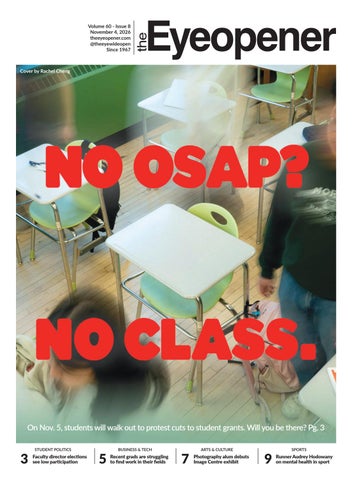
Cover by Rachel Cheng
On Nov. 5, students will walk out to protest cuts to student grants. Will you be there? Pg. 3
3
STUDENT POLITICS
Faculty director elections see low participation
5
BUSINESS & TECH
Recent grads are struggling to find work in their fields
7
ARTS & CULTURE
Photography alum debuts Image Centre exhibit
9
SPORTS
Runner Audrey Hodowany on mental health in sport
News
THE EYEOPENER WEDNESDAY, NOVEMBER 4, 2026 theeyeopener.com/news
Next Week: Students walk out in protest of OSAP cuts
New grad program seeks to combat child sex trafficking The program will launch next fall with applications opening in December Henry Brook Contributing reporter A new Health Sciences Master’s degree at Toronto Metropolitan University (TMU) will focus on combating Child Sex Trafficking (CST) and Online Child Sexual Exploitation (OCSE). The degree, which falls under the Faculty of Community Services, aims to meet the "urgent need for education that equips professionals to combat CST and OCSE as a children’s rights issue and a global public health crisis," the press release reads. The program will be led by associate dean Jennifer Martin, whose research has been at the forefront of this issue for 15 years. The Eyeopener reached out to Martin for comment, who was unavailable for an interview. In a statement to The Eye, the university said students can expect to take theories, methodologies, therapeutic practices and lived experiences, then integrate them into the real-world and design best practice responses to support victims. Child and youth care professor Tara Collins is part of the new program's faculty. She said Martin's expertise and the “dedicated efforts” of the program's faculty will be crucial to the success of the program. "It's essential given the com-
plexity and scope and scale of the issue of sexual exploitation with children," Collins said. She also said addressing CST and OCSE requires people who are passionate about advocating against the issue. “There has to be specialized training to support people who are passionate about children and young people and passionate about better understanding and responding to the issues in order to better support the young people and their families and communities involved," Collins said. The degree has been developed through collaboration with numerous agencies including highly experienced anti-CST/OCSE leaders from the Government of Canada, the Royal Canadian Mounted Police and a number of survivorled and youth mental health organizations, the announcement said. Ashley Franssen-Tingley is director of Stakeholder Relations at the Canadian Centre to End Human Trafficking. She said any efforts to fight child trafficking will require collaboration. “This is a whole-of-society response, so this can't just be NGOs and governments at the table. We need to have survivors. We need to have academics. We need to have private sector companies, including the tech companies, at the table addressing
this,” Franssen-Tingley said. She also said an increased focus on child-specific trafficking has been needed. “[Child trafficking survivors are] quite an underserved population when we're thinking about the anti-trafficking response infrastructure in Canada," she said. Erica Gorenko, a second-year criminology student, said many don’t realize how often child sex trafficking happens. “There's a bunch of crime that happens that is more talked about compared to child sex trafficking, even though it's one of the most serious and important crimes that can happen to children,” Gorenko said. According to a 2022 Statistics Canada report, women and girls made up 96 per cent of detected human trafficking victims in Canada, with a quarter of all victims under the age of 18. Statistics Canada also reports there was a 43 percent increase in the rate of online sexual offences against children from 2023 to 2024, an increase of 1,230 incidents, driven by a 65 per cent in the rate of luring. Online offenders took advantage of children who were largely at home and online during COVID-19, a period when online child exploitation cases sharply increased, a 2024 Royal Canadian
PIERRE-PHILIPE WANYA-TAMBWE/THE EYEOPENER
Mounted Police report said. Franssen-Tingley said universityage students bringing their knowledge, perspectives and experiences will be helpful in the fight against child trafficking in Canada. In a phone call with The Eye, TMU president Mohamed Lachemi said the program comes at an important time when AI, social media, loneliness and disorientation are common in the lives of children and youth. "The program attempts to close the gap in services and training to equip professionals to combat these serious issues and we are very proud to be the first university in Canada to offer such a program," Lachemi said. With Indigenous girls making up half of all girls trafficked in Canada, according to the 2014 National Task Force on Sex Traf-
ficking of Women and Girls in Canada, the degree will make special efforts to recognize how these communities are impacted, according to the announcement Zara Cox, a third-year social work student, said whilst the inclusion of Indigenous perspectives is critical, she hopes it is done in a way that avoids harm. “I would hope that it's done safely in a way that's not going to harm or re-traumatize people that have been involved in those experiences. Because I think the Indigenous communities should be at the core of the program,” she said. The program is taught through a trauma-informed lens and places significant emphasis on wellbeing and self care strategies, TMU said in a statement to The Eye. Read more at theeyeopener.com
Provincial funding secures new seats across faculties The $73 million investment will add 2,115 seats in STEM, 627 in health and 34 in education Nasha Dutta contributing reporter
New seats are coming to three faculties across Toronto Metropolitan University (TMU). The 2,776 spots are part of a $73 million provincial investment in the university aimed to prepare incoming students for high-paying and in-demand careers, according to the province. The money is part of a broader $1.7 billion provincial plan to fund more than 70,000 additional postsecondary seats “in high-demand sectors at publicly assisted colleges and universities.” This is the largest post-secondary seat expansion in more than a decade in Ontario, according to an Oct. 23 news release. Applications for colleges and universities to compete for additional funding opened in May. According to the release, post-secondary institutions identified programs requiring support. The province evaluated funding proposals based on institutional capacity, industry needs and student demand. The new spots will include 2,115 seats in STEM programs, 627 in
health programs and 34 for education programs. In a statement to The Eyeopener TMU said STEM programs received most of the seats because they encompass a significant range of subjects and account for a substantial share of enrolment. The allocation was also closely tied to "projected labour market demand based on analysis of regional employment trends," they wrote. Fifth-year biology student Kiran Ali, said with the number of students already in STEM programs at TMU, she worries there aren’t enough resources available to them. “The amount of people that they're bringing in STEM, there's not enough placement, regardless if there's funding,” said Ali. “It's not like they're going to increase their seats for stuff that has to do with co-op placement.” She said further schooling is often required following an undergraduate degree to obtain a job in the field. Isaiah Pilipa, a first-year history and philosophy student, questioned how TMU will improve its infrastructure to keep up with nearly
3,000 new students. “Just walking down Gould Street is basically like being on a busy subway at all times. So we're already really overcrowded and we kind of don't really have that many buildings,” he said. Pilipa also worries the additional seats may impact the student experience. “One of my favourite things about TMU compared to other universities is that at places like U of T and York, you never get to talk to your professor,” he said. “Here, a lot of the time you can email your professor, you can talk to them after class, you can go to their office hours and it'll just be you and them,”he said. Thomas Lopes, a first-year business management student, questioned how TMU will ensure professors are able to keep up with the influx of students. Lopes said at his current class sizes, he finds it difficult to connect with professors without coordinating with them well in advance and in office hours. “I find a lot of professors right now, they're, like, ‘just the scale of you guys, we can't answer emails,' or
RACHEL CHENG/THE EYEOPENER
'can't answer questions,'” said Lopes. Lopes worries current and incoming students might resort to AI to assist with their courseload if they are unable to connect with their professors one-on-one. The ministry received over 1,000 letters of support from employers who endorsed the expansion of seats across in-demand programs at their local institution, according to the news release. Ontario Chamber of Commerce CEO Daniel Tirsch welcomed the new seats. “Strengthening Ontario’s talent pipeline is critical to our competitiveness and today’s investment will help ensure employers can find
the skilled workers they need to grow,” he said. The new seats are expected to produce over three thousand graduates across STEM, health care, trades and education. Graduates from these programs are expected to fill roles across the economy, bringing the skillset developed at TMU to their chosen fields, TMU said in a statement to The Eye. They also said some sectors that graduates from these programs commonly enter include health care, public health, housing and infrastructure development, advanced manufacturing and life sciences.
News | 3
THE EYEOPENER WEDNESDAY, NOVEMBER 4, 2026
TMU community gears up for Nov. 5 walkout Students will take to Gould Street in protest of changes to OSAP and Bill 33 Zanoah Plummer news editor
Students, professors and unions are preparing for a Nov. 5 walkout in protest of recent changes to the Ontario Student Assistance Program (OSAP) and Bill 33. The date was selected by the Canadian Federation of Students Ontario (CFS-O), who intend for the action to be province-wide and span across several college and university campuses. The Toronto Metropolitan Students' Union (TMSU), the Toronto Metropolitan Association of Part Time Students (TMAPS) and the Toronto Metropolitan Graduate Students' Union (TMGSU) have all endorsed the walkout. The unions, in collaboration with the Student Mobilization Committee (SMC), are leading the contingent of Toronto Metropolitan University (TMU) students who are walking out. Participating students will leave class at 1 p.m. and gather near Lake Devo. The walkout is largely in response to major changes to OSAP that reduced the maximum amount of funding the program provides through grants from 85 per cent to 25 per cent, as previously reported by The Eyeopener. The changes came into effect this fall and many are already feeling the effects. In an email to The Eyeopener, CFS–O explained the purpose of the action: "Our demands are clear: grants, not loans; an end to tuition hikes; and hands off admissions, research security plans and students' fees." "We are calling for meaning-
ful and consistent public investment in colleges and universities rather than olicies that shift the burden of underfunding onto students," it read. TMAPS president Rose Finlay told The Eye the walkout was a "sister union effort" with the TMSU and TMGSU. "We will all be meeting at Lake Devo and lunch will be provided, as well as just some more general information about the walkout and why we're walking out and what our demands are to the province." Finlay said a petition will also be available for students to sign at the walkout. There is no policy granting wider academic amnesty for students who participate in the walkout and it will be up to individual professors to decide whether or not to grant it. However, the unions have created an email template students may send to their professors asking for amnesty. TMU president Mohamed Lachemi told The Eye it will be up to students' judgement whether or not to miss classe for the walkout. "TMU respects our students' right to demonstrate on matters that are important to them. Faculty and contract lecturers are aware of the walkout and invited to offer flexibility, if possible, for students who choose to participate in activities on Nov. 5, " said the president. "This is up to the discretion of the instructors, and may not be possible for all courses." Some professors have chosen to grant amnesty for all students in
their courses. Thomas Hart, a philosophy professor, said he will make his class asynchronous in order to support participants. "I think it's important as an instructor, as a professor, as a teacher, to make sure that the students have the freedom to be able to stand up for what they count as important issues in their lives. And this one certainly is." Hart said during his undergraduate at the University of Ottawa, similar legislation resulted in students protesting against funding cuts to education. Hart said he participated in the action and called cuts to education a "perennial thing." "It felt like an existential threat, because it looked like the goal was to sort of make universities inaccessible in order to restrict, as much as possible, the number of people that were going to be there," said Hart. Megan Morgan is vice-president of equity at the TMSU. She said professors should encourage students to participate in the walkout. "If this is taken into effect, they will have less students to teach. And I feel like it is important that they should encourage students to advocate for themselves and advocate for their tomorrow." Morgan said safety will be emphasized in the protest and the unions have ensured trained volunteers will be present in case students are uncomfortable with a possible police presence at the protest. "We are being trained to have de-escalation tactics, just in case it
RACHEL CHENG /THE EYEOPENER gets a little bit too rowdy. We're making sure that it's a safe environment," said Morgan. Paige Garvey, a third-year nursing student, said her professors have not discussed granting amnesty to students walking out. Though, she said she can "see the importance of the walkout." "I would hope that [the government] actually see the effect it has on post-secondary students," she said. "I hope they'll make a change." Trudy Kuropatwa, the chair of the SMC, said the planning for the walkout started well before orientation week. "We've been doing active outreach, talking to students daily on campus, one-on-one, in-class talks, connecting, again, to our student unions here at TMU and trying to, you know, light a fire under some of our democratic organizations so that when we do the walkout, it will be successful,
that it will be large." "We want to be acting ahead of legislation like this that affects students, that affects workers across the board, and to win back those grants and to win back loans." Finlay said she hopes that the walkout will "better educate the student body." "I think we provide some really good educational input in this area and just looking forward to gathering with our membership body, educating and even strategizing." Finlay is also eyeing the actions or escalations that may follow the walkout. "When we're in these spaces, we're collectively bringing together a larger community who can all kind of brainstorm what would be a good next step: a proposal for further protest or lobbying or whatever that looks like," she said.
Few candidates, few voters at faculty director elections Only four students ran in a TMSU by-election that sought to fill seven board seats Edward Lander editor - in - chief Last week's Toronto Metropolitan Students' Union (TMSU) faculty director by-election saw low turnout and low participation, with many candidates claiming their seats with less than 10 votes. The election sought to fill seven board seats left vacant after the Spring 2026 General Election. However, only four candidates ultimately ran and all were unopposed. The election spanned Oct. 26 to 28 and voting took place both online and in-person. Faculty directors are members of the union's board of directors who represent students in their respective faculties. Among the winners was secondyear computer science student Hamza Chaudhry, who acclaimed the Faculty of Science director seat.
He said the low turnout may stem from a lack of awareness of student politics and trust in the TMSU. “When students don’t trust an institution, they don’t take part in it,” he said in an interview with The Eyeopener. “When they don’t take part in it, it means that institution can’t bring about meaningful change.” Chaudry said he plans to use his position to rebuild trust between students and the TMSU, hopefully encouraging more students to vote or run in future elections. “To be blunt, like eight votes, 10 votes, 15 votes—this shouldn’t be enough to put anyone on a board just because no one else ran. There should be many people running,” he said. Chaudry said as a board member he'd like to make more information about board decisions available online and increase consultation with students through a
student-wide survey. “I want to remove the dichotomy between students and the TMSU, where the union is something that happens to them, not something that they’re part of, because that’s the way I felt before I ran in these elections,” he said. Third-year juris doctor candidate Ian Lin acclaimed the Lincoln Alexander School of Law Director seat. He ran in a slate alongside Anjalique Raghunauth, who won the faculty's second seat. Lin is vice-president of the Lincoln Alexander Law Students’ Society (LALSS) and Raghunauth is president. This by-election was the first where students who are signing officers for student groups or societies were permitted to run. In an emailed statement, the TMSU told The Eye this change was proposed at the union's last board meet-
ing and adopted into the Campus Groups Code of Conduct. In Lin’s candidate bio, he urged students—specifically law students— to participate in the elections. Lin won his seat with eight votes. But he said within LALSS’ own elections, voter turnout is much higher, with as many as half of the faculty’s students participating. “We have really great turnout in our internal elections, it's not like [students] don't vote, they do vote. I think it's just a battle of awareness,” he said. Lin said he hopes to increase ties between law students and the rest of the university in his role. “We are not a silo, we are part of the larger community,” he said. “I know not all law students feel that way, some of them just want to stay within law, but to me TMU was part of my identity.” Second-year creative industries student Alonzo Reyes was elected
Creative School director with 13 votes. He said the low voter turnout was likely associated with the race being a by-election, rather than a general election. Reyes said he’s eager to serve on the board, and would like to increase connections between Creative School students and the union. “It seems like The Creative School itself is an underrepresented group within the union,” he said. “If I can get it more ingrained in and work with the student body to guide the TMSU into a direction that helps everybody and creates a win-win, [that] would be something I want to work towards.” In their statement, TMSU said the seats that were not filled in the by-election will continue to be held by interim directors who were appointed at the Oct. 1 board meeting. They will hold the position until the board term ends on April 30, 2027.
4 | Editorial
THE EYEOPENER WEDNESDAY, NOVEMBER 4, 2026
The Eyeopener Vol. 60 | 2026-27
Want to contribute to your campus newspaper? The Eye is looking for new volunteer writers, photographers and more. Sign up at theeyeopener.com/join-us
EDITOR-IN-CHIEF
PHOTO EDITORS
Edward “Sunshine” Lander PRODUCTION EDITORS
Amira “Not So Sick” Benjamin Jasmine “Very Sick” Makar
Rachel “Kerr Hall Lover” Cheng Daniel “Bedridden” Opasinis Pierre-Philipe “Font Expert” Wanya-Tambwe MEDIA EDITORS
Nadine “The” Alsaghir Zanoah “Goat” Plummer
Victoria “Life On Mars” Andrade Ava “Hi! I'm From The Eyeopener” Whelpley
ARTS & CULTURE EDITOR
DIGITAL PRODUCER
NEWS EDITORS
Sophie “Pretty Pictures” Wallace BUSINESS & TECHNOLOGY EDITOR
Mishael “Looking 4 Work” Taruc
Lucas “Pumpkin Patch” Bustinski GENERAL MANAGER
Liane “Ole Reliable” McLarty
COMMUNITIES EDITOR
DESIGN DIRECTOR
FEATURES EDITOR
EDITORIAL INTERN
FUN & SATIRE EDITOR
CONTRIBUTORS
Rin “What Are You Supposed To Be?” Yanase
Vanessa “We'll Get 'Em Next Time” Kauk
Zoe “Rookie” Aloumanis Oliver “Cinematic” Ulster Gavin “I Don’t Know How He Does It” Kennington Nolan “Suited Up” Boivin Nicholas “Double Header” van der Ham Victoria “THE GOAT ” Cha Santiago “Beyond Belief” Ortega Ananya “Red-Tailed Hawks” Sharma CONNECT
@theeyewideopen theeyeopener.com CONTACT
T: 416-979-5262 ext. 2338 E: editor@theeyeopener.com 55 Gould Street, Suite 207 Toronto, Ont. M5B 1E9 ADVERTISING
Daniyah “9 to 9” Yaqoob Dylan “Defrosting” Marks SPORTS EDITORS
Francesco “Always” Cautillo Naomi “A Pleasure” Low
Grayson “Kinesiologist” Glenn Ariyana “From Manhattan” Richardson Mindy “Saviour” Nickerson Nasha "Double Feature" Dutta Henry "Running In Circles" Brook
advertising@theeyeopener.com Looking to promote your student group? Any official student group can get one quarter-page ad per school year for free. Ads are offered first-come, first-served. The Eyeopener is published by a non-profit corporation owned by the students of TMU.
If you talk the talk, walk the walk
Students will walk out for OSAP this week. Don't be afraid to join them Edward Lander
EDITOR - IN - CHIEF
I started high school in 2018, the same year Doug Ford was elected premier of Ontario. In the eight years since, I, like many of you, have had a front-row seat to Ford's disastrous decisions on education in this province. That year, Ford rolled back the 2015 sex-ed currciculum to one devised 20 years earlier in 1998. This prompted thousands of high schoolers to walk out in protest. In 2019, Ford introduced the Student Choice Initiative, which closely resembeled today's Bill 33 and sought to make certain ancillary fees—which fund student groups and services—optional for students to pay. He also came for the Ontario Student Assistance Program (OSAP), promising that
a large portion of grants would be converted to re-payable loans. That year, students at this university held a one-day student strike, shutting down a portion of Yonge Street. Flash forward to today and Ford is at it again. In February, the province drastically lowered the amount of funding OSAP provides through grants, dropping from 85 per cent to a measly 25 per cent. Now, we're well into the first semester where the change is in effect and students are feeling the heat. We're also facing Bill 33, which once again threatens student fees. If any of this makes you as angry as it makes me, don't stay silent. When high schoolers protested the 2018 sex-ed curriculum, Ford walked it back. In 2019, the Student Choice Initiative was struck down. Students have power when we come together—we've just got to show up.
your friendly neighbourhood bookstore
your friendly f iendly neighbourhood fr neig i hbourhood bookstore ig
your next great read awaits...
your next nex eext great read awaits... awaits t ... ts
benmcnallybooks benmcnallyb benmcnallybooks y ooks yb 108 Queen 108 Queen St. St. E E (at (at Jarv Jarvis) Jarvis) rvi rv vis)
Business & Technology | 5
THE EYEOPENER WEDNESDAY, NOVEMBER 4, 2026
The expectation gap: Are grads finding financial stability? Recent graduates have the odds stacked against them when it comes to building financial independence Molly Simpson contributing reporter
Two years after graduating in media production, 2023 Toronto Metropolitan University (TMU) alumna Camille, moved from her grandmother's Newmarket home to an apartment just outside of downtown Toronto. After a month of searching, she had found a position in media, working for a school board. As is often the case for early-career adults, Camille said finances are tight right now. Regardless, she’s optimistic about being at the beginning of financial independence. At her job, she creates teaching materials for staff, covers events and works with video editing and photography—all skills she says she developed in her program at TMU. Camille said she’s content with her role and plans to stay for the foreseeable future with how the job market is. Now on her own, Camille pays around $1,600 for her less than 500 square-foot apartment. She said about half of her income goes toward rent, and the rest to utilities, groceries, gas and other bills, leaving her with little money to save. She said she’s considering moving somewhere else with a roommate in the future. But living in the city has been worth it despite the high cost. “It's expensive and I'm spending more than I would like to be spending,” she says. “But moving back home is not an option for me…it feels like it would be a step backwards.” Camille isn’t the only recent grad who’s found herself in a position like this. While venturing into the ‘real world’ has always been difficult, today’s graduates seemingly have the odds stacked against them. With the rising cost of living, housing and other expenses, many of them find themselves tightening their belts until they establish careers in their desired fields. For fresh graduates in Toronto, these circumstances are perhaps worse. In the city, rent prices are up and many essentials cost more than they do outside the Greater Toronto Area. According to the Canada Mortgage and Housing Corporation, the average rent for a studio apartment in October 2015 was $937. In 2025, that figure was $1,491—a 62 per cent increase in just 10 years. According to Credit Canada, Toronto is one of the most expensive cities in the country to live in, largely due to living expenses. For Camille, initially staying with family gave her some financial stability, yet she felt moving was necessary to live life on her own. She said while they often get along, there are a lot of “strong personalities,” in her house that could make living at home difficult, and this was one of the urging factors to move out. Camille wanted to be independent, and have a space where she could figure out and experience her life as a Trans person, something she didn’t feel she could necessarily do at home. For privacy, The Eyeopener is not publishing her last name.
DANIEL OPASINIS/THE EYEOPENER “I would rather figure it out in the space where I know that there is potentially going to be more support,” she said. Moving into the city helped Camille with this, giving her independence and a space that’s more peaceful. “Living on my own, it's nice because my space is mine.” But even amid these circumstances, many fresh graduates say they are taking baby steps toward financial independence. Alicia Dos Santos graduated from the graphic communications management program last spring. While studying, she had lived at home with her mom in Oakville, working a job at a local Starbucks. Dos Santos now lives and works in Toronto, and feels she’s in a good place financially despite not finding a job in her industry. Because she doesn’t have classes, her availability is open and she often works 30 hours a week. At the moment, she is working shifts at a Starbucks downtown. “I have more time in the day to work at whenever time.” She said she now pays just under $900 in rent. Tracking her spending and income on an Excel sheet, Dos Santos said she’s been saving for the past two months. “So I'm on the up and I'm saving about half my paycheque.” Dos Santos isn’t actively job hunting, saying she intends to wait for her industry’s peak hiring times in the spring and fall. After graduation she said she had planned to apply this fall, but didn't. She said she no longer has a particular timeline in mind. “I think to set a deadline for myself would not be super helpful. I think I'm just going to get it done when I get it done. And then I'd rather take the time to work on something that I'm proud of,” she said. Some alumni don’t always end up in fields related to their degree. Wincy Li, associate director of career education at the Career, Co-op & Student Success Centre at TMU, said it has to do with the individual nuance a student brings to the table. “Some students need to just make a living right away, get a paycheque and so they might just kind of take the first job in what-
ever field they happen to find a job in, and they navigate their career from there. Others might come with a little bit more experience or professional contacts and they're able to land somewhere closer to where they want to be,” Li said. She said sometimes students’ expectations of their early post-graduation life simply isn’t feasible, and they should be patient with themselves and their employers. According to Statistics Canada, graduates with a bachelor's degree or higher level of education have only experienced “modest” wage growth in recent years. They also report that this demographic’s average income is $39.18 per hour as of 2025. The expectations of new grads versus the reality is clashing, according to a survey done by ZipRecruiter. The survey found that 82 per cent of students soon to graduate expect to start working three months after graduating, with only 77 per cent actually accomplishing this. It also reported that on average, graduating students expect to make an average salary of $101,500 annually, but the reality is an average income of $68,400, a 33 per cent discrepancy. Faye Dela Vega, a master of biomedical engineering student, who graduated in October is also navigating her post-graduation financial journey. Dela Vega said she worked part-time during school in retail, as well as taking on school opportunities, such as exam invigilation. She said losing those school positions will be challenging, but she hopes things will balance out, as she’ll have more freedom to take on hours at her retail job. In Canada, she’s only worked jobs unrelated to her degree. So, right now, she's prioritizing building a career in her field over her finances. Dela Vega said she wants to be in research and development in the pharmaceutical or biotech industry within the next two years. She said few people in her program have been able to get a job in the field, but finding them in Toronto is harder. “My friend got a job in Sudbury…he re-
located there because he got [a] full-time job there. But the problem is he's far away from his friends,” illustrating the tradeoffs often come with newly stepping into the job market. Dela Vega, who is from the Philippines, lives with her mother’s friend, which allows her to keep saving while looking into roles related to her degree. She says she currently pays rent, utilities, food and other necessities. Dos Santos said she had done something similar, living at home with her mom, which she acknowledged has provided her with a cushion if she accidentally overspends on something else from time to time. “I think things would be much different if I had moved out for first-year and been on my own, because I definitely would not have had as much savings and I probably would have been a lot more restricted with my spending,” Dos Santos said. Camille said that while finances can be tight, she’s not willing to neglect her social life. “There's no real choice…This might be technically irresponsible if you look at it purely on paper, but I'm not going to spend my life being a hermit.” She said budgeting for social activities requires some forethought and a “balancing act.” If she gets paid one week, she has to consider when her rent will be due. “I have to be choosy with what I'm going to do…what am I willing to be worried about?” This can look like staying in with friends and watching a movie, Camille said. Stepping out of graduation into an industry can be daunting and challenging. But Li wants students to remember that they are equipped and capable as they head into the job hunt. “Know that you have skills and experience, even if you think you don't, because in many ways, your school life, your academic life is preparing you for your career,” said Li. “Think about all of the group projects, think about all assignments, the research that you have to do, all of these different things are actually building your skills, right? And those are worth something.”
6 | Communities
THE EYEOPENER WEDNESDAY, NOVEMBER 4, 2026
What you wore this Halloween Four creative costumes The Eye spotted on Gould Street
Lauralee Lusung, second-year GCM: Ladybug Lusung was dressed as a ladybug alongside her co-vendors who donned bumblebee and caterpillar costumes. Lauralee said growing up she always loved ladybugs and said Halloween is a “time to be with friends.” The club collaborated with the TMU Sustainability Office to create a pollinator garden on campus over the summer RACHEL CHENG/THE EYEOPENER
Wildlife club seeks to boost awareness of environmentalism on campus Benjamin Park, third-year media production: Arlecchino (Genshin Impact) As a regular participant in cosplay conventions, Park chose to be a video game character. “She’s my favourite Genshin character.” The outfit shows traces of his craftsmanship: including fake nailchips, buttons on the vest and the styled wig.
Shaylynn Hewitt, first-year fashion: “Witchy-inspired look” “I love just dressing up for anything, so any excuse to go with a theme, I take it.” Hewitt said the makeup was done herself, based on a Pinterest design that inspired her.
Kat Chan, second-year GCM: Wendy (Don't Starve Together) Chan, who bleached her hair to disguise herself as her favourite video game character, said she hand-made the hair clip and the pleated skirt. “I just looked at the different skins that my favorite character has, and I matched them up together to make it look more interesting.” PHOTOS BY RIN YANASE
The group took part in planting a pollinator garden on Nelson Mandela Walk Ananya Sharma contributing reporter
Young people today have spent most of their lives hearing how little time the planet has left. Fifth-year biology student Jomanah Hafez, the founder of Toronto Metropolitan University’s (TMU) Wildlife Club, said that’s the reason her club exists. Hafez, who is specializing in environmental biology at TMU, told The Eyeopener she came up with the idea over winter break in her third year. Hafez said she wanted to start the club as a space for more environmental sciences in the Faculty of Science. The club was ratified as a student group with the Toronto Metropolitan Students' Union in February 2025. Hafez said the club has three goals: to promote biodiversity conservation, to encourage environmental stewardship and to carry out wildlife preservation efforts across campus. Though they’re based at TMU, she said that that last goal doesn’t stop at the edge of downtown. “Wildlife is everywhere you look,” she said. The club’s most visible project is a pollinator garden along Nelson Mandela Walk, which was planted over the summer alongside TMU’s Sustainability Office. The space includes native plants meant to draw in bees and butterflies. In a city where green space is fragmented, Hafez said even small amounts of native greenery “go a long way.” The club also received funding from the Jane Goodall Institute—a global charitable organization founded by the late antropologist. Hafez said securing funding was a big moment for such a young group. Goodall herself received an honorary Doctor of Science degree from TMU in 2001. Hafez believes the club’s existence is an achievement in itself, because it offers
young people a way into conservation that isn’t built on dread. On Oct. 27, the Wildlife Club screened Shark Whisperer (2025), a Netflix documentary that follows a marine conservationist on a mission to protect sharks. The event was hosted in the George Vari Engineering and Computing Centre, and followed a keychain-making event the week prior. Selehna Torres, a first-year media production student, attended both events. She said she's passionate about marine conservation, particularly wildlife like sharks. Cameron Cayab is a fourth-year biology student and a member of the club’s events team. He said a documentary he saw as a child about shark finning—the practice of harvesting shark fins for food—changed the way he’s seen animals and the environment. “We're using their fins to make shark fin soup, and it's super wasteful. So why do we do that?...Why not just work towards trying to make it better?” Cayab said events like this help build the kind of public support conservation movements need. For Anushen Selvasegar, a third-year environment and urban sustainability student, the screening was his first time watching a "wildlife-related" documentary. “I want to get connected with the TMU Wildlife Club,” said Selvasegar, He said he's heard from other students in his program that they'd also like to get involved with the group. Selvasegar said when we talk about wildlife, it doesn’t necessarily have to mean animals from outside Toronto. He said focusing on urban wildlife is also important. “We got bees, we got birds flying around, and how do they help our local environment?” he said. Hafez said the idea behind the pollinator garden was "kind of self-explanatory."
“We planted a bunch of pollinator plants that would encourage the presence of pollinator species like bees, butterflies, that sort of thing, which I feel like is really important because of how fragmented downtown is,” she said. Fifth-year biology student and events team member Lauren Szewczuk has written the Red-Tailed Hawks’ species account—a record that summarizes key information about animal, plan and other nature observations—for the Ontario Breeding Bird Atlas. Szewczuk said the club connects her with people who she can go birding with or look for reptiles and salamanders together. She said the club welcomes students outside the Faculty of Science, including those who don’t have a background in wildlife. “We’re not one of those clubs that are kind of closed doors,” she said. Hafez said community initiatives are the heart of the club, saying the fact it exists is already one of the club’s achievements. Watching students her own age get excited about nature in a big city like Toronto is “something that I never thought I would see,” she said. The club’s challenge is now visibility. Hafez said she wishes more TMU students knew that the club exists. The Wildlife Club is currently open for applications and is looking for more students interested in being general members, Cayab said. “I feel like a lot of young people, especially, associate anything regarding environmental conservation with so much doom and gloom because we've been told all our lives how much global warming is impacting us,” Hafez said. “It’s important to have that little piece of hope for people.” “It’s not the end of the world, and we still have time…We still have hope.”
Arts & Culture | 7
THE EYEOPENER WEDNESDAY, NOVEMBER 4, 2026
Photo alum's exhibit explores ephemerality and time through the lens of a camera
Molly Steels' photography series I am/was/always is on display at The Image Centre until Dec. 5 Nasha Dutta contributing reporter
Photography alumna Molly Steels’ series I am/was/always is now on display at The Image Centre. The series features photographs of her female relatives taken from her family’s archive, collages and Steels’ own original photography. “For me, this series started because I was thinking a lot about existentialism and the idea of all of us, inevitably, dying one day… [but] I was trying to think about approaching it with curiosity instead of dread,” said Steels in an interview with The Eyeopener. Through using natural materials and motifs, Steels pays homage to the shared lived experience and kinship spanning across generations in her family. For her, the medium of photography can feel like a form of time travel: a reassurance that because someone once existed, their presence remains anchored in time forever. “When I look through my family archives, I do feel this sense of comfort looking at their entire life and seeing it from a far off perspective,” she said. The series features a black and white portrait of Steels’ grandmother, Pauline Breen, or ‘Grandma Polly,’ as she calls her. The portrait is overlaid with pressed flowers collected by Steels on the day of Polly’s funeral–a ceremony Steels attended remotely via Zoom during the COVID-19 pandemic. The photograph itself is from Grandma Polly’s archive, passed down to Steels’ mother. The image references Steels’ intergenerational relationships within her family, working under overarching themes of transcendence and mortality. “Thinking of these different people that I hold so closely, but putting them all in the series and thinking of them as these people that I'm connected to in the grand scheme of time…just felt kind of
Photo from the series entitled Looking Indirectly.
Polly at Dominion Park.
Polly and Fern.
By the Lake.
SOPHIE WALLACE /THE EYEOPENER
PHOTOS SUPPLIED BY MOLLY STEELS special to me,” she said. Interspersed among the archival series are original self-portraits and conceptual still-lifes created in response to the old family photographs. One striking piece features a vintage, short-legged wooden chair, originally modified by Steels' great-grandfather to sit sturdily on a lake dock. The chair holds a strangely shaped piece of found timber by the water's edge that caught Steels’ eye during her creative process. Pairing generations-old functional heirlooms with raw forest remnants in her photography allows Steels to converse with her relatives. “Photography has given us a tool to
communicate across generations and across locations,” said Steels. “You get this photo evidence of somebody that you loved that you can look back on whenever you want in this moment frozen in time.” The series’ title draws from an essay by philosopher Diana Prokofyeva, titled "Death and the Experience of Photography an Existential Consideration." Steels writes on her exhibition website that the essay paints the photograph as “a phenomenon that exists between two worlds—the living and the dead—a way to avoid death by copying a moment and suspending it within time.” Steels resonates with Proko-
fyeva’s idea, that photography is a way to say, "I am and was and always shall have been." Several photographs in the series feature a lake by Steels’ family cottage in Gooderham, Ont., near where her great aunt Sylvia once lived. Steels says she feels a connection forged across time by swimming in the same body of water as her. “When you're floating in water, it places you into different places at once. You're above, you're below, you're in between,” said Steels. “Time and existence is something that we're floating in between.” The exhibit at The Image Centre also features a video produced by Steels, based on a letter written by
a fortune teller to Steels’ great aunt Sylvia. In the video, Steels laid excerpts from the letter over footage of herself standing in the lake. “Through this strange letter, I'm kind of thinking about how she would have felt reading it and like the wonder of what her life has in store,” said Steels. She first started work on the series in 2023, following Steels’ graduation from Toronto Metropolitan University. The total process, which spanned over three years, was not without its challenges. Without built-in faculty guidance, Steels was creating a photography project in circumstances she hadn’t experienced before. During a residency at Gallery 44 in Toronto, Steels was given space to explore the collage element of her series under professional guidance, accelerating the series’ completion. “It was a six-month residency that led to a solo show in their members' gallery,” said Steels. “That was a really great way to put a deadline on it and speed up my process.” Throughout I am/was/always, there is the repeated motif of natural materials, from photographed snake skin to collaged birch bark. Steels said this came from a desire to create a sense of ephemerality in the series. She said she hopes to convey the relationship between location and time by connecting the degradation of natural materials to the temporary nature of human life. Similar to human life, Steels said she is curious about the idea that her work will be something that degrades naturally over time. “I'm standing in one place looking back at all these people who've lived in the same world as me,” said Steels. “Thinking of the world as this shared backdrop and us as these people that just come in temporarily and experience it and then pass it on to the next.” I am/was/always runs at The Image Centre until Dec. 5.
Image Centre secures multi-year provincial grant Sophie Wallace arts & culture editor
The Ontario Arts Council (OAC) has awarded The Image Centre a grant of over $92,000, which will be renewed over the next three years. The OAC announced in an Oct. 20 press release it is investing $23 million across 435 arts organizations throughout the province, as part of its 2026-2027 Ontario Arts Operating Fund. Image Centre director Paul Roth says the funding will have a significant impact. “It’s extraordinarily
valuable,” he said, in an interview with The Eyeopener. The OAC’s previous model awarded funding on an annual basis, but this grant secures provincial funding for the next three years. “When you get a grant like that from the provincial arts council, you know that you have the confidence of the council and of the community,” said Roth. The gallery is primarily funded by the university, as well as national organizations like the Canada Council for the Arts. Roth said government grants are often awarded on a
project-to-project basis, whereas the Ontario Arts Operating Fund is not project-dependent. The grant will make up around three to five per cent of the gallery’s total funding for the year, said Roth. “[It] sounds small, but it’s not, it’s really significant,” he said. “[It will help] keep our collections safe and keep our gallery open.” The Image Centre describes itself as, “Canada’s leading institution dedicated to the exhibition, research and collecting of photography.” As the largest of only a few art galleries on campus, it gives the
community an opportunity to engage with a medium close to the university’s own history. “We are a part of a really rich photography community in the GTA,” said Roth. “For 50 years, the university has had what is widely considered the strongest photography education program in the country.” According to Roth, the application process is extremely rigorous, as the province “wants to make sure that people’s tax dollars are being spent wisely.” The new funding model was introduced in January, streamlining
the OAC’s number of funding programs from 16 to one. The OAC release says the arts organizations selected for funding generate an estimated $524.4 million in GDP, run over 22,000 public events across the province and support over 7,000 artist and arts worker jobs annually. Alongside the funding, the OAC plans to collect data to show “the program’s role in strengthening the arts sector and local economies,” according the release. More funding recipients will be announced early next year.
Sports
Catch up with post-game recaps at theeyeopener.com/sports
THE EYEOPENER WEDNESDAY, NOVEMBER 4, 2026 theeyeopener.com/sports
A tale of two banners
Bold basketball's championships will be etched in the history books during the Nov. 6 banner-raising ceremony Santiago Ortega CONTRIBUTING REPORTER
Eight months ago, the Mattamy Athletic Centre (MAC) Varsity Court was a madhouse in a way never seen before. As night fell on Feb. 28, the Bold men’s and women’s basketball teams were crowned the Wilson Cup and Critelli Cup Ontario University Athletics (OUA) champions, respectively. The wins came after the teams dispatched both of Carleton’s basketball programs in a commanding double-sweep home victory. Flash forward to this week, when both teams will raise their championship banners on Nov. 6, immortalizing these triumphs ahead of their home-openers against the Windsor Lancers. But beyond commemorating two storied OUA seasons, the night represents a multitude of long-time player aspirations realized across both programs. On the men’s team, star player and recent graduate Aaron Rhooms fulfilled his promise to deliver a banner to the program after four years of heartbreak. The U Sports Player of the Year was the engine of the Bold offence all season long and a pivotal piece of sporting success for Toronto Metropolitan University (TMU). Then-first-year guard Gurdeep Kalsi described how, even as a rookie, the season’s meaning was clear to him right away. “It was Aaron’s last year…we knew what we were going in to win for,” said Kalsi. The men’s team claimed their title after a hard-fought playoff stretch, winning in overtime against the Guelph Gryphons in the quarterfinals, then proceeding to upset the Brock Badgers and the Carleton Ravens—two
teams they had lost to during the regular season. When the time mattered most, the Bold put the previous setbacks aside, claiming their first title since 2017. “We were physically and mentally ready to play in those situations,” said head coach David DeAveiro. “Our guys had a quiet confidence within their work.” For the women, just four years had passed since their legendary undefeated national championship season in 2022. Following a Critelli Cup win last year, those who weren’t on the roster four years ago were able to live out the same feeling they’d heard so much about. Interim head coach Stefanija Mrvaljevic, who used to play as a guard for TMU herself, said in the final moments of the championship, her thoughts were on the players. “I wanted it so much more for our players to experience the highs that I was able to experience and [to] feel like you really worked for something with a group,” said Mrvaljevic. Fourth-year guard Kait Nichols, who experienced two semifinal losses before the eventual OUA championship, knew how eager the squad was to return to the peak previous teams had achieved. “We’d gotten so close a couple years in a row. Every year we came back hungrier. Last year, we were so connected,” commented Nichols, “all 15 of us stuck together throughout [the ups and downs].” Fourth-year guard Catrina Garvey chose to come to TMU partly because of the winning legacy she’d been told about by former player Marin Scotten, who was also a member of the 2022 team. Though the championship didn't come immediately, the wait made it mean that much more for Garvey.
ILLUSTRATON BY PIERRE-PHILIPE WANYA-TAMBWE/THE EYEOPENER “Persevering through my first couple of years to being in that moment and finally winning, it feels like all your hard work finally paid off and all that hardship you have to go through,” said Garvey. For their part, the women overcame almost every team they faced, losing just two games during the regular season. When playoffs rolled around, the squad dominated in their semifinal matchup, dismissing Windsor 97-38 before besting the Ravens 75-60 in a game they never trailed in. Like in the men’s program, there’s a similar absence this year for the women’s squad, with the departure of longtime head coach Carly Clarke, who now serves as an assistant coach for the Toronto Tempo. Clarke achieved three Critelli Cup championships during her 14-year tenure and was named U Sports Coach of the Year and OUA Coach of the Year across all sports for the women’s undefeated 2022 season. As the longest-tenured player on the team, Nichols enjoyed the championship as much for herself as for Clarke, seeing firsthand how much she’d contributed to the team throughout the years. “Being able to capture that, es-
pecially in Carly’s last year, meant a lot…she has been here throughout my university career, so that was special,” said Nichols. The coaching staff’s previous playoff experience had taught them that the work for a championship begins long before the playoff matchups. Mrvaljevic echoed a similar sentiment, saying, “You don’t become a good team in the playoffs, you become a good team in September.” “It takes some time to get that alignment and ultimately be really focused on the process,” said Clarke, adding, “we [made] sure that we were the best that we could be when playoffs rolled around.” DeAveiro agrees with the notion. Armed with a roster that lost ten players from last year, his main focus is on the growth of the team. “They don’t know how hard it was to achieve that last year,” said DeAveiro. “A championship is the ultimate goal, but I think with this group, it’s [the goal] to get better every day.” As they look ahead to the new season, DeAveiro knows the team needs to find its identity and roles in order to defend a title many weren’t a part of. So far, the women have con-
tinued their dominance from last year. Keeping most of their championship squad, including First-Team All-Canadian guard Myriam Kone and OUA Defensive Player of the Year Hailey Franco-DeRyck, they remained undefeated in preseason and have won their first three away regular-season fixtures, outscoring their opponents by a minimum margin of 20 points. Meanwhile, the men had a wake-up call in their opener against Laurier, losing 73-79, but bounced back with 79-54 and 9470 victories over Brock and McMaster respectively. Both teams will have the chance to relive their glory one last time when the two banners are raised, before officially turning the page to focus on their title defence. DeAveiro knows that teams will now be looking to come for TMU’s crown. We're now the hunted," said DeAveiro. "Everybody is coming for us, so we need to be prepared." Garvey noted the challenge that is now presented to opposing teams entering the MAC. “Having that banner is a threat that this team has won, and they want to do it again,” she said.
TMU eye OUA Finals after 1-0 win over McMaster Francesco Cautillo SPORTS EDITOR
The Toronto Metropolitan University (TMU) men’s soccer team won 1-0 against the McMaster University Marauders in the Ontario University Athletics (OUA) semifinals on Saturday night at Downsview Park. With the whistle blown, both teams opened their possessions with intensity, hoping to shake off the nerves and harsh temperatures on a cold Halloween night. TMU opened the scoring three minutes in following an electric
run from fourth-year forward Exosse Kadiebue, who dribbled past the defender with unmatched pace before smashing it short-side and into the net. TMU head coach Filip Prostran mentioned the pressure which comes from scoring first, stating “When you score that early, it’s tricky, you almost stop playing. You’re like ‘Is this enough? Do we need to score another one?'." After 20 minutes, the Bold began to find their footing again. A cross towards the far post found the foot of third-year defender Luc Ihama, who hit a half-volley
which left the goaltender helpless. Unfortunately for the home side, the ball bounced off the crossbar and was cleared desperately by the McMaster defence, keeping the score at 1-0 in favour of TMU. Kadiebue’s heroics held off TMU's 1-0 advantage until halftime. After the break, the Marauders picked up their intensity, aiming to find a tying goal earlier rather than push their luck. By pushing their possession up with long ball passes, the Bold were forced to make fouls, picking up yellow cards and clearing the ball quickly to counter McMaster’s onslaught of pressure.
TMU’s aggression continued into the 70th minute with slide tackles and intense pressing. The referee’s whistle was working overtime, calling fouls on both sides and rising above the roars of the Downsview crowd. Aware of the pressure and waning time, McMaster’s fifth-year goalkeeper Ethan Cagalj charged out of the net, clearing the ball and stopping any TMU attack that came his way. The away side piled on the chances, leaving the Bold clearing countless opportunities off their own defensive line. Although
TMU still held the lead, a McMaster goal seemed almost imminent, with the Bold’s only hope being draining out the clock. After 97 minutes of play, the whistle was blown and the home bench rushed the field. With this win, the Bold clinch their first OUA Final since 2022, as well as a spot in the U Sports National Championship in Victoria, B.C. UP NEXT: TMU face the Guelph Gryphons at Downsview Park with silverware on the line. Kickoff time is set for 7 p.m on Nov. 7.
Sports | 9
THE EYEOPENER WEDNESDAY, NOVEMBER 4, 2026
Running her race: Cross-country captain Audrey Hodowany on approaching mental health with intention
Hodowany is headed to the U Sports Nationals—but that’s hardly her most impressive accomplishment Victoria Cha CONTRIBUTING REPORTER
Audrey Hodowany is no stranger to commitment. When she isn’t training as a runner on the Bold cross-country team, she’s working as a research assistant on campus or as an Ontario University Athletics (OUA) ambassador. That’s not to mention attending class as a fourth-year nursing student and completing 12-hour hospital shifts in her work placement. Hodowany handles each role with a strong sense of duty, but juggling so many responsibilities hasn’t come without strife. Hodowany has been open about her struggles with mental health, and her journey to a better headspace wouldn’t have come without a conscious commitment to caring for herself, as she does for those around her. “Being successful or accomplished on paper doesn’t necessarily mean you’re doing well mentally,” she says. “You can be achieving all your goals and balancing multiple responsibilities, but if you’re struggling with your mental health, it can be difficult to feel fulfilled or fully present in what you’re doing.” Hodowany moved to Toronto from Taipei, Taiwan, in 2022 to attend Toronto Metropolitan University (TMU), but she didn't join the cross-country team until the 2025-26 season. During her first and second years at TMU, Hodowany had to discover who she was without her sport for the first time in over a decade, which she says was a challenge in itself. “Without that consistent routine for exercise or competition, it was really hard to develop my own routine and also to feel a sense of purpose,” said Hodowany. Having to acclimatize to a new city without her family by her side also weighed on her. Even when she found a way back to running in her third year, seeking a sense of community, she found herself facing moments that would spiral into periods of prolonged mental struggle. “I overextended myself into things I probably don't have time for,” she says. “There was definitely a time in the year when I was like, ‘I'm doing too much. I can't deal with all of this. What do I do now?’” Hodowany also mentioned the difficulties associated with nonteam sports like cross-country. “There’s nowhere to hide in racing, everyone can see you there. If you come last, everyone can see you.” When her piling responsibilities began to take a toll on her mental health, Hodowany began to realize focusing on the difficulty of her circumstances wouldn’t solve her struggles. After honest conversa-
tions with her parents, she decided her approach to school, work and running had to change. Hodowany turned to an oncampus counsellor who works with athletes. She says this invited a new perspective—one that emphasized how she treats herself internally. Hodowany compared self-care and performance to fueling a car. “If you're a really nice car, you don't pump yourself with bad gas. It's going to run, but it's not going to run really well,” said Hodowany. “What we put in is a big part of how we process our thoughts. You want to take care of yourself so you can process them well.” For Hodowany, admitting she needed help—and then seeking it—allowed her to handle her demanding schedule with more clarity and autonomy. “I would say it doesn't necessarily get better—I handle it better,” she said. “Rather than focusing on everything that felt overwhelming or outside my control, I began focusing on what I could do to support my own well-being and take a more proactive approach to my mental health.” Now, she navigates her mental health with more intention. When it comes to balancing her roles, she breaks tasks into individual steps, maintains a to-do list and knows when to put her wellness first. As a captain on her team, Hodowany has been able to foster a welcoming community through this philosophy. That starts by showing up for her teammates. “[Hodowany] is always there, always positive, always supportive of the other athletes,” said TMU head coach Charles Minor. Hodowany said having a supportive athletic group on campus to identify with is a big help. “It was really important for me to find a group of people who could do what we love together,” said Hodowany. When fourthyear business technology management student Sana Ramay joined the team in September, it was clear to her that Hodowany was someone who showed immense kindness for others, and someone she would get along with. “My first impression [of Hodowany] was she had this really welcoming energy,” she
PHOTOS BY LAZAR MIHAJLOVIC, SUPPLIED BY TMU BOLD said. “I just remember immediately feeling super comfortable around her, and she seemed like someone I could genuinely talk to and be myself around.” Ramay admires Hodowany’s attentiveness to her peers. “She notices little things, like maybe when I'm a bit quiet or something, she'll be like, ‘Hey, how was practice?' or 'How's your day been?’” As a new runner on the team, adjusting to school and sport is a new experience for Ramay. Similar to Hodowany, having likeminded people to share the track with is crucial to her. “The community that running has given me is just as important as the actual running,” she says. “Having people who understand the training, competition, and balancing school makes the experience feel more rewarding,” said Ramay. “There are many reasons why I keep showing up to run, and the friendships I've built along the way are an important part of that.” That sense of belonging goes a long way in the sport, Hodowany says. “We have a really wonderful sense of community within our team. We're really well bonded so we cheer each other on whether we're having a great race or not...When you look around and have all these people supporting you, a supportive coach and supportive teammates, it really helps alleviate the pressure in
such a comparative sport." Fernanda Oneil was an international student ambassador at TMU alongside Hodowany. She said she’s constantly inspired by her friend’s dedication to her passions. “Every single time I see her, I leave our time together [being] like, ‘Oh, I want to read something new’ or ‘there's something new I'd like to research,’ just because she's the kind of person that is constantly doing things, and it's all the good things you would like to see yourself doing,” said Oneil. Though her schedule is constantly demanding something of her, Hodowany has learned to put less pressure on herself to perform in certain ways. When it comes to running, that looks like “reimagining what competition is to me.” Last year, Hodowany had suffered a stress fracture and was unable to compete. She set high expectations for herself and wasn’t satisfied with how her season panned out. She said focusing less on the competition factor of her sport has led her to see greater results from her races this season. “I don't go out there thinking I'm going to place a certain amount. I go out there honestly just to have fun, because it’s also my last year. My scores have gone up dramatically, and it's crazy to think how much your mindset changes how you perform,” said Hodowany. After a strong race at the McMaster Marauder Lakefront Invitational on Oct. 16, Hodowany secured a spot in the OUA Championship on Oct. 31, where she ran an eight-kilometre race in 35 minutes and ended up qualifying along with four other TMU runners for the upcoming U Sports National Championships on Nov. 14. “I was really happy with my result, but it took everything out of me. I finished with nothing left in
me,” said Hodowany. After a four hour drive to Windsor, Ont., where the championship took place, Hodowany began her warmup and team exercises to ease the nerves. But before the race, she admitted that she felt slightly daunted by the terrain. “There was a massive hill… I knew it was going to be tough. I kind of went into the race just being really nervous,” said Hodowany. “I wanted to walk off at 2K, but I really just pushed through it, and I ended up running faster than my previous race earlier in the year, my OUA qualifying race, which was a flat race.” While she’s pleased with her results, for Hodowany, her biggest accomplishment was her resilience. “Honestly, I would have been happy regardless of making or not making nationals, because the idea of wanting to quit and then not quitting is honestly a really big deal to me.” The race was just another example of Hodowany being able to push through a difficult moment with the help of having the right mindset—one that could only be developed through past struggles and hardships. Now that Hodowany has reached this point, she’s using what she’s learned from her own trials to advocate for mental health and inspire others as a student, athlete, teammate, friend and beyond. “Throughout the years, you realize that mental health is ongoing rather than something's going on, and we should just fix it,” she says. “It's a process. By accepting that we're going to have down days and up days, that acceptance really helps get you through things,” said Hodowany. “If you take care of yourself and push through it, it's going to get better.”
10 | Fun & Satire
THE EYEOPENER WEDNESDAY, NOVEMBER 4, 2026
Eyebituaries Student crying in SLC group study room Rustin Peace OBITUARY WRITER
Disclaimer: The truthfulness in this story has sadly passed away following everything in it being made up from scratch.
The TMU Library study room reservation system
The study room reservation system has died away after a long battle with students booking rooms for four hours and showing up for absolutely none of them. Known for its confusing interface, mysteriously disappearing reservations and ability to crash five minutes before midterms, the system leaves behind hundreds of students studying on the floor of the SLC. A candlelight vigil will be held outside a study room that nobody was able to book.
The TMU Station escalators
These escalators have tragically passed away after years of carrying the hopes and dreams of TMU students running late to class. Despite numerous repairs, they ultimately succumbed to the overwhelming pressure of rush hour commuters. They are survived by the stairs, which have been doing all the work for years. Funeral arrangements are pending approval from the TTC although funds will most likely go towards more platform barriers.
The last available seat in the library
The last available seat in the library has been pronounced dead after being occupied by a student who arrived at 8 a.m. and refused to move until closing. Known for its brief moments of availability and its ability to be filled whenever you actually needed it, the seat will be remembered by the hundreds of students who spent their lunch breaks walking around every floor looking for somewhere to sit. In lieu of flowers, please bring your own chair.
The hope of graduating in four years
The hope of graduating in four years passed away peacefully after discovering that a required course was only offered once every three semesters and had a waitlist of 486 people. Born with ambition and a carefully planned academic schedule, it was ultimately defeated by midterm grades and the mysterious disappearance of available electives. It is survived by an extra year of tuition payments.
Your wallet
Your wallet has tragically passed away after being brutally murdered by cuts to the Ontario Student Assistance Program. Despite years of surviving tuition payments and the ever-increasing price of existing, it ultimately succumbed to the sudden loss of financial support. In lieu of flowers, please attend the walkout on Nov. 5, 2026.
actually doing great
The student was seen sobbing and crawling around in the fetal position Sheldon & Tracy Levy STUDENT LEARNING CENTRE
Disclaimer: While there have been many students who have cried loudly in the SLC, myself included, this particular instance has to be fake if they were actually doing great. A student was spotted on Monday in the Student Learning Centre (SLC) crying violently in an empty study room. Identified as third-year chemistry student Benson Berner, the student was allegedly on the eighth floor (the sky) sobbing into his hands and slapping the table while wailing loudly about his upcoming midterms. However, when The Eye connected with Berner later on, he was found to be “actually doing great.” “Believe it or not, I'm feeling amazing. When I was screaming earlier about midterms I meant the upcoming midterm elections in the U.S. I’m just so excited to see democracy play out, and I am very vocal with my emotions,” said Berner. When asked what he was going through when he had been seen shivering and weeping in the fetal position in the corner of the study room, Berner continued his defense of the situation. “Oh that? That was about the new diet I’m on. It’s nine Powerades and three to five bags of Sun Chips from the vending machine a day,” said Berner. “Every few hours the Powerade and Sun Chips create a vortex inside of my stomach that begins to feast on my intestinal lining, so I just need to remain in that position as it takes its course and completes the process. It’s all very great. I’m doing great.” Second-year professional music student Clef Treble initially spotted Berner. “He looked so sad, like me after Ryan Murphy announced the Glee reboot. I wasn’t really sure what
PIERRE-PHILIPE WANYA-TAMBWE/THE EYEOPENER he could be sad about. I mean this time of year is just as easy and breezy as the rest,” said Treble. Head of community wellbeing at TMU, Elle Ness, said she believes the current mental health state of students on campus is teetering between absolute insanity and complete unraveling chaos. “Students at TMU are like black holes. From afar they may appear stable and in place but once you get close to them, they begin to collapse and suck you in while crying nonstop about why the Glee reboot won’t be the same if Chris Colfer and Amber Riley don't come back,” said Ness. A new study released by Students Overcoming Barriers By Inspiring Nurturing Growth (SOBBING) found that a small percentage of students (99.87 per cent) are currently, and at all times, experiencing a complete mental breakdown, while a whopping 0.13 per cent of students are doing great.
Head of SOBBING Dr. Shaw Bing said the findings were not surprising as this current point of the semester is always a troubling one. “This is what we call the dead zone. You never really know what day it is, time seems to both slip away and go on endlessly and the idea of skipping class drives people to madness like a siren song,” said Bing. Bing added that the 0.13 per cent of students who reported doing great were further investigated, with researchers discovering that most had either recently dropped out or were lying. “We actually had one student tell us he was doing good, and then immediately burst into tears because his AirPods died in his ears. Another told us he had never been happier before proceeding to eat an entire box of granola bars on the floor while nervously checking his email through his fingers. We have
reason to believe nobody is actually doing great,” said Bing. Regardless of the study’s findings, Berner insisted that he was, as he said, "actually doing great.” “Like I said I’m actually doing great, amazing, fantastic, excellent, wonderful, outstanding, phenomenal, superb, brilliant, impressive, terrific, marvelous, very good, good, pretty good, decent, satisfactory, okay, average, mediocre, underwhelming, below average, disappointing, not great, poor, bad, really bad, terrible, awful, dreadful, horrible, horrendous, atrocious, disastrous, appalling, absolutely horrible, and utterly terrible. So really, really great. There is no clearer way to say it,” said Berner. Following our interview with Berner, he was seen re-entering the study room, tearing all of his clothes off and letting his tears and urine soak down his body while holding both of his thumbs up and smiling towards our reporter.
Games, Goofs & Giveaway! | 11
THE EYEOPENER WEDNESDAY, NOVEMBER 4, 2026
GROCERY GIFT CARD GIVEAWAY! The Eyeopener is giving away two $25 gift cards to METRO! Find the giveaway rules through the link in our Instagram bio. 1. Complete the Crossword! Only 100 per cent correct one's will be accepted. 2. Complete the Google Form via the QR code on the page and add a photo of your completed Crossword! 3. Await an email! The form will close end-of-day on Nov. 9, and winners will be contacted shortly afterwards and asked to come into our office for photos!
ACROSS 3. One of these a day is said to keep the doctor's away 6. Brand of cheesy crackers shaped like a certain sea creature 8. Brand of mac & cheese; perfect for crafting the last meal of the day 10. Round O-shaped cereal 11. The perfect blend of chocolate and peanut butter 12. Michael Bublé's favourite drink
Submit Completed Crossword Here
Sudoku
Hard
The Night I Ruined Christmas
1
ADULTS
SEINFELD
FRIENDS
THE OFFICE
It was Nov. 1, 1994. Mariah Carey's hit Christmas song "All I Want for Christmas Is You" had just hit the market. Her CDs were flying off the shelves like that red-nosed reindeer flies off the ground on Christmas Eve. I was at my local grocery store, shopping for eggs and honey to do what I called an "eggs and honey bath," when I noticed a crowd of people gathering around someone near the checkout. As I headed toward the madness, I began to notice the person they were crowded around was dressed head to toe in some sort of female Santa Claus outfit. To my suprise, it was the woman herself, Mariah Carey's publicist. She was wearing an identical costume to Mariah so they could protect her in public. Then I spotted her, Mariah Carey. The gems on her outfit shone in the light like teeth that had been whitened a thousand times. Once I made it through the crowd, I came face-to-face with Mariah. Her scent was that of candy canes and bacon grease with a hint of Bailey's. With my mouthful of eggs, that I had packed to snack on during my trip to purchase eggs at the grocer, I began to tell her how much her new song meant to me. During my blabbering, some of my mouth egg escaped and fell right into the back of her prized throat. As she coughed and fell to the ground her publicist noticed what I had been snacking on. "She's allergic to eggs!" her publicist yelled. But it was too late. The world's future Christmas icon had died from egg. I was charged with first-degree murder and sentenced to a lifetime without eggs and without my "eggs and honey baths." To this day the thing that haunts me the most is the look in her eyes when the egg hit her epiglottis. Her swinging uvula tried to fight off the egg chunk like the mighty soldiers of Rome fought in The Battle of Zama, but, like the Romans in The Battle of Cannae, there was no hope. I don't want a lot for christmas, there is just one thing I need...to forgive myself.
NEW GIRL
VEEP
The story presented above is true and happened.
8 6 7
4 2 6 4 5 9 7 6
8 4 5 1 7 1 5 8 3 2 6 4 1 6 5 6 9 8 Sitcom Word Search
9 8 2 3 9 7
6
DOWN 1. Creamy brown spread commonly put on toast or sandwiches 2. Canned soup brand 4. Hens lay 5. Chip brand that comes in tubes 7. Sandwich cookie filled with cream 9. "___ ____ gives you wings!"
7
4 6 8 4 5 9 2 7 4 9 8 3 9 5 1 3 3 7 9 4 5 8
Not So Hard
P
V
I
U N
I
P
N
F
F
T
S
S
E
I
N
F
E
L
D Y A
T D
Z
B
E H
F
Y W
I
T
A G V
S
L
C N
Z H X G U
S
F
E
J
I
N C
L
A
I
R
E
D
I
Z
L
L
E
Q N
J
A H
F
R U R
E
C
I
F
O
E H T N
X
L
U U C D R
F
A
P
P
L
F
U V