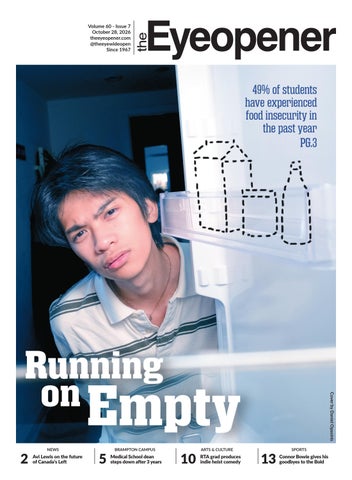
Volume 60 - Issue 7 October 28, 2026 theeyeopener.com @theeyewideopen Since 1967
Cover by Daniel Opasinis
2
NEWS
Avi Lewis on the future of Canada’s Left
5
BRAMPTON CAMPUS
Medical School dean steps down after 3 years
10
ARTS & CULTURE
RTA grad produces indie heist comedy
13
SPORTS
Connor Bowie gives his goodbyes to the Bold
News
THE EYEOPENER WEDNESDAY, OCTOBER 28, 2026 theeyeopener.com/news
Avi Lewis: There's opportunity for the NDP, Canada's Left At TMU's democracy forum, the new NDP leader said the party can regain momentum by tackling affordability and challenging wealth concentration among billionaires and corporations
Nadine Alsaghir NEWS EDITOR
New Democratic Party (NDP leader Avi Lewis spoke at Toronto Metropolitan University (TMU) on Thursday to discuss the future of his party and what’s next for Canada’s Left amid a rising cost of living and economic inequality. The event was hosted by The Dais, a public policy and leadership think tank at TMU, and moderated by political columnist Martin Regg Cohn. Regg Cohn said the forum aims to go beyond prepared talking points and typical news conferences to "dig a little deeper" and obtain in-depth answers from speakers. "This is the real Avi," Regg Cohn said. Lewis was chosen to lead the federal NDP in March. He succeeded Jagmeet Singh, who resigned after the party saw major losses in the 2025 federal election, including Singh’s own seat. Lewis is a former journalist and lives in Vancouver. He is married to author and left-wing activist Naomi Klein. Regg Cohn opened the forum with a sober look at the tough place the NDP found themselves in after the federal election, noting the party’s limited representation in Parliament with just five seats out of 343. Lewis said the NDP can rebuild its support base and build a wider audience by proposing policies that will improve the living conditions of Canadians through addressing the cost of living crisis. "I've talked to people with six figure salaries who feel one paycheque away from economic disaster … everyone's living paycheque to paycheque, even when their paycheque is battered. When you address that, that is the widest possible audience," Lewis said. He stressed the importance of investing in public sector solutions to aid Canadians’ financial struggles, including proposing public grocery stores and a crown corporation to provide affordable cell phone and internet plans. He said cutting taxes alone will not resolve the current crisis and pointed to the wealth held by billionaires, the big banks and the oil and gas industry. "The role of government surely is to go and get some of that wealth and plough it into solutions that will actually solve the crisis of everyday life, and that's my tax policy from a high level," Lewis said. Lewis also called for revers-
Lewis was chosen as leader of the federal NDP in March, after his party saw major losses in the 2025 federal election. ZANOAH PLUMMER/THE EYEOPENER
ing the privatization of Canada's health care system. He said the federal government should enforce the Canada Health Act to ensure health services remain universally accessible. He also said Alberta and Ontario are violating the law through health care privatization and many Canadians are increasingly having to pay out of pocket for medication and other health services, making the cost of living harder to manage. In addition, Lewis acknowledged differences between the federal and provincial NDP, saying regional oil and gas producing provinces have different approaches to energy issues. Lewis stated Canada must move away from its dependence on petroleum, arguing that fluctuations in oil prices contribute to rising costs for Canadians. Lewis said communication with Alberta NDP leader Naheed Nenshi has remained positive despite fundamental disagreements over energy policy. "The rest of the world is moving on. In China and India in the past year, all new demand for electricity has been provided by solar and wind, and Europe is moving off of gas and oil as fast as it can because of Russia's invasion of Ukraine. We're being left behind," he said. Lewis said the Right have been effective at appealing to people's anger over the cost of living crisis, but argued the anger has been redirected toward immigrants, Trans people—specifically Trans
youth—and people experiencing homelessness rather than those "amassing vast fortunes on our economic misery." He said class politics and identity politics should not be treated as opposing priorities. He said identity can be "weaponized" by the Right as part of the "blaming" and "punching down." “I think doing politics of the 99
Lewis was a journalist for 25 years, including for publications like CBC and Al Jazeera per cent means a deep commitment to diversity, a deep commitment to acceptance of everybody, and fighting together as a multiracial, multigenerational group for justice. It also means fighting for working people and addressing their crisis in everyday life," he said. Lewis said the NDP is aiming to make political participation more accessible to young people who may not have a political back-
ground or wealth. “We're really focusing on a bigger funnel to bring in people who don't consider themselves political, but who are angry about how hard life is,” Lewis said. Ajushan Thavaseelan, a secondyear computer science student at TMU, attended the forum. He said it's important for other students to attend these events because it allows them to hear viewpoints beyond their usual experiences. "We all get trapped in our own kind of environment, like our bubbles, so we might not necessarily see any other perspectives," he said. Thavaseelan said Lewis cares about issues conservative governments often fail to address. He also commended Lewis’s focus on issues affecting young people and said this could encourage more youth to consider voting NDP. He points to Lewis's discussion of “friend banking,” which involves contacting people within one's personal network to encourage them to participate in political campaigns. "I think he's really a grassroots leader when it comes to community building...I wish we saw a lot more of that in politics because it represents the ability to be engaged in-person with issues that really affect all of us in this day and age," Thavaseelan said. Shaun Ganzeveld, a third-year media production student at TMU, also attended the forum. He said Lewis's responses gave
him reasons to consider the NDP in a future election. Ganzeveld said Lewis's account of experiencing antisemitism as a child particularly stood out to him. “It's a very personal story. And so hearing him speak about his own personal experience with antisemitism, it makes you have a more personal connection with him," he said. During the forum, Lewis recalled a swastika carved into his school door and being bullied alongside his sister. He said his Jewish identity taught him that individuals have a responsibility to prevent atrocities from happening to anyone, not just Jewish people. "We need to fight all forms of discrimination together, in a fight against racism, all of us together, not with exceptionalism," Lewis said. Lewis said his 25-year career in journalism taught him to listen to people and tell their stories. While Regg Cohn referenced Lewis' description of politics a decade ago as "too personal and ugly," Lewis said it's getting uglier. He said Canada is in "desperate straits" and in need of change and a political party that can bring people together to fight for the basics of elements of everyday life. "I think that party politics is essential, but it's also insufficient. I think we need strong unions, I think we need strong social movements, we need a common front against the extreme right and against rising fascism. And I think I can play a role in one part of that."
News | 3
THE EYEOPENER WEDNESDAY, OCTOBER 28, 2026
Studying on an empty stomach
Good Food Centre report finds nearly half of TMU students have faced food insecurity in the past year Jaymes MacKinnon contributing reporter
An increasing number of students are struggling with food insecurity, a new report from the Good Food Centre (GFC) has revealed. The centre’s 2026 Hunger Report found that 48.5 per cent of students have experienced food insecurity in the past 12 months. GFC, which operates as Toronto Metropolitan University’s (TMU) campus food bank, conducted the survey this past spring. The report found many students are skipping meals because they cannot reliably afford food. According to the report, this is impacting their ability to finish work on time and fully engage in life on campus. Most of the nearly 900 students surveyed agreed “reliable access to food would improve their academic performance.” However, the report says only 20 per cent of students surveyed had visited the centre. The GFC is open to any TMU student who doesn’t have enough to eat, according to the centre’s coordinator, Rob Howard. “There's no litmus test to coming. Just show up, show us your student card and then you sign up with the Daily Bread,” he said. Howard, who is also a registered social worker, said it’s important students feel comfortable visiting the campus food bank. “It's your fees that support this place, so please come and use it and feel like you have a right to do that,” he said.
According to Howard, the GFC receives the majority of its food from the Daily Bread Food Bank and the rest through donations and money collected through student fees. The GFC is run in partnership with the Toronto Metropolitan Students’ Union (TMSU). The demand for food is rising according to Second Harvest, an organization that redirects surplus food from businesses to nonprofits across Canada. Nine in 10 non-profits across their network have seen an increase in demand for food in the last year. Similarly, Food Banks Canada has reported that a record 2.35 million people visited food banks in March 2026, more than double the usage since March 2019. Paul Parillo, senior operations manager at Second Harvest, said organizations distributing food are facing significant challenges meeting increased demand. “In some cases, they had to turn people away because they didn't have enough food…it kind of paints a picture of, you know, the huge increase in need,” Parillo said. Savie Edirisinghe, a third-year PhD student in clinical psychology, was not surprised by the high levels of food insecurity on campus. She said food insecurity should not be normalized as part of the student experience. “I want people to see these numbers and still feel galvanized and to not accept that or tolerate that,” she said. The rising cost of housing, tuition and a decrease in access to
DANIEL OPASINIS/THE EYEOPENER funding following recent changes to the Ontario Student Assistance Program (OSAP) has created “extreme circumstances” for students trying to budget, said Howard. Yukari Seko, the director of TMU’s Centre for Studies in Food Security, says these findings are also backed up by a survey of TMU students which she led in 2024. “At the beginning of the academic term, one in two TMU students go hungry,” she said. Seko said ending food insecurity on campus requires “systematic” solutions from the university. She listed income accommodations, bursaries and tuition exemptions as examples of some of
the supports that could help students struggling financially. “We also think that food— healthy and nutritious and culturally appropriate food for students—are not so available on TMU['s] campus and nearby,” she said. Students who are racialized, gender-diverse, disabled or do not have family financial support experience higher rates of food insecurity, the GFC report says. Zhenya Khvatoba, a fifth-year history student and organizer with The Common Pot, called the rise in food insecurity a “humanitarian crisis” on campus. “It's quite atrocious and it's horrible and, frankly, evil, because it's
a policy choice,” Khvatoba said. The Common Pot is a studentled mutual aid group that serves free vegan soup on Wednesdays. It receives financial support from the GFC. 92.6 per cent of students surveyed by the GFC support expanding free on-campus food programs. When Howard started his role in November 2025, there were around 70 regular weekly visits at the GFC. Now, he says 675 students are members with the GFC and the centre has around 200 visits a week. “We undertook a big, major campaign informing the student body that we're here,” he said.
Chow re-elected as mayor, Ward 13 sees upset
Progressive newcomer and TMU grad Curran Stikuts won in Toronto Centre Edward Lander editor - in - chief Olivia Chow will remain mayor for another term, Torontonians decided in the city’s municipal election held on Oct. 26. The incumbent mayor beat challenger and outgoing Beaches–East York councillor Brad Bradford in a close race that saw the pair neckand-neck through much of it. Chow campaigned on a similar progressive platform to the one she ran in the 2023 by-election, adopting the slogan “forward, not back.” Her priorities, according to her website, were lowering transit costs, tackling homelessness and cracking down on bad landlords. She also said she'd introduce a lower TTC fare cap than the one the agency introduced in September, promising just 10 rides before the service becomes free for the calendar week.
Bradford campaigned on a centre-right platform that put issues like crime, public safety and traffic congestion at the forefront. In Ward 13, home of Toronto Metropolitan University (TMU), incumbent councillor Chris Moise lost his seat, trailing several-thousand votes behind Curran Stikuts, a newcomer in the race. Stikuts received the support of New Democrat MPP Kristyn Wong-Tam, who serves Toronto Centre’s provincial riding and was formerly councilor for the ward. Stikuts was also endorsed by the Toronto & York Region Labour Council. Stikuts attended the Ward 13 All Candidates Panel, hosted by the Toronto Metropolitan Students’ Union on Oct. 19, where he discussed his platform. At the panel, he pledged to increase the ward’s housing supply through programs like the multi-
residential acquisition program, which supports non-profit housing providers with the acquisition and retrofitting of homes, according to the City of Toronto. He also commented on transit issues: “I remember commuting to TMU, it was a pain, it's always a pain, but there's some really easy fixes that we can do to help get things moving. First is looking at our bike lanes,” he said. Stikuts said there are opportunities to expand the ward’s bike network, including expanding cycle routes on Gerrard Street and Dundas Street. Before pursuing city hall, Stikuts was a housing advocate and former director of advocacy at the 519 Community Centre. Stikuts, who is also a graduate of TMU’s social work program, noted the university’s importance to the ward. “TMU is at the centre of our
DANIEL OPASINIS & JASMINE MAKAR/THE EYEOPENER ward and it's very much at the very, very centre of our city,” he said at the panel. The election also saw high voter turnout overall, with close to a million voters casting ballots in Toronto. Over 200,000 of those votes came during the early voting period. This was a nearly 72 per cent increase in advance voting, according to CBC. On campus, students shared
thoughts on the results. TMU student Pheonix Le said he was "ambivalent" to the results, but was pleased Bradford did not win the mayor's race. "I think Chow has a lot of room for improvement and promises she hasn't fulfilled yet. But I think it's more like harm reduction, as I'm pretty against a lot of the platform that Bradford was trying to champion," he said.
4 | Editorial The Eyeopener Vol. 60 | 2026-27
THE EYEOPENER WEDNESDAY, OCTOBER 28, 2026
High voter turnout? In this city?
EDITOR-IN-CHIEF
Nearly a million Torontonians cast a ballot this election. What brought them out?
PRODUCTION EDITORS
Edward Lander EDITOR - IN - CHIEF
Edward “Where's My Sticker” Lander Amira “Masthead Rep” Benjamin Jasmine “Not Masthead Rep” Makar NEWS EDITORS
Nadine “Cmd-D” Alsaghir Zanoah “Sick Again” Plummer ARTS & CULTURE EDITOR
Sophie “Film Editor” Wallace BUSINESS & TECHNOLOGY EDITOR
Mishael “El: 1 AI: 0” Taruc COMMUNITIES EDITOR
Rin “Coffee Culture” Yanase FEATURES EDITOR
Daniyah “Stats” Yaqoob FUN & SATIRE EDITOR
Dylan “Photo Op” Marks SPORTS EDITORS
Francesco “Profile Pro” Cautillo Naomi “YoutTube Tutorial” Low PHOTO EDITORS
Rachel “Ubyssey Fan” Cheng Daniel “Capitals!” Opasinis Pierre-Philipe “48.5 Per Cent” Wanya-Tambwe MEDIA EDITORS
Victoria “Not That Bowie” Andrade Ava “Detective” Whelpley DIGITAL PRODUCER
Lucas “King of Humanity” Bustinski GENERAL MANAGER
Liane “Glaswegian” McLarty DESIGN DIRECTOR
Vanessa “Poll Pollford” Kauk EDITORIAL INTERN
Grayson “Streeter Pro” Glenn CONTRIBUTORS
Myrtle “Trick or Treat” Manicad Jaymes "Table to Table" MacKinnon Isabella “Interview Trooper” Ibrahim Sophia “Pro” Blew Santiago “Away Game MVP” Ortega Gavin “Back to back” Kennington D’Arcy “Shootout” Bagley Michael “It’s a Sign” Elsaesser Milena “Railfan” Tesfay Milla “Pivot” Ewart Debora Ca "Crown" Quindecam Kristian "C.C." Tofilovski Shreya “Sounds Good!” Basu CONNECT
@theeyewideopen theeyeopener.com CONTACT
T: 416-979-5262 ext. 2338 E: editor@theeyeopener.com 55 Gould Street, Suite 207 Toronto, Ont. M5B 1E9 The Eyeopener is published by a non-profit corporation owned by the students of TMU.
Editorials published in The Eyeopener reflect the opinion of the editor-in-chief. Monday's municipal elections were full of surprises. Olivia Chow solidified her standing as a popular progressive, beating a second challenge from Brad Bradford. In Ward 13, where this university is located, longtime councillor Chris Moise was ousted by newcomer Curran Stikuts. In Mississauga, quarrels between municipal heavyweights Bonnie Crombie and incumbent Carolyn Parrish allowed for a new candidate take the win—Alvin Tedjo. But perhaps most shocking is the sheer number of votes cast in Toronto this race. Chow won with a monumental 532,000 ballots—that's nearly twice what she took home in the 2023 by-election. And although his bid was ultimately unsuccessful, Bradford received over 400,000 votes. His share this election was more than what Rob Ford won with in 2010 or John Tory took home in 2014. Even the advance voting period saw a signifiant cent jump in turnout, with more than 200,000 eager voters heading to the polls early. In total, the unofficial results suggest around a million Torontonians turned out this election. According to The Local, voter turnout was 46 per cent. That's 27 per cent more than 2022. But what about this race brought Torontonians to the polls in droves? It may have something to do with the stakes. It's no secret this election was a nail-biter. The polls approaching election day had Chow and Bradford at a near tie, with the challenger even edging Chow by a few points as of this weekend. But the turnout may also suggest rising divisions or polarization. If 400,000 Torontonians came out for Brad Bradford, this shows massive support for his platform—by people who are willing to take to the polls to show it. I don't doubt his populist, tough-on-crime stance resonated with voters in the suburbs, or even some in the downtown core. In Chow's acceptance speech, she seemed to acknowledge this, saying that Bradford brought "new energy and new ideas people cared about." She also promised to be a mayor for every Torontonian, "whether you voted for me or voted for someone else."
DANIEL OPASINIS/THE EYEOPENER There are a few things we know about the share of votes Chow got and a few things we don't. What we do know is where they were mostly highly concentrated. It's no surprise this was downtown, specifically this ward, Toronto Centre, where she received nearly 75 per cent of the vote in a massive outpouring of progressive support. What we don't know is the demographics of voters, particularly their age, which Toronto doesn't track. This means we won't know what chunk of collegeaged kids went to the polls this year. Nevertheless, we do know that those aged 18 to 24 are the least likely to vote at all levels of government. In this week's feature (see page 8), writer Shreya Basu explores some of the reasons why this may be. She speaks with experts, advocates and students about what compels them to cast—or not cast— a ballot. I'd like to think this race's high turnout was spread across demographics, including young people like you and me. Our newsroom is on the second floor of the Student Community Centre and shares a wall with Tecumseh Auditorium, which was a polling station this election. Whenever a voter was casting a ballot for the first time, the staff there let out a cheer. And this election, we certainly heard a lot of cheers.
News | 5
THE EYEOPENER WEDNESDAY, OCTOBER 28, 2026
Founding medical school dean steps down after 3 years
Dr. Teresa Chan will remain with the university part-time as clinical faculty member Nadine Alsaghir NEWS EDITOR
Founding School of Medicine dean Dr. Teresa Chan stepped down from her role on Oct. 13 after more than three years leading the school, according to an Oct. 19 announcement on Toronto Metropolitan University's (TMU) website. Dr. Chan joined TMU in July 2023 to "establish the university’s inaugural School of Medicine from the ground up," the announcement reads. She was a "fierce advocate and champion" and offered a new approach to medical education in Ontario, it continued. The announcement also recognized Dr. Chan's service as the university's vicepresident of medical affairs, overseeing the school's academic, strategic and operational development. In a LinkedIn post, Chan wrote that her family has been navigating "some significant health challenges" over the past few months. She said this prompted her to devote more time and energy to her husband who has supported her throughout her journey. "This was not an easy decision. I love this school, its people, and its mission. But
I also believe that leadership means recognizing when our priorities need to shift, and having the courage to act accordingly," she wrote. The Eyeopener reached out to Dr. Chan for comment, who said she was unable for an interview. Dr. Chan was central in shaping the school's approach to admissions, which focused on equity, diversity and inclusion. As previously reported by The Eye, Dr. Chan said the school developed admissions processes that reflected community and societal needs, including efforts to admit students from underrepresented groups including those who identify as Indigenous, Black or other equity-deserving groups. When the school’s admissions faced criticism in the media, Dr. Chan penned an opinion piece in the Toronto Star defending them, arguing that “schools of medicine need to do a better job at selecting prospective doctors if we are going to meet the health care needs of the public.” In her LinkedIn post, Dr. Chan wrote though she is proud of what they have accomplished at TMU, she particularly values the people who helped establish it. She men-
SAMMY KOGAN/THE EYEOPENER tioned colleagues, learners, clinical faculty, staff, community partners and supporters who "took a chance on a bold vision and worked tirelessly to bring it to life." Although she is stepping down as dean, Dr. Chan will remain with the university part-time as clinical faculty, according to the announcement. "I look forward to continuing as a clinical faculty member and researcher, contributing to the scholarship, teaching,
mentorship and innovation that have always been at the heart of my professional identity," Dr. Chan wrote. In a statement on TMU's website, President and Vice-Chancellor Mohamed Lachemi praised her contributions. "We are very proud of the School of Medicine and everything Dr. Chan has achieved during her time here … she leaves behind a lasting legacy of extraordinary achievements," he stated.
your friendly neighbourhood bookstore
your friendly fr neig ig f iendly neighbourhood i hbourhood bookstore
your next great read awaits...
your next nex eext great read awaits... awaits t ... ts
benmcnallybooks benmcnallyb benmcnallybooks y ybooks 108 Queen 108 Queen St. St. E E (at (at Jarv Jarvis) Jarvis) rvi rv vis)
6 | Business & Technology
THE EYEOPENER WEDNESDAY, OCTOBER 28, 2026
Student helps develop tech for sign language interpretation
The pilot project will bring digital sign language to airports Michael Elsaesser contributing reporter
Fifth-year computer engineering student Muhammad Wajeeh Ul Hassan is a research assistant for an AI startup planning to bring digital sign language to Canadian airports. Hassan has been working at Toronto-based startup Deaf AI. The company is training technology to communicate through sign language using artificial intelligence (AI) with a goal of developing real-time voice-to-sign interpreting services, according to their website. For Hassan, who is hard of hearing himself, the project means more than technological development. “I am eager to help people with disabilities because I am hard of hearing. I’m deaf but I have cochlear devices and so I can understand what it’s like to struggle with hearing difficulties,” he said. Deaf AI’s pilot project is working with smaller Canadian airports to display announcements with sign language on screens, said Hassan. The team includes a sign lan-
guage interpreter who pre-records set airport announcements, and uses face-swap software to anonymize the clips while keeping the language consistent. Once the sign language announcement videos have gone through the AI face swap software, they are reviewed by the team’s sign language interpreters for accuracy. “Sign language is very sensitive, so basically, let’s say if there’s any wrong change in the movement or something, it can change the meaning. So we have to...verify that the sign language is always consistent,” said Hassan. Through his work with Deaf AI, which started as a student placement, Hassan sees a future where this kind of technology could increase accessibility at universities. “I’m pretty sure there are lots of hard-of-hearing people in TMU...and I believe that I'm not the only one who’s struggling to hear,” he said. The university's Academic Accomodation Support (AAS) office states that 11 per cent of the TMU student population are supported by their services. During his lectures, Hassan
uses a microphone that connects to his cochlear device. Yet, he continues to face challenges in the classroom, specifically when trying to pick up the audio of a video shown in class or when his groupmates are speaking at the same time during a meeting. Students who have registered for accommodations through the university’s AAS office can request a sign language interpreter to assist with course instruction such as lectures and tutorials. The office will then contract to local interpreters, and can work with students if they have a preferred interpreter to assist with course instruction. Deborah Fels, director of TMU’s Inclusive Media & Design Centre, said the university should look beyond technical aides when it comes to removing accessibility barriers in the classroom. Fels emphasized the role of professors and the student-instructor dynamic in making education accessible. “I think we need more human intervention, to balance that power differential so that students can learn how to become self-advocat-
PIERRE-PHILIPE WANYA-TAMBWE/THE EYEOPENER ing in a way that makes sense for them, and how to approach their instructors, their academic assistants, and their group members,” she said. In discussing the potential for AI-assisted sign language interpreters, Fels said she sees more promise in advancements for captioning technology. She said AI speech recognition for captioning has seen large improvements in recent years, increasing speed and accuracy— though it still has limitations. “[Captioning] is text-based. It does not respect the cultural importance of sign language for people who are deaf, for sure, but it’s an intermediate solution that can, you know, at least have
some kind of educational value compared to AI sign language,” she said. Expanding on the current pilot program, Hassan is also working with the company on a navigation app for airports. It will provide directions to check-in kiosks, through security and to the gate with a sign language video. The app will provide both American Sign Language and Quebec Sign Language. Deaf AI is testing their pilot program in smaller airports in southern Ontario. “It makes me feel like I should do something, do a lot,” Hassan said, reflecting on his work. “I have the potential to help the Deaf community a lot more.”
New report ranks TMU high in transit sustainability, but students say there's still work to do
From providing public transit fare discounts to building campus residences, students propose ways TMU can do more Mishael Taruc business & technology editor
Toronto Metropolitan University (TMU) was among the top ranking North American universities for transportation in the 2026 Sustainable Campus Index. The report took into account the modes of transportation used by students and employees, the sustainability of the vehicles in the university’s own fleet and efforts to lessen business air travel. “By reducing dependence on combustion-driven transport, institutions can model sustainable transportation systems that benefit human health, improve campus operations, and reduce costs,” the report said. Some students say this reflects their own transportation habits. Charlotte Brooks, a second-year environmental and urban sustainability student, takes the streetcar to campus, which she says is “more sustainable than driving.” Another second-year environmental and urban sustainability student, Methum Jayasinghe, travels from
Hamilton to Toronto for an hour and a half via the GO train and TTC. In a statement to The Eyeopener, the university said, “TMU's downtown location was a major factor in its ranking…our institution’s location offers multiple sustainable ways to get to campus, including walking, bicycling, car sharing, ride sharing and public transit.” David Hunter, a master of spatial analysis student, said the most efficient way to get around the city is biking. “It's really great to bike in the city as long as you can find the right bike routes,” they said. A 2025 Nature Cities study found that in U.S. cities, protected bike lanes was linked to an increase in cyclist commuter mileage—52.5 per cent stronger than standard bike lanes and 281.2 per cent stronger than sharrows or lanes shared by bicycles and other vehicles. In parts of downtown, there are gaps in infrastructures for cyclists. When Hunter lived on Bay Street, they struggled when travelling south toward the waterfront due to the lack of protected bike lanes. “In fact, they just spray painted a
bike symbol on a path on Bay Street. And there's no protection and cars will zip around you,” they said. The Eye previously reported that the province began removing bike lanes in parts of Bloor Street West in Etobicoke and plans to remove those along Yonge Street, University Avenue and Queen's Park. Meanwhile, Jayasinghe said it would be helpful if TMU had a program providing TTC discounts since "it’s a commuter school.” The TTC monthly pass for postsecondary students currently costs $128.15. However, this may not be the most feasible option for many students. “I don’t spend over $100 on TTC a month,” said Brooks. Some students say there are areas beyond transportation where TMU still has work to do in the way of sustainability. Brooks said building more student residences would improve campus sustainability. TMU has three residences with a capacity of 1,144 beds—a low figure for over 40,000 enrolled students. The new Bond Street residence, which will double the campus housing capac-
RACHEL CHENG/THE EYEOPENER ity, is targeted to open in 2030. Meanwhile, third-year urban and regional planning student Gabriel Joseph Remot looked to more immediate sustainability solutions. He argued for limiting single-use plastics on campus. Remot also pointed out that the Hub Café uses recyclable containers but he often sees that these aren’t being returned. The Hub Café uses containers produced by Friendlier, for which students pay a refundable deposit of $0.50 with their order. After finishing the meals, students then return containers. A week or two after the return, students could request a refund or donate it to their chosen charity through the Friendlier app.
TMU aims to be a zero waste campus by 2035, and achieve a 90 per cent waste diversion rate, meaning only 10 per cent of its waste should go to the landfill and the rest is composted, recycled or reused. In 2025, TMU’s waste diversion rate is at 35.6 per cent. “Reaching our zero-waste goal depends on students, faculty and staff actively participating—sorting waste correctly, reducing waste and making use of campus reuse programs,” the university said. Hunter said it's important that TMU prioritizes sustainability as it shapes “the next generation of workers.” They said planting the seed early on helps students to “start thinking about sustainability.”
Communities | 7
THE EYEOPENER WEDNESDAY, OCTOBER 28, 2026
Black engineering society hosts conversation on textured hair care NSBE TMU is looking to help Black students navigate a sea of information on their hair wellness Debora Ca Quindecam CONTRIBUTING REPORTER
On Oct. 17, the National Society of Black Engineers (NSBE) at Toronto Metropolitan University (TMU) co-hosted The Crown Experience, an initiative meant to celebrate Black hair and provide information on how to properly take care of textured hair. NSBE is a non-profit and student-managed organization created to support Black students in the STEM fields. The event was hosted in collaboration with Nurvica, a company that offers personalized hair care, featuring special guidince in Black hair and prepared a panel of textured hair professionals for a wellinformed conversation. The panel including hairdressers, a barber and a trichologist who conducted a live scalp analysis. Bola Akintonwa, program coordinator of NBSE, said they decided to host the event with Nurvica because they have similar goals in common, including
to build up “the next generation of Black professionals, building a stronger sense of community among Black students,” he wrote in an email to The Eyeopener. At the event, a common sentiment amongst attendees was how to navigate through vast amounts of information online regarding textured hair care, which can be overwhelming. Alwyn Mabe, second-year mechanical engineering student and member of NSBE TMU, said it’s not easy for everyone to identify the right information that’s applicable to each individual, because every person has different hair conditions. “My hair is coarse and requires a lot of care, but during the winter, sometimes [there are] problems. If it gets too dry, wetting and taking care of it becomes difficult,” Mabe said. Beyond being a simple physical attribute, hair can symbolize history, identity and resistance. Diana Adu-Yeboah, secondyear sociology student, said that
historically, hair has been used as a means of survival for Black people. According to Face to Face Africa and Blurred Bylines, enslaved people across South Africa would cornrow escape routes on their heads to make their way north or braid rice seeds into their hair as they were transported to the West. At the same time, some acknowledged the presence of a general beauty standard that doesn’t cater to Black features. Njeri Muraya, a fourth-year sociology student at York University, attended the event. “There isn’t a hundred per cent acceptance of [Black] natural hair…It must be long and loose to be seen as ‘good,’” Muraya said. Stephen Nikechukwu Evuleocha is the chief operating officer of Nurvica. He said at times, problematic perceptions are further perpetuated by Black people when referring to their own hair. “Apologizing for the state of their hair, as if it’s something to apologize for…we need to change
RACHEL CHENG/THE EYEOPENER the attitude of how we, as Black people, view hair problems.” Akintonwa wrote that the event was “a good chance to educate our community on the importance of embracing our identity.” He believes there are many in the community who struggle to truly express their identities in the workplace, feeling “a pressure to conform to the standards of others.” “The Crown Experience addressed those expectations and reminded us that being authentic in our Blackness and professionalism can, and should go handin-hand.” “NSBE cares for the Black community as much as any other Black
[representing] group,” said Evuleocha, also a former member of NSBE's chapter at McGill University. NSBE originated in the U.S. at Purdue University in 1971 and has since grown throughout the world. Akintonwa wrote that NSBE’s mission is to provide a safe space for Black students and “to lend a listening ear to the struggles” the Black communities face as a collective. “I truly believe that organizations like NSBE is how we turn what can be an isolating, scary journey as Black students in STEM into a supportive, empowering experience where Black excellence can be celebrated and nurtured.”
Why does networking feel fake? Students are told networking is the key to success, but the pressure to prove themselves hinders true connections Kristian Tofilovski CONTRIBUTING REPORTER
“How important is networking in this program?” This was the first question I remember hearing a student ask at my program orientation at Toronto Metropolitan University (TMU) three years ago. “Very,” a faculty member replied. That terrified me. I was already worrying over how academicallychallenging university would be. Now, I was reeling over having zero LinkedIn connections. After nearly four years of university, I’ve learned I’m not the only one. “I think it’s really hard to find a job unless you know someone,” said Annam Okutinyang, a master of digital media student at TMU. A 2026 survey by Express Employment Professionals found that 82 per cent of Canadian job seekers consider networking important for getting a foot in the door, while 21 per cent reported receiving a job offer through networking. Okutinyang said the difficulty of finding a job without professional connections puts pressure on students to network, particularly online. According to the survey, 83 per cent of Gen Z job seekers use online
networking platforms. However, she said worries this may encourage students to prioritize quantity over quality, leaving them with hundreds of connections but few meaningful professional relationships. “I thought once I got 500-plus LinkedIn connections, all my problems would go away, but nothing happened. It’s just that you have 500 connections,” said Okutinyang. The pressure also extends to inperson interactions. Aliya Shoaib Alam, a first-year business management student, said TikTok videos offering networking advice often push students beyond basic professionalism, prescribing rigid ways to dress and behave to impress potential connections. “It makes me feel like I’m not being as authentic when I’m coming to network,” she said. “I feel like there’s a certain way that I have to win this person over, as though it’s a game rather than me just meeting someone.” I’ve felt this way, too. I remember wearing a white collared shirt to my very first coffee chat, buttoned all the way to the top, after reading online that it would come across as professional. We were in a Starbucks. I still cringe at how I tried to
weave words like “passionate” and “driven” into my answers. I was 16. I was so focused on sounding professional I barely felt like myself. Instead of having a conversation, I felt like I was performing for someone I wanted to impress. By the end, I was convinced they had seen right through my act, and I was too embarrassed to speak with them again. Looking back, I think much of that pressure came from my own insecurities. As students, we sometimes feel the need to present ourselves as more experienced than we are, forgetting that the professionals we’re speaking with generally understand we’re still learning. I’ve since learned to give myself a little more grace. For some students, the answer isn’t to abandon networking altogether, but to approach it differently. Saachi Berma, a master of digital media student, recommended starting with friends who may know people in their desired industries. As an introvert, Berma said these mutual connections make networking feel more natural and less like having to sell herself. “I’m also a big fan of cold emailing people,” she added. “I’ve done it for big companies, small companies, and it does work sometimes.”
DANIEL OPASINIS/THE EYEOPENER When applying for internships this summer, I looked beyond traditional job postings and cold emailed people at companies that hadn’t advertised internship opportunities. Most responded, with some even offering to create a position for me. Finding a niche can mean less competition from other students. With a minor in public relations and an interest in the death care industry, I reached out to a funeral home’s communications department. Although they couldn't offer me a position at the time, the conversation gave me a better understanding of the industry, and I was encouraged to reach out again if I saw a job posting that interested me. Students don’t always have to look outside the classroom to build professional relationships. Daniel Tut, an associate professor in finance at TMU, said he encouraged
students to use office hours and ask thoughtful questions about career paths, industry qualifications and opportunities beyond the classroom. He said he’s more inclined to help students who show genuine interest in their field, even if they don’t earn top grades. “You shouldn’t just look at your professor as a one-semester investment,” Tut said. He said he inspired students to maintain those relationships after their courses end, noting that professors can continue connecting them with industry professionals and offering career advice. You’re not alone in feeling that networking can sometimes become more about proving yourself than getting to know each other. Students are starting to realize that meaningful connections have less to do with how many people you know—it’s about how you get to know them.
EYEOPENER 8 | THE WEDNESDAY, OCTOBER 28, 2026
FEATU
College-aged kids have some of the worst voter turnout—and municipal politics often see the least engagement. Writer Shreya Basu asks, what will it take to get young people to the polls?
Advanced Voting
Municipal Voter turnout by the numbers
political scientist Robert Putnam, Miljan argues that the decline of communal life may help explain why fewer young people are participating in electoral politics. In his book, Bowling Alone: The Collapse and Revival of American Community, Putnam posits that with the rise of communication technology—beginning with the advent of the television—emerged a society in which people continue to pursue the same activities but increasingly do so alone, rather than as part of a community. In many places, people don’t even know their neighbours anymore, he argued. Miljan, whose research focuses on electoral reform and municipal policy, explains how Putnam’s theories translate into real voting habits. When people have fewer opportunities to build relationships and develop shared civic habits—especially if they are moving between wards, and don’t have the time to grow attached to a community—voting can become less of a routine and less of a priority. Gen Z are often characterized as an incredibly politically conscientious generation—they partake in boycotts, sign petitions, attend political rallies and debate social issues through online forums. These are all still communal activities. However, despite their level of engagement in those non-electoral forms, Statistics Canada data showed that those aged 18 to 30 are the least likely to vote across federal, provincial and municipal elections. Political scientists, Miljan explained lower youth voter turnout through the life-cycle effect, which argues that people tend to become more politically engaged later in life. “You're going to school, you're starting
your lives,” says Miljan. “Politics at any level isn't as important to you. As you become more stable [in] employment, you start paying more taxes, you become more interested.” However, Miljan is more concerned with what she describes as the generational effect, wherein successive generations appear to be voting at lower rates than those before them did at the same age. ON A RELATIVELY WARM DAY in September, Toronto Centre MPP Kristyn Wong-Tam visited campus on the invitation of the Toronto Metropolitan Students’ Union (TMSU). The union had hoped Wong-Tam could speak with students about affordability and the Ontario Student Assistance Program—in the end, less than 10 students showed up. Teresa Baricevic, the vice-president of education of the TMSU, says she thinks the turnout may have been low because of their own limited outreach efforts, citing an internal delay. But she wouldn’t call the event a waste. It served as a learning opportunity for their next one, a panel with Ward 13 candidates running for city councillor on Oct. 19. “We promoted [the Oct. 19 event] through Instagram and our email newsletters, several times and earlier than we had for the Wong-Tam event… There was a lot of word of mouth about this event as well,” Baricevic says. Admittedly, the All-Candidate Ward panel had a much higher turnout, with 40 to 45 RSVPs, a nearly full room with both students and members of the public. Unlike the event with Wong-Tam, where Baricevic along with the TMSU
161,147 votes 115,911 votes 124,299 votes 129,745 votes 2014 Municipal election
2022 Municipal election
2018 Municipal election
2023 Municipal by-election
president led much of the discussion themselves, they took a different approach this time, acting as moderators while attendees directed questions to the candidates. The format also allowed audience members to direct questions to specific candidates rather than having every candidate to weigh in on every issue. Questions submitted through TMSU’s Instagram in the week leading up to the event were brought into the discussion, which extended engagement beyond those physically in attendance. The questions pushed the session past its scheduled end time. But to Baricevic, the extra time was welcome. “[Students] had mentioned that they are actually looking forward to seeing more of these election based or politically engaging events coming up on campus.” For Baricevic, smaller turnouts will not deter the TMSU from organizing events like these. “We really just want to continue doing our best to get as many students as involved as possible, because there are so many topics within the government right now that are affecting students pretty heavily,” she says. For many TMU students, however, attending events on campus in the evening is not always feasible. With many students commuting to campus, often over long distances of more than an hour, staying after classes end means an even later journey home. Rosandra Gonzalez, a third-year creative industries student, who commutes from Richmond Hill, Ont., says this is the case for her. “Sometimes I'll be so tired from the day
Advanced voters this election
222,550
72% increase from 2023
DATA: CITY OF TORONTO
L
YDIA MILJAN CAN'T HELP but notice young people’s engrossment in the digital world. At restaurants, she watches them stare intently at their phones, often rather than the person sitting across from them. She's a department head and professor of political science at the University of Windsor and sees this as part of a broader shift in how the youth relate to one another and show up in their communities. Decades ago, Miljan explains, youth were more likely to share routines that fostered connection with the people around them. They watched the same nightly news, socialized in community groups and learned from older colleagues in the workplace. These everyday interactions helped establish a shared understanding of what it meant to participate in civic life. Today, she says, those connections and routines have weakened—if not disappeared entirely. The daily newspaper is no longer something that lands at everyone’s front door at the crack of dawn. Instead, today’s youth are expected to seek out political information themselves. In an election season, that can carry a lot of weight. “We’re so reliant on social media and the internet that the expectation is that the voters themselves know how to find this,” Miljan says. The same is expected of the youth voters here at Toronto Metropolitan University (TMU) too. In the weeks leading up to the Oct. 26 municipal elections in Toronto and across the province, TMU saw a number of campus events related to them: debates between mayoral candidates and Ward 13 candidates; collaborations with advocacy groups on voter issues; and even conversations with sitting Members of Provincial Parliament (MPP). The goal, organizers of these events have said, is to mobilize the youth vote and bring civic engagement back to the fore. But low student attendance has been the mark of many of these events—raising questions about Gen Z’s relationship with electoral politics. Drawing on the work of American
PHOTO ILLUSTRATION BY PIERRE-PHILIPE WANYA-TAMBWE
Z n e G e h T t o l l a B
URES
THE EYEOPENER WEDNESDAY, OCTOBER 28, 2026
56% 78%
of voters aged 18-24 voted in 2025
of voters aged 65-74 voted in 2025
tactics? Reach the youth through funky graphics, meme-esque content and by making their policies digestible in less than two-minute clips that ooze with charisma. According to CIRCLE, the youth voter turnout in the 2025 New York City elections was 28 per cent—“a major increase” from years past. And 75 per cent of the youth vote went to Mamdani. For students, however, the engagement challenge can extend beyond finding information. Miljan says younger voters, who are much more likely to move frequently and rent rather than own homes, can often have weaker ties to the communities where they live. As a result, they may be less familiar with their ward's issues, their city councillor or the responsibilities of municipal government. This is also echoed by Emmanuel Eyeoyibo, a first-year occupational health and safety student, who recently moved to Toronto from Ottawa for university and feels a
66% 83%
of voters aged 18-24 voted in 2021
of voters aged 65-74 voted in 2021
DATA: ELECTIONS ONTARIO
survey conducted by Abacus Data in 2021, 74 per cent of youth considered it important for them to be actively solving problems in their community and 78 per cent wanted to learn more about how to make a positive difference in their community. Voter apathy among youth can also partly be attributed to the complexity of municipal elections, which require every voter to pick a mayor, a city councillor and a school board trustee. Unlike provincial and federal elections, municipal elections require voters to navigate a ballot without the party affiliations that can help them identify candidates whose views align with their own. Miljan emphasized how this places an additional burden on voters, who must research individual candidates for mayor, city council and school board trustee. “We don't have a party system at the municipal level, so it requires that much more work on the part of voters,” Miljan said.
Finding information about candidates can be another obstacle. While municipal websites typically provide lists of candidates and their contact information, Miljan said voters must visit individual websites and social media accounts to learn about their platforms and priorities. That’s why, this last election cycle, candidates are also adapting how they reach voters. The incumbent candidate, and now mayor-elect, Olivia Chow launched a dedicated TikTok account for her re-election campaign in the weeks leading up to Toronto's municipal election, likely an effort to expand her reach on a platform popular among younger audiences. Over in Milton, Zainab Azim engaged in a municipal campaign that closely resembled the viral effort borne out of New York City, which won democratic socialist Zohran Mamdani the mayoral chair. Their
Provincial Elections
MILJAN DOESN’T NECESSARILY FEEL it's fair to say the younger generation doesn’t care about politics. She believes their involvement shows up in other places, such as through online political engagement and non-electoral outlets, like protest movements. “I think it's just that the way we engage now with social media, people might think that it's enough to just like and share. That’s still participation too, and, and I think that how we measure as political scientists has to be more nuanced,” Miljan said. According to a national public opinion
DATA: ELECTIONS CANADA
Youth turnout provincially and federally
we're hoping that we can help create opportunities for students to ask questions, challenge decision makers and just recognize that their voices deserve to be heard,” Finlay says.
Federal Elections
from commuting here, I don't want to stay even later and then get home even later, after I've had already such a long day,” Gonzalez says. Baricevic, on the other hand, feels that events held earlier in the day are unlikely to draw in more students, and that “afternoon into evenings” are their best bet. For some students, however, to engage effectively with local politics does not necessarily mean attending election events on campus. Pushpa Saha, a second-year media production student who voted in the municipal election, said her reasons for engaging in local electoral politics stems partly from growing up in a politically educated and engaged household. “A big influence is [that] the news is always on in my house. Even if I don't want it to be, I always know what's going on or [about] any issues in the city. And my parents vote. So it's kind of like, I don't see why I shouldn't vote,” Saha says. Despite casting a ballot, Saha says she has rarely discussed the election with her peers and she can’t recall talking about it with anyone other than her parents prior to the election. Part of the problem, she suggests, is the sense of disillusionment that can come from constantly consuming negative news online. She says scrolling through social media, particularly Facebook—where she is currently house hunting, making housing a key issue she paid attention to in the election—can leave her feeling as though the world is getting worse and people are increasingly hostile toward one another. “When people see that, it's easy to get into that apathetic mindset of: ‘This isn't going to change, so I'm not going to do anything about it,’” she says. President of the Toronto Metropolitan Association of Part-Time Students (TMAPS), Rose Finlay, echoed this sentiment when asked about the low student turnout at the town hall they co-hosted on Sept. 24 with TTCriders, a transit advocacy group. The event intended to educate students about how transit decisions affect them and their communities ahead of Toronto’s municipal election. “The challenge is not so much that students or young people are necessarily apathetic when it comes to politics, it's more [so] that they feel unheard,” she says. “Most young people feel like the system is broken and they don't see it as a democracy. So they feel like, ‘why would I show up? Why would I learn more? Why would I speak on something that I feel like I have no control over anyways?,’” Finlay says. At TMAPS, Finlay says they see voter engagement as part of their responsibility to help students understand their rights, help them to learn how to connect with decision makers and have a voice in decisions that affect their lives. “We're not there to solve political disengagement with a single town hall. But,
|9
lack of connection to local politics. While evening events would not pose much of a problem, he admitted that local politics had yet to become a priority. “I don’t really care about local politics, but I should,” Eyeoyibo said. Eyeoyibo’s views are reflected in Elections Canada data measuring levels of political interest across Canada, which shows that 45 per cent of Canadians in the 18-22 age group are somewhat interested in politics, while only 12 per cent say they are very interested. It’s a problem that the candidates running in Toronto’s municipal elections would benefit from solving. In the heat of the campaign, front-runners Chow and Brad Bradford had both made solving youth unemployment a part of their promise. Both made several appearances on “Student Vote,” an initiative that runs mock voting stations across elementary and high schools parallel to actual elections so that students know what it’s like to cast a ballot before they are eligible to do so. Whether the youth turned out for them, though, is a question that only the ballot box can answer. “I HOPE THAT OUR STUDENTS ARE voting today,” TMU president Mohamed Lachemi tells The Eyeopener on the afternoon of Oct. 26. “Universities can help build students' confidence in voting and I'm proud of the different initiatives that TMU is doing to promote voter turnout,” he said. On Monday, thousands lined up outside of polling stations from 10 a.m. to late in the evening. Among them, several young TMU students who took detours before or after class, sometimes on the instruction of their professors, to first cast their ballot. The Student Community Centre also turned itself into a polling station; yellow sign posts and a flag waving from the entrance beckoned students to their civic duty. By the night of Oct. 26, rumblings of a winner were confirmed: Chow, number nine on the ballot, is getting her second term. Roughly 46 per cent of Toronto had turned out to cast their vote. Details about the youth vote were not immediately available. Standing in front of a crowd of supporters at her election night HQ in Parkdale, Chow said, "Tonight, I want to thank everyone who participated in our democracy. Because democracy is something precious. Something we must never take for granted. Something we have to work to maintain. With our votes. With our hard work. Always." She said she doesn't forget coming to Toronto at 13, and how her experience as a child, in the community, influenced her foray into politics. The future Gen-Z mayor of Toronto is also somewhere in the city today. Engaged and active in local politics, in their own way.
Voters aged 18 to 24 see the lowest voter tunrout across all levels of government
10 | Arts & Culture
THE EYEOPENER WEDNESDAY, OCTOBER 28, 2026
TMU Grad helps bring Canadian indie heist comedy Lucky Weekend to life
Producer Julian Smither reflects on Yellowjackets actor Kevin Alves’s directorial debut Milla Ewart contributing reporter
For producer and Toronto Metropolitan University (TMU) alumnus Julian Smither, making Lucky Weekend was successful thanks to three things: good timing, great friendships and figuring things out as they went. “It was a stars-aligning type of situation,” Smither said in an interview with The Eyeopener. Directed by Yellowjackets star Kevin Alves, the independent feature follows 18-year-old Gabe who discovers his best friend stole his winning lottery ticket. He scrambles to assemble a crew for a chaotic weekend mission to steal it back. With an all-Canadian filming crew and cast, the film explores friendship and betrayal, while also addressing the uncomfortable uncertainties of life after high school. The project came together shortly after Smither and his producing partners, Alves and Alexa Brahas, who also stars in Yellowjackets, wrapped up another short film. With a lull in the industry giving the team a window before their next projects, they decided to seize the opportunity. “We could either do this now when everyone's available, or we
could wait like a year or two,” said Smither. Principal photography took place in October 2023 and finished in just 15 days, with filming taking place in various locations in Ontario, including Hamilton, St. Catharines and Dundas. However, work on the film continued beyond the initial shoot, with additional filming and editing continuing until a few weeks ago. “Indie film has changed significantly, especially from a year ago, two years ago, three years ago. So I guess the biggest challenge is just trying to get eyeballs on this project,” said Smither. For many crew members, it was their first full-length feature film. As the core executives, Smither, Alves and Brahas took on a range of responsibilities that would typically be shared among a team of about 30 people, from writing and building props to handling insurance. “It was literally just the three of us doing all of the things,” said Smither, adding that creating this film has been one of the biggest undertakings of his career. Even with the challenges, Smither said the atmosphere on set reflects the film’s central theme of friendship. Although many of the cast and
crew members had never met before, the group quickly bonded. “I think you really can tell howwell everyone got along. Not just in front of the camera, behind the camera too,” said Smither. The film's story centres on the transition out of high school, when friendships begin to change as people are figuring out their next steps. Smither believes these are themes that can feel relatable beyond adolescence. “Whether you're just exiting high school or you're at another moment in your life and it's a fork in the road, we all go through those types of things,” said Smither, even thinking the same thing when he was going on to graduate from TMU’s RTA program. “You know, are these people still gonna be my friends after?" Smither once wondered. "Honestly, like, yes, they still are.” Smither, who graduated from RTA in 2015, said the most valuable lessons he took from the program were learning to work with different people and to adapt to unfamiliar environments. “There were moments throughout this that we were like, 'I don't know, do we have something?' You kind of go through that process a bit in any
SUPPLIED BY 31TWELVE FILMS film,” explained Smither. But the resilience he learnt from the RTA program continues to push him past any challenges, adding “truthfully, I still take that to this day all of the time.” That ability to problem solve was vital while producing Lucky Weekend, which premiered at Raindance Film Festival in London, U.K. in June. Having no idea how the audience would react to this Canadiana feature, Smither was pleasantly surprised. “They were laughing at moments that I wasn't sure people were going to laugh at,” said Smither. “Everyone really loved it.” The team’s goal was to create a film infused with nostalgia, while also giving the typical coming-of-
age adventure a new spin. “[Alves] was like, 'a heist would be an interesting idea. I don't think we've seen a heist coming-of-age movie.'” The movie revolves around the typical teenager shenanigans of getting back at a friend, but Smither said the heartfelt moments will leave a lasting impression on the audience. “This world we're in right now, there's just so much going on and we wanted to create something that was fun. So I want people, when they leave, to be like I want to be friends with those people.” Lucky Weekend made its North American debut on Oct. 24 at the Reelworld Film Festival, Toronto, where Alves was awarded the outstanding feature film writer award.
Railfan premieres at Rendezvous With Madness festival Milena Tesfay contributing reporter
Sophie Wallace
arts and culture editor
Toronto Metropolitan University (TMU) RTA '00 alum Ian Daffern’s latest documentary film Railfan premiered at the Rendezvous With Madness Festival on Oct. 24, as part of the world’s largest arts and mental health festival. Daffern's documentary film is an exploration into the lives of those kids who enjoy going “railfanning,” an exercise in riding or spotting trains for the pure love of it. “Railfan is about love. It’s about kids who love trains and the people who love them,” he said, in an interview with The Eyeopener. The film screened at the Centre for Addiction and Mental Health (CAMH) auditorium in Toronto. Railfan follows six kids around New York City, showcasing care through photo essays, monologues and personal interviews with family members. It was filmed over nearly four years, starting in Dec.
2021 and wrapping up Sept. 2025. The film highlights the sensory experience of trains and subways as a key part of their draw, as well as the route mapping, scheduling and the systems underlying public transportation. “Even with the editing and the colour we were trying to evoke maybe what these sensations could be like,” Daffern explained. “There's more of a sense of freedom in the kids when they're riding the subway.” Building trust with the kids was crucial for Daffern. “This was the first film I ever made about autism… it was a journey for me,” he said. In 2020, Daffern found an article by photographer Travis Huggett in the New York Times. Centering on Huggett’s son Orson and other boys at the special needs school his son attended, the piece was titled “For autistic boys, the subway is actually soothing.” According to Daffern, Huggett was astounded by the huge amount of publicity it received—for many, it resonated deeply with something they hadn’t seen represented
SUPPLIED BY IAN DAFFERN before in the mainstream. Daffern said he reached out to Huggett, who agreed to produce Railfan with him. Huggett connected the team with the families of the boys captured in the documentary. Daffern’s connection to the children and their families is vital to their comfortability in sharing such an important part of their lives to the world. Another of the film’s interviewees is Booker Arnold, Huggett’s nephew. Arnold has lived his whole life in New York, and is overtly expressive in his disdain for all things car.
“Growing up I hated the smell of cars, I hated the smell of gasoline, I hated the smell of the inside of the car, but strangely I didn’t mind the smell of the subway,” Booker says on screen. “I feel honoured to live in a great city like this because we have the most subway stations of any other city in the world,” he says, following quickly with, “472.” Julian Diego is the artistic director of Workman Arts, the host organisation of the Rendezvous With Madness festival. They said they chose to feature this documentary
film as it encapsulates the festival’s theme: the "Complexities of Care." “[Care is] a four letter word like love—in that a lot of beauty has happened in its name, and a lot of harm has happened in its name,” said Diego. “Not all care is delivered in a prescription bottle, or a therapy session, or by a doctor,” they said. “A lot of care happens at a very grassroots level.” The film is currently being crowdfunded, and you can look out for it on CBC Gem in spring 2027. Read more at theeyeopener.com
THE EYEOPENER WEDNESDAY, OCTOBER 28, 2026 theeyeopener.com/sports
Catch up with post-game recaps at theeyeopener.com/sports
Running the numbers
Sports
By tracking stats and putting them to use in games, the men’s hockey analytics team has the game down to a science
Isabella Ibrahim contributing reporter
When the Toronto Maple Leafs partnered with analytics firm SAS in August 2014, the idea didn’t take long to trickle down to the Ontario University Athletics division. In 2018, the Toronto Metropolitan University (TMU) Bold men’s hockey program added its first analytics coordinator, Larkin Lee, to the roster. Eight years later, they’ve doubled down by hiring two additional analytics assistants, while the women’s team will introduce analytics staff to the lineup this season for the first time in program history. For Jack Bayley, a second-year media production student and analytics assistant for the men’s hockey team, much of his preparation and day-to-day work begins before puck drop, starting with scouting TMU’s upcoming opponents. “I will watch Brock’s last game, and I’ll go through the whole game. I’ll track the time on ice from the teams, kind of where, who they’re rolling out for lines,” Bayley said. By preparing video footage that analyzes their competition’s playing styles and tendencies, these insights help the team evaluate what TMU faces before planning their own tactics ahead of games. During games, Faizah Alam, fellow analytics assistant and fifth-year business technology management student, divides the workload with Bayley. The pair then collect a laundry list of statistics, including but not limited, to faceoff wins, critical shot attempts, odd-man rushes, and rebounds. Bayley said precise information is crucial for making TMU’s data models useful
in games. “It’s important to be getting the right stuff down,” he said. “Accurate data can help improve our models and make it so that our scouting reports and the information we have are the most accurate and the most up-to-date.” According to Alam, a data model synthesizes an abundance of collected information. This includes scoring opportunities and shot quality, to identify patterns, evaluate performance and generate insights, which can be used to recommend improvements and support tactical decision-making during games. “[Data models] are especially valuable because they provide a more objective way to evaluate performance beyond what we observe during a game,” said Alam. Much of Alam and Bayley’s work is done under a time crunch. They are often racing against the clock to compile and integrate their data into TMU’s analytics software, which has been developed in-house over multiple years by Lee. During intermissions, Lee creates detailed game reports based on the data tracked during periods and then shares these findings with the other coaches. “In the 15 minutes that we have, we have to present them with something that’s easy to identify and something that can be used quickly in terms of their decision-making,” said Lee. Presenting the data in a tailored format makes it easily digestible for coaches when they head back to the locker room. Alam said it’s important not to overwhelm the coaching staff with statistics, but instead, to share the most relevant details in that moment. “The goal is to take what's happening on the ice and turn it into information that can
DANIEL OPASINIS/THE EYEOPENER help the coaching staff better understand how the team is performing,” Alam said. “Analytics give teams another way to evaluate performance, identify patterns and understand where improvements can be made. For a university team like TMU, I think it's also a great opportunity to bring a more detailed approach to player development and game preparation,” she said. However, identifying a problem is just the first step. While analytics can display where a team may be struggling, they do not automatically provide the solutions needed to address them. “It's not necessarily about replacing traditional coaching methods, but rather adding another perspective that can help the team continue to improve,” Alam said. Coaching staff must understand and integrate the data presented to them, give players feedback and ensure they apply corrections accordingly. “For us, in terms of our operations, it’s never quite just analytics, and it’s never quite just like what we see on the ice,” Lee said. “We try to take everything as a whole picture and then make decisions based on that.” This balance is extremely important at the Ontario University Athletics level, where athletic resources greatly differ from
those attainable in professional organizations, such as the Ontario Hockey League and the National Hockey League (NHL). Lee said that teams in the NHL have access to detailed tracking technology built into players’ equipment and even gameused pucks. At TMU, this information is all tracked manually by the analytics team. Even without these resources, the Bold have expanded their analytics operations to the women's hockey program this year and aim to employ the same in-house software that Lee has developed with the men’s team. Alam said tools like these can make all the difference for teams trying to find every bit of performance. “I think one of the biggest benefits [of using analytics] is being able to make more informed decisions using data alongside what coaches and players are already seeing on the ice,” she said. Alam added how important this is for a game like hockey, in which line changes and strategic adjustments happen in a matter of instants, and can easily get lost in the chaotic beauty of the game. “Hockey is such a fast-paced sport, and there are so many little details that can be easy to overlook when you're watching a game in real time.”
Collins buries dagger, TMU outlast U of T in 4-3 victory Frost and Collins help seal win after nine-round shootout, defeat rivals in school day game D'Arcy Bagley contributing writer
The Toronto Metropolitan University (TMU) Bold women’s hockey team defeated their cross-town rivals, the University of Toronto (U of T) Varsity Blues in a 4-3 shootout win on Friday at the Mattamy Athletic Centre (MAC). Going into the game, the Bold were hoping to rebound from a 5-1 loss against Wilfred Laurier in their season opener and earn a win on home ice. Students from schools across the Toronto District School Board packed the MAC for the Bold’s School Day promotion, which involved activities like face painting and photos with TMU's mascot Frankie the Falcon. The young students created a raucous and lively atmosphere for the team during their home opener. “All the kids were really loud, so it made it lots of fun,” said TMU’s second-year goaltender Katie Frost. The game started with a U of T goal
scored by fifth-year forward Emma Elders, only two minutes into the game. However, the Varsity Blues also committed a body-checking penalty, in which the Bold’s second-year defender Maddy Collins capitalized on the U of T miscue by shooting one over the glove of U of T’s goalie, tying the game at one all. Despite the momentum shift, TMU committed a hooking penalty after eight minutes into the opening period. The Bold penalty kill was stellar during the game, shutting down the Varsity Blues on the power play before going a perfect 6/6 on other penalty kills later on. “Our penalty kill has come together great,” said Bold head coach Lisa Haley. “It was great to see them get the job done and get rewarded for it as well…So we’re very happy with special teams today.” Twelve minutes into the second frame, it was the Bold who caught their rivals offguard. First-year Bold forward Reese Logan scored her first career Ontario University Ath-
letics goal after a drop pass from fourth-year forward Neely Van Volsen left Logan open in the middle of the offensive zone, where she buried the puck to give TMU the lead. The Bold kept pushing after the goal and kept U of T on their heels. After lots of pressure, third-year forward Ava Caputo broke free before drawing a penalty on her breakaway. This gave Logan a penalty shot opportunity which she took advantage of, firing the puck five-hole to extend the Bold’s lead. When asked about her performance, Logan said that she felt “pretty honoured just to be on a team who believed in [her],” adding that “it’s a great accomplishment to be on a good team like this.” Thanks to Logan, TMU held a two-goal lead heading into the final period of play. Additionally, due to the Varsity Blues encountering some more penalty trouble, the home side soon found themselves on a four-minute power play. Despite being unable to produce anything on the opportunity, U of T was able to get back on
the board with a goal from fourth-year forward Abby Whitworth just before the ten-minute mark. Under a minute later, Elders scored her second goal of the game to tie the game at three. Regulation ended with a 3-3 tie, and overtime solved nothing as neither team was able to find the back of the net during the seven-minute period. The period was not without its chances as end-to-end action filled the MAC with screams and sighs from the students in the stands. In the later moments of overtime, Frost secured a game-saving pad save on a late two-player breakaway rush from U of T, sending the game to a shootout. The shootout went nine rounds as each goalie refused to back down. Eventually, Collins was able to fire one over the blocker of Matthews to give the Bold their first victory of the season, 4-3. UP NEXT: The Bold face the Carleton University Ravens at the Carleton Ice House. Puck drop is set for 7 p.m. on Oct. 30.
12 | Sports
THE EYEOPENER WEDNESDAY, OCTOBER 28, 2026
Bold overcome Ravens 2-1, clinch OUA semis
Ferraro comes up big in penalty kicks as TMU beat long-time soccer rivals, look ahead to their first OUA semi-finals since 2024 Francesco Cautillo sports editor
The Toronto Metropolitan University (TMU) Bold men’s soccer team defeated the Carleton University Ravens in a blockbuster 120-minute shootout victory in the Ontario University Athletics (OUA) quarterfinal on Saturday night at Downsview Park. The two rivals share a deep and historic rivalry during OUA playoff matches, dating back over a decade, as previously reported by The Eyeopener. Despite the Bold claiming their most recent regular-season meeting with a 2-1 win on Oct. 4, the Ravens came into the game in fresher form, having defeated the Laurentian Voyageurs in the opening wildcard match on Oct. 21. After kick-off, both teams took the time to shake out their nerves and establish their mindset with possession-based football, balancing and taking in the weight which this game carries. Around 15 minutes in, Carleton began to break free from the TMU defence, ripping a shot from just inside the 18-yard box, which was parried away by fifth-year goalkeeper Dante Ferraro. Carleton tried to play the ball around the back line, hoping to bypass TMU’s attacking pressure. However, this resulted in risky chances, such as third-year defender Luc Ihama’s chip shot, which was cleared out of desperation by the Ravens defence. Knowing that impending pressure was coming on all sides from their opponents, the Bold hoped to use these counter-attacking opportunities to pierce ahead and catch. Later on in the half, the mental battles turned into physical battles, as neither team was able to create major breakthroughs and struggled to maintain a grip on their collective team playstyles. As a result of this, yellow cards began to fly around the 35th minute, with frustration starting to get the worse of both sides as the Downsview crowd waited for a goal to break the deadlock. Downsview Park held its colective breath as second-year Bold defender Hazim Kadib took a rough fall, forcing him off the field and adding three minutes of injury time before the half. As the referee signalled for the break, the teams headed to their locker room as coaches hoped to deliver a half-time talk worthy of inspiring an opening goal. It wasn't until the 62nd minute where the score eventually broke uneven, with the opener coming from Ravens first-year defender Anthony Nonez. The Ravens took possession along the left flank, building speed and dribbling the ball down the Bold goal line before it was passed in front of the net, where Nonez perfectly placed the half-volley into the bottom left corner past Ferraro. Estatic Carleton players made their way down to the corner to celebrate Nonez, whereas the Bold took the time to mourn the goal, resetting their minds and eyeing the equalizer. After the goal, Carleton's chances pummeled the TMU defensive zone, as the Ravens
were not satisfied with only one goal and 20 minutes of regulation time still in hand. In the 79th minute, the Bold were given a free-kick chance just outside the box, but the shot was placed narrowly wide of the top left corner and the Ravens held their late lead. In a matter of seconds, however, the game script flipped and TMU were gifted a 95th-minute penalty after a passing play inside the box led to a reckless tackle by the Carleton defence. With less than a minute left in added time, third-year midfielder Aidan Hugo stepped up and confidently smashed the ball into the bottom right corner. Despite smacking off the goalkeeper’s glove, the shot was too powerful to stop and went in as the game’s equalizing goal. A game and rivalry of this magnitude was not worthy of only 90 minutes, as the whistle blew and the scoreboard showed even, the two sides prepared to head into extra time. The night grew darker and colder, along with the added pressure to perform. Each floodlight shining to light the stage for this familiar clash. This now marks the third consecutive year of OUA playoff meeting between these sides, in which all three games were decided beyond regulation time. First, it was the Bold who claimed a 2-1 victory in 2024, following extra time and a late game-winner from Hugo. A year later, the Ravens took revenge with a 1-0 win of their own. The first 15 minutes of extra time would settle nothing, as fouls and tensions only rose towards the impending final 15 in addition to the looming thought of penalty kicks. The second half proved similar, remaining scoreless despite only exchanges in possession, with the only consistency being that the feistiness remained on both sides. After 120 minutes of evenly matched soccer, the game would be decided with a penalty shootout. In penalties, it was fifth-year goalie Dante Ferraro who stole the show, saving two of the five rounds of penalties. After TMU slotted home a go-ahead kick, all the pressure fell on Ferraro again. After a deep breath and a leaping jump to his right, the veteran goalie came back big once more, saving the final penalty kick and keeping alive not only his OUA playing career, but also this TMU squad’s championship dreams. After benches cleared and celebrations erupted, spectators rushed the pitch to celebrate a hard-fought 5-4 home victory that sent the team back to the OUA semifinals for the first time since 2024. It won't be long until these two monumental athletic programs match up again in a game of this importance and intensity, but until then, it is the Bold who carry their heads high knowing that this rivalry now swings in their favour. UP NEXT: TMU will host the McMaster University Marauders in the OUA semifinals at Downsview Park on Oct. 31. Kickoff time is set for 7 p.m.
PHOTOS BY PIERRE-PHILIPE WANYA TAMBWE/THE EYEOPENER
Sports | 13
THE EYEOPENER WEDNESDAY, OCTOBER 28, 2026
Connor Bowie gives a captain's goodbye Connor Bowie has spent his time on the men’s hockey team giving back to the family culture that welcomed him with open arms when he was just a rookie contributing reporter
It was May 23, 2022, and a first-year Connor Bowie had landed at the wrong terminal following his flight from his hometown of Fort St. John, B.C. It was already night at Toronto Pearson, and after wading through crowds of people, Bowie finally found Toronto Metropolitan University (TMU) Bold men’s hockey head coach Johnny Duco amid the chaos. Though he’d just travelled across the country, Bowie only had one thing on his mind, “I want to see the rink!’” he told Duco. For Duco, this told him everything he needed to know about Bowie. “For me, that was like a very clear indication, this guy's a hockey player. He loves hockey.” Bowie, who has captained the Bold since 2025, quickly began racking up accolades the second he set foot on the ice, including making the Ontario University Athletics West All-Rookie team in his first year and winning gold for Team Canada at the Fédération Internationale du Sport Universitaire (FISU) World University Games in his third. Now, after almost half a decade, Bowie is approaching his final year of eligibility and will soon look ahead to a future beyond the Bold. When Bowie first began weighing postsecondary options, his commitment to TMU sparked almost instantly. “I don't even think the coaches know this,” said Bowie. “But I think the night after I saw the Mattamy Athletic Centre, I called my parents, and I was like, 'I'm pretty sure I'm going to come to TMU.' I think there were still probably two or three days left on that trip, but it kind of sealed the deal for me right away.” Before he knew it, Bowie was wearing blue and gold himself, and though it took time to adjust, he still remembers former teammates Cole Resnick, Kevin Gursoy, and Chris Playfair, who helped ease his transition as he fitted into a new dressing room. Years later, he extends the same kindness to new recruits that he received in his first season. “My first day, I didn't know who anyone was,” said first-year forward Jack Rimmer. “And [Bowie] was the first guy to come up to me and shake my hand. He's very inclusive and just a great guy, very welcoming for all the first-years.”
Just before the end of his first semester, Bowie began finding his stride. In a Nov. 26 matchup against the York University Lions, the Bold were up 2-1 in the second period before Lion first-year forward Thomas Lacombe equalized in the last frame with two minutes remaining. “I remember kicking myself coming back to the bench thinking, 'I’m a first-year guy, and [Duco] trusts me finally, and I do that,'” said Bowie. “And he looks at me, and he says, ‘You're going back out there, and you're going to win this game for us.’ And at the time, I was thinking, oh my god, he really believes in me.” Sure enough, Bowie would notch the game-winner with just 14 seconds left. That moment, he said, was when he truly found his place on the team. Towards the end of his second year, however, Bowie sustained a major hand injury, sidelining him during the University Cup Championship that March. “That was my first really big injury like that, and not being out there with your teammates, I think any athlete would know that that's just the worst thing that could happen to you,” he said. “It was tough for me mentally, but luckily I had a good support system with my family, friends and even the boys to make that transition easier.” Though Bowie couldn’t contribute on the ice, fourth-year defender Jaden Raad, who stepped in as a forward, said his initiative didn’t waver in the locker room. “Whether it was something he saw on the ice that might have helped us tactically or strategically, he'd be the first guy to speak up and say it,” Raad said. Bowie’s growing quality and maturity with the Bold earned him a spot on Team Canada for the FISU World Games in January 2025. Representing his nation in Torino, Italy alongside Duco and former Bold teammate Kai Edmonds in a fairy-tale goldmedal final over Slovakia, one moment for Bowie stands out in particular. After Team Canada had sealed their victory, the players waited to hear their national anthem played over the speakers. But no music came. Taking matters into their own hands, Bowie and his teammates filled the silence themselves. “They didn't play 'O Canada' after we won gold, and our whole team lined up along the blue line and just kind of sang it to our fans and all the Canadian supporters that came,” said Bowie.
From freshman phenom to fifth-year frontliner, Bowie looks to soak in the last of the memories and culture that sealed his commitment to the Bold PIERRE-PHILIPE WANYA TAMBWE/THE EYEOPENER For Duco, wearing the Team Canada logo was an immense source of pride, saying the games were “an unbelievable experience and something that [he’ll] cherish for the rest of [his] life.” Later that year, Bowie was voted captain by his teammates, marking a significant step in his leadership development. “He understood the importance of everybody feeling a part of the team and everybody really caring about each other,” said former teammate Chris Playfair, who handed off the captaincy to Bowie. Likewise, for Raad, his thoughts go back to his first year, when he was still trying to find his place in the lineup. He said Bowie was a reassuring and encouraging presence, who told him the adjustment would come and he would eventually end up where he wanted in the lineup if he kept working hard. “He’s one of those guys who knew how much I wanted it coming in, and kind of stuck by me, and he had the confidence in me,” said Raad.
Bowie credits his former captains for his own leadership qualities. “I've been lucky to have lots of really good leaders come before me, Jesse Barwell, [Playfair], a lot of other assistants too, that I was able to learn from,” said Bowie. Bowie now kicks off his final season with the Bold, where his banner hopes still remain for this year's team. But the first key to making the Queen’s Cup Championship is having a tight-knit team both on and off the ice. Whether it’s decompressing during a team dinner or a Tuesday movie night at Cineplex, Bowie has focused on building a family culture from the top down. “Yes, we work hard and we're focused on winning championships, but everybody has fun coming to the rink every day,” said Bowie. Bowie’s contributions are not lost on Duco, “He's just had an absolutely amazing career with us. We talk a lot with our leaders and our players about leaving the program in a better place than you found it. Without a doubt, Connor has left the program in a better place than he found it.”
PHOTOS BY OLIVER ULSTER
Sophia Blew
14 | Ghastly Ghouls & Foolishness
THE EYEOPENER WEDNESDAY, OCTOBER 28, 2026
Province continues removal of broomstick lanes amid backlash from witches, warlocks
The removals have faced protest and concern from cauldron stirrers, magic users and broom bearers alike Glinda Upland IN A BUBBLE
Disclaimer: This story is completely fictitious. Only a corrupt and counterintuitive system of power would result in the removal of protective lanes for a specific type of transportation that was implemented to protect users of that specific type of transportation. The provincial government, alongside the Ministry of Magic, have begun the removal of broomstick lanes on Toronto streets, but witches, warlocks and wizards have been putting up a fight. Starting at the intersection of Bloor Street and Diagon Alley, crews began taking out the lanes on Oct. 26. The province said it’s removing them to help deal with which traffic is which, and which traffic is witch. The province also plans to remove broom lanes along Yonge Street, University Avenue, Sanderson Street, Elphaba Lane, Ursula Road, Blair Boulevard and Jadis Street. Ontario Premier Doug Ford said he believes this removal will
benefit all Torontonians. “With these broomstick lanes, the city is in gridlock,” said Ford. “Once we set things right, these witches are just going to have to ride their brooms on the road on the way to weave their baskets and brew their potions.” Since the original implementation of broomstick lanes, individual collision rates for broom riders have dropped by 38 per cent to 56 per cent in some stretches in the city. This has resulted in a boom in the city’s economy through the increased purchase of dead animal parts, hemlock, toad secretions and moon water—which sells for $159 at Farm Boy. As the removals get underway, many broom riders are speaking out against the decision. Second-year potion engineering student and avid broom rider Hermoine Granger said she believes these removals are a danger to all who wield wands. “These lanes helped us figure out which was for which witch but now we won’t be able to see which is witch, which makes it harder for us witches who wished for less witches to end
RACHEL CHENG/THE EYEOPENER up in ditches and require stitches which itches,” said Granger. Potion brewer and broom wielder Gandalf the White said the lane removals will cause chaos and trouble for all witches,
warlocks and wizards who intend to continue their use of magic. “How am I supposed to get to Sweat and Tonic now? There’s no other place that sells better human sweat and tonics to add
What are we wearing Mohamed & Roberta's Tricks and Treats! this Halloween? Jermiah Flemming Iverson IV GHOST WRITER ( DIED IN 1702) Disclaimer: These are not the actual Halloween costumes of anyone mentioned, however they should be.
Olivia Chow
Costume: Edna Mode (The Incredibles, 2006) Quote: “Toronto! I have chosen to dress as this little woman child person because it is what I have chosen to do. When I was a girl, I dreamed of dressing up as this character, and since she had not been invented yet at that time, that means I invented her.”
Bradford Bradford
Costume: Mr. Clean Quote: “I have said numerous times that I planned on cleaning up this great city we live in, so I thought this costume went handin-hand with that message. That is the only reason I chose this costume, there is no other reason to compare me to Mr. Clean. I plan on utilizing this costume to demonstrate how I planned on cleansing this city. My “sponge” will be the bulldozers I will use to tear down every inch of these streets
and my 'magic eraser' will be thousands of police officers I hire to “erase” everyone who stands in my way.”
Mohamed Lachemi
Costume: Darth Vader (Star Wars, 1977) Quote: “Roberta, I am your father.”
Roberta Iannacito-Provenzano
Costume: Po, (Kung Fu Panda, 2008) Quote: “I wanted to be able to have a really short name for once.”
Frankie B. Bold
Costume: True Blue (U of T Beaver Mascot) Quote: “I really wanted to dress like a loser this Halloween, and after that women’s hockey game, I realized which eager beaver would fit the role just right.”
Fun & Satire Editor, Dylan Marks
Costume: Clown Quote: “I didn't even put anything on, and people keep coming up to me saying they love my 'clown costume.' I don't understand.”
to my potion,” said Gandalf. Mayor Olivia Chow has criticized the Ontario government’s decision to remove the lanes stating that, “bitches who mess with witches end up in ditches.”
MYRTLE MANICAD
Spooky, Scary Sillyness & Giveaway! | 15
THE EYEOPENER WEDNESDAY, OCTOBER 28, 2026
Ey Sp!
The Eyeopener is giving away two $25 gift cards to Balzac's Coffee Roasters! Find the giveaway rules through the link in our Instagram bio. 1. Complete the Eye Spy! Only perfect submissions will be accepted. 2. Complete the Google Form via the QR code on the page and add a photo of your completed Eye Spy! You must also include the correct number of these hidden pumpkins ( ) on pages 14 & 15 (EVERY ONE COUNTS). 3. Await an email! The form will close end-ofday on Nov. 2 and winners will be contacted shortly afterwards and asked to come into our office for photos!
FIND THESE...
Illustration by Rachel Cheng
Submit Completed Eye Spy Here
14 spiders
6 newspapers
HalLoweEn Night 2013
Spooky Sudoku!
The following is a true story of my Halloween night in 2013...
8 3 5 2 3 6 5 5 7 6 5 1 4 9 6 8 9 5 1 5 4 3 4 9 2 3 1 9 2 4 7 1 6 9
I was fresh out of juvie–that's jail for kids and those of you SpongeBob Roundpants kind of people reading this. It was the kind of night where the moon looked like cheese, so everybody was a cracker, if you know what I mean. The world was making a change for the better since Ylvis has just released the hit song The Fox (What Does the Fox Say?) just over a month earlier. And since nobody really knew what the fox said, a few of my buddies and I decided we oughta figure it out. Halloween was a Thursday that year, so all of our moms were watching the newest episodes of Scandal, which was all the rage at that time.
Sudok-oops! In last week's issue of The Eyeopener, two sudokus were featured on the games page and, inexcusably, they were identical. I would like to issue a general apology to you the readers, as a mistake of this magnitude is one that should NEVER be made. I would also like to issue a specific apology to one Lucy Jung who emailed her concerns. Lucy, I am very sorry for this mistake and I promise it will NEVER happen AGAIN. Please enjoy the new sudoku presented above for your completion!
7 pumpkins
I VOTED FOR THE WRONG CHOW...
Ok so I messed up. I left the voting booth and somebody asked me if I had voted for the right Chow. First of all, who are you to ask who I voted for? Secondly, I just copied off of the guy next to me. Now that I think of it, Braeden could be a stand up guy. Has anyone thought about how we're all just ruling him out as a distraction? Imagine a world where he won. Wait, like POV: Society if Braeden Chow was mayor. I did vote for Chris Moise though, personally because I think a bald head deserves to occupy that squeaky councillor seat. Can we get like 16 Chows to run next election and just leave it up to chance? Thoughts on that?
We snuck out of my room dressed like rabbits, mice and lemmings (typical fox prey) and began to roam around the streets of my suburban Ontario town on all fours, just waiting to be hunted. Now out on the street in the dead of night, we covered ourselves in raw eggs, meat and pet food so we could speed up the process. There were four of us. The fox took my buddy David first, then my friend Jack, then my best friend Brayden. The sounds of them being eaten are something I will never forget. To this day I'm not sure what the fox says. But I do know what it sounds like when they eat human flesh. "Wa-pa-pa-papa-pa-pow! Hatee-hatee-hatee-ho! Chacha-chacha-chacha-chow!"
ORDER ONLINE!
SKIP THE WAIT!
Order coffee and tea based drinks from 8:30am - 4:30pm. Pick up at the Café take-out counter.
SCAN TO ORDER