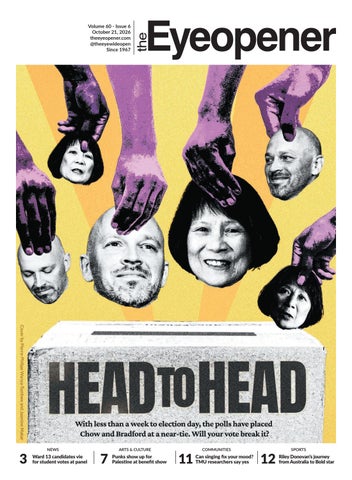
3
V olume 6 0 - I ssue 6 Octob er 2 1 , 2 0 2 6 theeyeopener.com @ theeyewid eopen S ince 1 9 6 7
NEW
S
Ward 13 candidates vie for student votes at panel
7
A RTS & C U LTU RE
P u nk s sh ow u p f or Palestine at benefit show
1 1
C OM M U NI TI ES
Can singing fix your mood? TMU researchers say yes
1 2
S PORTS
Riley Donovan’s journey from Australia to Bold star
N ew s
THE EYEOPENER WEDNESDAY, OCTOBER 21, 2026 theeyeopener.com/news
N ex t w eek : Winners and losers of the municipal election
Mayoral candidates battle it out at SLC debate radford and how de ated a orda l ty ho s n and safety on the rst day of the early o n per od J asmine M ak ar production editor
Ed ward Land er editor - in - cH ieF
Brad Bradford and Olivia Chow took to the stage at the Student Learning Centre (SLC) on Oct. 6 for a mayoral debate hosted by the Toronto Star, United Way Greater Toronto and the Democratic Engagement Exchange at Toronto Metropolitan University (TMU). The debate saw the two candidates go head-to-head over housing, transit, affordability and other issues close to Torontonians. It was the first major debate to not feature Chris Alexander, who announced his withdrawal from the race early that morning. Alexander held a steady thirdplace spot behind Bradford, polling with nine per cent of the vote on Oct. 6, according to a poll from Liaison Strategies. The debate also marked the first day of the early voting period—which ended on Oct. 11— with many Torontonians having already cast their ballot. In a phone call with The Eyeopener, TMU President Mohamed Lachemi said he was proud to host the debate at TMU. “We think it’s very important that we give students and the broader community the chance to hear from candidates on issues that affect our everyday lives,” said Lachemi. “Our hope is to create meaningful conversation so that people live with a better understanding of the issues shaping our city and candidates’ positions to make well-informed decisions.” Lachemi said in the 2023 municipal by-election, fewer than one in three eligible voters cast a ballot, and by hosting events like this, he hopes to encourage students to vote in higher numbers. With the debate being held on campus, many questions pertained to student issues, including one fielded by a fourth-year marketing and accounting student at TMU. Housing Moderator Edward Keenan of the Toronto Star opened by asking candidates questions about their housing plans. Chow discussed her push to build more affordable homes, citing 80,000 rental units currently in the works as well as plans to support renters facing wrongful evictions. “We can build more and many more housing units that people can afford,” said Chow. “We can go after slumlords so that renters can live in dignity.” Bradford called out Chow’s af-
t was the rst
a or de ate to not feat re hr s le ander who anno nced h s w thdrawal fro
fordable housing plan for having only built two per cent of her 65,000 affordable rental unit goal. Additionally, Bradford highlighted that 77,000 people left Toronto last year and said the majority of renters feel owning a home is out of reach. “Opening up some of our zoning, streamlining the permit process, getting to it faster, building the right type of supply in the right places-that’s what keeps Toronto affordable,” said Bradford.
how sa d radford s proposed ta free e w ll re re c ts to tal c ty ser ces C ost of Liv ing Chow said city services can provide “breathing room” for Torontonians facing financial hardship. She cited the TTC fare capping
program implemented under her leadership and promised to implement a universal free lunch program in schools if re-elected. On the other hand, Bradford said he plans to freeze property taxes and reduce water bills—which he said will save Torontonians almost $300 a year. He also shared plans to conduct a “line-by-line” review of the city’s budget, which he said hasn’t been done since 2011. Chow said Bradford’s plan would require major budget cuts in important sectors to accommodate for his property tax freeze. Throughout the evening, Bradford mentioned his plan to cut the Land Transfer Tax, which he said is the “biggest impediment” to homebuying in Toronto. C ost of Liv ing Bradford said Torontonians feel Chow “doesn’t take their safety seriously” and although violent crime is down, people feeling safe is just as important. If elected, he said he’d commit to a visible police presence on the TTC and hire 1,000 additional police officers. “Not every day, but every week, I encounter someone smoking crack cocaine on the 505—and that person needs treatment,” he said. “But it’s also true that you can’t engage in open-air drug use on our transit system, and that’s why ridership is 20 per cent less than what it used to be in 2019.” Chow said she’d focus on the root of crime by boosting funding for youth supports, keeping police hiring “on track” and com-
mit to hiring more mental health crisis workers. She mentioned Holly Roy, the mother of JahVai Roy, an eightyear-old boy who was killed by a stray bullet in August 2025. “Every mother in the city deserves to see her son come home,” she said.
radford sa d oronton ans are feel n nsafe and pro sed to h re new pol ce officers f elected Bradford critiqued Chow for not serving as chair of the Police Services Board, a position traditionally taken by the mayor of the city. Many past mayors, including John Tory and David Miller, served on the board. Lightning Round Toward the end of the debate,
the race early that
orn n
Keenan asked a series of questions looking for one-word answers. When asked whether taxes were too high, Bradford gave a firm yes, while Chow attempted to answer in a sentence before ultimately saying no. When asked whether Billy Bishop Toronto Island Airport should be expanded to accommodate jets, both candidates said no. When asked for their favourite Toronto sports team, Chow initially said the Raptors, before changing her answer to the Tempo. Bradford said he prefers the Toronto Maple Leafs. C losing S tatements Chow’s closing comments reiterated many of the promises she’d made earlier in the debate: lowering the TTC fare cap to 10 rides per week, building more affordable housing and cracking down on bad landlords. “Bradford will take us backward,” she said. “Be really clear, where do you stand? Because what you said and what you’ve done is totally different,” she told him. Bradford spoke to Toronto’s potential, saying that while he doesn’t believe Toronto is “broken,” he does think it’s “stuck.” He said his campaign represents a new direction for city hall and that, “if you want to change the city, you have to change the mayor.” Election day is on Oct. 26. To be eligible to cast a ballot, voters are required to bring identification. A full list of acceptable ID is listed on the city’s website.
News | 3
THE EYEOPENER WEDNESDAY, OCTOBER 21, 2026
Candidates make cases to students at Ward 13 panel of
cand dates d sc ssed the r plans and pro
ses ahead of
ct
elec on
Z anoah Plummer news editor
On Monday, candidates vying to be Toronto Centre's next councilor visited campus for a panel hosted by the Toronto Metropolitan Students' Union (TMSU). The candidates spoke to their plans for the ward ahead of the upcoming municipal election on Oct. 26. The panel hosted 10 of the 11 candidates running for the Toronto Centre seat. Cleveland Marshall was the only candidate not present at the event. The event was moderated by TMSU vice-president of education Teresa Baricevic and president Zain Baig. Each panelist was provided up to seven minutes to introduce themselves and their platform. Panelists were not allowed to mention other candidates' campaign promises when speaking. usi g a rdabi ity am g key issues discussed at a e Many candidates mentioned housing and affordability when introducing their platforms. According to a 2024 City of Toronto ward profile, 70 per cent of dwellings in Toronto Centre are rentals, compared to the citywide average of 48 per cent. Curran Stikuts is a Toronto Metropolitan University (TMU) social work alumnus and worked in frontline and leadership roles at the 519 Community Centre for a decade. He is also being endorsed by Toronto Centre's MPP, Kristyn Wong-Tam. "Of course we need to expand the amount of housing we have,” said Stikuts. “That is about looking at our programs like the multi-residential acquisition program where we buy up apartment buildings and keep them affordable, expanding the amount of money we have in those. But then also adding in the opportunities to buy up unsold condo units on the market so we can quickly bring more affordable units here right downtown onto the market." he added. The multi-residential acquisition program was launched by the city in 2021 and supports nonprofit housing providers with the acquisition, renovation and refinancing of rental homes. The program seeks to create permanent affordable housing for current and future tenants. Morgan Harris has served as the director of the Allan Gardens Food Bank since 2020. He said the TMSU panel was his "first outing as a candidate in a political event." Harris advocated for non-market housing as a solution to the rising cost of housing in the city. The average rent in Toronto has more than doubled since 1990.
osted y the
the panel saw
Ca didates eager t address c cer s ar u d me ta hea th a d addic The percentage of people living in Toronto who say they have good mental health has declined from 73 per cent in 2015 to 52 per cent in 2022, according to a 2026 study by the Wellesley Institute. A May CBC story found Toronto addiction recovery centres have months-long waiting lists for beds. Incumbent city councilor Chris Moise was elected in 2022 and is the current chair of the Toronto Board of Health. While in office, Moise created a community outreach team that involves Toronto Police and Toronto Public Health. "In that I've been able to secure 16 police officers and one sergeant, as well as eight public health nurses to go preemptively into the community in the downtown core and help people before they get into crisis." said Moise in an interview with The Eyeopener. "And so they've engaged about 5,000 people in the last three and a half years providing wound care, women's health and other health care needs. And also house referrals as well in addition to that," he said If re-elected, Moise intends to continue his work with the board. He also proposed initiatives such as capping TTC fares at 10 per week, protecting tenants against demovictions and providing free breakfast to Toronto District School Board students. Some candidates offered a different approach to addressing the needs of those struggling with mental health challenges and addiction. Victoria Davis is a harm reduction worker and student at TMU majoring in disability studies. She advocates for safe consumption sites in order to prevent overdoses from becoming lethal. She said many substances labeled as fentanyl are found to be something else when tested. According to Toronto's Drug
of the
cand dates r nn n for the seat a end J AS MIN E MAK AR/TH E EY EOPEN ER
Checking Service, 95 per cent of substances labeled as fentanyl that were tested did not meet expectations—meaning the sample tested did not contain fentanyl or was found to contain other undeclared substances. "We need to be able to have voluntary treatment available because currently there's about a 100-day waiting list. And if you catch someone when they're ready to come off of the substances, then you need to catch them right at that moment because those moments are very rare and they're very precious. Life is so, so, so precious and it's really important that we do what we can to preserve life," said Davis. Ca didates ta k tra sit a rdabi ity y uth em yme t Tom Cai is a mathematics and economics student at the University of Toronto. If elected, he said he will advocate for distance-based fare pricing to the TTC, capped at $3.30 at its highest. He emphasized the importance of creating job opportunities for youth amidst a rise in youth unemployment. Walied Khogali-Ali is a founding member of the transit advocacy organization TTCriders. He said he worked to establish the first U-Pass in the greater Toronto area at the University of Toronto Mississauga campus. This pass grants students unlimited free rides on MiWay vehicles. If elected, he wants to make the TTC free for students and seniors, support rent-to-own initiatives as a pathway to home ownership and provide youth with employment opportunities. E uity acc u tabi ity c cer s raised at a e If elected, Nicki Ward would become the first openly transgender woman to serve as a city councilor. Her campaign centres around supporting and creating cooperative housing and food initiatives to address housing and affordability is-
sues within the city. “I've been an advocate on the right side of history for 30-plus years,” she said. “I organized the first Trans March on Yonge Street. I organized the Trans Memorial. I helped spearhead the change of the Canadian Constitution over three successive federal governments, Bill 379, 289, do you remember? And finally Bill C-16." she said. She continued: "We did that from the outside with no money, no support, and the opposition of some of the worst human beings you'll ever encounter in your life. I'm not an advocate because I'm a mean-spirited person. It's because apparently when I go to the washroom, it's a political act." Norman MacLeod's platform is Indigenous-centric. If elected, he said he would like to enforce Treaty 13. Treaty 13, or the Toronto Purchase, is the disputed transfer of the land that later became Toronto. The treaty was not entirely honoured and parts of Toronto remain on unceded land, according to the Mississaugas of The Credit First Nation. MacLeod said he aims to, "make life more affordable for students by introducing a vote for free TTC. I will make life more interesting for students by introducing a voting age of 16 so that the older crowd in politics can become younger." he said. Joe Cadeau's campaign centres financial accountability. He would like to better manage the city's $18 billion budget without cutting services. If elected, Cadeau said he would like to be the link between the community and high-profile businesses in the area. Daniel Tate is the founder of IntegrityTO, an advocacy group he said demands "accountability, transparency with our municipal government—because oftentimes, with people, it feels like decisions are made in a vacuum or in a black box."
According to his website, if elected, Tate will audit city divisions to ensure funds are being spent effectively, introduce a zero-tolerance policy for crime and improve fare enforcement on the TTC. Tate has a complicated history with Moise. The pair have sparred at council meetings and Tate even made a formal complaint against him after a January 2025 encounter following a council meeting, as reported by CBC in March. An investigation by the city's Integrity Commisioner found Moise acted in a "derogatory manner" with Tate. Moise told CBC he has "no regrets" about the incident. A e dees give rtu ity t ask ues s The event ended by opening the floor to questions from audience members. Hamza Nasir, a third-year biomedical sciences student attended the event. He said being able to see how each candidate thinks gave him new perspectives on them. "I wasn't expecting it to be this interactive and this active. I essentially got to see every candidate speak and every candidate answer a question in their unique way, which I think was very nice." Mazen Adam, a third-year architectural science student, echoed a similar sentiment. "Most of them shared their own solution to [...] questions that we as [the] audience or the moderator asked. Some of them were scenario-based questions, so each candidate had a chance to show us how they would go through this problem or the solution for it, so that was interesting to me." Baig said he's interested in hosting similar events in the future to increase student engagement with politics. "We want students to basically see how their voices matter and how their choices can impact elections."
4 | Editorial
THE EYEOPENER WEDNESDAY, OCTOBER 21, 2026
Editorial: For the love of knowledge
T h e E yeopener V o l. 6 0 | 2026- 27 EDITOR-IN-CHIEF
Edward “We Are So Back” Lander PRODUCTION EDITORS
s
ed cal school
Z anoah Plummer news editor
Amira “Betsy” Benjamin Jasmine “Boba Tea” Makar
dito ia s b ished in The Eye ef ect the o inon o the ite
NEWS EDITORS
Nadine “Adobe Pro” Alsaghir Zanoah “For Ward 13” Plummer ARTS & CULTURE EDITOR
Sophie “Jake Ross” Wallace BUSINESS & TECHNOLOGY EDITOR
Mishael “Reverse it” Taruc COMMUNITIES EDITOR
Rin “Sing (2016)” Yanase FEATURES EDITOR
Daniyah “Ring On It” Yaqoob FUN & SATIRE EDITOR
Dylan “103 Degrees” Marks SPORTS EDITORS
Francesco “How Fran Does it” Cautillo Naomi “How Naomi Does It” Low PHOTO EDITORS
Rachel “Looks Good” Cheng Daniel “N.Y.C.” Opasinis Pierre-Philipe “Colour Theory” Wanya-Tambwe MEDIA EDITORS
Victoria “8 p.m.” Andrade Ava “Exposure” Whelpley DIGITAL PRODUCER
Lucas “TikTok star” Bustinski GENERAL MANAGER
Liane “Londoner” McLarty DESIGN DIRECTOR
Vanessa “Kradford” Kauk EDITORIAL INTERN
Grayson “Who's it gonna be” Glenn CONTRIBUTORS
Lama “Day” Alshami Shumaila “Ones” Mubarak Evan “Spiderman!” Perry Leah “Masking Tape” Tahtabas Ben “No Photos!” Hameiri Mutay Jack “ETTR” Steinhart Neve “Fashion Icon” Chamberlain Ananya “Humming Along” Sharma Molly “Oopsie” Simpson Lucas-Matthew “Photographer” Marsh Kyla “Double Byline” Pugen Victoria “Capable” Tavares Nicholas “SENS” Vanderham Victoria “Photographer?” Cha Adam “Camera Spotter” Motaouakkil Liana “Digitally Wise” Yadav Michael "On the Scene" Elsaesser Nasha "Disk Jockey" Dutta Charlotte “Options!” Ligtenberg CONTACT
T: 416-979-5262 ext. 2338 E: editor@theeyeopener.com 55 Gould Street, Suite 207 Toronto, Ont. M5B 1E9 he eo ene is b ished b a non co o ation o ned b the st dents o
d ra pton need to close ts a sh p l rary to open
ofit
When Toronto Metropolitan University (TMU) selected Brampton as the site for its new medical school in 2021, they picked the city for its needs. My hometown, nicknamed Flower City, has blossomed from a medium-sized suburb into one of the fastest-growing cities in the nation. In that time, it’s also developed a critical shortage of family doctors and healthcare professionals. Currently, Brampton has one hospital to serve a population of just under 800,000. The construction of a new medical school should have been great news for the city, but for many, it was eclipsed by the announcement it would be placed in the Bramalea Civic Centre. The Bramalea Civic Centre had sat in the heart of the Bramalea neighbourhood since before the city's 1974 amalgamation and served as Brampton's city hall until 1991. Inside, the Chinguacousay Library branch was the city's largest, standing at 38,000 square feet, prior to its relocation. Patrick Brown, who has served as the mayor of Brampton since 2018, donated the former Civic Centre building—which was valued at approximately $48 million—to TMU in order to establish the medical school. That medical school is now training a brand new cohort of doctors, which is crucial considering Brampton's dire need of healthcare workers. But should it have come at the expense of the city's biggest library? The Chinguacousay branch had undergone an extensive $2 million renovation just six years before it was made to relocate. Many residents were not able to enjoy the new amenities before the branch shut down;
the library was closed in 2020 to prevent the spread of COVID-19, and then the subsequent building donation forced the library to relocate. Now, the library is temporarily housed in the Chinguacousay Park Ski Chalet, a significantly smaller building in an adjacent park. The new Howden Library branch, intended to replace the old library, is not expected to open its doors until 2028. The proposed branch is also 8,000 square feet smaller than the former Chinguacousay Library. As a university, TMU should champion education in all its forms. I question how seriously it considered what the library's relocation could mean for a suburb primarily made up of workingclass immigrants when the donation was accepted. The Chinguacousay Library was an important bastion of knowledge for residents in Brampton. It was wedged between a bus terminal and the city's largest shopping mall, making it convenient for residents to commute to. Growing up, my brother and I used to visit the branch weekly. It was behind those bookshelves where I fostered my love of read-
ing and curiosity to learn. If it weren't for what I had learned at that library, I would not be a journalist today. Countless programs were hosted out of the branch and the renovation brought new amenities such as a makerspace and recording studio. At a time when literacy scores amongst Canadian youth are falling, it is more important than ever to protect and fund libraries. The building is also home to the Lester B. Pearson Theatre—which has been maintained within the medical school. Rowena Santos, the city councillor for wards one and five, said in a 2023 council meeting that Brampton needs an arts scene in order to have a "cool-factor" to attract people to the city. But seemingly in opposition to that, theatre groups such as Brampton Music Theatre have alleged scheduling conflicts when booking the theatre after the medical school moved into the building, as previously reported by The Eyeopener. I'm unsure how the city intends to build up Brampton's "cool factor" when one of three theatres in the city is facing these kinds of problems. The former Civic Centre
building was an important community hub for people in Brampton and surrounding cities. The loss of it as a public space has impacted residents from all wards of the city. As voters across the province— and in Brampton—take to the polls to vote for their next mayors and councillors, it is worth considering how candidates value education, arts and culture when filling out their ballots. The location of the Civic Centre building made it attractive to TMU, but I believe other locations such as the Peel Memorial Centre would have been more convenient. The Peel Memorial Centre is where Brampton's proposed second hospital will sit, and is also within close proximity to a GO station—it’s a dense commuter hub students could easily reach. Now, York University has similar plans to open a medical school in Vaughan. But they've announced the location will be in a brand-new building beside the Cortellucci Vaughan Hospital. Other municipalities didn't have to give up public spaces to open a medical school. So why did TMU and the City of Brampton take a cutting from Flower City?
News | 5
THE EYEOPENER WEDNESDAY, OCTOBER 21, 2026
Province continues removal of bike lanes amid backlash from protestors, cyclists
The removals have faced protest and concern from community members, including students M ichael Elsaesser contributing reporter
The provincial government has begun the removal of bike lanes on several busy Toronto streets, but cyclists have been putting up a fight. Starting with a portion of Bloor Street West in Etobicoke, crews began taking out the lanes on Oct. 14. The province says it’s removing them to reduce car traffic and make commuting around the city quicker. The province also plans to remove bike lanes along Yonge Street, University Avenue, Queen’s Park, Queen’s Park Crescent and Avenue Road. The removals follow the successful appeal of an April 2025 court decision that found removing the lanes would place, “people at increased risk of harm and death which engages the right to life and security of the person.” In a September press release, the provincial government said the they're still looking at options to keep bike lanes in areas “where they make sense and do not make gridlock worse.” As the removals get underway, some student cyclists are speaking out against the decision. Second-year urban and regional planning student Zachary Osborn is opposed to the removal of the lanes. He said cycling is an important mode of transportation for both students and broader Toronto communities. “I think there's a decent amount of students and professors that we have that do choose cycling, because it is more reliable. You know, if a distance is, say, five kilometers in the city, cycling will win every time.
It is way quicker than driving, [the] TTC can be unreliable," he said. Osborn conducted research with the non-profit organization, 8 80 Cities, on how municipalities across Ontario have accommodated cyclists through policy and infrastructure. “I feel like you're really taking in the city in an active way instead of a passive way, which is really cool,” he said. While the closest bike lane removals to the Toronto Metropolitan University (TMU) campus are several blocks away, many at the university cycle. According to TMU's website, the university has over 1,100 parking spaces for bikes and has said supporting cyclists is a priority in its 2020 Campus Master Plan. In that plan, TMU lists both safety and infrastructure considerations to encourage students, faculty and staff to bike to campus. A 2021 study conducted by TMU urban and regional planning professor Raktim Mitra also found that cycling infrastructure encourages both new and regular cyclists to bike more frequently. Osborn discussed some of the existing limitations with accessing campus by bicycle, due to the lack of protected bike lanes on surrounding streets. "It's unfortunate to see this narrative around removing bike lanes when streets like Dundas, or that go along TMU to the south, would be perfect for connecting students and making them feel more comfortable...now we have to work on coming up with arguments as to why we should keep what we already have, when we should be doing more,” he said.
MICH AEL EL S AES S ER/TH E EY EOPEN ER Construction crews planned to begin removing the Bloor Street West bike lanes the night of Oct. 13, but delayed their start due to protests. Organizers have since organized additional rallies. Kristen Hope was one of the protestors who attended a rally. “I'm proud of us for getting over 60 people out on, like, zero notice” she said. Irena Hrzina attended the same protest as Hope. She said she’s biked in the city for decades, but eventually had to stop because each trip on her bike "started to feel like a close call." "So I pulled back. The bike lanes on Bloor have made things safe again,” said Hrzina. Reflecting on the removal of the lanes, she said: “I think it's a shame that this is going ahead. All I can do is raise my voice and protest.”
Toronto Police Service confirmed three separate arrests at demonstrations on Oct. 14 and 15. In an X post on Oct. 13, transportation minister Prabmeet Sarkaria commented on the protests. “Make no mistake: these bike lanes are coming out. We have a clear mandate and we will deliver.” Mayor Olivia Chow, who is seeking reelection in the Oct. 26 municipal election, has criticized the Ontario government’s decision to remove the lanes. “Ford must stop interfering with our city. Make no mistake: Toronto will stand up for itself,” she said in an X post on Oct. 13. Chow’s opponent Brad Bradford, however, is in support of the removals. In an August press conference, he said he’d want to see the Bloor West bike lanes come out if elected. Work to remove the Bloor Street West bike lanes continues alongside protests.
Pro music gets Billboard praise TMU is the only Canadian school on the magaz ine' s 2026 list asha u a contributing reporter
Music magazine Billboard has ranked Toronto Metropolitan University's (TMU) professional music program among the world’s top music business schools for the second consecutive year. In its 2026 list, Billboard recognized TMU’s professional music program for what it calls a “commitment to exploring emerging trends and diverse music markets.” Billboard also applauded faculty member Charlie Wall-Andrews for incorporating AI into courses with ethics in mind. The publication highlighted the program’s courses in music business, production, entrepreneurship, marketing, management and live events. Wall-Andrews, who is an assistant professor in creative industries at TMU, was recognized as a Billboard Canada ‘Power Player’ in 2025. She said in an interview with The Eyeopener she helped shape the curriculum by drawing on her music industry experience and collaborating with industry professionals. “We need to help students be able to create content that is actually relevant in how people consume content today,” said Wall-Andrews.
She said the work-integrated learning in the program, which may include internships through courses, is the key component that leads to student success. Billboard also recognized the program's course developed in a partnership with Billboard Canada, which examined the career of Diljit Dosanjh, a Punjabi musical artist. Wall-Andrews compared the curriculum to international course offerings on Taylor Swift and Beyoncé, emphasizing the cultural element of the Dosanjh course. "Diljit Dosanjh provides a very different perspective, because now we're looking at what it means to break barriers, especially based on identity and how he has represented the diaspora of particularly the Punjabi, but also South Asian community, on a global stage with such diplomacy," she said. Adrian De Souza, a second-year professional music student, described the program as "community-oriented". He said it's helped him find his footing in the music industry and built friendships with students who have different interests and career goals. "I never felt that anyone tried to be more competitive than anyone else. It's more or less, hey, can you help me with this? Or, hey, can you do a bass part on that?" he said.
He also said professors in the program are encouraging and "try to accelerate you on what you can do in this program outside of the classroom." De Souza added said the program's instructors push students to use the program’s tools and resources beyond their coursework. Gabriel Ruddick, a second-year professional music student, said access to the program’s recording studios and professional equipment has been a highlight of his experience. Ruddick said he originally intended to go into music education after graduating from the program. However, as he progressed, he discovered he may want to work in the music industry instead of teaching music. Billboard Canada also reported that it and its publisher, ArtsHouse Media Group, will continue their partnership with TMU’s professional music program through a new course set to be offered in the winter 2027 semester. Ruddick said he hopes to see more offerings of local venue partnerships, internship
AV A W
H EL PL EY /TH E EY EOPEN ER
opportunities and co-op placements from the program. “Knowing that if I were to be picked up to work at a music festival or a local venue, I’d know what I was doing and be familiar with the equipment. I’d feel like I had a place in the music industry," said Ruddick. Wall-Andrews said developing the program has been a community effort. She added that the curriculum is shaped by student feedback, as well as input from industry professionals to better understand what they may expect of graduates. “I hold my students to the highest standard because they are the next generation that will shape this industry. And therefore, we need to be stewards of the culture of the art and to respect that, first and foremost," Wall-Andrews said.
6 | News
THE EYEOPENER WEDNESDAY, OCTOBER 21, 2026
TMSU puts weight behind OSAP walkout n on call n on st dents to o n o
Ed ward Land er editor - in - cH ieF The Toronto Metropolitan Students' Union (TMSU) is calling on students to join a Nov. 5 walkout against cuts to the Ontario Student Assistance Program (OSAP), rising tuition and Bill 33. The union announced the action in an Instagram post on Thursday, alongside the introduction of a webpage with information for students looking to participate. According to the webpage, the walkout will see students gather at 1 p.m. at Gould Street and Victoria Street, Lake Devo. The protest is largely in response to sweeping changes to OSAP, specifically the reduction of the maximum amount of funding the program provides through non-repayable grants from 85 per cent to 25 per cent, which was announced in February. Many students are already feeling the impact as the changes came into place this fall. Cordelia So-Kew, faculty of community services director for the TMSU, said the union has seen the pressure of OSAP cuts firsthand, noting a sharp increase in demand for emergency student grants.
protest on
She said these pressures are what drew the union to host the protest. “I think it is our job to advocate for students, and to show that we see what’s going [on] and that we are working for the students,” she said. Teresa Baricevic, vice-president of education for TMSU, echoed that sentiment. "The student movement is already pretty big as it is, but we want our students to be a part of it," she said. The Nov. 5 walkout will not be the first protest over OSAP cuts attended by TMU students since the change. The Canadian Federation of Students Ontario chapter (CFS–O) held two rallies outside Queen’s Park in March. Both saw high turnout, including from TMU students. One protest even saw two arrests. TMSU’s walkout will be one of many at Ontario universities that day, as part of a province-wide ‘day of action’ led by CFS–O. The walkout is being organized alongside the Toronto Metropolitan Association of Part-time Students, the Toronto Met Graduate Students' Union and the Student Mobilization Committee.
ay of c on
Baricevic, who is TMSU's representative on the university senate, said the union is looking to university administration to grant academic amnesty or accommodations for students who leave class to participate in the walkout. TMSU is also providing participants who may be wary of missing class with guidance, including an email template they can send professors requesting amnesty for their absence. They've also created a letter students may send to professors, asking them to grant wider amnesty to any students who walk out in their classes. “We ask that you show your support by granting students across Toronto Metropolitan University academic amnesty,” it reads. So-Kew said speakers for the rally are still being organized, but said the lineup will likely include representatives from labour unions and other student organizations. She said if enough students attend, the walkout will send a strong message. "There's a lot of beauty when everyone comes together and you see everyone come together," she said.
your friendly f iendly neighbourhood fr neig i hbourhood bookstore ig
your next nex e t great read awaits... ex awaits t ... ts
benmcnallybooks benmcnallyb y ooks yb 108 Queen St. E (at Jarv Jarvis) rvi rv vis)
Arts & Culture | 7
T E E EOPE E WEDNESDAY, OCTOBER 21, 2026
Toronto’s punk scene comes out for Palestine “T hree Y ears of Genocide, Three Y ears of Resistance, ” show raised funds for families in Gaza ucas-Ma hew Marsh contributing reporter
More than a hundred punk fans gathered in the basement of St. Anne's Anglican Church in Toronto’s Little Portugal neighbourhood to rally support for Palestinians during the ongoing genocide in Gaza. The benefit show, titled “Three Years of Genocide, Three Years of Resistance,” was organized by Students for Justice in Palestine TMU (SJP), underground event organizer Licentia, and Toronto based zine collective SHOUT!, the night brought together three Toronto bands—Lovice, Heat and Glove—to raise money and awareness for 11 families in Gaza. Josephine Eyford, co-founder of SHOUT!, said each band featured in the lineup had a preexisting relationship with the collective. Before the first band took the stage, an anonymous speaker from SJP stepped up to the mic to remind the crowd why they were there. “Two years ago today marked three years since the zionist attacks,” the speaker said. “Shame,” the crowd interrupted before they could finish. The call-and-response echoed throughout the basement all night, each time a new speaker addressed the crowd. When a speaker denounced Toronto Metropolitan University for "complicity" in the violence, the crowd called back "shame." From "nu metal” to “indie rock,” Eyford
prioritized bands they worked with in the past and knew “support the cause.” Eyford admitted the event was less of a “punk show” for the music, but nevertheless had “punk values” at its heart. “At its core [punk is about] helping...the underprivileged and the people that are not being spotlighted in the way that they should be,” Eyford said. For PJ Weinert, lead vocalist of Heat, it was only natural that the punk scene and the free Palestine movement go hand in hand. “The punk scene is always the kind of people to, instead of talking about shit, they get up and do some shit,” Weinert said. Around the edge of the pit, vendors and activist groups set up tables, some selling traditional Palestinian keffiyehs and ceramics. Among them was Mohammed Musallam, who runs 48Embroidery, a Palestinian embroidery business out of Mississauga. “We created this business to focus and represent Palestinian visual identity,” Musallam said. Musallam, who once taught art in Gaza, moved to Canada a decade ago. Since then, he has used his business to raise awareness about Palestinian identity. “Look what happened to my people in 1948,” Musallam said. “And you can know the facts.” Ever since the Nakba, Palestinians have faced displacement, discrimination and violence connected to Israeli state policy, according to the The Canadian Museum of
Human Rights. The latest chapter began when Israel launched a military campaign in Gaza following Hamas’ attack on Israel on Oct. 7, 2023, which saw more than 1,100 killed. Several NGOs, including the United Nations Independent International Commission of Inquiry, Amnesty International and Doctors Without Borders, have called the Israeli military's actions in Gaza a genocide. An estimated 74,000 Palestinians have been killed since October 2023, according to the Gaza Health Ministry. Between sets, the music stopped so the crowd could listen to video testimonies of several families in Gaza—the beneficiaries of last week’s show. Musallam said he planned to donate part of his sales to families affected by the violence.
“When you stand with Palestine, now you stand with humanity,” Musallam said. “We are people looking for our freedom, to live in peace.” Attendee Chris Adamo has been part of Toronto’s punk scene for years. He said he was grateful to see younger fans show up to support the cause. “Things have slowed down on social media, so people tend to keep less and less eye on it,” Adamo said. “I’ve seen fans really show support and keep that alive and reminding everybody, this is still going on and we still have to show up.” Eyford told the crowd that their support and the sense of safety in the room is what keeps the organizers coming back. “Every single one of you in the crowd is why we do this,” Eyford said.
Filmmaker who brought Brazil to the screen passes lessons onto students a ed d rector d splayed decades of wor at
M
y im s
contributing reporter
Famed Brazilian filmmaker Katia Mesel visited Toronto Metropolitan University (TMU) on Oct. 6 to showcase five short films and documentaries made over the course of her six decade long career. The event was hosted at TMU on the second floor of the Rogers Communications Centre. The Cinema of Katia Mesel was hosted in partnership with TMU and Brazil Film Fest Toronto. The event page described it as an opportunity for people to “discover and celebrate” the director and her impact on Brazilian culture. The director was born in Recife, the state capital of Pernambuco, Brazil in 1948. Described as “pioneering,” Mesel has been attributed to “preserving and celebrating Brazil’s cultural identity,’ by Brazil Film Festival Toronto in a recent Facebook post. Mesel graduated from architecture and graphic arts in 1970 according to Rio2C, a platform that hosts creative meetings in Latin America. A 1999 article in Ilustrada said Mesel’s film Recife de Dentro Para Fora (1997) won the first international environmental film and video festival. Mesel began her career in 1968. At the time, filmmaking was a gradual, labour intensive process. In her early career, she
would send her film to be developed in Panama, and would sometimes receive it two or three months later. As technology has changed and shifted, she too has adapted. Mesel said she's considering using artificial intelligence in her next film, Recife de Clarices. In the question and answer period, she said “it's a new technique,” she may use “a little,” in the opening of the piece. The documentary film will cover the story of Clarice Lispector, a Ukrainian-born Brazilian novelist considered one of the most influential and experimental Latin American writers, according to Bosco da Costa, the event organizer and an RTA lecturer at TMU. The screened films spanned clips of her work from Oh De Casa (1985) to the more recent Parto Sim (2018). Most of the works were documentaries, but Parto Sim, unlike the other four, was more fictionalized. This film centred the story of a woman from Fernando de Noronha, an archipelago off the coast of Brazil, who was forced to leave the island in order to give birth due to limited healthcare resources on the island. This film was a departure from the typical documentary style, as Mesel did not typically script her films she explained during the event’s Q&A. However, to get funding for the piece, she applied for a grant meant for fictional work. This translated to actresses with a script based off real in-
terviews Mesel had conducted. Her film Recife De Dentro Pra Fora was also shown at the Brazil Film Festival Toronto on Oct. 9 alongside Gugu’s World (2026). Ricardo Bernhard, the deputy consul of the Brazilian Consulate General in Toronto attended the event. He noted Mesel’s final shown film, Parto Sim, had a character living in Canada. He said there are many similarities between Brazil and Canada culturally and geographically, and said opportunities exist to bring the two cultural ecosystems closer together. "We have large territories, big populations, big economies, very important native populations, challenges in populating specific parts of the country and protecting the environment,” he said.
He said these similarities show up in the types of art the two countries create. Bia Piza Maia dos Santos, a fourth-year media production student, came to the event as someone wanting to enter the film industry with an awareness of Mesel’s work. “She's done so much for a female and Brazilian filmmaking,” she said. Dos Santos grew up in Canada but was born in Brazil. She said watching projections of Brazilian culture on screen is motivating. “I think keeping that part of your identity is really, really important. And she brought a piece of home to Canada,” she said. ” When an audience member asked for advice for young women entering film, Mesel gave words of encouragement: “I love this…I say, do it!” she said emphatically.
IL L U S TRATION
B Y RACH EL CH EN G/TH E EY EOPEN ER
EYEOPENER 8 | THE WEDNESDAY, OCTOBER 21, 2026
Sparing space for prayer At TMU and other Canadian universities, places for prayer are in short supply. For many Muslim students, this means turning to impromptu spaces from classrooms to stairwells BY SHUMAILA MUBARAK AND LAMA ALSHAMI
F EA TU
B
ASMAH KHALID WAS SITTING in the faux leather theatre seats at Cineplex Yonge-Dundas, attending a class when she had to rush outside with her friend. It was time for the evening prayers. The theatre was far from other campus buildings and going to one of Toronto Metropolitan University (TMU)’s two designated prayer spaces would take too long. Because the building didn’t have any room to pray either, she had no choice but to make use of the space she had—the cinema itself. Khalid went to a corner near the bathrooms, took out a prayer mat from her bag and laid it down on the floor. She asked her friend to cover her from passersby and to keep guard. She was anxious—the situation was far from convenient. As a Muslim woman, she was worried for her security when visibly performing prayer in public. The only reason Khalid was able to do it, she says, was because her friend was with her. “I don't think I would have been able to do that if I was alone.” Prayer is the most fundamental and mandatory institution within Islam. In the Qur'an—the Muslim Holy Book—worship is considered the ultimate purpose of a person's life. Hadia Mubarak, an associate professor of religion at Queens University of Charlotte says Islamic prayer can be divided into t o ty es or a rayer or a h here Muslims pray five times a day at designated times—and informal prayer, or du'a, which is an unstructured personal supplication with God (Allah) done anywhere and any time. a h hich is the seco d o i e i ars of Islam, Muslims are required to pray in a standing posture while facing the Ka'bah, a stone building in Mecca considered to be the ho se o od ara ca s a h ce tra to the Muslim identity.” Although unintentional, as a result of class scheduling, university courses can get in the way of Muslim students’ obeying this pillar of their faith. Located in Toronto where almost 10 per cent of residents are Muslim, according to Statistics Canada, TMU also has a large Muslim student body, many of whom require a ace to o er their a h The university currently has two designated full-time spaces that Muslim students can use to pray on campus. There are two multifaith rooms on the third floor of the Student Community Centre (SCC). Across campus, on the seventh floor of the Ted Rogers School of Management (TRSM) is the EDI Well-being Space. Launched by the Ted Rogers Students' Society in 2023, the space is set up to be a place “to pray, meditate, reflect, grieve, or find quiet,” according to their website. Between the two spaces, some Muslim students say it’s an inconvenient arrangement to balance school and their faith. MAHA KHAN OFTEN HAS TO PRAY IN random spots across campus to accommodate her busy schedule. At the library, where she spends much of her time as a fourth-year computer science student at TMU, she makes se o iet cor ers or a h Khan believes students spend most of their time at the library or Student Learning Centre, and thinks more prayer rooms, regardless of size, should be created to accommodate Muslim students. Sania Iqbal agrees. A fourth-year law and
business student at TMU, she often has to pray in empty stairwells if her classes are not near TRSM or the SCC. If she doesn’t have a prayer mat, she makes use of her jacket, placing it down on the ground in front of her, shielding her forehead from the floor. It’s not nearly as comfortable or conducive to heartfelt prayer, when instead of prostrating on a soft prayer mat, she can feel the cold of the ground beneath her. Hasnaa Ismail, a fourth-year social work student, said she wishes there were prayer spaces in the buildings she frequents, like Eric Palin Hall, Sally Horsfall Eaton Centre or the George Vari Engineering and Computing Centre. “Each building should have some sort of corner or some sort of [prayer] space…in the vicinity,” she says. She says the travel time from those buildings to the SCC is too long. When Ismail's professors give a break during class, it typically lasts 10 minutes—but the prayer itself often takes 10 minutes to offer, not including time it takes to walk to the room and back. Khan says sometimes, in the winter when the sun sets earlier, the time between prayers is shorter. The five daily prayers each have an appointed time: dawn, early afternoon, late afternoon, right after sunset and at night. his ca ses her to iss a h he she is in class. Instead, Khan has to make it up at home, outside the designated time. She said missing prayer weighs on her during class and she sits, hoping that the professor will end class early: “It’s not the best feeling.” In February 2026, the SCC multi-faith prayer space was relocated to a new room on the same floor of the building. The previous multi-faith room held a bigger capacity of students. Ismail remembers entering it for the first time during her TMU orientation. She climbed three flights of stairs and navigated her way towards the back of the building. As she entered, the smell of the black carpet on the floor leading to the sisters' prayer room “hit her” for the first time. Ismail stopped to make Wudu or ablution, the process of washing oneself before prayer, in the female washrooms. To her surprise, the bathroom had no paper towels. She had to make use of what was available. “I’m drying my arms using the hand dryers and I used toilet paper for my face. It was ridiculous. It was sticking on my face,” Ismail says. She then went into the prayer room, where the August heat surrounded her and the air felt stale. The room has two windows, and she says only one was cracked open. The Eyeopener reported on the relocation, with SCC staff citing student feedback and health and safety concerns as reasons for the move. “Our student community has expressed issues with the existing multi-faith space in OAK 319 relating to accessibility, a lack of communal space and heating/ cooling issues,” building staff wrote in an emailed statement at the time. But Muslim students continued to raise concerns about the new space. Khalid, for instance, says the old room looked better. She says entering the sisters' prayer room before, you would see Islamic books on shelves, a prayer clock hanging on the wall and even big boxes filled with prayer clothing, such as skirts and abayas for those who preferred to wear the garments for their supplications. She also said visitors would see natural light com-
RES
THE EYEOPENER WEDNESDAY, OCTOBER 21, 2026
|9
"It's a sign of progress when we can create spaces and accomodations" HADIA MUBARAK, ASSOCIATE PROFESSOR OF RELIGION ing into the room from the windows. The new room, Khalid says, is the opposite. “Now it's just a room,” Khalid says. “If you look at the space, there's no personality.” “We used to have those little desks… from Dollar Land that you can open up and you sit and you study. We don't have that anymore.” Ismail also claims they were not allowed to put pillows in the room, which they had in the old room. She says it felt like “they don't want us to have any little things that would help students feel more comfortable in this space. It's just like pray and leave.” To Khalid, a good prayer room would give off a feeling “where you just go and you automatically feel at peace.” Umar Ashraf, a third-year accounting student, compares the relocated room to an “empty classroom.” “Mosques aren't just places to pray. You're supposed to sit there, engage with the community,” he says. In Ashraf’s eyes, an ideal prayer space would look similar to his local mosque. As soon as you walk in, you see people praying, others reading the Qur’an or making du'a, incense burning and even Muslim students talking with each other outside the room. He added that, “obviously, that's not realistic,” but there should be students in the room who can find a spot to just “sit down for two, three minutes, close [their] eyes, take a break.” For Ismail, the sisters' prayer room has always been “too small” to fit everyone praying, especially in the afternoon and evening. “There's always times when people are just standing on the side, waiting for others to finish praying so they can pray,” she says. Students have to wait till the “first row is done, and [then] they're waiting for the second row to be done, so they can move.” But regardless of the issues with prayer spaces at TMU, students like Khalid are grateful for what they have. “I'm just happy there is a place to begin with,” she says. A unique characteristic of prayer in Islam is that the sacred day of worship is on Friday, or Jummah in Arabic. Jummah prayers are offered every week, where Muslims pray in congregation for the early afternoon prayer. Iqbal, who is the vice president of Islamic Education with the Muslim Student Association (MSA) at TMU, says Jummah is really important for Muslims. She says there is a ḥadīth—recorded sayings from the Prophet Muhammad—that states that it is 27 times better for Muslims to pray in congregation. Iqbal also adds that there is an entire chapter of the Holy Qur’an dedicated to Jummah. Since Jummah falls on a business day in the West, it’s often hard to accommodate for Muslim students to pray on campuses. Mubarak points out the weekend in the Western world falls on Saturday and Sunday, allowing Jewish and Christian students to have their holy day of worship off. In Muslim countries like Saudi Arabia
and some Malaysian states, the weekend begins on Friday. “Muslim students…they're already at a disadvantage, legally speaking, institutionally speaking, compared to their Christian or Jewish peers,” says Mubarak. “We don't realize that these students are not actually asking for any special treatment. They're asking for things that… other religious traditions are already entitled,” she says. Recently, TMU designated POD 252 as a space strictly for Jummah prayers on Fridays. In prior years, Ismail recalls the university used a room in the International Learning/Living Centre, which she says was “so crammed, it was just ridiculous.” Currently, the MSA hosts three Jummah prayers at staggered times in order to accommodate everyone's schedule. Still, Ismail
Prayer spaces at TMU 1
2
says, “We've had to turn people away. We've had to say, ‘I'm sorry, we've reached capacity. You have to pray somewhere else.’” For Muslim students, inaccessibility to the spaces is another hindrance to praying on campus. Ashraf recalls during the summer, the SCC would close at 4 p.m., meaning he could only pray one out of five prayers on campus. According to an Instagram post, the SCC was also only open for two days a week. “I feel like they should at least keep the prayer room open, or SCC open, from, like, 8 a.m. to 10 p.m. because that's generally when students have classes,” said Ashraf. With the SCC closed early, Ashraf would often have to go to TRSM, which is about a 10-minute walk, to offer his prayer in time. Sometimes, however, he claims he would find the TRSM room locked after 3 p.m., meaning he had to walk five more minutes to Masjid Toronto, a mosque on Dundas Street. He said he never found out why the TRSM room was locked, but two weeks after the initial incident, there was a sign on the door that said, “please don’t lock this door,” and he never faced the issue again. More recently, the SCC was closed for
Truth and Reconciliation Day, as every year on Sept. 30, the building closes in observance. However, this left Muslim students with one less place to pray on campus. On that day, Ashraf had gone to the SCC to pray but as he walked towards the door, he saw a sign saying that the building was closed. He said he noticed a couple other students trying to get in with no luck. “I just don't understand why one room couldn't be kept open,” Ismail says. When it comes to multi-faith rooms, neighbouring universities seemingly have more options for their students. The University of Toronto (U of T) St. George campus has 16 prayer rooms—two of those are dedicated Muslim spaces. “The reason we have so many,” Azlan Naeem, the president of the Muslim Students’ Association at U of T, says, “is because our campus
versities being heavily impacted. Several universities, such as Concordia University and McGill University, have closed their prayer spaces, according to CBC. “It completely undermines the spirit of what secularism was supposed to do, which was to protect religious minorities and not allow the dominant religious tradition to use the government to impose its own religious values on everyone else,” says Mubarak. The situation in Quebec is similar to when McGill evicted students from their prayer room twenty years ago. The Concordian reported the university cited its status as a "secular institution" and that it "has no obligation to provide space for religious purposes." Mubarak’s 2007 research paper tackled this question and addressed the debate against Muslim prayer rooms. Almost twenty years later, she finds herself repeating the same arguments. “Quebec has repressed the progress it's made in…celebrating diversity and pluralism. It's definitely a step backwards." Mubarak continues, “The myth of secularism needs to be disrupted because when elected leaders infringe on citizens' ability to practice their faith, that is an imposition of religion.” For Ismail, the situation in Quebec is “very sad” but it shows that Islamophobia has always been present in Canada. “They're just trying to erase Muslim existence, and they're trying to marginalize us even more, and they're trying to make us feel like we're the ‘other’,” she says. Ismail says she hopes Ontario isn’t next. Iqbal mentions that in the Canadian Charter of Rights and Freedoms, “we have freedom of religion, we have freedom of speech, we have the freedom to practice what faith we want to,” so Bill 9, “takes away from multiculturalism and the individuality of people.” So here, a border away—while they’re grateful for what their university does offer—these Muslim students are hopeful that TMU has the potential to do more for its students of faith. “I think TMU does need to let its students know that they stand with the Muslim population and they're doing things to better accommodate Muslim students,” says Khalid. Iqbal believes that prayer spaces don’t just help Muslims fulfill their religious obligations, but are also a way to build brotherhood and sisterhood amongst individuals. For Khalid, prayer helps her “disconnect from the world.” She finds downtown Toronto to be a very busy, fast-paced environment and prayer rooms help her find peace within herself.
Prayer spaces at U of T 1
2
3
4
5
6
7
8
9
10
11
12
13
14
15
16
is very big.” But at 37 hectares, TMU’s campus is around half the size of U of T’s 73.6 hectare St. George campus. To compete with U of T’s ratio, mathematically speaking, TMU would need six additional prayer spaces. When asked whether TMU has enough prayer spaces, Ismail says that “the simple answer is absolutely not. They are not enough.” She says TMU needs “at least five to be called a respectable school.” While Muslim students at TMU say the university should arrange more prayer spaces, a question still remains—do universities actually owe their students a right to faith accommodations? On its website, TMU responds in the affirmative: "The obligation to accommodate is mandatory, not discretionary," a statement on religious, Indigenous and spiritual observances reads. Mubarak says, “It's a sign of progress when we can create spaces and accommodations… to allow different types of people with different religious convictions to all thrive.” EARLIER THIS YEAR IN QUEBEC, A new secularism law, Bill 9, was passed, prohibiting prayer in public spaces, with uni-
1 0 | Business & Technology
THE EYEOPENER WEDNESDAY, OCTOBER 21, 2026
AI surveillance cameras make landfall in Ontario Privacy and legal ex perts worry about their unregulated deployment throughout the province
A d am M otaouak k il contributing reporter
Police services across Ontario are beginning to deploy Automated License Plate Recognition (ALPR) cameras. But according to experts, there are significant privacy risks to the technology and a lack of governance. These cameras stream live road traffic video to extract license plate information from the images. The images are stored in a database to match against a hotlist of cars involved in criminal investigations. According to a CBC report from June, Peel Regional Police deployed ALPR cameras across 50 intersections in Brampton at a cost of $2 million. In the U.S., residents have rallied against these cameras, typically deployed by surveillance company Flock Safety. In Brampton, content creator and Toronto Metropolitan University (TMU) alumnus Anthony Sistilli noticed the cameras throughout the city and decided to build his own ALPR camera, “as sort of a joke.” Sistilli documented this process on his YouTube channel where his ALPR video posted on Oct. 7 has garnered over a million views.
teer
“All I did was find a camera on Amazon that was decent enough to capture a license plate,” said Sistilli in an interview with The Eyeopener. Using large-language models to write software code and open source object detection software YOLO, Sistilli created a working system capable of capturing license plate information and storing it in a database. “Once the police came to my house to investigate it, that's when I sort of got angry,” said Sistilli. “I feel like I did nothing wrong,” he said. Before becoming a full-time content creator, he was a software engineer and start-up founder. “It’s astounding how little the average person knows about... how much this technology impacts their lives,” said Sistilli about his motivation to make a video on ALPR cameras. Sistilli spoke to elected officials in the U.S. who adopted the camera systems to tackle retail car theft. “And then one software update later...all of a sudden they’re tracking everyone,” he said, noting that the surveillance scope grew beyond suspected vehicles against the wishes of the officials. The Toronto Star previously reported that Toronto Police Services (TPS) deployed five cameras.
The Eye identified two cameras on Bloor West and Spadina facing a Jewish community centre and another on University and Armoury, facing the U.S. consulate. Tamir Israel, director of the Privacy, Surveillance and Technology Program at the Canadian Civil Liberties Association, worries about the intrusiveness of the technology. “It's something that could allow police to have a complete picture of where any vehicle was either in real time or at any point in time going back historically,” said Israel in an interview with The Eye. “There has been documented police misuse of these cameras for personal reasons or for wholly inappropriate reasons,” said Israel. He referred to Project South, an ongoing corruption probe into Greater Toronto Area police officers who are alleged to have used police databases for criminal activity. Before license plate tracking, facial recognition software such as Clearview AI was making its way into law enforcement. Andre Côté, executive director of the Dais at TMU, a policy and technology think tank, described how the US-based AI software tool was introduced. “The Toronto police were using trial versions of the tools that cer-
tain police officers had,” said Côté. “They were using them in ways that were compromising police investigations, because they were not lawful uses of those tools.” A 2021 investigation by Canadian privacy commissioners found Clearview allowed companies and law enforcement to match images against their database, which held over three billion images, violating privacy rights. In December 2021, CBC reported that the TPS had used Clearview in 84 investigations. The report indicated the TPS was no longer using the tool.
evolution to enefit so iet not har
n new oo prof co ns realtechn Liana Yad av contributing reporter
Amid rapid developments in technology—particularily in artificial intelligence (AI)—Toronto Metropolitan University (TMU) professor and director of Zone Learning at The Creative School, Richard Lachman, is arguing for stakeholders to reassess and slow down in his new book, Digital Wisdom: Agency in the Age of AI, released in February. In an interview with The Eyeopener, Lachman said the way technology has developed in recent years is not the "only way" it could have. In the mid 90s during his university days, Lachman said, “we thought the internet is going to be an incredible force for good” but it came with negative consequences as well. Lachman graduated from the computer science program at Massachusetts Institute of Technology, then went on to earn a doctorate at University of New England in Australia. In that time, he's seen tech develop rapidly and infiltrate all sectors of society. For exmaple, Lachman said just when we’re starting to wrestle with social media’s ramifications, with lawsuits protecting young people, we now have AI. Instead of looking at AI’s dis-
In Pflugerville, Texas, the police service was using ALPR cameras for local purposes, only to realize that other jurisdictions were accessing their data. In contrast, Côté said the speed cameras Ontario took down in late 2025 are examples of cameras being used for good. For Israel, current governance isn't moving fast enough he says more independent bodies should be established to govern surveillance technology. “We should be getting more proactive legislation from the government, imposing privacy rules around these tools.”
it ro ur es
to d scern wh ch tech the f t re needs and wh ch can e left eh nd
tant potential of abundance or doom, Lachman proposes a perspective dubbed ‘Realtechnik,’ which aims to solve problems that come with the tech. “The term comes from politics,” he said. Realpolitik means thinking about how people “actually behave in their cities, in their relationship with one another…and with institutions,” he said. Similarly, Realtechnik suggests a pragmatic and practical approach to technology. “It's not what it [technology] could do. It's what it's doing now.” At present, there is no legislative framework set in place in Canada specific to AI. The Artificial Intelligence and Data Act was proposed in 2022 to “set the foundation for the responsible design, development and deployment of AI systems that impact the lives of Canadians.” But in January 2025, the bill was terminated after former Prime Minister Justin Trudeau's resignation. When it comes to technology, “we release it and then maybe we back up a little bit and release a new version after it has caused harm,” Lachman said. "It is okay for us to slow down something that may benefit people if we also believe it may harm them.” In Digital Age, the professor coins “Lachman’s Law,” which
warns readers to “be wary of critiquing tech that doesn't work yet, when you mean to criticise whether it should work at all.” He said, “In these ways, when we're looking at the capability of something, we can sometimes say no to a technology. Not just because it is not good enough yet, but even if it got perfect, we don't want it to be functioning in this way.” He also pointed out the political and economic pressure from U.S. companies—Meta, Google, Amazon—who crack down on any independent desire to regulate. An investigation by Proton, a VPN service provider, found that Google, Apple and Meta have shared the data of 6.9 million accounts with U.S. authorities. The report also points to the "privacy tradeoff” made by users when they unknowingly share their data in exchange for a personalised experience on the platform. Lachman said regulation, in addition to individual choice and institutional decisions, is an important way to protect against harm from technology but “we need to vote for this.” He said students can make a difference. In the future, they could find themselves in decision-making positions in AI development and deployment in their daily lives.
AI use has been rampant in academia since ChatGPT’s release in 2023. But Lachman says AI can make educators and students more intentional, despite the disruption. In some ways, generative AI “is pushing us as educators to do things we should have been doing a long time ago,” he said. For students, Lachman said some of them have become “much more deliberate about their own educational process,” knowing to put in effort to get the most out of their time in school, rather than relying on AI. Despite the odds, Lachman is still excited about the future of AI if societal changes are made now. Fundamentally a technologist, he believes
in the potential and capability of tech tools and wants to see a future that contains and constraints them. To make that possible, he calls for a push against companies who choose the path of least resistance and the highest generative value if left unchecked. Lachman doesn’t believe change happens by waiting for companies like Facebook, Google or Apple to come up with their next product and hope it's better. "It's only by us making choices… about what we want to do with technology and presenting those opportunities with new product design or in some cases, designing those things ourselves.”
Communities | 1 1
THE EYEOPENER WEDNESDAY, OCTOBER 21, 2026
Students spotlight Toronto’s Black fashion history at the AGO Fashion students spoke with B lack fashion professionals and designers in a self-produced interview proj ect Nev e C hamb erlain contributing reporter
A group of Toronto Metropolitan University (TMU) fashion students are preserving Toronto's Black fashion history through interviews featured in a new Art Gallery of Ontario (AGO) exhibit. Nigel Lezama, undergraduate program director and associate professor in TMU’s fashion studies program, is an advisory member of Sunday Best: The Power & The Glory of Black Style, a new exhibit that opened last week at the gallery. Lezama has been working with fashion studies students on a digital interview project called Black Style in Context within the exhibition. The project features interviews, conducted by students, with Toronto-based Black fashion professionals and designers, including Iris Simpson, Mic Carter, Jeffery Kong and Kirk Pickersgill. The AGO exhibition explores the history and cultural significance of Black fashion across the African diaspora from the 1880s to the present. It features more than 50
garments shown through display and contemporary art such as photography, paintings and accessories from around the world. The exhibit presents fashion as a powerful tool for Black communities to assert their identity and challenge exclusion and oppression, an online AGO press release said. Lezama says the interviews are a way to enrich visitors’ experiences of the exhibition by examining the “life behind the garments.” He said he wanted the interviews to feel like genuine conversations rather than [formal] interviews. He and his students practiced how to listen and to be engaged with the artists to create an environment of trust. “It was so enriching for me to see my students get their voice through these interviews,” said Lezama. Amaiah Alexis and Mya Moore are fashion students and were interviewers for the Black Style in Context project. In an email to The Eyeopener, Moore wrote about her conversation with one of fashion icon Iris Simpson, where Simpson shared her experience working as a Black
woman and luxury fashion buyer. “She was so inspiring to talk to, and when she spoke, it was impossible not to feel motivated by her and her outstanding career,” Moore wrote. “I definitely want to dive a lot deeper into my Caribbean roots and make more traditional pieces as well,” said Alexis, in an interview with The Eye. “Fashion and style is about so much more than just the clothing. It is history, it is togetherness, yet individuality. And most importantly…it is about community,” wrote Moore. The AGO exhibit is the first of its kind in Canada, according to Lezama. He said it’s important to recognize Toronto's vibrant and inclusive fashion scene in the 1980s. “Toronto was a fashion capital,” he said. Alexis described the power of the historic “sunday best” garments—clothing traditionally reserved for church or special occasions—on display. “They make you feel like you're a million bucks. Everyone cannot help it but look at you because you stand out in a way that is just so,
Fashion studies prof. N igel L eza ma led the students as a S unday est ad sory e er RACH EL CH EN G/TH E EY EOPEN ER so unique to yourself,” she said. Clothes can be a sense of armour, Alexis added. “You wear the clothes, the clothes don't wear you.” Lezama hopes students will engage with the exhibit with all their senses open and see themselves as historical subjects, “meaning that we have agency, and that when we dress, we make choices that have meaning embedded into those choices, and that we also have an impact as the world moves.” “I would like to see our students see ‘what was’ and imagine ‘what can be’ through an exhibition like this,” said Lezama. Alexis also highlighted how the exhibit demonstrates the power of clothing to create meaningful conversations on histories threaded into someone’s clothes, which allows us to “get a different
perspective on life.” “I feel like we further history in a good way when we remember that our clothes really do hold a lot of power,” she said. Lezama hopes his students will carry their experiences working on the project and that listeners find comfort in the honesty and beauty of the conversations. “I hope that they enjoy what they're listening to. I hope that it keeps them curious. I hope that it makes them have questions and more questions,” Alexis said. The Sunday Best exhibit will be on view at the AGO until Feb. 28. The Black Style in Context interviews are available through QR codes, which visitors can scan while making their way through the exhibit. It can also be listened to online at.
Can singing nurture wellbeing? These researchers say yes
An annual symposium on campus discussed the poten al ene ts of ro p s n n for c ty dwellers A nanya S harma contributing reporter
Torontonians are "amongst the loneliest Canadians," according to 2023 report by the Toronto Foundation. But if you ask the researchers at The SingWell Project, part of the solution may be a simple activity many shy away from: singing. On Oct. 16, SingWell, an international network exploring the benefits of group singing for older adults’ well-being, held its fifth annual symposium at Oakham House. According to the event description, the day included a keynote discussing the potential of music to help community building, networking workshops and "the chance to sing together." Arla Good, a research associate in the psychology department at Toronto Metropolitan University (TMU), is the chief researcher and co-founder of The SingWell Project. She said the project began with a gap she saw in society and “a need for people to feel more socially connected."
Alongside Frank Russo, principal investigator at SingWell and a scientific director and psychology professor at TMU, Good studies both the psychological and physical outcomes of singing, including a sense of belonging and stronger voice and lung function. Lee Willingham, a professor emeritus at the music faculty of Wilfrid Laurier University, delivered the symposium's morning keynote and argued against music being treated as an elite art form reserved for perfection. Willingham said SingWell flips that idea by treating singing as everyone's "inalienable right." Willingham said group singing offers something other community activities cannot always provide. “It connects human beings beyond the verbal, physical and social level. It is a deeply spiritual thing,” he said. Calling group singing “social activism,” Willingham said it “engages people in thinking beyond getting the notes in tune, getting the words right, being in harmony.”
“We’ve seen it touch things like environmental justice, racism, poverty, gender discrimination. Singing can address all of these kinds of social concerns.” A 2021 research article by Good and Russo suggests that group singing can lower cortisol and accelerate social bonding. Aidan Giannopoulos is a fourth-year psychology student. He said musical activities, such as covering songs or playing instruments with friends, noticeably affect his mood and energy. Giannopoulos believes singing could be a useful campus activity, especially by making it informal and welcoming to people without a musical background. He said that songs in different languages could help students from different backgrounds connect. “I feel like that would definitely help students and people to connect and understand each other more through, common media,” he added. Tara Raessi, a 2024 TMU alumna, has watched that shift happen. She joined Russo's lab as an hon-
RIN Y AN AS E/TH E EY EOPEN ER ours thesis student in 2023 and has since helped support and lead SingWell events. "There's kind of a therapeutic effect of that," Raessi said. At the start of a session, people are nervous about how they'll sound. By the end, she says, they've "jumped a hurdle together" and are enjoying the sound of the whole group. Good said SingWell avoids the word "choir" because it can imply auditions, talent and performance, while its programs offer singing groups that include no audition, no performance and "talent optional." Good said the hardest part is getting people into the room for the first time. Once there, some-
one may hum along, then begin to sing and realize it does not matter how they sound. Good said funding is a major barrier to expanding accessible programs. Funded by the Social Sciences and Humanities Research Council of Canada, SingWell is building an evidence base to make the case for sustainable community funding. The symposium, she said, was a step toward the network needed to bring singing programs to more communities. “Seeing those relationships being built…that’s how we’re going to create this network that will make this program possible. That’s what I hope for this symposium.”
Sports
C at c h u p w ith pos t - g ame r
ec ap s at
th eeyeopener. c om/
s ports
THE EYEOPENER WEDNESDAY, OCTOBER 21, 2026 theeyeopener.com/sports
Riley Donovan: leadership, legacy and life after the Bold Men' s volleyball captain Riley Donovan moved across the world to j oin the B old. N ow, the star player is q uickly approach n rad a on and h s f t re after Kyla Pugen contributing writer
In 2022, Riley Donovan packed his life into suitcases and made the 16,000-kilometre journey from Sydney, Australia to Toronto, Canada. Though he says the memory feels like a lifetime ago now, he hasn’t forgotten the nerves of moving far from home when he was just 18 years old. “It was pretty daunting coming to a new country where I didn’t really have any family or any friends,” said Donovan, who is now in his fifth year at Toronto Metropolitan University (TMU). As the Bold men’s volleyball team captain, Donovan is looking back on the younger version of himself who first arrived in Toronto and all he’s achieved since then. “I’d like to think he’d be proud of the life that I’ve built here,” said Donovan. Throughout his time with the Bold, Donovan has excelled on the court. Last season, he played in 20 matches, appearing in 74 sets. He averaged a .217 hitting percentage, logged 198 kills and 89 digs and accounted for 228 points. In March, Donovan earned Ontario University Athletics (OUA) ThirdTeam All-Star honours. But as preseason concludes this Friday, Donovan will begin his fifth and final year with the team. When the Aussie began envisioning what the next chapter after high school would look like, he discovered TMU men’s volleyball head coach, Niko Rukavina. Unlike conventional recruiting, the two had never met in person on the court and many of their earliest conversations took place over Zoom from opposite ends of the world. But despite the distance, Rukavina saw something in Donovan’s character. “I picked up on his family dynamic and his relationship with his brothers and his parents, and right away we knew he was a good person. That is something that we look at when we’re recruiting,” said Rukavina. “It’s not just about potential. He came from a good family. He had a good heart and a good mind and someone that I think would have added to our culture,” he added. When asked about his relationship with
his coach, Donovan couldn’t pinpoint a singular moment that defined their bond; instead, he spoke to all the consistent commitments Rukavina made to nurture their partnership over time. “I kind of think about us having our weekly chats,” said Donovan. “He’s quite similar to me in a lot of the ways that he thinks and approaches different situations. I think he’s a role model for
“He knows when to keep it real with you,” said Moua. “But he also knows when to check in on you. If you’re not doing so well on an off day, he can tell.” Fourth-year setter Declan Dunn, another close friend and teammate of Donovan, said the same. “He always kind of knew where the perfect middle point of our attitude and our energy levels were,” said Dunn. “He’s a mature guy for us, and he does a really good job of keeping everyone else accountable, and that includes himself.” Back in Canberra, Kiefer Sinclair, one of Donovan’s former teammates and now a fourth-year setter at Lakeland College in
me later on. He’s got an awesome family and kids, and has gone through a lot of life experiences and lessons. [He’s] a very openminded guy that wants to get better and wants to learn.” Another of Donovan’s closest bonds is fourthyear setter Evan Moua, who joined TMU in the same recruiting class as Donovan back in 2022. Soon, the two would find themselves living together and even sharing Thanksgivings for the past four years, a tradition the Aussie had never celebrated back home. Moua describes Donovan as a ‘glue guy’— someone finely attuned to those around him and a presence that anchors the team.
Alberta, shared the courts with him at the Australian Institute of Sport just a year before he moved to Toronto. Even back then, Sinclair said Donovan’s level-headed attitude was evident. He also said when the pair were younger, they used to talk about the importance of taking the “high road” for many aspects of life, both on and off the court. “It doesn’t matter if I’m right or wrong, but let's just take the high road and do the right thing, and it’ll resolve itself later.” Throughout the past four years, Donovan’s journey has taken him up and down many roads, and at the end of the 2026-27
season, he’ll step away from a team that has become an integral part of structure and familiarity in his life. “I’m not going to be hanging out with 17, 18 of my best friends every single day, so that’ll be a struggle for sure. But it’ll be exciting. It’ll be a new chapter, and I feel like I’ll be ready to move on,” Donovan said. Though his future plans aren’t entirely decided yet, Donovan’s commitments to himself and those around him are clear. “I want to be known as a good brother, a good son, a good friend, a good boyfriend,” he said. “That’s what I want to be known as at the end of the day.” Donovan loves volleyball, and his achievements are a big part of his identity, but he's come to realize there's more to life than his sport. During his time with the Bold, the team hasn’t captured a banner. Yet, along with the program, he has gained more than just records. “Five years of memories and experiences, the good, the bad, you learn to love it all,” said Donovan. “Some of the best people I’ll probably ever meet, I’ll hold them very dearly for the rest of my life.” For Rukavina, Donovan’s legacy lives on in his mentorship and the care he’s imparted to the players who will soon lead the team after he graduates. Even throughout periods of injury and losses, Donovan's commitment and focus to the team always remained a steady constant. “He's just been a great leader and a voice for us. As the first years get younger and he gets older, I see more and more of him in the way he supports the younger players, the way he's there for them. Riley has his own life as an older player. He has his own community and his own way of doing things. But to be able to turn it all off or shut it all down, to be able to step up for a younger player or anybody on our team is a huge example of that,” said Rukavina. Donovan hopes to keep playing volleyball, in whatever capacity that may be. Always looking for new experiences and opportunities to challenge himself personally and physically, he’s considering pursuing a master’s degree in England while playing on a university team or joining a league in Europe. Rukavina plans to help his player navigate agent connections and overseas opportunities over the winter break, helping Donovan begin writing the next chapter of his life, much like he did when the two first met.
Bold outlast RMC in five-set thriller Naomi Low sports editor
The Toronto Metropolitan University (TMU) men’s volleyball team returned to the court with a gritty 3-2 win over the Royal Military College (RMC) Paladins on Sunday at the Mattamy Athletic Centre (MAC). The match marks the team’s second preseason victory over the Paladins after yesterday’s 4-0 sweep. "I felt that we did a good job getting around each other, staying big. That’s been a big point of emphasis this season.” said second-year middle Aidan Suttie.
The first set opened with a nearly 30-second rally that left both teams breathless. Momentum was gained after fourth-year TMU setter Declan Dunn earned an early kill.Secondyear right side Ross Buchanan sank a well-disguised play past a Paladin outside hitter’s fingers, extending his side’s lead to 7-3. But a flurry of Bold errors sparked an RMC resurgence as the Paladins rattled off a few runs of their own, tying the score 14-14. TMU stayed above water and soon within reach of the first set at 24-21. A last-minute RMC timeout couldn’t stop the Bold’s flow, efficiently sealing the frame 25-21.
Like the first set, the second began with a tight scoreboard battle. RMC had noticeably reorganized their offence and held a 13-9 lead, forcing Rukavina to call a timeout. Sensing the Bold’s uncertainty, RMC attack the sidelines and even capitalizing on an uncharacteristic TMU net violation at 18-12. Though kills by Buchanan pierced through the Paladins’ defence, they weren’t enough as RMC ran their way to the second set, 25-19. The level remained competitive after the changeover. Suttie, leading the team with six blocks, replicated the RMC playbook, targeting the
Paladins’ sidelines and lifting TMU in a five-point run to 15-9. “I think we put good pressure on them with our serves, and we didn’t make many unforced errors. We just played the game our way,” said Suttie. As both teams returned to the court, TMU persisted with their winning momentum, but struggled to convert and attacking errors kept piling up, allowing the Paladins to seal the third set, 33-31. In the fourth frame, TMU was set on redemption, looking towards their bench for support. “There was a little bit of fatigue from our long game last night, so the
young guys added a lot of energy,” said Rukavina. After finding a foothold, the Bold led 22-15 when RMC called a timeout. Unable to lull TMU’s onslaught, a strong serve from Suttie helped the Bold nick the set with the largest margin of the afternoon, 25-16. The Bold concluded an impressive effort over RMC in an emphatic 1511 victory in the fifth and final frame. UP NEXT: The Bold will play their final preseason match against the York University Lions on Oct. 23 at the MAC. First serve flies at 7 p.m.
Sports | 1 3
THE EYEOPENER WEDNESDAY, OCTOBER 21, 2026
Bold so er s
ost underrated rivalr
s record w th the arleton a ens has een a decade lon
V ictoria Tav ares contributing writer
Over a decade ago, on November 1, 2015, Bold men's soccer beat out the Carleton Ravens 3-0 in the Ontario University Athletics playoff quarterfinal. The win left the Ravens with a bad taste in their mouths. And if you ask head coach Filip Prostran, that loss sparked a rivalry that's lasted to this day. In a regular season match-up in October this year, Prostran dubbed the Ravens the Bold's "greatest rival for the past decade...whenever we play them, whether it’s playoffs or regular season, the margins are always so thin." Prostran isn't wrong. The Ravens and the Bold have been remarkably evenly matched, recording six wins, six losses, and four ties against one another since September 2017. Prostran, who was still in his first year of assistant coaching, said he remembered “being really, really nervous coaching that game.” That day, Prostran was also facing off against long-time Carleton men’s soccer head coach Sandy Mackie, whom he described as someone he held much respect for. Mackie, who finished coaching Carleton in 2015, had added
over two decades of experience to the Ravens since 1992. “[The Ravens] have a really, really clear picture of what they’re trying to accomplish, both offensively and defensively,” said Prostran. “Then on top of that, they always have this incredible unity and fighting spirit that I really, really admire,” said Prostran. Ball possession and “creating a rhythm with the ball” are just a few of the challenges the Bold have faced against the Ravens. TMU’s counter has always centred upon strategic versatility, rotating between high defensive pressure, a medium block and a more defence-based setup to disrupt Carleton’s rhythm and force the Ravens to continually adapt. By varying its defensive shape, the Bold aim to keep the Ravens guessing while maintaining possession and limiting their opportunities to establish control of the game. Set pieces are also a key focal point as Carleton has historically attacked from corners and free kicks in playoff matchups, supported by a physically imposing centre-back pairing. TMU will need to limit the Ravens’ space in the air and prevent them from capitalizing on these opportunities in future matches. Above all, the Bold must remain proactive and disciplined, avoid-
ing unnecessary fouls near their own goal that could give Carleton a dangerous scoring opportunity. As of this weekend, TMU clinched the first spot in the OUA standings, with rivals Carleton sitting in sixth. Although another quarterfinal meeting looks unlikely, the rivalry and its memory linger today in the players' minds. For Dante Ferraro, TMU’s fifthyear goalie, these memories are ones he relishes. “I look forward to it [playing against them], said Ferraro. "Every-
t for tat
W
IL L B RAH AM/TH E EY EOPEN ER
one’s going to be fighting and just doing our best battle with each other.” In a similar recount, third-year defender Noah Pickering describes playing against Carleton in the playoffs as “a dogfight the entire time.” Pickering, who appeared in TMU’s blockbuster 2-1 double overtime victory against the Ravens in 2024, remembers the moment with vivid clarity. “It was amazing. I love playing them because they really like to go back-and-forth just as much as we do.”
Beyond the rivalry itself, the theme of sportsmanship and respect circles itself. “They don’t go down without trying hard,” said Ferraro, adding, “it’s just their grit and their willingness to fight.” As Pickering noted, the Ravens have built a reputation for their grit, possession and “fluid” style of play. However, rivalries ebb and flow from season to season, and the Bold won’t wait on Carleton to find their best soccer in the postseason.
M finish undeeated ar el ri ht Me orial Classi run B old defeat X -W omen, look ahead to re lar season after to rna ent w ns
Kyla Pugen contributing writer
The Toronto Metropolitan University (TMU) Bold women’s basketball team capped off a perfect weekend at home on Saturday, securing a 71-62 victory over the St. Francis Xavier X-Women in the 38th annual Darcel Wright Memorial Classic at the Mattamy Athletic Centre (MAC). Riding the momentum of a 2-0 record, the Bold entered this matchup after securing wins over the McGill Martlets and defending U Sports champions Saskatchewan Huskies, hoping to finish the job against the Nova Scotia side. “This tournament is in memory of Darcel Wright, so we do it for her. Someone who’s paved the way. Someone who’s a legend,” shared fifth-year veteran guard Myriam Kone. The high-stakes matchup
featured coverage on the CBC Sports YouTube channel, broadcast directly by TMU Sports Media students. For the student-athletes on the floor, getting that level of national visibility was a rare and meaningful thrill. Kone noted, “U Sports Basketball is growing and it’s a great brand to be investing in and I’m really glad that also Women’s Basketball is getting this chance to get put on TV.” Third-year forward Hailey Franco DeRyck echoed this sentiment, saying “it feels super cool. It’s a really good opportunity, and I hope opportunities like this can keep on happening, especially here in Canada.” Feeding off the energetic home crowd and broadcasting to a national audience, the Bold set the pace early. TMU came out firing from the opening tip-off, establish-
DAN IEL OPAS IN IS /TH E EY EOPEN ER ing inside physical play and dynamic floor spacing, resulting in a 20-10 lead to end the opening quarter. St. Francis looked to respond by making tactical adjustments, pushing back with a tough, physical style of play. Now, the Bold have to respond to the pressure, looking to stay composed and build an early lead. Interim head coach Stefanija Mrvaljevic explained that the focus was simply on “reflecting and focusing on the things that we can control.” The second quarter proved even, with each team scoring 19
points, as the X-Women looked to break down the Bold lead. “They’re a really aggressive physical team, and so we were trying to implement that aggression back,” said the defensive-minded Franco DeRyck. St. Francis continued to slowly creep back into the game, outscoring TMU and bringing the scoreline within ten at 54-46. The skilled duo of Kone and fourth-year guard Catrina Garvey have proven a lethal combo throughout their careers together, with their proficiency extending into this matchup. The two
starters combined for a total of 30 points for the Bold, helping to seal the deal in the final minutes. In the end, TMU was able to hold on for a 71-62 win, ending their tournament with an undefeated record and a win sheet of highly established programs. The Bold now eye the regular season and their Ontario University Athletics title defence. UP NEXT: The Bold host the Guelph Gryphons on Oct. 10 at the MAC for their opening game of the regular season. Tip-off is set for 4 p.m.
1 4 | Fun & Satire
THE EYEOPENER WEDNESDAY, OCTOBER 21, 2026
Q&A: Where the mayoral candidates stand on the issues Disclaimer: Even though these crimes may not have truly occurred, it's fun to imagine that they did. The following are crimes that actually occurred on campus in the past week.
ROCK WENT BYE BABY On Monday, in news that has rocked the entire Toronto Metropolitan Univeristy (TMU) community, somebody stole one of the giant rocks by Lake Devo. TMU Security is unsure how the rock was taken with no trace. All those interrogated as suspects remained stone-faced.
GARBAGE GRABBER On Thursday, an unknown culprit was seen stealing the foulstenched garbage straight from the bins on Gould street. The suspect was seen entering the bins, picking out garbage and then eating it frantically. A description of the suspect is as follows: approximately two feet tall, wearing a gray fur coat, black eye mask and a striped tail.
BEACH BREACH On Tuesday, on the ‘beach’ floor of the Student Learning Centre, several thugs vandalized the impossible-to-work-on chairs with drawings of male sexual organs and circles with smaller circles at their center, presenting as breasts.
CAMPUS SCORE Last Friday, the campus store was raided and ransacked. Though typical thieves may have gone for the cash, the only thing stolen were 55 large dry erase calendars.
FRANKIE PANKY Last Tuesday, Frankie B. Bold was seen on Gould street in full Victoria's Secret laced lingerie flocking up and down and squawking loudly about how good it felt to feel the lace on their feathers. While looking rather egg-sceptional, the bird was then seen engaging in a public group cloacal kiss (bird orgy) with local pigeons around the entrance to the library.
BYEOPENER Last Monday, several copies of The Eyeopener were found taped to security cameras while being used to hide the identities of criminals who stole candy from the Student Community Centre vending machines. No Famous Amos cookies were harmed.
radford and how d sc ss oronto s
Polly Tix tA L K s A
L ot A t tH e dinner tA bL e
Disclaimer: While the mayoral election is on Monday and you should absolutely vote in it, please do not make a decision based on this fictional Q&A. With the municipal elections less than a week away, top mayoral candidates Brad Bradford and Olivia Chow are making their final pitches to voters before they head to the polls. They’re also making their final media appearances, including an exclusive interview with our own extremely influential publication. Here, The Eyeopener sits down with the pair one last time. Eye: How are you both doing today? Chow: I'm doing well and I'm excited to be here. Bradford: I'm doing well, too— and I must say how sorry I am that the woke mob renamed your university. Eye: Okay then. Let's get into the questions. Community safety has been a big topic this election. What will you do to make Toronto safer?
Chow: A lot of people have criticized me for not serving on the Police Services Board like my predecessors. But is that really such an important board? There are so many other boards I’m happy to get behind: keyboards, charcuterie boards—yum, and the Toronto Metropolitan University (TMU) board of governors, where my homegirl Roberta Iannacito-Provenzano is. Bradford: Under Chow's watch, Toronto has become a much more dangerous city. Now, they keep telling me violent crime is actually down. But what matters is how Torontonians actually feel. Particularly one Torontonian: me—Brad Bradford. It's so dangerous out there I actually stopped going outside over a year ago. So I'm not really sure what it’s like these days, but I imagine it's pretty damn scary! Boogeymen and ne’er-do-wells and the like. Eye: Transit has been another point of contention this election—whether that’s the TTC, bike lanes or traffic. Do you have a plan to keep Toronto moving? Chow: You all loved fare capping after 47 monthly rides. But if I’m elected, I’ll knock it down
est challen es ahead of
onday s elec on
to 10 per week. Actually, why not eight? Or seven? Maybe the whole thing should be free and we’ll power it with pedals like a bike? How about that? Bradford: Not to sound like a broken record, but the TTC sure is scary isn’t it? Now I don’t ride it, but for those who do, I can only imagine—and I have a very active imagination. I also want to clarify something I said in the mayoral debate here at TMU. Yes, it’s true that every time I ride the TTC I see someone smoking crack. However, what I did not mention is that I have only ridden the TTC once.
going to work to try and afford a home you will never afford, go to Caribana and dance with feathers on until you feel like you have no feet. That’s (C)how change begins. Bradford: My philosophy has always been to axe the tax. I want more money in the pockets of Torontonians who’ve earned it, which is why I’d cancel the double land transfer tax for home buyers. Now, I know this won’t help many renters, but I ask you this: Have you tried getting your bread up? Have you tried hustling? Have you tried securing the bag? These are all good options I ask you to consider.
Eye: The cost of renting or buying a home in this city has been on the rise for years. How will you make sure Toron tonians can afford a place to call home? Chow: I’m going to answer this question with a confusing story. I grew up in St. James Town, one of Toronto’s poorest neighbourhoods. I know what it’s like to live paycheque to paycheque. Many Torontonians tell me they’re struggling, and I see you. That’s why I encourage everyone to take in the sights and sounds at any and all street festivals around the city. Instead of
Eye: Before I let you two go, is there anything else you’d like to say to Torontonians before they head to the polls? Chow: When you head to the polls this week, I'm the second “Chow,” wait… The second right? No, I might be the first “Chow” on the list. I’m actually not sure, who even is Braeden? Bradford: Who is this for again? TEMU university? You are all radical and will not vote for me anyway. Does TRSM have a student paper?
Daring student clicks on D2L grade notifi ation durin readin ee Z achariah Fitz
gerald
notH ing better to do
Disclaimer: If it sounds unbelievable it's because it is. No student would ever dare to view a grade during the sacred protection of reading week. With the possibility of the disrespectful release of grades during reading week, most students set their phones to do not disturb and ignore any trace of an email from D2L Brightspace. However, this reading week, one daring student made the unwise choice of peeking at a grade. First-year computer engineering student Alicia Keys went into reading week with an essay rudely due at 11:59 p.m. the Friday before, which she submitted at 11:59 p.m. the Friday before reading week. “It was the kind of assignment you leave to the very last minute because you think you can do it in an hour but once you get started you realize why you’ve had a month to do it,” said Keys. “But I figured once it was submitted I could enjoy my reading week and not worry about it until
CH ARL OTTE L IGTEN B ERG/TH E EY EOPEN ER I was back.” However, this belief was almost immediately proven wrong when Keys was notified on the Tuesday of reading week through an emailed grade notification from D2L declaring her grade for the assignment had already been posted. “I got the notification and I almost fell off the bed I had been rotting in for several days straight. At that point, I had gotten bored of
Netflix, Instagram Reels, TikToks, Google Giggles and video essays on Elizabeth Holmes that I thought ‘what the hell?’ and clicked on it,” said Keys. Following the click, Keys discovered that the only thing she would find was her week being ruined and her “mode” being switched from chill to school. “I can’t binge eight-episode limited series’ on Hulu and AppleTV+ anymore without feeling guilty.
My mode has completely shifted,” said Keys. Keys’ professor, Dr. Arthur Fishel, said he believed the assignment due date and the grade release date were both more than fair. “The only unfair thing in this situation is that I have to read 200 essays that were probably written with AI,” said Fishel. “Also, I control my page on Rate My Professor so I can do anything to my students with no consequences.”
Games & Giveaway | 1 5
THE EYEOPENER WEDNESDAY, OCTOBER 21, 2026
Oakham Café + Met Pub Giveaway! The Eyeopener is giving away two $25 gift cards to Oakham Cafe/Met Pub! Find the giveaway rules through the link in our Instagram bio. 1. Complete the crossword! Only 100 per cent correct word search will be accepted. 2. Complete the Google Form via the QR code on the page and add a photo of your completed word search! 3. Await an email! The form will close end-of-day on Oct. 26 and winners will be contacted shortly afterwards and asked to come into our office for photos!
Submit Completed Word Search Here
J C A M D E O R H A M T L N D S D E P E W P I E E J E X O U T S P N P T A F A N B L Y F T G G U F A W S O T O E L A L I K U F Q R W T F F J T W A E O E A C M E B O P U E T I H W T A L F P L R S M O F C K B T Y N K B C N O B J S T T G A N F I A H C E B U P S U P M A C A S O H D A O A K H A M H O U S E V J B B D F K E C S E T N E M E S A B Q W W L L L N A B H S O I S K V E S C Y O M F M E U O O A O T M U S L N R O F R E G R U B O D A G T L M C P I Y C R B W E E M A F G N M E C J M F T G K I Q C O L S R R N R O E L H O I U K T E Q D Z D J R P P J H L R S O N O M A S M O C L A I R E R Q Z Z I L C P L I S M D A C E Q B Q D W E W Q C P O B L B A G C U T Y H L A T T E S G A M L E G R I L L E D C H E E S E B S S N D A E I Z N U B T B G H R A G U S L E O W T R S T U D E N T L O A N S P E C I A L E Draw an Eyeopener Cover!
S ud ok u
3 5 8 5 2 3 6 5 7 6 1 4 9 6 5 5 8 9 4 3 1 5 2 4 9 3 1 9 2 4 7 1 9 6 TIC-TAC-TOE
3 5 8 5 2 3 6 5 7 6 1 4 9 6 5 5 8 9 4 3 1 5 2 4 9 3 1 9 2 4 7 1 9 6
� Almond � Americano � Bagel � Bar � Basement � Beer � Burger � Caffeine � Campus Pub � Chai � Cocktail � Coffee � Espresso � Flat White � Fries � Gould Street � Grilled Cheese � Hot Chocolate � Latte � London Fog � Matcha � Met Pub � Milk � Muffin � Oakham Cafe � Oakham House � Oat � Pasta � Pool Table � Poutine � Salad � Soup � Student Loan Special � Sugar � Tea � TMU
THE MET
PUB QUIZ E v e r y T u e sd a y , 8 - 9 p m @ The Met Campus Pub