Volume 60 - Issue 5 October 7, 2026 theeyeopener.com @theeyewideopen Since 1967
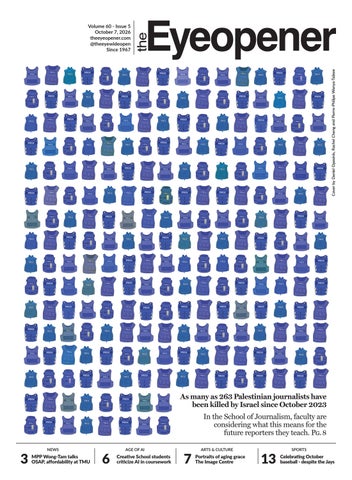
As many as 263 Palestinian journalists have been killed by Israel since October 2023 In the School of Journalism, faculty are considering what this means for the future reporters they teach. Pg. 8
3
NEWS
MPP Wong-Tam talks OSAP, affordability at TMU
6
AGE OF AI
Creative School students criticize AI in coursework
7
ARTS & CULTURE
Portraits of aging grace The Image Centre
13
SPORTS
Celebrating October baseball - despite the Jays
We want to hear from you!
Answer 3 questions for a free cup of coffee from Oakham Caf
THE EYEOPENER WEDNESDAY, OCTOBER 7, 2026 theeyeopener.com/news
News
Next week: Mayoral candidates debate at the SLC
MPP Wong-Tam talks OSAP, affordability at TMSU panel
Wong-Tam said they hoped to increase voter awareness ahead of municipal election Zanoah Plummer news editor
Toronto Centre MPP Kristyn Wong-Tam visited Toronto Metropolitan University (TMU) on Sept. 28 for an event hosted by the Toronto Metropolitan Students' Union (TMSU). The panel was moderated by TMSU vice-president education Teresa Baricevic and president Zain Baig. Baricevic, who coordinated the event, said she hopes “students understand that their voices can be heard and can actually make a difference and that their vote does matter. And getting involved will actually make more of a difference than you think." Political issues relevant to postsecondary students were the main point of discussion for WongTam. Among the most discussed were changes to the Ontario Student Assistance Program (OSAP), which came into effect this semester. The changes saw the amount of grants the program offers lowered from 80 per cent of tuition to a much-smaller 20 per cent. "It's probably one of the biggest challenges I think students are facing today," they said. "I have met students who got their acceptance paper authentication,
their acceptance letter [to] postsecondary, but they're not financially ready to go because of the OSAP program change." Wong-Tam also spoke on accessibility in Ontario and what both able-bodied students and students with disabilities can do to improve access on their campuses. Wong-Tam said the fight for an accessible Ontario is everyone's responsibility, because "every single one of us, [at] one point in our lives is going to be living with a disability." Affordability was a recurring topic of discussion. Wong-Tam spoke on the housing crisis, the youth employment crisis and an increasing reliance on food banks across Canada. According to Food Banks Canada, in March 2025, there were around 2.17 million visits to food banks. Canada's youth unemployment rate sits at 12.9 per cent, as of August 2026. Wong-Tam said these compounded crises are part of why students across Ontario are struggling financially. "The future feels a little bit bleak. Especially if you're a student or you're a young person, and you're asking yourself, ‘when are you going to catch a break?’ And so all of this means that we need to encourage students to take a seat
DANIEL OPASINIS/THE EYEOPENER
at the table where decisions are made. It also means that students can draw from the past for inspiration, because I know that students have made a huge difference when they fought against raising their tuitions," said Wong-Tam. Though the event drew a small number of in-person attendees, many of those who did show up asked questions. Aveen Abdoli, a fourth-year nursing student, was one of the students who attended the event. "Not many people value this kind of knowledge and yet we see
so many things on our phones and we're so enraged by them," she said. Yet that piece where we're supposed to take action is usually null, like it doesn't exist. So I was surprised to see that there wasn't so much traction." Abdoli continued: "I was expecting a lot more TMU students, especially because we're in the city and we have such a diverse population and our problems are all so layered, that there would be more interest," she said. "But I hope to see more in the future." Artin Nikou, a second-year glob-
al management student, had similar thoughts about the event's turnout. "If people are only coming to TMSU's fun parties, and they're not coming to important events about their own future, what does it tell [us] about the people?" Wong-Tam closed the event by stressing the importance of voting in the municipal election. They encouraged students to educate themselves on the issues and get involved with local politics so they can make an informed decision when they head to the polls later this month.
TRSM issues intent for Master of Real Estate program
University says program would be first in Canada to focus on data analytics and emerging technologies Nasha Dutta contributing reporter
Ted Rogers School of Management announced a notice of intent for a new master of real estate (MRE) program, a 12-month course-based master's program set to launch in Fall 2028. According to the notice, the proposal will be available online for customary review until Oct. 30, 2026. The notice also states the program will build on Toronto Metropolitan University's (TMU) real estate management (REM) undergraduate program while becoming the "only Canadian graduate real estate program with core courses in both real estate data analytics and emerging technologies.” The technologies listed in the notice include data science, artificial intelligence, machine learning, geographic information systems and property technology. The program requires a minimum GPA of 3.0 out of 4.33 over the last two years of study. The MRE "aims to prepare the next generation of leaders for careers in Canada’s dynamic real es-
tate markets and their growing international connections," according to the university's website. David Scofield, a professor of REM at TMU, is responsible for overseeing developments in the program’s proposal. He explained that the proposed program is designed to respond to several challenges facing the real estate industry. "We're seeing a huge technology shift in terms of how real estate assets are valued, how leasing occurs, how financing occurs, how assets are managed and customer experience. All of this is being affected by new and emerging technologies," he said in an interview with The Eyeopener. Scofield added that the MRE aims to respond to an industry demand for real estate professionals with a diversified skillset. He said the program does this by addressing the "gap in the market," adding that there isn't another Canadian program combining a focus on international real estate and emerging technologies. "The quality of work, the caliber of thinking and knowledge and critical reasoning is much higher at the graduate level than what we
would typically be expecting at the undergraduate," Scofield said. Alaleh Zarrinnia, a third-year REM student, believes the MRE would be a good way of "concluding" a real estate education. Zarrinnia told The Eye her program course selection feels incomplete, and she wishes she had an option to study certain topics in greater depth. She added that enrolling in the master's program would bridge a gap between the undergraduate program and working in the industry. "Real estate, there's so much to it, and no matter how much you learn, it'll never be enough because the market is constantly changing. That's why it's very good to not just do an undergrad, but also a master's because you just want to learn more," she said. Nicholas Mayer, another thirdyear REM student, said his interest in the program is based on whether TMU plans to partner with real estate companies in the future. “That would be my greatest, value proposition to it—is the relationships you would build,” he said. Mayer believes the program could also be beneficial for re-
PIERRE-PHILIPE WANYA-TAMBWE/THE EYEOPENER
search purposes. "There will be a time where the research is also needed internally at these institutions. So people doing those master's programs, I would look to them rather than someone that has been an analyst and an associate," he said. Prasad Kadam, a real estate sales representative based in Toronto, said the growing use of AI is also changing how professionals compete in the industry. “[If they don't integrate AI] they'll just be behind in their marketing and manageable skills because nowadays the market is more competitive,” he said. He added real estate agents need
to stand out by creating content and keeping their work up to date, which AI can help them do. "If they don't use AI, they can have their business, but it'll be harder for them to compete in this cutthroat competition," he said. Scofield said the importance of growing as a real estate professional lies in understanding different institutions and cultures that shape international real estate markets. “[It’s about] making sure we’ve got really internationally minded graduates who can function in Toronto and Canada and Vancouver, wherever, but also be equally at home if they’re based in Spain, or Seoul, South Korea,” Scofield said.
4 | Editorial The Eyeopener Vol. 60 | 2026-27 EDITOR-IN-CHIEF
Edward “And To 60 More” Lander PRODUCTION EDITORS
Amira “Museum-head” Benjamin Jasmine “Shutterbug” Makar NEWS EDITORS
Nadine “Line Edit” Alsaghir Zanoah “Get Well Soon” Plummer ARTS & CULTURE EDITOR
Sophie “Immortal” Wallace BUSINESS & TECHNOLOGY EDITOR
Mishael “AI-ed Out” Taruc COMMUNITIES EDITOR
Rin “Honourary Engineer” Yanase FEATURES EDITOR
Daniyah “Champ” Yaqoob FUN & SATIRE EDITOR
Dylan “Subway Floor” Marks SPORTS EDITORS
Francesco “Recap King” Cautillo Naomi “Recap Queen” Low PHOTO EDITORS
Rachel “M” Cheng Daniel “V” Opasinis Pierre-Philipe “Ps” Wanya-Tambwe MEDIA EDITORS
Victoria “Aussie” Andrade Ava “Investigator” Whelpley DIGITAL PRODUCER
Lucas “Bighead” Bustinski GENERAL MANAGER
Liane “Hmmm.” McLarty DESIGN DIRECTOR
Vanessa “Saint” Kauk EDITORIAL INTERN
Grayson "Copy Editor" Glenn CONTRIBUTORS
Yuna “I Don’t Carr” Cho Jasmine “Travel Agent” Abbott Lola “Turtle Chips” Poore Charlotte “Fall Ball” Ligtenberg Sydney “Moving Too fast” Shaw Myrtle “Old Reliable” Manicad Nasha "Tech-driven Realtor" Dutta Isabella “On It” Ibrahim Oliver “Media Pass“ Ulster Aswin “Extra Set” Priyadharshan Alan “Double Duty” Tran Noah “Super Sub” Curitti Sidney “Soccer” Shaw Kyla “Leafs“ Pugen Gavin “Downsview” Kennington Santiago “Weatherman” Ortega Will “2 for 2” Braham Molly “Handmade” Simpson Maria “First” Beltran CONTACT
T: 416-979-5262 ext. 2338 E: editor@theeyeopener.com ADDRESS
55 Gould Street, Suite 207 Toronto, Ont. M5B 1E9 The Eyeopener is published by a non-profit corporation owned by the students of TMU.
THE EYEOPENER WEDNESDAY, OCTOBER 7, 2026
Editorial: Where Cornell failed its students, its student newspaper stepped up Jasmine Makar & Amira Benjamin PRODUCTION EDITORS
Content warning: This editorial discusses sexual violence and trauma. The coverage of Cornell University student Jane Doe's sexual assault case didn't begin on Sept. 16 when she first filed a lawsuit against her university, the Chi Phi fraternity and the seven main defendants. It started on Nov. 8, 2024 when The Cornell Daily Sun first reported a fraternity's suspension following reports of sexual assault and drugging. For months, Sun senior editor Cereese Qusba had been following the story: speaking to Jane Doe and her lawyers, researching Cornell's policies and getting the facts right. Qusba told The Cut that although it’d been a year since the incident when she began reporting on it, she was determined to not let it go uncovered . The culture of sexual violence and predation on Cornell's campus—as well as the administration's failure to respond to it—had been long acknowledged, based on many passionate responses to the case by both current and former students. The Sun reported that in 2024 alone, 23 cases of on-campus rape were reported to Cornell. To ensure the names would not be buried, the Sun published an editorial doing what the university “would not,” naming the seven accused: Matthew Ingalls, Jonathan Newell, Winston Lee, Gillio Lopes, Diego Sarabia, Scott Norris and Scott Kretzschmar. Weeks after Jane Doe's initial report, interim Cornell president Michael Kotlikoff issued a public statement regarding the university's intention to investigate. "Only those who perpetrate sexual violence benefit from its concealment," it read. Kotlikoff wrote this in November 2024, while his university was simultaneously supplying incomplete information from its investigation to the District Attorney's (DA) office. From the information Cornell supplied, the DA decided a criminal investigation was unnecessary, and no charges were laid. The Sun also reported that the Ithaca Police Department never received reports of Jane Doe's alleged sexual assault. According to The New York Times, Jane Doe then engaged the univer-
sity’s Title IX office, which ensures the school complies with federal civil rights laws against sex-based discrimination, sexual harassment and sexual violence. This launched another investigation into the incident in January 2025—another step taken by Jane Doe months after her initial report. Following Jane Doe's lawsuit, the DA reopened the case, but just a few days later, New York Governor Kathy Hochul signed an executive order to appoint a special prosecutor to oversee an investigation, ending the DA’s involvement entirely. "This has, in turn, undercut my faith, and the public's faith, in the District Attorney's ability to effectively investigate and prosecute the case at this time," Hochul wrote in her statement. Although legal action should have been conducted in 2024, the blame cannot solely be placed on the DA. Cornell can also be held responsible for a lack of transparency, withholding information in the initial investigation. Just a day before the alleged assault occurred, the Sun reported that a drug-related arrest was made at Chi Phi by Cornell campus police. The university is now accused of negligence, violation of state human rights and education laws, and negligent infliction of emotional distress. Throughout Jane Doe's lawsuit, it is reiterated that Cornell had a duty to protect Jane Doe as an undergraduate student in the university's care. But two years later, here we are: Jane Doe did everything
ILLUSTRATION BY DANIEL OPASINIS/THE EYEOPENER she was ‘supposed to do' as a victim—and it was her own university that failed her. Jane Doe travelled across the country alone, as a non-legacy admittant, to one of the most academically rigorous schools in the United States with an eight per cent acceptance rate. She paid nearly $100,000 USD in tuition, involved herself in Greek life and took a chance to achieve her goals at Cornell. It’s a story that has played out on so many other campuses. The Sun's continued coverage of the seven accused and the lawsuit is providing the care and justice the university did not. By documenting every step (and misstep) of the administration, the Sun is serving justice to students who deserve to know what is being hidden from them. The Sun's reporting has been remarkable. And it's far from the first time student journalism has achieved this. University administrations benefit from complicity to protect their image. In Cornell’s case, this enabled dangerous behaviour. But student journalists, who are beholden to students and students alone, are in the unique position to call this out. In 2021, after rumblings online, Western University’s student newspaper, the Gazette published a story with The London Free Press, detailing mass drugging and sexual assaults during O-Week festivities. The story broke news of the horror
over 30 women experienced at a student residence and sent shockwaves across Canada. Concordia University’s The Link has historically covered the toxic culture of sexual assault and harassment on their Montreal campus, holding the administration accountable for their lack of transparency. This problem that can be traced over a decade. Less than a week ago, The Stanford Daily reported that their university cut a sexual assault awareness program due to "budget cuts and program changes"—the same campus which was at the centre of the Brock Turner case a decade ago. Time and time again, stories from sexual violence survivors indicate a need for change, whether it's in the legal system, conversations surrounding rape culture or university policies. And until change comes, until survivors receive the peace and justice they are denied, journalists are obligated to keep calling on those with the power to bring about these changes. As Qusba said in her interview with The Cut, "Our reporting is also bringing to light that this is not an isolated incident and that people have experienced similar things in Greek life, whether at Cornell or other universities. Our coverage was absolutely completely raw from the lawsuit and nothing was concealed. At a minimum, that’s what we can do as the student newspaper."
News | 5
THE EYEOPENER WEDNESDAY, OCTOBER 7, 2026
Students advocate against use of AI in group of Creative School courses Part of the CSE curriculum previously used an AI tutor chatbot and continues to use AI "personas" Ava Whelpley media editor
Last fall, a group of first-year students at Toronto Metropolitan University (TMU) penned a letter to the dean of The Creative School, Natalie Álvarez, outlining their frustrations with the use of artificial intelligence (AI) in CSE100: Wicked Problems and Creative Intervention. Now, a year later, they question whether meaningful change has come from it. The letter, co-written by photography student Zoë Wolfe, who is now in her second year, included 35 signatures and data from a survey she shared with students at The Creative School where they could express their concerns with the course. “It is our hope that with this feedback you [the dean] and the administration will seriously reexamine the decision to make these in-development and ethically questionable courses a requirement for students in The Creative School,” the letter, which has been obtained by The Eyeopener, said. CSE100 is the first course in a series of courses with the “Creative School Experience” (CSE) name. Owais Lightwala, an assistant professor in The Creative School and instructor of CSE100, describes the course as a “how to change the world course.” Specifically, he said the course is trying to answer, “what are the superpowers that creatives have that they can lend to these [wicked] problems,” he said. Lightwala describes “wicked problems” as the many large and complicated issues with complex answers facing our world today. However, students in the first iterations of this course took issue with use of AI tools, including the integration of an AI tutor chatbot in the Fall 2025 curriculum. “It was a chatbot that was trained with the course's content and assignments and you could upload drafts of your work and get feedback on them before you submitted,” Lightwala said. In light of student feedback, the tool was not implemented into the Fall 2026 curriculum. However, both the Fall 2025 and 2026 curriculums integrated AI “personas” into an assignment in which students were asked to practice interviewing. In an emailed statement to The Eye, The Creative School explained their reasoning for keeping the AI persona. "With 600+ students, sending everyone out to interview members of the public would require research ethics approvals that aren't practical at
Human Rights Services engaged after antisemetic vandalism found in DCC Amira Benjamin production editor
AVA WHELPLEY/THE EYEOPENER that scale, so without simulations students would get no interview practice at all.” In the survey conducted by Wolfe, 40 per cent of students surveyed said they were “learning nothing” when asked how much they feel they are learning in the course. As well, 36.5 per cent said they do not feel valued as students in the course. Wolfe surveyed 52 students who she says are in The Creative School. The letter also included anonymous testimonials from students with responses mainly expressing negative feelings towards the integration of AI in the course. One student wrote, “The course is useless to us, and a slap in the face to artists.” The course was designed by Lightwala in collaboration with journalist and television host Ramona Pringle, who is also an associate professor in RTA School of Media and director of the Transmedia Zone at TMU. The course was first launched in Fall 2025 after several years of development. CSE100 aims to cultivate cross-program collaboration for students at The Creative School through an assignment called “design jams,” where students practice designing “creative interventions in response to an actual problem,” Lightwala explained. The letter that Wolfe addressed to Álvarez questioned whether CSE100 should remain mandatory for certain Creative School students. “There was a general feeling amongst my cohort that this was a huge waste of time and actually a detriment to our learning,” said Wolfe. Kat Suriano, a second-year photography student, spoke on behalf of her peers as the second-year representative of the Image Arts Course Union (IMACU).
Suriano said students did not feel motivated because “they felt like their creativity was kind of being stripped away." Suriano also added students felt their work was being treated as a simple "pass-or-fail-type like submission," making assignments seem like a box to check off, rather than something they wanted to engage with. In response to the letter, a focus group was formed by The Creative School to discuss the course. “They were trying to get our feedback on how to fix the class. They actually tried to offer me a paid position to work on the class,” said Wolfe. She also said the dean's office promised participants $25. Wolfe said the payment was never received and the office did not respond to her emails about the matter. In The Creative School's emailed statement, they said some students may not have received compensation due to an "internal processing error." They added that they, “have already begun reaching out to provide $50 as compensation beginning September 28.” The integration of AI tools in academia has been a hot topic in higher education for some time. Last week, TMU's Leadership Task Force on Generative AI published a report, which listed undergraduate programs that have integrated AI competencies in their curriculum. CSE courses were among those listed. The report suggests opportunities for generative AI to be implemented into learning and teaching at TMU. Some ways students might engage with AI were also included, stating that “some students may also benefit from and prefer seeking anonymous tutor-
ing support from AI assistants.” However, the report stated additional “educational scaffolding,” “clear communication” and “training on academic integrity” are necessary to prevent cognitive offloading—which is when students rely on AI to do thinking and problem-solving for them. Lightwala said the course curriculum has since expanded to include a component on AI literacy and ethics. The third learning outcome in the Fall 2026 syllabus, states students should “critically engage with the ethical and sustainability dimensions of creative interventions, including the use of AI tools.” “I do think it makes sense that if we're going to introduce an assignment that uses a technology [that] maybe we need to explain the technology as part of the course, so that you know what it is and what it's not and how to engage with it ethically and responsibly,” he said. Paige Connolly, a first-year student in creative industries who is currently enrolled in CSE100, said the course has not covered AI literacy or ethics in class so far. However, Connolly said she understands the importance of the addition. “I think that…with AI being so constantly changing…it's really important to know how to properly and appropriately use it, and how to not abuse the usage of it,” she said. She believes though AI can be useful at times, this is reliant on a balanced and measured use of the technology. She said it’s still important for students to practice brainstorming on their own. “I think that it's just very important to remember that we chose to be in a creative program so we need to try to be creative,” Connolly said.
Toronto Metropolitan University issued a statement on October 2 regarding antisemitic vandalism discovered in the Daphne Cockwell Complex (DCC) student residence. The statement condemns the vandalism, saying that "antisemitism has no place at TMU,” and “behaviour that targets or causes harm to members of our community goes against the university’s values.” The statement did not specify when the vandalism occurred or where in the building it was discovered. DCC residents approached by The Eyeopener on Friday said they were unaware of the vandalism and did not receive any additional information as residents of the building. The public statement said the university is investigating the incident and has engaged Human Rights Services and the Student Care team. Human Rights Services is part of the Office of the Vice-President, Equity and Community Inclusion and tasked with promoting a campus environment free from discrimination and harassment. In August, the university released an external review from retired Ontario Justice Mary Lou Benotto, exploring the campus climate postOct. 7, 2023. The report outlines what some participants described as rising antisemitism. This included recounts from participants who recalled seeing “antisemitic graffiti in campus washrooms and common areas, including symbols and messaging found threatening" The university said the incident will be addressed through the Student Code of Non-Academic Conduct and the Discrimination and Harassment Policy. The Eye reached out to the university for additional information, but was told there's nothing, "more than the statement at the time."
JASMINE MAKAR/THE EYEOPENER
6 | Business & Technology
THE EYEOPENER WEDNESDAY, OCTOBER 7, 2026
New task force report will guide AI use at TMU Report comes over a year and a half after task force creation
Amira Benjamin production editor
With artificial intelligence (AI) disrupting academia, a new report from a Toronto Metropolitan University (TMU) task force aims to guide the university in adapting to the rapidly-developing technology. Published on Oct. 1, the report from the Leadership Task Force on generative AI highlights potential applications and risks of implementing AI throughout university administrative uses, educational supports, scholastic research and improving student experiences. Thus far, the implementation of AI at the university has been at the discretion of departments, and, at the teaching level, individual instructors. According to the university’s AI Resources webpage, instructors may integrate the use of generative AI into coursework, but are encouraged to refrain from marking assignments with the technology. According to the report, the task force consulted the TMU community, including an online survey that received 88 responses and five town halls which saw 129 registrants. The task force includes viceprovost academic and task force co-chair Sean Kheraj, vicepresident research and innovation Steven Liss and Ted Rog-
ers School of Management dean Cynthia Holmes. Balancing teaching AI competencies with academic integrity The task force suggests that generative AI tools can support student learning experiences, particularly as "collaborative learning partners" and "anonymous tutoring support." The report also highlights the use for generative AI to improve accessibility, such as for the generation of alt-text for videos and images or AIassisted notetaking. The report outlined programs with "integrated AI competencies," ranging from learning AI foundations throughout several undergraduate engineering courses to "explicit curriculum modifications made to address AI" within certain Image Arts film and photography courses, considering the societal contexts of AI in Liberal Studies. It also makes room for concerns over academic integrity. The report notes the risk of students submitting AI-generated coursework and the possibility of "cognitive offloading…as a result of overreliance on AI tools." As previously reported by The Eyeopener, Hector Flores, the Toronto Metropolitan Students’ Union student issue and advocacy coordinator, reported that over a sixmonth period, 30 per cent of aca-
demic misconduct consultations the union held with students were over the alleged use of AI in coursework. The task force’s report said using generative AI tools for student assessments is a "high risk activity," and its authors "advise that the university continue to monitor the scholarship on…the effects of AI on learning and teaching." Considerations of AI tools for research amid privacy and transparency concerns The report found that generative AI could be applied for brainstorming, grant development, data collection and content creation. And with appropriate disclosure, generative AI can be used for tasks such as ideation, data analysis, data visualization and image generation. It highlighted that AI tools "may also undermine [the grant development/review] process if researchers offload critical cognitive and analytical work to machine assistance." The report cautions that some funding agencies or academic journals require AI disclosure or outright prohibit substantial use. The report also warned ongoing privacy concerns about public generative AI tools, as they "collect user input to further train [language learning models] and thus present significant data privacy risks."
PIERRE-PHILIPE WANYA-TAMBWE/THE EYEOPENER AI can enhance the student experience, but not in all areas The task force highlighted how AI tools could improve student experience at TMU. Among them are, "enhanced staff productivity and effectiveness," "better student preparations for workforce expectations regarding AI" and "improved access, inclusivity, and innovation in the learning environment.” However, the report expressed hesitation with implementing AI tools for certain services, particularly mental health services, citing concerns over sharing private student information with outside parties. "In community consultations, there was optimism about the po-
tential for adopting AI systems to improve student services, but many in the community saw a need to ensure that there is always a human touch in the services TMU provides to students," the report stated. Assisting with administrative tasks with human oversight The report found that generative AI has potential to support administrative tasks, so long as space is made for human oversight to ensure "accuracy and maintenance of institutional reputation." The task force also expressed concern over potential cybersecurity vulnerabilities and data privacy risks in administrative and operational settings. Read more at theeyeopener.com.
Student small business owners say authenticity is key to building an online brand
For students, authenticity is its own social media strategy Mishael Taruc business & technology editor Student-owned small businesses at Toronto Metropolitan University (TMU) are finding increasingly creative ways to utilize social media to market their products online. Andrea Romero, interim director of Strategic Planning, Impact & Scholarly Research and Creative Activities at The Creative School said social media is “where people are. "It's really hard to see people walking down the street and not being on their phones,” she said. If student business owners are able to tap into that, she says, they’ll have a better chance at reaching potential buyers. Fourth-year business management student Lauren Martinez sat behind her stall of crochet tops, hats and keychains. Her brand Rengsuu (@rengsuu on Instagram) is among the lineup of small businesses at Mutual Market, a small business showcase that takes over Gould Street on Wednesdays and Fridays in October. Rengsuu’s Instagram page features Martinez showing off her products
in posts with maximalist designs and pastel and muted colour palettes. Similarly, bright and light colours draw the eyes when scrolling through PageDraws (@pagedraws on Instagram)—an art business offering stickers, keychains, journals and live photobooth run by TMU alumna Paige Tsang with help from her sister Chloe Tsang, a second-year public health student. Her Instagram account is littered with cartoon animals in her art style. “I'm trying to push the branding more. So I'm trying to keep all the colours cohesive, all the elements,” Tsang said. Third-year business management student Sumaya Said who runs Sumaya’s Bake Shoppe (@sumayasbakeshoppe on Instagram) said her business’ online presence is an extension of her own personal brand. “I love pink, as you can see,” pointing to her all-pink set up, saying, “ever since I was little, it has been my favourite colour, it just brings me a lot of joy.” Online, Said showcases her homemade cookies and cupcakes in pink menus and ribbons.
Romero says this is a common tactic in online marketing. “People want relatable personas,” she said. “What type of things are they doing on a day to day? Are they at a coffee shop? What stores are they shopping at? How do they style the product? And all of that becomes relatable content,” she said. Martinez said she does not run her business account like larger corporations do. “I kind of treat it as like my own personal account, kind of like an artist's journey.” She also said she focuses on reels “because that’s what gets the most traction on social media these days.” Tsang also uses this format to show authenticity. “If you look at my reels, they're a little silly. So they're mainly just for fun,” she said. Said, on the other hand, takes photos of happy customers for her followers to see. Romero emphasizes that producing online content for a studentowned online business can start small. “You do want to have good lighting. You want to ensure that the video is crisp, but you don't need
DANIEL OPASINIS/THE EYEOPENER something like overproduced. It just needs to be authentic,” she said. She advised students who are thinking about starting their small business to use resources on campus. The Creative Enterprise Hub offers programming for TMU students to turn their ideas into careers and businesses; they provide mentorship, resources and networks for creatives to jumpstart their projects. She also warns students not to underestimate the value of their professors. She says they can be “a gateway to supporting you outside
of your academic world.” “Marketing is step two,” Romero said. She encouraged student entrepreneurs to talk to people first and share their ideas to get feedback. She said young entrepreneurs should think about why their ideas matter and who it is serving. “You need to make sure that you're giving something that people want, not just what you want,” she said. For Martinez, simply starting is most important. “It doesn't have to be perfect. Just get it going. And then you will learn on your way.”
Arts & Culture | 7
THE EYEOPENER WEDNESDAY, OCTOBER 7, 2026
Tatreez bridges years and generations at the Textile Museum of Canada “Retracing Tatreez: Palestinian Thobes through the 20th Century” allows Palestinians to connect with their heritage Molly Simpson CONTRIBUTING REPORTER
The Palestinian dresses and garments had been in the Textile Museum of Canada’s catalogue for years when Nina Rafique took note of them. She was studying art history and material culture and semiotics at the University of Toronto while working as the museum’s receptionist. During her time at the museum, Rafique began researching the garments, and pursued the project for educational credit as part of her degree. Although she is no longer working at the museum whilst on a pre-master's degree gap year, Rafique is the guest curator of “Retracing Tatreez: Palestinian Thobes through the 20th Century,” an exhibit that displays Palestinian garments from the museum collection. Tatreez is an embroidery form where Palestinian women and girls decorate their dress garments with “symbols of history, memory, and place,” and reflect the world around them according to the Metropolitan Museum of Art. Colours and threads, needlework used and individual interpretation all tell a story of a particular maker. Most of the items on display were made prior to the Nakba in 1948. Arabic for “catastrophe,” Nakba refers to the mass displacement of Palestinian people during the establishment of Israel, according to the exhibit description. The exhibit pieces were mainly acquired by non-Palestinian people after being “looted, left behind, or separated from their original owners,” according to the exhibit website. The pieces came to the museum through
passive acquisition, a practice where people donate their personal collections. However, the practice has since been halted by the museum due to ethical concerns. “A lot of the time that's coming from art collectors and people who aren't necessarily from the cultures of the items that they're donating. So they're coming to the museum as beautiful objects, but objects without really additional context to where they're from specifically, what they actually are, when they're from, because they're already being bought with several levels of separation from the original person who made them,” Rafique said in an interview with The Eyeopener. In history, tatreez has made appearances as part of uprisings and resistance. During the First Intifada, a major Palestinian uprising in response to Israeli settlement between 1987 and 1993, Palestinian women embroidered tatreez into garments using colours associated with the Palestinian flag in response to restrictions on displaying the flag, according to the Metropolitan Museum of Art. Tatreez garments are often patterned with birds, trees and flowers common to the location of the maker. The garments and thobes— the name for these Palestinian dresses—are a “documentary” of the lives of the women who sewed them, Rafique said. She said it’s possible to identify where a garment came from based on patterns and fabrics, with the exhibit organized by region. Signs saying “maker once known” sit with most accompanying placards in the exhibit. Rafique said her favourite garment in the collection is a primarily black thobe from an
MOLLY SIMPSON/THE EYEOPENER area between Ramallah and Jerusalem. The thobe has red tatreez patterns and small multicoloured thread work up the front. Aside from just being beautiful, Rafique said it’s “kind of like [a] physical archive of everything that's happened to it,” featuring different dye batches, threadwork and strange repair attempts, potentially from people who did not understand the practice, Rafique theorized. She noted a rare initial on the garment, something that she said doesn’t often appear on thobes. She said this is because people didn’t assume they would be separated from these items. “I don't know this woman's name. I don't know anything about her, really, except where she was from. But I do have the first little bit of her initial…and it still endures on the dress, even though there have been all these other hands and all these other alterations and repairs on it since then,” she said. Rafique was happy she was able to save the garments from “museum death,” where items enter museum collections but end up in storage rather than display. Now, Palestinian visitors who don’t have tatreez as part of their
family heirlooms will be able to view them. And when a family does still have tatreez heirlooms and practice, the exhibit has the ability to inspire. Nazha Syriani, a fifth-year fashion student at Toronto Metropolitan University (TMU) is aiming to incorporate tatreez into a capstone project she will work on in sixth year, where she must produce five individual garments. She says she wants to reproduce the story of her grandparents in tatreez on one of these items. Syriani tried tatreez for the first time at a workshop in Mississauga. She told The Eye she embroidered the Moon of Bethlehem, a common tatreez motif, which took her two hours. “Palestinians are always at risk of our culture and heritage being erased,” she said. “Keeping these art forms alive and being passed down just allows us to be connected with our heritage and all the women before us, as well as showing the world that we're not going anywhere and we are here to stay.” The exhibit opened on Sept. 24, and will run until May 2, 2027 on the second floor of the Textile Museum of Canada.
Richard Avedon’s portraits find something timeless in aging Displayed on campus, the portraits challenge viewers to confront aging as a universal human experience Maria Beltran CONTRIBUTING REPORTER
Across from the main gallery of the Richard Avedon Immortal: Portraits of Aging exhibit currently on display at The Image Centre, is a smaller room home to a series of photographs from the final years of Avedon’s father’s life. The portraits offer an intimate encounter with aging through his father’s battle with terminal cancer. Restaged from his seminal 1974 Museum of Modern Art exhibition in New York, the year after his father died, the portraits document a body changing with time, bringing the viewer face-to-face with a process that is both deeply personal and universal. Richard Avedon rose to prominence in the post-war fashion industry, becoming one of the most influential photographers of his time through work in magazines like Harper’s Bazaar and Vogue. Yet despite his association with glamour, Avedon challenged the convention of portraits that idealized their subjects through flattering poses, lighting and retouching.
Although Toronto Metropolitan University’s (TMU) Image Centre did not set out to make Immortal a timely exhibition, curator and director Paul Roth believes its subject resonates with Canada’s aging population and the need to address “issues of representation, of health, [and] public policy around aging in Canada.” Drawing on his longstanding ties to the Avedon Foundation, Roth secured the artworks on loan from from major institutions like the Museum of Modern Art in New York. Through Avedon's portraits, he hopes to bring these concerns into view by presenting aging as something all humans share. Avedon’s own relationship with aging was complex. Roth suggests that Avedon saw it as “a condition that we are all in all the time,” rather than something that suddenly happens to us one day. “It’s a thing that we all face, and some of us face it in pain, and some of us face it with great verve and excitement and energy…all of it is there. All of it is in those photos,” said Roth. Avedon’s portraits show how differently
aging can be experienced—and perhaps nowhere more strikingly than in his portraits of William Casby and singer Marian Anderson. Casby was 106 when Avedon photographed him in 1963, more than twice Anderson’s age, and had been born into slavery more than a century prior. As Roth explains, Avedon photographed Casby as part of a project with writer and activist
James Baldwin exploring the American civil rights movement. His face fills the frame against a stark white background, with wrinkles, pores and scars rendered in fine detail. Casby’s portrait carries the weight of a history that was still within living memory in the 1960s. Read more at theeyeopener.com
PIERRE-PHILIPE WANYA-TAMBWE/THE EYEOPENER
EYEOPENER 8 | THE WEDNESDAY, OCTOBER 7, 2026
W
ALID BATRAWI WAS AT home in Ramallah when he first heard reports of an attack on Oct. 7, 2023. He left around 6:30 a.m. to take his daughter to school, where he fiddled with the radio in his car and set it to a station that was blaring sirens alongside news commentary. When he got home, Batrawi—a journalist and educator for many years in the West Bank—began to learn more about the attacks that had unfolded that morning. Shock consumed him. Within hours of Hamas’ deadly attack, which killed over 1,100 Israelis and saw 251 more taken hostage, Israel began its relentless bombardment of Gaza, dropping hundreds of missiles on the first day. In the coming weeks, hundreds would be buried beneath rubble. Children would be separated from their parents. Mothers would find parts of their children strewn in the aftermath of bombings. Hospitals would be forced to perform amputations without anesthesia, aid would be turned away and people would be forced from home with nothing but the clothes on their back. In those first weeks, Batrawi says, Western media often got the story wrong. Headlines decried those who were “killed” in Israel, but in Palestine, victims just “died.” Israeli children were children, but six-year-old Hind Rajab from Palestine was a “woman” who was killed. For Batrawi, who had worked for publications like the BBC and the CBC, the coverage was, in simple terms, a “failure.” “They failed me, not as a Palestinian, but as a journalist who believed in their values,” Batrawi says. In the midst of the active bloodshed and the media coverage he felt turned a blind eye, Palestinian journalists fought tooth and nail to get the reality Gaza faced out into the world. In blue vests labelled “press,” they separated from their families to follow the truth. Many found out about deceased loved ones on air and some even lost their own lives while covering the emerging genocide. Months earlier, in May 2023, Batrawi had visited the Gaza Strip to conduct a “hostile environment training” for journalists there. He taught them how to hide, how to find shelter if they found themselves reporting with bombs raining down. But by late 2023, Batrawi felt ridiculous about what he had taught them. Gaza, he said, was not the “ideal war” scenario with places to hide. “This is actually what makes me sick, because many of those who I have trained have been targeted and killed, and one of them is still missing,” Batrawi says. Batrawi is now an instructor at Toronto Metropolitan University (TMU)’s School of Journalism. Every day, he comes to campus wearing a press vest pin to keep the memory of his killed colleagues with him. And every day, he resolves to teach future journalists what he believes the journalists of today failed to do for his people. Since Oct. 7, 2023, hundreds of Palestinian journalists have been killed by Israel. The Committee to Protect Journalists (CPJ) says as of Sept. 30, the number is around 189. A Sept. 30 estimate from Al Jazeera places that figure
FEATU
Teaching journalis amidst genocide
TMU’s School of Journalism is one of Canada’s top institutions for learning the craf when the number of journalists killed for their work is climbing in Palestine a obscured, some faculty are considering what this means for the generation o BY DANIYAH YAQOOB
A whiteboard in the journalism student lounge in the Rogers Communications Centre has been populated in Palestine. When the board was filled, students added more names on sheets of paper. DANIEL O at as many as 263. They are among the more than 75,000 Palestinians killed since Oct. 7, 2023, which includes more than 20,000 children, according to Al Jazeera. Many organizations, the United Nations (UN) included, had called Gaza the deadliest place in the world to be a journalist in 2025. “Israel has now killed more journalists and media workers than any other government since CPJ began collecting data in 1992,” CPJ said in a live tracker. An investigation, dubbed The Gaza Project, determined that many of those killed had been targeted, despite clearly labelling themselves as members of the press.
It’s a violation of international law, one that even the UN’s Human Rights Office called out last year. “Directing attacks against protected persons such as journalists is a violation of international humanitarian law and also constitutes a war crime,” they wrote. Watching her colleagues killed across the world stirs an “indescribable” feeling for Sonya Fatah, a journalist and associate professor in the program. “Every journalist [in Palestine] has written their epitaph, knowing that it's entirely possible that they’ll be gone the next day,” she says. It’s a sense of duty you can’t teach.
"My message for the students here is that you are our hope in Gaza." —Hedaya Shamun, visiting journalist at the TMU School of Journalism
WHEN THE VIOLENCE BROKE OUT ON Oct. 7, Ravindra Mohabeer, chair of the School of Journalism, was in his second year in the role. He knew that the school had a history of writing statements and outlining a position when something significant happened in the world. But in that moment, he says the school leadership group focused its response to serve the students, not to take a position. “[Focus] on what our core business is,” is a philosophical approach Mohabeer says a colleague uses. “[We are] working with young people who are navigating a complex world, who don't always have a full understanding of the pieces of that world,” says Mohabeer. He says the school focused on their core responsibility to students, "as people and as student journalists." The School of Journalism at TMU has a layered staffing system. In addition to full-time faculty, many educators at the school are parttime instructors and journalists by day. Some of them had expressed concerns to Mohabeer early on—they wanted guidance, like a script,
URES
sm e
ft of reporting. But at a time and headlines are being of reporters they teach
d with the names of journalists killed OPASINIS/THE EYEOPENER on what to say or how to handle discussion on Palestine, because in their newsrooms, they were often given editorial guidelines on what to do. Mohabeer acknowledges that students may have wondered, “How come I feel as though I am unable to talk about something that is incredibly important to me at this particular moment in time?” Fatah shared a similar sentiment, that students would be the better judges of the school's response. Universities around the world struggled to facilitate that dialogue, too. Some more famously than others. In the United States, at institutions such as Columbia University, police were called in to arrest students who protested Israel on campus. Columbia’s School of Journalism avoided taking a public stance. But by mid-2024, the Arab and Middle Eastern Journalists Association at Columbia proposed the idea of a memorial in the lobby of the school to honour the journalists whose lives were lost. Some faculty hesitated, but the dean of the school ultimately allowed it to be installed.
THE EYEOPENER WEDNESDAY, OCTOBER 7, 2026 By February 2024, the number of Palestinian journalists killed reached somewhere above 80, as previously reported by The Eyeopener. In TMU's journalism school, Fatah was approached by journalist Pacinthe Mattar, who wanted to organize a vigil for their colleagues who had been killed. She asked if the School of Journalism would host it. The faculty had “mostly” been in support and approved it as a collective, Fatah says, and some attended the vigil. In the end, over 150 people gathered at Bond and Gould Streets, laying flowers and candles in front of the names of the journalists who lost their lives in Palestine, Lebanon and Israel since Oct. 7, 2023. A moment of silence was held at the event for 83 seconds— one second for each journalist killed. “I felt that that was a good, visible thing that the School of Journalism had participated in, with the support of the chair,” Fatah says. Since the vigil, the number of Palestinian journalists killed has tripled. And many media outlets continued to get the story wrong. So in their classrooms, these journalism educators felt they needed to figure out how to train their reporters more responsibly. IT IS AUGUST 2025. PALESTINIAN journalist Anas Al-Sharif is in a media tent near the Al-Shifa Hospital—one of the largest medical centres in Gaza, which had been placed under siege by Israel. Around 11:30 p.m., an Israeli airstrike was launched on the media tent and Anas Al-Sharif was killed alongside his colleagues, Mohammed Qreiqeh, Ibrahim Zaher, Mohammed Noufal, and Moamen Aliwa. A witness said their murder was instant. His last words were tweeted after his death: “This is my will and my final message. If these words reach you, know that Israel has succeeded in killing me and silencing my voice. First, peace be upon you and Allah’s mercy and blessings.” Associate chair of the journalism program, Asmaa Malik, couldn’t understand what she was reading. The pain of his killing—one that Israel confirmed was targeted, according to Reuters (the Israeli military alleged he was a Hamas operative, a claim Al Jazeera rejected)—was visceral: “I felt it in my body.” In 2023, Malik had been on sabbatical. But she saw in the coverage of Gaza postOct. 7 something she had seen in the coverage of Muslims and the Middle East post9/11: complicity. Malik has a copy of “The New York War Crimes,” a protest publication by advocacy group Writers Against the War on Gaza that interrogates The New York Times’ coverage, pinned to a bulletin board in her office in the Rogers Communications Centre (RCC). In her introductory classes, Malik educates her students on the importance of knowing where their news is coming from and who their sources are, to avoid the mistakes she believes Western outlets had made in running Israeli government claims without verification. In her literary journalism classes, she teaches duty of care by bringing up incidents in Palestine. In her critical issues in journalism classes, she invites guest speakers who have carved out their own spaces in the media landscape to write about Palestine. “I always find a way to bring it in,” Malik says. “It always makes sense to see things through that lens. No matter what you're teaching, it's always relevant.” In January 2024, Malik and Fatah published a joint article in The Walrus, arguing in the headline, “Attacks on Press Freedoms Have Chilling Effects Far beyond Gaza.” They wrote about straw-man debates Western media had engaged itself in over bias and objectivity when it came to covering
Palestine fairly. They spotlighted Canadian journalists who had been punished for asking for better coverage on Gaza. They argued that Canadian newsrooms’ silencing and censorship “undermines the very standards newsrooms claim to be upholding.” In their view, the genocide in Palestine could teach a thing or two to journalists here. Malik acknowledges that not all of the faculty in the program have been as comfortable bringing up issues like the genocide in Gaza as examples in their classes. But she also acknowledges the role the school must play in a world where graduates of the program may be asked to obscure the truth in a story—they don’t want to just produce journalists that get jobs, but journalists who change how the industry works. “The more journalists who are seeking to make change in newsrooms, the better in the long-term,” she says. Fatah has a similar approach to journalism education, hoping to train students so they can make a case for telling a story the way it deserves to be told. She’s embedded Palestine and Palestinian journalists into her personal and class projects. Her live journalism show, Living With Drones, which her graduates collaborated with her on, has taken on a life of its own, now touring internationally. It shares the story of two Palestinian lawyers who, like all in Gaza, live with the constant hum of drones in the air above them. “It's two years since we did it, and it's exhausting to do. But I think it's an obligation in a way,” Fatah says. While Western outlets jump to talk about press freedoms on a normal day, she says, they have refused to in the Palestinian context. So with her students, they do this “small thing” to support the work journalists do to bring focused, human stories of Palestine to the world. “If I'm to work at a place like TMU or at a school of journalism, it's personally important to me that it's not just a job—that it is more than that,” she says. IT IS MAY 2022. SHIREEN ABU AKLEH, a veteran Palestinian journalist for Al Jazeera, admired by many, stands in the West Bank wearing a clearly marked press vest. She is shot while covering the operations of the Israeli military in the area. Well before the events of Oct. 7, 2023, she was one of the Palestinian journalists Israel targeted and killed. Batrawi once shared an office with Abu Akleh in the West Bank. He still remembers her smiling face, and his shock when her life was stolen. As the genocide escalated, he joined The Gaza Project and found evidence that many of the hundreds of Palestinian journalists killed were being targeted by the Israeli military for trying to report the truth. In the last year, the School of Journalism has brought on two Palestinian members to join the team: Batrawi, who assists in the fourth-year course, On The Record, training from his lived experience as a broadcast journalist. This year, Hedaya Shamun was brought on as the non-fiction writer in residence and visiting journalist at the school. Fatah says bringing them on was an intentional decision. “We are looking at what can we learn from journalists on the ground covering genocide or occupation,” she says. “Instead of the other way around, where the Western training machine kind of looks at, ‘let us teach you how to do the thing.’” It’s part of a broader change being brought to the School of Journalism. Years back, when TMU was still a polytechnic, the em-
|9
phasis was on hands-on training; but in recent years, history and theory is taking a larger place in program syllabi. Following a periodic program review, the faculty is proposing changes to the curriculum that will mandate all journalism students take a course to understand Canadian history—and principles like duty of care, international awareness and numeracy will all be embedded into the program in a scaffolded way that adds more emphasis than before. The changes could come into effect as soon as Fall 2027. Batrawi says the role of a journalism school in a time of media crisis is to double down on teaching students verification when it matters most. To teach their students history so they have context of the world they’ll report on. And he emphasizes the importance of bringing on international journalists to expand the horizons of a Canadian-centric media industry. Shamun, a journalist from Rafah who was among the first graduating class of journalists from her university in Gaza, hopes the journalism school teaches its students the importance of human-centric journalism. “It's like we lost part of our souls this genocide. But I believe the new generation, students and the university, can do many things.” “If you are a journalist or if you are a writer, feel all these human issues. You can't stop, you can't sleep, you want to do more,” she says. “So maybe my message for the students here is that you are our hope in Gaza. The children, women, young people who [are being killed], you can make them alive by writing about them, their stories. Because they have very beautiful dreams, but they are now in another world.” IT IS SEPTEMBER 2026. MUHAMMAD Abdel Aziz al-Najjar, a Palestinian journalist, is in the Gaza Strip after almost a year of so-called ceasefire. In an unspecified attack, he is killed. His name does not appear in Western headlines. The news cycle has moved on. But the students do not. In the journalism student lounge inside the RCC, is a whiteboard many used to doodle on. The content was always changing; sometimes comic strip illustrations, sometimes messages left between friends and sometimes nothing at all. At some point during the Winter 2024 semester, however, the whiteboard was transformed into a memorial. One by one, the names of journalists killed in Gaza were added in blue ink, until the board filled at 132 with Salim alSharafa, a presenter and journalist for AlAqsa TV, a son and a colleague, who was killed by Israel in 2024. So a blank piece of paper was taped beside the whiteboard, where the names of the journalists killed continued to be written down. And then another piece of paper was taped on—then a third, a fourth and a fifth. The names of 272 journalists are now committed to memory in the lounge. In the three years since it was posted, it’s not been touched. It has not been erased. “I will not talk about the numbers because all members of my society, every child, every woman or journalist they killed—we should care about their dreams,” Shamun says. And so remembering their names and their dreams is what the journalism students do. Every time they walk into the lounge, they are forced to pause. To bear witness. It is a sobering reminder for the journalists born out of TMU, for the work they’ll have to do when they graduate into the industry.
10 |
THE EYEOPENER WEDNESDAY, OCTOBER 7, 2026
your friendly neighbourhood bookstore
your friendly f iendly neighbourhood fr neig i hbourhood bookstore ig
your next great read awaits...
your next nex ex e t great read awaits... awaits ts t ...
benmcnallybooks benmcnallyb benmcnallybooks y ooks yb 108 Queen 108 Queen St. St. E E (at (at Jarv Jarvis) Jarvis) rv rvi vis) The Eye is looking for new student members of our Board of Directors
Are you a student in one of the following faculties?
• The Faculty of Engineering and Architectural Science • The Faculty of Arts • The Faculty of Community Services
Do you want experience serving on an administrative board? Email generalmanager@theeyeopener.com to get involved.
Communities | 11
THE EYEOPENER WEDNESDAY, OCTOBER 7, 2026
EngPlay kicks off new season of student-run musical theatre The club has been staging annual parody productions starring engineering students for several years Rin Yanase communities editor
Engineering student-run theatre group EngPlay kicked off its 2026-27 season with their first event of the year on Oct. 2. In a classroom at the George Vari Engineering and Computing Centre, the club unveiled this year's crew members to attendees. Sharon Ebenesar, a fifth-year aerospace engineering student, is the co-director of EngPlay this year. She’s spent five years with the student group, previously serving as a part of the stage crew and production team. Ebenesar said the event was the club's “kick-off,” with a focus on following up on people who showed their interest in EngPlay during orientation week. “We're trying to promote and give more outreach for people who want to join stage crew or technical crew,” she said. Sophie Petrushkina is a fifthyear aerospace engineering student and former director of the club. She said EngPlay puts on an annual rendition or parody of an existing creative work or an original piece written from scratch.
In May, the troupe put on a musical parody of The Hobbit at Toronto's Alumnae Theatre with an “engineering twist,” which included the swapping of Middle Earth for “Middle-Eng.” During the winter semester, the group also hosted "Eng Got Talent," an on-campus talent show which invited students across the province to perform. The Oct. 2 event also gave a rundown on their yearly schedule, a screening of the club’s past works and inclusive games. Mokorinayo Olowoyeye, a firstyear industrial engineering student, learned about EngPlay through their social media posts and booth at the university orientation. Olowoyeye said she was a part of the ensemble in her high school's musical theatre club. “Even before that, I just really loved musicals,” she said. For Olowoyeye, who is searching for something that allows her to “find a merge between the engineering and the arts,” EngPlay was a perfect creative outlet. “I feel like there's a lot of people who think if you're a student who grew up artsy and you want to go into STEM, for whatever
PHOTO ILLUSTRATION: PIERRE-PHILIPE WANYA-TAMBWE/THE EYEOPENER, PHOTO SUPPLIED BY SHARON EBENESAR reason it may be, you have to leave your arts at home. And I feel like that's not true,” Olowoyeye said. “I've realized there's a lot of correlation between engineering and then music, theatre and arts. Maybe because engineering revolves around a creative aspect, so having this creative [outlet] is also really important,” Petrushkina said. Petrushkina said her experience as a director was challenging because there was “a lot of potential for the club to actually not survive.” Being the sole applicant for the director position, Petrushkina led
the crew, pulling the club out of the very fragile state to be able to sell out its annual show. “It took a lot of effort, sweat, tears,” she said. Olowoyeye said finding communities in the intersection of your interests or background makes the student experience more rewarding. In addition to EngPlay, she said she just recently joined the Toronto Metropolitan University chapter of the National Society for Black Engineers. “I feel like that really helps you because specific people who share similar interests or skills are able to help you more,” she said. As a new co-director, Ebenesar
said, “we want it to be a safe space for everybody to have an outlet, like how [Petrushkina] and I had an outlet for our creative skills, to be that source of entertainment and reliability for engineering students who feel the same way.” She said the crew also wants to try collaborating with students from other departments, broadening their outreach while “keeping it engineering-centred and engineering-focused.” EngPlay announced on Oct. 2, their next annual production will be a parody of Legally Blonde and more details will be posted on social media in the coming days.
Trinity Square Cafe marks 50 years of service to the community
The local non-profit hopes to strengthen ties with the TMU community Yuna Cho contributing reporter
A non-profit charity cafe is celebrating 50 years serving the community around Toronto Metropolitan University (TMU). Since 1976, Trinity Square Cafe has been supporting people living with mental health challenges, offering them a place to develop “valuable interpersonal and employability skills” through working as cafe staff and building new connections within the local community. Kelly Brown is the vice-chair of the volunteer-run board of directors of Trinity Square Cafe. She told The Eyeopener how the cafe has been serving as an inclusive, safe space for the local community, not just for the people who work with them, “in the middle of a very busy downtown.” Brown said the cafe plays a role as “a bit of an escape in the heart
of the city” and is “really accessible to students at TMU, offering that quiet kind of solitude.” Lesley Norton is the executive director of Trinity Square Cafe. She's witnessed its growth over the 30 years she's worked for the program. Norton described the cafe as both a workplace and a social place that offers “a good start” to the participants. Their mental health conditions can often fluctuate, she said, which makes it difficult for them to maintain conventional employment that requires them to work set hours and complete a specific amount of work. "They need more flexibility,” said Norton. Cameron Woods, one of the program’s participants, said he has been working at Trinity Square Cafe for around a year. Every Thursday afternoon, he commutes downtown and works his shift, where his tasks range from serving in the dining area or
baking in the kitchen. According to Norton, the program serves people of various ages from their late teens to their late 80s, all of whom have different kinds and levels of mental health challenges. She said they consider whether clients are comfortable enough to have social interaction and participate in social activities. Max Rudenko is a third-year electrical engineering student. He learned about the cafe through his interview with The Eye. He said its safe and quiet environment is “definitely appealing,” admitting he finds it hard to discover an ideal location to study around the campus and downtown. “Our campus doesn't really have that much space to sit,” Rudenko said. Nasra Khalif, a second-year professional communications student, agrees. As an international student from the United Kingdom, she said “finding a community that
RIN YANASE/THE EYEOPENER [she fits] into” is one of her biggest struggles navigating school life in a large city like Toronto. Brown said inflation following the COVID-19 pandemic and economic pressures resulting from U.S. tariffs have increased prices, making overall operations more challenging for the cafe. Maher Qureshi, a program staff member who has been working at the cafe for three years, said it is becoming difficult to maintain the program and expand some services. She said the program is important as many of the clients already consider the cafe an important part of their
daily lives and hopes the cafe will continue to grow as an established part of the community. “If we could get more funding, we could hire more staff to help with the workload.” Trinity Square Cafe is a publiclyfunded program supported by the Ontario Ministry of Health. According to the ministry’s detailed payment schedule, the funding amount of $387,073 remained unchanged from 2023-25. Still, Brown said they're trying all they can to keep “serving the community and keeping the door open.” With files from Rin Yanase.
Sports
Catch up with post-game recaps at theeyeopener.com/sports
THE EYEOPENER WEDNESDAY, OCTOBER 7, 2026 theeyeopener.com/sports
‘One game at a time': Bold soccer on the playoff push
With two weeks left in the regular season, both TMU lineups are determined to return to post-season Noah Curitti contributing reporter
With the Ontario University Athletics (OUA) playoffs approaching, the Toronto Metropolitan University (TMU) Bold men’s and women’s soccer teams are entering the final stretch of their regular season, which ends on Oct. 18. With four matches remaining, both teams have little room for error as they look to rank sixth or higher in the East division to qualify for the playoffs. “The regular season serves as a platform to iron out the kinks, to see who can do what, try different combinations, look at your team’s deficiencies, and try to be best prepared,” said Bold head coach Filip Prostran. The men’s team currently leads the OUA East division with a 6-11 record, scoring 19 goals while only conceding eight. Five of the team’s 19 goals are credited to third-year midfielderTaha Ilyass, a seasoned newcomer who scored a hat trick in a 4-1 win against the Queen's University Gaels on Sept. 13. Bringing a wealth of experience from his time at Hamilton United and Forge FC, Ilyass has found his place on the team as a natural leader. “Going into the changeroom, I had to get a message across that we didn’t come three or four hours of a drive to lose…Being one of the older guys on the team with a good amount of playing experience, I’ve been in situations like those before. I knew I had to step up and come out of the second half strong,” said Ilyass. Six days later, the Trent University Excalibur handed the Bold their first loss of the season. But TMU had not soon forgotten its perseverance. Stepping back onto their opponent’s field a week later, they responded with a resounding
3-2 victory. “The Trent game was tough. They are a well-coached, hardworking team, and we didn’t match the same desire they had to win. But in the return game, I felt we played very strongly in the chances we created and the things we implemented,” said Prostran. Third-year defender Noah Pickering was at the centre of the comeback, scoring a brace in the process. “We had a chip on our shoulder going into the game…We definitely went into it almost with the mindset that it was a playoff game and that we had to be perfect,” said Pickering. Pickering, who is usually favoured as a centre-back, has recently flourished on the attacking line, scoring three goals in his last five matches. The stat ranks him tied for second on the team behind Ilyass, who leads the team with five goals. Ilyass, like Pickering, has also had to step up offensively as injuries have reshuffled the roster. Nevertheless, he welcomes the responsibility. “I am willing to play, wherever is needed to get the results,” said Ilyass. “The higher the level gets, it’s more about the small details, and that’s what really makes a difference. Our objective right now is to win the OUA and to go to Nationals.” For Prostran, the team’s ability to remain mentally focused and adaptable will be key to fulfilling this goal as the regular season winds down. “There will be moments when you need to look at each other and galvanize the team to get over the hump…The team that is ready for that adversity and ready to embrace it and respond to it appropriately will get out the other end better,” said Prostran. Last year, one of the biggest challenges during the playoffs was
PIERRE-PHILIPE WANYA-TAMBWE/THE EYEOPENER the Carleton University Ravens, who eliminated the Bold in the quarterfinals. “We’re coming into this one wanting blood. They like to attack just as much as we do, so we need to be ready for a back-and-forth game,” said Pickering. As for the women’s team, they enter the final stretch as a young and ambitious squad, welcoming 10 first-years to the roster. “I think [the first-years] have been extremely willing to learn and willing to work hard and do what’s needed for the team,” said fourth-year goalie Elisa Paolucci. At 3-3-2, the Bold currently sit sixth in the OUA East, having scored 10 goals while conceding 13 throughout eight games. “We had a great start to the season. Our record doesn’t truly display how well we’ve been doing. It’s a very tight race in the standings, and we have a team that’s willing to fight and compete in every single game,” said Paolucci. Just a week prior, the team faced their toughest task of the season against the No. 1-ranked Ottawa
University Gee-Gees, who defeated them 5-0 on Sept. 27. The loss followed a stretch in which TMU had earned points in three consecutive games, including a 2-1 win against the Nipissing University Lakers, a 1-1 draw against the Queen’s University Gaels and a 1-0 win over Trent. Responding to a first-round loss in last year’s playoffs, the win over the Lakers showed character from the team. “From the outside looking in, it didn’t look like a match we would be successful in, but it was a true display of what our team is capable of,"said Paolucci, adding that "I think we played our true sense of soccer.” Offensively, fourth-year midfielder Rebecca Bartosh has been one of the team’s biggest contributors in her first season with the Bold. “It has been one of the easiest transitions I've had. The girls were so welcoming and have helped me settle in. It has been a really competitive atmosphere to continue developing as a player,” said Bartosh. With playing time from Kan-
sas State University, the University of Pittsburgh, and the Guam National Team, she brings an optimistic outlook towards the team’s playoff push. “We’re confident. We had a setback against Ottawa, but every good season has a game that acts as a catalyst for change. We’re taking it in stride,” said Bartosh. “The most important play is the next play. We’re taking it one game at a time and focusing on each opponent as they come.” For the women, creating more offensive opportunities and limiting defensive breakdowns will be important as they approach the next fixtures with a motivated mentality, determined to rise in the standings. “Why not us? We have shown we belong here and I know we can make a deep run. The sky is the limit for us,” said Paolucci. With four fixtures remaining on the calendar, the squads have two weeks and four matches each to solidify the form, identity and momentum they hope to carry into the playoffs.
TMU back to winning ways following 3-1 victory
Bold score three unanswered to defeat Carleton in annual 'Think Pink' cancer awareness game
Francesco Cautillo sports editor
The Toronto Metropolitan University (TMU) Bold women’s soccer team secured a 3-1 win against the Carleton University Ravens at Downsview Park on Sunday. This result comes only a day after a 2-1 loss against the Royal Military College Paladins, which dropped them to eighth in the East division of the Ontario University Athletics standings. The Bold aimed to refresh their mindset heading into this matchup, though, looking to #ThinkPink as
they celebrated their annual breast cancer awareness game. To honour the campaign, TMU wore pink socks and training jerseys and promoted donations through bracelet sales and baked goods, hoping to reach their donation goal of $5,000. With the starting whistle blown, the Ravens looked to establish ball control and passing. The Bold, on the other hand, focused on long balls and gaps in the Carleton defence. However, neither team’s strategy was effective after thirtyfive minutes, and frustration was beginning to beckon. After forty minutes, Carleton attempted a corner kick and a poten-
tial dangerous opportunity from the set piece. A long and high cross bounced along the defence line before finding fourth-year Carleton midfielder Ava Mills, who shot it past fourth-year TMU goalkeeper Elisa Paolucci and into the net. The Bold knew they needed a prompt response in order to keep themselves in the game and stop the Ravens from pulling away. TMU’s third-year midfielder Natalie Moynihan lurked at the edge of the opposition box, awaiting a loose ball to drive her way. After stepping up and hitting a clean shot, the ball flew past the glove of the goalkeeper and into the top right corner, securing
the equalizer right before half-time. In the second half, Carleton attempted to recreate their first goal, putting themselves in position for their effective corner kicks. TMU continued with the longball strategy and high press. In the 57th minute, they saw success when a deep pass was headed towards the Ravens keeper, but after a missed communication with the defender, the ball snuck out and onto the foot of first-year Bold defender Hannah Duncan, who slotted it into an open goal. With TMU now leading 2-1, the onus was on fifth-ranked Carleton. But the Bold's offence thrived,
keeping the pressure on and forcing a third goal, after third-year defender Reilly Flesher finished a volley off a set piece to extend her team’s lead. At 75th minute mark, all that was left to do for the Bold was to see out the final stretch of regulation time. When the match was called, the Bold would redeem themselves following two consecutive losses, sealing the win 3-1 and capping off a great display on Think Pink day. UP NEXT: TMU host the Ontario Tech Ridgebacks on Oct. 9 at Downsview Park. Kickoff at 1 p.m.
Sports | 13
THE EYEOPENER WEDNESDAY, OCTOBER 7, 2026
Fall baseball nostalgia returns to campus
TMU baseball and softball athletes reminisce about their autumn memories from the dugout Francesco Cautillo sports editor
As the air cools and leaves fall, the Toronto Metropolitan University (TMU) Bold men’s baseball and women’s softball seasons have slipped away along with the last hints of summer. But this year seemed to bring about more sentimentality, as many look back on the season that sparked a number of new Toronto baseball fans, who saw a historic Major League Baseball (MLB) World Series Cinderella run bring a city together. Despite the Toronto Blue Jays falling short in the finals, the season kindled a connection between Toronto and its fondness for baseball. For first-year infielder Ethan Vadivale, he first recalls becoming interested in the sport in October 2015, when he witnessed Blue Jays greats like third baseman Josh Donaldson and outfielder José Bautista show inklings of the same passion and excellence produced by last year’s roster. “It was just something else compared to anything I’ve witnessed,” said Vadivale. Autumn often conjures memo-
ries of the MLB playoffs, and for players at all levels, it brings back recollections of their own postseason calendar. “You have all the best teams going out in the fall. That’s when post-season baseball is at its best,” said Vadivale. For other players like Ava Marmorato, a second-year pitcher and outfielder for the Bold women’s softball team, weathering the harsher aspects of ‘fall ball’ made it harder to enjoy as a child. “When I was younger, we would always complain that we never wanted to play in the fall,” said Marmorato. “We were busy with school starting and didn’t want to play in the cold.” Both Marmorato and Vadivale alluded to the extra effort needed to adapt to the crisp weather, with Marmorato describing being “bundled up in sweatshirts and blankets” in order to continue playing. Despite October’s blustery conditions, both TMU players mentioned how the change of season helps build the teams’ character and shared sense of community. As she’s grown older and has now returned for her second year of school, Marmorato has begun to
CHARLOTTE LIGTENBERG/THE EYEOPENER cherish the friendships she’s found and the memories she's made at TMU softball. “I would even say now that I actually prefer that fall baseball setting because at TMU, our season is the fall,” said Marmorato, describing that the shorter season “makes it more sentimental in a way.” Vadivale also spoke of these bonding moments with his team,
reflecting that he’s “fortunate enough to be with a good group of guys,” especially as he navigates the student-athlete challenges in his first year of university. As the seasons change, so do the two TMU squads. Despite both teams missing out on championship glory, Vadivale and Marmorato have set sights on the offseason and continuing the effort towards their aspirations.
“Playoffs are always our goal,” said an optimistic Vadivale, recalling throughout the season when the team “showed a lot of grit.” Even with a large graduating class and balancing the growing pains of a rebuilding year, Marmorato is confident that the “great bond” formed on the team will continue into the 2027 season and translate into success for the squad.
Bold banish last year’s playoff loss with 2-1 win over Ravens Late winner from Hugo solidifies TMU victory over division rivals Santiago Ortega contributing writer
In their first fixture as East division leaders of the Ontario University Athletics (OUA) standings, the Toronto Metropolitan University (TMU) men’s soccer team secured a 3-1 win against the Carleton University Ravens on Sunday afternoon. In their last meeting, the teams faced off in the quarterfinals of last year’s OUA playoffs. After the match went into extra time, the Bold fell to the Ravens, conceding just one goal and, with it, their championship contention. “They’ve been our greatest rival for the past decade…It’s always a pleasure playing them,” said TMU head coach Filip Prostran. Both teams came into the matchup aware of this year’s heavy playoff implications. A handful of fouls in the first 14 minutes led to TMU’s fourth-year forward Exosse Kadiebue receiving the first yellow card of the match. Just before halftime, Kadiebue
broke the deadlock, taking a pass from second-year defender Hazim Kadib just outside the box. Dribbling past two defenders, he smashed a shot into the top-right corner to put TMU up 1-0 going into the break. “I’ve just been training. The physio, they’ve been amazing getting me prepared. I’ve been a little injured…hats off to the physio,” Kadiebue said. In the 58th minute, TMU nearly doubled their lead after a botched save from second-year Carleton goalkeeper Nathan Frans led to a rebound. Thirdyear defender Luc Ihama quickly shot it past the keeper, but it was flagged offside. Carleton capitalized quickly in the 66th minute as a pass from the left side through the box found second-year full back Anthony Aweya on the far right side. Aweya, subbed in just five minutes earlier, forewent a touch and slotted the equalizer past fifth-year Bold goalkeeper Dante Ferraro. Carleton nearly took the lead
WILL BRAHAM/THE EYEOPENER in the 83rd minute when secondyear midfielder Xavier-Etienne Patry met a free-kick cross with a scissor kick, but Ferraro leapt up and sent it over the crossbar. In the ensuing corner, Carleton lost possession, gifting Kadiebue a through ball all alone. Raven first-year right back, Anthony Nonez, grabbed him from behind, drew jeers from the TMU bench and supporters, and picked up a red card in the process. With a man advantage and seven to play, TMU sent everything forward in search of the tiebreaker but nothing came of it.
In added time, TMU third-year midfielder Aidan Hugo received a pass from fourth-year defender Nabil Hakim outside the box. After a deflected shot from a Carleton defender, Hugo sent it into the bottom left corner, sealing TMU’s long-awaited victory. “I figured why not try to cut in, shoot the ball, see what happens? Luckily, it took a little lucky bounce and went my way,” Hugo said. Prostran hailed Hugo’s contributions on the pitch. “Today, his defensive work [was] great. Winning tackles, hitting people, tracking back.
It’s something he’s capable of,” said Prostran. The win keeps TMU atop the OUA East standings with 19 points, two clear of U of T with a game in hand. Ahead of the squad’s next four matchups, optimism is rife throughout the locker room. “We’re ready for anything,” said Kadiebue. UP NEXT: TMU will face the Ontario Tech Ridgebacks for their second-to-last home-field fixture of the regular season on Oct. 9. Kick-off is scheduled for 3:15 p.m.
14 | Fun & Satire
THE EYEOPENER WEDNESDAY, OCTOBER 7, 2026
Campus buildings now powered by Lachemi on bicycle after diesel generators malfunction Dylan Marks bicycle reporter
Disclaimer: As funny as it is, let’s agree Lachemi would never put in this much effort to better the school. Last week, The Eyeopener reported that three campus buildings are currently running on diesel generators after sustaining damage in a September storm. This week, following the malfunctioning of said generators, Toronto Metropolitan University (TMU) President Mohamed Lachemi has taken it upon himself to power the buildings via bicycle. Connected to the damaged buildings’ energy supplies through a really long extension cord, the bicycle Lachemi is pedalling is completely decked out in TMU Bold blue and gold as well as fresh Frankie B. Bold decals duct-taped to the sides. When asked why Facilities Management and Development could not simply replace the generators, Lachemi declared this would defeat the entire purpose of the endeavour. “Students, I will not stop pedalling until the power to these buildings is restored, or until my new biking Instagram account
@presidentandvicepedaller reaches 471,070 followers—one for every dollar of my giant salary,” he said while pedalling furiously. Students and other passersby on Gould street noted the sight of Lachemi helping out the university community was inspiring. “It’s like when Darth Vader throws Palpatine down the reactor shaft in Return of the Jedi,” said second-year nursing student Jordan Mills. “You're surprised because he’s the bad guy, but now you’re like, ‘ok, so who’s this new guy? What’s he gonna do now?’” she said. First-year english student Aaron Taylor said he stops to view the spectacle whenever he comes to campus. “I come by every day hoping he’ll give me a turn on the bike, but he never does. How is that fair?” he asked. Fourth-year new media student Lauren Blake commended the president. “This is the kind of thing you want to see at your university—a president really helping out the community. He’s a stand up guy—or I guess a sitdown guy because he’s on the bike all day long,” said Blake. While the act may appear selfless, TMU Provost and incoming replacement for Lachemi, Rober-
DANIEL OPASINIS/THE EYEOPENER ta Iannacito-Provenzano, said the president’s efforts may not be as sincere as they seem. “So basically the bike isn’t connected to anything. I told him some made-up crap about electricity from Back to The Future, since I know he’s never seen it,” said Iannacito-Provenzano. “He’s kind of started to go nuts trying to fill the time ever since he decided to leave so I’ve
been feeding his delusions so he won’t change his mind about going. First it was starting that @TMUsquirrels Instagram page, then it was tearing down the Imperial Pub. For a while he was using the TMU Safe app to get tucked in at night and now it's this,” she said. “Mama needs this job and she’s gonna do whatever it takes." Though the provost claims the
bicycle is not powering the buildings, an unknowing Lachemi said he has no plans of slowing down anytime soon. “I am currently pedalling at a pace that allows me to achieve the 1.21 gigawatts of power needed to light up these buildings,” said Lachemi. “I can’t stop now. I feel the power in every pedal, every mountain I climb is another jolt of lightning directly into my brain.”
Student actually buys stapler from school supplies vending machine in SLC Richard Snackwell vending machine reporter
Disclaimer: True: There is actually a school supply vending machine in the SLC. False: No one has ever purchased anything from it and no one ever will. Community members at Toronto Metropolitan University (TMU) were shocked to learn this week
that a student allegedly purchased a stapler from the school supply vending machine inside the Student Learning Centre (SLC). The vending machine, believed by many to be some kind of joke, holds various school supplies including but not limited to pens, pencils, markers, crayons, notepads, staples, paper clips, clips for paper, paper, rulers, scientific cal-
MYRTLE MANICAD/THE EYEOPENER
culators with out of date buttons and, as mentioned, staplers. Fifth-year mechanical engineering student Gordon Swingline said he purchased the stapler because he “needed it.” “I don’t see the big deal with this whole situation. I needed some sort of device that could connect two separate pieces of paper together into one pamphlet type
thing, and I saw the machine was selling one for the fair price of $32,” said Swingline. In an interview with The Eyeopener, the company who operates the machine said Swingline’s purchase was the first transaction the machine has ever seen. Vending machine repairman Ole Joe Vending said he was alerted in his small lighthouse off the coast of Nova Scotia via carrier pigeon just days after the transaction had occurred. “The prophecy foretold that one day, ‘whomever shall taketh the stapler from the machine shall fulfill the foretelling and set the machine free’,” said Vending. “Beautiful creatures, these machines. When I fix them I talk to them. I have always talked to them. They talk back too.” Interim Director of Student Life and Learning Support Andrew Bisnauth, said the machine is typically not a priority for the building's staff as it has been dormant and unused for so long. “We kind of do anything in that building—I mean, one floor is the beach,” said Bisnauth. “That vending machine is the least of our concerns, all our focus is cur-
rently on adding a ninth floor that is outer space-themed where there is no oxygen.” When asked how they felt about Swingeline’s purchase, his classmates said they were completely shocked. “I think it really shows a sign of the times, I mean what kind of sicko would buy a stapler from a vending machine?” said one classmate. “I talk to the vending machines as well and they do talk back,” said another. “I was inspired by his purchase of the stapler, I might go crazy myself and buy a $48 mouse from it,” said Swingline’s classmate.
Games & Giveaway | 15
THE EYEOPENER WEDNESDAY, OCTOBER 7, 2026
G M U A S M Y M S S D S C K R Y G H S M E A D L T Jumbo Word Search E F B R M R G C N H E M P M H C A N B T N B I E S The Eyeopener is giving away four ticket bundles. Each includes two ticket vouchers and one $20 gift card to Imagine Cinemas! Find the giveaway rules through the link in our Instagram bio. 1. Complete the crossword! Only 100 per cent correct word search will be accepted. 2. Complete the Google Form via the QR code on the page and add a photo of your completed word search! 3. Await an email! The form will close end-of-day on Oct. 12 and winners will be contacted shortly afterwards and asked to come
Submit Completed Word Search Here
Anaconda Avatar Avengers Backrooms Bulls Coyote vs Acme David Disclosure Day Doomsday Evil Dead Burn Goat
R A T A V A E S R R H O S O E Y X W A A S C S A A A E F N M B R G D E P O I R E Q A M C L L I C H E F G N J A E L D N S M R L T O K I O L O I G L C B E V W O P M D Y E E T K V A W R N U U Y V A O I E N L E P T C R E J H V C E L P D B W O T E M S M H V L O P B R H E I H T A R K A D K O Y I T L U P T C H I L E Y E U D H Z B S O J U A D E R N A R R F N R U B D A E D L I V E T M S E V V U E E C E O O Y R O T S Y O T N O P L A B K E V A I V D I D J T Z O O T O P I A B U U S R A I I N S N D I T A E R U E M E R P U S Y T R A M T L O R D V C S C Y C A W N O I S S E F N O C E H T L M T O H Q E A T T E L D K A E S Y W B K A G P H E I O A N E R R L H H R O J Y S Z Y D S H A J O E R A L A O L L P Y A M I N S I D I O U S L C K U R W P M O N G U P K I S G C O T H E O D Y S S E Y A H Q O I R A P N R L P R N I S N L O B Q Y K W G V A M K M A T W M G M A E B C O Y O T E V S A C M E L B A P D J A M T A R P P R I M E T I M E Q Q O N E V E Z G G B P B R L U V K S M I N I O N S A N D M O N S T E R S W Y P S O D M I H F O S R E D N I M E R Q N J L J X A S I A S C A R Y M O V I E U L B G N U S G N O S R P Y T J M P Q L V W B L R E G N E S S A P E M Q M D Heart of the Beast Hoppers Insidious Iron Lung Killer Whale Marty Supreme Mercy Michael Minions and Monsters Moana Mortal Kombat
Obsession Passenger Paw Patrol Practical Magic Primate Primetime Project Hail Mary Reminders of Him Resident Evil Scary Movie Send Help
Song Sung Blue Spider-Man Supergirl The Confession The Drama The Odyssey The Raven Toy Story Undertone Verity Zootopia
Sudoku
8 3 5 2 3 6 5 5 7 6 5 1 4 9 6 8 9 5 1 5 4 3 4 9 2 3 1 9 2 4 7 6 9 1 Easy
9 6
5 1 8 7 2 7 9 5 1 7 4 6 2 3 8 5 1 4 1 1 7 8 6 4 3 7 9 2 4 7 8 9
Medium
4 3 8
3
7 8 4 5 9 4 1 8 7 9 5 6
5 3 1 7 8 4 3 9 1 2 4
8 7 Hard
5
New to Uber? 40% off your first 2 rides.
Uber
Promo code: CANADAUNI40 To activate the offer, users must enter promo code CANADAUNI40 in the Uber app prior to requesting their first trip with Uber. Maximum savings of CA$10 off. Limited to 2 redemptions. Offer expires on July 24, 2027 at 11:55 PM PT. Offer must be redeemed within fourteen (14) days of being added to the account. Valid only on the user’s first trip taken on the Uber platform. Valid only on trips starting in Canada. Valid only for trips taken on a personal profile. Promotion does not apply to surcharges, government fee-related charges, tolls, tips or taxes (which will be calculated based on the prediscount amount). Cannot be combined with other offers or savings (except for any applicable Uber One member benefit). In some cities, municipal or provincial regulations require a minimum charge for transportation; in such cases, a promo will not reduce the price below the required minimum charge. Offer is non-transferable. Offer and terms are subject to change.