Volume 60 60 -- Issue Issue 44 Volume September 30, 30, 2026 2026 September theeyeopener.com theeyeopener.com @theeyewideopen @theeyewideopen Since 1967 1967 Since
3 2
TMSU
Funding delays frustrate campus groups
6
AGE AGE OF OF AI AI
What What do do we we lose lose when when proproduction duction work work is is automated? automated?
7 8
COMMUNITIES COMMUNITIES
New Newguide guideaims aimsto toease ease student studentcaregivers’ caregivers’struggles struggles
12
SEASON SEASONPREVIEWS PREVIEWS
What Whatto towatch watchout outfor for this thisathletic athleticseason season
We want to hear from you!
Answer 3 questions for a free cup of coffee from Oakham Caf
THE EYEOPENER WEDNESDAY, SEPTEMBER 30, 2026 theeyeopener.com/news
Next Week: Toronto Centre MPP Kristyn Wong-Tam visits TMU
News
Campus groups at a stand-still due to TMSU backlogs
An unexpected leave of absence contributed to administrative and financial backlogs Kate Ruest contributing reporter
Some student groups and course unions under the Toronto Metropolitan Students’ Union (TMSU) are growing frustrated amid delayed funding approvals, reimbursements and other administrative services while the fall semester is well underway. On Sept. 21, the TMSU issued a statement on their Instagram and website, regarding concerns the groups had raised with the union. The statement said campus groups and course unions have been experiencing "delays in receiving responses to inquiries, funding approvals, office allocation, reimbursements and other administrative support." According to the TMSU, these delays are the result of an unexpected and urgent leave of absence by campus groups coordinator, Danielle Beckford. The statement defined Beckford's role as “the primary staff member responsible for more than 200+ Campus Groups and Course Unions.” The TMSU wrote in a statement to The Eyeopener that Beckford “notified [TMSU] of her emergency leave of absence soon after Labour Day.” The TMSU explained that while actions were put in place to support groups after her absence, they had not anticipated the volume of administrative issues that arose after receiving funding and reimbursement requests. Lilly Chamblin, a third-year fashion student who is the founder
and co-president of the Printmaking and Zine Club found the delays frustrating. Chamblin said recent communication from the union has been inconsistent and her group has been waiting weeks to have their budget for this year approved. She said she recently spent $150 on event expenses and has yet to have the costs reimbursed by the union because the club's events and base funding application has not been approved yet. While she acknowledged she had the funds available to cover the expense, she worried whether other groups would be able to do the same. “I just don’t feel like it should be an issue where if one person leaves, the entire students’ union falls apart,” Chamblin said. Asha Edwards, a fourth-year sociology student and vice president of external affairs for the Caribbean Students’ Association, said she’s had a similar experience. “We need our funding and we can't get that if you only have one person who's handling all that. And when she goes on leave, everything falls apart. That's not fair to her and that's not fair to us as well,” said Edwards. The Eye reached out to Beckford for comment, but did not receive a reply in time for publication. The TMSU changed their funding policy in January 2026, introducing a new application process for both base funding and event funding as previously reported by The Eyeopener. Clubs now have to apply for base funding that covers opera-
SAMMY KOGAN/THE EYEOPENER tional expenses and events funding separately, compared to the prior process which granted base funding to student groups automatically. Edwards said she learned about the TMSU’s statement on the delays by a screenshot of the Instagram post. “[TMSU] didn't even send us an email about it. As far as I know, it was just put up on Instagram for us to find.” “We're at the end of the first month of school and we have zero answers,” she said. On the other hand, some students had sympathy for the union.Janna Ojah-Maharaj, a third-year language and intercultural relations student and president of her program's course union, said “it’s obviously a really tricky period… I think it's a lot on their end right now.”
Ojah-Maharaj said she attended the Campus Groups Training sessions held on Sept. 23, where the TMSU acknowledged the delays and pointed to the statement they had released. “They were obviously very apologetic about it […] you can tell that they are trying,” said Ojah-Maharaj. “There is a lot of stuff from summer and orientation that they're still working through […] between office allocation and funding, they're working through a lot of backlog.” Ojah-Maharaj said these frustrations began to be voiced around and following orientation week. “People were just frustrated […] they didn't know that there was so much going on within TMSU between the overhaul and reformatting things.” In their statement, the TMSU
said they plan to explore the possibility of bringing on more staff or reforming their existing funding system, and encouraged campus groups and course unions to continue reaching out with concerns regarding these delays. In their statement to The Eye, the TMSU said, “We have learned that transparency is of utmost importance.” The TMSU apologized for the delays being experienced by union members and said they recognize the effort that goes into running campus groups and course unions. "[We] would like to thank all stakeholders for their continued efforts to build campus life despite these delays and unforeseen circumstances." The TMSU has not provided a timeline on when the delays will be resolved.
Town hall talks transit ahead of municipal election The event was organized by TMAPS and advocacy group TTCriders Edward Lander
editor - in - chief
Amira Benjamin production editor
The Toronto Metropolitan Association of Part-time Students (TMAPS) and transit advocacy group TTCriders hosted a town hall on Thursday evening, discussing how transit issues play into the upcoming municipal election on Oct. 26. The meeting held at Oakham Lounge featured presentations from TTCriders on the city’s transit issues and why students should consider where candidates stand on transit when heading to the polls. Although the town hall saw low attendance, a spirited discussion of transit improvement was still had. Throughout the town hall, presenters and attendees emphasized that transit issues are
also student issues. Much of the discussion centered around the TTC’s new fare capping program, which lets riders board for free after 47 trips within the calendar month. In her re-election bid, Mayor Olivia Chow has said she will extend the program, promising riders just 10 taps before fares become free for the remainder of the week. Members of TTCriders said while fare capping is a step in the right direction, because the discount does not currently apply to those with a post-secondary monthly pass, the program is leaving student riders out of the picture. The TTC currently advises students to continue using the postsecondary pass rather than taking advantage of fare capping, as this "guarantees the lowest fare and best value.”
The event saw a presentation from Toronto Metropolitan Graduate Students’ Union (TMGSU) general manager and Ward 13 councillor candidate, Walied Khogali Ali. Khogali Ali said during his time as executive director of the University of Toronto Mississauga Students’ Union, he was involved in the creation of the first U-Pass in the Greater Toronto Area. The initiative provided students at the university with unlimited free access to Mississauga’s transit network, MiWay via a levy on their tuition. "Students should not be paying hundreds of dollars in transit. It's a barrier," he said. Khogali Ali said he is an advocate of free transit for students and would like to see similar initiatives at Toronto universities. Andrew Pulsifer, executive director of TTCriders, said the group has been pressuring can-
didates to commit to transit improvements ahead of the election. Part of this initiative is the creation of a pledge for candidates, declaring they will, “work to keep transit affordable for riders, support transit priority measures like dedicated lanes and advocate for increased investment in service so that transit is faster, more frequent and more reliable.” Among the 73 current signees of the pledge are Ward 13 incumbent city councillor Chris Moise as well as his competitors, Curran Stikuts and Nicki Ward. “We are trying to make sure that everyone who is running for office knows that transit riders are paying attention,” said Pulsifer. Pulsifer said the Toronto Metropolitan University town hall was one of many the group has held. “We partner with local community groups to hear from local transit riders about their experiences tak-
ing transit,” he said. He added that TTCriders is working towards the creation of a guide about where Toronto's candidates stand on transit. Some at the event questioned whether free transit is a real possibility, citing the system’s reliance on fares for funding. While it's unclear what per cent students make up of TTC ridership, a 2025 report on the TTC's operating budget found that 38 per cent of the system's funding came from passenger revenue. Since 1998, when the provincial government ended its annual subsidies to the TTC, the network has relied heavily on rider fares to stay afloat financially, according to Global News. The event wrapped up with an open conversation, where organizers encouraged attendees to share their thoughts on how transit in the city could be improved.
4 | Editorial The Eyeopener Vol. 60 | 2026-27
THE EYEOPENER WEDNESDAY, SEPTEMBER 30, 2026
Dude, where's my U-Pass?
EDITOR-IN-CHIEF
Students nearly had fares paid through tuition once. Should we give it another shot?
PRODUCTION EDITORS
Edward Lander EDITOR - IN - CHIEF
Edward “Gravy Train” Lander Amira “Canadian Dream” Benjamin Jasmine “Philosophy” Makar NEWS EDITORS
Nadine “Zanoah” Alsaghir Zanoah “Nadine” Plummer ARTS & CULTURE EDITOR
Sophie “Hostess” Wallace BUSINESS & TECHNOLOGY EDITOR
Mishael “BSc” Taruc
COMMUNITIES EDITOR
Rin “Gourmet” Yanase FEATURES EDITOR
Daniyah “24-hour challenge” Yaqoob FUN & SATIRE EDITOR
Dylan “Pumpkin Pie” Marks
It's not often the TTC makes my day. But on Monday, it got pretty close. I tapped my card at the turnstile and to my surprise, I'd hit the 47 tap fare cap. If you're not already familiar, fare capping is a system that replaces traditional fare passes, allowing anyone who surpasses 47 trips in a month to ride free for the rest of it. Essentially, it eliminates the need to calculate whether a monthly fare pass would be worth it for your wallet. Fare capping has also become a central part of Mayor Olivia Chow's re-election bid. On Sept. 11, Chow promised to lower that tap number to just 10 per week. Meaning, someone who rides
transit to and from their nineto-five job would hit the cap by Friday afternoon and cruise through the weekend fare-free. Transit promises are being made left and right this election. Brad Bradford, who is trailing close behind Chow (and used to be an urban planner himself), is promising to get things moving on the Scarborough East LRT, a proposed 18.6-kilometre rapid transit line. He told reporters on Sept. 8 he'd have shovels in the ground by the end of his "first term." Transit issues are also, arguably, the ones that matter most to students. According to a 2020 study from the university, twothirds of us commute to campus, and many of us travel more than an hour each way. But in this election, students
seem to be getting left out of the picture. Fare capping doesn't apply to those with a postsecondary student pass, and it's unclear whether candidates would extend it to them. In fact, the TTC advises students to continue buying postsecondary passes, saying they remain the cheapest option for this cohort. The Ontario Government's One Fare program did make things cheaper for the many of us who travel between municipalities during our commutes, but this isn't the best we can do. A standard for student fares already exists in some parts of the country—and it's called a U-Pass. Students at the University of Toronto Mississauga have been riding that city's transit system free for the past 17 years thanks to a U-Pass paid through through a levy
on their tuition. In the Metro Vancouver area, post-secondary students have the option in the form of TransLink's U-Pass BC Program. In 2018, the Toronto Metropolitan Students' Union held a referendum on whether to implement an 'RU-Pass' on this campus. Though the vote succeeded, the new levy was caught up in the turmoil of the Student Choice Initiative, which allowed students to opt-out of once mandatory fees. Fearing students would back out, the TTC got cold feet and never signed an agreement with the university. But with the cost of living on the rise, the Ontario Student Assistance Program slashed and student fares seemingly not on the minds of our candidates, perhaps it's time the prospect of a U-Pass returns to Toronto Metropolitan University?
SPORTS EDITORS
Letter to the editor: TMSU Run-off election
PHOTO EDITORS
To The Eyeopener masthead and readers, We are writing to respond to Xavier Loose’s Letter to The Eyeopener (Sept. 16, 2026) regarding the TMSU 2026 Vice President Student Life (VPSL) Run-Off Election. We appreciate all student feedback and take all concerns regarding a potential breach of our By-laws, policies and procedures seriously. We would therefore like to emphatically state that our elections have operated within all of our policies and By-laws and provide clarification regarding the series of decisions which culminated in the recent run-off vote. During the 2026 General Election, the leading VPSL candidate was disqualified. Under the Elections Procedures Code (EPC), the student-led Board of Directors is required to facilitate another election for the position within two weeks following the disqualification of a winning Executive candidate. That process had been delayed due to a then-ongoing court mat-
Francesco “Threecap” Cautillo Naomi “Archives” Low Rachel “Back” Cheng Daniel “On” Opasinis Pierre-Philipe “Top” Wanya-Tambwe MEDIA EDITORS
Victoria “Sophie's Guest” Andrade Ava “Reporter” Whelpley DIGITAL PRODUCER
Lucas “Pipsqueak” Bustinski GENERAL MANAGER
Liane “nickname” McLarty DESIGN DIRECTOR
Vanessa “STICKERS!” Kauk EDITORIAL INTERN
Grayson "B-Day" Glenn CONTRIBUTORS
Charlotte “3 for 3” Ligtenberg Ariyana “Double Double” Richardson Luke “Sideline Hit” Turner Sidney “Superman” Shaw Nicholas “Timmy Stu” Van Der Ham Gavin “McKenna” Kennington Oliver “Archives” Ulster Isha “Blue Moon” Rizwan Jake Michael Ross Hannah “Overtime” Thompson Milena “Gianmarco?” Tesfay Adam “Tech Insider” Motaouakkil Neve “First Clipping!” Chamberlain Lucas-Matthew “Streeter Mode” Marsh Nasha “Ghormeh Sabzi“ Dutta Kate "Social Butterfly" Ruest Emily "Know Your Rights" Nascimento CONNECT
@theeyewideopen CONTACT
T: 416-979-5262 ext. 2338 E: editor@theeyeopener.com 55 Gould Street, Suite 207 Toronto, Ont. M5B 1E9 ADVERTISING
advertising@theeyeopener.com
ter in which a TMSU member argued that the outcome could directly affect the VPSL re-vote. Rather than proceed while that complaint was still before the Court, the Elections & Referenda Committee (ERC) voted to put the election timeline on hold pending its resolution. Once the court matter was resolved, the ERC voted on Aug. 12 to pick up where it had left off, and proceed with a RunOff Election with the remaining eligible candidates from the General Election. Unfortunately, an administrative error resulted in a premature announcement of the run-off campaign and voting dates. However, the TMSU Board of Directors subsequently approved the September election timeline, in accordance with our By-laws, and as soon as administratively possible. The Board made these decisions keeping in mind that Orientation season and the return to Fall classes provided important opportunities to promote the Run-Off Election on-campus.
A crucial distinction to note is that TMSU held this election as a continuation of the 2026 General Election, not the beginning of a new election. By carrying out this Run-Off Election, we successfully closed the loop on the outstanding Vice-President Student Life race and carried out the process as set out in the EPC provision 11.5.1. A General Election is the full election process through which TMSU members elect candidates to multiple Executive and Board positions, beginning with nominations and mandatory information sessions, which are then followed by the campaign and voting periods. This run-off was much narrower in scope. It was not a new General Election and we did not restart the entire process outlined above. It is a continuation of the 2026 General Election for just one Executive position—Vice President, Student Life—that remained unresolved after the winning candidate was disqualified. That is why there
was no new nomination period, why participation was limited to the remaining eligible candidates from the original race and why candidates were barred from introducing entirely new platforms or campaign promises. In closing, we would like to share two important notes regarding fairness and transparency: the current TMSU Executives recused themselves from the planning and facilitation of the VPSL re-vote in full. Additionally, while all in-camera sessions of the Board are reserved for confidential discussions (HR decisions for example) and/or legal advice, any Board decisions that are voted on during in-camera sessions are recorded outside of these confidential portions and included in Board minutes which are made available on our website. Sincerely, Sally Lee & Scott Miller Berry Interim Co-Executive Directors, Toronto Metropolitan Students’ Union (TMSU)
News | 5
THE EYEOPENER WEDNESDAY, SEPTEMBER 30, 2026
Changes to eviction rules raise student concerns Eviction notices for nonpayment time cut in half Emily Nascimento contributing reporter
Amendments to the Residential Tenancies Act (RTA) took effect through Bill 60 and Bill 97 on Sept. 21, raising concerns among student renters about housing security. Under the previous rules, tenants falling behind on rent were given a 14-day deadline to pay before landlords could evict. Under the new legislation, landlords can give just seven days notice before evicting if an N4 form has been filed. If the payment is not made within the timeframe, landlords can present an L1 form, beginning the eviction process. In a report from the Housing Secretariat to Toronto City Council, the stated goal of these bills is "speeding up access to Landlord and Tenant Board (LTB) decisions and increasing the supply of rental homes.” However, the report also says the changes will "limit renters’ rights to effectively protect their tenancies, appeal decisions, access legal resources and obtain financial compensation to find new homes." It also stated the changes could add pressure to city programs which provide financial support, eviction prevention services and housing stability supports. During the Nov. 24 debate in the Legislative Assembly of Ontario over Bill 60, the legislation passed its final vote 71-43 despite opposition from the NDP, Liberals and Green Party. Opposition members of provincial parliament (MPP) raised concerns about faster evictions, shorter appeal periods for tenants and changes that could weaken security of tenure. NDP leader Marit Stiles said tenants need stronger protections against rising rents and evictions during the debate. "We need to bring back real rent control, closing the loopholes that are letting big corporate landlords jack up the rent above guidelines over and over again; to end bad faith evictions; to establish vacancy control;
and to ensure fairness, finally, at the Landlord and Tenant Board," she said. NDP MPP Catherine McKenney said they believe Bill 60 is not a housing plan, but rather a homelessness plan. “Right now, people are frightened. We held town halls across Ontario, and we heard from dozens and dozens of renters living in fear—fear of renoviction, fear of eviction, fear that one missed paycheque will put them on the street," they said during the debate. Previously, landlords could use an N12 form, which allows them or their immediate family to move into their rental properties within a 60-day window if they pay a tenant one month’s rent as compensation. Under the amendment, landlords will no longer need to pay compensation if they give at least 120 days' notice. Some students at Toronto Metropolitan University (TMU) worry what the changes will mean for them and other renters. Talha Khan, a second-year aerospace engineering student studying internationally, said situations outside of his control may impact his ability to pay monthly rent with this new cut. “My family sends me the money from my home country, so sometimes it gets delayed because of banks and the holidays,” said Khan. He said with the new changes, a small delay could be much more of a risk than before. Fiona MacDonald, a first-year creative industries student, said the shorter deadline is a "slap in the face." MacDonald said she wasn’t aware these changes had come into effect. “[I wish they’d] make it more obvious and also give more exposure to these new bills and everything coming in, so that everyone is made aware of them,” she said. The Toronto Community Housing Corporation reported 40,932 eviction applications from January to October 2025 in social housing alone. According to a report by Rentals.ca and Urbanation, rental properties in Toronto were averaging $2,571 as of this August. This was
DANIEL OPASINIS/THE EYEOPENER compared to the average of $1,917 in Oct. 2025, as previously reported by The Eyeopener. Abeeha Mahmood, a second-year aerospace engineering student, said she’s worried that the new deadline could add more stress on her student life, making it harder to balance both studies and work. “Right now the OSAP that I'm getting is not covering most of my expenses and I'm paying out of pocket…and on top of that, if something like this happens I think it’s gonna put a financial burden on myself,” she said. Daniel Tucker-Simmons, principal lawyer and founder of Avant Law Firm, explained the steps students can take when facing potential eviction and the LTB process. He said the seven-day deadline determines when a landlord can file an application to the LTB for an eviction, not meaning the tenant can be immediately removed. "What students can do to fight that is just not move and then just keep an eye out for the [LTB], which will send a notice saying that a hearing will be held," said Tucker-Simmons. He advised students facing eviction to prepare for the hearing by reading all notices and information provided by the LTB and following the required steps. Bruno Dobrusin is co-chair of the Toronto Tenant Union, a city-wide organization bringing together multiple housing rights
groups. He said the organization is working to "put the word out" and publicize the importance of collective organization. Dobrusin said he has seen an "explosion of cases" with the addition of N12, but the union was able to intervene in many instances. "Often what landlords will say is 'my kid is coming back from Vancouver and they're going to move in so I need the unit' and then the unit goes out for rent in the market two months later for double the [rental price]," he said. Dobrusin added that even in cases where the landlord intends on the individual moving in, there should be "an element in this fight of fairness". "They have to consider that there is a tenant there, that person has a life and their housing is a key part of their life," he said. Dobrusin encourages students to get involved within a union or community organization to help challenge these changes. He said tenants should educate themselves on their rights as renters in the legal system and "get talking to each other” to contribute to building knowledge on the situation. “These are very difficult to defeat at the individual and also at the legal level. It requires putting the landlord on the spot, it requires mobilizing your neighbours, but it is possible and we have had a lot of wins," he said. With files from Milena Tesfay
3 campus buildings have been running on diesel generators for nearly a month CED, the building which houses administration for the Chang School, remains closed Edward Lander editor - in - chief A group of buildings that lost power during a storm on Sept. 2 will still be running on diesel generators until Oct. 2, according to Facilities Management and Development (FMD). The university told The Eyeopener in an email that water damage to infrastructure in the basement of the Victoria Building during the severe thunderstorms damaged the power supply to Image Arts, The Image Centre and the G. Raymond Chang School of Continuing Education (CED). After a three-day outage, generators were brought in to restore power. Now, FMD said the generators will continue powering these buildings until necessary repairs are completed. FMD said they cannot confirm how much the university is spending on the generators nor the diesel fuel required to power them.
However, in a statement to The Eye they said, “TMU is working closely with its insurance provider and final decisions on the cost of the generators and whether or not it will be covered by insurance are not available as of yet.” Diesel, which the generators run on, has seen a large price increase in recent months, hitting record highs amid shipping blockages caused by the U.S.-Israel war with Iran, according to Global News. The average cost of diesel across Canada hit $2.75 per litre in midSeptember, according to Kalibrate analytics. The Canadian Press reported that this cost surpasses a previous record of $2.25 per litre in 2022, which was fuelled by the Russian invasion of Ukraine. The two generators, located in front of the Victoria Building and behind the Image Arts building, are being rented from L.M. Generating Power Co. and Gal Power Systems, both purveyors of emergency power supplies.
Toronto Hydro said in an email to The Eye they are continuing to work closely with the university and are, “ready to safely reconnect the affected facility once the necessary repairs are completed.” They also said they were not involved in the procurement of the generators. Though the generators have allowed for activities to continue in the Victoria Building, Image Arts and The Image Centre, CED remains closed until further notice. The university said on their website they are working to ensure all activities that would typically take place in the building find new locations. Heather Hardcastle, space planning manager, has been tasked with coordinating any relocations. In an email sent to The Eye on Sept. 9, the university said CED contains mostly administrative activities. An alert posted to their webpage states FMD is “optimistic” the building will reopen
on Oct. 2, but the department will provide an update closer to the date.
A diesel generator has been parked in front of VIC since early September. DANIEL OPASINIS/THE EYEOPENER
6 | Business & Technology
THE EYEOPENER WEDNESDAY, SEPTEMBER 30, 2026
Media production students say ‘no’ to AI automating production work Relying on AI to automate production tasks can weaken students' skills, creative industries professor warns Adam Motaouakkil contributing reporter
Alberto Lusoli, an assistant professor in creative industries at Toronto Metropolitan University (TMU), is concerned that artistsin-training who automate their work risk losing their “eye”—the ability to critically analyze and reason about art. In a lecture delivered last March for the Responsible Artificial Intelligence Project at TMU, he described how techniques like chroma-keying, a process that combines multiple images together, help artists develop their craft. Manual chroma-keying is repetitive and labour-intensive, making it a prime target for automation. It’s one of many labour-intensive parts of production work, alongside things like 3D-modelling and creating production pipelines to allow multiple teams to work on shared material across platforms. “These tasks, regardless of how boring or repetitive, could be a training ground for workers,” Lusoli said in an interview with The Eyeopener. While it is not yet clear whether generative AI can provide sim-
ilar training, Lusoli worries that AI chatbot design encourages users to work alone. “I'm concerned about the way AI is designed as a super empowering jetpack that allows you to do everything by yourself in your own technological bubble,” said Lusoli. “That prevents people from having to talk to other people with different skills,” he said. Generative AI promises to speed up the creative process, from generating storyboards to automating special effects. Users prompt AI software like Anthropic’s Claude to produce media, going as far as embedding the chatbots into their production workflows. Adobe also embedded AI in their products—from generating assets to colour grading videos and refining workspaces. On Sept. 18, fourth-year students promoted their projects during the annual media production practicum. Students interviewed by The Eye echoed Lusoli’s views on de-skilling and the loss of collaboration between artists. “AI makes things look cheap,” said Teresa Van, a fourth-year media production student, referring to a saturated ecosystem of generic
PIERRE-PHILIPE WANYA-TAMBWE/THE EYEOPENER media as “AI slop”, such as in restaurants or in advertisements. Annasophia Silva-Serrano presented her group project, Scales, a movie about a woman turning into a fish as she goes through the modern dating scene. On VFX, Silva-Serrano said, “we want to [avoid] using any AI, just because we feel as though it could take away from an opportunity.” Her group was looking to work with someone to create the scales on their main character through traditional modelling software.
Lusoli recounted sentiments film crews shared with him throughout his workshops. “We are professionals, we are what we went through. That’s what builds your resumé, but also your sense of worth,” he said. Silva-Serrano reflected on the prospect of automating a VFX role. “What people like about the industry is the community that comes from it, creating a bigger creative brain together,” she said. Students are learning to protect their craft and understand the social consequences of fully relying on AI.
Fourth-year media production student Victoria Do said, “If they [people] hear AI was used on a creative project, they’re not going to want to support it.” Van said that there is an emerging audience for artists avoiding the use of AI as people begin valuing original work over AI art. Lusoli did not completely dismiss generative AI, stating that it could become another tool that artists are expected to use critically. Silva-Serrano said, “It’s good to know about [AI]...so that you can be steps ahead of it as well.”
TMU proposes new BSc program in sustainability science
Prospective students interested in environmental and urban sustainability may soon have the option to pursue it through an arts or science degree Neve Chamberlain contributing reporter
On Sept. 15, Toronto Metropolitan University (TMU) released a notice of intent proposing a new bachelor of science (BSc) program in environmental and urban sustainability science (EUS) for 2028. Some EUS students say it’s long overdue. According to the Department of Geography and Environmental Studies website, the current bachelor of arts (BA) program combines social sciences, natural sciences, urban planning and several other disciplines to tackle environmental and sustainability issues in and beyond the Toronto community. The BA program emphasizes experiential learning and includes opportunities for hands-on experiences through research projects and even field work across the globe. According to the notice of intent, the EUS BA program remains one of the strongest envi-
ronmental studies programs in the province by admissions. Kiana Maslen, president of the EUS Student Association, said “a lot of us wish [the BA] program would have been a bachelor of science, and we sort of feel like to some degree it already should have been.” The association’s vice president, Jasmine Fisher, said she has enjoyed every minute of her BA, but sometimes felt that the program came across as confusing to other students. “It's put in that arts box, and I don't know, [the work is] not taken as seriously,” said Fisher. Maslen and Fisher said they hope this new program could help bring more attention to EUS and its impact as a discipline. Tor Oiamo, an associate professor and chair of the department of geography and environmental studies, said that “geography is quite inherently interdisciplinary.” The two programs are meant to complement each other and appeal to prospective students by combining different skill sets in science
and social science, Oiamo said. The notice of intent also said the proposed BSc program aims to take the interdisciplinary nature of the existing BA program a step further by providing students rigorous scientific training with required courses from the departments of geography, chemistry and biology, ecology and environmental management. Oiamo clarified there are no specific gaps in the current BA program. “The main difference being, again, a stronger foundation and focus on scientific skills, practical skills, laboratory skills, field skills and technical skills,” he said. Oiamo mentioned this proposed program comes during a time of great environmental instability with concerns over climate change and global warming often dominating the news. He said that these challenges “can’t be solved by a single discipline” and EUS programs are focused on placing TMU students at the forefront of creative solutions.
He also highlighted that this "sister" program could bring opportunities for lasting collaborations with community groups. There is significant student demand for the BSc, with many students arguing that the BSc designation on resumés could benefit them when applying for jobs postgrad, stated the notice. Maslen said she wish more peo-
ple knew how broad EUS is. “Even my own mom is asking me all the time, like, 'what does that mean?' but when you actually get into it, you realize you have the opportunity to go into virtually any field with this.” In an emailed statement to The Eyeopener, the office of the provost and vice-president, academic said the notice of intent period lasts 30 days.
GRACE HENKEL/THE EYEOPENER
Communities | 7
THE EYEOPENER WEDNESDAY, SEPTEMBER 30, 2026
TMAPS launches online guide for student caregivers The guide is the first of its kind at TMU Lucas-Matthew Marsh CONTRIBUTING REPORTER
On Sept. 16, the Toronto Metropolitan Association of Part-time Students (TMAPS) released a new online guide for student caregivers. The Pregnancy, Caregiving & Parenting Academic Support Guide is the first resource of its kind at Toronto Metropolitan University (TMU), offering information on accessibility services, childcare and community organizations. According to Hermela Geremew, TMAPS’ vice president of equity and change, the idea came from student caregivers themselves, who raised concerns about the challenges they face navigating higher education. “We had to bring attention to their experiences and begin addressing the barriers they face,” Geremew wrote in an email to The Eyeopener. TMAPS met with current and former student caregivers to ask what support they needed most from the university. “Hearing these experiences helped me better understand the challenges they face,” Geremew wrote. “I want to keep hearing from students and use what we learn to advocate for changes that directly benefit them.”
Shanice Harris, a former TMAPS volunteer and alumni of TMU’s social work program, spoke at the launch meeting TMAPS hosted as one of the panelists. In the interview with The Eye, Harris said these kinds of resources would have made a world of difference at the start of her degree. “I did feel isolated,” Harris admitted. “I felt removed, like I shouldn't have been where I am.” While TMU doesn’t collect data on student caregivers, a 2011 study published in the Canadian Journal of Higher Education found that 11 to 16 per cent of Canadian post-secondary students are caregivers for at least one child under 18. Harris, already a mother of a four-year-old, learned she was expecting her second child during her first semester. While most professors were understanding, Harris recalled one male-presenting professor telling her she should have “planned better.” "That did impact how I asked for help later on, which impacted my studies," Harris said. Senate Policy 167 is supposed to protect students like Harris and offer short-term accommodations. But Harris remembers
being told that professors could decide how and when to apply it. The new guide mentions Policy 167 as the policy student caregivers can reference. It also indicates how they can take advantage of academic considerations and receive accommodations such as deadline extensions or make-up assessments. “I had to take requests to withdraw, in order for me to get my grades back on track because of this initial [setback],” Harris said. Olivia McIntosh, another panelist at the meeting is a Chang School graduate and the former president at TMAPS. She believes being a caregiver should not be something that makes “pursuing an education become unnecessarily difficult.” “Student caregivers deserve to feel that they belong in the institution just as much as any other student,” McIntosh wrote in an email to The Eye. Katherine McCallum, a secondyear occupational health and safety student at TMU, attended the launch meeting. McCallum said she often feels she is navigating life as both a student and a parent on her own. On the day McCallum spoke
RACHEL CHENG/THE EYEOPENER to The Eye, she said she was off to write a test, pick up her sixyear-old son from school, cook dinner, drop him off at capoeira and somewhere in between, fit in the interview. As a student caregiver, McCallum said planning can only go so far. “Kids get sick,” McCallum said. “A lot! Especially when they are young. If we don’t have any support around us to help out at the last minute, choices must be made, and it will always be my child.” Somehow, McCallum manages to hold it all together. “I am proud of my excellent grades so far and hope that I am setting a good example for my son,” McCallum said. Harris said she wants TMU to understand that asking for help is “not always easy.” The guide offers a list of on and off-campus support that student caregivers can rely on, from Aca-
demic Advising, Childhood Resource Consultation Program to the private infant feeding room. Under the Ontario Human Rights Code, student caregivers are protected from discrimination based on family status. TMU states on its website that it is required to grant equal access to education to all students, “regardless of their sex (including pregnancy), family status (parent/child caregiving responsibilities).” Geremew said TMAPS will keep working with student caregivers to update and expand the guide. "We want to do it all by ourselves,” Harris said. “We want to show we're like the super mom or the super dad or the super caregiver. When we do fall short and need that help, TMU and administration [need] to be readily available to support that and not make us feel like we're left alone."
'Tasting your memories:' international students connect to home through cuisine
International students disclosed their mixed feeling about making traditional meals Nasha Dutta CONTRIBUTING REPORTER
Rin Yanase
COMMUNITIES EDITOR
For international students at Toronto Metropolitan University (TMU), migration poses a number of challenges—and some say food is one of the biggest hurdles. Helia Nazhad, a second-year biomedical science student at TMU moved to Toronto by herself in early 2025. Born and raised in Mashhad, Iran, Nazhad said she considers having Persian cuisine a form of “self care.” Whenever she feels homesick or misses her parents, the dishes she cooks or orders help her feel connected with her home. Nazhad said tasting Persian foods is like tasting her memories. Cooking ghormeh sabzi, a Persian herb beef stew reminds her of how her aunts would always bring the dish to family gatherings. Ashika Niraula, a senior research associate at the Global Mi-
gration Institute at TMU said “access to culturally familiar food can play a very important role in supporting the emotional well-being of international students.” Niraula said she’s spoken with a number of international students for her research on migration and settlement in Canada. She said food is not simply a basic need for many international students. “I think it's very closely tied with the culture, of course, but also a sense of belonging,” she said. Rafid Ehsan, a fourth-year business management student from Bangladesh, said he rarely cooks his traditional meals at home, describing the act as an experience that leaves him “very emotional” and “asks a lot” of him. “I personally avoid my own [Bengali] flavours because the moment the oil hits the onions or the turmeric hits the oil, it invokes very strong familial feelings when I was a little boy.” For Ehsan, the taste of home is not always a source of comforting famil-
iarity. He said the ingredients he grew up eating—fresh-caught tilapia or fragrant cumin—now remind him of a home that he left four years ago. “I'd say, longing for something that's not there anymore,” he said. Although Ehsan acknowledges the Bengali community in Toronto, particularly within the Danforth area, he finds it hard to compare the quality and price of ingredients that are accessible here to what's available back home. Nazhad said “All of the vegetables or ingredients that we use in Iran—they're not all available here. Also, the meat…the way they feed those lambs and cows is completely different from here. So the meat [in Iran] has a different taste from here.” A 2008 study published in Meat Science found grass-fed, grain-fed and concentrates-fed beef all have different flavours. Having spoken with TMU’s international students who have smaller diasporic communities or live in the Greater Toronto
CHARLOTTE LIGTENBERG/THE EYEOPENER Area, Niraula learned maintaining connections to cultures back home can be “both rewarding, but also challenging.” She said they “would talk about the feeling of homesickness,” because their co-ethnic diaspora network was relatively small. Food helps diasporic students to create the “powerful link to home, to family, to cultural identity,” Niraula added, saying it also plays a role as bridges with communities of differing cultural backgrounds here in Canada. “They are, from my perspective, trying to balance a desire to explore new identities and experience be-
yond the familiar cultural circles, and food played an important role in it,” she added. Niraula has seen how those connections become the starting point for them to build solidarity with other international students under the political insecurity they might be experiencing. “The changes in immigration policies have direct impact on international students,” she said. Ehsan said on the rare occasion he cooks Bengali cuisine, “the experience of making those things is one of being emotional and one of being proud. “It's beautiful. It's the pain that you enjoy.”
EYEOPENER 8 | THE WEDNESDAY, SEPTEMBER 30, 2026
FEATU
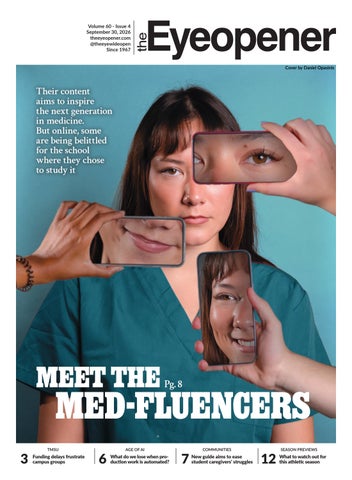
Students in the School of Medicine have amassed thousands of followers documenting their education for social media. In doing so, they've also joined a larger mission: proving the new school stacks up against the competition. Features editor Daniyah Yaqoob speaks with TMU's emerging med-fluencers
Roselaide Decker says some classmates act as her content "helpers."
BRING ON THE MED-FLUENCERS IT WAS A WARM DAY IN MAY 2025
when the School of Medicine sent admission offers to students who would make the inaugural MD cohort. Zaynashae Boreland was one of the applicants awaiting an offer. She refreshed her MyServiceHub portal at 9 a.m. with an anxious breath. Having become a registered nurse (RN) years prior, she set her sights on medical school. And Toronto Metropolitan University (TMU), which was close to home and had a mission she says aligned with her own, seemed like the perfect choice. When a notification pinged in her inbox, she set up her phone camera against her laptop, three lenses looking her in the eye, to capture her reaction. She clicked the notification open. “There it is. Official. Been placed on the waitlist,” she said to the camera, a hand over her mouth to restrain the soul-crushing disappointment. Another realization sent her reeling right after: she would have to update her followers. Since 2022, Boreland has run a side gig as a content creator. On her Instagram @medwithzayna, she's built a following of just under a thousand, posting about her life as an RN. Since she posted online that she had applied for TMU’s medical school, her followers were waiting for an update. By the evening of May 13, decision day for many Canadian medical schools, she posted her reaction video and switched her notifications off for a week after to avoid seeing any of the responses. She wouldn’t find out until later how supportive her community had been despite the apparent defeat; they told her they found comfort in her candid reveal, and to know they were not alone in the waitlist process. Then, two weeks later, she got a call informing her she’d been moved off the waitlist and secured a spot in the program. The very first thing she did was lift up her camera again to share the news with her followers. “If I could take the call on a different
phone, or whatever, I would have because I would have set up that camera and been ready to film,” Boreland says. Her followers were overjoyed for her. She says the relationship between them is what keeps the cogs in her brain spinning, trying to determine what to bring to her audience next. Although TMU’s medical school is only now in its second year, Boreland is one of many content creators—or “med-fluencers”— who have popped up on the new campus. “Med-fluencer” is an emerging term describing those in medicine who dabble in content creation, filming informative videos, vlogs or skits. On the more famous side of the spectrum are people like Dr. Mike, Dr. Glaucomflecken, “Foot Doc Dana,” of the United States, Sabrina Yang in Canada and more who have accumulated massive followings by standing in front of their cameras in a pair of scrubs. At TMU, there are a handful of emerging content creators who do everything from motivational content, to application guides, giveaways, sponsorships and day-in-the-life vlogs. While some other medical students poke fun at the number of them on the Brampton campus, these med-fluencers see their mission as more than making informal vlogs or filming trends. Their content, they hope, can validate a school that has been heavily criticized online and in the media by providing a look from the inside. The Ontario government gave TMU the okay to open a new medical school in 2022. And from the beginning, the stated mission of the school was to serve those communities in the Greater Toronto Area who have been historically underserved. As the only medical school currently in the Peel Region, it would also work to solve the significant shortage the region faces in quality health care, according to officials. However, the school’s efforts were met with backlash for all kinds of reasons. When the school had announced in 2024
Zaynashae Boreland started creating content as a nurse. that it would not require the Medical College Admission Test (MCAT), a common test required by medical schools across Canada and the U.S., and would admit students with the lower-than-average minimum GPA of 3.3, it was received with hesitancy, including from some students The Eyeopener spoke to at the time. Others lambasted the school for its heavy emphasis on diversity, equity and inclusion (DEI) in its admissions process—writers for the National Post even opined when the inaugural class started in September 2025, “We want more doctors. TMU's DEI med
"I'm not doing it to be famous or anything like that. I see a lot of work that I want to do."
school isn’t the way.” “Admissions should be based on merit and aptitude, not politics; otherwise, we risk having future physicians who are less qualified to meet patients’ needs,” authors Matt Spoke and Ariella Kimmel argued, perhaps oversimplifying TMU’s requirements for its students. The school’s DEI mandate also found its way into local headlines. TMU responded to the debate around reserving 75 per cent of seats for “equity-deserving admission pathways” by removing what President Mohamed Lachemi called “aspirational” language from the website. It was reported by the National Post that Premier Doug Ford’s office had even spoken to the school about the equity admissions. But nevertheless, the school says that DEI will be “intentionally infused throughout all facets” of the program, according to the university’s website—but the fury of the original debate still affects how seriously some took the medical school on social media. Threads upon threads on Reddit discuss the merit of the school, and some even advise that TMU should be applicants’ “last choice.” Part of the flack the school has received online has been for the supposed influencer culture it has cultivated. On Reddit, one comment even suggested the “M” in TMU stands for med-fluencing.
NOW IN HER SECOND YEAR AS A
medical student, Boreland is in classes on Monday, Wednesday, Thursday and for a halfday on Friday. Every other Tuesday, she’s in clinical placements, where students are immersed in hospital and community experiences in the Peel Region. Still, every day, she finds the time to make at least one or two posts. The majority of Boreland’s content is spontaneous. “I don't plan it out,” she says. And yet, it resonates with her followers. Boreland is now at just over 10,000 followers on Instagram, and just under that on TikTok, a milestone she hopes to reach soon and plans to celebrate with a giveaway. Boreland says filming is now second nature to her, four years into her content creation journey; every vlog she films begins with a shot of her pulling her bag out of her car, and in every class, her peers have
URES
THE EYEOPENER WEDNESDAY, SEPTEMBER 30, 2026
|9
PHOTO ILLUSTRATIONS BY DANIEL OPASINIS/THE EYEOPENER
One online commenter even suggested the “M” in TMU stands for med-fluencing.
become used to her phone resting against her laptop, the back camera facing Boreland to capture her studiously nodding along in a lecture. After a stacked day on campus, Boreland will come home and begin to edit the day’s footage; a self-described “talker,” the voiceovers come naturally. And having done so much editing by this point, it now only takes her half an hour to get the video up on the internet. The footage she doesn’t use ends up recycled in other posts. For Andrew Faller-Saunders, a first-year medical student, keeping up between school and content can be intense—they’re in class four out of five days a school week. Shortly after he was accepted into the school, he started an account on Instagram called @andrew.in.med, a public journal to document his experiences. His first post went up on Sept. 7, an introduction to himself and what he hoped the account would become. “I wanted to make this space to share a bit of my journey through medical school, but also the things that brought me here and continue to shape how I think about medicine: public health, mental health, substance use, disability justice, health equity, community, research and advocacy,” a caption under his headshot read. But then, it was three weeks of silence on his profile. The thought kept gnawing at him: I made that first post, now I need to follow up. But medical school is intense, and on top of the two Toronto hospital jobs he works as an evaluator and caregiver, his content schedule does fall behind. The stethoscope ceremony two weeks ago and orientation week activities, still haven’t received their spot on his Instagram grid; for now, they sit in a folder with other posts he’s still hacking away at. He still plans to continue the content whenever time permits; to an extent, caregiving and cultivating a community online go hand-in-hand for Faller-Saunders. “I definitely have felt that overwhelming feeling, already,” he says with a laugh. “It’s only the beginning, [hopefully] the more you get used to it, the easier it’ll get.” Roselaide Decker hopes that’s the case, too. As an undergraduate student, she watched other people’s content about medical school which motivated her along the application process. This summer, when she got in, the now-first-year medical student made her own account: @roses.are.med. It was inspired by a suggestion she’d heard another person give to incoming students: to create a page dedicated to documenting the medical journey and where they could network within the industry. And so after testing
the waters with a carousel post of the medical school’s open house on her personal Instagram, which received a “huge” positive response, she took the big step of making it her first public post under her new online persona. “Love love loveeee the username,” a fellow TMU medical student, and influencer, @medwithanam, commented underneath. In the three months she’s been posting, she’s accumulated just under 200 followers on Instagram, and over 30 people have reached out to her for support in their own medical school journeys—a full circle moment after she spent years knocking on others’ doors. “That’s been a great part that I didn't really expect. There's a lot of prospective applicants and undergrads who express the same fears I had. To get messages from them has been like, ‘oh, wow, I know exactly how you're feeling. Here's all the resources that I have,’” she says. It’s not just in the virtual world that her profile has helped her connect; even within the medical school, Decker said people are beginning to recognize her. They stop her in the halls and ask her when her next post is coming out. When they see her bring up her phone, they quickly organize the space they’re working in so she has the best shot. “I have helpers,” Decker says with a smile. She’s now even running for vice president of communications on the TMU Medical Student Council, and for her campaign videos, her classmates are pitching in, in front of and behind the camera. Boreland also has her own fanbase at the institution. Faller-Saunders says he watched her vlogs to get an idea of the space and tips videos during his own application process; her presence and advice on a free social media platform made the process feel more accessible to him. Even the dean of the medical school, Dr. Teresa Chan, knew who Boreland was. When they met in June, Chan had advised Boreland to expand to YouTube so she can “really grow” and build a following. Chan told The Eyeopener in an email that content creation is a way to combat health misinformation. For Faller-Saunders, who grew up in poverty and has seen the devastating consequences of the health care system’s failures up-close, including when he lost his mother to suicide, the goal with his social media presence is to advocate: for Palestinians suffering a medical crisis, for his father, who lives with a disability and wants to share his story with the world but does not have the platform to do so and for those he believes the health care system fails in various ways.
“I'm not doing it to be famous or anything like that,” he says. “I see a lot of the work that I want to do in that space where it's being vulnerable, trying to make spaces for things that aren't talked about as much.” In that way, Faller-Saunders' goals as a content creator align with his goals as a future physician: to create a safe space in the world for the people searching every corner for support. As noble as medicine is, his content creation is for a purpose he believes is noble too—so anyone who takes that work unseriously becomes noise in the distant background. Even the guest speakers at the medical school have touched on the power of social media in their profession. Decker says one speaker brought up the value of knowing how to communicate with people in simple terms, which some medical professionals who make content for the average audience have mastered. Others still have reminded students to be wary of what they post online as medical students and to consider the way they represent the school when they go about filming their day. “I think there's the tendency towards virality and things like that. But I have to remind myself that I'm a medical student. There's a responsibility that comes with that and I want to be able to maintain that,” Decker says. It's a responsibility the others take seriously, too.
IT'S OBVIOUS ON SOCIAL MEDIA:
any good also comes with the bad. While Instagram and TikTok have been effective places for med-fluencers to create communities bent on solving the world’s health care problems, there is also a share of hate comments. Boreland and Decker are both Black women in medicine. While their public platforms have allowed them to connect with other Black students applying for medical school, on the more rare side, they have received demeaning comments on account of their identity. “There have been backhanded comments about TMU as a school and me being able to go there, talking about the demographics of the class,” Decker says, referencing the DEI backlash. Under a video of her transition from being a registered nurse to medical school,
one that received significant attention, Boreland also spotted comments from people who didn’t think she deserved to be in medical school. “The whole point, for me, at least, is to share my story as a Black Jamaican whose family immigrated here however many years ago, to show that this is possible for us,” Boreland says. For both women, it was a matter of deleting the comments as soon as they came in so they didn’t have the chance to oxygenate and grow. “Luckily I’m the owner of the platform, so it’s very easy to control,” Decker says. She says the pushback actually pushes her to keep going, reframing the narrative around the medical school that spreads online. For its part, the university itself has been active on social media, pushing word of the medical school, and the stories of its students, out into the world. “I think TMU has done a really good job at being very present on social media. Because it's a new school, it's hard to advocate for its right to even be here,” FallerSaunders says. There was a point in his life when he thought medicine would not be an option for him; it felt out of reach because of a number of systemic barriers. But when TMU launched its school, and its mandate had an eye on “not just individual health, but communities and system change,” it was the first time he felt like he belonged. His second-ever post was specifically to appreciate the school for featuring his story on their socials. While he hasn’t figured out what exactly his content will look like in the future— that’s something he wants to ask his followers for input on—one thing is for certain: he, Boreland and Decker all plan to reaffirm to the world, and their thousands of followers combined, that their medical training is based on merit. Where they go to school has no bearing on their talent, or their passion to fill a health care gap and accessibility problem the country is struggling with. And so when they whip out their DJIs and their phones, whether intentionally or not, TMU’s med-fluencers are now playing a role in validating the school as an institution capable of medical training by providing an inside look—because what do the haters really know?
Advocacy is a tenant of Andrew Faller-Saunders' online presence as a med student.
10 |
THE EYEOPENER WEDNESDAY, SEPTEMBER 30, 2026
your friendly neighbourhood bookstore
your friendly f iendly neighbourhood fr neig i hbourhood bookstore ig
your next great read awaits...
your next nex e t great read awaits... ex awaits t ... ts
benmcnallybooks benmcnallyb benmcnallybooks y ooks yb 108 Queen 108 Queen St. St. EE (at (at Jarv Jarvis) Jarvis) rvi rv vis) The Eye is looking for new student members of our Board of Directors
Are you a student in one of the following faculties?
• The Creative School • The Faculty of Engineering and Architectural Science • The Faculty of Arts • The Faculty of Community Services
Do you want experience serving on an administrative board? Email generalmanager@theeyeopener.com to get involved.
Arts & Culture | 11
THE EYEOPENER WEDNESDAY, SEPTEMBER 30 2026
Summer may be over, but Quincy Isaiah's latest album is about to drop The fourth-year TMU student's latest album, Summer’s Over, comes out Oct. 1 Jake Ross CONTRIBUTING REPORTER
Studying by day, making music by night? It may be a hard tune to balance, but for Quincy Isaiah, a musician—and a fourth-year Toronto Metropolitan University student in the graphic communications management program, it’s a regular weekday. Isaiah says he manages it by balancing his school schedule with music-making time. He has classes three days a week, then practices and records on the other two. "I usually just go to school till five and then go to the studio, or rehearsals," he said. "It's nice because like a lot of my friends at school know about my music, so I go to school and get to talk about ideas with them in between classes." The past couple weeks have been particularly busy for Isaiah. He has a new album dropping titled Summer’s Over and a gig at Toronto's Adelaide Hall coming up to celebrate it. “Honestly, I kind of just work on the stuff during class and then do my homework at four a.m. or something,” he said. Born in Burlington, Ont., Isaiah started singing covers in Grade 3. “I just started memorizing songs and performing them for my family and stuff,” he said. When he got to Grade 6, he joined his school’s glee club, which allowed him to perform in front of
larger audiences, including singing the national anthem at events. At 14, through a scholarship from the glee club, Isaiah got the chance of a lifetime and went to Los Angeles to attend a summer camp at a conservatory. There, he learned from professionals and record in a real studio. When he returned, he saved up money and bought the equipment needed to build a home studio.
“I was listening to basically whatever was around me on the radio" Growing up, Isaiah listened to a variety of genres, listing the likes of Adele, Bruno Mars, Coldplay, Maroon 5 as his early creative influences. “I was listening to basically whatever was around me on the radio and in my house,” he said. “That's when I really started getting into music, like seeing their performances and dancing and stuff.” As he got older, he started getting more into R&B and hip-hop, listening to J. Cole, Bryson Tiller and Brent Faiyaz—and of course, Toronto’s homegrown talent like Drake and The Weeknd. Isaiah started seriously recording music in high school, releasing some of the tracks on YouTube and Spotify. He got approached by producer Lincoln Blaché and
IMAGE SUPPLIED BY QUINCY ISAIAH. COMPOSITION BY PIERRE-PHILIPE WANYA-TAMBWE/THE EYEOPENER was signed to his production company, Maison Blaché. For his first few songs, he would record in his bedroom and friends’ basements before taking the tracks to get mixed in the studio. His previous album, The Freshman, came out in June. He said it’s meant to capture a transitional period in life, moving from childhood to adulthood. “For that album, it was more so just growing up, and I felt like the freshman, that whole idea and concept really captured the idea of it,” he said. "It was a collection of four years of music just put into one." Isaiah describes his newest album, Summer’s Over, as a continuation of his musical growth. It’s about his experiences spending a summer living in Toronto and his musical progression. He adds that it’s more intentional than his first album. “I just switched it up completely with this project,” he said. In contrast to the often
light, playful energy of The Freshman, Isaiah said Summer's Over feels more mature, with a darker R&B vibe. The six-track album moves between atmospheric melodies and driving, rhythmic vocals, with introspective lyrics to match.
“I just switched it up completely with this project” For other aspiring young musicians, Isaiah said “they should meet as many industry people as they can, post as much as you can and share your music widely.” He advised aspiring musicians to study artists they wish to emulate and encouraged them to, “be intentional with how you want to do it, and study what you want to be like." Summer’s Over will be released on Oct. 1 and can be found on all major streaming platforms.
Students' top cheap eats around campus
Students share their go-to spots for grabbing a bite without breaking the bank Hannah Thompson CONTRIBUTING REPORTER
Between tuition, textbooks and everyday expenses, finding an affordable meal near campus can be difficult. Whether you have 20 minutes between classes or need a quick dinner before studying, here are four spots Toronto Met sudents recommend. YONGE STREET WAREHOUSE Second-year sport media student MarieGiselle Passero’s go-to is Warehouse at 336 Yonge St.—especially on Mondays. “It might be pretty basic, but I say Warehouse,” Passero said. Her picks include the loaded fries, which are currently $7.75 and fingers and fries for $10.95. Warehouse’s current menu also lists a number of other meals for under $13. HERO DUMPLING Also recommended by Passero: Hero Dump-
ling at 437 Yonge St., just north of campus. The restaurant’s current menu lists six steamed pork and cabbage dumplings for $3.99, six soup dumplings for $4.99 and 10 pan-fried pork and cabbage dumplings for $6.99. “They have, like, really great deals that you can grab from,” Passero said. H-MART First-year early childhood studies student Marlie Aguinaldo said H-Mart, a grocer located across from the Student Learning Centre, has recently become one of her favourite places to grab lunch. “It’s really good, and there’s so many different things to try,” Aguinaldo said. For a quick meal between classes, Aguinaldo said she recently picked up spicy chicken and rice from the hot table. “It was so freaking good. I’m gonna go get it again,” she said. For Aguinaldo, having affordable food close to campus is especially important
RACHEL CHENG/THE EYEOPENER when students are balancing school with other expenses. “We work really hard already, and our body needs to be fuelled throughout the day,” she said. “It’s really important to have just a quick, easy, cheap meal to get us through the day.” CHIPOTLE Second-year business management student Michael Barry said Chipotle is one of his favourite options, especially when he wants to customize his order.
“My favourite cheap eat around campus is Chipotle, especially with the build your own [tacos] hack,” Barry said. Chipotle’s Yonge Street location at 323 Yonge St. can be expensive, but Barry said he likes getting kids tacos with 3 sides for about $8. With tuition, textbooks and living expenses already adding up, Barry said affordable food is important for students. “There’s so many options for accessible, affordable meals,” he said, also pointing to the TMU Good Food Centre as another option for students when cooking meals at home.
Sports
Catch up with post-game recaps at theeyeopener.com/sports
THE EYEOPENER WEDNESDAY, SEPTEMBER 30, 2026 theeyeopener.com/sports
What to watch out for this athletic season
Six storylines to follow as the Bold return to action for the 2026-27 season Kyla Pugen contributing reporter
As another athletic year kicks off, many of the Toronto Metropolitan University (TMU) varsity programs have begun their preseason campaigns. Each program faces a unique test this year, from defending Ontario University Athletics (OUA) titles to clinching playoff hopes, the men’s and women’s basketball, hockey and volleyball programs look to etch a positive mark on another year. Before the banners are raised and the standings take form, here is The Eyeopener’s ultimate Bold season preview for the 2026-27 season. Women's Basketball: Bearing the target Returning to the court as defending OUA champions, the TMU Bold women’s basketball team enters the season well aware of the expectations held to their name.
Men's Basketball: Entering the post-Rhooms era While the women’s program relies on stability, the Bold men’s basketball team enters the season at a pivotal crossroads: life after Aaron Rhooms. Following a legendary career where the program icon picked up U SPORTS Player of the Year honours and led the Bold to a Wilson Cup championship, TMU officially steps into the post-Rhooms era for the first time in five seasons. With heavy roster turnover, the burden of continuity falls on returning core veteran pieces like third-year guard Kevin Toth. “I’m really just trying to mentor and just be as vocal as I can,” Toth said. “And help introduce them to what the standard is here at TMU.” Toth also emphasized that maintaining TMU’s championship pedigree will require early chemistry: “We just gotta be connected… Last year, our locker room and chemistry was pretty unmatched…
RACHEL CHENG/THE EYEOPENER due to injuries and illness to multiple players. With the second month of classes, a road trip out east, and the start of the regular season coming up, it was in the best interest of the team to take this weekend off.” Posting a 6-20-0 record last year, the Bold will look to improve their consistency, as well as acclimatize six new rookies to the lineup, some of whom have already stood out in preseason. If TMU can establish game-togame stability, that identity will be the push they need to punch a ticket back into the McCaw Cup playoff picture. Men's Hockey: Going for gold
PIERRE-PHILIPE WANYA-TAMBWE/THE EYEOPENER According to second-year guard Ella McDonald, holding onto that title means preserving the core strategies that interim head coach Stefanija Mrvaljevic hopes to carry on from her predecessor Carly Clarke. This includes themes of identity, perseverance and trust. “Going into this season, we’re gonna have every team on our backs, every team is going to want to be us this year,” McDonald said. “It’s just about keeping our core identity, knowing who we are as players and how we get together and how we play together.” After capturing the Critelli Cup last year, the team faced an unfortunate finish in Québec, ending sixth in U Sports rankings. Returning to 2026-27 with a close-knit core, the roster hopes to weather the adversity ahead to return to the OUA final. “In the hard times, we have to figure out ways to bring each other up and celebrate,” McDonald noted. “There’s going to be a lot of ups and downs this season… so sticking together is the main thing.”
The biggest part is to make sure we can get there with this group.” Without Rhooms attracting the opposing defence's focus, TMU will rely on a collective effort to distribute the scoring. “You can’t replace him because he’s one of one,” Toth acknowledged. “It’s just gaps and pieces that need to be filled… it’s going to be a different team, and we’re excited to see how it looks.” Women's Hockey: Looking for their x-factor For the Bold women’s hockey team, the path to a postseason return begins with a sustainable preseason regiment. To prioritize player health, TMU cancelled its third exhibition fixture, originally scheduled for Sept. 26 against the Nipissing University Lakers. In a written statement to The Eye, TMU Athletics digital marketing and communications administrator Kristian Cuaresma said, “TMU cancelled the game
Since the heartbreaking overtime loss to the Queen’s University Gaels in last year’s OUA bronze medal game, the Bold men’s hockey team has been operating with a singular focus: playoff redemption. Despite actively being in a rebuild with a large number of first and second-year players, the program hopes to build consistency starting with their early-season mindset. “I think that we’re just a really mature group. We’re a smart group. We’re very well coached and managed,” said first-year defenceman Carson Lloyd. “Where we’re going to outperform other teams is in our ability to play the game together… in our work ethic and our dedication to playing it the right way.” The program’s success will be judged on small and key decisive moments, such as the incredible persistence shown in the 6-5 homecoming victory against Queen’s on Sept. 18, and navigating elimination scenarios. “We take pride in making sure we’re doing our best every day,” Lloyd said. “Because at the end of the year, it’s the little tiny things that matter.” Driven by last year’s heartbreaking finish, this group isn’t satisfied with just another post-
season appearance. Rather, they are determined to complete their push for a championship. “I don’t think anyone’s going to be happy with a silver medal,” Lloyd said. “We all believe we have a national championshipquality team and that’s the goal.” Women's Volleyball: Trusting the process For the Bold women’s volleyball team, the young squad is motivated after narrowly missing the OUA playoffs last year. That finish provided an opportunity for the team to regroup and measure their success beyond just their season record. “The only urgency that our team feels right now is the urgency for them to bring their best selves to practice everyday,” acting head coach Julie Gordon noted. “We’re trying to place more value on the practices and how we’re developing in each and every practice and how we’re improving week to week rather than the scoreboard.” In their first preseason match against the three-time Ontario College Athletic Association East Division champions, the Seneca Polytechnic Sting, the program channeled their energy into a thrilling five-set battle. Though they were unable to hold off the Sting’s offence, the Bold’s growth in resetting during
points has shown their ability to fill in last season’s gaps. The team’s fight against Seneca provides an optimistic glimpse of progression ahead of the regular season. “I would say our ability to play out of system [will be our defining trait],” said Gordon. “We’ve put a large emphasis on out-of-system attacking and out-of-system setting, and the understanding of risk management when in those scenarios.” Grounded in small continuous developments and a supportive team chemistry, the team aims to pick up right where they left off in February. Men's Volleyball: Finding a collective rhythm The Bold men’s volleyball enters the year trying to discover how fast they can find their team synergy. Much of the group’s potential depends on the continued growth of a stellar second-year class. Last year, libero Ethan Lau, outside hitter William Gimbert, and right side Ross Buchanan provided remarkable offensive firepower and quality, all earning spots on the OUA’s All-Rookie Team. Though the team posted a 5-15 record last season, if this talented young core can guide the squad as a unit, TMU could show promise to qualify for playoffs.
PIERRE-PHILIPE WANYA-TAMBWE/THE EYEOPENER
Sports | 13
THE EYEOPENER WEDNESDAY, SEPTEMBER 30, 2026
Sarah Jenkins returns to TMU as sport media instructor
After her Olympics coverage, the sport media graduate returns to pass on her industry knowledge Ariyana Richardson contributing reporter
As Sarah Jenkins set foot back on the Toronto Metropolitan University (TMU) campus, the surreality of the moment was not lost on her. Once a student in the university's inaugural sport media class, which graduated in 2018, she is now returning eight years later as an instructor for RTA 992: Social and Interactive Media for Sports. Since graduation, Jenkins has actively continued a career that has taken her through sports broadcasting, content creation and social media consulting for athletes of all levels. “It's crazy to be back and now be the one instructing because… some part of me feels like I'm still a student,” said Jenkins. Karen Sebesta, a former executive producer for CBC and a senior producer for the Olympics, helped develop the sport media program and taught Jenkins in the first Creative Processes class. “She was always very engaged and excited,” Sebesta said. When she asked the class about their favourite sports, Jenkins spoke about freestyle skiing, amateur and Olympic sports. “Right away she stood out, because that is what I do,” Sebesta said. As Jenkins progressed through the program, her connection
with Sebesta became significant to her development. “I can't speak enough about the impact of having a woman who got to the level of executive producer in sports in this country as my first instructor and mentor in this world, which was so important and so valuable for me,” Jenkins said. “She had to come up in a much different era than I did, and I'm so grateful that I had her in my corner. She gave me my first job at CBC. She got my foot in the door there, and I will always be eternally grateful for that.” Jenkins was among the first sport media students recommended for Olympic coverage, with members of the inaugural cohort working at the 2016 Rio Olympics and the 2018 Pyeongchang Olympics before they had even finished the program. While working the Olympics, Jenkins found herself in the control room during Tessa Virtue and Scott Moir's iconic “Moulin Rouge” figure skating performance. “The director just turned around and yelled, ‘Jenkins, get me the math on that score.’ I was like, I'm a creative person, not [a] math [person],” Jenkins said. “I've never been more nervous in my life,” she recalled. “We're in this room controlling all of the screens for what is such an iconic moment which every-
PIERRE-PHILIPE WANYA-TAMBWE/THE EYEOPENER one else in Canada’s watching.” After graduation, Jenkins' career has been about adaptation and versatility. “I knew that things were changing and I always really focused on digital content and YouTube content and all of that,” said Jenkins. “I got so well-rounded, and it proved to me that my career doesn't have to be one thing.” When the COVID-19 pandemic hit, Jenkins seized an opportunity to learn a new skill: content creation, which has opened doors to
consulting for professional athletes. While building her career, Jenkins always knew she wanted to teach at some point, following in the footsteps of her parents who taught post-secondary courses. With her experience in founding her own content production company in 2024, Sarah Jenkins Media, she was the perfect fit for the Social and Interactive Media for Sports elective. The course had been dormant for a few years and needed someone actively working in the indus-
try to bring it back to life. But Jenkins said the transition to instructor was not without first-day jitters. “I was pretty nervous, especially the first class…I'm sure students are nervous, you still want the students to connect with you and feel like they're getting value out of what you're bringing,” Jenkins said. But after the first class, her years of experience and familiarity with the coursework silenced her nerves. Read more at theeyeopener.com
TMU defeat Redbirds 4-3 in overtime as preseason starts to close up
Ianniello delivers dagger to seal victory Ariyana Richardson contributing writer
The Toronto Metropolitan University (TMU) Bold men’s hockey team jumped back into form following a 4-3 overtime win over the McGill Redbirds at the Mattamy Athletic Centre (MAC) on Sept. 26. The Bold entered the game less than 24 hours after their first preseason loss. Despite the quick turnaround, TMU came out with offensive pressure before McGill matched their pace in a stagnant back-and-forth opening period. “If we are going to get where we want to go in the end, these are going to be the quick turnarounds, the experiences they’ll learn from” said head coach Johnny Duco. McGill opened the scoring 10 minutes into the period, with first-year forward Justin Boisselle bringing speed and power to the
Redbirds’ attack. However, TMU quickly responded with an offensive push led by second-year forward Marko Djordjevic. McGill sustained the pressure, scoring a second goal to tip the game 2-1, and start the scoring frenzy. Djordjevic stepped up again for the Bold, scoring twice and picking up an assist to give TMU the 3-2 lead. Alongside fellow second-year forwards Ryan Cooper and Carter Streek, Djordjevic repeatedly created opportunities throughout the game for goals, tallying himself with three points off TMU’s three goals so far. “We’re a very fast line,” Djordjevic said. “I’m gonna do everything I can to help the team as like a second-year guy and leader.” Duco saw that chemistry as well. “They flew, they were the fastest line on the ice,” Duco said.
OLIVER ULSTER/THE EYEOPENER “They created a lot for us.” Although McGill held a 12-11 edge in shots during the first period, TMU eventually caught up to the Québec-side, outshooting the Redbirds by a larger 25-16 gap in the second. While the Bold continued to find ways to score, their defense structure struggled with the absence of fifth-year forward Connor Bowie and first-year defenseman Carson Lloyd. These minor defensive miscommunications took their toll, as McGill capitalized on a short-handed goal in the
third period. Tying the score and sending it to overtime, the game began to mirror Friday’s game against MacEwan. For a young team still developing its identity, Duco believes mistakes are part of the process. “We got a lot of new players coming in,” he said. “It’s not a straight line to success. It’s gonna take some time.” Even with the late drama, TMU was able to persevere on home ice, as a McGill overtime penalty proved costly, and third-year defenceman Joseph Ianniello shot in the dagger to sink the Redbirds in a 4-3 Bold win.
With one preseason game remaining against the University of Toronto Varsity Blues on Sept. 30, the Bold have some time to breathe and one more opportunity to build on Saturday’s win before the regular season begins. “The goal remains the same, we want to be a top team and we want to compete for a championship,” Duco said. UP NEXT: The Bold face the University of Toronto on Sept. 30 in their final preseason game at the MAC. Puck-drop is set for 6 p.m.
14 | This oughta make you laugh
THE EYEOPENER WEDNESDAY, SEPTEMBER 30, 2026
Next week: Some more bullshit.
Cyber science students 'very close' to figuring out how to use TMU Authenticator Sy Burr SCIENCE
Disclaimer: Yes, there actually is a new cyber science program at TMU but no, even they can’t figure out the elusive concept of two-factor authentication. Following the introduction of the new cyber science BSc program at Toronto Metropolitan University (TMU), students and faculty of the program set their sights on figuring out the largest source of cyber security confusion at TMU: two-factor authentication (2FA). Since its introduction at TMU in 2019, 2FA has plagued every staff member uploading slides at the last minute and every student trying to quickly check their exam grade on their phone at a family dinner during the holidays. Dean of cyber science at TMU, Liam Keyboard, said he believes the program was a necessary addition to the school, even if it sounds like what a four-eyed computer nerd studies in an 80s movie. “I came up with the idea for the program when I was tired
and cold. I sort of sighed and was shivering when I utilized the onomatopoeia meant to represent the sound of breathing while shivering, also known as ‘brr.’ So it was a sigh and then a brr, and thus cyber [science] was born!” said Keyboard. Though he may believe this to be true, many students of the new program believe its origin came from the actual concepts the program teaches. “Wouldn’t the idea for the cyber acience program come from the concept cyber science? I think Dr. Keyboard is a little too ‘deep in the research’ as we cyber scientists say—you wouldn’t get it,” said first-year cyber acience student Keisha Hax, as she hacked into the mainframe. Regardless of its original origin, as it stands, the program has shifted its entire focus and all of its resources on figuring out 2FA and possibly how to put an end to its confusion for good. “We have every single oversized loud computer and whirring data machine working overtime on cracking these elusive six
First Year Advice: I missed one class. Am I going to fail? Isha Rizwan MAKING UP UTTER NONSENSE
Disclaimer: While most things posted to Reddit are probably made up for attention, this interaction actually is, so don’t think about it too hard. This interaction was originally posted on r/TorontoMetU, if you don’t know what that is you should try chudding it up. Q: I need some advice. I am a new student at Toronto Metropolitan University (TMU) and I believe I have just made the largest mistake one can make in their postsecondary academic career. I was out late on Friday night, dressed as a banana and trying to combine every kind of substance in my stomach without resulting in a medical emergency, just trying to get the full university experience I had grown up seeing in movies. As a result of my excessive consumption, I ended up sleeping through the entirety of Saturday, Sunday and the majority of Monday only to awake at 3:42 p.m., having just narrowly missed my 8 a.m. class. Not only is this the first class I have EVER missed in my life, I believe this singular action will set off a chain of events that will result in
me becoming someone on TikTok who begs for roses and bounces up and down for $0.17 donations. Is my life over? A: As someone who has been doing this for years now, I will give you one piece of advice: you are doomed. Your worst fears aren’t even the tip of the proverbial iceberg. And as someone who doesn’t know what proverbial means, you need to trust what I’m about to say. It starts with missing the first class, then the second, then the third, then you’re smoking a little pot here and there because you like how it makes you feel, then it's cocaine and then you blink and you’re a backup dancer for an Imagine Dragons cover band that tours small towns in Saskatchewan and every night you look at pictures of AI puppies on Google Giggles just to feel something. You stare at the stars at night, thinking about where it all went wrong and you pinpoint it back to one singular moment… the sweet shot of dopamine you got from skipping that first class. So my advice, next time you want to miss class, do what any sane person would, call the building your class is in and report a gas leak. I hope this helps xx.
PIERRE-PHILIPE WANYA-TAMBWE/THE EYEOPENER number codes,” said Keyboard. First-year student Whirr Burr (no relation) believes that, while the steps taken to fully understand the complicated system of 2FA may be complex, as a whole, the method of completion is not as hard as it seems. “It's a fairly simple process. We
take the mainframe of the coagulated bicentennial overdraft loop and connect that to the ransomware phishing encryption key to override the compressor that bypasses flux capacitation on a cryptographical scale never before seen in the cyber world. From there it's a simple DDoS attack
Waiting in line for the "wait in line" pop-up
sequence that will create an asymmetric key capable of beaconing browser-based exploitation with the goal of exfiltrating that end-to-end encryption. It’s not rocket science, it's cyber science,” said Burr, as he input the final keystroke logger into the malware node.
MYRTLE MANICAD
Goofs, Games & Giveaway | 15
THE EYEOPENER WEDNESDAY, SEPTEMBER 30, 2026
2026 TV GUIDE
What to watch while you watch Instagram reels...
The Eyeopener is giving away two $25 gift cards to Subway! Find the giveaway rules through the link in our Instagram bio.
Widow's Bay (Apple TV+) PLEASE WATCH THIS SO I HAVE SOMEONE TO TALK ABOUT IT WITH PLEASE WATCH THIS SO I HAVE SOMEONE TO TALK ABOUT IT WITH PLEASE WATCH THIS SO I HAVE SOMEONE TO TALK A-
1. Complete the crossword! Only 100 per cent correct crosswords will be accepted. 2. Complete the Google Form via the QR code on the page and add a photo of your completed crossword! 3. Await an email! The form will close end-of-day on Oct. 5 and winners will be contacted shortly afterwards and asked to come into our office for photos!
Adults (FX)
ACROSS 1. imaging test typically used to monitor pregnancy 7. drug that induces loss of sensation in a specific area of the body 8. how the body turns food and drink into energy 9. doctors who specialize in caring for kids of all ages 11. substances that aid in loosening the bowels and encourages defecation
Submit Completed Crossword Here
Letter to the Fun & Satire Editor: "I ate the Purina Fancy Feast®" Dear Mr. liar liar pants on fire, I consider myself a free thinker. An Auteur of independent speech and thought. Naturally, the study of astrology attracts me like that sweet, light nectar of beer. So last week when I read the horoscopes section I was delighted, intrigued and titillated. And boy, was it ever my week. Cat food. Purina Cat food. Purina Fancy Feast® Paté Wet Cat Food Variety Pack. My mouth is still watering at the thought alone. To be on the level of a cat, agile, on the hunt, fluffy, is equivalent to the status of a king. Yet, I regretfully come to you in a seething rage with no one to blame but you, naturally, as nothing is ever my free-thinking fault. I ate your cat food, but not because you told me to but rather as my own choice. And now I am deathly ill. This needs to be clear. My tummy is a-rumbling, I’m a big fat little boy, maybe I've even been bad, a bad little boy who needs to be punished. Nonetheless, you sir, are going to suffer the consequences. You will be facing the full breadth of my crack team of cokedout 80s Wall Street lawyers. Meow meow, motherfucker.
DOWN 2. primary male sex hormone 3. fluid that protects a fetus during pregnancy 4. doctor who specializes in female reproductive health 5. location of TMU's medical school, nicknamed flower city 6. the immune system's response to injury or infection 10. of, relating to, affecting, or including both the stomach and intestine
Ice Cream Word Search
C D
Medium
I
N
J
V K V V H Q G D B
O O G
S
T
R
C
A W B
E
R
R
Y
R
VANILLA CHOCOLATE STRAWBERRY
J
F
U N N O G N A M H U O
O M
I
F
I
G
P W T M Q X U W
N G Z
L
E
T
A
U M L
V
J
E
Z
O C O H C N MANGO T B L Y R T I PISTACHIO
T
P
I
S
T
A C H
I
O
E
E
COCONUT
U A N A N A
B
C
I
R
E
S
BANANA
A A
L
L
A
COFFEE
Paul Baker I need you come to Toronto and utilize every part of my body.
The Adventures of Brisco County, Jr. They sure don't make 'em like this anymore I'll tell you that much. This was the kind of show you could put on and really take your pants off to. A real show for real people. The kind of show you'd start watching after a long day of work and before you knew it, Brisco and his band of befuddling buddies would be in the midst of all kinds of hilarious hijinks. Like Brisco always says, "Brisco County is my father, please call me Brisco County Jr."
BROWNIE
Ted Lasso (Apple TV+) Ted and friends are back, this time coaching an all-women's team as they face the greatest threat to women's professional sports: Sydney Sweeney. Fun & Satire corrections for Sept. 23, 2026
Page 15: - Advertisement was spelled incorrectly in the correction for the week of Sept. 16th's spelling of advertisement, spelled as "advertisment." - I made everything up. You know, like a liar.
New to Uber Eats? $20 off your first 2 orders
Promo code: EATSUNI2026 You must enter the promo code in the “Promotions” section of your account to get $20 off your first 2 orders with participating restaurants. First time users only. Offer must be redeemed within fourteen (14) days of being added to the account. Promo code only valid for those who received it directly from Uber. Promotion expires on January 1, 2027 at 12:05 AM EST. Taxes and fees still apply. Promo offer may not be combined with other promo offers (except for applicable Uber One member benefits). Pickup orders excluded. Terms are subject to change. Other exclusions may apply (e.g., alcohol orders). See app for details.