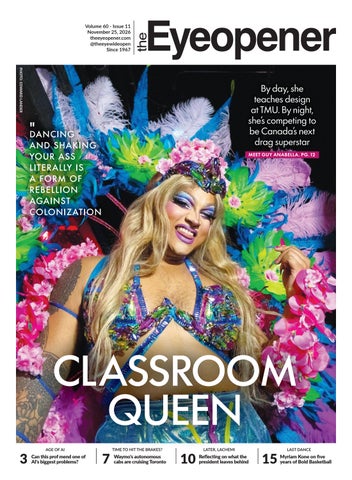
Volume 60 - Issue 11 November 25, 2026 theeyeopener.com @theeyewideopen Since 1967
PHOTO: EDWARD LANDER
By day, she teaches design at TMU. By night, she’s competing to be Canada’s next drag superstar
"DANCING
AND SHAKING YOUR ASS LITERALLY IS A FORM OF REBELLION AGAINST COLONIZATION
MEET GUY ANABELLA. PG. 12
CLASSROOM QUEEN 3
AGE OF AI
Can this prof mend one of AI's biggest problems?
7
TIME TO HIT THE BRAKES?
Waymo's autonomous cabs are cruising Toronto
10
LATER, LACHEMI
Reflecting on what the president leaves behind
15
LAST DANCE
Myriam Kone on five years of Bold Basketball
News
The Eyeopener is off for Winter Break We'll be returning to print January 20
THE EYEOPENER WEDNESDAY, NOVEMBER 25, 2026 theeyeopener.com/news
Head of DMZ stepping down after 10 years Abdullah Snobar, who has led the startup incubator since 2015, will leave at the end of November Grayson Glenn editorial intern
Edward Lander editor - in - chief
Toronto Metropolitan University’s (TMU) startup incubator DMZ is looking for new leadership after executive director Abdullah Snobar announced his departure Nov. 16. Snobar, who has led the organization since 2015, said he’s cherished his time in the position, but his career is taking him elsewhere. “It’s a bittersweet moment in the truest sense of it, but I've had an incredible tenure here and have been privileged to do the things we've been able to do, but the timing is perfect,” said Snobar said in an interview with The Eyeopener. Launched in 2010, DMZ provides tools and expertise to both student and external entrepreneurs who are looking to launch businesses. According to Snobar, under his leadership the program launched and provided guidance to thousands of founders and startups. “It's been an absolute pleasure, the pleasure of my life, doing the work that I got to do and the people that I got to meet, I'll forever be grateful and forever
be honored for having had the chance and the trust to do this,” said Snobar. The legacy Snobar leaves behind at TMU goes back further than his time at DMZ. He earned a bachelor of commerce from TMU in 2009 and later completed a master’s in business administration. During his undergrad, he was president of Ryerson Commerce Society, now called the Ted Rogers Student Society. He was also a faculty director of the Toronto Metropolitan Students’ Union. Since then, he’s sat on the boards of major companies, startups and charitable organizations. In 2018, he was a recipient of Canada’s Top 40 Under 40 awards program. Snobar said he’s proud of what he achieved while at the helm of DMZ. “Honestly, I think I've reached a moment where I've been able to do all the major initiatives that we wanted to get off the ground,” he said. Snobar launched various projects at DMZ focusing on underserved groups and diverse entrepreneurs. This included the Black Innovation Program, which was began in 2019. Snobar said Black founders were underrepresented at DMZ, which
Abdullah Snobar has led DMZ since 2015. During his time, it was ranked the number one university-led startup incubator in the world. VANESSA KAUK/THE EYEOPENER did not mirror the amount of Black talent in the startup sphere. “I will never accept it, that there isn't enough talent in the Black community,” said Snobar. “So, we needed to provide more access for Black Founders to realize that there is a pathway for them to be able to get the support that they need.” The DMZ has supported Black entrepreneurs through pitch competitions and the Black Innovation Summit. According to DMZ’s website, they’ve "empowered" over 2,000 Black founders.
2018 saw one of the DMZ’s biggest accolades, being named the world’s number one university-based startup incubator by UBI Global. “I never even imagined it would be a possibility for us to be honest because we were up against some of the biggest institutions in the country, let alone in the world.” Snobar’s 10 years at DMZ ran alongside the term of TMU president Mohamed Lachemi, who started his role as president in 2015. Snobar said Lachemi provided crucial support for the DMZ. “Nothing would have been pos-
sible in what we accomplished had Mohamed not been supportive of what we did,” he said. Snobar will stay with the organization until the end of November to assist in the leadership transition. While he couldn’t say where he’s headed next, he did mention he will be in a similar field, though “it won't be in universities, that's for sure.” Additionally, he’d like to take this time to spend time with his family for the next two months and will announce his next steps early in the new year.
FEAS gets $25 million donation in Lachemi’s honour The scholarship will fund undergraduate and graduate students in the coming years Irsheen Sandhu contributing reporter
Nadine Alsaghir news editor
Jack Cockwell, former CEO of Brookfield Asset Management, is investing $25 million in the Faculty of Engineering and Architectural Science (FEAS). The donation, which will go toward student scholarships, is the largest single gift for scholarships in the university’s history, according to a news release. The investment will be split between $10 million for undergraduate students in entrance and merit-based scholarships and $15 million for graduate students in renewable scholarships. According to the release, the gift was made in honour of outgoing Toronto Metropolitan University (TMU) president Mohamed Lachemi, who is a former professor of civil engineering. Lachemi told The Eyeopener in a statement he is “proud that the scholarship fund will empower the next generation of engineers, architects and technology innova-
tors to become leaders and changemakers in the industry." Mehrab Mehrvar, a professor and associate dean of graduate and post-doctoral studies at the Faculty of Engineering and Architectural Science said the money will make a difference when it comes to recruiting graduate students. "The cost of living is increasing every year, and as the faculty of engineering and architectural science here at TMU, we have been doing our best to provide sufficient funding for all our graduate students," he said. Engineering and architectural science students have one of the most expensive tuition fees at TMU, ranging from $10,960 to $11,571 annually, according to the university’s website. Kazem Fayazbakhsh, an associate professor in the aerospace engineering department said even graduate students who receive project funding still struggle. He said many will seek extra work on or off campus to meet their financial needs. "This really helps students to focus on their studies, because they can do something which is related to their work," he said. Fayazbakhsh also said he hires
undergraduate students to do research in his own lab. "What I can say is that we always have more kind of interesting projects, and even more interest from students than we can support," he said. Hitesh Doshi, a professor in the architectural science department, said the investment towards graduate students contributes to the competitiveness of the university. "I think we are not as competitive as many other places are… There is support, but we can be a lot more competitive, and that will allow us to essentially attract students that we would otherwise not be able to attract...I think that's really what the differentiating power is here," he said. Raahi Shah, an international aerospace engineering student, said the entrance scholarship was one of the major reasons he chose to attend TMU. “We have very little opportunities to put our hands on scholarships, which is also why TMU has a very small percentage of international students compared to other universities," he said.
Printing and model making are two of the biggest academic-related expenses, said Andy Nguyen, a thirdyear architectural science student. "Laser cutting is $20 to $30 just for an hour of laser cutting, along with materials…You can use recycled materials, that's one way to save money, but you're stuck spending a minimum of $20 to $30 for an hour of laser cutting alone," he said. Doshi said one of the biggest challenges the department is facing, beyond assisting students, is infrastructure. "It's good to have us supporting students, but if you're going to attract more students, where do we house
them? Where do we educate them? Where do we build the labs, where is the space for that?" Doshi asked. Fayazbakhsh said though the donation will be of help, further efforts could be made. "I think this donation is still not enough. There are much more needs that the students have… I think we're on the right track, we just need more support," he said. In a statement to The Eye, the faculty’s dean, Sridhar Krishnan, said the first cohort of undergraduate students will be eligible to receive scholarships in Fall 2027, while graduate students will be eligible in Fall 2028.
DANIEL OPASINIS/THE EYEOPENER
News | 3
THE EYEOPENER WEDNESDAY, NOVEMBER 25, 2026
Can this prof mend one of AI's biggest problems? Canada Research Chair Morteza Zihayat leads the Human-Centered Machine Intelligence Lab at TMU Nadine Alsaghir NEWS EDITOR
As more people turn to artifical intelligence (AI) to search for information, Canada Research Chair and Toronto Metropolitan University (TMU) associate professor Morteza Zihayat is studying how bias plays a part in AI and exploring how the technology can be shaped to produce more fair results. Zihayat, a professor in the department of electrical computer and biomedical engineering, was named a Canada Research Chair in Human-Centered Artificial Intelligence in 2025. His work studies how the information used to train AI can reinforce existing preconceptions. He said AI can learn biases from the data it is trained on, bolstering stereotypes to appear in search results. "It's not about if the bias is there. The question is if the new models are intensifying these biases or not," he said. According to a 2026 report from the Canadian Internet Registration Authority, 46 per cent of respondents used AI in the past year. And while 19 per cent of users said they always verify information using another source, the report also highlighted that 53 per cent of Canadians had encountered fake content in the past year. In a 2025 paper, Zihayat and a group of researchers examined how gender bias tends to enter search systems and how “traditional gender binaries are perpetuated and reinforced through data and algorithmic processes." Zihayat said bias in AI is not limited to gender or race but can also come from the underrepresentation of certain groups in the data used to train these systems. He said this can reinforce existing societal stereotypes and influence how people perceive themselves and their opportunities. He pointed to how a search for a gender-
neutral term such as “nurse” can predominantly display images of women. "That's kind of implied that… maybe a boy who's interested in going for nursing, gets impacted, 'oh, maybe that's not the job for me.'..From whatever we feed to humans' mind, it impacts their life," he said. Compared to humans, users are nearly three times more likely to change their decisions when AI disagreed with them, according to a 2024 StudyFinds report. Zihayat said the responsibility for these biases extends beyond those who develop the technology. “AI is a system, a hybrid system, combinations of humans as users, humans as decision makers, humans as regulators. And the technology itself,” said Zihayat. Another area of his research focuses on decentralized AI systems, which seek to give people more control over how AI systems are built and used. However, Zihayat noted that while it currently feels more like a hope than a certainty, some progress is being made. He said a lot more is to be done because decentralization comes with various technical challenges. Through his Canada Research Chair appointment, Zihayat has received funding to expand his research, improve infrastructure and hire more students at his TMU lab. Zihayat said much of his lab’s current research focuses on exposure in generative search, which he said is among the first in the world to do so. It explores how AI systems determine which sources and individuals receive visibility when generating responses. “These models, when they generate answers, they cite some pages, some people. Why these people?” said Zihayat. As part of this research, his team has received approval to ac-
Zihayat's lab is exploring how bias gets into AI, and how to weed it out. PHOTO COURTESY OF MORTEZA ZIHAYAT cess Instagram data to better understand how the platform's AI influences the attention individuals receive online and how this could affect those who financially benefit from it. "So the question is how attention, economy and these generative AI interplay," he said. Search and online algorithms aren't the only place where AI bias has proven to be an issue. Omar Falou, a professor in the computer science and TMU's physics department, conducted postdoctoral research at the Sunnybrook Research Institute where he trained AI algorithms to analyze medical imaging. Falou uses AI models to analyze clinical data and predict early on whether a patient will respond to a specific treatment, helping doctors avoid giving patients ineffective or costly treatments. However, Falou said one of the biggest challenges of incorporat-
ing AI into medical research is obtaining enough diverse patient data to train these models. He said having smaller sample sizes of data can lead to less accurate and more biased AI models. Falou also said bias can come from inaccuracies in training data. In his field of medical research, he said inaccuracies in patient data can influence how AI models predict treatment outcomes. “The more diverse, the more data you have, the better. So I think down the road, I'm hoping that through some strategic partnerships, we can all exchange medical data, at least in my field, in order to provide a better…outcome and then further improve the model,” said Falou. While researchers continue to explore ways to reduce AI bias, Alexey Rubtsov, an associate professor in TMU's mathematics department, said defining what constitutes the concept of bias is
also relevant. "Bias is not necessarily a bad thing. I can intentionally bias a system to align it with my ethical standards,” said Rubtsov. Rubtsov explained that bias isn't always discriminatory or harmful. He gave an example of a financial institution favouring environmentally friendly companies over others that may harm the environment. Zihayat said his lab will continue to explore human-centred AI, with upcoming research focusing on the fairness, safety and societal impacts of these systems. He said one of his greatest concerns is not only how biased information can influence everyday decision-making, but also its wider implications on society. “Imagine a society of those people who have made biased decisions. It’s like a vicious loop. It comes back to you. And one day you will get affected,” said Zihayat.
Full-time undergraduate stu- endorsed by the TMSU, as reason Additionally, updates to ongo- data on the usage of the TMSU's What to know dents, medical and law students for the motion to be presented. ing independent investigations student services are among some eligible to attend the meeting. The motion states that the pro- conducted by MNP, an accounting of the information in the report. before TMSU's are Interested students are required posed strike would happen in the firm, will be shared at the meeting. According to section 3.4 of the to reserve a spot through the TMTMSU's bylaws, at least 100 stuMNP was appointed to investiWinter 2025 semester no later Winter SAGM SU's website. than Feb. 28 of next year. Eligible gate allegations of fraud and elec- dents must attend the meeting to
Zanoah Plummer NEWS EDITOR
The Toronto Metropolitan Students' Union (TMSU) is hosting their Semi-Annual General Meeting (SAGM) on Nov. 26. The meeting will be held at the Daphne Cockwell Complex at 6 p.m., and will see students vote on major decisions.
According to the union, the meetings "are the highest decision-making body of the students’ union." Student attendees can vote on decisions that the union presents. On the table for Thursday's meeting is a motion for a one-day student strike in opposition to recent changes to the Ontario Student Assistance Program. The preamble lists prior actions, such as the Nov. 5 walkout
attendees may vote on whether or not the motion should pass. On the agenda for the meeting is the presentation of audited financial statements from the 2024-2025 school year. The documents were audited by BDO Global, an accounting and consulting firm. Thursday's meeting will have a motion to appoint BDO for the 2026-2027 financial audit.
tion interference in the 2024-2025 TMSU general election. The meeting will also share updates to the TMSU's ongoing lawsuit against its former executive members. The TMSU states it will share its end of year report for the 2025-2026 school year. The report shares data from the TMSU's services and equity centres. Plans for the future and
meet the quorum. The minimum number of students must be met in order to vote on presented items. Past SAGMs have unveiled insight into academic misconduct cases, presented financial irregularities regarding the TMSU's ongoing litigation and gave students information on the TMSU's general elections, as previously reported by The Eyeopener.
4 | Editorial The Eyeopener Vol. 60 | 2026-27 EDITOR-IN-CHIEF
Edward “Last One (For Now)" Lander PRODUCTION EDITORS
Amira “Get 'er Done” Benjamin Jasmine “Hot Pot” Makar NEWS EDITORS
Nadine “Rage Bait” Alsaghir Zanoah “Not Done Yet” Plummer ARTS & CULTURE EDITOR
Sophie “Last One” Wallace BUSINESS & TECHNOLOGY EDITOR
Mishael “Double Trouble” Taruc COMMUNITIES EDITOR
Rin “Folder Finder” Yanase FEATURES EDITOR
Daniyah “Last One” Yaqoob FUN & SATIRE EDITOR
Dylan “Christmas' #1 Fan” Marks SPORTS EDITORS
Francesco “Triple” Cautillo Naomi “Threat” Low PHOTO EDITORS
Rachel “Cartoonist-inResidence” Cheng Daniel “Fast & Furious” Opasinis Pierre-Philipe “Flannel” Wanya-Tambwe MEDIA EDITORS
Victoria “Trooper” Andrade Ava “Let's Trust Them” Whelpley
THE EYEOPENER WEDNESDAY, NOVEMBER 25, 2026
Changing of the guard On 10 years under Mohamed Lachemi
Edward Lander EDITOR - IN - CHIEF Every Wednesday, The Eyeopener delivers 25 papers directly to the president's office. We rarely see him in the flesh, but as we put together that week's issue, the knowledge that the president's eyes will be on it often comes to mind. Sometimes we even count how many papers are left by the end of the week. But this Wednesday will be the last time we do that. We'll still be bringing papers to Jorgensen Hall’s 13th floor when we return in January, but there will be a new president occupying the office. At the end of this semester, Mohamed Lachemi, who's been at the helm of Toronto Metropolitan University (TMU) for 10 and a half years, will step away in favour of Roberta Iannacito-Provenzano, the current provost and vice-president, academic. Lachemi started out at TMU as a professor of civil engineering in 1998. Since then, he's worked his way up the administrative ladder, serving as dean of engineering and architectural science, then provost—the same job as his successor. Some of Lachemi's bigger accomplishments are obvious. A School of Medicine in Brampton, a law school, a new residence under construction on Bond Street and the centre for student well-
being—the construction of which regularly rattles our office. In this week's feature (see page 10), contributing writer Jaymes MacKinnon has spoken to everyone from Lachemi’s administrative coworkers to his harsher critics to get the full picture of the legacy he's leaving behind. It's a wartsand-all piece that chronicles the president's past from his upbringing in a small Algerian town to TMU's top brass. The Eye has a storied history with the presidents of TMU's past. Reporting on the university's administration (the good and the bad) means speaking to the president is a weekly occurence. In some years, I will say we've perhaps gotten too close. Lachemi's predecessor, Sheldon Levy, for example, took our masthead shopping at Loblaws in the Mattamy Athletic Centre in 2014— the building he developed during his time as president. He bought them a turkey that was purportedly brined in an editor's bathtub. With this president we've kept a healthy distance—something that hasn't prevented him from appearing in some 648 Eye stories during his term. Only time will tell what kind of leader Iannacito-Provenzano will be, but rest assured, we'll be there to report on it every step of the way—warts and all.
NOW'S YOUR CHANCE TO
JOIN THE EYE WINTER 2027 EYE-LECTIONS ARE FAST APPROACHING
DIGITAL PRODUCER
Lucas “Skippy” Bustinski GENERAL MANAGER
Liane “The Goat” McLarty DESIGN DIRECTOR
Vanessa “20 Mins Early” Kauk EDITORIAL INTERN
Grayson “Byline!!!!” Glenn CONTRIBUTORS
Jaymes “Take The Job” MacKinnon Kyla Cassandra “Vroom!” Cortez Harsh “Big Fan” Kumar Michael “Numbers Game” Elsaesser Landon “Shhh!” Randfield Santiago “Ol’ Reliable” Ortega Noah “MSOC” Curitti D’Arcy “10-round shootout” Bagley TJ “Dorm snack” Atayde Victoria “Sorry we ditched you” Cha Owen “Always fire” Coughlin Ishreen "Bob the Builder" Sandhu James “Hostest with the Mostest” Alloul Mindy “Body Builder” Nickerson Molly "Back Into It" Simpson Caelyn "Photographer" Mancenarez-Worsnop Eunice “Queen” Soriano Airen “First Timer” del Pilar Gray “Award-Winning” Moloy CONTACT
T: 416-979-5262 ext. 2338 E: editor@theeyeopener.com 55 Gould Street, Suite 207 Toronto, Ont. M5B 1E9
STAY TUNED TO @THEEYEWIDEOPEN FOR MORE INFORMATION Mohamed Lachemi shortly after he took the presidency in 2015 SIERRA BEIN/THE EYEOPENER
|5
THE EYEOPENER WEDNESDAY, NOVEMBER 25, 2026
HOT CAMPUS PASS $
55 bi- weekly
UNLIMITED CLASS ACCESS
FAR INFRARED HOT STUDIO YOGA • PILATES • STRENGTH • SCULPT • STRETCH TERMS AND CONDITIONS APPLY
Volume 60 - Issue 10 November 18, 2026 theeyeopener.com @theeyewideopen Since 1967
HEY YOU!
Want to advertise in The Eyeopener? Contact advertising@theeyeopener.com 2
OSAP OUTRAGE
What’s next after the Nov. 5 walkouts?
3
SLEEP TIGHT
New nap space for 5 launches in the SCC
10
ARTS & … MONEY?
Creatives stand to gain under new Carney budget
13
SPORTS
Esports are at a crossroads in the face of AI
your friendly neighbourhood bookstore
your friendly f iendly neighbourhood fr neig i hbourhood bookstore ig
your next great read awaits...
your next nex eext great read awaits... awaits t ... ts
benmcnallybooks benmcnallyb benmcnallybooks y ooks yb 108 Queen 108 Queen St. St. E E (at (at Jarv Jarvis) Jarvis) rvi rv vis)
6 | Photo
THE EYEOPENER WEDNESDAY, NOVEMBER 25, 2026
The Semester in Photos
Images of the people, events and places that defined the Fall 2026 semester 1
RACHEL CHENG/THE EYEOPENER
2
JASMINE MAKAR/THE EYEOPENER
WHO'S WHO Arianna Shannon, the student star of TIFF's Sunburn Law and business grad Arianna Shannon starred in Sunburn, which took home Best Canadian Feature Film at TIFF this year. Shannon is one of many TMU students and alumni who make up TIFF's 'TMU Mafia,' a group of actors, writers, directors and more whose work is making waves at the fest.
1
Chow and Bradford battle it out at SLC mayoral debate Before Olivia Chow won a second term as Toronto's mayor with an overwhelming share of the vote, she sparred with challenger Brad Bradford in a debate at TMU's Student Learning Centre. The candidates clashed on issues from transit to public safety and fielded questions from student attendees.
2 PIERRE-PHILIPE WANYA-TAMBWE/THE EYEOPENER
3
Students facing a tuition hike granted amnesty after 2 years A group of mostly-Iranian international students who were promised domestic tuition were granted it after nearly two years of advocacy. The university had reversed the policy promising domestic fees but went back on it after the students said the decision put their futures in jeopardy.
3
4 5
Men's Soccer scores first OUA championship in program history The Bold men's soccer team captured the 2026 OUA championship win in November, hoisting the Blackwood Cup after a 3-0 victory over the Guelph Gryphons. This was the first-ever OUA championship victory in program history.
4
OLIVER ULSTER/THE EYEOPENER OLIVER ULSTER/THE EYEOPENER
6
Bold Men's Hockey defeats Queen's at homecoming Bold men’s hockey hosted the Queen’s Gaels at the MAC for their fall homecoming game on Sept. 17. The Bold secured a 6-5 comeback victory after trailing 4-1 in the first period. Rookie forward Carson Lloyd capped off the night, scoring the game-winner the team's first preseason victory on home ice.
5
Hundreds walk out of class in protest of changes to OSAP Students have been fighting back after the Ford government reduced the portion of funding students can receive from OSAP in the form of grants. This culminated on Nov. 5 in a day of action organized by CFS–O. At TMU, that day saw hundreds of students walk out in protest of the changes. Now, the TMSU and other student unions are considering what's next, including the possibility of a student strike next semester.
6
DANIEL OPASINIS/THE EYEOPENER
THE EYEOPENER WEDNESDAY, NOVEMBER 25, 2026 theeyeopener.com/business
Business&Tech
Waymo gears up for Toronto launch, but experts say challenges lie ahead The self-driving ride service will launch in Toronto in 2028 Kyla Cassandra Cortez contributing reporter
Autonomous taxi service Waymo is heading to Canada—with a Toronto launch just two years away. But experts say the company has a lot to prepare for when it comes to navigating the city. According to its website, Waymo is currently mapping Toronto's roads and testing with someone behind the wheel—or “qualified autonomous driving specialists.” The company uses all-electric Jaguar I-PACE SUVs, a discontinued model with a fast-charging battery and a size Waymo considers “ideal for city driving.” Waymo currently operates in 15 cities, including San Francisco, Los Angeles and Miami. The company also plans to expand to more U.S. cities and other parts of the globe, such as Tokyo and London. However, the company has already hit a few road blocks. CBC reported that California Department of Motor Vehicles temporarily banned Waymo vehicles on freeways on Nov. 11 following a Nov. 5 incident where three Waymo cars drove into a construction zone and a Nov. 6 incident where another Waymo car attempted to bypass highway patrol officers. Aarushi Tripathi, an artificial intelligence expert and policy analyst for grassroots organization Technologists for Democracy,
said she is “not very optimistic” about introducing Waymo cars in Toronto. Tripathi said public consultations should be done with Torontonians before launch because introducing the vehicles will have major impacts. Consultations should be introducing Waymo “with the legislators, with municipal leaders as well. I think that so far, [it] hasn't been done very extensively, and the cars are already on the road,” she said. Alex Wojtkowski is a recent aerospace engineering graduate and founder of TMU Velocity, a student team which develops autonomous vehicles. He thinks it's “admirable,” that Waymo wants to expand to Toronto, but said their vehicles still face challenges. A major one, Wojtkowski said, is mimicking the reaction time, perception and decision-making of a real person. "When it comes to autonomous vehicles on the road, there's a lot of predicting that needs to be done. People are great drivers because we can look everywhere… We can think quickly,” he said. But for computers this process is a lot more difficult. Patrick Loa, an assistant professor in the Department of Civil Engineering, said he thinks there will be “a learning curve” when it comes to navigating Toronto traffic, streetcars
and the behaviour of Toronto drivers, cyclists, and pedestrians. He’s also wary of how Waymo’s vehicles will operate in Toronto winters. “Given that a lot of the places where they launched and where they’ve seen the longest run of deployment, [it] rains, but it doesn’t snow,” he said. Meanwhile, the company plans to improve accessibility and mobility in Toronto by partnering with organizations such as BALANCE for Blind Adults, the Canadian National Institute for the Blind and Epilepsy Ontario. However, Loa said its Jaguar and Ojai vehicles are not wheelchair accessible. “There's a barrier with the design of the vehicles, so if you travel with a large mobility aid, particularly one that cannot be folded and put into a trunk…you're not able to get into one of these vehicles, at least not easily,” he said. Its wheelchair accessibility issue raises the question of whether the price point is justified. On a trip to San Francisco, Loa said he paid US$70 for a Waymo ride during the afternoon rush hour. He said San Francisco’s prices per mile are “roughly equal to or slightly higher” than usual ride services. “There's definitely going to be people who want to experience being in a driverless car and are willing to pay a premium for it.” For Tripathi, paying more for
DANIEL OPASINIS/THE EYEOPENER a Waymo ride doesn't make sense if existing ride services and public transportation are cheaper. “If you're still paying more than public transit or if you're paying more than a normal cab [or] Uber, then I really don't see the point, honestly,” she said. A ride’s cost depends on a minimum price charged for all trips, the trip’s distance and the trip’s length of time. A ride in Las Vegas includes a base rate of US$9.49 plus US$1.23 per mile and US$0.45 per minute. Other conditions, such as time and booking demand, also affect prices. Waymo also offers Waymo Premier—similar to an Uber One membership, but is invite-only for US$29.99 per month. In comparison, the Uber monthly membership in Canada is $9.99. When Loa used a Waymo, he said there was an “adjustment period” where he had to get comfort-
able with the steering wheel and pedals moving by themselves. After he adjusted, he found Waymo’s software to be a “little bit more conservative” than a human driver and felt as if the vehicle didn’t make any “super risky” maneuvers. Wojtkowski said if Waymo passed the required safety tests and met a certain driving standard, he wouldn’t mind using the service. However, a Liasion Strategies poll found that most Torontonians said they would not use Waymo. 41 per cent said “not at all likely”, while 21 per cent said “not very likely.” Similarly, Tripathi said she wouldn’t use it when it launches. “I like public transit and what it offers. I like traveling in buses and in trains and subways, and I think there's just so much more value in investing in those services and instead of putting money in on cars that are already creating more problems,” she said.
Are students comfortable talking about money?
As the cost of living rises, students and experts weigh in on whether talking about money is a taboo Landon Randfield contributing reporter
Many young Canadians are finding it difficult to discuss their financial situation today. Noorah Umar, a firstyear social work student at Toronto Metropolitan University (TMU), says she's apprehensive when discussing finances with friends. “With family, I'm pretty open. With friends, I'm a bit more reserved,
but I still try to be open because I feel like it's important to break the taboo around income,” said Umar. “The idea of somebody knowing how much money is in my account just makes me a bit uncomfortable.” In a May survey by Canadian finance platform MooseMoney, 49.9 per cent of Canadians would rather discuss their sex lives than their credit score with friends. For those struggling financially, that
DANIEL OPASINIS/THE EYEOPENER
number jumps to 61.2 per cent. 31.5 per cent admitted to lying about their annual salary and 26.3 per cent admitted to lying about credit card debt. “There's a lot of shame and guilt that is tied to money,” said John Lee, a clinical psychologist. “When we get trapped in a cycle of guilt and shame, we tend to engage in avoidance behaviours that perpetuate a bad financial situation,” he said. “Someone who is really ashamed about their credit card debt, they're likely not [going] to open their credit card bills, and it's just going to perpetuate their situation.” Thomas Flynn, a second-year acting student, said he isn't surprised. “I think that money is a big social factor and people often define themselves by how much they make or how well they're doing financially.” He also said the shame around discussing finances may be passed down from older generations. Austin McIntaggart, a fourthyear media production student, said the problem is a combination
of doubting one’s self-worth and feeling like they cannot provide for their families or loved ones. “There are also aspects of just self-fulfillment. Sometimes it's not necessarily whether they're able to provide a...stable life; it could be about the fact that they're not where they want to be personally or professionally, and that would impede them [from] talking about their position,” said McIntaggart. Emily Turton, a second-year acting student, describes herself as a “job-hopper,” yet is very open when it comes to discussing her finances. “I'm very comfortable talking about how open I am with how much money I'm making and like what I'm spending it on, but in terms of...bigger financial things like my rent and stuff like that, I'm not so open about it,” said Turton. The survey also found that 42 per cent of Canadians would wait until their finances felt out of control before contacting a profession-
al, if they felt they could no longer afford to pay for basic necessities. About 31 per cent said they would try to handle the debt themselves rather than ever seek help and 14.6 per cent would wait until they are threatened with legal action. Varsiha Jeyarajah, a first-year social work student, said one way to break the taboo is to learn more from peers and coworkers about how they make ends meet. She said competition should not get in the way of helping each other. “Where we're going in society, economy-wise, we can share a couple of secrets, help one another out, and I feel like that can build community,” she said. To help reduce the stress around finances, Lee argued it often comes down to psychology rather than math. “I think the key is not having money control you or master you, but you learning how to master money, and so doing things that might be a bit difficult or unfamiliar.”
8 | Business & Technology
THE EYEOPENER WEDNESDAY, NOVEMBER 25, 2026
Photo cards and credit cards: affording fandom
While fandom culture is a vital part of student life, rising costs make it out of reach for many students
Harsh Kumar contributing reporter
Fourth-year psychology Toronto Metropolitan University (TMU) student Sophia Di Manno is a “superfan” of The Weeknd. She's seen the Toronto artist perform live a number of times, but recently, she said, the rising cost of concerts has been making this harder. “I had what I called my Weeknd savings account. So every paycheck, I would just literally put money into this bank account because I knew I wanted to go and see him as many times as financially feasible,” she said. Di Manno isn't the only one who found that fandom now re-
quired careful budgeting. For many students, being a fan of their favourite artists, movies, shows or sports teams is a pivotal part of their upbringing; it is an integral part of their identity and a way for them to build community and find new friends. However, as students face rising costs in an increasingly expensive world, the cost of fandom is now a line item that has to be considered alongside rent and groceries. A report from global concert data company Pollstar found that average ticket prices for the top 100 global grossing concert tours rose from $96.17 in 2019 to $132.62 in 2025, an increase of 38 per cent.
PIERRE-PHILIPE WANYA-TAMBWE/THE EYEOPENER
Di Manno said that while the price of a ticket is the most expensive part of going to a show, there are other expenses associated with a night out that start to add up quickly. “I don't drive to concerts. I would take the trains. The cost of public transit, if I'm going to get some drinks and food, there’s a little bit [of spending] there,” she said. In her experience, by far the most expensive cost is concert merchandise besides the ticket, Di Manno said, “I buy multiple pieces of merch there, and merch is not cheap.” A fan spending report by atVenu found that fans were spending an average of U.S. $64 on merchandise in 2025, which was up seven per cent from the previous year. Fourth-year business technology management TMU student, Aydin Vahidy, is a fan of the Raptors fan and the indie band Geese. He said being a music fan has gotten harder amid the consolidation of the concert industry under a handful of companies. Ticketmaster, the largest ticketing platform owned by Live Nation Entertainment, the largest concert promoter and organizer in the industry. In January, CTV reported that the Quebec Superior Court allowed a class action lawsuit against Ticketmaster, accussing the platform of “abusive
service fees”. “Obviously, that means Ticketmaster can just do whatever they want in terms of price gouging,” said Vahidy. He said that it puts consumers in a corner with no other option than to simply spend. “There’s nothing you can do about it, really, like tickets are on sale in one spot and either you go and spend the $40 in surcharge fees… you don’t know where it's going; it's just an extra fee,” said Vahidy. A recent report from American firm Ally Financial found that Gen Z is now spending more on sports fandom than ever before, spending on average $2,000 a year. Ethan Milne, an assistant professor of marketing at Ted Rogers School of Management, had conducted research on fanfiction communities and brand legal disputes over copyright. Milne said that when spending for fandom activities and merchandise, being a fan cannot be divorced from being a consumer. “The second money changes hands, that's when you become a consumer,” he said. Though costs are rising, some are finding ways to bring people together through fandom without breaking the bank. Seiya Scott is a third-year fashion student and a member of
TMU Fanworks, a club dedicated to fanfiction and fanart. Members of TMU Fanworks are fans of gaming and television. “We’ll all stream [things] together so that cuts some of the costs; someone buys it, and then we’ll all watch it together,” said Scott. Katty Alhayek, an assistant professor in the School of Professional Communication, said corporations know how much fans love their products and are eager to market them. “They create different products, different experiences to capitalize on your fandom and affection. Like a type of effective economy,” she said. But Vahidy said it’s still possible to be a fan without breaking the bank. “Just [be] more mindful of the independent creators that are around you in such a vibrant city, there’s so many of them to go to and to spend a fraction of what you do just to get an amazing local indie fee and a great community,” he said. For Alhayek and many fans, fandom will always be about community and being around people who enjoy the same interests as you. “Being a fan is more about finding a community, finding like-minded people who like stuff that you like and sharing this identity with them,” she said.
Bank of Canada rate hike adds to student loan concerns
Higher interest rates on provincial and private loans come as students already face OSAP cuts and rising tuition Michael Elsaesser contributing reporter
On Oct. 28, the Bank of Canada increased its benchmark interest rate from 2.25 per cent to 2.5 per cent, reversing a series of cuts that began in June 2024. The central bank attributed the decision to high energy prices and economic growth, warning that the rising business costs could contribute to inflation. In its Nov. 10 summary of deliberations, the bank’s Governing Council acknowledged that further rate increases could be necessary if inflation continues. For students, the announcement has different implications depending on how they finance their studies. The provincial government and commercial banks base their student loan interest rates off the Bank of Canada's policy decisions. Following the October announcement, major Canadian banks increased their prime lending rates from 4.45 to 4.70 per
cent, effective Oct. 29, 2026. Under the Ontario Student Assistance Program (OSAP), loans can consist of both federal and provincial portions, which are subject to different interest rules. The federal portion of OSAP has remained interest-free since April 2023, protecting borrowers from Bank of Canada policy rate increases. According to an April 2026 briefing note from Employment and Social Development Canada, the elimination of federal student loan interest is expected to save the average borrower $350 this year. The federal government also maintained temporary increases to student grants for the 2026-2027 academic year, contrasting with Ontario’s decision to reduce the proportion of non-repayable grants. In February, Ontario announced changes to OSAP, reducing the maximum amount of non-repayable grants from 85 to 25 per cent, effective as of September. The remaining assistance must be provided through repayable
loans, potentially increasing students’ debt after graduation. The provincial portion of OSAP carries a variable interest rate of prime plus one percentage point, meaning Ontario student loan interest rose from 5.45 to 5.70 per cent. For borrowers with $10,000 in outstanding provincial loans, the increase represents around $25 in additional interest annually, assuming the balance remains unchanged. Interest on provincial loans begins accumulating after students leave full-time studies, including during the six-month period, before repayments are required. Students borrowing through private banks may face more immediate consequences, as those loan options accumulate interest while borrowers remain enrolled. The increase follows years of fluctuating interest rates and changes in student borrowing at TMU. According to Government of Canada figures compiled by The Eyeopener, the annual value of student loans at TMU reached $106.8
PHOTO ILLUSTRATION BY DANIEL OPASINIS/THE EYEOPENER million in 2023, before declining to $95.8 million in 2024 and $88.25 million in 2025. This is a 17.3 per cent decline in two years, although they do not state whether changes in interest rates contributed directly to the decrease. The most recent figures also predate significant changes to the OSAP system. Also in February, Ontario ended its domestic tuition freeze, permitting annual increases of up to two per cent for three years, followed by increases capped at the lesser of two per cent or the three-year average inflation rate. In an emailed statement to The Eyeopener, Toronto Metropolitan Students’ Union (TMSU)
vice-president education Teresa Baricevic said the changes create additional barriers for students. “[This] makes it harder for students to afford a post-secondary education, and creates more barriers for future students to begin their studies and their post-secondary journey,” she said. Baricevic said approximately 400 people attended the Nov. 5 campus walkout opposing the changes. TMSU continues to organize through its Hands Off Our Education campaign alongside the Canadian Federation of Students. Baricevic said the union would continue encouraging students to attend demonstrations, lobby government officials and contact elected representatives.
Communities | 9
THE EYEOPENER WEDNESDAY, NOVEMBER 25, 2026
Students create little free library to dispense Black literature in the Annex TMU assistant professor Darcy Ballantyne leads the project
Molly Simpson contributing reporter
A new little free library focused on Black authors is set to hit the streets of the Annex in the coming months, and students at Toronto Metropolitan University (TMU) are behind it. Darcy Ballantyne, a TMU English assistant professor who teaches the course Black arts, Black power, had her class create a little free library over the semester with the aim of planting the project in the Toronto community. Ballantyne said the library will feature books she has received through donation, all written by Black authors regardless of the genre. “We want books by Black authors from right across the Black diaspora and all genres,” she said. Some of the authors that have been collected so far include Austin Clarke, Michelle Obama, Toni Morrison and TMU faculty members Jumoke Verissimo and Linzey Corridon, Ballantyne said. Experiential learning was an “integral” part of the project according to Ballantyne, who believes learning doesn’t need to
just be lecture based. Ballantyne was also inspired by a scene from W.E.B. Du Bois’ The Souls of Black Folk, where a young Black boy is reading beneath a tree. She said Du Bois was commenting on how, despite slavery and the criminalization of reading for Black people at the time, the idea of an educated Black person shouldn’t be surprising. Ballantyne said in her experience, she hasn’t found many little free libraries that are diverse. “I've always found that it was rare to find a book by a Black author in the little free libraries. And that could be for any number of reasons…but I thought, why not create a little free library dedicated to elevating the books written by Black authors?” Ballantyne lives in the Annex and plans to add books when the library is installed. While she will continue to be a caretaker to the little free library, a lot of work went into getting it off the ground in the first place. Lexia Forte-Viveiros, a third-year English student, worked on the library. Her role included managing
a group in charge of designing gifts for sponsors of the project. “I learned a lot because it was more of a leadership group where we had to not only communicate with ourselves, but also make sure that other groups were on task,” Forte-Viveiros said. Forte-Viveiros also said she took the class out of an interest in learning about different cultures. She said the class exposed her to books by Black authors she might not have otherwise read. Her favourite piece from the class: Zora Neale Hurston’s Their Eyes Were Watching God. She said the project is a good way to share literature people might otherwise not be exposed to. “I love little free libraries in general…but I've never seen a Black studies one, so I think that's really interesting. Now people who have not really read books from Black authors can actually now get educated on that.” The little free library will live in the former home of Albert C. Jackson, Toronto’s first Black mail carrier. According to Heritage Toronto,
PIERRE-PHILIPE WANYA-TAMBWE/THE EYEOPENER Jackson (born in 1857), escaped slavery in Delaware U.S., with his mother and siblings in 1858 before arriving in Toronto. Jackson was hired as a letter carrier in 1882, but due to discrimination from his colleagues, did not begin right away. This inspired Toronto’s Black community to protest and demand the then prime minister Sir. John A. Macdonald to reinstate him. Jackson served as a mail carrier for 36 years until his death in 1918. Time prevailing, Ballantyne said some of her students are interested in decorating the library with images from Black literature.
She said they were especially interested in the pear imagery from Their Eyes Were Watching God. Ballantyne said little free libraries help with the “democratization” of access to good books. “You take a book and hopefully you give a book,” she said. “I think that they spark our imagination, right? For me, there's nothing greater than stumbling upon a new little free library that's full of really interesting books.” The library’s exact launch date is still unknown, however the class will host drop-in reveal on Dec. 4.
Image Arts students’ Salon Show highlights talent of budding student artists
This year's exhibition features 82 works produced by photography and film students Caelyn Mancenarez-Worsnop contributing reporter
A group of fourth-year photography students opened the Salon Show for the Maximum Exposure (MaxEx) 32 in the Image Arts building on Nov. 20. MaxEx is a student-led, endof-year exhibition for Image Arts (IMA) students to have an opportunity to showcase their work, focusing on the fourth-year thesis projects done by both photography and film students at Toronto Metropolitan University (TMU). The Salon Show is one of the many annual events that build up to the end-of-year MaxEx event, which features work from photography and film majors from all undergraduate students, including their work-in-progress and finished projects. “The idea of the Salon Show is to give viewers a glimpse into the talent our students hold at The Creative School and within The Image Arts community,” read a description at the exhibition. Carter Henry, a fourth-year photography student and project man-
ager of the MaxEx photography team, said the showcase was a necessary event for artists to have the opportunity for their work to be seen. “We as artists don’t want our art just to sit there; we want to put it out for the world,” Henry said. “In the age of technology and AI, it's a great way to showcase what humans are creating with the technology we've been given,” he said. Rowena Gao, a fourth-year photography student and communications director of MaxEx, said the Salon Show gives students an idea of what the event can provide to advance their portfolio. “Doing a salon show in the first semester lets people know who we are and that MaxEx exists,” Gao said. The Salon Show and MaxEx provide students with a space to network and add to their professional portfolios. This year’s exhibition highlights the room surrounded by 62 large-print images displayed along with 20 small-print images. The total 82 works were displayed without any titles or
names attached, showcasing the different techniques each student used for their storytelling through the photography. One of the students used paint to cover the subjects’ faces and hair with a bunch of white stripes, leaving viewers imagining the backstory behind the work. Another incorporated a film photography technique called sun printing into their work. Sun printing, or cyanotype, is a type of printing that uses ultraviolet light to develop images on paper. The students’ work depicts a woman playing a guitar, with the main colours being blue and white. Jennifer Harwart, a third-year photography student and gallery coordinator, helped with the exhibition for two years and was pleased with the work submitted this year. “I really like the show this year. I think it does showcase a lot of what students are interested in and what they’re doing,” Hawart said. “Compared to the years before, they have a lovely variety of images…and I like the number of images they have,” she said.
CAELYN MANCENAREZ-WORSNOP/THE EYEOPENER MaxEx hosts many small events leading up to their final exhibit, including the Salon Show and a semiannual gear sale that took place earlier this semester. The team had a wide range of tech, such as cameras, tripods, computers, photography books and smaller camera accessories. Most prices were under $150, with the cheapest item being photography books for $5. The earnings help them fund the endof-year event. “We are trying to price both in
ways that we make a sale, but also that you go home with gear that is both good and affordable,” Henry said. “[This year], we were given an entire storage room of gear. We were [also] given gear from multiple profs, really without asking,” he said. “Some years, we were given older, more used, worn-down gear. This year, I felt like it was a little more useful and up to date than some other years.” The Salon Showcase will be on view at Gallery 310 (IMA 310) in the Image Arts building until Dec. 4.
| THE EYEOPENER 10 | FEATURES WEDNESDAY, NOVEMBER 25, 2026
Lachemi?
TAKE THE YEARS YOU'VE SPENT
on campus and double them. Quadruple them. Sextuple them, even. Kella Loschiavo likely has you beat. “I’ve been at TMU for 41 and a half years and I've seen many presidents,” she says. “I believe that President Lachemi will be remembered as a president who oversaw the most significant periods of transformation in the university[’s] history.” Loschiavo is, herself, a president. She leads the Ontario Public Service Employees Union (OPSEU) Local 596, Units 1 and 2. The union represents academic and administrative support staff, research assistants and student residence workers at Toronto Metropolitan University (TMU). Reflecting on 10 years of change is a daunting task, but Loschiavo is well-prepared to do so. She describes Lachemi’s leadership style as “ambitious, strategic and focused on institutional growth and transformation.” The growth Loschiavo refers to is undeniable: during Lachemi’s term, the COVID-19 pandemic and artificial intelligence (AI) challenged core assumptions about what a university can and should be. Under
The leader at the helm of this transformation leaves a fragmented legacy. Protests over the last three years on campus, and how they were handled, have seemingly tarnished student trust in the university. There is no doubt that Lachemi made long-lasting changes to TMU’s public perception, institutional offerings and geographical footprint. However, for some, that change was perhaps achieved through gradual distancing between the office of the president and the students, faculty and staff who will live in the wake of the decisions Lachemi made long after his exit.
MOHAMED LACHEMI FACED A
challenge when he assumed the presidency in 2016: the shadow of a popular predecessor. Sheldon Levy, who was president from 2005 to 2015, had an unusually positive reputation for a university administrator. Profiles of him in The Eyeopener and Toronto Life depict a humble and charismatic “dreamer” who was known to commute via motorcycle
Lachemi opening the Ryerson Faculty of Law in September 2020. Now the Lincoln Alexander School of Law, the school was an aspiration of the president. his leadership, TMU opened a law school and a medical school, changed its name and expanded its real estate portfolio. The “Rye-high” reputation that trailed the school for years has nearly been rebranded out of existence. But how the towering man in square-frame glasses will be remembered is in question. “From a union perspective, leader[ship] must be measured by more than strategic plans and institutional achievements,” Loschiavo said. “It also must be measured by communication, transparency, meaningful consultation and the ability to listen to people affected by decisions.”
and rarely turned down a chance to chat. In a farewell feature on his legacy, The Eye’s Jonah Brunet remarked he was unable to find a single person who had “anything bad” to say about the former president. Levy took over TMU’s top job from Claude Laujeunnesse, who attracted controversy among students when he accepted a nearly 40 per cent salary bump between 1996 and 2002. During his annual state of the university address in 2001, The Eye reported that a student yelled, “And another pay raise for you, huh, Claude?” To which Lajeunesse responded, “I hope so.” When Lajeunesse left TMU in 2005, his salary was
$260,531, the equivalent of $411,440 today. Lachemi earned $471,070 in his final year as TMU’s president, nearly double that of Toronto mayor Olivia Chow. In the middle of Levy’s second term, the Board of Governors changed university bylaws to allow presidents to serve additional terms beyond the cap of two five-year periods. Levy ultimately declined to serve a third term and Lachemi, then provost and vicepresident academic, stepped in as interim president in December 2015 while the board of governors searched for the right person. In March 2016, it was officially decided he was that ‘right person’ and appointed him as the university’s ninth president and vicechancellor. At that point, Lachemi had been at TMU since 1998, when he joined the department of civil engineering and proceeded to climb the ranks. His interest in engineering was sparked as a teenager in Algeria after an earthquake killed 4,000 people in his small hometown. “Engineer” remained a core part of Lachemi’s professional identity through his tenure: when students protested the statue of Egerton Ryerson on Gould Street in 2017, Lachemi said, “My background is engineering, I like to build things, I don’t like to destroy things.” Lachemi came into TMU’s top seat with a list of goals. “We have achieved almost everything on that list, along with many other new developments,” Lachemi told The Eye in a written statement. However, Lachemi remains humble about those achievements. “It’s not about me,” he said, crediting the “incredible team of people at TMU who make all of these changes possible.” “What I have always admired is his humility, regardless of the scale of his accomplishments,” said Sri Krishnan, dean of the Faculty of Engineering and Architectural Science. Members of Lachemi’s staff did not return The Eye’s request for an interview or comment. But his colleagues in other parts of the school will remember him in all kinds of ways, bitter and sweet. Carl Kumaradas, vice-provost and dean of the Yeates School of Graduate and Postdoctoral Studies, remembers a time when Lachemi advised him on a home renovation project. “I’m like, 'who knows something about concrete?' And I said, 'oh, Mohamed does.' So I emailed him, can we have a chat about my basement…he gave me advice,” Kumaradas said. His colleagues, like dean of the Chang School, Linda Koechli, have described him as a big-picture thinker. “Some of the words
that come to mind when I think of him and the work that he's done over several years [are]...openness to the innovation, the big ideas,” Koechli said. If there is one thing Lachemi will be remembered for, it will be as the president who made the very-big-picture call to change the university’s name. After years of pressure from students highlighting Egerton Ryerson’s role in the creation of the residential school system, the change was made official in April 2022. The controversial decision was the fourth name change since TMU was founded as the Ryerson Institute of Technology in 1948. TMU was the first university in North America to “change its name to address its colonial history,” President Lachemi wrote in a Toronto Star op-ed. “Changing the name of the school [was] pretty consistent with the direction that our school really wants to go towards—a more progressive and social justice-oriented direction in its education and mandate,” says Ian Lin, vice-president finance of the Lincoln Alexander Law Students' Society. “I think changing the name of the school [was] definitely required in light of…truth and reconciliation.”
NOT EVERYONE IS A FAN OF
Lachemi’s approach to solving TMU’s big problems. Sociology professor Jacqui Gingras is critical of what she sees as the “corporatization” of the university under Lachemi’s leadership. “Decisions are based on cost-effectiveness. Decisions aren't based on what are the best learning environments, what are the best research environments for people to engage in knowledge, production, discovery, and all those kinds of things that we are really passionate about here at a university,” Gingras said. Pamela Sugiman, a professor of sociology and former dean of the faculty of arts, echoed Gingras’ sentiment. “I think there has been a movement towards managerialism and administration…a focus on smoothrunning efficiency,” Sugiman said. “Sometimes we need to push beyond that in the interest of students and faculty, and for the university as a whole. Sugiman is currently in an active $2 million lawsuit against TMU for alleged breach of contract without prior notice, violations of Ontario’s Human Rights Code and unlawful seizure of her research funds. Incoming president Roberta Iannacito-Provenzano told Sugiman she was removed from her position as dean in July 2024. At the time, Sugiman was on bereavement leave following the death of her only child in November 2023. The university alleges the demotion was driven by financial mismanagement. Sugiman and some of her colleagues have publicly alleged that she was fired because the
BOTTOM LEFT: PHOTO COURTSEY OF ALYSSA FAORO, TOP CENTRE: PHOTO BY SAMMY KOGAN
What is the Legacy of
In his 10 years at the top, Mohamed Lachemi has presided over one of the most change-filled periods in TMU's history. Before he leaves at the end of the semester, Jaymes MacKinnon spoke to students, faculty and school leaders to get an honest look at what the president is leaving behind
FEATURES | THE EYEOPENER WEDNESDAY, NOVEMBER 25, 2026
| 11
After protestors toppled the statue of Egerton Ryerson in June 2021, Lachemi announced that it wouldn't be repaired or replaced
Lachemi became president in 2015, suceeding the much-loved Sheldon Levy
TOP RIGHT: PHOTO BY JES MASON, TOP CENTRE: PHOTO BY SIERRA BEIN, BOTTOM LEFT, PHOTO BY SAMMY KOGAN
university no longer saw the diversity, equity and inclusion (DEI) initiatives Sugiman had championed as economically viable. Sugiman’s case is one of several active suits that call into question how seriously TMU takes its proclaimed DEI values; Lachemi’s term could arguably be characterized by some of them. In 2025, a group of current and former TMU law students who wrote a letter to the university in support of Palestine sued the school for defamation, seeking damages up to $10 million. The students say they intended for the letter to remain between them and the university; however, the law school publicly condemned their writing as antisemitic, leading to an “intense and widespread backlash” against the students, according to their statement of claim. An external review by a judge, now known as the Macdonald Report, found the students did not breach the student code of conduct in their letter. Shortly after the letter was made public, Diamond & Diamond law firm launched a class action lawsuit against TMU, Queen's University and the University of British Columbia, alleging the universities failed to protect Jewish students from antisemitism. Earlier this year, Liat Schwartz, a former child and youth care student and former president of Students Supporting Israel’s TMU chapter, launched a $1.3 million lawsuit alleging the university created a "poisoned environment” for Jewish students on campus. Distrust between students and the university reached a fever pitch in September 2025, when a video of TMU Security physically restraining and arresting a student at a pro-Palestine demonstration went viral. The university appointed another external judge to review the incident, who concluded security was lawful in their use of force. Some members of the TMU community, like law student Ian Lin, have been satisfied
with how Lachemi handled the reviews. “We were facing a lot of acrimony from the law community and having that expert independent opinion…really brought affirmation and stability,” he said. Others were less convinced. “People have different views on the use of external investigators,” says Sugiman. “Some people believe that decisions can be made by the leaders of the university. But there's been a movement away from that at TMU. There's a problem, so we'll hire an external investigator.” Gingras, who is a member of the group Faculty for Palestine, sees the reliance on external reviewers as an outsourcing of moral issues. “I just think it's a moral failing, it's a lack of moral courage, it's a lack of moral clarity,” she said. “What does a leader do in those situations? They don't react, they act. And this has been a long series—decades-long series—of reactions.” It’s criticism that Lachemi has faced from the student body, too. Students for Justice in Palestine TMU, for example, has approached the president many times in-person on campus. “I just wanted to ask, what was with that incident that happened recently,” a student asked in a recorded interaction with Lachemi in an elevator last year, referring to an offcampus Students Supporting Israel event that was the subject of one of TMU's external reviews. “Can you please stop?” Lachemi said, as the student asked him further questions. In his statements to The Eye, Lachemi addressed these demonstrations. “Over the past few years, I have often said that we cannot adjudicate or solve foreign policy or global conflicts—this is not the role of a university nor are universities equipped to do so. Our responsibility is to serve the whole community,” Lachemi said. “I have been encouraged by the work undertaken by members of our community to foster understanding, dialogue and a sense of belonging.”
Lachemi spearheaded the initiative for a School of Medicine at TMU, ultimately selecting Brampton as the host city.
IN EVERY CONVERSATION ON
Lachemi’s legacy, students, faculty and staff discussed two significant accomplishments: the launching of the schools of law and medicine. “These are significant accomplishments, and they have changed the institution,” said OPSEU president Loschiavo. “However, I would also raise another side of this transformation. From the perspective of OPSEU, we've asked who carries the workload associated with all of this growth.” There is an extraordinary amount of labour needed to keep an expanding university running. CUPE 233, the union representing TMU’s custodial and maintenance workers, came into conflict with President Lachemi during a strike action in April 2023. In a press release at the time, CUPE accused Lachemi of crossing the picket line, refusing to negotiate and suggesting the president went “out of his way to insult and demean [their] members.” Loschiavo leads a different union on campus, but she says the university has not properly consulted unions on campus during Lachemi’s term. “[Employees] want to see the university succeed, but they also want to be respected, consulted, and supported,” Loschiavo said. “The president should be meeting with all unions and hearing and consulting with all unions, but we were not consulted at all, I felt.” Zain Baig, president of the Toronto Metropolitan Students’ Union (TMSU), praised Lachemi as an "optimistic and realistic leader.” But he echoed Loschiavo’s concerns, saying he wished the president had been more communicative with student leaders and describing the existing communication system between TMSU and the university as “kind of bureaucratic.” “I know some executives from other student unions across Ontario and they work a lot more closely with their administration,” Baig says. “We communicate through the office of the vice-provost students…they're very responsive and we work with them all the time. But that's not really the president's office, you know what I mean?” “There's so many ways things could have been different,” said Gingras. “I've communicated these things through email, [but] it becomes like, an exercise in futility to ask nicely for things to be different...But it's an incredible feeling of helplessness.” People outside of the school may remem-
ber Lachemi for all the things he’s done to it. People inside it, however, will remember how he did those things. “We cannot continue to talk about innovation, excellence and community while overlooking the people who make those things possible,” Loschiavo said. “The real legacy about leadership is not simply what you build during your time in office, it's about what you leave behind and how you leave an organization and how people remember being treated under your leadership.”
UNLIKE LEVY’S PLAIN AND
simple “good guy” legacy, Lachemi’s seems to be more complicated. It’s something, to his credit, that he acknowledges. “Balancing the priorities of a university comes with its unique challenges. I don’t think anything can fully prepare you for the scale and depth of this job. However, an important lesson I learned from my parents, especially my mother, is to learn from your experiences,” he said. This is learning he’ll now pass on to his successor, Roberta Iannicito-Provenzano, who will become TMU’s first woman president in January 2027. “I have seen firsthand her inclusive, thoughtful and committed leadership. I know she is committed to supporting the TMU community, fostering an inclusive environment and advancing academic and research excellence,” Lachemi said. Already, there are questions about how Iannicito-Provenzano will choose to lead. By selecting a university insider, the Board of Governors has chosen continuity in leadership; those with qualms about the last 10 years will be watching her governance closely, Loschiavo included. “President Lachemi will leave behind a university that looks very different from the one he inherited,” she says. “The question is whether the next chapter will be about building [an] even a stronger institution, while also rebuilding the relationship with the people who make that institution work.” TMU’s incoming leader won’t have to go far for advice: unlike past presidents, Lachemi isn’t ready to leave campus just yet. “We will certainly miss him in senior academic leadership, but I am personally delighted that [Lachemi] will be returning to the Faculty where his research, teaching and academic leadership journey began,” said Dean Krishnan. “It is a wonderful homecoming.”
Arts&Culture
Online exclusive: Are backstage artists being undervalued at awards? Performance students weigh in
THE EYEOPENER WEDNESDAY, NOVEMBER 25, 2026 theeyeopener.com/arts
Guy Anabella is Drag Race's classroom Queen The TMU design professor is bringing her Caribbean culture to compete on the show’s seventh season, which premiered last week Eunice Soriano contributing reporter
When she was young, Guy Anabella was constantly told being Queer and Caribbean could not coexist. But after discovering her love of drag around six years ago, the art form guided her to embrace these identities. Now Anabella, who is also a part-time professor at Toronto Metropolitan University (TMU), is strutting in stride to the Canada’s Drag Race's season seven runway. “I never thought it was okay to be both Queer and Caribbean, but through drag, it has allowed me to explore both,” Anabella said. The first time Anabella watched Drag Race she was reminded of her younger self, who sang power ballads from musical divas like Whitney Houston and Celine Dion to harness her strength. Gravitating towards creative pursuits felt natural to her, even though they didn’t coincide with her culture’s norms. “Caribbean culture tends to be very homophobic or very enforcing of gender roles, and so liking those things, liking dolls and stuff like that, I kind of learned that I wasn't supposed to like those things,” Anabella said. With only an eyeliner pencil, an eyeshadow palette and lipstick, Anabella said even the simplest makeup look helped her feel transformed when she started doing drag in 2022. As time went on, Anabella elevated her performances by weaving in her Guyanese heritage. From the dazzling costume designs, glowing makeup and riveting performances, she finds a great deal of inspiration in Toronto’s own carnival scene. Anabella credits Carnival for helping her express both her Queer and Caribbean sides in a way that feels authentic to her. “Dancing and shaking your ass literally is a form of rebellion against colonization, which is so poetic to me and it feels correct,” she said. “Queer folks and Caribbean folks, both of them are fighting for their own human rights, but a lot of the culture overlaps, and so drag allows me to live that intersection beautifully,” Anabella said. Since its inaugural season in 2020, Canada’s Drag Race has seen many Caribbean queens grace its runway, including Anastarzia Anaquway, Tynomi Banks and Priyanka, who eventually went on to be crowned the first winner.
EDWARD LANDER/THE EYEOPENER Guy Anabella, backstage at Buddies in Bad Times Theatre in Toronto, to celebrate the premiere Canada's Drag Race season seven. “Dancing and shaking your ass literally is a form of rebellion against colonization" Anabella said watching these queens on stage instilled her with confidence. She now hopes she can pay it forward to the new fans and aspiring drag art. “When I saw Priyanka, I was
like, okay, Priyanka is doing it, so why can't I?” Anabella said. Six years before Anabella’s drag career took off, she started teaching design courses through The Chang School of Continuing Education at TMU. Anabella said there are similarities between being a professor and a drag artist. Both roles allow her to convey her artistry to a wide audience while also curating a safe environment.
Anabella celebrates her Queerness and Guyanese culture through drag. EDWARD LANDER/THE EYEOPENER
“I find drag artists create [a] safe space for their audience, but also professors should be creating safe spaces for their students so that they can feel comfortable to be creative as well,” she said.
"I think that we can find any type of drag here in Toronto, and I love that. A lot of people are now infusing their culture into their drag" Teaching and performing in Toronto has allowed her to explore many facets of the city's art landscape. Anabella takes pride in being part of a vibrant drag scene and finding a community that bolsters diversity. She said the variety of social identities and representations in Toronto continue to redefine what drag means. “I think that we can find any type of drag here in Toronto, and I love that. A lot of people are now infusing their culture into their drag, and a lot of people make their own stuff,” Anabella said.
“We're seeing drag kings becoming more prominent in the drag scene. We're seeing, you know, AFAB drag artists, both drag kings and queens, non-binary representations as well.” Anabella hopes bringing “the brains, the brawn and the beauty” to the competition, will help her secure the win. “I'm very excited for people to get to know me and see a different side of me. You know, that I don't get to do all the time being a professor. I get to kind of let my hair down being on this show…you can just be fun and be yourself, and just have a good time, and so I'm so excited to share my stories and share my runways and my creative concepts,” said Anabella. Drag has taken Anabella on a journey, as she learns to embrace all the qualities that make her unique. She said she hopes fans can take away this message from watching her perform on the newest season. “What society tells you you should be is not always the right thing. You have to do what feels right inside of you and express yourself,” Anabella said.
Arts & Culture | 13
THE EYEOPENER WEDNESDAY, NOVEMBER 25, 2026
TMU Alum shortlisted for CBC Poetry Prize Jan A. Wozniak explores childhood memories and neurodiversity in his poem, “Wrong Planet, Wrong Planet” Airen del Pilar contributing reporter
Jan A. Wozniak, alum and recipient of Toronto Metropolitan University’s (TMU) first Autism Scholars Award, has been shortlisted for the CBC Poetry Prize for his poem titled “Wrong Planet, Wrong Planet.” Wozniak has known about the CBC Poetry Prize competition for a long time, and this isn’t the first time he's submitted one of his poems. Last year, his work “Memory Palace of the One-Track Oracle,” was recognized and shortlisted, eventually being published in CBC Books. The latest poem's title comes from the name of a forum that was popular amongst autistic and neurodivergent people in the early 2000s, according to Wozniak. "Wrong planet" syndrome is an informal phrase used by some autistic people to describe their feelings of being out of place, misunderstood or “like an alien.” “It's sort of an homage to this really helpful resource that existed…sometimes neurodivergent people felt like they were sort of dropped off, or they were born on this planet, and they weren't sort of given the social scripts or, like, imprinted with this knowledge on how to socialize,” he said. The poem is a collection of Wozniak’s memories of growing up in two rural areas in Ontario: Simcoe, where he spent much of his time with his childhood best friend, and in Glen Meyer, where he often stayed with his grandparents.
“I think I was very much engaging with how my memory works. Many years have passed, but I think that there was this longing to maybe make sense of the past, to think through some of the people that were in my life and the interconnectedness of it.” In his poem, he also explores about his relationship with time, saying, “When you're older and you're looking back on your life, you kind of go, 'huh,' it's like our relationship to time and memory is very puzzling at times…suddenly, you’re back in childhood, or you remember someone that you deeply cared about, and they’ve sort of come and gone in your life.” Wozniak studied English and philosophy at TMU and said that he still uses the concepts he learned from these classes in his writing pieces today.
"Wrong planet" syndrome is an informal phrase used by some autistic people to describe their feelings of being out of place, misunderstood or “like an alien.” Currently, he is working in the neurodevelopmental field at the Azrieli Adult Neurodevelopmental Centre at CAMH, where he also takes inspiration from the often-underrepresented people he works with. “I've found it's been hard to find pieces on neurodiversity in more creative spaces,” he says.
Wozniak received TMU's first-ever Autism Scholars Award, now he's been shortlisted for his second CBC poetry prize. PIERRE-PHILIPE WANYA TAMBWE/THE EYEOPENER Due to his busy schedule working as a therapist and disability advocate, he explained that the poem was written over the course of a couple of months and compared the writing process to piecing together a quilt. “I started to see some patterns emerging, and I was like, 'Oh, like discard this, cut this, glue this together, I'll stitch this in here,' and then eventually it kind of ended up as this sort of interesting collage.” The poem describes his relationship with his grandparents, whom he had to communicate with in broken Polish. And he often references pop-culture from his childhood, like Nintendo games or movies he enjoyed as a kid. In “Wrong Planet, Wrong Planet,” he references the video game Majora’s Mask he played as a kid, a Legend of
Zelda game from 2000. “There are some things that are sort of sprinkled in there too, of…letting Majora's moon crash, starting over again, gravity.” For Wozniak, writing poetry is “a kind of excavation.” “The arts are a really helpful tool for self-expression and for working through sometimes difficult emotions like grief and longing,” he said. Wozniak has written around 50 poems, and he has also been exploring fiction and non-fiction pieces.
For Wozniak, writing poetry is “a kind of excavation.” “Often I'm writing about things like childhood and adolescence and different chapters
of life and what the experience was like. Things like loneliness. There's a lot of things too, like popular culture,” he said. ‘I often will integrate things like Nintendo or movie references. There might be more critical poems that critique certain worldviews or perspectives on autism and neurodiversity as well. I think in some works I sort of challenge some of the stereotypes,” he said. Although “Wrong Planet, Wrong Planet” is currently a standalone poem, Wozniak said he may expand it to something larger. “Out of all the works I've probably done so far, [it is] the one that I appreciate the most because I think there was a willingness to explore some uncharted territory…it was very personal and very reflective,” he said.
Sports
Catch up with post-game recaps at theeyeopener.com/sports
THE EYEOPENER WEDNESDAY, NOVEMBER 25, 2026 theeyeopener.com/sports
The last call: voices of a championship In their final year at TMU, commentator duo Samir Mansour and Austin Terry followed every moment of the men’s inaugural OUA championship
“I think we both got the vibe that this team can go really far,” said Terry. “We both came out of that game going ‘it was a good broadcast, but we're probably going to have a lot of playoff games on our hands.’” The anticipated postseason run brought Noah Curitti the Bold back to their home field for three Mansour’s attention. In his third year, Terry contributing reporter more matches. After opening with the drajoined the Bold’s commentary team, stepmatic viral victory over rival Carleton, the ping into an open position after a student Samir Mansour almost didn’t make it to had graduated. Bold followed it with a 1-0 semifinal win Downsview Park. Between the arduous over the McMaster Marauders and capped “It just seemed like a no-brainer. It’s the commute and the field’s infamous the championship off on Nov. 9 exposure to the elements, the Towith a 3-0 win over Guelph, capronto Metropolitan University turing their first OUA banner in (TMU) Bold men’s soccer colour program history. commentator wasn’t eager to brave “Having just seen them fall short a windstorm. But with his usual of the hurdle several times and then play-by-play commentator Austin finally overcome everything to get Terry out of commission on Oct. that championship, I mean it was 24, Mansour decided to take on the a real feel-good moment, of course call himself. for them, but for us on the sidelines That night, Mansour called the as well, who have invested our time Bold’s Ontario University Athletin coming out to Downsview doing ics (OUA) playoff opener against the commentary,” said Terry. the Carleton Ravens, witnessing a Mansour and Terry’s partnership dramatic penalty shootout victory behind the microphone began to in which TMU avenged their firstmirror the camaraderie they witround playoff exit from last season. nessed on the pitch. Commentary, Footage from the shootout later like soccer, Mansour realized, is a went viral on social media, capteam sport too. turing unsportsmanlike exchanges “By the end of it, we ended up refrom both teams’ goaltenders and alizing that in order for either one players. With Mansour’s voice on of us to look the best, we have to the call, the video amassed nearaid each other,” said Mansour. “A ly 30 million views across Instagood moment for him is a good gram and other platforms, earning moment for me.” TMU and U Sports soccer attenThrough the ups and downs of the season, Mansour and Terry's love for the game persevered. The Bold’s championship could tion worldwide. PIERRE-PHILIPE WANYA-TAMBWE/THE EYEOPENER have ended that Saturday, but “Do it when nobody’s looking, said Mansour’s journey to Downsview Mansour. “If I did that game thinking of get- sport I love the most, and there was a va- pearance in lieu of fourth-year goalie Elisa was worth it in the end. ting a viral clip, I don't know if that would cancy of commentators, because not a lot Paolucci, their biographical knowledge of “I chatted with Samir more in the past have ever happened.” of people wanted to do the commute to the game helped bring each broadcast to life. couple of months than I had, I think, in the When Mansour, a lifelong soccer aficio- Downsview Park,” Terry said. “You knowing too much is not the same entire build-up to this because we were tonado, started in the sport media program The pair knew one another from class, but as knowing enough,” said Mansour. “It's gether so much our friendship grew, and it at TMU over three years ago, he felt out of they didn’t get close until last year, when they not about being overprepared, but back- was a great time,” said Terry. place. Having not been a fan of the bigger attended an Oasis concert at Rogers Stadium, ing yourself up with facts and stats that Now, as both prepare to graduate in the North American sports like hockey, basket- just a stone’s throw from Downsview. really allow you to just step out of your spring, they leave behind a shared place in ball or baseball, he struggled to gel with oththe program’s history as the two voices beFamiliar with Terry’s commentating comfort zone.” ers in his program. As the season played out, the team’s skill hind a historic season. gig with the Bold, it was there that Man“It's like we all have the same passion, but sour opened up about his own goals: “I’m soon became increasingly evident. After a “I feel like it was all like just a labour of it's in different fonts, and I just couldn't find like, ‘Austin, I really want to do stuff re- win over the Ontario Tech Ridgebacks on love from everybody, and just being able to anybody like me,” said Mansour. lated to my sport, but I just don't know Oct. 9, Terry left the broadcast booth with look back at that stuff and just see it is inBut Terry’s unmistakable British accent, how to do it.’” an inkling that he’d make several more trips sane, you know, we were there for their first a rarity among OUA broadcasts, caught ever championship,” said Mansour. Terry connected Mansour with the Bold, to Downsview before the season ended. helping bring him on as a commentator for the 2026 season, and by August, Mansour was calling his first game live on the air. Having navigated his own first-game nerves, Terry became a steadying presence for the new colour commentator. Since then, they’ve covered Bold soccer’s biggest moments of the season. From fourth-year defender Sam Rankin’s transfer from TMU to Trent to rookie goalkeeper Will Boorne making her first OUA ap-
Where the varsity teams stand ahead of winter break
Women's Hockey
Record: 5 wins - 5 losses Next game: at Laurier (Nov. 27) Division standings: Fifth place
Men's Basketball
Record: 8 wins - 1 loss Next game: at Lakehead (Nov. 27) Division standings: First place
Women's Basketball
Record: 10 wins - 0 losses Next game: at Lakehead (Nov. 27) Division standings: First place
Men's Volleyball
Record: 3 wins - 3 losses Next game: at Queen's (Nov. 27) Division standings: Eighth place
Women's Volleyball
Record: 4 wins - 2 losses Next game: at Queen's (Nov. 27) Division standings: Sixth place
Soccer
Record: 6 wins - 4 losses - 2 OTL Next game: at Laurier (Nov. 27) Division standings: Fifth place
Volleyball
Men's Hockey
Basketball
Hockey
As home games wrap up at the MAC, here's how the Bold are looking ahead of their final games of the year Men's Soccer
Record: 7 wins - 2 losses - 3 ties Next game: N/A Season Finish: OUA Champions
Women's Basketball
Record: 4 wins - 5 losses - 3 ties Next game: N/A Season Finish: Playoffs Round 1
Sports | 15
THE EYEOPENER WEDNESDAY, NOVEMBER 25, 2026
Myriam Kone: 'one of one' Beyond the accolades, Bold women’s basketball guard Myriam Kone merits her all-star status with her resilience and on-court vision Santiago Ortega contributing reporter
It’s the penultimate home game of the year, and Myriam Kone’s back is against the wall. Returning to the court for the first time after sustaining an injury during a matchup with the University of Ottawa Gee-Gees, the fifth-year guard and the Bold women’s basketball team find themselves trailing the Waterloo Warriors 60-50. With ten minutes left on the clock, the Bold are at risk of losing their first home game since February 2025 and ending their seven-game undefeated season-winning streak. But Kone, as she so often does, shows up. Putting up 13 points in the fourth quarter, she leads the Bold in scoring for the frame, while staying productive on defence, en route to a 73-68 comeback victory. A performance of this kind is nothing new for the fifth-year guard. After transferring to the Bold last year from the University of Calgary, Kone was immediately named a U Sports First Team All-Canadian and set the program record for points in a season with 448. Though Kone’s work ethic may not be quantifiable on paper, her potential for the Bold was evident long before she came to Toronto Metropolitan University (TMU). Fourth-year TMU guard Catrina Garvey remembers first seeing Kone while watching the 2024 U Sports Women’s Basketball Final 8 in Alberta with thenBold head coach Carly Clarke. “I thought she was really good, I actually pointed it out to Carly,” said Garvey. Clarke shared interest in Kone, but didn’t reach out to recruit her until she knew she was leaving Calgary. When Kone did ultimately make contact with Clarke, the situation was perfect for both. “We knew coming in she was going to be a great player,” said Clarke. “We felt our program and style of play was a great fit for her.” Once in new threads, Kone quickly found her level, posting a then-career-high 28 points against the McMaster Marauders in November 2025.
Kone’s vision on game night, though, is perhaps less impromptu than some might assume. A student of the game, she prepares with hours in the gym and studying film, so when tip-off is underway, she’s ready to hit the ground running. Stefanija Mrvaljevic, the Bold's interim head coach, spoke about how Kone's acuity for improvement shines through in her determination to understand and analyze her opponents' tactics. “She’ll watch game film and learn from what just happened. She also does a great job of learning within a game how they’re guarding her,” said Mrvaljevic. Clarke said Kone has made significant strides in her three-point shooting and decision-making, while Mrvaljevic pointed to Kone’s passing as an underrated aspect of her game. Garvey, who experienced semi-final losses in both her years at TMU before Kone joined, described Kone as the “special person and spark” the team needed. The skill Kone provided would soon be seen in full force in the Bold’s second home game for the 2026 winter semester. As the undefeated Queen’s University Gaels came to town, TMU were 14-2 on the season, holding the second best record in the Ontario University Athletics (OUA), behind only the Gaels themselves. With 30 seconds left in the game and the Bold up by two, Kone received a pass and swished a corner three to effectively seal the victory for the Bold. She finished the night with 28 points and five steals, leading the scoresheet for both teams. Both Garvey and Mrvaljevic said the game was their favourite performance from Kone so far. “Her defensive presence was exhausting for the other team. She was so locked into her matchup and controlling what she could on defence,” Mrvaljevic said, adding, “I think that game highlighted the multiple dimensions [Kone] has.” For her performance, she was named OUA Athlete of the Week for the first time. It certainly wouldn’t be the last, with Kone picking up two more since then. As the Bold progressed through the
Kone knocks down a three pointer against OUA rivals Carleton Ravens PIERRE-PHILIPE WANYA-TAMBWE/THE EYEOPENER
PIERRE-PHILIPE WANYA-TAMBWE/THE EYEOPENER playoffs, Kone was the leading scorer in both the quarter and semi-final matchups, recording the most assists and steals in the quarter final as well. Then came the Critelli Cup. Kone was on the court for 38 of the game’s 40 minutes. She delivered one of her most complete displays, finishing the night with 22 points, six assists and four steals. By the end of it all, the Bold were crowned Critelli Cup champions and Kone was named Critelli Cup Player of the Game. “I think she is an incredible athlete, like truly one of one at our U Sports level and just how she taps into her athleticism,” said Mrvaljevic. “She has a drive to perform, compete, succeed and I think that comes in the games, in the practice and in the work that she puts in independently, and I think the combination of all those things makes her really special.” As the Bold look to defend their title with a squad of both veterans and young guns, Kone is also looking to pass on her knowledge to the next generation. Second-year guard Ella McDonald says Kone is someone who wants those around her to improve, too.
“My IQ and decision-making have really grown, kudos to her. She’s always helped me in that way and taken me under her wing.” Going into her fifth and final year, teams across the OUA now have a season’s tape on Kone’s game. It still has not mattered. Five games into the season, she delivered her third double-double, tallying a new career-high 35 points against the Windsor Lancers, while registering 12 rebounds and shooting 14/25 from the field. She came up just one point shy of the TMU single-game scoring record. “She’s really driven to perform, and that mindset, work ethic and wanting to keep learning the game helps her be successful when, ultimately, environments are going to continue to change,” said Mrvaljevic. Though the playing field may change over time, Kone’s tireless and passionate mindset hasn't wavered. As the Bold now embark on their final semester of the season, their goal of a banner remains. "Everybody works really hard. They challenge me hard every day," said Kone. "I think we have a good core. I think everyone loves each other. I think we do this for each other."
Kone in the 2025/2026 U Sports Final 8 hosted in Québec City, QC. PIERRE-PHILIPE WANYA-TAMBWE/THE EYEOPENER
16 | Sports
THE EYEOPENER WEDNESDAY, NOVEMBER 25, 2026
TMU stay undefeated with 70-56 win over Brock
Kone shines in return as donimant fourth quarter sees Bold to 10-0 record TJ Atayde contributing writer
The Toronto Metropolitan University (TMU) Bold women’s basketball team took care of the Brock University Badgers 70-56 on Saturday night at the Mattamy Athletic Centre (MAC). Fresh off their comeback win the previous night against the University of Waterloo Warriors, the Bold looked to secure a win in their final home game of the 2026 campaign. TMU got off to a strong start, thanks to fifth-year guard Kait Nichols, who scored the Bold’s first five points. It would come at a price, though, as she also committed two fouls in the game’s first two minutes. Brock responded by taking control of the quarter, going up 13-8 midway through. Third-year Brock forward Vienna Vercesi and fourth-year guard Jamie Addy led the charge for the Badgers with six and seven points respectively in the quarter. Standout fifth-year guard Myriam Kone kept the Bold within reach as she scored four points in the first quarter, matching her firsthalf tally from last night. Kone’s contributions helped TMU end the period strong as
things were even at 19-19 heading into the second quarter. The Bold got off to another strong start in the second frame, led by fourth-year forward Hailey Franco DeRyck making amends for a 10-point, seven rebound performance in the previous outing with ten points and ten rebounds in the first half alone. “[Franco DeRyck’s] just a high-motor, competitive player…she attacks and competes on both ends of the ball every single night,” said interim Bold head coach Stefanija Mrvaljevic. The Badgers once again responded to a strong TMU start as Addy and third-year guard Ava Stranges helped Brock level the game at 29 apiece at the midway point of the quarter. From that point on, the Bold would cause nightmares for the Badgers as they ended the quarter on a 12-2 run, aided by Franco DeRyck and second-year guard Ella McDonald, who provided a spark off the bench with nine points and two rebounds in the half. Fourth-year Bold guard Catrina Garvey credited the team’s defence as the reason for the surge, saying, “That’s what we pride ourselves on and what we wanna get our energy from.” TMU
OWEN COUGHLIN/THE EYEOPENER would head into halftime with a convincing 41-31 advantage. The Bold came out of the locker room at halftime guns blazing, with Kone being a huge part of the rally, dropping seven points in the quarter alone. The bench stepped up once again as McDonald and first-year forward Lily Blondon provided quality points in the quarter. “That’s just expected at this point…everybody puts in so much time, energy [and] effort into their own preparation [and] development,” said Mrvaljevic on her team's bench prescense.
Fourth-year guard Shailah Adams did her best to keep Brock in the contest with seven points in the period, but ultimately the outcome became too much to climb back from as TMU took a commanding 63-48 lead heading into the fourth quarter. Another bench piece emerged for the Bold as third-year guard Magdalena Vukojev knocked down a triple in the quarter to add on to the list of bench contributors for TMU. The defence-filled quarter was all the Bold needed as they would ride the wave to a 70-56 victory, marking the fourth time
this decade TMU had begun an OUA season with at least nine consecutive victories. When asked about how this year’s team compares to previous years, coach Mrvaljevic said there’s “just a level of [competitiveness] and now with this group experience…we understand what it takes to put ourselves in the positions where we want to get to.” UP NEXT: The Bold play against the Lakehead University Thunderwolves at CJ Sanders Fieldhouse. Tip-off is set for 6 p.m on Nov. 27.
Bold overcome Badgers in 96-79 victory
TMU bench stars shine in final home game of 2026 as the squad improves to 8-1 record D'Arcy Bagley contributing writer
The Toronto Metropolitan University (TMU) Bold men’s basketball team defeated the University of Brock Badgers 96-79 on Saturday night at the Mattamy Athletic Centre (MAC). The win secured the season sweep over the rival Badgers, with the Bold earning their first win of the season at the Niagara-side with a 79-54 victory back on Oct. 30. TMU started the game slow and found themselves down by seven early on. “When you’re struggling to shoot, your defence has to be solid,” said TMU head coach David DeAveiro. Despite the slow start, the Bold clawed back into the game with strong transition offence and great efficiency. TMU finished the first with an electric 11-0 run highlighted by a monster dunk from fourth-year forward Benni Kazadi. These were Kazadi’s first two points at the OUA level, as the forward had an impressive debut coming off the bench and tallying ten points while shooting 80
per cent from the floor. “I’m beyond happy…that’s my brother,” said second-year guard Nathaniel Savage. Savage had a standout performance himself as the 2-way guard scored an efficient teamhigh 16 points with the bulk of his points coming in the second quarter. Fifth-year forward Ares Culley-Bremner held down the fort in the paint for TMU, recording five rebounds in the quarter. His presence alone shut down the Badgers offense as they recorded a lowly ten point in TMU’s paint during the first half. Even though the Badgers were down 15 at the half, their superstar third-year forward Andrew McKenna had a game-high 16 first half points. The Bold would later shut him down in the second half, limiting him to just two points. “We were willing to make McKenna’s life as hard as we could,” said DeAveiro. The start of the second half saw Brock start to climb back with efficient three-point shooting and TMU giving them many open shots, which Brock capitalized on. “I thought we gave up too many threes,” said DeAveiro. “We struggled following the plan today.”
The momentum shift led DeAveiro to adjust his defence to prioritize limiting Brock’s open shot opportunities. “We know [they’re] gonna pick and pop and shoot,” explained DeAveiro. “We’re just gonna switch it so they can’t.” TMU continued their outstanding performance into the final frame, with Savage picking up two steals early on in the quarter
to put the Badgers away for good. Describing his defensive mindset, Savage said, “Basketball isn’t just about scoring. We win championships by playing defence.” Fourth-year forward Greg Angelakos added the exclamation point to the victory by picking up his first point of the season on TMU’s last possession of the game. The Bold dominated the turn-
over battle in this game and it led them to a 17-point win over the Badgers. TMU also scored 29 more points off of turnovers, with the bench doing their part and accounting for 56 of Toronto’s 96 points. UP NEXT: The Bold take on the Lakehead Thunderwolves at the Thunderdome on Nov. 27. Tipoff is set for 8:00 p.m.
GAVIN KENNINGTON/THE EYEOPENER
Masthead | 17
THE EYEOPENER WEDNESDAY, NOVEMBER 25, 2026
A
EDITOR-IN-CHIEF
Edward Lander
B
PRODUCTION EDITOR
C
PRODUCTION EDITOR
D
NEWS EDITOR
E
NEWS EDITOR
F
G
H
Amira Benjamin Jasmine Makar Nadine Alsaghir Zanoah Plummer ARTS & CULTURE EDITOR
Sophie Wallace
BIZ & TECH EDITOR
Mishael Taruc
COMMUNITIES EDITOR
Rin Yanase FEATURES EDITOR
Daniyah Yaqoob J K
L
M
N
FUN & SATIRE EDITOR
Dylan Marks
SPORTS EDITOR
Francesco Cautillo SPORTS EDITOR
Naomi Low PHOTO EDITOR
Rachel Cheng PHOTO EDITOR
Daniel Opasinis PHOTO EDITOR
O
P Q
R T
Pierre-Philipe Wanya-Tambwe MEDIA EDITOR
Victoria Andrade MEDIA EDITOR
Ava Whelpley DIGITAL PRODUCER
Lucas Bustinski DESIGN DIRECTOR
Vanessa Kauk GENERAL MANAGER
Volume 60 Fall Masthead Visuals by Pierre-Philipe Wanya-Tambwe, Daniel Opasinis and Rachel Cheng
Liane McLarty EDITORIAL INTERN
Grayson Glenn
18 | Ho Ho Ho! Ha Ha Ha!
THE EYEOPENER WEDNESDAY, NOVEMBER 25, 2026
Lachemi announces his next job will be Santa Claus The President and Vice-chancellor is trading JOR for JOY Hermey the Elf WANTS TO BE A DENTIST
Disclaimer: While he may not actually be taking the reins of the deer, Lachemi is ending his reign at TMU. With president and vice-chancellor Mohamed Lachemi leaving Toronto Metropolitan University (TMU) at the end of this semester, many have asked what's next for him after 10 years at the top. Well, look no further because the president has just announced his upcoming leave from TMU will be followed by a new job as Santa Claus. The move came as a surprise to members of the TMU community as Lachemi had made no prior indication that he would be moving to the North Pole and taking over as Old Saint Nick. When questioned why, Lachemi told The Eyeopener it felt like the obvious next step following his 10-year term. “The job market is so very hard now and being a man who enjoys travel, colder temperatures, milk and bringing joy to so many people, I felt the choice was almost too obvious,” he said. Lachemi announced he scored the job when current Santa and
head of North Pole Christmas operations, Santa Claus, posted his leave on LinkedIn. Claus said his decision to retire was not an easy one. “The straw that broke the reindeer’s back was when a child wrote in with the 215-millionth iPhone Duo request we had gotten so far this year. I mean there’s only so much we can do,” said the original Claus. “Everything has changed. North Pole rent is through the roof (which is made of goddamn ice like the rest of my house), Mrs. Claus says I don’t spend any time with her and we can’t afford to make any toys ever since the elves decided to unionize after they watched Newsies.” While opinion on Lachemi’s decision has been mixed, many students have spoken out about how this change may affect the holiday season. “I think he’ll do a fine job. Now could you please point me in the direction of the nearest adult film and alcoholic beverages?” said an 18-year old student who looked like two kids in a trench coat. “I don’t celebrate Christmas but I think everything Lachemi does is great and his opinions are correct,” said a student who
RACHEL CHENG/THE EYEOPENER wished to remain anonymous. “I asked for an iPhone Duo and I better get it,” said a little boy holding up his wishlist. “I just hope Mohamed Claus can use the true magic of Christmas and help me walk again," said Tiny Tim. “Lachemi is leaving? What?! Why?! What?! No! No God why!? What!?” said one student, sobbing and punching themself
in the stomach. Lachemi added that while his decision to “work the pole” was an easy one, he will continue to utilize the true meaning of Christmas as long as it benefits board members. “I promise that I will work the pole long and hard. I’m not sure about the name Santa though, I was thinking ‘president and vice-chancellor of Christmas,
Mo-ho-ho-ho-hamed Lachemi,’” said the president. “I also plan on tearing down the toy factory and replacing it with 21-storey elf residences.” TMU’s provost and incoming replacement for Lachemi, Roberta Iannacito-Provenzano, said the president’s decision is one she supports fully. “Whatever will get him up and out of here,” she noted.
TMU students’ Christmas wishlists consist of groceries, socks and rent money Buddy Hobbs COTTON - HEADED NINNY MUGGINS Disclaimer: I actually want socks for Christmas. I’m not sure about any of you guys though. Students at Toronto Metropolitan University (TMU) have begun sending Santa Claus their Christmas lists this upcoming holiday season. But in lieu of the usual toys and copies of GTA 6, a shocking number of students are asking for everyday items. In a report released by the Evaluating Letters and Verifying Every Santa-request (ELVES) bureau, it was found that the most wished-for items this year included groceries, toothpaste, soap, socks and rent money. Head of ELVES and chief justice of joy, Holly Jolly Ho-Ho, said she believes the increase of mundane wishlist items is linked to both the amount of money students have and their inability to refrain from spending that money on mindless slop. “We knew students at TMU were broke as shit but I think we underestimated the extent of how broke they truly were,”
said Ho-Ho. “We got a letter from a secondyear finance student asking for a bag of apples and enough money to pay off his three credit cards that he’d maxed out on Sombr tickets.” The student in second-year accounting and finance, Noah Cash, said his wishlist reflects the adult experience and his hope for eventual financial independence. “I think it's a part of growing up. You start to realize maybe you don’t need the iPhones, the Xboxes and the Meta glasses. And, while I want all of those things more than I want oxygen to breathe, at the end of the day I need to pay off my somber Sombr debt, and I need apples to keep the doctors away,” said Cash. Along with Cash, many other students have come forward with their lists, showing the large divide in what they really want versus what they need. Lawrence Brooks, a third-year biology student, had just three items on his list: a set of 12 plain white t-shirts from Walmart, a pack of Buldak ramen and the 11-pack Axe body wash set from Shoppers Drug Mart. Brooks said he is happy with his
list, although next year he plans to go wild and ask for eggs. Fourth-year business management student Jennifer Silverfish asked for enough money to cover her OSAP grants that had switched to loans and a pack of dental floss picks. “Doug Ford ruined my life so I figured the only person that could fix it would be another fat
white guy,” said Silverfish. Ho-Ho revealed that Santa Claus and all ELVES members are both underwhelmed by the lack of technological asks while also overwhelmed with the increase in asks for things they don’t usually need to make. “We thought everybody would be asking for PS5’s so they could utilize
the realistic public transit system built into GTA 6 but all anybody wants are new corduroy slacks from Simons and full rotisserie chickens from Costco,” said Ho-Ho. “Why are these students asking for coupons and envelopes of cash when there are so many wooden toys and loud trains we could make for them? It doesn't make any sense.”
RACHEL CHENG/THE EYEOPENER
Holly Jolly Holiday Hogwash & Giveaway! | 19
THE EYEOPENER WEDNESDAY, NOVEMBER 25, 2026
TIM HORTONS GIVEAWAY! The Eyeopener is giving away two $25 gift cards to Tim Hortons!
ACROSS 2. Type of tree commonly used as a Christmas tree 5. Shiny decorative strands used on Christmas trees 12. One of Santa's reindeer 14. Figure often placed atop a Christmas tree 15. Decoration hung on Christmas trees 16. Traditional Christmas drink 18. Hung above doorways during Christmas 20. The most famous reindeer of all
Find the giveaway rules through the link in our Instagram bio. 1. Complete the Crossword! Only 100 per cent correct one's will be accepted. 2. Complete the Google Form via the QR code on the page and add a photo of your completed Crossword!
DOWN 1. Christmas sounds often heard on sleighs 3. Used for wrapping gifts 6. Hanging ice 7. Decorative Christmas ring 8. Countdown to Christmas 10. Instrument played with Christmas carols, typically in church 11. "_____ Christmas!" 13. Santa's helpers with antlers 17. Common Christmas dinner item 19. Traditional dessert served during Christmas
3. Await an email! The form will close end-ofday on Jan. 9, and winners will be contacted shortly afterwards and asked to come into our office for photos!
Submit Completed Crossword Here
Holiday Word Search
S A C
L A
I
R
E
R K
F
E G T
E
E
R T K N L
T
L
S
V
Santa Claus Reads The Eyeopener
S O T
Q&A With Santa Claus Jack Frost NORTH POLE CORRESPONDENT
The following is a real interview with Santa Claus because Santa is real. EYE: Mr. Claus, may I call you Santa? SANTA: I have many names. Santa Claus, Saint Nick, Father Christmas, Daddy Red Hat, Noël, Kris Kringle, Kris Jenner, Saint Nikolas, Babbo Natale, Shengdan Laoren, Nick—the list goes on and on. You can call me anything, just don't call me late for dinner haha! EYE: Daddy Red Hat, what do you say to the billions of people around the world who refuse to believe in you? SANTA: I try to stay positive, as it is my brand, however, if I'm being honest, I wish death upon them. A long, drawn out and painful death. I have killed before and I am thinking about doing it again this Christmas. EYE: What is your message to the world this Christmas? SANTA: Stop asking me for stuff. You think I'm made of money? I'm made of cookies, milk and cane-shaped candies, you bitches.
A H H C A N D Y C A N E O V
Read more nowhere, that's it.
L G
S
A
I
L N
I
D K A U B T
L
E
T
L
L
J
Q&A With Rudolph
G M L O E S
E
B
P A C D P W E
E D A
L G N
I
A L M F
R U D O L
P H F A N
Kevin McCallister
N S
E D N
R A U K
HOME ALONE
R
E
TREE LIGHTS CANDY CANE SNOW FA LA LA
I
E
S
The following is an excerpt from a real interview with Rudolph the Red-Nosed Reindeer.
JINGLE BELLS SANTA SLEIGH RUDOLPH REINDEER
It's timeeeeeeeeeee..........
RACHEL CHENG
Sleigh Delay
MYRTLE MANICAD
EYE: I want to talk about these so called "other reindeer." There's been a lot of talk on the verbal abuse they put you through, can you talk about that? RUDOLPH: They would laugh and call me all sorts of names. The worst was they would call me 'Rudolph the Red-Nosed Rein-Queer', and sing the song with changed lyrics to be about how my nose was so red because it was always so far up Santa's ass. EYE: That must have made you feel like a huge piece of shit, right? RUDOLPH: I didn't feel too bad. I mean I lit those dicks up come Christmas Eve, so...