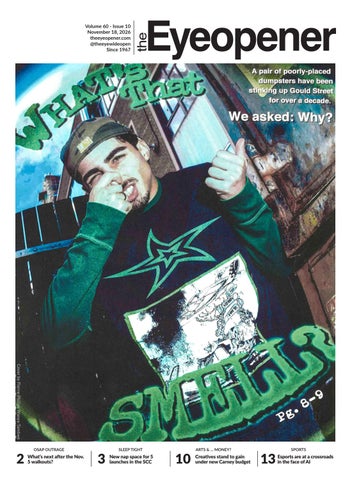
Volume 60 - Issue 10 November 18, 2026 theeyeopener.com @theeyewideopen Since 1967
2
OSAP OUTRAGE
What’s next after the Nov. 5 walkouts?
3
SLEEP TIGHT
New nap space for 5 launches in the SCC
10
ARTS & … MONEY?
Creatives stand to gain under new Carney budget
13
SPORTS
Esports are at a crossroads in the face of AI
News
THE EYEOPENER WEDNESDAY, NOVEMBER 18, 2026 theeyeopener.com/news
Next Week: He's out, she's in: Prepping for a presidential transition
Delays persist while TMSU searches for new coordinator
Some student group and course union leaders are still dealing with administrative and financial slogs Kate Ruest contributing reporter
Campus groups are experiencing ongoing delays following the departure of the Toronto Metropolitan Students’ Union (TMSU)’s campus groups coordinator and new changes to financial processes. On Sept. 21, the TMSU released a statement saying the former campus groups coordinator took an unexpected leave of absence. Campus groups faced delays as a result, as previously reported by The Eyeopener. Now, almost two months later, the union is hiring a new coordinator and groups continue to experience delays, with some claiming their situation has worsened. Asha Edwards, a fourth-year sociology student and vice president of external affairs for the Caribbean Students' Association said her club experienced delays receiving office space. Edwards said she applied for office space in late August. She sent a follow-up email to the TMSU about the matter the morning of Nov. 9. She said received a response that same afternoon informing her that she's been granted office space.
“It just makes me wonder, what would have happened if I did not send that email [...] Were we not going to get an office space until we complained?” she said. Jude D’Cruz, a second-year civil engineering student and president of Frame by Frame TMU, is also experiencing delays in both reimbursement and office allocation. He said his group did not receive confirmation regarding a locker space until they had followed up with the union. “We put that request in [for office space], in August or September [...] we only followed up with them recently [...] then they told us we got approved for a locker, but that they can't figure out the locker combos, so we won't have access to it yet.” D’Cruz also emphasized his need for reimbursement, revealing that he is currently awaiting nearly $2,000 from the union. Katharine Reyes, a 2026 business management graduate and a former executive member of the Toronto Metropolitan Acappella Collective, now called the A Cappella Collective, said she has been waiting for reimbursement of over $1,200 since April 2026. Reyes said during her time at Toronto Metropolitan University
PIERRE-PHILIPE WANYA-TAMBWE/THE EYEOPENER (TMU), “80 per cent of the time, it was a negative experience" communicating with the TMSU as a group executive. She suggested the TMSU hire more than one campus groups coordinator. "It's not the campus groups coordinator’s fault that they're slow to answer." said Reyes. In a statment to The Eyeopener, the TMSU said they intend to hire a campus groups assistant in the future. Since the absence of the former coordinator, interim vice president of student life Ahmmad
Haidary has been the main point of contact for campus groups. In an emailed statement sent to campus group leaders on Nov. 14, TMSU president Zain Baig explained the cause of the delays. "Due to increased financial governance, security procedures and TMU oversight in recent years, TMSU can no longer issue cheques or payments to students or vendors directly. We must provide all the information to TMU Finance Departments, who review and distribute the payments on our behalf," the email reads.
Baig said the TMSU has scheduled a meeting with TMU’s finance department to "streamline this process so it doesn’t take longer than it needs to and can be done as quickly and efficiently as possible." Edwards noted that communication had improved between her and Haidary, acknowledging he has been “trying his best.” “We do wish they were a bit faster and a bit more open with communication, but we'll take what we can get,” said Edwards. D’Cruz said he feels similarly, noting that individual communication with Haidary has been faster. “He's pretty good at picking the pieces back up and being organized. At least from what I can see,” said D’Cruz. The TMSU has been in the process of hiring a new campus coordinator since Oct. 28. With new leadership, some students hope the situation will improve. Janna Ojah-Maharaj, a thirdyear language and intercultural relations student and president of her program’s course union, said “[The TMSU is] setting themselves up to be in a decent enough position where I think next semester could go a lot smoother. They kind of had the opportunity this semester to get their footing.”
Meeting asks what's next after Nov. 5 OSAP walkouts
TMSU approved a Nov. 11 motion to organize a one-day strike in winter 2027 Kornelius A. Fox contributing reporter
After walkouts on Nov. 5 against cuts to the Ontario Student Assistance Program (OSAP) saw significant turnout, students and organizers are asking what’s next. On Thursday, the Toronto Metropolitan Students' Union's (TMSU) Student Action Committee meeting considered next steps for the movement, including a proposed weeklong student strike. The walkout, which was organized by the Canadian Federation of Students Ontario (CFS–O), resulted in students taking to Lake Devo in protest of recent changes to OSAP and Bill 33. The meeting was organized by the Student Mobilization Committee (SMC) and led by SMC chair Trudy Kuropatwa Trent. Attendees included executives and staff from TMSU, the Toronto Metropolitan Association of Part-time Students representatives (TMAPS), along with other students and student groups. Kuropatwa Trent opened the meeting by congratulating the organizers. She recognized the walkout as one of the biggest actions
across Ontario, with about 400 students present. "I think the most important thing to keep in mind and to ground us before we even start is: this is not the end, and we can't let it just be, 'we did the rally, we punched ourselves out'...We did the action—yes, it was good—but what comes next?" she said. Kuropatwa Trent said TMU's strong on-the-ground outreach helped produce the large student turnout. Cordelia So-Kew, faculty of community services director for TMSU said the walkout was a great opportunity to connect with other levy groups outside of TMU, including the Ontario Secondary School Teachers' Federation (OSSTF). "They talk about in CFS, that it's a structure test, right? But it's also kind of testing what your resources look like…I think it was really good how that played out," she said. The walkout also included collaboration with the George Brown Students’ Association. Deepakshi Deep, who works for the student association, reported 70 registered participants and more than 400 petition signatures. During the debrief of the Nov.
12 meeting, attendees outlined areas for improvement. Kuropatwa Trent said unclear communication and overlapping responsibilities left her managing multiple tasks during the walkout. She recommended providing individuals with specific tasks in the future to avoid others being handed unfamiliar duties and ensuring all workers are informed on the details. So-Kew said it’s also crucial to stay mindful of exam schedules for future actions. "I have a lot of exams coming up, so I understand that there are a lot of students who are like 'I want academic accommodations,'…There's just things that can't be missed in classes that students just feel it's not feasible," she said. Malik Asoh Ajesam, events and outreach coordinator for TMAPS raised accessibility concerns at the walkout, including the initial absence of a ramp to access the stage. "It was ableist that it wasn't there to begin with," dey said. Ajesam also suggested providing heaters and hand warmers at future cold-weather demonstrations. Much of the meeting eyed what’s next.
The Nov. 5 walkout saw students attend to protest the province's changes to OSAP. DANIEL OPASINIS/THE EYEOPENER So-Kew said a week-long strike motion is scheduled for consideration at the Canadian Federation of Students’ national general meeting. Its outcome has not been confirmed. Kuropatwa Trent said if it were to go forward, the strike would need substantial student and union support. "We need to build something substantial before moving towards that tactic…We should be fighting for the demands versus fighting for the strike," she said. Separately, according to a TMSU
Nov. 11 board meeting, the union passed a motion that day to organize toward a one-day strike in winter 2027. Board members said it will be discussed during the Semi Annual General Meeting on Nov. 26. "I think just knowing how many people are in this meeting and were in the past Student Action Committee meeting as well, it really just goes to show like we're trying to solidify, we're trying to grow. It's not the end," Kuropatwa Trent said.
News | 3
THE EYEOPENER WEDNESDAY, NOVEMBER 18, 2026
Small fire evacuates Kerr Hall Monday The cause of the fire remains unknown Zanoah Plummer news editor
Daniyah Yaqoob features editor
PIERRE-PHILIPE WANYA-TAMBWE/THE EYEOPENER
New nap space fits five sleepy students
Toronto Fire Service extinguished a small fire that saw Kerr Hall North evacuated on Monday morning. The building was evacuated just after 9:53 a.m., according to a TMU Safe alert issued early that morning. There have been no reported injuries at this time. According to the alert, Toronto Fire Service was notified. The university issued an all-clear at 10:09 a.m. A representative from Toronto Fire Service told The Eyeopener
the fire started in a washroom garbage can. “There’s nothing for us to be able to say what caused it, because the garbage can just basically melted. So your security did a great job. They actually used a dry chemical extinguisher on it, they put it out nice and quickly,” said the representative. “We just got there, made sure it was fully out. We just put more water on it to cool things off. So everything’s fine.” According to the all-clear alert, the second-floor area of Kerr Hall North will “continue to be restricted to clear smoke.” In an alert, the university confirmed the space reopened just after 11:30 a.m.
The space on the SCC's third floor opened Monday Nadine Alsaghir news editor
Tired students now have a new place to rest, thanks to the Toronto Metropolitan Students’ Union (TMSU). On Monday, the union opened its long-awaited ‘napping centre,’ a space that they say aims to provide students with a place to rest between classes and help manage the demands of academic responsibilities and lengthy commutes. The napping centre is located on the third floor of the Student Community Centre (SCC) and features five sleep loungers, low lighting and a rack to leave belongings and clothing. The initiative was proposed by TMSU president Zain Baig, initially as part of his election campaign. He said the executive team helped bring the idea to life. Baig said the room was proposed to help students with long commutes, awkward class schedules or work shifts, who may be sacrificing sleep in the process. “You're already losing sleep in the morning for commuting…that really impacts your ability to focus on classes,” said Baig. “It also affects your mood and mental health…taking a nap just for 20 minutes, in between, just to rebuild your focus and to just get a little bit of rest, it helps a lot and goes a long way,” he said. The space is modeled after one at McMaster University that Baig said he learned about through a friend. He said the union consulted with the people behind the McMaster nap space to learn how they could create something similar. Baig said they adopted several aspects of the McMaster space, including using the same supplier for their loungers.
The loungers use an antimicrobial material similar to that used in hospital beds, which can withstand industrial cleaners and be regularly sanitized. The centre’s policies also mirror those at McMaster. However, he said his team also made some changes to the setup. For instance, unlike McMaster's unsupervised space, Baig said the SCC's centre is periodically supervised. According to a 2024 Frontiers in Psychology study, nearly two-thirds of students surveyed at the University of Waterloo and McMaster are considered poor sleepers, and over a third were not getting seven hours of sleep. “I've seen a lot of students sleeping in random places, like outside, inside, on benches in the library,” said Baig. “A dedicated napping area should be available for everyone.” “It shouldn't just be a luxury for students who live nearby or have campus residence or somewhere where they can take a nap. It should be available for everyone.” Shanya Ramesh, a first-year economics student, said the space would be particularly useful during midterms, when students may struggle with sleep. “I actually had no sleep during midterms and when I come to school, l'll just be wanting to sleep around SLC, but I don't feel comfortable sleeping around people like that,” Ramesh said. She said having a designated space would give students somewhere they could feel more comfortable resting between lectures. Fourth-year business management student Mahroo Ahmed said she’s very conscious of her surroundings when resting and hopes the space has sufficient privacy. “I'm not even saying that as a Muslim, I'm saying this as a girl as well, I don't want just anybody com-
ing into the room while I'm napping and I'm vulnerable,” she said. Ahmed added she would be more likely to use the space if other students were not occupying it at the same time. “Maybe they could do like a partition…for example, they could have just two beds and then separated…I feel like that's too congested, five people in one,” she said. Ahmed also suggested designated hours for women, similar to women-only hours at the Recreation and Athletic Centre (RAC). Policies at the napping centre include wiping loungers with disinfectant before and after use, keeping phones on silent, refraining from using electronic devices and avoiding food and drinks. Baig said securing funding was the biggest challenge. He said the five loungers cost approximately $20,000, citing their fabric quality and long-term durability. Baig also said the initiative experienced delivery delays. Though work on the project began in June, shortly after the executive team was elected, the lounges were not delivered until around Halloween. A survey will be provided for every student that uses the room for feedback, according to Baig. He added the team may consider expanding the space if demand increases and the room is frequently occupied. The napping centre will be open Monday to Friday, from 10:30 a.m. to 5:30 p.m, with appointments offered in fixed onehour time slots. First-time users must register in person with the front desk staff and provide their OneCards. Returning users may make an appointment either in-person or by calling the front desk.
VANESSA KAUK/THE EYEOPENER
Historian-priest talks religion in global politics at IID Aleeha Raza contributing reporter
Historian and Jesuit priest, Father John Meehan, discussed how religion continues to shape international relations post-Cold War at an International Issues Discussion (IID) talk last week. In the Nov. 11 talk, Meehan argued that religion is often viewed through the lens of conflict and extremism, but can also contribute to peace-building, climate action, migration efforts and discussions around artificial intelligence (AI). The event was organized by IID, a student-led forum cofounded and managed by Toronto Metropolitan University history professor Arne Kislenko. Meehan has a doctorate in history from the University of Toronto (U of T) and is the former director for the Bill Graham Centre for Contemporary Studies. He
also formerly served as the president of the University of Sudbury. Meehan's discussion opened by reviewing the history of religion and politics in contemporary times. “I tried last night in my talk to distinguish two types of religion, you know, the religion of the oppressor, of the powerful, that uses religion to keep other people down and maintain their power,” said Meehan in an interview with The Eyeopener. He said there is a side of religion that isn't often seen; the “religion of the oppressed” that uses religion to promote equality. Meehan cited Martin Luther King Jr. and Gandhi, who both used religion to promote their causes, as examples of religion's benefit to social justice. He discussed how religion influenced global politics historically and how its role has evolved since the collapse of the Soviet Union and 9/11. Read more at theeyeopener.com.
4 | Editorial The Eyeopener Vol. 60 | 2026-27
THE EYEOPENER WEDNESDAY, NOVEMBER 18, 2026
Does TMU need a bit of TLC?
EDITOR-IN-CHIEF
This campus is an experiment in urban planning. But is it a successful one?
PRODUCTION EDITORS
Edward Lander EDITOR - IN - CHIEF
Edward “Kern -40” Lander Amira “Where's 4?” Benjamin Jasmine “Cardigan” Makar NEWS EDITORS
Nadine “Powerhouse” Alsaghir Zanoah “No Sudoku?” Plummer ARTS & CULTURE EDITOR
Sophie “Work, Work, Work” Wallace BUSINESS & TECHNOLOGY EDITOR
Mishael “Advice” Taruc
Since opening its doors nearly 80 years ago, our campus has undergone a great many changes. We've gone from one old hall to roughly 43 buildings spread across 27 acres. And the Yonge Street corridor where the university sits has seen even more change. The "sin strip" that once spanned from Dundas to Gerrard has seen many of its bars and strip clubs shuttered or swapped for high-rise housing
developments—including Zanzibar, which closed after a fire in August. But if you've read the university's 2020-2030 Campus Master Plan, you'll see that the biggest changes to TMU may still be on the way. The plan dubs many of this campus' most central buildings—like Kerr Hall, the Victoria Building and Podium as "opportunity sites," meaning they're candidates for demolition or redevelopment. In the case of Kerr Hall, the concept plan suggests demolishing it entirely in favour of two
COMMUNITIES EDITOR
Rin “Volunteer” Yanase FEATURES EDITOR
Daniyah “Garbage Juice” Yaqoob FUN & SATIRE EDITOR
Dylan “Tree” Marks SPORTS EDITORS
Francesco “One Billion” Cautillo Naomi “Recaps” Low PHOTO EDITORS
Rachel “GOAT” Cheng Daniel “Sick :(” Opasinis Pierre-Philipe “Smell-O-Vision” Wanya-Tambwe MEDIA EDITORS
Victoria “Rest & Relaxation” Andrade Ava “Sick Day :(” Whelpley DIGITAL PRODUCER
Lucas “Poople” Bustinski GENERAL MANAGER
Liane “Bike and Walk” McLarty DESIGN DIRECTOR
Vanessa “Please don't kern -40” Kauk EDITORIAL INTERN
Grayson “Line Editor” Glenn CONTRIBUTORS
Henry “Real Person” Brook Adrian “Speaker Legend 2” Ord Shreya “Double Double” Basu Emma “Scrapbooker” Dobrovnik Nicholas “Media table?” van der Ham Owen “Got motion” Coughlin D’Arcy “Does it all” Bagley Sidney “DCA?” Shaw TJ “Rookie” Atayde Gavin “Ghost” Kennington Nazifa “Double” Amin Maria “IG admin” Kotsos Santiago “Trooper” Ortega Oliver “Always” Ulster Sophia “Potential Pitch” Blew Adam “Potential” Miedzygorski Kate "Nancy Drew" Ruest Korneliuis "Accountability" A. Fox Aleeha "Coexist" Raza Chels "Networker" Awad Gray “The Huddle” Moloy Caelyn “First Guest” MancenarezWorsnop Yuna “Feach Debut!” Cho Neve “All-Star” Chamberlain EMAIL editor@theeyeopener.com
ADDRESS 55 Gould Street, Suite 207
Toronto, Ont. M5B 1E9
Letter: Remembrance Day Is a Matter of Loss, Not War Letters published in The Eyeopener reflect the opinion of the writer. Every November 11, a nation of strangers agrees to say nothing for two minutes. It is the most eloquent thing we do all year. The Toronto Metropolitan Students' Union, evidently, found the silence in want of commentary. Its statement acknowledges "the violence of Canada's military history," lists veterans among the lives lost alongside civilians and their families, and goes on to charge Canada's "alliances and actions" with the deaths of "millions of civilians." It is a bizarre choice to dissect foreign policy on a day set aside for grief. It is, however, entirely predictable; the union is ideologically bound by its own handbook. TMSU Issues Policy #9 explicitly mandates the union to oppose "War and occupation as state policies," advocating for the complete "abolition of the institutions of the military and war." A union may speak for its students on tuition, rent and the price of a transit pass; it ought to hesitate before using a memorial as a soapbox for its codified geopolitical grievances. I do not dispute that civilians die in war, or that the loss is real; the history is not in question. My objection is to the order of service. The statement mourns civilians "especially" in the Global South, which ranks the bereaved by region, as though there were colour to human suffering. And what is that ranking meant to accomplish, on this day of all days, except to turn mourners into an audience? It is "what about them," delivered at the one ceremony set aside for those who serve. Whatever the intent, the effect is to make the dead an argument. I write as an Iranian Canadian. Persia declared its neutrality in the First World War, yet was occupied regardless; between 1917 and 1919, at least two million Iranians died of
famine and disease in the shadow of a war Canadians remember every November. Those dead need no separate geography to be counted. Pseudo-compassion that needs a map to decide who qualifies is not compassion; it is curation. The statement also names the Indigenous, women, 2SLGBTQ+ and racialized veterans who were mistreated in service. The history is documented; it is indeed shameful, and it deserves a statement of its own. Attached to this one, it is not so much honoured as annexed. The union, fundamentally unable to simply express gratitude under its strict anti-militarization mandate, instead uses the real suffering of marginalized veterans as a rhetorical shield to soften an otherwise divisive political manifesto. None of this argues that war is good. Veterans know otherwise; they carried it home. Remembrance has never been a celebration of generals, and Vimy Ridge is acknowledged there, not applauded. The day belongs to the foot soldier, so often too young and so often unwilling, who got through on small acts of courage nobody recorded; to the families who waited by the door; to the peacekeepers and to those lost in service in peacetime. Not even half of us could have survived what they were put through. History produces neither saints nor devils, only people, flaws and all. The decent response is gratitude for the good, the bad and the ugly alike. We repay them by living fully, and by never mistaking peace for a given. Criticism of militarism is a worthy cause, and the calendar is generous with other days. Remembrance Day is not about war. It is about loss. Lest we forget. Submitted by Aria Bakhtiarizadeh, B.Sc. Biology candidate in the Department of Chemistry and Biology.
much-taller towers spanning a massive urban park the plan calls a "jewel." These two "world-class academic buildings" will "frame and animate the park, with active, student-centred uses and amenities," boasts the plan. The TMU proposed in this plan looks a whole lot different from the campus we attend today. But it's not hard to see why the university would want something as far as possible from the "Rye High" reputation it's just beginning to get away from. And it's no secret our cramped campus has led to a lot of issues. In this week's cover story (see page 8), writer Yuna Cho explores one of the most infamous of these woes—the waste depository on
Gould Street that often produces unpleasant odours to the dismay of students on their way to class. When we asked TMU why it's there, they told us what we perhaps already knew: in the dense downtown core, space for facilities like these is hard to come by. Cho's feature poses that same question to some of the experts here at TMU, including urban planning and architectural science profs, as well as some of the students who have to smell that smell every day. When the lofty concepts in the master plan are implemented (if they ever are) and Kerr Hall comes down, I think I speak for all of us when I say those dumpsters better come down with it.
NOW'S YOUR CHANCE TO
JOIN THE EYE WINTER 2027 EYE-LECTIONS ARE FAST APPROACHING
News | 5
THE EYEOPENER WEDNESDAY, NOVEMBER 18, 2026
BBSA helps Black students navigate a tough job market
Black youth face a disproportionately higher unemployment rate at 22.6 per cent Chels Awad CONTRIBUTING REPORTER
With a high youth unemployment rate continuing to affect Toronto Metropolitan University students, one student group is aiming to help Black students navigate this uncertain job market. On Nov. 13, the The Black Business Students’ Association (BBSA) hosted a career accelerator event, offering students networking and professional development opportunities. Keynote speaker at the event, Efosa Obano, founder of Black Founders Network and the African Impact Initiative, encouraged attendees to find driven, like-minded individuals to build business coalitions, which she says will open doors for career development. Obano shared his own experiences entering the workforce and his entrepreneurial goals throughout his university and professional career in his keynote. He emphasized the importance of identify-
ing career goals early and building professional connections. “People that are the most important to my success today are people that I met at things like this [event]...people have to go through [personal assistants], to get a hold of these people. But I made these connections with them when we were still starting out,” said Obano. Obano spoke highly of the support he leveraged while still in university and how those resources and relationships supported his entrepreneurship endeavours. “I find that we’re often very keen to connect to people we view as successful,” he said. “Mentors that have been there, done that, and we don’t enough utilize the people beside us, who are in the same ‘level’ as we are,” he said. Obano said rather than focusing on connecting with others who might be more senior, it is also important to build relationships with each other. He said these networking events
help young professionals build lasting connections that can lead to future employment opportunities. Intisar Mohamed, third-year business technology management student who helped facilitate the event said navigating university as a Black student comes with its own challenges. “I feel, as myself being a Black student, It’s really hard to find your community on campus," she said. Mohamed said events hosted by BBSA help students build confidence and career-building skills before entering a challenging job market. “I think that the most important thing is to bridge that gap and break that barrier so students actually have the opportunity to continue and are able to progress in their careers and build up that corporate ladder. It’s all through connections and all through networking,” she said. Jahmera Ricketts, a fourth-year professional communications student and a member of the corporate relations team for the BBSA,
spoke to his experience looking for jobs as a person of colour. “Honestly, it’s been pretty hard. Definitely like a lot of rejection emails, a lot of like, resume sending out and just tweaking them. Trying to make sure that they can pass AI [filters] and things like that.” said Ricketts. According to a July 2026 Statistics Canada report, the unemployment rate among youth aged 15 to 24 was 12.6 per cent, while Black youth faced a disproportionately higher unemployment rate at 22.6 per cent. The event boasted several workshops to help students get an edge in the job market, including resume and LinkedIn workshops as well as a free headshot opportunity. It also hosted recruiters from Ontario Power Generation and Onyx Initiative, a nonprofit organization that supports Black post-secondary students in accessing career opportunities. Saige McCollin, a fourth-year business management student, said she was able to find an internship through connections she had
made prior to applying for a role. “That’s how I found my placement, but I know there was like a thousand people trying to get the same job,” she said. “It’s the skills that you build and it’s one of those kind of ‘if you know you know’ things and that’s what makes it difficult for a lot of students, because sometimes they just simply don’t know.” Reginald Oblitey, lead career success coach at Onyx Initiative and host of the ‘Beyond the Resume’ workshop at the event, provided students with opportunities to connect with industry professionals in their chosen fields. “Our big thing is identity. Building your identity as a young Black scholar in Canada. The way the market is now is a tough market. How do you find your place? We do a lot of grounding around that,” said Obitley. “We really are poised to connect. Build those bridges, develop the identity and the confidence within our young people.”
your friendly neighbourhood bookstore
your friendly f iendly neighbourhood fr neig i hbourhood bookstore ig
your next great read awaits...
your next nex e t great read awaits... ex awaits t ... ts
benmcnallybooks benmcnallyb benmcnallybooks y ooks yb 108 Queen 108 Queen St. St. EE (at (at Jarv Jarvis) Jarvis) rvi rv vis)
6 | Business & Technology
THE EYEOPENER WEDNESDAY, NOVEMBER 18, 2026
Demystifying the finances behind publishing Getting noticed by a publishing house can be tricky for aspiring authors. Can self-publishing be a sustainable alternative?
Shreya Basu CONTRIBUTING REPORTER
Many academics have a goal of getting a book published, but wanting it is only half the battle. Turning their writing into a sustainable income can be an even greater challenge, whether they choose to pursue a traditional book deal or publish independently. Master of digital media graduate Viola Hernandez came up with the idea for an illustrated children’s book during the pandemic. Initially intended it to be a personal project, she decided to share it publicly after family and friends encouraged her. In an interview with The Eyeopener, she said her background in design gave her confidence to take on tasks involved in the publishing process. “Knowing that I have the skills to do it myself…[is] why I thought that self-publishing would be a good route to start with because I don't have to pay for a designer to do the book cover, the layout and even any of the drawings,” said Hernandez. She published Can You Hear the Halcyons Sing? through her personal brand, Fishy Design Studio, in 2022. The story follows the characters Lion and Bunny as they share their dreams and navigate growing up. As a Toronto Metropolitan University student, she used a self-directed course to map out a production model for self-publishing. It could yield a 30 to 40 per cent mar-
gin on book sales if the copies are produced with lesser print or paper quality and modified dimensions compared to traditional formats. Hernandez’s model explored three streams of revenue. First, she manually processed orders through her website and shipped it via Canada Post. She also used an application programming interface, connecting her Shopify store to a print-ondemand company, which handled printing and shipping by itself. Lastly, she sold her books via Amazon. According to a SheWrites article, Hernandez’s model is on par with the typical self-publisher, with authors making royalty rates of 35 to 70 per cent on e-books and around 40 to 60 per cent on print books. However, gross royalty rates don't equal a true net profit margin, as authors pay for production and marketing expenses out of pocket. Despite Hernandez’s success with self-publishing, it is not enough to get noticed by publishers. She said they are more inclined to give book deals to authors with an established audience and proven sales numbers. “It feels like [as] authors and creators, we have to do our own marketing. We have to build our own audience before traditional publishing would even want to invest in an author,” explains Hernandez. But for Hernandez, her motivation was to share a personal story with others, not monetary gain. For Alexandra D’Amico, a liter-
ary agent at The Rights Factory, the choice between the two lies in the author capabilities. Self-publishing allows for higher profits and production control, but lacks the editorial support, marketing and promotion networks that come with traditional publishing. “Is the revenue that you're getting making up for that time you're putting into it the cost of cover design and editorial help? Or are those things that the publisher is taking care of worth that extra few dollars per book?” D’Amico questioned. According to Cody Caetano, national bestselling writer of HalfBads in White Regalia and literary agent at CookeMcDermid, the biggest consideration for publishers is the quality of manuscripts they receive, as well as commercial viability and established readership. “It can be really fruitful and viable and exciting to meet an author who is quite aware of their readership and has a real competent understanding of how to connect with them,” said Caetano. Still, Caetano cautioned against generalizing the industry. Experiences and expectations vary across authors, agents and publishers. Traditionally, after signing a deal with a publishing house, an author gets compensated by way of advances, a sum of money paid over installments to financially support the author while they write their book. As the book sells, initial royalties earned go towards paying back the
RACHEL CHENG/THE EYEOPENER advance to the publisher until it is earned back in full, a process known as “earning out” the advance. Eternity Martis, an assistant professor in the School of Journalism published her memoir, They Said This Would Be Fun: Race, Campus Life, and Growing Up through McClelland and Stewart in 2020, which went on to become a national bestseller and won the 2021 Kobo Emerging Writer Prize for non-fiction. Martis is nearing the point of earning out her advance, years after her book was first published. Beyond this, the book’s success has proved to be lucrative for her; it opened doors for talks, TV work and residences. “The book had significant financial success…not necessarily because of the book sales, but because of the activities that I did around the book,” Martis said. “A lot of my book is related to issues on campus. So over the last years, I've probably done about 100 talks. Those talks are paid.” Authors do not receive immedi-
ate royalty payments on the sale of their books. Caetano explained that book deals often include a provision known as a royalty escalator, which automatically increases an author's royalty percentage once a specific sale milestone is reached. The streams of income are rarely straightforward, but Martis believes that authors can make a full-time living through keynote speaking, partaking in panels and giving lectures. For aspiring authors, D’Amico said that the biggest mistake is to expect it to happen quickly. The timeline varies for every author and it can take several manuscripts and years before a writer gets published. “Having patience and persevering and having that fortitude to hold on to the dream is the best advice I would give anybody. Sometimes it takes a little bit of time, but that doesn't mean that you should give up,” said D’Amico, “You'll see it happen.”
Read it, return it or keep it: Prof opens free library in TRSM Chris MacDonald wants to make physical books more accessible to students
DANIEL OPASINIS/THE EYEOPENER Rin Yanase COMMUNITIES EDITOR
Students in the Ted Rogers School of Management (TRSM) have a new place to pick up a book, thanks to a law and business professor. Associate professor Chris MacDonald created a free library—a
shelf of donated fiction and nonfiction books free for the taking— on the eighth floor of TRSM. MacDonald, who studies business ethics, pitched the idea of the library. As someone who is “very passionate about reading,” MacDonald said he’s been trying his best to encourage students to read and wanted to make
physical books more accessible with the building. MacDonald said the key element of the library is that the books don’t necessarily have to be returned. “You take a book and if you love it, keep it,” he said. “If you want to give it away, that's fine, too. It's absolutely no strings attached.” “I'm hoping that [there] will be a fairly constant flow of books,” said MacDonald. “I would love to be, you know, adding a couple dozen new books to the shelf every week and having a couple of books disappear every week.” The library has a donation cart located in the staff and faculty lounge of the TRSM building, seeking all kinds of books, except out-of-date textbooks, from professors. “We're taking from people who are in the habit of reading and spending a lot on books sometimes,” MacDonald said. He said he hopes to be “the conduit” between students who seek access to physical books and university professors, who are capable of providing it. “Lots of students struggle with
debt, and lots of students struggle with funding overall…I just don't want that ever to be a reason why you couldn't have a good book to read,” he said. A 2026 OECD report stated that the decline in reading has been a trend globally, and Canada is no exception. According to CBC, the average proficiency in reading of Canadian students in continues to decline since 2015. Ifnan Naazer, a third-year biology student, said she goes to a local library whenever she wants to read something, but rarely purchases physical books. Naazer said buying physical media would be “a financial burden” for her. Angelie Cantonjos, a fourth-year marketing student, prefers to have her own copies of her favourite books. “When I'm reading a physical book, it just takes me away from this digital age,” she said. Cantonjos said reading physical books feels like “me time”—an antidote to the amount of time she spends looking at a laptop screen. Clark Velasco, a second-year mechatronics engineering student,
said he doesn’t read much because he doesn’t have the attention span. “It's not as stimulating as scrolling on your phone,” he said. Velasco said people nowadays are less likely to choose physical options when consuming media. “We have YouTube videos, we have online books, online textbooks…We kind of take these things for granted because it's so easily accessible,” he said. The books in the free library are currently sorted and stored by MacDonald himself. To help him organize the shelf, MacDonald said, he’s planning to look for student volunteers from the Law and Commerce Reading Society, a student reading group he founded in 2025. “If [students are] going to be on the TTC for an hour to get home, this way, they're free to grab a book, and they'll have something to keep them company on the way home,” MacDonald said. “Given how important reading is for our mental lives…and our development as people, I just want to lower the barriers [for students to read],” MacDonald said.
Communities | 7
THE EYEOPENER WEDNESDAY, NOVEMBER 18, 2026
New club connects students with volunteer opportunities
GiveBack TMU wants to make volunteer opportunities more accessible to students Gray Moloy CONTRIBUTING REPORTER
GiveBack TMU, a brand new student club at Toronto Metropolitan University (TMU), is hoping to bridge the gap between students and volunteering opportunities. Some students say they’re being ‘ghosted’ by volunteering organizations. That's why fourth-year biology student Roshani Singh and her younger sister Rhyah Singh, a firstyear aerospace engineering student, co-founded the group. Now, the student-run volunteer plug is well into their first semester in action. In an interview with The Eyeopener, Roshani said the idea to start the club came up through watching her sister struggle to find volunteering positions to complete her mandatory 40 hours of community involvement as a high school student. “It was a lot of applying and not hearing back,” Rhyah recalled. “In my head, I was kind of like, if I do it through a school club where I can show the organizations that there is a larger interest of help, and also, if we're able to do it with you once, it's likely that we will be able to volunteer with you again when you need.” The pair decided to create a
newsletter to compile current volunteer opportunities for interested students. “Barriers like not hearing back, not getting a response…can really put people off of [volunteering],” said Roshani. “It's like applying for jobs as well. You know, when you keep applying and not hearing responses back, you're just less likely to do it as much. And that's not what we want with volunteering.” she said. At the beginning of the school year, Roshani and Rhyah tabled at a campus groups fair to share the idea with students. Rhyah said 100 students signed up for their newsletter that day. Anisha Kabir, a second-year public health student, said she met the sisters at the club fair. “I never saw a university club helping students get into volunteering,” said Kabir. “I thought it was super cool.” Kabir is now the education and marketing lead for GiveBack TMU. In her position, she organizes current volunteer opportunities into the newsletters for prospective student volunteers. Through their newsletters, students can choose which volunteering opportunities fit with their schedule, Roshani said. “It
really is a no-commitment club.” Currently, GiveBack is seeking volunteers for shifts at Daily Bread Food Bank and North York Harvest Food Bank in late December. Christian Chiarotto, a third-year economics student, is GiveBack TMU’s finance and outreach coordinator. He said the organizations they have reached out to have been very receptive to the idea of working with the group. Their first volunteering shifts will bring out 10 to 15 volunteers for each food bank, he says. The application for both opportunities closes on Nov. 20. From connecting with some of the organizations and charities, Roshani had learned that many are seeking to expand their teams of volunteers to a younger age group. Through volunteering at food banks, Roshani and Rhyah hope to increase access to nutritional food that reflects that vast amount of cultures and diets that
RACHEL CHENG/THE EYEOPENER need to access the services. “A lot of the time, the basics that they have to offer at a food bank just aren't something that they can actually consume,” said Roshani. Roshani said the sisters are especially passionate about helping food banks because of their own family history with food banks. “It holds weight to us,” she said. GiveBack TMU will be coordinating more volunteering opportunities for students to get involved
this holiday season, said Roshani. “We're thinking [of doing] two or three bake sales throughout the year to try to fundraise money for [SickKids Foundation],” she says. “Yonge Street Mission has also asked if we could host a toy drive.” The club's goal for the next term is to have events or volunteering opportunities every week. “We want to get volunteers into volunteer opportunities as much as we possibly can,” said Roshani.
South Asian law students come together for festival celebration
The joint event gathered two student groups for Diwali and Bandi Chhor Divas Caelyn Mancenarez-Worsnop CONTRIBUTING REPORTER
The Sikh Law Student Association (SLSA) and the South Asian Law Student Association (SALSA) hosted their first Diwali/ Bandi Chhor Divas Celebration at Oakham Lounge on Nov. 13. Both SLSA and SALSA are student-led groups under the Lincoln Alexander School of Law. SLSA creates a space for Sikh identifying students to network, seek mentorship and guidance from peers and lawyers actively in the field, while SALSA also provides similar opportunities for all South Asian law students. The two organizations hosted the event to celebrate both holidays together. Diwali is the festival of light celebrated in Hinduism, Sikhism and Jainism, also called Deepavali. Bandi Chhor Divas, a Sikh festival, means “Day of liberation,” falling on the same day as Diwali—this year, on Nov. 8. Both organizations agreed to collaborate to host their first celebra-
tion together, with sponsors from Blake, Cassels & Graydon LLP, a large Canadian law firm. Rhia Dhindsa, is a second-year law student and co-president of SLSA. Dhindsa helped organize the event alongside co-president Jupnoor Aulakh, vice president Kulveer Toor and SALSA president Arvith Jhirad. Dhindsa said student events for these holidays rarely happen, specifically in the school of law. “I feel like there wasn’t [an event for Diwali/Bandi Chhor Divas] that happened before at this school; we wanted to find a way to bring the South Asian community together, the Sikh students together, and just remember that we are all one,” Dhindsa said. Ayesha Khokhar, a secondyear law student and member of SALSA, said this event was not just about celebrating the holidays; it was about bringing together a community. “The law field is getting more diverse, but it’s not quite there yet. So, I think having these events [is] just so
important to build those connections early on,” she said. This celebration included a keynote speech from Aaron Bains, a South Asian lawyer at Aird & Berlis LLP. Bains spoke to the members about how small acts of kindness can change a person's life. He shared stories about his time entering the law industry and gave students advice about networking with their peers. Bains also discussed the importance of the Ontario Student Assistance Program (OSAP) and how vital it is for students to receive an education, specifically law students. Sharing his thoughts on the fact that law students would no longer receive OSAP funding, Bains said: “Nobody screws over students.” Arjun Rattan, first-year board representative of SALSA, said that it was important to him to see the effort clubs were making to commemorate an important holiday on a large scale.
The two groups gathered in Oakham Lounge on Nov. 13. CAELYN MANCENAREZ-WORSNOP/THE EYEOPENER “It's just nice knowing that the clubs, the organizations at our school, are putting on events to commemorate...Diwali and Bandi Chhor Divas,” Rattan said. “The fact that we all fall under the South Asian umbrella, and we respect...our differences and celebrate each other's cultures is a huge thing. It not only brings us together, it stifles the division you see in the political world and society in general,” he said. Iqra Syed, a first-year board representative of SALSA, said she celebrated her first Diwali at the event and felt like it was im-
portant to come and show support for her community. “As someone who moved out of their home city...I feel like coming to this event helped me feel closer to my culture and just celebrating with people who grew up [similarly] to the way I did,” said Syed. Sofia Prebtani, a first-year law student, said it's important to find ways to have breaks from school during these important holidays. “I think school is so busy and life is so busy, especially in law school. So it's a way to kind of escape from that,” she said.
EYEOPENER 8 | THE WEDNESDAY, NOVEMBER 18, 2026
S ' T A WH THAT L? L E M S
I
T’S MID-SEPTEMBER and architectural science lecturer Scott Sorli knows exactly where he’s taking his students for a quick lesson: the Gould Street dumpster. Marked by an enclosure at the corner of Gould and Church Streets, just outside Kerr Hall, the streaks of brown on the pavement are the unmistakable sign of the infamous waste site—that is, if the pungent smell in the air didn’t tip you off first. With the second-year students of his architecture studio, Sorli goes on a tour of the campus from the Architecture Building to the World Food Market on Yonge Street, where the class this year is conducting a field study. On the tour, he hopes to teach them the history of the buildings and urban elements around them. That’s what makes the dumpster a necessary pit stop, Sorli says. His group of 13 stand around the enclosed site, slightly perturbed by the smell (“garbage juice,” one professor suggests), but they know why he’s brought them here. Sorli asks his students to be conscious of the architectural decisions made in the world around them. He asks them to question: where would you put the garbage? Surprisingly, it’s not always an easy answer. Over the last several years, as Toronto Metropolitan University (TMU) has rapidly grown, the stench of the Gould Street dumpster has, unfortunately, part of the campus character. Sat in a public-facing part of campus, it’s become a question that many is asking—why is the refuse of the school out in the open for everyone to smell? Sorli doesn’t necessarily agree that the dumpster should be smack in the middle of the university. But the answer as to why it’s there may say something about the school’s urban identity.
T
he Ryerson Institute of Technology—today, TMU— was first established in 1948. Just 250 people made up its first batch of students. Fast forward to nearly 80 years later, and the since-accredited university sees upwards of 45,000 students each year and has expanded to take over more of the downtown core.
FEATU
For years, a group of dumpsters have been stinking up Gould Street. So why hasn't TMU moved them? Writer Yuna Cho discovers the answer may have something to do with the school’s cramped urban campus and ever-shifting identity
To this day, the heart of the university and one of its main buildings given its sheer size, is Kerr Hall. It’s among the older buildings of the university, having been built in the 1960s. It may also have a role to play in the stink. The main reason the garbage area is located where it is today, according to Sorli, may be related to the anti-urban philosophies that influenced city planning and architecture during the mid-twentieth century. That philosophy, as some experts explain, was a reaction to increasing urbanization by those who didn’t believe a city was the ideal place for people to live. Before it was the Ryerson Institute of Technology or TMU, the school was a teachers' college known as the Toronto Normal School in the mid-1800s. When Howard Kerr came into leadership, it was renamed and transformed into a post-secondary institution—with that came big construction changes. The old buildings of the Toronto Normal School had to be demolished, and instead, were replaced with what we know today as Kerr Hall. “The parti for the new academic building… was a three-storey block with a raised basement built around a courtyard,” a study on the history of Kerr Hall establishes. The main entrance to the complex was through a gate to the north on Gerrard Street, while two smaller archways on Gould Street welcomed people from the south. The building had pedestrian access on all four sides, but for a while, it was Gerrard Street that was more popularly used. What the architects of the over half-acentury-old Kerr Hall may not have imagined was that the area around their waste site on the Gould Street side would soon become a heavily pedestrianized zone, someday leaving hundreds of 20-somethings with no choice but to hold their breaths as they walk by. In a statement to The Eyeopener, the university said the area “is a central waste depository on campus for multiple buildings. Given the Toronto TMU Campus is located in an urban setting with space limitations, this has been the most suitable location.” But Sorli says now that we’ve moved
away from those mid-century philosophies, TMU’s approach to garbage should develop, too. “I think that the university is maintaining a legacy that is anti-urban in form because of that dumpster's location,” he says. "But now I think that the conception of the city is a much more positive one than it was when this building was built. And so we need to accommodate our new understanding of our experiences of the city as a potentially positive one and not to denigrate it through leaving garbage around.” As for the smell, Sorli thinks it may be a combination of food and waste, forced to mingle for several days on end, under the beating sun in the summer, that gives off an unseemly stench. The run-off on the streets, he says, is the same kind of liquid that collects at the bottom of a garbage can. Although the school has expanded in recent years—something that Chris De Sousa, an urban planning professor at TMU did not necessarily expect to see—it still doesn’t cater itself to freely rearranging things. “I don't think it was ever intended to grow as well as it has,” De Sousa says. “I think it was meant to be Kerr Hall and some smaller buildings, and it's grown kind of with the downtown.” Before Gould Street became a pedestrian intersection, De Sousa
“It was really bad, it’s always stinky and I don’t know why it’s in the middle of the campus.”
says because of the nature of Kerr Hall and its entrances, Gerrard Street would have been the entry point as it was a vehicle-heavy zone, while Gould Street would have been the less busy street. But as TMU began to expand north, east, south and west, the flow of traffic changed, too. Now, Gould and Church are among the busiest intersections with dozens of students waiting to cross at all hours of the day. Other comparable universities in the city like the University of Toronto (U of T) and York University, own large swaths of land. U of T St. George sits on more than 180 acres; York’s Keele Campus is one of the largest in Canada at over 500 acres. TMU trails far behind, jamming 43 buildings on just 27 acres. TMU has largely grown through the acquisition of nearby buildings as they vacate. Most recently, the university has taken on the old Toronto Public Health building at Victoria and Dundas, as well as a collection of buildings on Dundas and Bond, including the Imperial Pub, which will soon be home to a 1,370-bed residence. On Church Street, the school is adding five stories to O’Keefe House, turning it into the new Centre for Student Wellbeing. But changing how the old buildings operate, like Kerr Hall, which is heritage-listed, costs more, and so it comes down in the list of priorities. The growing number of students on campus have already made every corner of it home. De Sousa, an urbanite through and through, still marvels every time he walks down campus these days—the rock at Lake Devo now blasts music and even well into the evening, he finds stu-
URES
THE EYEOPENER WEDNESDAY, NOVEMBER 18, 2026
dents gathered along the paved university grounds, sitting outside of Balzac’s and enjoying the urban life. “The reality is, as that street has become pedestrianized, it's become more popular, and you get more people eating lunch, students liking to linger and enjoy their time there,” De Sousa says. It’s a sweet development but the problem of the smell remains. In fact, it’s perhaps a question of the university’s reputation.
A VISUALS BY PIERRE-PHILIPE WANYA-TAMBWE
nora Constantine and Kesavy Baskaran were among the hundreds of eager students that packed TMU during this year’s Orientation Week. The biomedical science and computer science majors respectively were excitedly exploring the campus they’d call theirs. Something they haven’t forgotten from that week, however, was the stench as they crossed Gould Street. “It was my first impression,” Constantine says. “It was really bad, it’s always stinky and I don’t know why it’s in the middle of the campus.” Constantine says she recognizes the campus is in a dense downtown, but says the dumpster’s presence in the middle of it leads her to question the university’s attention towards sanitation nonetheless. For its part, the university says it is making efforts to address the leakages and smells. “We do recognize that as is common in an urban setting, there are sometimes odours and leakage from this space and we make ongoing efforts to address this. These efforts include power-washing the surrounding area and cleaning the compactor. This past summer, we also installed additional absorbents and deodorizers,” a statement reads. But some students don’t feel these efforts are making an impact. “I didn’t want to come to Oakham Cafe, [Daphne Cockwell Complex] or the engineering building,” Baskaran says, thanks to the smell. The pair have classes in the engineering building, and to get there, they use Dundas Street East and avoid the intersection all together. The waste depository is a big enough problem that it’s become a recurring topic on the r/TorontoMetU subreddit.
|9
"Given the Toronto TMU Campus is located in an urban setting with space limitations, this has been the most suitable location" — TMU FACILITIES MANAGEMENT AND DEVELOPMENT “I simply stop breathing,” one user said was their solution. “Personally, I have set paths that I walk depending on where I need to go. These paths also, on average, have the least annoying outdoor smells. But normally, when you get ‘surprised’ by the smell, a quick breath hold and fast walk will help you get out of it,” another poster advised. Sorli says there is something to be said architecturally about the response to the reeking dumpster—a stench even he calls revolting “in a certain sense.” “Smell is an urban condition,” Sorli says. But it’s one that’s long been overlooked in architecture. As it stands currently, some experts suggest that much of urban planning revolves around visual aspects. But the experts also say that smell plays a big role in our lasting perception of a place. For decades, parts of TMU have, simply put, stunk. Compared to universities like U of T and York that are contained within a set of “walls,” even figuratively so, TMU prides itself on being a part of the city in a way the others are not. Because of that, it gets slapped with the same label as Toronto does: unclean—because of the way humans perceive bad smells, as signalling a dangerous or unsatisfactory place. De Sousa says in the grand scheme of things, the problem TMU faces is not that big a deal. Rather, for urbanites, the various smells of a city, good or bad, are part of the experience. Like chirping birds add character to a forest, smell gives character to the city. All of his favourite educational experiences have been on campuses that were deeply embedded in an urban zone, with all the pains that comes with being at the centre of it all. “If you're an urbanite, and you like urban things, and you like the big lights, big city action, the noise, the variety of people, then this is the kind of place that you want to be.
If you want to be in a campus with benches and lollipop trees, probably go somewhere else,” De Sousa says with a laugh. So why the Gould Street dumpster smells is a moot point—it is a dumpster. Instead, the question is whether we can fix the problem of it being a university landmark.
I
n TMU’s campus master plan, the redevelopment of Kerr Hall is central. The building has been dubbed an “opportunity site,” meaning it’s a candidate for internal renovations to “refresh and improve the existing space,” or to be demolished entirely. The plan hopes to make the Kerr Quad the campus “jewel” by turning it into a community park that provides a green space for the university. The existing building would be replaced by two taller buildings on each side, known as the "New West Park Building” and the “New East Park Building” in the concept plan. However, it’s not clear what the redevelopment would mean for the dumpster or waste management on the whole. De Sousa and Sorli both say that expectations that the dumpster would be moved in the redevelopments have to be tempered. “That's what makes planning in a city kind of more interesting, is that you've gotta navigate these challenges and try to come up with the best solution of the bunch, and you're never gonna make everyone happy, but you try to find the better compromise,” De Sousa says. For Sorli, the question of why things haven’t changed sooner may also come down to funding. “The university itself is cutting back on, let's just say maintenance and care of the institution, and instead it's spending more money on security and disciplining of
the institution,” he argues. Sorli says he feels he sees more security guards on campus than care-takers. “That’s a financial choice of the university that I think is perhaps misplaced priorities.” According to this year’s budget report, the annual deferred maintenance increased by half a million dollars. De Sousa agrees that maintenance may not receive as much funding presently—it’s one of the expenses that many institutions in Ontario considered expendable during the tuition freeze, as funds may have gotten tighter, he says. An opinion piece in The Globe and Mail last year suggests the “financial chokehold” Ontario universities have been placed in means they are cutting programs, jobs and deferring maintenance. But De Sousa doesn’t think more money is going into one pocket than another. He says students and their students’ union should find ways to enhance the campus as volunteers and, like he sometimes wipes down tables as a professor, take responsibility for the campus they spend time on and keep it clean. Still, if it’s a matter of the school’s reputation, Sorli thinks it is worth every penny. That’s why he makes his students stand in front of the dumpster and bear witness—so when it comes time for them to be architects themselves, they may do so with more attention to the inhabitants in mind. “I want them to experience the negative aesthetic of the smell of the garbage because that's what everyone experiences,” Sorli says. “Someone comes to Toronto Metropolitan University and expects a quality educational experience—and this is the welcome that they get at one of the most important thresholds to the university. I think it's just a mistake.”
Arts&Culture
THE EYEOPENER WEDNESDAY, NOVEMBER 18, 2026 theeyeopener.com/arts
Artists stand to gain under new Carney budget The proposed Canadian Creative Credit could offer artists tax relief Shreya Basu contributing reporter
Prime Minister Mark Carney announced Canada’s new federal budget on Nov. 5 and it includes a provision that may make finances more manageable for artists. The budget includes the creation of the Canada Creative Credit, a proposed non-refundable personal income tax credit that would provide tax relief on up to $45,000 in annual qualifying net business income derived from original creative artistic works. In simple terms, non-refundable tax credits reduce the amount of taxes you owe, but cannot bring the owed amount below zero, where you get paid the difference (as tax returns). The proposed credit would apply alongside the existing basic personal amount, which lets you earn a set amount before needing to pay federal income tax. Students in Toronto Metropol-
itan University's (TMU) creative programs say the credit could go a long way. First-year image arts film student Angelina Lo sees the credit as a positive step and said the arts deserve greater institutional support alongside STEM fields. “You go watch a movie, you pick up a book, you see art on the walls as you walk through the city…that's what's running our world,” she said. Lo said the government could do more to support young artists. Third-year photography student Sam Cianpa said while the proposed credit could offer some financial breathing room when pursuing a full-time career in the arts, they believe more needs to be done to support emerging artists. “People can't really afford their own rent, let alone studios rent,” Sianpa said, adding that more affordable creative spaces and government funding could help artists sustain themselves financially.
RACHEL CHENG/THE EYEOPENER In an interview with The Eyeopener, creative industries adjunct professor John Schoales said the credit could benefit artists who have been previously excluded from government funding and grants determined on citizenship or residency requirements. “I think an important part of
this is that [it] could benefit excluded artists [since] it's being delivered through the tax system. So it's a non refundable tax credit, which means anyone who pays taxes should qualify for it,” explained Schoales. Schoales also suggested that the Canadian government's emphasis on sovereignty amid trade ten-
sions with the U.S. could also be a driving force in supporting Canadian artists in an effort to further a Canadian identity. “I think the government is trying to tap into the idea of giving artists support because it creates…further Canadian identity and independence on a psychological level,” said Schoales.
New book from former journalism associate chair explores intimate partner violence
Ann Rauhala’s She Ran details her reckoning with the grief of her best friend’s murder, over 50 years later Sophie Wallace
dressing this enormous social injustice that we seem to be so poor at recognizing is to have a sort of Me Too moment on this front. I invite every woman, but particularly those who have really won a lot of life's lotteries, to step forward and say, believe it or not, I was abused. And I'm seeing that happen now. How could I call on other women to do that, if I'm not willing to say, you know, I had a boyfriend who I thought was going to hurt me one day, and I decided to leave?
ArtS AnD cuLture eDitor
Ann Rauhala was drawn to journalism through an urge to tell stories. She came to Toronto from Sudbury, Ont. in 1973 to study. She went on to do a BAA in journalism at Toronto Metropolitan University (TMU) from 1977 to 1979. When she was 21, Rauhala’s best friend was murdered in a brutal case of intimate partner violence (IPV). The loss has stayed with her throughout her long career as a foreign editor for The Globe and Mail, a television news documentary filmmaker at CBC and a professor of journalism at TMU. Nearly 50 years later, Rauhala decided to write about it. The result, She Ran: The Media and the Public Response to Domestic Violence, published Oct. 2026. She Ran is a beautiful, intimate and hard-hitting examination of the people and the grief IPV leaves behind, and what it will take to move closer to eradicating this violence from our society. This interview has been edited for length and clarity. As journalists, we’re taught that we have to remove ourselves
from the story, even if we are activists at heart. How did you strike the balance between memoir and investigative journalism?
In the book, you touch on the idea that there's no such thing as the perfect victim. It's so easy for people to think that IPV is only something that happens to other people. What are some misconceptions that contribute to IPV being so pervasive?
I was also taught to keep myself out of the story. It mystifies me a great deal that there are still journalism instructors in Canada promoting this idea of objectivity. No one I ever taught was told that objectivity was the goal. This wasn't a completely factbased reporting project. This was my life's work, and I wanted to step up and say what really went on. I think an important key to ad-
Well, first of all, this attitude that somehow certain socioeconomic or ethnic groups are more predisposed to this kind of violence—it just isn't true. IPV is absolutely everywhere. And I speak from now personal experience, because since the book was released, I'm having strangers, or friends of friends, disclosing to me the violence they endured, at least twice a week. I think another issue and another
She Ran was published Oct. 26
problem is our own sense of, "oh, this is a private matter." That is such a falsehood, because we know that this kind of violence brewing in privacy can erupt into a deadly mess that affects all kinds of people who are completely uninvolved. Finally, what do you want people to know about your friend? She was an intelligent, warm, kind, young woman who clearly had a big future ahead of her. And I and dozens of others were deprived of having the opportunity of having her go along our decades together. She would certainly have been in-
fluential in any community she lived in, and she always had an instinct to stand up to bullies, and to look out for the underdog. In her short life she demonstrated that. She was alive, and she was lively and funny and energetic and had her little insecurities and could laugh at herself. Those close to her lost a lot, but we all lose a lot when someone like that leaves us for no reason other than the unattended mental health struggles of a young man who believed that he loved her. So, we should never have lost her and I don't want anyone like her to go missing the way she did anymore.
The author in her early 20s. SUBMITTED BY ANN RAUHALA
Arts & Culture | 11
THE EYEOPENER WEDNESDAY, NOVEMBER 18, 2026
Community at the Cutting Edge Emma Dobrovnik contributing reporter
What comes to mind when you hear the word collage? Maybe you think of snot-nosed kindergarteners fighting over a lone tube of glue. Maybe you think of a geriatric scrapbooker with one too many Michaels gift cards. A few post-secondary students might think of something else altogether. It seems like everyone and their mother has attended some kind of cozy-collage-zine-making workshop—and for good reason. A quick online search of Toronto art events will turn up any number of “free-to-attend, supplies-provided” craft nights, from moodboards to printmaking. However, collaging may very well be at the helm of the crafting renaissance. What is it about a pair of scissors and some thrifted magazines that get arts and engineering students excited? Are we disillusioned with the algorithm? Are post-COVID youth attempting to recover third spaces on campus? Do we merely possess a primal impulse to cut things up and stitch them back together? Lilly Chamblin, president and founder of Toronto Metropolitan University (TMU)'s Printmaking and Zine Club, understands collaging’s tactical appeal. Having hosted collage and zine-making nights on campus since last fall, Chamblin has seen huge turnouts at the club’s events. While her role as facilitator may be handsoff, she feels that students yearn for a hands-on experience now more than ever. “I do think people are really craving physical media that’s been eradicated…I also think people like these slower experiences,” she said. “Everything is so fast, and being downtown, to just get to sit in a room for two hours and put something together with your own hands; you kind of just get to breathe. I think people really value that.” Chamblin first pitched the idea for a TMU printmaking club in 2024, but the Toronto Metropolitan Students’ Union requires potential clubs to demonstrate student interest before being officiated. Initially hoping for 20 student signatures, Chamblin received 120. “It’s so hard to get people to talk to each other. It’s impossible to make friends in classes, but there’s something about that environment,” she said. “We get people coming in by themselves or maybe with one friend and they end up sitting at a table with six people. Then they come back with each other for the next meeting because they’ve become friends after sitting at a table and collaging for two hours.” It seems the veneer of social anxiety all but erodes when you’re
elbow to elbow at the collage table. After all, it’s hard to ignore someone when you’ve got to ask them to pass the glue. Beyond collaging, the club also hosts moodboard-making workshops, linocut patch nights, and even Halloween crafting sessions. Chamblin hopes to offer more printmaking workshops going forward. “Art of really any kind has become such an expensive hobby to have, and as one the few art clubs on campus, I want it to be something where all our events are free,” she said. “We want anybody of any skill level to be able to come and participate.” While collaging and community may go together, it's impossible to talk about collage without touching on transgression. Born on the fringes of surrealism, collaging paved the way for those marginalized within mainstream art movements. Collaging pioneers like Hannah Höch and Eileen Agar were among the first to legitimize the art form, and collage played a pivotal role in later countercultural spheres like the 1990s’ riot grrrl and queerpunk movements. Widely considered the only woman surrealist, Agar began working collage into her paintings as a way to recreate herself in her own image. She spoke openly about how surrealism positioned women as muses—something to be seen rather than someone that sees. Oddly enough, it wasn’t until she crashed into a mirror that she considered how collage could function as a medium of reinvention. Relegated to the role of the eternal object, Agar noted how collaging’s very form mirrored her life and career. Like Agar, Höch was the only prominent female artist in her scene, transcending genre altogether. Her use of collage was both playful and political, with pieces like “Beautiful Girl” parodying beauty standards. The audacity in her messaging resulted in her being labelled a "degenerate artist” during the Second World War. Since collaging skirts the conventions of fine art, it was adopted by early zinemakers as an accessible way to design and publish independent media. Zine-making's sheer ease allowed those barred from traditional media to share their art and writing. Zines democratized publishing, crafting networks of local literature and lived experiences. One of the first Queer zines, G.B. Jones and Bruce LaBruce’s J.D.s (Juvenile Delinquents), was born right here in Toronto. A seminal Queer text, J.D.s coined the term “Queercore” and circulated artwork considered too seedy for mainstream publications. With little to no budget and total editorial independence, J.D.s was a form of gonzo journalism. The self-described “anarcho-punk queer zine” carved out a space for those who felt too Queer for the punk scene, too
When tearing things up brings people together
RACHEL CHENG/THE EYEOPENER punk for the Queer scene. However, it may be that Gen Z’s return to analog suggests a kind of tech disillusionment. The entertainment most readily available to us is increasingly dictated by profit-motive. When you can’t scroll any platform without seeing hypersaturated reels, the analog revival feels deeper than a romantic retrospective. Could Gen Z’s fascination with digicams, wired headphones and yes, collage, be considered its own kind of revolt? I posed the question to Lucy Zuo, a multi-media artist and volunteer at the Toronto Zine Library (TZL). Not only does the library serve as a community archive, but the volunteers also host collage, junk journalling and cardmaking workshops. As far as preserving physical media, the TZL is a general authority on all things print. “We live in a digitized world where a lot of information is shared via monetized platforms owned by people who have a vested interest to push certain things and not push certain things,” Zuo said. “I think it’s really important to have an archive of physical documentation of moments in time that aren’t censored.” But why collage? If we’re so hellbent on physical mediums, why not buy a sketchbook and call it a day? To answer this question, I went back to my roots. As a social science student turned do-it-yourself aficionado, I’ve had an off and on relationship with crafting since elementary school. As a kid, I loathed the craft table. Whereas others would flock to the jumbo-pack of Crayola, I’d fantasize about long division and grammar. During craft time, there was no instruction manual. There were no right or wrong answers, and I couldn’t figure out how to “win” at art class. When I was 13, I discovered collage through Rookie Magazine, an online zine run by and for teenage girls. Something about seeing reader-submitted collages made
me think I could do it too, or at least try. I’d spend hours collaging on my bedroom floor, unsure of what I was making but content all the same. I stopped collaging in high school, trading scrap paper for Tumblr moodboards. It wasn’t until 22 that I got back into it for good, and I owe the University of Toronto's The Gargoyle for reigniting my love of collage. I first submitted an article to the publication in winter 2025 and despite my reservations, I left that production night having made something uniquely my own. More importantly, I left having made friends I still have to this day. So I wasn’t surprised to hear Druphadi Sen, one of The Gargoyle's current editors-in-chief, discuss the paper's production night. Collaging may cut through social tension, but she also mentioned its accessibility. “Newcomers, first-years and people we met during the clubs fair might not necessarily have the technical expertise to do the layouts of their pieces, like on InDesign or Photoshop, because that's its own set of skills,” Sen said. “They also might not feel confident enough to contribute right away, so collaging is a really accessible way for them to participate.” And she might be right: you don’t need to be an artist to collage. If you’ve got paper, glue and an idea, you’re set. If I’m being honest, you don’t even need scissors. For arts teacher and sculptor Khush Sagar, collage is an exercise in error. Having taught art to kids, seniors and everyone in between, she sees collage as an antidote to perfectionism. “I think adults have this fear—and it’s instilled in everyone—to be less creative and more representational,” she said. “There’s no such thing as error in art, but specifically through collage there’s so much endless possibility without any real chance of messing it up.” Maybe there’s no such thing as error in art, but other mediums
are surely less forgiving. What distinguishes collage from something like linocut is that you’re expected to err when collaging. In fact, you’re even encouraged to do so. Collage is failure-forward, meaning even the most art-averse can participate. Collaging’s lack of a technical barrier is worth celebrating, but its accessibility is twofold. Alanna Chelmick, art facilitator at Toronto's Issues Magazine Shop, noted that people gravitate towards group collaging partly because of its affordability. “People want to be in community, and they don't always want to be drinking, right? It's not always about going to a bar or restaurant and spending exorbitant amounts of money,” she said. “But people want to connect with folks and do it in a way where it's encouraging a good feeling. I think that's the power of collage.” For many, the community hangout is a lost art. At a time when 60 per cent of Canadians feel disconnected from their communities, the opportunity to be with others is nothing short of paramount. But when 58 per cent cite affordability as a barrier, it can also feel too good to be true. From TMU’s Printmaking and Zine Club to the Toronto Zine Library, many collage events are free to attend or pay what you can. More often than not, materials are provided. It’s no coincidence that an art form predicated on repurposed materials would lend itself to affordability. In a way, collaging is an equalizer. It’s not pay-to-play, and you don’t need a fine arts degree to “get it.” Anyone can do it, and it seems that almost everyone wants to. Collage persists because it demands something of you. Not technical skill or financial investment, but time and attention. It demands that you leave the house, sift through materials, and sit with the worthwhile tedium of creation. And for all that collaging may demand, people just might be willing to deliver.
Sports
Catch up with post-game recaps at theeyeopener.com/sports
THE EYEOPENER WEDNESDAY, NOVEMBER 18, 2026 theeyeopener.com/sports
Behind the Bōgu TMU’s Kendo Club aims to foster a welcoming community while preserving a Japanese martial art Francesco Cautillo sports editor
It's the evening of Nov. 4, and Toronto Metropolitan University's (TMU) Kendo Club president Jazz Yeung is in the basement of the Podium building preparing for their annual safety meeting. Kendo is a sword-fighting martial art deeply rooted with Japanese cultural ties. The word ‘Kendo’ translates to ‘the way of the sword’. In this competition, combatants look to strike the opponents' head, chest, neck and wrists through the use of technically-demanding motions. Yeung, who is a fourth-year social work student, started the sport only a year ago. They say the movements involved in the sport “might be a deterrent for some people” at first, but the sense of community and routine of Kendo itself eased their transition into the sport. “When you do exercise and do this intense training that has a military background, you tend to form really close bonds with the people you do this with because Kendo’s hard,” said Yeung.
To balance the intensity, Yeung organizes monthly socials outside their Kerr Hall Gym dojo, making sure all club members get “a chance to really get to know each other.” While Yeung prepares the safety seminar, their clubmate Sebastian Brawn-Czapski prepares the swords, or shinai (竹刀), with an oiling treatment. Brawn-Czapski, a fourth-year child and youth care student, joined the Kendo club just under two years ago, around the same time as Yeung. As someone who enjoys medieval martial arts, Brawn-Czapski was eager to explore the sport, quickly discovering the balance between the sport and the cultural traditions attached to it. “I was not necessarily expecting this level of rituals attached to it,” said Brawn-Czapski. “It’s almost like a form of meditation.” With that said, Brawn-Czapski used the sport to his advantage, quickly adapting to the principles of the traditional Japanese sport. “It gives you a space to exercise with friendly people that don’t
PIERRE-PHILIPE WANYA-TAMBWE/THE EYEOPENER mind you being you, so long as you're following the guidelines and the rules of the dojo.” The TMU Kendo Club has also fostered a community of acceptance, often bringing together Queer and neurodivergent groups among other members. Brawn-Czapski, who is neurodivergent, describes the sport as incredibly relaxing for those like him. “We spend a significant amount of our time masking to try to be normal,” said Brawn-Czapski. Now, he and other neurodivergent members can replace their social mask with a Kendo mask, called men (面), and other protective armor called bōgu (防具).
Equipped with protection and their swords, called shinai (竹刀), members are ready to train. Yeung said the club members often connect with their "similar hobbies outside of Kendo,” saying that “when you have stuff in common, it’s easier to talk and connect.” Not only does the club hold themselves responsible for being welcoming to all, but they are also accountable for the crucial acts of dojo etiquette associated with Kendo. Some of this etiquette involves bowing in, lining up in a specific fashion and making sure to bow to the dojo and any sensei that are present. “It’s pretty fundamental [to
preserve] because if we go and visit other dojos and break etiquette, then we look really bad,” said Yeung. Both Brawn-Czapski and Yeung said that preserving Japanese culture is also an essential part of the club’s principles. “Traditions make us whole,” said Brawn-Czapski. “We have international students here. You want to look for something that reminds you of the structure that you’re used to. So having something like that, having a space like that set up in TMU, makes us more inclusive and a space for everyone from around the globe to just come out and learn new things.”
Bold tally 20th consecutive victory over Trent
TMU women's volleyball claim back-to-back wins over Trent, move to 4-2 on regular season TJ Atayde contributing writer
The Toronto Metropolitan University (TMU) Bold women’s volleyball team completed a weekend sweep after defeating the Trent University Excalibur in four sets on Sunday at the Mattamy Athletic Centre. Following their straight sets victory the previous day, the Bold looked to extend their winning streak against the Excalibur to 20 games and extend this year’s regular season winning streak to four games. The Excalibur looked eager to bounce back, building a run for an 11-7 start in the first set. Fourth-year outside hitter Kathryn Beresford led the charge for Trent with 19 kills in total. TMU would battle back in the set to be within one point, but unfortunate errors led to the Excalibur reaching set point at 24-20. In need of a spark, acting head coach Julie Gordon turned to fourthyear outside hitter Tyra Krapp, whose serving shift pushed the momentum in favour of the Bold. Big time kills from third-year middle blocker Rayanna Amos-Ross
Fisher and third-year outside hitter Rian Lenarduzzi set up Krapp to serve up a set-ending ace to give the Bold a 26-24 first set win. “She’s amazing…any role we put her in she takes it very seriously,” said Gordon on Krapp’s impact. At the beginning of the second set, Trent would once again go out to a quick start scoring the first three points; a start that would be outdone by the Bold who went on a 6-1 run to counter the Excalibur. The teams would be even for the majority of the set until TMU fourth-year outside hitter Marta Cerovic provided one of her teamleading 14 kills on the day. Facing a 24-22 deficit, the Excalibur turned to Beresford again, who smashed three consecutive kills to bring Trent to set point; a point they would gain thanks to a crucial block from first-year middle blocker Jillian Fennema. The Excalibur levelled the game with a 26-24 set two victory. “They really modified how they were playing…they did a great job of getting their middles a little more involved,” said coach Gordon. TMU would respond promptly in the third set with first-year
MARIA KOTSOS/THE EYEOPENER outside hitter Makenna Williams racking up five kills and two aces in the set. “It’s really just my teammates… they have so much confidence in me and they keep me going,” said Williams who ended the game with a career-high nine kills. Mistakes plagued the Excalibur throughout the match as they recorded 34 errors in total, seven of which coming in the third set.
Despite their mishaps, Trent would claw back to within three points, only the Bold to reclaim momentum and the third set 25-20. The Excalibur’s errors once again proved vital in the beginning of the fourth set as TMU took advantage. Amos-Ross Fisher had a vital impact for the Bold in the fourth set by providing two kills and two blocks. When asked her effectiveness, Amos-Ross Fisher replied simply
with “my team’s confidence.” The Excalibur would fight to go within two points in the set, but Williams and company proved to be too much for Trent to handle, and third-year middle blocker Julia Breen would put the final nail in the coffin. UP NEXT: TMU face the Queen’s University Gaels at Queen’s Athletics and Recreation Centre at 6 p.m. on Nov. 27.
Sports | 13
THE EYEOPENER WEDNESDAY, NOVEMBER 18, 2026
No cheat code for creativity: AI and the future of esports
Can AI improve esports without compromising the humanity of the game? Neve Chamberlain contributing reporter
Artificial intelligence (AI) is changing how esports players train and compete across the globe, but student athletes at Toronto Metropolitan University (TMU) say it can never replace the human creativity that makes gaming fun. TMU esports fields competitive teams for several games, including Valorant, Smash Bros. and Rocket League. “Sports is an art, right? And if you turn an art into an algorithm, it ceases to be art," said Mateusz Sobolewski, a fifth-year computer engineering student and manager for TMU esports’ Rocket League team. For Sobolewski and other members of TMU's esports community, AI presents both opportunities and challenges, from improving player performance to threatening the integrity of competition. There is a place for AI in esports, "but it's kind of about finding the balance. That is the most important part," said Justin Mandel, one of TMU esports’ streaming producers.
AI as a tool
For Mandel and Sobolewski, one promising application is making player statistics easier to access and analyze. AI tools can help identify player strengths and weaknesses, analyze gameplay footage (known as video on demand, or VODs) and scout opponents, Mandel explained. “I think a lot of people are very doomer about AI,” Mandel said. He stressed the importance of distinguishing between generative AI and AI used particularly in data analysis and machine learning. Mandel acknowledged concerns that AI could put people out of work, but said esports is a new industry where roles are still evolving.
“In esports, it has this very startup mentality…it's been such a new phenomenon that the titles and jobs are being made up as we go,” he said. Sobolewski compared AI’s potential for statistical analysis in Rocket League, a competitive game that combines soccer with vehicular acrobatics, to its use in traditional sports. “In sports, I think everything comes down to numbers, and that's what AI is good at, right? Every sport has something that they track, there's statistics in everything, right? And so AI is going to be one of the things that helps with that, definitely,” said Sobolewski. But Sobolewski and Mandel see a limit to what AI should bring to the competition.
AI as a threat
Games such as Apex Legends and Counter-Strike face significant cheating issues as more sophisticated AI-powered methods speed up cheat code development, Mandel explained. Anti-cheat programs, which detect players modifying games, are also becoming less effective against AI tampering, he said. “It's much easier to poke holes and break something down than it is to build it up,” he said. Ali Sarwary, a competitive Super Smash Bros. player and vicepresident of TMU's Smash Bros. Club, has already seen AI-assisted cheating emerge in the fighting game community. Sarwary recalled an online Twitch stream where a streamer used an AI bot that automatically moved against opponents and selected the best option for different situations. “It's kind of scary,” he said, explaining that while cheating is more difficult to get away with at in-person tournaments, online players may encounter opponents they have little chance of beating.
DANIEL OPASINIS/THE EYEOPENER Sobolewski said he does not tolerate cheating on his Rocket League team. “It ends up being a very monotone game where…it removes the fun of the game…not because you lose, but because you're not playing against…a real person," said Sobolewski.
AI vs. human creativity
Beyond competition, some students are concerned about what generative AI could mean for creativity in esports. Sarwary said he is disappointed by the growing use of generative AI in tournament graphics. At TMU, the Smash Bros. Club has its own artists who create tournament graphics and loading animations, Sarwary said. However, an artist friend of his was recently falsely accused of using AI to create tournament artwork, sparking controversy within the community. Sarwary said the accusation was particularly upsetting after seeing how much time and effort his
friend had put into the work. “I think players and other organizers can tell when there's like no soul in an event, or there's no soul in [artistic] creations, because fighting games and esports in general is very, very soulful,” said Sarwary. Mandel and Sobolewski also expressed their frustrations. “Generative AI is an exploitation of human labour where consent was never present. These artists were never compensated for their work, and the continued use of it sets the agenda that it would be okay to allow these practices in the future,” said Mandel. AI can process numbers and identify patterns, but it cannot necessarily replicate the creativity and human decision-making involved in competitive gaming, explained Sobolewski.
AI and the future of esports
Looking ahead, Mandel predicted a “sort of renaissance” in narrative-focused games. AI can make it easier to create visu-
ally appealing games with effective mechanics, he said, but not necessarily stories that resonate with players. “You have to make a product that people enjoy, and if you make a product that a robot enjoys, well, I don't think people are going to enjoy that,” he said. Despite fears about AI's future in gaming, Mandel encouraged students to keep an open mind. “Don't shy away from learning how to use [AI], because that is the only way to kind of defend yourself,” he said. Sobolewski advised using AI as a tool but not making it your entire identity. “Just go with the flow,” he said. For these athletes, the appeal of esports ultimately comes down to the human behind the controller. “The beauty of e-sports…is that at any time of your life, at any moment, you can choose to become good at it. You can choose to compete. And that's something that doesn't exist in traditional sports,” concluded Mandel.
TMU beat Western in tight 71-68 victory Santiago Ortega contributing writer
The Toronto Metropolitan University (TMU) Bold men’s basketball team defeated the Western Mustangs on Saturday night at the Mattamy Athletic Centre (MAC), winning a 71-68 dogfight of a game. The win marked the Bold’s sixth straight victory after an opening loss, giving TMU athletics as a whole a clean sweep of victories on a day when six games were hosted at the MAC. With a zone defence that made finding holes difficult, the Bold found any way possible to get an “ugly win” tonight, as Bold head coach David DeAveiro described it.
“It’s no excuse, but it’s hard to play two games back-to-back when you’re playing two teams who play completely different,” said DeAveiro. “One team is in zone for 40 minutes, the other team is pushing up on you and pressuring you and playing really good half-court defence.” Western found the first points of the game, but second-year Bold guard/forward Gurdeep Kalsi responded swiftly, draining a corner three-ball to kick off TMU’s scoring. Second-year Bold guard Nathaniel Savage kicked off the second quarter the same way as the first, draining a three-point bucket. Western fought back and after a TMU timeout three minutes later,
the game was all tied up at 27. With two minutes left in the second, Kalsi drained another three to give the Bold their biggest lead of the night up to that point, 41-32. The Mustangs wouldn’t let that figure stand, and going into the half, the score stood 42-38 in favour of the Bold. Fifth-year forward Ares CulleyBremner ignited the MAC with a thundering dunk to put the Bold up by ten, marking the score at 54-44 past the halfway point in the third. Culley-Bremner also shined on defence, finishing with 17 rebounds on the night, tied for eighth-most in a match in Bold history. “We don’t win tonight without Ares,” said DeAveiro.
Culley-Bremner however, was a little more tongue-in-cheek about his performance. “Western plays zone the whole game, so it’s kind of free boards if you’re a big man,” said Culley-Bremner. “Take it with a grain of salt, but it feels good.” Fourth-year TMU guard Gabriel Gutsmore built on CulleyBremner’s momentum with a tough layup while drawing a foul to put the Bold up 12. Gutsmore finished the game with a teamleading 21 points. As time winded down in the fourth quarter, fans from both sides started to get into the close game. With two minutes left, Kalsi found Gutsmore next to the rim as the shot clock winded down. He
went up for another tough layup to keep the Bold up. “I think the last two days showed that [Gutsmore] can beat anyone and now he’s making really good decisions when he does beat people,” commented DeAveiro. After second-year Bold guard Fernando De Los Santos missed a free throw with the Bold up three, the Mustangs quickly snatched the ball and attacked. Instead of shooting a three, however, he opted for a layup that Kalsi defended as De Los Santos picked up the rebound and another foul to secure TMU's win. UP NEXT: TMU faces the Waterloo Warriors at home next Friday, Nov. 20. Tip-off set for 8 p.m.
14 | Fun & Satire
THE EYEOPENER WEDNESDAY, NOVEMBER 18, 2026
TMU: All final exams will now take place on weekends
The exams are set to replace all enjoyment, leisure and times for rest Henry Brook finally , a real person Disclaimer: Although your exam may actually be on the weekend, it’s not because of this fictional policy. With exam season almost upon us, our friends in the university administration have announced that each and every final exam will be scheduled for a Saturday or Sunday. Rather than having exams spread between Dec. 9 and Dec. 20 like originally planned, the university says all final exams will now take place on the middle two weekends of the month, with many occurring at the same time. In the announcement, professor Gina Test from the Office of the Registrar, said the university initially considered consulting students on whether to reverse the decision, but worried the extra work may eat into their weekend. “Our students love using their weekends to study anyway, so whilst this wasn’t intentional, it should make no difference from what they’re used to,” she said. This marks a notable change for the university, which has always been known for making things exceptionally easy and relaxing for students during exam periods.
The Eyeopener reached out to Toronto Metropolitan University (TMU) president Mohamed Lachemi for comment. He had this to say: “We didn’t mean for this to happen, but that’s just what happened when we asked ChatGPT to generate the schedule.” “It’s nobody’s fault in particular and I promise we’ve learnt our lesson. I’ve already recommended that Dr. Iannacito-Provenzano uses Claude when she takes over next semester,” he said. President Lachemi also said he felt the university was actually doing students a favour by scheduling exams this way. “I tried to get exams scheduled over the holidays, but apparently that would have been too harsh, even for us,” he said. The student response to the announcement has been overwhelmingly negative, with some disappointed as they had only just gotten over the stress of midterms. “I did so poorly on my midterms that I’m pretty sure my professors are going to kick me out of university and now you’re telling me I have weekend exams as well?” asked terrified and naïve first-year law student Connie Cerned. “At least one day I’ll be a fulltime lawyer and all this stress will
DANIEL OPASINIS/THE EYEOPENER be a distant memory,” he said. While first years are still worrying about assignment results, many other students are annoyed with the potential loss of income that looms. Third-year aerospace engineering student, Prancer, said that the announcement would affect his part-time job. “That time of the year is really
busy for me at work, and my boss won’t be as jolly as he usually is if I have to take weekends off to sit an exam.” On the bright side, some students may feel little-to-no change from previous semesters, where the university has placed all of their exams within 24 hours of each other, regardless of day of the week.
Whilst some students are worried, fourth-year professional communication student, Noah Clue, said that she wasn’t even aware that TMU had an exam period. “I had no clue people did exams here, I thought everyone was like me and only had to complete assignments and open-book tests,” she said.
A Q&A with the Lake Devo 'Speaker Guy'
The music legend speaks on his life choices and song choices Adrian Ord another real person
Disclaimer: He may actually be sitting on that rock, blasting tunes and hoping someone will approach him, however this interview would never actually happen since we wouldn’t be able to hear his answers over the blaring of Kendrick Lamar’s “Not Like Us.” Toronto Metropolitan University (TMU) has a special relationship with the greater public that really makes the campus feel like a metropolitan university. Gould Street plays host to all sorts of randoms who elevate the vibrations and pump up the noise. E-bike delivery drivers travelling at 100 km/h, ‘vintage’ resellers selling AI slop and pamphlet hander-outers informing us of Jesus’ inevitable return can be spotted daily, working hard to make a campus experience students won’t tell their parents about. Out of all the different campus characters, people who play very loud music on their speakers are, of course, everyone's favourite. We spoke with the most recent musical phenomenon on campus, the guy sitting on Lake
Devo’s rocks and playing music requested by passersby. He told us everything that had to happen in his life that has brought him to this point. Eye: By what name would you like us to refer to you? A: I was thinking you could call me “Speaker Legend.” Eye: I believe that’s taken by a guy who spins a speaker on top of his head. Is there another option? SG: The Rock? EYE: I believe that’s taken by the guy who changed the hierarchy of power in the DC universe forever. SG: Gordon works. EYE: Gordon, what has led you to this point in your life? SG: There was a moment a few weeks ago when I realized I was stuck in a rut, doing the wrong thing. I had a high-paying job, a family, friends, a beautiful wife, an entire collection of any cheese you could imagine. I realized that life wasn’t for me, I wanted to sit on a rock and play loud music for university students. Also can you call me Speaker Legend #2?
PIERRE-PHILIPE WANYA-TAMBWE/THE EYEOPENER EYE: Is there any specific reason you choose the songs you choose? SG: Well I try to get in the mindset of the average TMU student walking to class. If it’s a manic Monday I’ll play "Manic Monday" by The Bangles. If my Monday is a bit sad I’ll play “Blue Monday” by New Order. Sometimes it’s one of those Monday’s where you forget which day it is so I play "Monday, Monday" by The Mamas & The Papas. It really depends. EYE: Your banner says people
shouldn't be afraid to approach you, why not? SG: Well I certainly don’t bite, I nibble. Don’t be nervous or embarrassed to come up to me please. Just come. Come on up. Whether you’re asking me to play "Together" from the 2014 Veggietales film Celery Night Fever or you’re asking for “Epic Horn sound effect” from MLG Youtube Clips, I won’t judge. EYE: Is there anything you won’t play?
SG: Don’t ask for Alex Warren’s “Ordinary” or I’ll push you off the rock. Oh ya, I forgot to mention, if I don’t like your song request I get to push you off the rock. Christmas music in November? You’re off. Some of that Diddy sound? Nope, I respect women. The Gummy Bear Song? I hope your affairs are in order. And any requests for Engelbert Humperdinck and I’m coming for you.
EYE: Is there a message you have for the people reading this? SG: Stay in school kids. Specifically TMU, specifically on Gould Street, specifically by Lake Devo and specifically by the rocks where I play my music. EYE: Lastly, will you continue to stay and play during the freezing cold of winter? SG: I will stay here until the day I die or until my rainbow JBL runs out of battery. Whichever happens first.
Games, Goofs & Giveaway! | 15
THE EYEOPENER WEDNESDAY, NOVEMBER 18, 2026
SUBWAY GIFT CARD GIVEAWAY! The Eyeopener is giving away two $25 gift cards to Subway! Find the giveaway rules through the link in our Instagram bio. 1. Complete the Crossword! Only 100 per cent correct ones will be accepted. 2. Complete the Google Form via the QR code on the page and add a photo of your completed Crossword! 3. Await an email! The form will close end-of-day on Nov. 25, and winners will be contacted shortly afterwards and asked to come into our office for photos!
ACROSS 2. A long shaped 'sandwich' not considered as one by most 6. Warm pita wrap filled with freshly shaved meat 7. Bagel's middle 8. A pizza folded in half 9. Spread that puts the PB in PB&J 12. Hellmann's spread
Submit Completed Crossword Here
DOWN 1. Size of Subway sandwich, famously $5 in 2008 3. Simple sandwich elevated with tomato soup 4. Chilly sandwich made for hot summer days 5. Vietnamese-style baguette sandwich 10. Singer who ate peanut butter, banana and bacon sandwiches 11. Bacon, Lettuce, ________
Last week, we asked you to draw your own trees and share them with us. Currently, we have only received one:
BY MYRTLE MANICAD
U B S L T E K D T B W M M Y R K B D G W A Q S O T C E O G G E J R E T U P M O C O L H U S I G R P P V S F N P T T B C S Z C R G C L A I R E J T T M E E D W A K V L N D R A O B Y E K O C I H Q L D F X E B G T E P H O N E C R Chew Book Lamp
Bottle Computer Mouse
Charger Keyboard Phone
HOLIDAY FAIR Local Artisans Oakham Cafe & Met Pub Merch
Hot Apple Cider Kitchenwares Clothing Books SCC Front Lobby 55 Gould Street
Tuesday, November 24, 2026 11am-4pm
& more!