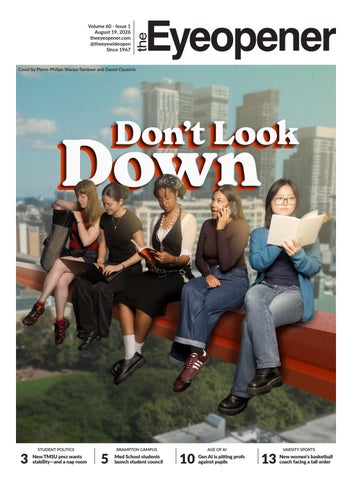
Volume 60 - Issue 1 August 19, 2026 theeyeopener.com @theeyewideopen Since 1967
Cover by Pierre-Philipe Wanya-Tambwe and Daniel Opasinis
3
STUDENT POLITICS
New TMSU prez wants stability—and a nap room
5
BRAMPTON CAMPUS
Med School students launch student council
10
AGE OF AI
Gen AI is pitting profs against pupils
13
VARSITY SPORTS
New women’s basketball coach facing a tall order
News
2 | THE EYEOPENER WEDNESDAY, AUGUST 19, 2026
TMU recieves final report in external review of pro-Palestine demonstrations involving student arrests Former Ontario Premier Bob Rae will oversee implementation of the review's reccomendations Amira Benjamin production editor
Zanoah Plummer news editor
On Friday, the university released the final report in an external review into two incidents involving the arrest of pro-Palestinian student demonstrators and community members at Toronto Metropolitan University (TMU) late last year. The review, which was conducted by retired Ontario Justice Mary Lou Benotto, found that the university failed to “consistently and decisively” apply policies capable of addressing the conduct that occurred at these events. In response to the review, the university has created an implementation task force to address recommendations outlined by Benotto. The task force will be chaired by former Ontario premier and Canadian ambassador to the United Nations, Bob Rae. The university first commissioned the review on Oct. 7, 2025, following the arrest of a student during a pro-Palestine demonstration on Sept. 19, 2025. Justice Benotto was appointed by TMU on Nov. 4, 2025 and the review was later expanded to include a Nov. 5, 2025 off-campus event involving Students for Justice in Palestine (SJP) and Students Supporting Israel (SSI). The nearly 200-page report claims the “absence of clear enforcement, combined with ambiguity around free expression and protest, “have contributed to escalating tensions on campus and a perception that “disruption carries few consequences.” The report also contains several passages redacted in order to protect the integrity and confidentiality of the proceedings, according to the document. The review saw over 100 oral and written submissions by university community members, including staff, faculty and students, as well as external community members. Security guard’s use of force at Sept. 19 event was found to be “reasonable” The report claims force used by TMU Security during the detainment of a student protestor on Sept. 19, 2025 was lawful. The student was detained during an SJP demonstration at a Dais event featuring minister of AI and digital innovation Evan Soloman, as previously reported by The Eyeopener. The report alleges that when security was directing the student out of the auditorium, she “flailed her arms and her phone made
contact with the security guard’s face.” The review says it is unclear whether contact was intentional or accidental. Following this, the student was restrained and arrested using what the report calls a “takedown” maneuver. Benotto alleges that TMU Security was lawful in their use of force. Security guards in Ontario are permitted to use force, as long as it is not excessive and the security guard has use of force training, according to the Private Security and Investigative Services Act. Benotto found that social media footage shared after the event “omitted important context and portrayed the incident as “brutalization,” contributed to hostility toward the security guards involved.” The section on the incident, titled “A fair, accurate and impartial account of the events of September 19 inside the auditorium,” is also partially redacted. TMU did not shirk responsibility for Nov. 5 event by denying on-campus space On Nov. 5, 2025, SSI hosted an event featuring former Israel Defense Forces (IDF) soldier Jonathan Karten as part of SSI’s “Triggered” speaking tour. The event was held off campus in a private venue after TMU denied SSI’s request for on-campus space, as previously reported by The Eye. SJP organized a protest of the event, in which they entered the venue. During the protest, a glass door was broken, injuring Karten. It is unclear who broke the door. After police arrived, five protestors were arrested and a sixth was charged later that week. The review concludes that TMU did not avoid responsibility for the event by not permitting SSI to host it on campus. Benotto writes that “TMU anticipated significant disruption and security risks surrounding the event and denied SSI permission to host it on campus in part because of this.” The report states this should not have necessarily resulted in the cancellation of the event, but rather “the preferred institutional response should be mitigation – stronger security, clearer conduct expectations, and enforcement of rules.” The review claims TMU expressed concerns about controversy prior to when the event took place and had “early administrative back and forth” with SSI regarding the event. TMU was concerned about SSI omitting information about the event be-
SONIA KHURANA/THE EYEOPENER cause they had not initially disclosed key information, such as the number of speakers and the structure of the event. The review states that TMU allowed the event to proceed without proper mitigation risks “undermining viewpoint neutrality” and TMU’s responsibility to protect freedom of expression. Students say their support for Palestine has led to scrutiny, discrimination The review also included context for SJP’s demonstrations and the broader Palestinian solidarity movement. Students participating in proPalestine activism who were interviewed for the report repeatedly expressed how they have received public scrutiny because of “their identity, advocacy, or association with Palestine solidarity efforts” the report reads. In a written submission to the review from Canadian Lawyers for International Human Rights, the organization wrote, “Pro-Palestinian expression is increasingly restricted on Canadian university campuses, with individuals facing punishment or threats of discipline for showing solidarity with Palestine.” The report also states one of the reasons SJP feels ignored is because the university has not adopted the Arab Canadian Lawyers Association’s definition of antiPalestinian racism. “For many Palestinian, Arab, and Muslim participants, advocacy on campus was described as a deeply personal response to loss, displacement, and concern for family members affected by the conflict,” the report reads.
Jewish participants said antisemitism isn’t being addressed on campus According to the review, some Jewish students interviewed said TMU has not fostered an inclusive environment for Jewish students. The review also states that many Jewish students, faculty and staff no longer feel comfortable publicly identifying as Jewish. One Jewish staff member who was interviewed for the review said they “just stopped talking about anything Jewish.” “Several stated that they had been told that Jews were not considered an equity-deserving group and believed this contributed to a lack of targeted support and recognition of anti-Jewish discrimination,” reads the report. Report makes recommendations to university Benotto provided the university with eight recommendations which are to be addressed by the task force. The first of which is a revision of the university’s 2010 Statement on Freedom of Speech to “expressly prohibit” intimidation, harassment, discrimination and conduct that interferes with the expressive rights of others. The report recommends this be done alongside “a comprehensive campus free expression framework and a review of the relationship between academic freedom, faculty political advocacy, and professional responsibilities.” Benotto also called on TMU to apply more consistent enforcement of the Student Code of Non-Academic Conduct. Furthermore, she recommended the
university implement “stronger accountability mechanisms” for recognized student organizations, timely misconduct actions, and “[TMU] review where collective conduct violates University standards.” The review also recommends TMU adopt the International Holocaust Remembrance Alliance (IHRA) working definition of antisemitism as an “educational policy and framework” in recognition that “discrimination against Jews manifests through opposition to Zionism” while “affirming that criticism of Israeli government policy remains protected expression.” In 2023, the IHRA definition found itself at the centre of backlash when over 100 advocacy groups including Human Rights Watch, Amnesty International, Jewish Voice for Peace, wrote to the United Nations asking them to reject the adoption of the definition, claiming that in practice, it “has often been used to wrongly label criticism of Israel as antisemitic, and thus chill and sometimes suppress, non-violent protest, activism and speech critical of Israel and/or Zionism.” In the press release, the university called the recommendations “complex,” but said they will carefully review each of them. Nine academics and community consultants will sit on the task force, including six TMU professors and the director of TMU’s Centre for Free Expression, James Turk. The task force will also include student members who will be named at a later date. The task force will provide a blueprint for implementation to the university by March 2027.
News
THE EYEOPENER | 3 WEDNESDAY, AUGUST 19, 2026
Fire tears through Zanzibar Tavern
Three-alarm blaze damaged Yonge Street strip club early Sunday morning Edward Lander editor - in - chief
DANIEL OPASINIS/THE EYEOPENER
The Eye sits down with new TMSU president Zain Baig
After a year under the leadership of two interim directors, a student is at the helm of the union Zanoah Plummer news editor
It’s no secret that the last few years have been tumultuous for the Toronto Metropolitan Students’ Union (TMSU). The union's previous elections have seen candidates rack up hundreds of demerit points, with votes have been delayed or declared void entirely. After the winter 2025 general election was declared null and void following an investigation launched in January of that year, two interim executive directors were appointed to steer the ship pending a fair election. Now, after the winter 2026 general elections were executed largely pain-free (save for a one-month delay), a new executive team is taking the reins—and for the first time in more than a year, the TMSU will be led by a student. Candidates from the Team Justice slate swept the winter 2026 general election and Zain Baig, a fifth-year business technology management student at Toronto Metropolitan University (TMU) was elected president of the union. The Eye sat down with Baig to discuss his goals for his term and his plans to address the woes facing the union. How do you feel about being elected president? I'm very grateful for the opportunity to represent TMSU members and address their needs at an organizational level. I plan to do my absolute best to ensure students receive an efficient and effective union after that has not been the case for far too long. It's definitely a challenging role and can be intense sometimes, but in a good way.
I learn something new almost every day. I'm glad I get to be here to solve all the complex problems that have still not been addressed. A lot of the full-time staff, part-time staff and volunteers at TMSU are amazing people and great to work with. The TMSU has had a difficult few years. What change do you hope to bring during your term? I will rebuild TMSU into a union that actually prioritizes students and addresses their needs. A union where every student is aware of their rights, responsibilities, freedoms and services available to them. A union that functions efficiently and effectively. A union with up-to-date policies and bylaws that are relevant to students in 2026 onwards, with permanent safeguards and governance guidelines against corruption and fraud that last beyond my term. I think it is going to be hard to earn students' trust, but I want TMU students to hold us accountable. [The union is] in charge of millions of dollars of tuition fees, and a lot of that money has gone to waste in the past. The union has long promised to serve students, and that hasn't happened for years. I'm ready to turn the union around to truly serve students and use their money wisely. At the end of my term, I plan to look back on a year where we made students feel truly involved and empowered by their union. One of your big initiatives is creating a nap space on campus. What inspired this? TMU is a big commuter school, and many students spend one to two hours commuting to and from campus daily. Having multiple
classes in a single day can mean students are very often on campus from early morning to night. This takes a large toll on your energy, productivity, mental health and ability to focus. These negative effects can increase drastically if you aren't getting eight to 10 hours of sleep every night. Which, honestly, not many students are getting, if they're working part-time to pay off their tuition or involved in extracurriculars. I was introduced to the concept of a napping space to boost productivity and support wellness at one of my co-op placements, where I used it almost every day as I was working nine to five doing night classes and involved in extracurriculars. I also noticed other students struggling with this. I see students sleeping in uncomfortable public spaces on campus almost every day, and people are always asking about napping spots on the TMU Reddit. How can students reach the TMSU to ensure their voices are heard? There are numerous ways for students to reach the TMSU. All of the executives, including myself and the vice-presidents' contact information, including our email, is on the TMSU website. There's also the committees. We have regularly scheduled meetings for the Social Justice Committee, the Student Action Committee, and the Events Committee. These are opportunities for students to really voice their concerns, because those committees are the decision-making tools of the union. Any decision that the union makes is done through a committee. This interview has been edited for length and clarity.
An early-morning fire at Zanzibar Tavern closed a portion of Yonge Street near campus on Sunday. Crews responded to reports of thick black smoke coming from the roof around 6 a.m. In a phone interview with The Eyeopener, Toronto Fire Services (TFS) said the bulk of the fire was extinguished as of 10:30 a.m. Crews remained on scene on scene throughout the day to check for any hot spots, according to a spokesperson for TFS. In a post on X at 7:58 a.m., TFS wrote, “Crews are actively fighting fire with areas of the structure now deemed compromised.” During the blaze, the university issued a TMU Safe Alert advising students to avoid the area. The Student Learning Centre was also evacuated as a precaution. The alert was lifted at 10:58 a.m. TFS told The Eye their investigations team has been engaged to determine the cause of the fire. They also confirmed nobody was injured in the blaze. Talen Tsigaris, a second-year global management studies stu-
dent, was on campus at the time of the blaze. He said the response from TFS and police was so intense, he initially believed the SLC was on fire. "I was just relieved that it wasn't campus and that no one was injured," he said. According to the club’s website, Zanzibar Tavern first opened in 1949 as a restaurant. The business was purchased by real estate mogul David Cooper in 1960 who transformed it into an adult entertainment venue. Cooper died in 2019. The club's current owner, Allen Cooper, told CBC he plans on reopening the business after repairs are made. He said the establishment has 30 employees and sees as many as 200 dancers each week. The Eye reached out to Zanzibar for comment, but did not recieve a reply in time for publication. Zanzibar is known by many students for its neon signage and goldplated facade. The club celebrated its 75-year anniversary in 2024. In a statement posted on social media, Toronto Centre councillor Chris Moise commended TFS' efforts. He also said he'd be reaching out to the club's owners to, "offer any assistance that we can following this tragic incident."
Firefighters were called to the scene just after 6 a.m. Sunday following reports of smoke. EDWARD LANDER/THE EYEOPENER
The adult entertainment venue is considered a landmark by some TMU students. EDWARD LANDER/THE EYEOPENER
Editorial
4 | THE EYEOPENER WEDNESDAY, AUGUST 19, 2026 The Eyeopener Vol. 60 Masthead
Editorial: Riding out the storm
editor-in-chief
This year won't be easy for Ontario students. We're here to help you navigate it
production editors
Edward Lander editor-in-chief
Edward “Argue AI” Lander Amira “Locked Out” Benjamin Jasmine “Coffee?” Makar news editors
Nadine “Adobe Fonts” Alsaghir Zanoah “Cover Model” Plummer arts & culture editor
Sophie “Rock & Roll” Wallace business & technology editor
Aditi “Last One” Roy communities editor
Rin “Gem” Yanase features editor
Daniyah “Backup Plan” Yaqoob fun & satire editor
Dylan “Four Pages” Marks sports editors
Francesco “Coach” Cautillo Naomi “WFH” Low photo editors
Rachel “Achoo!” Cheng Daniel “Coverline?” Opasinis Pierre-Philipe “Super Glue” Wanya-Tambwe media editors
Victoria “First” Andrade Ava “Pronounciation?” Whelpley digital producer
Lucas “One Year Older” Bustinski general manager
Liane “Good Pun” McLarty design director
Vanessa “Call Me.” Kauk contributors
Naseema "On a Roll" Raja Mohamed Meriem "An Apple a Day" Nour Landon “Gould & Dundas” Randfield Simran “MC” Sidhu Nolan “Screen Record” Boivin Monte “Flow State” Safarian Jake “His Cat Hates Him” Ross Negin “Deceased" Khodayari
connect
@theeyewideopen theeyeopener.com contact
T: 416-979-5262 ext. 2338 E: editor@theyeopener.com address
55 Gould Street, Suite 207 Toronto, Ont. M5B 1E9 advertising
advertising@theeyeopener.com
Even if you’re new here, I probably don’t need to tell you that Toronto Metropolitan University (TMU) is going through a lot of changes. Just look to the south end of campus where a new 21-storey residence is emerging from a great big hole in the ground, or to Gould Street where O’Keefe House—a former 32-bed residence—is taking the shape of the university’s new Centre for Student Wellbeing. Changes are coming to the top brass too. TMU President Mohamed Lachemi—the man who’s been running the show for 10 years—will walk away at the end of this semester in favour of Roberta Iannacito-Provenzano, the university's current provost, who will be the TMU's first woman president come January. The changes aren’t just on campus either. Many students have their eyes glued to Queen’s Park, where later this year, Premier Doug Ford will decide the fate of ancillary fees—the part of your tuition which funds student groups and services. Last year, the legislature passed Bill 33, which is set to make these fees optional, giving students the chance to opt out of paying for things like clubs, sports, mental health services and—you guessed it—student media. Your wallet might be familiar with another change at Queen’s Park: massive cuts to OSAP grants. In February, Ford lowered the amount of grants the province’s student assistance program doles out from 85 per cent to a measly 25, saddling many with loans and rendering post-secondary out of reach for others. If you’ve made it
PIERRE-PHILIPE WANYA-TAMBWE/THE EYEOPENER here, congrats—you’re one of the lucky ones. Toronto, which you might be calling home for the first time, is about to undergo a city hall shakeup. In October, mayor Olivia Chow will have her leadership challenged in a municipal election along with Toronto’s 25 other councillors—including our Ward’s incumbent, longtime councillor Chris Moise. That’s not all. If you look around campus you might notice we’re being surrounded. There’s high-rise development on every side of TMU, including Yonge Street's ‘Concord Sky,’ a 95-storey ‘supertall’ condo tower that will very likely block the sun from Kerr Hall Quad when it tops out next semester. There are, of course, things that never change around here. Our students’ union still faces woes of all kinds. Last semester, the
union’s executive sued a group of former members and affiliates some $20 million dollars, alleging corruption, fraud and a litany of other wrongdoings. That lawsuit heads to the courts this fall, so stay tuned for our coverage. But this semester is seemingly a turning point for the beleagured union. After the first election to not be declared void in some time, a student will be at the helm of the TMSU. Fifth-year business technology management student Zain Baig—who we interview on page two—will take over from two lawyers who were appointed run the union during an investigation into alleged financial mismanagement. Another thing that doesn’t seem to be going anywhere: artificial intelligence. Last semester we spent a lot of ink reporting on how the technology is disrupting classrooms, personal
lives and entire fields of study. This semester, that focus will continue. In this week’s feature, we meet professors and educators whose jobs have become something entirely different in the ChatGPT era. There’s one more thing that isn’t changing this year: your student-run campus newspaper, The Eyeopener. This year is our 60th year covering everything in and around TMU (queue the confetti) and we’re not about to stop now. We’re independent—meaning we can say just about anything we want about the university (given it's true). If you’d like to test that, come write for us. You can find a brand-new issue on stands every week, starting Sept. 16. Pick up a copy wherever you found this one or find us circulating them on Wednesday afternoons. We carry a megaphone if you have trouble finding us.
News
THE EYEOPENER | 5 WEDNESDAY, AUGUST 19, 2026
Medical school students launch student council
The group's inaugural executive team seeks to represent medical students and foster community Meriem Nour contributing reporter
In November 2025, students in Toronto Metropolitan University’s (TMU) medical school launched the School of Medicine Student Council (TMMSC), establishing a student-run organization that oversees an umbrella of clubs, societies and events on the Brampton Campus. The council’s inaugural executive team says they are focused on building a strong sense of community and support among students on a campus that's only a year old. Shymega Arasaratnam, co-president of the TMMSC, said there was a lot of advocacy work happening within the cohort—which launched with just 94 students last year—because there were no recreational structures in place for the student body, including interest groups and clubs. "I knew that our cohort was built on that foundation of advocacy, and we knew that we needed to build structures that work for us, that are tailored for us, that are also built by us," said Arasaratnam. The council oversees initiatives such as talent shows, a handful of new student groups and mentorship programs, which Arasaratnam said have matched 109 resident physician mentors with 80 student mentees. Arasaratnam said medical students having a campus to themselves gave them
"common ground," helping them launch different cultural, religious and interest groups early on. On May 20, the council hosted a cultural bazaar, which they hope to be the first of many, where students represented their countries and backgrounds through booths featuring food, music, games and traditions. Haris Ahmad, co-president of the TMMSC alongside Arasaratnam, said that the idea to launch a formalized council started early in September 2025. Ahmad explained that around 60 medical students gathered the following month to discuss the logistics and operations of the council. According to Ahmad, the council will host its first student-organized orientation week for the upcoming fall semester, in collaboration with the School of Medicine's school-run orientation week. "Community organizations will be present and students will be able to pick their own adventure and get to understand the wider grounds and field," said Ahmad. Talia Hassan, a second-year medical student—a member of the original cohort— said the council's administration actively heard student concerns through surveys and group-chat discussions and made changes when needed. Hassan gave an example where she was in a class where the facilitator wasn't
EDWARD LANDER/THE EYEOPENER meeting student expectations. The group provided feedback and the facilitator was quickly replaced. "The fact that they were able to make that change so quickly, just based on our group’s feedback, says a lot," she said. Hassan said that her favourite parts of this past year were the post-exam socials, which included bowling, dinners and going to Activate Games. The socials were orga-
nized by Helen Abay, the vice-president of student engagement for the council. Hassan also added that the council created networking opportunities with other TMU programs, such as a law social event with the Lincoln Alexander School of Law. Arasaratnam said that their goal is to leave behind a "body of work" that is going to be there for future generations of medical school students to carry on.
Student riders react to e-scooter, e-bike safety campaign Cyclists are cautious about how the campaign will be enforced Naseema Raja Mohamed contributing reporter
The Toronto Police Service (TPS) has launched a two-week safety and enforcement campaign for micromobility vehicles, including e-bikes and e-scooters. The campaign, which will run from Aug. 10 to 24, focuses on educating road users about laws and regulations to promote safe riding, as well as increasing law enforcement where misuse is common. According to Toronto by-laws, it is illegal to ride e-scooters on public roadways and sidewalks. The city also has similar restrictions for e-bikes, which cannot be ridden on sidewalks and certain roadways. E-bikes and e-scooters are among one of many ways Toronto Metropolitan University (TMU) students get to and from campus and some are skeptical about how the campaign will be enforced. Zain Fayaz, a second-year civil engineering student at TMU, uses an e-bike regularly as a mode of transportation. He says he the campaign is overreaching. “To be fair, I think that the removal of the Yonge Street, Bloor Street and University [Avenue] bike lanes are a much, much bigger issue, given that thousands of people ride those [streets] every single day, myself included," said Fayaz. "My direct route to school is being removed and it is making me decide to maybe even switch modes on how I get there.” According to data from TPS, Toronto has seen 514 micromobility vehicle collisions this year, including two fatal collisions. TPS has not released the specific
locations where they will be conducting their campaign. "Officers can and will use collision and enforcement metrics to position themselves in areas where the data shows an increased risk to vulnerable road users or where observed volume and operator behaviours warrant it," TPS wrote in a statement to The Eyeopener. Fayaz fears at the end of the two-week blitz campaign, problematic riders will return back to their previous behaviors. Ammaz Baig, a 2023 graduate from TMU's law school, said he regularly rode an e-bike during the time he attended TMU and had similar concerns. Baig said that informing the community is safe and reasonable, but doesn't believe the approach will remain effective in "the long run."
better [road users], would be beneficial to everyone," said Lazarou.
"What if they don't really take the lesson that's being taught here and do anything with it?" While optimistic, Lazarou warned that a campaign based around enforcement instead of education could negatively im-
pact cyclists. "Students will be affected if they feel like they're going to be chased down.... It's not a good scenario. I believe [in] making a workshop, making a seminar, something like that, where everybody's included and can learn the rules of the road," Lazarou said. "Because better pedestrians and better cyclists make for a much safer city."
"My direct route to school is being removed and it is making me decide to...switch modes on how I get there" "After these two weeks, what if everyone just goes back to doing what they're doing before? What if they don't really take the lesson that's being taught here and do anything with it?" said Baig. Tommy Lazarou is a cycling coach and founder of Bike Foundations, an organization that provides bike lessons. He thinks that the enforcement program may encourage cyclists to be more careful on the roads. "I think encouraging people to be more aware, if they're taking courses... or somehow participating in actively becoming
PIERRE-PHILIPE WANYA-TAMBWE/THE EYEOPENER
Business & Technology
6 | THE EYEOPENER WEDNESDAY, AUGUST 19, 2026
Can anyone afford to go out anymore?
Four students share how they manage their personal finances to afford a social life Aditi Roy business and tech editor
It’s no secret that the cost of living is ever-increasing, and university life is changing under the weight of financial pressures. In June 2026, the consumer price index—which measures the increase in price of goods—increased by 2.8 per cent in Canada. This rise in prices comes alongside high youth unemployment rates and the shrinking of entry-level jobs. Youth unemployment rates softened from 14.6 per cent last September to 12.6 per cent this July. However, young adults aged 15 to 24 are still grappling with sparse work opportunities. An August 2026 TD Bank study found that there are around 25,000 fewer jobs in retail and service industries this year compared to 2019—a common gateway for young adults into the workforce. This pressure is significant for university students. According to Statistics Canada, average tuition
for undergraduate students in Ontario has climbed by 2.9 per cent, now averaging at $8,958 from 2025 to 2026. Despite the unfavourable economic conditions, students at Toronto Metropolitan University (TMU) are still adamant on fostering a social life for their mental health and emotional wellbeing. Here, we speak with four students in different stages of life who are finding ways to build and maintain their social lives in the midst of economic uncertainty. Smit Shah, Third-year Smit Shah is a third-year business management student at TMU. Though he isn't a fan of clubbing or bars, he said he does find time to catch up with his friends on campus. “On a weekly basis, I go out pretty sparingly, [I] spend lots of time communicating over social media nowadays. We only go [out] in-person [if needed],” said Shah. His social life revolves around grabbing meals with friends and
getting coffee during school days, preferring caffeine runs for affordability and convenience. “If it's just coffee that we're going for, that'll all be within $5 to $12 but if it's [a] full-on meal, it could range anywhere between $20 to $30,” he said. Shah said he has become increasingly mindful of his spending since his first year, when he realized the financially draining nature of being a student. “At the end of first year, I realized how much money I needed for textbooks, online modules, transit [and] meals, so after that point, all of my money was going towards school and food,” he said. Despite this, Shah said he understands the value of socializing. “I'm actually planning on going out more because I feel like in my first two years I wasn't quite socializing as much as I should have to build my foundation and my networking skills,” said Shah. He sees the process as an experiment, slowly expanding his social life while prioritizing his studies and
DANIEL OPASINIS/THE EYEOPENER work and ensuring he is financially stable. Shah estimates his social spending to be $80 to $100 a month. Gordan Cao, Fourth-year Gordon Cao is a fourth-year business management student at TMU. Cao enjoys his weekends going out and socializing with friends, saying that he couldn't imagine a
life without it. “It's kind of like you're escaping reality, like a de-stressor. Hanging out with friends, you just kind of forget about all your issues,” he said. Cao has recently slowed down on partying, now only going out once every two weeks. Read more at theeyeopener.com
Communities
THE EYEOPENER | 7 WEDNESDAY, AUGUST 19, 2026
Gems of the library
From board games to romance novels, students share their favourite ways to use the TMU Library Jake Ross contributing reporter
As students gear up for their return to school in a couple of weeks, they may not be aware of the full slate of offerings their campus library has available to them—other than a quiet space to work. Some returning Toronto Metropoltian University (TMU) students say more people should know about the resources available to them, and use them while they’re able, sharing their “unconventional” uses of the university's libraries with The Eyeopener. The TMU Library has over 500,000 physical books in its collection, and according to its website, prioritizes the acquisition of leisure materials including fiction books, and what it calls, “stress busters,” like puzzles and board games. Lily Bitton, a second-year undergraduate student in the English program, says she takes full advantage of the expansive array of books the library has to offer. “It has such a wide selection of books that I didn't really realize it has so many fiction books,” she said. Her favourite is the Popular Reading Collection section, which, according to the library’s website, has over 200 mystery, romance and other fiction books.
“There are so many new books that would be full price at Indigo that I can read for free or that are included with my tuition. I’ve read some good books that have been on my list for a long time because they’re available there,” she added. She said she prefers the campus library because they have a better selection of books than the public libraries in her hometown of Guelph, Ont. She said it's also more convenient than going to a Toronto Public Library branch. A survey conducted by the University of British Columbia Library found that while 94 per cent of respondents said they might or would use a leisure reading collection, only six per cent of respondents got most of their books for leisure reading from the school's library, despite it having 81 per cent of the books students had requested in the survey.
“I’ve had some good books that have been on my list for a long time because they’re available there” Bitton thinks more students should take advantage of the offerings at the campus library. “I try to push people to go because it’s such a great resource. But most of the
Caught up with courses, some students may forget they've subscribed to the nine floors of the TMU Library. DANIEL OPASINIS/THE EYEOPENER people I’ve talked to don’t really use it as much as I do,” she said. A survey of Canadian post-secondary student’s school library usage published in College and Research Libraries, a peerreviewed academic journal, found while a majority of students still use their campus library as a place to do work, it is increasingly becoming a social space. Piero Alvarado Bellido, a third-year student in the Business Technology Management program, is a fan of the library’s board game selections. He’s even hosted a board game function at the school’s library.
“I originally would just go to the library whenever I wanted to do an assignment. And eventually, one day I invited my friends, and we played some board games,” he said. The library’s boardgame collection includes classics like Battleship and Monopoly, which are available to borrow from the Circulation Desk on the second floor, or you can bring your own board games, like Bellido and his friends have done. For students like Bitton and Bellido, the library is more than just a place to finish an assignment. It is home to some gems that often go unappreciated.
Back-to-school advertising is everywhere. How much stuff do you really need?
Students opened up to The Eye about their consumer judgement when it comes to shopping for school Rin Yanase communities editor
Seeing strangers trying to persuade you to buy an iPad from the other side of the screen is admittedly a normal experience for university students in 2026. Online content advising students to buy study gear is increasingly common, but whether those tools will actually help you in school, is another question entirely. Some Toronto Metropolitan University (TMU) students say more often than not, what you need is your own judgement when it comes to back-to-school purchases, not what people say online. A study conducted by the Indonesian Journal of Education and Social Studies indicates four main factors through which student consumer behaviour is formed, which start with “structured and systemic influencer marketing” and end with “the Fear of Missing Out phenomenon that triggers social anxiety.” Kaylin Dhanpaul, a third-year biomedical engineering student at TMU, says back-toschool influencers have never persuaded her to spend on school supplies. Dhanpaul calls these kinds of videos “scammish,” adding that “they're definitely catered towards us students,” “I feel like if you think you're having a bad time, you might want to buy something like that.” On the flip side, Dapo Ogunsola, a thirdyear biomedical science student, gave a
heavily-advertised study tool a try. He said he now regrets the $24-a-month he paid for Grammarly AI. “I saw it on TikTok, so I just tried it out,” he said. The software he downloaded to paraphrase his own work indeed saved him time, as he expected, but was not cost effective. The university’s Academic Integrity Office also instructs students to assume AI tools which paraphrase or rewrite text are prohibited, unless otherwise noted by a professor. Ogunsola still had to check the accuracy of the AI by himself, which also convinced him to ultimately cancel its subscription.
considering purchasing. Russell Belk is a marketing professor at York University's Schulich School of Business. In his consumer research, he uses the term “extended self,” where he reckons that what we buy, what we desire and how we use these things reflect who we are. “It means that our notion of who we are goes beyond our skin,” he said. Belk also said university students are in “a liminal state between who they were and who they will become.” Belk added, “[Students are] trying to
adapt to their changing views, changing values and chenging aspirations in terms of peer influence.” This isn’t far off from the reason Islam chose to buy an iPad this year. She said it was because of someone she knows who was using one around her. “In the beginning, I saw a lot of videos saying ‘look, you should get an iPad,’ and all. I was like, no, I'm just going to stick to a pen and paper. But then I actually saw how useful it is, how much more convenient it is, I did end up eventually getting it,” she said.
“[Students are] trying to adapt to their changing views, chenging values and chenging aspirations in terms of peer influence” Shehreen Ahmed Islam is currently in her co-op year, studying aerospace engineering at TMU. She has a relatively positive attitude towards the back-to-school marketing content. “I think they can be helpful at times because sometimes you just don't know the kind of benefits you can get as a student,” she said. She said she also does her own research when she finds herself interested in a product promoted online. Among of her most trusted resources are her friends, many of whom actually have what she’s
PIERRE-PHILIPE WANYA-TAMBWE/THE EYEOPENER
8 | THE EYEOPENER WEDNESDAY, AUGUST 19, 2026
SEPTEMBER
Fall Semester Calendar
SUNDAY
Pick up a new issue of The Eyeopener on stands weekly.
MONDAY
6
TUESDAY
7
Holiday/Special Date
THURSDAY
FRIDAY
1
2
Last day to 3 Request Missing Spring/ Summer 2026 Undergraduate Grades
4
5
8
9
10
11
12
18
19
25
26
First Day of Fall Term Classes
Labour Day (University Closed)
Academic Important Date
WEDNESDAY
SATURDAY
Rosh Hashanah
13
14
15
Last Day 16 to Clear All Outstanding Academic Graduation Requirements
17
20
21
22
23
24
27
28
29
30
Last day to drop a Fall Term course (full refund of fees)
Last day for full payment of undergrad tution for Fall Term
National Day for Truth and Reconciliation
OCTOBER SUNDAY
MONDAY
4
Toronto Metropolitan University’s independent student newspaper since 1967 Follow us on Instagram
@theeyewideopen
ILLUSTRATION BY RACHEL CHENG/THE EYEOPENER
The Eyeopener
TUESDAY
5
WEDNESDAY
6
7
THURSDAY
FRIDAY
SATURDAY
1
2
3
8
9
10
Last day to drop a course or withdraw from program (50 per cent refund)
11
12 Thanksgiving (University Closed)
13
14
15
16
17
Study Week
18
19
20
21
22
23
24
25
26
27
28
29
30
31
Halloween
THE EYEOPENER | 9 WEDNESDAY, AUGUST 19, 2026
NOVEMBER SUNDAY
MONDAY
TUESDAY
WEDNESDAY
THURSDAY
FRIDAY
SATURDAY
1
2
3
4
5
6
7
8
9
10
11
12
13
14
Deadline to submit OSAP documents and appeals
Remembrance Day
17
18
Diwali
15
16
19
21
20 Last day to drop a course or withdraw from program
22
23
29
30
25
24
26
28
27
MONDAY
TUESDAY
WEDNESDAY
2
THURSDAY
FRIDAY
3
7
8
Last day of Fall Term undergraduate classes
Fall Term Undergraduate Study Day
14
15
SATURDAY
5
4
9
10
12
11
Exam Period 16
17
18
Official end of Fall Term
27
21
22
23
Winter Solstice
28
29
30
24
25
Christmas Eve
Christmas Day
31
New Year's Eve
Library For material and search advice call 416-979-5055. Academics For academic help, questions and concerns, visit torontomu.ca/contact/student/academic_contacts. Accommodations for students with disabilities Email aasadmin@torontomu.ca or call 416979-5290.
Hanukkah Ends
19 Last day of Chang School classes
20
TMU Human Rights Services For discrimination and harrassment complaints or sexual violence complaints, call 416-979-5349 or email humanrights@ torontomu.ca.
Student Learning For academic support and tutors, call 416598-5978 or email slls@torontomu.ca.
Hanukkah Begins
Transfer credit application deadline
13
Community Safety and Security In all emergency situations, call 911. In other circumstances, call campus security at 416-979-5040 if you see something that needs to be checked out. This is the number for Walk Safe as well. You can email them at walksafe@torontomu.ca.
Ombudsperson’s Office Confidential help for students who need it when dealing with the university’s systems and processes. Call 416-979-5000 ext. 557450 or email ombuds@torontomu.ca.
1
6
The Eyeopener We are dedicated to reporting on the stories that matter here at TMU. Visit our office in the Student Campus Centre (SCC207) or email editor@theeyeopener.com if you’d like to come forward with a potential story. If you’re someone who’s interested in volunteer opportunities with us, shoot us a message on any of our platforms!
TMU Medical Centre Email medicalct@torontomu.ca or call 416-979-5070 for support. Call 911 in all emergencies.
DECEMBER SUNDAY
Important Numbers & Emails
26
Academic appeals Have a problem with your grades? Visit yourtmsu.ca/services/academic-advocacy. Legal help - free legal advice legal@yourtmsu.ca
Boxing Day
Why are calendar puns so bad? Because they're always so week and dated
10 | THE EYEOPENER | WEDNESDAY, AUGUST 19, 2026 | FEATURES
AI tools can complete coursework without students having to lift a finger—and it's getting harder and harder to catch. With chatbots in the classroom, professors have an entirely new job: Convincing their students to do any work at all
I
By SIMRAN SIDHU Photo Illustration by RACHEL CHENG
t was one of those evenings in April for Jordan Le Roux. Finals season was at its peak, and as a teaching assistant (TA) for several classes in Toronto Metropolitan University (TMU)’s history department, dozens of assignments were sitting in her inbox waiting to be marked. Sitting on the couch, with a cup of tea within arm’s reach, she scanned essay after essay, highlighting sentences, leaving notes and coming up with a grade to submit to professors for final review. Le Roux clicked onto an assignment from a student she recognized. She knew them to be articulate in class and passionate about the field. The essay, she thought, would be enlightening. But as Le Roux read through the paper, she noticed paragraph after paragraph that followed the same narrative structure. It was as if there was something less-than-human about the words she was reading. And having graded hundreds of assignments at that point, Le Roux knew why: artificial intelligence (AI) had played a role in its production. “I wasn’t angry, but just confused at what I read,” Le Roux says. In her one year as a TA, she estimates she marked over 700 assignments, big and small—and roughly estimates that around 50 per cent contained some kind of AI contribution, ranging from finding sources to writing entire paragraphs. It’s alarming, she says, what the AI boom in academia is doing to students. “I am sad that people—really bright, really smart people—are depriving themselves of that chance to do that learning.”
W
ITHIN THE SPAN of a few very short years, generative AI has transformed from a minor curiosity into a permanent fixture of modern academia. From the early phase of generating extra fingers, AI has rapidly evolved to the point where even the most seasoned scholars struggle to distinguish human prose from machine outputs. The statistics paint a bleak picture. A 2025 survey by accounting firm KPMG found that 73 per cent of Canadian students are using AI to do their schoolwork in some way, shape or form. Twenty-five per cent of them admitted to using AI every single day, or at least, for every single assignment
they’re given. That figure is up 10 per cent from the year before. Forty-five per cent of students even went as far as saying that using AI is their “first instinct” when their professors hand them an assignment. It’s a boom being felt coast to coast—and, arguably, around the world—since platforms like ChatGPT came onto the scene in 2022. Since then, software like Claude, Gemini, Microsoft’s Copilot, Perplexity and dozens of smaller start-ups have become bookmarked tabs on Canadian students’ browsers, accessed more frequently than even Google by some. Universities and academic settings, in some sense, feel light-years behind the rapid emergence of artificial intelligence platforms. Administrators have had to work quickly to put together guidelines for AI-usage on their campuses, including TMU, which tells its students: “Unless explicitly stated by the instructor, students should assume that using AI to complete assessments is prohibited.” TMU’s Senate’s policy on academic integrity has evolved to consider fabricated work, anything produced by AI, as well. Professors, many who have had decades teaching at the university, once used to worry about students cheating with analogue methods—still putting in the work to find the formulas, for example, but refusing to memorize them. Now, they worry about whether students care at all about the coursework, when at the press of a button, a bot can take care of their degree.
F
OR GRAHAME LYNCH, an associate professor and interim chair for the School of Fashion, the current alarm around AI feels deeply familiar within the history of the art he teaches. When Lynch talks about artificial intelligence, he does not begin with ChatGPT or Gemini—he begins with the camera. “When photography was invented, people declared it the death of painting,” Lynch says, with a chuckle. “Yet painting did not die, it evolved.” With tools like a camera, the artist still does the thinking. They still drive the creative direction by making intentional choices. But with AI, the software transitions from an assistive tool into a substitute for thought. When the algorithm itself handles the entire creative process, the
Boyd is no longer necessarily teaching people—his classroom materials, instead, are training AI algorithms
It's hard to be a prof in the age of AI
relationship between the student and their work is disrupted. So the emergence of AI, Lynch thinks, may change how people think of creative work. Lynch believes the current AI disruption may stem from a pressure on students to present refined and perfect final products, often leading them to entirely skip over the messiness of the creative process. To counteract this, in his courses he emphasizes physicality and methods that document the developmental journey, focusing on reflection, highlighting the step-by-step decisionmaking process and embracing mistakes. In his interdisciplinary image making course, he brings students back to physical, tactile mediums like handcutting collages, cyanotypes and cutting negative images. Mediums where AI could provide little help, because his students are taught to embrace and adapt to the imperfections of making the wrong cut.
O
NE OF THE MOST attractive— and perhaps most advertised— academic uses for AI is generating written work. The KPMG survey found that 36 per cent of Canadian students regularly use AI to generate their essays and reports. And in TMU’s English department, where reading and writing is their bread and butter, the faculty are more than aware. For Jason Boyd, an associate professor and former director of TMU’s Centre for Digital Humanities, reading and evaluating student prose is second nature after years on the job. Sat at his desk one day, Boyd was sifting through his students’ submissions. When he opened an assignment for a liberal studies course on crime fiction, he couldn’t help but notice there was something fundamentally off. The text displayed on his laptop was littered with factual errors, nonsensical claims and odd structural contradictions. There was no human voice, just a mechanical sequence of sentences that made very little sense in the context of the assignment. Boyd knew immediately what he was looking at was a student who had pasted the assignment prompt into ChatGPT, copied
the output without rereading a single word, and submitted it. “My reaction was sort of a combination of ‘how dumb do they think I am?’ and somewhat amused because some of these outputs are just completely absurd,” Boyd says. “My sense was these were people who had done absolutely nothing—hadn’t come to class, hadn’t read the text. It wasn’t a case of a student under extraordinary pressure and using a tool out of desperation. It was people who had no investment whatsoever in the course, and strangely thought they could get a passing grade.” Discovering these AI submissions was not merely about catching students cheating, but opened a window into a deeper, troubling trend across campus. To Boyd, the threat of AI is something much more sly than automated essay generation. What keeps him awake at night is the slow, deliberate erosion of reading. “Students basically just run a book through Gemini and say, ‘Just give me a summary of it.’ But we are interested in literature beyond plot summary,” Boyd says. “We’re interested in the actual text, the actual language.” To Boyd, an algorithmic plot summary doesn't just risk skipped pages or getting things wrong, but AI replaces the original author’s voice, nuance and intent. “My real concern is that we’ve already lost them because they’re not even reading the texts they’re supposed to be writing essays on,” Boyd says. This detachment leaves many educators facing a profound pedagogical hurdle. Boyd has experienced incidents in which students not only feed readings into chatbots for plot summaries, but have those same chatbots complete their assignments, essentially passing the entire academic process into the hands of a bot. At that point, Boyd is no longer necessarily teaching people—his classroom materials, instead, are training AI algorithms. Where once, students might’ve skimmed a passage or two to forge an essay on an entire novel, AI makes it so that they don’t even have to touch the book. Now, Boyd and
FEATURES | WEDNESDAY, AUGUST 19, 2026 | THE EYEOPENER | 11
his colleagues have to do something professors a few years ago didn’t—convince students to do anything at all. “How do I make them understand that reading is important, actually reading the literature is important, reading the text is important?” The challenge for professors nowadays is no longer detecting who used generative AI to do an assignment—this far into the AI boom, catching students in the act isn’t going to do much. Now, the job is convincing a generation that is raised on the instant gratification of generative platforms that the slow, tedious process of fighting with complex prose is where intellectual growth occurs. Canadian students who use AI are admitting it themselves: nearly 50 per cent of those surveyed by KPMG say their critical thinking skills have deteriorated since they committed themselves to an algorithmic aid. To Boyd, outsourcing the act of writing to an emotionless algorithm isn’t just a problem with academic misconduct, but it may be a hurdle to the development of critical thinking. “Writing is a form of thinking,” Boyd stresses. “It’s a form of interpersonal communication. Anything that comes out of Gemini or ChatGPT has no intent behind it. It’s just a statistical word pairing.”
easier, faster way that might just give them the edge they need to push through. Quenneville says that her personal decision not to use AI does not mean she is unaware of its advantages. “I worry about being left behind because I do know that some people can use AI to make their life a bit easier. It lowers the time consumed to write. But education [can] be strenuous—it is mentally taxing. When you succeed, and you know it’s based on your own merits and hard work, it’s very rewarding,” she says. To Boyd, this tension underscores a fundamental question about how society
Generative AI can organize data and draft outlines, but it cannot care for or understand the material
T
HE DIVIDE IS NOT as simple as students who use AI and those who don't. There's a middle ground, where some use it to brainstorm and check their work but draw a harder line at asking it to do the thinking portion for them. That adds another variable to a professor’s evaluation, now having to determine how
F
OR ÉMILIE QUENNEVILLE, a final-year public health student at TMU, her first formal encounter with artificial intelligence in a university setting was not her attempting to shortcut her studying, but instead an assignment from one of her professors. In a course focused on pollution and waste management, the professor tasked the class with prompting a chatbot to answer complex queries. Students were then required to cross-reference the accuracy of these outputs against peer-reviewed scientific studies. The results were very telling. Rather than unveiling a flawless repository of human knowledge, the exercise exposed the limitations of artificial intelligence. She remembers being frustrated by what it got wrong, but more than that, was less than impressed by the technology that claims to do all. “I find chatting with it quite frustrating, actually. It was very biased in its wording, and the results weren’t accurate. It wasn’t coming from scientific sources,” she says. The assignment, as worrisome as the findings were, was another professor’s attempt to confront their students with the reality of AI in academia—that often, it can be embarrassingly off the mark. But Quenneville wasn’t in need of any convincing. Being a mature student, she has been exposed to higher education settings before the mainstream surge of AI and maintains a conscious, grounded distance from artificial intelligence as study aids. Her skepticism is rooted in a recognition of what is sacrificed when students allow AI to do the intellectual heavy lifting. However, it is difficult to dismiss all together the convenience of artificial intelligence, especially in competitive academic settings. When assignment deadlines loom, and peers openly share prompts to help reduce hours of essay preparation, choosing the longer, harder path requires immense discipline. The pressure is relentless—a constant whisper in the back of every student’s mind that there is an
related to academic misconduct, with a significant rise driven by allegations of unauthorized AI use. That’s because algorithmic unreliability directly impacts students within the classroom. In March 2026, The Eye detailed a case of a fourth-year student at TMU who spent months disputing an academic misconduct allegation after her instructor claimed her essay vocabulary was suspiciously advanced. Instead, some faculty are shifting focus from catching cheating to rethinking evaluation, redesigning assignments to demand authentic human presence. Boyd said his teaching methods now put more emphasis on in-class assignments, or work that requires “precise engagement” with the fundamentals of the texts he assigns, in a way that AI cannot do. Cordeiro has an assignment-by-assignment approach to AI-use: some allow it, if the student discloses and explains the role artificial intelligence played, while others don't make room for AI. In media production, some software tools are beginning to embed algorithmic support, so he prepares his students to know if, when and how to use them when they enter the real world. Univiersty of Toronto's law faculty is even making the case for some classes to become laptop-free zones, asking students to handwrite notes so the possibility of sophisticated AI models doing the remembering for them is off the table altogether. The path forward across higher education will not be defined by the presence of artificial intelligence, but by how intentionally students choose to draw the line between tool and thinker. Generative AI can organize data and draft outlines, but it cannot care for or understand the material.
L
values higher education. If university is viewed simply as a credential factory, a place to collect marks and secure a title as soon as possible, then delegating coursework to AI is an understandable outcome. But if university is considered a transformative space for cultivating independent thinking and deep literacy skills, he argues that relying on automated outputs represents a profound loss for students. RTA School of Media assistant professor AJ Cordeiro goes further to argue that, because of AI, post-secondary institutions are being forced to reconsider what a degree validates. “We are moving away from certifying that someone can make something, like drafting a basic essay or generating a list of shots, to certifying that they can be held responsible for it,” Cordeiro says.
much AI use makes an assignment academically dishonest. As departments across TMU adapt, many educators are searching for a solution that doesn't lie in surveillance or band-aid prohibitions. Bans are difficult to enforce and anti-cheating software often yields false positives, creating a tense environment of suspicion instead of curiosity. In a 2023 study published by Stanford researchers, popular detection algorithms consistently misclassified nonnative English writing as though it was machine-generated, flagging roughly over 61 per cent of non-native essays due to the more constrained language structures. As previously reported by The Eyeopener, 30 per cent of all student consultations handled by the TMSU’s advocacy office between May and December 2025 were
YNCH HAS BEGUN trying to pull his students out of the digital ecosystem entirely. He's created assignments which focus on hands-on mediums—going back to things like old school prints and a journaling method to document the thinking process. He's not the only one. In-class discussions, handwritten assignments, reflective journals and physical methods are regaining central roles in course syllabi. Other professors, still, are doing what they can to educate their students on the ethical uses of AI and its applications in the real world. The temptation to use AI will always be there, lurking in the background of another browser tab, ready to produce an answer before a student has even finished reading the question. But this convenience always comes with a choice and a sacrifice, whether to use AI as a tool or to allow it to become the thinker. So, for today’s students, the most important lesson a professor can aim to teach, might be why they should learn at all.
Arts & Culture
12 | THE EYEOPENER WEDNESDAY, AUGUST 19, 2026
Women Turning to Stone: Inside Olivia Quain’s stark antidote to glamour photography
The recent photography graduate’s thesis work is featured in the Women’s Art Association of Canada’s scholarship exhibit, “Nature Is Her Form” Sophie Wallace arts and culture editor
Disclaimer: Olivia Quain has previously contributed photographs to The Eyeopener. She had no part in the production of this story. Sunlight bursts from the ground. A woman contorts herself to mirror the jagged shapes of Scarborough Bluffs. Hair and skin and rock face meld into one. Toronto Metropolitan University (TMU) photography '26 graduate Olivia Quain’s thesis work Turning to Stone asks a vital question: what do we make room for when we stop asking women to be beautiful? The black and white image series captures women’s bodies amongst the rocky cliffs of Ontario. In some, the figure is barely discernible, emerging as little more than a glimmer of light and
texture; in others, she fills nearly the entire frame. “You look at a rock. And it's not necessarily always beautiful. Right? That doesn't mean that it's not interesting,” said Quain in an interview with The Eyeopener. Quain’s curiosity about rocks started long before her thesis work began to take shape.
“I started to sort of see the rocks as really sentient, very quiet observers of time and space” Quain went on exchange to Edinburgh, Scotland in her third year. Her maternal grandfather had traced her family's roots on to the nearby Isle of Mull—a fitting place, she decided, for setting her exchange semester project. After a chance meeting with a geologist on the ferry to Mull, Quain spent a spontaneous day travelling
Quain describes telling her models, “let's just play and relax and tell me what you noticed.” SUPPLIED BY: OLIVIA QUAIN
with him around the island, learning about the ancient landscape her ancestors called home. “I had never really come face to face with my family in such a disjointed, but very intimate way,” she said. “I started to sort of see the rocks as really sentient, very quiet observers of time and space.” Her work photographing the geology of Mull earned her the Dixie Allen Excellence in Photography Award, sponsored by the Women's Art Association of Canada (WAAC). But back in Toronto, Quain began to observe parallels which formed the basis of her thesis project, Turning to Stone. “I was like, 'wow, there's actually a lot of similarities in the roles that we appoint to rocks and roles that we appoint to women',” she said. “For survival reasons, [women] have to take an interest in their surroundings.” Throughout history, Quain said women have been “kinkeeping,” and “keeping track of family members and relationships and information and interpersonal conflict.” “When shit hits the fan … people go to the women,” she said. She feels this echoes how we can learn so much about our histories from analyzing stone. One idea was central to Quain’s photographic exploration of this parallel. “What I wanted to shy away from was sensationalizing the female form,” she said. “I didn't want it to be about beauty or curvature.” Quain said her goal was to subvert stereotypical visual cliches of woman-earth photography. “Woman and waterfall or woman and tree … it all sort of felt like it was wrapped up in this, like, big
“What I was looking for were these arguably pretty masculine structures, you know, angular, jagged, destructive,” said Quain. SUPPLIED BY: OLIVIA QUAIN fertility analogy,” she said. “I was like, 'no, dude, women have been sitting here watching it all play out for millions of years' … that's much more interesting to me than a woman's potential to bear children.”
“What I wanted to shy away from was sensationalizing the female form” Quain described inviting her models to play with the space around them. “A lot of it was just me hanging out with cool women, and asking them while I'm shooting, like, 'what are you noticing about the rock that you're touching right now? Or, do you think you could
fit your head in there?' We're just having fun,” she said. “I was much less interested in flattering my models. And I think, in turn, that kind of removed the pressure from the models to look good. And of course, they look beautiful, because they are. But … that wasn't either of our goals,” said Quain. The rough textures and angular shapes of Quain’s high-contrast images are far from overtly feminine; Quain describes often displaying her photographs upsidedown, giving them a sometimes disconcerting quality. Nonetheless, the audience is captivated. Quain’s work will be on display at the WAAC's Dignam Gallery, as part of the "Nature Is Her Form" exhibit, until Aug. 25.
Sports
THE EYEOPENER | 13 WEDNESDAY, AUGUST 19, 2026
A Bold through and through: Stefanija Mrvaljevic
Former assistant coach and Bold student-athlete Stefanija Mrvaljevic promoted to interim head coach Monte Safarian contributing reporter
On Nov. 15, 2025, a matchup against York University quietly foreshadowed the future of Toronto Metropolitan University (TMU) women’s basketball. The Bold simply needed a timely stand-in, a dependable lieutenant to command the sideline for the night. They left with a 62-53 victory and their first glimpse of a promising young assistant coach beginning to find her voice. The mastermind behind it all? Stefanija Mrvaljevic. Seven months later, that glimpse became a reality. Following thenhead coach Carly Clarke’s departure for an assistant coaching role with the WNBA’s Toronto Tempo, Mrvaljevic was named interim head coach for the Bold. Clarke leaves behind a 14-year tenure, decorated by three Ontario University Athletics championships and the undefeated 2022 U SPORTS national title. It’s a bar that could intimidate almost anyone asked to meet it. Instead, Mrvaljevic views the opportunity through a lens of gratitude. “For that amount of pressure, there’s probably an equal amount of honour that I feel to have been
entrusted to carry the program forward,” she told The Eyeopener. That honour is deeply personal. Just five years ago, Mrvaljevic wore the Bold jersey herself, navigating the same highs, lows and uncertainty her athletes experience today. TMU gave her championship memories, but its lasting impact came through the relationships and experiences that shaped her beyond basketball. Clarke and the coaching staff showed her how influential a coach can be during an athlete’s formative years. Now, Mrvaljevic has the opportunity to leave the same imprint on the players she leads. At every stage of her journey, Mrvaljevic has had to embrace something unfamiliar. Becoming an assistant meant suddenly coaching former teammates and learning how those relationships could evolve without losing the trust behind them. The experience ultimately shaped one of her deepest beliefs as a coach: before she can lead the player, she has to understand the person. Those relationships carry a different weight now that Mrvaljevic is head coach. Trust remains at the heart of how she leads, even as she learns that supporting her players sometimes
PIERRE-PHILIPE WANYA-TAMBWE/THE EYEOPENER requires making difficult decisions. “You’re thinking about every ripple effect,” she said. “You’re thinking about the program as a whole. You’re thinking about every individual as a whole.” As an assistant coach, Mrvaljevic’s authority grants ideas and possibilities. Now, in new shoes, the final decision and everything that follows rest with her. When the right answer is not always clear, Mrvaljevic
draws perspective from her staff and players, trusting the people who have grown alongside her. Second-year guard Reese Bolibruck has seen that team togetherness approach firsthand, long before Mrvaljevic became head coach. Bolibruck first crossed paths with Mrvaljevic at a summer camp when she was in Grade 9. Two years later, they began working together at Team Ontario, where
Mrvaljevic watched Bolibruck continue to develop. Last season provided one of their most meaningful stretches together. With Bolibruck injured and moving in and out of the lineup, Mrvaljevic remainepresent through the uncertainty. “She took the time to understand me as a person before a player,” Bolibruck said. Read more at theeyeopener.com
What makes a good watch party? Fighting FIFA prices with community Nolan Boivin contributing reporter
This summer, Toronto played host to World Cup soccer for the first time in history. The massive tournament brought over 300,000 fans into the city for the six matches played at Toronto Stadium (renamed from BMO Field). While the men's FIFA World Cup brought some of the globe’s best soccer talent to Toronto, steep ticket prices barred many from attending matches in person. For many fans, including students, watch parties offered another way to enjoy the same energy, community and togetherness as the stadium-goers. Organizations such as Pride House Toronto 2026, a welcoming space for 2SLGBTQ+ fans, gave people a place to watch the games while creating an experience that extended beyond the pitch. Over the five-week tournament, Pride House Toronto 2026 welcomed over 4,500 people to their space, according to Joseph Recupero, an associate professor in Toronto Metropolitan University’s (TMU) RTA sport media program. Recupero’s knowledge of Pride House spans over a decade; he
knew of their watch party presence in the 2015 Pan American Games. While working for CBC at this time, Recupero stuck with the idea of working exclusively for the Pride House and helping for the next local opportunity and fulfilled that for Pride House Toronto 2026. Watch parties are a great way to build community and inclusivity for fanbases and many factors go into the making of a good viewing. For Recupero, “A great watch party is determined by the event or the competitors competing [and] the audience watching." Supporters of Portugal, France, England, Spain and Argentina were among those who rallied behind their nations at Pride House. The crowds there encapsulated the multiculturalism of Toronto as noted by Recupero: “The World Cup is one thing that really shows how multicultural Canada and Toronto truly is.” On top of showing each match, Pride House TO26 also offered programming such as trivia nights, a queer sports league day, a queer makers market and a film screening and panels focusing on inclusion in sports, giving fans more than one way to get involved. In his most recent stint with
RACHEL CHENG/THE EYEOPENER Pride House, Recupero wanted to connect the organization with TMU's RTA sport media program. To achieve this, he enlisted RTA student volunteers to work the event throughout the tournament, including internship opportunities. Recupero met attendees who he says reminded him why his work mattered. One attendee, an older man who Recupero estimated was in his eighties, attended Pride House events on multiple occasions, often sitting alone at a high top table. Noticing his frequent visits, Recupero approached him to ask about his experience. The man told Recupero he had come a long way to attend the events and appreciated the welcoming atmosphere. “I nearly cried,” Recupero said.
“This is why we do this, to make safe spaces for sports fans of all backgrounds, cultures, genders, orientations, [and others] feel welcomed and supported. Our motto was 'All Are Welcome',” he added. On campus, the Toronto Metropolitan Students’ Union (TMSU) partnered with the Met Campus Pub to replicate the fan experience for TMU students watching the Canada-Bosnia and Herzegovina match. The watch party was held for the Canada home-opener game on Jun. 12. The event offered free mocktails, plus-ones for TMU students, as well as raffle prizes such as TMU Bold merchandise and a pair of Toronto Blue Jays tickets. Pei Pilgrim, a fourth-year pro-
fessional music student at TMU, attended the watch party and said good events transcend the game itself. “In my opinion, good watch parties always come with a plethora of good vibes, good people and a good game,” she said. Pilgrim said that the event’s accessibility and promotion through the campus organization helped bring people together. At the pub, there were activities such as esports, raffles, as well as food, which also entertained fans beyond the game. “I work in sports and I’ve found that watch parties are just a great way to celebrate with people and meet new friends over a common interest,” Pilgrim said.
Fun & Satire
14 | THE EYEOPENER WEDNESDAY, AUGUST 19, 2026
Student waitlisted for waitlist waitlist Daniel Opasinis contributing jester
Disclaimer: Much like the concept of waitlists, this story is complete bullshit. Right on the cusp of entering his seventh year at Toronto Metropolitan University (TMU), engineering student Linus Longsworth has once again been waitlisted for the waitlist waitlist for some of his most-needed courses. University registrar Shari Hodges recently opened a new list after the old one got too damn long. Some say there's another waitlist in the works but reports have yet to be confirmed. “I’ve been waiting for this opportunity pretty much forever,” Longsworth said. Longsworth was scheduled to graduate in 2022, but has been barred from doing so for not meeting a single upper-level liberal studies requirement for the past four years. Longsworth has begun theorizing as to why he’s been unable to enrol in courses before they fill up. One such theory is that students from New Brunswick are beating him to it.
“They’re an hour ahead on enrollment day, fishing away on their big ol' boats and hogging up all the classes,” he said. In his extended time at TMU, Longsworth has been able to tack on multiple additional majors to his original program. This year, he's set to complete the aerospace engineering program. “When I started this program there were jobs out there, now I'm begging for jobs on Indeed while language models invent the next hot thing,” he said. Longsworth said he’s been able to enrol in a handful of unique courses while awaiting a successful shot at an upper liberal. “I got into NMA831: History of Liza Minnelli Impersonations, but I’m still waiting to hear back about Head Injuries in Latin American Acrobatics—fingers crossed!” he said. Two-thousand-five-hundrethyear language and intercultural relations student Siddhartha Gautama is yet another student patiently waiting on the waitlist waitlist. Now an omniscient being and religious symbol, he currently sits with four students ahead of him.
PIERRE-PHILIPE WANYA-TAMBWE/THE EYEOPENER “Yeah Queen Lizzy was just ahead of me, but…haha—you know! Now it’s just myself, David Attenborough, Clint Eastwood, a redwood tree and also the concept of time itself,” Gautama said, sitting cross-legged in Kerr Hall Quad. The many waitlists have begun being used as a form of social currency by students across the university. Zachariah Smitherton said he's found great benefit from the new rankings. “Me? I'm 348th on the waitlist. I'm a part of this society, it's not a frat or anything—we
can’t actually call it that, so don’t say that to anyone, but we're all sub-1,000,” he said, crossing his arms and shrugging nonchalantly. Smitherton said his friends will hunt down lowly students on the waitlist and hang them by their underwear from emergency button stations on campus. “Just wait bro, like it's totally lame to not be waiting like we’re waiting, and the weight of waiting has been weighing on me for way too long,” he said. The waitlist currently holds a line of 2,947 students, while the
waitlist’s waitlist has racked up nearly double that. Not to mention the waitlist for that waitlist waitlist, which currently holds every student at the university. You’re on the waitlist too! Currently 36,529 people are ahead of you. But that’s just before you get to the waitlist waitlist which should go by in a breeze. You didn't know? “At this point it's been so long that no one really knows what the waitlist is for, you just gotta keep waiting because like, what if it’s something really cool?” said Longsworth.
10 things to do while you wait for the light to change at Gould and Yonge Landon Randfield contributing wisecracker
Disclaimer: While these are all things you could do, it doesn't mean you should do them. If you’re a new student at Toronto Metropolitan University, you will undoubtedly learn that the light at Gould and Yonge, just outside the Student Learning Centre, is like going from Rogers to Bell: it takes forever to change. We’ve created this list of things you can do to help stay productive or sane while you wait for that one measly light to switch. 1. Strike up a conversation with a stranger Shared suffering is a great conversation starter for meeting new people. Don’t be afraid to start chatting with other students about how long the light is taking. 2. Order some food You’re in the heart of Toronto with dozens of great food places nearby. Set up an Uber Eats order and get something to tide you over while you continue to wait. 3. Binge-watch a show or movie Now is the perfect time to hop
on Netflix, Disney+, Apple TV or heck, even Tubi, and finish that movie or series your friend won’t shut up about. Why not binge the newest season of Reacher because there is a new season of Reacher for some reason. 4. Raise a flock of pigeons Lots of pigeons can be found in this area and odds are good you’ll find a nest or two. Raise the babies as your own, and you’ll have your own flock that will make your life a bit less lonely while you wait.
your special someone. Get a place somewhere in the city, settle down, maybe have a few kids and teach them to walk so, when the day finally comes where the light changes, they’ll be ready. 8. Start digging for the lost treasure of Egerton Ryerson Just make it clear you don’t support anything he ever stood for, grab your shovel and start digging! Who knows what you’ll find. Gold? A treasure chest of jewels? Official documentation
of misdeeds related to the forming of the residential school system? That’s the adventure! 9. Become mayor I hear there’s an election coming up and God knows that current mayor of ours has let these traffic light-related issues go on long enough. If you’re really committed, run for city council, eventually run for mayor and change the timing of the light yourself. 10. Watch the collapse of
the city and heat death of the universe Witness businesses, restaurants, and city officials come and go. See your colleagues graduate and go on with their lives. Watch as the street is buried under new infrastructure, as everyone you have ever known crumbles to dust. Watch as the devil turns the blue sky black and as the moon begins to collide with Earth, that orange hand shall illuminate your last thoughts as you plunge into the depths of death's sweet embrace.
5. Finish your degree You're right next to campus, so maybe just turn around and get back to work. By the time you graduate, there’s a real possibility the light just might have changed. A low possibility, but a possibility nonetheless. 6. Create a religion This light has to be some form of cosmic retribution from some deity or other; why not make it legit? Start a religion praising the benevolence of this sacred crosswalk. 7. Get married It’s possible one of those people you meet at this crosswalk is
RACHEL CHENG/THE EYEOPENER
Froshy Foolishness & Giveaway!
THE EYEOPENER | 15 WEDNESDAY, AUGUST 19, 2026
Froshy Fun Giveaway!
The Eyeopener is giving away two $50 gift cards to IKEA. Find the giveaway rules through the link in our Instagram bio.
1. Complete the crossword! Only 100 per cent accurate crosswords will be accepted. 2. Complete the Google Form via the QR code on the page and add a photo of your completed crossword! 3. Await an email! The form will close end-ofday on Sept. 14th and winners will be contacted shortly afterwards and asked to come into our office for photos!
ACROSS 1. Office supply item or store you might buy them from 5. Yellow No. 2 pencil brand 6. You might be on it if you were late to course enrolment 7. Possible reward for additional homework
Colour in the Frankie
Fun
DOWN 2. Common AI and plagiarism checker for professors 3. Earth, Wind & Fire hit for back to school season 4. Fall weekend of partying on campuses
President’s Corner: Ask Lachemi
Chang School statues say LOWLY STUDENT: Dearest President they are "Just Friends" Mohamed, I currently sit by my 2016 MacBook Pro wondering why you would ever think about doing this to me. I am of course referencing the fact that you, our fearless and ferociously financially fierce figurehead, have decided to abandon ship at the end of this semester and leave us drowning in a sea of your abscence. Mo, I worry for you. I stay up at night wondering how you will get by with just the $3,886,457+ you've made in the past 10 years as President at our institution. Please ease my worries and hold me in your arms as you feed me with the milk of reassurance from your loose teat.
DR. M. LACHEMI PhD: Dear student, come suckle. I appreciate your concern. Much like a cartoon baker, I have my fingers in a lot of different pies. The fingers being my money and the pies being shady backdoor business deals. So do not fret as my tall buildings will always be with you.
Frosh Word Search
Easy
U M T H Y A D
I
S
O A K H A M B
S
L
F
A
L
L
F
K
E
D C
R Q M A
T
S
D
L
L
O
S
S M C U
I
S
R O A
I
V
R
I
C O V
H U
L
R
I
S
L
G
D C
L
A
I
R
E
C Q
CLASSES FROSH DCC ILC FAIR OAKHAM FALL SLC LIVE GOULD TMU
E
Submit Completed Maze Here
Maze
Medium
Members get $0 Delivery Fee How's that for math?
Save on Uber and Uber Eats Benefits apply on eligible rides & orders only. 3 months free subject to eligibility and member terms, see app for details
3 MONTHS FREE
JOIN TODAY
Eligibility & member terms apply.