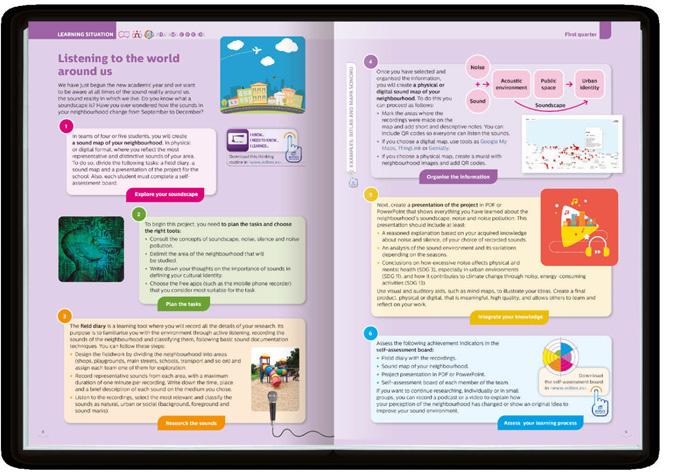
Learning situations are incorporated into the new edition. Each term begins with a learning situation, where the students must integrate and connect all the basic skills and knowledge that will be used in the unit. Activating what has been learned can only be done through action, by means of an enjoyable task that allows students to develop their ability to work in teams, learn skills, foster creativity, and understand the importance of “learning by doing”. At the end, each student will assess their learning process with the self-assessment board.
PROJECT
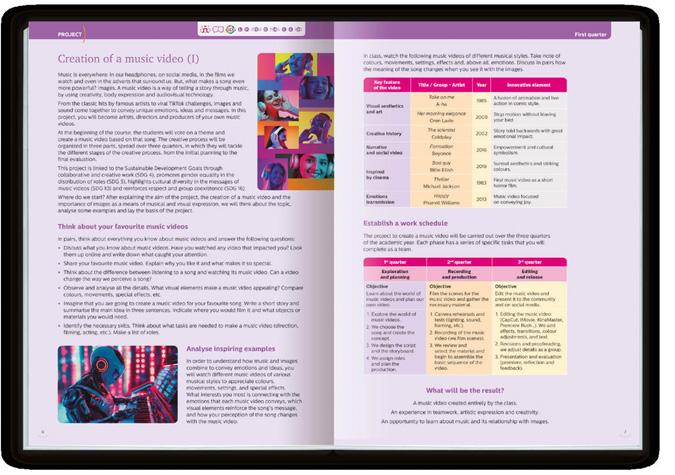
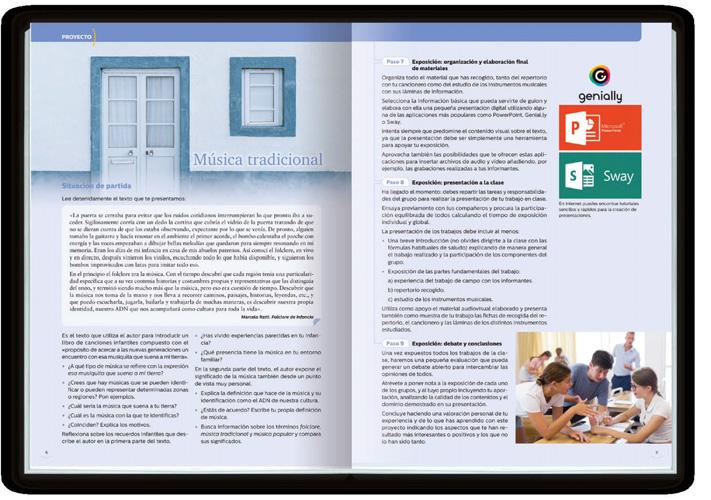
Each book is based on a global project (MUSIC I: “Creation of a music video”; MUSIC II: “Fashion show”), which will be developed step by step, in four stages, throughout the academic year and will turn each student into the main character of their own learning process with an active methodology based on research, thinking and cooperation, where they will learn to take on different roles and responsibilities.
DANCE
Dance takes on a more prominent role both within the book and the “In motion” section.
PERFORMANCE
Scores for all musical activities are provided for the instruments usually available in the music classroom, and for the usual range of school voices. In addition, the ukelele is added into the performance activities.
NEW FINAL SECTIONS
Among these, “Main character ” stands out, specifically highlighting prominent figures in the field of music who have become leaders in different professions within the music industry, as well as the growing importance of female musicians throughout history.
The “Creation and multimedia lab” explores the use of different apps and the using of specific digital tools for music edition, experimentation, creation, performance and recording.
Musical practice
Richness and variety of the repertoire is provided for the musical practice, always with the corresponding simplified or adapted scores. The selection is based on quality criteria in order to offer the most significant references in musical culture.
The scores for all musical activities are provided. For teachers, they are a real ‘treasure’ as working material, and for students, they become the element where they see their learning progress reflected and reinforced.
All the scores proposed for performance are adapted to the instruments normally available in the music classroom and to the usual range of voices. In addition, in many cases, they include musical backing and accompaniment tracks.
Multiple intelligences
A commitment to diversity and integration. Music and dance develop multiple intelligences in all their forms: musical intelligence, bodily-kinesthetic intelligence, spatial intelligence, intrapersonal or emotional intelligence, interpersonal or social intelligence, linguistic intelligence, and logical-mathematical intelligence.
Education for sustainable development
The 17 SDG of the 2030 Agenda are addressed so that students acquire and promote a commitment to the most urgent challenges that humanity is facing: ending poverty, protecting the planet and guaranteeing human rights for all people.
Skill-based assessment
This is a key element for student inclusion and academic success. Certain activities are marked with key competency symbols. In addition, practices, activities and tasks belonging to these types are marked with their symbol:
Our books develop the four specific skills established by the new Music curriculum for secondary education through the following teaching approach:
Features
Comprehensive presentation of content (basic skills and knowledge) in an ordered and coherent structure that makes the book clear and easy to use.
Teachers have access to comprehensive material that allows them to choose and adapt their working methods, content selection, activities and levels of difficulty or depth.
Independent learning. Students can use the book independently and easily find what interests them, understanding and even unconsciously assimilating concepts and their relationships.
Flexibility. The books can be worked through in an ordered and comprehensive manner, if desired. However, they also allow the alternation or combination of content, the elimination of some content, barely mentioning it, or addressing it in depth without the need to resort to other sources.
This is a complete resource, with all the content and a variety of activities (in terms of procedures and levels of difficulty), making it a unique working tool, complemented by digital resources and a specific answer key for teachers.
Quality of the text due to careful writing, concise language and rigour in the presentation of the content.
The basic techniques for performance (vocal and instrumental), specific warm-up exercises and techniques for controlling emotions have been incorporated.
We are committed to highlighting the role of women in all areas of music, incorporating female figures into the regular development of content, but also dedicating a specific section to a more in-depth and detailed study, as well as offering recordings of the more prominent women composers.
Active learning methodologies
Based on the real world: all knowledge, problem or activities are introduced within a specific context and help in everyday life and different situations.
Learning by doing: a more practical approach, where students can “get involved” and learn how to “apply” that knowledge.
Team work : working in teams to solve complex problems and tasks, while taking on responsibilities.
Ability to discover new knowledge: learning to learn, so that each student takes control of their own learning process.
Highly diversified personal learning environment (PLE): including content, tools, working methods, scores, audio files, backing tracks, MIDI files, downloadable activities and tasks, applications, information sources, and so on, which facilitate independent learning.
Project based-learning
Approach to a cross-curricular project that is different for each course (MUSIC I: “Creation of a music video”; MUSIC II “Fashion show”) that makes each student the main character of their own learning process with an active methodology based on research, thinking and cooperation, where they will learn to take on different roles and responsibilities.
The starting point is a situation that motivates students, encompassing basic knowledge, assessment criteria and skills, applied in a real life context or situation, with the aim of creating a final product.
Use ICTC
The use of different apps is explored in depth with the employ of specific digital tools designed for music edition, experimentation and creation, performance and recording.
NOVELTIES 2026
The paper edition includes a licence to use the book in digital format on www.blinklearning.com
The paper edition includes a licence to use the book in digital format on www.blinklearning.com
Project. Creation of a music video (I)
Learning situation 1. Listening the world around us
Unit 1. Sound and silence
Unit 2. Pitch and duration
Unit 3. Intensity and timbre
Project. Creation of a music video (II)
Learning situation 2. Discovering melodies and cool groups
Unit 4. Rhythm and melody
Unit 5. Harmony and texture
Unit 6. Musical forms
Project. Creation of a music video (III)
Learning situation 3. Staging a big concert
Unidad 7. Vocal genre: the voice
Unidad 8. Instrumental genre Unidad 9. Traditional music
Project. Creation of a music video (IV)
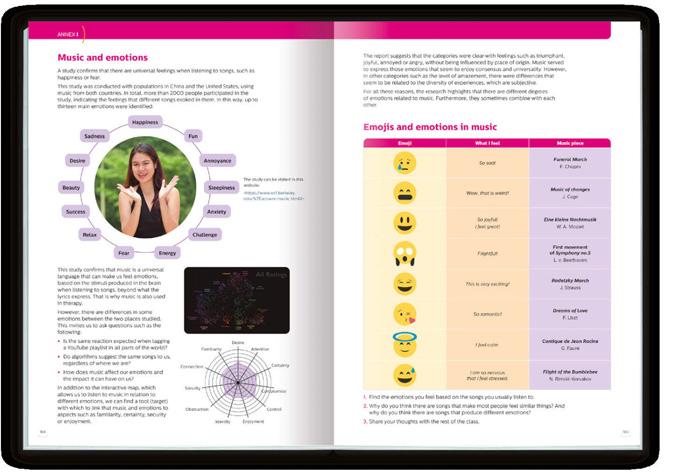
Annex I. Music and emotions
Annex II. Harmony in urban popular music
Annex III. Live music
Listening index
ISBN: 978-84-1059-493-7
Project. Fashion show: from prehistory to the 21st century (I) Learning situation 1. Musical archaeologists in a dig Unit 1. Prehistory and music in ancient times
Unit 2. Middle Ages
Unit 3. Renaissance
Project. Fashion show: from prehistory to the 21st century (II) Learning situation 2. A visit to Beethoven’s house
Unit 4. Baroque
Unit 5. Classicism
Unit 6. Romanticism
Project. Fashion show: from prehistory to the 21st century (III) Learning situation 3. Let’s go to a concert!
Unit 7. Music in the 20th century
Unit 8. Urban popular music in the 20th century
Unit 9. Music in the 21st century
Project. Fashion show: from prehistory to the 21st century (IV)
Annex I. A historic soundtrack! History of music through cinema
Annex II. Involved and solidary music
Annex III. The music we listen to. The soul’s album: songs with emotions.
Listening index
ISBN: 978-84-1059-494-4
INDEX
INDEX
UNIT STRUCTURE
LEARNING SITUATIONS
Learning situations are incorporated into the new edition. Each term begins with a learning situation, in which the students must integrate and connect all the basic skills and knowledge that will be used in the quarter. Activating what has been learned can only be done through action, by means of an enjoyable task that allows students to develop their ability to work in teams, learn skills, foster creativity, and understand the importance of “learning by doing”.
PROJECT
Each book is based on a global project (MUSIC I: “Creation of a music video”; MUSICA II: “Fashion show”), which will be developed step by step, in four stages, throughout the academic year and it will turn each student into the main character of their own learning process with an active methodology based on research, thinking and cooperation, where they will learn to take on different roles and responsibilities.
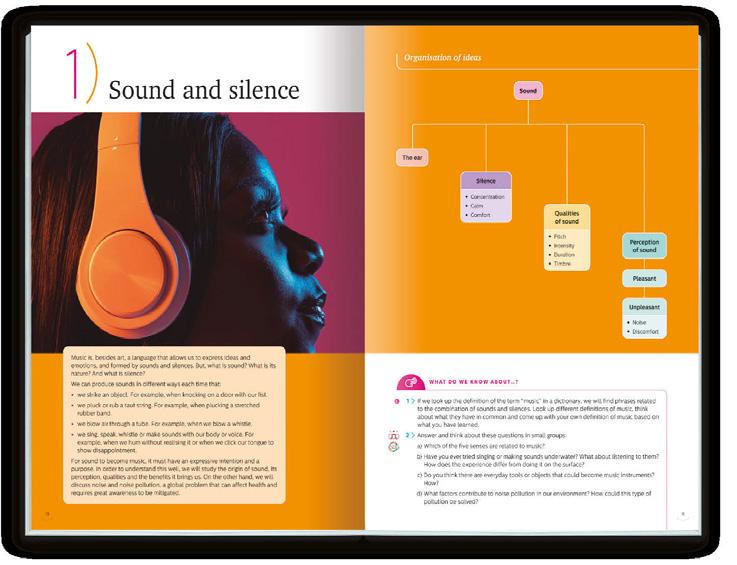
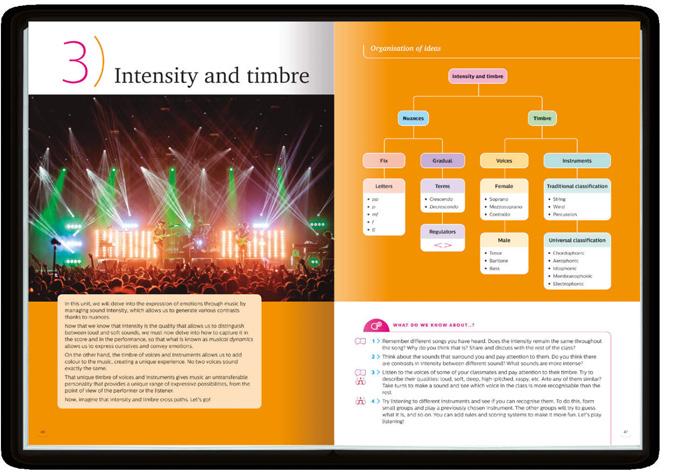
INITIAL PAGES with a motivational image, introduction, diagram and starting questions.
UNIT STRUCTURE
CONTENTS
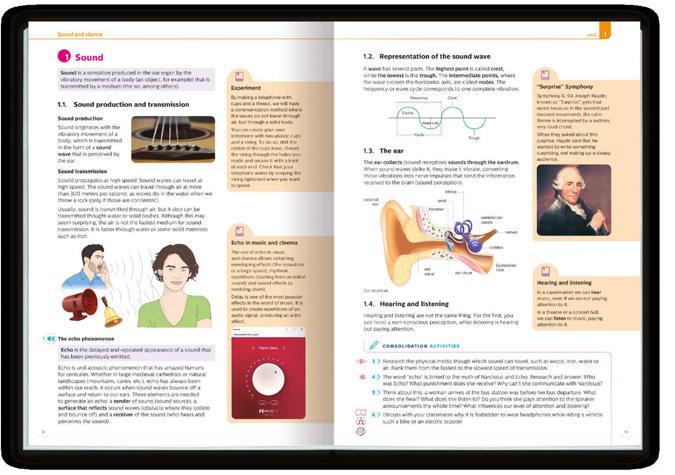
Several diagrams, tables, illustrations and musical examples have been included to understand and assimilate the information in a simpler and more enjoyable way. Reinforcement, listening and performance activities are very useful to consolidate the knowledge acquired in a more practical way. Complementary elements and interesting facts are included in the margins. Listening activities are identified with the symbol and the number corresponding to their order of appearance in the book and availability on the website.
PERFORMANCE – LISTENING IN MOTION
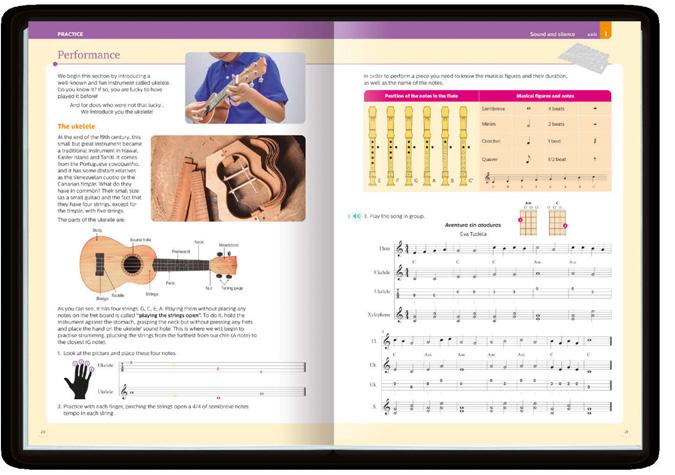
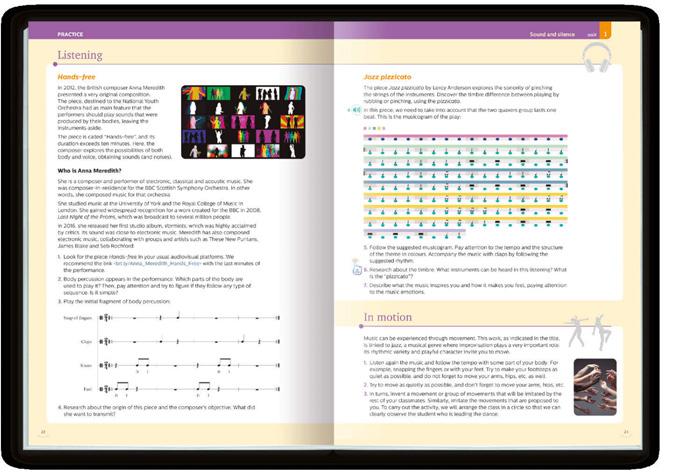
• Performance, listening, improvisation and creative activities help to consolidate instrumental, vocal and physical expression and listening skills through a wide variety of musical examples.
• Scores for all the musical activities for the instruments normally available in the classroom and the usual range of voices are provided. In addition, the ukelele is incorporated into the performance activities.
• The “In motion” section includes several dance activities to develop coordination, rhythm, body perception and interaction with the group in a playful manner.
There are audios, MIDI and musical bases.
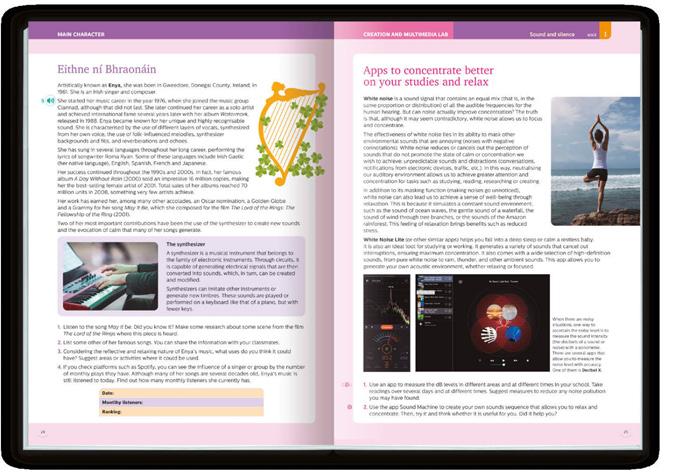
MAIN CHARACTER
This section presents, in an engaging manner, prominent figures in the field of music who have become leaders in various professions within the music industry.
CREATION AND MULTIMEDIA LAB
It focuses on musical creation and the use of new technologies applied to music.
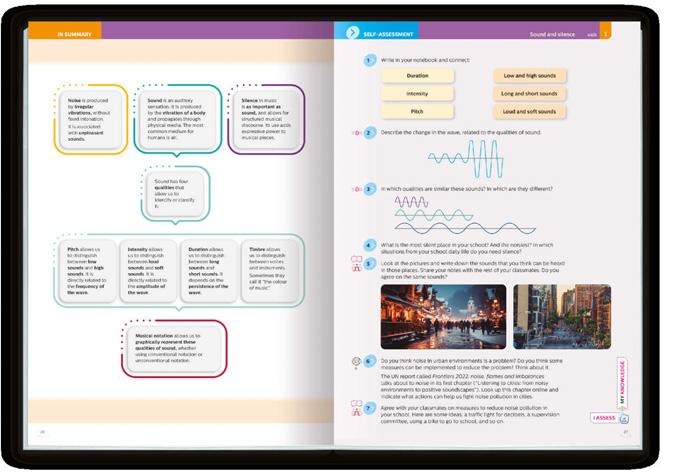
IN SUMMARY
SELF-ASSESSMENT
Final activities where the fundamental knowledge and skills applied in the unit are reviewed and consolidated.
The main contents of the unit and the relationship between them are shown visually and concisely. Key skills: linguistic communication skills L multilingual skills P math skills and science, technology and engineering skills STEM digital skills D personal, social and learn-to-learn skills PSAA civic skills C entrepreneurial skills E awareness and cultural expression skills CEC
Other symbols used in tasks and activities
ANNEXES
At the end of each book, there are three annexes that expand and enrich the content to explore music from new perspectives. Each one focuses on a key aspect that contributes to a better understanding of how music is experienced, felt and built in different contexts.
The paper edition includes a licence to use the book in digital format on www.blinklearning.com
The paper edition includes a licence to use the book in digital format on www.blinklearning.com
Proyecto: Música tradicional
1. Las cualidades del sonido
2. Cualidades del sonido: la altura
3. Cualidades del sonido: la duración
4. Cualidades del sonido: la intensidad
5. Cualidades del sonido: el timbre
6. La organización del sonido: ritmo, melodía, textura
7. La estructura de la música: la forma musical
8. El contenido y la función de la música: la forma musical
ISBN: 978-84-1321-832-8
The paper edition includes a licence to use the book in digital format on www.blinklearning.com
Proyecto: «Grabamos un anuncio publicitario»
1. El sonido y el silencio en la música
2. Música del mundo
3. Música de ahora y de antes
4. La música popular urbana
5. La música y la danza a escena
6. La música y los medios audiovisuales
ISBN: 978-84-1134-646-7
Proyecto: Concierto final
Antes de empezar
1. Antigüedad y Edad Media
2. Renacimiento
3. Barroco
4. Clasicismo
5. Romanticismo
6. Siglo XX
7. Músicas del mundo
ISBN: 978-84-1321-833-5
1. Música y tecnología
2. La música en el cine y los videojuegos
3. La música y los medios de comunicación
4. Historia de la música popular
5. Historia de la música popular en la actualidad
6. La música en España
ISBN: 978-84-9161-855-3
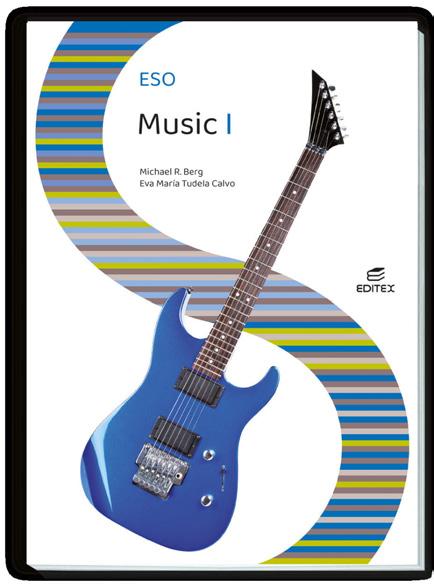
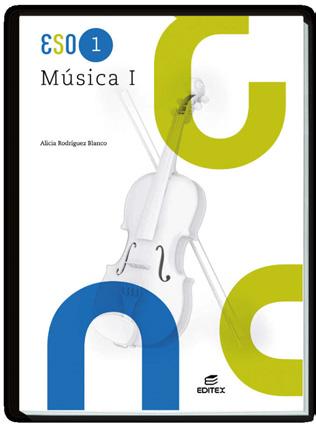
Música I
It focuses on the following basic skills: Listening and musical perception (A) Performance, improvisation and stage creation (B). These are the contents of musical language, which include both the basic elements of language and its graphic representation (notation-scores), as well as working procedures (musical practice) based on listening.
Musical practice of listening and performance with its score to work on two aspects at the same time: language and culture.
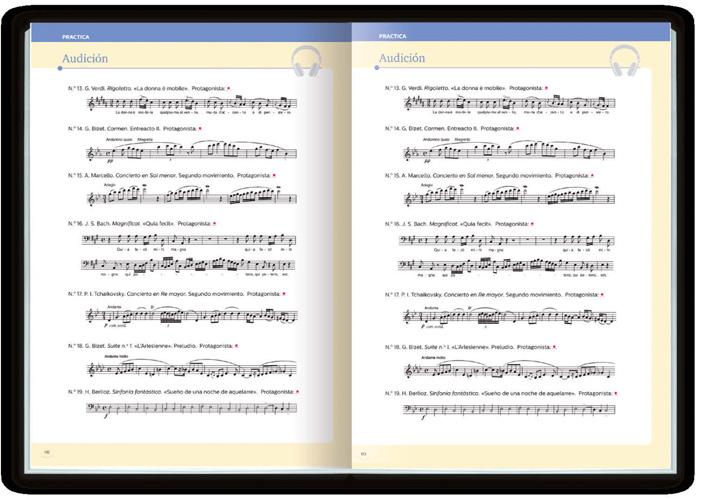
Scores. Scores are provided for all musical activities, for the instruments normally available in the music classroom and for the usual range of voices.
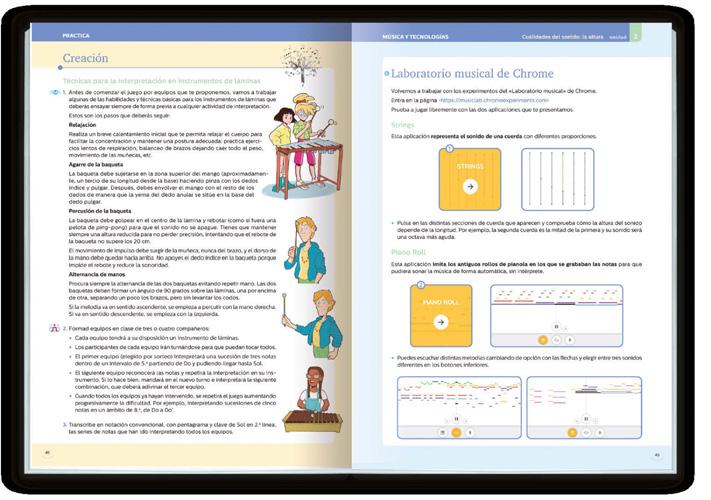
Chrome Musical Lab: apps that offer experiments and games with sound, from handling sound waves to musical composition with melodies and chords.
Body percussion and batucada activities.
Project
The book is based on the project global “Traditional music”, where students must integrate and connect all the basic skills and knowledge they will be working on throughout the academic year. This is an enjoyable project to “learn by doing”, which allows students to develop teamwork skills, skills-based learning and creativity.
Gamification
Several proposals based on games, either individual or in groups.
Ecuaciones musicales: Musical equations: equivalence of musical durations.
Dominoes game: works on the correspondence of musical figures and rests.
Sound deck: the four characteristics of sound converted into the four suits of the deck with all the elements of musical language.
Game of the musical goose: open-ended game that encourages cooperative work and creativity. Sound riddles, crossword puzzles, word searches, typos, intruder
Use ICT
The use of different apps is explored in depth with the use of specific digital tools designed for music edition, experimentation and creation, performance and recording.
There are audios, MIDI and musical bases.
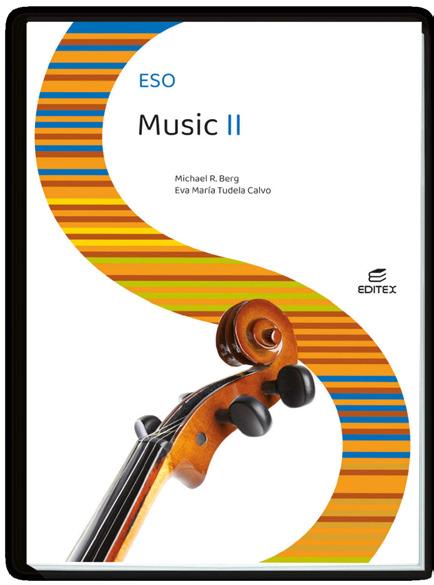
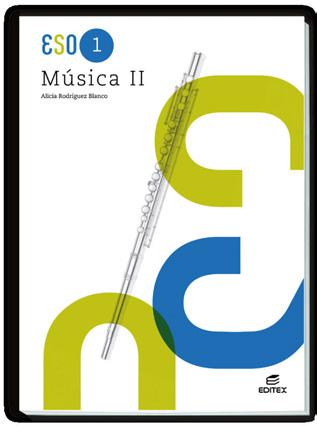
Música II
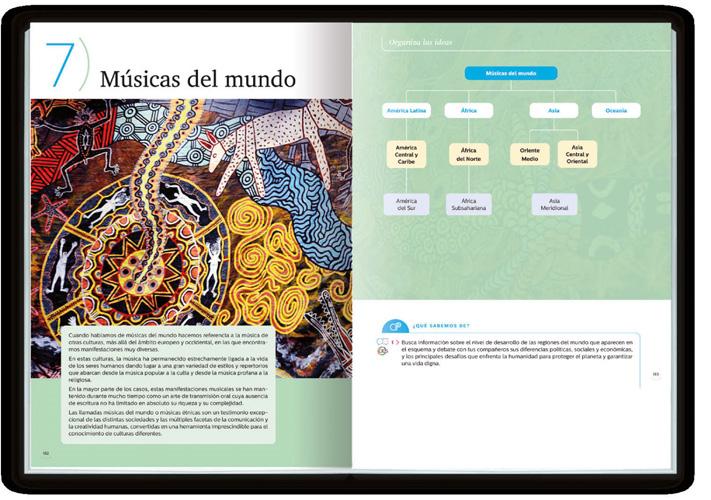
Focused on the basic knowledge of Musical contexts and cultures (C) that we can understand as music history of our western culture and, now with a new final unit, of music in other cultures (“Music of the world”).
UNIT STRUCTURE
Introductory pages provided context, with illustrations, an introduction, an outline and a specific timeline.
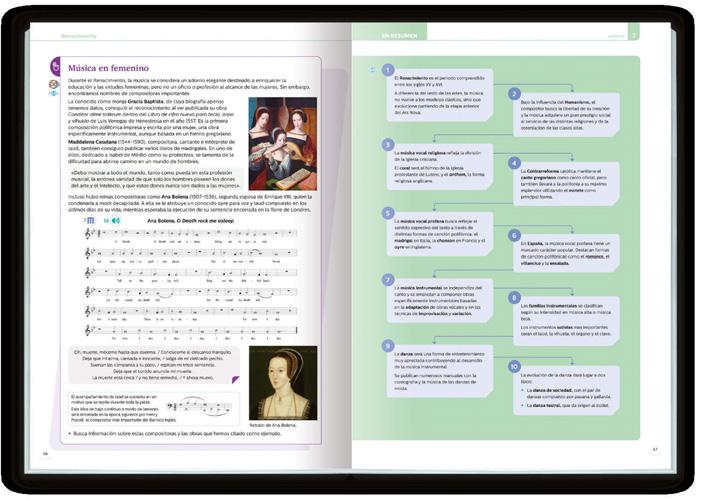
Section “Music in the feminine” to reinforce more specifically the work on women in music addressed in the tables and in the development of the text.
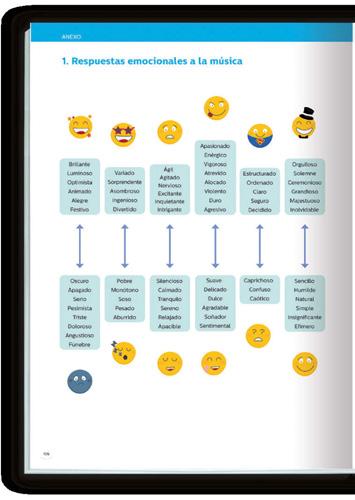
Working emotional education through the “Emotional responses to music” chart, designed to provide each student with a vocabulary that allows them to identify and express their emotions.
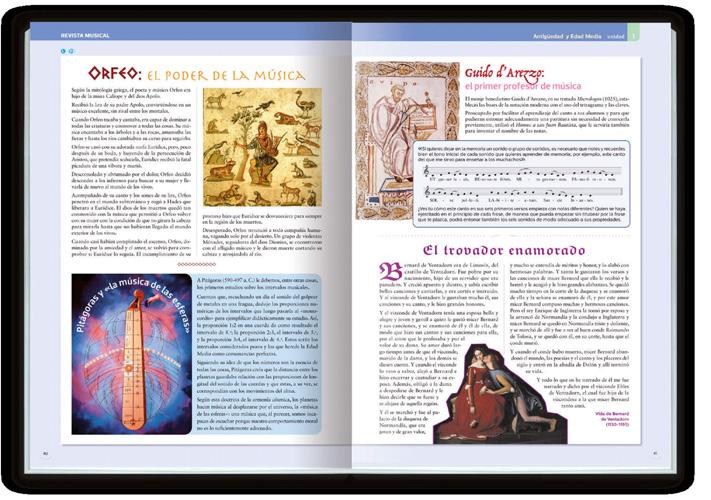
Musical magazine with interesting, high-quality articles on different aspects and anecdotes from the world of music. It helps to meet compulsory reading requirements by providing a wide selection of material to work on reading comprehension and opening up the possibility of discussion or research activities.
Project
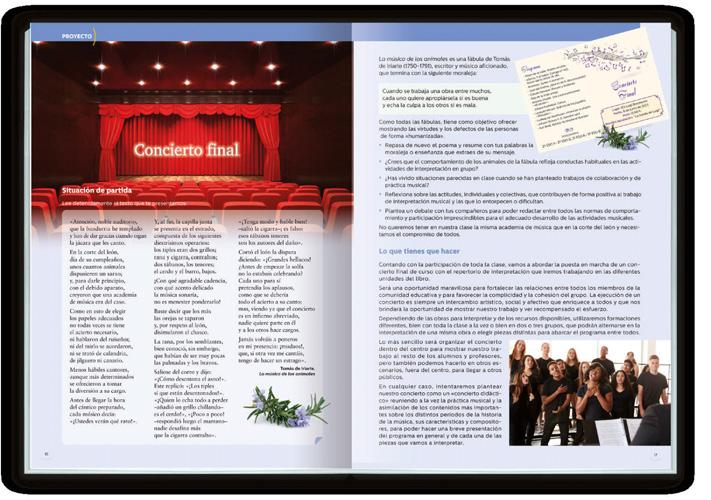
The book is based on the project global “Final concert”, where students must integrate and connect all the basic skills and knowledge they will be working on throughout the academic year.
DIGITAL CONTENTS OFFER
Digital resources compatible and usable into educational platforms.
DIGITAL EDUCATIVE BOOK (DEB)
Digital format that includes the book and associated resources. The teacher’s book and the student’s book are differentiated. Access via plataform www.blinklearning.com.
What contents are available for the student?
Students have access to different tools and resources that allow them to follow the class: they can highlight, add comments and complete activities. They can also access additional content provided throughout the unit. Opportunity to learn through interactions, videos, audio files and web links that expand or complement the content of the book.
What contents are available for the teacher?
In addition to all the student resources and content, teachers have direct access to all the teaching resources in each one of the units: - Programming - Answer key - Presentations - Etc.
PROGRAMMING
ANSWER KEY
It includes the wordings and answers of all the suggested activities in the student’s book. When the question is open-ended, guidelines for assessment are provided.
Editable electronic document that includes, for each unit, the objectives, content, assessment criteria, methodology, etc.
IMAGE GALLERY
All photographs, illustrations and diagrams for each unit are available for projection in the classroom.
ASSESSMENT TEST INTERACTIVE ACTIVITIES
An effective tool to assess student’s knowledge acquisition that becomes an attractive resource of the learning process and the use of technologies. Navigation is easy and intuitive, reinforcing digital competence and learning through practice with immediate results.
ESO
Catalogue Music
TEACHER’S INFORMATION CENTER
If you have any question or want more information:
Phone: 91 799 20 40
E-mail: correo@editex.es
ORDERS
Phone: 91 799 20 60
E-mail: comercial@editex.es
If you want to know more about our publications: www.editex.es