editel ISSUE 2/2025
journal
CORPORATE MAGAZINE OF THE EDITEL GROUP
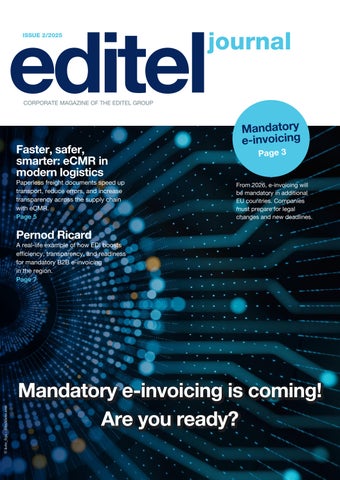
Faster, safer, smarter: eCMR in modern logistics Paperless freight documents speed up transport, reduce errors, and increase transparency across the supply chain with eCMR. Page 5
Mandatory e-invoicing Page 3
From 2026, e-invoicing will be mandatory in additional EU countries. Companies must prepare for legal changes and new deadlines.
Pernod Ricard
© koto_feja – iStockhoto.com
A real-life example of how EDI boosts efficiency, transparency, and readiness for mandatory B2B e-invoicing in the region. Page 7
Mandatory e-invoicing is coming! Are you ready?
2 editel journal
Editorial
© Katharina Schiffl
A small step with big impact
Gerd Marlovits CEO
At first glance, the introduction of e-invoicing might seem like just one more task in the business routine. But with mandatory implementation approaching in more and more EU countries, it’s becoming clear that this step carries enormous weight. Structured electronic invoices are more than just a new format. They’re transforming the way companies work, make decisions, and collaborate. Preparing now will pay off, as it lays the foundation for greater efficiency, flawless data, and full transparency across the entire process chain. After all, electronic invoices never stand alone. They’re connected to purchase orders, dispatch advices, accounting systems, and communication with retail partners.
Once this flow is fully automated, the relief in day-to-day operations becomes tangible — oftentimes in unexpected areas. The many real-world examples featured in this issue are testimony to that: whether in manufacturing or logistics, wherever digital processes interlock, they create accuracy, speed, and stability. And wherever media disruptions disappear, employees gain valuable time for tasks that truly add value. Switching to e-invoicing may be mandatory, but its impact reaches far beyond mere regulatory compliance. It paves the way toward more modern, resilient processes — and a future in which businesses stand to benefit for years to come. Happy reading, Gerd Marlovits
3 Pernod Ricard 7 Articles in Mandatory e-invoicing is becoming mandatory The EDI solution gives Pernod Ricard this issue e-invoicing across Europe. Learn how companies faster processing, fewer errors, and realstay compliant while boosting efficiency with smarter digital processes.
time insights ahead of mandatory 2026 e-invoicing.
5 EUDR made easy with DESADV 9
eCMR: faster, safer logistics Paperless freight documents speed up transport, reduce errors, and increase transparency across the supply chain with eCMR.
DESADV combines delivery data and EUDR documentation for faster, transparent, and efficient supply chain operations. E-Invoicing Exchange Summit Vienna 2025 Insights from the summit on ViDA, system interoperability, and practical tips for companies planning e-invoicing.
11
Brief & digital ERP and EDI: a guide to seamless integration
A practical guide to ERP and EDI integration, showing how seamless connectivity enhances automation, data accuracy, and business efficiency.
© HAKINMHAN- iStockphoto.com
editel journal
Mandatory e-invoicing: time to get on board Belgium, Croatia, Poland, and soon France: the list of EU countries introducing mandatory B2B e-invoicing is growing rapidly. Companies in other European countries with subsidiaries in these jurisdictions also need to take action.
T
he foundation has been laid, and e-invoicing is gaining momentum. After the Council of EU Finance Ministers (ECOFIN) adopted the ViDA directive last year and the European Parliament approved the ViDA package this year, many countries have now entered the implementation phase. Germany began introducing mandatory e-invoicing — with transition periods and exceptions — at the start of 2025. More countries are set to follow: Croatia, under its working title Fiskalizacija 2.0, and Belgium plan to introduce corresponding B2B e-invoicing requirements as early as January 1, 2026; Poland will follow on February 1; and several other member states are already preparing their own rollouts (see overview). According to the current version of the ViDA directive, the key deadline for mandatory issuance of e-invoices within the European Union is July 1, 2030.
theless, companies should already be taking proactive steps, especially if they operate in countries that are now introducing mandatory e-invoicing. For companies based outside these countries, there is currently no obligation to report cross-border B2B invoices — for example, invoices issued to Polish business partners — to the Polish authorities under the new KSeF rules. The situation changes, however, when a company has its own subsidiary or permanent establishment in Poland. In that case, any invoice issued by this entity must be created and transmitted in full compliance with KSeF requirements.
Action required
e-invoicing: far more than going paperless
In many EU countries, structured electronic invoices are currently mandatory only in the B2G sector. Never-
As highlighted by the example of Croatia, e-invoicing goes far beyond replacing paper or PDF invoices. At its
In Croatia, the new regulation goes beyond the introduction of B2B e-invoicing. Among other measures, it also includes mandatory electronic archiving of invoices as well as digital bookkeeping.
3
4 editel journal
e-invoicing in the EU: Overview of upcoming regulations*
Belgium B2B Croatia B2B – Phase 1 Latvia B2G
2026
Jan.
Germany B2B (all taxpayers) Latvia B2B Slovenia B2B Norway B2B (non-EU)
France B2B – Phase 1
Feb.
2027
Sep.
Poland B2B/B2G – Phase 1 Greece B2B
France B2B – Phase 2
Jan.
Sep.
Spain B2B Germany B2B (> €800,000 turnover) Slovakia B2B Estonia B2B Croatia B2B – Phase 2
2028
2030
e-invoicing as the norm in B2B and B2G
* Introductions in the B2B and B2G sectors – postponements possible, as of November 2025
core, it is about achieving fully digital capture, recording, and archiving of B2B business transactions. One goal of this digital transformation is to reduce VAT fraud, which cost EU member states an estimated €61 billion in 2021 alone, according to the “VAT Gap Report.” At the same time, the introduction of e-invoicing opens the door to significant process optimization, efficiency gains, and cost reductions. EDITEL CEO Gerd Marlovits comments: “Creating an invoice is ultimately just one link in a chain of transactions between business partners. The obligation to transmit structured e-invoices will further accelerate the digitalization of upstream and downstream processes — from ordering and delivery confirmation to posting and archiving.” An integrated EDI solution ensures seamless data exchange, both internally with ERP or merchandise management systems and externally with business partners.
From obligation to opportunity For this reason, Mr. Marlovits advises companies to view the legal obligation to issue structured e-invoices as an opportunity to optimize their digital processes and to use it as a moment to review all upstream and
Our experts have decades of experience implementing projects of this kind. Gerd Marlovits, EDITEL CEO
downstream workflows as well: “Our experts have decades of experience implementing projects of this kind.” Since ViDA leaves the specific design to individual member states, EDITEL has established its own E-Invoicing Competence Center, which analyzes the often-complex national regulations and provides a clear overview of the various legal and technical requirements in each country. This enables companies across the EU and beyond to receive forward-looking support as they transition to the new rules. More information about e-invoicing and country-specific solutions is available online:
editel journal
Digital transformation in transport: when freight documents go digital In transport logistics, paper-based freight documents are still part of everyday operations — often resulting in delays, media disruptions, and significant administrative effort.
B
the additional protocol to the CMR Convention — legally recognized as equivalent to the traditional paper consignment note.
eCMR – a driving force in digital logistics architecture
eCMR in practice – modern platform solutions on the rise
While trucks cover hundreds of kilometers every day, paper-based documents often fail to keep up. Manual signatures, copies, and hand-entered data lead to errors, costs, and delays. The eCMR eliminates these issues: it is generated electronically, made available on mobile devices, and — in countries that have ratified
For the digital consignment note to deliver its full benefits, companies need reliable, user-friendly, and easily integrable systems. One such solution is FreightLogs by EDITEL — a platform that makes the transition from paper-based documents to fully digital transport processing particularly simple.
© Denys – iStockphoto.com
ut the industry is changing: electronic processes are increasingly replacing traditional document flows, creating greater efficiency, transparency, and security throughout the entire supply chain. A key driver of this development is the eCMR, the digital consignment note. It replaces the traditional paper document and brings speed, control, and legal certainty to transport operations.
All countries with the eCMR additional protocol
As of December 2025, around 40 countries have adopted the eCMR protocol, including most of Europe. This continues to boost acceptance in international road transport.
5
6 editel journal FreightLogs gives logistics companies access to the eCMR, regardless of their size or existing IT infrastructure. The solution is web-based, ready to use immediately, and can be operated even without any integration effort.
© RgStudio – iStockphoto.com
Another advantage: the digital documentation cannot be altered afterward or lost. The eCMR can also be integrated into broader digital systems — for example, for real-time shipment tracking or automated data exchange via EDI interfaces.
Why now is the right time The international trend toward the digitalization of transport documents is gaining significant momentum. Governments and authorities are increasingly relying on electronic information flows, and supply chain partners expect structured, real-time data. Companies that implement the eCMR today benefit from stable processes, reduced administrative effort, and more efficient management — and they position themselves for upcoming regulatory developments: By 2027: EU Member States must accept electronic information exchange via certified eFTI platforms 2029: Full digitalization of transport documents for all international shipments within the EU To leverage these advantages in day-to-day operations, the right digital platform is essential.
KEY FEATURES OF FREIGHTLOGS eamless integration into existing systems via S REST API (ERP/TMS/WMS)
How FreightLogs works in daily operations I mport the transport order: Order data is automatically transferred to FreightLogs. Driver access via link: The driver opens the mobile application without needing to install anything. Guided process: The app walks the driver step by step through loading, transport, and delivery. Digital signature: Signatures are captured directly on the mobile device with a clear, traceable digital record. Automated creation of the eCMR: The document is immediately available to all parties involved. Direct data exchange: Information flows straight back into the company’s systems.
ultiple digital signature methods, including M Sign on Glass, Sign on Delivery, and the industry-standard eSeal in accordance with the EU eIDAS regulation
As a result, manual intermediate steps are eliminated, and companies benefit from a fully digital, audit-proof document management process.
apture of additional metadata such as tiC mestamps, GPS location, and a complete document history
Ready for the digital future of transport? We already are.
ole-based access for drivers, dispatchers, R customers, partners, and authorities
The course in logistics is clearly set toward digitalization — and with solutions like FreightLogs, taking that step is easier than ever. If you want to make your transport processes more efficient, transparent, and futureproof, we’re here to support you: from the initial rollout to seamless integration into your daily operations. Together, we’ll make your journey into digital logistics not only possible, but successful.
egally compliant archiving in line with indusL try-standard retention requirements Mobile-optimized, making it ideal for international transports and mixed fleets
editel journal
Pernod Ricard sets the pace in digital transformation With the successful introduction of EDI, Pernod Ricard is reshaping its entire order-to-cash process — accelerating order handling, reducing errors, and gaining real-time transparency, while positioning itself ahead of mandatory B2B e-invoicing in Croatia by 2026.
P
ernod Ricard has made a major step forward in its digital transformation by introducing Electronic Data Interchange (EDI) to streamline business operations. From faster order processing and fewer errors to realtime visibility, the new system is enhancing every stage of the order-to-payment process. As Croatia prepares for mandatory B2B e-invoicing in 2026, Pernod Ricard is already ahead of the curve-leveraging automation to stay compliant and competitive. Read the interview below to find out how Pernod Ricard successfully implemented this transformation in partnership with EDITEL. What did Pernod Ricard’s business operations in Croatia and the region look like before introducing EDI, and what challenges did you face? Josipa Lukić: Before EDI, most communication with customers and suppliers took place via e-mail and phone calls, and in the past even by fax and text message. This meant manual order entry into the ERP system, additional verification steps, and frequent reconciliation of item codes, units of measure, and quantities. In logistics, the lack of timely advance notifications often created bottlenecks in goods receipt, while in finance, invoice posting and reconciliation were slower because the documents lacked standardized structures. In short, we faced limited standardization and no true “end-to-end” visibility from order to payment — the typical challenges of non-automated communication. What were the main reasons for implementing an EDI solution, and why did you choose to work with EDITEL? The primary motivation was to improve data quality and accelerate processes through standardized EDI
The greatest impact has been across the entire order-to-cash process, particularly in the integration between our ERP system and partners. Josipa Lukić
messages (ORDERS, DESADV, INVOIC) and global identifiers. Since early last year, collaboration with EDITEL has intensified in preparation for mandatory B2B e-invoicing in Croatia, effective January 1, 2026. We initially chose EDITEL because of their team’s professional approach: they inspired confidence, communicated complex topics clearly, and provided guidance on what needed to be done, who should be involved, the expected timeline, and what to anticipate in each project phase. We continue to partner with EDITEL because they offer comprehensive end-to-end technical support from clarifying data requirements, providing training, and helping structure the entire order-topayment process to ensuring fast, seamless integration with our ERP and with customer and supplier systems.
7
8 editel journal Which processes were most affected by the introduction of EDI (for example, procurement, logistics, administration, or customer relations)? The greatest impact has been across the entire orderto-cash process, particularly in the integration between our ERP system and partners. The change enabled immediate reconciliation of shortages and surpluses, and inventory discrepancies caused by incorrect receipts have virtually disappeared. We send INVOIC messages as structured e-invoices, which pass validation seamlessly and accelerate posting, while we receive electronic orders and delivery confirmations directly from our customers. As Croatia moves into the era of mandatory B2B e-invoicing, such standardized data exchange is becoming the new norm for an ever-growing number of our customers. Can you describe the specific benefits—time savings, fewer errors, faster order processing, and greater transparency? The time from order receipt to processing is now significantly shorter. We estimate that EDI orders are 50% to 80% faster than those entered manually, depending on the number of items and the accuracy of key data. Message validation and the use of global identifiers have reduced complaints and debit notes. In logistics, RECADV messages and, where applicable, ASNs provide advance visibility and simplify goods receipt. E-invoices undergo formal checks before being sent, minimizing “ping-pong” exchanges and allowing faster posting. As Croatia transitions to mandatory B2B e-invoicing from 2026, these benefits are becoming systemic across the entire ecosystem rather than isolated improvements. However, to fully realize the advantages of EDI, a wellstructured system and accurate master data are essential. Otherwise, the time gained through automation can quickly be lost to correcting inaccurate information. How have your customers and suppliers responded to the EDI transition — has it made cooperation with Pernod Ricard easier for them? The Croatian market is quite heterogeneous. About 50% of our orders are now exchanged via EDI with larger customers, and onboarding with them is usually quick since they already have experience and established
mappings. Smaller customers, however, often lack an ERP system or find its maintenance too costly. In many cases they also don’t have the internal expertise needed for full integration, so they are not yet ready to adopt EDI completely. We expect that, with the introduction of mandatory e-invoicing on January 1, 2026, the number of customers using EDI will increase rapidly. How does working with EDITEL support further digitalization and help you achieve your strategic goals? EDITEL serves as our integration backbone across multiple markets and protocols, allowing us to connect new customers and suppliers faster and with minimal internal development effort. The platform adapts to local regulations and infrastructures, ensuring ongoing compliance as Croatia transitions to mandatory B2B e-invoicing in 2026. Because everything runs on the same platform, we can easily expand the scope – for example, to include stock reports or payment notifications – without having to “reinvent the wheel.” Our collaboration with EDITEL is fully aligned with Pernod Ricard’s Supply Chain strategy, which aims to simplify processes, accelerate speed-to-market, and establish faster, easier communication – ultimately leading to better service for our customers. What advice would you give to other companies considering EDI, and what do you see as the greatest value of this collaboration? First, make sure your master data is clean including locations, items, and packaging and define a minimal set of EDI messages (order, receipt confirmation, and e-invoice) before expanding further. Second, segment your customers: pursue full integration with those who have the capacity, and gradually onboard others by highlighting clear benefits and providing a structured roadmap. Third, plan backward from regulatory milestones – for example, Croatia’s January 1, 2026 and Slovenia’s January 1, 2027 deadlines) and use them as natural targets for the entire supply chain. The greatest value for us lies in having a reliable, standardized data flow without manual entry, offering real-time visibility across procurement, logistics, and invoicing. This ensures full alignment with our global strategy of simplification and better communication, ultimately resulting in higher service quality for our customers.
© rawintanpin – iStockphoto.com
editel journal
DESADV – the transport vehicle of the EUDR With the EDI message DESADV, companies have a proven tool at their disposal— one that not only transmits delivery information efficiently but also ensures EUDR-compliant documentation.
I
t’s no coincidence that the DESADV (despatch a dvice) — the standardized electronic delivery notification defined by the GS1 EANCOM© standard — is often referred to as “the digital backbone of the supply chain.” Why? Because in practice, it is used to transmit essential logistics data such as quantities, packaging details, and item numbers. Its primary purpose is to provide the recipient with detailed information about a delivery before or upon arrival, enabling optimal preparation for incoming goods — for example, by reserving the appropriate storage space, triggering automatic postings, or planning quality inspections.
DESADV takes on a new role Going forward, the DESADV will also indicate whether an item falls under the EUDR regulation and whether the required Due Diligence Statement (DDS) has been created. The reference number of the DDS can be embedded directly within this message — effectively turning the DESADV into a transport vehicle for EUDR-relevant data. EDITEL supports its clients by providing customized mapping within its outsourcing services to ensure that
9
10 editel journal
all required fields are mapped correctly and in compliance with the standard. Even if another postponement of the EUDR is being discussed, it is advisable to make preparations early. After all, one thing is certain: postponed does not mean canceled.
Why is the DESADV used for the Due Diligence Statement (DDS) reference? Standardized and established: The DESADV is an internationally standardized EDI format (EDIFACT) and is already widely used across many supply chains. Adding DDS information does not require any fundamental system changes. Supply chain synchronization: The DESADV is sent before the physical delivery, making it the ideal moment to transmit the DDS reference. Automatable: Many companies already operate EDI systems, which makes integrating DDS data into the existing message simple and cost-effective.
Typically affected products include beef, cocoa, coffee, palm oil, soy, wood, and certain products made from them.
New status of negotiations (December 2025): As part of the trilateral negotiations between the European Parliament and the Council, a compromise was reached to postpone the application of the EUDR and at the same time simplify certain obligations: Large and medium-sized enterprises must comply with the EUDR obligations from December 30, 2026. Small and micro-enterprises will be granted an additional transition period until June 30, 2027. This agreement must still be formally adopted by the Parliament and the Council and published in the EU Official Journal before it becomes legally binding. If no agreement is reached, the current date of application of December 30, 2025, will remain in force.
I ntegration into existing workflows: The recipient can process the DDS reference number and verification number directly within their goods receipt workflow. Secure transmission via established B2B networks: The message can be transmitted through a secure, established B2B integration network (EDI network). Such networks ensure fail-safe infrastructure and enable traceable, reliable transmission of sensitive EUDRrelevant data.
EUDR application deadlines The EU Deforestation Regulation (EUDR, Regulation (EU) 2023/1115) requires companies to only place certain raw materials/products on the EU market, make them available, or export them if they can be proven to be “ deforestation-free” (not associated with deforestation or forest degradation), roduced legally in accordance with the laws of the p country of production, and overed by a due diligence statement, including c risk assessment and risk mitigation measures.
Example of a DESADV including a DDS reference number and verification number
editel journal
11
E-Invoicing Exchange Summit Vienna 2025 – event report In September 2025, Vienna hosted the E-Invoicing Exchange Summit— one of Europe’s leading events dedicated to electronic invoicing and digital document exchange.
The evening networking sessions once again proved that the E-Invoicing Exchange Summit is not just about presentations. Above all, it is a space for meaningful conversations and relationship building. It is often in these informal settings that new questions arise and ideas are born, later evolving into concrete initiatives.
European and national perspectives The second day of the summit featured keynote speeches and high-level panel discussions. Particular interest centered on presentations about the ViDA initiative, through which the European Commission aims to introduce mandatory B2B e-invoicing across the entire European Union. Many participants noted the diverse approaches individual countries are taking to implement their national systems and discussed how these can be aligned with the EU’s broader vision. The program also included a dedicated session on Poland, where experts presented the current status of the KSeF system, the implementation timeline, and the key challenges facing businesses. This session confirmed that Poland stands at the center of attention in the evolving European e-invoicing landscape. The final day of the conference looked ahead to the
© EDITEL
A
t the EDITEL Group booth, we enjoyed lively discussions with partners and industry experts. This year, we chose not to appear on stage, which allowed us to focus entirely on dialogue and the exchange of experiences. The three-day conference brought together experts, tax administration representatives, standardization bodies, and technology providers. From the very first day, the workshops centered on practical topics — ranging from regulatory requirements to international interoperability projects and the Peppol network. Tomasz Kuciel, Head of the e -Invoicing Competence Center at EDITEL Poland, together with representatives from the Polytechnic University of Milan, co-hosted a workshop on turning legal requirements into business development opportunities.
future of e-invoicing. Speakers highlighted the growing importance of automation, the use of artificial intelligence in data analysis and tax reporting, and how digital processes can evolve into a true competitive advantage for businesses.
Insights from EDITEL’s perspective For EDITEL, participating in the Vienna summit was an excellent opportunity to strengthen relationships with business and institutional partners. Our booth attracted considerable attention, and the conversations we held revealed a growing demand for solutions that go beyond regulatory compliance — solutions that truly enhance business processes. Our presence also confirmed that the direction EDITEL is taking with its solutions is fully aligned with European trends and market expectations. This serves as a strong signal that our expertise and portfolio are being recognized and valued all over Europe. The E-Invoicing Exchange Summit Vienna 2025 once again demonstrated that electronic invoicing is no longer the future — it is the present. Regulations such as KSeF in Poland, Fiscalizatia in Croatia and ViDA at the European level make it clear that digital document exchange is rapidly becoming a daily business reality. Equally important, however, is the exchange of experience — hearing how others have overcome similar challenges and comparing those insights with one’s own strategy. Such dialogue continues to drive innovation and strengthen collaboration across the entire e-invoicing ecosystem.
IMPRINT Owner and publisher: EDITEL Austria GmbH, 1040 Vienna, Brahmsplatz 3; T: +43 (0)1/505 86 02; E: info@editel.at; W: www.editelgroup.com EDITEL Austria GmbH is a wholly-owned subsidiary of GS1 Austria GmbH. The corporate objective of EDITEL Austria GmbH is the electronic data exchange between business partners, the sale of the required software and support services.
Management and responsible for the content: Gerd Marlovits Proofreading: Dagmar Jenner, www.texterei.com Layout: www.creativedirector.cc Printing company: Print Alliance HAV Produktions GmbH Disclosure pursuant to Austrian Media Law as amended in March 2009: the purpose of this newsletter is the promotion and support of EDITEL Austria‘s business activities. Publication frequency: twice a year in English language with a circulation of 50 copies. The EDITEL Journal is also published in German, Czech, Slovak, Hungarian, Croatian and Polish languages. All issues are available as e-papers at www.issuu.com/editel_group.