
Monthly Monitor I May 2026

Monthly Monitor I May 2026




Jeff brings over 30 years of experience in the energy industry, specializing in pipeline capacity management, utility agreement negotiations, and evaluating energy supply and infrastructure for greenfield facilities.

With more than 20 years of experience in supply advisory across Mexico and LATAM, Alberto focuses on both clean energy and conventional supply. He oversees Mexico operations and coordinates activities throughout Latin America.

Yasiru provides analytical support for energy supply strategies, contributing to procurement planning and market evaluations for Trio’s clients.
Bryon advises industrial and commercial clients on energy procurement strategies, leveraging extensive experience in the natural gas markets.
Anthony manages natural gas purchasing and balancing for large end users across multiple pipelines and LDCs. He also develops risk management and procurement strategies for clients in the steel and automotive manufacturing sectors.

Todd works with large industrial and commercial clients to manage natural gas exposure. Since entering the energy industry in 2000, he has developed deep expertise in risk management, asset management, and commodity trading.

With over ten years of experience and strong market expertise, Paola navigates the evolving power procurement landscape with a strategic approach. She supports clients with power procurement strategies, tariff analysis, budgeting, and ongoing market monitoring.
David brings nearly 25 years of energy industry experience, assisting clients with supply procurement, market analysis, tariff evaluations, budgeting, regulatory awareness, and cost control strategies.




John has over 30 years in the energy industry, including 20 years procuring power for clients in major deregulated U.S. markets. He supports Trio’s advisors in developing power procurement strategies.

With more than 11 years in the energy sector, Iryna manages gas and power procurement, physical trading, forecasting, budgeting, demand response, and customized reporting for industrial and commercial clients.

Stu has over 20 years of experience in the natural gas market, including physical and financial trading, procurement, asset optimization, balancing, and risk management.

Cynthia has over 17 years of experience in North American wholesale and retail energy markets. She offers expertise in deregulated power and gas markets, energy operations, regulatory compliance, and retail energy strategies.
Roger brings more than 25 years of experience in commodity sales, procurement, transportation, and midstream services. He excels in applying technical and interpersonal skills to drive results across diverse industry segments.
Irfan specializes in creating compelling visual content and brand assets that elevate Trio’s identity and storytelling across global platforms.
Daniel focuses on power procurement for large industrial and commercial clients. With 17 years in sales and account management, he brings a client-focused approach to energy strategy.
Jeff Bolyard - Principal, Energy Supply Advisory
Data centers have been around for around two decades now with an estimated 4,000-5,000 currently in operation in the U.S. However, the size and scale of what are being built today are much larger than those of the early days. The impact of the new version of these power hungry sources of demand is shifting the location and their individual energy sourcing strategies. A standard AI facility being developed these days talk in terms of 1 GW each with a top tier data center campus requiring 6-10 GW each. To give you an idea of just how much energy we’re talking about, Cleanview estimates that as of May 2026, the average capacity of the remaining coal generation fleet operating in the U.S. has a capacity of 0.875 MW each with the largest coal plants clustered around the 3-3.7
GW each. With an estimated 1,500 data centers being developed and/or under construction, the amount of power needed over the next five years to meet this demand is staggering.
Just 3-5 years ago, having a renewable source of power supply, was an absolute requirement by most AI developers and owners. However, there has been a shift from required to desired over the past several years which has been prompted by the long interconnection queue timelines and complicated by growing state level concerns of cost and reliability on existing users. Speed to market has become the priority and with no plans for new coal fired plants being built, the data center need for speed has

targeted natural gas as the next best alternative with a trend to generate that power on-site using natural gas as the fuel to meet that priority. Since significant amounts of natural gas and the necessary pipeline capacity to deliver the large amount of natural gas doesn’t exist everywhere, the concept of matching utility scale co-located generation needed at a data center with the availability of the natural gas supply to feed it is seeing a few states rise to the top as potential sites, with the largest giga scale facilities progressing in specific areas. There are a handful of very large projects that stand out, which are clustered regionally in Texas, along the Gulf Coast and in Appalachia. It is not a coincidence that growth has expanded beyond the traditional data center alley of Northern Virginia
and Silicon Valley in Northern California as these two states are already the largest importers of power in the country and now struggling to meet growing demand.
The map below highlights nine major data center projects under development with a higher degree of success under a shorter timeline.
There are a few items in common with the hottest data center locations being developed and those benefits include a shorter timeline to be online which is being driven by access to natural gas supplies and
pipeline infrastructure, larger availability of land outside the typical urban environments of historical trends and within states that have more favorable legislative frameworks.
The nine projects in the table above would consume an estimated 7.8 Bcf per day of natural gas, which is something very few other areas in the country can provide under the much shorter timelines desired by
7,776,000
these mammoth projects and a primary reason why those locations were chosen.
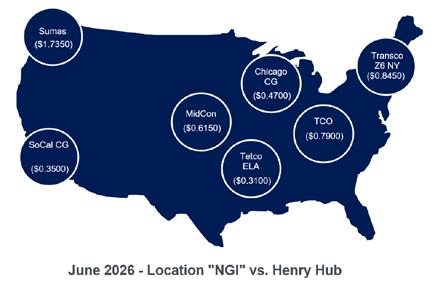
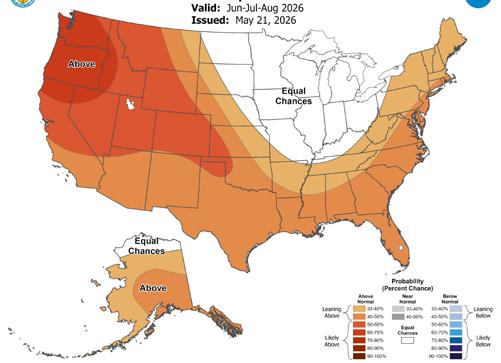
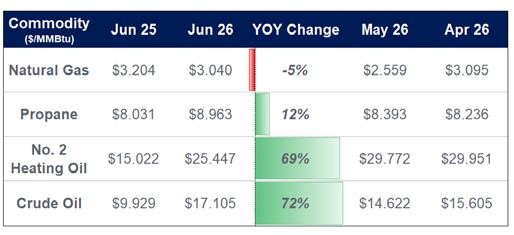
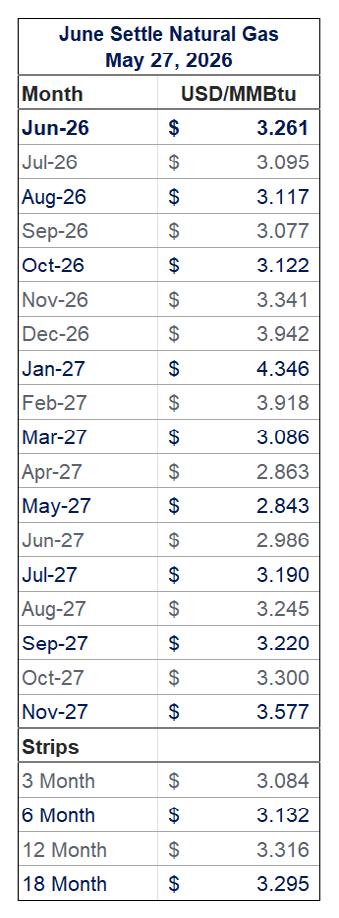
Precipitation Outlook NYMEX Settle
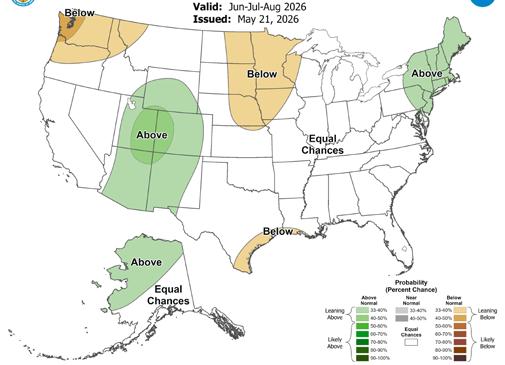
Valid: Jun-July-August, 2026
Issued: May 21, 2026
Todd Hickman - Sr. Energy Supply Advisor
• The past three months in global crude oil markets were defined by extreme volatility triggered by the escalation of conflict in the Middle East starting February 28, 2026. The de facto closure of the Strait of Hormuz, which is a critical chokepoint for nearly 20% of global seaborne oil, caused unprecedented supply disruptions, with Gulf producers (Saudi Arabia, Iraq, UAE, etc.) shutting in over 10–14 Mbpd of output. This led to record inventory draws (129 M barrels in March and 117 M barrels in April), massive physical tightness, and a dramatic price surge: Brent prices spiked from around $60–70/barrel in late February to highs near $138/barrel in early April. Non-OPEC+ supply
from the Americas, Russia, and others partially offset losses, but overall global supply fell sharply while demand contracted due to higher prices and economic impacts.
• In May, markets began to ease as ceasefire negotiations progressed and partial de-escalation hopes emerged, though uncertainty over Hormuz reopenings and durable peace kept the risk premium elevated. Prices pulled back significantly from April peaks, with Brent settling around $99–103/barrel and WTI near $91–96/barrel by late May amid improved Atlantic Basin flows and expectations of gradual supply recovery. The
period highlighted the market’s extreme sensitivity to geopolitical headlines, with large swings in time spreads and physical premiums, leaving the complex still event-driven heading into summer.
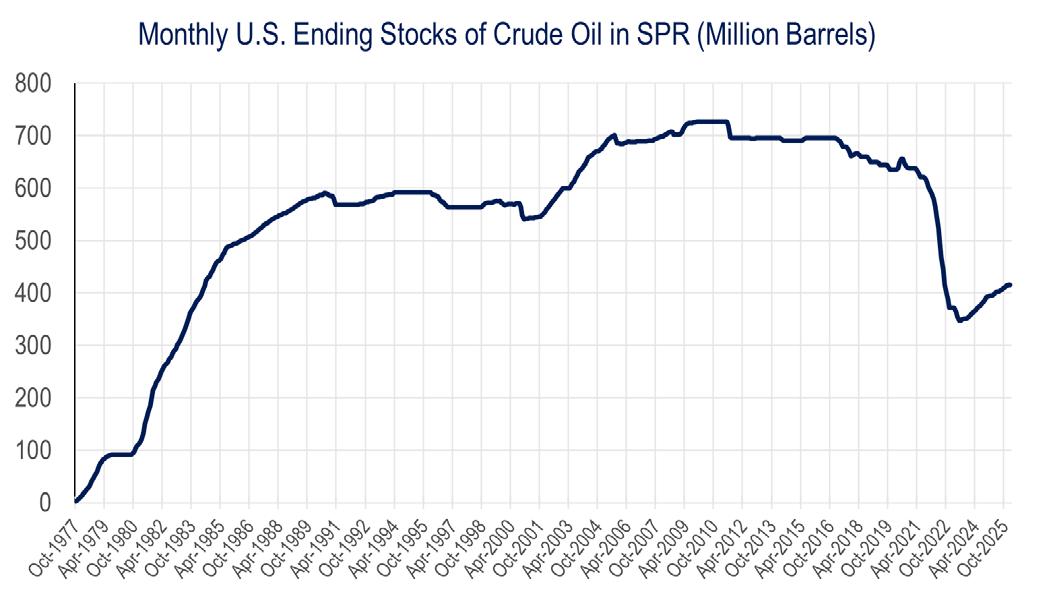
• The U.S. Strategic Petroleum Reserve (SPR) played a prominent role across this period, following a pattern of major drawdowns, partial rebuilds, and renewed releases. In response to Russia’s 2022 invasion of Ukraine, the Biden administration executed the largest SPR release in history (~180 million barrels), dropping inventories from over 570 million to a low around 370
million barrels by mid-2023. Modest rebuilds occurred in 2024–early 2026 (reaching ~413–415 million barrels by early 2026 under the Trump administration), but the recent Middle East crisis prompted another substantial drawdown of 172 million barrels, announced in March 2026, with record weekly releases (including 9.9 million barrels in one week in May) pushing current levels down to approximately 374 million barrels — among the lowest since the early 1980s.

Paola Madrigal - Energy Supply Advisor
The New York Independent System Operator (NYISO) is a summer-peaking market, where heat drives peak electricity demand as consumers use more electricity to cool their homes and businesses. This summer, the National Oceanic and Atmospheric Administration (NOAA) forecasts above-average temperatures across much of the United States from June through August 2026, including the entire NYISO footprint.
According to the NYISO annual Summer Reliability Assessment1 , there are 34,615 megawatts (MW) of power resources available to meet a forecasted peak demand of 31,578 MW. The baseline reliability margin this summer stands at 417 MW, the lowest in recent history. Under normal conditions, this represents an adequate margin. However, reliability becomes deficient under extreme weather scenarios:
1 NYISO annual Summer Reliability Assessment: https://www.nyiso.com/ documents/20142/57796669/S2026%20Capacity%20Assessment%20 for%20OC.pdf/0b4612fb-fb14-671f-98b1-89ec25d2732b
• A heatwave averaging 95°F over 3 or more days would produce a capacity margin of –1,679 MW.
• An extreme heatwave averaging 98°F would push that deficit to –3,370 MW.
Under either scenario, NYISO operators would activate emergency operating procedures to secure up to 3,166 MW of additional resources. The grid operator may also issue public alerts and request electricity conservation when reserve margins drop below regulated levels.
New York's grid carries significant fuel concentration risk. Based on the North American Electric Reliability Corporation (NERC) 2026 Summer Reliability Assessment2 , nearly 60% of on-peak power
2 NERC 2026 Summer Reliability Assessment: https://www.nerc.com/ globalassets/our-work/assessments/nerc_sra_2026.pdf

generation relies on natural gas. This dependence directly links electricity costs to gas price movements.
According to the Federal Energy Regulatory Commission (FERC) Summer Assessment 20263, natural gas prices at major eastern trading hubs are expected to be higher this summer compared to summer 2025. The primary driver for eastern hubs is lower storage inventories, following extended cold weather last winter that drew down reserves. The Transco Z6 NY hub, a key New York City pricing point, is forecast to average $2.30/MMBtu, approximately 4% above summer 2025 levels.
When generators pay more for fuel, wholesale electricity prices rise, and those increases ultimately flow through to consumer bills. While natural gas is one of several factors behind energy costs, it remains a primary driver of wholesale price levels.
3 FERC Summer Assessment 2026: https://www.ferc.gov/media/reportsummer-assessment-2026
To prepare for tight grid conditions this summer, consumers with operations in the NYISO footprint should implement the following strategic steps:
1. Monitor NYISO grid alerts4, particularly during extended heat events that may trigger emergency operating conditions.
2. Clients exposed to market-settled (real-time or day-ahead indexed) power prices should anticipate potential price spikes during periods of high demand.
3. Consider reducing peak demand during highrisk heat windows to limit both grid stress and exposure to elevated peak-hour prices.
4 https://www.nyiso.com/-/nyiso-s-grid-alert-system-keeps-new-yorkersinformed

Cynthia Wang - Sr. Energy Supply Advisor
Nova Scotia Energy Board (NSEB) issued its final order on April 30, 2026, approving the two-year General Rate Application that Nova Scotia Power (NS Power) filed last September for 2026 and 2027.
The new rates became effective on May 1, 2026, and a further adjustment will take place on January 1, 2027. As a result, residential and small general rate classes will see more than 7% increase over the two-year period, down slightly (1%) from initially requested, while industrial and large commercial accounts can expect 0.1% to 10.9% decrease at the same time.
As a comparison, areas in the province served by municipal electric utilities will see their electricity rates increase by 4.4 % over the next two years.
Given the rate increases NS Power has implemented over the past 3 years, 6.9% in both 2023 and 2024 plus 2.4% in 2025, this latest rate application had raised affordability concerns and drew criticism from customers, stakeholders, consumer advocates, and even the Premier, especially when some customers are still dealing with billing issues caused by the cyberattack on NS Power that occurred more than a year ago and the utility’s reliability performance has fell behind for years.
However, similar to statements in their previous rate applications, NS Power claimed that rate changes are necessary and essential to safeguard and reinforce

system reliability, meet growing electricity demand, address significant impacts from severe weather and increasing fuel costs, and support energy efficiency programs as well as investments to meet governments’ mandated targets of moving off coal and reaching 80% renewable energy by 2030.
NSEB acknowledged that increases were required to cover the rising costs of providing services and operating more renewable resources but decided some adjustments needed to keep customer rates fair and reasonable.
One of the adjustments directed by NSEB was to change how NS Power split distribution system costs among different customer groups based on their demand to reach its revenue requirement and shifted related costs from residential, small general, and unmetered customers to other rate classes.
NS Power used the minimum size method for classifying its distribution system under cost-of-service study in the initial rate application. During the hearing period, one expert witness said that this method did not reflect cost-causation principles and inaccurately allocated more costs to residential customers, and recommended NS Power to either change the method entirely or use the minimum size method with a peakload carrying capacity adjustment, where the latter was adopted by NSEB’s order.
NS Power, a subsidiary of Halifax-based publicly traded company Emera, operates as a vertically integrated electrical utility in Nova Scotia, providing 95% of the province’s generation, transmission, and distribution services with more than 525,000 residential, commercial, and industrial customers. A big portion of NS Power’s 2,400 MW installed capacity

is coal generation, providing more than 50% of the province’s power supply. It also operates 400 MW hydro generation through 33 plants on river systems across the province and owns a few gas/oil and wind assets.
NS Power used to be a provincial Crown corporation before the province sold it in 1992.
The provincial government introduced legislation in February 2024 to modernize the electricity system, including the creation of an independent system operator to enhance transparency and accountability, and to introduce competition to the monopoly held by NS Power.
Regulated by the NSEB as a nonprofit organization, Nova Scotia Independent Energy System Operator (NSIESO) is assuming long-term electricity system planning, transmission grid operations, and procurement responsibilities from NS Power and Nova Scotia Department of Energy, purchasing and dispatching energy resources from all producers, including NS Power at the best possible cost.
As with ISOs in other jurisdictions, NSIESO’s NSEBapproved costs are expected to be passed through to customers.

Alberto Campos - Manager, Energy Supply Mexico
April 2026 was defined by meaningful regulatory recalibration and renewed infrastructure momentum across Mexico’s power and natural gas sectors. Recent policy adjustments signal a more pragmatic approach to private sector participation ahead of upcoming USMCA trade negotiations. Meanwhile, large-scale gas pipeline expansions reaffirm the country's reliance on gas-fired generation, even as new storage regulations and distributed generation trends underscore a growing need for grid flexibility. The market is steadily evolving toward a hybrid model—blending state-led planning with selective private investment to advance grid modernization while preserving national sovereignty.
S&P Global Ratings revised Mexico's long-term sovereign outlook from ‘stable’ to ‘negative,’ though it affirmed the country's foreign currency ('BBB') and local currency ('BBB+') ratings.
Key drivers behind the revision include:
• Fiscal Consolidation Risks: Weak economic growth is projected to drive a larger-than-expected increase in public debt and a heavier interest burden.
• State-Owned Enterprise (SOE) Support: Ongoing financial support for Pemex and CFE continues to pressure public finances, increasing the risk of accelerated debt growth and restricting Mexico's fiscal flexibility.
• Trade Uncertainties: The agency cautioned that the upcoming 2026 USMCA negotiations could potentially weaken Mexico's historically solid external trade and economic relationship with the United States.

Following months of stakeholder negotiations, the government introduced revised rules governing private power generation. Dubbed the "Mix Scheme," this regulatory shift allows private generators to scale investments while maintaining CFE’s dominance in the energy sector. This pragmatic pivot has the potential to unlock stalled Power Purchase Agreements (PPAs) and revive developer project pipelines, though execution risks remain tethered to evolving contract structures and CFE's central role.
Continued consolidation among private generators
Grupo México’s Infrastructure Division announced a definitive agreement to merge its power generation assets with Saavi Energía, a privately held generator owned by Global Infrastructure Partners (a BlackRock company). Pending standard regulatory approvals, the deal is expected to close in Q3 2026.
• Asset Portfolio: Creates a diversified platform of 14 generating plants in high-demand zones.
• Capacity: 4,510 MW of active capacity, supplemented by an approximate 5,000 MW growth pipeline.
• Ownership Structure: Post-transaction, the new entity will be owned 70% by Grupo México and 30% by Global Infrastructure Partners.
capacity
To mitigate near-term congestion risks that distort locational price signals and hinder renewable integration, the Federal Electricity Commission (CFE) outlined an ambitious National Transmission Network (RNT) expansion plan.
• Investment: At least 171.6 billion MXN.
• Target: Reach 118,266 km of high-voltage power lines between 2025 and 2030.

• Strategic Focus: The program will build new lines and modernize substations in high-industrial zones (the Bajío, Monterrey, northern border), highdemand tourist corridors (Cancún-Riviera Maya, Los Cabos, Puerto Vallarta), and critical agricultural hubs (Chihuahua, Sonora, Sinaloa).
Major pipeline expansion program announced
President Claudia Sheinbaum announced a $8.14 billion (140 billion MXN) infrastructure initiative, funded by CFE and CENAGAS, to expand, modernize, and rehabilitate Mexico's natural gas network.
• Strategic Scope: The expanded network will supply 13 upcoming CFE power plants and 15 strategic industrial hubs.

Meet the people who power Trio. In this video series, you’ll hear from people from across our organization as they share their perspectives on working at Trio, their areas of expertise, and how they incorporate Trio’s values into their everyday lives.
• Market Impact: The initiative seeks to boost domestic production and system efficiency, deliberately aimed at mitigating geopolitical and climate risks tied to importing 75% of the nation's gas from the US. While this creates substantial midstream opportunities in transport and compression, it simultaneously locks in long-term natural gas dependency as the backbone of Mexico's power expansion.
First comprehensive storage integration framework
In a major regulatory milestone for grid flexibility, the newly restructured National Energy Commission (CNE) published a comprehensive framework for electricity storage.

Discover our broadcast: Risky Business. This broadcast that cuts through the noise of global energy markets. Go behind the scenes with our experts and find out what market trading and risk management really look like.
Key Framework Highlights:
• Five Deployment Models: Unlocks multiple configurations, including co-located (with power plants), behind-the-meter (at load centers), and standalone systems.
• Wholesale Market Access: Facilities with at least three hours of duration can now qualify as firm capacity and participate directly in the wholesale electricity market, establishing a major new asset class for private capital.
• Social Impact Requirements: Storage projects must now undergo tiered social impact assessments. Projects exceeding 250 MWh face more stringent requirements. While this may extend development timelines, it aims to ensure higher project sustainability and better community integration.
Regulatory clarity is a critical step forward, enabling Battery Energy Storage Systems (BESS) to monetize grid services. However, the ultimate bankability of these projects will depend heavily on the specifics of revenue stacking mechanisms and market access conditions.
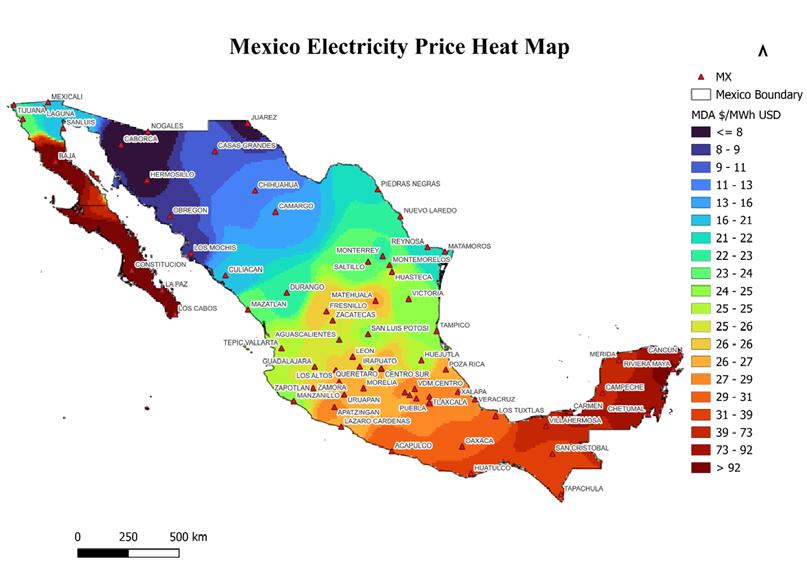
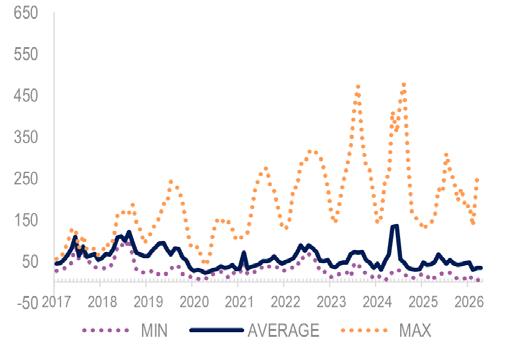
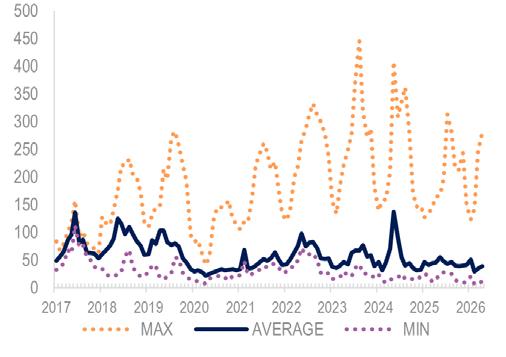
Average Day-Ahead Market (MDA) prices slightly rose to $34.67/MWh, representing a 1.11% increase over the previous month.
Average real-time market (MTR) prices have reached $38.32/MWh, marking a 10% increase from the previous month.
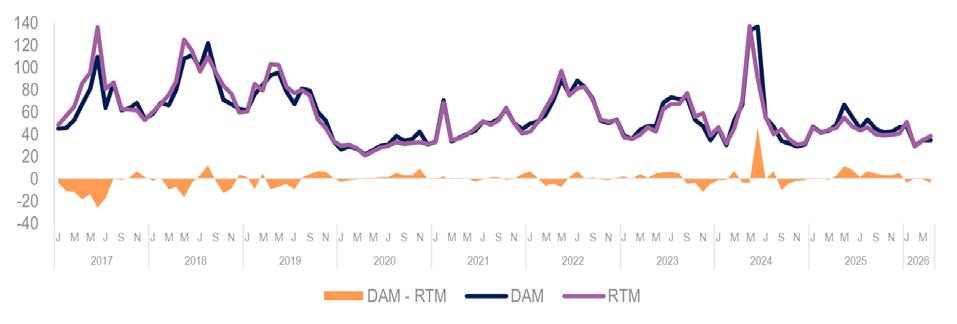
The price spread between the day-ahead and real-time markets increased to $3.66/MWh in April 2026. This convergence indicates significant improvements in demand forecasting and more precise operational planning, reducing the volatility gap between scheduled and actual power requirements.

Peggy Stassen
Managing Director, Supply Advisory +1-614-339-2639
Peggy.Stassen@TrioAdvisorycom
Jeff Bolyard
Principal, Energy Supply Advisory +1-614-339-2625
Jeff.Bolyard@TrioAdvisory.com
John Reid
Principal, Energy Supply Advisory +1-614-339-2629
John.Reid@TrioAdvisory.com
About Trio
Trio is a global energy and sustainability advisory company that helps large commercial, industrial, and institutional organizations navigate the energy landscape. Trio provides integrated strategy and implementation offerings across energy supply management, data management, energy optimization and electrification, clean
100+
energy, and sustainability to help the world’s largest organizations deliver on their strategic objectives and priorities.
For more information trioadvisory.com
clients in the Fortune 500 and Global Fortune 500 30+
countries doing business in 13+ GW
offsite and onsite renewable energy procured
Did you know
Headquartered in Irvine, CA, with a global presence in North & South America, Europe and Asia-Pacific.
Irvine: 18500 Von Karman Ave., Suite 260, Irvine, CA 92612
Boston: 53 State Street, Suite 500, Boston, US 02109
London:1 Haven Green, Ealing Broadway, London, UK W5 2UU
Sarajevo: Danijela Ozme 3, Sarajevo, BA 71000
Utrecht: Stadsplateau 19-40, Utrecht, NL 3521 AZ
Frankfurt: Fridrich Ebert Anlage 49, Frankfurt am Main (Messeturm), DE 60327