The Next Phase of BMS
Supplier Decarbonization
June 17th, 2026
Bristol Myers Squibb Supplier Decarbonization Accelerator

BMS Supplier Decarbonization Accelerator Team

Rondu Vincent
Executive Director, Responsible Sourcing
BMS


Devin Carsdale
Director, Responsible Sourcing
BMS
Chelsey Fogarty Manager, Sustainability & Clean Energy
Trio

Emily Thiem
Consultant, Sustainability & Clean Energy
Trio
Today’s objectives
• Review BMS’ Science-Based Targets and expectations for suppliers
• Learn about the BMS Supplier Decarbonization Accelerator’s evolution and new workstreams for suppliers launching soon

• Understand recent changes to the Science-Based Targets Initiative and impacts to suppliers setting targets within the next two years

BMS’ Ambition & Supplier Requirements

BMS is committed to achieving net-zero emissions

Companies have a critical role to play in the collective effort to mitigate the impacts of climate change

At BMS, we understand that healthier environments support healthier people

This is why, in 2024, BMS set targets to achieve net-zero emissions across our value chain by 2050

Supplier partnership is critical for climate action
BMS’s Science-Based Targets:
54.6% reduction in BMS’s operational and upstream energy-related emissions by 2033

75% of suppliers by emissions to set science-based targets by 2028
Net-zero value chain emissions by 2050

Achieving net-zero emissions requires effort and alignment across our value chain
Key suppliers play a vital role in decarbonization
You are a strategic partner
Take action
Recognize value
• As assessed by BMS, your value chain emissions are appreciable
• You are a key stakeholder in reducing these emissions
• Use best practices and creative collaboration to reduce emissions
• Promote human health and well-being through climate action
• The only wrong action is inaction
• Thrive in a decarbonized society
BMS Supplier Decarbonization Accelerator
All key suppliers (YOU!) are requested to set a science-based greenhouse gas (GHG) emission reduction target by 2028
• Having set targets ourselves, we understand that setting GHG targets is no small ask

Please visit BMS.com for an overview of our supplier sustainability programming
To invest in your success, we’ve created The Accelerator to provide programmatic support, knowledge, and training to support you on your sustainability journey
We highly encourage you to participate in the program and take advantage of the resources and consultative services from our program implementation partner, Trio
Celebrating success
Thank you to our leading suppliers who have submitted and validated GHG reduction targets through the Science-Based Targets initiative!
In 2025…
Suppliers set and validated targets with SBTi 69
36
Suppliers made SBTi commitments
63% of BMS suppliers have a Science-Based Target or SBTi commitment!
The Next Phase of BMS Supplier Decarbonization
The target setting journey
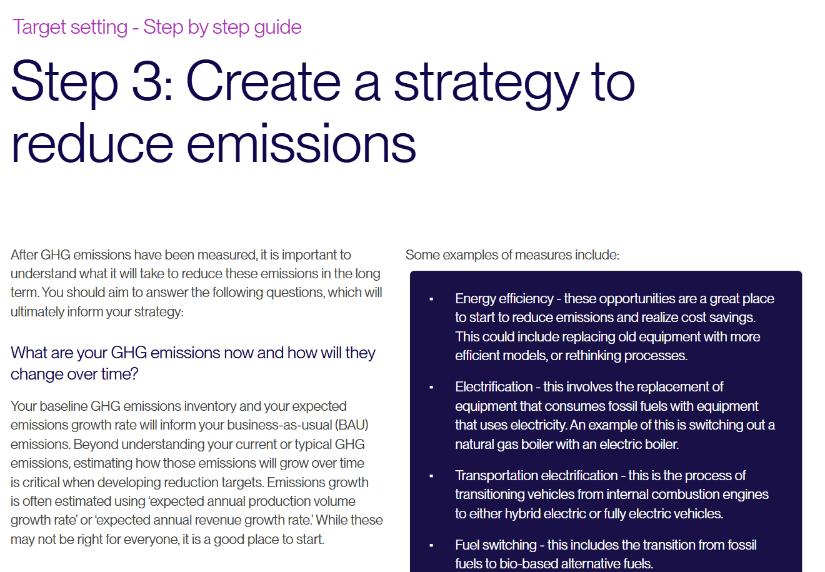
Suppliers must complete a GHG emissions inventory and use this data to create a clear strategy to reduce emissions. These actions are essential to gain internal buy-in to implement impactful decarbonization projects.
1. Calculate your S1 & S2 GHG inventory
2. Calculate your S3 GHG inventory
4. Make a public commitment to set a target 3. Form a decarbonization strategy
Evolving programming to meet supplier needs
The first 2 years of the program were focused on capacity building and education for all suppliers. Moving forward, the program is adapting to support suppliers where they need it most
Key Suppliers Without Targets
Workstream A: Foundations Program Workstream B: Strategy Accelerator Lab Workstream C: Setting Science-Based Targets
Workstream A: Foundations Program
Workstream A: Foundations Program
Target Suppliers: Suppliers who do not have a complete Scope 1, Scope 2 and Scope 3 GHG inventory
Outcomes: Suppliers understand how to complete a GHG inventory and commit to completing an inventory by the end of 2026
• What is the Foundations Program: an educational webinar series focused on measuring your GHG emissions
• What does it require from suppliers: attendance and engagement at a 3-part webinar series
• Capacity: Any supplier interested can join
• Timing: July – October 2026
Workstream B: Strategy Accelerator Lab
Workstream B: Strategy Accelerator Lab
Target Suppliers: Suppliers who do not have a decarbonization strategy, but have completed a GHG inventory
Outcomes: Suppliers have a decarbonization strategy to socialize with leadership and will be well positioned to set targets
• What is Strategy Accelerator Lab: a curated module-based curriculum and tools designed to guide suppliers through the decarbonization strategy development process
• What does it require from suppliers:
— Attending a 6-part educational series
— Timely completion of homework assignments Collecting and providing energy consumption, growth, and operations data
— Commitment to engage for the entirety of the lab
• Capacity: Enrollment limited to 20 suppliers
• Timing: July – December 2026
Workstream C: Setting Science-Based Targets (SBTs)
Workstream C: Setting SBTs
Target Suppliers: Suppliers who are positioned to set targets in 2026
Outcomes: Suppliers submit targets for validation in 2026
• What is the Setting SBTs Workstream: additional 1:1 support and tailored guidance for suppliers who are nearing the target submission process
• What does it require from suppliers: joining a 1:1 call with BMS and Trio to provide a progress update and discuss barriers as relevant
• Capacity: Suppliers identified on a rolling basis
• Timing: Ongoing
Next steps & timeline
1 2 3 4
Review workstream invitation email from BMS Sustainable Procurement or your BMS POC
Complete the form linked in the email to confirm/decline enrollment and provide a status update We will reach out to confirm enrollment or provide next steps Begin participation in workstream
Sent June 11th Due June 24th Beginning of July End of July
SBTi Overview and Updates Impacting Suppliers
What is a Science-Based Target?
The Science Based Targets Initiative (SBTi) is a corporate climate action organization that mobilizes companies to take the lead on urgent climate action
• Provides standards and guidance to help companies set ‘science-based’ net-zero targets that are consistent with limiting global temperature rise to 1.5°C
• Targets validated by SBTi are globally recognized and seen as the gold standard for target setting because they are aligned with climate science
~11,000 companies taking action
What is a ‘science-based’ Greenhouse Gas (GHG) emissions reduction target?
How Much companies need to reduce their GHG emissions
How Fast those emission reductions need to occur
In order to prevent the worst effects of climate change


Key target setting criteria
Scope Coverage
Base & Target Year
Ambition
Reduction
Requirement
Target Method
Which emission scopes are required to have targets?
What is the timeframe to meet your targets?
What is the level of ambition in terms of limiting temperature rise?
What is annual rate of emissions reduction required?
What method will be used to achieve the target?
Corporate Net-Zero Standard Updates: Timeline
The SBTi standards and guidance evolves over time to align with the latest science and best practices
*Key
updates for BMS Suppliers
February 2025
SBTi announced its intention to revise and update the Corporate Net-Zero Standard, launching the project for Version 2.0.
April 2026*
SBTi released Version 1.3.1 of the Standard, modifying nearterm target reduction requirements making targets more achievable for companies with more recent base years
The initial draft of Version 2.0 was published for public consultation, with new requirements for businesses to set, track, and revise net-zero targets.
March 18, 2025
February 1, 2028*
Version 2.0 required for new targets, which will require immediate adoption of the new standard criteria and requirements.
The final revised Version 2.0 standard is published, after all pilot phases and further consultation rounds conclude.
June 11, 2026
Existing SBTi targets with a target year of 2030 or later are expected to adopt Version 2.0, SBTi has provided transition guidance for new targets. 2030
Dec 31st, 2028 – targets due for BMS requirements
SBTi Corporate Net-Zero: April 2026 Update
In April 2026 SBTi released a methodology update (V1.3.1) that offers companies a more feasible approach to setting and achieving near-term targets while maintaining net-zero ambition by 2050
• Near-term emissions reductions required by 2030 for companies with more recent base years than 2020 are lower and more achievable
Example: Company “A” Near-Term Target
Before Update
• Annual reduction trajectory less aggressive in nearterm as total emissions reductions required to achieve net-zero are more evenly distributed between base year and 2050
This update is relevant for companies setting or updating targets in 2026 or 2027
After Update
Company “A” commits to reduce Scope 1 + 2 emissions 42% by 2030 from 2024 base year
Company “A” commits to reduce Scope 1 + 2 emissions 31.3% by 2030 from 2024 base year
-10.7% change in required reductions (example)*
*Example figures are for illustrative purposes only and were derived using the Version 2.4.1 of the Near-Term Target Setting Tool (Before Update Figures) and Version 2.5 (After Update) of the Tool, published by SBTi
What Does This Mean for my Organization?
• Companies setting targets in 2026 and 2027 can take advantage of the V1.3.1 SBTi update, which makes near-term reduction requirements lower and more achievable
• Companies without targets by February 1, 2028, will be expected to set targets under V2.0 immediately, while companies with existing targets will transition to new standard by 2030

Key Takeaways & Next Steps



Key takeaways
• Supply chain partnership is critical for climate action, and that is why BMS is investing in this program and asking you to take action
• Setting GHG reduction targets is a journey which is why we have broken it down into discrete steps actionable milestones for each supplier depending on your climate maturity

Call to Action
• If you do not have a Science-Based Target locate an email from the BMS Sustainable Procurement team on your identified workstream and respond to your unique survey link ASAP
— Responses due no later than June 24th
— Reach out to

For questions on the BMS Supplier Decarbonization Accelerator please contact: BMSDecarbAccelerator@Trioadvisory.com For questions on BMS’ Responsible Sourcing Program please contact: SustainableProcurement@bms.com
We are seeking your commitment
We value our supplier partnerships, and that’s why we have invested in this program to partner directly with you to provide the resources and support you need to navigate the climate action landscape
• What we expect from you: Active engagement in the program, utilizing provided resources
— Senior / executive level engagement and socialization
Demonstration of progress year-over-year
• What BMS is providing:
Access to a tailored educational content created specifically for BMS suppliers
— Free 1:1 consultation hours with our expert advisors, Trio Key resources and information on all things decarbonization at your fingertips