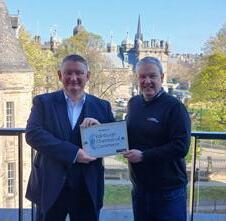
As we move into the summer months, this edition of Business Comment reflects a business community that continues to evolve with focus, resilience and clear ambition.
Across these pages, there is a strong emphasis on building for the future. Investment in leadership and talent is evident through initiatives such as Rising Stars, while advances in digital infrastructure and emerging technologies highlight the pace at which organisations are adapting to a changing landscape.
At the same time, there is a growing commitment to shaping a city that is both competitive and sustainable. Progress on net zero initiatives, alongside landmark developments such as the reopening of the King’s Theatre, demonstrates how businesses and institutions are contributing to Edinburgh’s long-term vibrancy and appeal.
While challenges around skills, economic pressure and transformation remain, what stands out is the collective willingness to collaborate, adapt and move forward with purpose. This edition captures that spirit and the shared momentum across the business community. We hope it informs, inspires and strengthens connections.
Supporting Scotland’s Wellbeing, One Ramen at a Time
Thistle Foundation’s charity partnership with Maki & Ramen has raised over £20,000 to support people living with long-term conditions and disabilities in Edinburgh.
Thistle Foundation, the Scottish wellbeing charity dedicated to supporting people with disabilities and long-term health conditions to live a life free of isolation and loneliness, where a health crisis doesn’t mean a life crisis, was looking for an organisation to partner with to increase awareness and support for their cause across Edinburgh. Through their connections with Edinburgh Chamber of Commerce they found Maki & Ramen and really triumphed with how aligned their values were and how well they could work together to achieve these shared goals.
“Everyone deserves the opportunity to live good lives and achieve what matters most to them. Our partnership with Thistle Foundation reflects our shared values of inclusion,
empowerment and community support,” said Rebecca Cuthbertson, Marketing Lead of Maki & Ramen.
Each Monday in Maki & Ramen branches across Edinburgh between the hours of 4-8pm, Maki & Ramen donates £1 of every ramen sold directly to Thistle Foundation. Since the partnership began in 2024 Maki & Ramen have donated over £20,000, which has positively impacted people in Edinburgh with long-term health conditions.
Becoming a partner of Thistle means not only supporting Scotland’s wellbeing, it’s giving individuals in your local communities the opportunity to live well and thrive. Roxana, someone who came to Thistle for support, talks about her experience:
“At my first session, I felt like I was finally being heard. This was important to me since I was feeling so isolated. My Practitioner, Julie, was also patient at listening to me, my story, and what I’m going through […] It helped me so
much having a space where I could feel seen by Julie, where everything is confidential, and I could listen and navigate life in my own way.”
The partnership between Maki & Ramen and Thistle has made life-changing experiences like Roxana’s possible.
William Oviatt, Head of Business Development and Income Generation, said, “It’s been a privilege to partner with Maki & Ramen who have not only raised a fantastic amount of money for us, but have spent time with our colleagues and people we support, building an understanding of what it’s like to live with long-term health conditions, and the impact wellbeing support can have on people’s lives. In Scotland, 1 in 3 people have one or more long-term health conditions that impact their day-to-day lives. It’s why partnerships like this are so important, enabling us to reach more people, supporting them to grow in confidence, connect with their community, and have lives that are about thriving rather than just surviving.”
Heriot-Watt appoints two female Entrepreneurs in Residence
Heriot-Watt University has appointed two entrepreneurs to help support the next generation of Scottish startups and strengthen links between academia, industry and investors.
Gemma Stuart, founder of health startup Gut Wealth, and Jessica Mullen, an exited founder and angel investor, have joined the university as Entrepreneurs in Residence within its Global Research, Innovation and Discovery (GRID) ecosystem. Both bring experience of building and scaling businesses and will focus on helping early-stage ventures tackle commercial challenges and prepare for investment.
Stuart is currently scaling Gut Wealth after recently securing seed funding. Mullen previously founded and exited her own company and now works with startups as an investor and adviser, including through angel syndicate Apollo Informal Investment.
Their appointments expand HeriotWatt’s advisory support for academic and student entrepreneurs, bringing
founder experience into closer collaboration with the university’s existing startup and innovation teams.
Stuart said: “Heriot-Watt has a real entrepreneurial spirit and understands that founders need practical, real-world support to turn ideas into commercially viable businesses.
“With my recent experience of starting and scaling a company, I’m looking forward to helping the university’s entrepreneurs navigate commercial readiness, access the right funding at the right time, build strong networks and create a viable pathway to investment.”
Mullen added: “I’ve founded, scaled and exited a business and now, as an angel investor, I understand what funders are looking for.
“There’s a real opportunity for HeriotWatt to strengthen its pipeline from early-stage ideas through to investment-ready companies.
“I’m particularly passionate about supporting more women into
entrepreneurship and helping ensure a broader range of founders can access the funding they need.”
Both founders will work directly with students, researchers and spinouts, offering mentoring and advice on growth, customer development and fundraising.
Danielle Moran, incubator manager at Heriot-Watt’s Edinburgh Business School, said the appointments reflected a wider ambition to strengthen Scotland’s innovation ecosystem.
“Our Entrepreneurs in Residence bring exactly the kind of experience our researchers and students need. They’ve built businesses, scaled them and understand how to attract investment,” she said.
The initiative forms part of HeriotWatt’s wider push to strengthen its enterprise offering and support a more diverse, commercially focused pipeline of startups emerging from Scottish universities.
Online Safety Is Becoming a Workplace Issue, Says Kids N Clicks
Kids N Clicks is helping employers support working families by making online safety an essential workplace priority.
Family stress is quietly costing UK employers an estimated £8bn a year in lost performance, absenteeism and staff turnover (Deloitte, 2024). Social media anxieties, online grooming risks, addictive algorithms, AI-generated content and cyberbullying are weighing on parents, grandparents and carers in ways that increasingly spill into the workplace. These pressures do not stay at the front door.
“Parents are navigating a digital landscape that is evolving faster than anyone can keep up with,” said Parven Kaur, founder of Kids N Clicks.
“The anxiety that creates doesn’t switch off when someone walks through the office door.”
The scale of concern is striking. 75% of parents say they are concerned about what their children see, hear and do online (Ipsos, 2025), and 84% describe feeling overwhelmed by the challenge
of keeping them safe (Internet Matters, 2024).
Yet digital family support remains largely absent from traditional wellbeing programmes. Mental health, physical health and financial wellbeing have become established pillars of workplace support. The pressures of raising children in a digital world have not.
“Employers are absorbing the cost of that stress without even realising it,” said Parven. “This is one of the most pressing and overlooked workforce challenges of our time.”
Kids N Clicks was created to bridge that gap. The Edinburgh-based business offers employers a dedicated app that keeps parents, grandparents and carers informed on the latest online risks and trends, giving them the confidence and tools to handle difficult conversations at home. Workplace sessions and webinars sit alongside it, bringing the issues to life across teams.
More than 80% of attendees reported increased confidence in understanding and navigating the online risks affecting
young people in their care.
“We wanted to give people the language and the knowledge to have these conversations with their children,” said Parven.
“Not to frighten them, but to help them feel equipped.”
For every £1 invested in employee wellbeing, organisations receive on average £4.70 back in improved productivity, with the greatest returns coming from early, preventative support (Deloitte, 2024).
That impact was recognised at the Scottish Cyber Awards 2026, where Kids N Clicks won both Best Security Awareness Campaign and Diversity in Cyber, reflecting its position at the intersection of online safety, employee support and workforce resilience.
“Every organisation has employees who are caring for a young person” said Parven Kaur. “This is not a niche issue. It is one of the most pressing and overlooked workforce challenges of our time.”
Turning concern into opportunity: Working together to tackle
Youth unemployment and economic inactivity have recently risen to the top of the policy agenda, interim report by former Cabinet Minister Alan Milburn has highlighted the scale of the challenge, warning that more than one million young people across the UK are currently not in employment, education, or training (NEET). And the numbers are currently going in the wrong direction: the new economic forecast from the British Chambers of Commerce suggests that youth unemployment could reach 17.8% by 2027.
This is both a social and economic issue. Youth unemployment and inactivity are estimated to cost the UK £125 billion annually. Beyond the economic impact lies a significant human cost. Extended periods out of work can have long-term effects on earnings, health, and wellbeing – each year being ‘NEET’ can cost someone around £52,000 over their lifetime, whilst prescriptions for anxiety and depression are 50% higher in the 10-20 years following a period out of education or training.
Businesses are losing access to a significant pool of talent at a time when skills shortages remain a persistent challenge. Crucially, the Milburn report stresses that young people have not become less motivated or less educated. Research shows that 84% of young people classified as NEET want to be engaged in work or learning.
Many of these individuals are both capable and qualified: nearly 30% have achieved good GCSEs or equivalent qualifications, and around 15% hold a degree. Despite this, they continue to face barriers to accessing opportunities and gaining
the experience employers demand. Instead, Milburn points to deeper systemic issues - “fault lines” across the education, health, and welfare systems - combined with a shifting labour market. Employers, under pressure from rising costs and increased regulation, are becoming less willing to take a chance on young, inexperienced candidates, particularly those dealing with anxiety or depression.
Meanwhile, the sectors that have traditionally provided a large proportion of people’s ‘first jobs’ have contracted or restructured –particularly since the pandemic.
Recognising the importance of the issue, Edinburgh Chamber made skills and talent a central focus of a conference we held earlier this year. We brought together employers,
opportunity: tackle youth unemployment
educators, and policymakers to discuss practical solutions and have since made a series of recommendations to both the UK and Scottish Governments.
These include improving investment in skills, embedding employers more deeply within workforce planning, and ensuring businesses are supported to recruit and develop talent.
Alongside our policy work, the Chamber has a strong track record of taking direct action, alongside our members. During the Covid-19 pandemic, we worked with the UK Government to deliver the Kickstart Scheme, helping more than 90 businesses provide placements for over 270 young people. Those opportunities offered valuable work experience and helped
many participants move into sustained employment.
Today, as concerns grow about a new generation being left behind, we are once again working with partners to create solutions. Edinburgh Chamber is supporting the Department for Work and Pension’s Youth Jobs Guarantee Scheme across Central and East Scotland, alongside The King’s Trust, Glasgow Chamber, Barnardo’s, and Action for Children.
The Jobs Guarantee Scheme offers employers a unique opportunity to strengthen their workforce while making a real difference.
Participating businesses are asked to offer a six-month meaningful role to a young person aged 18-21 who has been claiming Universal Credit and seeking work for 18 months. Salaries, employer National Insurance, and minimum pension contributions are all fully funded through the programme, while participants receive pre-employment training and ongoing in-work support to help them succeed.
The first phase aims to support 150 young people across the region. For employers facing recruitment challenges, this is an opportunity to access motivated new talent, build future workforce pipelines and contribute to tackling one of the most pressing economic and social challenges facing our communities.
If your business can provide an entry-level role offering meaningful experience and development, we encourage you to get in touch. Together, we can turn concern into opportunity and ensure more young people have the chance to realise their potential.
New Visitor Levy projects are set to deliver for Edinburgh’s businesses
by Jane Meagher, Council Leader
As the first city in the UK to introduce a city-wide visitor levy scheme, we know that other councils - together with the UK, Welsh and Northern Irish governments - will be watching closely as we prepare to go live on 24 July.
I’m sure they’ll be paying particular attention to how we intend to spend the proceeds - worth nearly £100 million over the next three yearswhich will help us to sustain and enhance our reputation as one of the world’s most popular and enjoyable destinations.
Projects stand to benefit everyone who works, lives in and visits Scotland’s Capital. Examples include investing more in our public spaces, parks and greenspaces, putting more police on our streets and restoring cultural attractions, including much-loved venues like the Royal High School and Leith Theatre.
While many of these headline projects have rightly captured the popular imagination, a central part of our plans for the income from the levy is to increase our support for the businesses that help make the city the destination it is today.
That’s why we also include projects that will see us partner more closely with businesses of all sizes in the visitor economy, helping them adopt greener practices, provide Fair Work for their employees, create greater job security and improve Edinburgh’s visitor experience even further.
As part of this, we will soon be launching the Edinburgh Visitor Economy Improvement Fund (EVIF). Businesses already working together as a collective, or looking to start - such as local high street alliances and associations - will immediately be able to apply for shared grants of up to £15,000 to invest in projects that improve visitor experiences.
From sharing technology to developing skills, there are real opportunities for these businesses to invest in their operations while protecting and improving their neighbourhoods’
unique characters - and helping to make our city a more ethical and inclusive destination for everyone.
We’ve always said this is a city fund and spending decisions need to be taken with the whole city in mind – and we’re very grateful to Edinburgh’s business community, whose contributions have helped shape the levy’s development from the outset.
We will keep involving businesses and communities as the scheme develops, and we want to hear from everyone as it settles in and the spend programmes begin to deliver.
We know that Edinburgh’s success as a visitor destination has many benefits and also presents additional challenges. The levy is a huge opportunity to address this, and could provide our capital city with £45-50 million a year by 2028/29 - the single biggest injection of new funding this side of the millennium.
The scheme stands to benefit us all, and I strongly believe we can keep growing Edinburgh’s global reputation while promoting responsible and sustainable tourism.
A cleaner, greener, safer, wellmaintained and more sustainable Edinburgh isn’t just great news for the city’s visitors, it’s a once in a generation opportunity for everyone who lives and works here all year round.
The Late Payments Bill: Fuelling Edinburgh’s Next Economic Chapter
Building a fairer payment culture to strengthen Edinburgh’s business ecosystem
Cashflow is the absolute lifeblood of enterprise, yet for too many small firms across Edinburgh, that lifeblood is being restricted. For years, small business owners have faced an unfair, systemic challenge: the crippling culture of late payments. Late payments cost the UK economy £11 billion a year, forcing the closure of 38 small firms every single day. Founders spend an average of 86 hours annually chasing overdue invoices—time that should be spent growing their companies.
This is why the Small Business Protections (Late Payments) Bill, officially announced in the King’s Speech and now introduced in the UK Parliament marks a defining moment for our business community.
As Scotland’s economic powerhouse, Edinburgh boasts a higher economic output per capita than any major UK city outside London. Our local economy thrives on a unique blend of world-class financial services, a booming tech ecosystem, creative industries, and a vital hospitality sector. However, the Edinburgh Chamber of Commerce has made it clear that to secure high-value jobs and long-term resilience, we must improve access to capital and strengthen our local business base.
Unlocking trapped cash is the single fastest way to achieve that goal.
Stepping up a gear
When a large corporation delays paying a small Edinburgh supplier, it is taking an unauthorised, interest-free loan at the expense of a smaller partner. This imbalance of power will now be directly tackled by robust legislation:
• Strict 60-Day Limits: The bill introduces a mandatory 60-day maximum payment term for large firms paying smaller suppliers.
• Mandatory Penalties: Statutory interest set at 8% above the Bank of England base rate will become nonnegotiable in all commercial contracts.
• Dispute Time Caps: A strict time limit will be introduced for large firms to raise invoice disputes, preventing them from using stalls as a delay tactic.
• Banning Cash Retentions: Crucially for Edinburgh’s major urban development pipeline the Bill will completely ban the practice of withholding retention payments under construction contracts.
Just as importantly, this legislation gives my office new statutory powers to independently investigate large companies, adjudicate payment disputes, and issue direct fines to persistent offenders.
Driving Edinburgh’s Global and Local Growth
The Edinburgh Chamber of Commerce has highlighted that companies engaged in international trade are up to 35% more productive than those focused solely on domestic markets. However, entering global supply chains requires up-front capital. When local SMEs are paid predictably and promptly, they gain the immediate financial stability required to innovate, adopt net-zero strategies, and scale into international markets.
I know that speaking out against a major corporate client or a prime contractor can feel terrifying for a small supplier fearing they might lose future work. This legislation levels the playing field so you no longer have to suffer in silence.
The UK government has signalled that it stands firmly behind small businesses. My office is fullycommitted to ensuring this bill translates into immediate change on the ground.
Let’s work together to eliminate late payments and ensure Edinburgh’s small business community receives the fair, prompt payment culture it has rightfully earned.
Emma Jones CBE, The UK’s Small Business Commissioner
To help solve Scotland’s retirement crisis, firms must seize the pensions dashboard opportunity
Scotland, like the rest of the UK, is facing a retirement crisis despite the formidable heritage of its pensions industry. Last month, the Pensions Commission warned that around 1.2 million people in Scotland are under saving for retirement and 1.4 million are not saving into a pension at all.
Scotland, like the rest of the UK, is facing a retirement crisis despite the formidable heritage of its pensions industry. Last month, the Pensions Commission warned that around 1.2 million people in Scotland are under saving for retirement and 1.4 million are not saving into a pension at all. The cost of living is forcing many households to focus on bills, debt and day-to-day expenses, pushing pensions further down the priority list.
Access to better information, tools and support is therefore vital if more people are to make informed financial decisions
and improve retirement outcomes. This is where the new MoneyHelper pensions dashboard comes in. Later this year, if it launches on schedule, it will let people see all their pensions in one place for the first time to better understand their retirement prospects and reconnect with forgotten pension pots. This will be followed by pension providers’ own dashboards.
K PMG research shows that 82% of people in Scotland are unaware that the pensions dashboard is launching. Yet once the concept is explained, nearly three-fifths (59%) say they are likely to use it. That points to strong demand for a tool that makes retirement savings easier to understand.
For years, one of the pensions industry’s biggest challenges has been disengagement. Many people have built up multiple pension pots but lack a clear view of what they have saved or whether they are on track. The dashboard has the potential to change that but visibility is only the first step. Once savers can see the full picture, many will start asking what it means for them and what they should do next. That creates an opportunity for firms to bridge the gap between information and advice through Targeted Support, the new form of financial assistance introduced by the FCA and the government earlier this year.
There is a clear advice gap to fill. More than half (54%) of Scottish adults say they have never sought professional advice on their pensions, with 32% saying they do not think they have enough saved to make advice worthwhile and 23% saying they cannot afford it. At the same time, Scottish pension savers appear receptive to extra help: 54% like the idea of receiving targeted support on pensions and 47% say they would use it if available.
If Scotland is to avoid a deepening retirement crisis, people need to understand their retirement position and how to take the next step. The MoneyHelper dashboard can help by bringing pension information into one place, while Targeted Support offers firms a practical way to help people understand what that information means and what action may be right for them. But awareness of the dashboard remains low, so more must be done to explain how it can help people save for retirement.
If firms and policymakers can get that right, the dashboard could become a powerful tool for improving engagement and boosting people’s retirement prospects, which the country urgently needs.
Katie Clinton, Partner and Head of KPMG’s Nations and Regions Financial Services Business
Capital Theatres raises the curtain on King’s Theatre official reopening
The King’s Theatre will reopen to the public on Saturday 1 August following an extensive redevelopment that has reshaped the historic Edinburgh venue for contemporary audiences while preserving its heritage. The project marks the culmination of more than two years of construction work and delivers a building designed to serve both current visitors and future generations.
The reopening will be marked with a public Opening Weekend on 1 and 2 August, during which visitors will be invited to explore the transformed theatre. The event offers access to areas of the building not usually open to the public, alongside behindthe-scenes tours that include the opportunity to step onto the newly installed flat stage. Visitors will also be able to learn more about the theatre’s history and the redevelopment itself. While attendance is free, advance booking is required, with tickets available now available via the Capital Theatres website.
Ahead of the official reopening, Capital Theatres plans to host a programme of test performances designed to assess how the venue operates with a live audience. These events will allow teams to rehearse practical elements such as ticketing, audience movement through the building and front-ofhouse services. The line-up includes A Great Night Out, Frozen Singalong, and performances by Mhairi Black and Kevin Quantum.
The test events will lead into the theatre’s first full programme following its reopening, which begins later in the summer. Early highlights include a live recording of Graham Norton’s podcast Wanging On, performances as part of the Edinburgh International Festival, and contemporary dance with Jasmin Vardimon’s Lullaby. Together, these events signal the venue’s return as a key contributor to Edinburgh’s cultural calendar.
At the centre of the redevelopment is a significant upgrade to the theatre’s performance capabilities. Structural changes include the extension of the fly tower by 4.5 metres, allowing for larger and more technically complex productions. The original raked stage has been replaced with a new level stage, increasing flexibility and enabling a broader range of performances, from drama to l arge-scale touring productions and dance.
Accessibility has been a central focus of the project. For the first time in its history, the theatre provides a step-free journey from street level to seating areas and the stage itself. Improvements include the installation of two public lifts serving all levels, as well as a separate lift backstage. Seating has been reconfigured to include more wheelchair spaces, transfer seating and wider seats within the stalls. Each floor now includes accessible toilet facilities, alongside a
Changing Places toilet available to all visitors.
The redevelopment also introduces new public spaces intended to broaden the theatre’s role within the community. A street-level café will provide a more open and informal point of entry to the building, while a new Creative Engagement Studio has been designed to host workshops, community projects and events. Throughout the venue, heritage displays and artefacts will highlight the theatre’s long history and its significance within Edinburgh’s cultural life.
When it reopens on 1 August, the King’s Theatre is expected to take its place once again as a central cultural destination in the city. The redevelopment positions the building not only as a restored historic venue but as a modern, accessible theatre equipped to support a wide range of performances and audiences in the years ahead.
Photo: Bennetts Associates
An innovative approach to legal services
Carole Tomlinson shares why real people will always matter as she takes up the role of Chair at Anderson Strathern
Taking up the role of Chair at Anderson Strathern feels both exciting and significant, not only for me personally, but for what it says about the kind of firm we want to be. As we celebrate our 325th anniversary, I think there is something powerful in recognising that longevity can only become true when it is accompanied by a willingness to evolve. A forward-thinking outlook is crucial to any company that has stood the test of time.
My ambition is not simply to preserve what has made us successful so far, but to build on it carefully and thoughtfully. Anderson Strathern has always been a firm built on relationships – with our clients, with our colleagues and with our community. I want us to remain progressive, collaborative and ambitious, while never losing sight of the fact that ours is, at heart, a people business. For me, that means keeping client service front and centre, investing in our people at every stage of their careers and making sure that change always strengthens, rather than weakens, the personal relationships on which great legal service depends.
As I take up the role, I am acutely aware that this is not simply a title change. It’s an opportunity to help shape how Anderson Strathern responds to a legal market that is changing at pace. We are living through a period defined by rapid technological progress, shifting client expectations and wider economic uncertainty. For me, the challenge is not whether the profession will change - it is constantly evolving and shifting - but how we make sure that transformation strengthens what matters most: excellent service, trusted relationships and a culture in which our people can develop and contribute with confidence.
I am genuinely excited by the opportunities that technology and AI can bring to legal services, but I do not think progress should ever be measured simply by how quickly we adopt new tools. What matters more is whether those tools help us serve clients better and support our people in meaningful ways. Clients still want to feel known, understood and reassured, particularly when they are dealing with important or difficult decisions. That is why I believe digital transformation has to be about more than systems or processes. My priority is to make sure we use innovation in a way that frees our people to focus on the conversations, relationships and strategic thinking that clients genuinely need from us. That is where law firms will differentiate themselves in the years ahead.
In practical terms, my plans as Chair are centred on three things. First, I want us to keep client service at the heart of everything we do and to protect the personal connection that matters so much to our clients. That means continuing to invest in client service executives who can help guide clients through their journey with the firm and ensure they feel supported, informed and valued at every stage. The second, is our junior colleagues and how best we can support their development, giving them the opportunities, encouragement and experience they need to grow and thrive. The third is digital transformation, but in a way that is grounded in people rather than technology alone. For me, that means making sure we bring colleagues with us, listen to their concerns, build their confidence and ensure that change feels positive, inclusive and worthwhile.
Is your finance function ready for what’s next?
Lauren McCluskey, Head of Office of the CFO and Partner, AAB
The desk of the CFO is a strange and wonderful place, akin to Mary Poppins’ bag, but in a growing business, it’s also where the question “are we ready for what’s next?” gets answered every day. From compliance and audit through to funding rounds, acquisitions, and investor engagement, themodern finance function sits at the centre of growth and decisionmaking.
As businesses scale and enter more complex environments, whether that’s group reporting, external investment, or transaction preparation, the demands on finance increase significantly. The question is no longer just whether the finance function works today, but whether it is built for what comes next.
Is your finance leadership equipped for growth, complexity, and scrutiny?
A CFO is expected to cover a wide and increasingly complex remit: finance, compliance, audit, funding, acquisitions, investor relations, and more.
At the same time, they must lead teams, ensure succession planning, and maintain operational control.
In many growing businesses, the CFO is also the most senior finance professional in a largely non-finance environment. This naturally creates pressure on bandwidth, with limited capacity to move beyond day-today execution into strategic leadership.
Is your current finance structure limiting your ability to scale?
For many growing businesses, the challenge becomes one of capacity rather than capability. Leadership teams, often founders, find themselves stretched across multiple critical responsibilities, including finance.
At this stage, finance can shift from enabling growth to constraining it, particularly where reporting demands, compliance requirements, or fundraising activity intensify.
When does it make sense to rethink the traditional CFO model?
The CFO role is deeply embedded within a business, and at its best, the CEO–CFO relationship is a critical partnership, aligned on strategy, risk, and decision-making, while also providing constructive challenge.
For many organisations, the challenge is not whether they need CFO-level expertise, but how to access it in a way that is flexible, scalable, and aligned to evolving needs.
Traditionally, outsourcing finance meant a more detached, transactional model, often focused on reporting cycles and KPIs, with limited integration into day-to-day decision-making. As a result, it could feel disconnected from leadership and reactive in nature.
However, this model has evolved significantly. The most effective modern approach is not about removing finance from the business but embedding senior expertise in a way that flexes with need, particularly during funding rounds, transactions, and periods of rapid growth.
Importantly, this also requires a mindset shift. The most effective CFO relationships operate as a true extension of the leadership team, where CEO and CFO are aligned on risk, able to challenge one another constructively, and jointly shape strategic direction.
What does ‘good’ look like in a finance function under pressure?
There is no single model for a highperforming finance function. What matters most is clarity around what the business needs to operate and grow with confidence.
Strong finance functions combine technical capability with cultural alignment. This is critical: success is not defined by structure alone, but by trust, communication, and the ability of leadership and finance to challenge each other constructively.
Finance teams are not just reporting engines; they are risk partners. They
provide insight and guidance that enable sustainable growth. Without alignment on risk appetite between CEO and CFO, even the most technically strong function will struggle to deliver value.
Increasingly, businesses are achieving this balance by combining internal capability with external expertise, accessing senior leadership in a flexible way rather than relying solely on a single permanent hire.
How do you build a finance function that scales with growth, funding, and change?
Effective finance functions are built on clarity, integration, and adaptability. Clear expectations, defined outcomes, and strong communication are essential.
Where external or outsourced support is introduced, success depends on integration, not separation. The most effective models operate as part of the leadership team, contributing to decisions in real time rather than acting as a disconnected reporting layer.
Finance is not about perfection. It is about enabling informed decisions with the best available information and adapting as the business evolves.
Final thoughts
A strong finance function is not defined by structure alone, but by readiness, readiness for growth, for scrutiny, and for change.
As businesses scale, the demands placed on finance increase quickly. Many organisations are addressing this by adopting more flexible models of financial leadership, combining internal teams with external expertise through an extended “Office of the CFO.”
This approach provides access to senior capability when it is needed most, without the constraints of traditional structures. But its success depends on more than structure alone, it relies on alignment, trust, and a leadership team willing to integrate finance into decision-making rather than treat it as a separate function.
Edinburgh College becomes first college in Scotland to fully decarbonise one of its campuses
Edinburgh College recently advanced its Net Zero goals after becoming the first college in Scotland to completely decarbonise one of its campuses.
Working in partnership with renewable energy experts
Vital Energi, and funded through the Scottish Government’s Energy Efficiency Grant Scheme 2024/25, the College completed one of its most ambitious energy programmes to date by replacing the existing fossil-fuel heating system at its Midlothian Campus with a new renewable heating system.
The College’s gas heating system has been replaced by a new 640kW air source heat pump, delivered through the Non-Domestic Energy Efficiency Framework (NDEE), with upgrades being made to the secondary heat system and controls, which will reduce carbon emissions on campus by over 100 tonnes each year.
Edinburgh College Vice Principal Jon Buglass said:
“We are delighted to reach this important milestone, with our Midlothian Campus becoming the first college campus in Scotland to be fully decarbonised. We’ve completely replaced a fossil-fuel heating system with a modern, renewable alternative that will cut emissions, reduce long-term operating costs, and create a more sustainable
environment that will benefit our college community for years to come.”
The project is being delivered through the NDEE framework and comes with an energy performance contract, which guarantees certain key performance indicators, such as carbon reduction, will be met, providing the College with certainty that its new heating system will perform as promised.
“Normally, organisations decarbonise in phases, with several smaller projects, but Edinburgh College has been able to electrify their heating system in one single phase, which is an important achievement, and one which we’re sure will inspire other colleges.”
“The scheme allows them to break away from old, fossil fuelled boilers and embrace the latest technology and, as the grid decarbonises through more green sources, such as wind and solar, those carbon savings will continue to grow.”
In addition to eliminating its reliance on gas in a single phase, the project has an added benefit of being an educational resource for the College’s Engineering, Renewables and Energy Efficiency Training Centre, allowing students to study and learn from the new low-carbon system.
Innovative new funding mechanism for nature recovery
The City of Edinburgh Council is looking to launch its first Community Municipal Investment in September of this year. This funding will be used for projects to enhance nature recovery across Edinburgh.
The specific projects will be confirmed before the launch and will all focus on delivering nature-based solutions which could include tree planting, biodiversity enhancement and flood prevention projects.
Community Municipal Investments (CMI) are an interesting model that allows the public to invest (and financially benefit) in the delivery of local climate projects. CMIs let citizens invest in the places they care about while giving councils the benefit of low-cost, long-term capital
and deeper civic and community engagement.
The first Edinburgh Green Investment will launch in September 2026, and the funding window will be open for three months with an initial target of £1 million. Investments can start from as little as £5 and will return interest to investors every 6 months.
CMIs are a new take on the old idea of municipal investments, repurposed for the digital age and with a focus on climate action. It was common until the 1980s for UK councils to borrow money from their residents, but the idea fell out of favour due to high administrative costs at that time. The power of this type of funding however, has now been refreshed and streamlined via digital platforms by Abundance Investments.
Since 2020, 18 UK local authorities have been using CMIs to fund climate action and local green projects. Glasgow City Council (GCC) launched their first CMI round in September 2025 and successfully raised £1 million for solar panels on public buildings with their second round raising funds for naturebased solutions across the city.
The unique opportunity that CMIs bring is their role in engaging local communities in facilitating and participating in local climate action. Edinburgh residents can invest directly in projects that aim to restore nature, improve biodiversity, reduce air pollution, reduce carbon emissions and benefit health and wellbeing in their communities. The CMI approach reduces barriers to investment and makes this a more accessible opportunity.
Over 200 Businesses Supported on Net Zero Transition in Edinburgh
Edinburgh’s business community is making real progress on sustainability, driven by the Chamber’s Projects team and two flagship initiatives: Net Zero Edinburgh and Edinburgh B Corp 500.
Over the past three years, both programmes have provided practical support to SMEs, helping them navigate the path towards net zero and purposeled accreditation.
As expectations around sustainability continue to rise, businesses face growing pressure from clients, supply chains and procurement processes to demonstrate credible carbon reduction. For many SMEs, the ambition is clear, but the route forward is less certain.
Net Zero Edinburgh is helping to bridge that gap.
The programme has already supported more than 200 businesses across the city, offering tailored guidance to meet a wide range of needs. This has included helping organisations
measure their carbon footprint, identify reduction opportunities, understand available funding, and strengthen internal engagement.
Alongside this, eight events have been delivered on key topics such as starting a net zero journey, circular economy, and low-carbon innovation. These sessions have enabled peer learning, with local businesses sharing practical insights, actions and lessons learned.
A core element of the programme is its cohort model. Thirty-six businesses participated in a structured three-month programme, attending workshops and receiving tailored support to calculate emissions and develop clear net zero action plans.
As a result, participants have gained not only knowledge but the confidence to begin implementation. Running alongside this, the Edinburgh B Corp 500 project supports businesses working towards B Corp certification. Delivered in partnership with Edinburgh CAN B, the initiative aims to help 500
organisations achieve certification by 2030.
B Corp certification, awarded by B Lab, recognises businesses that meet high standards of social and environmental performance. With over 100 B Corps already in Scotland, the movement continues to grow.
Through the project’s cohort, 20 businesses have received tailored support from qualified B Leaders, guiding them through the B Impact Assessment process. Encouragingly, eight companies have already achieved certification, with several more progressing through evaluation.
Together, these initiatives are strengthening Edinburgh’s business base, supporting SMEs to become more resilient, competitive and sustainable. Businesses interested in net zero support or B Corp certification can contact the Projects team.
Both programmes are funded by the UK Government and the City of Edinburgh Council.
EICC sets new standard with fully integrated Impact Report
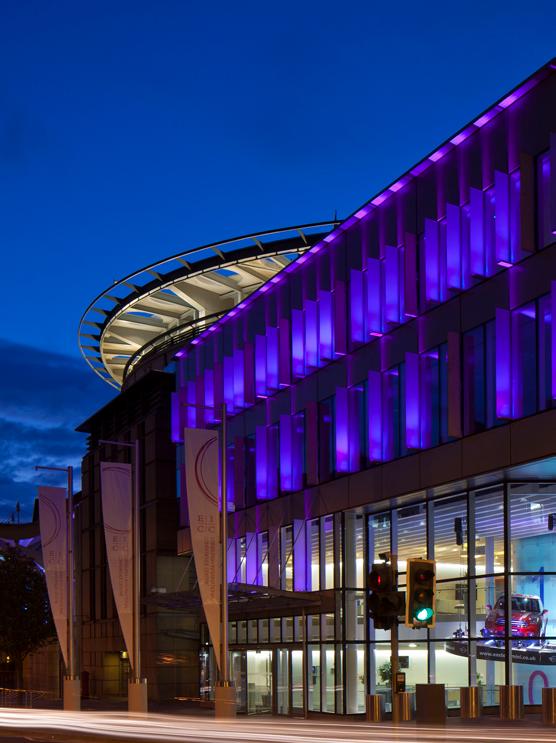
Edinburgh International Conference Centre (EICC) has launched its third annual Impact Report – the first to measure the venue’s environmental, societal and economic outcomes in a single integrated assessment.
The report marks a milestone in EICC’s commitment to responsible business and sets out how venues can demonstrate value beyond economic contribution alone.
Recognising events not only as economic drivers but also as platforms for positive societal and environmental change, the report outlines how EICC is approaching impact across the meetings and events sector.
In 2025, EICC hosted 175 events, generating 173,000 delegate days and contributing £76 million to the economy. Since opening in 1995, the venue has delivered more than £1 billion in total economic impact to Edinburgh.
Total emissions in 2025 were 996.5 tonnes of CO₂e, averaging 5.7 tonnes per event – around 25% lower than the industry benchmark of 7.61 tonnes cited by isla’s Temperature Check.
This contributes to a 62.8% reduction in emissions since 2013, reflecting sustained investment in energy management, waste systems and catering practices, despite an increase in event volumes.
Alongside environmental progress, the report highlights a range of initiatives focused on community engagement, inclusion and knowledge exchange.
Launched in March 2025, the EICC Impact Network connects event organisers with schools, universities, charities and local businesses. More than 30 collaborators are already involved, with further growth planned.
The Exchange Initiative links Edinburgh’s academic community with the business events sector, supporting knowledge exchange. In October 2025, its first three Fellowship recipients attended the SIU Congress, with additional fellowships in development.
EICC also partnered with Welcome Brain and ABPCO to co-launch the Neurodiversity in Events checklist, designed to help planners embed inclusion from the outset. The framework was trialled by NatWest at the venue in May 2025.
The venue delivered six EICC Live events during the year, supporting public discussion on issues including the circular economy, tech poverty and innovation. All events were free to attend.
The report also highlights progress on food waste, which fell by 33% compared with 2024, alongside a 7.5% reduction in food preparation waste, driven by improved measurement, portion control and kitchen practices.
Amanda Wrathall, Chief Executive Officer of the EICC, said:
“At EICC, sustainability has shaped how we operate since opening in 1995 and continues to guide our approach today. What began as a focus on reducing our direct environmental impact has evolved into a broader commitment to supporting communities while protecting the natural world.
This report reflects the progress we have made and the work still ahead.
As Edinburgh’s largest purpose built conference centre, we recognise our responsibility to lead by example. As a city owned venue we remain committed to measuring, managing and reducing event-related emissions, while working in partnership with organisers and stakeholders to create meaningful, lasting value through every event we host.”
Pulsant completes £500,000 Edinburgh data centre upgrades
Investment programme modernises facilities and improves on-site experience at three city sites, including Scotland’s most connected data centre
Pulsant, the UK data centre and digitalinfrastructure platform, announced the completion of a £500,000 investment programme across its three Edinburgh sites, including Scotland’s most connected data centre at South Gyle.
Delivered during the last two years, the roll-out has focused on improving the day-to-day, on-site experience for clients, visitors and Pulsant people, modernising facilities and refreshing interiors.
The investment further strengthens Pulsant’s offering to data-driven Scottish organisations which are looking to scale and grow.
Its distributed infrastructure platform enables digital transformation, underpinned by low latency connectivity.
The flagship South Gyle site offers access to more than 30 national and international carriers, including Scotland’s LINX internet exchange and global network Megaport.
The local investment is part of a £2m Data Centre Experience programme across the UK which has also seen refurbishments completed at Pulsant sites in several location in the UK.
During initial stages, Pulsant worked closely with clients, through a series of user groups, to better understand how its data centres are used in practice. They highlighted a need for more welcoming, efficient and collaborative spaces to help IT teams and technicians work more productively when on site.
Around 240 businesses use Pulsant’s digital infrastructure platform in Scotland for services including colocation, housing their own servers and IT infrastructure in its secure, interconnected facilities.
“From early origins in Edinburgh, Pulsant has grown into a UK-wide platform, but we retain a deep connection with the capital and its business community,” said Ben Cranham, Chief Operating Officer at Pulsant. “Our presence is significant, with three sites and around a third of
Pulsant people based in the city.
“Data Centres are often designed primarily around the infrastructure, rather than the people who work in them every day, and our goal has been to create spaces where everyone –clients, partners, visitors and our team – feels welcome, supported and happy to be there.
“By paying close attention to details, we’re delivering spaces that not only enhance wellbeing and productivity but also help us stand apart in the market.”
Clients and contractors have noticed big improvements, singling out excellent site security, board and breakout rooms, rest areas and even complimentary drinks in post-upgrade feedback to the company.
Main features of the Edinburgh investment programme include:
• Clearer navigation: A new zonal layout and improved signage, improving the efficiency of engineers’ time on site;
• Enhanced amenities: Dedicated breakout spaces for calls, meetings and downtime, supporting client on-site productivity;
• Modern meeting rooms: Equipped with AV technology and guest Wi-Fi, supporting client-supplier meetings and project management efficiency;
• EV charging points: Supporting sustainability and electric vehicle use;
• Upgraded build rooms: Dedicated build bays with tools, test Power Distribution Units (PDUs) and equipment, increasing convenience and on-site productivity as equipment can be configured away from the data hall and then installed;
• Streamlined site access: Improved security processes for smoother movement on site, maintaining the highest levels of security whilst reducing bottlenecks at busy times.
Ben Cranham, Chief Operating Officer, Pulsant.
Space mission launch advances UK standing in quantum communications
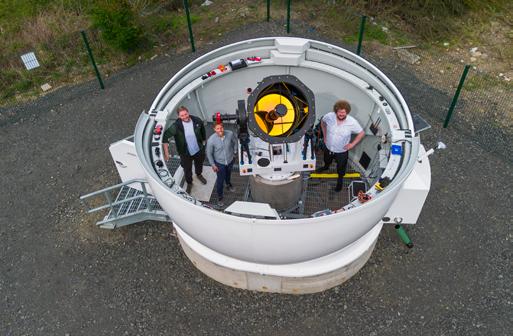
AUK-led space mission spearheaded by Heriot-Watt University is set to accelerate the development of next-generation secure communications, with the launch of the “Satellite Platform for Optical Quantum Communications” (SPOQC).
Delivered through the University’s Integrated Quantum Networks (IQN) Hub, the mission builds on earlier UK research investment and brings together leading academic and industry partners to advance the UK’s position in the fast-growing quantum technology sector.
The SPOQC CubeSat, launched on 30 March 2026 aboard a SpaceX rocket, is now entering its final commissioning phase. It will shortly begin transmitting quantum signals to Heriot-Watt University’s Optical Ground Station in Edinburgh, enabling real-world testing of space-to-Earth quantum communication.
Quantum technology is expected to play a critical role in future digital infrastructure, particularly as advances in computing threaten current encryption methods. Quantum communications offer a highly secure alternative, with built-in detection of any interception attempts. While terrestrial fibre networks are already in use, their range is limited, positioning
satellite-based systems as essential for global deployment.
Led by Heriot-Watt University, the SPOQC collaboration includes the Universities of Bristol, Strathclyde and York, STFC RAL Space, and industry partner ISISPACE. Together, the consortium is combining expertise in quantum engineering, satellite systems and network integration to demonstrate practical, scalable solutions.
The mission will test two distinct quantum communication approaches using a dual-source payload, providing comparative performance data under real operating conditions. These experiments will inform future system design and help de-risk the development of commercial quantum communication services.
By integrating advanced quantum technologies into a compact CubeSat platform, SPOQC demonstrates a costeffective and scalable model for future satellite networks. The results are expected to support the commercialisation of quantum-secure communications and contribute to the UK’s ambitions to build a globally competitive quantum industry. Full system trials are scheduled to begin in the second half of 2026, marking a key step towards the deployment of secure, space-enabled communication infrastructure.
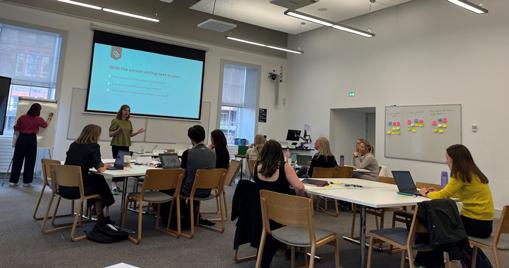
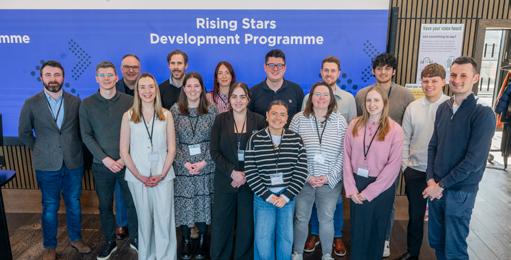
The Edinburgh Chamber of Commerce’s Rising Stars Professional Development Programme is fast becoming a defining part of our mission to support, empower and elevate the next generation of business talent. Launched in 2025 and delivered from January to April 2026 in partnership with the University of Edinburgh, the programme was created to address a clear need: structured, high quality development for early to mid career professionals who are ready to step up and lead.
Rising Stars blends academic expertise with real world business insight from across our membership, creating a learning environment that is both intellectually stretching and deeply practical. It builds on the success of our Rising Stars networking series - which has welcomed more than 500 professionals from over 200 companies - and takes that momentum further by offering a six part, immersive development journey.
Participants explore AI enhanced strategic thinking, emotional intelligence, team dynamics, communication, personal branding and innovation - all areas identified as priority skills gaps in our 2025–26 Membership Survey. The result is a programme that speaks directly to the needs of Edinburgh’s employers and the ambitions of their rising talent.
The inaugural cohort brought together 20 professionals from charities, professional services, healthcare, retail, real estate and more. What made the experience truly special was the energy in the room: cross sector conversations,
shared challenges, and the realisation that leadership is strengthened when perspectives collide.
Participant feedback was exceptional. Every attendee reported increased confidence as a leader and said the programme met or exceeded expectations. As one participant shared: “The sessions were engaging, relevant and really valuable at this stage of my career. I took away so many positive points that I will incorporate into my leadership style.” Another reflected on the power of hearing from business leaders who “brought to life what had been taught earlier in the session, providing real life scenarios and inspiration.”
The programme’s delivery model - combining world class academic input with senior business leaders from across our membership - was repeatedly highlighted as a defining strength. Hosting the series at the Edinburgh Futures Institute reinforced its future focused ethos and showcased the power of collaboration between academia, business and the Chamber.
As we look ahead, we are now preparing to launch the second Rising Stars cohort in summer 2026, ahead of delivery in early 2027. With strong employer demand and a growing alumni community, Rising Stars is set to become a cornerstone of the Chamber’s commitment to developing Edinburgh’s future leaders.
If your organisation is ready to invest in its emerging talent, you can now register your interest for the 2027 cohort by contact training@edinburghchamber.co.uk to find out more.
Say hello to...
Claire Swanson Director of Creative Development Capital Theatres
Previously Head of Creative Engagement, Claire now joins the Executive Team as Director of Creative Development and will lead on the creative strategy for the organisation, including creative engagement and artistic planning and development. The creation of this new role reflects the continued growth and impact of Capital Theatres’ work both on and off our stages, and recognises the organisation’s deep commitment to supporting artists, participants, and communities across Edinburgh and beyond.
Claire Swanson, Director of Creative Development at Capital Theatres said: “I’m delighted to be taking on the role of Director of Creative Development at Capital Theatres, and to be joining the Executive Team at such an important moment for the organisation. Our creative strategy is about how we connect artistic ambition, public value and meaningful engagement with audiences, artists and communities across Scotland. I’m looking forward to building on the brilliant work already happening across the organisation, and to helping shape the next stage of Capital Theatres’ creative development.”
Graeme Mann Business Development Director Hampden Bank
Graeme is a highly experienced banking and business development professional with over 25 years in financial services, specialising in relationship management, commercial growth, and customer experience.
Before joining Hampden Bank, Graeme worked in business development at Coutts, covering the whole of Scotland. He has also held a number of senior roles at the Royal Bank of Scotland, including Senior Relationship Manager and Regional Business Development Manager.
Graeme holds a Postgraduate Certificate in Business Administration and Management, as well as a Diploma in Lending Skills from the Chartered Banker Institute.
Originally from Aberdeen, he has lived in Edinburgh for 15 years with his family. Outside of work, Graeme enjoys golf, rugby, and more recently padel.