A mis padres...
“Una fórmula artística es perfecta cuando se adecua al carácter y a la grandeza del tema interpretado” Paul Cézanne
Tiempo de amistad El hombre Expresar en prosa las realidades del espíritu artístico de Ramón Gutiérrez Ruipérez, nos obliga a rozar la poesía y tratándose de un hombre encendido desde la base misma de su esencia por la flama artística; la cruzada es más exigente. Pero contamos con la transparencia de un hombre que siendo profundo en su tarea, porta sencillez. Padre en la actualidad de dos hermosas florecillas bañadas de sol en sus cabellos y de océano en sus cándidas miradas, estimulan a Ramon Gutiérrez la pintura humana, ingenua, tierna. Tema que explora y combina con maternidades que recuerdan el Olimpo, donde la Madona es además diosa protectora. Detrás de la estética que busca el artista, se encuentra el destello abnegado de su Clara compañera. El trío sagrado del macrocosmos, arquetipos eternos, están presentes en su vida y los desarrolla en su obra: los sabios, pensadores hombres justos. La fémina, púdica aunque desprendida de atuendos que confunden; a veces madre, otras mimetizada en su propio limbo. Y la inocente infancia, tranquilamente divertida y prístina, hasta ahora han ocupado sus obedientes pinceles. Sus temas van más allá de la realidad concreta, pudiendo reflejar en el soporte aquello que la pura esencia tiene acceso. La filosofía
Ruipérez cuenta con el poder de dinamizar la grandeza de este venerable arte en quien se deja invadir por sus pinturas. Arte serio, alejado de modismos e inercias contemporáneas. Arte serio que deja estela en el recuerdo y tiene presencia. Arte serio cargado de investigación previa, análisis e intuición; donde cerebro y corazón; reflexión e intuición danzan al unísono. El tiempo, en la obra de Ramón, es el tiempo de la percepción del observador. Un tiempo que no está sometido a un espacio y a elementos que definan con rigidez. Todo fluye... Y la tenacidad, el estudio y la búsqueda de lo sutil son importantes valores que dan forma a su obra. El pintor Fiel a la regla de oro de la mejor pintura: la primera pincelada; aquel gesto dinámico, certero; podemos asegurar que se trata de un pintor auténtico, genuino, puro. Ajeno a la saturación, sus trabajos están caracterizados por la frescura y la seguridad del trazo. La composición, el color, la materia y la luz; reflejan la dignidad con la que reviste sus pinturas. Matérico cuando corresponde y transparente a la vez, ensalza la esencia del concepto con armonías cromáticas. Ramón conoce la estrategia para fusionar la belleza y el encanto del mensaje en cualquiera de sus temas figurativos o expresivos.
Las obras de Ramón Gutiérrez Ruipérez hablan en sí mismas de principios de vida, de valores perdurables. Aunque exaltado en las luces, pronuncia las sombras, haciendo que las primeras aniden en el recuerdo del observador.
Conocedor profundo de los secretos del dibujo, impresiona reflexionar sobre sus “dejadas”; parcelas desdibujadas e inteligentes insinuadas, que sin estar presentes, participan de la totalidad.
Ramón no pinta porque sí, la contemplación de su obra impregna la propia esencia de humanismo. El mensaje se aloja y habita en lo profundo porque este hombre exige que doblen las campanas del querer, el poder y el hacer, antes y durante el parto de sus cuadros. Refiriéndonos a la reunión en sí mismo, mental, emocional y física; Ramón cuenta entonces con todo lo necesario para que la belleza, la humanidad y la fuerza de su arte, se plasmen en su obra viva.
Su cadencia rítmica, sin estridencias, hace de la nobleza de su arte “sabia poesía”, pintura exenta de caprichos. Sabemos que Ramón Gutiérrez Ruipérez realiza su trabajo en coherencia con los dictados de su conciencia profesional, comprometida con la expresión más elevada del espíritu y su principal compromiso: el arte.
El compromiso
La aspiración Entre pincelada y pincelada, este pintor deja entrever claramente su aspiración: el Arte serio. Ramón Gutiérrez
Antonio Carrillo Bernal, pintor Abril 2002
Time of friendship The man In order to express the reality of Ramón Gutiérrez artistic spirit, we are obliged to touch on poetry. This is the case of a man who has been enlightened from the basis of his essence itself. Nevertheless we count on the depth of his transparency, which brings up his simplicity. Ramón has two daughters who stimulate him to perform human, naive and tender paintings. He explores and combines these aspects with issues related to maternity, which remind us of Olympus where Athena is also the protective goddess. Behind the aesthetics this artist is looking for, one can find the influence of his life partner. The sacred macro cosmos trio and the eternal archetypes are present in his life. He develops these in his work in three representative figures: the wise men, the thinkers and the fair men. The female is sometimes shown as a mother, other times she is depicted in her own limbo. His style illustrates an innocent and amusing childhood while his themes go far beyond specific reality and reflect access to the pure essence. Philosophy Ramón Gutiérrez’s works speak for themselves, about the principles of life and everlasting values. Whilst exalting light he also highlights shadows that linger in the observer’s memory. Ramon’s paintings illustrate his own essence of humanism. The message he transmits stays and lives in the deepest part of the human being. This message compounds love, power and labour before and while he is producing his works. As means of the combination of his mental, emotional and physical strength, Ramón gathers his artistic beauty and humanity to reflect them in his living work.
Time in Ramón’s work is the time in perception for the observer. A time that is neither subject to space nor physical elements may be defined with rigidity. Everything flows and the tenacity, the study and the search for subtlety are important values that shape his work. The painter Loyal to the golden rule of his first touch with the brush; that dynamic gesture with certainty; we can be sure that he is an authentic, genuine and pure painter. Who is unknown to saturation, his works are characterised by the freshness and confidence of his brush. The composition, colour, matter and light reflect the dignity with which he endows his paintings. Materials when needed and transparent at the same time, he spices the essence of concept with the harmony flowing from contrasts. Ramón knows the strategy to bring together the beauty and enchantment of his message in any of his expressive themes. He is deeply knowledgeable in the secrets of drawing. It is worth reflecting on the gaps and blanks “left” in his paintings. These are insinuated in a clever way that without being present form part of its totality. The compromise His paintings lack of rhythm provides nobleness, which makes his art wise poetry. We know that Ramón Gutiérrez carries out his work coherently according to his professional conscience, with the highest expression of his spirit and his commitment to Art.
The aspiration In his work, this painter reveals his own aspiration: the serious Art, which is quite apart from contemporary ways and inertia. Ramón Gutiérrez develops the greatness of this art and allows the observer to become intrigued by his art. Serious art, rich as a result of previous research and analysis where mind and heart, thought and intuition are working as one.
Antonio Carrillo Bernal Abril 2002
Baco y Ariadna (Gran Crátera). Collage, acrílico y conté sobre tela. 217 x 130 cm.
“Siento, pienso, pinto” Al largo de todo este tiempo que llevo con la pintura, desde que empecé, podría decir que estaba muy atraído por la forma, mi preocupación estaba en el dibujo, en la percepción, en la manera de verla y entenderla. Es una etapa inicial quizás corriente. Para mi ha sido importante la concepción de la figura, la manera de entenderla estéticamente, el color aparece más tarde, y en esencia, muy en esencia podría decir que estoy en lo mismo, solo que con el tiempo apareció el claro-oscuro, es decir la luz, y ésta irremediablemente acompañada del color y la materia. Esto sería una reflexión muy simple y primaria de lo que ha podido ser mi evolución plástica, en cuanto a la dimensión visual.
Como en algunas obras de Picasso o Rembrandt, la sensación intimista, y la profunda psicología humana que desprenden, es como una sensación… es la búsqueda de esa sensación. Plásticamente Cezanne fue muy importante en la idea de estructura, me ha aportado composición y una manera especial de entender el cuadro. Aunque yo siempre he dicho que he tenido como punto de partida a Picasso, él fue quien me llevó a Cezanne, y también a Velázquez. Me ha interesado mucho el humanismo en la tradición pictórica, el cual empecé a entender en la epoca azul y rosa de Picasso, también la vertiente temática y filosófica. La transcendencia humana que pueda tener mi pintura se originó ahí. En mi periodo académico, me interesó mucho Miguel Angel por su manera de entender la belleza en sus figuras y el movimiento. Estos artistas habrían sido mis referentes, pero sin embargo, tambien me pueden seducir piezas de Modigliani, Chagall, Tolouse Lautrec, Sorolla… por nombrar algunos, no tengo referencias inamobibles , hay también muchos artistas desconocidos que me han impactado. Ahora hace tiempo que no voy a museos, es como si tubiera un gran rompecabezas en la cabeza de imágenes y sensaciones, voy trabajando en base a eso y en las ideas del momento. Plásticamente me interesan artistas contemporáneos; efectos plásticos nuevos como los de Barceló, o dentro del realismo español Antonio López, o el gran retratista Revello de Toro. También artistas catalanes impresionistas y expresionistas como: Anglada Camarassa , Gimeno, Nonell, Mir (aunque yo no sea muy paisajista) … Van Gogh en sus paisajes me hizo ver el color y a la vez la fuerza expresiva de la línea, me entusiasmó la dimensión mística de la línea acompañada de materia. Esta
Las Musas, conté y pastel sobre papel – 97 x 87 cm. Siempre me han atraído elementos muy importantes, en la percepción psicológica de la obra, el carácter y la profundidad. No la profundidad visual, necesariamente (perspectivas), si no la psicológica.
A veces trabajo de una manera absolutamente caótica y voy conformando el tema a medida que trabajo, pero cuando me analizo compruebo que detrás está todo eso. Actualmente, he incorporado la técnica de collage aplicando trapos y telas; es pintar antes de empezar a pintar, solo que construyendo. Arranca de los cubistas, de los collages, pero también es un poco que el soporte te condicione… empecé a coger mis trapos manchados y vi que me gustaban y los fui combinando, cambiándolos de sitio, y a trabajar con el azar como Jackson Pollock con el dripping, Barceló, o hasta Goya que empezó tirando una gota de agua sobre una plancha de cobre (en sus últimos trabajos). Me dejo llevar por otras cosas, por otras fuerzas, esa sugerencia inicial para iniciar el tema, aunque luego yo lo dirija más o menos, ahí estoy en ese juego, parto del trapo para aplicar un tema que pienso que irá bien con ese contexto, estoy empezando con algo, estoy en un proceso inicial.
dimensión mística-expresionista de la línea sería uno de los interrogantes en mi proceso de trabajo. También ahora me están rondando sensaciones originadas en otros ámbitos como en la literatura o en la música, no todas las influencias vienen de la pintura, pero esto ya serian imágenes poéticas; ritmos cálidos, armonías que me llevan a esas sensaciones de profundidad psicológica, de transcendencia.
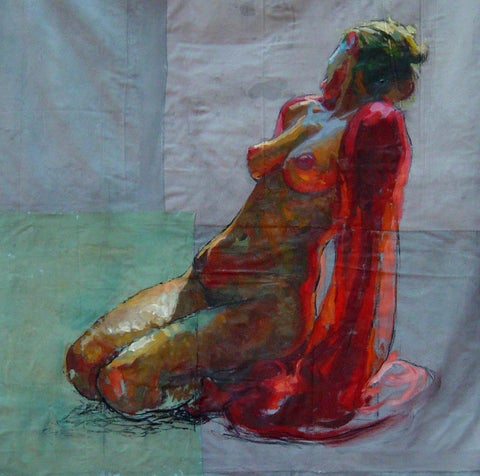
Los temas están muy ligados al momento que vivo, lo que me impacta de la vida cotidiana, eso se refleja en el momento, aunque siempre retorno a unos temas, como el desnudo, la maternidad, la infancia, los gestos, los sabios, los ancianos, la gente mayor, son como constantes que siempre están, aunque vaya por épocas que los trabaje más o menos.
Ramón Gutiérrez Marzo 2006
Una impronta de lo que puede ser, de algo que se queda, que es la profundidad, cuando cualquier obra hace mella es porque tiene una dimensión profunda importante para el espectador. A veces esa profundidad puede estar en un ramo de flores. En la concepción del tema actúa la dimensión mítica, entre otras; desde la mitología, los cuentos, las historias bíblicas (son una forma de mitología). Parto de la sensación en la pose de la modelo e inconscientemente acabo dándole concepto en la idea mítica, que ya tengo como base adquirida, y lo incluyo en algunas de mis obras como la “Magdalena” o “Venus”, que hacen referencia a una mitología judeo-cristiana. Siempre está como presente, es como un sustrato que tengo ahí, son los elementos que configuran parte de mi obra. El tema a veces se configura partiendo de un elemento muy simple como una mancha, un color o bien de la improvisación.
Arlequín II. Óleo, carbón y collage sobre tela 116 x 73 cm.
“I feel, I think, I paint” When I began to paint I felt very attracted for the forms, my main concern was the drawing, the perception, the way of seeing it and understanding it. This is possibly, an initial stage, common in all the beginner artists. The conception of the figure has been very important for me, how to understand it in an aesthetic way, the color appears later, in essence, I could say that I am still in the same way. As time was passing appeared the clear -dark, the light, and the light always comes accompanied by color and texture. Possibly this is a very simple and primary reflection of what could have been my plastic evolution as for the visual dimension of my works.
human psychology that emanates from their paintings, is like a sensation... it is the search of that sensation that moves me. I consider the paintings of Cezanne very important in the idea of structure, his works have taught me how to compose and how to understand the paintings of a special form. Although I always say that my starting point was Picasso, and he was who led to me Cezanne and to Velazquez. I always have been very interested in the pictorial tradition of the humanism, which I began to understand studying the pink and blue periods of Picasso, also the thematic and philosophical aspects. The human importance that could have my paintings have it origin there. During my academic period, I was fascinated for Michelangelo and his form of understand the beauty in his figures and the movement of them. My main references are all the artists that I have mentioned previously, but I ´m interested as well in some pieces of Modigliani, Chagall, Toulouse Lautrec, Sorolla...I don't have immovable references, there are also many unknown artists that hit me. Is like I had a great puzzle in my head with images, sensations, feelings. I work based on that puzzles and in the ideas I have in the moment. I am also interested in contemporary artists; plastic new effects like those of Miquel Barceló, the sublime realism of the Spanish Master Antonio López and the paintings of Revello de Toro, as well all the artists of the Catalan School like: Anglada Camarassa, Gimeno, Nonell, Mir (although I don't paint landscapes). Looking at the landscapes painted by Van Gogh I discovered the color and at the same time the expressive force of the line, I got thrilled with the mystic dimension of the line accompanied
I always have been attracted for important elements, for the psychological perception of the work, the character, and the depth. Not only the visual depth (perspective) but the psychological depth. Like in some works of Picasso or Rembrandt, the intimist sensation, and the deep
Sometimes I work in an absolutely chaotic way and I built the topic while I ´m working on the painting, but when I analyze my own work I realized that behind it, is all that I feel and believe. In my last works I have incorporated the technique of collage, applying rags and cloths; is like painting before beginning to paint, but building it. This technique began with the cubists artists, from the collages, but is also important the support. I began to catch my spotted cloths and realized that I liked the results so that I began to combining them, changing those of place, is like working at random like Jackson Pollock with the dripping, Miquel Barceló, or even Goya that began throwing a drop of water on one iron of copper (in his last works). I got carried away by other things, other forces, the initial suggestion capable to start the subject, although then I direct it, I am in that game, starting with the cloth and then applying a subject that I think will go well with that context, I am beginning with something, I am in an initial process.
with texture. This dimension mystic- expressionist of the line would be one of the queries in my process of work. Now, I ´m feeling sensations originated in other worlds, in the literature and in the music, not all the influences come from the painting, but this would be poetic images, warm rhythms, harmonies that lead me to those sensations of psychological depth. An importance of what could be, or of something that remains that is the depth, when any work makes impression in the spectator it is because it has a deep dimension. Sometimes that depth could be in a simple bouquet of flowers. In the conception of the topic act the mythical dimension, between others; from the mythology, the tales, the biblical stories (I think that they are a form of mythology). My starting point are the sensations I have when I saw the poses of the models, then unconsciously I finish it giving a concept to the mythical idea, that I already have as an acquired base, I include it in some of my paintings like the "Magdalena " or " Venus," both paintings make reference to the Jew Christian mythology, which is always present, like a substratum I have inside , these are elements that configure part of my work. The subject sometimes is configured by leaving a very simple element, like an stain, a color, or just from the improvisation.
The topics are bound to the moment that I live, which the things] of the daily life that impress me, this is reflected in the moment, although I always return to some topics, like the nude, the maternity, the childhood, the expressions, the gestures, the elder people, those subjects are like a constant that is always there, although Is for periods that I work more or less with those topics. Ramón Gutiérrez March 2006
Biografía Ramón Gutiérrez nació en Barcelona el 2 de junio de 1966. Es el mayor de los cinco hijos de Juan José Gutiérrez y María Luisa Ruipérez. El arte y la cultura fueron, durante su infancia, una constante en las actividades de la familia gracias a las aficiones de sus padres. De hecho, de Joven, Juan José Gutiérrez había practicado el dibujo con cierta seriedad. Hacia 1970, la familia se traslada a Cerdanyola del Vallès. Pese a que a Ramón siempre le había gustado mucho dibujar, la actividad nunca había tenido más trascendencia que la de un simple juego infantil. No será hasta la llegada de la adolescencia cuando el arte irrumpa con fuerza en su vida.
colectivas, en salas de toda España. Durante este período establece una serie de contactos que le marcarán profundamente, tanto con destacados pintores ya conocidos a nivel internacional, como Felix Revello de Toro, y con figuras tan populares como el ya desaparecido Xavier Cugat, caricaturista y celebre musico, con el que entabla una gran amistad y que le dá una serie de consejos que le marcan profundamente. Una vez finalizada la carrera, sigue pintando y exponiendo, además de trabajar como profesor de pintura en varios centros, y de dar clases en su taller.
También una de sus aficiones importantes, en cuanto a su formación estética, ha sido la música, iniciándose en el "rock and roll" de los años cincuenta, posteriormente el blues, el jazz, la ópera, Dylan, los Stones, ocupan un lugar importante en su estudio. La pasión por la música ya nunca le abandonará. Hacia 1980 empieza a descubrir el cómic. Se obsesiona con el tema, y se pone a dibujar sin descanso. Su interés por mejorar su técnica pronto le llevan a estudiar las técnicas de los grandes de la pintura. La impresión que le causa un libro sobre Van Gogh y una visita al Museo del Prado acaban de convencerle de que su camino está en la pintura. Se matricula en la Academia "Els 4 Pintors" de Barcelona, donde permanecerá durante unos años y en cuyas aulas aprenderá casi todo lo que un pintor necesita saber. Entre 1985 y 1991, estudia la Carrera de Bellas Artes en la Universidad de Barcelona. Al mismo tiempo, desarrolla una intensa actividad artística. Dedica prácticamente todo su tiempo a pintar y realiza varias exposiciones, tanto individuales como
Ramon Gutiérrez, 1989
Como es lógico, su estilo ha evolucionado mucho a lo largo de las dos décadas que han transcurrido desde que la pintura se convirtió en uno de los principales ejes de su vida. Sus cuadros inicialmente han tenido un marcado carácter "social" que, durante sus primeras etapas se hacía patente retratando las situaciones en las que viven las capas más desprotegidas de la sociedad. Mendigos, tullidos y "seres desgraciados", en general, habitaban en la mayor parte de aquellas primeras telas. Desde hace unos años, sin embargo, su pintura se ha vuelto más "amable". Entre sus obras más recientes abundan las maternidades, aunque también le interesan otros temas como todo lo relacionado con la mitología griera, el mundo de la farándula y el espectáculo y lo que él define como "el mundo de los sabios". Pese a todo, él defiende que el hecho de practicar una pintura más preocupada por la estética no quiere decir que sus cuadros sean menos humanos. "En un mundo tan deshumanizado como el que nos ha tocado vivir, yo apuesto por reinvindicar, a través de mis cuadros, la importancia de las relaciones humanas".
Con toda seguridad, también deben haber influido en su nuevo estilo su actual situación familiar. Desde hace años tiene en su pareja -Clara- un pilar fundamental tanto en su obra como en su vida personal. La pareja tiene dos hijas, Luna y Noa. Hace unos años, Ramón y su familia dejaron Cerdanyola del Vallès para trasladarse a Sant Feliu de Guíxols (Girona). Desde el año 2000 hasta el 2004, toda su obra fue gestionada por Carmen Clusellas (comerciante de arte de Barcelona). Durante estos años expondrá en diferentes salas en Madrid, Barcelona, Valencia y Paris. Finalizada esta etapa, Ramón trabaja como artista independiente exponiendo en diferentes salas y con coleccionistas particulares. Actualmente esta representado por SIFA en EEUU y Canadá .
Gran Tutú. Óleo, carbón, y acrílico sobre tela, 254 x 162 cm.
Biography Ramón Gutiérrez was born in Barcelona June 2, 1966. He is the eldest of the five children of Juan José Gutiérrez and María Luisa Ruipérez. When he was a child, thanks to the interest of his parents, art and culture were always present in the activities of the family. In fact, when he was young, Juan José Gutiérrez had done some painting too. In 1970, Ramon moved to Cerdanyola del Vallès. Nowadays he lives in Sant Feliu de Guíxols on the Spanish Costa Brava. When he was a child, Ramón spent many hours drawing. But when he looks back on those "first steps in the world of art" he remembers it was only simple childlike play. Music has also been one of the artistic forms that has influenced him significantly, initially the Rock’n’Roll of the fifties and later the Blues, Jazz, Opera, Dylan and the Stones, they still occupy an important place in his studio. His passion for music continues today. Around 1980, Ramón discovered comics. In just a few weeks, he, along with some of his friends became obsessed with everything related to this medium. They began to draw without rest, and to read and collect every book and magazine they could find. Ramón's interest in improving his technique moved him to find new ways of learning, and soon he was studying the styles of some of the greatest painters of all time. His life changed completely the day he discovered a book about Vincent Van Gogh, in a friend's home. The paintings he saw in this book made a deep impression on him. A few months later, he visited "El Museo del Prado", in Madrid, and he realized, from that moment on there was only one way for him to go… he wanted to be a painter. Very soon after that, he took his first painting lessons in the "Els 4 Pintors" Academy, in Barcelona, where he studied for several years, and where, as he said, he
learnt almost everything that a painter needs to know. Between 1985 and 1991, he studied his Degree in Arts at the University of Barcelona. At the same time, he increased the intensity of his creative activity, painting without rest and exhibiting his work in many individual and shared exhibitions around Spain. During this period, he also established some relationships that caused a deep impact on his life. He met other painters (that, in some cases, are already internationally known) and made contacts
with figures not directly related to the world of art but who influenced him deeply too. Perhaps amongst the second group of people we should make a special comment about Xavier Cugat, the world famous Catalan musician who was one of the greatest celebrities in show business all throughout the thirties, forties and fifties. Xavier Cugat and Ramón Gutierrez became good friends during the last months of the musician's life, and his death caused deep shock in the young artist. Once Ramón finished his studies at University, he carried on painting without rest, and tried to find an opportunity to gain his own place in the world of art. In order to make a living at the same time however, he also began working as a specialist teacher of painting techniques in several schools. Obviously, his style has evolved a lot over the two decades that have elapsed since painting became the reason for his existence. However his paintings still maintain a "social" context which had initially been an integral part of his work. His well developed social conscience was particularly obvious during these early years, when he tried to reflect the lives of beggars, poor people, and in general, the more disadvantaged of our society, through his painting. More recently his work has evolved to something more "kind". Nowadays a good part of his paintings reflect maternity, however he is also interested in other subjects such as; Greek mythology, what he defines as "the wise people", or the Circus and Show Business in general. Of course, as we already said, he is still absolutely "in love" with everything related to any kind of music. All these influences are ever present in his work. He likes to think, that while he tries to achieve a higher aesthetic level in his current paintings than in his first works, this doesn't mean that he has forgotten the social message that he wants to
in this world in which we live, human values like love or friendship are often forgotten. His paintings try to specifically protect all these forgotten values. On the other hand, we can not ignore the fact that now he is partnered with Clara, and they have two daughters (Luna and Noa). Obviously, these significant life experiences have allowed him to see life from a very different point of view than the one he had as a teenager. A few years ago, Ramón and his family left "Cerdanyola del Vallès" and have settled into their home in Sant Feliu de Guíxols, in Girona, where they live today. In 2000, he started working with Carmen Clusellas, an Art Gallery Owner from Barcelona, and one of the best art dealers in Spain. Since his relationship with Carmen Clusellas began, Ramon's career has taken an important step forward. His paintings are already exhibited in the United States and in Paris. As we write (January 2004), it seems that his work is already set to become a big hit on the international market but only time will tell. One thing about which there can be no doubt is that Ramón is an artist above all else and will, for the rest of his life, continue doing the one thing he knows he was born to... painting. From 2000 to 2004 Carmen Clusellas was his art dealer, during this time his work was exhibited in different Art Galleries in Madrid, Barcelona, Valencia and Paris. After this phase Ramon worked as an independent artist displaying his work in different Art galleries and private shows. Nowadays SIFA is Ramon’s art dealer in the USA and Canada.
Obra
Beso en la frente. Óleo sobre tela. 65 x 50 cm. (25.5 ´´ x 19.6 ´´)
Abrazo. Óleo sobre tela. 73 x 60 cm. (28.7 ´´ x 23.6 ´´)
Diálogo. Óleo sobre tela. 55 x 46 cm. (21.6 ´´ x 18.1 ´´)
Maternidad en la ventana. Óleo sobre tela. 81 x 65 cm. (31.8´´ x 25.5 ´´)
Sonrisa. Óleo sobre tela. 65 x 50 cm. (25.5 ´´ x 19.6 ´´)
Paternidad. Óleo, carbón y collage sobre tela. 81 x 81 cm. (31.8 ´´ x 31.8´´)
Maternidad con vestido. Óleo sobre tela. 65 x 54 cm. (25.5´´ x 21.2´´)
Triple Presencia. Óleo sobre tela. 73 x 60 cm. (28.7 ´´ x 23.6 ´´)
Triple Presencia – II. Óleo sobre tela. 81 x 65 cm. (31.8 ´´ x 25.5 ´´)
Lección. Óleo sobre tela. 65 x 50 cm. (25.5 ´´ x 19.6 ´´)
Tenor. Óleo sobre tela. 46 x 38 cm. (18.1´´ x 14.9 ´´)
Pianista (Contraluz). Óleo sobre tela. 46 x 38 cm. (18.1´´ x 14.9 ´´)
Instantes Iniciales. Óleo y carbón sobre tela. 146 x 114 cm. (57.4´´ x 44.8 ´´)
Ensayo. Óleo, carbón y betún sobre tela. 100 x 81 cm. (39.3´´ x 31.8 ´´)
Ensayo - II. Óleo sobre tela. 100 x 81 cm. (39.3´´ x 31.8 ´´)
Banda en Union Square. Óleo , carbón y collage sobre tela. 162 x 130 cm. (63.7´´ x 51.1 ´´)
Trombón de varas. Óleo , carbón y collage sobre tela. 100 x 73 cm. (39.3´´ x 28.7 ´´)
Viejas Notas. Óleo, carbón y collage sobre tela. 133 x 107 cm. (52.3 ´´ x 42.1 ´´)
Coro Infantil (Estudio). Óleo, carbón y collage sobre tela. 81 x 81 cm. (31.8 ´´ x 31.8´´)
Coro infantil. Óleo , carbón y collage sobre tela. 116 x 73 cm. (45.6´´ x 28.7 ´´)
El Coro. Óleo , carbón y collage sobre tela. 310 x 310 cm. (122´´ x 122 ´´)
Leccíón de piano. Óleo y collage sobre tela. 100 x 81 cm. (39.3´´ x 31.8 ´´)
Ensayo del arlequín. Óleo, carbón y collage sobre tela. 146 x 97 cm. (57.4´´ x 38.1 ´´)
Gesto. Óleo, carbón y collage sobre tabla. 61 x 38 cm. (24´´ x 14.9 ´´)
Gesto - II. Óleo, carbón y collage sobre tabla. 55 x 46 cm. (21.6 ´´ x 18.1 ´´)
Descanso. Óleo y carbón sobre tela. 73 x 60 cm. (28.7 ´´ x 23.6 ´´)
Flamenca. Óleo, carbón y collage sobre tela. 92 x 76 cm. (36.2 ´´ x 29.9 ´´)
Estudio “Lago de los Cisnes”. Conté y óleo sobre cartón. 33 x 24 cm. (12.9 ´´ x 9.4 ´´)
Máxima Expresión. Óleo sobre tela. 73 x 60 cm. (28.7´´ x 23.6´´)
Pareja. Óleo sobre tela. 73 x 60 cm. (28.7´´ x 23.6´´)
Fantasía. Óleo sobre tela. 55 x 46 cm. (21.6 ´´ x 18.1 ´´)
Payaso y Bailarina. Óleo sobre tela. 100 x 73 cm. (39.3 ´´ x 28.7 ´´)
Streeper I (Nacimiento de Venus). Óleo y carbón sobre tela. 88 x 53 cm. (34.6 ´´ x 20.8 ´´)
Cortina roja. Óleo collage y carbón sobre tela. 133 x 107 cm. (52.3 ´´ x 42.1 ´´)
Ojos para la pintura. Óleo y carbón sobre tela. 200 x 190 cm. (78.7 ´´ x 74.8 ´´)
Desnuda en la Chaisse Longue. Óleo sobre tela. 46 x 38 cm. (18.1´´ x 14.9 ´´)
Frágil equilibrio. Óleo sobre tela. 195 x 97 cm. (76.7´´ x 38.1 ´´)
Transparencias. Óleo sobre tela. 73 x 60 cm. (28.7´´ x 23.6 ´´)
Reflejo. Óleo sobre tela. 81 x 65 cm. (31.8´´ x 25.5 ´´)
El Bloc. Óleo sobre tela. 100 x 81 cm. (39.3´´ x 31.8 ´´)
El Bloc - II. Óleo sobre tela. 146 x 114 cm. (57.4´´ x 44.8 ´´)
Magdalena. Óleo y betún sobre tela. 195 x 130 cm. (76.7´´ x 51.1 ´´)
Niña en la silla. Óleo, carbón y collage sobre tela. 156 x 100 cm. (61.4´´ x 39.3 ´´)
La Comba. Óleo, grafito y collage sobre tela. 130 x 89 cm. (51.1´´ x 35 ´´)
Niña de la Caracola. Óleo, carbón y collage sobre tela. 81 x 65 cm. (31.8´´ x 25.5 ´´)
Jugando en la playa. Óleo sobre tela. 55 x 46 cm. (21.6 ´´ x 18.1 ´´)
Con las flores (Estudio). Óleo sobre tela. 55 x 46 cm. (21.6 ´´ x 18.1 ´´)
Susurro. Óleo sobre tela. 65 x 54 cm. (25.5 ´´ x 21.2 ´´)
La escalera. Óleo sobre tela. 81 x 54 cm. (31.8 ´´ x 21.2 ´´)
Con la cortina. Óleo sobre tela. 55 x 46 cm. (21.6 ´´ x 18.1 ´´)
El día más divertido. Óleo, carbón y collage sobre tela. 81 x 65 cm. (31.8´´ x 25.5 ´´)
Colores del mar. Óleo y collage sobre tela. 100 x 81 cm. (39.3´´ x 31.8 ´´)
Colores del mar. Óleo y collage sobre tela. 100 x 81 cm. (39.3´´ x 31.8 ´´)
El altar de baco. Óleo y carbón sobre tela. 100 x 81 cm. (39.3´´ x 31.8 ´´)
Hiedras. Óleo collage y carbón sobre tela. 116 x 89 cm. (45.6´´ x 35 ´´)
Parra. Óleo y Collage sobre tela. 100 x 81 cm. (39.3´´ x 31.8 ´´)
Glicinias. Óleo, carbón y collage sobre tela. 100 x 73 cm. (39.3´´ x 28.7 ´´)
Olivo (Estudio). Óleo, carbón y collage sobre tela. 100 x 73 cm. (39.3´´ x 28.7 ´´)
Ofrenda I Óleo, carbón y collage sobre tela. 73 x 60 cm. (28.7 ´´ x 23.6 ´´)
Pino de la Costa. Pastel y collage sobre tabla. 46 x 38 cm. (18.1´´ x 14.9 ´´)
Caracola y Vela. Pastel sobre tela. 65 x 54 cm. (25.5 ´´ x 21.2 ´´)
Descanso de la Diva. Óleo y carbón sobre tela. 221 x 138 cm. (87´´ x 54.3 ´´)
La partitura. Óleo sobre tela. 55 x 46 cm. (21.6 ´´ x 18.1 ´´)
Pensamientos. Óleo sobre tela. 81 x 65 cm. (31.8´´ x 25.5 ´´)
La Partitura II. Óleo sobre tela. 81 x 65 cm. (31.8´´ x 25.5 ´´)
Tras la Cortina. Óleo, carbón y collage sobre tela. 100 x 73 cm. (39.3´´ x 28.7 ´´)
Mascota. Óleo, carbón y collage sobre tela. 146 x 89 cm. (57.4´´ x 35 ´´)
Estudio de cabeza. Óleo, carbón y betún sobre tela. 73 x 60 cm. (28.7´´ x 23.6 ´´)
Pintora. Óleo sobre tela. 100 x 81 cm. (39.3´´ x 31.8 ´´)
Reflexión. Óleo sobre tela. 73 x 60 cm. (28.7´´ x 23.6´´)
La falda verde. Óleo sobre tela. 130 x 81 cm. (51.1´´ x 31.8´´)
La falda de flores. Óleo sobre tela. 81 x 55 cm. (31.8´´ x 21.6´´)
El fondo (Estudio II). Óleo sobre tela. 146 x 114 cm. (57.4´´ x 44.8 ´´)
Las sandalias. Óleo sobre tela. 55 x 46 cm. (21.6 ´´ x 18.1 ´´)
Mirando abajo. Óleo sobre tela. 100 x 81 cm. (39.3´´ x 31.8 ´´)
Pasión por un jarrón. Óleo, carbón, pastel y collage sobre tela. 100 x 81 cm. (39.3´´ x 31.8 ´´)
Estudio de cabeza. Óleo, carbón y collage sobre tela. 55 x 46 cm. (21.6 ´´ x 18.1 ´´)
Retrato. Óleo sobre cartón. 46 x 27 cm. (18.1 ´´ x 10.6 ´´)
Retrato. Óleo sobre tela. 65 x 54 cm. (25.5 ´´ x 21.2 ´´)
Retrato. Óleo sobre tela. 65 x 54 cm. (25.5 ´´ x 21.2 ´´)
"This work is unlike anything I have ever seen, and wholly original." Those were literally my first thoughts when I first saw Ramon Gutierrez' paintings for the first time via digital images. When I saw the work in person, I was astounded. After pondering for a little bit, the sly references to Velazquez, Cezanne, even Picasso became apparent. Hailing from the province of Catalonia--a particularly beautiful part of Spain with a rugged terrain, beautiful shoreline, amazing cities and a light unlike any other in the world---Ramon's Mediterranean influences come through loud and clear. Ramon uses thick strokes of oil to almost three dimensional effect in his work. He makes ample uses of rich, vivid tones and textures. The layers and textures are built up over a framework of layered canvas, sometimes stained different colors. For me, the intimate and deep human sensations depicted in the work seem to almost come alive, and truly move my soul. -Joseph Daniel-Warren, S.I. Fine Arts, New York City
"Gutierrez presents a stunning tour de force of realism." -Gail Roff, Owner, Gail Roff International Fine Art, San Clemente California
"Gutierrez' work is almost like a bullfight for me: controlled bursts of romantic, passionate stokes, with exactly the right amount of paint on the canvas, nothing more and nothing less." -Kate Maas, Gallery Director, Patou Fine Arts, Miami-Ft. Lauderdale Florida
1982 - Exposición colectiva. ATENEU de Cerdanyola del Vallès. (C./ Industria, Cerdanyola) 1987 - Exposición individual de dibujo y pintura: "Ramón Gutiérrez 84-87", GALERÍA LOLA ANGLADA (CI. Viladomat, 271-273 Barcelona) 1987 - Exposición individual de dibujo y pintura: "Ramón Gutiérrez". SALA BANESTO (Sant Cugat) 1988 - Exposición individual de dibujo y pintura: "Figures tancades" . GALERÍA CAU D'ART (Pl. Marquilles, 2 Sabadell). 1989 - Exposición individual de dibujo y pintura: "Dualidad". EL CAVA (C/. Sant Francesc, 35 Cerdanyola). 1990 - Premio de retrato. Universidad de Barcelona: Facultad de BELLAS ARTES de Barcelona. 1990 - Ilustración del libro de poemas "Les sonnetes de l'autre" de Paul Mourosy, que es el galardonado con los premios de la Academia de poetas de Francia y presentado en Bucarest en 1991. 1991 - Exposición colectiva de dibujo y pintura: "De realitat a realitat". Universidad de Barcelona: FACULTAD DE BELLAS ARTES. 1991.- Exposición individual de dibujo y pintura: "Contrastes". GALERÍA LLEONART (C/. de la Palla, 6 Barcelona). 1992 - Exposición colectiva de dibujo y pintura: PRIM-ART 8 (C./ d'en Prim, 127 Badalona). 1993 - Exposición individual de dibujo y pintura: "Rojo Pálido". GALERÍA ARTSENAL (C/. Valldoreix, 58 Sant Cugat). 1993 - Exposición colectiva: "2ª Subhasta d'art a la baixa". GALERÍA ARTSENAL (C/. Valldoreix, 58 Sant Cugat). 1994 - Exposición individual de dibujo y pintura: "Cuenta Cuentos". GALERÍA GIRA-SOL (C/. San Hermenegildo, 7 Madrid). 1994 - Exposición colectiva de pintura: "Libre" GALERÍA GIRA-SOL. (C/. Sant Hermenegildo,7 Madrid). 1994.- Exposición colectiva: GALERÍA FORUM (C/. Albareda, Girona). 1994.- Exposición colectiva: GALERÍA EL CLAUSTRE. (C. Nou, Girona). 1995.- Exposición colectiva: "Exposició benéfica pro-casal de la Mare de Deu del Roser de Cerdanyola del Valles". SALA D'ART BUIGAS (Av. Catalunya, 23 Cerdanyola) 1995.- Exposición colectiva: "Arte Actual" GALERÍAS GIRA-SOL. (CI. San Rermeregildo,7 Madrid) 1996.- Exposición individual de dibujo y pintura: GALERÍA ROVIRA (C/ Sant Pere, 22 Sabadell) 1996 - Exposición colectiva de dibujo y pintura: GALERÍA D'ART AB (Agustí Vinyamata, 55 08400 Granollers) 1996 - Exposición colectiva de dibujo y pintura: GALERÍA D'ART GRIFÉ & ESCODA, S.L. (CI. Conde de Salvatierra, 6-8 08006). 1996 - Exposición colectiva de pintura: GALERÍA D'ART XIPELL (Passeig Pere III, 32 Manresa). 1996 - Exposición colectiva de dibujo y pintura: SALA TUSET (Tuset,3 Barcelona). 1997 - Exposición colectiva de dibujo y pintura: OLOT ART (C/.Sant Rafael, 35 Olot). 1997 - Exposición colectiva de pintura: GALERÍA D'ART MARC SABATA (Travessera de Gràcia, 62, P,Q,R, BCN).
1997 - Exposición individual de pintura: GRÀCIA (Av. Mistral, 48 Barcelona). 1997.- Exposición colectiva de pintura: GALERÍA TOISON (C/. Arenal, 5 28013 Madrid) 1997 - Exposición colectiva de pintura: GALERÍA INFANTAS (C/. Infantas,19 28004 Madrid). 1997 - Exposición colectiva: HIPERMERCAT D'ART (Vinçon) GALERÍA SAFIA, (Gràcia - Barcelona). 1997.- Exposición individual de pintura: GALERÍA CHELSEA (C/. Sant Miquel, 37 Manresa). 1999 - Feria de Arte de Santander. 1999 - Feria de Arte de Valencia. 1999 - Exposición colectiva: HIPERMERCAT D'ART (Vinçon). GALERÍA SAFIA, (Gràcia - Barcelona). 2000.- Exposición colectiva: HIPERMERCAT D'ART (Vincon) . GALERÍA SAFIA, (Gràcia - Barcelona). 2000.- Exposición colectiva: GALERÍA CARMEN, (C/. Villarroel. Barcelona) 2001.- Exposición colectiva: EL CORTE INGLÉS de Barcelona 2001.- Exposición permanente: AMOUR A L'ART de París. 2001.- Exposición colectiva: GALERÍA CARMEN (Platja d'Aro). 2001.- Exposición colectiva: EL CORTE INGLES-Castellana de Madrid. 2002.- Exposición permanente: Galerie L'Amour de l'Art (París). (Reseña en la revista francesa "Arts") 2002.- Exposición individual: GALERÍA ROVIRA (C/ Sant Pere, 22 Sabadell) 2003.- El Corte Inglés. Diagonal BCN "Pintors catalans". 2003.- Sala Braulio. Av.Rey D.Jaime, 23 12001 Castellon Exposición "2 Pintores Ramon y Costa Vila". 2004.- Exposición individual: GALERÍA ROVIRA (C/ Sant Pere, 22 Sabadell) 2005.- Exposición individual: GALERÍA TAÜLL (C/ Laforja, 26 08006 BARCELONA) 2006- Exposición colectiva: “Maestros Europeos” Gail Roff EEUU: - PATOU Fine Art (Florida) http://www.patoufineart.com/contact.htm - Gail Roff International Fine Art. San Clemente (California) http://www.galeriegeorge.com - Cristopher Hill. Sta Helena (California) http://www.chgallery.com/
http://www.ramon-gutierrez.com ramon-pintor@hotmail.com
Gracias a Marc Tomás y Joan Iriarte por sus fotografías, a Juan Antonio Hidalgo por su colaboración en la creación y edición de este libro, a Antonio Carrillo y a Manolo Kupka por sus textos y traducciones a Rosa Anguas, de SIFA por su colaboración en los textos y a todas mis “musas”. Gracias también a todas las personas que me han apoyado durante todos estos años como Xavier Cugat, Blas de Santiago, Gerardo Noiceaux, Rosita Rovira, Carmen Clusellas, Dr. Anibarro, o Carlos Taberner, y a todos los que no nombro, pero que también están.