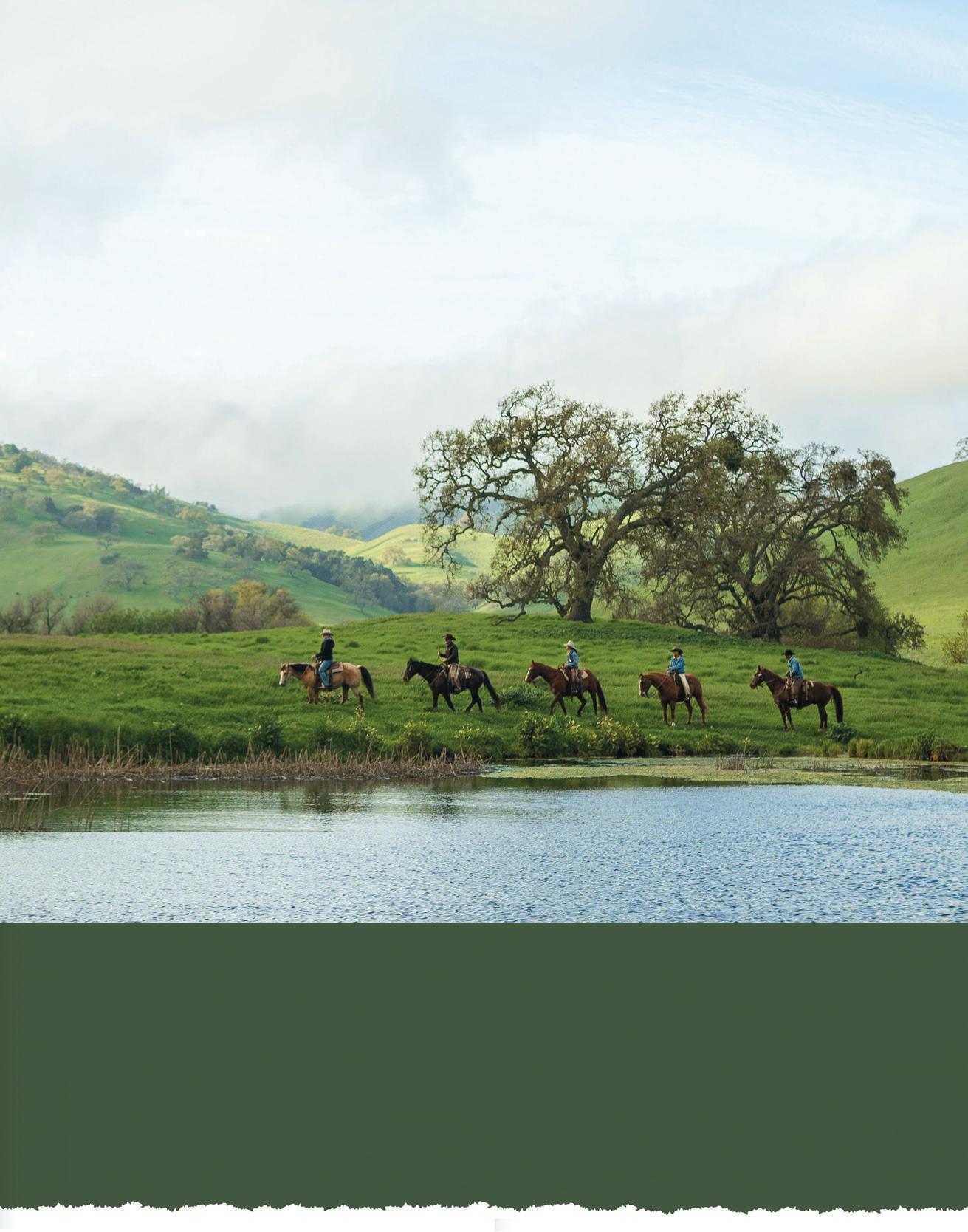
Celebrating the Local Food and Drink of Santa Cruz, Monterey and San Benito Counties
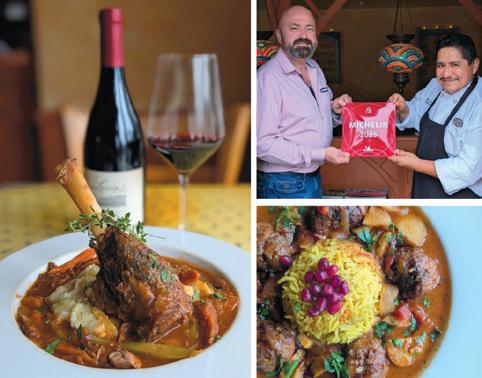
Four Winds delivers outsize happiness with mini citrus trees; School of Jamrock teaches aspiring cooks to play the hits (and deep cuts); Divine wine minds confront a crossroads with conflicting wisdom
Eating
California’s state jewel is a stunner
50 ON THE FARM FLOWER EMPOWERED
Meet a pioneering Watsonville cannabis farm
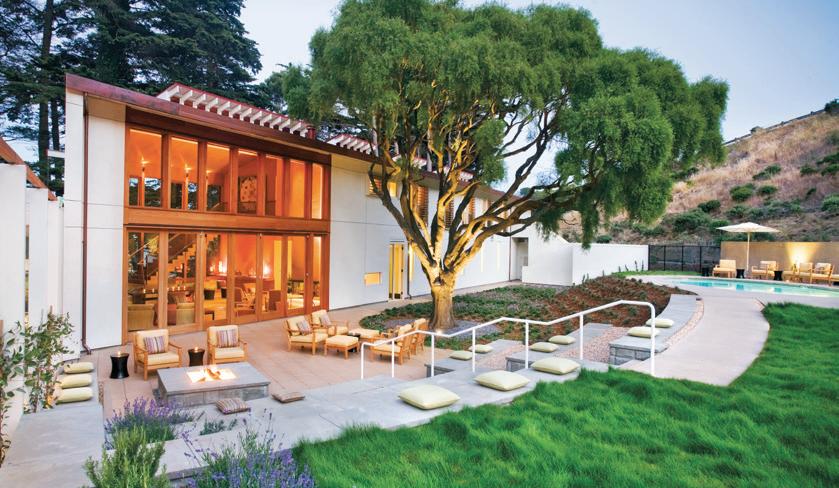
57 APPETITE FOR TRAVEL CAVALLO POINT
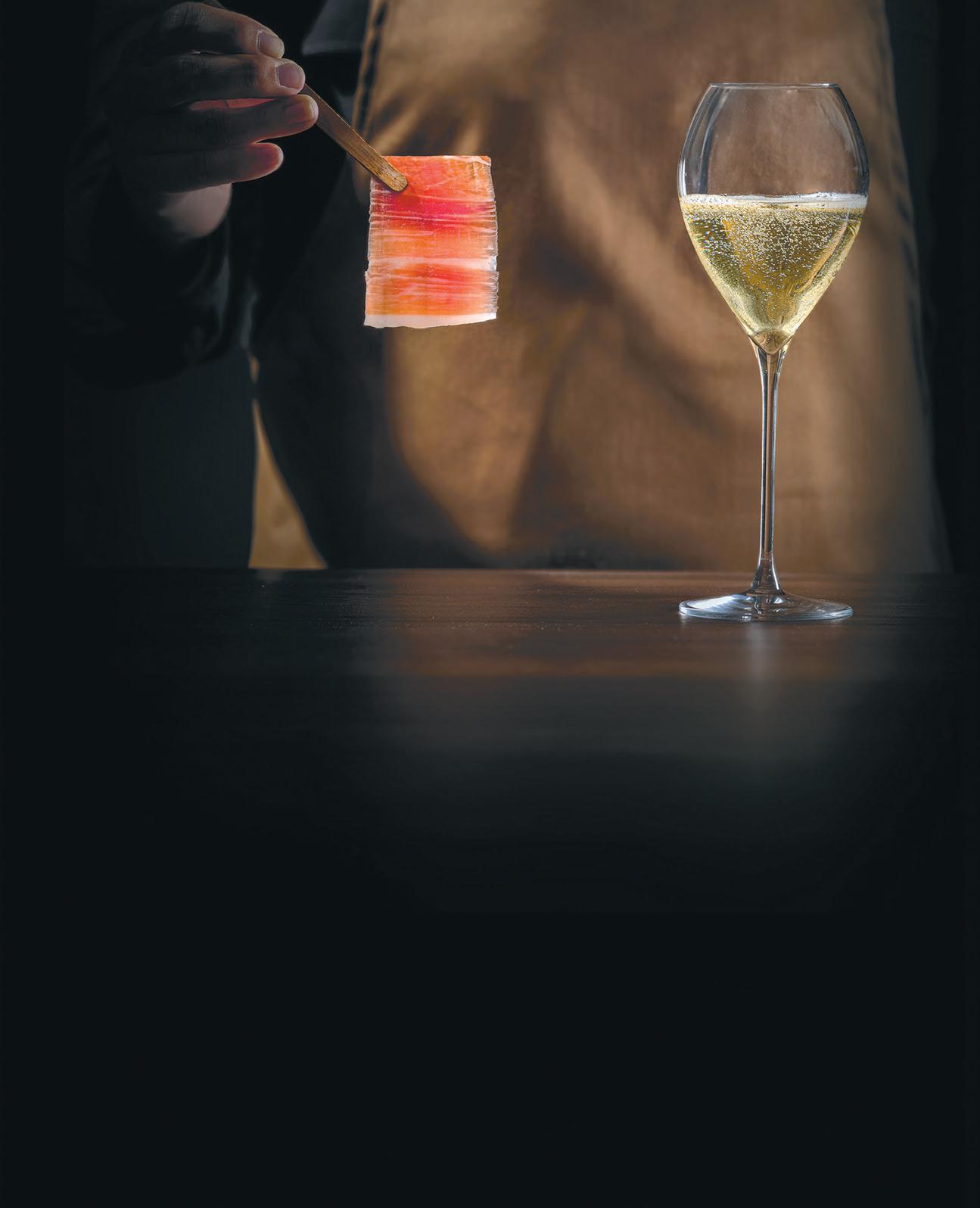
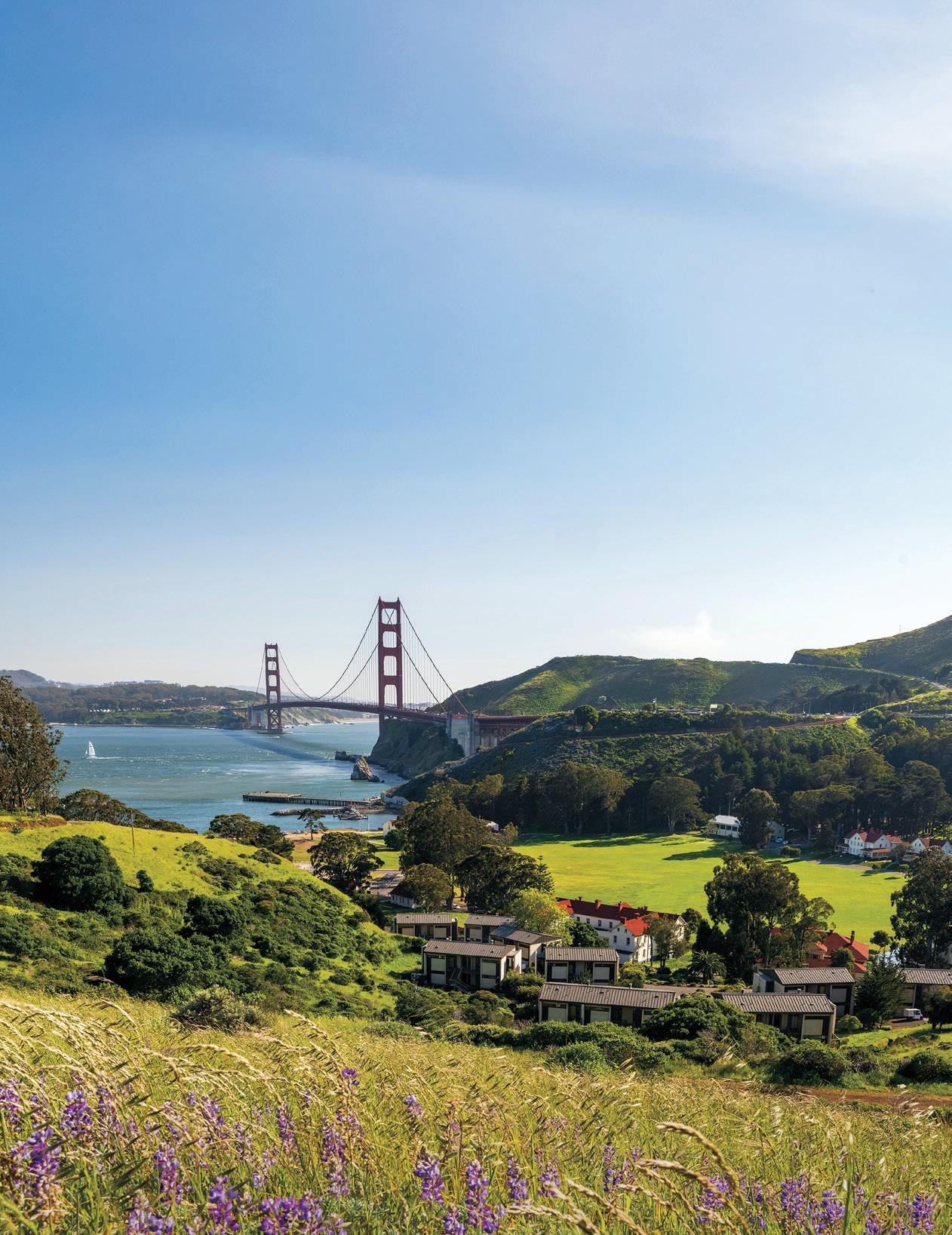
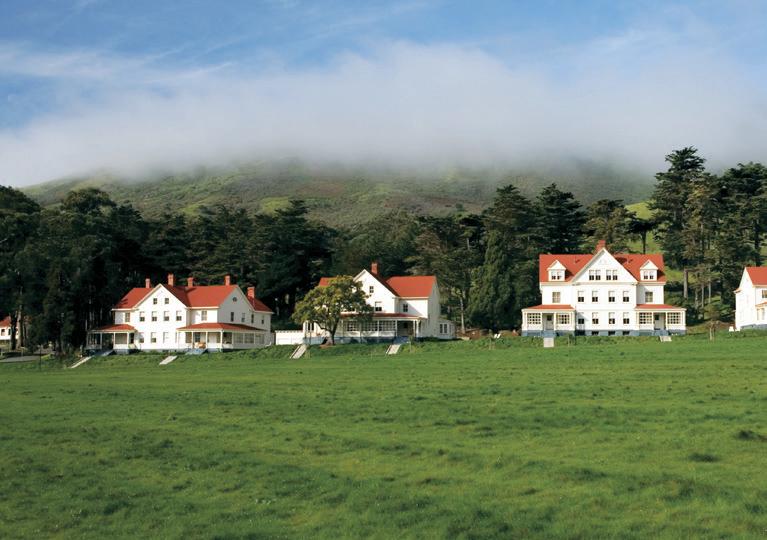
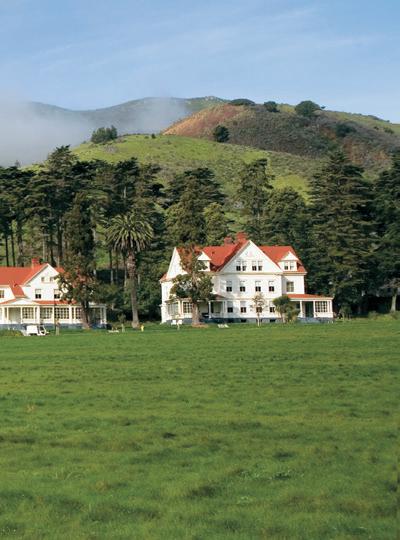
Post Ranch’s counterpoint property explodes with history and possibility
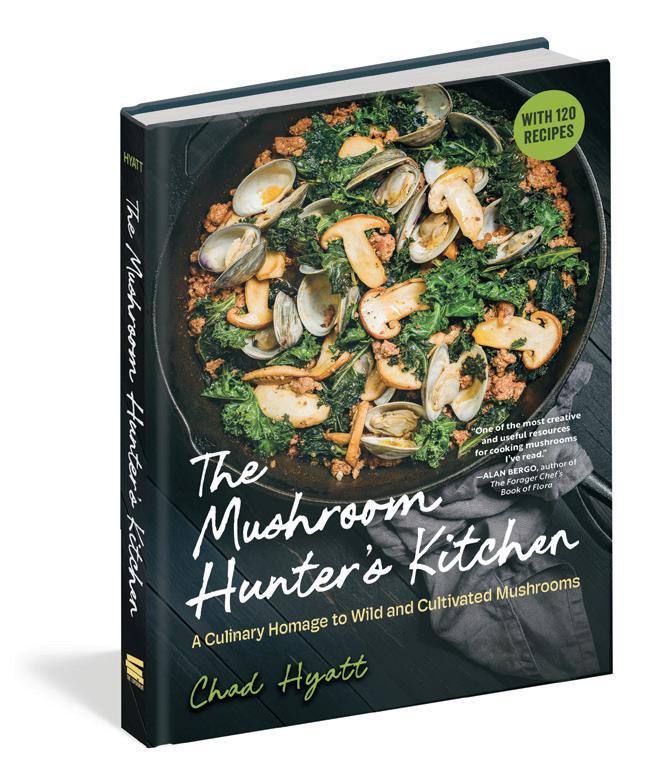
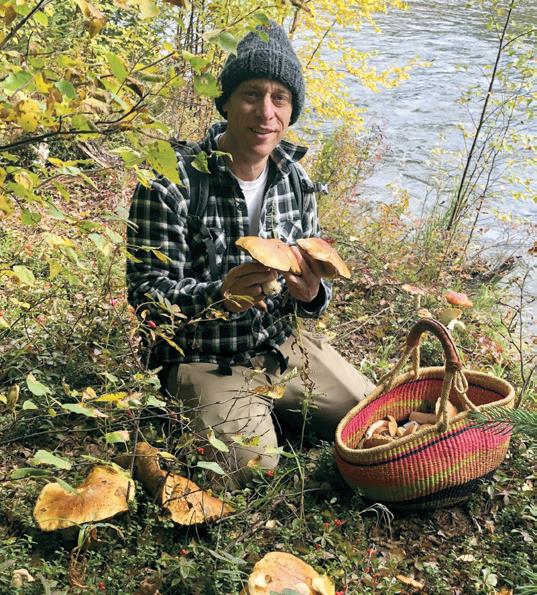
67 COOKBOOK CONFIDENTIAL THE MUSHROOM HUNTER’S KITCHEN
Chef-forager Chad Hyatt draws from decades in the duff
70 MONTEREY BAY
73 DINE
88 LAST CALL NAVY GROG
The under-the-sonar Trident Room rebirths a tiki torpedo
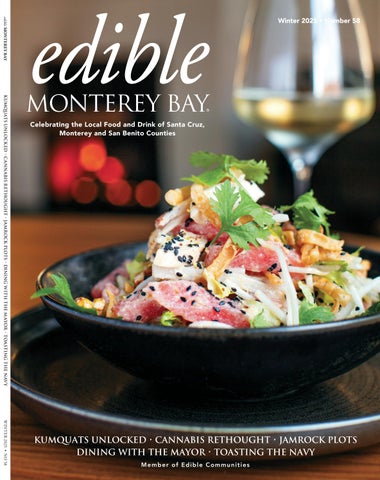
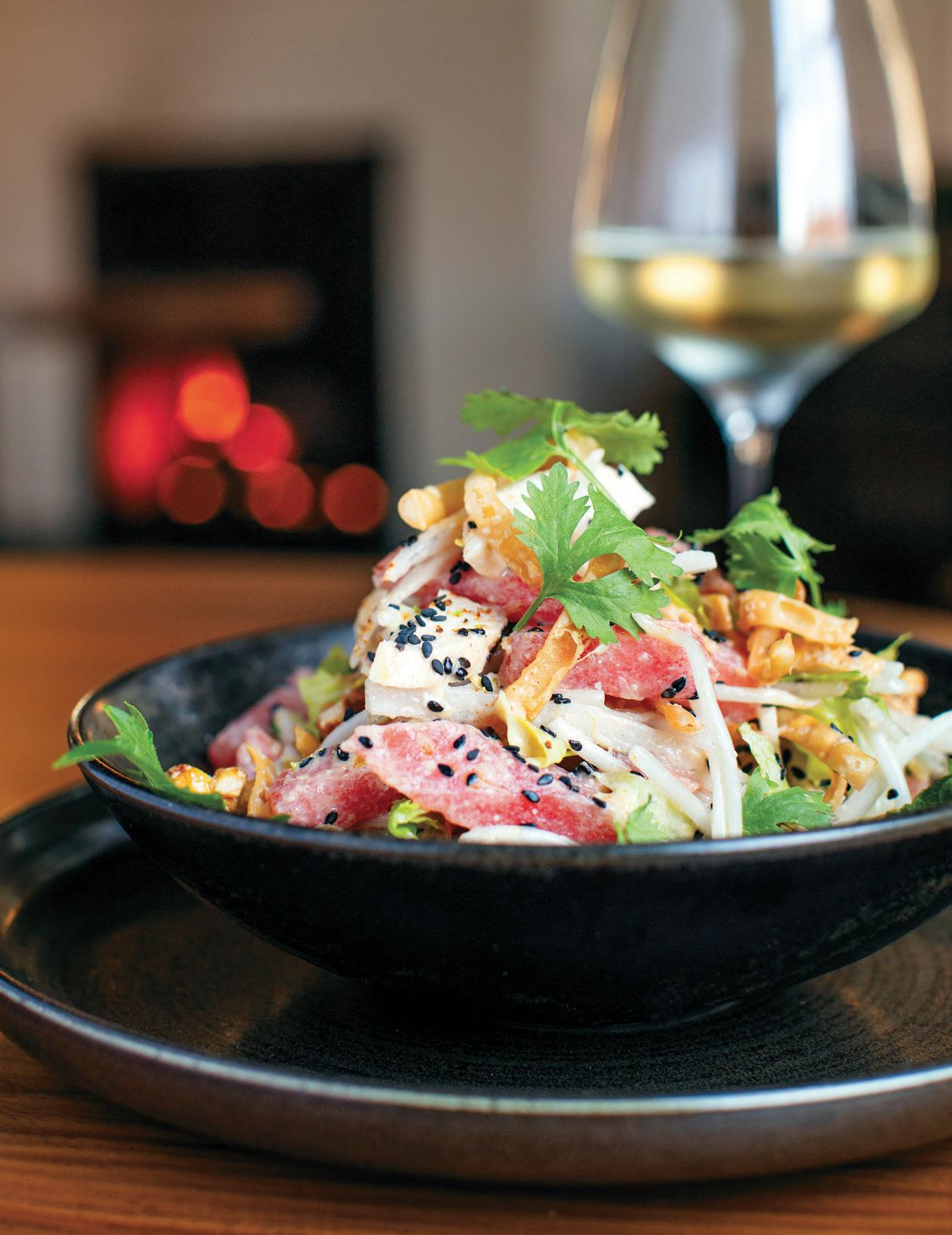
COVER PHOTOGRAPH
Kodiak Greenwood
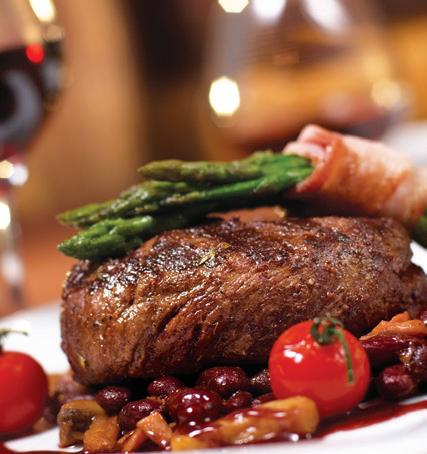
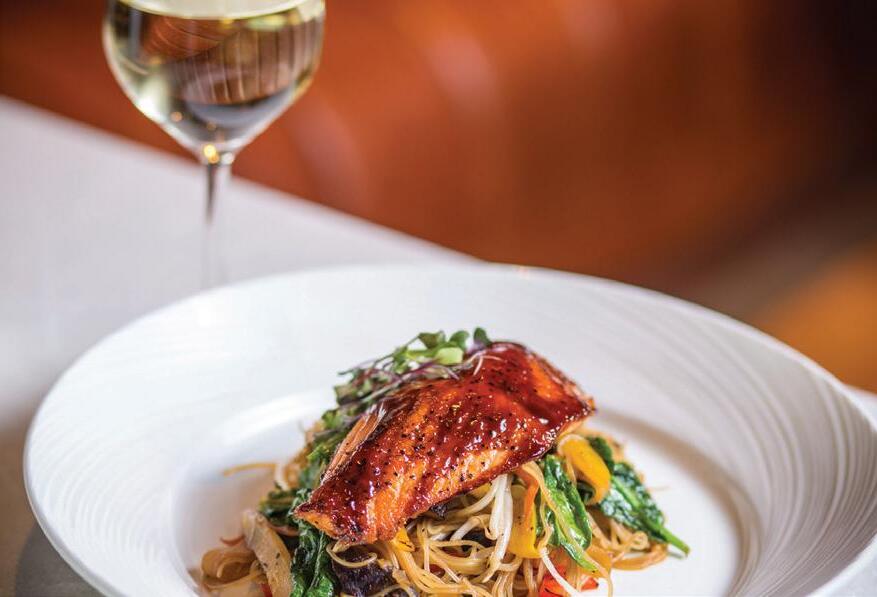
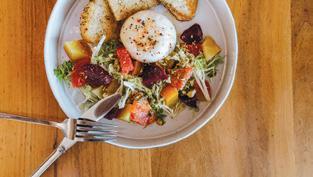
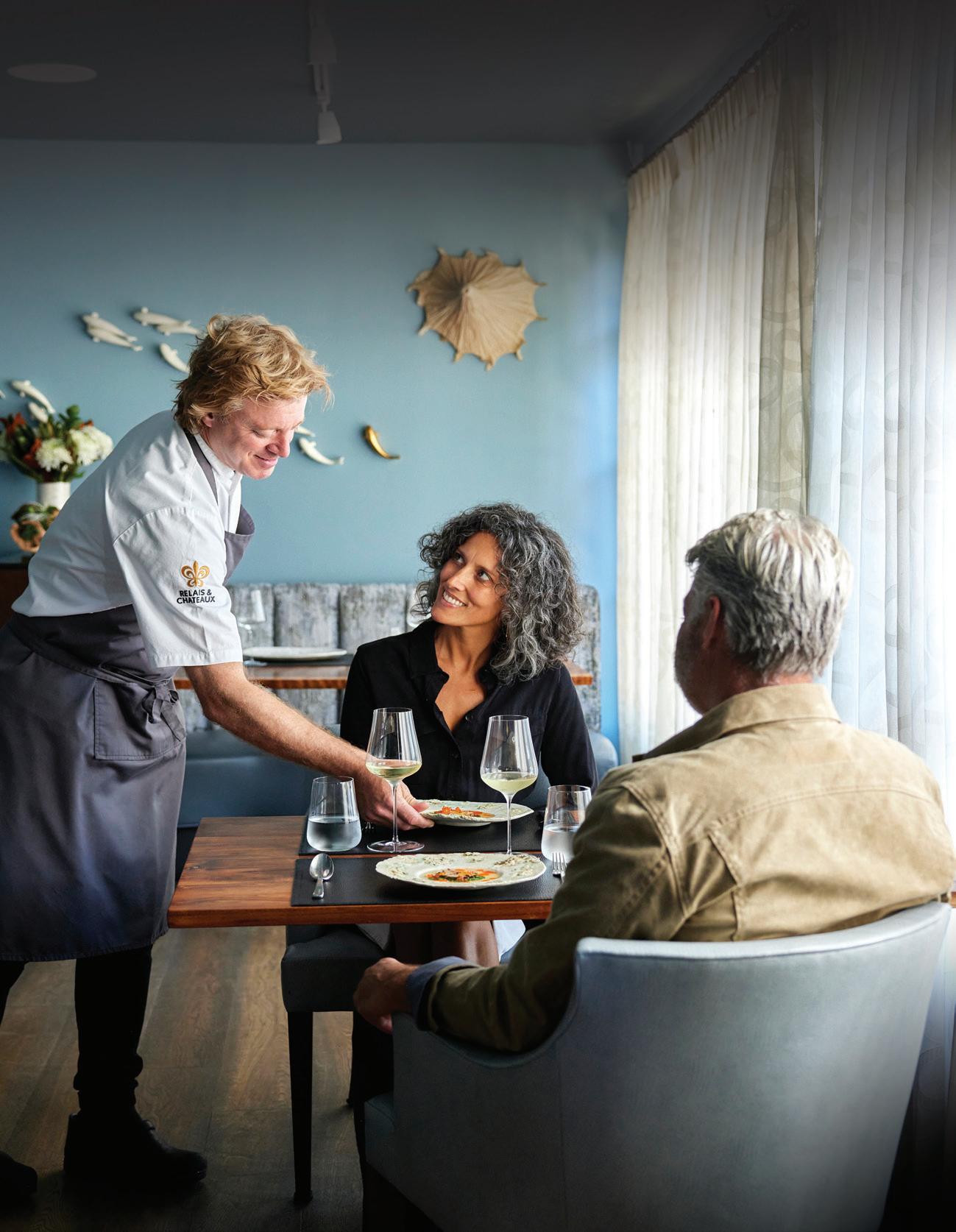
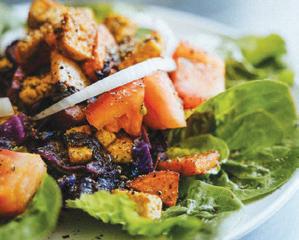
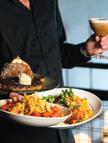
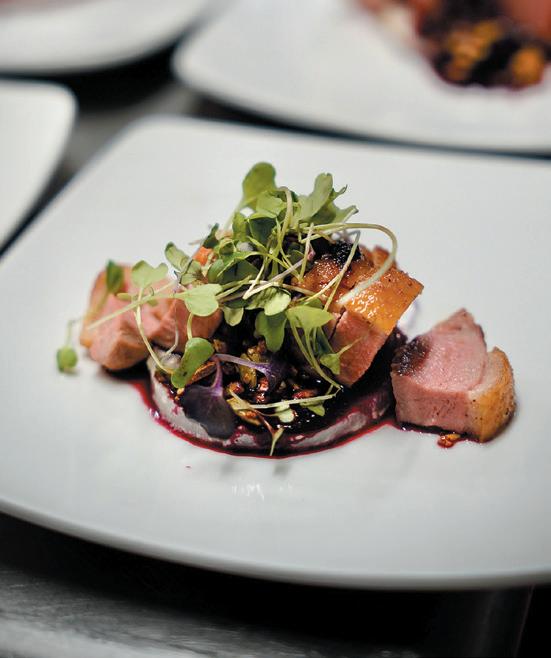
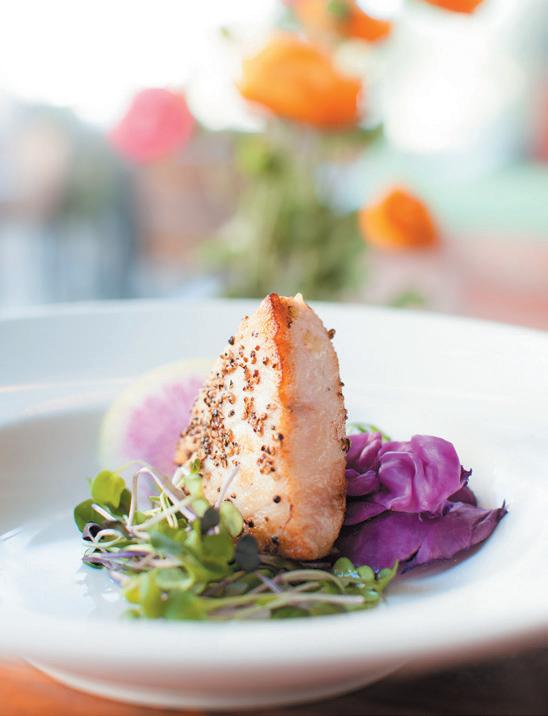
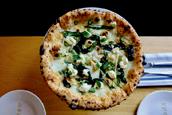
Grilled chicken salad with daikon, candied cashews, peanut vinaigrette and crispy wontons at Cavallo Point.
CONTENTS PHOTOGRAPH
Geneva Rico
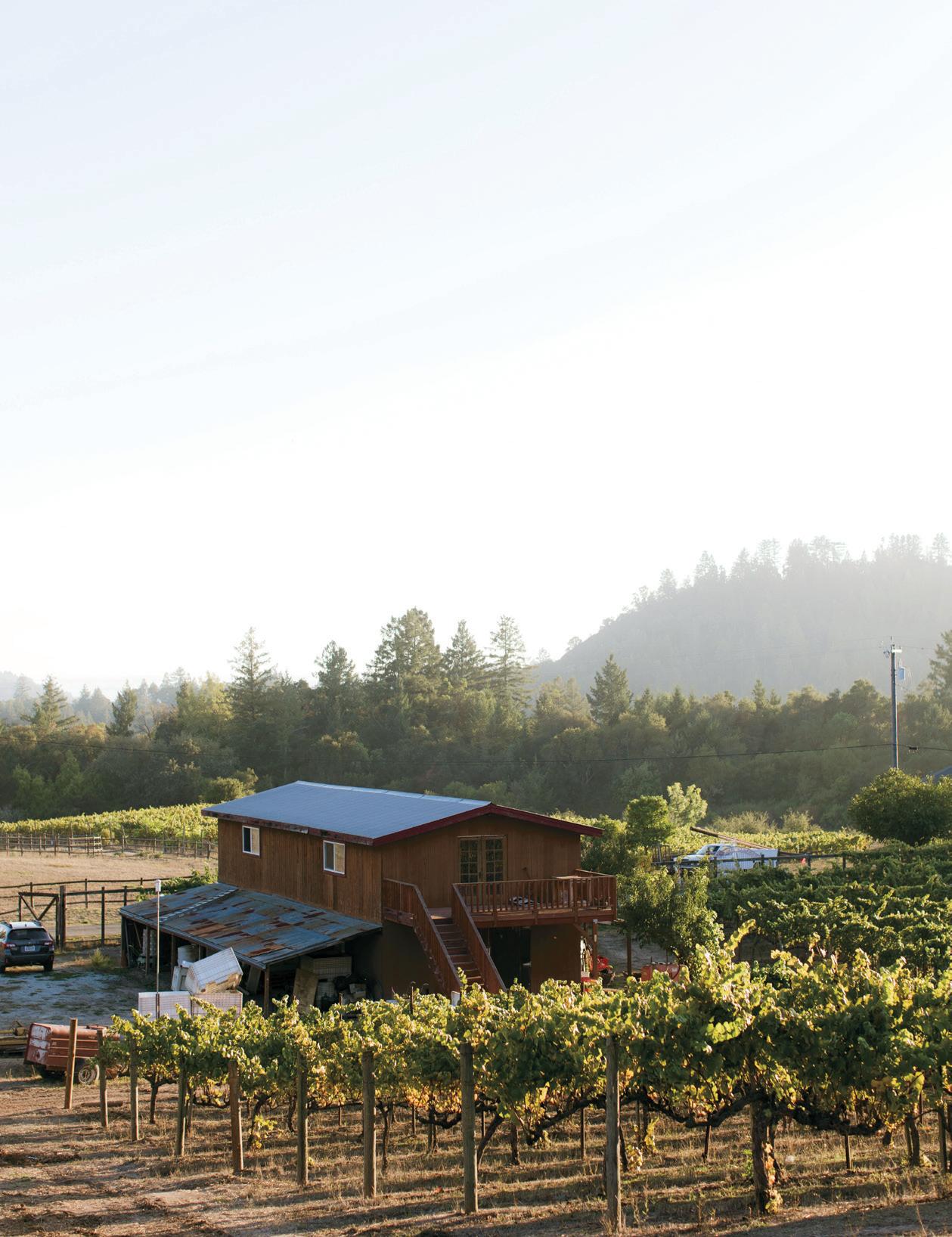
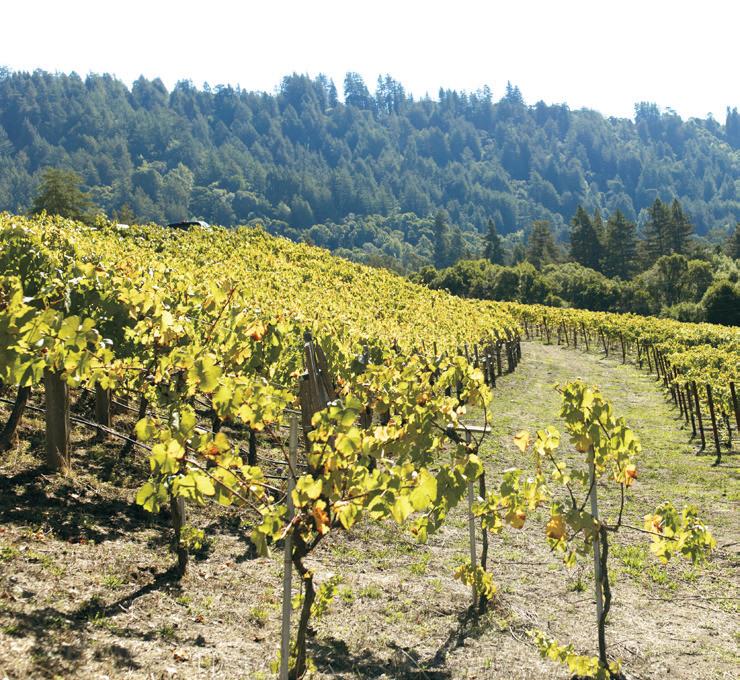
At Zayante Vineyards in Felton, 10 different grape varietals flourish and the preferred footwear is boots.
RECIPES IN THIS ISSUE
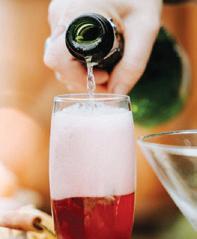
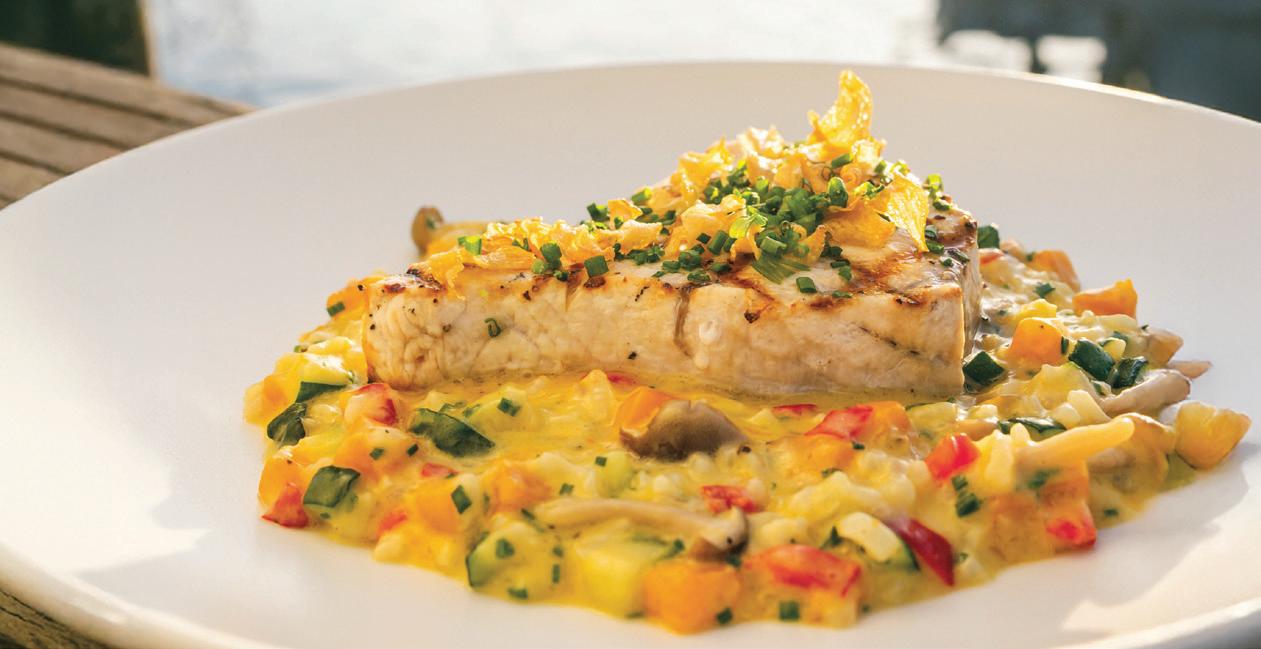
14 Pan Roasted Halibut with Blood Orange and Champagne Butter
23 Saff ron Rice Pudding with Kumquats in Syrup
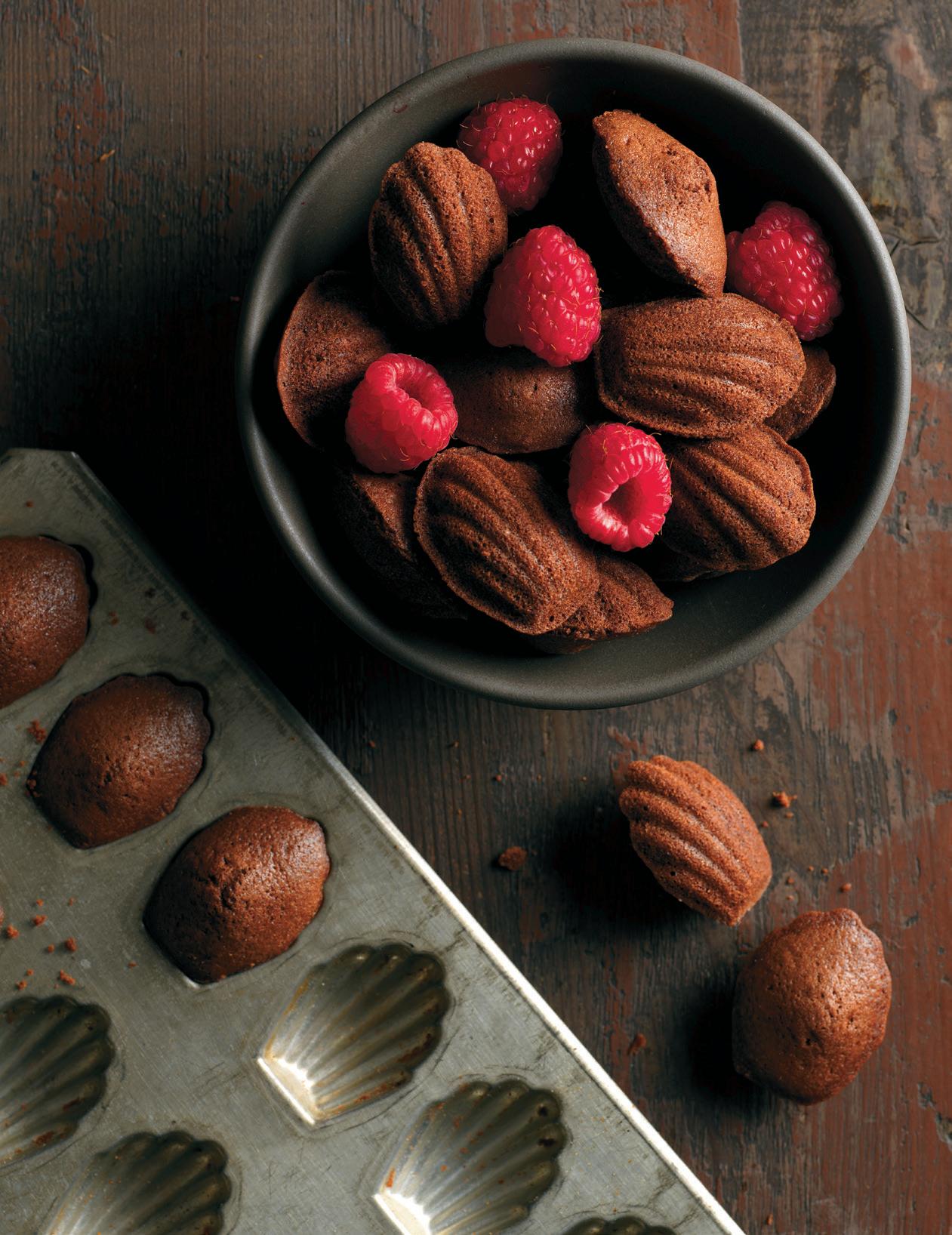
41 Chocolate Mini Madeleines
43 Vanilla Madeleines
69 Mushroom Meatballs
GRIST FOR THE MILL
Santa always placed a fresh orange in the toe of our Christmas stockings. My siblings and I were perplexed about getting a piece of fruit, when there was plenty of orange juice in the fridge and that stocking space could be better used for toys. But in the darkest season of the year, citrus represents sunshine, warmth and celebration.
Later when my parents moved to California, they had a beautiful backyard full of mature citrus trees. So perhaps it’s no surprise that I’ve become a citrus collector too.
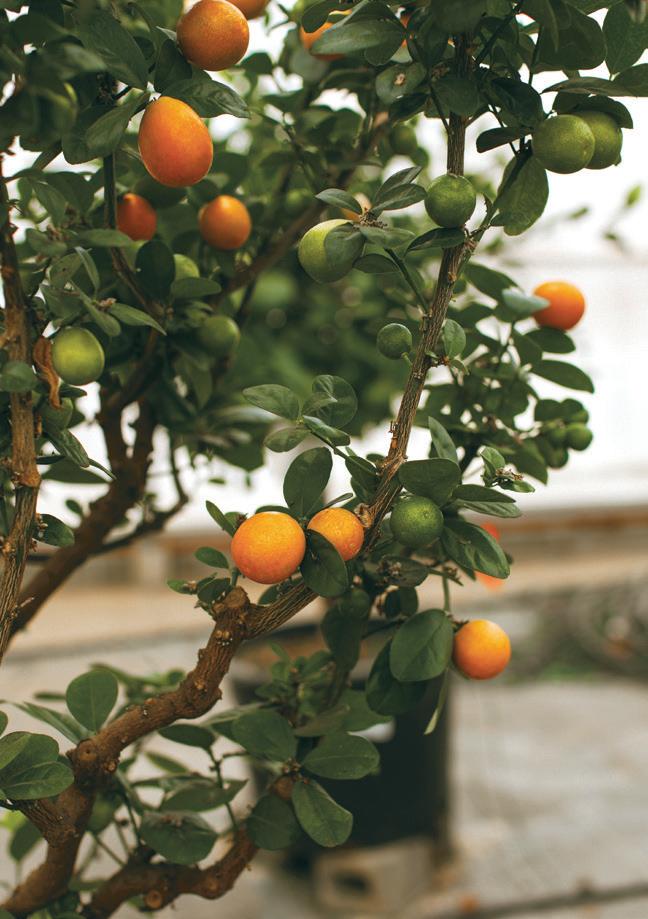
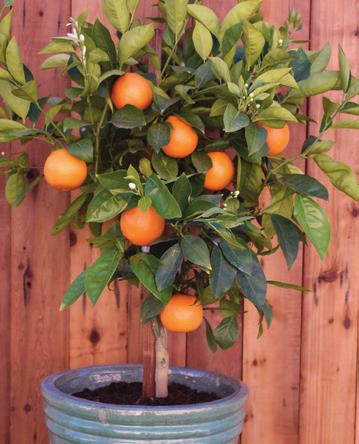
It started with a simple Lisbon lemon tree planted in a big blue pot. That tree has been producing for more than a dozen years now and has been joined by a potted satsuma mandarin, Valencia orange, makrut lime, Buddha’s hand citron and my latest pride and joy—a two-year-old calamondin kumquat, that blooms nonstop with tiny white flowers and bright orange fruits. Those potted citrus trees make my little corner of the Santa Cruz Mountains feel like a Mediterranean hideaway and they all came from Four Winds Growers in Watsonville.
So I’m especially pleased to introduce you to that Watsonville family business, which is behind much of the nation’s backyard citrus, in Kathryn McKenzie’s story “Magic in Miniature” and provide some expert growing and cooking tips in Jamie Collins’ What’s in Season story on kumquats—a pair of sunny stories for a joyful season.
In fact, this issue of EMB is filled with uplifting stories about interesting people doing things to improve the community. We profile the veteran chef who teaches teens to cook in Hollister, find out how the mayor of Carmel connects with his constituents over lunch and meet the couple behind a “strictly local” cannabis business in Soquel.
For adventurers and armchair travelers, Ryan Masters shows us how to mine for the state’s most precious gem, surprisingly close to home, and Amber Turpin takes us to a luxury resort at the foot of the Golden Gate Bridge.
As 2025 comes to a close, we are feeling very grateful for the support of all the advertisers that make Edible Monterey Bay possible. Please shop local this holiday season and visit the wonderful shops and restaurants you see on our pages. A big thanks to them and to our loyal readers for a wonderful year.
Enjoy the holidays,
Deborah Luhrman Publisher
EDITOR AND PUBLISHER
Deborah Luhrman
deborah@ediblemontereybay.com
831.600.8281
FOUNDERS
Sarah Wood and Rob Fisher
MANAGING EDITOR
Mark C. Anderson
COPY EDITOR
Doug Adrianson
LAYOUT & DESIGN
Matthew Freeman and Tina Bossy-Freeman
AD PRODUCTION COORDINATOR
Tracy Smith
AD DESIGNERS
Louise Androlia • Julie Greene • Cat Kahnle
Coline LeConte • Sarah Owens • tracysmithstudio
Sarah Williams
CONTRIBUTORS
Kera Abraham • Analuisa Béjar • Jamie Collins
Analuisa Béjar • Jamie Collins • Robert Eliason
Kelly Rose Evans • Kodiak Greenwood
Dan Linehan • Ryan Masters • Glen McDowell
Kathryn McKenzie • Laura Ness • Geneva Rico
Patrick Tregenza • Amber Turpin
ADVERTISING SALES
ads@ediblemontereybay.com • 831.600.8281
Shelby Lambert shelby@ediblemontereybay.com
Kate Robbins kate@ediblemontereybay.com
Aga Simpson aga@ediblemontereybay.com
Fran Fitzharris fran@ediblemontereybay.com
DISTRIBUTION MANAGER
Mick Freeman • 831.419.2975
CONTACT US: Edible Monterey Bay P.O. Box 487 Santa Cruz, CA 95061 ediblemontereybay.com 831.600.8281 info@ediblemontereybay.com
No part of this publication may be used without written permission of the publisher. Subscriptions are
Our Mission
At Edible Monterey Bay , our mission is to celebrate the local food culture of Santa Cruz, San Benito and Monterey counties, season by season. We believe in sustainability, and we believe everyone has a right to healthful, clean and affordable food. We think knowing where our food comes from is powerful, and we hope our magazine, website and newsletters inspire readers to get to know and support our local growers, fishers, chefs, vintners and food artisans.
EDIBLE NOTABLE
MAGIC IN MINIATURE
A Watsonville world of citrus trees, in smaller sizes, connects a country with grow-your-own fruit
By Kathryn McKenzie
Photos by Geneva Rico
In 1946, when Floyd Dillon lit the first light bulb that dwarf citrus trees might be the next big thing, he wasn’t a plant person himself.
In fact, his great-granddaughter Lexa Dillon points out, “He worked in women’s fashion at department stores. But he was always looking at trends.”
The elder Dillon realized that there was an opportunity to create citrus that bore exceptional fruit and beautiful flowers and leaves, at a manageable size for home landscaping.
Yet at that time there were no such citrus varieties on the market, since citrus was only regarded as a commercial crop, grown on enormous trees in huge orchards.
That pioneering curiosity led Dillon to work with researchers at UCLA and UC Riverside to develop smaller citrus trees. And that, in turn, led to his founding Four Winds Growers, a wholesale nursery that today offers fruit trees specifically for home gardeners and hobbyists— and it is still largely the citrus varieties that capture gardeners’ fancy.
In fact, hobbyists throughout the U.S. regard Four Winds as one of the premier sources of semi-dwarf citrus trees. The Watsonvilleheadquartered company continues to expand its offerings, not just in
“Tiny fruit, super sweet, sets lots of fruit. It’s the cutest little thing.”
citrus but for other trees and plants grown for fruit or fragrant leaves used in cooking.
Their customers often establish such close relationships with Four Winds that they’ll proudly send photos of their trees, Lexa notes. She mentions people growing citrus indoors in New York City and in Chicago, and there’s even a picture from a fan of a calamondin (mandarin-kumquat hybrid) growing inside their home in Fairbanks, Alaska, since 2018.
“Truly inspiring!” Lexa says.
In fact, she says while leading a tour through one of the greenhouses, food trends have also sparked interest in some unusual plants, like finger limes and curry leaf, the latter used in South Indian and Sri Lankan dishes. She hands curry leaf’s pungent leaves to visitors, crushing them so their spicy scent fills the air. She also enthusiastically points out a seedless mandarin: “Tiny fruit, super sweet, sets lots of fruit. It’s the cutest little thing.”
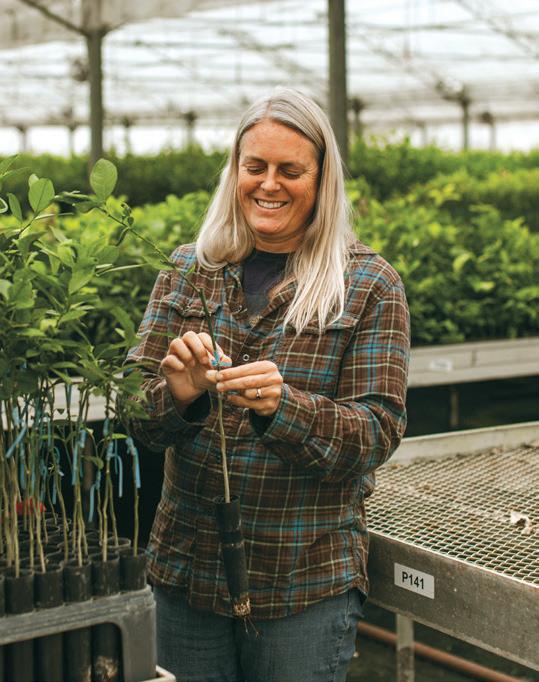
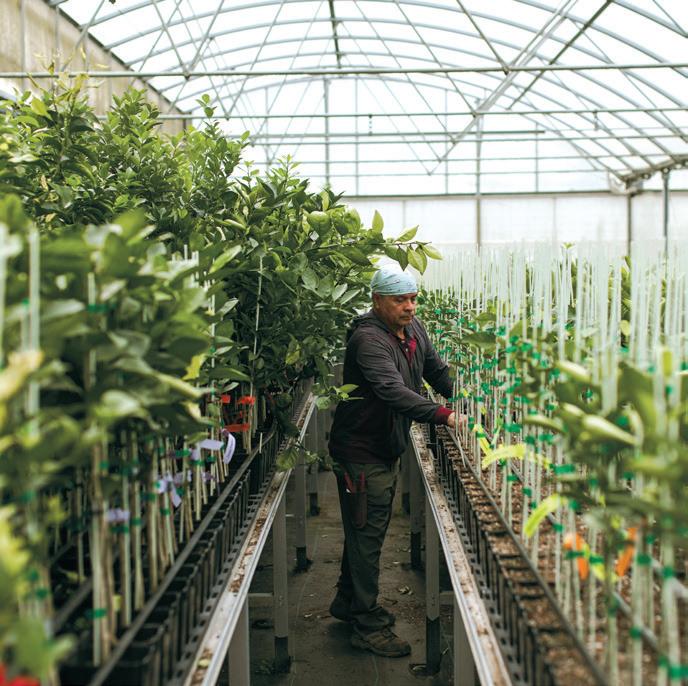
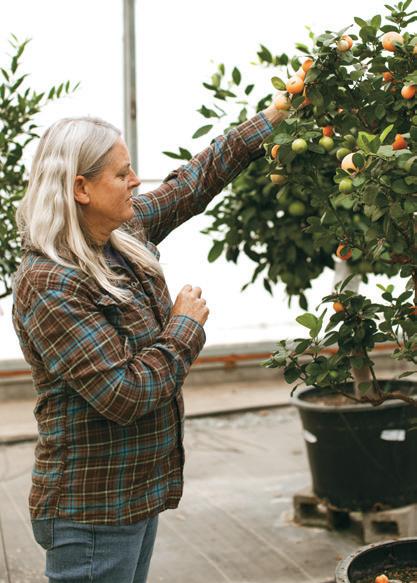
Fourth generation citrus grower Lexa Dillon pampers her seedlings (opposite) as Four Winds’ online resources empower home gardeners to do the same.
The secret to creating semi-dwarf citrus is in the rootstock. Specific rootstocks are used to create smaller trees—semidwarf citrus, when planted, tops out at 8 to 10 feet—with cuttings, also known as scions, inserted into the rootstock to produce the desired fruit.
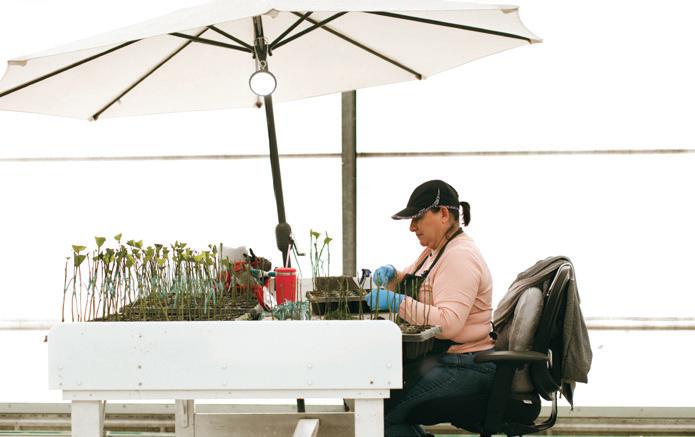
At Four Winds, several female employees are busily cutting and grafting to make the baby trees, which are typically sold after another one to two years of growth.
As a wholesaler, Four Winds supplies retail nurseries as well as landscapers and online customers, shipping about 150,000 units a year. Retail nurseries carry popular varieties like Improved Meyer Lemon and Cara Cara Sweet Orange while the intense hobbyists will often seek out the unusual ones, like the new Variegated Pink Lemon (striped leaves and inner pink fruit) and the Seville Sour Orange, which adds intense citrus flavor to Cuban and Yucatecan cuisines.
One of the newest darlings is the Shiranui Mandarin (similar to Sumo, a patented variety), which has an unusual rough skin but is deliciously mild and sweet and easy to peel.
Celebrate Celebrate
Four Winds still has the Dillon family at its helm, including Lexa; her brother, Aaron; and their father, Don Dillon Jr. Despite all the challenges thrown at them in recent years, from the Covid pandemic to the encroachment of serious citrus diseases, the company continues to grow and thrive.
Lexa notes that out of the 60 California nurseries that used to sell citrus trees, now there are only seven. “It’s become so regulated and burdensome,” she says. “But for us, this is our thing.”
Covid was interesting, Lexa says, because it impacted their workforce—and at the same time, sales spiked, because everyone was getting into gardening.
“We sold as much in several months as we usually do in a year,” she says.
The latest challenge to their business is the HLB or citrus greening virus, carried by the Asian citrus psyllid insect, which is decimating both commercial and home citrus. “It makes fruit bitter and lopsided and eventually kills the tree,” Lexa says.
There is no cure, and infected trees must be destroyed before the disease spreads. Fortunately, it hasn’t yet hit
Four Winds Growers’ vast semi-dwarf tree inventory includes finds like Fukushu kumquat, Australian finger lime, yuzu, Calamansi and seedless mandarins.
Northern California and Lexa is hopeful that it won’t. But because of it, all their greenhouses must have blower systems that activate when doors are opened, and monthly inspections to make sure the pest isn’t present.
Four Winds sells other types of fruit trees and bushes as well, from avocados to blueberries, olives to guavas, but it’s still the citrus they are known for after all these years.
And here, we’re fortunate that most citrus trees grow just fine outdoors, since the Monterey Bay region’s temperate climate prevents prolonged winter freezes.
“People here can pretty much grow anything,” Lexa says.
Especially with a gust of help from Four Winds.
Long-time local journalist and author Kathryn McKenzie grows Meyer lemons and oranges at her home in North Monterey County, and lives in hope that her avocado trees will someday bear fruit.
Winds of Wisdom
Quick insights on growing citrus
One of the reasons why Four Winds is so beloved by its customers is its commitment to helping home citrus growers who call or email with questions. Its website, fourwindsgrowers.com, has a wealth of information as well. Here are some basic tips:
• Semi-dwarf citrus can be planted in the ground or in containers. Use a light, well-draining soil mix for container plants and make sure there are numerous drainage holes.
• Find a sunny, wind-free area with southern exposure for planting. Reflected heat from homes or walkways can help protect citrus from frost and aid summer growth. Allow room for the tree or shrub’s ultimate size.
• Upper roots should be just below the soil line. Keep soil and mulch away from the base of the trunk, but provide a generous basin around the trunk where water can collect and soak in.
• Trees may be pruned to any desired shape, and pruning can be done year-round except in winter.
• Protect lemons, limes and young trees if temperatures are predicted to drop below 32°F. Frost blankets and Christmas lights can help keep plants from freezing.
• Watch for signs of deadly Huanglongbing (HLB) disease, which will kill citrus plants. More information is available at ipm.ucdavis.edu.
—Kathryn McKenzie
Citrus is the specialty at Four Winds, but the farm also cultivates figs, olives, avocados, berries and more.
EDIBLE NOTABLE
GENERATIONAL TALENTS
A seasoned chef finds focus—and shares the love—by coaching youngsters in Hollister
Story and Photos by Robert Eliason
Additional Photos By GENEVA Rico
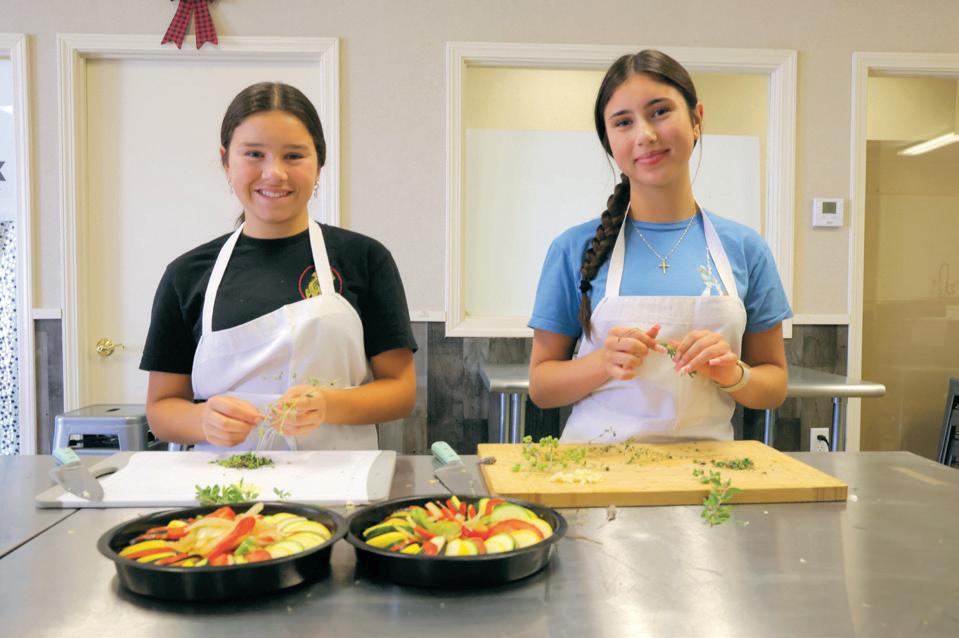
In a haze of flour dust, 15-year-old Mikalah Montoya pulls her first-ever batch of spaghetti through a pasta machine.
From the broad smile on her face, it’s clear she’s enjoying every messy moment.
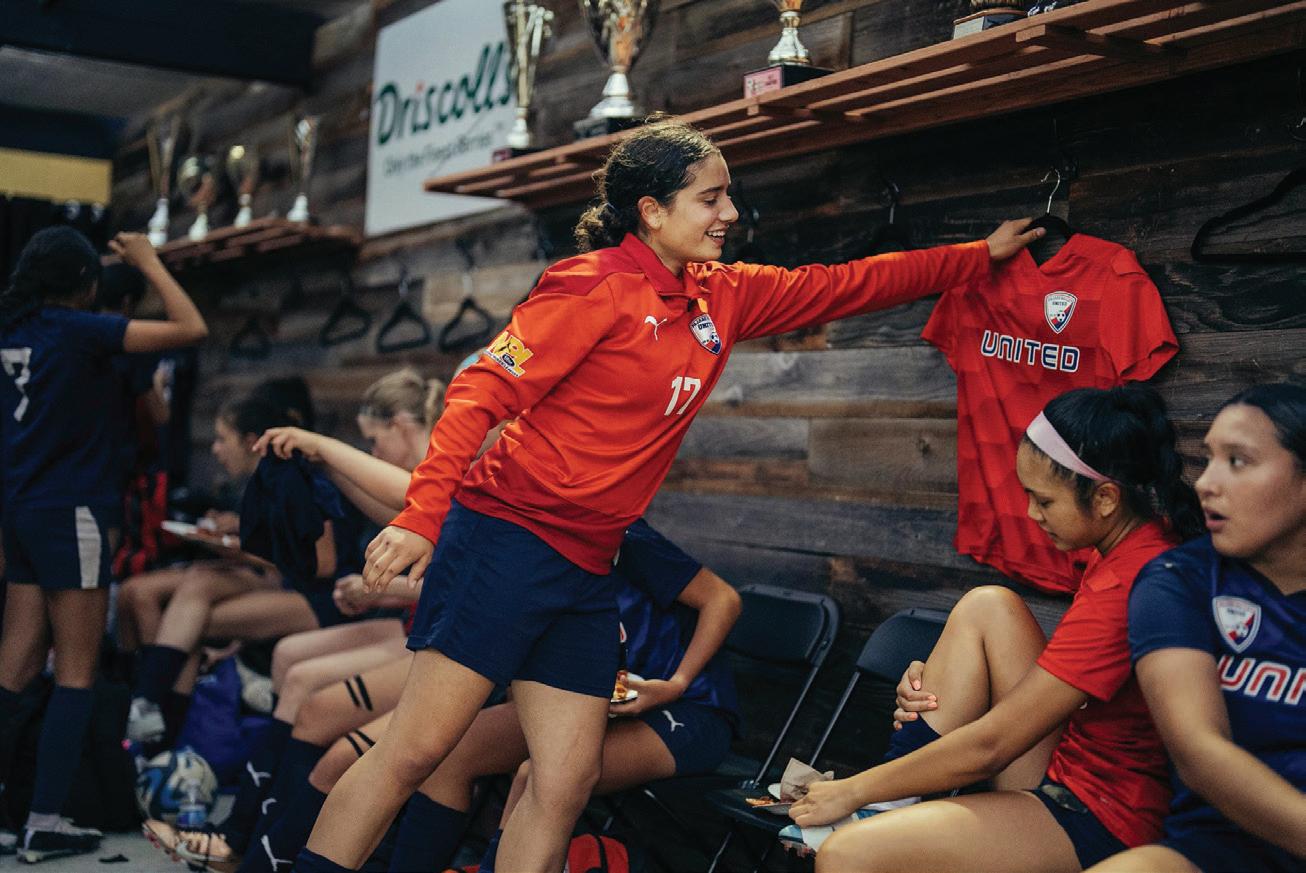
She’s standing in Hollister’s Jamrock Culinary Center, a first-time participant in David Jamrock’s Teen Cooking Camp.
She says that the approach to learning here is so easy that it gives her confidence to make the recipes at home.
“It’s really opened my eyes to new ways to cook,” she says.
The experience differs dramatically from Jamrock’s own teenage years in the kitchen, when he helped prepare lamb medallions with roasted shallots for a Chaine des Rôtisseurs event under the auspices
of the International Association of Gastronomy.
He opened his 1,500-square-foot culinary center in Hollister a year and a half ago, with the modest ambition of holding worldcuisine-themed classes four or five nights a week, drawing from his repertoire of 100+ teaching recipes.
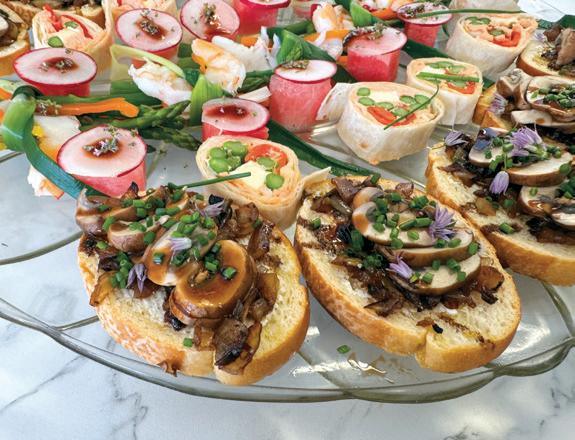
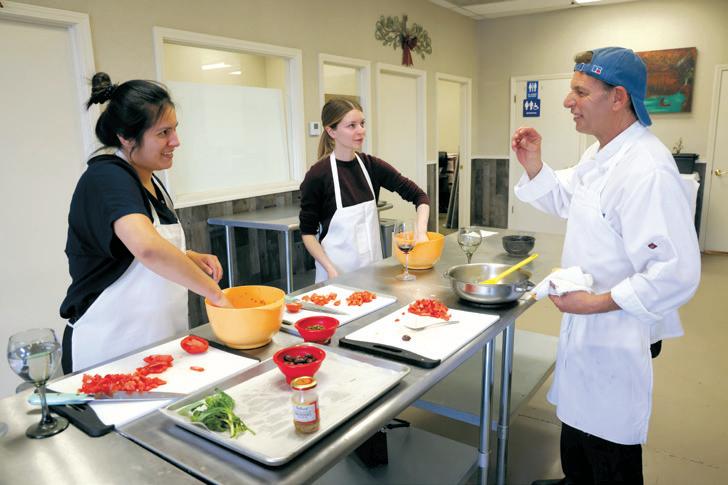
Mikalah Montoya and Sophia Luiz (above) peel herbs that will go into appetizers like shrimp-asparagus wraps and caramelized onion-mushroom bruschetta. Later Jamrock (next page) reduces a sauce in his working school/ carering kitchen.
At the same time, he has become one of the area’s goto caterers for local events and recently signed with the Eat This TV network for a video series scheduled to be filmed early next year.
While other kids were cutting class for different reasons, David Jamrock snuck out for a personal field trip to the New York Hotel Restaurant Expo.
“Basically,” he says, “my thing right now is to give back what I know to the general public.”
Jamrock began his career at 14 with a three-year apprenticeship at the Aqua Turf Country Club in New Haven, Connecticut. At 16, he served on the U.S. Culinary Olympic team during the competition in Frankfurt, Germany.
While other kids were cutting class for (perhaps) more nefarious reasons, Jamrock snuck out for a personal field trip to the New York Hotel Restaurant Expo to buy cutting boards and stainless steel bowls. (His cooking teacher retroactively authorized the absence as an “approved field trip.”)
Following his graduation, he worked at or managed a variety of fine restaurants throughout the country, ranging from Jacqueline’s in Washington, D.C., where he was the first non-French chef, to the
Cadillac Grill in Jackson Hole and the Alpine Meadow Ski Resort at Lake Tahoe.
He prepared private dinners for presidents and celebrities, including the Fords—Gerald and Harrison— and hung out in a kitchen back alley with Frank Sinatra and Sammy Davis Jr.
He went gonzo with Hunter S. Thompson in Aspen and grew edible flowers for the likes of Alice Waters and Chris Cosentino in the Bay Area.
“Cooking becomes your whole environment,” Jamrock says. “But the shelf life of chefs isn't very long, especially in a high-traffic business. Somebody always doesn’t like somebody, and restaurants close.”
Staying ahead of the pandemic-induced decline in the restaurant industry, Jamrock began working for Taste Buds, a San Jose–based cooking school franchise.
He used that experience as a model in creating the culinary center.
Jamrock believes teaching was already part of his job as a chef, instructing his staff daily to ensure that a dish they had already prepared, as he puts it, 100,000 times came out precisely the same on the 100,001st.
The classes rotate through various cuisines, with sushi nights, pasta making and vegetarian cooking being the most popular.
Jamrock portions the ingredients for each participant and then leads
Students Vicky Cabrera and Olive Dahm dice tomatoes while Jamrock drops intel on loan from decades of experience.
them through each step of the process, from correctly slicing an onion to cooking firm and sticky sushi rice.
He notes that his goal is to teach at least five things that his students never knew that they could use in their home kitchens. The teen camps use the same formula, with each of the three days themed to create a complete meal.
That ranges from appetizers like bruschetta with wild mushrooms and Jamrock-grown herbs to desserts like cannoli made with mascarpone, lemon and chocolate chips in baked wonton wrappers.
Along with his classes, Jamrock has expanded into catering and is working with Hollister’s Crave Wine Co. on a series of dinners and tastings for its wine club customers, including an event in honor of Calera Winery’s 50th anniversary.
Crave co-owner Mike Kohne says that Jamrock is an ideal partner in pairing foods with wines for these functions due to his technical expertise and his versatility, with a good grasp of what works and, more importantly, what does not.
“He has great access to local foods that have interesting stories and flavors,” Kohne says. “He understands these things down to the minor details.”
It was a Facebook post about one of Jamrock’s dinners for Crave that caught the eye of an Eat This TV producer.
He shot a pilot last May in New York, and with 10,000 views in 10 days and a 90% viewer retention rate, the company offered him a 12-part series to be filmed in Hollister.
Debuting next year, the show focuses on garde manger: the art of preparing platters, hors d'oeuvres and decorative items, such as watermelon baskets and squash vases, harkening back to his days competing in the Junior Culinary Olympics.
Jamrock says that every cooking show chef wants to demonstrate their best dish, regardless of the viewer wanting to make it, and very rarely does anyone learn anything.
His goal is to demonstrate the “little tricks and techniques” that are often not included in written recipes.
“I’m not saying that I’m not going to show off,” he says, “but I’m not showing off for me. I’m going to show off so that you can. That’s my promise.”
The Jamrock Culinary Arts Center is located at Fiesta Plaza, 191 San Felipe St., Suite H, in Hollister. More at chefjamrock.com.
Robert Eliason writes about the variety, creativity and history of San Benito County’s culinary scene while also reporting on local politics and current events, and collecting rare books and vintage cameras.
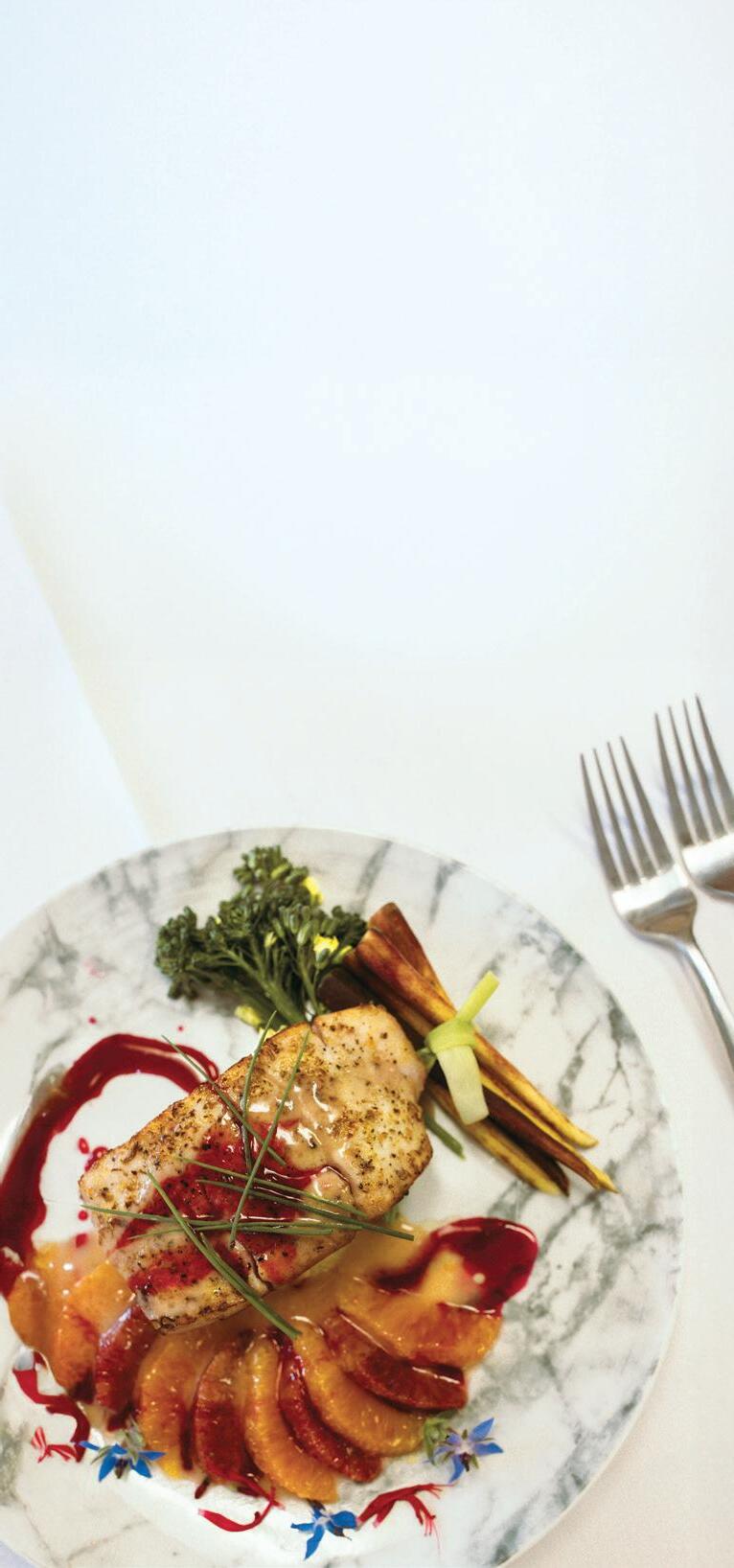
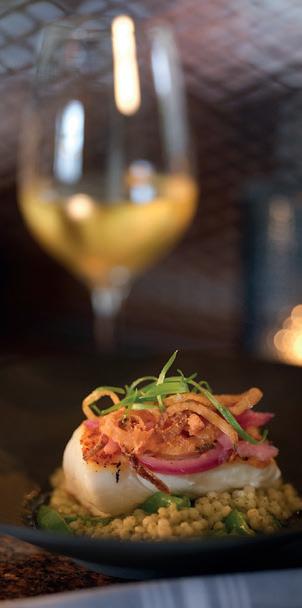
Pan Roasted Halibut w/ Blood Orange Champagne Butter and Pomegranate Glaze
Courtesy Chef David Jamrock
1 ounce vegetable oil
6 ounces fresh halibut filet
1 blood orange cut in segments
4 ounces Champagne or other sparkling wine
4 ounces pomegranate juice
CELEBRATE
½ cup sugar
2 ounces cold butter
Salt and pepper
Chives or scallions chopped small for garnish
Bring pomegranate juice to a boil in a small sauce pan and add sugar and reduce until syrup consistency. Set aside.
Heat a medium sauté pan and coat with a thin layer of vegetable oil.
Season the halibut filet with salt and pepper, and place the nice side down to sear. When it releases from the pan, turn over and place it in the oven for 3–5 minutes.
Remove from oven and pan and place on a platter.
Now add blood orange segments and deglaze with Champagne, reduce till almost gone and add butter stir in till it melts and serve over halibut. By adding the butter slowly this creates blood orange beurre blanc sauce
Garnish with chopped chives or scallions and pomegranate syrup.
Serves 1.
Vinekeepers Dilemma
Leading Santa Cruz Mountains viticulturists traverse industry twists with both new and vintage strategies
Story by Laura Ness
Photos by Geneva Rico
In the tiny town of Milton, near where I grew up in the Hudson Valley of New York, there is a literal fork in the middle of the road: a shiny 33-foot stainless steel beauty, tines in the sod, beckons drivers to take Route 199 or 308, or smack into the fork.
Vineyard owners, viticulture experts and winemakers in the Santa Cruz Mountains find themselves at a similar crossroads.
Demand for wine has cratered, prices for Pinot Noir grapes—the variety most widely planted in the region—are plummeting and farming costs are at an all-time high, especially in an area prone to fog and mildew.
Grape growers and winemakers are struggling under the current conditions but see some possible solutions by emphasizing quality of grapes over quantity, focusing on more unusual grape varieties and
recalibrating marketing for younger consumers.
Viticulturist Ken Swegles farms more than 100 acres across 52 vineyards in the Santa Cruz Mountains, where the “holy trinity” of Chardonnay, Cabernet and Pinot Noir dominate.
“It’s hard to sell Pinot Noir that costs $5,000 an acre to farm for $3,500 a ton,” he says. “I’m losing money each time.”
This year was the toughest year for selling fruit he’s seen in his 19 harvests, even though the quality was superb.
“I had three clients back out last minute,” he says.
Farming practices directly impact the quality of the fruit, and small growers tend to be extremely cost-conscious and change-averse.
Long-time viticulture consultant Prudy Foxx, who works with dozens of clients in the region, points to another issue.
Zayante Vineyard in Felton grows a diverse range of grape types for both estate vinos and hand-picked partners like Margins Wine.
“Vineyard owners tend to offset costs by opting for quantity over quality,” she says. “Tonnage is the measure of success.”
But growing more of what’s falling out of favor is a recipe for failure. “The small growers are especially shocked that suddenly all the small buyers are going away,” Foxx adds.
She fears the little home vineyard people are giving up.
“It’s an energy pit and a money pit,” she says. “Small backyard vineyards will be the first to go, but larger purely production vineyards are going to take a hit [too].”
One strategy Foxx advocates is reducing croploads, and promoting higher quality, by pruning earlier.
“Cut back right from the start, and seriously prune for quality: two to three tons is our max per acre target here,” she says. “With a lot less crop to manage, you reduce disease pressure and the need for labor inputs, which can lower farming costs.”
Swegles hopes winemakers will be drawn to varietals like Aligote, Chenin Blanc and Gamay Noir—because they are non-mainstream, versatile and can be made in both classic styles and in fresher fashion—and happen to be varietals he’s been grafting in local vineyards. He’s even changed trellising to increase yields on these varieties at the largest vineyard he manages, Ascona, a Skyline Boulevard gem he farms with Cole Thomas.
Gamay Noir is also rising in popularity for its wildly enticing aromatics and intense fruit that can hit your palate like Pop Rocks. “Gamay offers something unique in the red wine space,” says Thomas. “Most red wines are tannic and meant to be aged, but Gamay is
historically done carbonic and has very little tannins. It’s the traditional grape for quaffable reds.”
Thomas, winemaker for Madson Wines, where Swegles is a partner, argues that the Santa Cruz Mountains are a great place to grow different grapes, such as Syrah, Cabernet Franc, Chenin Blanc and Aligote, and he’s especially keen to see the results of experimental Cab Franc and Riesling blocks.
Foxx, who has practiced the art and science of viticulture for well over 30 years, has seen this movie—citing atypical varietals MüllerThurgau and Siegerrebe she cultivated in Washington when she started in the business.
“They sell in the tasting room, but are not mainstream,” she says. “People don’t recognize them and you can’t get a good bottle in most wine shops.”
Her advice is to stick with the noble classics like Cabernet Sauvignon, Pinot Noir and Chardonnay.
“Nothing is ever wrong with growing them,” she says. “Monks spent hundreds of years developing the clones and varieties that have earned reverence in the wine-drinking world. There is a reason we call them ‘noble.’”
But the real conundrum is just getting the attention of Gen Y and Z to try any kind of wine in the face of so many new and tempting alternative beverages.
“Young people have a short attention span,” Thomas says. “They have a hard time connecting with the historical background of wine. They just want something quaffable and delicious.”
He argues that wine marketing and regional messaging needs to evolve to keep the Santa Cruz Mountains relevant to consumers.
“Napa prestige and being part of an elite club worked for Boomers,” he adds. “But this doesn’t have the same value with the younger generation.”
It’s time to update the narrative to emphasize values, including environmental stewardship and fair labor practices, he argues. “Consumers want to know, ‘What do you stand for?’” says Thomas. “We started the winery with these intentions. We are actually making our own wine and have tried to do the right things from day one, being super intentional about how we manage the land.”
Foxx hopes to see more attention on the stories of the vineyards and how they contribute to the true flavors of Santa Cruz Mountains.
“Our terroir is distinct and we are fortunate we have many generational family owners with a distinct connection to the land,” she says.
Swegles and Thomas farm organically, and practice minimal interventionist winemaking. “We add no enzymes or pectinase,” says Thomas. “That speaks volumes to the younger generation that is health focused and very aware of what they put in their bodies.”
Getting people involved in the agricultural and processing part of winemaking can unlock the desire to learn more. “The engagement piece is really important,” says Thomas. “People are scared of wine.
They come to the tasting room or wine walk, and say, ‘I know nothing about wine.’ They feel self-conscious.”
He recently invited some tasters to come into the cellar and taste Ascona Chardonnay that had just completed primary fermentation. “I am trying to make people feel at home in a space that makes them feel more important and comfortable,” he says. “People need to be empowered to embrace the journey. Once they connect with the agricultural or production sides of wine, they get hooked.”
Swegles thinks Gen Z will come around. “When I was their age, I drank beer. But an IPA is not going to cut it when you take your lady out to dinner…you will realize that wine is a part of our culture.”
He figures that by 2030, this downturn will pass, as Gen Z develops wine curiosity and evolves their palate: “They’ll start cooking more and going out to dinner with friends and they will buy more wine and realize the benefits.”
This could lead a new population to find their own way in the world of wine, and encounter more pleasant forks in the road: Red or white? Old World or New? Subtle or big?
Whatever the case, Swegles sees the chance to transform tension into tranquility.
“Stress is the biggest killer,” says Swegles. “A glass of wine at dinner is going to help your quality of life.”
Laura Ness traipses through vineyards and spits into floor drains in damp cellars, commiserating with winemakers who yearn to share their stories and the fruits of their passion with wine lovers. She will never forget her first sip of Chenin Blanc in the heart of Chinon.
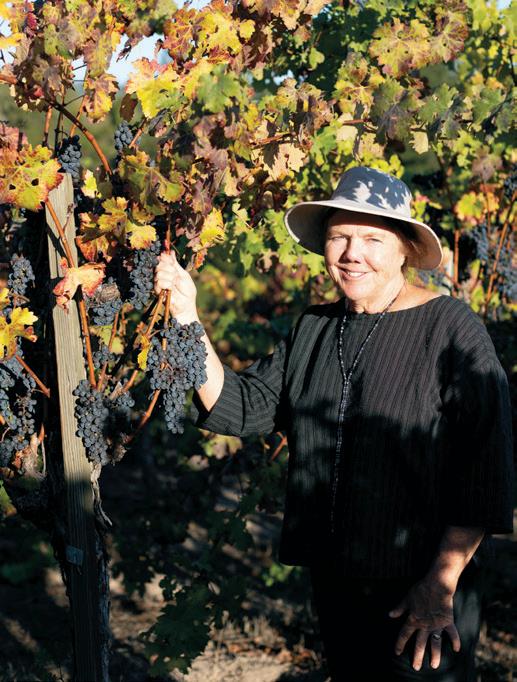
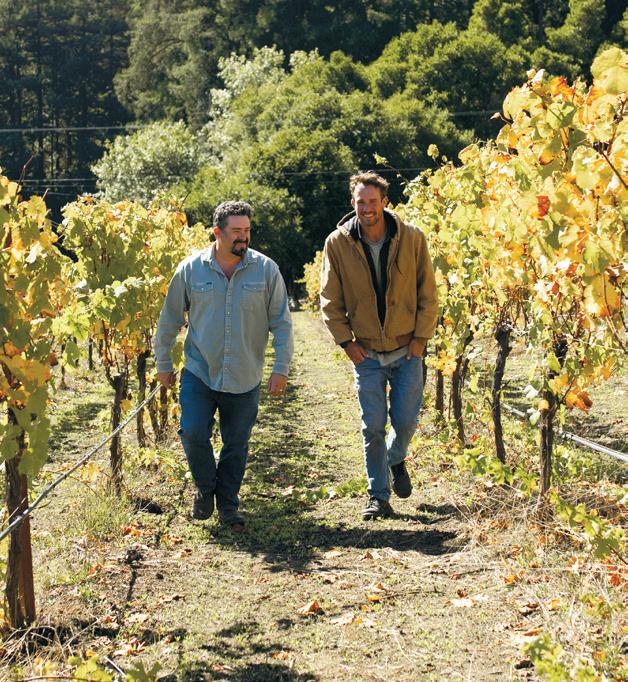
From left, Prudy Foxx checks on grape ripeness at Zayante; Toyon Vineyard vines swoop along a south-facing hillside three miles from the Pacific; Ken Swegles and Cole Thomas walk and talk trends, flavor profiles and new ways to trellis the wine narrative.
WHAT’S IN SEASON
Kumquats
Everything you don’t know about a frisky little citrus with big upside
STORY BY JAMIE COLLINS
PHOTOGRAPHY BY KELLY ROSE EVANS
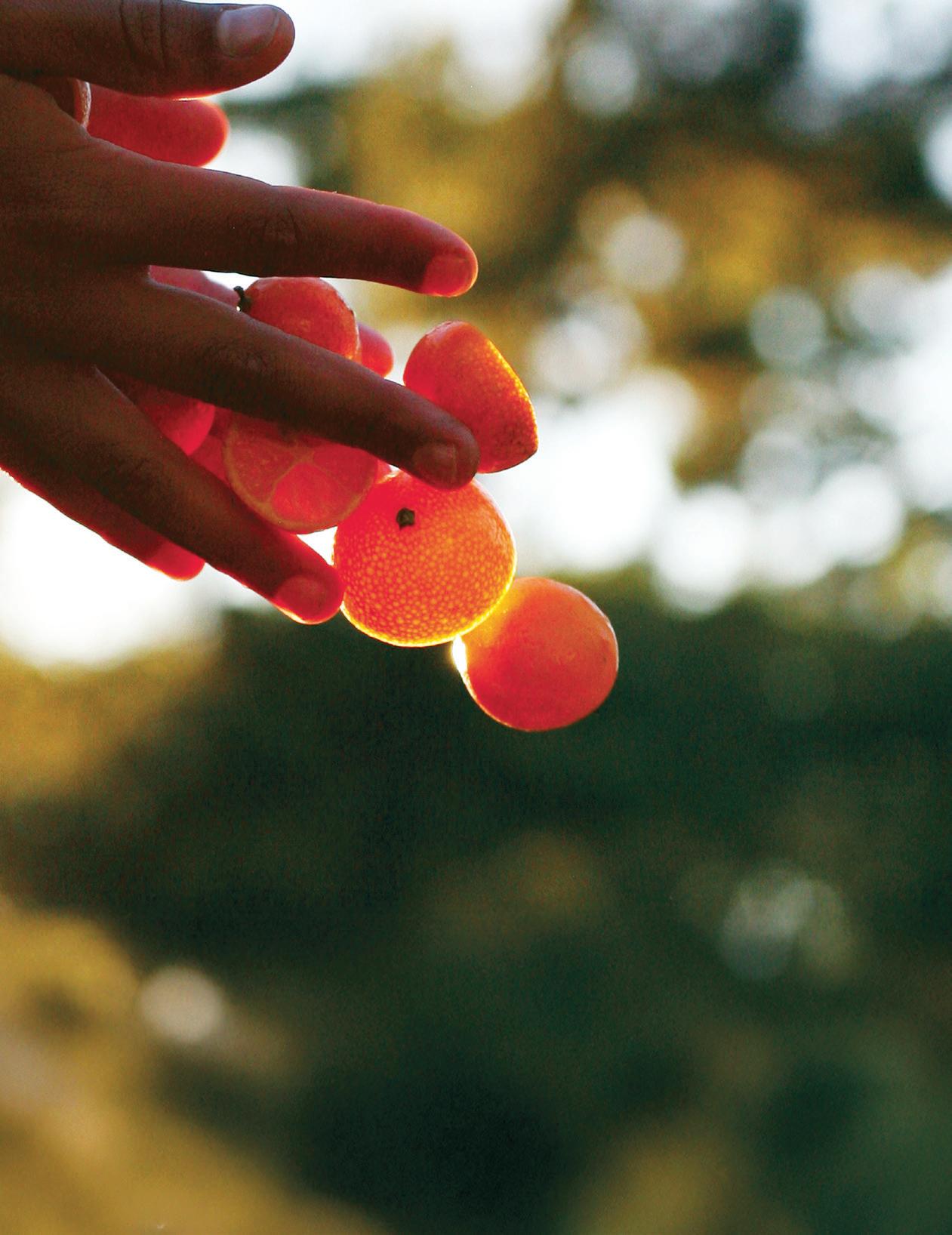
The best way to experience a kumquat is to roll the fruit between your fingers to release the oils and pop the entire thing in your mouth.
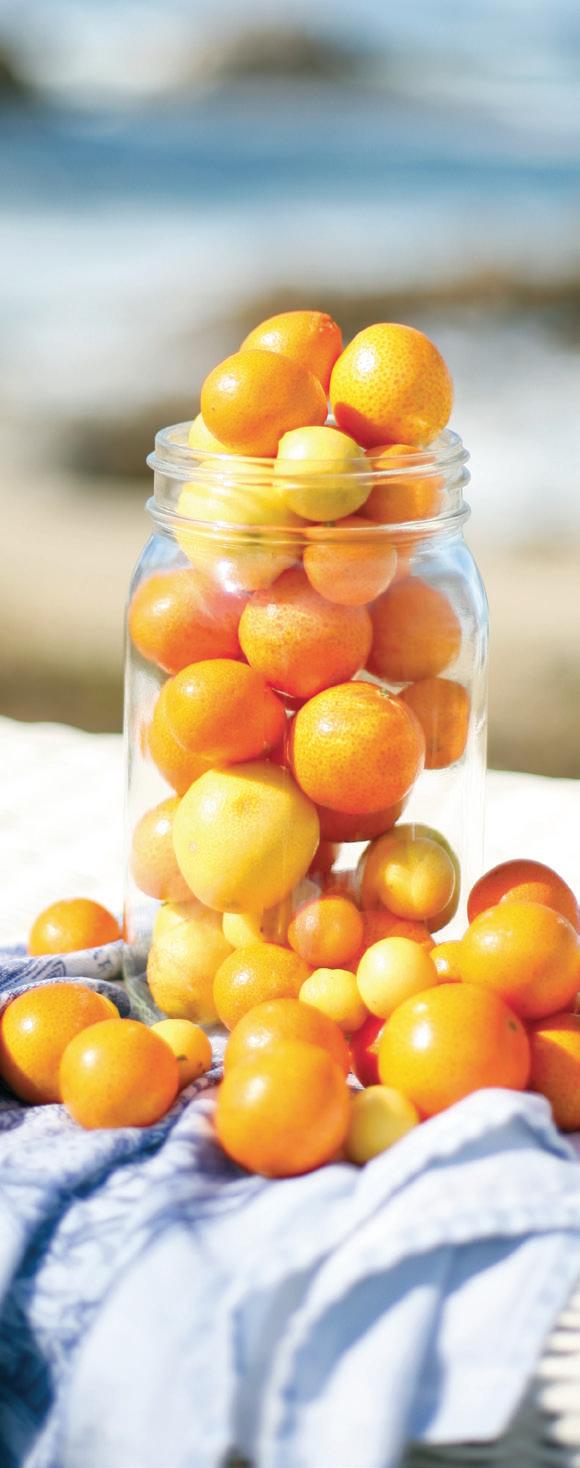
Kumquats are magical little orbs of tart-sweet natural candy. Unlike other citrus, they can be eaten in their entirety. And that provides the surprise juxtaposition: The sweet part is the thin skin, while the sour part is the inner flesh.
When I first discovered these as a young kid—and as most kids do when they really like something they are eating—I would gently eat the sweet peel off a kumquat and then slowly suck out the tart juice until my face puckered, savoring the experience.
While kumquats aren’t technically considered a citrus, they are close cousins. Kumquats are actually quite frost-tolerant, compared with all other citrus, and can handle temps as low as 18°F.
There are four main traditional kumquat varieties as well as two hybrid cultivars. My farm, Serendipity, sells both limequats and mandarinquats at the local farmers markets, but we only have a few trees so the fruit tends to sell out quickly. You can find them this winter through spring at the Live Oak Farmers Market on Sundays in Santa Cruz.
Customers love the novelty of these little fruits; most report eating them fresh or making the best-tasting marmalade. Kids, like a younger me, are especially fond of them.
In my opinion, the best way to experience a kumquat is to first roll the fruit between your fingers to release the oils and pop the entire thing in your mouth. Rolling the fruit mellows the sourness of the pulp and allows the sweetness of the peel to come through, acting like a natural sour candy.
TYPES AND TASTING NOTES
Some distinguishing characteristics of this tiny but mighty fruit help differentiate the different types:
Marumi (or Fortunella japonica) is the ancient Chinese variety that was originally grown as a bonsai, or for ornamental gardens. It is small and round with a sweet peel and more bitter pulp. Best made into candied fruit, chutneys or marmalade.
Nagami (Fortunella margarita) is the most commonly available kumquat. It is also tiny, about 1 inch long, and egg-shaped, with a thin, sweet peel and sour flesh.
Meiwa (Fortunella crassifolia), a hybrid of the Nagami and Marumi, is the sweetest variety and the best for eating fresh. Meiwa—pronounced MAY-wah—is round and enjoys a thicker, sweet peel with fewer seeds than the Nagami.
Mandarinquat, aka Calamondin (Fortunella x Citrus reticulata), is a cross between a kumquat and a mandarin orange. The flavor is like a sour mandarin with a sweet skin, allowing for a great all-purpose ’quat. A popular ingredient in drinks in the Philippines.
Limequats (Fortunella japonica x Citrus aurantifolia) draw genetics from a kumquat and a key lime. They are more cold tolerant than limes, so they offer a great option if you want little limes for cocktails but live in a spot with cold winters. Tart and slightly bitter with an edible peel.
HISTORY AND HERITAGE
Kumquats have ancient history. They are native to China, have grown for thousands of years, and the word kumquat is derived from a Cantonese word that phonetically sounds like “gam gwat,” which translates to golden orange.
There are records dating back to the 12th century indicating kumquats were grown as food but also as an ornamental, and given as gifts during the Lunar New Year to invite a prosperous and lucky year ahead.
Like bonsai trees, kumquats were grown in pots and brought inside during the winter, where the bright orange, decorative balls can be enjoyed during the darkness of winter months.
A Scottish botanist named Robert Fortune visited China and returned to England with the trees in 1846. Honoring the botanist for his discovery, the scientific name Fortunella was given to the kumquat. By the early 1900s the kumquat tree had been replicated and made its way to North America, Australia and the Mediterranean, areas with favorable growing conditions for the kumquat.
Florida was the first to commercially grow kumquats in the late 1800s and later the cultivation spread to typical citrus-growing areas that included California, Louisiana and Texas.
Still, the production of kumquats remains very small compared to other citrus, so small that they are considered a rare novelty fruit.
Which keeps with the theme.
In Chinese and Vietnamese cultures, kumquats are a traditional gift and decoration for the Lunar New Year, as their their bright color represents wealth.
PREP AND PARTAKE
Kumquats are little vitamin C bombs, and because you eat the peel they are a great fiber source too.
Citrus peels also have shown to have anti-cancer benefits, and while the bitter peels from other citrus are hard to eat, the kumquat’s skin isn’t—making those antioxidants much easier to ingest.
Because of their acid-to-sugar balance—along with natural pectin—kumquats lend themselves to preservation in syrups, marmalades and alcohol infusions.
I’ve made them into a shrub with rose geranium resulting in mind-blowing mixed drinks. Simply cut them in half, coat with sugar and let sit for a few days in the fridge, then top with some apple cider vinegar and some herbs of your choice.
Another easy way to utilize kumquats is to simply slice them and pop them in a jar, coat in sugar and top with your preferred booze. Vodka works the best, but rum is also a good choice for a tropical spin. In about a month, strain out kumquats.
I also like to slice them really thin and eat them on top of highquality dark chocolate, and I’ve enjoyed them with some fancy cheeses.
On top of that, a syrup can be made from them to pour over waffles or pancakes. It works as a drizzle over yogurt or ice cream, too.
Kumquat marmalade is so much better than orange marmalade because it doesn’t have the bitterness from the pith.
David Hardie, the chef at Elroy’s Fine Foods in Monterey, makes a seasonal kumquat rice pudding that has a cult following.
For savory preparations, you can cook kumquats with honey, soy sauce or coconut aminos and ginger—mix with an immersion blender and use the result to glaze meat like duck or chicken.
They can also be included in a lovely fennel salad. Try making a coleslaw using cabbage, fennel and kumquats with a lemon, honey and olive oil dressing.
Jennifer Ashby of Ashby Confections has recently been perfecting candying citrus and other fruits.
She attests that when you candy fruit, it intensifies the flavor and turns them into shiny jewels. It is a long process and a labor of love— they need to be cooked six different times in a sugar syrup over five days, while the water evaporates and the syrup infuses into the fruit. Then they need to dry for a few days before being dipped in chocolate.
Ashby plans to offer classes on candying fruit when she opens her new shop on Pacific Avenue in Santa Cruz in 2026. You can find her candied kumquat dark chocolate bars and other candied citrus around Christmastime.
They’d make a great stocking stuffer.
If you are lucky enough to locate these little fruits at your local farmers market, why not make a special liqueur as a holiday gift to bring to a holiday party this year?
Homemade hostess gifts are greatly appreciated and there is still time to infuse.
Whatever the case, this tiny fruit delivers big dividends, along with a puckered smile.
Jamie Collins tends Serendipity Farms, a Monterey Bay Area pioneer in organic practices, while servicing local farmers markets and consulting for those hoping to grow better in the produce sector.
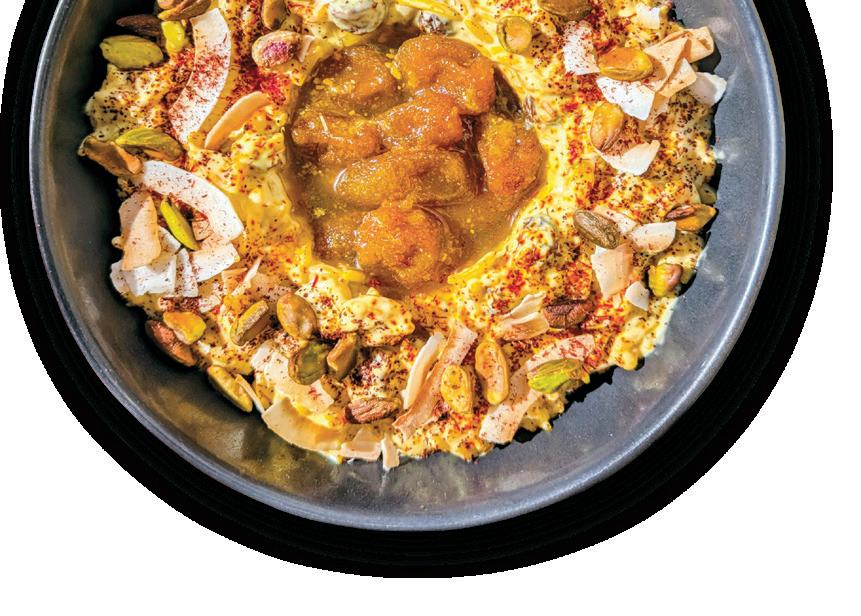
with Kumquats in Syrup
Courtesy David Hardie, chef and culinary director, Elroy’s Fine Foods Hardie prefers this recipe chilled, but his wife digs it—and digs into it—while it’s fresh and warm. The kumquats in syrup are pretty handy for other recipes as well, Hardie adds, possibly as a fun addition to a cocktail. Elroy’s does seasonal rice puddings year round if you want to quicken the taste adventure.
Kumquats in syrup:
2 teaspoon ground fenugreek seeds
2 cups sugar
¾ cup orange juice
1 pint kumquats, cut in half, seeds removed
Rice pudding:
½ cup basmati rice
1 cup water
2 (13.5-ounce) cans coconut milk
1 teaspoon saffron
½ teaspoon salt
½ teaspoon ground green cardamom
¼ cup sugar
¼ cup diced dried apricots
¼ cup golden raisins
To garnish:
¼ cup toasted coconut flakes
¼ cup toasted pistachios
1 teaspoon sumac powder
Preparation:
For the syrup, add all the ingredients to a small pot and bring to a boil over medium-high heat. Add the kumquats
and simmer for 5–8 minutes. Turn off the heat and let cool for a couple minutes, then transfer to a heatproof storage container.
For the pudding, cook the rice with the water in a small pot on the stove and set aside.
In a separate small pot, bring to a boil all pudding ingredients except the raisins and apricots. Start with a can and a half of the coconut milk and save the other half to adjust for preferred thickness. Once boiling, add the rice and bring back up to a simmer and continue to simmer for 5 minutes. Turn off the heat and add the raisins and apricots. Let cool, transfer to a heatproof vessel and store overnight in the refrigerator.
To assemble, portion the pudding into 3–4 bowls leaving a well in the middle of each for the kumquats. Add the kumquats with syrup and garnish with the pistachios, coconut and sumac.
Serves 3–4.
Reservations
HOSTED BY CARMEL VALLEY CREAMERY
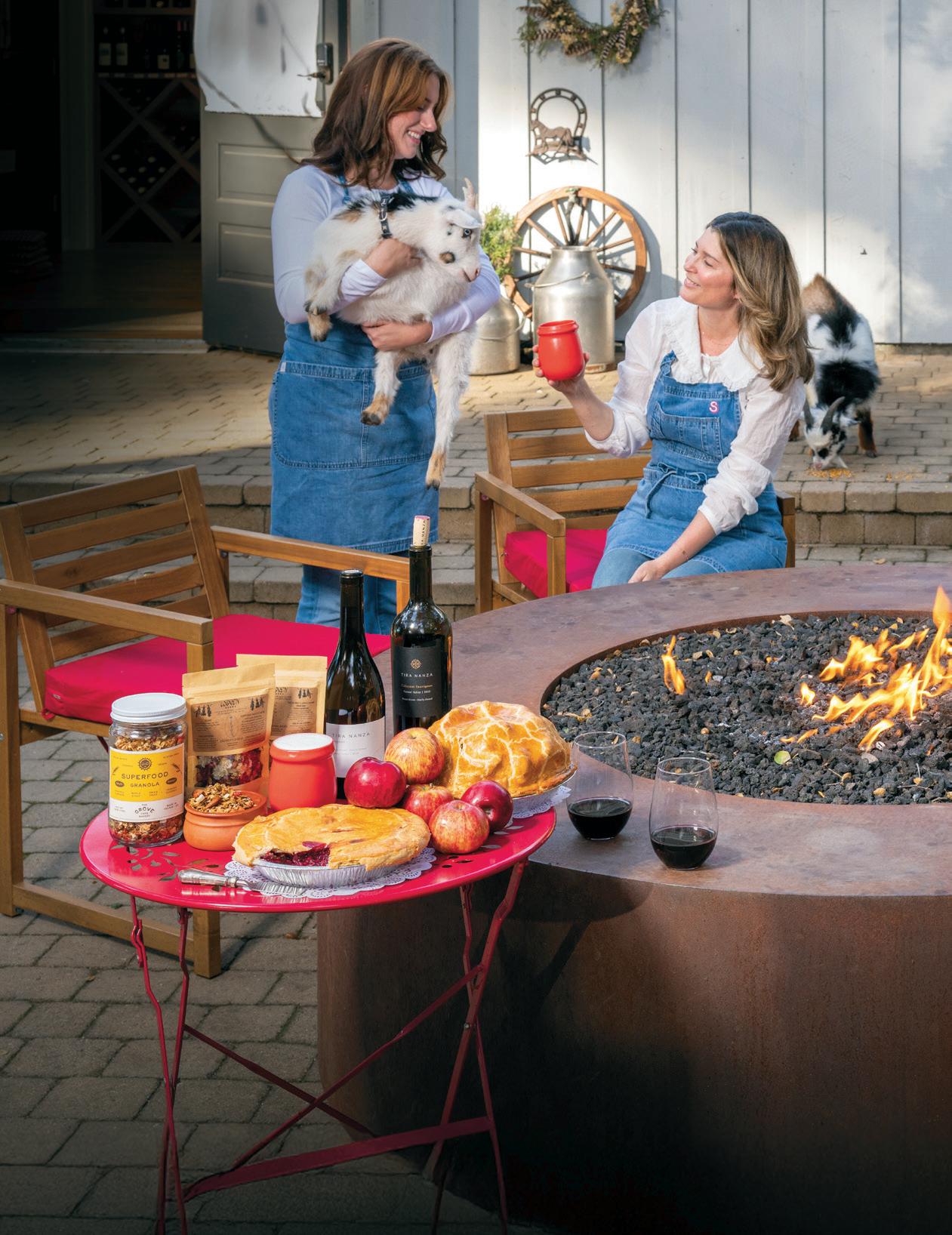
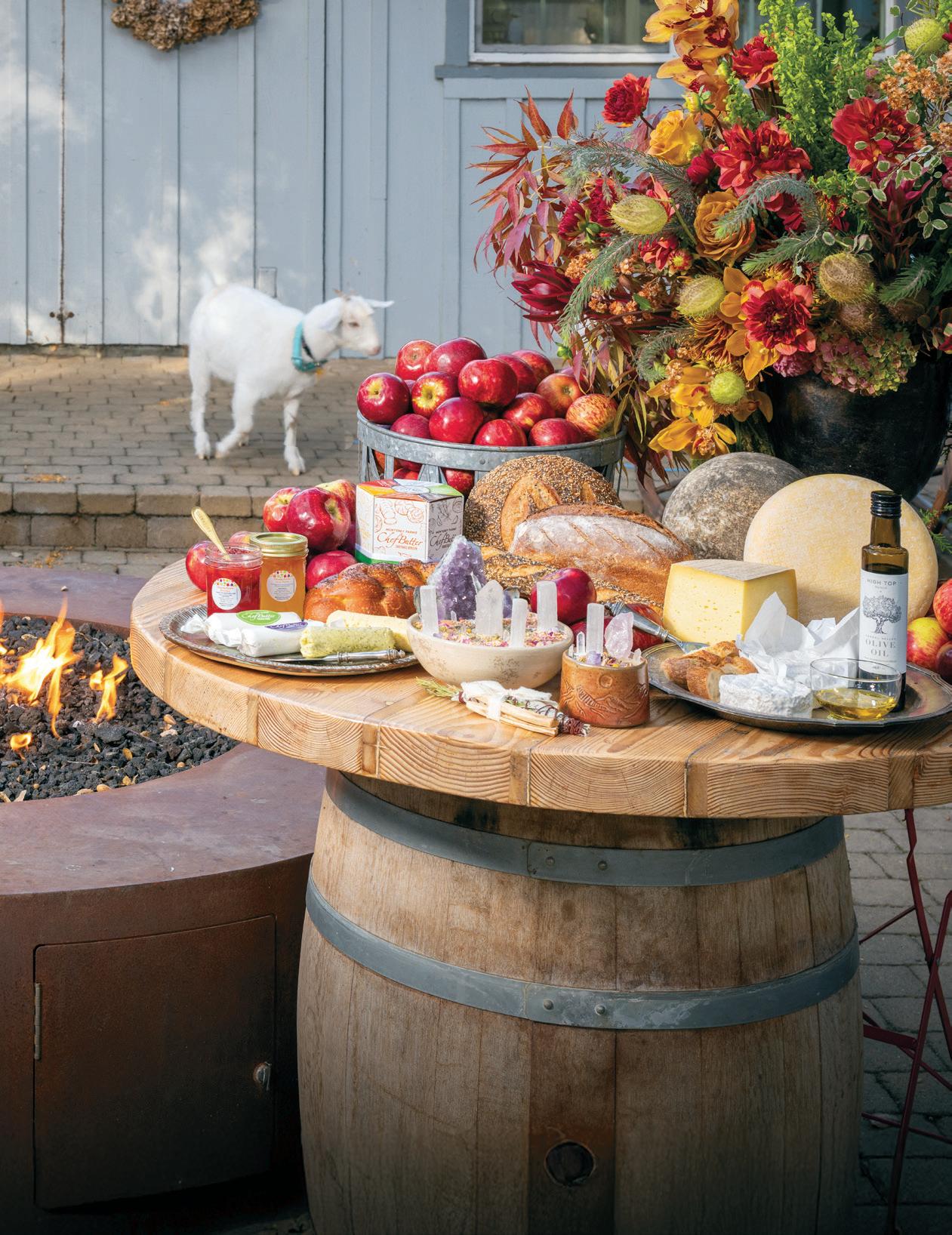
Cheesemaker Sophie Hauville has fashioned Carmel Valley Creamery into a gathering place that embodies the warmth and flavors of the community. Small tables and warm fire pits on the patio invite customers to linger over coffee drinks, bites of her handcrafted cheeses and local artisanal treats from the shop. Hauville and her assistant, Alexis Sabolsice, can often be seen making cheese or sharing stories with visitors. During special events, playful goats stop by to entertain shoppers— bringing extra charm to this welcoming spot.
The Grove Cafe Bakery | 6249 Highway 9, Felton @thegrovefelton | thegrovefelton.com
Wild Foraged Tea Blends from Big Sur Woven Herbs | Local Restaurants and Pop-Ups @wovenherbs | wovenherbs.com
Tira Nanza 2024 Estate Viognier
Tira Nanza 2023 Estate Cabernet Sauvignon
Tira Nanza Wines | NW Corner of Mission at 7th Ave. Carmel @tirananza / tirananza.com/wines
Berry Pie, Red Braeburn Apples, Dutch Apple Pie Gizdich Ranch | 55 Peckham Rd. Watsonville gizdich-ranch.com Handcrafted Strawfire Jam and Citrus Heaven Kumquat Marmalade
| Farmers Markets and Pop-Ups @chunkyfruits | chunkyfruits.com
Curated by Aga Simpson
Photo by Glen McDowell
EDIBLE COMMUNITY
Lunch with the Mayor
How a daily restaurant ritual contributes to real progress for Carmel STORY AND PHOTOGRAPHY BY MARK C. ANDERSON LEAD PHOTOS BY MANNY ESPINOZA
When Dale Byrne told his wife, Margaret, that he wanted to run for mayor of Carmel, she had what she calls “some stipulations.”
Chief among them: lunch.
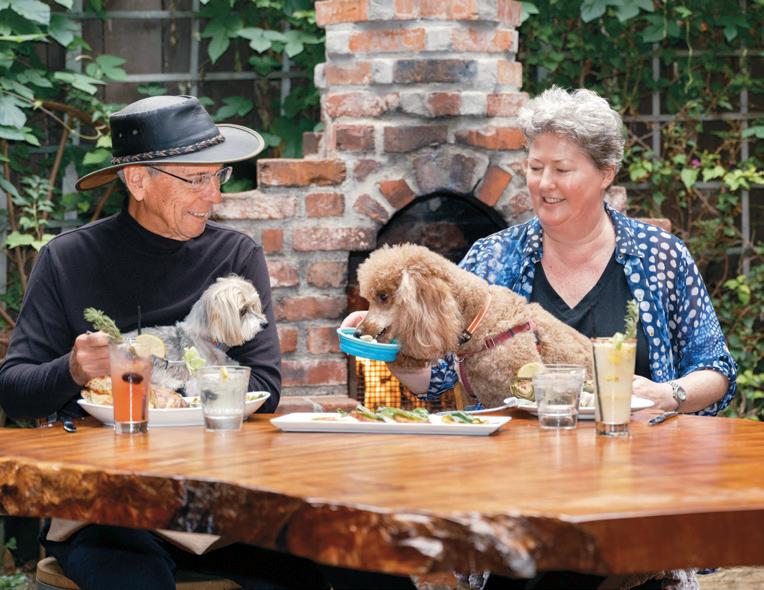
They eat out seven days a week—always lunch, never dinner—and always accompanied by Hamilton, the miniature red poodle, and Blue, the 6-pound silky terrier-Maltese mix with a penchant to yelp suddenly, which mellows when he gets a napkin gently draped over his eyes.
“Lunch is our outing,” says Margaret, who’s quick to confirm it’s “for sure” the best meal of the day. “It’s more relaxed, a little less expensive, and involves much of the same menu as dinner, so you’re not missing out.”
A year into her husband’s two-year term, her envisioned lunch outcomes sound unanimously approved.
“It’s important,” Dale says. “She’s serious about that being our time together. Without her I would work all the time.”
The couple enjoys roomy retirement options after a lucrative career pioneering supply chain software. That includes the wildly successful Intactix International Inc. Dale founded and grew to $20 million annual profit and ubiquity in retail outlets like Target and Walmart, with 12 offices around the world.
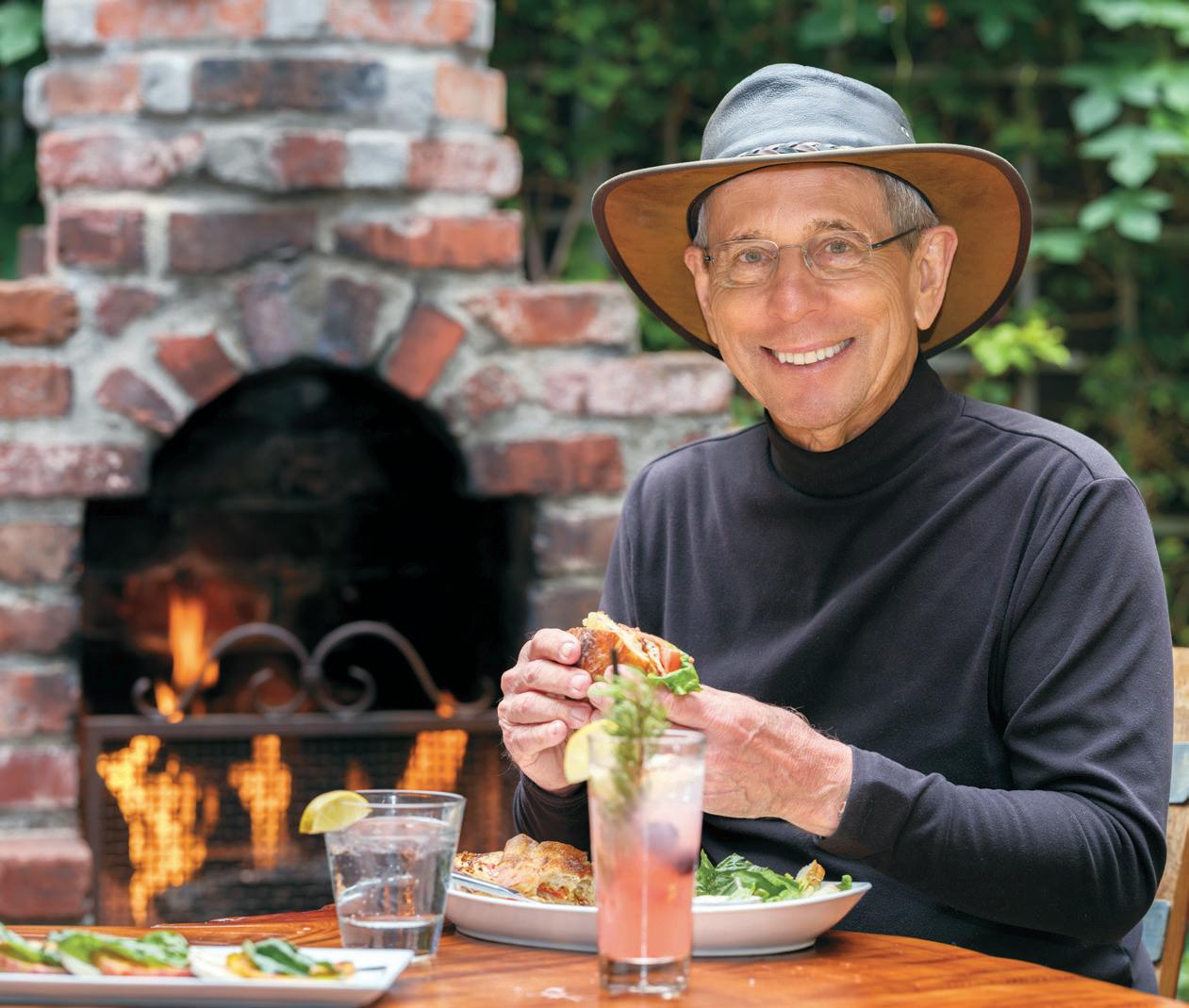
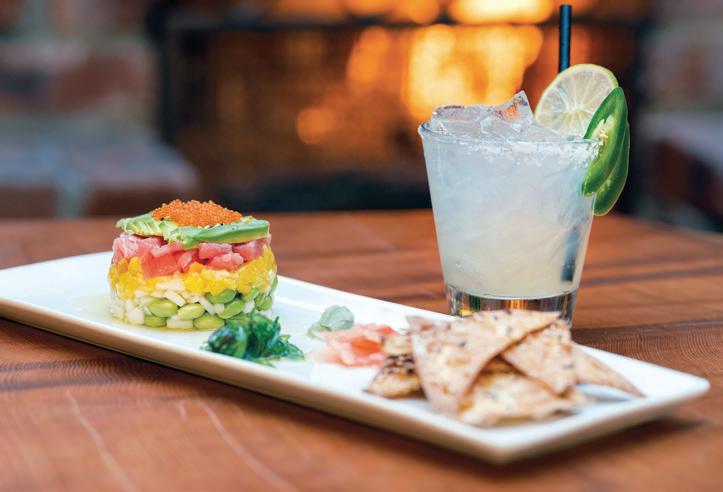
Dale Byrne enjoys regular fireside lunches on the welcoming patio at Hog’s Breath Inn, where the bigeye tuna tartare tower presents a tasty opening plate.
Instead, they’re in perpetual municipalimprovement mode, shepherding platoons of
yellow-vested volunteers on a bevy of beautification tasks like litter cleanup, landscape maintenance and city property repair, historic Forest Theater included.
That happens through their nonprofit Carmel Cares, under the slogan “Carmel-by-the-Sea is OUR town. Let’s make it better together,” and through the organization’s prolific public reporting—nearly 2,000 Google slides presented to the Public Works Department in 80 status meetings since July 2000.
“I didn’t want people to say we were running amok and undisciplined, so we tell the city everything in unbelievable detail,” Dale says. “We behave like an internal agency.”
Carmel Cares was founded with modest ambitions (traffic calming), then Covid catalyzed greater action. The Byrnes arranged a nifty triage: Raise money through donations and grants to filter through the Chamber (keeping it afloat) to distribute to Carmel restaurants (keeping them alive) to prep food for hunger-busting NGOs like Meals on Wheels and Boys and Girls Club (keeping their populations nourished).
“A win win win,” Margaret says.
Ashley Wolff, chef-owner of breakout fusion sensation Jeju Kitchen—one of the Brynes’ go-tos (see sidebar, p. 29)—zooms in.
“Between the second and third closures, many of us were on the verge of not reopening,” she says. “Can you imagine if half of Carmel’s restaurants closed?”
Meanwhile, Carmel Cares started deploying volunteer gardeners and professionals alike to attack weeds and heal neglected public spaces left untended by vanishing city services.
“It couldn’t have happened without the pandemic,” Dale Byrne says. “Most cities wouldn’t let you do it. Now we’re a role model, with other cities [including Pacific Grove and Pleasanton] starting to visit us and learn how to replicate what we’re doing.”
Outsiders could’ve understandably viewed his mayoral win last November over well-known incumbent Dave Potter as a surprise. Wolff, who lives in downtown Carmel, describes why it wasn’t.
“When you see Dale and Margaret and all the Carmel Cares volunteers literally every single day, for years, picking up trash, cleaning up Scenic Road, making it beautiful, planting flowers, keeping everything clean—and you remember the way they helped restaurants—it wasn’t being told, ‘These are my promises,’” she says. “It was, ‘We’ve done these things, now let’s do more.’ It was easy math.”
More is happening, even as Mayor Byrne has coffee with any citizen who asks,
Hamilton (in Margaret’s lap) is happy to take advantage of Carmel-by-the-Sea’s indulgent dog menu options. Blue (with Dale) and “Hammy” both love rawhide—and the family’s midday ritual: “Oh, they know when it’s time to go to lunch,” Dale says.
and learns from his mayor pro tem (and former Mountain Village, Colorado, mayor) Robert Delves to temper the number of projects to consummate fewer, better. So the lunches offer a rare off switch.
“Lunch is Margaret’s way to get me to sit still and unwind,” Dale concedes, his resting grin face widening.
Other less-intended outcomes do come with lunch.
As they’re walking to their spot of the day, they’re constantly reviewing upkeep improvements and opportunities. They’re easy targets for those with a concern or question. And, for diners who love a healthy restaurant community in a squaremile hamlet loaded with 60+ of them— not counting bakeries, coffee shops and foodie-friendly neighborhood markets— they’re smelling what’s cooking up close.
Another parallel outcome: Everybody wants to talk to the mayor, and he loves to visit with them.
“One of the challenges is when people come up at lunch and say, ‘Sorry to interrupt,’ and then they interrupt,” Margaret says. “I appreciate it when they say hello and can send an email.”
“Everybody wants to talk,” Dale says. “And I want to talk! That’s our brand!”
Policies for Progress
A quick list for frequent lunchers
Eating out every day isn’t for amateurs. Here’s how the vets do it.
BYO to-go
Even in a town smart about packaging requirements, the boxes pile up.
Reusable Tupperware FTW.
Sidesaddle the sauce
It’s an indefinite “cruise,” not a weeklong trip. Being able to self-administer often-indulgent dressings is a good thing.
Gauge gluten
The Byrnes aren’t gluten-free, but they are aware of its cumulative effects on inflammation, joint pain and glycemic issues, so they know which of Dale’s beloved chowders flow without flour.
Soup up
Many of Carmel’s homespun standouts feature rotating soup specials, which furnish a lot of flavor without a lot of expense or heaviness.
Sharing is caring
These two have it dialed on which plates they like to share, which restaurants don’t mind doing it and which ones don’t charge.
Pair with protein
Like many chronic restaurant lunchers, the Byrnes know how to enjoy a strong entree salad with steak, chicken or seafood.
Walk it off
The Byrnes’ diminutive furries don’t dig the long walk from their house near Carmel Beach (their preferred workout venue), so the humans park up by Sunset Center where spaces are easily available and stroll the rest, allowing for greater digestion, dog joy and—of course—interaction with neighbors.
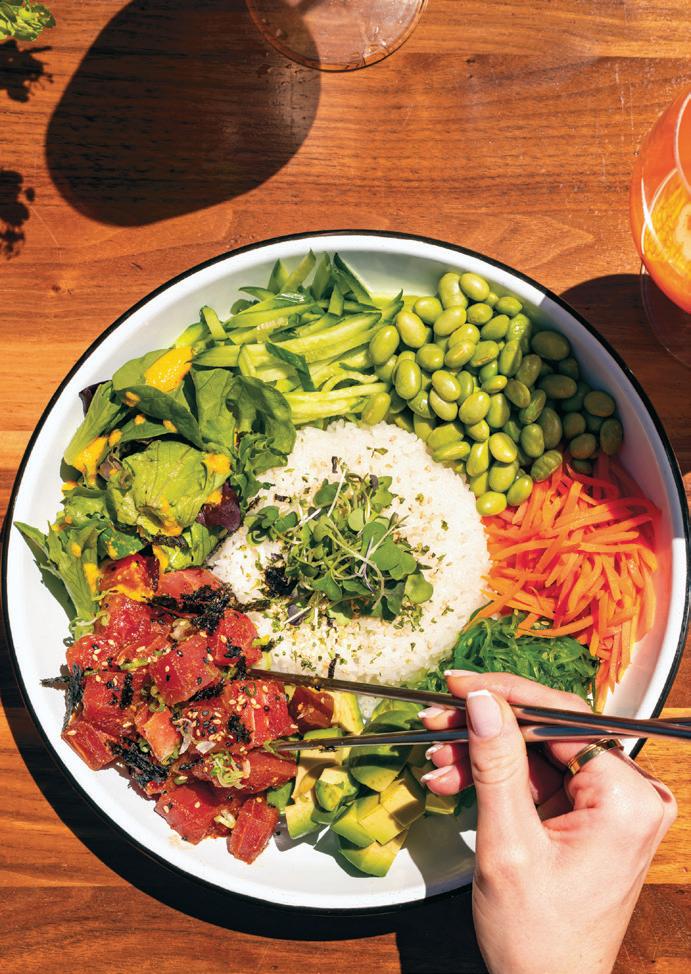
Jeju’s tuna poke bowl (pictured beneath text) represents a Margaret Byrne fave.
Edible first learned about the Byrnes’ lunch pact in reporting delays around the 2025 rebirth of Hog’s Breath Inn. That’s the bar-restaurant that, poetically enough, was the creation of another visible and restaurant-adept mayor, Clint Eastwood, whose face graces every wall at the Hog, and whose quote topped the original inserts Carmel Cares gave restaurants to hand out to customers and encourage city stewardship: “Sometimes if you want to see a change for the better, you have to take things into your own hands.”
Some well-intended City rules and red tape meant Hog’s Breath was losing vital summer revenue and piling up costs while waiting to open. Byrne got together with Assistant City Administrator Brandon Swanson, whom he credits with helping
execute a solution starring creative thinking and code-friendly heaters, while observing an opportunity.
“Figuring all that out is a customer service issue,” Dale says. “We should have a concierge to enable improvements for existing businesses and those who want to move here, and make them happen fast.”
The former CEO acknowledges he has plenty to learn as a lawmaker (“I could be stepping on toes because I’m not paying attention to politics”) and around how to find consensus (“I hope I haven’t irritated too many people but I’m very honest, and people may say, ‘Dale thinks he’s all that.’ But I’m not that kinda guy. I just don’t let things get in my way”).
He does believe that being a serial luncher flattened his learning curve.
“Over time it’s gotten harder to have businesses here! It’s really expensive!” he says. “I know how difficult it is because it’s my friends who run the restaurants, and it’s only getting more challenging to hire and pay people.”
Hog’s Breath owner-operator Lee Morcus was endorsing Byrne before he and his wife became regulars.
“Dale is remarkable,” Morcus says. “His head and heart are in the game. I don’t think he ever sleeps.”
As the discussion about lunch leads to other topics, such as his early Carmel Resident Association highs and lows and potentially edgy City Council dynamics, Dale replies to a question with a question.
“Is this still for the story about lunch?”
Well, yes.
But this story is also about cruise ships and allergies, walkability and talkability, cynicism and a joyous little poodle named Spencer.
Dale and Margaret Byrne, post retirement, were about that cruise life, floating around South America for 60 days or traversing whole hemispheres in 90. Until they learned what was making Margaret ill on board: She had an undiagnosed allergy to the nickel present in those huge ships.
Stuck ashore, Margaret began researching the best place to visit with Spencer, their miniature red poodle.
She soon discovered that, yes, Carmel is where Brad’s Barkery does canine “cannolis,” offers breed-specific grooming, and sells Louis Vuitton Blue Dog denim jackets; Carmel Groomers does blueberry facials; and Mad Dogs & Englishmen bike-coffee bar will rent you an e-bike with a pup sidecar.
They made the town’s preeminent pooch palace, Cypress Inn, their home away from home to the point they stayed in each room, and figured they vacationed here so much they might as well move, and now they have a standing reservation for Terry’s Lounge at the inn every Friday at 11:30am.
Late, great, Carmel-loving Spencer the miniature poodle appears on the wall at Terry’s Lounge in Cypress Inn, in an image Dale Byrne took, framed and implored late, great, Carmel-loving property founder Denny LeVett, who passed on in October, to hang.
After they made Carmel permanent, Dale introduced a theory he resurfaces now and again, and transformed into a column for the Carmel Residents Association newsletter the couple helped run for years: “My wife Margaret and I have spent significant time cruising the world. Yet, since we’ve been living full-time in Carmel-by-theSea, we’ve cancelled four cruises. Why? Because cruise ships come here! So, we decided to treat every day as if we’re on one…We will show you how you can turn your hometown into a virtual cruise ship and learn things about our Village that you didn’t know or haven’t seen in a long time.”
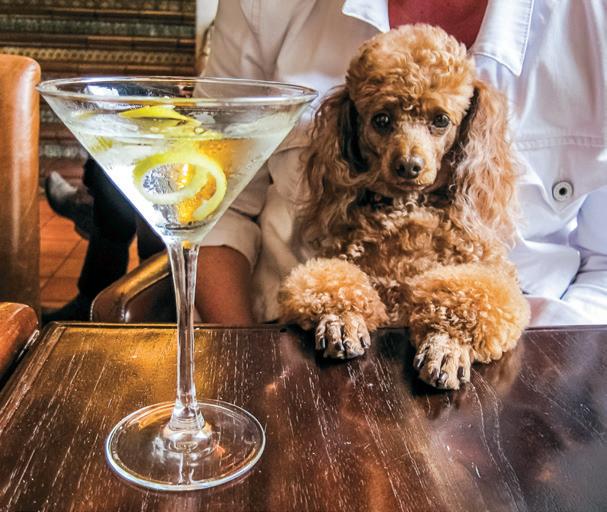
Spencer the miniature poodle—“Just a happy dog; he loved the beach,” Dale says—has passed across the rainbow bridge, but still looks down from the wall at Cypress Inn, alongside a towering martini.
Another post-retirement collaboration for the Byrnes became renovating Carmel homes with elaborate attention to design and detail, five all told, moving on to a new project when someone made an unrefusable offer.
“Each one we figure we’d never leave, but this time it’s real,” Dale says. “I have the whole city as my project, whether as mayor or through Carmel Cares.”
More practically, all that time navigating code gave him the deep download on city inner mechanics.
“I really understand the system and how it works, and especially what frustrates people,” he says, “The way I work, I make the right connections so I won’t get frustrated.”
Cynicism can feel like a prerequisite for politics. For instance, it’s easy to neg the City Council for being deliriously proud of passing a law to give houses addresses—while making fun of the fact they should be, because that’s how vicious a controversy it was in Carmel, #champagneproblems style.
But even if you throw a dark filter on Dale, and imagine, for instance, he isn’t even listening to those who stop him and get his attention for 15 minutes (though he is), he’d still be pretending to listen, and that in and of itself would be a therapeutic civic service.
Rich Pepe, as a 50-year Carmel restaurateur, active city advocate and one-time mayoral candidate, is well-qualified to identify why a relative newcomer clicks.
“It’s a kooky little village that’s really a couple of football fields with no red lights!” he says. “It’s a very walkable town, and a very talkable town, and Dale’s carrying on that theme.”
So maybe it’s as simple as that, or as simple as this: If you get cynical with a proactive leader who says there’s nothing better than eating lunch with his wife and dogs daily—other than perhaps taking those dogs to the beach and picking up garbage with a group of like-minded friends—maybe you’re not on the right cruise ship.
The Byrne List
Seven days of first family endorsements by the sea
Experienced Carmel diners will quickly observe some shared qualities among the go-to spots for Dale and Margaret Byrne: consistent dishes, great outdoor spaces and supreme dog-friendliness.
Margaret notes another commonality that comes with 20 years of dining out in Carmel, first as constant visitors and now residents: relationships. It’s no coincidence each of their preferred picks is run by hospitality lifers who make a point of interacting with regulars.
“We know a lot of the servers too, as they tend to be long-term employees,” she says. “It does create a family feel.”
The couple’s stated goal is to eat lunch out daily. Here appears a normal week’s worth of lunch destinations, in alphabetical order, and some of their favorite plates, with two bonus considerations at the end.
Anton & Michel
Here the Court of the Fountains offers a soothing setting for both two- and four-leggeds, and a European feel to match the menu. Top picks for the humans: garlic confit free-range chicken breast with a Yukon Gold mash, and a Cobb salad Margaret tabs as “fantastic” thanks to loaded balance and sublime soft-boiled egg. “I just love it,” she says. “You gotta know what you’re doing to get the egg right every time.”
Mission between Ocean and 7th • antonandmichel.com
Cypress Inn
Late great dog-loving Doris Day’s legend that started it all for the Byrnes is one of many places where they have a standing reservation they rarely miss. And they often do free jazz on Tuesday evenings in the piano room, where—like Terry’s Lounge—the dogs frequently outnumber the people. The soups, the salads, the club and the fish taco all earn loyalty from them.
Lincoln and 7th • cypress-inn.com
Soups like the cioppino are a strong suit at Nora’s, and soups are a common order for the Brynes to lead off lunch.
El Bistro by the Sea
The newest addition to the Byrne List exploded on the scene with Instagram-friendly indulgences like lava cake French toast and carnitas barbecue burgers. Dale digs the al pastor tacos and takes a chunk of his morning meetings on the quiet back patio or in the free-of-charge group room. With a nudge from the couple, the popular but spendy spot introduced a very popular locals breakfast menu built around daily values.
Mission and 5th • instagram.com/elbistrobythesea
Grasing’s Restaurant
At the stately steakhouse, Byrne shouts out the charcuterie (“exquisite and affordable”) and Manhattans from the Old World–style bar (“superb”). Margaret, meanwhile, wonders how they get the poultry in the grilled chicken club—with avocado, fresh tomatoes, smoked bacon, cheddar cheese and garlic aioli on toasted sourdough—so crazy tender. “They must pound it or something,” she says. “Great flavor, great presentation, great bread.”
Northwest corner of Mission and 6th • grasings.com
Hog’s Breath Inn
The couple’s set of strategies (see sidebar, p. 29) helps avoid overstuffed afternoons, which means splitting their favorites on Hog’s Breath’s cinematic—and historic—patio, which recently hosted the Carmel Cares litter-abatement team for beer, wine and apps, on the house, post Halloween Parade by the Sea. Those include the Dirty Harry Burger, named for a previous mayor’s silver screen character, and a nacho platter that transcends the genre. “It’s hard to find a good nacho plate, and harder to find one this good,” Margaret says.
South of 5th on San Carlos • hogsbreathinn.net
Jeju Kitchen
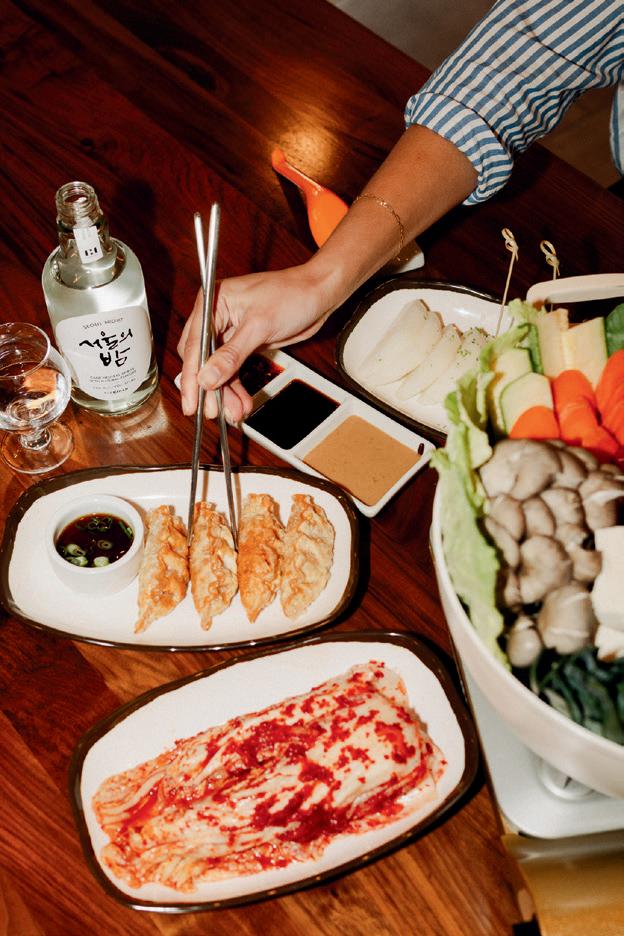
Aboard this Korean fusion–fueled rocket ship, Carmel’s First Family swears by the leafy terrace seating, complete with Carmel Plaza’s dogs-only Fountain of Woof. But they are perhaps more driven to visit by kimchi pork hot pot, smash burger and tuna poke bowl, which Margaret describes as nothing short of “beautiful.” “It’s so pretty, and also extremely tasty.” The smash burger gets top rating too. “They’ve got good flavor all around the spectrum of their menu,” she adds. Suite 106, Carmel Plaza • jejukitchencarmel.com
Nora’s Carmel
Another recent addition to Byrne lineup doesn’t feel new to them because they’re well acquainted with the family behind it, who also operate nearby Anton & Michel and Treehouse Café. Like Hog’s Breath, going easy at a place built around grandma’s comfort food keeps the cruise boat afloat, but proves hard given world-class onion rings and a chicken pot pie Margaret calls “just shockingly good.” “Definitely a cheat day [choice],” she says. “It’s that good you want to eat the whole thing, but shouldn’t.”
San Carlos between Ocean and 7th • norascarmel.com
Treehouse Café
This second-story balcony enjoys a lofty place in another category: Dale’s favorite clam chowder in town, and he swears he’s tried them all. Simple, gluten-free and enjoying the right thickness, optimum texture, potato load and clam quantity, it may be in line for a mayoral medal. “Within six blocks I can get four different kinds that I like,” he says, “but I don’t feel that way about any other one.” Sometimes he grabs an extra serving to take home to accompany Margaret’s gourmet dinners.
San Carlos Street between 7th and 8th • treehousecafecarmel.com
Bonus number one represents a rare non-Carmel note: On particularly beautiful days they do love a short drive to dine at Stillwater in The Lodge at Pebble Beach, which reopened in November with a plush new look and revamped menu as the final piece of a renovation that also updated The Tap Room tavern and The Bench restaurant, kitchens included. The Byrnes go for sweeping views and “really good food,” per Margaret. “Stillwater is so hard to beat, so close to Carmel, and when you dine they refund the gate fee,” she says. “I don’t know if a lot of locals realize that.”
Bonus nugget two works as a disclaimer: While one of their steady spots’ chefs (Ashley Wolff of Jeju Kitchen) accurately observes, “They have a schedule for every place, and always get their things,” this list is not fixed forever. Dale makes a point of observing Flaherty’s Seafood Grill and Oyster Bar and Village Corner Bistro are monthly rotation participants thanks to owner attentiveness, gluten-free options, plus Flaherty’s oysters and clam chowder. He goes on to tick off Cafe Luna, Toro Sushi, Pangaea Grill and Pâtisserie Boissiere too. As he writes in a vintage “Carmel Cruising” column, “I’m more convinced than ever that we are the most fortunate people in the world!”
Abalone • Anchovies • Cabezon • Dungeness Crab • Rock Crab • Starry Flounder • Pacific Grenadier • Herring • Lingcod • Rock Cod, aka Rockfish • Sablefish, aka Black Cod • Pacific Sanddabs • Dover Sole • Petrale Sole • Rex Sole • Spot Prawns
* December only ** February only
All fish listed are rated “Best Choice” or “Good Alternative” by the Monterey Bay Aquarium’s Seafood Watch program and are found in abundance in local waters. See seafoodwatch.org for more information.
5-course Chef's Selection Menu
3-course Choice Menu & Sunday Brunch
Farmers Marke t s
It’s soup season! Hardly a novel notion, but there’s something so calming and grounding about making a pot of homemade soup. From the very first peeling and chopping to the nourishing bowl in front of you at the end, the process is centering in a way that rises above other kitchen tasks. That slow, methodical action also extends to anyone who eats the soup, almost like feeding them
Wednesd ay
spoonfuls of mindfulness…or at least some folks think so. Our farmers markets—and the farmers who grow our food—are also part of this soup-making magic. The produce we use and the fun of shopping for it, precedes what goes into the pot, adding a connected dimension to what eventually simmers on the stove and warms the belly.
Saturd ay
—Amber S. Turpin Thank You
Downtown Santa Cruz Farmers Market
1pm-5pm • Year-round Lincoln and Cedar Streets • 831.454.0566 santacruzfarmersmarket.org
1 2
Friday Watsonville Certified Farmers Market
2–7pm • Year-round
Watsonville City Plaza, Peck & Main Streets 831.588.7366 facebook.com/watsonvillefarmersmarket
10am−2:30pm • April to October 1441 Constitution Blvd., Salinas 831.384.6961 everyonesharvest.org
Thursday
Carmel–by-the-Sea Farmers Market
10am–2pm • Year-round 6th and Mission Streets
831.402.3870 goodrootsevents.com
Castroville Farmers Market
3−7pm • Year-round
Castroville Recreation Center 11261 Crane Street ncrpd.org
Seaside Certified Farmers Market
3–7pm • Year-round
Laguna Grande Regional Park 1259 Canyon del Rey Blvd. 831.384.6961 everyonesharvest.org
Friday
Monterey Certified Farmers Market
8am–noon • Year-round 1410 Del Monte Center 831.728.5060 montereybayfarmers.org
Saturday Old Town Salinas Farmers Market
9am–2pm • Year-round
300 block Main Street
650.815.8760 wcfma.org/salinas
Sunday
Carmel Valley Certified Farmers Market
10am–2pm • Year-round
Mid-Valley Shopping Center 550 Carmel Valley Road
650.290.3549 wcfma.org
Marina Certified Farmers Market
10am–2pm • Year-round 215 Reservation Road
831.384.6961 everyonesharvest.org
IN THE KITCHEN
Madeleines
Making a case that the tiny cakes are the ultimate food-memory connector
By Analuisa Bejar
Photos By Patrick Tregenza
You don’t really know somebody—especially if they’re a fellow foodie—until you ask this question: What’s your madeleine?
To be clear, it might not have anything to do with madeleines. It’s a way of asking what food awakens a deep connection between taste bud, emotion and memory?
Maybe it’s apple pie, because a bite of warm apple pie steaming with spices today takes you back to Grandma’s kitchen.
For me it’s a freshly shucked oyster, whisking me away to a cold and windy Brittany beach in France, yards away from where it grew, amplified with a squeeze of lemon. Every time I slurp an oyster my mind goes there.
For the hardened critic in Ratatouille, it’s the famed and rustic vegetable dish in the title of the movie. Once he tastes it, his expression softens and he’s time-warped to his childhood home with his mom baking his favorite comfort food.
That scene is actually based on one of the most quoted pieces of food writing, and for very good reasons, because that’s where the concept first gained real literary visibility.
Between 1913 and 1927, Marcel Proust published seven volumes of his novel In Search of Lost Time. It follows the narrator’s life experience in stream-of-consciousness flow that changed the way authors considered storytelling.
And it all starts with a simple madeleine, dipped in tea, that gave name to the concept of involuntary memory unleashed by food. In the literary world and French culture it quickly became known as la madeleine de Proust, or “Proustian madeleine.”
The passage runs three pages, so it appears abbreviated here:
My mother… sent out for one of those short, plump little cakes called ‘petites madeleines,’ which look as though they had been molded in the fluted scallop of a pilgrim’s shell…
I raised to my lips a spoonful of the tea in which I had soaked a morsel of the cake. No sooner had the warm liquid, and the crumbs with it, touched my palate than a shudder ran through my whole body, and I stopped, intent upon the extraordinary changes that were taking place…
At once the vicissitudes of life had become indifferent to me, its disasters innocuous, its brevity illusory—this new sensation having had on me the effect which love has of filling me with a precious essence…
The whole of Combray and of its surroundings … sprang into being, town and gardens alike, from my cup of tea.
Regardless of the weight they carry on that long literary trip, madeleines are the smallest and lightest of cakes.
They are not cookies.
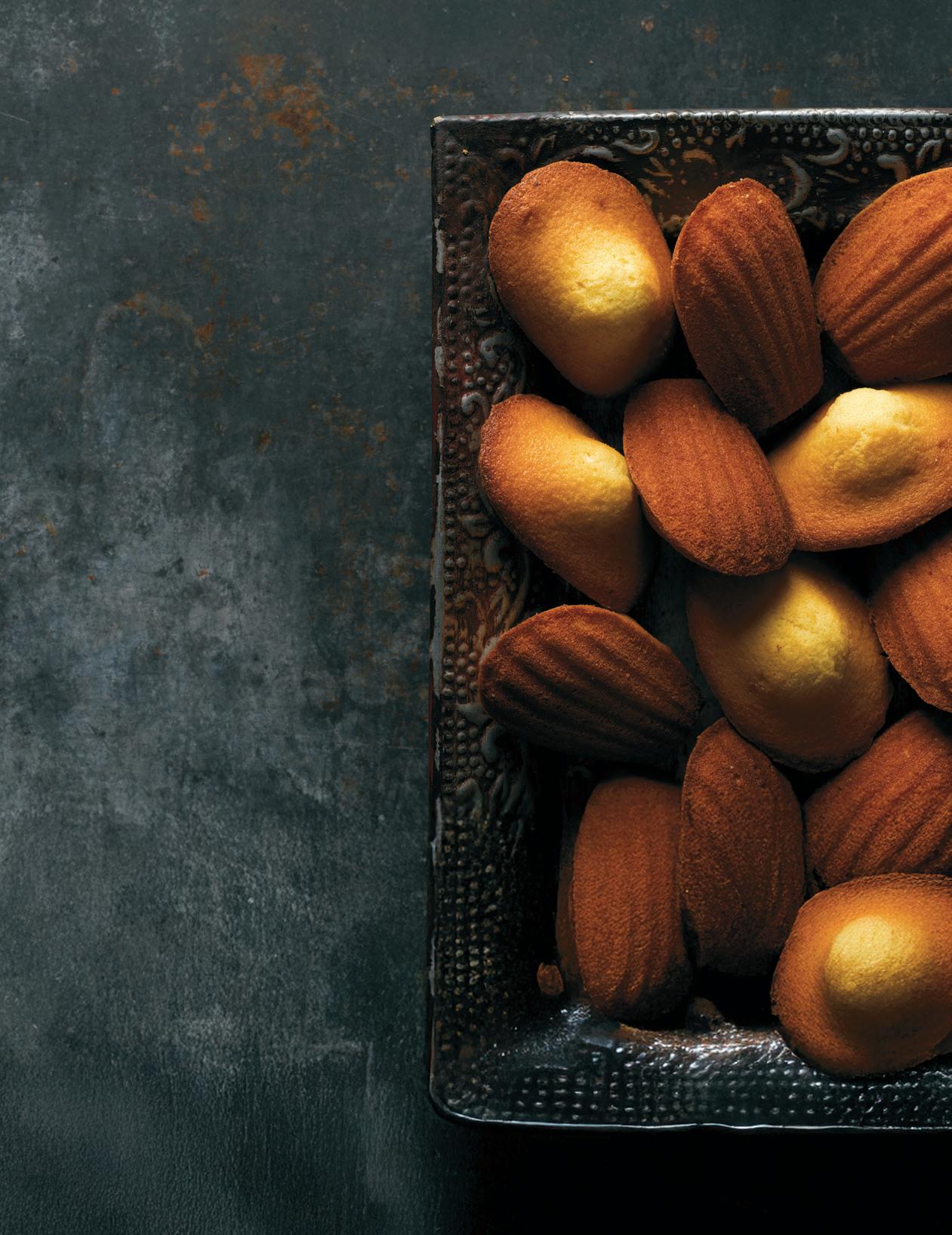
The basic recipe’s composition is very much like a pound cake, almost equal parts butter, sugar, eggs and flour. They are defined by the seashell mold used to bake them, but a mini muffin tin works too.
Fresh out of the oven they are a study in contrast: crisp edges with a buttery ethereal interior. They can disappear in a bite. Their classic perfume is vanilla. Lemon, orange and mandarin zest also present top options.
Even if the French hold them as part of their identity, they were originally created for an exiled Polish king in the 18th century. In Spain, shaped more like a mini muffin, they are part of every breakfast and are called Magdalenas.
In Paris, as in the rest of France, they have long been found in most bakeries but, like fashion, they come back in waves: Right now they are having a moment of their own—of a non-Proustian variety, though those may be involved.
Social media is riding an explosion of madeleine posts, as spots dedicated entirely to the mini cakes are cropping up.
Chocolate mini madeleines
This version is the perfect ending for a meal. Serve with fresh raspberries and espresso. If you like a deeper chocolate flavor, fold in some chips.
4 eggs
1 egg yolk
125 g (½ cup) sugar
125 g (1 cup) flour
40 g (1/3 cup) cocoa powder
Pinch of salt
125 g (½ cup) butter, melted and cooled
Whisk eggs, egg yolk and sugar until soft and trebled in volume.
Sift flour, cocoa powder and salt; fold them into the batter.
In a separate bowl, combine about ½ cup of the mix with the butter. Fold into the remaining mix.
Refrigerate for 1 hour before baking.
When ready to bake, preheat oven to 350ºF and prepare molds.
Divide batter into molds and bake for 5 minutes, or until firm to the touch or thoroughly cooked. Allow to cool in pan, and serve.
Makes 36
Right now madeleines are having a moment of their own— of a non-Proustian variety, though those may be involved.
Those include Le Comptoir at the Ritz, which arranges them in boxes with bright glazes and fruit compote or cream fillings, drawing long lines, day and night.
More understated—yet technically flawless—versions are available at Le Comptoir de Madeleine, or the very trendy Mado à Paris.
You can also find them at Proost Coffee Shop et Bar à Madeleines with all sorts of Instagram-ready toppings.
The basic recipe is super simple. All you need is a bowl and a whisk. I like to brown the butter for extra flavor. A little baking powder is not indispensable but helps with consistency.
One important step is to refrigerate the batter for an hour and up to a couple of days before baking. That—and a well-buttered mold—are fundamental in getting the nice tall bump that differentiates the ideal madeleine.
Experimenting beyond the classic with different herbs, spices and flavors proves rewarding. I love cardamom with orange. Basil, lavender, cinnamon, orange blossom water, rose, violet, Earl Grey tea or matcha can also elevate the experience. Seeds like black sesame or poppyseed, nuts like hazelnut, pistachio or almond can go on top or nestle inside.
The classic seashell-shaped mold is easily available online; you do need to butter and flour it before each use. Getting a nonstick version that only needs a light veil of melted butter makes things easier. Metal rather than silicone helps achieve a crisp crust.
Glazes provide a simple and effective way to add flavor and appeal. To prepare a basic glaze, simply mix strained citrus juice or fruit purée—such as raspberry or passionfruit—with powdered sugar until it reaches a light consistency. That also helps lock moisture in.
If you glaze them while still warm, you will get a lovely opalescent thin layer; if you wait until they are cold, you can get a thicker and more elegant finish, a good backdrop for flowers or other details.
A delicious addition can be a dip in chocolate, maybe with chopped nuts for bonus contrast, texture and flavor. Madeleines are a blank canvas, a wonderful little gift.
Holidays and special occasions present a perfect opportunity to create memorable food moments for the next generations. Have the kids pitch in when cooking, while tasting and sharing their opinion—perhaps experimenting with a simple recipe like a madeleine and making it their own with personal twists.
It may just become part of their identity.
Reminder! Creating transportative food memories does not have to include madeleines.
For my son and me, it is all about chocolate mousse, with olive oil and salt. The first time we had it we couldn’t stop talking blissfully about nuances, texture, origin and flowery taste notes.
Wherever he goes, if there is chocolate mousse, he asks for olive oil and salt and starts a revolution at the table. He lives on another continent now (in London), but I always love his calls to describe the olive oil–sea salt results in great detail.
That’s what having a madeleine moment is about. Food can be eaten and disappear in an instant—what remains are the feelings we have around it.
Analuisa Béjar loves exploring flavor as the chef at her Sunny Bakery Cafe in Carmel Valley. A native of Mexico City, she’s gone on to become an award-winning writer, editor, food critic, recipe developer and culinary teacher.
inauthentic detroit-style pizza
Inside Sante Adairius Rustic Ales Portal 1315 Water Street, Santa Cruz bookiespizza.com
Vanilla madeleines
This is a basic recipe that welcomes many flavorings. Add lemon or orange zest, a pinch of spices or herbs. Honey and milk contribute moisture and help keep them soft for a longer time.
Recipe is in grams for precision; you can multiply or divide it easily.
To prepare the madeleine pans, butter and flour lightly. If you have a nonstick pan, just a touch of butter works.
260 g (1 cup plus 1 tablespoon) butter
4 eggs
160 g (¾ cup) sugar
1 tablespoon vanilla extract (paste, or pulp from one bean)
80 g (4 tablespoons) honey
80 g (1 3 cup) milk
260 g (2 cups) flour
2 teaspoons baking powder
1 pinch salt
Melt the butter over medium heat and cook it while stirring until lightly browned; allow to cool.
In a medium bowl, whisk eggs with sugar and vanilla until even in color and the sugar is dissolved.
Mix in honey and milk.
Sift flour with baking powder and salt. Add into bowl, combine until smooth.
Refrigerate for at least an hour and up to two days.
When ready to bake, warm oven to 360ºF.
Place mix into mold; bake for 8 minutes, or until madeleines have a bump and are lightly browned.
Allow to cool in pans, and serve.
You can finish them with melted dark chocolate and chopped pistachios.
Makes 30
Unearthed Wonders
Tucked next to San Benito County and Salinas Valley, the Benitoite Mining Co. makes treasure hunting real
Story by Ryan Masters
Photos By Kelly Rose Evans
Do-it-all mine staffer
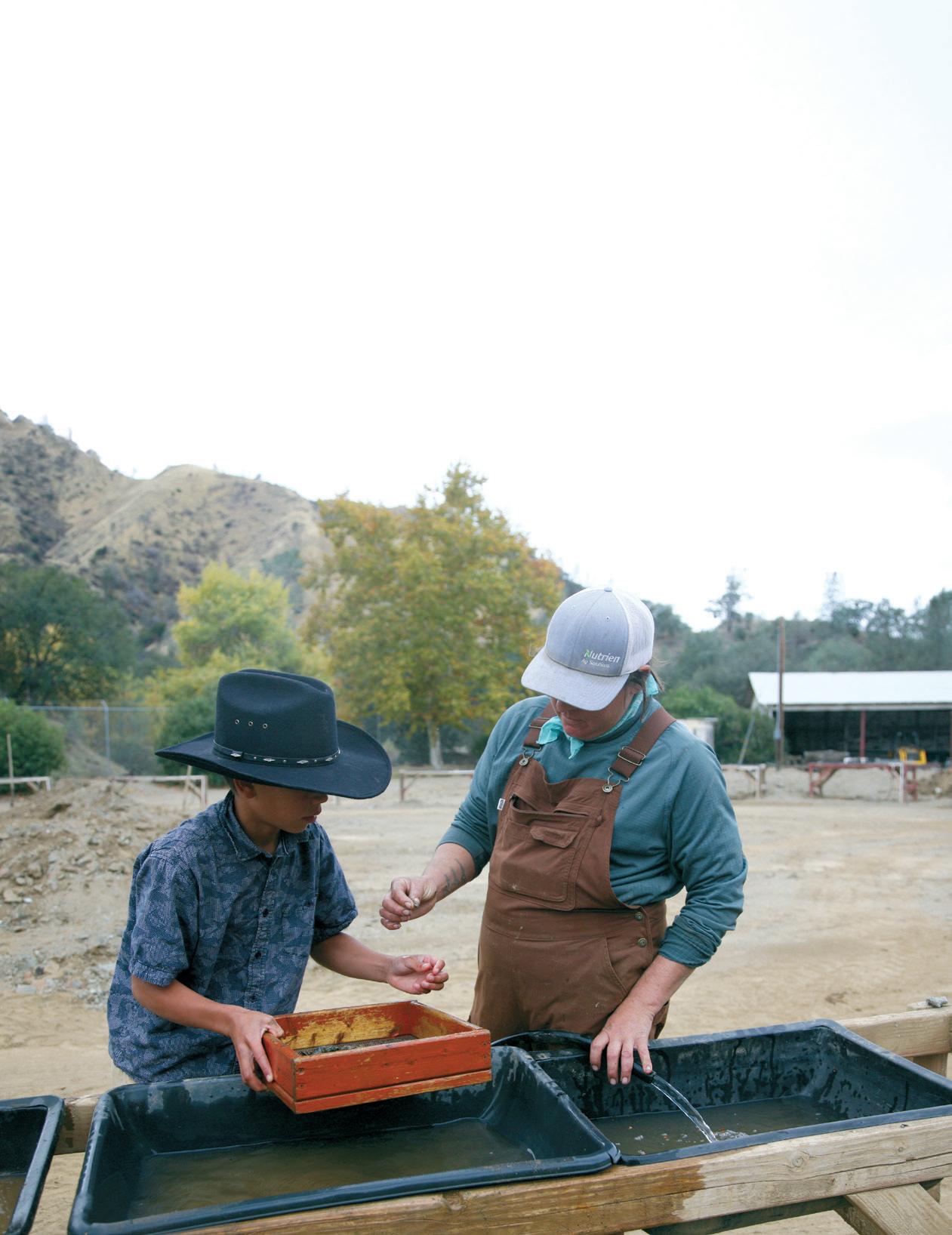
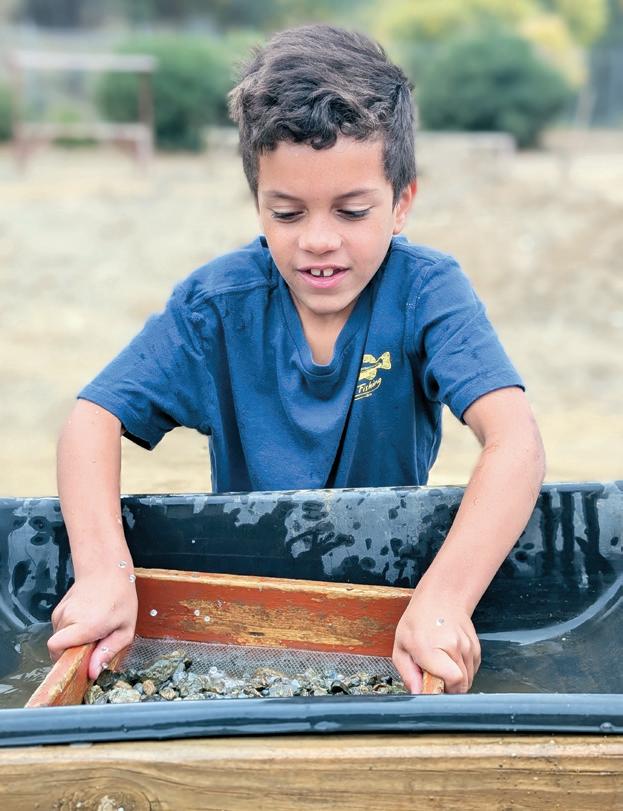
Monica Morris helps a young gem hunter identify a small piece of benitoite after leading him through the multipart process of panning and rinsing.
The serpentine barrens of San Benito County divide Monterey County’s Salinas Valley and Fresno County’s San Joaquin Valley. This harsh and surreal landscape in the southern Diablo Range was formed 135 million years ago when the earth folded and pressed itself into unique geologic deposits.
Over the last century, the resulting terrain has yielded more than 20 never-before-seen minerals, yet none qualifies as more dazzling and valuable as benitoite (pronounced beh-nee-TOW-ite), California’s official state gem.
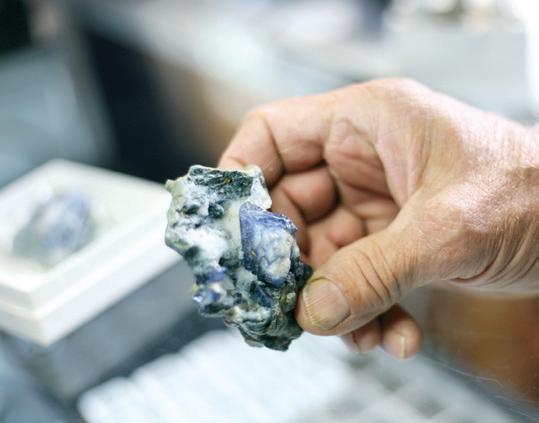
It’s a sapphire-blue jewel with hints of violet that magically fluoresces beneath ultraviolet light.
Never heard of benitoite? You’re not alone.
It remains a well-kept secret. Rarer—and more valuable than diamonds, emeralds or rubies—gem-quality benitoite is worth roughly $8,000 a carat.
Although the mineral itself can be found in Montana, Australia and Japan, the good stuff only occurs here, in this little-known part of California.
Yet today, thanks to an intrepid truck driver and his son, you can find gem-quality benitoite without venturing too far into this dangerous—and awe-inspiring—country.
Editor’s note: Often it’s good to tread new territory. That happens here, as EMB enlists an uncommon writer, reporter and swamp rock singersongwriter to share a revelation that doesn’t have much to do with food and drink, but evokes the type of exploration central to our mission.
CLEAR CRAZINESS
The roughly 56-square-mile section of San Benito County now known as the Clear Creek Management Area constitutes one of the world’s largest serpentine deposits.
That greenish rock gains its name for its snake-like patterns and has a waxen feel. It also contains a naturally occurring asbestos that can pose a health risk for miners, off-roaders or anyone else kicking up dust in Clear Creek.
Due to these concerns, the Bureau of Land Management (BLM) requires permits for entry, restricts access to main roads and advises visitors to take precautions to reduce dust exposure.
Make no mistake: Clear Creek is a bizarrely beautiful, yet forbidding destination.
Its lunar slopes resemble abstract art painted in reddish ochre, faint green and cream hues. Outcroppings the color of dirty blood jut imperiously over steep canyons. Stubborn stands of ghost pine and patches of scrub brush cling to toxic soil.
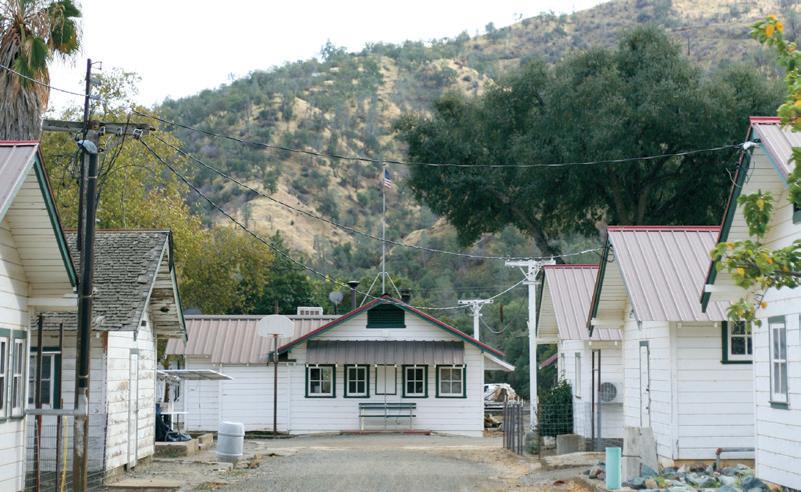
At the converted labor camp, $10,000 specimens of the state jewel await in the orientation office—and a burly buffalo helps distinguish the destination.
“Sometimes you find your best stone in your first screen, sometimes your last.”
Other than scorpions, rattlesnakes and carrion birds, most wildlife is conspicuously absent in the barrens.
What’s more, the region is difficult to hike and its roads are nearly impossible to traverse without four-wheel drive. Infamous 19th century bandits such as Tiburcio Vásquez and Joaquín Murrieta are rumored to have holed up here.
Yet the area’s porous, sponge-like soils effectively drain all moisture into a system of creeks that flow year-round, projecting wild colors from their undrinkable waters: bright-green jadeite, startling red cinnabar, kaleidoscopic plasma agate, bonewhite magnesite.
It’s a place unlike any other on Earth.
PRECIOUS DISCOVERY
In early February of 1907, an inexperienced prospector and failed melon farmer named Jim Couch set out into the serpentine barrens north of Coalinga.
Staked with $50 worth of supplies and a horse by mining speculators Roderick Dallas and Thomas Sanders, he wandered for more than two weeks, scanning the eroding hills around the headwaters of the San Benito River for mineral deposits.
Couch was on the lookout for cinnabar, a source of mercury. The New Idria Mercury Mine, located 13 miles to the north of where Couch was exploring, had been claimed 50 years earlier and was on its way to becoming the second-most-productive mercury mine in North America.
Dallas and Sanders were hoping their $50 investment might yield another
source of the valuable element, which, at the time, was used extensively in a wide array of industrial processes, medicine and scientific equipment.
On Feb. 22, Couch camped in a forest glade near a small tributary of the San Benito River, and set out on foot to look for promising outcroppings. On his way up the slope opposite his camp, he wandered into a patch of small, dark-blue hexagonal crystals.
At first, Couch thought he’d stumbled into a field of sparkling diamonds or sapphires. Elated, he hurried back to Coalinga with specimens.
Dallas and Sander were impressed, but when jewelers couldn’t identify the unique gem, their euphoria turned to puzzlement.
Not until Couch’s gems reached the lab of Berkeley geologist George Louderback were they identified as an entirely new discovery.
The glittering blue crystals were softer than most sought-after gems—6.5 on the Mohs scale of hardness (compared to a diamond’s 10)—but they had a world-class refractive index, or “sparkle.” In a nod to the area where it was found, Louderback named the gemstone benitoite.
For the next three years, Couch and his benefactors mined benitoite. Before long, they realized the mine wasn’t going to transform them into the next Rockefellers. The gem was not only scarce, it was difficult and time-consuming to extract.
Not that there wasn’t interest. Shortly after the initial discovery, Tiffany & Co. offered to sign an exclusive deal to sell benitoite, but ultimately deemed the stone too rare to market.
“It’s
In 1910, the Dallas Gem Mine, as it had been dubbed, was shut down.
5970 San Felipe Rd. Hollister
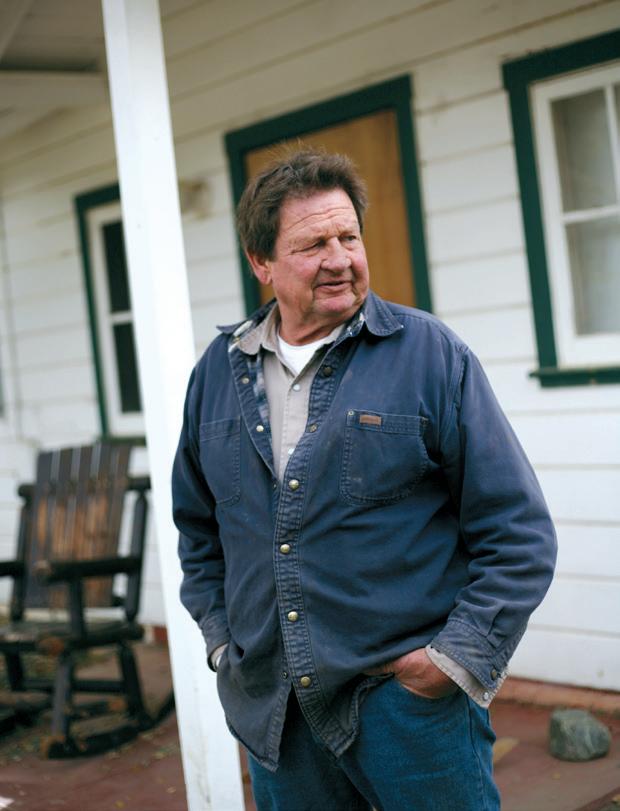
Dave Schreiner welcomes families to the property with country-fried wit; benitoite pops under UV light in the dark room; and young seekers are encouraged to shake with oomph.
not your grandma’s china!” Monica Morris says.
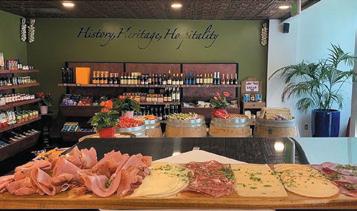
History, Heritage & Hospitality
Are Served Daily
GOLDEN STATE GEM
Over the next 75 years, the Dallas family leased the mine out to various operations. While the mine never made anyone wealthy, the large amount of specimens and rough gem material extracted over the years made benitoite a must-have among collectors and a challenge for adventurous jewelers.
Elvis “Buzz” Gray and Bill Forrest leased the mine from 1967 to 2001 and probably did the most to raise awareness of benitoite. In 1985, they were among the driving forces behind the California legislature naming benitoite as the state gemstone.
Gray and Forrest bought the mine from the Dallas family in 1987 and, over the next 12 years, the property was expanded, tested and mined.
In 2000, they sold the mine to a group out of Colorado, which operated a processing plant. Four years later, the company considered the mine no longer commercially viable and sold it to a truck-driverturned-machinist from Coalinga.
NEW DIRECTION
As a truck driver hauling loads through the Central Valley in the 1980s, Dave Schreiner fell in love with the history, beauty and geology of the hills outside of Coalinga.
In 1992, Schreiner bought a compound of deteriorating buildings roughly 10 miles south of the gem mine. The structures, which included barracks and a large dining hall, were built in 1940 to house 300 California correctional department inmates.
At the outset of World War II, this incarcerated labor force was tasked with transforming the wagon trail that led from Coalinga to Clear Creek into a road that could support large government ore trucks. After the state closed the camp in 1955, it became a CAL FIRE base before housing the California Conservation Corps.
Throughout the 1990s, Schreiner began the slow and arduous process of renovating the structures into a compound for his new family. But benitoite was never far from his mind. He continued to prospect around Clear Creek, hoping to find another source of the gem, but found nothing.
So when the Benitoite Gem Mine came up for sale in 2004, he leapt at the chance.
MINE-FULLNESS
Dave Schreiner’s son John was in high school when his father purchased the Benitoite Gem Mine. Knowing that they didn’t have the manpower to work the mine full time, Dave Schreiner decided to offer a “fee digging” operation. Members of the public could pay to sift through the benitoite-rich dirt outside of the mine and keep what they found.
At first, they met customers at the mine, but that proved to be a logistical hassle and security risk. Driving to the mine required customers to navigate a confusing cobweb of roads. People often became lost or stuck en route. Plus, there was no way to monitor the mine remotely or keep trespassers out. The Schreiners would often arrive at the mine to find their “No Trespassing” signs riddled with shotgun holes.
When the BLM closed the Clear Creek Management Area in 2008 to study how much danger the asbestos posed to the public, that proved to be the last straw. The Schreiners shut down their on-site feedigging operation and re-evaluated their business model.
Today, Dave Schreiner (now 68) and John (34) haul dirt in dump trucks from the Benitoite Gem Mine’s grounds to be processed at the family’s road-camp compound, which they’ve renamed the Benitoite Mining Co. Now anyone willing to pay can experience the thrill of finding benitoite without risking life or limb to get there.
For a fee ($140/adults; $75/children 12 and under), benitoite hunters can spend the day sifting through a pile of the mine’s dirt for the small triangular gems and larger specimens, which occur in white natrolite, a calcium-based mineral found in the light-blue schist.
The Schreiners provide handheld shaking screens to separate the blue schist, natrolite and crystals from the dirt as well as convenient wash tables, but it’s still a hard day’s work, especially in the summer. To make finding the fluorescent
Liquid Treasure
“Benitoite” is also a rare find of a wine to mine This earthy creation, from Stirm Wine Co. of Watsonville, has much to recommend it.
The inspiring elements include a young visionary winemaker (Ryan Stirm), small-batch production (416 cases) and an uncommon blend of organic and dry-farmed varietals, starting with Cabernet Pfeffer (and fruit from 120-year-old vines).
Plus a specific identity of place, like the jewel it’s named for, as Stirm writes on his website: “This wine is a varietal ode to the ‘holy trinity’ [of] Cabernet Pfeffer, Negrette, and Zinfandel which played all have played an important historic and current role in San Benito viticulture.”
Stirm and his team pick the grapes for the blend, by hand, at six separate harvest dates—like they’re plucking jewels from nature.
More at stirmwine.com.
C. Anderson
benitoite easier, the Schreiners converted one of the road camp buildings into a black-light room.
Dave Schreiner’s sun-worn face has begun to take on the look of ochre-colored serpentine barrens, but his eyes remain gem-bright when he talks benitoite.
Most everyone finds something, he notes, estimating one in 20 find a stone with “pretty good’ value to it—even the smallest stones can be worth between $90 and $160. The trick, of course, is knowing the indicators and finding something good, but it takes some doing.
“Sometimes you find your best stone in your first screen, sometimes your last,” he says.
NEXT DEPTH
Shortly after the Schreiners bought the mine, a rumor began to spread that it was totally depleted. Yet father and son insist that plenty of benitoite remains.
Jim Couch’s original discovery in 1907 consisted of a 60-meter pipe of benitoiterich blue schist. That pipe of material was completely mined out over the past century. However, an unknown amount of benitoite remains in the loose soil around the mine.
“Everything we’ve ever dug is off the top of the ground,” John Schreiner says. “And every load still has a lot of material in it.”
And some loads still contain jaw-dropping discoveries. In August, while customers sifted dirt at the Benitoite Mining Co., Schreiner sauntered up to the pile and plucked a magnificent specimen from it. He estimates the piece, which contains large gems set in the matrix of white natrolite, to be worth roughly $40,000.
“While there’s not a lot of people willing to drop that much money for one specimen,” he says, “there’s definitely a market among gem-and-mineral collectors—people who want to display it in their collections.”
Today, the Schreiners’ continue to make improvements to their historic compound and hope, someday, to expand the Benitoite Mining Co. into a campground with cabins and RV hookups.
“We want to keep a family-friendly vibe up here,” John Schreiner says. “That’s kind of what it’s all about.”
For more information and to make a reservation, visit benitoitemining.com or call 1-833-GEM-HUNT. The Benitoite Mining Co. is located at 48242 Los Gatos Road, Coalinga.
Ryan Masters is a writer, musician, big wave bodysurfer and firefighter from Santa Cruz. Discover more at ryanmasters831.com.
—Mark
ON THE FARM
Flower Empowered
Fog City Farms stands out in a crowded cannabis market with a local focus, slick design and fresh product
for indoor
cultivation, including conditions engineered
Story by Kera Abraham
Photos by Mark C. Anderson
James Cunningham (right) leveraged his construction skills and scientific curiosity to design smart systems
cannabis
to mimic the seasons.
“Some people just want the THC, and some people want the entire experience.”
Inside a warehouse in the industrial flats of southwest Watsonville, hundreds of waist-high plants reach toward low, cool LED skies. The whirring fans force James Cunningham and me to shout at each other like we’re in a crowded nightclub. He’s showing me the vertically stacked racks of cannabis in a room the size of a pickleball court. The muggy air smells like wet earth and chai spices.
Light-emitting diodes revolutionized indoor growing, Cunningham says, and his team pushed their efficiency even further.
“We figured out we needed to lower the LEDs above the canopy to get the right light intensity,” he yells. “Once we did that, we saw all this empty vertical space. So we started looking into multi-tier racking—and eventually made the racks mobile.”
He spins a wheel and one of the tiered racks glides to the right, creating an aisle between the crop rows. Cunningham says his company, Fog City Farms, was the first to use mobile racking systems in cannabis cultivation.
Fog City isn’t a farm in the traditional sense; it’s a high-tech, ultraefficient operation spread across three Watsonville warehouses. But when I ask Cunningham what makes his brand stand out, he describes a “farm-toneighbor” experience: local, high-quality cannabis grown by people who live here, sold to people who live here.
I ask Cunningham (at a normal volume—we’re outside now) how a small, family-run business like his can survive in a collapsing market. He takes a wide stance and spreads his fingers:
“We stay small, stay fresh and stay true to the local community.”
Cannabis has rooted in California soils for more than two centuries. As early as 1795, Spanish colonizers at the missions— which were controlled by Franciscan priests and the Spanish military— forced Native peoples to cultivate in-
dustrial hemp. A century later Southwest Asian immigrants started growing the psychoactive variety here, to make hashish.
After the state legalized medical marijuana in 1996, 3.5-gram packages sold for around $50. Twenty years later, when California legalized recreational use, the price was about the same. Today you can often find 3.5 grams of flower for $25.
The current chapter in California cannabis history is marked by a mainstream, flooded market. Illegal growers who evade pesky regulations, coupled with industrial-scale producers who crank out cheap product, are squeezing out small growers.
“It’s a very difficult environment regionally for small farmers,” says Sam LoForti, Santa Cruz County's cannabis licensing manager. “Access to retail space—getting your product on a shelf—is more and more difficult as the market continues to contract.”
As Cunningham puts it: “We’re like crabs in a bucket, trying to find our way out.”
Some dispensaries operate like liquor stores, selling items with no more backstory than Hot Cheetos. Others offer curated experiences, with “budtenders” who can tell you how, where, when and by whom the products were grown—and their terpene profiles, chemical compositions, flavor notes and likely effects.
“Some people just want the THC,” LoForti says, “and some people want the entire experience.”
Cunningham is counting on the full-experience people. “For us, small-batch is survival,” he says. “We can’t outgrow or outspend anyone. But we can outfresh them.”
To out-fresh them, Cunningham runs Fog City like a neighborhood bakery: small batches, rapid replenishment.
Every two weeks the team harvests a crop of flower from one of three climate-controlled rooms, each of which mimics the outdoors in a different season. The bright room with the loud fans was a hot, sticky summer day; a dark room next to it was a crisp, dry autumn night.
Fog City’s two-tier set-up maximizes space and air-flow.
Amy Cunningham (opposite left, with sales/marketing chief Sunny Winkleman) notes, “This industry is changing constantly. We have to ride the ups and downs of the rollercoaster pretty much daily.”
“We aim to sell it within three weeks of harvest, and it’s ideally consumed within eight weeks of packaging,” Cunningham says. “After that, terpenes degrade and you lose flavor and freshness.” It’s the difference between August and January tomatoes.
The growing space itself is another innovation. Cunningham’s tiered racks let him double the vertical density of the crop—but it posed a new challenge: Stacking plants vertically traps heat and humidity, causing mildew and rot. He had to solve for airflow.
Cunningham, with a background in engineering and construction, designed his own solution. In 2017, he founded a company to market the in-rack airflow system. He says Vertical Air Solutions products are now moving wind through more than 3,000 grow rooms worldwide.
He also leveraged another upright strategy: vertical integration, controlling Fog City’s supply chain from seeds in the warehouse to sales at their Soquel dispensary.
Cunningham’s two-acre warehouse operation employs over a dozen people for cultivation, drying, processing and trimming. Each plant gets individual attention, like grapevines in a vineyard. The outcome is an artisanal bud with a backstory.
“We stay small, stay fresh and stay true to the local community.”
Corporate cannabis dispensaries can have a minimalist, Apple Store vibe—gleaming surfaces, backlit display cases, products arranged on floating shelves.
“Sometimes walking into a dispensary can feel intimidating,” says Amy Cunningham, James’s wife and business partner. “We really want people to walk into our shop and have it feel comfortable, warm and inviting.”
The walls of their Soquel Village dispensary, the Fog Bank, are hung with photos showing their crop and the people who produce it—from the cultivation technicians to the processing crew and budtenders. Amy designed the small space to feel homey among the surrounding restaurants and antique shops.
The name itself is a nod to the Cunninghams’ home zone. Fog City describes the region from Big Sur to San Francisco, a stretch often blanketed by a cool, hazy marine layer. James and Amy were both raised in Santa Cruz and grew up breathing the sea-fresh vapor that can both create the conditions for
mold and produce exquisite flavors.
Only about 50 acres of cannabis are grown legally in unincorporated Santa Cruz County, LoForti says—barely registering alongside 2,640 acres of strawberries, 1,790 acres of apples and 600 acres of wine grapes. But cannabis, like wine, is part of the region’s agricultural identity.
“People choose to imbibe on different things,” he says. “Cannabis can be paired with food just like wine can be.”
He points to the county’s terroir: geologically young soils with readily available nutrients, and of course the fog. Outdoor cultivators are developing strains specific to these conditions, rich in terpenes that create distinctive flavor profiles. They’re also using horticultural methods like hügelkultur—building soil with rotting logs and debris—and removing naturally occurring metals from their land.
“People have done the work to plant in the soil in this county,” LoForti says. “The uniqueness of Santa Cruz County crops comes from the dirt they’re grown in, and our climate.”
At Café Guaraní, every empanada is handmade with love, tradition, and rich South American flavor. Enjoy gluten-free, vegan, and classic varieties, paired with our signature yerba mate or spiced mocha. Discover the heart of Paraguay in every bite.
Empanadas with Soul
Opens at 8am daily
For struggling growers, staying local and legal is the high road. California’s licensed cannabis growers pay for compliance, permitting and taxes—all costs illegal growers evade.
Even within the legal market, retail dynamics work against small growers. LoForti says big chain dispensaries often push older or more expensive inventory first, burying fresh local products. “The business model matters,” he says.
As other small growers give up, Amy’s proud that Fog City is still standing. “This can be a very unforgiving industry,” she says. “We feel very lucky that we’re still hanging on with the support of our family, friends and the community we love.”
There’s reason for optimism: Last spring, Santa Cruz County became the first in the nation to allow cannabis lounges at dispensaries. The county also allows retail sales and consumption at farms. In other words, you can now visit a local pot farm, buy the crop directly from the farmer and then stay on the farm to smoke it.
“The whole point of going to the farm is you want to look at the flower, you want to smell it and you want to taste it. Just like a winery,” LoForti says.
At The Fog Bank in
Amy cultivates passionate staff and educated customers who appreciate the value of local flower.
It’s the entire experience—not just THC, but the story, the flavor, the freshness.
Thanks to the county’s new ordinances, visitors to Santa Cruz County may soon be able to tour a cannabis farm, buy a bag of flower, then stay for paired tastings with food and drink. In Monterey Bay’s farm-to-table culture, cannabis can take its place beside local wine.
The afternoon fog rolls in from the bay, and James Cunningham heads to his next meeting. While larger operations chase trends like vape oil and THC soda, he’s keeping his focus simple: fresh cannabis flower for neighbors who value its provenance.
“We just want to keep doing what we love, in the place we call home,” he says. “That’s enough.”
Kera Abraham is a Seaside-based writer, community advocate and communications consultant. Her winter aesthetic includes quality wool, slow-cooked stew and magnetic nail polish.
Soquel Village,
taste your way through carmel-by-the-sea’s vibrant food & wine scene with more than 60 restaurants and 18 wine tasting rooms. get inspired at carmelcalifornia.com or scan to learn more.
Two-Star Michelin Chef Justin Cogley, Aubergine Restaurant
Unforgettable Serve
Aged even more Aged
Made with care
Crafted in Spain
THE EXCELLENCE OF EUROPEAN D.O. CAVA AND JAMÓN CONSORCIOSERRANO
Crafted in Spain, perfected by time
In a world that often prioritizes speed over substance, there remains proof that good things, and excellent taste, take time. D.O. Cava and Jamón ConsorcioSerrano are two such treasures, each representing a unique blend of Spanish tradition and taste created with time and perfected over centuries.
Cava has earned its place among the world’s finest sparkling wines, yet it remains wonderfully versatile. Whether paired with a simple salad, a casual meal or a celebratory toast, Cava brings a touch of elegance to every occasion. What makes Cava de Guarda Superior unique is that it is produced using the traditional method where secondary fermentation occurs in the bottle.
This meticulous process, lasting a minimum of 18 months, is carefully overseen by the D.O. Cava regulatory body, ensuring that each bottle upholds the highest standards of quality and authenticity. Made from organic vineyards that are over 10 years old, Cava de Guarda Superior reveals its craftsmanship with every pour. As the delicate, harmonious bubbles rise to the surface, you can truly appreciate the time and care it took to perfect them!
Similarly, Jamón ConsorcioSerrano is more than just a drycured ham. This exquisite product is made using traditional
curing methods which takes a minimum of 12 months to deliver a delicate and rich flavor. Each production is upheld to the rigorous standards of the Consorcio del Jamón Serrano Español, which ensures that every piece of Jamón ConsorcioSerrano bearing the seal is of exceptional quality. Like Cava, Jamón ConsorcioSerrano is not merely an accompaniment to festive tables; it is a versatile delight that can elevate everyday meals with its complex flavors and delicate texture.
Both Cava and Jamón ConsorcioSerrano are perfect examples of how time-honored craftsmanship, underpinned by the European Union’s commitment to quality and tradition, creates products that are unmatched in their category. They are not just crafted in Spain; they are perfected by time, offering a taste of excellence that is both accessible and extraordinary. Whether enjoyed on a special occasion or as part of your daily life, Cava and Jamón ConsorcioSerrano bring the best of Europe to your table.
Learn more on our website
Cavallo Point
A place tucked under the Golden Gate unlocks more than most anticipate
Story by Amber Turpin
by Kodiak Greenwood
You could throw a rock off the end of the Golden Gate Bridge and hit Fort Baker, but it’s a place you wouldn’t know existed simply by driving over the iconic overpass.
At least I didn’t.
I had heard for years about Cavallo Point, full name “Cavallo Point: The Lodge at the Golden Gate,” the renovated hotel and spa within historic military buildings at Fort Baker.
But for some reason I never put a place to the name, as-
suming it was in some obscure location in Marin County.
That somewhere is at the very toe of the Golden Gate, accessed via the first exit once you cross over heading north.
And while I didn’t yet know about this little pocket of seaside adventure, many folks do—and have, for generations.
My visit, on the invitation of the operators, was full of a lot of this kind of learning: discovering something new to me, yet well-worn and loved by many.
Which is some of the best kind of learning there is.
Photos
Cavallo Point partners with REI on Golden Gate-centric kayak and e-bike tours.
If you have been to the Presidio of San Francisco and noted the refurbishments and renovations on that property, then Cavallo Point Lodge will feel familiar, if a bit more contained.
FOUR WINDS GROWERS
Growing and Shipping since 1949
California’s Premier Citrus Grower
Now offering a large selection of other Ornamental Edibles
Available in leading California Nurseries or at fourwindsgrowers.com
Both places represent a “post-to-park” trend, wherein the United States transfers control of historic military locations to protection under the National Park System (NPS), and in this case, the former 1905 U.S. Army post, Fort Baker, now being part of the Golden Gate National Recreation Area (GGNRA).
Cavallo Point includes more than 25 buildings, including old barracks and officers quarters, set around a wide-open grassy area and Horseshoe Cove harbor, with views of the city and sea beyond.
The former parade grounds and structures are populated by many—often for dog walking, drone flying, picnicking and strolling—yet at the same time feel quiet and solitary.
While similar in concept to the Presidio, Cavallo Point Lodge is singular in immersion once you’ve checked in.
The front desk guy who welcomes me says that, “Even when the city is socked in with fog, this pocket of the bay is often sunny.”
He tells me to come back to the lobby for the daily wine reception, which I do, and find four different regional wines, including a North Coast Pinot Noir and a Napa Cab.
In the morning the same area serves coffee, tea and a wide array of breakfast treats, like mini-pastries and blueberry muffins. Either time of day the move is to take your beverage out to the wide front porch and sit in one of the many cushy rocking chairs that line it, taking in the views and the vibes.
As front desk guy conveyed, the sun cracks through the fog in the late afternoon and it’s spectacular—although foggy weather lends to cozy times in the two restaurants onsite and the updated, comfortable rooms.
If you’ve ever been lucky enough to stay at the coastal crown jewel Post Ranch Inn in Big Sur, then you may feel another sense of familiarity here at Cavallo Point.
Mike Freed is co-founder and managing partner of Passport Resorts LLC, the company that owns both Cavallo Point Lodge and Post Ranch Inn.
The cluster of contemporary rooms, set in two-story structures along the upper hillside of the property, evoke the same luxurious design and feel as Post Ranch.
Giant textured bath sheets, handcrafted furniture, and lavender- and eucalyptus-scented organic body products indicative of the onsite scenery and scents are all intentional touches that don’t go unnoticed. Green credentials are equally robust here.
There are also a number of historic lodging rooms, set within the whitewashed buildings around the center of the
property. These feature Colonial Revival aesthetics and turn-of-the-20th-century details, updated with modern touches.
There is also a mercantile with local goods and curated clothing across the hall from the lobby area, a fitness center in a former barrack with a fleet of Pelotons, the walls dotted in black-and-white photos of times past when these were populated with soldiers.
They even have house Lexus cars that guests can take “test driving,” all gassed up and pre-paid for the Golden Gate toll if you want to cruise to the city.
If you ever find a blank space in your schedule here, you can take part in a variety of activities and events, such as watercolor classes, stand up paddleboarding,
Cavallo Point has been a member of Historic Hotels of America since 2009, and nestles into the Golden Gate National Recreation Area, one of the largest urban national parks in the world.
kayaking, morning yoga and a variety of hikes. Non-guests can sign up for many of these offerings for a very reasonable fee.
Since I arrived a bit early, before heading out for some exploring I decide to grab a bite of lunch at Farley, the casual bistro onsite that offers an all-day menu. This is one of two restaurants at the hotel, with a comfy tavern ambiance, alongside a long marbletopped bar and mirror-backed booths.
My giant crab cake is moist and generous, scattered with pickled mushrooms and edible flower petals, all atop a dill remoulade sauce. I make note of the long drinks list, featuring elevated cocktails like the creamy International Orange with carrot juice, gin, St-Germaine and a hint of dill; and the Post Ranch Margarita, a nod to the sister property.
Satiated, I set out on foot to explore the area, walking across the street to where some signposts mark a variety of routes. If I had chosen to turn left, I would have reached the Sausalito ferry landing in about two miles (there’s also a free shuttle).
I veer right, finding myself below the Golden Gate in under five minutes, next to Moore Road Pier, a no-license fishing and crabbing destination.
Cutting over and across the small marina shoreline, with a public ramp plus kayak and boat rentals, I skirt up the Battery Yates trail, a short but steep incline to the Fort Baker armaments, built in 1897 atop the bluffs, with a sweeping overview of the entire waterfront.
This overlook offers a 360-degree view of Sausalito, Alcatraz, the Golden Gate and all the sailboats dotting the bay. It is an epic viewscape to take in, and all set atop old armory buildings that feel like a Star Wars set.
This armory was, in fact, used by the U.S. Coastal Artillery, in service from 1905 to 1946. Today, it’s a great hiking trail and a good place to spy on birds, harbor seals, sea lions or the endangered Mission Blue butterfly and its host plant, silver lupine.
Along my walk, I notice many families and kiddos, which makes sense since this section of Fort Baker along Horseshoe Cove is also home to the interactive Bay Area Discovery Museum. It’s a fun spot that infuses the area with a family-friendly energy.
The small plot also plays home to the Presidio Yacht Club, with the Travis Marina Bar upstairs and the Tamalpais Outrigger Canoe
The Healing Arts Center & Spa Massage specializes in aromatherapy, body treatments and water therapies, among other modalities.
Club boats pulled up right down below. That conjures a throwback atmosphere, right on the water, and a great post-hike spot for a beer.
Old photos line the walls, dozens of flags drape from the ceiling and a nononsense food menu and drink selection stock the bar. A piano sits in the corner, and there’s live music on the weekends, all in efforts toward the Travis Marina public service mission that supports the Air Force, in alignment with the preservation work of the NPS and GGNRA.
“I’m the cook and the bartender … I do it all here,” says Sunday shift bartender Christina, as a steady stream of hikers, tourists and the sailing community come and go. You can get a drink here for less than the bridge toll on the way home.
Which is actually another tenet of the Travis philosophy: “We exemplify a deep ethic to serve people of all generations and walks of life. We keep our prices affordable and the aesthetic tone of our space historic and familiar. This is an institution for the people.”
I head back over to the Lodge for my next adventure, taking place on the second floor above Farley at their very own Cavallo Point Cooking School.
That’s right, there’s also a cooking school here, which is yet another “secret” thing I’m just hearing about.
It’s led by Chef Tim Grable, who was campus director at Le Cordon Bleu College of Culinary Arts in San Francisco for 15 years before jumping across the bridge.
An astonishing array of culinary classes are offered here, mostly on weekends and many times sold out to local participants. Turkey, Rome, Vietnam and Seoul all informed recent cuisines touched upon by Grable and his team.
“Globetrotting is the fun part for me, in terms of the palate,” Grable says.
He goes on to say he’s always open to ideas. For instance, when a recent participant of the India class remarked that the menu was mostly Northern Indian dishes, she is now collaborating with Grable to develop a new class focused on a Southern menu, her native cuisine.
When I walk into the lofty, 1,200-square-foot open kitchen with a long dining table and stations for participants to group around, Chef Grable is there greeting students, pouring the first of several glasses of wine to match the menu.
“Destination: Sicily” is the theme for our class and a small table is piled with regional snacks as we sip a crisp Sicilian white.
Grable tells us that the idea for this class came about when he was watching season two of “White Lotus.”
The Lodge at the Golden Gate’s two dining venues—the casual Farley and more upscale Sula— deliver deliciously on items like seasonal soups and desserts, precision-sourced proteins and a grass-fed burger with smoked mozzarella and caramelized onion on brioche.
“Everything goes straight to food with me,” he says.
As we nibble and sip, Grable begins the class with some knife safety—“because we all have a glass of wine in our hands and I’m about to hand you all a bunch of sharp knives,” he jokes.
He explains the dishes we will be preparing together, we popcorn around the room, from project to project—as opposed to assigned stations—granted a chance to use the mandoline to slice fennel for the salad, chop olives for the caponata, sear filets of halibut for the scarpariello, and even pipe whipped ricotta into cannoli shells for dessert.
“You really want to use all your senses when cooking. How does it sound? How does it look? How does it smell?” says Chef Alexis, a recipe developer and content creator. “I bring a little bit of millennial vibes to the team here.”
We sit down to eat a family-style feast that we took part in preparing, and are friends by the end of the night. Chef Grable must never get sick of seeing the community forming at his workplace, pouring an extra glass of Graci Etna Rosso as we linger.
JULIA’S
My new cooking class friend, Bridget, who sits next to me at the table, says she lives just a few minutes away in Marin but loves coming to this property. She also adds that locals consider the Cavallo Point Healing Arts Center & Spa a gem here. She meets up with her friends, some coming from the city and farther afield, as a lovely meeting place to spend the day.
Hearing this tip, I am thrilled that the same spa offers two hour complimentary passes for all overnight guests, and that my front desk friend encouraged me to book a time slot already. The next morning I enter this two story sanctuary of healing and calm ready for some relaxation, suited up in a luxurious chocolate brown robe that I find in my locker. My guest pass gives access to a large outdoor mineral pool, heated to 98°F (nice in the fog). Similar to the Post Ranch pools, these spaces are intended to be meditative, with signs encouraging quiet conversations and no cell phone use.
A multistory, expansive sitting space with a tall column fireplace and tea bar menu serving a full lunch menu and a wide variety of tea-based drinks makes me see why Bridgit and her friends love coming here.
There’s also a long list of treatments and services available to book, from Shamanic Journeys to Reiki to six different meditation classes. And Integrative Medicine programming too
Thoroughly chilled out, I make a final stop for brunch at Sula. This is the second restaurant at the Lodge, a bit more upscale, Mediter-
ranean-inspired, and known as an elegant dinner spot. I could still see the appeal, even if my daytime reservation did not lead to the Moroccan-spiced grilled lamb on the dinner menu. A roaring fireplace, pressed tin ceilings and glowing globe light fixtures make for a lovely dining setting, even at 11am. Many folks are enjoying their meal al fresco on the porch out front as well.
As I slather whipped butter onto my thick slice of levain toast, I can’t help but overhear a table nearby speaking with their kind server, who knows both guests’ names as regulars, one would assume.
“This always brings back memories for us,” says Samuel. “When I was young and had so much energy I would run all around here!”
Samuel’s wife chimes in.
“And there’s history for us here, because our family was in World War II,” she says.. “I’m glad it’s a National Park, otherwise someone would have come in and torn it all down.”
Indeed, how lucky we all are that wasn’t the case.
Later, I return my room key, reluctantly, gathering myself to depart.
“You sure you can’t stay one more day?” asks the front desk guy, my new best friend. Tempting, but I’ll be back.
Amber Turpin has been writing about food and travel for more than 20 years, mostly perched (when back at home) at a kitchen table in a little house in the Santa Cruz Mountains. She is a columnist for the North Bay Bohemian and Pacific Sun and story editor for Edible Silicon Valley
Cavallo Point offers either historic or contemporary rooms.
COOKBOOK CONFIDENTIAL
Wild Ride
Chef Chad Hyatt shares decades of experience cooking with foraged mushrooms in his new cookbook
BY Deborah Luhrman
It was 5am and still dark when Chad Hyatt packed up his car in San Jose and headed for Lake Tahoe on his first real mushroom hunt.
Someone had accidentally posted the location of a big porcini flush to a foraging chat group. It was the early 2000s and that was already a no-no, but the young chef enlisted a friend and wasted no time getting up there to try his luck.
Thunderstorms in the Sierra had unleashed a mushroom bonanza and Hyatt quickly gathered 10 pounds of pristine porcini buttons.
“Every mushroom we found seemed like discovered treasure,” he says. “That was it, after that I was hooked!”
They made the 200+ mile drive back home the same day, as the passengers were eager to begin tasting their treasures—first making a batch of gnocchi in porcini butter and, later, more elaborate dishes.
Hyatt has been foraging and cooking with wild mushrooms ever since, perfecting the collection of 120 recipes that fill his new cookbook The Mushroom Hunter’s Kitchen: A Culinary Homage to Wild and Cultivated Mushrooms.
The book shows how to use mushrooms in every meal of the day, from Candy Cap Granola Bars for a quick breakfast to Mushroom Ceviche at happy hour and Blueberry Porcini Ice Cream for dessert.
“One of the biggest mistakes people make is thinking of mushrooms as a vegetable,” he says.
Actually, fungi are neither plants nor animals but belong to their own kingdom.
And rather than thinking of them as a side dish, they work bet-
ter combined with other ingredients—and that’s what Hyatt does throughout the book, in a variety of recipes for jams, soups, stews, pasta dishes and hearty entrees.
One of the great things about the book is that you don’t have to be a forager to use it.
Most of the recipes also work with store-bought cultivated mushrooms, and we are fortunate to have a good selection of fungi at Monterey Bay area grocers, as well as the Far West Fungi company store in Santa Cruz.
Mushroom foragers are a pretty geeky crowd and usually passionate gourmets, and Hyatt fits right in. He abandoned a budding engineering career in Silicon Valley to become a chef, studying at the now-closed Professional Culinary Institute in Campbell. He then worked in a number of high-end kitchens, including Madera at the Rosewood Sand Hill hotel in Menlo Park and the Menlo Country Club in Woodside.
In the book he shares decades of deep culinary knowledge about the various types of commercially cultivated mushrooms and common foraged varieties, indicating the best cooking options and preservation techniques for each, because “different textures and flavors require different cooking methods.”
Hyatt frequently forages for chanterelles in live oak forests around the Santa Cruz Mountains with his wife, Rosa Lara-Fernandez, a Spaniard who grew up foraging in the Pyrenees. The couple spends several months of the year in Catalunya and Galicia, and the Spanish influence is evident in some of the book’s recipes.
He also loves to hunt for porcini in winter months on the Monterey Peninsula.
“Monterey is a great place to forage. If it’s the right season you can just go around and pluck porcini from people’s front yards,” he says, admitting he may have done that once or twice.
Another myth Hyatt would like to bust about mushrooms is that you shouldn’t wash them.
“It’s not bad to get them wet,” he says. “Wild mushrooms grow in dirty, muddy spots and I always wash them under water.”
He also washes store-bought mushrooms, because, you know, “they are grown in compost.”
Hyatt has been traveling the country in support of the new cookbook, following the mushroom for-
aging season and making appearances in Vermont, Minnesota, Colorado and the Pacific Northwest.
He’s a sought-after speaker at meetings of specialist mushroom clubs and often prepares dinners for them or offers cooking classes, using the book as a teaching tool.
As our local mushroom season ramps up, he’ll return to California and plans to take part in the Santa Cruz Fungus Fair in January. Look for him as one of the featured speakers and helping prepare the After Hours Dinner, like he did last year.
So plan to meet him there, where copies of the cookbook will be on sale, and loads of wild mushroom lovers will gather.
Deborah Luhrman is an eternal gardener and publisher of Edible Monterey Bay.
MUSHROOM SEASON
Winter represents prime mushroom hunting season around the Monterey Bay Area, especially in wet years. Give it a try or learn more at one of these events.
Santa Cruz Fungus Fair • January 9–11
London Nelson Community Center, 301 Center St., Santa Cruz Includes educational sessions, a vast display of foraged mushrooms in woodland settings and After Hours Mushroom Dinner.
Big Sur Foragers Festival • January 22–24
Big Sur Lodge, 47225 Highway 1, Big Sur Includes foraging hikes, community events and Fungus Face-Off featuring 10 local chefs and wineries.
Julia’s Vegetarian Restaurant • Sundays in winter 1180 Forest Ave., Pacific Grove Local mycologists lead mushroom forays, weather permitting.
Book your wedding before December 20, 2025 and receive $10 saving per person! (anywhere between 100-200 guests)
Author Chad Hyatt is an expert forager and classically trained chef. (Photo: Lenny Hyatt)
Mushroom Meatballs
Courtesy chef Chad Hyatt
Hyatt created this recipe for his mother, who became a vegetarian 30 years ago and can finally enjoy meatballs again. His grandmother always stuffed her meatballs with raisins, so that’s his favorite way to eat them. You can leave the raisins out of this recipe, though, if you prefer.
¼ cup raisins
¼ cup Marsala wine
1½ pounds mixed fresh mushrooms, cut into 1/8-inch pieces*
2 tablespoons unsalted butter
Salt and pepper
½ yellow or white onion, minced
1 large garlic clove, minced
1 tablespoon finely chopped fresh parsley
½ teaspoon finely chopped fresh orega no, ¼ teaspoon dried oregano
¾ cup breadcrumbs
¼ cup plus 2 tablespoons finely grated Parmesan, Pecorino Romano, or hard aged Gouda
1 egg, beaten
Combine the raisins and Marsala wine in a small bowl and set aside.
Wet or dry sauté the mushrooms (depending on their type and moisture level) until they just begin to brown, using the butter. When browned, continue cooking over medium-low, season with salt and pepper, add the onion and garlic and sauté until the onion is just starting to brown, 5 to 10 minutes. Remove from the heat and stir in the parsley and oregano. Adjust the salt and pepper to taste.
Transfer the mushroom mixture to a large bowl and stir in the breadcrumbs. When cooled completely, stir in the cheese and egg. Knead the mixture with your hands for about 30 seconds to make sure everything is thoroughly and evenly mixed. Cover and refrigerate for at least 30 minutes or up to 1 day to fully hydrate the breadcrumbs.
Drain the raisins, discarding the liquid. Preheat oven to 350°F and line a rimmed baking sheet with parchment paper. Scoop the mushroom mixture into 2- to 3-tablespoon
portions. Press each portion into a ball in your hand. Using a finger, make an indentation into the middle of each one. Place a few of the plumped raisins into the indentation, then press to seal the mushroom mixture around the filling. Place the meatball on the prepared baking sheet, then repeat until all of the mushroom mix is used up.
Bake the meatballs until lightly browned, 20 to 30 minutes. Remove from the oven. At this point, the meatballs are ready to eat, but they are even better if simmered for 1 to 2 minutes in an Italian red sauce and served in the sauce.
Makes about 10 meatballs.
* Almost any mushrooms will work in this recipe. Use a mix of two or three different types for well-rounded texture and flavor.
All of these restaurants emphasize local ingredients and they also advertise in Edible Monterey Bay!
Please check hours online before you go and tell them we sent you.
APTOS
Cavalletta 9067 Soquel Drive
831-661-5010 • cavallettarestaurant.com
Chef-owners Shawn Ryberg and Nick Sherman (who also operate Trestles in Aptos) offer seasonal Italianinspired fare in a laid back environment that includes a leafy deck overlooking Aptos Creek. Pizzas, salads, pastas and entrées are all made in-house using locally sourced ingredients. Short rib rigatoni, seafood scampi, focaccia with burrata and lasagna, served Mondays only, are fan favorites. The partners spent nearly a year perfecting their pizza dough, which is light and tangy, and blisters to perfection in the wood-fired oven. Open Th–F, M 5–9pm. Sa–Su 4:30–9pm.
Mentone
174 Aptos Village Way
831.708.4040 • mentonerestaurant.com
A fun twist on the cuisine of the Riviera, Mentone is a casual restaurant and cocktail bar from David Kinch— one of the country’s most acclaimed fine dining chefs. Kinch loves the Mediterranean coast where France meets Italy, and Mentone brings some of those flavors to California with appetizers like duck rillettes and stracciatella with olive oil produced just down the road. There are house-made pastas and a handful of bistro-style entrées like pan-roasted black cod and steak frites, but the main draw is pizza—pulled bubbling hot from the Valoriani wood- fired oven and loaded with Italian toppings. Open W–M 5–9pm. Lunch Sa–Su noon–2:30pm.
Persephone
7945 Soquel Drive
831.612.6511 • persephonerestaurant.com
With a namesake like the mythic Persephone, this restaurant in Aptos proclaims its deep reverence for seasonal cooking. Themes central to harvest, winter and spring are core to Persephone’s story, and are reflected in the changing menu at this fine dining destination, where chef Cori Goudge-Ayer presents inventive, ingredient-driven creations. The restaurant is a family-run
Grilled California swordfish with butternut squash risotto, piquillo peppers, beech mushrooms and garlic chips is one of chef Jeffrey Wall’s new dishes at Johnny’s Harborside in Santa Cruz.
passion project, bringing together parents, siblings and a long history of culinary arts in a beautifully redesigned space overlooking Aptos Creek. Open for dinner W–Sa 5–8:30pm. Fourth Sundays, Winemaker Dinner with five-course pairing menu.
New Leaf Community Markets
161 Aptos Village Way
831.685.8500 • newleaf.com
The Aptos branch of the beloved local market group occupies the remodeled Hihn Apple Barn, built in 1891. In addition to local groceries and organic produce, New Leaf Aptos has made-to-order sandwiches, pizza, freshly rolled sushi, soup and hand-prepped salads, as well as a coffee bar, juice and smoothie bar and organic Straus soft serve ice cream. Open daily 8am–9pm.
The Penny Ice Creamery
141 Aptos Village Way, Suite 2
831.204.2523 • thepennyicecreamery.com
Open Su–Th noon–9pm, F–Sa noon–10pm. See The Penny description under Santa Cruz for more.
Seascape Foods
16B Seascape Village • 831.685.3134
A charming family-owned market with an ample deli counter featuring daily chef specials, salads, breakfast items, freshly squeezed juices and sandwiches on housemade organic sourdough bread. The grocery section includes organic produce, artisanal products, local beer and wine, and gifts. Eat outside next to the fountain on the patio or take your goodies to the beach nearby. Open daily 8am–8pm.
CAPITOLA
New Leaf Community Markets
1475 41st Avenue
831.479.7987 • newleaf.com
Just opened in 2024, the new Capitola New Leaf Community Market occupies a larger footprint at 24,000 square feet, allowing expanded sections for organic produce, meat and seafood. The store also has increased its natural wellness section and its hot and cold food to go
options. Enjoy California BBQ, fresh sushi and a selfserve poke bar. A coffee and juice bar offers locally roasted drip coffee and juices in reusable glass bottles. Open daily 7am–10pm.
The Penny Ice Creamery
820 41st Avenue
831.204.2523 • thepennyicecreamery.com
Open Su–Th noon–10pm, F–Sa noon–11pm. See The Penny description under Santa Cruz for more.
Trestles
316 Capitola Avenue
831.854.2728 • trestlesrestaurant.com
Just steps away from the iconic Capitola train trestle, chef-owner Nick Sherman’s passion for great food is evident in every dish at his popular neighborhood bistro. Local seasonal ingredients star in appetizers like chicory salad, roasted fairytale pumpkin with goat cheese and mole negro, Brentwood street corn and crispy pork belly with watermelon radish. Entrées include smoked eggplant gnocchi, Niman Ranch pork chop and fresh fish— all served with local wines and craft beers on tap. Open W–F 5–9:30pm, Sa–Su 4:30–9:30pm.
CARMEL
Bruno’s Market & Deli
6th Avenue & Junipero Street
831.624.3821 • brunosmarket.com
Where the locals have been shopping for the past 72 years, Bruno’s Market & Deli is known for its quality groceries and friendly service. An array of specialty foods, as well as popular brands, an award-winning meat department and locally grown, organic produce await shoppers. For those with no time to cook, Bruno’s chef prepares fresh entrées to go, including its renowned hand-carved prime rib dinners Thursday to Saturday from 4pm until sold out. There is also an extensive wine selection for the connoisseur. Open daily 7am–8pm.
Covey Grill
8205 Valley Greens Drive
831.620.8860 • quaillodge.com/dining/coveygrill
Covey Grill at The Quail features USDA steaks and sustainably sourced seafood complimented by unique plantbased offerings in addition to seasonal American cuisine. Covey Grill offers casually elegant indoor and outdoor dining options against the stunning backdrop of Quail’s sparkling lake and lush garden landscapes. Open for full dinner service M–Su 5–9pm, with bar opening at 4pm.
Earthbound Farm’s Farm Stand
7250 Carmel Valley Road
831.625.6219 • earthboundfarm.com
Earthbound Farm’s 100% certified organic kitchen delights with specialty coffee and tea, soft serve ice cream and a made to order breakfast and lunch menu—including soups, sandwiches, salads, baked goods, fresh juices and smoothies. Food is available to be enjoyed on the beautiful grounds or for takeaway. In addition to certified organic produce, the Farm Stand offers a selection of natural, organic, local beer and wine, groceries, gifts and flowers. Stroll through the gardens and learn about Earthbound’s commitment to organic integrity. Open daily, but check hours online as they change seasonally.
Edgar’s
8205 Valley Greens Drive
831.620.8860 • quaillodge.com
Clubhouse classics are served in a relaxed setting overlooking lush greens and the stunning hills of Carmel Valley. Enjoy New England clam chowder, Cobb salads, sandwiches, tacos, nachos and elevated flatbread pizza, A
all superbly created by executive chef Goran Basarov. Edgar’s also serves dinner weekends with bistro specials like lasagne on Fridays and prime rib on Sunday nights. Open for lunch daily 11am–3pm, happy hour M–Th 3–6:30pm, Su 3–5pm, and open for dinner F–Su 5–9pm.
Edwin’s
6th Avenue & San Carlos Street
831.250.7744 • edwinscarmel.com
One of the liveliest corners of Carmel, Edwin’s combines live music with a flavorful menu of Asian fusion dishes rooted in the Philippines and Indonesia. This family-owned and operated spot always attracts a crowd to the bar, where guests can enjoy appetizers like satay and lumpia, with local wines and craft beers. The cozy dining room turns a meal into a group experience, with chef’s choice combo baskets and individual entrées like Balinese fried chicken and Singapore chili prawns. Open for lunch F–Su noon–3:30pm and for dinner W–M 5pm–close.
Grasing’s
6th Avenue and Mission 831.624.6562 • grasings.com
Chef-proprietor Kurt Grasing’s namesake restaurant has expanded since opening in 1998 to include two large dining rooms, multiple outdoor dining areas and the ever-popular bar/lounge. A Carmel classic located in the heart of the village, Grasing’s serves California cuisine, with an award-winning wine list and a vintage spirits program featuring classic cocktails made with rare Mad Men-era gins, whiskeys, Camparis and amaros. Open daily M–F 11am–9pm, Sa–Su 10:30am–9pm.
Enjoy the Area’s Finest Sustainable Seafood
Savor our innovative and organic cuisine from local farmers and fishermen.
Indoor dining and special outdoor heated patio. Full bar, craft cocktails, gluten-free menu.
Named for an island known as the “Hawaii of Korea” that grows divine produce, Jeju Kitchen is a buzzy spot with a mix of Californian and a modern update of classic Korean dishes. Inspired by her mother’s home cooking, owner Ashley Wolff serves up kimchi pancakes alongside coconut prawns and a crispy garlic Caesar salad; smash burgers with Gangnam tots, Jajangmyeon noodles and customer favorites—like the spicy bulgogi chicken and salmon rice bowl. Open daily 11am–8pm.
Sea Harvest Fish Market & Restaurant
100 Crossroads Boulevard, Suite A 831.626.3626 • seaharvestfishmarketandrestaurant.com
The Deyerle family that owns this local gem has its own fishing boats for the freshest catch on the Monterey Peninsula. Sea Harvest doubles as a fish market and casual restaurant with indoor and outdoor seating. The oysters and clam chowder are customer favorites, but don’t miss the fried combo platter, grilled fillets and fish tacos. Open daily 8am–8pm.
Stationaery
San Carlos Square, Between 5 th and 6 th avenues 831.250.7183 • thestationaery.com
Stationæry is a neighborhood restaurant in Carmel operated by Anthony and Alissa Carnazzo. Offering brunch, dinner, specialty coffee, and natural wines, they celebrate comforting flavors with elegant presentation. Led by chef Amalia Scatena, Stationaery primarily sources from Monterey and Santa Cruz county farms and ranches, according to what is fresh and in season. A take-away and bottle shop next door allows for to-go orders and a unique selection of Old World and domestic wines. Brunch daily 8am–3pm. Dinner Th–Sa 5:30–9pm.
OUR CLIENTS SAY IT BEST
“We started banking with West Coast Community Bank when we saw how responsive they are to not just our needs as a law firm here in Monterey County, but also to our business clients. By banking locally and working with a community bank, we know we’re supporting the community by keeping our money local.”
Jeannette Witten Managing Partner
Yafa
Junipero and 5th Avenue
831.624.9232 • yafarestaurant.com
Recognized with the Monterey Bay area’s first ever Michelin Bib Gourmand, indicating good value, Yafa offers a wide selection of Mediterranean dishes in a warm atmosphere that’s popular with locals. Diners can choose from a vast menu of appetizers like Lebanese hummus, baba ganoush, Jerusalem lentil soup and the highly-recommended grilled octopus. Entrées include something for everyone, with pasta plates, substantial salads and perfectly grilled kebabs, steaks and rack of lamb. Open nightly 5–10pm.
CARMEL VALLEY
Ad Astra Bread Co. 320 Mid Valley Center @ad.astra.aterlier.cv
The first branch of Monterey’s popular Ad Astra bakery is quickly becoming a favorite with Carmel Valley locals. Stop in for Dune Coffee Roasters espresso drinks, tea, pastries, breakfast parfaits with fresh fruits and simple sandwiches that make good use of Ad Astra’s wildly popular sourdough breads. Open Th–M 7am–3pm, consult Instagram site for updated days/hours.
Carmel Valley Creamery
1 Esquiline Road
831.200.9532 • carmelvalleycreameryco.com
French-born cheesemaker Sophie Hauville crafts mouthwatering artisan cheeses and brings new life to a historic Carmel Valley building that sits close to the river and used to house a community gathering spot, Rosie’s Cracker Barrel. There is fresh goat cheese, fromage blanc, a bloomy rind Camembert and aged cheeses infused with coriander and peppercorns. Customers can watch cheese being made through glass windows, while they sip espresso drinks, nibble Ad Astra pastries or shop a curated selection of artisanal food products and gifts. Open daily 7:30am–5pm.
Jerome’s Carmel Valley Market
2 Chambers Lane
831.659.2472 • jeromescarmelvalleymarket.com
A chef-owned, friendly neighborhood market, Jerome’s offers local and organic produce, natural meats and seafood, and a great selection of domestic and imported wine, beer and microbrews. French-trained chef and owner Jerome Viel prepares delicious hot foods, sandwiches and salads for eating at outdoor seating or takeaway. The offerings start with breakfast burritos, croissants and other French pastries in the morning, followed by favorites such as coq au vin, spaghetti carbonara and chicken enchiladas for lunch and dinner. Open M–Sa 7am–7pm, Su 7am–6pm.
Tune in Fridays around noon for Edible’s
Mark C. Anderson and his Friday Found Treasures on 94.7 FM and streaming worldwide at KRML.com!
Sunny Bakery Cafe
18 E. Carmel Valley Road
831.659.5052 • instagram.com/sunnybakerycafe
Friendly local café offering homemade pastries, espresso drinks and light fare. Warm, welcoming service and a great array of treats made daily on site with wholesome ingredients that honor the seasons. Owner Analuisa Bejar heads the locally-minded kitchen with favorites like egg sandwiches, quiches, panini, frittatas, and irresistible BLTs. Buttery pastries, cookies, cinnamon rolls, muffins and cakes round out the list. Open W–M 7am–1pm.
FELTON
The Grove Cafe and Bakery 6249 Highway 9
831.704.7483 • thegrovefelton.com
It’s no wonder this cafe and bakery is bustling for break-
fast, lunch and midday snacks. Chef Jessica Yarr brings her creative and culinary talents to this community-focused space and offers a made-from-scratch menu brimming with bright flavors and local, seasonal produce. A variety of breads—sourdough, mountain rye and Japanese milk bread—are made in-house, along with a delicious array of sweet and savory pastries. Breakfast bowls, hearty salads, small plates, local beer, natural wines and 11th Hour Coffee drinks round out the menu. Special events and catering available. Open M–W 8am–3pm, Th–F 8am–4pm, Sa 8am–5pm and all-day Sunday brunch 8am–4pm.
Wild Roots’ 100% organic produce, natural groceries, organic meats and FishWise-certified seafood all go into the prepared foods offered by the store’s full-service deli, salad and soup bar and juice bar. Enjoy on the patio out in front or take home. Open daily 9am–9pm.
HOLLISTER
Dunneville Market & Kitchen
5970 San Felipe Rd.
831.637.9191 • dunneville.com
Open since 1910, historic Dunneville Market & Kitchen is a regional draw for its tri-tip sandwiches, available in nine variations—not counting add-ons like avocado, Ortega chiles or sautéed mushrooms. The San Benito County institution was purchased in 2021 by chef Sean Shelton and his wife Sophia, who have amped up the menu with homemade soups, salads and hot sandwiches to rival the tri-tip, like the fried chicken, smoked pulled pork and calamari. Breakfast platters include chicken fried steak, biscuits and gravy, and Dunneville’s breakfast burrito. A market carrying local wines, beers, Vertigo coffee beans and other delicacies make Dunneville a destination worth seeking out. Open T–Sa 7am–6pm.
La Catrina Mexican Grill
449 San Benito Street
831.313.0905 • catrinagrill.com
Family owned and operated since 2014, La Catrina offers classic Mexican tacos and enchiladas along with specialties, including chiles rellenos, cochinita pibil and garlic shrimp. Drink specials are available nightly, and there’s outdoor patio seating. Don’t miss La Catrina’s weekend brunches with chilaquiles, omelets, pancakes and menudo. Open M–Th 11am–9pm, F 11am–10pm, Sa 9am–9:30pm, Su 9am–8pm.
Paine’s
421 East Street
831.637.3882 • paineshollister.com
Hollister’s favorite casual fine dining destination for nearly 100 years, Paine’s offers a wide selection of tasty pastas, fresh seafood, grilled steaks and chicken dishes. The peaceful atmosphere and white tablecloths make it a good place to slow down and relax with a glass of wine, or enjoy a beer while watching a game at the bar. Banquet facilities are also available for large groups and special events. Open M–F for lunch 11am–2:30pm and dinner 4:30–9pm, Sa for dinner only 4:30–9pm. Closed Su.
Running Rooster
800 San Benito Street
831.634.0135 • runningrooster.com
With a passion for providing high-quality, honest food and great service, Running Rooster is a lively place to stop in for lunch or dinner. Choose among eight varieties of burgers, tacos, meal-sized
and wood-fired piz-
Dream with Us
zas. Heartier fare in the evening also includes steak, oven roasted salmon, short ribs and rotisserie chicken. There’s brunch on weekends, and a full bar serves craft cocktails, local wines and 23 beers on tap. Open W 4–8pm, Th 11am–8pm, F 11am–9pm, Sa 10am–9pm, Su 10am–8pm. Closed M–Tu.
MONTEREY
A Taste of Monterey
700 Cannery Row, Suite KK (2nd floor) 831.646.5446 • atasteofmonterey.com
With its tall wrap-around windows offering spectacular views of Monterey Bay, a Taste of Monterey is a celebration of everything that makes the county unique. Start with the impressive collection of local wines available by the glass, in educational tasting flights or in bottles to take home. New owners Britt and Belynda Talbert make sure the food also trends local with specials like artichoke crab dip, Brussels sprouts with Baker’s bacon, cheese and charcuterie plates, salads and flatbread pizzas. Open Su–Th noon–6pm, F–Sa noon–7pm.
Ad Astra Bread Co.
479 Alvarado Street adastrabread.com
Come for the legendary all-organic sourdough—Seaside sourdough, olive sourdough or seeded sourdough— slow-fermented in a two-day process. (Or the focaccia, or French baguette.) Stay for the big-city coffee and creative sweet treats, while enjoying the spirited and youthful service and watching the Ad Astra elves through the tall glass wall separating the cafe and production area. Open M–Su 7am–5pm.
Coastal Kitchen
400 Cannery Row
831.645.4064 • coastalkitchenmonterey.com
Executive chef Michael Rotondo’s tasting menu at Monterey Plaza Hotel’s flagship restaurant represents one of the most habit-forming in the region, but there’s a lot more to recommend this spot. From a refreshed dining room, sweeping views of the Pacific await from each seat. Local delicacies receive elevated treatments: tempura artichoke with black button sage honey, woodroasted black cod with shishito, squash blossom and charred coconut jus, and king salmon with raspberry, aromatic herbs and seasonal tomatoes—paired with hand-picked top-shelf wines. An indulgent new prixfixe Sunday Brunch with endless Champagne is also well worth the splurge. Open Tu–Sa 5:30–8:30pm, Su 10am–2pm.
Coniglio Brothers Italian Deli
750 Cannery Row, Suite 108
831.901.3175 • conigliodeli.com
For authentic Italian deli sandwiches perfect for munching on a bench along the Coastal Trail, this Cannery Row deli is the place to go. Helmed by Jason Coniglio, the next generation of the family behind Carmel’s legendary and much-missed Mediterranean Market, deli sandwiches are named in tribute to Uncle Philly, Uncle Peter and Uncle Johnny. Try the muffaletta on a partially-cored french roll and throw in a couple of Italian sodas, then maybe pick up some colorful dried pasta to take home. Open Su–Th 10am–5pm, F–Sa 10am–6pm.
Estéban Restaurant
700 Munras Avenue
831.375.0176 • estebanrestaurant.com
At the heart of the downtown Monterey dining scene, Estéban Restaurant serves Spanish-inspired California cuisine made from local, seasonal ingredients, which can be enjoyed on the Mediterranean garden patio
MONTEREY’S
Hotel specializes in fresh seafood paired with produce from local farms and wines curated by renowned Monterey County winemaker Ian Brand. Culinary advisor Paul Corsentino and executive chef Jose Velasquez have enlisted a roster of passionate fishermen and farmers to delight diners, and also offer a full bar with carefully crafted cocktails. Don’t miss the crispy Monterey Bay grenadier appetizer and the black cod cioppino or the mushroom forager’s omelet for breakfast. Open daily for breakfast 7–11am and dinner 5–10pm.
Oystertown
281 Lighthouse Ave.
831.312.8150 • oystertownusa.com
As its name indicates, the latest creation of chef Phillip Wojtowicz—formerly of Big Sur Bakery and Poppy Hall—focuses on bivalves. The chef and partner Monica Schweiger offer a selection of the freshest oysters in town, served with seasonal mignonette, topped with caviar or smoked trout roe, in shooters, baked or whipped into a smoked oyster dip. And their love for the sea doesn’t end there. Also on the menu are steamed mussels, clams, crudos, scallop ceviche and jumbo shrimp, along with a few land-based options like Mama Lena’s meatballs and an Italian chopped salad. A selection of sparkling wines is available for pairing and happy hour takes place Thursday to Sunday from 4:30–5:30pm. Open Th–Sa 4:30pm–9pm, Su 11:30am–5:30pm, M 4:30–9pm.
Peter B’s 2 Portola Plaza
831.649.2699 • peterbsmonterey.com
Following a multi-million dollar renovation, Peter B’s debuts a fresh look and a fresh menu of beer-friendly foods and craft beers brewed on site. Featuring wood, stone, and copper accents inspired by Monterey Bay, Monterey’s original craft brewery and favorite sports bar offers a rotating selection of beers on tap, two happy hours, a lively sports bar atmosphere, and outdoor dining on a pet-friendly, heated patio with fire pits. A go-to spot for locals and visitors alike. Open Th–M 4–10pm.
Schooners Monterey
400 Cannery Row
831.372.2628 • schoonersmonterey.com
Residents regularly vote Schooners Best Drink With a View, and they’re not wrong. The eye candy rolls from the waves crashing on the tidal zone below to Seaside and Santa Cruz beyond, and the sippers are memorable. But that’s only part of the program. The seafood-centric menu ups the atmospheric effect with contemporary takes on a Monterey cioppino pot, seared sea scallops, Dungeness crab dip and Thai-style steamed mussels. Specialty cocktails, organic fresh-pressed juices and curated small batch beers and wine complete the affair. Open 7am–9pm daily.
Celebrating 25 Years of Transforming Lives
Sea Harvest Restaurant & Fish Market
598 Foam Street
831.626.0547 • seaharvestmonterey.com
For 25 years, Rancho Cielo has empowered Monterey County youth to become accountable, productive citizens and professionals through high school education, vocational training, life skills and, importantly, hope. With your support, we can continue to help them build a brighter future for themselves and our community.
This fresh and casual seafood spot near Cannery Row is perfect after a day exploring the Monterey Bay Aquarium. There are grilled entrées and lots of fried options with chips, including calamari, clams, prawns, scallops and oysters. Try Sea Harvest’s popular clam chowder or a basket of crispy artichoke hearts. Open daily 9am–7pm.
Tidal Coffee
400 Cannery Row
831.645.4030 • tidalcoffeemonterey.com
Thoughtful coffee blends with organic beans headline here, but picnic-lunch goodies and house-made sandwiches also come recommended. Monkey bread, maple scones and almond croissants feature in early, followed by soups, salads and panini like the roast beef with horseradish aioli, grilled onion, sliced tomatoes, smoked mozzarella and pickled peppers. The coffee shop aesthetic is cute, but the adjacent decks overlooking Monterey Bay present a superior spot to spoon a fig-mascarpone or vegan chocolate-hazelnut gelato with a fresh cortado. Open Tu–Th 6am–noon, F–M 6am–4pm.
Tidewater
2600 Sand Dunes Drive
831.394.3321 • tidewatermontereybeach.com
The only truly beachfront dining experience on the Monterey Bay, Tidewater is located outside the newly redesigned Monterey Beach Hotel. It’s a perfect spot to watch the waves and catch a sunset, while indulging in Tidewater’s handcrafted cocktails or a glass of local wine or beer. Cozy up to the fire pits complete with blankets and lounge seating. Nibble on light bites like oysters, shrimp tacos or steamed mussels in Thai coconut curry broth or order a cheese and charcuterie plate to share. Open daily 4–9pm.
Located in Old Monterey in a vibrant and diverse neighborhood, Wild Plum draws people from all walks of life with sustainable bistro fare that uses organic, lo -
cally sourced produce, hormone-free Diestel turkeys roasted on site, grass-fed beef and house-baked bread and pastries. Breakfasts include scrambles, omelets, and breakfast tacos and burritos and for lunch, soups, salads, paninis and burgers. Wild Plum has a new graband-go location at Ryan Ranch, with breakfast, lunch, bakery items and espresso drinks. Open W–M 7:30am–3:30pm. Closed Tu.
MOSS LANDING
Sea Harvest
2420 Highway 1
831.728.7081 • @seaharvestmosslanding
Outdoor tables on a wooden deck overlooking Elkhorn Slough are the perfect place to enjoy fresh seafood from one of the Deyerle family’s fleet of fishing boats, the same family that runs the restaurant. Choose from grilled catch of the day, shrimp Louie, fish and chips or some of the best Baja-style battered fish tacos around. Open daily 11am–7pm.
Woodward Marine Market
10932 Clam Way
831.632.0857 • woodwardmarinemarket.com
Moss Landing, population a few dozen, enjoys an out-sized number of beaches, marine research institutes and, thankfully, eateries. Its newest ranks among the most inviting. WMM occupies a historic location at the Moss Landing Harbor fuel dock that delivers place-appropriate fuel for the eager eater. Clam chowder and Monterey Bay calamari lead the way on the appetizer front. A pair of salads offers roughage with style. Plates and bowls round out the menu—think bouillabaisse, fish and chips, Woodward burger, artichoke-prosciutto sandwiches and seared fish tacos. Local wines and Prosecco available, as well as local craft beer, including Alvarado Street, Other Brother, Fruition and Corralitos brewing. Open Tu–Sa 11:30am– 6pm, Su 11:30am–4pm.
PACIFIC GROVE
Café Guaraní 111 Central Avenue
831.747.1551 • cafeguarani.com
Family owned and operated, Café Guaraní is devoted to bringing traditional South American empanadas to the Monterey Peninsula. These are Paraguayan versions, with baked or fried options, meat filled or vegan. Chef-owner Liliana Rodas de Araujo has been making empanadas since she was six years old and is also known for her special occasion cakes, available by pre-order. The café also serves lunch sandwiches, yucca fries, croquettes and vegetarian chili. There’s a robust coffee program and several variations of yerba mate—a stimulating South American herbal tea. Open M–F 8am–3pm, Sa–Su 8am–5pm.
Julia’s Vegetarian 1180 Forest Avenue, Suite F 831.656.9533 • juliasveg.com
Voted the best vegetarian/vegan restaurant on the Monterey Peninsula for more than 10 years running, Julia’s features inspired vegan, vegetarian and gluten-free food with a touch of class. Julia’s is well known for its fresh seasonal exotic mushrooms, elevated vegan desserts and house-brewed kombucha on tap. Julia’s expanded breakfast menu is a great way to start your day, featuring egg sandwiches, candy cap French toast and a cordyceps brunch bowl. Plus, everything can be made vegan! Open daily for breakfast, lunch and dinner.
Simpson, Realtor® Sales Associate Lic 01772443 Sotheby’s International Realty 3775 Nona Marie, Suite 100 Carmel, CA 93923
831-402-4394
cary.simpson@sothebys.realty sothebysrealty.com Operated by Sotheby’s International Realty, Inc.
HOUSEMADE PASTA
for Seabright, Santa Cruz and the world since 2006
5387 Seabright Ave
831.457.2782
Wednesday through Sunday, we open at 5pm lapostarestaurant.com
Passionfish
701 Lighthouse Avenue
831.655.3311 • passionfish.net
Specializing in sustainable seafood and locally grown produce, Passionfish is a perennial award winner and a James Beard Award finalist for its Outstanding Wine Program—with an extensive selection of local and European wines at close-to-retail prices. Mother-son owners Meral Alpay and Rasit Berk Guvenc continue the restaurant’s legacy with favorite dishes like Dungeness crab salad with avocado and spicy ginger vinaigrette, smoked trout ceviche tostaditas, albacore tuna with artichoke-basil caponata and sea scallops with tomato-truffle butter, poached lettuce and savory rice custard. Open nightly 5–9pm.
Spotted Duck
542 Lighthouse Avenue, Suite 102
831.920.2662 • spottedduckpg.com
Spotted Duck brings a welcoming environment to downtown Pacific Grove. Chef/ owner Jerry Regester is hands on each night, preparing the menu with his creativity and capturing the essence of the changing seasons. A small restaurant with big flavor, a bistro-style menu and a French perspective, its motto is, “Duck is the new chicken!” Also offering great wines, local beer on tap and fun soju-based cocktails. Located in the historic Holman Building at the gateway to downtown Pacific Grove, Spotted Duck is considered one the best neighborhood restaurants by locals. Come eat, come experience the memorable food and hospitality that will have you coming back for more. Open Th–M 5–8pm.
Wild Fish
545 Lighthouse Avenue
831.373.8523 • wild-fish.com
Owners Liz and Kelvin Jacobs welcome you to feast on the bounty of nearby waters and farms at their 100% local and organic seafood restaurant, enjoying exquisite dishes like crispy sablefish, halibut and petrale sole, accompanied by local vegetables. You’ll also enjoy fresh oysters, innovative salads, house-baked bread and sides like fingerling potatoes with poppyseed crème fraîche or baby carrots with wild nettle pesto, that make this a dining destination. Did we mention English sticky toffee pudding for dessert? Open for lunch daily 11:30am–3pm and for dinner M–Th 5–8:30pm, F–Sa 5–9:30 and Su 5–9pm.
SALINAS
Heirloom Pizza
344 Main Street
831.998.8824 • heirloompizzapie.com/salinas/live
With the same award-winning Chicago style and thin crust pizzas as its Monterey location, live@heirloom pizza in Salinas offers weekly live music, karaoke and comedy on an intimate stage. Or watch the big game on the giant screen TV, while enjoying the full bar. A huge upstairs room is available for banquets, corporate functions and private parties. Check website for upcoming events or get on the mailing list. Open Su–M and Th 5–8pm, F–Sa 4–10pm. Closed Tuesday and Wednesday.
Rancho Cielo
710 Old Stage Rd. 831.444.3533 • ranchocieloyc.org
Enjoy a memorable 3-course prix fixe dinner that supports culinary training of underserved youth on Friday evenings at Rancho Cielo’s Drummond Culinary Academy. Savor a menu inspired by the seasons, featuring fresh produce harvested from the organic garden. Under the guidance of Executive Chef Estevan Jimenez, students prepare and serve outstanding California cuisine, gaining hands-on culinary and hospitality skills. Advance reservations needed, as these dinners are very popular. Open Friday evenings October to May, 5–7 pm.
SPOTTED DUCK
RESTAURANT
SAN JUAN BAUTISTA
Vertigo Coffee Roasters
81 Fourth Street
831.623.9533 • vertigocoffee.com
Artisanal coffee roasted on site as well as brunch items, local craft beers and wines, plus wood-fired pizzas with naturally leavened, twice fermented sourdough crust have made Vertigo a locals’ favorite as well as a great find for visitors en route to the San Juan Mission, Pinnacles or other area attractions. See their website and social media for more information.
SANTA CRUZ
Avanti Restaurant
1917 Mission Street
831.427.0135 • avantisantacruz.com
A local’s favorite since the 1980s, Avanti pioneered farmto-table dining and the use of organic, local vegetables, pasture-raised meats and sustainable seafood. Favorite dishes include calamari fritti, Brussels sprouts with roasted butternut squash and fresh pappardelle pasta with pork meatballs. On Sundays it offers Fogline Farm fried chicken dinners. Diners can choose the upscale contemporary dining room, a heated outdoor patio or the garden room. A full bar features seasonal cocktails, along with local wines and craft beer. Open W–Su 5–9pm.
Bookie’s Pizza
1315 Water Street
bookiespizza.com
Located inside the Santa Cruz outpost of Sante Adairius Rustic Ales, Bookie’s Pizza is owned by fine dining veteran chef Todd Parker and offers “inauthentic” Detroit-style square pies. Each pizza is made using the best seasonal ingredients from local farms, fishermen and foragers. Dough is made with organic flour, naturally leavened for 48 hours, and each pizza comes with its own unique sauce. Open Su–Th noon–9pm. F–Sa noon–10pm.
Charlie Hong Kong
1141 Soquel Avenue
831.426.5664 • charliehongkong.com
Charlie Hong Kong has been providing the Santa Cruz community with healthy, sustainable, affordable and high-quality food since 1998. The colorful, casual eatery’s delicious fusion of Southeast Asian influences and the Central Coast’s local organic produce have made it an in clusive, family-friendly, neighborhood favorite. Its slogan is “love your body, eat organic,” and its cuisine is proof that fast food can be good for you. All signature dishes are vegan with the option to add meat or fish. Gluten-free op tions are available. Dog friendly. Open daily 11am–10pm.
NOW offers three unique homemade pasta dishes on Tuesday and Wednesday evenings!
OPEN Daily 11:30am -8:30pm Abbott Square Market, Santa Cruz pizzerialabufala.com
105 Walnut Avenue • eathookandline.com
831.225.0434 • 4-9pm Thursday through Monday
Crow’s Nest
2218 E. Cliff Drive
831.476.4560 • crowsnest-santacruz.com
A perfect spot to enjoy breakfast and lunch or catch a din nertime sunset over the harbor, the nautical-themed Crow’s Nest is a Santa Cruz institution that never goes out of style. There’s always something happening, from live music to comedy nights and happy hours. Famous for its salads, house-smoked salmon and seafood entrées, the Crow’s Nest is a member of Seafood Watch and is a certified green busi ness. Open M–F 9am–8:30pm, Sa–Su 8am–8:30pm.
Far West Fungi
224 Laurel Street, Suite A101
831.226.2626 • farwestfungi.com
The air surrounding the cozy café in downtown Santa Cruz is always infused with the delightful scents of savory mushrooms and truffles. Each visit offers a fresh experience with the seasonal menu featuring a variety
AUTHENTIC NEAPOLITAN PIZZA AND ITALIAN CLASSICS
YOUR LOCAL HEALTH FOODS STORE
of cooked and fresh mushrooms, while the extensive selection of dried mushrooms, tinctures, books and cultivation supplies ensures your pantry stays stocked with rare foraged treasures. Indulge in must-try delights like candy cap mushroom cookies, hot mushroom by locally brewed kombucha on tap. Open daily 11am–5pm.
Hook & Line
105 Walnut Avenue
831.225.0434 • eathookandline.com
Chef Santos Majano makes a welcome return to the Santa Cruz dining scene with his own seafood concept restaurant. Hook & Line taps local fishermen for the best fish and shellfish, then adapts the menu, whether it’s octopus, mussels, California halibut or just-caught Monterey Bay sardines. Oysters play a big role with a custom designed shucking station and several varieties on offer at all times. Happy hour all night Mondays and 4–5pm Th–Su features $2 oysters and special prices on wine and craft cocktails. Open Th–M 4–9pm.
Johnny’s Harborside
493 Lake Avenue
831.479.3430 • johnnysharborside.com
With sweeping views of the Santa Cruz Yacht Harbor, Johnny’s location assures fresh off the boat seafood. Steamed Dungeness crab with drawn butter is always a good choice in season, but don’t miss the clam chowder, fish and chips or Johnny’s authentic Italian-style cioppino. Crab-encrusted salmon, shrimp scampi and California halibut entrées are customer favorites, along with fish tacos, burgers and beersteamed clams. Open T–Su noon–8:30pm. Closed M.
La Posta
538 Seabright Avenue
831.457.2782 • lapostarestaurant.com
A cozy neighborhood bistro not far from the Santa Cruz yacht harbor, La Posta chef Rodrigo Serna prepares traditional rustic Italian cuisine using local ingredients. The emphasis is on simple, seasonal selections, with the balance of the menu reflecting whatever produce is freshest right now. La Posta also offers a great selection of Italian wines and a heated outdoor patio. Open W–Th 5–8:30pm, F–Sa 5–9:30pm, Su 5–8:30pm. Closed M–Tu.
The Midway 1209 Soquel Avenue 831.427.7187 • themidwaysantacruz.com
Acclaimed Santa Cruz chef Katherine Stern pivoted from running a popular farmers market stand during the pandemic to opening her own restaurant at the end of last year. The vibe is sleek and modern, and the food is sophisticated. Whether you try the lemon verbena pancakes, the chicken chile verde or one of the salads from the daytime menu, all dishes star seasonal produce and ingredients from Stern’s farmers market friends. Dinner options change frequently and always include a house-made pasta and a vegetarian entrée. Check website for the most updated menu. Carefully selected wines, beer and coffee roasted by Cafe Delmarette are available. Open Th–M 11am–2pm and 5–8:30pm, Sa–Su until 9pm.
New Leaf Community Markets
1101 Fair Avenue • 831.426.1306
650 River Street • 831.621.0777
newleaf.com
The Westside New Leaf has a large deli counter and coffee bar, with a big selection of sandwiches, salads, bakery items, soups and other hot foods. You can eat at an in-store counter or at tables outside. The beautiful new Downtown New Leaf at the intersection on Highway 1 and River St. has a similar selection of hot foods, fresh pressed juices and to-go items, but more of them, in a huge store that occupies 29,000 square feet and includes an ample in-store dining area. Open daily 7am–9pm.
Drs. Sellars, Fleck and Farley
The Penny Ice Creamery
913 Cedar Street
831.204.2523 • thepennyicecreamery.com
Lines out the front door of its converted Spanish bungalow are evidence of Penny’s popularity. All ice cream, including bases, is made from scratch on the premises using local organic ingredients when possible. Dozens of exotic flavors rotate seasonally, but two favorites are chocolate caramel sea salt and strawberry pink peppercorn. Open daily noon–11pm.
The Picnic Basket
125 Beach Street
831.427.9946 • thepicnicbasketsc.com
Across the street from the main beach, owners of The Penny Ice Creamery offer an alternative to boardwalk fast food. Sandwiches, organic salads, coffee and beer, all from local food artisans, and of course Penny’s popular ice cream, are all on offer to eat in or outside with your feet in the sand. A selection of grab-and-go foods, drinks and beach essentials are available in the newly expanded restaurant. Open daily 7am–4pm.
A
Perfect Place For FoOd, Wine, Friends! on the beach in santa cruz
Pizzeria La Bufala
Abbott Square Market, 725 Front St.
831.999.0301 • pizzerialabufala.com
Located in downtown Santa Cruz’s lively Abbott Square Market, Pizzeria La Bufala has been serving authentic Neapolitan pizza since 2017. This cozy spot offers a wide variety of wood-fired pizzas along with favorite Italian dishes like lasagna, gnocchi, meatballs, eggplant parmigiana and tiramisu. The authentic Italian tradition shines through in every dish, making it a beloved destination for tourists and locals alike. Open Su–Th 11:30am–8:30pm, F–Sa 11:30am–9pm.
Staff of Life
1266 Soquel Avenue
831.423.8632 • staffoflifemarket.com
A Santa Cruz landmark, Staff of Life started in 1969 as a small natural foods bakery and has grown over the years into a full service natural foods supermarket known for its local organic produce, seafood and natural meats as well as an extensive bulk department. Deli items and foods from the hot bar can be enjoyed at the Café del Sol. Open daily 8am–9pm.
Vim Dining & Desserts
2238 Mission Street
831.515.7033 • vimsantacruz.com
Chef-owner Jesikah Stolaroff brings creativity and precision to her elegant New American cuisine, giving diners a clue to her background as a fine dining pastry chef. The seasonal menu might include appetizers like kimchi rice fritters, lamb meatballs or cherry burrata, with entrées such as pineapple trout, leek butter fettuccine or coriander crusted filet mignon—served in a tasteful dining room with a full bar or on the outdoor patio. Save room for unforgettable desserts and check website for their monthly Afternoon Tea Party. Open W–Sa 5–8:30pm.
Veg on the Edge
725 Front St. Suite 106
831.750.3344 • vegontheedge.com
Opened in 2016 and located at Abbott Square Market in downtown Santa Cruz, this fast-casual eatery serves only vegan food. The menu incorporates West African cuisine you can savor in the stews and soups, along with eclectic California favorites created on site including wraps, tacos, burgers, bowls, and fries. Veg on the Edge uses only fresh produce and brings high quality fair-trade products to the community whenever possible. Open Su–Th 11am–9pm, F–Sa 11am–10pm.
scan to check out our Entertainment calendar
SCOTTS VALLEY
The Penny Ice Creamery
262 Mount Hermon Road, Suite 104 831.204.2523 • thepennyicecreamery.com
Open Su–Th noon–9:30pm, F–Sa noon–10pm. See The Penny description under Santa Cruz for more.
SEASIDE
Bayview Grille
1 McClure Way 831.899.7271 • bayonetblackhorse.com
The Bayview Grille at the clubhouse of Bayonet & Black Horse Golf Course is a hidden gem with sweeping views of green fairways and the Monterey Bay. Locals in the know stop by for the build-your-own breakfast burritos, pineapple upside down pancakes and coffee cake French toast. The all-day menu, starting at 11am, features classics including tempura artichoke hearts, Cobb salads, fish and chips, a prime rib French Dip sandwich and a highly rated double smashburger that goes well with the Bayview’s irresistible beer-battered fries. Happy hour daily 3–5pm. Open daily 7am–5pm.
WATSONVILLE
Coffeeville 948 East Lake Avenue facebook.com/coffeevillesantacruz
Local family owned and operated, Coffeeville prides itself on its dedication to single origin coffees roasted in small batches. It’s the perfect spot to enjoy a cappuccino or an espresso, offering a warm and lively atmosphere that gives a great start to your day. Organic teas, affogatos, pastries and breakfast sandwiches are also on the menu. Open M–Sa 7am–4pm, Su 8am–3pm.
Fruition Brewing & Kitchen 918 East Lake Avenue fruitionbrewing.com
Fruition serves seafood and comfort food with delicious craft beers made on-site. The brewpub offers a rotating selection of beers with attention to balance, using the finest local, organic and California-grown ingredients with attention to balance and refreshing precision. The kitchen cooks with the seasons, featuring stunning snacks, salads, soups, outstanding oysters and gourmet grilled cheeses to pair with the super fresh beers, local cider and wine. Check their calendar for events in the tasting room and on the pet-friendly patio, including First Friday art, trivia nights and karaoke. Open W–Th noon–9pm, F–Sa noon–10pm, Su noon–8pm.
Visitors from all over love this fourth-generation, family-run farm business that popularized the “pik-yor-self” experience just east of Watsonville. Tour the farm, pick fresh apples or berries or watch the action inside the juice-pressing barn. No one leaves hungry if they spend time at the bakery-deli that pleases with its fresh pies, shortcakes and pastries, along with hearty sandwiches and box lunches. This family-friendly experience is also a treat for kids, who will enjoy the wide-open spaces and the homemade popsicles. Open daily 9am–5pm.
Hong Kong Garden
1012 East Lake Ave.
831.724.1188 • qmenu.us
Watsonville’s go-to spot for fresh Chinese food, Hong Kong Garden offers dine in and take out service. There is a friendly, family vibe and a large dining room tucked into a corner of the East Cliff Village shopping center. Reasonably priced classic Chinese dishes are prepared to order, including Hong Kong style noodles and sizzling rice soups. Two dozen lunch specials, including rice, come in at $10 or $11. Open W–M 11:30am–8:30pm.
HONG KONG GARDEN
Heart of the Monterey Bay
Ozzy’s Pizzeria
1036 East Lake Avenue
831.319.4464 • ozzyspizzeria.com
Ozzy’s motto is “Pizza is Life,” and owner Tim Silva’s ca sual yet creative style translates to both the ambiance and the food. Crowned World Pizza Maker of the Year in 2015, Silva makes sure everything is made from scratch, using organic ingredients, including the sauces and the outstand ing sourdough crust—which is expertly charred in the wood-fired oven. Vegan, vegetarian and gluten-free options are available, and online orders can be placed through the website. Open Su–M noon–8pm, W–Th noon–8pm, F–Sa noon–9pm. Closed Tuesday.
Silver Spur
1040 East Lake Avenue
East Lake Village is excited to add a Santa Cruz County institution to its dining roster, Silver Spur! Just opened in March of this year, the new restaurant specializes in break fast and lunch, offering a similar menu to the original Sil ver Spur restaurant in Soquel, opened in the 1960s. Loyal customers come for signature orange rolls, cinnamon rolls, bread pudding and dozens of egg dishes. Father and son owners Juan Valencia and Daniel Govea also offer home made soups, sandwiches and heartier items like chickenfried steaks, oven-roasted turkey and roast beef.
Staff of Life
906 East Lake Avenue
831.726.0240 • staffoflifemarket.com
Opened in 2021, Staff of Life’s second store in Watsonville is its first and only branch. The store is sustainable down to its bones and includes all the natural groceries, organic produce and includes all the natural groceries, organic produce and baked goods you would find at the Santa Cruz store, along with a juice and smoothie bar, freshly made sushi, a gelato bar, a full deli and a hot bar. Open daily 8am–8pm.
Sushi Qu
952 East Lake Avenue
831.319.4567 • instagram.com/sushiqu1
The place to go for sushi, sashimi, tempura and other Japanese specialties, Sushi Qu puts the emphasis on freshness and flavor. Menu items are available for dine-in or take-out, and if you’re in need of platters for your next event, Sushi Qu can do that as well. Check out the monthly specials on Instagram and Facebook. Open Tu–Th 11:30am– 2pm and 5–8pm, F 11:30am–2pm and 5–8:30pm, Sa 11:30am–2:30pm and 5–8pm.
TASTING ROOM - NEW LOCATION 19 East Carmel Valley Road in Carmel Valley, CA 93924 Open Daily 12 – 5pm LepeCellars.com | 831-597-2029
LAST CALL
NAUTICAL BY NATURE
Navigating powerful Navy Grog at the legendary Trident Room
BY DAN LINEHAN
PHOTO BY OTIS CONKLIN
For centuries, swabbies aboard tall sailing ships were lucky to get a swig or two of grog, a watered-down mixture of bottom-of-the-barrel rum with dubious origins and who-knows-what fortifications.
That drink gained an upgrade when eccentric adventurer Donn Beach—who helped found the tiki bar movement in the 1930s with his Hollywood restaurant Don the Beachcomer and later served in World War II as a U.S. Army Air Force officer—invented the exotic and potent Navy Grog.
“Because Donn held the Navy in such high esteem, he dedicated this drink to them,” says spirits expert John Radley. “The blend of Demerara, Jamaican, Puerto Rican rums gives it a fantastic flavor profile.”
Radley recently ran a rum mixology class featuring Navy Grog at the historic Hotel Del Monte, long part of the Naval Postgraduate School (NPS) campus in Monterey. NPS students come from all military branches to earn advanced degrees in fields like aerospace engineering and physical oceanography. (Full disclosure: I author science content as a contractor for NPS.)
Many of them also pass through the Trident Room, a time-warp base -
ment tavern where the grog was recently revived. Navy memorabilia fills the space. A kaleidoscope of stained glass sea scenes backlight the bar. Nautical ropes hang from the walls. More than a thousand mugs imprinted with nicknames dangle from hooks on its ceiling.
As the fog settles on a fall evening, Chelsea Chu mixes Beach’s concoction with the movements of a sailor bracing sails.
“You have to shake it till it froths,” she says with a happy huff, then finishes off each with a molded cone of ice surrounding a drinking straw.
The drink’s balance proves fresh and full, strong but soothing. The combination of rums hit from funky to funkier, in the best way. A legendary drink for a legendary place.
In 1880, railroad tycoon Charles Crocker built the Hotel Del Monte and soon after established the picturesque 17-Mile Drive starting at its front doors. During WorldWar II, subsequent owner Samuel F.B. Morse opened it to servicemen training to fight overseas. The Navy purchased the hotel and grounds in 1948, and moved NPS there in 1951.
“The bar was known as the ‘Children’s Play Room’ during Prohibition,” says Trident Room manager John-Wyatt Williams. A week after Prohibition ended, the hotel rechristened it as the Del Monte Tap Room. NPS later renamed it the Trident Room.
The Trident Room provides more than a watering hole: It has a full menu, and its kitchen serves the hotel and caters special events.
“We source as much of the ingredients locally as we can,” Williams says. “It’s great food, great portions and great prices.”
Access to the Trident Room and Hotel Del Monte is restricted to those with approved military affiliations or accompanying authorized sponsors. More info at nps.edu.
If visiting, don’t miss the Tower Hour 3–6pm Fridays for $5 drink specials and spectacular views of Monterey from atop the hotel.
Dan Linehan is a longtime Monterey author who has traveled the high seas for his multimedia projects. More at dslinehan.com. Find the Navy Grog recipe at ediblemontereybay.com.
From the roof terrace to the basement bar, the formerly world-famous Hotel Del Monte feels like stepping back in time, with layers of legacies, including Salvador Dalí parties and Ernest Hemingway sightings.