FALL 2026
66
EAT. DRINK . READ. THINK .
Sheroes of the Food System • The Champions of Cheese • Heirloom Apples A member of Edible Communities
FA L L 2 0 2 6
•
ISSUE 66
sheroes “Here’s to healthy soil, humans, communities, and a healthy planet, engaged in our sacred eternal work of feeding each other.” ― ODESSA PIPER
6
IN SEASON Heirloom Apples by Marissa DeGroot and Recipe by Lauren Rudersdorf
8
NOURISH To Her Health by Laura Poe Mathes
12 HOME AND KITCHEN GUIDE Sponsored Content
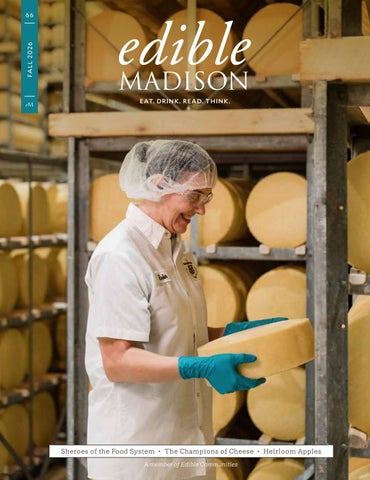
18 THE CHAMPIONS OF CHEESE Wisconsin's Women Master Cheesemakers by Erica Krug
24 LEADING WITH LOVING-KINDNESS AT LALLANDE by Emily Tucker
29 COOK AT HOME Her Food, Her Story by Meggan Roberts
Above: Liz Griffith ( featured page 6) collects apples at Door Creek Orchard in Cottage Grove. Photo by Sharon Vanorny. Cover: Erin Radtke, Wisconsin's fifth female Master Cheesemaker, inspects award-winning cheese at Sartori Cheese. Photo courtesy of Dairy Farmers of Wisconsin.
FALL 2026 RECIPE INDEX 7
Honey Apple Galette with Hickory Nut Crust
10 Mineral Mama Tea 30 Cheese Baked Eggs 30 Tomato Jam 33 Squash and Pumpkin Seed Pesto Pizza
34 Pepper-Crusted Pork Tenderloin
There was no shortage of
Feeding people isn’t simply about the food we make, it’s an
inspiration for this season’s
intention that turns every family dinner into an hours-long
issue celebrating the sheroes (our
affair because everyone is eating slowly and sharing stories of
women heroes) of our local food
their day. It’s an art that made every classmate's jaw drop at the
system. From culinary legends like
Halloween treats I brought for the class party, (IV bags filled with
Odessa Piper to trailblazers like
Hawaiian Punch and Almond Roca cleverly placed in cat litter
Elena Terry, southern Wisconsin is
boxes with Grape Nuts were particular hits!) It’s showing love
brimming with talent, knowledge
for one another through a bountiful homemade meal.
and perseverance. In industries traditionally dominated by men, I am grateful for the bounty of women farmers, chefs, advocates, service industry stars and more that I aspire toward. I am in awe of Kristen Kordet of Blue Moon Community Farm and her ability to face challenges with grit and a great sense of humor. I hope one day to bring as much love into my work as Lauren Montelbano of The Vibrant Veg—I swear you can taste the joy in her food. I celebrate the work of Qwantèse D. Winters providing meal support to postpartum women, I applaud the determination of Francesca Hong in bringing her service industry experiences all the way to the Capitol, and I couldn’t be more grateful to Christy McKenzie not only for her community work through Pasture and Plenty but for giving us the ability to share the stories of our local food system through Edible Madison. How lucky am I to call these women my friends, colleagues and personal heroes. But I would be remiss if I didn’t mention the shero who has made the largest impact on my culinary journey—my mother, Dana Slimmen. Some of my most impactful childhood memories took place in the kitchen, sitting at the breakfast bar, watching
So, to honor my culinary shero, here are the Rules of Feeding People according to my mother: 1. Count your number of guests. Multiple that number by at least three. Prepare food for that number of people…maybe more. 2. No one leaves your house hungry or without enough leftovers for at least a week. 3. At least one drawer in your kitchen should be dedicated to sprinkles, and you should own at least two dozen cookie cutters…because food should be fun. 4. Everyone is always welcome around the table. These have always been the unspoken rules in my mother’s kitchen. Even when means were low in our family and meals were made with inexpensive ingredients but lots of heart, everyone was welcome to our meals and could share in whatever we could offer. I believe in the power of food to bring us together. I believe that feeding people can bring us joy and bring us healing. I learned this from my mother and I see these lessons reverberate through our communities thanks to the work of the many sheroes of our local food system—those whose stories we share in this season’s issue and the countless others doing this difficult but delicious work every day.
my mother make spaghetti or waffles—nothing fancy but always from scratch and always yummy.
Cheers,
But more than teaching me how to cook, my mother taught me how to feed people.
Marissa DeGroot, Managing Editor
FALL 2025
FAL L
202 5
62
NK EAT. DRI
. REA D.
THI NK
.
PERS IMM
WE DELIVER!
ONS • CRAZ
Subscribe at ediblemadison.com to have every issue of Edible Madison
Y FOR CRUC IFERO
delivered right to your door. Fill your year with seasonal recipes and stories
US • SOW ING FOOD SOVE REIG
that dive deeper into our local food system.
NTY NUMBER EDIBL 62 • EMAD ISON.COM
Pers imm
2
Cra zy
for Cru
A mem
cife rous
ber of
Edible
ndd 1
25_v1.i
2-FALL
ISSUE6
adison-
EdibleM
ons •
• FALL 2026
• Sow
Commun
ing Foo
d Sov
erei gnty
ities 8/3/25
9:25 PM
FRESH
EAT LOCAL MONTH
OCT 1 6:00 PM
We carry more than
4,993 517 products from
local farmers, artisans, and makers.
Celebrate Local in September Local foods don’t just taste better — they are better. Since they don’t travel thousands of miles to reach your plate, they’re fresher, more flavorful, and better packed with nutrients. Every local purchase helps support local farmers and makers, and keeps our communities growing strong.
Everyone is welcome at the Co-op! No membership needed to shop—but members get extra sales, discounts, and perks. Join today for just $10. willystreet.coop/eat-local-month
SUPPORT LOCAL. TASTE THE DIFFERENCE. EDIBLEMADISON.COM 3
CONTRIBUTORS MARISSA DEGROOT Marissa feels fortunate to be a part of our local food system as the managing editor of Edible Madison as well as working at Vitruvian Farms, her husband Tommy's organic vegetable and mushroom farm. She loves raising their daughter, Ollie, and their team of fur babies on the farm in McFarland.
SUNNY FRANTZ
MANAGING EDITOR Marissa DeGroot
Sunny is an editorial and commercial photographer with a studio on the west side of Madison where she lives with her husband, their two kids and a tiny dog. She specializes in food and product photography and loves the opportunity it gives her to connect with the many wonderful businesses and entrepreneurs in Madison.
PUBLISHER Christy McKenzie
NICK GARCIA Nick is a portrait and editorial photographer living in Cottage Grove. Most often he can be found with a coffee in hand, spending time with family, watching soccer, listening to the latest indie music to hit the charts and exploring new cities and spaces around the Midwest.
ERICA KRUG Erica is a freelance writer from Madison. In addition to writing and helping to run youth writing summer camps, she also works for Rooted, a local nonprofit, where she supports statewide farm-to-school efforts. Erica loves gardening, swimming in cold lakes and playing Yahtzee.
LAURA POE MATHES Laura is a registered dietitian focused on using real foods and herbs to help heal the gut. She is the creator of the Rest, Digest and Heal online course and community, and teaches traditional cooking and fermentation classes around the region. Laura lives in the Driftless Area with her husband and kiddos where they homestead and play in the river as much as possible. Originally from Missouri, she now understands why cheese curds are a thing.
CHRISTY MCKENZIE Christy is the owner of Pasture and Plenty—a specialty market and deli, demonstration kitchen, and meal kit pick-up and delivery service. P&P gives the community access to healthy, locally sourced meals and foods that make eating well and eating local easier every day. She works to create and connect community around issues of food equity, access and agency. She is the publisher of Edible Madison and a sometimes writer.
JESSE RAUB Jesse is a writer for Serious Eats, a former coffee professional and an amateur bread baker. He lives in Madison and spends his free time attempting fussy dough-based recipes along with walking his dog.
MEGGAN ROBERTS Meggan is a jack-of-all-trades, master of none, but still considers it better than being a master of one. She currently manages the Farm Store at Vitruvian Farms, but has variously been a chef, an educator, a mathematician and a researcher. She now lives in Mount Horeb with her husband, and enjoys filling her time with learning something new every day.
LAUREN RUDERSDORF Lauren is a grant writer, recipe developer and freelance marketing consultant who advocates for local producers and cooking with the seasons. Her love of good food began in Madison at the Dane County Farmers' Market and deepened on the organic CSA vegetable farm she ran with her husband for nearly a decade. Now, life looks different with a big garden and two sweet kiddos to care for instead of the farm, but it's no less delicious.
BUSINESS DIRECTOR Christy McKenzie SALES DIRECTOR Lauren Rudersdorf BUSINESS DEVELOPMENT & EVENTS Tink Sivyer LAYOUT & PRODUCTION Nicole Welch COPY EDITOR Andrea Debbink CULINARY ADVISOR Christy McKenzie SOCIAL & DIGITAL PRODUCER Lauren Rudersdorf ADVERTISING & SPONSORSHIPS Lauren Rudersdorf laurenr@ediblemadison.com CONTACT US Edible Madison 4313 Somerset Lane Madison, WI 53711 hello@ediblemadison.com SUBSCRIPTIONS Subscriptions are available beginning at $35 annually. Learn more at ediblemadison.com/subscribe. We want to hear your comments and ideas. To write to the editor, use the mailing address above or email hello@ediblemadison.com. Edible Madison is published quarterly by Forager Publishing, LLC. All rights reserved. No part of this publication may be used without written permission by the publisher. ©2026
EMILY TUCKER Emily is the creator and host of Stuff Yer Face, a food-focused feature on WORT 89.9FM that connects listeners to the many intersections of our local food system. Originally from the Driftless Region, she now lives on Madison’s Northside with her husband, Zane, and their young son, Gorham. Emily loves cooking, baking, eating, writing, and reading about food and is endlessly curious about the ways food connects us all. When she’s not in the kitchen or editing audio, she’s happiest outside—preferably hiking, biking or taking a cold dip.
NICOLE WELCH Nicole is a graphic designer, photographer and artist from Madison. Her favorite things include backpacking with her husband, binging NYT Cooking videos and being a home chef, reading plenty of books and playing Dungeons and Dragons with her stepsons. She aspires to someday photograph and design a cookbook.
4
• FALL 2026
Every effort is made to avoid errors, misspellings and omissions. If, however, an error comes to your attention, please accept our sincere apologies and notify us. Thank you. VISIT US ONLINE AT EDIBLEMADISON.COM
FARM to school AID
SEPTEMBER 12 TROY FARM
Free music festival benefiting local school gardens rootedwi.org/farm-to-school-aid
EDIBLEMADISON.COM 5
By Marissa DeGroot Recipe by Lauren Rudersdorf
Liz Griffith’s favorite heirloom apple variety is
all very distinct, so that’s probably the biggest
Ashmead’s Kernel. “It has the most intense flavor
challenge, it’s just learning what they need and
and it’s very complex as well,” says the co-owner/
then having the time and money to give it to them
head grower at Door Creek Orchard and self-pro-
every year.” And sometimes it can be many, many
claimed apple nerd. “It’s not just sweet and it’s not
years before some of these heirloom varieties
just tart. It’s sweet, tart, it’s nutty. It’s got honey
even begin bearing fruit. Griffith specifically cites
and floral overtones.”
Northern Spy and how it takes 10 years to come
At the family-owned-and-operated orchard in Cottage Grove, they are growing 97 producing
Northern Spy, along with Calville Blanc d'Hiver,
varieties of apples with 56 of those they consider
are both heirloom varieties Griffith recommends
heirloom varieties. Heirloom, or heritage, apples
if you’re looking for a great baking apple. “They
are traditional varieties that have been passed
tenderize but they will hold their shape,” she
down for generations. “If an apple came out before
says. “Which is what you want in a galette or a tart
1950 then it could be considered an heirloom, but
where you’re seeing the slices of apple.” These
it’s not strictly defined,” says Griffith. “Generally
varieties, along with Ashmead’s Kernel, typically
they are older varieties that were not bred for shelf
come available in early October, though snaps of
life or travel. They were generally bred for flavor or
extreme heat and cold in spring and summer have
storage, not refrigeration and/or hard cider-mak-
made both growing and predicting availability
ing or baking.”
challenging for Wisconsin orchards. In addition to
Today the majority of mass-produced apples are bred for uniformity, shelf life and their ability to be transported long distances. And while some very small modern breeders and growers are considering flavor in their breeding, Griffith says that “Big
the challenges of growing heirloom apple varieties, Griffith mentions how the sometimes “ugly apples” can be a tough sell for customers more accustomed to the cosmetic beauty of a Gala or Golden Delicious.
Apple” (the overall industry) is still breeding for
So this fall, look beyond a bumpy exterior or petite
mainly texture with varieties like Honeycrisp and,
size and dive into the world of heirloom apples
a more recent release, Cosmic Crisp at the fore-
and all they can offer. Stop by your local orchard
front when it comes to texture over taste.
or market to talk to the growers and learn which
Heirloom apples, however, are notable for their quirky shapes, unique colors and range of flavor profiles, from intensely sweet to highly acidic. “They all have their own personalities and how they want to be stewarded,” says Griffith. “They’re
6
into bearing no matter the rootstock.
• FALL 2026
varieties they recommend for cider, applesauce or just eating fresh alongside a favorite cheese. While discovering your new favorite apples, take time to appreciate the variety in flavors, textures and all the hard work local growers put into preserving these historic gems.
DIRECTIONS
Honey Apple Galette with Hickory Nut Crust For this galette, use firm and tart apples. Golden Russet and Northern Spy are wonderful choices that are easily available at local orchards. The Calville Blanc D’Hiver at Door Creek Orchard is also a wonderful option if you’re looking for a classic, heritage tart apple. I love to combine a few different varieties of apples because I think it yields a really beautiful flavor.
1. Chop the nuts in a food processor until finely ground. Add the flour, sugar and ½ teaspoon of the salt. Pulse once or twice to combine. Add the butter and process in the food processor until the butter resembles small peas.
5. In a medium bowl, combine the apples, honey, cinnamon and the remaining ½ teaspoon salt. Stir until the apples are coated with the honey mixture, then add cornstarch and stir a few more times until the cornstarch is dissolved.
2. Fill a measuring cup with the cold water. Add an ice cube to quickly chill. Pour about half the water into the nut mixture and process until the dough just starts to come together. If the dough remains dry and crumbly, add another tablespoon of water. Continue adding water tablespoon by tablespoon until the dough comes together.
6. On a floured surface, roll out the galette dough into a 12 x 18-inch oval. Transfer to a parchment-lined baking sheet. Place the apples in the center, leaving 1–2 inches of dough on all sides, and then drizzle with any remaining juices on top. Fold the crust over the apples so it encloses them.
3. Press the dough onto plastic wrap until it comes together, wrap, and chill in the freezer for 30 minutes. 4. When you’re ready to bake the galette, preheat the oven to 375 degrees F.
7. Brush the dough with egg, and then sprinkle it with sugar. 8. Bake for 30 minutes, turn the baking sheet 180 degrees, and continue baking until golden brown, about 20 minutes.
Serves 6–8 Prep time: 40 minutes Cook time: 50 minutes INGREDIENTS 1/2 cup hickory nuts or pecans, toasted 1 cup plus 2 tablespoons all-purpose flour 2 teaspoons sugar 1 teaspoon kosher salt, divided ½ cup salted butter, chilled and cubed ⅓ cup cold water, plus 1 ice cube 3 large heritage apples or 5 small heritage apples, peeled and thinly sliced ¼ cup honey 2 teaspoons cinnamon 2 tablespoons cornstarch 1 egg, whisked
Photo by Sunny Frantz
1 tablespoon raw sugar
EDIBLEMADISON.COM 7
N O U R I S H LAURA POE MATHES
that women go through in our modern culture, and
regular. This is also the time to focus on nutrients for
nourish themselves is something I feel incredi-
they are the times when a woman’s nutritional needs
bone density, as this is the peak time for girls to build
bly passionate about and I truly want to shout
(among other physical and mental health needs) shift
bone in their life. Foods high in calcium, magnesium,
significantly and extra care is called for.
collagen, and vitamins D and K are essential for bone
pull women in the wrong direction.
Adolescence: This season is all about big change, both
exercise is needed to stimulate bone growth—nutrients
One important point when talking about women’s
to reflect this. General principles and goals of nutrition
nutrition: women are not just small men. They have a
during adolescence include supporting growth and
very different physiology because of specific hormones,
development, strengthening bone density, maintaining
menstruation, motherhood and even simple differences
hormone balance, promoting healthy skin and learning
like muscle and bone mass. Women's nutritional needs
how to make healthy food choices on their own as teens
reflect these differences and should be cared for as such.
become more independent—without demonizing certain
Unfortunately, much of the research in nutritional
foods or nutrients. An extremely important, yet basic,
science does not reflect these crucial differences, and it
nutritional goal is to get adequate calories and protein,
seems science is only recently catching up with what
which support overall growth. Undereating during
ancient wisdom around the world has always known:
adolescence can be detrimental to the development
during important seasons of a woman’s life, she needs
happening during this stage; focusing on nutritious,
special nourishment and attention to her well-being to
regular meals that always include plenty of protein rather
support each season.
than relying on snacks and convenience foods is key for
H
elping women understand ways to properly
its importance from the rooftops—especially as so much information and influence online continues to, sadly,
The special seasons I think deserve the most focus, nutritionally and wellness-wise, are: adolescence, menstruation, pregnancy and breastfeeding/postpartum, and postmenopause. These are a few rites of passage 8
• FALL 2026
of the mind and body, and the nutritional intake needs
this. The brain is going through a lot of development during this time and it needs plenty of healthy fats to support this. These fats support hormone balance as well, which can ease menstrual symptoms and keep cycles
health, and it is important to note that weight-bearing alone are not adequate to build strong bones. Acne can be a common concern during this stage of life and, while some may be unavoidable and normal, severe, persistent acne problems are usually related to hormonal imbalances, nutrient deficiencies or gut dysfunction— or all three. Foods with plenty of zinc, manganese, B vitamins, vitamins A and C, omega-3 fatty acids and collagen promote healthy skin. Supporting liver and gut function with fiber, polyphenols found in colorful plant foods, probiotic foods and herbs like digestive bitters can also help with skin issues. Sleep, hydration (not with energy drinks!), movement, spending time outside and fostering screen-free social connections are also all important for helping adolescents find balance in both mind and body. During adolescence, encourage nutritious foods to meet these special needs and feel good overall, but avoid any dieting and discourage teens from being overly restrictive with food. This is also a
great time to help teens learn to cook, grow food, shop
Pregnancy and Postpartum: One of the most beau-
health impacts. Nourishing the microbiome during
for groceries and learn about food budgeting and meal
tiful, magical, transformative things a woman can go
pregnancy includes eating plenty of fiber-rich, prebiotic
planning as they prepare to go off on their own. These
through is creating (and giving birth to) a new human
foods and fermented probiotic foods as well—those
skills are a much better focus than weight or dieting
being. And what a nutritionally-demanding task this
pickle cravings are onto something! Another nutrition
to help them enjoy good health for a lifetime. Favorite
is! General principles and goals during pregnancy are
issue during pregnancy is foods to avoid due to risk of
foods for this season: pasture-raised meat, eggs, full-fat
to support the growth of both mother and baby, keep
food-borne illness or other issues of toxicity. Notable
dairy, olive oil, avocados, yogurt, root vegetables, leafy
blood sugar balanced, prevent anemia, ensure proper
foods here are high-mercury seafoods like tuna, swordfish
greens, bone broth, pumpkin seeds, kombucha, cod
hydration, address morning sickness and GI changes,
and shark, deli meats and soft cheeses, caffeine in high amounts and alcohol.
liver oil, fish, oysters, citrus and other fruit, liver and
nourish the microbiome, support immune function and
whole grains. Books to learn more: Eat Well and Feel
to be conscientious of food safety. There is an immense
Great: The Teenager’s Guide to Nutrition and Health by
focus on nutrient density as calorie needs increase
Tina Lond-Caulk and No Weigh!: A Teen's Guide to
during pregnancy but micronutrient needs increase
Positive Body Image, Food, and Emotional Wisdom by
even more significantly. Nutrients of concern during
Shelley Aggarwal, Signe Darpinian, and Wendy Sterling
pregnancy include choline, vitamin A, iron, iodine,
Menstruation: A woman’s monthly menstrual cycle
vitamins, vitamin K2, and vitamin E. These nutrients
brings changes to her physical and emotional needs, and diet and lifestyle considerations for this weeklong phase should reflect these. Nutritionally, one of the biggest goals is to replete what is lost during menstruation, especially the 20–30 milligrams of iron lost per cycle on average. Getting plenty of iron-rich foods, along with co-factors like zinc, vitamin A, copper, lactoferrin and riboflavin to help with absorption and utilization of that iron, helps to prevent iron-deficiency anemia. During menstruation, the body needs extra calories; because of this, cravings and overall appetite can increase. Listen to your body and give it the nourishment it needs! Adequate
selenium, vitamin D, folate, riboflavin and other B are needed to prevent birth defects and support healthy fetal development, and should be a big focus when planning a healthy pregnancy diet. Animal foods are very important for this season and have been valued in traditional cultures for centuries for their nutrient density. They are pregnancy superfoods, as they provide rich sources of fat-soluble vitamins (A, D, E and K) and numerous minerals like iron, which can tend to decrease later in pregnancy as blood volume increases. Sunshine is a superior source of vitamin D, so get plenty of safe sun exposure during pregnancy (sun that beautiful
Once the baby arrives, a mother’s nutritional needs continue to increase to help with healing and, most energy-intensive of all, breastmilk production. Pay special attention to postpartum nutrition, keep taking prenatal vitamins during breastfeeding and ensure lots of hydration for milk production. There are special herbal teas for increasing milk flow, and foods like oats are considered galactagogues, which are supposed to help increase milk production. Most of all, keep stress and activity low and nutrient intake high to keep up milk supply. Simply eating enough can be as important as almost anything else to support birth recovery and milk production—during nursing, calorie needs increase by around 800 calories per day, and some vitamin and mineral needs are higher than even during pregnancy. There are many factors for postpartum depression, including lack of sleep and social support, but nutrition certainly
belly!) along with nutrient-dense foods.
plays a role, including postpartum hypothyroidism or
and headaches, so bolster intake of whole plant foods
Ensuring plenty of protein greatly supports growth, but
is one piece of the puzzle both for baby and the mental
during menstruation to ensure this, and look into topical
also helps with blood sugar balance and even morning
and physical health of the mother. Favorite foods for
magnesium oil or magnesium supplements if this is an
sickness. If morning sickness occurs, supplementing with
this season: eggs, cheese, yogurt, whole milk, butter,
ongoing concern. Walking and yoga are great for these
vitamin B6 may help, as can certain herbs and having
pasture-raised meats, liver, low mercury fish,
symptoms, as well as staying adequately hydrated. Some
small, regular, protein-rich meals. Sipping smoothies,
crab, oysters, cacao, mushrooms, sea-
intake of magnesium can help with menstrual cramping
low levels of vitamin D. Proper postpartum nutrition
women find acupuncture and abdominal massage to help
milk, broth and teas throughout the day can help provide
weed, avocado, stewed fruits, sweet
alleviate symptoms like this as well. The week (or so) of
hydration and nutrients as you move through morning
potatoes and root vegetables, cod
menstruation is a woman’s time to cleanse and renew.
sickness. If excessive vomiting during pregnancy occurs,
liver oil, dates, unrefined sea salt,
It’s a new start, after all. This is the time to nourish
known as hyperemesis gravidum, see a medical profes-
Brazil nuts, sesame seeds, broths
ourselves well food-wise but also to tend to the whole
sional to see what steps can be taken to ensure proper
and soups, leafy greens, berries, oats,
body; overall self-care should increase—think massages,
nutrition and hydration to avoid serious complications.
congee, lacto-fermented pickles,
warm baths and extra rest. There are many herbal teas
Hydration during pregnancy is extremely important and
sauerkraut, kimchi, coconut
to support this time and these can be a great addition
becomes even more so later in pregnancy as the blood
oil and ginger. Books to learn more: Real Food for Pregnancy
to your monthly self-care. Healthy menstruation may
volume increases significantly. Electrolytes, from food
cause slight decrease in energy or changes in mood
or supplements, help improve hydration status but also
by Lily Nichols, RD; Awaken-
due to hormonal shifts, but should not disrupt your
support blood pressure regulation and, for some, morning
ing Fertility, Nine Golden Months and The First Forty Days by Heng Ou
whole life. If this is a pattern you see, talk to a doctor,
sickness. Keeping blood sugar balanced is an important
midwife or other healthcare practitioner to address
concern, as insulin sensitivity naturally decreases during
hormonal issues or other imbalances. Favorite foods
pregnancy. Choose nutrient-dense sources of carbohy-
for this season: grass-fed beef, liver, beets, carrots, leafy
drates always paired with plenty of protein, fiber and
greens, sauerkraut and kimchi, fish and shellfish, eggs,
healthy fats for blood sugar management. Exercise can
whole grains, sprouted nuts and seeds, full-fat dairy
also help with blood sugar; it is important to stay active
and chocolate. Books to learn more: The Fifth Vital
for a healthy pregnancy, so choose movements that keep
Sign by Lisa Hendrickson-Jack, Taking Charge of Your
you feeling good and strong throughout pregnancy
Fertility by Toni Weschler, and The Garden of Fertility
but don’t overdo it. The mother’s microbiome—the
by Katie Singer
ecosystem of bacteria and other microbes that populate the gut and entire body—directly influences that of the baby’s, which can have long-lasting and far-reaching
Postmenopause: Women go through many journeys throughout their life, but the postmenopausal season seems to get the least amount of attention—there certainly aren’t enough “I am through menopause!” showers, if you ask me, or any true rites of passage for that matter. During this season, a woman’s health needs change along with everything else. The nutrition principles for postmenopause mainly center around preventing bone and muscle loss, healthy weight maintenance, supporting blood sugar balance, EDIBLEMADISON.COM 9
cardiovascular health and digestive function. Overall,
A decrease in stomach acid that often occurs with aging
ful vegetables and berries. Books to learn more: The
calorie needs decrease postmenopause, and appetite often
can also lead to lowered absorption of vitamin B12, so
Menopausal Years: the Wise Woman Way by Susan Weed, The Great Menopause Myth by Kristin Johnson
follows, so prioritizing nutrient-dense foods, especially
be sure to include plenty of animal foods to provide
protein- and fiber-rich foods, is key to getting adequate
this. Sleep issues can arise with the hormone changes
nutrients within the body’s calorie needs. During this
of menopause, and while poor sleep can be difficult
season, a major goal is to keep up protein intake to
on its own, inadequate sleep can affect many health
prevent muscle loss. Adequate protein and physical
outcomes—including mood, mental health and even
activity also help prevent bone loss, a major health issue
memory—so work to get enough sleep and make sleep
for postmenopausal women due to the natural decrease
hygiene a priority during this phase. If symptoms of
in estrogen. Adequate intakes of calcium, magnesium
menopause become uncomfortable, such as hot flashes
and fat-soluble vitamins A, D, E and K help maintain
or disrupted sleep, there are many herbs available that
bone density. These nutrients should be paired with
support the body’s transition of hormones during
weight-bearing exercise like yoga, strength training and
menopause. Look for a practitioner that can help as a
walking as well to help prevent loss of both muscle and
resource for finding the right formulas for you. Many
bone. Exercise during this time of life should focus on
women find the numerous changes that occur around
balance, strength and mobility to support aging gracefully
this change of life add unwanted stress, and mindfulness
and help prevent injury and falls.
work, meditation, prayer and other practices can be
Supporting brain health through aging is important for memory and cognition. Foods like fish and pastured eggs that are rich in omega-3 fatty acids and choline are great for brain health. As we age, changes in digestive function can occur. Include a variety of colorful plant foods for polyphenols, ample fiber (at least 25 grams per day for women) and fermented foods to support digestive function and prevent issues like constipation.
incorporated to help center and adjust to these upheavals in life. For keeping healthy both physically and mentally during this season, it is so important to find ways to stay active and engaged in a variety of ways to make this season one of freedom, wisdom and gorgeous gray hair. Favorite foods for this season: yogurt and kefir, lean animal protein, fish and shellfish, walnuts, eggs, bone broth, beans, cinnamon, whole grains, color-
While each of these phases is unique, there are some common themes, including that women have been undernourishing themselves for far too long. This is due to (including but not limited to): influences from the media, diet culture, lack of proper studies, misinformation about nutrition and lack of understanding and compassion for the needs of women’s health. There are also themes that flow through each season, including the absolutely essential inclusion of nutrient-dense animal foods, healthy fats, a diversity of plant foods and, quite simply, eating enough nutrients in general. In the current culture of “skinnytok,” plastic surgery and social media filters, it is no small feat for women to dare to be well-fed. Of course, addressing further realms of well-being, including movement, time in nature, mental health and social support must be part of the picture as well. Once we can start supporting women through understanding and encouraging adequate nutrition and self-care, society as a whole will be much better and women can thrive as they are meant to. We are powerful beings—let’s start eating like it!
Mineral Mama Tea Makes 1 pint of dried tea blend Prep time: 10–15 minutes
INGREDIENTS
DIRECTIONS
1 ounce dried nettles 1 ounce dried peppermint 1 ounce dried red raspberry leaf 1 ounce dried lemon balm 1 ounce dried chamomile 2 ounce dried rose hips
1. In a quart-sized glass jar, combine the dried herbs and mix well. 2. When you are ready to brew the tea, bring 8 ounces of water to a boil. Once boiling, pour the water over 1–2 tablespoons of the dried tea mixture in a mug or heatproof vessel. 3. Let the tea steep for 8–12 minutes, then strain and enjoy as-is or with a bit of honey.
10
• FALL 2026
Photo by Sunny Frantz
This mineral-rich tea is great for supporting the body before, during and after pregnancy. It can be made in large batches and kept on hand to have a warm, soothing cup of tea whenever you need it. These herbs can support digestion, soothe the nervous system and ease some pregnancy symptoms. Though these herbs have been used by mothers for centuries and are generally considered pregnancy-safe, some practitioners recommend avoiding herbs during the first trimester. If you are pregnant or nursing, be sure to consult your healthcare provider before adding in this or any herbal remedies.
SP ON SOR ED CON TEN T
Blue Roof Orchard
GROWING A COMMUNITY OF APPLE ENTHUSIASTS
Photos courtesy of Blue Roof Orchard
By Jesse Raub
Every apple from Blue Roof Orchard is the
to taste a wide variety of apples at the exact
culmination of a year’s work. “It starts in
moment they ripen. “We go out to sample
born and then grew up eating our produce.
winter,” says Chris McGuire, who runs
each variety when it’s almost ripe, tasting to
That’s really rewarding to think about.”
the farm with his wife, Juli. “That’s when
make sure it’s perfect,” says Chris. “I really
we do most of our pruning, which is one
look forward to Winecrisp. It’s a dark red and
of the most time-consuming tasks.” As a
purple russeted apple with a rich, complex,
certified organic orchard, every aspect of
spiced flavor. It ranks number one in our CSA
their process requires extra effort, from
member survey at the end of every year.”
testing new disease-resistant varieties
Additionally, Juli has developed recipes
to maintaining a healthy orchard floor to
for no-sugar-added applesauce and apple
shaping each tree so the apples that grow
butter, available in select Madison stores
receive direct sunlight. That work pays off,
and as an add-on for CSA members, made
however. “People tell us, ‘Oh, the apples are
from a blend of different apples to ensure
just so good, my kids won’t eat supermarket
prime sweetness and tartness.
apples anymore,’” says Juli.
Juli. “Our members have had kids who were
Blue Roof Orchard is a family operation that’s centered around community support and delivering the best-tasting apples possible. Chris and Juli moved to Wisconsin specifically to start a farm where they could raise their family and be proud of the produce they grow. “What drives me to live and work at this place is really the love of food,” says Juli. They have a distinct passion for the apples they grow, and listening to Chris wax poetic about their
Chris and Juli have been farming on this land
different varieties is a delight. “Another one I love is the Chestnut Crab, which we’ve
Blue Roof Orchard primarily sells their
for over 23 years, which means they have
apples through a CSA, with a variety of
personal relationships with every apple tree
been growing for a few years, and we hope
box sizes available for weekly or bi-weekly
planted. They also have CSA members who
to pick enough to add it to this year’s CSA
pick-up at over 20 locations in and around
have been with them since 2005, when they
boxes. It's a small apple, but really delicious
Madison and southwest Wisconsin. Because
first started selling to the public. “We know
and complex.”
they grow varieties that thrive in south-
what grows best on our land, but we’ve also
central Wisconsin, their harvest season lasts
gotten to know our community of eaters and
for three months, ensuring that members get
have a strong relationship with them,” says
BLUE ROOF ORCHARD |
“My favorite variety,” adds Juli, “is always the one we’re picking right now.”
19638 COTTAGE INN ROAD, BELMONT, WI
|
EDIBLEMADISON.COM 11 BLUEROOFORCHARD.COM
H O M E & K I TC H E N G U I D E
5 trends to showcase your love of local in your home and kitchen By Marissa DeGroot
#1 | Natural Inspiration This season you’ll be seeing earthy color palettes, natural textures and materials that bring a clean yet cozy feel to your home. If you’re remodeling, consider incorporating natural, native building materials like sustainably-harvested local timber or landscaping stone like Wisconsin dolomitic limestone.
#2 | Big & Bold Decor The bolder and more eclectic the better these days. Give your maximalist styling a local flair by browsing secondhand stores, adding treasures from area art fairs, or embracing the millennial inheritance and incorporate the handed-down hoard into your own layered decor.
#3 | Vibrant Tables Every plate and fork offers an opportunity to showcase your style. Boldly patterned napkins, mixed-and-matched dishes and ornate glasses all found at antique shops or crafted by local potters can add personality and flair to your next dinner party.
12
• FALL 2026
Making Madison Modern since 1948
www.centuryhouseinc.com 3029 university ave | madison
#4 | More than a Splash of Color No need to play it safe when it comes to color. Brightly painted kitchen cabinets and vivid statement furniture can bring joy into your spaces. When browsing your local kitchen store, see what hues speak to you when purchasing your next Dutch oven or visit your neighborhood gallery and find some local art to inspire your palette.
#5 | Gather Round the Kitchen Inevitably, every party ends up with guests gathered around the kitchen—sipping, snacking and laughing into the night. While this certainly isn’t a new trend, kitchens are now being remodeled to accommodate cooking as well as conversation. Consider designing your kitchen to give you plenty of counters for a spread of local food and beverages along with space for all to gather around and enjoy.
EDIBLEMADISON.COM 13
S P O NSO RED CO NTENT
What does sustainable living look like when it is designed around real life? For one homeowner, the answer was a near net-zero home that combines exceptional energy performance with warmth, comfort and enduring craftsmanship. The vision was clear: create a home that would minimize energy use and long-term maintenance while remaining welcoming, resilient and deeply connected to the rhythms of everyday living. At Associated Housewrights, projects begin with listening. Through a collaborative design-build process, the homeowner's goals became the foundation for every decision—from the building envelope and renewable energy systems to the materials that would shape the character of the home for decades to come. A highly insulated envelope, high-performance windows and doors, radiant heated floors and rooftop solar panels work together to dramatically reduce energy demand while maintaining yearround comfort. Yet the home's success is measured by more than performance metrics alone. Natural materials including Accoya siding, white oak trim, reclaimed barn beams, and stone were selected for their beauty, durability and ability to age gracefully over time. Expansive windows bring daylight deep into the home, creating a strong connection between indoors and out. The result reflects the Housewrights’ approach: translating a client's vision into a home where thoughtful design and enduring craftsmanship support the way they want to live. In this case, that vision included creating a home that is both environmentally responsible and deeply livable. This near net-zero residence demonstrates that sustainability is not about sacrifice—it's about building a home that performs exceptionally well while supporting the life that unfolds within it. 14
• FALL 2026
SP O NSOR E D CO NT E NT
Carnelian Art Gallery opens in downtown Madison An assemblage of local, regional artworks comes to the city By Emilie Heidemann
When Carnelian Art Gallery opened in downtown Madison, in March 2024, it did so with the intention of bolstering the artists of not only this city, but the broader Midwest. There’s an unlimited well of talent to be showcased, says owner and head curator Evan Bradbury. He also thinks that the artworks that the gallery exhibits and collects should adorn the walls of every home and business space, particularly in Madison. Carnelian Art Gallery—located at 221 King Street in Suite 102 just a hop and a skip from the Capitol Square—puts on rotating, month-long exhibitions with artists who work with a variety of media, from paintings to pottery. This gallery is also building an in-house collection of art, offer art consulting services and more. Exhibitions have included sculpture, surreal art, landscapes, figure paintings and more. “No show has been my favorite,” says Bradbury. “I love all my children equally.” An upcoming exhibition will feature Madison artist Douglas Hyslop, in “Of Clowns and Artistic Depth,” an exploration of Hyslop’s imaginary universe of circus folk. It opens at 5 pm on Friday, July 10, with Hyslop slated to deliver an artist talk at 6 pm. Light refreshments will be served, and admission is free. Attendance at exhibition opening receptions has topped just under 200 people, and the gallery has built a solid reputation in Madison as a communal and inclusive space to view and purchase art. The gallery not only recognizes the need for affordable artist studio spaces, but also creative connections. That’s why it has three private studios for rent. It also offers a 1,500-square foot showroom which serves as a quirky backdrop for events, from art show receptions to networking galas. The gallery’s collection of art is available for purchase at a variety of price points inside its physical space, as well as on its website at carnelianart.com. Sign up for the gallery’s newsletter on their website. “We are full of people’s dreams,” says Bradbury.
Carnelian Art Gallery Hours Thursdays, 12-4 pm Fridays, 2-6 pm Weekends, 10 am to 4 pm
Contact the gallery by emailing carnelianartgallery@gmail.com or by calling (608) 333-5309.
SP O N SO R E D CONT E NT
A gathering of local goods and luxuries 1. Old Eighty Bourbon, Smalley House Bourbon & Ocooch Mountain Brandy Their most requested local spirits. English Prairie Distilling Co englishprairiedistillery.com
2. Unsweetened Dried Cranberries Ingredients: Cranberries. No added sugars, juices, oils, or anything! Honestly Cranberry honestlycranberry.com 3. Willy Street & Brandied Pear Body Soaps Fall favorites are back. Celebrate Wisconsin agriculture through soap! Suds & Harvest sudsandharvest.com 4. Cultured Butter Fresh and tangy cultured butter, small batch, hand-shaped. Landmark Creamery landmarkcreamery.com 5. Juli’s Apple Butter Classic taste of the fall crafted from our organic apples with no added sugar. Blue Roof Orchard bluerooforchard.com 6. Handcrafted and Custom Pottery Small custom utensil holder and vase from Cambridge, WI. Rowe Pottery rowepottery.com 7. Cold Pressed Juices Fresh, vibrant, cold-pressed juices inspired by the beauty of real ingredients. Wild Honey Juicery & Café wildhoneyjuicery.com 8. Christmas Spice Jam Named "Christmas in a jar" by one Wisconsin State Fair judge. AVEnue Orchard aveappleorchard.com 9. Artisan Dark© Collection Taste six single-origin dark chocolates from the world’s equatorial cacao regions. Driftless Chocolates dritlesschocolates.com 10. Juli’s Applesauce Classic taste of fall, crafted from our organic apples with no added sugar. Blue Roof Orchard bluerooforchard.com 16
• FALL 2026
2 3
1 5 4
TheFall Table Hosted by Anaway Place
6
10
7
8
9
ANAWAY PLACE A hidden gem of the Driftless, Anaway Place is a boutique nature retreat with ten architecturally unique cabins stretching over 110 acres. Whether you come for an overnight getaway, a relaxing retreat or a celebratory gathering, Anaway Place offers a space to slow down, reconnect and restore. Explore miles of hiking trails, browse local goods at their general store, curate your own private wellness experience with massage and yoga, or discover the newly opened Candlewood Events Barn, perfect for celebrations, workshops and gatherings. While you can’t beat a crisp autumn retreat, Anaway Place is a destination for all seasons with cozy fireplaces and snowy landscapes to lush green views and summer picnics, it’s always the right season for a visit to Anaway Place. 21558 Candlewood Lane, Richland Center | anaway.com
EDIBLEMADISON.COM 17
THE
Champions Cheese
OF
Wisconsin's Women Master Cheesemakers By Erica Krug
18
• FALL 2026
If
Wisconsin were its own country, it would rank 4th in the world for cheesemaking. Not only is Wisconsin the only state where making cheese requires a license, but it’s the only place in the world outside of Switzerland where cheesemakers can formally earn the title of “master” through an arduous and lengthy process. “We take anything dairy quite seriously,” says Pam Hodgson of Sartori Cheese. “This is America’s Dairyland.” But while cheese production is a leading industry in our state, it has long been a male-dominated field. Hodgson, who received her cheesemaking license in 1996, is one of only five women who have earned the designation of Master Cheesemaker. Although this fact becomes apparent when scrolling through photos of each year’s class of Wisconsin’s Master Cheesemakers, Hodgson can sense a shift. “There are a lot of women in Wisconsin making fantastic cheeses, but it takes 15 years to become a master,” she says. “It’s a reflection of where we have been, but not where we are going.”
Established in 1994, the Wisconsin Master Cheesemaker program is a partnership between the Center for Dairy Research (CDR) and Dairy Farmers of Wisconsin (DFW). The program, which was designed to honor the very best in the cheese industry, provides advanced training for experienced cheesemakers who must hold a Wisconsin Cheesemaker License for at least 10 years and have been actively making their certification cheese for a minimum of five years. After their application has been accepted, candidates must complete three intensive years of training courses, plant inspections, sample submissions, and examinations while continuing to produce high-quality cheese. In 1991 Hodgson and her husband Dave were beginning farmers but needed additional income “to make that dream possible,” Hodgson says. “I applied to do quality control at a cheese plant and somehow convinced them to hire me. The plant manager was astute and probably saw something in me that I didn’t know I had.” As Hodgson moved up the ranks, she took on more leadership, something some people considered “a big deal,” as the plant’s only female employee in a leadership role. “Ninety-five percent of my colleagues were supportive,” she says. “But 5% made it harder.” When the plant hired another woman a few years into her tenure, Hodgson says the change was immediately noticeable. “Overnight the plant changed to a place where men and women work,” she says. “The pressure wasn’t all on me.” After receiving her cheesemaking license in 1996, Hodgson took a job with Sartori in 2005 where she was encouraged to experiment and had room to be creative. “They gave me permission to fail,” she says. Bolstered by a new confidence to innovate, coupled with wisdom gained from her maternal grandfather who was also a cheesemaker, Hodgson made the decision to apply for the Master Cheesemaker program. “My grandfather would say, ‘you always go back to what you know works,’” she says. “If you have trouble, something changed, go back to what you know.”
EDIBLEMADISON.COM 19
In 2013 her hard work paid off when Hodgson became the second woman to earn the designation of Master Cheesemaker, recognized for cheeses in two categories: Open hard (hard cheeses are defined by their aging process, think Parmesan or Romano) and fontina. Following in Hodgson’s footsteps over ten years later were Sara Griesbach of Nasonville Dairy in 2024, Marieke Penterman of Marieke Gouda in 2025, and most recently, Hodgson’s colleague at Sartori, Erin Radtke, in 2026. Radtke, who became Wisconsin’s fifth female Master Cheesemaker this past April, grew up a few houses down from the plant in Antigo where she used to ride her bike and where she now has a job making award-winning cheese. Radtke began her cheesemaking journey in 2004 when she first got a job working all of the positions—from sanitation to packaging—on the plant’s floor. Radtke believes that while women can handle all of the physical tasks that come with cheesemaking, certain changes in the process have made it more of a welcoming environment. “I think the advancements in equipment have helped introduce women into the plants,” she says. “When I started in 2004 there was a lot of manual labor and it can be intimidating when you walk into a plant and there are no other women working.” Now Radtke looks at her Master Cheesemaker title as a way to help more women join her field. “I think about all of the things I can do as a mentor now and how I can share my knowledge to help them,” she says. Since becoming coworkers at Sartori, Radtke and Hodgson talk once a week and love the opportunity to collaborate, dream up award-winning cheeses and, something that happens to all cheesemakers, mess up. “We have had a few things that have failed miserably,” Hodgson says with a laugh. “Pam has been a huge inspiration to me, we have worked together on challenges in the plant, worked on cheese for competitions, we brainstorm and troubleshoot,” Radtke says. The feeling is mutual. “Erin is the real deal,” Hodgson says. “When I look at what Erin has accomplished, she is so amazing and inspirational…I’m so happy to see her become certified and become recognized.”
Top: Pam Hodgson in the historic Sartori East Main Caves in Plymouth. Bottom: Sartori cheese is made from milk sourced entirely from Wisconsin family farms. Opposite Page, Top Left: Erin Radtke became Wisconsin's fifth female Master Cheesemaker in April 2026. Opposite Page, Top Right: Wheels of Sartori's award-winning Merlot BellaVitano® in the East Main Caves. Opposite Page, Bottom: Radtke has worked at Sartori Cheese since 2004 working nearly every position on the plant's floor.
20
• FALL 2026
Wisconsin’s first female Master Cheesemaker, Carie Wagner, never considered her gender to be a barrier into the cheesemaking industry. A cheesemaker for 42 years, Wagner grew up on a dairy farm where she was the oldest of three girls. “We just did everything that a boy would do,” Wagner says. “We drove tractors, we pitched manure.” While she planned on continuing in the footsteps of multiple generations of family dairy farmers before her, Wagner’s parents encouraged her to first go to college. Working her way through college at UW–River Falls by milking cows at a local farm
Left Page, Top; Right Page, Top Left; Right Page, Bottom: photo courtesy of Dairy Farmers of Wisconsin.
Since becoming a Master Cheesemaker for the first time in 2013, Hodgson earned recognition again in 2020. Long relying on advice from her grandfather, Hodgson now has her own wisdom to share with fellow cheesemakers like Radtke, whom she feels a calling to help guide. “Everything is connected. When managing a biological process, a small tweak can affect everything. You touch a spider web in the corner and the whole thing vibrates,” Hodgson says. “So let the process speak to you, listen to the process, let it tell you what is happening.”
at 4 a.m. seven days a week, Wagner started as a pre-vet major but made the decision to switch to the food science department where she met cheesemaker Ranee May. When May asked Wagner to help run the program’s new pilot plant, Wagner began making ice cream, sherbet and cheese by hand. Wagner says the job made her a better field hockey player. “A cheese make can take four hours—that is a lot of hand-stirring except for a 30-minute break for the cheese to coagulate!”
“ We ta ke a ny t h i ng da i ry q ui t e s e r i o u sly. Th i s i s A m e r i ca’s Da i ryla n d.” — Pa m Hodgson, Sartori Ch eese While working for May, Wagner had the opportunity to continue to gain new skills. “I learned how to drive a bumper hitch trailer,” she says. “I would take the milk tank, drive it to the dairy farm and fill up a tank of milk.” Wagner credits May with encouraging her to pursue cheesemaking as a profession. “Ranee was really supportive and made sure we understood the whole process of making cheese. She was a great mentor.” After gaining enough hours as an apprentice working for May, Wagner applied for and received her cheesemaking license in 1984 before graduating from college in 1986. Now retired from Organic Valley, Wagner reflects on what it meant to be the first female Master Cheesemaker. “Nobody ever said ‘you are a woman and you can’t make cheese,’” Wagner says. “I didn’t meet resistance. I never had anything but support.” Today she is still in touch with her fellow Master Cheesemakers. “It’s this passion we all have for making wonderful cheese and helping farmers be successful in their own right,” she says. “I have been so fortunate in my career to work with such great people and great mentors.” EDIBLEMADISON.COM 21
SP ON SOR ED CON TEN T
More Than a Meal: Building a Stronger Community Through School Food Each school day, Monona Grove School District’s (MGSD) nutrition professionals prepare and serve thousands of meals to students across the district. While these meals are essential to ensuring students are ready to learn, their impact extends beyond the cafeteria. School meals provide opportunities to strengthen the local economy, support Wisconsin agriculture and nourish the community. The Cafeteria as a Classroom MGSD recognizes that school cafeterias can be classrooms in their own right. By partnering with teachers, families and community organizations, the district works to create meaningful connections between nutrition education and students’ experiences in the lunch line. When students learn about agriculture, nutrition and food systems—and see those lessons reflected in their meals—food literacy grows in tangible ways. Bringing Wisconsin Farms to School Plates Throughout the school year MGSD highlights local foods, most often fresh produce, on school menus. Sometimes those efforts are subtle, with locally grown items featured on school garden bars. Other times, local procurement takes center stage through statewide initiatives that celebrate Wisconsin agriculture. The district regularly participates in campaigns such as Muffin MAYnia, Wisconsin Chili Lunch and the Great Apple Crunch, giving students opportunities to enjoy foods grown close to home and prepared from scratch in school kitchens. This past May, MGSD's breakfast menu featured homemade muffins made with spelt flour from Doudlah Farms in Evansville, introducing students to a Wisconsin-grown whole grain. By prioritizing local procurement, the district invests in regional agriculture and the local economy. The Shift to Scratch Cooking Pairing local procurement with nutrition education is part of a broader vision for the future of school meals in MGSD. The department is working to expand scratch cooking across all schools, preparing more foods from basic ingredients rather than relying on heat-and-serve products.
Even the most nutritious meal only has value if students choose to eat it. Introducing new foods to students requires intentional planning and repeated exposure. MGSD supports this process through nutrition education, taste tests and community events, including community dinners that feature the same scratch-made menu items served during the school day. Innovation Through Collaboration Innovation is also driven by collaboration. The department hosts interns from UW Health's Integrated Graduate Program in Nutrition and Dietetics and Madison College's Culinary Arts program, bringing fresh perspectives to school meal programs. The department also values partnerships with organizations such as the Monona Eastside Business Alliance and REAP Food Group, whose support helps strengthen local food initiatives while ensuring the community's evolving needs are met. How Families Can Power the Program The future of school meals ultimately depends on community support. One of the most effective ways families can support innovation in school nutrition is also the simplest: encouraging students to participate in school meal programs. Because school meal programs are entirely self-sustaining, every meal served strengthens the financial foundation that allows the district to purchase more local foods, expand scratch-cooking initiatives and invest in staff. School meals are an investment in the community’s future, and the progress communities want to see is made possible through participation today. School meals are building a healthier future for everyone. Contact school.nutrition@mgschools.net for more information on ways to get involved.
ood.
A CELEBRATION OF RURAL LIVING
HILL & VALLEY EXPLORATION TOUR
September 19-20 and 26-27, 2026
Experience, Learn and Buy Local! explorehillandvalley.com Sauk, Richland & Juneau Counties, WI @ExploreHillandValley
ExploreHillandValley.com ExploreHillandValley@gmail.com
RooftoP I patio I Bar I Restaurant E WashINGton Ave. I Madison, Wi I aticolounge.com
Secluded blufftop B&B • Authentic Finnish Sauna rental • Seasonal cooking classes
grocery & deli
good. local. food.
58965 LUCKY LANE • EASTMAN, WI 54626
LATARNIAGUESTHOUSE.COM
EDIBLEMADISON.COM 23
Leading with Loving-Kindness at Lallande By Emily Tucker
The early evening sun and perfectly
me right up on a rainy day. Founded by
cool breeze settled gently over Monroe
Maitri in 2010, she now runs it with her
Street as we walked to our dinner reser-
husband and business partner, Mark
vation at Lallande. Inside the 3-year-old
Pavlovich, in addition to Lallande. As
10-top bistro, I was simultaneously
customers happily waited for to-go
transported and at home. The open
orders, a large box sat labeled, “Food
kitchen hummed and servers moved
Drive,” already filled with donations
effortlessly in their crisp aprons and
from customers and neighbors. On
comfy shoes. It felt high-class but with
the pastry case, a note stated Bloom’s
low stakes—my happy place and exactly
commitment to local ingredients and
the feeling co-owner Annemarie Maitri
their thoughtful selection of gluten-free
is going for: “We want to be your French
and vegan treats amongst their tra-
grandmother. That’s the style.”
ditional Viennoise pastries. And then
band and I lingered over our warm olives, bistro steak and braised rabbit, winebraised leeks, and a cup of post-dinner coffee to cap things off. Taking in the room, I noticed friends celebrating mile-
in walked Annemarie Maitri, her face and energy beaming from under her raincoat hood and hat. Immediately, it was clear: she carries the same warmth, generosity and feeling of home as the spaces she’s created.
stones, a solo diner treating themselves
As the daughter of a military parent,
and neighbors greeting each other from
Maitri grew up all over—from Japan
across the room. At Lallande, the food
to the American South—shaping her
matters, yet all the other details are
understanding of food and her sense of
designed to accompany these seem-
hospitality. “My parents would embrace
ingly small rituals that are actually life’s
every food culture that we lived in,
big moments. Similarly, at Maitri’s Bloom Bake Shop next door, the cozy bakery glow and smells of fresh bread and sugar warmed
so I thought everyone grew up with escargot shells in their pantry and a rice cooker,” she shared. One might think such a cultured upbringing stands in
Clockwise from top left: Annemarie Maitri,co-owner of Lallande and Bloom Bake Shop. The Lallande team before the start of dinner service. Lallande's cocktail menu features unique drinks celebrating seasonal flavors. Lallande is next door to Bloom Bake Shop. 24
• FALL 2026
Photos by Nick Garcia
A rare night out without our son, my hus-
contrast to the Upper Midwest tastes
years, those values held. During the
and temperature, but after twenty
COVID-19 pandemic, after having to lay
years in Wisconsin, Maitri considers
off their whole Bloom staff on March 17,
herself Madison’s biggest fan. “My mom
2020, Maitri and a small team continued
always used local ingredients,” Maitri
limited to-go orders and later made
says. “Moving here and walking the
sandwiches for protesters following
market…really felt like home in a way
the murder of George Floyd.
that I didn’t expect it to.”
That same spirit of care extends to her
Maitri’s connection to local food and
now-thriving staff teams at Lallande
community shows up in tangible ways.
and both Bloom locations. “It is so
“As a small business, we believe the
important to me the magnitude and the
values we hold for our community—not
responsibility of taking care of people
just feeding you—are important,” she
that have chosen this place to work
says. One Bloom staff member, Scottie
because so much of our life is work,” she
Cross, created “Donation Creation,” a
says. Maitri’s longtime team member,
monthly sandwich special that directs
Christy Harvey, says, “Annemarie is
proceeds to hyperlocal nonprofits, like
a great leader just being herself. She
Rubin for Kids. On Lallande’s website, a
strives to serve the community with her
section dedicated to “Our Friends” lists
expertise: great food with sustainability,
the countless farmers and producers
inclusivity and love in mind. She takes
they partner with to bring delicious
care of her people by building a business
dishes to the table. And even in the
that helps each staff member grow.”
hardest moments of the last several
EDIBLEMADISON.COM 25
Maitri, a mother of three, started her first business when her kids were three, five and seven. “It took a village, and that in turn was a gift for my children because of the way they see this community and the way they see Madison. They all have a piece of them that understands that it can’t just be all about ourselves.” Maitri says, “Even though this started out as mine, it’s not mine anymore. It’s all of ours, and it’s this big beautiful thing that we have to take care of and nurture.” So what’s next on Annemarie Maitri’s Monroe Street horizon? Waltzing Matilda’s, a new breakfast-focused concept with the same values of supporting community and local farmers, will open in late summer just down the street from Lallande—a space to prove that breakfast doesn’t have to be American. “My mother used to make a Japanese fish soup. There are a lot of ways to enjoy breakfast,” says Maitri. “We have this beautiful world around us, and in a time when we’re not necessarily respecting it, I think we have opportunities to make people feel seen in this community.” Whether you’re popping in for a pastry at Bloom or celebrating a special occasion at Lallande, Maitri’s restaurants and teams offer warmth, handcrafted food, and the feeling that people thought carefully about your experience before you arrived. For a busy chef and restaurant owner, her secret to success may be simpler than it seems: steady leadership, consistently showing up for others and the quiet joy of making space for community and connection around food—all daily acts of loving-kindness. These are Annemarie Maitri’s superpowers. Clockwise from top left: Preparing Lallande's bar before guests arrive. A Lallande hors d'oeuvre, Basque Terrine. The Lallande menu changes often with the seasons.
26
• FALL 2026
Photos by Nick Garcia
The front entrance to the Monroe Street restaurant.
YOUR FAVORITE LOCAL TEA SHOP
C om e to o u r p op - u ps in
M ad i so n ! SCHEDULE
The Bodega at Breese Stevens Madison Night Market
108 E MAIN STREET DOWNTOWN MT HOREB www.telsaan.com
Madison Makers Markets 608 Markets in Sun Prairie
EDIBLEMADISON.COM 27
Riverview Terrace Cafe & Kitchen Garden The women leading the local food movement at Taliesin
Many come to Taliesin for the architecture and the opportunity to be immersed in the space Frank Lloyd Wright called home for nearly 50 years. But on this cool, rainy morning there seemed to be just as many guests arriving to simply enjoy a warm beverage and stunning views of the Wisconsin River at Taliesin’s historic cafe. Riverview Terrace Cafe, the only remaining Frank Lloyd Wright-designed restaurant in the world, is the perfect place to begin a journey around Taliesin. Throughout the rich, historical tour it becomes increasingly clear the vital influence nature, farming and the valley landscape had on the design and structures that exist on the 800-acre estate, including Wright’s home, studio and the school. Honoring the natural beauty and farming culture of the Driftless Region are values that continue to shape the cafe and Taliesin’s Kitchen Garden that now supplies seasonal produce for the restaurant. A Bite of Local History
The Art of the Garden
As Cafe Manager Keeley Sjostrom bounces from greeting
A short drive down the road from Riverview Terrace Cafe,
guests to washing dishes—and even jumping on the line if
Kitchen Gardener Abbie Lehman is harvesting the last of
needed— it’s easy to see how in just over a year in the role,
the summer tomatoes and peppers while the butternut
she has embraced the thrill and the challenge of running
squash grow ever larger. “This year we will supply over 70
Riverview Terrace Cafe. “My curiosity for food and how
varieties of produce to the cafe throughout the season,” says
it makes us feel is really what pushed me this way,” says
Lehman, but the Kitchen Garden at Taliesin acts as not only
Sjostrom. That consideration around how food makes us
a production space but also one for education. “We have
feel, as well as a focus on working with local producers and
gardening classes that we do here as well as foraging classes
Taliesin’s Kitchen Garden, shows up in the menus Sjostrom
that I teach on the trails on the estate.”
has rebuilt. Burgers are made from Cates Family Farm beef, located just three miles from the cafe. In the salads you’ll find produce from the Kitchen Garden down the road at Taliesin.
Lehman is a natural teacher, her eyes lighting up as she has us smell and taste wild bergamot, lemon balm and more vibrant herbs all destined for cafe dishes or to become spe-
“ What I've learned in the last year of being here is how con-
cialty teas. Lehman and Sjostrom have partnered together,
nected food, art and architecture are with this place,” says
allowing the cafe menus to influence what is grown in the
Sjostrom. That connection, along with renewed menus and
Kitchen Garden, but also having the menus reflect what is
expanded hours, has more than just tour guests coming in to
seasonal and native to the region. In addition to more native
grab a bite. “We are seeing a lot of traction on breakfast, and
species, Lehman is adding more edible perennials every
it’s not just from the tour traffic,” says Sjostrom. “It’s from
year to the garden, allowing her to bring more local food to
locals. We actually have regulars that are coming in here to
the cafe while bringing the garden into a greater harmony
eat.” And it’s no wonder why diners would want to return to
with nature—an intention Wright would surely have been
Riverview Terrace Cafe when you can enjoy a seasonal meal
behind. “I think the tenets that we have here in the garden
surrounded by history, Frank Lloyd Wright’s architecture and
flow naturally with [Wright’s] history here and I think he
panoramic views of the Wisconsin River.
would appreciate it.”
Riverview Terrace Cafe is open year-round for breakfast and lunch. Check their website for hours of operation.
Riverview Terrace Cafe • 5607 County Road C, Spring Green • TaliesinPreservation.org/Cafe S P ON SOR ED CON TEN T
Photos courtesy of Taliesin Preservation
By Marissa DeGroot
Photos by Sunny Frantz
Her Food, Her Story Wisconsin is fortunate to have a community of mighty women who are making great contributions to our local food system—from chefs and farmers to business leaders and advocates. In this season’s Cook at Home, four local heroes share recipes close to their hearts, recipes that tell just a bit of their incredible stories. Whether it’s a recipe that showcases the causes they are passionate about, a dish passed down through generations, or a meal their family enjoys together, these recipes give us a glimpse into the past, present and future of some of the most impactful women in our food scene.
Cheese Baked Eggs We are always looking for a simple and fulfilling way to feed the ones we love. These eggs were made by Diana Murphy’s mother for their large family on Sundays after milking when there was a bit more time to spend on a meal together. Murphy still carries on the tradition today, making these creamy, rich eggs for her family after early mornings caring for and milking the goats at their Cross Plains farm.
Serves 4–6 Prep time: 10 minutes Cook time: 20 minutes INGREDIENTS 3.5 ounces goat cheese (see note) 6 eggs ¼ cup heavy cream ½–¼ cups shredded cheese (cheddar, Monterey Jack or Parmesan) Salt and pepper to taste
DIRECTIONS 1. Preheat the oven to 350 degrees F. Lightly butter six cups of a muffin tin. 2. Divide the goat cheese equally into each prepared cup of the muffin tin, then break one egg into each cup. Top with 2 teaspoons of heavy cream and some shredded cheese on each egg. Sprinkle the eggs with salt and pepper to taste. 3. Place the muffin tin into a rimmed baking pan large enough to contain it, then pour hot water into the baking dish until it is 1-inch deep. 4. Bake the eggs for about 20 minutes or until they are set when you jiggle the pan. 5. Serve the eggs on their own or with an English muffin and your choice of breakfast meat. Note: You can use whatever goat cheese you can find, but I highly recommend any of the delicious flavors made by Dreamfarm. Select a shredded cheese that complements the flavor of goat cheese you use.
Recipe by Diana Murphy of Dreamfarm
Tomato Jam At her New Glarus restaurant Cow & Quince, Lori Stern used this workhorse recipe to enjoy the flavors of Wisconsin summer well into the fall and winter. Toss tomatoes in the freezer when they are plentiful, then make this recipe when you have time in the slower autumn months. Today in her role leading a nonprofit educating and empowering organic farmers, Stern continues to value the ability to preserve local produce when bountiful and enjoy throughout the year. She suggests adding this tomato jam to a BLT or using it as an extremely flavorful enhancement to salad dressings or mayo for sandwiches.
Makes 2 quarts Prep time: 10 minutes Cook time: 2–3 hours
DIRECTIONS 1. Add all the ingredients to a large pot. You do not need to remove the tomato skins. Simmer over medium heat until desired consistency, 2-3 hours. To test if the jam is thick enough, place a ceramic plate in the freezer for about 15 minutes. Using a spoon, drop a small amount of hot jam onto the plate. Let sit for a few seconds, then pull your finger through the jam. If it wrinkles instead of flooding back across the plate, it is set. 2. Using an immersion blender or working in batches with a standard blender, process the tomato mixture until smooth. Taste the jam and adjust the seasonings to your preference. 3. Refrigerate, freeze or follow water bath canning instructions to preserve the jam.
INGREDIENTS 5 pounds of tomatoes (heirloom or a blend of varieties), stems removed 3½ pounds granulated sugar (~8 cups) 2 ounces balsamic vinegar (~4 tablespoons) 2 ounces red wine vinegar (~4 tablespoons) 1 ounces kosher salt (2 tablespoons plus 1 teaspoon)
30
• FALL 2026
Recipe by Lori Stern, Executive Director of Marbleseed
EDIBLEMADISON.COM 31
32
• FALL 2026
Squash and Pumpkin Seed Pesto Pizza Allison Pfaff Harris’s passion is to make local food the norm for more people rather than the exception. While there are many barriers to overcome in that struggle, an important one is learning how to cook what is locally available seasonally. Pizza makes a fantastic and flexible vehicle for many ingredients, especially what is available during fall in Wisconsin. Below is one suggestion of toppings that features colorful slices of butternut squash paired with a basil pumpkin seed pesto, but the sky is the limit! Pfaff Harris encourages you to try new things when it comes to your pizza toppings, and don’t be afraid to try again if it doesn’t work out.
Serves 4–6 Prep time: 45 minutes plus 3–4 hours resting time Cook time: 10–15 minutes
INGREDIENTS For Pizza Dough 3¼ cup Meadowlark Organics bolted bread flour 2 tablespoons granulated sugar 1 tablespoon dried yeast 1¼ cup ice water 2 teaspoons kosher salt 1 tablespoon olive oil For Pizza 1 recipe pizza dough ½–1 pound butternut squash, peeled and sliced thinly 4 tablespoons olive oil, divided 2–3 cups fresh basil ½ cup shredded Parmesan cheese ½ cup pumpkin seeds 8 ounces feta, crumbled Salt and pepper to taste
DIRECTIONS For Pizza Dough 1. In the bowl of a stand mixer with the dough hook attachment, blend together the bread flour, granulated sugar and yeast. Add the ice water and gently mix with the dough hook until a shaggy dough forms. (You can also use a large mixing bowl and a wooden spoon if you do not have a stand mixer.) Rest the dough for 15 minutes. 2. In the stand mixer or mixing bowl, begin mixing the dough again. Slowly add the salt and olive oil and keep mixing for about 90 seconds; the dough should start forming into a smooth ball. Continue to knead using the dough hook or by hand on a lightly floured surface for about 15–20 minutes. The dough will become smooth and tacky but not overly sticky. To test if enough gluten has developed, break off a small piece of dough and gently stretch it. If you can stretch it until it is thin enough to see your fingers through, it is ready. (This is called the windowpane test.) Note that fresh milled flours such as Meadowlark’s bread flour can take longer to develop a strong matrix of gluten than commercially available flours, but the improved taste is worth it!
For Pizza 5. While the dough is rising, preheat the oven to 450 degrees F. 6. Place the sliced butternut squash on a baking sheet. Drizzle with 1 tablespoon of olive oil and add the salt and pepper to taste. Toss to coat, then spread out in a single layer. Bake for about 10–20 minutes or until the squash is barely tender. Allow to cool. 7. Place a pizza stone (if you have one) in the oven and increase the heat to 475 degrees F. Allow the oven and stone (if using) to preheat for 30–60 minutes. 8. Make the basil pumpkin seed pesto: add the fresh basil leaves to a food processor with the Parmesan cheese, pumpkin seeds and a pinch of salt. While running the food processor, slowly drizzle in the remaining 2 tablespoons of olive oil, or until you reach your desired texture. Taste and adjust the seasoning to your preference. 9. Working with one ball of dough at a time, gently stretch the dough into a circle. You might find it helpful to use a rolling pin to start, then drape the dough over your knuckles and rotate until the desired size is reached. Stretch the dough until it is nearly as thin as you can get it—about 12 inches diameter. Place the dough on a baking sheet. Repeat with the remaining ball of dough. 10. Spread a thin layer of the basil pumpkin seed pesto on each pizza dough, then top with the cooled slices of butternut squash. Sprinkle crumbled feta on top. 11. Bake the pizzas on the baking sheet or pizza stone (if using) until the crust is risen and golden, about 10–15 minutes.
Recipe by Allison Pfaff Harris, Farm to School Director at REAP Food Group and contributor to Healthy School Meals for All Wisconsin
3. Place the dough in a bowl and cover with a light drizzle of olive oil. Cover the bowl with a damp tea towel and allow to rise for 2 hours. 4. Divide the dough into two balls. Pinch any seams together and roll each ball on a lightly floured surface to form a tight ball. Cover the dough balls with a lightly floured tea towel and allow to rise for an additional 1–2 hours.
EDIBLEMADISON.COM 33
Pepper-Crusted Pork Tenderloin The best way to know that you have a rockstar recipe on your hands is when hungry kids continue to ask for it. This recipe has proven to be a winner for Anya Firszt’s family and one that she turns to on chilly fall nights to keep everyone warm and well-fed. Having led at Willy Street Co-op since 1996, Firszt intimately understands the importance of high quality ingredients and finding recipes that truly allow those ingredients to shine. This recipe lets local pork shine and pairing it with a side of roasted potatoes or root veggies can’t hurt.
Serves 4 Prep time: 15 minutes Cook time: 35 minutes INGREDIENTS 1½–2 pound pork tenderloin ½ tablespoon salt ½ teaspoon sugar Pinch of baking soda (see note) 6 tablespoons olive oil, divided ¼ cup black peppercorns, coarsely cracked 1 teaspoon orange zest ¼ teaspoon nutmeg
DIRECTIONS 1. Adjust an oven rack to the middle position. Preheat the oven to 300 degrees F. Place a wire rack on a rimmed baking sheet and spray with nonstick spray. Set aside. 2. Combine the salt, sugar and baking soda in a bowl. Set aside. 3. In a small pan over low heat, heat 4 tablespoons of olive oil with the cracked peppercorns until bubbles appear, about 6–7 minutes. Strain the oil and peppercorns through a fine-mesh strainer. Reserve the peppercorns; discard the oil. Mix the peppercorns with the remaining 2 tablespoons of olive oil, orange zest and nutmeg. Set aside. 4. Place the tenderloin on a cutting board. Sprinkle the salt, sugar and baking soda mixture evenly over the meat, and rub it in until it feels tacky. Then rub the tenderloin with the peppercorn mixture, creating a pepper crust. 5. Place the tenderloin on the prepared wire rack. Bake for 30–35 minutes, or until the tenderloin reaches an internal temperature of 145 degrees F. 6. Remove from the oven and allow to rest for 15 minutes before slicing. Serve hot or cold. Note: Be light-handed with the baking soda. It encourages browning of the tenderloin, but more than a small pinch will create off flavors.
Recipe by Anya Firszt, General Manager of Willy Street Co-op
34
• FALL 2026
S P O NSO R E D CO NT E NT
Local Food Is All About Building Relationships Last year, Willy Street Co-op celebrated its 50th year of offering sustainably produced groceries to the greater Madison community. Purchasing Director Liz Muñoz and the Co-op’s General Manager Anya Firszt chatted about local food—their decades of involvement with it and why customers care about it so much. Liz: How long have you been involved with local food? Anya: In November, 1985, I moved to Madison. One of the first people I met said, “You have to go to Willy Street Co-op; they have the best local food.” So I shopped there, then I volunteered, was hired as a clerk, and became the Assistant Produce Manager in 1989. I learned that local food is all about building relationships. These relationships were the groundwork in establishing our farmer program, where farmers could commit to selling us certain crops so that we’d have a consistent supply, and we’d commit to buying those crops so they had a guaranteed market. As General Manager, my role now is more about encouraging others to build and strengthen their own relationships with smaller local vendors. Liz: That farmer program continues to be really beneficial both for our growers and for the Co-op. As the Purchasing Director, I see firsthand how the care and emphasis we place on local foods and producers, at all levels of our organization, really comes through. We track the number of local vendors we work with—about 500 right now—and our team works to grow that where we can. Anya: I believe people still care about where their food comes from and how it's grown. That was one of the original reasons Willy Street Co-op was founded, and those values are still very much alive today. I love knowing that my food didn’t have to travel a thousand miles for me to enjoy it. But local sourcing isn’t always as easy as just buying from a distributor, is it? Liz: No, it can certainly be less efficient! Often a family or small group is running all aspects of an operation, and they may be actively producing or packaging their products rather than responding to emails. Many new local vendors are just learning, so we may spend more time with them. We get a ton of interest from local vendors, and when we’re able to bring them in and be a part of their success it's a great reminder of why we’re here doing what we do for our local food community! To learn more about Willy Street Co-op, visit willystreet.coop or any of their three stores. You don't have to be a member to shop!
YES, YOU YES, YOU CAN CAN BUY BUY AA HALF HALF COW COW ONLINE. ONLINE. AND AND NO, NO, IT’S IT’S NOT NOT HARD. HARD.
When you When you want want real, real, pasture-raised pasture-raised meat, meat, Riemer Riemer Provisions Provisions is is the the easy choice. easy choice. We We bring bring the the best best of of Wisconsin Wisconsin farming farming straight straight to to you— you— from everyday from everyday grass-fed grass-fed cuts cuts to to full full bulk bulk shares. shares. No No guesswork, guesswork, no no compromises on compromises on how how the the animals animals are are raised. raised. Just Just premium premium quality quality you can you can taste taste and and feel, feel, shipped shipped frozen frozen to to your your door. door.
Try Our Try Our Eat Eat at at Pete’s Pete’s Secret Seasoning Secret Seasoning Salt! Salt!
EXCELLENT FOOD EXCELLENT FOOD FROM FROM REAL REAL FARMS FARMS FOR FOR BUSY BUSY FAMILIES FAMILIES If you’re If you’re looking looking to to buy buy a a local, local, pasture-raised pasture-raised turkey turkey for for your your Thanksgiving dinner Thanksgiving dinner this this year, year, look look no no further! further! Simply Simply scan scan the the QR code QR code below, below, add add aa turkey turkey to to your your cart, cart, and and have have it it shipped shipped to your to your doorstep! doorstep!
CONTACT US! 608-897-6295 jen@riemerprovisions.com W2252 Riemer Rd, Brodhead, WI www.riemerprovisions.com @riemerprovisions Riemer Provisions
SHOP HERE!
Crushed red Crushed red pepper pepper to to taste taste 3 parts 3 parts onion onion powder powder 3 parts 3 parts ground ground turmeric turmeric 5 parts 5 parts pppaprika aprika aprika 5 parts 5 parts gggarlic arlic powder arlic powder 300 parts 30 3 parts sssalt alt alt
This is for anyone who eats. For television host and author Capri Cafaro, the phrase No Farms No Food® isn’t just a familiar bumper sticker—it’s a truth she knows personally. Having spent years working alongside dairy producers and grain growers, she came to understand that protecting farmland and supporting the people who steward it are inseparable parts of a healthy food system. For Cafaro, American Farmland Trust (AFT) is doing work she recognizes from the ground up. Not just protecting acres on a map but showing up for the farmers and ranchers behind them—in the fields and in the rooms where decisions get made. “Anyone who eats should recognize that farmland preservation and supporting the next generation of farmers is critical to our sustainability as a nation,” Cafaro reflects. As a storyteller and host of programs exploring America’s regional food cultures, Cafaro is especially passionate about amplifying the voices of those behind our food—from family farmers to the many women who farm or co-farm more than 40 percent of U.S. farmland. For her, conservation organizations like AFT are part of how we make sure the land and the communities that steward it can continue for generations to come. Join Capri and thousands of others in helping keep America’s farms and ranches thriving. Become a member of AFT today.
Capri Cafaro, television host, author and AFT member
Become a member at farmland.org/edible
American Farmland Trust believes in thriving farms and ranches. AFT protects agricultural land, promotes environmentally sound farming practices, and keeps farmers on their land. It is the only national agricultural organization of its kind recognizing the connection between land, practices, and farmers. Because of AFT, millions of acres of farmland that otherwise would have been converted into house lots and shopping malls remain in farming, and tens of thousands of farmers and ranchers have adopted better farming practices.
All fresh. All from scratch. All flavor. www.eatforage.com
Featuring locally grown, organic produce.
Discover local locations to eat, drink, shop, and more!
Presents
A Symposium on Rot + Renewal “Brisbane House has ruined us for all future rentals!” Experience the award-winning restoration, stylish comfort, and beautiful grounds. Wonderful, unforgettable stays in the River Valley.
freethinkers hall sauk city, wisconsin
Oct 9–11
visit: woRmfarminstitute.org EDIBLEMADISON.COM 39
Sealed with Excellence from Europe D.O. CAVA AND JAMÓN CONSORCIOSERRANO
Each piece of Jamón ConsorcioSerrano comes from 100% Spanish pigs and is produced using traditional methods. But what truly sets it apart is the rigorous manual selection process: master ham experts personally examine every single piece, checking its texture, aroma, and flavor by hand to ensure it meets the highest standards. This dedication to craftsmanship has resulted in over 20 million pieces certified to date, representing 30-35% of all high-quality Serrano ham from Europe exported worldwide. Both Cava and Jamón ConsorcioSerrano are perfect examples of how time-honored craftsmanship, underpinned by the European Union’s commitment to quality and tradition, creates products that are unmatched in their category. Their seals are more than marks on a label— they are promises of authenticity, excellence, and the patient dedication that only time can deliver. Whether enjoyed on a special occasion or as part of your daily life, Cava and Jamón ConsorcioSerrano bring the best of Europe to your table.
Look for the Seal
The D.O. Cava and Jamón ConsorcioSerrano seals are your guarantee of true Spanish excellence. Two seals, one promise: the finest taste of Spain.
Learn more on our website Funded by the European Union. Views and opinions expressed are however those of the author(s) only and do not necessarily reflect those of the European Union or the Ministry of Agriculture, Fisheries and Food of Spain. Neither the European Union nor the granting authority can be held responsible for them.
THE EUROPEAN UNION SUPPORTS CAMPAIGNS THAT PROMOTE HIGH QUALITY AGRICULTURAL PRODUCTS.
Enjoy wine in moderation. Min. 11º Max. 12,5º
In a world that often prioritizes speed over substance, there remains proof that good things, and excellent taste, take time. D.O. Cava and Jamón ConsorcioSerrano are two such treasures, each representing a unique blend of Spanish tradition and authenticity, guaranteed by seals that signify uncompromising quality. D.O. Cava is a prestigious Designation of Origin from Europe renowned for its exceptional quality and versatility, crafted using the traditional method, which involves a second fermentation in the bottle. To receive the green, silver or gold quality label, or “marchamo”, a Cava wine must be wine certified by the Cava Regulatory Council. The regulatory body ensures that strict standards are met to maintain the excellence and authenticity of Cava, allowing it to consistently rank among the best sparkling wines internationally. As of 2025, all Cava under the D.O. Cava designation is 100% organic, making it the first major sparkling wine appellation in the world to achieve this milestone. Similarly, the ConsorcioSerrano seal on Jamón Serrano is your assurance of exceptional quality. For 35 years, the Consorcio del Jamón Serrano Español has been dedicated to preserving the authenticity and excellence of this emblematic product. While European standards already require an impressive 30 weeks of curing, the Consorcio demands a minimum of 52 weeks— more than a year of patient perfection.
Photo courtesy of Carla Minsky
BY MARISSA DEGROOT
F
or the past six years, Cassie Wyss, along with Michael
distribute food directly to households in need. “At the end of
Noltner and the team at Crossroads Community Farm,
2025, we had purposefully grown and given away $369,000
have been growing and donating vegetables across the
of vegetables,” says Wyss. “By the end of the 2026 season,
Madison area through the Purpose Grown Project. “Everyone
that total number will be over half a million.”
deserves access to fresh, healthy, dignified food,” says Wyss. “To be low-income shouldn’t equate eating low-quality food.”
The generosity of their community and customer base have allowed this program to continue while still providing
At Crossroads, they aren’t giving away produce they couldn’t
Crossroads’ farmers a living wage for their hard work. And
otherwise sell. They purposely grow and supply some
while the challenges of farming are ever present, they have
of the highest quality vegetables you’ll find in Wisconsin
not diminished Wyss’ ability to see the economic struggles
to community organizations like Allied Food Pantry,
so many families experience and her drive to provide high
WayForward Pantry and Healthy Food for All who will
quality, nutritious food to those in need.