15 SEPTEMBER 2026 | VOL. 105 | NO. 9
Kia kaha te reo Māori Educators keeping language and culture alive in the day to day
How one Northland school built a blueprint for multilingual success
A principal returns home to keep the ahi kā of te reo Māori burning
Weaving mātauranga Māori into learning in Tāmaki Makaurau
ISSUE 105.9
Share your practice
In this issue
Every day, educators across Aotearoa are finding new ways to support learners, strengthen their communities and improve outcomes. Some of the best ideas don’t come from reports, research papers or professional learning workshops. They come from your classrooms, staffrooms, playgrounds and offices. Each issue, we're asking educators one question. We'll publish a selection of responses in a future edition and some may inspire Education Gazette stories.
How do you help ākonga see their language and culture reflected in everyday learning?
Editor’s note
T
o celebrate Te Wiki o te Reo Māori, we curated a special edition of stories showcasing the many ways tumuaki me ngā kaiako are strengthening te reo Māori, tikanga Māori and a sense of belonging for tamariki and rangatahi across Aotearoa, whatever their heritage, language or culture. From championing te reo Māori me ngā tikanga Māori in everyday school life, to authentic partnerships with iwi, bilingual learning environments, multilingual success stories, cultural leadership and celebrations of diverse languages, these stories show that when identity is nurtured, ākonga can learn, lead and succeed as themselves. Ngā mihi maioha to the tumuaki, kaiako, ākonga, school kaimahi, whānau and community partners who welcomed us into their spaces and shared their kōrero. We are now heading into our final three editions of 2026. We'll be exploring the power of community, the importance of wellbeing, and what learning in Aotearoa looks like (from spring lambs, to water safety, to outdoor adventures). Mā te huruhuru ka rere te manu. May these stories uplift, inspire and spark new whakaaro in your kura,
2 8 12 18
A principal returns home to keep the ahi kā of te reo Māori burning Weaving mātauranga Māori into teaching and learning at Upper Harbour Primary How one Northland school built a blueprint for multilingual success Kia Angitu Tātou Katoa: Working together for literacy success at Flat Bush Primary
22 26
The kaiako elevating te reo Māori at Shirley Boys’ High School Kiribati language unit celebrates culture and builds confidence
30
Classroom conversations spark civic confidence
34
Bringing local stories to life through animation
38
The pathway to principalship: Leadership journeys, lessons and advice
JOIN US ONLINE Get the latest vacancies, notices, and stories: gazette.education.govt.nz Follow us on Instagram: @edgazettenz
PUBLISHED BY
centre or hāpori.
Education Gazette is published by the Ministry of Education
Kia kaha te reo Māori!
The Ministry of Education and Education Gazette do not endorse, approve, or accept responsibility or liability for the accuracy or content of information belonging to third parties, including but not limited to information in links to third party websites.
Mauri ora, Sarah Wilson Ētita | Editor
PO Box 1666, Wellington. ISSN 2815-8423 (online)
Terms and conditions: gazette.education.govt.nz/terms-and-conditions © 2026 Education Gazette. All rights reserved.
KEY CONTACTS Story ideas and feedback We welcome your ideas and feedback. If you have a story in mind, email us a brief outline (50–100 words).
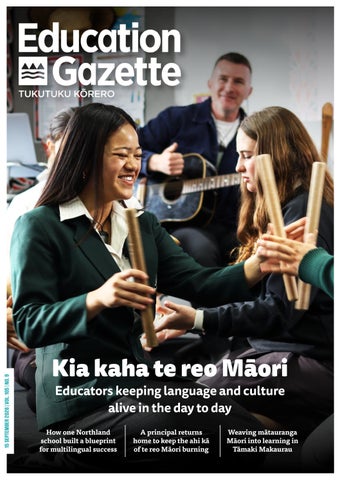
On the cover Te reo Māori students performing tī rākau at Ōrewa College, where te reo Māori and tikanga Māori are a natural part of daily life.
Scan the QR code and tell us in 50–150 words. B
gazette@education.govt.nz Vacancies and notices listings Vacancies@edgazette.govt.nz
Education Gazette
tinyurl.com/5n955xdd
gazette.education.govt.nz
15 September 2026
Tukutuku Kōrero
1
TE REO MĀO RI
A principal returns home to keep the ahi kā of te reo Māori burning From morning greetings and student-led mihi whakatau to a growing Māori-medium pathway, te reo Māori and tikanga Māori are becoming a natural part of daily life at Ōrewa College. For principal Wiri Warriner, that journey is deeply personal.
W
hen Wiri Warriner walks through the gates of Ōrewa College each morning, he does so as principal, but also as someone whose connection to the school stretches back decades. The classrooms have changed, the opportunities available to students have expanded, and the place of te reo Māori and te ao Māori within the life of the kura has evolved significantly since he was a teenager. Yet for Wiri, returning to Ōrewa College has never simply been about coming back to a familiar place. It has been about contributing to a community that helped shape him, and helping create opportunities for the next generation.
“I feel incredibly privileged and honoured to be back where it all started,” says Wiri. “My roots on the Hibiscus Coast go back close to four decades, so it does feel somewhat surreal to have found a career I am incredibly passionate about; supporting youth, our next generation, and helping people to grow, and then to be able to do that by giving back to the community that once served me.” That sense of service has long been part of Wiri’s story. His parents left dairy farming when the family moved to the Coast, retraining while working and raising two children. His mother worked in rest homes and youth centres before becoming a professor, while his father built a career in the mental health sector and later became the CEO of a mental health organisation.
“I hope they remember that their school helped plant a seed, or gave them an experience that shifted their thinking.” “In different ways, service has always been part of what our family does,” says Wiri. Just as influential were the many events his parents took him to while he was growing up. “Mum and Dad would also take us to hui, blessings, openings and kaupapa Māori events across the Coast. “Although we are Ngāti Whātua, we would be there supporting others who were creating kaupapa Māori opportunities locally. There were fewer of those opportunities then, and a smaller group of people involved, so it was important to our whānau to turn up and support.” The growth he sees today did not happen by accident, he says, but through the commitment of people who consistently showed up. “For me now, there is something quite special about being in a position to continue that work; helping create opportunities so they are easier to come by, and so those experiences become a natural part of our community where people feel comfortable engaging. “The Hibiscus Coast is in a really positive place at the moment in that respect and that is a credit to the leaders who have been the ahi kā (burning fires) over many years.” A marks theGazette signing of an agreement between Fukuoka City mayor Mr Takashima and 2 pōwhiriEducation Ōrewa CaptionCollege principal Wiri Warriner (centre right), cementing a 40-year partnership as sister cities.
gazette.education.govt.nz
15 September 2026
Tukutuku Kōrero
3
A return with purpose
While Wiri’s commitment to te reo Māori and te ao Māori is now a visible part of his leadership, he is the first to admit that his own journey has not been a straightforward one. As a student at Ōrewa College in the late 1990s, he took junior Māori and enjoyed it, but the pathways available at the time were limited. “I took junior Māori as a subject here in the late 1990s, but when I wanted to continue, I ended up having to do the rest by correspondence because there was a shortage of teachers.” Years later, after travelling overseas and playing sport in the United Kingdom, he returned to Aotearoa and began his teaching career at Massey High School. It was there that an unexpected opportunity became a turning point. As his fixed-term contract drew to a close, another position became available if he was willing to, as he puts it, “dabble in teaching junior Year 9 and 10 Māori”. What began as a practical career decision quickly became something much more significant. Wiri still remembers the feeling that he was entering unfamiliar territory at his first department meeting – all in te reo Māori. “It was a large department with a full immersion programme, Te Reo Mahanahana. I remember thinking, ‘I’m in the deep end here. I can’t speak fluent Māori, let alone follow everything that is going on’.” Rather than being deterred, he found himself energised by the challenge and “then very quickly it became, right, let’s figure this out”. Teaching te reo Māori and working alongside immersion pathways exposed him to different approaches and opened his eyes to the opportunities education can create. “I absolutely loved it. It challenged me and gave me a whole new appreciation for different ways of teaching and learning, and for making things like retrieval and rote learning fun and engaging.” A particularly powerful influence came from the students in the rumaki classes where te reo Māori was their first language. “I was also teaching two rumaki health and PE classes where te reo Māori was the students’ first language. That was probably where I saw first-hand something I really envied. They had their language.” The experience helped crystallise something that continues to motivate him today. Around the same time, he watched leaders such as principal Bruce Ritchie advocate publicly and authentically for te reo Māori. 4
Education Gazette
“As a non-Māori principal, I would see him sitting in whānau hui genuinely advocating for the revitalisation of te reo Māori. You could tell he meant what he said, and that had a profound impact on me. “It made me think beyond just being a teacher, or aspiring to be a great teacher. It made me think about the bigger picture and the influence you can have across a community.”
Where belonging becomes visible
Today, Wiri believes one of the clearest signs of progress is not found in a strategic plan or a roll number. It is found in the everyday life of the school. If a student were arriving at Ōrewa College for the first time, he hopes what they would encounter would feel welcoming, natural and unforced. “I would hope that a student walking through the gates would first see smiles on the faces of students and staff, followed by a teacher saying, ‘Kia ora’ or ‘Mōrena’. Nothing big, nothing too put on.”
The significance of those moments lies in their ordinariness. They signal a culture where te reo Māori and tikanga Māori are increasingly part of the everyday rhythm of school life. “Even something as simple as hearing our receptionist greet people with such manaaki, with a ‘Kia ora’ or ‘Mōrena’, tells you something. Those simple things start to become the norm.” That sense of confidence is becoming increasingly visible in students themselves. Wiri recalls a recent series of visits from local primary schools, where Year 6 students were given the opportunity to experience life at Ōrewa College before deciding where they would continue their education. “We are now at a place where our students can lead mihi whakatau confidently, with mana and care. We had strong whaikōrero from our Year 7 students, followed by waiata tautoko.” What followed was an unexpected reminder of how much had changed across the wider community.
“Every feeder primary school responded with whaikōrero and waiata tautoko, unprompted. It wasn’t directed or led by their teachers. The students just knew the process.” For Wiri, the moment demonstrated the cumulative impact of years of collaboration and intentional effort across schools. “That was amazing to see because it reflected the immense, deliberate and intentional work our network of educators had done over many years, particularly around kaupapa Māori. We are now starting to see the fruits of that labour.” As he walks around the school, he sees similar signs everywhere. “You hear simple, common phrases being used by staff, and when you walk around the school, students are using more te reo Māori as well. You hear it walking the school, in classrooms and in assemblies. It is starting to feel normal. Not put on and not pressured.”
Students in the Rumaki Reo programme “Taipari” attending the Matariki Festival at Mahurangi College. gazette.education.govt.nz
15 September 2026
Tukutuku Kōrero
5
Throughout the process, the school sought guidance from whānau, neighbouring kura and mana whenua. Wiri says leaders spent time learning from schools including Pasadena Intermediate, Whangārei Intermediate and Henderson Intermediate, while continuing to engage with Ngāti Manuhiri and leaders including Te Kurataiaho Kapea of Ngāti Rango and Ngāti Whātua, who is also an Ōrewa College alumnus. “We had an idea about where we wanted to go, but the response from the community gave us the confidence to be bold and more ambitious.” One memory stands out for Wiri, of a student from a non-Māori background who stood and delivered a whakatau in te reo Māori for five minutes. “At the beginning of the year, his family were still considering whether the programme was going to be right for him. Now they are not looking back.” For Wiri, moments like that reinforce what the work is ultimately about; creating an environment where people feel safe, confident and encouraged to participate. “The responsibility now is to make sure students feel comfortable walking through the doors that have been opened. “For Māori students, that means feeling confident
Students perform tī rākau in their te reo Māori lesson.
For Wiri, that normalisation matters because, as he says, “When small things become normalised, that leads to it becoming revitalised”. He also believes great practice extends beyond language learning alone. “For us, it is not just about learning the language. It is also about understanding the why.” He says the deeper students’ connection to place, culture and community becomes, the more likely they are to develop a sense of pride, purpose and belonging.
Planting seeds for the future
The school’s growing Māori-medium and bilingual pathways have emerged from the same philosophy. When conversations began about strengthening Māori provision at Ōrewa College, the initial vision was relatively modest. Through engagement with whānau, students, staff and the wider community, however, it quickly became clear there was significant appetite for something more ambitious. “The message from whānau was pretty clear. They wanted more reo, a stronger sense of kaupapa Māori, and they wanted to feel more connected to the kura and to the journey their tamariki were on. 6
Education Gazette
to reclaim their language without any sense of shame. We also have many non-Māori families who genuinely want to be part of the learning and want to do that in a way that is respectful and supportive.” When he thinks about the future, his mind returns to a memory from Wales. While coaching rugby overseas, he met a school coach whose children spoke fluent Welsh alongside their father. The interaction lasted only a few moments but stayed with him long afterwards. “I remember watching them and immediately thinking, ‘I want that. I want that for my kids’. “There was something really powerful about seeing a language living naturally within a family. It wasn’t being performed or taught at that moment; it was simply normal.” If, decades from now, one of today’s students is speaking te reo Māori comfortably with their own tamariki, Wiri hopes Ōrewa College will have played a small part in that story. “Maybe they go on to advocate in their own way, continue into further study, or carry those practices forward into the next generation. “I would love to think that, in some small way, part of that journey started at their kura.”
“When small things become normalised, that leads to it becoming revitalised.” “There is sometimes that feeling when your child gets to secondary school that you hear less and less about their day and it becomes harder to be part of their journey. We knew that a strong kaupapa Māori philosophy, through something like a bilingual or whānau-based programme, could help break down some of those barriers. “When you enrol a student into a programme like this, in many ways you are enrolling the whole whānau. It takes that collective commitment to make it work.” School leaders initially imagined a small bilingual class. Then applications began to arrive, with 45 families wanting to take part for the first year. The response encouraged the school to move faster, expand its planning and think more boldly about what might be possible. gazette.education.govt.nz
Wiri with the four Head Manukura for 2026. 15 September 2026
Tukutuku Kōrero
7
IWI PARTN ERSH I PS
F
rom Te Wao Nui ā Tiriwa Waitākere Ranges that dominate the horizon on Auckland’s North Shore, a strong sense of place has long shaped learning at Upper Harbour Primary School. Located in Greenhithe, Upper Harbour Primary caters for students from Years 1 to 6. While more than half of its students identify as Asian and only a small proportion identify as Māori, the school believes local mātauranga Māori and mana whenua knowledge are fundamental to every child's education in Aotearoa. Kirstin Douglass, deputy principal at Upper Harbour Primary School, says the school’s approach to learning has evolved over several years through conversations with teachers, students, whānau and community organisations. Together, they explored the experiences, values and local stories that mattered most to their community, helping shape learning that reflected both local aspirations and the unique environment surrounding the school. “This allowed us to see what our learning community wanted more of and the experiences that were uniquely ours.” Once that foundation was established, the school began working alongside Te Kawerau ā Maki through the Mana Kura initiative to connect learning with local iwi histories, pūrākau and ancestral knowledge. “For our mātauranga team, the Mana Kura initiative’s intent is firstly about building a genuine relationship and long-term collaboration with schools,” says Josie Wall, education lead at Te Kawerau ā Maki. “As kaiako ourselves, we understand the many other conflicting priorities that our partnership schools may have, which is why we co-design the programme in an organic way that fits each school’s individuality, location in Aotearoa, and unique histories.”
Weaving mātauranga Māori into teaching and learning at Upper Harbour Primary Through five years of developing its approach to teaching and learning, including a three-year partnership with Te Kawerau ā Maki, Upper Harbour Primary School has woven local pūrākau, mātauranga Māori and authentic action into every classroom, helping students develop a deeper connection to place, purpose and community.
Memorable and meaningful
Today, students revisit a series of te ao Māori concepts throughout a two-year learning cycle, with each concept providing a meaningful context for learning across reading, writing, science, social sciences and outdoor education. “Teaching and learning is grounded in mātauranga Māori, but the concepts themselves are timeless, transferable and universal,” says principal James Wheaton. Each term begins with a local pūrākau that introduces the concept students will explore.
students at Upper Harbour Primary took centre stage during a school production 8Nearly 400 Education Gazette to share their learnings about Aotearoa New Zealand’s ocean health.
gazette.education.govt.nz
15 September 2026
Tukutuku Kōrero
9
One story that has resonated strongly with students is that of Te Au ō Te Whenua, whose diplomacy brokered peace between two iwi. Through this pūrākau, students explore the concept of whakawhanaungatanga and the importance of building relationships. Months after learning the story, students encountered the word ”diplomat” during a reading lesson and immediately connected it back to Te Au ō Te Whenua. “That showed they understood the story so well they could transfer that understanding to a completely new context,” says Kirstin. “Storytelling makes learning memorable. That’s how young brains are wired. Te Kawerau ā Maki gifted us with the knowledge of our local iwi histories as taonga to educate this new generation, and our students treat them as taonga as well.” A defining feature of Upper Harbour Primary School’s approach is encouraging students to put their learning into action. Whether improving their environment, advocating for change or contributing to their community, students are expected to apply what they have learned in meaningful ways. Current learning demonstrates kaitiakitanga in
10
action, with younger students establishing a worm farm in the vegetable garden, middle-school learners leading replanting projects, and senior students installing predator tracking tunnels throughout the school’s nature trail. “Reading materials across our curriculum align with students’ learning across all year levels, while writing tasks always have an authentic purpose,” says James. “Our children care about what they’re writing because they’re knowledgeable about it through their reading. This has led to accelerated progress in reading outcomes.”
Strengthening connections to people and place
Working alongside Te Kawerau ā Maki has also strengthened relationships between the school, whānau and the wider community. Through local pūrākau and shared learning experiences, students are developing a deeper understanding of their role as kaitiaki of their local environment. One of the concepts explored through stories shared by Te Kawerau ā Maki is kaitiakitanga, including what it means to care for the local ngahere.
Education Gazette
Upper Harbour Primary School students putting kaitiakitanga (guardianship) into action at a local reserve.
gazette.education.govt.nz
“We co-design the programme in an organic way that fits each school’s individuality, location in Aotearoa, and unique histories.” Over the past two years, several classes have participated in Auckland Council’s Adopt-a-Park programme, helping care for a reserve beside the school through weeding, planting and monitoring predators that threaten native wildlife. The work has given students authentic opportunities to contribute to their community while strengthening connections with whānau and local organisations. Another example of this learning in action was last year’s whole-school production exploring the health of Aotearoa’s oceans. “The message was incredibly strong,” says Kirstin. “Parents couldn’t get over how knowledgeable the children were, and even at home students were advocating for changes like using shower timers because they felt empowered to make a difference.” The school has also seen students sharing their learning with whānau in practical ways. Last term, Year 4 to 6 students learned about kauri dieback disease before visiting the Arataki Visitor Centre to see its impact firsthand in Te Wao Nui ā Tiriwa, the Waitākere Ranges. The experience inspired many students to educate their whānau about the disease and the simple actions people can take to help prevent its spread. Students created posters and shared their learning during student-led conferences, encouraging families to clean footwear before and after entering the bush and to stay on designated tracks. The partnership has also strengthened students’ connection to the local landscape and the stories embedded within it. During the recent visit to the Arataki Visitor Centre, students immediately recognised carvings representing ancestors they had learned about in class. “It was almost like they’d come home. Our students were saying things like, ‘they’re the ones we’ve been learning about,’ and they wanted to tell the educators the stories they had learnt,” says Kirstin. She has also noticed local place names becoming part of students’ everyday language. “We recently asked the children to complete a writing sample, and many of them independently 15 September 2026
Upper Harbour Primary School connects classroom learning with local history at Arataki Visitor Centre, based in in Te Wao Nui ā Tiriwa, the Waitākere Ranges.
referred to the forest as the ‘ngahere’ and the Waitākere Ranges as ‘Te Wao Nui ā Tiriwa’,” she says. “It was exciting to see these names becoming part of the children’s everyday language and understanding of the place they call home.”
Building authentic partnerships takes time
For James, seeing students embrace local iwi history has been one of the greatest rewards of the partnership with Te Kawerau ā Maki. “To see such a diverse school community embrace local history and sacred iwi mātauranga has been a privilege to see develop.” Having worked alongside the school throughout its mātauranga journey, Josie shares in that pride. “Upper Harbour Primary have treasured our pūrākau, and we looked at how the stories of our tūpuna can be embedded in the classroom.” The school’s approach to teaching and learning, and the framework they developed to guide it, demonstrates this. Looking back, James believes meaningful change takes patience. “My advice for our school principals wishing to embed te ao Māori into teaching and learning is to go slow and bring your stakeholders with you – your children, your teachers, your whānau and your iwi.” Tukutuku Kōrero
11
ESOL
How one Northland school built a blueprint for multilingual success Nineteen years ago, St Francis Xavier Catholic School in Whangārei had just three English language learners. Today, 265 students are supported through a carefully developed ESOL programme that combines strong relationships, targeted support and a celebration of language, culture and identity.
T
he bell rings at St Francis Xavier Catholic School in Whangārei and children spill into the playground speaking a tapestry of languages. Some have arrived in New Zealand only recently. Some are taking their first steps in English. Others move easily between languages, cultures and friendships, carrying the stories of home with them. For many students, their journey began long before they entered the classroom. Before a new English language learner starts school, the team at St Francis Xavier sits down with the student and their whānau. The school learns about the child’s interests, strengths and home language. Interpreting support is available through migrant learning assistants who speak Malayalam and Tagalog, helping families feel understood from the outset.
It is one example of how the Whangārei Catholic primary school has responded to a remarkable transformation in its community.
A comprehensive system grows
In 2026 the number of English language learners grew exponentially to more than 50 percent of the total student population. Principal Bernie Hall says a demand for a Catholic education is a driving factor for these families to enrol at St Francis Xavier. As the principal, Bernie says this growth has meant finding new ways to adapt, including creating a larger ESOL space to work in. The school combined two office rooms so students could have group lessons, as well as acting as a permanent workspace for the ESOL team. But for Bernie, the growth has never been about numbers and spaces alone. “Going from three learners to 265 has certainly required us to grow, change and continually reflect on our practice,” says Bernie. The ESOL team, led by Leasa Hirst, now works alongside classroom teachers, runs Intensive English Language Programmes for junior and senior learners, provides oral language groups, target focus groups, one-to-one support and in-class assistance. As the number of learners has grown, so too has the range of support available, so students get the help that matches their stage of language development and individual needs. “Rather than seeing the growth as simply a number, we have seen it as an opportunity to strengthen what we do as a school,” says Leasa. Behind the systems and data sits a simple goal: helping children feel they belong. “Our ESOL programme is not just about teaching English; it is about building confidence, belonging, relationships and the skills learners need to access the whole curriculum.”
A first day built around belonging
Imagine arriving at a new school in a new country, surrounded by unfamiliar sounds, routines and expectations. At St Francis Xavier, that experience is carefully considered. Before students even begin classes, the school gathers information about their language background, previous schooling, strengths and interests. Their English language needs are assessed and any immediate learning requirements identified. Caption
12
Education Gazette
Culture and diversity is celebrated at St Francis Xavier Catholic School.
gazette.education.govt.nz
15 September 2026
Tukutuku Kōrero
13
On a student’s first day, a member of the ESOL team checks in with them, ensures they have a buddy and helps them become familiar with key places around the school. Particular care is taken to learn and pronounce each child’s name correctly. The support continues well beyond that first morning. ESOL staff spend time in classrooms observing, getting to know each learner and identifying what support will help them succeed. Students are then placed in targeted programmes matched to their stage of language development, whether that be intensive English instruction, oral language development or support in specific learning areas. The school’s approach is captured in its ESOL motto: ‘Every Language Matters, Every Culture Belongs, Every Learner Can Succeed.’ Principal Bernie Hall.
“Our ESOL programme is not just about teaching English; it is about building confidence, belonging, relationships and the skills learners need to access the whole curriculum.”
Knowing learners deeply
As enrolments grew, the school recognised the need for more sophisticated ways to understand learner progress. The ESOL team developed its own tracking and assessment systems, allowing them to record observations, monitor development and respond quickly when needs emerge. “The biggest difference has been that we are now able to make more informed decisions about each student’s learning,” says Bernie. The system builds a picture of each learner from the day they arrive. Staff combine formal assessments, classroom observations and ongoing monitoring to identify strengths, learning needs and next steps. Information is shared between the ESOL team and classroom teachers, helping ensure support remains responsive and targeted. The team also uses digital tools to record observations, capture evidence of learning and track progress over time. Student work can be photographed and linked to observation records, helping the ESOL team identify patterns, respond to gaps and make informed decisions about teaching and support. As well as tracking individual progress, the school’s data helps identify broader trends across year levels and learner groups, allowing programmes and resources to be adjusted where they will have the greatest impact. The collaboration is central to the programme’s success. While classroom teachers remain at the heart of students’ learning, the ESOL team provides additional expertise, targeted teaching and strategies that help
Jolly Pathickan Joy, Jerlene Sevilla, Anita Pattathil and Leasa Hirst.
learners access the curriculum. Together they reinforce vocabulary, sentence structures and language needed for classroom success. Teachers regularly share information about student progress and classroom experiences, while the ESOL team provides targeted language support that complements classroom learning.
“The biggest change is seeing students move from watching and observing from the sidelines to becoming active participants.” Finding a voice
One student’s story illustrates the impact sustained support can have. When L.P. joined the programme, she spent several months in what educators call the silent period. She communicated with only occasional English words and was hesitant to participate. The team’s initial focus was not on fluency, but confidence. Alongside classroom support, L.P. joined the school’s Intensive English Language Programme, receiving targeted teaching in a small-group environment focused on listening, speaking, reading and writing. Gradually, her oral language began to emerge.
As she began to code-switch between languages, both the ESOL team and her classroom teacher gained a clearer understanding of what she knew and where further support was needed. The small-group environment gave her opportunities to participate, take risks and develop confidence. The student started taking part, asking questions and seeking clarification when needed. Even after extended trips back to her homeland resulted in some regression, the team was able to respond quickly with renewed support and increased focus on rebuilding her listening, speaking, reading and writing skills. Today, L.P. is well adjusted, confident, happy at school, and “making wonderful progress”. Leasa says her journey reflects the importance of recognising that language learning takes time. “Ongoing, targeted support can make a significant difference to a student’s confidence, wellbeing and academic progress.”
From the sidelines to the centre
For the St Francis Xavier team, some of the most rewarding moments cannot be measured by assessment data. They see it when students begin raising their hands. When they make friendships. When they stop watching and start participating. “As students’ English develops, we often see significant changes in their confidence, participation and sense of belonging,” says Leasa.
Students enjoy sharing their cultures.
14
Education Gazette
gazette.education.govt.nz
15 September 2026
Tukutuku Kōrero
15
An opportunity, not a challenge
Students who were once hesitant become willing to take risks. They begin answering questions, sharing ideas and communicating more confidently with both teachers and peers. They become more independent, asking for help when they need it, seeking clarification and advocating for themselves. As language grows, Leasa says so too does independence. “For us, the biggest change is seeing students move from watching and observing from the sidelines to becoming active participants in their own learning and school life.”
Celebrating every culture
The school’s commitment extends beyond language development. Throughout the year, students are encouraged to share their languages, traditions and cultural knowledge. Home languages are viewed as strengths, not barriers, and families are recognised as key partners in learning. Learners are encouraged to continue using their first language as a foundation for learning English, while families are supported to maintain cultural and language connections at home. One highlight is the school’s annual cultural evening in term 4, when students and whānau proudly share traditional dress, music, dance and food. The event has become a much-loved celebration of the diversity that now defines the school community. Supporting that diversity are migrant learning assistants who bring both professional expertise and lived experience to their work. They provide translation support, help learners access classroom learning and often serve as an important bridge between school and home.
St Francis Xavier's ESOL room.
“As an immigrant, I understand the struggles my English language learners students face every day,” explains Anita Abraham Pattathil. “I find so much joy in seeing their happiness and watching their faces light up over the tiniest breakthrough and I love encouraging them to succeed.” Jolly P. Joy says working with English language learners has shown that every learner has a unique journey. “I feel privileged to be part of that journey, helping students overcome language barriers, discovering their strengths, and helping them to feel a sense of belonging in their new school community.” For Jerlene Sevilla, the work is deeply personal. “As a migrant myself, I know exactly how overwhelming a new language and culture can feel. My role as a migrant learning assistant is so close to my heart, success for me isn’t just about teaching a new language; it’s about building a safe space where our learners gain confidence, thrive at school, and proudly share their culture.”
As schools across Aotearoa experience growing linguistic diversity, Leasa believes the lesson from St Francis Xavier is straightforward. “My advice would be to see the growth as an opportunity rather than a challenge. Rapid growth of our English language learners required us, the ESOL team, to be proactive, flexible and responsive to the changing needs of our students, their families and the staff.” For St Francis Xavier, growing alongside learners has meant developing assessment tools tailored to their context, creating resources to help teachers using the English Language Learning Progressions, building strong partnerships and supporting classroom teachers and ESOL specialists to work closely together. Looking around the school today, it is easy to see why.
Success here is not defined solely by English proficiency. It is the child who finds their voice. The learner who asks for help. The student who proudly shares their culture while confidently navigating a new language. It is, as Leasa describes it, seeing English language learners become “confident, capable and active participants in their learning and school life, while still maintaining pride in their own language, culture and identity”. And in a school where dozens of languages echo through classrooms and playgrounds each day, that sense of belonging might be the most important language of all. “With the right support and a strong whole-school approach, multilingual learners can thrive and enrich the entire school community,” says Bernie.
A blueprint for ESOL success Start with relationships
Value every language and culture
» Meet with students and whānau before enrolment.
» Treat home languages as strengths, not barriers.
» Learn about their language background, previous schooling, interests and strengths.
» Create opportunities for students to share their language, culture and experiences.
» Provide interpreting support where possible and ensure students have a buddy from day one.
» Celebrate cultural diversity through events that actively involve whānau and the wider community.
Build a layered support system
Invest in specialist expertise
» Offer different types of support for different needs, including Intensive English Language Programmes, oral language groups, target focus groups, one-to-one support and in-class assistance.
» Employ staff who understand the experiences of migrant and multilingual learners.
» Regularly review groupings so support remains responsive as students progress.
Make ESOL everyone’s responsibility
» Use multilingual support staff to bridge communication gaps and strengthen relationships with families.
Think long-term
» Keep classroom teachers at the centre of learning.
» Recognise that language acquisition is rarely a straight line.
» Create strong communication between classroom teachers and the ESOL team.
» Continue support beyond funded units when learners need it.
» Share information about students’ strengths, needs and next learning steps so language support is embedded across teaching and learning.
» Focus on confidence, wellbeing, participation and belonging alongside English language development.
Use evidence, not assumptions » Assess learners on arrival and monitor progress over time. » Combine observations, classroom assessment and student work samples to build a clear picture of language development.
Define success broadly » Success is not only fluency in English. » Success is a learner who asks questions, takes risks, participates in class, forms friendships and maintains pride in their language, culture and identity.
» Use data to identify emerging needs, target resources and measure progress.
16
Education Gazette
At an annual cultural evening, students proudly share traditional dress, music, dance and food.
gazette.education.govt.nz
15 September 2026
Tukutuku Kōrero
17
STRUCTU RED LITERACY
Kia Angitu Tātou Katoa: Working together for literacy success at Flat Bush Primary At Flat Bush Primary School, a focus on structured literacy is bringing teachers, whānau and learners together. Guided by a Ministry of Education curriculum advisor, the school is combining evidence-based practice with culturally responsive teaching to support success for all.
W
hen the 25 teachers at Flat Bush Primary School in Ōtara, Auckland, gathered for a Teacher Only Day with Ministry of Education curriculum advisor Renu Sikka, the learning was about more than literacy. For principal Banapa Avatea, it was an opportunity to strengthen a shared vision that underpins everything the school does. “A whole-school approach was vital to align with our guiding vision: Kia Angitu Tātou Katoa – Success for All,” says Banapa. The work also aligned with the national goal of having 80 percent of Year 8 students achieving at or above the expected curriculum level in reading, writing and mathematics by 2030. For Flat Bush Primary, where student transience and attendance can present challenges, a consistent approach across classrooms is essential. “Our community faces high transience and variable attendance; without consistent delivery and curriculum across all classrooms, learning continuity would be disrupted.”
Bringing the science of learning to life
The professional learning focused on structured literacy and the science of learning, helping teachers deepen their understanding of how children learn to read and how teaching can be tailored to meet different needs. A key focus was the Ladder of Reading and Writing by Nancy Young, which highlights that learners require different levels of support on their reading journey. 18
Education Gazette
Flat Bush Primary School principal Banapa Avatea.
gazette.education.govt.nz
15 September 2026
While some students acquire reading skills relatively easily, many benefit from explicit, systematic instruction and others require intensive, targeted support. For Flat Bush Primary’s teachers, the framework provided both reassurance and direction. During the workshops, teachers connected theory with classroom practice, exploring how knowledge, skills and teaching strategies work together to accelerate learning. The day also strengthened teachers’ understanding of explicit instruction, effective lesson design, and the use of assessment tools such as DIBELS to identify learning needs early.
Reflecting the school's diverse community
For Banapa, structured literacy could never be separated from the school's cultural context. “Our collaboration with Renu provided an evidencebased roadmap that we could contextualise for our unique community.” That community is one of New Zealand’s most diverse, and the school has intentionally woven students’ languages, cultures and identities into its teaching and learning programmes. “To ensure the approach reflected our learners’ cultures, we integrated Pacific contexts into the learning.” In the Samoan bilingual unit, for example, traditional navigation is used to teach mathematics, while concepts such as fale construction and cultural patterns help localise learning. Shared reading experiences have also been extended by incorporating students' home languages. Tukutuku Kōrero
19
“Our strategic plan emphasises creating learning partnerships with whānau through the curriculum,” says Banapa. They also work to make learning progress visible and meaningful for families. "We share literacy learning and progress with families by involving aiga/whānau directly in assessment conversations.” Earlier this year, 68 whānau attended a structured literacy information session, while another 30 attended a workshop explaining the school's updated reporting approach. Looking ahead, strengthening communication with families around achievement and attendance remains a priority.
Flat Bush Primary kaimahi at a Teacher Only Day.
The professional learning sparked renewed energy within the Samoan bilingual team. “In practice, this engagement looked like culturally responsive groupings that strengthened student belonging and motivation.”
“Our 25 teachers felt unified and practically equipped to elevate their teaching strategies." Strengthening teacher collaboration
The impact of the Teacher Only Day was evident almost immediately. Banapa says his team left with a shared understanding of what effective literacy instruction looks like and how it can be implemented consistently across the school. “Our 25 teachers felt unified and practically equipped to elevate their teaching strategies. “In practice, this involved teams collaborating in practical workshops to interweave knowledge with practice.” That sense of collective responsibility continues through the school's professional growth cycle, which includes practice analysis conversations (PACs), classroom observations, buddy coaching and professional learning discussions. 20
Education Gazette
“Teachers have ongoing support from curriculum leads who are provided with release time to help guide the implementation,” says Banapa. Teachers are also engaging in increasingly rich conversations about student achievement. Assessment information is helping them identify where learners sit on the Ladder of Reading and what support is needed to help them progress. “There are also focused cross-level conversations happening to specifically target the Year 3 and 4 achievement dip,” says Banapa. He further explains that they use structured mid-year reviews to provide support for Years 2–4.
“Whānau played an active and critical role in supporting learning at home.” Early signs of impact
“Teachers have noticed significant upward movement in academic achievement,” says Banapa. According to the school’s 2025 achievement data, reading achievement at or above expected levels
increased by 10.4 percentage points between mid-year and the end of the year. The proportion of students achieving in the “Exceeding” category grew by 11.2 percentage points, while the number of students in the “Progressing Towards” category fell by 19.3 percentage points. Writing achievement showed particularly strong improvement. The proportion of students achieving in the “Exceeding” category more than tripled, increasing from 3.8 percent at mid-year to 12 percent by year’s end. Overall writing achievement at or above expected levels increased by 12 percentage points across the school. Mathematics results were also encouraging, with the Year 4 cohort recording a 37 percent increase in students achieving at the expected level. Beyond academic achievement, the school has seen dramatic improvements in punctuality. By term 4, 80 percent of students were arriving on time regularly, compared with 27 percent in term 1 of 2024. While challenges remain, including student transience, irregular attendance and language barriers for some learners, Banapa believes the school is building strong foundations for the future. Through a combination of evidence-informed teaching, culturally responsive practice, strong whānau partnerships and ongoing professional learning, Flat Bush Primary School is continuing its journey towards Kia Angitu Tātou Katoa – Success for All.
Whānau as partners in learning
While teacher practice is a key focus, Banapa says whānau have also played an important role in the school’s literacy journey. “Whānau played an active and critical role in supporting learning at home.” The school has hosted Talanoa Ako workshops to show families practical ways to support literacy and numeracy learning, while volunteer programmes have strengthened connections between home and school. “The active participation in Talanoa Ako workshops and volunteer programmes indicates a positive reception and a strengthened whānau-school engagement,” says Banapa. The school places a strong emphasis on learning partnerships, with families invited to participate in workshops and share their cultural knowledge and professional expertise with students. gazette.education.govt.nz
Ākonga and kaimahi celebrate their principal. 15 September 2026
Tukutuku Kōrero
21
TE REO M ĀO RI
The kaiako elevating te reo Māori at Shirley Boys’ High School At Shirley Boys’ High School te ao Māori is woven through everyday school life, from karakia in classrooms and house assemblies to strong whānau partnerships and student leadership. Kaiako Chez-William Waihi and Paul Peawini, supported by acting headmaster Rob Wilson-Pyne, are helping create a culture where Māori students can see themselves reflected, supported and inspired to succeed.
Welcoming students from Japan with a mihi whakatau.
Role models in action
Shirley Boys’ tauira achieved outstanding results at Ngā Manu Kōrero 2026.
F
or many people, the opportunity to be a role model is one of the reasons they choose a career in teaching. Although relatively new to the teaching profession, Chez-William Waihi says the role models in his own life have done more than inspire him, they have shaped the way he teaches. “I try to lead from the front in how I want my students to be. Not just as Māori, but as students as a whole. So when they do go on to pathways post school, I’ve given them some words of wisdom, or a little bit of inspiration to succeed.” Chez has been a teacher at Shirley Boys’ High School
22
Education Gazette
for just over two years, and senior leadership has already begun to see how important relatability can be for role models. “The boys revere him; he’s young, but old in character. The boys really do look up to him, a young Māori man who is brilliant in what he does, and always supports them,” says Rob Wilson-Pyne, acting headmaster of Shirley Boys’. In his short term so far at Shirley Boys’, Chez has already made an impact on the school’s nearly 300 Māori students, as well as the wider roll of around 1,200 students. gazette.education.govt.nz
Kaiako Paul Peawini, known as Paora, was similarly influenced by the role models in his own life and now aims to help young Māori men become the best versions of themselves. Mentored by Gilbert Enoka in his youth, Paora has always found success integrating te ao Māori into his physical education lessons. Now having completed over five years at Shirley Boys’, he is able to look back and appreciate the strides his school has taken. “From the principal down, our school really values te ao Māori in our spaces; it’s something that we’re really proud of.” At Shirley Boys’, leadership doesn’t stop with staff. Many of the school’s senior students are becoming role models in their own right. “This year our headboy is Māori. He’s been involved in our whānau form classes for five years. From a student perspective I am sure seeing someone come from the same kaupapa spaces as you and achieving so many things is really inspirational,” says Chez. Staff say many students are finding their own ways 15 September 2026
Caption.
to weave kaupapa Māori into school life. “Regardless of their background and what they bring, we listen to their ideas of leadership. We have had wellbeing programmes, kids going overseas, other initiatives, all set up by the boys,” adds Rob. “We’re very fortunate to have a number of boys who have been wonderful leaders in our school. We’re very proud of all of our boys.”
Supporting fellow kaiako
Rob explains that most of the initiatives his students have set up are their own ideas, on their own accord, including the introduction of their school’s karakia into student-run house assemblies. Rob believes the success of this integration stems from the way leaders encourage the use of te reo Māori and tikanga Māori without forcing it. Paora believes knowledge and confidence remain two of the biggest barriers for some teachers wanting to incorporate more te ao Māori into their practice. “A lot of it is confidence; once they get that basic confidence then it starts to become a natural, normal part of their day.” Tukutuku Kōrero
23
“A lot of it is confidence; once they get that basic confidence then it starts to become a natural, normal part of their day.”
Both Paora and Chez remark that, in some sense, they believe they could still be doing much more to increase the knowledge and confidence of their fellow teachers. “I think that’s somewhere my role could improve – the professional development of others. It’s hard to remember sometimes that some people want to help more, but they don’t know how,” says Paora. “A lot of staff do come to me on their own terms, to ask for guidance. But I think I could be a bit more forthcoming in order to help some teachers understand more,” says Chez. Rob is proud of his team and points out the lengths both of these teachers have gone to in order to integrate Māori culture and language throughout Shirley Boys’. “We hear karakia being recited by the department members regularly, it’s beautiful. Chez is younger, but like I said, he has the wisdom of a man above his years. “Regardless of what they can or cannot be doing more of, all of these teachers are extremely proud of where their school is at, and where it is headed.”
Connections with whānau
The impact of kaupapa Māori at Shirley Boys’ extends beyond the school gates and into the wider community. “I have two boys here too. I tell my wife that our boys are in good hands. The languages, the practices and the role models at the school are incredible,” says Paora. Often holding hui nights with whānau of students to get to know them better, Shirley Boys’ takes the time to understand and acknowledge their feedback and aspirations. Many parents are incredibly involved in some extracurriculur activities at the school, especially assisting and even coaching the kapa haka. “But not just only in our haka spaces; that’s really just the way it is across all our families. They have always been incredibly supportive. We’re really lucky with the parents we have,” says Rob. “We get many students who join us straight from bilingual or full-immersion. They are usually concerned that their kid might lose the skills they’ve gained from those schools.” Building trust with those whānau, and the students themselves, is an important part of the school’s approach. “Some of those boys are really nervous, their parents too, so it’s just gaining their trust and showing them we can still provide everything they need,” says Rob.
Top: Coming together as a kura to celebrate Matariki with a hāngī. Bottom and right: Students take part in a haka competition between houses.
24
Education Gazette
“I try to lead from the front in how I want my students to be. Not just as Māori, but as students as a whole.”
gazette.education.govt.nz
15 September 2026
Looking beyond the school gates
The team is also looking beyond Shirley Boys’, with ambitions to strengthen engagement with te ao Māori both within their own school and across the wider education sector. Paora says they have goals and plans to take their Māori education to a higher level and have already begun connecting with other schools in order to achieve this. “We know we are not the pinnacle. Chez is connected to Hastings Boys’, and they are connected to other kura – they’ve been doing stuff that we have wanted to for many years,” says Rob. With high hopes for the future, the teachers of Shirley Boys’ are excited to expand their success across New Zealand. "Years ago they did fantastic work as well, creating things, but keeping it to yourself. Whereas now we share knowledge, help everyone succeed.” As members of the South Island Boys’ Network, the team sees collaboration as essential to lifting outcomes for all ākonga. As Chez puts it, “We are of the view that if we can help other people be better, then it’s going to make us better. Anything that helps us, and also raises the bar of what we can achieve, is good.”
Tukutuku Kōrero
25
L A N GUAGE
Kiribati language unit celebrates culture and builds confidence At Finlayson Park School in Auckland, a unique learning environment is helping young people strengthen their language, culture and sense of identity.
W
hat I want to see is children loving their language,” says Taeang Erika, head teacher of the Marawen Te Rabakau Kiribati bilingual unit at Finlayson Park School. Established in 2020, the unit is the first of its kind in New Zealand, providing students with opportunities to learn through the Kiribati language while celebrating the traditions, values and stories of their heritage. “They love to know more about their culture and they know they belong to Kiribati.” For Taeang, the work is deeply personal. Having grown up in Kiribati before moving to Auckland for further study, she understands the importance of maintaining strong cultural connections while living away from home. “I miss the sound. I miss the noise. I miss the way my people are,” she explains. Students in the language unit learn not only the language itself, but also the stories, traditions, songs, dances and values that make Kiribati culture unique. Students in Years 1 to 4 learn through an 80 percent Kiribati and 20 percent English approach, while students in Years 5 to 8 transition to a 50/50 balance between the two languages. Head teacher Taeang Erika and Marawen Te Rabakau Kiribati bilingual unit students.
26
Education Gazette
gazette.education.govt.nz
15 September 2026
Tukutuku Kōrero
27
Taeang Erika (seated far right) proudly poses with her Year 6-8 students and teacher aid Taeam Tokamaen (standing far left).
Growing confidence through culture
Taeang recalls that when the programme first began, many students were hesitant to speak. “At first it was a noiseless classroom,” she says. “But after a while, the sounds of the language surrounded me.” Today, those once-quiet learners confidently communicate in Kiribati, share traditional knowledge and participate in cultural performances. The benefits are equally evident in how students describe their experiences. “I get to be around my people and I get to learn more about my identity,” says Caleb. Brielle agrees. “I like to learn about all the Kiribati legends shared from the past and all the Kiribati traditions.” The programme also nurtures confidence and leadership. Students report feeling proud when they can use their language publicly and share their culture with others. “One of my highlights was performing in front of the school,” says Caleb. “It made me feel proud and confident.”
28
Education Gazette
Keeping traditions alive
Another significant aspect of the unit is its commitment to preserving traditional knowledge. Students learn practical cultural skills such as making bwaai ni maie (traditional dance costumes including grass skirts) and te mwae (woven pandanus headbands). As one student explains, these skills are important for future generations. “What if the people who know how to do it are gone and it’s just us? We have to do it.” Taeang agrees. “I often refer to my students as trees. We need the roots of our culture and language and without them we will collapse." The programme’s success can also be seen in the achievements of its earliest students. This year, Taeang watched her first cohort transition to secondary school after teaching many of them since Year 1. “I was in tears because they had been with me since Year 1,” she recalls. “I felt so proud when their reports came back.” Looking ahead, Taeang hopes her students will become future leaders. More importantly, she wants every child who leaves the unit to know exactly who they are and where they come from. “I feel proud and happy,” she says. “You will not find another school like us. We are unique and special.” gazette.education.govt.nz
We’re on Instagram! us for real stories from classrooms and communities across Aotearoa. 15 September 2026
Tukutuku Kōrero
29
CIVICS
Classroom conversations spark civic confidence Teachers at Edgewater College and Aorere College are supporting students to engage with democracy in new ways. Through the civics education programme Waha, students are exploring their values, debating real-world issues and gaining confidence in their own voice.
E
dgewater College students say the civics education programme Waha has changed how they think about democracy and their place in it. Before taking part, Devyna knew little about Aotearoa New Zealand's political system. “I only knew that children had rights, but not how many,” she says. Now she and her classmates say they feel more confident using their voice and engaging with issues that affect them. Rolling out in intermediate and secondary schools this year, the Waha programme is split into three teaching components: Your Voice (what it means to be an individual citizen); Our Voice (exploring civics and the legal system); and Waha (how to take action on the issues that matter most to the students). It’s a flexible programme, where teachers can decide how their classes learn best, whether information is shared in bite-sized snippets or as a whole subject. There are also video and game elements to support higher engagement.
Growing engagement with civics
When Edgewater College teacher Katarena Bisset sat amongst only 10 others at a civics workshop at the Social Science Teachers' Conference last year, she recalls feeling disappointed at the turnout. But sitting behind her was Sarah Guy from YouthLaw, who invited Katarena to help the organisation out with Waha. “From the get-go, I was in,” says Katarena. “I’m extremely passionate about this because everything we do impacts children, and if they are not aware of who’s making decisions for them and they don’t know how they can be involved, then we teachers are not doing our jobs properly.”
30
Education Gazette
Ākonga at Aorere College are engaging with civics education in new ways.
gazette.education.govt.nz
15 September 2026
Katarena says civics education is taught differently across the motu. Some schools only do a week of civics at the junior school, where others might only teach civics during an election year. Before Waha was taught in her class as a pilot programme, Katarena says that her students “knew a whole lot of nothing” about civics. “They knew they could vote one day and that was about it. They think it’s something for adults; it’s not a young person problem,” she says. But her students also told her they wanted to be heard, but they felt they weren’t being listened to. “That was really cool to see; that despite my students thinking they were not a part of democracy, they still wanted to be.”
Understanding different perspectives
Aorere College teacher Moira Hintz began working with YouthLaw this year to help craft, develop and launch Waha. “It’s been a long-time focus of mine to help our students better understand that they can have a voice,” she shares. “Just because they’re a 13-year-old in the classroom, it doesn’t mean they can’t have an impact on a political party’s policy.” Her social science class took part in a pilot of Waha, helping shape resources that made sense to students. “We didn’t know how it was going to work with the students until we were there in the classroom, seeing how they interact and engage. We want this to be educational in a fun and beneficial way,” says Moira. She says her class discussed issues such as school phone bans and the legal driving age, with students often taking different positions. Some argued the driving age should be raised, while others believed it should be lowered.
Tukutuku Kōrero
31
“By getting students to reflect on what matters to them in the classroom, they can see that their peers may have different perspectives.” On the topic of the voting age, in Moira’s younger class, she noticed they reflected what is already heard across the political spectrum in the adult world. “Some said, ‘No, we’re too young, we don’t know what we’re talking about,” she shares. Others argued their voice did matter, as they would be affected later in life by laws and decisions made now. “It was really interesting to hear these conversations coming through,” says Moira.
Finding their voice
Ākonga at Edgewater College use the programme resources to understand their rights and find their voice.
32
Education Gazette
Both Katarena and Moira say their students most strongly resonated with the ‘Your Voice’ segment, where they would reflect on what’s important to them, identify their values and see how that reflected in policy. “They see how within their class of 30, there are 30 individual voices, and these voices make up how our country is run; it’s meant to reflect everyone,” says Moira. Devyna says most of the time, she feels left out of “political things”, but Waha made her feel heard and seen.
gazette.education.govt.nz
YouthLaw’s Sarah Guy gets ākonga engaged in the Waha programme.
“You shouldn’t be afraid to speak up for yourself and state your opinion, but you also need to hear everyone else’s opinion,” adds another student, Sophia. With the General Election taking place in November this year, Waha is creating conversations in the classroom, whether the students are of voting age or not. “We want students to understand that the electoral process isn’t just about ticking two boxes once every three years after they turn 18,” says Moira. “It’s a process where their voice continues to matter after the election results come out.” For example, students can talk to their local MPs about issues they are passionate about. Students Paki and Sophia say Waha has made them want to be more vocal about their political feelings. “I want young people to feel empowered to share their voice so decision makers can actually hear them,” says Katarena. “I think we would see so much incredible participation from young people if we allowed them to have the chance to do so. Their opinions are so creative, interesting, informed, and they really matter. When decisions affect them, we need to ask them for their thoughts.”
15 September 2026
Resources are available for teachers to download and work through with their classes at waha.org.nz, and any enquiries can be sent to hello@waha.org.nz.
Civics learning is also strengthened through the refreshed New Zealand Curriculum, where the Social Sciences learning area includes a deliberate progression of learning about identity, communities, citizenship, rights, responsibilities and participation from the early years onwards. This gives schools a coherent curriculum foundation for civics education, supporting students to develop the knowledge, understanding and practices needed to engage actively in their communities and in New Zealand’s democracy. Programmes such as Waha can help bring this learning to life through discussion, debate and authentic opportunities for participation. The refreshed Social Sciences learning area, Years 0-10, can be found at newzealandcurriculum.tahurangi.education.govt.nz.
Tukutuku Kōrero
33
D IG ITAL TECH NOLO G I ES
H
Bringing local stories to life through animation
andmade ōrea (longfin eels) inch across carefully crafted riverbanks. iPads are balanced in position. Students huddle around miniature sets, moving their characters just millimetres at a time before capturing the next frame. In a Year 6 classroom at Shannon School Te Kura o Hanana, ākonga are bringing local stories and learning about the longfin eel, or ōrea, to life through stop motion animation. Kaiako Lois Erceg-Erkilic, third-year Bachelor of Teaching student teacher Zirae Hyde and Dr Ben Egerton from Te Herenga Waka – Victoria University of Wellington have been supporting students to combine literacy learning, mātauranga about their local environment and digital technologies to create animated retellings of pūrākau and environmental stories connected to their rohe. For tumuaki Rochelle Thorn, the project reflects the school’s wider vision for teaching and learning. “What we are striving for in our kura [is] explicit, intentional teaching that builds strong literacy and numeracy foundations, alongside rich, engaging learning programmes grounded in te taiao,” she says.
Earlier this year, Education Gazette explored how Shannon School Te Kura o Hanana was bringing the stories, identity and environment of the rohe to life through its school values and murals. The Year 6 class is now building on that mahi, using stop motion animation to share their learning about the local ōrea through literacy, storytelling and digital technologies.
Stories from the awa
Using stop motion to tell the stories of the ōrea.
34
Education Gazette
Ākonga A welcome made ōrea pōwhiri using starts playdough. the tournament.
gazette.education.govt.nz
15 September 2026
One focus of learning has been the awa near the kura, home to ngā ōrea, the longfin eel. This learning has been enriched by the mātauranga shared by the local hapū and mana whenua, Ngāti Whakatere, including knowledge of tūna, waterways and te taiao. Through Ngāti Whakatere conservations with local councils, tamariki have had opportunities to experience kaitiakitanga in action and connect their learning to caring for their awa, whenua and taiao. Ākonga in Lois’ and Zirae’s Year 6 class have been learning more about ōrea, their habitats, breeding cycles, food sources and significance within the local environment. They have explored the awa itself, learned about hīnaki with support from Zirae, and engaged with pūrākau connected to the species. Lois was also keen to introduce ākonga to stop motion animation and digital technologies as a way of sharing their learning and stories with a wider audience. She says the project provided an opportunity to bring together thinking, care, knowledge and creativity through learning that matters.
Tukutuku Kōrero
35
“I feel like a movie director working alongside my team to create and use our imaginations to tell a story in an enthusiastic way. Hikaka!” “By developing stop motion skills, our ākonga retell their pūrākau and share their mātauranga, making connections between their learning, identity and the world around them. They investigate our environment, explore the challenges facing our whenua and taiao. They collaborate to problem-solve and imagine positive solutions as kaitiaki.”
From writing to animation
On a Thursday in July, Ben joined Lois and Zirae in the classroom to begin bringing the stories to life. The day started with literacy learning. Working in small rōpū, tauira developed narratives that would later form the basis of their animations. Lois and Zirae revisited key scientific and te reo Māori vocabulary, spelling patterns and descriptive language, encouraging students to craft a short, written piece of around a paragraph in length. Through drafting, revising and responding to feedback from classmates, the stories evolved. After each round of writing, a spokesperson from each group shared their work with the class. Other students offered whakaaro, and groups returned to their whiteboards to revise and improve their writing. The resulting stories reflected a wide range of approaches. Some took a scientific perspective, others imagined life through the eyes of an ōrea. Some focused on environmental messages, while others explored the more humorous side of eel life. Once the writing was complete, Lois photographed the whiteboards to record each group’s final version.
Developing digital technology skills
Literacy and creativity come to life when creating the animations.
36
Education Gazette
After morning tea, attention shifted to animation. Ben introduced students to Stop Motion Studio, a free application that allows users to create frame-byframe animations. After some discussion, it quickly became apparent that several students already had experience with stop motion and were eager to share their expertise with classmates.
gazette.education.govt.nz
Working in groups, tauira experimented with camera angles, zooming, framing shots and creating movement. They learned how to avoid hands appearing in the frame, how to create pauses by taking multiple still shots and how to move objects in very small increments. “Teeny-tiny steps” became a common piece of advice. Plastic dinosaurs used for practice were eventually replaced with playdough ōrea created by the students themselves. The challenge then became how to combine what they had learned about storytelling with their growing animation skills. As the day ended, ideas were beginning to take shape.
“It shows that rigour does not come at the expense of creativity, curiosity and critical thinking.” Bringing stories to life
The following week, the class dedicated an entire day to completing the animations. After revisiting their storylines and animation techniques, students began planning. Ben introduced the design cycle of “Investigate”, “Plan”, “Make” and “Appraise”, before students worked through how they would turn their stories into finished films. The classroom soon became a hive of activity. Sets were designed. Models were built. Audio tracks were rehearsed. Students timed readings, tested scenes and refined their ideas. Cutting, gluing, directing and production were underway. “I really like experimenting with stop motion animation,” says student Israel. “I feel like a movie director working alongside my team to create and use our imaginations to tell a story in an enthusiastic way. Hikaka!”
Rich opportunities for learning
By the end of the day, every group had produced a completed animation. Some stories explained scientific concepts. Others explored environmental issues. Some told cautionary tales and some embraced humour.
15 September 2026
What united them was the pride students felt in sharing their learning. “I am extremely glad that we were given the chance to tell our pūrākau in stop motion,” says Robyn. “I loved being able to express and share mātauranga and imagination in creative ways with my group.” Beyond the finished animations, the project created opportunities for collaboration, communication, creative thinking, decision-making and the application of knowledge across different learning areas. For Rochelle, the project demonstrates that strong foundations and creativity can work hand in hand. “It shows that rigour does not come at the expense of creativity, curiosity and critical thinking. Rather, when we get the balance right, tamariki develop the knowledge and skills they need to think deeply, make connections, solve problems and engage meaningfully with their learning programmes and the world around them.” Ezra agrees. “Stop motion is a great learning experience which enabled us to use new learned skills to bring our pūrākau alive. Ka mau te wehi!”
Sharing stories into the future
Now that students have developed stop motion skills, new opportunities are emerging. The technique can be used to revisit existing stories or tell new ones. Students can refine their approaches, develop more sophisticated narratives and pass on their skills through tuakana-teina relationships. Lois believes the learning extends well beyond animation itself. “This learning nurtures a sense of spiritual commitment and empowers them to serve, care for and make a meaningful contribution to their hāpori, their whenua and their taiao.” The project is already feeding into upcoming speech presentations and will feature in learning celebrations with whānau later in the year.
More in the series Murals spark a rohe-specific shift at Te Kura o Hanana A journey through time in Shannon – He haerenga tahi o tēnei rohe o Hanana Pūrākau, place and digital learning: Storytelling in action
Tukutuku Kōrero
37
LEAD ERSH I P
The pathway to principalship: Leadership journeys, lessons and advice From returning home to lead in their own communities to building schools through trust and relationships, Tuakau College principal Donna Tupaea and Sir Edmund Hillary Collegiate Senior School principal Christine Pili share the experiences, values and lessons that have shaped their pathways into principalship. Both principals also share their advice for aspiring teachers and leaders, including how to best approach a job application. Donna Tupaea at Tuakau College.
D
onna Tupaea’s educational journey has come full circle, taking her home. The Tuakau College principal was raised in Manurewa, but her whakapapa is to Ngāti Tīpa (Waikato), Ngāti Kawiti (Te Arawa) and Ngāti Hāmoa and the village of Malaimalu in Samoa. She returned to Te Puaha o Waikato four years ago, taking the helm of Tuakau College this year. “I’m back home, where I belong,” says Donna. "I've brought all my mātauranga, my experience and work in leadership, and my knowledge and expertise back home to benefit all of our community." When Donna took her first steps on her education journey, she held a clear purpose, inspired to pursue teaching by the exceptional teachers she had as a young student herself.
38
Education Gazette
“I wanted to make a meaningful difference for our rangatahi,” she says."I've brought all my mātauranga, my experience and work in leadership, and my knowledge and expertise back home to benefit all of our community."
A pathway shaped by opportunity
Looking back, Donna never planned to become a principal when she first entered into the education leadership space early in her career, it was something she grew into. “I wouldn’t describe it as a linear journey either,” she shares. “I didn’t follow the path that most principals would.” Instead, Donna gained leadership experience through a variety of opportunities that came her way. She served as a deputy principal in three different South Auckland secondary schools, worked as a professional learning and development facilitator in a Māori education reform initiative and later lectured at the University of Auckland.
gazette.education.govt.nz
Then, while working as a change and implementation manager with the Ministry of Education, Donna supported system changes in Waikato. "It was my work in these varied roles, mentoring, coaching, or leading adults, which really strengthened my desire to become a principal," she says. "My purpose has always been to grow great teachers for our rangatahi. Through my own journey, I've learned that the most impactful principals are those who care for their people and grow them at the same time."
the ground,” she says. “It’s the best part of my day when I can talk to students and watch teachers in action.” Connecting with fellow leaders is equally important. Donna regularly networks with other principals to “share the gold”. “We want to support each other. I am always seeking out the best way forward.” Donna also places a strong emphasis on developing leadership capability within her own team, helping others recognise and build on their strengths.
Leadership grounded in people
Lessons learned along the way
At Tuakau College, Donna now brings together the many strands of her career. Daily life is busy and varied, but she is intentional about balancing operational demands with being present for staff and students. “I try to balance the core business work with being connected and engaged with my people on
15 September 2026
Reflecting on her pathway, Donna says her understanding of education has evolved. “I used to think education was all about curriculum data and achievement data,” she says. “But fundamentally, it’s about people. We must look after people as they are what drive the initiatives.”
Tukutuku Kōrero
39
“I came to see and understand education as a powerful lever to help turn around outcomes and change the trajectory for our kids.” While leadership is often described as lonely, Donna believes it does not have to be. She has learned the value of remaining calm amid the constant challenges that come with leading a school. For Donna, calm leadership helps build confidence across the school community. “As a leader, if I can remain calm, it has such an influence on the people I lead,” she says. “I am creating an environment and culture where people are confident through the stability I can provide myself.” She attributes that stability to patience and the trust she has built with her people.
Always keep the faith
The biggest lesson from her educational journey is to never underestimate young people. “They have such an abundance of potential. I’m always looking for the spark in every child,” says Donna. “I believe that when you give our kids the right support, when you back them, when you encourage them, they will thrive. And they’ll often surprise us, too.” It is a belief that underpins her leadership and one she often shares with others. “Keep the faith” when it comes to young people.
40
Education Gazette
Donna’s advice for aspiring Māori leaders Know your purpose Do the work that needs to be done, stay focused and achieve what you set out to do, then return home when you’re done. Your tūpuna, your whenua will call you when the time is right.
Draw strength from your identity Your identity, your lived experiences, those are your strengths. Our tamariki need to see themselves in us.
Stay connected to your why Stay connected to the reason why you came into teaching, especially in those times where you’re challenged and start to give up.
Find mentors and build networks Seek out people who can strengthen you, both personally and professionally, and stay connected to your community.
Be patient with yourself I have been here forever, and I still don’t have all the answers. Never forget your impact.
gazette.education.govt.nz
Christine Pili and students at Sir Edmund Hillary Collegiate Senior School.
C
hristine Pili is the Senior School principal at Sir Edmund Hillary Collegiate. She is a secondgeneration New Zealand-born Samoan whose villages are Leauva‘a and Avao, Salei‘a. “My Samoan identity and upbringing have had a strong influence on who I am today, both personally and professionally,” says Christine. Staying connected to her cultural values continues to guide her leadership.
Foundations built in faith and community
Christine’s journey into teaching was shaped by her church community and Christian faith. “I was really fortunate to have some really great Sunday School teachers at St Stephen’s church growing up in Onehunga,” she says. “The teachers encouraged me and gave me opportunities to participate, build my confidence and lead as a young person in front of church services and the congregation.” Those experiences laid the foundation for her future career. Curious about people, relationships and the ways culture influences how we see the world, Christine
15 September 2026
studied history and eventually education. That pathway led to her first teaching role. “As a teacher, you have an incredible opportunity to make a positive contribution to a young person’s life,” she says.
Growing as a leader
Christine spent 18 years at Tangaroa College, developing her leadership capability while progressing from classroom teacher to year-level dean and later associate principal. This year, she began a new chapter at Sir Edmund Hillary Collegiate. Like many principals, she says there is no such thing as a typical day. “I’m meeting with the team, whānau, making connections through community groups and external agencies,” she says. “I’m constantly learning, and solving problems for what’s best for the students, staff and local community.” Visibility remains a priority. “It’s important that I remain approachable to the students and connected to what is happening in the classroom.”
Tukutuku Kōrero
41
Christine’s advice for Pasifika teachers Value your measina As Pasifika, our culture, language, worldview and lived experiences are our strengths. We don’t need to leave these things at the school gate to be considered professional. Walk in both worlds Develop your teaching practice alongside your cultural strengths so students are equipped to thrive in a rapidly changing world. Do your homework Understand the curriculum, use evidence-based practice, seek feedback and keep learning about changes in education.
Christine’s advice for job applicants Show your impact Don’t just list positions and responsibilities. Demonstrate what changed because of your leadership, teaching or initiative. Stand out from the crowd Consider what unique contribution you can bring and communicate that clearly. Keep it concise Aim for a professional CV of around two to three pages, supported by a complementary cover letter. Respect the community Don’t come into school believing that you are here to save our students or community. When I’m reading the application, I’m looking for someone who respects our students and sees their strengths and potential. I want someone who can contribute to their cultures, their skills, their professional expertise, while also being willing to learn from the community they’re joining. Be yourself in interviews Interviews can be nerve-wracking, but panels want to get a sense of who you are. Something as simple as smiling, making eye contact and engaging with everyone on the panel makes a difference. Introduce yourself well Share who you are, your values, what you can contribute and why you have applied for the role. Know the school Research the school’s students, community, and clearly connect your experience to its direction. Instead of just reading from the website, ensure your skills and assets align with the school values.
Becoming a teacher: Kaupapa Māori and Māori medium
The power of relational trust
One of Christine’s biggest learnings is that teaching, learning and leadership are all grounded in relationships. “You can have great strategies, systems and plans but if people don’t trust you, it becomes very difficult to move a school forward,” she says. “Leadership is about relationships. It’s about knowing your staff and community, being visible, having challenging conversations when necessary, and having a team that really believes our students can be champions.” She has also learned that effective leadership is not about carrying every responsibility alone. “Sometimes leadership means stepping up, sometimes it means creating space for someone else to lead.”
Discover how you can study to become a kaiako in te kaupapa Māori me ngā kura arareo Māori.
Keeping students at the centre
Across every role she has held, Christine’s focus has remained constant: creating opportunities for young people to succeed. Whether working with students, staff, whānau or community partners, her approach is guided by respect, connection and a belief in the potential of every learner. For Christine, strong relationships are not simply part of leadership. They are the foundation on which everything else is built.
Do you have a passion for teaching in kaupapa Māori and Māori-medium settings or as a reo Māori teacher? Are you passionate about te reo Māori revitalisation? You will be in high demand for your passion, language skills, knowledge of tikanga and mātauranga Māori.
Thinking of taking the next step in your leadership career? Each year the Aspiring Principal Programme accepts 200 applicants who want to make the move to become a principal in the next 2 to 3 years. The programme is open to experienced educators with high levels of leadership aspiration and potential. The year-long programme focuses on developing leadership capability and strengthening readiness for principalship. If accepted into the programme, you will be matched with an experienced principal mentor who will work alongside you. The programme is delivered by University of Waikato through Te Whai Toi Tangata and Poutama Pounamu.
Tap the video to learn more, or visit workforce.education.govt.nz.
Applications for the 2027 intake are open now until 30 September. Visit workforce.education.govt.nz to learn more and apply.
Take your time in an interview Use real examples, ask for questions to be repeated if necessary, and bring a pen and paper to note key points.
42
Education Gazette
gazette.education.govt.nz
15 September 2026
Tukutuku Kōrero
43
The trusted voice of education in Aotearoa.
Get real stories from classrooms and communities, plus jobs and professional learning opportunities.
Scan to stay connected.
gazette.education.govt.nz